Dave Walsh's Blog
July 6, 2025
New Short Fiction Available: Look for the Helpers
I’ve got a new short story published this last week! You can check it out on Phano, where it’s a part of their seventh issue. It’s a rather… charged story that I’m proud of and I hope you’ll read and enjoy, or at least read and ruminate over for a while.
Thanks for all the support.
Read Look for the Helpers on Phano

February 13, 2025
Cover Reveal and Pre-Order Announcement: Iconoclast Available on May 6th
 I’m so excited about this.
It has been over two years since my last release, and so much has changed since then. The world feels like a much more uncertain place than it did two years ago. This book began as a project I worked on in 2016 prior to my boys being born, and started off like most of my books do: with a joke.
Since then it blossomed out into a richer idea. A novel about power dynamics, capitalism run wild, oligarchs and people abusing their power. You can’t just let those people run unchecked, though, which is why the core of this novel is the people who need to work together to build a better future for humanity.
Now I get to share it with you on May 6th.
I’ve never been a big ‘cover reveal’ guy, but here we are. The art is done by Logan Espartero. A big part of why I stepped back from indie publishing in 2023 was the rise of the large language models (LLMs, also known as AI) and authors intent on using them.
As a writer and an artist, I have zero desire to use machines any more than I have to. I love writing and creating, and this book is a testament to that. Right down to the editing and cover being done by humans as well. That might not seem like a big deal to you, but it is to me. For art to survive and thrive in this cultural moment, it takes bold stances against people with power.
If you aren’t aware, an iconoclast is someone who destroys icons (meaning images, monuments, etc.) to challenge beliefs (both spiritual and political) of the status quo. There have been various iconoclast movements throughout history, and in the age of machines creating edifices to the ultra wealthy, it feels like the right moment for this book to surface. I held it back for years (three to be precise), and now it feels like I can’t hold back any longer.
 You can pre-order Iconoclast directly from me.
January 15, 2025
The Lessons of Babylon 5 S4’s ‘The Long Night’

You know, it’s been a while since I’ve written about Babylon 5. Let’s pretend to not look back at the dates of previous entries just for my sanity, please? Ironic enough, as I find myself deep into another viewing of Babylon 5, we’re sitting on the precipice of another potential dark age here in the United States. I know many people who are retreating into comfort watches that depict better times, but I’m again drawn to the show I’m always drawn to, which is Babylon 5. A show that depicts the failures of certain democratic systems in the face of imminent fascism and external threats.
Much like the other great show about a space station, Star Trek: DS9, Babylon 5 doesn’t pull any punches and uses the genre of science fiction to talk about big issues masked under costumes, alien sounding names and all the other trappings of sci-fi. I’ve given up talking about each individual episode long ago, because there are plenty of episodes that provide background information or standalone amid the much longer story, and some of the core story episodes tend to be action-oriented and straightforward.
The war with the Shadows is interesting, for sure, but it’s a lot of the other stuff that always stands out to me and holds up over multiple re-watches. Today I want to talk about the episode The Long Night, nestled into the early part of the action-packed season 4, it depicts a lot of the failings of the Centauri while the war with the Shadows has escalated to include the Vorlons, intent on destroying Centauri Prime. The awful, mad Emperor must be dealt with, and it falls upon the shoulders of Londo, Vir, and the unexpected ally in G’Kar to handle this.
Emperor Cartagia has proven himself fully gone, ready to sacrifice his entire planet and people for a chance at “god-like powers” at the hands of the Shadows. Londo is to be his right-hand man, but it’s clear this is all wrong. Londo has come around to the fact that he has indeed been the villain and a pawn throughout this intergalactic game of chess for the Shadows, and while Cartagia is falling right into that same trap, Londo, with the help of Vir, can see that.
We’re witnessing Rome burning and Nero fiddling.
The plan itself is very Centauri; stabbing the Emperor in the back with a poisoned blade, but it requires one last show of force from G’Kar, who is sentenced to death. While they originally provide him with chains he can easily break, the emperor reveals he had them replaced, although he doesn’t seem to understand it was Londo responsible. What ensues is G’Kar, being brought into the Imperial Court for sentencing, breaks through the literal chains that bind him, even if they are incredibly strong, and flames the passions of the other Narn who were being brought up on sentencing alongside him. The Narn rise up, begin to battle with the guards, and Londo whisks the confused emperor away. Of course, Londo fumbles the ball when the times comes, the Emperor swats at his hand when Londo calls him foolish and beings choking him, which forces a nearby Vir to grab the needle and thrust it into the heart of the Emperor.
While Londo, and the Centauri way, was to stab in the back, Vir was never given that option. Vir, the gentle-hearted and soft-spoken attaché to Londo, is always forced to do the dirty work. But he’s empowered here, locking eyes with the Emperor as he breathes his last, pained breaths. There’s no doubt it was a Londo plot, but Vir is no longer the stuttering, feeble assistant. He’s a part of history by slaying the mad emperor.
The power of this episode, though, is not these things, nor is it the talk of First Ones, Vorlons, or Shadows. It is instead in the always capable hands and words of G’Kar. G’Kar finds Narns trashing the throne room and looking to him for guidance, asking him to assume control and strike back at their enemies the Centauri, not understanding G’Kar had already struck a deal with Londo that with his help to slay the emperor, there was a promise of a free Narn.
G’Kar no longer yearns for power, though.
“… I did not fight to remove one dictator just to become another myself.”
“But the Centauri—”
“Are a lost people! They are to be pitied. They are already on a course for self-destruction. They do not need help from us.”
The lesson G’Kar learned from his trials and tribulations was not one of vengeance or spite. It was not about endless bloodshed. It was about peace, and that unchecked power only brings more bloodshed. If his government were to re-form, he’d take his place, but have no desire to be a sole dictator. It’s a distinction that I feel is the direct opposite of something like, say, Dune. In Dune, Paul Atreides is a chosen one, and while later installments in the series do their best to tear down this idea of a chosen one ascending to power (never mind the endless debate over the intent or execution of the idea in the books, exhausting), in the first book itself, everything leads to that moment and then, well, it happens.
Instead, G’Kar is presented with his ultimate victory. He could merely reach out and grasp power, and it would be his. His heroic trials would be codified into a religious act of divine right to rule and he could crush the Centauri. But why?
G’Kar’s entire character arc is that of a mildly villainous ambassador on Babylon 5, to a political refugee, to a prisoner for attempting to murder Londo, then in prison he has an awakening. The person we’d already seen growing and becoming more of an actualized being found meaning in his life through the idea of service to his people. That marked him as a leader, although he never wanted that. When push came to shove, he was willing to risk his freedom and life for his people, which led him into the hands of the Centauri. When accused of being a coward for refusing to accept power, and when asked how he’d suffered, instead of fighting his allies and proving his worth, he merely laughed and walked off, just being freed himself from torture and coming close to death numerous times.
What G’Kar’s arc does is remind us what everyone is fighting for in Babylon 5. Yes, they’re fighting for victory against powerful ancient forces who were working behind the scenes to curate sentient life as a part of some power struggle, but what happens after that victory? The Earth government is broken, thanks to the work of the PsyCorp and the Shadows. The Mimbari have splintered. The Centauri are in ruins. The Narn have barely held on. What’s the end goal?
What G’Kar’s arc shows us is that sometimes violence is necessary to overcome an adversary, but that relishing in, or getting lost in that violence as a means of control, is how to perpetuate that cycle. It might not always be possible to make amends, but that doesn’t mean further destruction will improve anyone’s lives. It won’t bring back the dead, it’ll only create more.
On the other side of the equation is Vir. Londo believes it’s right for him, the newly appointed Prime Minister, to return to Centauri Prime to take care of his people. When he looks for Vir, he’s deep into a bottle, torn up over his actions. We talk a lot about the powerhouses that are Andreas Katsulas and Peter Jurasik, with their performances stealing the show much of the time, but god damn is Stephen Furst something here.
“Don’t you understand? I’ve never done anything like this before. I close my eyes and I always see his face… Don’t you know that all I ever wanted was to do a good job? A small title, nothing fancy. You know, a wife I could love and… maybe even one who could actually love someone like me. I never wanted to be here. I never wanted to know the things that I know. To do… the things that I’ve done.”
“I know. I know, Vir. I never wanted you in that hole. I wanted you to… I remember when you first arrived on Babylon 5. You were so full of life, innocent. I was not kind to you. I treated you poorly. I think that I did that because I was envious of you. Envious that you had come so far and were still innocent in your way. You still believed. I, on the other hand… I cannot tell you that the pain will ever go away. I cannot tell you that you’ll ever forget his face. I can only tell you that it was necessary. You may have helped to save our people. You did a hard thing. But you still have your heart, and it is a good one. You would not be in such great pain otherwise. It means there’s still hope for you. And for that, I find I still envy you.”
Not everyone can be a G’Kar. Not everyone can be a revered leader. In life and struggles, there are always the people like Vir. The people who believe. The people who will do the right thing, even if it hurts them, and do so while not giving up hope. There’s a lot we can learn from Vir Cotto, the character. Is he destined to become the Emperor, like was predicted? Does it even matter? Vir was a good person in a bad spot, forced to take action for the betterment of the many, even if it hurt him.
Vir is not a powerful warrior, or a brave chosen one. He’s not the usual hero you get in science fiction, just like G’Kar isn’t. That is the beauty of this show, even after all of these years. That there’s still hope. There’s always hope. As long as there are good people doing good things, there will always be hope.
I’ve announced my next book, Iconoclast, will be coming out this year.

May 16, 2024
Check out the Universe of Adventure bundle on StoryBundle!
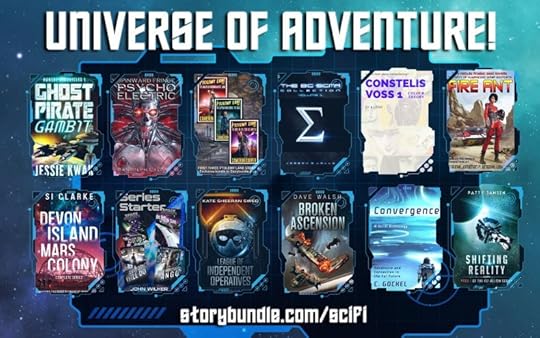 Universe of Adventure
There’s a whole Universe of Adventure waiting for you over at StoryBundle with the latest science fiction bundle, Universe of Adventure.
It’s curated by John Wilker and myself, and features twelves of the best indie authors pumping out that sweet, adventure-filled science fiction you crave.
Check Out Universe of Adventure on StoryBundleHere’s the lowdown from StoryBundle.
For StoryBundle, you decide what price you want to pay. For $5 (or more, if you’re feeling generous), you’ll get the basic bundle of four books in .epub format—WORLDWIDE.
Constelis Voss 1 by K. LeighGhost Pirate Gambit by Jessie KwakBroken Ascension by Dave WalshConvergence by C. GockelIf you pay at least the bonus price of just $20, you get all four of the regular books, plus 8 more books, for a total of 12!
Ptolemy Lane 1-3 by Cameron Cooper (StoryBundle Exclusive)Devon Island Mars Colony by Si ClarkePsycho Electric by Randolph LalondeShifting Reality by Patty JansenLeague of Independent Operatives – Books 1-3 by Kate Sheeran SwedThe Big Sigma Collection Vol. 1 – Enhanced by Joseph R. LalloFire Ant by Jonathan P. BrazeeSpace Rogues 1-2 & Grand Human Empire 1-2 by John Wilker (StoryBundle Exclusive)This bundle is available only for a limited time via http://www.storybundle.com. It allows easy reading on computers, smartphones, and tablets as well as Kindle and other ereaders via file transfer, email, and other methods. You get a DRM-free .epub for all books!
January 14, 2024
Review: The Saint of Bright Doors

So, I sped through this before it came out thanks to a galley copy I had, but I didn’t really ~get~ the full experience. I bought a copy and promised I’d get back to it.
Then I did.
There’s a lot in this book, and on a raw, surface level, the plot was good, albeit there was a point just past the middle during the imprisonment stuff where it got bit muddy and dragged. What you need to realize about this book is how deeply connected to the author’s home and Buddhism this really is. My first read, I uhh, didn’t pick up on some of it. The prose is lovely; the characters are interesting and the ideas work really well. Once you can start slotting in the characters into the story of Buddha, right down to Buddha’s abandoned son, named Rahula, or translates literally to “fetter.” You know, like a restraint. That was my first big clue that pointed me in the right direction, and everything else fell into place after that.
I’ll let you sift through the rest. It was a bold choice from the author, if not downright brave. It adds a ton to the story, but I firmly believe the story and book itself works on its own without making these connections.
All of this is interwoven with a lot of modern history. Pandemics, revolutions, state violence and oppression, it’s all there. Fetter’s existence is a strange one, trained from a young age by his mother to be a perfect weapon, but grows up to want nothing to do with the violence of his youth. He learns to come to terms with his upbringing while also hardening his own beliefs on liberation, love and destiny. All of it contrasted by his shadow, which his mother dislodged from him at a young age, but proves to be a strong allegory and ally throughout the story.
This is one of those books where you take away from it whatever you want to put into it. I’m glad there are books like this being released and authors like Vajra Chandrasekera writing these sorts of challenging books.
You should check it out and get a copy for your shelf.
January 10, 2024
To the Moon and How Narrative Belongs in Games

The videogame medium as a whole has a continual problem with the concept of narrative.
Early games were either devoid of narrative or kept the narratives so deceptively simple that there was no real reason to worry about them. Here’s a gorilla who kidnapped a princess, here’s a plumber jumping over barrels to save her. Go. RPGs came along and added more depth to the field, but along with that came a cavalcade of tropes and repetitive gameplay that fans became so reliant upon, that it took literal decades to move on from endless level grinds, although new RPGs have embraced the no frills of the newer type of action gameplay a la newer Final Fantasy installments, there are still nostalgic games that embrace that same grind that makes those game 100-plus-hour marathons with about ten hours of story stretched out into the aether.
Narratives in games have been an evolving situation, albeit that evolution is at a snail’s pace compared to the graphical and technical leaps within the industry. At this point, games like The Last of Us have become a standard for narrative excellence, although for folks like me, the ludonarrative dissonance is too strong to overlook. Playing a taut, heavily scripted narrative experience that’s immaculately animated, framed, acted and scored only to enter into disruptive gameplay segments where a character who frets about the morality of harming human beings then starts lobbing bricks and bullets at the heads of immaculately scripted baddies doesn’t work for me.
This gave rise to a subgenre of games called “walking simulators,” dubbed as such by HARDCORE GAMERZ who saw these more artistic games that didn’t focus on addictive gameplay loops or shooting mechanics, but instead something closer to film or prose-like pacing, but with using a videogame as the medium and delivery method as diminutive experiences. Yet, these games have endured, sometimes using simple, free or commercially inexpensive tools to make said games, with the focus on telling a great story, not bogging you down with skill trees or boss fights.
To the Moon is one such game, from way back in 2011, and a game I’ve put off playing for years for who knows what reason. I think it might be the intro with the two quirky scientists that threw me off, or how rough the actual game played while controlling them to get past the intro scene. But I finally sat down and played this game last week and was pleasantly surprised by it.
The conceit is simple: you control two scientists (although you pick the man or the woman as your main playable character) who work for a service that traverses the memories of a client, connecting their memories with strong found objects, then implanting an idea to help craft an end-of-life wish. In this case, they’re at the home of John, a dying widower who built a house on a cliff side right next to a lighthouse and has a house filled with origami rabbits.
You see, he wants to go to the moon.
The problem is, nothing in his memories point to having any strong connection with going to the moon and there’s a stopping point for these memories where he’s suppressed parts of his childhood. Traversing these memories, the doctors find a complicated relationship between John and his autistic wife, the same reason he built the house by the lighthouse, the person who created the rabbits, and the person he devoted his life to. Only his memories make things seem more fraught and complicated. In fact, John feels almost unlikable throughout parts of the story.
As the story unfolds, you learn more about these characters and this is one of those games where a lot of the minor details come back later to be much more meaningful. There are a few “gamey” segments where you’re dodging spikes or trying to navigate through a maze, which isn’t great, but a bulk of the game is walking around, watching these memories unfold and interacting with said memories.
The two doctors can be grating at times, but it all pays off nicely. This is very much a game built in RPG Maker, although later ports were built in Unity, and while there isn’t a lot of technical mastery over the medium, it’s perhaps one of the best actual stories I’ve ever experienced in a videogame to date. The same kind of punch that comes from playing a game like Dear Esther, Everybody’s Gone to the Rapture, Gone Home, Adios and other “walking simulator” type of games. What’s striking is that this is the kind of story that could technically be done through other mediums. This could easily have been a play or a film, but there are integral parts that are so uniquely built for the medium of games that even if gameplay takes a backseat to the narrative, it’s very much a videogame and very much worth your time.
December 27, 2023
Against the Day

It’s a book about light.
I’m going to need time to sit and think about this one. This was technically my third read-through, although I believe it’s my first time making it all the way through. I waited years so it would feel fresh again and I’m very, very glad that I did.
This isn’t the kind of book you consume, feel your feels in the moment and move on from. It’s the kind of book that you need to live in and allow time to digest. It’s a big, giant book about a ton of different things, but the through line is always light, be it bifurcated or not. If anything, this book is directly engaging with us, the readers, as well as our expectations, and the power of perception.
The Chums of Chance are what we get when we, the reader, gets our way and won’t let go of a children’s book, forcing them to undergo political consciousness and evolution, which leaves them, well… in a very strange, alien-like state by the end of the book, heading towards grace.
I might leave an actual review of this some day, but today is not that day. Or perhaps it is, and I’m just not allowing myself that specific grace. This book is something special. An evolution of a form, containing within it recognizable forms of “lesser” work, elevated through raw prose, imagination, and a form unto itself.
… Plus it’s really funny.
I can’t recommend this one enough. You should pick it up.
October 2, 2023
10.2.23
Boy, I haven’t posted on here in a while, eh?
Sorry about that. I’m not great at this regular blogging thing sometimes. In some ways, I operate best when spitting out big ideas before going into hibernation.
After months of work, I finally began querying for a new book I’ve written, which makes the second this year. I’m not feeling entirely confident in it as it’s such a strange, demoralizing process, but I believe in this book and feel it deserves the widest potential audience.
August 1, 2023
August Newsletter – Just Another Step Forward
Type your email…
Subscribe
July 21, 2023
Book Review: Silver Nitrate by Silvia Moreno-Garcia

There’s always that sense of excitement when Silvia Moreno-Garcia has a new book coming out. In part, it’s because you know you’re in for something that has her signature style, but will not be retreading on territory covered in previous books. For the most part.
Silver Nitrate is a marvelous supernatural book set in Mexico in the 80s, focusing on their film and television industry. We follow Montserrat, an audio editor for a local film house, and Tristan, a disgraced telenovela star who’s scarred up face has him doing voiceover work instead of being the leading man he was. Their shared love of campy horror flicks and a chance encounter with a retired local horror director, Abel, leads them down a dark path of helping him complete one of his lost films that’s kept on rare (and volatile) silver nitrate stock.
Of course, Abel was working on the film with a former Nazi occultist who’d embedded spells in the film, and his untimely death left the spell chain broken, which Abel felt led to the end of his career and a string of bad luck. When Montserrat and Tristan promise to help finish by providing voiceover for the film and help complete the spells, their luck changes for a brief period before, well… as one of Abel’s former friends Jose puts it, they set off a magical nuclear bomb and played right into that Nazi’s hands of looking for immortality.
There’s a lot of love put into this novel, with a focus on old horror flicks and Mexico’s film scene and tons of occult stuff. Lots of research went into making sure everything felt right, and it shows. Much like Velvet Was the Night, this book is dripping with style, tension and is a joy to read. I found myself not reading too much at a time for the explicit purpose of not wanting to finish it too quickly, which is always a good sign.
Moreno-Garcia has a rare talent for making immensely readable books that still pack deep thematic elements for those willing to look beyond the well-crafted plots. Her books tend to have a strong focus on setting and effortlessly give you a feel for where it’s taking place, along with the characters. You may not get lost in her prose or references, but these books are always grounded and a great read.
I’ll always recommend her work strongly, this book included.