
Lance Fortnow's Blog, page 7
April 27, 2025
A personal view of the NSF hot mess: My REU program
------------------------------------------------
Lance (see here, here) and Scott (see here, here) have commented on the hot mess at the NSF. (ADDED: Funding has gotten worse, see this blog post by Lance, this post by Scott and this other post by Scott. If you want a break from all this bad news see this blog post by Scott.)
I agree with their posts and do not have anything to add about the general situation.
Hence I give you a personal view. While not as important as the general problem, what is happening to me may be considered one of many canaries in the coal mines. (Do my readers know that expression and where it came from? If not then see here.)
Random points about my NSF-REU grant.
1) I got my REU grant, REU-CAAR (Combinatorics and AI for Real problems--that's not what it stood for then but its what it stands for now) in 2013 for 2013-14-15. (To see what REU grants are either go to my post about them here or goto my current website about it here.)
2) It has been renewed for 2016-17-18 and 2019-2020-2021 and 2022-2023-2024 and 2025-26-27. The last one with a caveat.
3) In all but the last one, being recommended for a grant was equivalent to getting the funding. But for the 2025-2026-2027 I have not seen a dime and I assume I will not get funding in time for a Summer 2025 program to be run normally. (ADDED: I was correct on this.)
4) I am running the program anyway- mostly local students (don't need housing) who don't need stipends. There may be a little (not much) money for a few stipends, from other sources. ADDED: Here is a list of approaches people who have been promised money but haven't gotten it are doing
a) Run a program with very little money and have the students come WITHOUT stipend, WITHOUT housing, WITHOUT transportation, WITHOUT food. Mostly local students. The program can still run but is against the whole point of REU grants which is broadening of students and giving students from non-research schools a chance to do research. (Only 3 of my students are from Non Research Schools. Another 4 are from High Schools, so not sure how that counts for this.) One odd pro: In my case I have 25 students- I can make more offers since I am not paying anything.
b) Run a program with some money you have lying around. You may decide to give stipends but NOT housing.You may (like approach (a)) hence take mostly local students. But all students get stipends.
c) You assume you will get money by (say) May 15). So you take applicants, accept and reject as appropriate. PRO-if the money comes in, you run a normal program. CON- you may end up cancelling in (say) Mid May leaving students in the lurch.
d) Do not begin trying to run a program UNTIL you get funding. If you get funded late then run a small program of mostly local students.
e) There are probably other approaches or combinations of the above.
5) I've heard that the reason I won't see money in time is NOT that REU grants are DEI but because of the staff cuts at NSF make it harder to get funds out the door.
6) Will I get funded in time for 2026? I'd be surprised either way. Is it possible for both A and NOT(A) to be surprising? I'll make that an REU project in 2026 if I get funded by then. 7) One of the original motivations for the REU program was to give students at non-research schools a chance to do research. Hence I use comes from a non-research school as a non-merit criteria. Is using that criteria DEI? I doubt Elon has thought that through.
8) Another non-merit criteria I use is how many students want to work on which projects. For example, if 10 very qualified applicants want to work on Ramsey Theory, I can't take all of them. I urge the applicants to specify at least 3 projects they are happy to work on, though many do not do that. Is using the distribution of projects, a non-merit criteria, DEI? I doubt Elon has thought that through.
9) Another non-merit criteria I use is veterans. It is rare that a veteran applies to my program, but it does happen and they get a preference (we've had 3 veterans). Is that non-merit criteria DEI? I doubt Elon has thought that through.
10) One of the things that made America great in the past was our scientific achievement. Hence we need a president who wants to Make America Great Again. We can abbreviate that to MAGA.
11) A good Popperian scientist would STUDY the NSF (and other programs) SEE what is wasteful and what is not and ACCEPT what they find. Had they done this it would have lead to some minimal changes at the NSF and the NIH and other organizations. But instead they just asserted that the NSF and NIH waste money. (Spellcheck thinks that Popperian is not a word. Oh well. For those who don't know what that means, see Karl Popper's Wikipedia entry here.)
12) Is the overhead on grants too high? That is a fair question to ask. But cutting overhead from 50% to 15% overnight is disruptive and does not get into the issue of how high overhead should be.
13) Will industry step in and fund research? I doubt it will be enough.


April 23, 2025
Real People
Right after the election I wrote a post predicting what would happen to higher education under Trump, most of which is coming true, but I had a massive failure of imagination missing the direct attacks on major universities. I won't detail all the challenges to higher ed, which change daily with every new executive order and court ruling. The Chronicle has a good tracker of these changes.
But often lost in all the news are the actual people who aren't making the news hurt by these actions, through no fault of their own: A student who had his visa cancelled while out of the country so he can't get back in. PhD students who just lost their funding when their advisor's grant was cancelled. A postdoc in a similar situation just months before he starts an academic job. A young faculty member who had to hold off submitting a Career award proposal until a TRO restored the indirect cost. A recently tenured professor at a good US university interviewing outside of the country. Potential students in other countries trying to decide if they should still go to school and build a life in the US.
The number of people, grants and universities affected is still on the low end, nearly all students continue to study, graduate and work without any problems, and many universities have offered legal and financial support to affected students and faculty. In my humble opinion, the strong educational opportunities inside the US still greatly exceed those outside. Universities have weathered many challenges before: McCarthyism in the 50s, campus occupations and protests in the 60s, and budget challenges from the great depression, to the fiscal crisis and covid. Trump's time as president has an end date and we'll get through all of this, but it requires all of us to push back and remind the administration and the public about the important role our universities play in the health of the country.
And as much as it pains me to say this as a Cornell alum, I'm rooting for Harvard.
April 16, 2025
Eisenhower's Farewell Address
I'm short on time time this week so I thought it would be good to look back, some 64 years ago, to Dwight Eisenhower's farewell address. It calls for balance between the industrial-military Complex and the scientific-technological elite. While written for a different time, it's well worth taking the time to watch or read the full speech and think what is says about today's complex world.
Dwight D. Eisenhower — FarewellAddressThe White House,January 17, 1961
I. The American ExperienceGood evening, my fellow Americans.
First, I should like to express my gratitude to the radioand television networks for the opportunities they have given me over the yearsto bring reports and messages to our nation.
My special thanks go to them for the opportunity ofaddressing you this evening.
Three days from now, after half a century in the service ofour country, I shall lay down the responsibilities of office as, in traditionaland solemn ceremony, the authority of the Presidency is vested in my successor.
This evening I come to you with a message of leave-takingand farewell, and to share a few final thoughts with you, my countrymen.
Like every other citizen, I wish the new President, and allwho will labor with him, Godspeed. I pray that the coming years will be blessedwith peace and prosperity for all.
Our people expect their President and the Congress to findessential agreement on issues of great moment — the wise resolution of whichwill better shape the future of the nation.
My own relations with the Congress, which began on a basisof mutual confidence and ended on the same note, have been throughout marked bya spirit of co-operation. In the councils of government, we must guard againstthe acquisition of unwarranted influence, whether sought or unsought, by themilitary-industrial complex.
The potential for the disastrous rise of misplaced powerexists and will persist.
We must never let the weight of this combination endangerour liberties or democratic processes.
We should take nothing for granted.
Only an alert and knowledgeable citizenry can compel theproper meshing of the huge industrial and military machinery of defense withour peaceful methods and goals, so that security and liberty may prospertogether.
II. The Balance in GovernmentAkin to, and largely responsible for the sweeping changes inour industrial-military posture, has been the technological revolution duringrecent decades.
In this revolution, research has become central; it alsobecomes more formalized, complex, and costly.
A steadily increasing share is conducted for, by, or at thedirection of the Federal government.
Today, the solitary inventor, tinkering in his shop, hasbeen overshadowed by task forces of scientists in laboratories and testingfields.
In the same fashion, the free university, historically thefountainhead of free ideas and scientific discovery, has experienced arevolution in the conduct of research.
Partly because of the huge costs involved, a governmentcontract becomes virtually a substitute for intellectual curiosity.
The prospect of domination of the nation’s scholars byFederal employment, project allocations, and the power of money is ever present— and is gravely to be regarded.
Yet, in holding scientific research and discovery inrespect, as we should, we must also be alert to the equal and opposite dangerthat public policy could itself become the captive of ascientific-technological elite.
It is the task of statesmanship to mold, to balance, and tointegrate these and other forces, new and old, within the principles of ourdemocratic system — ever aiming toward the supreme goals of our free society.
III. Peace and ResponsibilityAnother factor in maintaining balance involves the elementof time.
As we peer into society’s future, we — you and I, and ourgovernment — must avoid the impulse to live only for today, plundering for ourown ease and convenience the precious resources of tomorrow.
We cannot mortgage the material assets of our grandchildrenwithout risking the loss also of their political and spiritual heritage.
We want democracy to survive for all generations to come,not to become the insolvent phantom of tomorrow.
Down the long lane of the history yet to be written, Americaknows that this world of ours, ever growing smaller, must avoid becoming acommunity of dreadful fear and hate, and be, instead, a proud confederation ofmutual trust and respect.
Such a confederation must be one of equals. The weakest mustcome to the conference table with the same confidence as do we, protected as weare by our moral, economic, and military strength.
That table, though scarred by many past frustrations, cannotbe abandoned for the certain agony of the battlefield.
Disarmament, with mutual honor and confidence, is acontinuing imperative.
Together we must learn how to compose differences, not witharms, but with intellect and decent purpose.
Because this need is so sharp and apparent, I confess that Ilay down my official responsibilities in this field with a definite sense ofdisappointment.
As one who has witnessed the horror and the lingeringsadness of war — as one who knows that another war could utterly destroy thiscivilization which has been so slowly and painfully built over thousands ofyears — I wish I could say tonight that a lasting peace is in sight.
Happily, I can say that war has been avoided.
Steady progress toward our ultimate goal has been made.
But so much remains to be done.
As a private citizen, I shall never cease to do what littleI can to help the world advance along that road.
IV. Final ThoughtsSo — in this my last good night to you as your President — Ithank you for the many opportunities you have given me for public service inwar and peace.
I trust that in that service you find some things worthy; asfor the rest of it, I know you will find ways to improve performance in thefuture.
You and I — my fellow citizens — need to be strong in ourfaith that all nations, under God, will reach the goal of peace with justice.
May we be ever unswerving in devotion to principle,confident but humble with power, diligent in pursuit of the nation’s greatgoals.
To all the peoples of the world, I once more give expressionto America’s prayerful and continuing aspiration:
We pray that peoples of all faiths, all races, all nations,may have their great human needs satisfied — that those now denied opportunityshall come to enjoy it to the full — that all who yearn for freedom mayexperience its spiritual blessings.
Those who have freedom will understand, also, its heavyresponsibilities — that all who are insensitive to the needs of others willlearn charity — that the scourges of poverty, disease and ignorance will bemade to disappear from the earth, and that, in the goodness of time, allpeoples will come to live together in a peace guaranteed by the binding forceof mutual respect and love.
Now, on Friday noon, I am to become a private citizen. I amproud to do so. I look forward to it.
Thank you, and good night.
April 14, 2025
I want an application of this application of Ramsey Theory to Semigroups
I recently read the following theorem
Def: A semigroup is a pair \((G,*)\) where \(G\) is a set and * is a binary operation on \(G\) such that * is associative. NOTE: we do not require an identity element, we do not require inverses, we do not require commutative. We DO require that G is closed under *.
Theorem: Let (G,*) be a finite semigroup. There exists x in G such that \(x*x=x\).
Proof: Let \(x_1,x_2,\ldots,x_r\) be a sequence of elements of G (repetition is allowed---indeed required since we will need \( r >|G| \).) Let \(r\) be such that any |G|-coloring of \(K_r\) has a mono triangle.
Such an \( r\) exists by Ramsey's Theorem \((|G| \) colors, seek mono \(K_3\)).
Consider the following coloring: for \(i<j\), \(COL(i,j) = x_i* \cdots* x_{j-1} \).
By the choice of \(r\) there exists \(i<j<k\) such that
\(x_i* \cdots * x_{j-1} = x_j *\cdots *x_{k-1} = x_i* \cdots *x_{k-1} \). We call this \(x\).
Since \(x_i *\cdots * x_{k-1} = x_i *\cdots *x_{j-1} * x_j \cdots *x_{k-1}\) we have \(x*x=x\).
End of Proof
Great! Lets find some semigroups to apply this to.
1) If G has an identity element \(e\) then the Theorem is trivial, take \(x=e\). So we seek a semigroup without identity.
2) Can't we just take a group and remove its identity element? No- then it won't be closed under *.
3) Can't we just take the set of N that are \ge 1, under addition. No good- that's infinite. Note that the theorem does not hold there.
4) Can't we just google. I kept getting infinite examples or being told that I can ADD the identity to a semigroup to get an identity.
5) Can't we just ask AI. I used Claude which gave me a trivial 2-element example. I then asked for an example with more than 10 elements. It DID give me one:
\(G=\{1,\ldots,12\} \)
\(x*y=\min\{x,y,10\}\)
For this semigroup (and similar one) the theorem is trivial since \(\forall x\le 10, x*x=x\).
I asked Claude for an example with more than 10 elements that does not use MIN and it said
Due to capacity constraints NO CAN DO.
6) SO what I really want is the following:
Give me a FINITE semigroup G WITHOUT identity for which the statement
is there an \(x\) with \(x*x=x\)
is not obviously true- so that the Theorem above is interesting.
April 9, 2025
Why Can't We Break Cryptography?
In the recent Signalgate scandal, several senior Trump administration appointees used the Signal app on their phones to discuss an attack on the Houthis. People discussed the risk of the phones being compromised or human factors, such as adding a prominent journalist to the group chat by mistake. But mostly no one had concerns about the cryptography itself on this widely-available app.
It wasn't always this way--cryptography used to be a cat and mouse game, most notably the breaking of the German Enigma machine dramatized in the movie The Imitation Game. Then Diffie and Hellman in their classic 1976 paper stated
Theoretical developments in information theory and computer science show promise of providing provably secure cryptosystems, changing this ancient art into a science.
And in recent memory we've had several successful cybersecurity attacks, but never because the encryption was broken.
We've made incredible progress in solving problems once thought unsolvable, including language translation, chess, go, protein folding and traveling salesman. We have great SAT and Mixed-Integer Programming algorithms. We've blown through the Turing test. None of these algorithms work all of the time but no longer do hard problems seem so hard. Yet cryptography remains secure. Why? How did we get to this Optiland, where only the problems we want to be hard are hard? Quantum computers, if we have them can attack some cryptographic protocols, but we're a very long way from having those capabilities.
My latest theory involves compression. Machine learning works by finding a representation of a function in a neural net or other form that gives an imperfect compressed version of that function, removing the random components to reveal the structure inside. You get a smaller representation that, through Occam's Razor, is a hopefully mostly accurate version of that data. For example, we learn the representation of a Go player by training a neural net by having the computer play itself over and over again.
Cryptography is designed to look completely random. No compression. If you remove the randomness you have nothing left. And thus modern algorithms have no hook to attack it.
This is just the beginnings of a theory. I don't have a good formalization and certainly not even the right questions to ask of it.
So to me it's still a big mystery and one that deserves more thought, if we really want to understand computational complexity in the world we actually live in.
April 6, 2025
I was invited to a Nutrition conference. Why?
From November of 2024 to March of 2025 I have gotten email inviting me to speak at conferences and/or submit to journals in the following topics:
NOT EVEN CLOSE TO MY FIELD:
Addiction Medicine, Behavioral Health and Psychiatry.
Looking forward to your involvement and your invaluable contributions.
Possible reason for the invite: My name is Bill and I am a chocoholic.
Infections Diseases
Your exceptional expertise in the field of infections diseases aligns perfectly with our conference focus.
Possible reason for the invite: I had a mild case of COVID two years ago. (I suspect most of my readers did. Did you also get an invite?)
Vaccines
We eagerly anticipate your participation and the invaluable perspective you will bring to the event. As a first step we kindly request the title of your presentation.
Clearly they want me to talk about using Schur's Theorem and FLT (n=3 case) to show that the primes are infinite. Why that one? All of my papers are tied for relevance to vaccines.
Possible reason for the invite: I have gotten both the flu vaccine and the COVID vaccine.
Nutrition
We are excited to extend an invitation for you to join us as a distinguished speaker on your field since you have expertise in the field of nutrition.
Possible reason for the invite: I take a Vitamin D pill every morning.
Pharmacy
We are excited to extend an invitation for you to join us as a distinguished speaker on your field since you have expertise in the field of pharmacy.
(Identical wording to the Nutrition invite.)
Possible reason for the invite: My wife's first degree was in Pharmacy and they got confused. They were very confused since she got the degree under her maiden name.
Drug R+D
We are pleased to offer two nights of accommodations at the venue hotel. (I am skeptical of that)
Possible reason for the invite: I watched Breaking Bad and blogged about it here and .
Aquaculture and Fisheries
We are thrilled to invite you as a Speaker. Your exceptional expertise in the field of aquaculture aligns perfectly with our conference focus. (The wording is a mashup of the wordings in other invites.)
Possible reason for the invite: I am a pescatarian.
Env and Earth, medical sciences, and immuotherapy
This email did one smart thing and one dumb thing. Smart: listing three areas so maybe they will get lucky. Dumb is the following sentence which proves they are a scam (not that proof is needed):
Your publication ``On the sizes of DPDAs, PDAs, LBAs" has caught our attention. We believe your expertise would greatly enrich our journal's focus on these rapidly evolving areas.
That is indeed a paper I wrote, with Richard Beigel (I wonder if he also got an invite). Its here. I am very happy with that paper; however, its applications to Environmental Science, Earth Science, Medical Science, or Immunothearpy are .... limited. To be fair, it has been said that Math done for its own sake often has applications that the author did not foresee. So I look forward to lower bounds on the sizes of DPDA's being the key to solving global warming.
Possible reason for the invite: I live on the Earth.
Linguistics
Your publication ``On the sizes of DPDAs, PDAs, LBAs" has caught our attention. We believe your expertise would greatly enrich our journal's focus on these rapidly evolving areas.
The astute reader may notice that this is identical to what the Env-Earth-Med-Imm people send and wonder if I made a mistake with cutting-and-pasting. A fair question, indeed it would be the null hypothesis, but no--the ``linguistics'' and the ``E-E-M'' people are using the same script.
Apparently linguists are also impressed with my publication on the size of DPDAs, PDAs, LBAs. This makes more sense since CFGs and PDAs are equivalent. NO IT DOESN'T"T. I don't think linguists have cared about CFGs for a long time.
Possible reason for the invite: Aside from my paper with Richard Beigel on lower bounds for whatnot, I also had at one time a paper with Lance about the size of CFGs for {w} that attracted some attention from an AI journal that would give us a discount on page costs (we declined their kind offer). See here
Modern Management
Impressed by your research On the size of DPDAs, PDA, LBAs I cordially invite you to share your new research findings for presentation at the INSERT NAME OF CONFERENCE on Modern Management.
How do I know this is a scam? Because the paper appeared in 2015 and they are calling it `new.' Also, they forgot to cut and paste the actual name of the conference.
Why has my PDA lower bounds paper gotten so much attention? I do not know. I assume someone pointed to it and others happen to find it. Or perhaps the paper has more applications than I thought.
Possible reason for the invite (not including my brilliant work on the sizes of devices): The conference is on Modern Management. I have manged my REU-CAAR grant since 2013. That includes managing it through COVID and through Elon.
Diabetes
We are excited to extend an invitation for you to join us as a distinguished Speaker at the INSERT NAME OF CONFERENCE Your expertise in the field of Diabetes, making you an an excellent
(Very similar to Nutrition and Pharmacy. The last sentence IS as it was in the email- it is incomplete and does not have a period.)
Both Modern Management and Diabetes need to up their game--leaving in `INSERT NAME' is just incompetent.
Possible reason for the invite: My work on Muffin Mathematics (see here).
LNG
Greetings to you,
I hope this message finds you well.
I would like to explore the possibility of collaborating with you on an LNG project. Would you be available to discuss this opportunity further?
Looking forward to your response.
At first I thought it was LLM and it might be a HS student who wants to work with me in AI. Then I noticed it was LNG which is Liquid Natural Gas.
Possible reason for the invite: Since Darling drives and I don't, I pump the gas.
Social Science and Business
A journal on these two topics together emailed me that they exist but wisely made no claim that I am an expert in the field. So they may be legit.
Possible reason for the invite: The royalties on my muffin book are less than the cost of buying muffins for the audience whenever I give a talk on it. This is either a counterexample of how to run a business or a clever way to avoid taxes. Either way, it could be an article in their fine journal.
CLOSE BUT NO CIGAR (That's an old phrase. Younger readers- have you heard that expression before? I was curious so I decided to run it up the flagpole and see who salutes.)
Numerical Analysis
It is a great pleasure to invite you to organize a Symposiums on your research subject.
Possible reason for the invite: I took a course on Numerical Analysis in 1978 and got an A.
Fuzzy Systems
We bring together global experts. (Am I one of them?)
Possible reason for the invite: I teach Freshman Discrete Math so I have seen many fuzzy proofs.
Nanotechnology
We are thrilled to invite you to be part of our prestigious event.
Possible reason for the invite: They got vaccinated for COVID and the nanotech in their vaccine, put there by the other Bill G, made them invite this Bill G.
Optics
We are thrilled to invite you to be part of our prestigious event
(Identical wording to the invite for Nanotechnology.)
Possible reason for the invite: I wear glasses.
Systemics, Cybernetics, and Informatics
We invite you to submit a paper and/or organize a workshop in Systemics, Cybernetic, or Informatics [ Wow! I didn't know I was a big shot in Systemics. I don't even know what that is.]
Possible reason for the invite: I use email.
Quantum
Based on your research interests we would like to invite you to consider NAME OF JOURNAL OMITTED for the publication of your next article if accepted after peer review.
I have one article that has the word quantum in the title, see here. I am working on a slide-packet with a colleague on quantum entanglement and the CHSH game (ah- my wife had conjectured that math games are not fun games, see here, here, here, perhaps her conjecture should be extended to Physics). I've also had some blog posts about quantum computing.
The paper is public. The slide-packet is not, though its hard to know whats public nowadays (see here). However I really doubt my paper or my slide packet is why I got the invite. And I doubt my quantum computing posts indicate that I know any quantum computing (this is not self-deprecating- my posts are more about non-tech aspects, for example see here).
Might be legit: They didn't praise my work in quantum.
Might not be legit: The quote from the email I have above is so generic that I could easily have gotten (and probably have) an email with the exact same wording asking me to submit to a journal on (say) Fluid Mechanics. Also, as noted, I don't work in quantum.
Possible reason for the invite: Uncertain.
Fabrication, circuits, etc.
We are hiring tenure-track faculty in device and fabrication, circuits, architecture, and systems, and EDA areas with highly competitive salaries in the world and cutting-edge research facilities. I'd appreciates you recommending your students to us. [They then gave two links to check out, which I of course did not do.]
Not my area (what does EDA stand for?) but it is plausible that I have students in my classes who would be interested. Even so, I won't be passing this on.
Possible reason for the invite: I got an A in a hardware course in 1977.
Mobile Applications
We have gone through your prior article entitled ''Finding Large Sets Without Arithmetic Progressions of Length three: An Empirical View and Survey II" [Really? You may be the first ones to read it.] We thought it was extremely well written [Really?]. It with excellent pleasure [is that really a phrase `excellent pleasure'?] that we extend an invitation In connection with your to contribute any article of your choosing to our esteemed journal. Your involvement would undoubtedly enhance the value of our publication.
You may be thinking `Bill left out a period between `invitation' and `I' . - Actually, they left it out.
Only the heading of the email says `Mobile Applications'
Later they refer to Journal of International Journal of ...
for their esteemed journal.
Possible reason for the invite: This was send to me my mistake. It was meant to be send to a puzzle column where the reader is asked to spot 10 things wrong with the paragraph.
Not Sure What The Field Is
I am the editor at [Insert Name of Journal]. We are currently seeking high-qualify manuscript for our upcoming issue, and would like to invite you to submit your work for consideration. [The word `qualify' is not a typo on my part, its what they had. It is probably a typo on their part.]
The email actually had in it the wording [insert name of journal]. This indicates that this is a generic email where they forgot to put in the name. The only reason it might not be a scam is that they didn't call me an expert or anything of the sort.
Possible reason for the invite: [Insert Reason]
Not Sure WTF
Since your published paper ``Review of `What Can Be Computed?' '' has been widely recognized, [really?] we welcome your submission of original research on hot topics [Is Ramsey Theory on Ordered Sets a Hot Topic?] in your specialized of interested fields [does that last part make sense in English?].
Possible reason for the invite: They were impressed with a book review. Some people are easy to impress. Are you? The review is in this column here so you can judge for yourself.
WHY ALL THE INVITES?
1) I suspect that most (all?) of them are some sort of scam. I end up paying a conference fee or page costs or something. But is that really a scam? If I know exactly what I am getting--- a line on my resume--- and I know its a no-quality conference or journal, then its not a not a scam. On the other hand, I don't think an article in Pharmacy will help my resume.
2) Perhaps it is easier to email Everyone than trying to figure out whose a Math person, whose a Nutrition person, etc.
3) The UPSIDE of emailing EVERYONE is that they cast a wide net and might get someone who they didn't think of.
4) The DOWNSIDE of emailing EVERYONE is... THERE IS NO DOWNSIDE. Email is free, and its not as though emailing ME will make me respect the conference on optics any less -- or more accurate to say that my negative opinion of these venues will not harm them.
5) There is a harm to society. I delete so many emails without looking at them carefully that I might delete something I do care about. Has this happened? Not that I know of-- but I wouldn't know.
6) I normally delete all such emails; however, I kept all those that came in November 2024, Dec 2024, and Jan 2025, and wrote the post. Then I got a few more in Feb and added to the post. Then one in March so I added that one to the post. I thought it best to post this before I get even more. I could do a statistical study of all of these emails and write a really bad article. Maybe a Nutrition Journal will publish it.
April 1, 2025
PDQ Shor (?-2025)
 PDQ Shor
PDQ Shor, Peter Shor's smarter brother, passed away last week. PDQ was a Physicist/Computer Scientist/Mathematician/Astrologer/Psychic at the University of Northern South Dakota in Wakpala.
Dr. Phineas Dominic Quincy Shor III, PhD, MBA, BLT, received his education at Europa U. during one of his many alien abductions. He ended up in South Dakota after having fled every other state.
He was most famous for the concept of unnatural proofs, collected in his anthology Proofs from the Other Book, which includes his classic "interpretive dance proof" of the Pythagorean theorem. Critics complain the proof only handles the case where the right angle is on the left.
His follow up book, Proofs from the Crypt, contains his masterpiece, a 1237 page proof that conclusively shows that the empty set contains no irrational numbers.
Like his brother he's moved to the quantum space, reverse engineering Peter's work by giving a doubly exponential time quantum algorithm for multiplying numbers. He created the innovative dipping bird quantum error collection machine that constantly monitors a quantum machine collapsing all entanglement. Apple bought the device for $327 million which immediately destroyed their plans for a QiPhone.PDQ used the proceeds to create the perpetual Turing machine, guaranteed to never halt. Until it did.
Sadly PDQ passed away from paranormal causes last week. Or was it last year? No one is quite sure. He donated his body to pseudoscience, currently lying in state in an undisclosed state. We hardly knew you.
With apologies to Peter Schickele. This April Fools post was inspired by the complexity class PDQMA.
March 29, 2025
Survey's are done stupidly/A stupid question from a survey
I have often began taking a survey and quit in the middle. Why?
1) It goes on to long. When I told the surveyors that he may get more people quitting for that reason so he should make it shorter he said, rather rudely, that he is an expert on surveys and they need to ask this many questions to calibrate things properly. I tried to engage him in an intelligent conversation about the tradeoff: the longer it is the better the info, but less people fill it out, so what is the optimal point? He told me I was an idiot. Well... that's not going to encourage me to fill out his survey.
2) It asks questions that are too personal.
3) It asks questions that seem irrelevant to me for their purpose (to be fair, perhaps I do not know the real purpose)
4) They ask a really stupid question. Here is the stupidest I've seen:
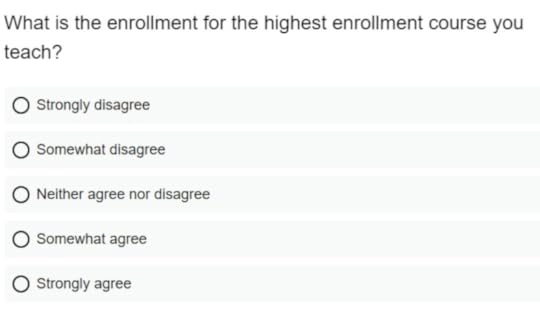
Challenge: Have you ever seen a stupider question?
As always, I ask non rhetorically.
March 26, 2025
What Happened to MOOCS?
In 2012 I wrote a blog post about the growing influence of Massively Open Online Courses, or MOOCs.
John Hennessey, president of Stanford, gave the CRA keynote address arguing that MOOCs will save universities. He puts the untenable costs of universities at personnel costs (faculty salaries) are making colleges unaffordable (not sure I fully agree). He argued that MOOCs will help teach courses more effectively. The hidden subtext: fewer professors and probably fewer universities, or as someone joked, we'll all be branch campuses of Stanford.
I ended the post "MOOCs may completely change higher education in America and around the world. Or they won't." A reader asked "Wondering what are you takes about MOOCS now?". Good question.
If you want a detailed answer I had chatty put together a deep research report. Here's my take, mostly from the US computing perspective. The term MOOC is rarely used anymore, but we have seen tremendous growth in online courses and degrees, particularly in Masters programs.
We've seen some major successes, most notably the Georgia Tech Online Masters of Science in Computer Science program that we started in 2014. By we, I mostly mean then-dean Zvi Galil's tenacity to make it happen. Zvi made the right moves (after some pushing), getting faculty buy-in, strong incentives for faculty participation, putting significant resources for course development, a very low-cost degree and most importantly insisting that we have the same if not better quality than our on-campus offerings. The program grew tremendously reaching about 10,000 students by 2020. Georgia Tech had to add a new graduation ceremony for students who finished the degree remotely but traveled to campus for graduation.
We've seen a plethora of new programs. Most domestic students can get a good computing masters degree at a fraction of a cost of an in-person program. On-campus Masters program in computing are now almost entirely international for on-campus programs can deliver something an on-line course cannot: A visa, and a chance to build a life in the United States.
These new programs vary quite a bit in quality, some truly strong, others less so. Some are outright misleading, making a deal with a university to use their name but otherwise having no connection to the school's faculty or academic departments. These programs often feature 'professional certificates' marketed under university branding but are actually developed and administered by third-party education companies.
While we learned to teach everything online during the pandemic, on-line degrees don't work as well for bachelor degrees where the on-campus experience almost matters more than the courses, or for research-intensive PhD programs.
We are not all branch campuses of Stanford but the story isn't done. Colleges continue to have financial challenges, artificial intelligence will continue to play new roles in education, not to mention the recent actions of the Trump administration. Hopefully MOOCs won't be the only thing surviving.
March 23, 2025
Recording lectures? Posting the Recordings? Using Slides?
The issue of whether to record lectures or post slides or more generally how much material to give to the students is a new question (the last 20 years?) but I do have an anecdote from 1978.
I was taking an applied math course on Mathematical Modelling from James C Frauenthal (He would sometimes write his initials \(\binom{J}{F}\)) and he passed out his notes ahead of time. I think I was the only student who read them ahead of time. One time I had read the following passage ahead of time:
We have been somewhat cavalier in our assumptions.
During class he said
What is wrong with this mathematical model?
I replied
We have been somewhat cavalier in our assumptions.
He was somewhat surprised, but pleased that someone was reading his notes.
FAST FORWARD TO MODERN DAY.
How much material should we make available for our students? I post slides and recordings.
PRO: If a student misses class they can catch up. Especially good if missing class is rare.
PRO: If a student is in class then they can go back to some point they were confused on.
PRO for slides: When asking a student when they began getting lost we can find the exact slide. This is much better than the word salad that students sometimes emit when describing where they are lost.
BILL: So you understood the definition of P. So you were lost when I defined NP?
STUDENT: No, I got lost when you described some kind of really exciting algorithm.
BILL: Exciting algorithm? What did it do?
STUDENT: You said it was a paradox.
BILL: This is a class in algorithms. We have not discussed any paradoxes.
STUDENT: Did so!
BILL: We can figure out what ails thee. What did the algorithm do?
STUDENT: Something about the whole being greater than the sum of its parts.
BILL: Parts! I think you mean that we solve sub parts and then put them together. This is the Dynamic Programming paradigm. OH- I think you confused paradigm and paradox.
STUDENT: That's exactly what I said. Dynamic means exciting! And paradox is just another name for paradigm.
Often it was hard to see where they got lost.
CON: Students may skip class and not go over the slides or recordings!
CON: The technology sometimes does not work.
BILL: You missed class and expect me to redo the lecture in my office. Did you watch the recording?
STUDENT: No. The recording did not work and its your fault!
BILL: The first day of class I said you should come to class for the following reasons
1) You can ask questions. The paradox is that's hard to do in a large class, but with so many student cutting class, its a small class!
2) Taking notes is a good way to solidify knowledge.
3) Going to class forces you to keep up.
4) The technology might not work. Last semester this happened four times. Twice it was my fault, and twice is was not my fault. But that does not matter- it will happen.
5) If you show up in my office hours and want me to explain what I lectured on I will be annoyed.
STUDENT: Uh,... I missed the first day.
CON: In the long term students get in the habit of not going to class. I can't tell if this is worse than it used to be.
CON for Slides: Its hard to be spontaneous. Some of the classrooms don't even have whiteboards to go off-script with. The following happened in the pre-slide days (apologies- I've told this story before on this blog) on April 25, 2003 in my Automata Theory class. I had already done decidability and was goin going to do r.e. sets.
STUDENT: Do you know whose 100th birthday it is today?
BILL: Will there be cake? If so will they let me eat cake?
STUDENT: Today is Kolmogorov's 100th birthday.
BILL: AH! I was going to do r.e. sets but instead I will do Kolmogorov Complexity!
STUDENT: Great! Uh. Maybe. Is it hard?
BILL: Its fun!
I then gave a lecture on Kolmogorov complexity on the fly, on the whiteboard. I made it part of the course and on the final I asked them to show that if w is a K-random string of length n then any context free grammar for {w} in Chomsky Normal Form requires at least \( n^{0.99} \) rules (this is not the strongest result possible).
This is impossible with slides. No more on-the-fly lectures.
CON for slides: Some proofs are impossible to do really do on slides. The Poly VDW theorem and the Kruskal Tree Theorem are two of them. Fortunately those are both in Ramsey Theory that has 30 students and a whiteboard, so for those lectures I use a white board.
PRO for slides: My handwriting isn't that good, so slides helps a great deal.
CAVEAT: I used to read a proof, write it out by hand, type it up in LaTeX, and then make slides. Now I go straight from reading it to slides. This is sometimes not a good idea as I am worrying about fonts and formatting before I really understand the proof. I recently went BACK to the handwritten notes THEN LaTeX THEN slides. That increased my understanding since (1) when doing the handwritten notes I was not distracted by fonts or formatting, and (2) at every iteration I picked up some subtle point I had missed.
CAVEAT: When teaching a large class you really can't use the whiteboard since the people in the people in the back row can't see. I don't know if that's an argument FOR slides or AGAINST large classes.
SO- what do you do: record, not record, slides, no slides.And why? And does it work?
Lance Fortnow's Blog

- Lance Fortnow's profile
- 4 followers

