Lance Fortnow's Blog, page 4
August 10, 2025
My Tom L post inspired a mathematical definition of Rabbithole
BILL: You call that a rabbit hole?! A while back I spent 3 hours reading questions and answers on quora ranging from is Michelle Obama actually a man? to Is Donald Trump the Anti-Christ? (The answer to both is no.) THATS a rabbithole. Listening to Tom L is not.
NICK: SO... what is and isn't a rabbit hole? Also, is it rabbithole or rabbit hole?
BILL: Spellcheck is happy with rabbithole, hence so am I. As to your question, we need a function \(f\) and a threshold \(T\) such that
if you spend \(x\) minutes on A, and
you get y enjoyment out of it, where \(0\le y\le 10\), and
\(f(x,y)\ge T\)
then A is a rabbithole.
(Note- I was kidding. There can't possibly be a function f that works.)
ONE DAY LATER
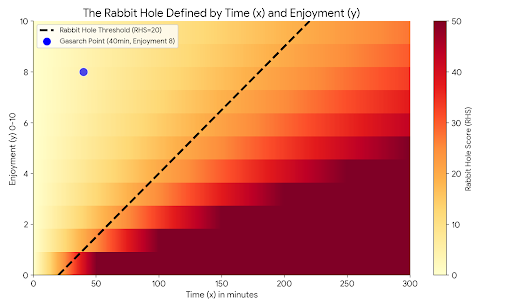
NICK: I asked Gemini what \(f\) and \(T\) are and it told me:
\(f(x,y) = \frac{x}{y+1} \) and
\(T=20\).
It also gave me some examples:
1) The Tom L. Example: 40 mins, 8/10 enjoyment. Score 4.44. NOT a Rabbit Hole!
2) Doomscrolling: 90 mins, 1/10 enjoyment. Score 45. Rabbit Hole!
3) Binge-Watching Mediocre TV: 3 hours (180 mins), 4/10 enjoyment. Score = 36. Rabbit Hole!
4) Incredible Documentary: 3 hours (180 mins), 9/10 enjoyment. 18. Worthwhile but its close.
Gemini also output a heatmap, see here.
BILL: Uh- I was only kidding.
NICK: Well, the jokes on you.


August 7, 2025
AI and ...
AI and Vacation
I'm back from my German vacation. This was my first AI vacation, by which I mean how I used AI to navigate a foreign country. Taking a picture of a hand-written menu board, not just to translate the dishes, but to get a description of each. Visiting a palace with a German-speaking tour guide and translating in real time. Even the more mundane taking pictures of buildings to learn about them.
On the TV I saw something about Künstliche Intelligenz, and Chatty told me it was German for Artificial Intelligence. The Germans use KI instead of AI partly because AI can be confused with Ei (egg). At least that's what AI tells me, so it must be true.
AI and Math
At the beginning of my vacation, Google announced that they achieved gold medal status in the International Mathematical Olympiad. An impressive achievement though Terry Tao makes a good point that comparing an AI system to a time-constrained high-school students is not an apples-to-apples comparison.
I already find talking to AI about math topics quite useful, though it's like talking to an early PhD student. Sometimes they just say things that aren't correct, but usually they are. The reasoning models are particularly good at finding holes in P v NP proofs. For example here's the conclusion of ChatGPT o3-pro's review of the paper from Eric's guest post.
The paper is a reminder that lower‑bound proofs live or die on the exact breadth of the algorithmic model they exclude—too narrow and the result is unsurprising, too broad and the proof tends to break. At present this work sits in the first category.
What I want to see is AI come up with a solution to an open math problem, a true new insight beyond just some optimized search. I'm not looking for P ≠ NP, just some result that would be publishable in a respectable conference or journal, even just a new completeness result. We haven't really seen that yet, but I suspect we will soon and then we can figure out where math goes from there.
AI and Bill
In his presidents question and solution, Bill states that AI had failed to find the right answer to his problem. Back in June, I saw Bill's draft post and tried AI to solve it.
AI initially failed the test but for a good reason. Bill's initial draft post had Ford and Dole in Group Two because they received LLBs instead of JDs. In the past the LLB was the professional law degree. Yale didn't change to JD until 1971. Ford got his LLB from Yale in 1941.
When I removed Ford and Dole, ChatGPT o3-pro correctly gave the reason for the partition, though it did take over 13 minutes.
Every name in Group One spent time in a law school—most completed a J.D. or LL.B., and the two exceptions (Al Gore and, in some accounts, Lloyd Bentsen) still enrolled in law studies.
examples – Walter Mondale (University of Minnesota Law) en.wikipedia.org,
JD Vance (Yale Law) en.wikipedia.org,
Al Gore (attended Vanderbilt Law) en.wikipedia.org.
No one in Group Two ever attended a law school; their highest formal education is in fields such as engineering (Jimmy Carter), economics (George H. W. Bush), business (Donald Trump), political science (Paul Ryan), or acting (Ronald Reagan) en.wikipedia.orgen.wikipedia.org.
So the distinguishing property is legal education: every Group One figure went to law school, while none in Group Two did.
Another commentor got a similar result for ChatGPT o4-mini-high. I just tried it on Gemini 2.5-Pro and it also gave the correct response, this time in seconds.
On the other hand, E tried several base models and none of them succeeded. The lesson: You want to solve a tricky problem, pony up the $20/month and use a reasoning model.
August 4, 2025
Some thoughts on journals, refereeing, and the P vs NP problem
A guest post by Eric Allender prompted by an (incorrect) P ≠ NP proof recently published in Springer Nature's Frontiers of Computer Science.
For a time, I served as Editor-in-Chief of ACM Transactions on Computation Theory, and in this role I had to deal regularly with submissions that claimed to resolve the P vs NP problem. Finding referees for these papers was sometimes challenging, so I frequently ended up reviewing them myself. Dealing with such submissions involves enough overhead that ToCT, J.ACM and ACM Transactions on Algorithms limit the frequency with which authors can submit work of this sort. But for every submission, on any topic, the overall process was the same: Find someone on the Editorial Board who has sufficient expertise to find referees and make knowledgeable use of their recommendations. If there was no such person on the Editorial Board, then it was always the case that the submission was out of scope for the journal.
These thoughts are brought to mind by a recent case, where it seems to me that the editorial process broke down.
Springer publishes several high-quality academic journals that deal with Theoretical Computer Science. One Springer journal, Frontiers of Computer Science, recently published an article entitled SAT Requires Exhaustive Search, where one of the authors is a Deputy Editor-in-Chief of the journal. The abstract of the article states that it proves a result that is stronger than P not equal to NP. The Editorial Board of the journal has some members who are expert in computational complexity theory. However, all the ones whom I know personally have asserted that they had no knowledge of this paper, and that they were not involved at all in handling the paper.
When Ryan Williams and I learned about the publication of this article, we drafted a comment, which we sent to the Editor-in-Chief. We recommended that the paper be retracted, in which case there would be no need to publish our comment. However, the Editor-in-Chief declined to retract the article, saying that he could find no evidence of misconduct, and thus we have been assured that an edited version of our comment will appear in the journal.
Our comment calls attention to some shortcomings in the proof of the main theorem (similar to shortcomings in several other failed attempts to separate P from NP). But we were able to say more. Often, when one is looking for bugs in a purported proof, one has to deal with the situation where the claimed theorem is probably true, and the only problem is that the proof is not convincing. However, the main theorem in their paper (Theorem 3.2) states that a particular constraint satisfaction problem requires time more than \(d^{cn}\) for any constant \(c<1\) (where \(d\) is the domain size, and \(n\) is the number of variables). In particular, their purported proof claims that this holds even when \(k=2\) (meaning that each constraint has at most 2 variables). However, Ryan Williams presented an algorithm more than two decades ago that runs in time \(O(d^{(0.8)n})\) in this special case, contradicting the lower bound claimed in the article.
The article contains an appendix, with glowing testimonies from various researchers; the lead-in to the appendix also contains enthusiastic comments from Gregory Chaitin. I contacted Gregory Chaitin, and he asserts that he did not read the paper, and that he was quoted out of context.
The edited version of the comment that Ryan Williams and I wrote, which will supposedly appear in Frontiers of Computer Science soon, differs from the version linked here (our original submission) primarily in one respect: Our closing paragraph was removed. Here is that paragraph:
Finally, it is our opinion that the publication of this article is a complete embarrassment to this journal and its publisher. We believe that, at the very least, the paper should be withdrawn, and Springer should conduct an investigation to understand how such a paper could have made it through the peer review process.
July 27, 2025
Tom Lehrer Passed Away at the Age of 97
Tom Lehrer passed away on Saturday July 26 at the age of 97.
He worked in both of my fields of interest: Parody Songs and Mathematics.
1) He got a BA in Mathematics from Harvard, Magna Cum Laude, in 1946.
2) While he was an undergraduate he wrote an performed the song Fight Fiercely Harvard which was a gentle football fight song. IDEA: Use the melody to write a song about Harvard's current fight with the Trump Administration.
3) He wrote some political songs. Some were performed by Nancy Ames on the British Satirical Show That was the week That Was. Tom L didn't like that probably because they cut some of the more controversial lyrics. He later wrote and performed songs for another political satire show, The Frost Report Here are some of his political songs and comments on them:
Who's Next - about which countries have or will have nuclear weapons. IDEA: Update it.
The Vatican Rag- about the Catholic Church- controversial now, rather tame now. If you heard it now you won't understand why it was ever controversial. Such is the nature of biting satire. I noticed this in an earlier post, see here. As such, I view old political novelty songs as entertaining history.
4) He went to graduate school for Math at Harvard. He worked on it on-and-off and had other jobs but left Harvard in 1965 (see his Wikipedia entry here for the full story).
5) One of the things he was doing while he was at Harvard was compose, sing, and record songs. Here are the some of particular interest to my readers:
New Math - I was actually a victim or beneficiary of the new math.
Lobachevsky- Historically inaccurate but funny.
The Elements- This might be Tom L's best known song. Its to the tune of I am the very model of a Modern Major General; however, some of the songs that use that Tune seem to be parodies of The Elements.I have a website of parodies of Modern Major General here. Unfortunately the song that is most clearly a parody of The Elements, Dr Jane's The Muscles of the Kitty Cat, seems to have disappeared from You Tube. It is not on Spotify. (Spellcheck thinks that Spotify is not a word.) I can't find it anywhere on the web. I DO have it on CD.
The Decimal Song- About using base 10. This was on The Frost Report. Not on any album so you might not know this one, though it is on you tube.
That's Mathematics- Originally written to be the theme song for a PBS math show now titled Square One Television. They did not use it. He later added a lyric about Andrew Wiles. Square One Television often features math songs. Here are my favorites: The Mathematics of Love, 8% of my love,That's Combinatorics, Polka Patterns (by Weird Al).
That's Mathematics sung by Mathematicians A nice tribute to him. It was done a few years ago. Tom L knew about it and was delighted.
The Derivative song I could not find on line. It is not on any album. Oh well.
6) A few years ago Tom L put his songs in the public domain, see here. That website also includes lyrics for songs that were never recorded. IDEA: Record them!
7) Tom L claims to have invented Jello Shots as a way to get around alcohol-free requirements. The Great Luke Ski wrote a song about Tom L in the style of Tom L. Its not on You Tube but it is at FUMP (FUnny Music project) here (click on play on second song)
8) His singing career was fairly short. Three albums, a few tours, a few other songs. Weird Al has 14 albums, Alan Sherman has 10 albums (Alan Sherman was born four years earlier than Tom L but died in 1973). However, the percent of great song on Tom L's albums is around 90%, whereas for Weird Al and Alan Sherman its around 60% (this is just my opinion). Also, Tom L had a day job. He has said he never really retired from singing, he wrote when he felt like it, and over time didn't feel like it. For what he said about retiring from singing, see his Wikipedia page here.
9) There are two stories about Tom L I bring up - one seems to be TRUE though I thought it was FALSE, and the other IS FALSE.
a) He stopped political satire because:
Political satire became obsolete when Henry Kissinger won the Nobel Peace Prize.
I have the following (possibly false) memory:
Tom L has denied this and points out that he had pretty much stopped many years earlier. And I'll point out that he wrote non-political novelty songs as well (that is Tom L did, not Henry K).
BUT- Wikipedia and other sources say that its true. Who am I do disagree with the Google Gods?
b) He was sued by Wernher Von Braun's family for his song about Wernher. This is false and the web says that it is false. Tom L denied it in a 2003 interview. I have a (possibly false) memory of reading that he wished it was true because it would mean people are still listening to his music.
9) On Jan 1, 2025 he became one of the rare people who:
-- Lived during two square years (1936 and 2025).
-- Was of age and mental ability to appreciate that they had done this
I had a blog on people who lived through 2 square years here.
10) I end with what might have been his last song
July 24, 2025
Answer to my GROUP ONE/GROUP TWO Prez question
In a prior post I asked what criteria I used to place Prez and VP nominees since 1976 into two groups.
In the book Abundance I read that since 1984 all of the Democratic nominees for Prez and VP except Tim Walz had gone to law school. I decided to get data on that, along with Republicans, and also go back to 1976 since leaving out 1980 (Jimmy Carter did not go to law school) seemed like a cheat. So GROUP ONE all went to law school, and GROUP TWO did not. I restate the groups and note which law school and a few other fun facts. There are a few glitches along the way. And then I have comments on the problem and AI (when was the last time there was a blog post that did not mention AI?)
GROUP ONE:
VP-1976 and 1980. Prez-1984
Walter Mondale. University of Minnesota Law School. 1956.
Prez-1976
Gerald Ford. Has an LLB from Yale. 1941. What is an LLB? Some law degrees were called LLBs in an earlier time. This is a glitch. Some places on the web call it an undergraduate degree in Law (the B stands for Bachelors) but some say it's equivalent to a JD. Fords's seems to be equivalent to a JD.
VP-1976. Prez-1996
Bob Dole. Has an LLB from Washburn University in Topeka Kansas in 1952 . See entry on Ford for what an LLB is. From the Wikipedia entry on Bob Dole it seems like the LLB was an undergraduate degree, but its hard to tell.
VP-1984
Geraldine Ferraro. Fordham University School of Law. 1960.
Prez-1988
Michael Dukakis. Harvard Law School. 1960.
VP-1988
Lloyd Bentson. LLB from the University of Texas Law School. 1942. See Entry on Ford for what an LLB is. From the Wikipedia entry I cannot tell if it was the equivalent of a JD.
VP-1988 and 1992
Dan Quayle. Indiana University Robert H. McKinney School of Law. 1974.
Prez-1992 and 1996
Bill Clinton. Yale Law. 1973.
VP-1992 and 1996. Prez-2000
Al Gore. Vanderbilt University Law School. He quit to run for the House of Representatives. I still count this but it's a glitch.
VP-2000
Joe Lieberman. Yale Law School. 1967.
Prez-2004
John Kerry. Boston College 1976.
VP-2004
John Edwards. University of North Carolina School of Law. 1977.
Prez-2008 and 2012
Barack Obama. Harvard Law School. 1991.
Prez-2012
Mitt Romney. MBA/JD (a joint program) from Harvard. 1975. (This surprised me.)
VP-2008 and 2012. Prez-2020
Joe Biden. Syracuse University College of Law. 1968.
Prez-2016
Hillary Clinton. Yale Law School. 1973.
VP-2016
Tim Kaine. Harvard Law School. 1983.
VP-2016 and 2020
Mike Pence. Indiana University Robert H. McKinney School of Law. 1986.
VP-2020. Prez-2024
Kamala Harris. University of California, Hastings College of the Law. 1989.
VP-2024
J.D Vance. Yale Law School. 2013.
The only names that were flagged for being misspelled are Dukakis, Bentson, and Kamala.)
--------------------------------------
GROUP TWO
Prez-1976 and 1980
Jimmy Carter
Prez-1980 and 1984
Ronald Reagan
VP-1980 and 1984, Prez-1988 and 1992.
George H.W. Bush
(The only people who were nominated for VP twice and Prez twice are John Adams and George H.W. Bush. Richard Nixon was nominated for VP twice and for Prez three times.)
VP-1996
Jack Kemp
Prez-2000 and 2004
George W. Bush
VP-2000 and 2004
Dick Cheney
Prez-2008
John McCain
VP-2008
Sarah Palin
VP-2012
Paul Ryan (This surprised me.)
Prez-2016 and 2020 and 2024
Donald Trump
VP-2024
Tim Walz
(The only name flagged for being misspelled was Walz.)
-----------------------------------------------
Some notes
In these notes I treat Bentson, Dole, Ford, who all got LLB's, as having gone to law school and finished it.
1) Of the 16 Democrats, 14 went to law school and 13 finished law school.
2) Of the 14 Republicans, 6 went to law school (all finished).
3) The LLB's and the fact that Al Gore started but did not finish law school are examples of edge cases which are cases that are odd outliers which an AI might not have been trained on or know to look for. Over time will these diminish or will we always need humans to help with that?
4) I was surprised that Mitt Romney had a double-degree MBA/JD since (a) I didn't know there were such things and (b) since he worked at Bain Capital I thought of him as a business person--- MBA--- which is correct but incomplete.
5) I was surprised that Ford, Dole, and Bentson had LLBs since I never heard of that before.
6) I was surprised that Paul Ryan does not have a law degree. Seems like the type that would have one.
7) Let LL mean Prez and VP both went to law school. Let LN mean prez went, VP didn't go. NL and NN are obvious. We considered 13 elections. Dems: 10 LL, 2 NL, 1 LN. Reps: 5 NN, 5 NL, 2 LN, 1 LL. Since I was surprised that Romeny went to law school AND I was surprised that Ryan did not, I would have thought 2012 for Reps was NL but it was really LN.
8) One of the commenters used several AI programs on the question and NONE solved it. Some humans DID solve it.
a) Some comments suggested that an AI should be able to list several ways the lists differ, and have probabilities of which ones are sensible. My take: maybe in the future but not now.
b) Is this kind of question fair to ask an AI (or for that matter a person). They have to guess what I have in mind. Be that as it may, the AIs tried on the program.
DID NOT list out a different criteria that was right
but
INSTEAD gave criteria that were just wrong.
c) A commenter wrote that the study was not rigorous. That's correct. So view this blog post as the starting point: study how AI's do on this question and others like it, keeping track of which AI and how the question is posed. Then we will have a better sense.
9) Is this a sign that AI is not as good as people think OR is it just a hiccup?
July 21, 2025
Trevisan Prize- Deadline July 31 for Notification Intent, Aug 31 for nomination.
July 20, 2025
A Prez Question: Can AI do it? Can you? Can I?
I am curious how AI or humans can do on the following question.
I have listed out the nominees for Prez and VP (Vice Prez) since 1976 and put them in two categories.
What criteria did I use?
The criteria is about their lives. So it's not going to be something like
The ones in GROUP ONE have last names with at most 3 vowels.
A few notes before the lists:
1) You may come up with criteria I didn't come up with. It may even be outside of my rules- for example about vowels. Fine- I will be curious if some criteria like that happen to be equivalent to my criteria.
2) You can use whatever you want- Wikipedia, ChatGPT, your friend who knows a lot about presidents.
3) Leave comments with your proposed answer AND HOW YOU GOT IT, though be warned to NOT go to the comments if you want to work on it yourself, since the right answer might be there.
4) There are people who were the nominees for Prez or VP several times.
I want the list to be in chronological order. I list everyone only once.
What to do about (say) the fact
that Bob Dole ran for VP in 1976 and for Prez in 1996?
I list people in order of the FIRST time they were the nominee.
So I have:
VP 1976. Prez-1996
Bob Dole
5) I added some misc information for fun. That information is NOT relevant to the solution.
-----------------------------------------------
GROUP ONE:
VP-1976 and 1980. Prez-1984
Walter Mondale
Prez-1976
Gerald Ford
VP-1976. Prez-1996
Bob Dole
VP-1984
Geraldine Ferraro
Prez-1988
Michael Dukakis
VP-1988
Lloyd Bentson
VP-1988 and 1992
Dan Quayle
Prez-1992 and 1996
Bill Clinton
VP-1992 and 1996. Prez-2000
Al Gore
VP-2000
Joe Lieberman
Prez-2004
John Kerry
VP-2004
John Edwards
Prez-2008 and 2012
Barack Obama
Prez-2012
Mitt Romney
VP-2008 and 2012. Prez-2020
Joe Biden
Prez-2016
Hillary Clinton
VP-2016
Tom Kaine
VP-2016 and 2020
Mike Pence
VP-2020. Prez-2024
Kamala Harris
VP-2024
J.D Vance
(The only names that were flagged for being misspelled are Dukakis, Bentson, Kamala.)
--------------------------------------
GROUP TWO
Prez-1976 and 1980
Jimmy Carter
Prez-1980 and 1984
Ronald Reagan
VP-1980 and 1984, Prez-1988 and 1992.
George H.W. Bush
(Not counting the early elections which had different rules,
I think the only other person who got the nomination twice for VP
and twice for president is Richard Nixon. If I am wrong, let me know.)
VP-1996
Jack Kemp
Prez-2000 and 2004
George W Bush
VP-2000 and 2004
Dick Cheney
Prez-2008
John McCain
Prez-2008
Sarah Palin
VP-2012
Paul Ryan
Prez-2016 and 2020 and 2024
Donald Trump
VP-2024
Tim Walz
(The only name that was flagged for being misspelled was Walz.)
July 16, 2025
Turing, Wagner, Ruth
Douglas Hofstadter first published Gödel, Escher, Bach: an Eternal Golden Braid in 1979 and my then high school self tried, and failed, to read though the entire book. It focused on the contradictions, with Kurt Gödel's incompleteness theorems, M. C. Escher's Drawing Hands and Johann Sebastian Bach's Canon a 2 per tonos, a piece that keeps rising until it ends a whole tone higher than it started.
I'd prefer to focus less on the paradoxes and self-reference to the true beauty and complexity of computation. So now having had a long career in the field, who would I call on to capture the power and beauty of computing?
It has to start with Alan Turing. His seminal paper On Computable Numbers, with an Application to the Entscheidungsproblem gives a clean model for computation and still the best argument (Section 9) for why this simple model captures everything computable. The Entscheidungsproblem, that you can't mechanize all of mathematics, comes as a consequence, not as a goal of the paper. In a much later paper, The Chemical Basis of Morphogenesis, he shows how the beauty of nature can emerge naturally from computation, which of course we now know much better arises from discrete DNA sequences.
For music, instead of Bach's abstract works, I prefer to focus on the emotional power of music that still arises from a musical score that is not unlike a computer program in the way it lays out the composition. Take for example Richard Wagner's Prelude and Liebestod (the beginning and the end of his opera Tristan and Isolde). It captures the tension of the two lovers from the very first notes and keeps that tension going until it resolves at the very end.
While soccer and basketball have mostly continuous play, I prefer that great American game of baseball that after each pitch has a very discrete state space that stadiums would capture with a few light bulbs (strikes, balls, outs), and yet could keep the excitement and tension on every one of those pitches. No one dominated the game more in his time than George Herman "Babe" Ruth, who I might have admittedly also chose to keep the same syllable cadence as Hofstadter.
So let's thank Turing, Wagner, Ruth, and the many others that showed we can show how incredible complexity and beauty can arise in the simplicity of computation. So many stories to tell.
July 13, 2025
How much money did Francis Scott Key give to have a building named after him?
UMCP has a building named
The Francis Scott Key Building
STUDENT: How much money did Francis Scott Key give to have a building named after him?
BILL: He didn't give money. He wrote The Star Spangled Banner.
STUDENT: I get it! He left the royalties! That would be a lot since Major League Baseball plays that song before every game!
BILL: The song is in the public domain.
STUDENT: That's too bad. Well, at least UMCP got some money out of it before it was in the public domain.
BILL: Francis Scott Key did not give UMCP the royalties from his song.
STUDENT: Well then what did he give UMCP?
BILL: He didn't give UMCP anything. He died in 1843 and UMCP was founded in 1856.
STUDENT: Oh. So his descendants gave money to have a building named after him.
BILL: No, that didn't happen either.
STUDENT: Then why is there a building named after him?
BILL: To honor him.
STUDENT: What does that mean? The only reason to name a building after someone is if they give money to the school. The notion of "honoring someone" sounds so odd--in fact I honestly don't know what it means. OH, I get it, they are just using that name as a placeholder until they find someone who gives the school money for a building.
BILL: I doubt that. Once a building is named to honor someone, it won't change the name for money. That's just too crass.
LANCE: Don't be so sure. When I started undergrad at Cornell in 1981, Benjamin Franklin hall, the site of the country's first Electrical Engineering Department, was just renamed to Olive Tjaden hall. One of my professors made fun of the change, "Why should we name it after Ben Franklin—he never donated to Cornell".
During an alumni weekend, we had a visit from a former alum and his wife, Olive Tjaden, to my fraternity, Kappa Delta Rho (Yes, I was a frat boy in college). She was not shy about bragging that the building was named after her. For some reason Mr. Franklin never showed up to defend the old name.
Cornell still has a Lincoln Hall named after the former president.
BILL: Does any campus name buildings to honor people anymore?
LANCE: At this point I wouldn't be surprised if some university names a building "Donald J Trump Hall" as part of a settlement.
But really, these days, you need money to build buildings, so they get named after donors—or after someone the donor wants to honor. Even if a building is built on state funds, it's usually given a generic name to leave open a naming opportunity later.
BILL: What happens if you name a building after someone because they gave money but later if they found out that they are an X (you can fill it in with some type of person you would not want to honor)? If you had named the building to honor them, you can change the name. If you named it because they gave money you may have a contractual obligation to keep the name. (This was almost a problem with Enron Field, see here).
LANCE: In 2017, Yale renamed Calhoun College, named for a white supremacist, to honor Grace Murray Hopper.
BILL: I hope they got all the bugs out first.
I conjecture very few (any?) colleges name buildings anymore to honor people. It is purely transactional.
1) Am I right? ADDED LATER: Some comment pointed out that I a wrong. See the comment and also these pointer:
Univ of MD at College Park: Pyon-Chen Hall here,
Univ of MD at College Park: Johnson-Whittle Hall (same pointer as Pyon-Chen) ,
Univ of MD at College Park: Thurgood Mashall Hall here.
Princeton: (Toni) Morrison Hall: here
Readers- if you have other examples of BUILDINGS named after people do honor thos people, please leave a comment about it that provides enough information so I can get a pointer.
2) If so, is this a bad thing?
3) And when will Grace Murray Hopper College be renamed again after a donor?
July 9, 2025
The Customers of the Academy
So who are the customers for universities? Before I go there, let's look at newspapers. Until the early 2000s, newspapers were primarily driven by advertising revenue. Readers were the product. While newspapers needed readers to sell, they could get them by offering cheap subscriptions by focusing on quality coverage that focused on news and analysis from a broad range of views. But since then, the few newspapers that thrive now do so mostly on subscription revenue, print and digital, and the readers have become the customers. They also have more competition from other sources like social media. So newspapers now tailor their coverage and their brand for the paying subscriber, and while most still focus on accuracy, they'll stick to narrower views in their analysis which often overshadows the pure news.
Universities have a mission beyond just serving students, providing them with knowledge in exchange for tuition. They have a societal mission. The Morrill Land-Grant Act of 1862, which helped establish and grow a number of public universities, wanted to educate students to improve the productivity of American agriculture and industry. The GI Bill in 1944 brought the masses of returning soldiers into higher education. The Higher Education Act of 1965, brought in resources for students through Pell Grants and federally-guaranteed student Loans to further the competitiveness of America through the Cold War. Most universities have non-profit status because of their broader mission.
In other words, society as a whole was our customer. Our role is to educate and prepare students to help push our society forward. Many universities also have a research mission, also mostly government funded, both to recruit expert professors to educate our students, but also to produce important knowledge to manage the complexities of the world. Students participated willingly for future intellectual and financial gain and our role was to ensure the students got a strong education, for the betterment of not just themselves but the workforce and society they would later join.
Our viewpoint has changed as college costs increased and universities became more dependent on tuition and governmental financial aid. Institutions started treating the students as the customer, to ensure they came to the university and stayed there. More amenities, grade inflation, much more student support and tolerance. The relationship became transactional, a student comes, pays their tuition and their time, gets a degree and gets a job. The focus becomes more on degrees that prepare you for the workplace, a focus more on immediate skill and credential building than producing students who have the critical thinking skills to build a strong career.
And now in a time of changing demographics, less government support and AI heading towards performing many of the skills universities teach, how does the story continue? How do universities focus back on producing students who can not just live in our society but improve it? How do they focus on the right customers while ensuring educational quality? Universities need to get it right, or they won't have customers at all.
Lance Fortnow's Blog

- Lance Fortnow's profile
- 4 followers