
Chris Baty's Blog, page 126
April 8, 2017
Writing Affirmations, submitted by Camp NaNoWriMo participants....
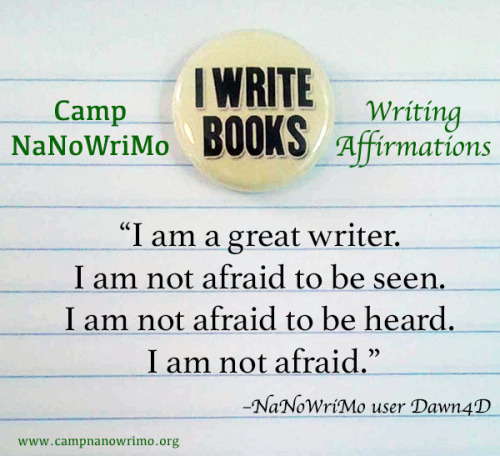
Writing Affirmations, submitted by Camp NaNoWriMo participants. (Text reads: “I am a great writer. I am not afraid to be seen. I am not afraid to be heard. I am not afraid.” By NaNoWriMo user Dawn4D)


April 7, 2017
Camp Pep: Forget Your Fears

Camp NaNoWriMo is nothing without you, our incredible participants. Today, Joaquín Pineda, a fellow Camper, offers you some pep:
Dear writers,
Writing is dangerous. Like many dangerous things, there’s often fear of failure attached to it. When you take the plunge and set pen to paper or fingers on keyboard, there are many worries that start swirling around your head. What if people think you’re a terrible storyteller, or what if you expose too much of yourself in your writing? What if people start scowling at you as though to say, “How dare you open up like this? Why would you ask the questions nobody’s meant to ask? Why would you say the things that should Never Be Said?”
And yet we love writing.
Why?
When we take all of the things that are not writing out of writing (all those daydreams about doing an interview for Rolling Stone and The Paris Review, about winning awards, about Chris Nolan doing a movie adaptation of our work), we’re left with one of the purest–if not the purest–forms of expression there is. It doesn’t matter if we’re writing a blood-pumping thriller or a scathing critical essay. Writing never fails to open up new paths that are as exciting as they are exhausting. It’s easy to reach too far, to overestimate ourselves or underestimate the challenges ahead.
Neil Gaiman once shared this advice: Either write in a way that makes you accountable to others, or write purely for yourself. Camp NaNoWriMo can be the delicious blend between the two. Let this month be a time of exploration. Let your project take you wherever it will, whether that’s giggling about old anecdotes, blubbering about past heartbreaks, or making up something entirely new.
Later on, you can be the consummate professional making everything lean and powerful. You will be surprised at the kind of muscle you see once you cut the fat and gristle away, no matter how much of it there is.
For now, go write and enjoy your Camp and don’t let anybody–especially your own ego–tell you what to put on paper. Write that fun short story you keep telling yourself is full of clichés. Write a steamy poem to that coworker who keeps flirting with you, or a funny one about your cat. Write about what keeps you awake on Sunday nights. Write about the last time that you cried. The choice is yours.
Write and never forget that you don’t do it for the interviews, the likes, the retweets or even a pat on the back. You do it because every cell in you screams when your brain isn’t busy juggling sentences and the stories they will build. You do it because there is nothing like riding that wave when ideas and language are one and every word comes out perfect, meaningful, charged with electricity that jolts you and makes you feel alive.
You do it because you love it, and you won’t let a little fear stand in your way.

Joaquín Alberto Pineda is the author of MUTEKI – Sendero de los Campeones (Road of Champions) and the upcoming short story collection Parables From a Stressed Out Artist, both self-published. Joaquín currently resides in Mexicali, Baja California, Mexico, where he works as a high school teacher. Visit his blog (in Spanish), Facebook (in Spanish), or Twitter (in English).
April 6, 2017
"Have you eaten lately? Rested? Taken time to relax and let your mind wander? Sometimes we get so..."
-
Heidi Heilig is the author of the YA historical fantasy The Girl From Everywhere and the sequel, The Ship Beyond Time. She holds an MFA from NYU’s Graduate Musical Theatre Writing Program. She is bipolar, biracial, and pansexual, and enjoys surprise twist endings.
Your Camp Care Package is brought to you in partnership with We Need Diverse Books. Sign up to receive more Camp Care Packages at campnanowrimo.org
April 5, 2017
"The question people most often ask when building characters is: who? Who is this person? Lists often..."
But for me, the next question must always be why? Why are they like this? Why do they love and hate the things they do? Why do they look and dress and talk this way? For me, rich characters have reasons behind their choices!”
-
Heidi Heilig is the author of the YA historical fantasy The Girl From Everywhere and the sequel, The Ship Beyond Time. She holds an MFA from NYU’s Graduate Musical Theatre Writing Program. She is bipolar, biracial, and pansexual, and enjoys surprise twist endings.
Your Camp Care Package is brought to you in partnership with We Need Diverse Books. Sign up to receive more Camp Care Packages at campnanowrimo.org
April 4, 2017
Writing Affirmations, submitted by Camp NaNoWriMo participants....
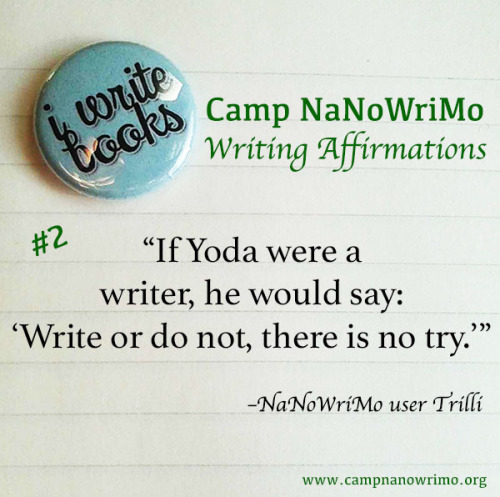
Writing Affirmations, submitted by Camp NaNoWriMo participants. (Text reads: “If Yoda were a writer, he would say: ‘Write or do not, there is no try.’” By NaNoWriMo user Trilli)
April 3, 2017
"I came from a playwriting background, so I really enjoy writing dialogue. One trick I’ve used..."
Does it flow like a real conversation? Does each character have a consistent personality? Sometimes it’s easiest to tell when you hear it aloud!”
-
Heidi Heilig is the author of the YA historical fantasy The Girl From Everywhere and the sequel, The Ship Beyond Time. She holds an MFA from NYU’s Graduate Musical Theatre Writing Program. She is bipolar, biracial, and pansexual, and enjoys surprise twist endings.
Your Camp Care Package is brought to you in partnership with We Need Diverse Books. Sign up to receive more Camp Care Packages at campnanowrimo.org
April 1, 2017
"Tape over your Delete key. Press it down. Blot it out with stickers that shed glitter all over your..."
Now. Write. Write for a few minutes. Write one or two words. But do not delete any of it. If you must, give yourself some space from it. Give yourself a moment to let the wild, teeming wonders of your brain clamber over your empty page. See what else is hiding inside of you that needs some freedom to come out.”
-
Karuna Riazi is an online diversity advocate, essayist, and overwhelmed undergrad senior at Hofstra University. Her debut novel, The Gauntlet, is out this week!
Your Camp Care Package is brought to you in partnership with We Need Diverse Books. Sign up to receive more Camp Care Packages at campnanowrimo.org
March 31, 2017
"Sometimes, you need a dragon at your heels, breathing fire and threatening destruction, to really..."
If you’re worried that every writing session you set aside won’t yield anything but empty space, more additions to your Pinterest boards, or a few demolished candy bars—you might need a little more motivation.
Try a site like Write or Die, where you have to keep typing or watch your words fade away into oblivion. Depending on how you set the timer, it’ll give you a little room to agonize over every letter you manage to think up and more concern about reaching your word count quota for the day—and you don’t even need to invest in a good, flame-proof set of armor to do it.”
-
Karuna Riazi is an online diversity advocate, essayist, and overwhelmed undergrad senior at Hofstra University. Her debut novel, The Gauntlet, is out this week!
Your Camp Care Package is brought to you in partnership with We Need Diverse Books. Sign up to receive more Camp Care Packages at campnanowrimo.org
March 29, 2017
Worlds Within Words: A Structural World-Building Exercise

We’re getting ready for Camp NaNoWriMo next week! Camp is a great way to expand your writing style or work on a different type of project than you normally do. Today, author, educator, and participant Tilia Klebenov Jacobs shares a fun technique to help the worlds that you create come alive:
World-building is the process of constructing an imaginary world, sometimes associated with an entire fictional universe.
In terms of technique, it is sufficiently de rigueur to merit its own joke in La La Land, where a blowhard screenwriter vaunts his supposed world-building prowess as Emma Stone backs politely away. But there’s a reason the term has been around for over half a century: unless your fictional world feels real, the story fails. And by real I do not mean that it cannot contain, for example, trolls, light sabers, or plot devices hinging on magic and/or time travel. It can have all of this and more; but it must feel authentic.
World-building begets authenticity because it combines character and setting to create a believable context for your plot. And although the term is most often associated with fantasy and science fiction (such as Tolkien and Star Wars), the fact is that any writer of fiction needs to master this technique.
The best fictional worlds combine plot, character, and setting in such a way as to make them inextricable from one another. If you, the author, can change the setting without altering the characters, something is amiss. If you can subtract a character from your plot without damaging it, the plot needs work. (Of course, maybe what it needs is to get rid of that character, in which case, congratulations!) But when you combine these three elements in perfect proportion to one another, you have built a convincing world.
With that in mind, I give you a simple world-building exercise that works with pretty much any story in any genre:
Think of a room or other space where a character in your story spends time. The space need not appear in the story; this is primarily for your edification. The easiest option is the character’s bedroom, but his or her jail cell, sailboat, or opium den will also suffice.Write the numbers one through ten on a piece of paper. Or type them onto your screen of choice.
List ten objects that are in that space. Give yourself five minutes max. Three is better.
One of the objects is something the character does not want anyone else to see.
Now write a half-page description of the space containing these items. Be sure to include plenty of detail, such as the color of the walls, what it smells like, etc.
Chances are that when you are done, you will know more about your character than you did before you started.You will see a space that he or she has crafted, or at the very least hangs out in. You will know what is important to that person, especially because of that one object that the character doesn’t want anyone to see. (Where is it hidden? How did it get there?)
If that isn’t enough, you can add a few more variables: one of the items was a gift. One is the character’s favorite food. One belongs to the protagonist’s antagonist. And so-forth.
For the best results, think of this not necessarily as something you will include in the body of your story (though if it fits there, by all means use it). Instead, consider it scaffolding or framework. When a building is complete, we don’t see the beams holding it up, but they’re certainly there.
This exercise may provide you with a scintillating description of your sexy protagonist’s boudoir, or it may give you information that only you, the author, know or need to know. But the world you build with that knowledge will feel more real. That’s world-building: the creation of a setting that contains more than we can see. The beams are in place, the world is secure. And all because of ten objects in a room we never even see.

Tilia Klebenov Jacobs is an award-winning author who lives near Boston. She writes fiction and memoir. Her newest novel, Second Helpings at the Serve You Right Café, is available at Amazon.com and independent bookstores. Her debut novel, Wrong Place, Wrong Time , won the Beverly Hills Book Award for Best Thriller. A graduate of Oberlin College and Harvard Divinity School, Tilia has also taught middle school, high school, and college, as well as participating as an educator for a writing program for prisons. Visit her website at http://www.tiliaklebenovjacobs.com/ .
Top photo by Flickr user Shereen M.
Worlds Within Worlds: A Structural World-Building Exercise
We’re getting ready for Camp NaNoWriMo next week! Camp is a great way to expand your writing style or work on a different type of project than you normally do. Today, author, educator, and participant Tilia Klebenov Jacobs shares a fun technique to help the worlds that you create come alive:
World-building is the process of constructing an imaginary world, sometimes associated with an entire fictional universe.
In terms of technique, it is sufficiently de rigueur to merit its own joke in La La Land, where a blowhard screenwriter vaunts his supposed world-building prowess as Emma Stone backs politely away. But there’s a reason the term has been around for over half a century: unless your fictional world feels real, the story fails. And by real I do not mean that it cannot contain, for example, trolls, light sabers, or plot devices hinging on magic and/or time travel. It can have all of this and more; but it must feel authentic.
World-building begets authenticity because it combines character and setting to create a believable context for your plot. And although the term is most often associated with fantasy and science fiction (such as Tolkien and Star Wars), the fact is that any writer of fiction needs to master this technique.
The best fictional worlds combine plot, character, and setting in such a way as to make them inextricable from one another. If you, the author, can change the setting without altering the characters, something is amiss. If you can subtract a character from your plot without damaging it, the plot needs work. (Of course, maybe what it needs is to get rid of that character, in which case, congratulations!) But when you combine these three elements in perfect proportion to one another, you have built a convincing world.
With that in mind, I give you a simple world-building exercise that works with pretty much any story in any genre:
Think of a room or other space where a character in your story spends time. The space need not appear in the story; this is primarily for your edification. The easiest option is the character’s bedroom, but his or her jail cell, sailboat, or opium den will also suffice.Write the numbers one through ten on a piece of paper. Or type them onto your screen of choice.
List ten objects that are in that space. Give yourself five minutes max. Three is better.
One of the objects is something the character does not want anyone else to see.
Now write a half-page description of the space containing these items. Be sure to include plenty of detail, such as the color of the walls, what it smells like, etc.
Chances are that when you are done, you will know more about your character than you did before you started.You will see a space that he or she has crafted, or at the very least hangs out in. You will know what is important to that person, especially because of that one object that the character doesn’t want anyone to see. (Where is it hidden? How did it get there?)
If that isn’t enough, you can add a few more variables: one of the items was a gift. One is the character’s favorite food. One belongs to the protagonist’s antagonist. And so-forth.
For the best results, think of this not necessarily as something you will include in the body of your story (though if it fits there, by all means use it). Instead, consider it scaffolding or framework. When a building is complete, we don’t see the beams holding it up, but they’re certainly there.
This exercise may provide you with a scintillating description of your sexy protagonist’s boudoir, or it may give you information that only you, the author, know or need to know. But the world you build with that knowledge will feel more real. That’s world-building: the creation of a setting that contains more than we can see. The beams are in place, the world is secure. And all because of ten objects in a room we never even see.
Tilia Klebenov Jacobs is an award-winning author who lives near Boston. She writes fiction and memoir. Her newest novel, Second Helpings at the Serve You Right Café, is available at Amazon.com and independent bookstores. Her debut novel, Wrong Place, Wrong Time , won the Beverly Hills Book Award for Best Thriller. A graduate of Oberlin College and Harvard Divinity School, Tilia has also taught middle school, high school, and college, as well as participating as an educator for a writing program for prisons. Visit her website at http://www.tiliaklebenovjacobs.com/ .
Top photo by Flickr user Shereen M.
Chris Baty's Blog

- Chris Baty's profile
- 63 followers

