Stephen Morris's Blog, page 22
May 17, 2019
Melchizedek, King of Salem

This icon of Melchizedek is one of several that I painted many years ago. You can see the curls of the challah bread in his hand reflected in the curls of his beard. He wears the turban of a high priest and the crown of a king, as he was both priest of God Most High and king of (Jeru-)Salem.
Melchizedek is a mysterious but very important figure in the Bible. He is the king of Salem (later known as Jerusalem) and a priest of God Most High, and he blessed the patriarch Abraham. In the book of Genesis, we read how Abram returns from defeating king Chedorlaomer and meets with Bera the king of Sodom, at which point: “…Melchizedek king of Salem brought out bread and wine: and he was [is] the priest of the most high God. And he blessed Abram, and said, ‘Blessed be Abram to the most high God, possessor of heaven and earth, And blessed be the most high God, which hath delivered thine enemies into thy hand’. And Abram gave him tithe from all.” (Genesis 14:18–20)
Melchizedek is also mentioned in Psalm 110 as an example of one man acting as both priest and king (a new development in Jewish practice, dating from the time of the Maccabees about 200 BC) and Christ is compared to Melchizedek in the Epistle to the Hebrews in the New Testament. Melchizedek is the only non-Jewish priest in the Old Testament who is considered legitimate; his priesthood is also greater than the Jewish priesthood because he blesses Abram [Abraham], the father of all Jews and thus all of Abraham’s descendants–including the Jewish priests! Abraham also offers Melchizedek a tithe (10%) of all he has, indicating that he considers Melchizedek more important than himself. Melchizedek, king of Salem [i.e. “righteousness” and “peace”], sacrifices bread and wine to God; this is considered by Christian readers as a clear allusion to the Eucharist. Because he is king of righteousness and seems to be a priest for all eternity (as there is no record of his birth or death or his ancestors), he is considered by Christians to be an archetype of Christ Himself.
Some Jewish legends also notice his apparent eternity and say that he presided at the funeral of Abel and was hidden by God in Eden during the Flood to protect him. He was also important to Jews who rejected the legitimacy of the Temple, such as the Essenes and the Qumran community who compiled the Dead Sea Scrolls.
Melchizedek is commemorated by the Eastern churches on May 22.
The post Melchizedek, King of Salem appeared first on Stephen Morris, author.


May 10, 2019
“Happy Birthday, Stock Market!”
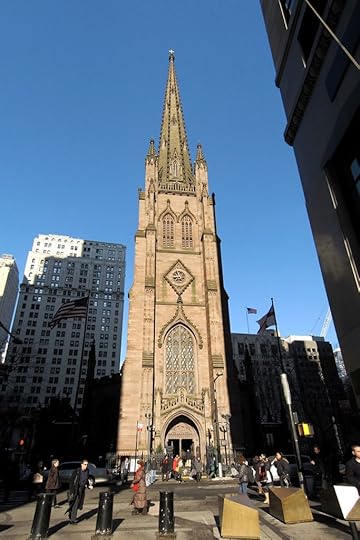
Wall Street leads directly to the front door of Trinity Church in New York City. Trinity Church is an Episcopal church that was founded by royal charter in 1697. The first church was on Wall Street facing the Hudson River.
When Trinity Church was destroyed by the Great New York City Fire of 1776, services moved over to St. Paul’s Chapel until the new church was finished in 1790.
The rebuilt Trinity Church was destroyed by the snowstorms of 1838 – 1839.
The current Trinity Church was completed in 1846. It was the tallest building in the United States until 1869 when a church in Chicago took the title. Trinity Church remained the tallest structure in New York City until it was surpassed by the Brooklyn Bridge towers in 1883.
Two dozen merchants and brokers established the New York Stock Exchange on May 17, 1792. In good weather they operated under a buttonwood tree on Wall Street. In bad weather they moved inside to a coffeehouse to conduct business.
Previously securities exchange had been intermediated by the auctioneers who also conducted more mundane auctions of commodities such as wheat and tobacco. On May 17, 1792 twenty four brokers signed the Buttonwood Agreement; the agreement had two provisions:
1) the brokers were to deal only with each other, thereby eliminating the auctioneers, and
2) the commissions were to be 0.25%.
The earliest securities traded were mostly governmental securities such as War Bonds from the Revolutionary War and First Bank of the United States stock. In 1817 the stockbrokers of New York operating under the Buttonwood Agreement instituted new reforms and reorganized. After re-forming as the New York Stock and Exchange Board the broker organization began renting out space exclusively for securities trading, which previously had been taking place at the Tontine Coffee House. Several locations were used between 1817 and 1865, when the present location was adopted.
The location of the stock market, a building on Wall Street, is shorthand for referring to the entire financial system. There are varying accounts about how the Dutch-named “de Waalstraat” got its name. A generally accepted version is that the name of the street was derived from a wall (actually a wooden palisade) on the northern boundary of the New Amsterdam settlement, built to protect against Native Americans, pirates, and the British. When the British did take control of New Amsterdam and it became New York, the New York City Common Council made Wall Street the city’s first official slave market for the sale and rental of enslaved Africans and Indians in 1711. The slave market operated from 1711 to 1762 at the corner of Wall and Pearl Streets. It was a wooden structure with a roof and open sides, although walls may have been added over the years and could hold approximately 50 men. The city directly benefited from the sale of slaves by implementing taxes on every person who was bought and sold there.
Much of Wall Street itself is owned by Trinity Church; the land along the northern wall of the fort was a gift from Queen Anne to the parish.
The post “Happy Birthday, Stock Market!” appeared first on Stephen Morris, author.
May 3, 2019
Visiting the Departed
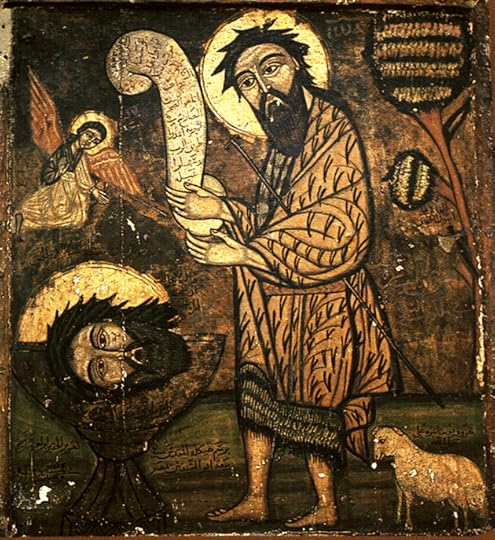
This Coptic icon for the Beheading of St. John the Baptist, shows St. John ‘in clothing of camel’s hair’, with a cross (here in the Coptic Tau (T) form), beholding his own head. The axe at right refers to this line from his own preaching: “And even now the axe is laid to the root of the trees. Therefore every tree which does not bear good fruit is cut down and thrown into the fire.” [Mt 3.10; Lk 3.9]
Decoration Day was first observed on May 5 in the U.S., with the tradition of decorating soldiers’ graves from the Civil War with flowers. On May 5, 1868, General John A. Logan issued a proclamation calling for “Decoration Day” to be observed annually and nationwide; he was commander-in-chief of the Grand Army of the Republic, an organization of and for Union Civil War veterans. With his proclamation, Logan adopted the Memorial Day practice that had begun in the Southern states three years earlier. The observance date was later moved to May 30th and included American graves from World War I and World War II, and became better known as Memorial Day. In 1971, Congress moved Memorial Day to the last Monday in May, thus creating a three-day holiday weekend.
In much of Central and Eastern Europe, the Orthodox Church celebrates the Tuesday after Thomas Sunday as the “Day of Rejoicing” (Radonitsa) by visiting graves and celebrating memorial services for the departed for the first time since before Palm Sunday. (Many monasteries depended on donations in exchange for their prayers for the departed; resuming these services was important for the financial survival of many small monastic communities.) The Day of Rejoicing also begins the marriage season. Since weddings are forbidden during the Great Lenten Fast (because that time should be devoted to penance and self-examination, rather than merrymaking), as well as during Bright Week (because at that time the Church celebrates nothing else except the Resurrection), with Radonitsa comes the time for weddings.
Among Eastern Christians, the Beheading of St. John the Baptist on August 29 is the day to pray for soldiers slain in battle and to visit their graves as established in 1769 at the time of Russia’s war with the Turks and the Poles. The day is always observed with strict fasting, and in some places the pious will not eat food from a flat plate, use a knife, or eat round food on this day because of the association of these things with the Gospel account of St. John’s beheading.
The post Visiting the Departed appeared first on Stephen Morris, author.
April 26, 2019
Resurrecting Easter
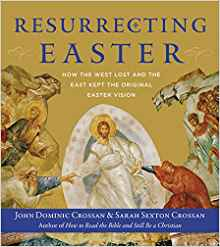
“Christ is risen! Indeed, he is risen!”
In the iconography of the Eastern Church, the risen Jesus grasps the hands of other figures around him. Unlike the Western image of a solitary Jesus rising from an empty tomb, the authors of Resurrecting Easter saw images of the Resurrection depicting Jesus grasping the hands of Eve and Adam, lifting them to heaven from Hades or hell. They discovered that the standard image for the Resurrection in Eastern Christianity is communal and collective, something unique and distinct from the solitary depiction of the resurrection in Western Christianity.
A popular 7th-century homily on the Resurrection tells us
“The Lord rose, then, after three days… and all the descendants of the nations were saved in Christ. For one was judged and multitudes were saved. The Lord died on behalf of all…. [and] He raised up all humanity to the height of heaven, bearing a gift to the Father, not of gold nor silver nor precious stone, but rather that human race which he made according to his own image and likeness.”
In the Eastern images of the Resurrection, Adam and Eve–often with Kings David and Solomon, St. John the Baptist, and other prophets from the Old Testament–represent all humanity exiting an empty Hades. The whole human race shares in the triumph of the Resurrection of Christ and the earth itself is saved from the desecration of Abel’s blood shed by Cain. This is reflected in the hymnography of the Holy Saturday services as well:
TODAY, HELL CRIES OUT GROANING:
MY DOMINION HAS BEEN SHATTERED.
I RECEIVED A DEAD MAN AS ONE OF THE DEAD,
BUT AGAINST HIM I COULD NOT PREVAIL.
FROM ETERNITY I HAD RULED THE DEAD,
BUT BEHOLD, HE RAISES ALL.
BECAUSE OF HIM DO I PERISH.
GLORY TO THY CROSS AND RESURRECTION, O LORD!
Resurrecting Easter reflects on this divide in how the Western and Eastern churches depict the Resurrection and its implications. The authors argue that the West has gutted the heart of Christianity’s understanding of the Resurrection by rejecting that once-common communal iconography in favor of an individualistic vision. As they examine the ubiquitous Eastern imagery of Jesus freeing Eve from Hades while ascending to heaven, they suggest that this iconography raises profound questions about Christian morality and forgiveness.
A fundamentally different way of understand the story of Jesus’ Resurrection, Resurrecting Easter is illustrated with 130 images and introduces an inclusive, traditional community-based ideal that offers renewed hope and possibility.
The post Resurrecting Easter appeared first on Stephen Morris, author.
April 22, 2019
Christ is Risen (2019)!

Easter Monday is a holiday in most of Europe. Offices and banks are closed. People get a 4-day weekend as most places were closed on Good Friday as well. I always thought it was a shame that the United States doesn’t get Easter Monday as a holiday as well.
The post Christ is Risen (2019)! appeared first on Stephen Morris, author.
April 12, 2019
Holy Week: The Death of Death
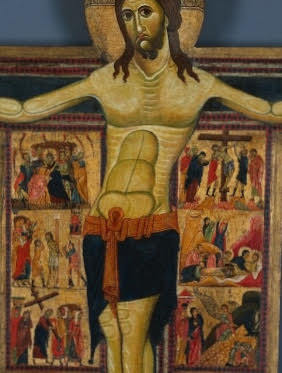
This 13th century crucifixion from Pisa also depicts scenes from Holy Week: Christ’s arrest, his scourging, carrying the Cross, as well as his death, burial, and resurrection. (Cleveland Museum of Art)
Holy Week is the opportunity to celebrate and contemplate the last week of Christ’s ministry, from his entrance into Jerusalem on Palm Sunday to his Resurrection. The heart of Holy Week–the heart of the Christian year–is the nexus of Good Friday-Holy Saturday when Christ’s death and resurrection are celebrated and proclaimed.
Christ’s death was more than a tragic event for a particular person. His death was the encounter between God and Death itself. Once Death had entered the world, following the sin of Adam and Eve, it consumed everything. But when God allowed himself to be consumed by Death, then Death consumed itself. Christ’s resurrection is the pledge that Death has been rendered powerless although it can still be frightening–like a serpent or a chicken with its head cut off, squirming around and spewing blood but harmless apart from whatever fear or disgust we give it.
“Christ concealed the hook under the bait by hiding his strength under weakness. Therefore that murderer who from the beginning thirsted for human blood, rushing blindly upon weakness, encountered strength; he was bitten in the act of biting, transfixed [with nails] as he grasped at the Crucified…. I behold the jaws of the serpent pierced through, so that those who had been swallowed may pass through them…. Well may he be angry, roar, and waste away, for the prey has been snatched from his teeth.” (St. Guerric of Igny, Sermon 30)
In the Middle Ages, many images of Christ on the Cross–especially those based on Byzantine models–contain images of the other events in Holy Week as well.
The post Holy Week: The Death of Death appeared first on Stephen Morris, author.
April 5, 2019
Passiontide
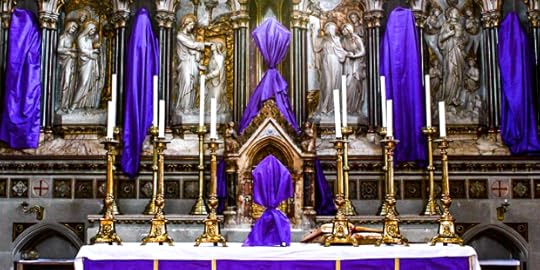
The statues and cross on this altar are veiled for the two weeks of Passiontide.
In western Christian liturgical practice, the last two weeks before Easter were commonly known as “Passiontide.” The statues and crosses would be veiled. Some think this dates from a time when Lent was itself only two weeks long and that the images were therefore veiled for all of Lent. Some think that as Lent became longer–finally becoming the 40-day fast it is now–that the statues and crosses were veiled for all of Lent. Practices varied a great deal across western Europe. In some places the crosses were covered on Ash Wednesday; in others on the first Sunday of Lent. In England it was customary on the first Monday of Lent to cover up all the crucifixes, images of every kind, the reliquaries, and even the cup with the Blessed Sacrament. In other places, veils were still only used during the two weeks of Passiontide itself.
Why cover the cross and other images? Scholars suggest that at the time when veiling was introduced, the image of Christ on the Cross was still that of Christ Triumphant: his eyes are open, he is calm, and he is robed as a king or priest. He is ruling the world from the throne of the Cross, as many iturgical hymns say. The image of Christ on the Cross as the Man of Sorrows (his body twisted in agony, his eyes often closed in death, the pain and agony of Crucifixion on full display) did not become popular until much later. The veils were thus used to hide the triumphant images of Christ as the faithful were preparing to celebrate that triumph. (The saints are likewise images of Christ triumphant in the lives of believers and would therefore be covered as well during the time of preparing to celebrate Christ’s triumph over Death.) By the time the image of the Man of Sorrows on the Cross–which would be appropriate for veneration during the preparation for Easter–became popular, the veils had become too entrenched in popular custom and so the images of Christ on the Cross continue to be covered.
Even in the Orthodox world, the two weeks before Easter are distinct liturgical periods: the Week of Palms which leads up to Palm Sunday and the Passion Week which culminates in Good Friday-Holy Saturday-Pascha (Easter). But the images are not veiled in Orthodox churches.
A beautiful example of Christ Triumphant on the Cross from 13th century Pisa–currently in the collection of the Cleveland Museum of Art–can be seen here.
The post Passiontide appeared first on Stephen Morris, author.
March 29, 2019
St. Mary of Egypt
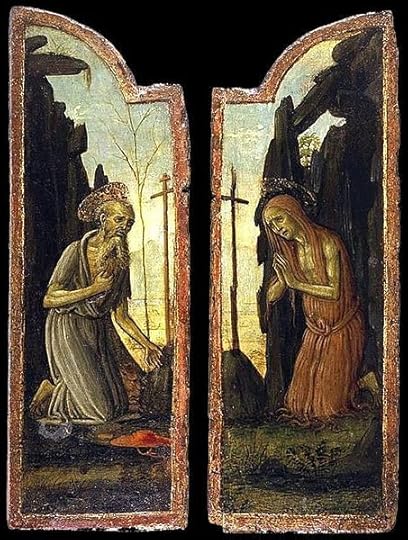
St Jerome and St Mary of Egypt (first half of 16th century)
St. Mary of Egypt was among the most popular saints of the Middle Ages. She is still extremely well-known in the Orthodox Church although she is not as well known anymore among Western Christians. She is considered a model of repentance and commemorated on April 1 (the anniversary of her death) and the 5th Sunday of Lent (in the Orthodox liturgical tradition).
According to her life (written by Sophronius, 7th century patriarch of Jerusalem and available in the Golden Legend), Mary was a sexually active young girl who ran away from home in Egypt when she was 12. Her parents never heard from her again and never knew what befell their daughter. She made her way to Jerusalem, seducing men along the way. She had a conversion experience in Jerusalem and fled into the desert, where she lived as a hermit for several decades. A lone monk discovered her one spring and learned the story of her life. He brought her Holy Communion the next year. When he attempted to meet her a third time, he discovered her body and realized that she had died only hours after he had given her Holy Communion.
She was clearly a headstrong young woman. She used the resources available to her to make her way in the world. Coming from a poor, rural family, that meant her only resource was her body. But her conversion experience made her realize that relying on her sexuality to survive was a dead-end; she wanted more than a collection of sensual experiences and memories to give meaning to her life. So she embraced an extreme form of desert asceticism as a hermit. Just as her sexual behavior was extreme, her asceticism was as well. She was not given to half-measures.
There were many versions of her life available in medieval Europe, a testimony to her popularity. Many of them are still available, in translation. Her image was painted many times as well.
The post St. Mary of Egypt appeared first on Stephen Morris, author.
March 22, 2019
“Happy New Year 2019?!” Annunciation Day
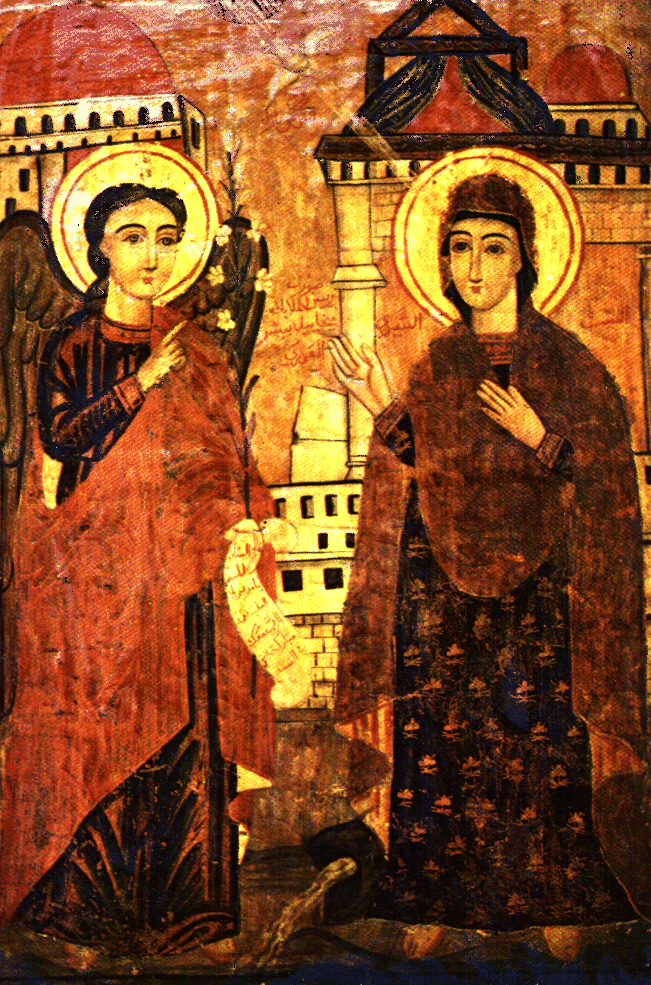
A Coptic icon of the Annunciation, showing the angel Gabriel presenting a lily as he announces the Incarnation to the Mother of God.
Lilies are often associated with the celebration of Annunciation. When Eve was driven from Paradise, lilies bloomed wherever her tears fell onto the earth and Gabriel presented lilies to the Virgin Mary when he announced that her Son would re-open Paradise to mankind. Other legends say that lilies blossomed from drops of milk from Hera’s breasts that fell upon the earth and that the lily was therefore the only flower with a soul. Lilies are traditionally considered to drive away ghosts and evil (esp. the Evil Eye) and can break love spells. The first lily of the season strengthens whoever finds it.
Roses are also associated with Annunciation and are used to cast love spells or in healing magic. If you plant roses in your garden, they are said to grow best if you have stolen the seeds from someone else and will then attract the faerie folk.
The Annunciation is celebrated on March 25 (the traditional date of the springtime equinox). Not only was Annunciation — and the equinox — vital to keeping track of time for secular purposes, many ancient and medieval authors claimed that the Annunciation/equinox date were vital at many points of salvation history: the birthday of Adam and the Crucifixion were said to have occurred on March 25 as well. Some also said that March 25 marked the fall of Lucifer, the parting of the Red Sea, as well as the day on which God said, “Let there be light!”
Sometimes called “Lady Day,” the Annunciation was kept as New Year’s Day in many places; the last to give up Annunciation as the New Year’s Day was England and its American colonies in 1752. The correct synchronization of the equinox with the Annunciation is a critical element in the calculation of the date of Easter and the medieval and Renaissance disconnect between the Annunciation and the equinox prompted Pope Gregory XIII to reform the calendar in 1582.
The post “Happy New Year 2019?!” Annunciation Day appeared first on Stephen Morris, author.
March 15, 2019
Bloodstone or Aquamarine? The Birthstone of March

Bloodstone, the birthstone for March, is used as a medicine and an aphrodisiac.
Bloodstone, long considered the birthstone of March, is jasper speckled with iron oxide. (Months were assigned stones and gems from the high-priest’s breastplate of Aaron in the Old Testament or the gems described as the foundations of the New Jerusalem in the Apocalypse, the “Revelation of St. John.”)
Bloodstone was used to heal blood disorders and stop bleeding noses and wounds in Babylon and was carved into amulets to protect against the Evil Eye. Ancient Greeks thought using it in ritual would hasten changes in fortune. Western European Christians in the Middle Ages thought all bloodstones had been splashed with Christ’s blood at the Crucifixion and used the stones to carve images of either the Crucifixion or scenes of martyrs’ deaths.
These gems would be pulverized and mixed into egg whites with honey and used to remove poison from snakebites. Knights and soldiers would bring bloodstones with them into battle not only to staunch bleeding but to increase courage and physical strength as well. It was also thought to confer invisibility, a useful skill in battle. It was also used as an aphrodisiac (useful after battle).
Some also associate aquamarine gems with March. This gemstone was believed to protect sailors, as well as to guarantee a safe voyage. The serene blue or blue-green color of aquamarine is said to cool the temper, allowing the wearer to remain calm and levelheaded.
In the Middle Ages, many believed that the simple act of wearing aquamarine was a literal antidote to poisoning. The Romans believed that if you carved a frog into a piece of aquamarine jewelry, it would help to reconcile differences between enemies and make new friends.
In some times and places, an aquamarine was given to the bride at her wedding in order to symbolize long unity and love. Some believed it could re-awaken love between two people; maybe that’s why it is also associated with a couple’s 19th anniversary?
The Sumerians, Egyptians, and Hebrews all admired aquamarine, and many warriors would wear it into battle to bring about victory. Many ancient medicines used powder from aquamarine to help cure all manner of infection, but it was said to be particularly good for eye ailments.

Since early times, aquamarine has been believed to endow the wearer with foresight, courage, and happiness. It is said to increase intelligence and make one youthful. As a healing stone, it is said to be effective as a treatment for anxiety and in the Middle Ages it was thought that aquamarine would reduce the effect of poisons.
The post Bloodstone or Aquamarine? The Birthstone of March appeared first on Stephen Morris, author.