
Cedar Sanderson's Blog, page 255
October 22, 2013
Beautiful America: Looking Back
My father travels in time. Every year he spends a few weekends and extra days when he can steal away in the eighteenth century. Specifically, sometime during the French and Indian War. I’ve gone along with him, as I can disguise myself well enough, although I am not as knowledgeable as he is… I’m sharing some images, mostly captured by him, of encampments that evoke the bygone history of our nation, during a time when independence was not yet breathed of, but in the crucible of this conflict, teh tools were forged that would fight and win the freedom of our nation.

Somewhere at the foot of Mount Washington.

Dawn reaches the encampment

Sutler’s Row: Copper pots for all uses

A bit of our future, looking back.

Time to chow down.

A camp in the white mountains.

Bacon, old-school. Yum!



October 21, 2013
Well-Covered
A books cover speaks loudly… I’ve put together some examples, good and bad, over at Amazing Stories today.
What do you think belongs on a science fiction cover? Fantasy? What looks awful? Next week I will get into how to find and use images.

Book covers from another generation.


October 20, 2013
Pixie Snippet #6
If you have not been reading along, the first snippets can be found here.
#############
“What are we going to do about the troll’s body?” I asked her.
“Raven will take care of it.” She pointed and I saw that he was still in giant bird, form, and pecking at the troll. There were a bunch of other ravens there, and clouds of them flying in. I looked away. I really didn’t need this image in my dreams.
Bella looked a little pale, too. “I’ll take you back to Raven’s cabin. We can’t get past him to Tok right now.”
“What about other traffic?” I didn’t really care, but I was curious if she had ever dealt with this before.
She peered skyward through the windshield. “I don’t think this will take long.”
I followed her gaze to the cloud of birds. “I think you’re right. Let’s go.”
She made a nice tight turn and got us headed away from the growing flock of carrion birds. Neither of us talked again on the way back to the cabin. I was nodding in the drowsy heat by the time she turned back onto the driveway and jolted me awake. But at least I was warm again.
Inside, she looked rather helplessly at me, and I could tell she was unhappy and out of her element. The first time I had seen her like that, now that I thought of it. I filed that away as useful information. It took a lot to shake this one, she was steady under fire, but afterward, the reaction.
“Coffee? Or would you rather tea? Raven’s version of tea is… excreable, but…”
I stopped her before she could go on. “Coffee is good. I’m not that English.”
I sat on the couch and watched her get it brewing with quick, economical motions. She knew her way around this kitchen.
I went on. It was time to make her aware of who I was, at least to some of me. “Actually, I have spent as little time there as I could since I was old enough to leave.”
“I thought pixies were bound to their home tor?”
I wriggled out of my coat. The wood stove was keeping the cabin nicely warm. “Not bound, no. Just it’s a trait of our kind to be homebodies. I’m a very odd Pixie, by my family’s opinion.”
“That explains why you have no accent.”
“Well, that, and I tried to get rid of it.”
“Oh.” She brought me a chipped mug full of coffee. It smelled heavenly.
“So, um, Lom, what do you really do? What was that thing?” She sat down on the couch next to me. There really wasn’t anywhere else to sit in the tiny dwelling. I took a gulp of too hot coffee to try and delay my answers to those loaded questions.
“Well, I am not doing any longer what I’ve spent most of my adult life at. I got called into service a few days ago.”
She lifted that eyebrow at me. I regarded the line of her jaw as it tightened with a slight head tilt, and thought for about the dozenth time since I had first seen her that I was going to have to either learn control or become an eunuch.
“The service of the Court?”
I felt apologetic as I explained. “Not exactly. Your service, specifically.”
I might as well have struck her in the face. She flinched back. “What? I don’t want that.”
I sighed. I wanted to rub my face, but a half cup of still steaming coffee in my hand kept me from it.
“I told you we needed to talk. Let me begin at the beginning?”
She leaned back and nodded. Her face was tight and unhappy. I took a deep breath, and then decided I needed to stand and pace a little.
“How much do you know about your heritage?”
She closed her eyes and sighed. “My grandmother used to tell stories. About fairies, and then when I was older I realized that they were about real people. After my mother died, when I moved in with them, she told me more. And she taught me how to use my Sight.”
“That’s why you knew I was a pixie.”
She nodded. “I should have used it on the troll.”
She looked so dejected I took pity on her. “Why would you? You weren’t expecting trouble. I’m guessing you do not scan for the Folke everytime you meet a stranger.” Which meant she had been looking for me? Now, that was an interesting thought.
“No, well, sometimes when I meet someone I’ve never seen before.”
“Have you ever met any?” I walked into the kitchen and put the empty coffee cup on the counter.
“Other than you? Yes, a couple others.”
“So you know that there are other things than fairies out there, you knew I was a pixie. What did Lavendar tell you about your magic, and that of other species?”
“I don’t have any magic!” She looked as startled as she sounded. “I’m only a little bit of fairy. I just don’t understand why they want me to come back to them. Lavendar left, and she wouldn’t talk about why, but I do know she never wanted to go back, or for me to go back. She told me…” Bella stopped talking and looked away from me, toward the door, pressing her lips together.
I sighed and ran my fingers through my hair. She didn’t trust me, even now. “Let me guess, she told you to never trust a fairy or a pixie. To run if you saw a goblin coming.”
She shook her head. “Nothing bad about pixies. She told me that fairies never meant what they said, and goblins are defilers of all that is good.”
I was surprised to hear that Lavendar had borne no ill-will toward pixies. That would have been an interesting story, but it was too late to hear it.
“I don’t have time to give you all the details. That will have to be filled in later. You really are an heir to the High Court.”
“An heir?” She interrupted me. “How many are there? And how can I possibly be an heir, I’m not…” She waved her hand. “All fairy.”
“The fairy line hasn’t been pure since the human race came along.” I chuckled. “Fairies and humans don’t cross breed easily, but that doesn’t keep them from trying.”
She looked taken aback at that. Evidently she had never thought through her grandparents having sex before.
I went on. “And that has been part of the problem, too. Fairy is… not a fertile species. Children borne to fairy and human parents are usually sterile, like a mule.”
Now she raised both her eyebrows, but I had her full attention.
“The succession for the Queen of High Court is matrilineal and it’s partly a meritocracy. Out of the females of each generation to the royal family, one is chosen to be Queen. In order to choose one, they are required to serve at Court for a time. That is what you are going to have to do.”
She sat up straight. “I do not want to. How do I say no?”
I shook my head. “You don’t have a choice. It’s a duty that you are required to fulfill.”
“No one can make me.”
“Ordinarily, I would say that was something you could get away with.” I sat down next to her, facing her. She was very tense, and on the verge of jumping up, I could see. “But there is something else going on here. That’s why the troll was after you.”
“After me? It was an accident.” She had forgotten what I told her at the scene. No surprise, she was under a lot of stress.
“No, it was an ambush.” I was speaking softly and as matter-of-factly as I could. She was practically vibrating with unhappiness. “He, or whoever he was working with,” I couldn’t get the dumb look in his eyes out of my head, “used magic to send a fake radio message they knew you would respond to. He’s a troll, he had an affinity for bridges, that’s likely why they used that.”
I took her hand, and she didn’t resist. Her hand was warm and calloused. “He was going to kill you and it is my job to stop that from happening.”
“I…” she stopped. She looked like she had lost all the breath in her body.
“It’s going to happen again. This is why I was sent, instead of overnight mail. Because the heirs have been dying. Your mother’s generation is almost gone. Two of your generation are dead. There were only seven of you to begin with.” I was doing my best to sound reasonable, rather than ‘listen to me you silly twit.’
She sank back into the cushions, her face pale. She didn’t let go of my hand.
“I’m not important enough to bother with.” She told me quietly. “Can’t I renounce it, or something? Abdicate?”
In this position I was very close to her. She smelled of soap and water and girl, and I swallowed. I would have given anything to assure her it would be all right, she could just say no and everything would leave her alone.
“That is not an option. They are going to come after you, after anyone who they can use as a lever, until they get to you.”
“Who are ‘they,’ and are you saying my family might be in danger?”
The door rattled, and we both jumped.


October 19, 2013
Lit-er-achure
My post for Mad Genius Club is up!
What would you expect from a College-level Literature course? And how are you working to subvert the growing aversion to reading? Find out there, as I muse on the seeming demise of words and “works of length.”


October 18, 2013
Review: Sort of
 I know, I know, I’m horrible. *covers face with hands*
I don’t have a formal review for you to read. I am going to tell you what i have been reading, and say, go get it! Why do I so cavalierly command? Well, it’s a classic, and it’s a dollar. You spend that much on a soda at lunch. Just do it.
No, not that kind of classic. This one you will like, I promise. No grey goo, turgid prose, and over-flowery descriptions here.

 Inspiring heroes, strong women, spaceships, Null-ABC, action, time-travel, and the Fuzzies! What more could you ask for? Yes, I know many of his work is free, but this way you get it all in one neat, well-formatted package for your reading pleasure. You will thank me.


October 17, 2013
Preservation of Innocence
I was talking to a friend about the post at Mad Genius Club which I wrote in protest over being bullied into not parenting my children by gently steering them away from books I felt were inappropriate to their ages. She pointed out that I am arguing for innocence. It’s something we have far too little of, in this media-rich world, where almost from infancy children are exposed to television, videos, and yes, even books, that were never meant for a child’s eyes. In response, rather than attempting to allow our children the privilege of a little innocence, instead the reaction was to say “They will see it anyway, so why try to stop it?”
Why not, indeed? Perhaps because as a culture we now embrace pop stars who writhe all but naked on the stage, books that advocate ephebephilia and incest, but reject values, morals, and chivalry? I am not a perfect person, but I do believe that there should be personal responsibility in this world, a duty to protect the children, and the honor to stand up to bullies in any form or age.
I love my kids. I’m not going to let them grow up stripped of innocence, following their feelings blindly, and unable to think. That means I’m going to say no to them from time to time, and do things they don’t want me to, because I’m the adult, and it’s my job.

I want my kids to be able to read voraciously, and to be able to trust what they bring home from the children’s section of the library.


October 16, 2013
How to Write Realist YA: Part 2

Young readers identify strongly with what they are reading
Once again, I am joined by my unnamed guest blogger in the final part of his insightful article on the problems besetting young adult fiction. I deeply appreciate all the effort he has put into writing this, and no, really, this isn’t me. I’d be bragging if it was! You can find the first part of this article here.
############
In the last installment I described the facile nature of today’s “Realist” Young Adult Fiction as a sort of “porn” that indulged teenager’s most unsubstantiated worldviews of persecution and victimization. Facile. Yes, that’s exactly how I would describe these books. It’s not that teenagers can’t handle difficult material; it’s the manner in which it is so easily delivered to their audiences that makes them so damaging. They indulge in a teenager’s fantasies in exactly the same way people escape into porn. While not the usual bump and grind, they do in fact, work on this level to their intended audience.
The formula by now is very shopworn, and has been since the days of Dead Poets Society. You have an awkward misunderstood teen with the literary tastes of Simone de Beauvoir and the wit of Oscar Wilde. Either they are new at school, or a new boy/girl arrives who makes them feel ALIVE! The new arrival will undoubtedly speak in stilted phrases more common to an Aaron Sorkin production than an actual teenager. They will dress in vintage thrift store clothing, affect odd habits, enjoy old photos or movies. Secrets will be revealed and shared. A near cult-like environment will develop around the core group. They will be hated, bullied and in turn rebel against their unjust situation. They will be portrayed as the only “awake” people while the rest of the world, parents, teachers, other popular teenagers, are unthinking automatons.
Unspoken romantic interests will be rife. There will be a gay or minority friend who’ll be trotted out, not as a real person, but as a prop for some further conflict by which the protagonist can prove they have grown or become truly tolerant. Parents are peripheral, useless or abusive. Experimentation with sex or drugs or both is mandatory, and painted as a way to true intimacy. (While John Green justifies his sex scene as awkward and unsatisfying, it none-the-less fulfills this purpose, being the cause of a later moment of intimate revelation. The message is clear. Even bad sex is more liberating than no sex.) In fact, the genre more or less endorses bad decision-making as an avenue to greater self-discovery.
There will be lots of cute moments, good humor, minor triumphs along the way. Things will start to work out for the group, one will get a major part in a school play, get recognized by their crush, stand up to a bully, and a happy ending is hinted at, until there is some great disappointment, at which point it’s customary for a major character to die, – or more recently be institutionalized. Whether by suicide or some terminal disease is optional, but it must be terribly earnest and cause lots of soul-seeking and anguish, which usually means the protagonist will find solace in a quotation lifted from the author’s English 101 class. The trauma of losing this person is the one thing that will catapult the protagonist from their sheltered life, cause them to shed their false consciousness and finally start living for themselves. All aptly summed up in a pithy phrase by the author that will be in the blurb and become a tagline in the movie version. You get the idea. All feelings will be validated, but no real moral heavy lifting is involved.
This is contemporary “sick-lit” as it stands today. Any clever writer could churn one out. I’m not sure the term “sick-lit” is helpful. Rather I think we should stick to the term “realist” even though I’m not exactly sure it’s an apt description either. To say realist Youth fiction attempts to show the real world is questionable at best. I’ll just say my teenage years were not populated by characters that could have dropped out of a Wes Anderson film. I’m betting yours wasn’t either. So they are not fundamentally realist at all. They are fantasies, just the kind without quests and rings and wand and wizards. That in itself, is also fine. My objection is not to revive battles over genres. To each his own. No my objection is not that they present heavy themes, but those themes are fundamentally weightless, deposited in phony narratives, triggering emotional highs and lows at very little cost.
I remember pouring through Billy Bud and Kerouac, and let me tell you, it was work. Not that they weren’t enjoyable. Billy Bud remains a favorite, but it was work. The emotional highs and lows, and sorting out what it all meant, was hard work, but worth it. John Green is a good read, but a fast and fun read. Unlike a hike that takes you on your own leg power, Green’s books and others like them are rollercoasters. You just sit back and take the ride. It’s in this way that John Green is writing porn. It takes no effort and provides only empty thrills.
So why is this such a problem? I mean, we aren’t talking about actual porn or obscenity, so what’s the big deal? Isn’t everyone entitled to a little escapism now and then? Certainly they are. I escape into real estate listings I’ll never be able to afford. I’m not against people being entertained, and I haven’t even checked the listings for manors in the Napa valley today. To paraphrase Cecil B. DeMille, I am more than happy to give the people what they want. And clearly, teens want it, and authors like Green are expert at giving it to them, but do the teenagers know that’s what they are getting?
The article goes on to argue, somewhat ineffectively I think, that unlike the recent vampire or dystopian crazes in young adult fiction, teenagers can’t distinguish between fact and fiction, fiction and fantasy. The obvious fantasy of sparkly undead and death match lottery-winners are therefore “safer” than stories about kids facing suicide or terminal cancer, because they don’t trigger this confusion. I’m not so sure that’s true. I think that’s exactly wrong in fact. Books are about more than just events and settings. They are about ideas and feelings. Precious few if any of us have shared the decks of a whaler with a peg-leg maniac, or a raft with a runaway slave. Those experiences are as remote to most of us as the fields of Pelenor or Narnia, and yet they remain safely within the category “real.” Rather it’s the feelings and ideas a book generate that make it real. I was nearly as traumatized by the (Ok mild spoilers here) death of Dobby, as I was of a real person, and it wouldn’t have mattered at all if he had been a South Londoner and drug-addled teenager instead of a house elf. There are no “safe” books, as long as the books connect to a reader’s feelings and mind. And the kind of books that don’t are rarely worth reading. This however doesn’t make the article’s point less important. If anything it makes it worse.
At this point I will resist the urge to go into a long discursus on V.S. Ramachandran’s work on mirror neurons, – seriously, you should look it up – but basically, humans are hard-wired for empathy. It doesn’t matter if the person is a house-elf in a book, or your real life best friend, because “feeling” is real, no matter how it happens. The things we feel in imaginary places are as real as the things we feel in real life, if only less intense. This is where an author has a moral responsibility to his audience, and where I think Young Adult authors are especially culpable. Some are very deft at letting their readers know, by wink and nod, that this is, though it takes place in a presumably real world, largely a fantasy, a construct designed to make the reader cry and make the author money. I know he may have some high-minded ideals he wishes to teach through his work, but that’s basically the gist of it. Feelings=money. That’s what an author is paid to do. So you drown your reader in it. It’s just smart marketing, and frankly, pretty easy to do.
This is why Young Adult fiction becomes problematic and why so much of it crosses over into the category of “porn” as it I have defined it, a self-indulgent fulfillment of unrealistic expectations or fantasies. As the father of two teenagers, and as a volunteer for my church youth organization, as well as many local and community youth organizations, I can tell you that teenagers do not extrapolate knowledge from many examples and many experiences. Rather they tend to extrapolate knowledge from their own immediate experience in a rather self-centered way. I know, shocker huh? We all do this, but the filters that prevent us from doing this are not as developed amongst teenagers as in adults. Well most adults anyway. They just haven’t experienced as much, so their own immediate experience takes precedence, over the views of others. (If any one doubts this analysis, let me ask first if you have met any teenagers.) And what they read, becomes part of that immediate experience. With me so far? That means that whatever validates the usual and unremarkable slights and offenses of an average mundane teenage life get amplified. The Venn diagram overlap between how teenagers are depicted in realist young adult fiction and actual teenagers is truthfully, very small. Almost zero. But the overlap between the characters and how teenagers imagine their lives to be, is huge. It justifies their sense of hurt and loneliness, amplifying it and feeding it back to them in an endless loop. You can get a nerve to twitch if you hit it just right. The authors of these books have found their nerve, and they are stomping on it, repeatedly. By concentrating on feelings, and validating those all too common feelings of victimization and isolation, they can guarantee a steady stream of emotional outpouring (and money) but at what cost?
The desensitized addicts of real porn have to seek bigger and more extreme forms to keep getting the same hits. They turn inward on themselves and seek only their own pleasure and gratification. A culture of teens raised on books that focus on feelings, as opposed to life skills, will not challenge itself. If they listen to books which say that fulfillment is found in experimentation, (sexual, drugs or otherwise) instead of in self-mastery, self-denial and mental and emotional discipline, it will create a generation of very disappointed young adults. As they enter the real world, they will continue to seek emotional salience and greater validation for their emotional states in a world that frankly, is uncaring and unresponsive. And here I also speak not from theory, but by experience and must get deadly serious.
I am an educator, and as such I see the products of the current age of popular culture. I am amazed that my students have a hard time when I grade them and find them wanting. They immediately respond with indignation, emotionalism or disbelief. I find it astonishing that they even have a difficult time understanding that an answer, or an argument can be “right” or “wrong” at all. Often they will argue with me, bitterly, that because their answer was well and sincerely felt, it should count the same as if it was well argued, well-thought or even factual. When I inform that, no, your emotional state, your sense of validation is most definitely not the same as the correct answer, or a well-written essay, they are completely stymied. So over-stimulated is their emotional reflex, the other parts of their being can’t even interact. Not validating their emotions is the worst thing imaginable you can do to them. When faced with my intransigence on this matter, they often break into tears, unable to accept that I am not willing to validate their inner feelings. I am not relating merely a few anecdotes here and there, and many of my colleagues have noticed the same trend. I feel pity for these kids, but feeling, is ultimately not the same as doing, or even being.
Entertainment takes many forms, but the authors of these books, if they know what they are doing, are playing on the fears of a group that is desperately seeking this kind of message, and I fear they are doing so irresponsibly. How much of this is the fault of the fiction they are reading, or the practice of giving everyone trophies for just showing up, or the constant reinforcement from social media is hard to say. I myself check my updates near constantly and feel little pangs of joy whenever someone ‘likes’ something I’ve said or finds it at all clever, (or more commonly despair when they don’t.) I am grown-up enough however to know that this is just a temporary hit. However, I fear the current generation doesn’t understand it. When your books tell you that the secret to life is to feel authentically and act on your emotions, you are going to have a rude awakening some day soon. We all will.
Now I don’t wish to be a killjoy or a curmudgeon. At this point I’ve probably crossed the line into self-parody and should find a lawn somewhere so I can tell people to get off of it. I don’t mean to pick on John Green especially, but I mention him for two reasons. One, I’ve actually read his books, and two, I’m kind of a fan. I love his crash course series and vlogbrothers venture and have since I was introduced to them, but his books are indulgent in precisely the way I’ve described them. Not bad, just indulgent, especially to their target audiences. Not to say that they are without literary merit, but production qualities aside, yeah, they’re porn. They exist to give easy gratification to a particular segment’s self-inflated sensibilities.
So my plea is not to say we should censor these books or their authors. Nor do I wish to say that all of these are bad books or that all these writers are bad authors. If they were, it would almost be excusable. Truthfully, I think many of them are excellent authors, which makes it worse. They have fine-tuned their talents to pluck a particular thread in such a way, as to excite a specific and emotional response. There are of course exceptions, and many young adult novels reveal characters that discover the virtues of self-mastery, discipline, building life skills and self-sacrifice. Some are just dreck, and some are a mixed bag. Many of these novels also have much to recommend them and try to demonstrate the age-old principles of adulthood championed since at least the days of Vergil, and probably much earlier, but those messages get lost in the overwhelming backwash of emotionalism targeted specifically to young adults.
No my plea is not for authors to be banned, but for authors to write better ones. You can entertain and uplift at the same time, without pandering. Adulthood is hard, but the principles are basic. You show up. You keep your promises. Sacrifices are necessary. People most often care about what you can do, not how you feel. It is oftentimes boring, and hard, but you do it because others depend on you and the rewards are worth it. We shouldn’t make it harder for youth to find those messages because we are too busy selling their own insecurities back to them.


October 15, 2013
Teen Read Week Interview
I was interviewed for Teen Read Week, and it appears on Jennifer Loiske’s blog as part of the Teen Read Week Blog Hop! So hop on over there, because if you answer my question, in the comments, you could win a copy of Vulcan’s Kittens!


Wanderlust Lost
Wanderlust Lost
Tennyson’s Ulysses was written when Tennyson was a very young man, but it deals with Ulysses in his old age, home from twenty years of wandering and fighting the gods themselves, and it resonates with men of the age Ulysses is in the poem. How is this possible? Tennyson grasped on the longing of age for lost youth, but also for the thrill and race of adrenaline that warriors must leave behind when they retire from the field of battle, whether that be the military, or the less life threatening boardroom of a business.
His legacy from this poem seems clear in the other great poets of far-flung continents that came a generation after he wrote Ulysses. The spirit of Wanderlust affected the people of Tennyson’s time, and in Ulysses he captured that feeling, which would become the refrain of Kipling, Service, and Paterson. Rudyard Kipling certainly knew Tennyson, as they were contemporaries, but there are no records of either AB Paterson or Robert Service meeting him. Nevertheless, their poetry is full of the themes that began with Ulysses’ “I cannot rest from travel; I will drink life to the lees.”
Kipling’s The Old Men
“We shall lift up the ropes that constrained our youth, to bind on our children’s hands;
We shall call to the waters below the bridges to return and to replenish our lands;
We shall harness (Death’s own pale horses) and scholarly plough the sands.”
Tennyson’s youth was bound by his father’s drunkenness, mental instability, and poverty. It wasn’t until he was able to leave home for college and the relative freedom of that institution, where he was to meet his great friend Arthur Hallam, that he began to truly produce poetry. During this time he was also able to go on a grand tour of the Continent, a custom of the time where a young man could see the world, or as much of it as was easily accessible, and it is certainly from that experience that Tennyson was later able to draw the resonance of Ulysses longing for his travels once home again. Much later in life, Tennyson would travel more, but when he wrote Ulysses, he would most likely have felt that he would never leave home again.
Robert Service’s Spell of the Yukon
“There’s a land where the mountains are nameless,
And the rivers all run God knows where;
There are lives that are erring and aimless,
And Deaths that just hang by a hair;
There are hardships that nobody reckons;
There are valleys unpeopled and still;
There’s a land – oh, it beckons and beckons,
And I want to go back – and I will. “
Robert Service echoes even more strongly the yearning of a man for the unknown, for the wilderness that could take his life between one heartbeat and the next. He comes back in his poetry again and again to the concept of the explorer, a man who doesn’t fit in, like Ulysses’ frustration with the sedate, everyday people who populate his kingdom, and even his scorn for his son who is quite happy just dealing with the petty affairs. Ulysses was one of the “Men that Don’t Fit In,” as you will read below, and there are many like him, stifled in office jobs, or menial work because they cannot conform to society today. It seems that we no longer have wildernesses and unknown countries for men like this to explore, and many who feel the Wanderlust have no outlet for it, unlike Tennyson’s time, when there were still large parts of the globe unmapped.
Robert Service’s The Men that Don’t Fit in
“There’s a race of men that don’t fit in,
A race that can’t stay still;
So they break the hearts of kith and kin,
And they roam the world at will.
They range the field and they rove the flood,
And they climb the mountain’s crest;
Theirs is the curse of the gypsy blood,
And they just don’t know how to rest.”
After the Industrial Revolution, which Tennyson was philosophically opposed to, the concept of retirement came in. Tennyson’s idyllic vision of a bucolic countryside, being spoilt by the encroaching engines of steam and power, did not extend fully to include the aged and halt still working in the field, or at whatever jobs they could manage, right until the last. It was only with the rise of business as we know it that the concept of being able to stop working, retire to some pasttime and relax, came into being. With this historic change came a dawning realization on the parts of families and doctors as they watched these men stop working, and within a far shorter time than expected, simply die.
A. B. Paterson, A Voice From Town
“But a truce to this dull moralizing,
Let them drink while the drops are of gold.
I have tasted the dregs – ‘twere surprising
Were the new wine to me like the old:
And I weary for lack of employment
In Idleness day after day,
For the key to the door of enjoyment
Is Youth – and I’ve thrown it away.”
The conundrum of men reaching what was their stated life-goal after working for years, to be able to be home with their wife, and enjoy their old age, falling into depression and dying shortly after achieving retirement has been much studied over the years since it was first observed. The percentage of men suffering from depression is notably higher than women who retired with them (Doshi, p 693) which can partly be explained by the continuing roles of a grandmother to care for the newest generation of youth (Szinovacz, p 4). Men seem to struggle more with the change in roles (Mo, p 470), which can have deleterious effects on their health and will to live, as seen in the Paterson poem above, where the old man is drinking heavily in regret for his lost youth and inability to work.
Rudyard Kipling, The Mary Gloster
“Not the least of our merchant-princes.” Dickie, that’s me, your dad!
I didn’t begin with askings. I took my job and I stuck;
I took the chances they wouldn’t, an’ now they’re calling it luck.
Lord, what boats I’ve handled — rotten and leaky and old –
Ran ‘em, or — opened the bilge-cock, precisely as I was told.
Grub that ‘ud bind you crazy, and crews that ‘ud turn you grey,
And a big fat lump of insurance to cover the risk on the way.
The others they dursn’t do it; they said they valued their life
(They’ve served me since as skippers).
“I didn’t begin with askings” this was a man who started at the bottom, unable to have an opinion of his own, but by the end of the stanza he was the man in charge. He took crazy risks, and they paid off for him. Like Ulysses, he saw many men die, men he could call friends, who had struggled alongside him. Yet he survived. He states that it was not luck, it was the risks, and the hard work, and the willingness to throw his life away that made him a merchant-prince in the end. Ulysses, always fighting his way toward home, came home to a kingship, and a nagging sense of loss when his risks were all done.
Paterson’s The Road to Old Man’s Town
“And marching with us on the track
Full many friends we find:
We see them sadly back
For those who’ve dropped behind.
But God forfend a fate so dread -
Alone to travel down
The dreary road we all must tread,
With faltering steps and whitening head,
The road to Old Man’s Town!”
In Ulysses we see this theme of companionship being dear to him, those friends he had lost on his journeys still with him, “my mariners, souls that have toiled, and wrought, and thought with me” (p. 395). In the original Homeric telling of Ulysses return home, none survived to come with him into Penelope’s hall. Perhaps this longing for those lost friends also ties into his stated intent “to sail beyond the sunset , and the baths of all the Western stars, until I die.” The bonds forged in battle and adversity are strong, a brotherly love that gives more to men than we commonly consider. David Drake writes of this relationship, “pain shared is pain divided, joy shared is joy multiplied,” in his story of veterans come home from war, ‘redlined’ or beyond the point of endurance for a human (Drake, location 2280). They can only speak of what they saw to those who were there with them in the cauldron of war, and that is a barrier forever between them and the life they left for war, then came home to, leaving too many companions, like Ulysses’ mariners, behind them. This does not make them broken, it has been discovered. Those who did learn to cope gained in wisdom proportionate to the stresses of combat they had undergone. The study states “how one appraises and copes with problems may be more important in the prediction of positive adaptation than the simple occurrence of stress” (Mroczek, p. 115).
Tennyson’s Ulysses
“I cannot rest from travel: I will drink
Life to the lees: All times I have enjoy’d
Greatly, have suffer’d greatly, both with those
That loved me, and alone, on shore, and when
Thro’ scudding drifts the rainy Hyades
Vext the dim sea: I am become a name;
For always roaming with a hungry heart”
Historically men have borne the brunt of the search for new lands, the forge of battle, and in my paper I largely addressed this as a male issue, for Ulysses is a man who having come home to his woman now yearns to leave her again. In our new world this is no longer the case, and women walk alongside their men to find the far shores of that dim sea in partnership. Even in the Victorian era of Tennyson this was done, but not celebrated as it is today. Yet, now that we can be men and women united in our search for those far shores, what are we seeking? With Earth giving up her mysteries, what remains? Where shall we send our young men, to struggle, die, but return oddly changed by their experiences, to be the men of these poems? Today, the wilderness might lie as far out as the stars, where the tinkling pinpoints of light might be a planet fit for a siren, or a god of which we cannot name with the knowledge we have today. In time, though, Wanderlust will break through the bounds of gravity and we will roam again, for in many of us chained to this modern world there lies a hungry heart.
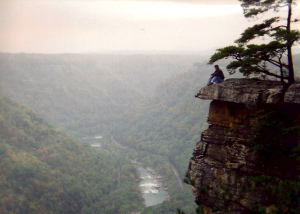
Overlooking the land where anything might happen – wanderlust


October 14, 2013
Locked to Freedom
Cross-posted from Amazing Stories Magazine today.
The problem with the internet is that anyone can write something down, publish it, and present it as fact when it’s not. http://boingboing.net/2013/10/11/amazon-requires-publishers-to.html I have ten titles on Amazon, and another one coming out later this week. Every single one, the default is no DRM, although there is a check-box I can click if I decided I wanted it on my work. Which I don’t. Unlike Big Music and Big Publishing, I don’t think all people are thieves. I also know better than to think that DRM is anything but a challenge to hacker twits who break stuff just for jollies.
The great thing about the internet is that anything can write something down, publish it, and have it become real. This week I came across this article, a truly gifted piece of snark that I enjoyed reading (defining snark: a blend of sarcasm, irony, and one-upmanship. With a heavy dollop of nasty). “It is manifestly obvious that a self-published author is no author at all, and that a self-published book is not published. And since a book must have an author, it is surely evident that a self-published book is not even a book.” Tom Simon goes on to point out that the self-published are in good company, since by that definition, Samuel Clemens’ work was also non-existent.
Mark Twain’s books leads me to a link exploring in photos the abandoned Mark Twain Library in Detroit. I’m rather fond of libraries, and to see this one eerily still, destroyed, with books scattered across the floors and grime on the beautiful windows still letting light in is disturbing. My mind begins to roam through possibilities in these images. They seem so distant to my own experience that they could easily be drawn from a work of fiction, of some distant dystopia. I think they would make a strikingly evocative cover for a book on the fall of some civilization.
Speaking of things that are changing, still? Again? hard to tell, since our industry seems to be in the throes of changing almost weekly. Covers… how important are they? I have to wonder, after looking at a lot of them in designing covers not only for myself now, but other indie authors, how much weight an average reader does give to them. The answers seem to lie across the spectrum, with some claiming they never look at a cover, and others saying that it is what they look at first, because a good cover means that someone paid enough attention and time to make the book worthwhile. I’d argue that last point, having seen the gamut of covers run from execrable, with great story inside, to fabulous, with cra**y story inside.
As an indie author, I’m responsible for all of that, from the ideas that form the work, to the cover that graces it. It means that for me, I work hard at crafting a good product. I do a lot of side work I don’t get paid for, but I have a specific goal in mind that I am working toward. I don’t agree with the guy in this article, who seems to think that because traditional publishers are falling away and he can’t rely on them for income, he will be forced into servitude, to have to work for free. No, there are choices out there, as a writer, that give you control over your own destiny. Brandilyn Collins, in an interview, says this, and pinpoints for me the reason I went indie: “ I’m no longer selling my assets; I own them.”


