
Rob Tripp's Blog: Cancrime, page 3
July 19, 2017
McDonald’s murderer says he’s “funny,” “boring”


July 17, 2017
“It’s insanity” to free serial killer who assaulted girl in prison: Ex-detective
June 30, 2017
Kingston Penitentiary already 32 when it became nation’s prison
 Canadians are celebrating 150 years of nationhood on July 1, marking the birth of the Dominion in 1867. The year also marks an origin point for Kingston Penitentiary, although the institution already was 32 years old at the time of Confederation. Built on the north shore of Lake Ontario in eastern Ontario, on a small bay adjacent to the Village of Portsmouth, the facility was known for the first three decades of its existence as the Provincial Penitentiary at Portsmouth. It received its first prisoners on June 1, 1835. It was renamed Kingston Penitentiary in 1867, becoming the new nation’s first federal prison. Confederation may have stirred joy and national pride, but it was not a happy time for prisoners of the Dominion. A repressive regime of enforced silence, punishment and hard labour persisted at Kingston Pen.
The warden of the newly renamed Kingston Penitentiary in 1867, Donald MacDonell, wrote, at the time, that convicts of the penitentiary were seen as being devoid of rights:
“So long as a convict is confined here I regard him as dead to all transactions of the outer world.”
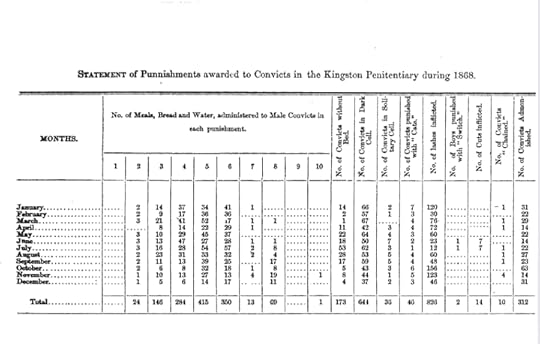
In 1867, convicts of KP still endured brutal punishments for minor breaches of rules. They could be struck with a switch or cat ‘o nine tails, confined in dark cells, placed on bread and water diets and shackled in chains. When a new warden, James Ferres, took over from MacDonell in 1869 and issued a report in 1870, he noted that he found “five convicts wearing a chain; one had carried it for six months, three for seven months, and one for nine years!”
Records reveal that in 1868, more than 800 lashes were inflicted on convicts and more than 40 prisoners were punished with the ‘cats. Two boys (children were confined in the pen) were punished with a switch. The federal government closed Kingston Penitentiary in 2013. Its future remains uncertain, although it remains open to public tours.
A page from the warden’s report for 1868:

June 9, 2017
For a murder victim’s family, perhaps death extinguishes anguish
 Parents are not supposed to outlive their children, so when a child is murdered, an unnatural order possesses a family. The Fraser family is finally free of it. Thirty-two years ago, Ian Fraser (inset) found his mortally wounded 16-year-old daughter Heather on her hands and knees in a snowy park on a cold January evening in Smiths Falls, a small town in eastern Ontario. Heather had been raped and stabbed. Soaked in blood, she was crawling through snowdrifts, trying to reach a nearby road when Ian Fraser, searching, spotted a shape in the park. When the father held his first-born child, she uttered just one word: “Stabbed.” Hours later, Heather died in hospital. Last month, on May 10, 2017, Ian Fraser died at the age of 88. We must hope that death extinguished the anguish he endured for three decades. His wife Carolyn, Heather’s mother, died in 2014.
Ian Fraser was a vet, a member of the Stormont, Dundas and Glengarry Highlanders infantry regiment. Raised in Morrisburg, Ontario, a small, riverfront village in eastern Ontario, Fraser met and married his wife Carolyn Hollier in 1964 in Ottawa. In 1968, he began working for the agency that operates the Rideau Canal, the historic, 200-kilometre long inland waterway connecting the capital to Lake Ontario. The couple had a second child, Laurie, two years after Heather was born.
In 1975, Fraser’s canal job was transferred and the family moved to Smiths Falls, a picturesque town 75 kilometres south of Ottawa known for its railway roots and a chocolate factory. It likely seemed a safe place to raise a young family.
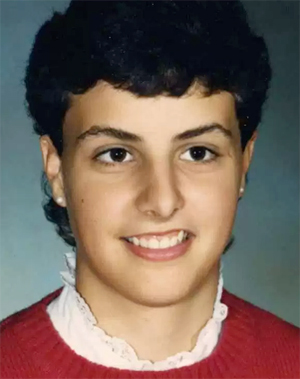
Heather Fraser, who was murdered at age 16 in Smiths Falls, Ontario in 1985
Heather grew into a remarkable young girl. In Grade 6, she was named outstanding student in her school. In Grade 8, she was president of student council. She was awarded one of the highest honours the Girl Guides bestow.
As a teen, she taught Sunday School at the Presbyterian Church. In high school, Heather joined student council. She won spots on school basketball, volleyball and badminton teams. She was a member of the school band. Her grades were excellent so she was placed in a gifted program.
Outside school, she played ringette and softball and won medals in highland dancing. She worked part time at the canteen at the community centre and the arena. She seemed destined for greatness, until her chance encounter, on January 28, 1985, with one of the town’s angry and aimless young men, high school dropout and petty thief Jamie Giff.
The 17-year-old with a growing record of criminal convictions was burning with rage that night. He was furious that his teenage girlfriend had left him. He was hunting her, so that he could beat or kill her. Instead, he found Heather, walking home alone from a student council meeting. The two passed on the sidewalk along the Abbott Street park. Giff decided that Heather was a suitable proxy for his rage. He threatened Heather with a large knife and forced her to walk to the western edge of the park property, behind an embankment that was not visible from the road or sidewalk. He raped her, mutilated her vagina with his knife and stabbed her twice, once in the upper right chest and once in the back, below her right shoulder blade. Believing he had killed Heather, Giff fled.
The injuries were lethal, but Heather began to crawl toward the lights of the sidewalk and the street. She made it roughly halfway out of the park before her father found her, shortly after 7 p.m.
“She was hunched over on her hands and knees with her head down as though she was crawling,” Ian Fraser later told police. “I turned her over on her side. I asked her what was wrong and she just uttered one word, ‘Stabbed.’ She was deep in shock because her eyes were bulging and wide open. There was sort of a gurgling sound in her throat. After she said, ‘stabbed,’ I had her head in my arm and I could see that her shirt was dark and could feel that it was wet. I’m not sure if I opened her coat, not sure whether I unzippered it or not. I think I unzippered it. Her slacks were part way down, about her hips. I hesitated for 10 to 15 seconds, wondering what to do.”
“Then I saw the lights of two vehicles coming north across the bridge. I jumped in the centre of the street and waved both arms. The first was a half-ton truck; the second was a panel truck. They stopped; both drivers rolled their windows down. I asked for help because my daughter had been hurt. Both drivers came running over to her with me. Three of us picked her up and put her in the panel truck. I got in the back with her, with her head in my arms and she started to moan and struggle a bit and I tried to console her, telling her we would be there shortly.”
Heather was taken to the local hospital but was immediately transferred to a hospital in Ottawa. Ian and Carolyn Fraser followed the ambulance in their own car.
About six hours after Ian Fraser found Heather in the park, she was pronounced dead.
Jamie Giff was convicted of first-degree murder and sentenced to life in prison with no chance of parole for 25 years.
In July 2016, Giff was granted full parole, the most permissive form of freedom for a convicted murderer, after the parole board determined he does not present an “undue risk” to society. He can live on his own in the community, without direct daily supervision. He is living in Montreal. In the only interview he has ever given, Giff told me in 2010 that Heather was not his intended victim.
“That day, the rage to kill became uncontrollable,” he said. “[My girlfriend] was the intended victim. Heather Fraser was an innocent victim.”
Ian Fraser was interviewed by the Ottawa Citizen newspaper last year, after Giff was granted full parole, and was asked how he felt on the day that he found Heather.
“I don’t want to remember,” he told the Citizen.
» Read all of Cancrime’s coverage of the case
April 27, 2017
The Mother and the Murderer: Woman confronts son’s killer in prison

 Carolyn Solomon, a mother of two from Sudbury, Ontario, travelled 1,500 kilometres, past razor-wire topped steel fences and gun-toting watchtower guards, into the bowels of a federal penitentiary, to confront the man who murdered her son. Why did she do it? What did the killer say when Solomon looked into his eyes and demanded to know why he shot her son? Solomon explains in The Mother and the Murderer, Episode 8 of the Cancrime podcast (after the jump).
Solomon says she wasn’t on a “forgiveness journey” when she confronted triple murderer Michael Hector inside a Nova Scotia prison in 2013. Solomon felt that she needed to see firsthand that the career criminal was safely locked behind bars. At the meeting, held in a small room inside Springhill Institution, Solomon was the more fearsome of the pair – an aggrieved and determined mother bent on ensuring that the man who shattered her family and who has tricked the system repeatedly, remains imprisoned.
“I don’t trust them … to keep him from falling through the cracks again,” she says.
Michael Hector was on parole when he murdered 29-year-old Kevin Solomon on January 9, 1997 in Thunder Bay, Ontario. Hector murdered another man, Solomon’s roommate, Robert McCollum, that day, and, roughly a month later, he shot to death a third man, gas bar attendant Blair Aitkens, 20. Hector shot Aitkens in the head twice after robbing him of $944. Hector pleaded guilty to three counts of first-degree murder and was sentenced to life in prison with no chance of parole for 25 years. The events sparked investigations of the correctional and parole systems that had freed a repeat offender with a history of parole violations who went on to commit three murders, while supposedly under the watchful eye of supervisors.
The investigations produced troubling revelations. The community parole supervisor didn’t have a complete picture of Hector’s violent criminal past and didn’t check in with Hector’s family and friends. He didn’t know that Hector was spiraling out of control in the months leading up to the murders. Parole board members who freed Hector didn’t read his complete file before making their decision to turn him loose. The head of the Correctional Service at the time, Ole Ingstrup, admitted these failures, in an appearance before a parliamentary committee (Read a transcript of that hearing).
An investigation report deferred blame, asserting that not even a complete and thorough tracking of Hector’s case could have foreseen his murderous rampage.
In effect, three deaths were bloody evidence that, in many cases, Corrections experts and parole authorities are just guessing when they predict whether a violent criminal will reoffend and can be set free.
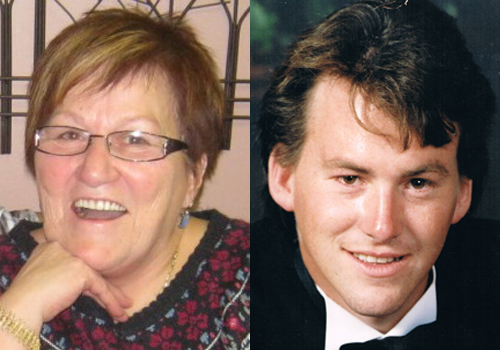
Carolyn Solomon and her son Kevin, who was 29 when he was murdered in January 1997 in Thunder Bay, Ontario, by federal parolee Michael Hector, who murdered two other men, Blair Aitkens, 20, and Robert McCollum, 29 (photos courtesy Carolyn Solomon)
Hector had been paroled from prison and jail sentences many times before the 1997 murders. He was 32 years old in 1997 but already had a lengthy criminal record stretching back to his teen years that included armed robberies, conspiracies and weapons offences. Each time he was freed, he committed new, violent crimes. In 1995, roughly halfway through a cumulative 13-year sentence, he was given full parole, the most permissive form of freedom. His most recent crime was an armed robbery of a store in Winnipeg in 1991. Records documenting the 1995 decision to parole him claimed that he had made “positive progress on his day parole,” he had “recognized the motivating factors of his past criminal behaviour” and he learned that it was necessary to “put his greed for money aside.” The record also noted that his federal record began in 1982 and was followed by “a relatively consistent pattern of increasingly serious offences.” The records suggest he didn’t have a problem with drugs and alcohol and did not have mental health problems. One psychiatrist wrote that “it is doubtful Mr. Hector will require ongoing therapy on a regular basis.” A judge would later says Hector was a psychopath – a remorseless and egocentric predator bent on self gratification at any cost.
Carolyn Solomon and the family of victim Blair Aitkens sued Corrections, the parole board and the John Howard Society, which was contracted to supervise Hector in the community. Lawyers for those Solomon sued put her through hell, she says, until they finally made a cash settlement – a paltry amount she says was a “joke” – enough only to cover her costs. It was hush money, Solomon says, designed to silence her.
Instead, she has raised her voice. Solomon joined a prominent organization based in Ottawa, the Canadian Resource Centre for Victims of Crime. Solomon is now a board member with the agency. She has given speeches and lectures and joined government-established advisory bodies. She has pushed politicians to give victims a greater role and voice in the criminal justice system and she has demanded greater access to information about criminals. Her commitment to the issue is unflinching.
She says there have been some small improvements in the way the criminal justice treats victims but, she says, it still fails many. She believes the entire system is too focused on criminals. Senior bosses, including the commissioner of the Correctional Service, don’t give, in her words, “two hoots about victims.” She says she’ll never stop pushing to balance the scales of justice in favour of victims.
Two parole records for killer Michael Hector, a 1994 decision granting him day parole (release to a halfway house) and a 1995 decision granting him full parole:
If you listen to the Cancrime podcast on iTunes, please leave a rating and a review and don’t forget to subscribe to ensure you’re notified when future episodes are released.
» In a decision released in 2000, Ontario’s top court rejected Hector’s appeal. Read the decision
» The Canadian Resource Centre for Victims of Crime provides support and information for victims and their families. You can call them at 1-877-232-2610 or contact them through their website
Podcast music: Music For Podcasts 2 (Lee Rosevere) / CC BY-SA 4.0

April 13, 2017
Shafia legal appeals exhausted with top court decision
 Canada’s top court has mercifully put an end to the Shafia family charade of innocence claims and birthdate uncertainty. The Supreme Court of Canada announced today (April 13, 2017) that it will not hear the appeal of Hamed Shafia (inset), who claimed he wasn’t 18 years old at the time he and his father and mother murdered four other family members, including three of Hamed’s five sisters. In essence, the court declared that the Shafias are mass murderers and liars, and that’s the end of it. They no longer have any legal recourse. The decision follows the unanimous rejection by Ontario’s top court of appeals by the trio.
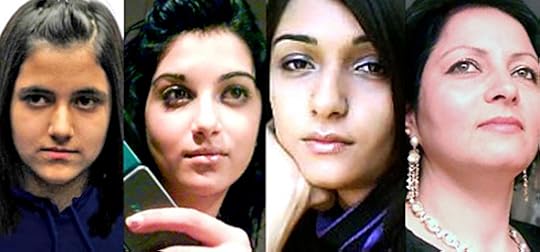
The victims (from left) Geeti, Sahar, Zainab, Rona
The decision by the Supreme Court finalizes a Shafia family portrait already thoroughly sketched. Patriarch Mohammad Shafia is a narrow-minded, greedy and domineering tyrant who ruled his big Afghan family with anger and violence. He demanded subservience and bullied others to do his bidding. He called three of his daughters “whores” because they defied his demands for obedience and modesty. Angered that they sought freedom, Shafia forced his wife and eldest son to help him murder half his family. Caught after killing his kin, Shafia and his second wife and son concocted fantastic lies and preposterous explanations in a desperate bid to elude justice. When that failed, Mohammad Shafia fabricated an elaborate scheme to extricate Hamed from the crushing weight of adult justice.
But no one has been taken in by the lies.
“Charitably put, the evidence of guilt was overwhelming,” Ontario’s top court said, when it rejected the appeals of the killer trio and refused to consider dubious new evidence of Hamed’s age.
The Court of Appeal for Ontario noted that there is one person who could have testified to Hamed’s age with certainty.
“Tellingly, the only accurate source of information about Hamed’s date of birth – Tooba – has not filed an affidavit on the motion,” the Ontario court stated, in its decision released in November 2016. “Her police statement and trial evidence supports the conclusion that Hamed was 18 when the deceased were killed.”
The Supreme Court didn’t provide reasons for refusing to grant Hamed an appeal hearing, but the court received hundreds of pages of information filed by lawyers.
The arguments of Hamed’s lawyers focused on the claim that he wasn’t 18 at the time of the murders. This assertion was built on a supposedly newly discovered document from Afghanistan establishing a different birthdate. Ontario’s top court said the document’s origin was “inherently suspect” and a critical entry on it was “suspect.”
In addition, the timeline of the Shafia family did not make any sense, when reconstituted to accommodate Hamed’s supposed new birthdate of Dec. 31, 1991, rather than Dec. 31, 1990.
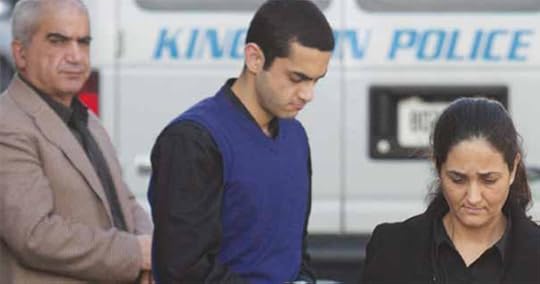
The convicted killers (from left) Mohammad Shafia, son Hamed, wife Tooba
The 1990 birthdate is recorded in his passport and numerous immigration documents. In order to reconcile Hamed’s purported 1991 birthdate with the births of the other siblings, Mohammad Shafia claimed that the birthdates of three other children – also recorded in many official documents – are also wrong. Shafia claims that Sahar was born in 1992, not 1991; Mina* was born in 1993 and not 1992 and Zafar*, his other son, was born in 1994 and not 1993. Shafia was cross-examined about this seismic shifting of the family timeline, under oath, during an in-camera hearing held in a Kingston courtroom in October 2015. I obtained a transcript of the secret hearing.
At first, Shafia told Crown lawyer Jocelyn Speyer, who questioned him, that he remembered the years that three of his children were born, but “not precisely” when the others were born. He claimed that he knew when Hamed, Zainab and Sahar were born but, during further questioning, his memory seemed to improve and he suddenly remembered when Zafar and Mina were born.
“I thought you just told me you only remember, exactly, the years for Zainab, Hamed and Sahar?” Speyer asked.
“I remember somehow of Zafar, Mina, I remember that, because, after a while when we got, so, she was born,” Shafia answered. “The other ones? No.”
Speyer responded: “I didn’t understand any of that answer.”
It’s not surprising that Shafia’s convoluted answers were puzzling. His shifting timeline didn’t align with other information.
There’s good evidence that the family fled civil war in Afghanistan in August 1992, moving to Pakistan. Shafia has repeatedly confirmed 1992 is the year they left Kabul, with three young children – Zainab, Hamed and Sahar. But in order to explain Hamed’s new birthdate, Shafia has moved Sahar’s date of birth to October 1992, after the family left Kabul. He doesn’t appear to have an explanation for a timeline in which Sahar is born both before and after the family moved to Pakistan.
There’s more evidence that Shafia lied about the new timeline. During that closed-door hearing in October 2015 in Kingston, the Crown showed Shafia a photograph, date stamped May 22, 1993 and taken in Pakistan. The photo shows Shafia and three children, Zainab, Hamed, Sahar and Tooba, who appears to be pregnant, holding an infant.
“It has to be Mina,” Shafia testified.
He wasn’t asked to explain this significant inconsistency. In Shafia’s new Hamed-wasn’t-born-in-1990 timeline, Mina was born in December 1993, seven months after the Pakistan photo that shows Tooba holding Mina. The photo, embedded at the bottom of this story, was included in the material filed with the Supreme Court of Canada.
Hamed Shafia and his father, Mohammad, and mother, Tooba Yahya, were each convicted in January 2012 of four counts of first-degree murder. Sisters Zainab, 19, Sahar, 17, Geeti 13 and Rona Amir, 50, who was Shafia’s first wife in the polygamous family, were found dead June 30, 2009, inside a sunken car resting at the bottom of a shallow canal in Kingston, in eastern Ontario.
Jurors during the murder trial heard that Mohammad Shafia orchestrated the killings, believing it would restore his family honour. He felt it was tarnished because three of his daughters violated cultural rules around modesty and obedience and Rona, his infertile first wife, supported the defiant girls. Jurors heard that Hamed researched locations to dispose of the bodies and means to commit the murders. The victims may have been killed first, perhaps by being drowned in a bathroom or in a shallow pond, before they were placed inside a car that was shoved into the canal. A doctor concluded all of the victims died of drowning, but he could not say conclusively when or how they drowned.
The killers were each sentenced to life in prison with no chance of parole for 25 years.
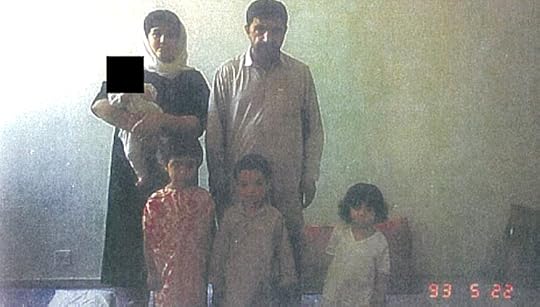
A photo apparently taken in Pakistan in May 1993, showing Mohammad Shafia and Tooba holding an infant (Mina*), with children Zainab (from left), Hamed and Sahar in front. Mina’s face is obscured to protect her identity, in compliance with a court order. (from Supreme Court of Canada file)
* These are pseudonyms for the three surviving Shafia children who are not in prison. These names are used throughout my book on the case, to comply with a court order that protects their identities. The order never expires.
» Read more about the Shafia web of lies
» Complete guide to the case
» Buy my book on the case
March 10, 2017
Rate of prison escapes increases 45% in 3-year span
 Corrections Canada doesn’t seem concerned by a 45-per-cent increase in the rate of escapes from penitentiaries over the past three years. The rate in the 2015-16 fiscal year was 1.23 escapes per 1,000 inmates, up from 0.85 three years earlier, according to a departmental plan for 2017-18 recently tabled in parliament (read it in full after the jump). The prison service says that “in spite of the increase in the rate of escapes during the last three years, the results are still meeting CSC’s target.” It demonstrates that, if you set your expectations suitably low, any achievement is acceptable. This isn’t the only non-success at the $2.5 billion a year penitentiary service. In this three-year period, the rate of “non-natural and undetermined offender deaths in custody” rose by 60 per cent.
Corrections also doesn’t appear too concerned about the substantial increase in the rate at which prisoners are dying “non-natural deaths.”
“When dealing with non-natural deaths in custody, escapes, or drugs in institutions, CSC’s objective is zero,” the service states, in the document. “It is necessary, however, to put that objective in the context of reality; therefore, CSC’s results are compared with those from previous years and in relation to its current operational context.”
In the past decade, a litany of reports from the office of the correctional investigator, coroner’s inquests and CSC’s internal investigations exposed chronic problems related to deaths in custody that required urgent attention. The correctional investigator has repeatedly criticized Corrections for failing to incorporate past lessons and failing to respond to key recommendations.
Here’s the section from the Correctional Service’s 2017-18 plan, revealing the increases in escape and death rates:
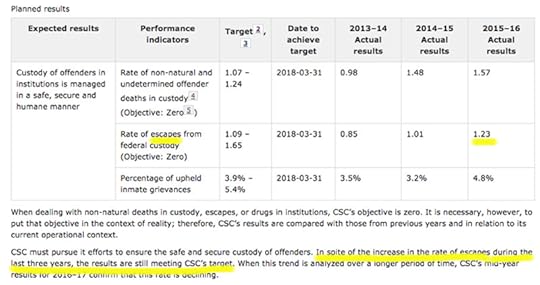
The department plan notes that the prison service’s 2017-18 spending is expected to be $2.57 billion. In the past decade, the budget of the federal prison service has ballooned by more than $1 billion, an increase of more than 60 per cent since 2005-06, when the Harper-led Conservative government came to power with a tough-on-crime agenda that put more people behind bars for longer sentences.
Here’s the complete department plan document for 2017-18:
» Previous post on prison spending and inmate deaths
» Infamous escape from Kingston Penitentiary of Tyrone Conn
February 27, 2017
Infamous honour killer father dies in prison
 Muhammad Parvez, who strangled his 16-year-old daughter Aqsa (inset) to death because of his distorted belief that she had tarnished his family honour, has died in prison. His death comes nearly a decade after the murder that became a flashpoint for a national debate about cultural traditions imported to Canada by newcomers. “I killed my daughter. . . with my hands,” Parvez said, in a 911 call placed minutes after the murder in the Parvez home in Mississauga, Ontario in December 2007. The Parvez case sparked a sustained and furious national debate about the spread of misogynistic and patriarchal practices that put women and girls at risk of violence and death, though there had been many such murders dating back decades before Aqsa’s death. The debate intensified two years after Aqsa’s death, when four members of the Shafia family were murdered in June 2009 in Kingston, Ontario in a mass honour killing – the case that is the focus of my true crime book, Without Honour: The True Story of the Shafia Family and the Kingston Canal Murders.
Corrections Canada says Muhammad Parvez, 67, was found dead on Feb. 22, 2017. He had been serving time at Beaver Creek Institution in Gravennhurst but he was found dead at a Corrections Canada hospital at Millhaven Institution near Kingston, according to Cancrime sources. He was suffering from cancer. Deaths in custody in Ontario are automatically subject to coroner’s inquests.
Parvez pleaded guilty to second-degree murder, along with his son Waqas, in Aqsa’s killing. The father and son were sentenced to life in prison with no chance of parole for 18 years. Waqas Parvez remains behind bars.
In an interview with police, Aqsa’s mother said that she asked her husband why he killed their daughter.
“He said, ‘This is my insult. My community will say you have not been able to control your daughter. This is my insult. She is making me naked,’ ” Aqsa’s mother told officers. (the full interview appears in the statement of facts embedded at the bottom of this story)
Aqsa was murdered because she sought freedom from the oppressive control of her Pakistani father, who did not want her to wear western clothing, socialize with friends or work at a part-time job. When she defied her father, he plotted to kill her. The Parvez case highlighted the inability of Canadian institutions and agencies to recognize and respond appropriately to such threats. In the months before the murder, Aqsa had told school authorities, counsellors and friends that she feared her father would kill her. Similarly in the Shafia case, there were multiple warnings before the murders.
After the Parvez killing, the federal government commissioned a study of honour killings. It concluded what many other experts and researchers had long established – that the murders are a product of oppressive, patriarchal traditions in which women and girls are required to be obedient, subservient to the men in their families, modest and compliant. Men in these families view disobedience, particularly if it’s known publicly, as bringing shame or dishonour on the patriarch and the family. The men cling to the distorted belief that the only way to cleanse this shame is to kill the offending girl and/or woman. Honour killings are practised in many cultures and across numerous religions. In Canada, because many honour killings have involved perpetrators from Muslim-dominated South Asian countries, the debate has often become a polarized and angry tirade against religion. For a thoughtful analysis, read the policy paper (embedded below) by Aruna Papp, survivor, advocate and author, one of Canada’s few true experts on honour violence and honour killing.
Though the Parvez case was one of the first in Canada to attract widespread and sustained national coverage – and to garner international headlines – it was far from the first in the country. In 1991, Daljit Singh Dulay killed his sister, Kulwinder Dulay, 20, her husband Gurdawr Singh Dulay, 28, and Mukesh Kumar Sharma, 28, on a street in downtown Calgary, Alberta, outside a video store where the couple worked. Daljit Dulay was angry that his sister had eloped and secretly wed, without the permission of her strict Sikh family. He was convicted of two counts of first-degree murder and one count of second-degree murder.
Some other honour killings in Canada:
• 1999, Ottawa: Adi Abdel Humaid stabbed his wife Aysar Abbas to death while they were in Ottawa (they lived in Dubai). She was stabbed in the neck at least 19 times and stabbed in the heart. Humaid was convicted of first-degree murder. His appeals were rejected. At trial, a defence expert on Islamic religion and culture testified that infidelity by a woman could lead to violence because it would be viewed as a serious violation of family honour.
• 2003, British Columbia: Amandeep Atwal, 17, died of multiple stab wounds at the hands of her father, Rajinder Singh Atwal, who was convicted of second-degree murder in the case. He had brought his teenage daughter to hospital in Langley, B. C., claiming she had inflicted the wounds on herself, but court heard that Mr. Atwal disapproved of the 17-year-old’s love affair with a classmate, who was a year older.
• In 2006 in Ottawa, Ont., Khatera Sadiqi, 20, and her fiance, Feroz Mangal, were shot to death by Sadiqi’s brother, who believed she had shamed the Pakistani family by getting engaged without her father’s consent. Hasibullah Sadiqi, 23, was convicted of two counts of first-degree murder.
• In June 2007 in Scarborough, Ont., Anitha Selvanayagam, 16, and her boyfriend were walking together when they were run over and seriously injured by a van driven by her father. Prosecutors called it an “attempted honour killing” by Sri Lankan immigrant Selvanayagam Selladurai who was angry that his daughter had dated a boy of a lower caste. He pleaded guilty to three counts of aggravated assault. Selladurai also ran down his son-in-law in the attack.
• In January 2009, Amandeep Kaur Dhillon, 22, was stabbed to death by her father-in-law, 47-year-old Kamikar Singh Dhillon, who believed she would disgrace his family by divorcing his son. He pleaded guilty to second-degree murder.
Because Aqsa Parvez’s killers pleaded guilty, there was no trial, but an agreed-statement of facts was entered into evidence:
Aruna Papp’s policy paper on honour killings:
» All Cancrime coverage of the Shafia honour killing case
February 23, 2017
Calgary triple murder case makes legal history
 A Calgary murder case has established a significant Canadian precedent. For the first time, a multiple murderer has been sentenced to 75 years in prison without parole eligibility in a case in which the bodies of the victims were not found. A judge imposed the crushing penitentiary term – three consecutive life sentences – on Douglas Garland (inset) in February 2017, after he was convicted of three counts of first-degree murder in the deaths of five-year-old Nathan O’Brien and his grandparents, Alvin Liknes, 66, and Kathy Liknes, 53. Only a handful of Canadian killers have been sentenced to prison terms longer than 25 years, under changes to criminal law that came into force in 2011.
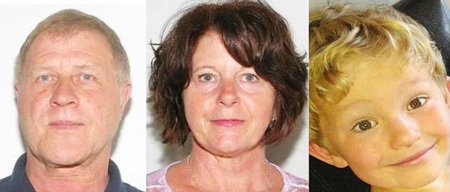
The victims, (from left) Alvin Liknes, Kathryn Liknes, Nathan O’Brien
The victims vanished in 2014 and, although their bodies were not found, jurors at Garland’s trial were told that investigators believe he kidnapped them on June 29, 2014 and took them to his family’s farm north of the city, in Airdrie. The victims may have been tortured and murdered before their bodies were burned. Jurors were shown aerial photographs that prosecutors contend show the bodies of the victims prone in the grass at the Garland property. The photos were taken by an aerial surveying firm. The bodies were not located when Garland was arrested two weeks after the victims disappeared, although forensic investigators found the DNA of the trio at the Airdrie farm – including on a meathook and a saw. Small pieces of human remains, including what were believed to be teeth, also were found.
A murder prosecution is not unheard of in Canada in the absence of the body of the victim, but cases with multiple victims are rare.
In 1987, Al Dolejs, a Calgary man, was convicted of murdering his 12-year-old son Paul and his 10-year-old daughter Gabi. Their bodies were not found until after Dolejs was convicted, when he led police to the remains.
In January 2017, Travis Vader was convicted of two counts of manslaughter in the deaths of Lyle and Marie McCann, Edmonton-area seniors who disappeared in 2010. Their burned out motorhome and SUV were found but a forensic anthropologist could not find any human remains in the charred debris. Vader is appealing.
In the past decades, there have been successful murder prosecutions in the absence of a single body.
In 2001, Timothy Culham was convicted of murdering 72-year-old Toronto antique collector Hugh Sinclair. Sinclair’s body was recovered after the conviction. Culham lost an appeal against his conviction for first-degree murder.
Peter Stark was convicted in 1994 of first-degree murder in the death of Julie Stanton, a 14-year-old girl who had been his neighbour in Pickering, Ontario. She disappeared in 1990. Her body was found two years after Stark had been convicted and sent to prison. In Stark’s appeal, the Court of Appeal for Ontario noted that at trial “there was no crime scene evidence placed before the jury, nor any other forensic evidence establishing a connection between [Stark] and Julie Stanton.” The appeal was dismissed. Stark died behind bars in 2016 at age 71.
While the Garland prosecution was largely circumstantial, prosecutors had evidence that tied him directly to the victims, including the forensic findings at the farm and surveillance footage from the Calgary neighbourhood where the Likneses lived that captured a truck matching the description of Garland’s. The truck was seen in the area on the day the victims vanished.
Although it’s not yet clear if Garland will appeal, appeals are commonplace in cases where accused are convicted of first-degree murder.
Robert Baltovich was convicted of second-degree murder in 1992, although police had not found the body of his purported victim, his girlfriend Elizabeth Bain. The 22-year-old Toronto woman disappeared in 1990. Baltovich spent eight years in prison. He appealed and his conviction was overturned, primarily because the appeal court found that his trial was unfair. “The charge to the jury was unfair and unbalanced,” Ontario’s top court ruled. “It also contained significant errors of law that were prejudicial to the appellant.” The court ordered a new trial but at the second trial, the prosecution called no evidence and Baltovich was acquitted.
In the Garland case, prosecutors also had compelling evidence from the Liknes home. There were bloodstains and bloody handprints that indicated a violent struggle had taken place, evidence suggesting that the three family members had been assaulted, perhaps incapacitated by violent blows, and abducted. Forensic examiners did not find Garland’s DNA in the blood-stained Liknes home.
In a first-degree murder case the prosecution must establish, beyond a reasonable doubt, four essential elements: that the accused person committed an unlawful act, that the unlawful act caused the death of the victim, that the accused person had the intent required for murder and, the murder was both planned and deliberate. Although motive is not an essential element that must be proved in a murder case, prosecutors established that Garland long harbored a grudge against Alvin Liknes over past business dealings between the men. Garland nursed his bitterness for years until it became a murderous obsession. He acted on it when he learned that the Likneses were moving away from Calgary.
Jurors heard that forensic investigators found a concealed computer hard drive at the Garland farm. The drive contained documents and photos about torture, murder and dismemberment. Documents found included a book on how to kill without joy, how to become an assassin, an autopsy manual and a file on DNA removal. There were 87 photos of dead or dismembered people and there was information about adult diapering. Investigators also found photos of adult women in diapers who were bound with handcuffs and other restraints. Investigators also found a trove of weapons on the farm, including knives, striking instruments, and handcuffs.
Justin Bourque was the first person in Canada sentenced to 75 years in prison, after the law was changed in 2011. In 2016, John Ostamas was sentenced to 75 years after he was convicted of murdering three homeless men in Winnipeg.
February 16, 2017
Sex predator-psychopath free again, charge recommended
 The parole board has recommended the laying of a criminal charge against a serial sex offender living in Vancouver because he breached conditions designed to protect the community. The board also imposed new conditions on him as it struggles to control the psychopath with a 30-year record of crimes including sexual assault and accessory to murder. Donald Gazley (inset), who is living at a halfway house in Vancouver, already is subject to an onerous 10-year supervision order, a rarely used form of close observation imposed on the most dangerous criminals. Gazley, 56, was diagnosed in prison as a “classic psychopath” and is considered a high risk to commit new sex offences. His last federal penitentiary sentence expired in December 2015 and he was released to a halfway house. His 10-year supervision period began at that time. In the roughly 13 months that he has been free from prison, Gazley has been repeatedly caught engaging in worrisome behaviour that appears designed to test the boundaries of his legal leash and put him in a position to procure new victims.
In this most recent decision, November 4, 2016, the Parole Board of Canada concluded that Gazley’s recent conduct constitutes a breach of the conditions of his supervision order and he should be charged with a criminal offence. A conviction could put him back in penitentiary for two years. It’s unclear if he will be charged. The final decision rests with Crown prosecutors. Spokesmen for the Parole Board of Canada, which makes decisions in Gazley’s case, the Correctional Service, which supervises him in the community, and Vancouver Police, could not tell Cancrime if a charge has been laid or will be laid. It appears that Gazley is again free from custody.
The latest parole decision came after Gazley was arrested August 29, 2016 and his release was suspended. It was the second such suspension (read about his previous suspension) since he was released from prison in December 2015.
The parole board notes, in this latest decision, that, despite 10 supervision conditions and the requirement that Gazley live at a halfway house, he engaged in behaviour that substantially elevated his risk of reoffending.
“The Board is satisfied that no appropriate program of supervision can be established that would adequately protect society from your risk of reoffending,” the decision states.
In an attempt to rein in Gazley, the parole board imposed two new conditions to his supervision order: he is forbidden from owning or possessing a computer or any other device that permits him access to the Internet, including a cellphone, unless approved by his parole supervisor and, he is not permitted to access the Internet without the direct supervision of an approved adult.
There are now 12 conditions on Gazley’s long terms supervision order, up from seven when he was first freed in 2015.
A host of troubling information about his recent activities is documented in the latest parole record:
• Gazley was seen by police meeting women at a coffee shop without reporting the meetings to his parole supervisor, as required
• he was providing legal representation to another inmate to obtain identity documents from another country, without the knowledge of his supervisors
• his cellphone was under another offender’s account
• he had established a web-based business under a different name and it was registered to another federal offender with whom he was forbidden to have contact. The business allowed people to contact him for editing work and falsely indicated he had worked with students, the federal government and non-profit organizations.
• he had borrowed a camera from another halfway house resident to take pictures at Stanley Park
• he had communicated with a woman by email in order to obtain personal information.
Gazley is subject to onerous requirements that forbid him from initiating any friendships or relationships with women without informing his parole supervisor. He’s also barred from going near any places, such as parks, swimming pools, schools and recreational areas, where children would congregate.
Gazley’s criminal record stretches back to 1977 and includes sex crimes against children as young as 11, including girls and boys. He also has committed sex crimes against vulnerable adults.
Gazley is a chronic liar and manipulator. He confessed, during his testimony during a murder trial in Ontario in 2002, to lying “almost … all the time” when talking to police about the murder, before striking a deal for a lenient sentence in exchange for his testimony against the killer. (Learn more about Gazley’s past and psychopaths in this story and podcast).
Gazley has continued to reoffend despite going through many treatment programs during his multiple terms in prison and jail. Treatments given to sexual psychopaths “have shown little or no reduction in recidivism rates,” according to research by forensic psychologist Stephen Porter, an expert on psychopaths. His research shows that Gazley fits into a category of criminals who “can be expected to offend early, persistently, and often violently across the lifespan.”
Despite the threat Gazley poses and his resistance to treatment, top legal authorities in Ontario, where he was last prosecuted, chose not to seek to have him declared a dangerous offender. This designation could have kept him behind bars forever. Gazley was sentenced to eight years in prison in 2008 after pleading guilty in an Ottawa court to attempting to lure a 14-year-old girl into sex acts.
In 2000, Gazley was sentenced to the equivalent of 16 months in custody after he pleaded guilty to four sexual assaults on girls aged 11 to 14 in Kingston, Ontario, including a learning disabled girl he met at his son’s school. That year, he also pleaded guilty to accessory to murder and was handed a lenient 11-month sentence, in exchange for his testimony against the killer.
Gazley was convicted of sexual assault in 1985 for an attack on a 20-year-old woman with a developmental handicap. Gazley was a social worker at the group home where she lived.
The written record of the November 4, 2016 parole decision:
» Research on sexual psychopaths
» All Cancrime coverage of Gazley
Cancrime

- Rob Tripp's profile
- 8 followers

