
Rob Tripp's Blog: Cancrime, page 7
November 27, 2015
Shafia appeal hearing put off until 2016
 As expected, Ontario’s top court has postponed a hearing of an appeal by three members of the Shafia family of Montreal, who were convicted of murdering four other family members in a mass honour killing. The hearing, originally scheduled to be heard by the Court of Appeal for Ontario on Dec. 14, has been put off because of the surprise claim by one of the three convicted killers, Hamed Shafia (inset), who is bringing an application to admit fresh evidence.
The youngest of the trio now claims he was under 18 at the time of the murders in June 2009 and therefore eligible to seek trial and sentencing as a youth. He claims he was born in Afghanistan on Dec. 30, 1991. Hamed, along with his father Mohammad Shafia, now 62, and his mother Tooba Yahya, now 45, were each convicted of four counts of first-degree murder and sentenced to life in prison with no chance of parole for 25 years. If Hamed were tried and convicted as a youth, he would be eligible for a much shorter period of parole ineligibility. It is expected that the hearing of the appeals will be held in early March.
The three convicted family killers claim, in their key appeal document filed with the court, that they were victims of “cultural stereotyping” and “overwhelmingly prejudicial evidence” that should not have been admitted at their murder trial.
The bodies of Shafia sisters, Zainab, 19, Sahar, 17, and Geeti, 13, and of Roma Amir, 50, who was Mohammad Shafia’s first wife, were found in a submerged car in a shallow canal in eastern Ontario on June 30, 2009. The polygamous Afghan family settled in Montreal in 2007.



November 23, 2015
Youngest Shafia honour killer claims he was underage at time
 Hamed Shafia (inset), the Montreal man convicted, along with his father and mother, of murdering four family members in what the trial judge called a “heinous” and “despicable” mass honour killing, is poised to present a new claim to Ontario’s top court in the appeal of his conviction. The youngest Shafia killer maintains that he was not 18 years old at the time of the murders on June 30, 2009, and he has documents newly obtained from Afghanistan, his birthplace, that purport to prove it, Cancrime learned.
Shafia was tried and sentenced as an adult, based on documents that indicated he was born in Kabul on Dec. 30, 1990. Those records established that he was 18-and-a-half years old at the time of the killings, and therefore subject to adult criminal law.
After a 45-day trial, he was convicted of four counts of first-degree murder and sentenced to the mandatory term of 25 years in prison before parole eligibility. If convicted of murder in youth court and sentenced as a youth, he would be eligible for parole much sooner, perhaps in as few as five years, calculated from the date of his arrest, July 2009, according to Nicholas Bala, a Queen’s University law professor and expert on youth criminal law.
“He would have significantly earlier parole eligibility,” Bala said. The legal scholar, who has studied youth criminal law for more than 30 years, said it might be the first case in Canada in which a killer sought to prove he was underage after his adult conviction.
“I don’t think it’s ever been litigated in this way,” he said.
Veteran Toronto criminal defence lawyer James Lockyer said this case is unique.
“I’ve never heard of such a case,” he said.

The victims, (from left) Zainab, Sahar, Geeti, Rona
Hamed Shafia was tried jointly with his father, Mohammad Shafia, now 62, and his mother Tooba Yahya, now 45, in the murder of his sisters, Zainab, 19, Sahar, 17, and Geeti, 13, and of Roma Amir, 50, who was Mohammad Shafia’s first wife. The polygamous Afghan family settled in Montreal in 2007. Two years later, the victims were found dead inside a sunken car resting at the bottom of a shallow canal in Kingston, in eastern Ontario.
The trial was held in Kingston from October 2011 to January 2012. After the guilty verdict, trial judge Robert Maranger said the crimes were based on a “twisted notion of honour.” Jurors heard that Mohammad Shafia orchestrated the killings, believing it would restore his family honour. He felt it was tarnished because three of his daughters violated strict cultural rules around modesty and obedience and Rona supported them. Jurors heard that Hamed researched locations and means to commit the murders.
The Montreal Gazette has learned that a secret hearing was held on Oct. 23 in a courtroom in Kingston, during which Mohammad Shafia testified that the newly obtained documents correctly show that his son was born Dec. 30, 1991. It would make Hamed 17-and-a-half at the time of the killings, and 23 today.
The three killers already filed a 110-page document with the Court of Appeal in March 2015, complaining that they were victims of “cultural stereotyping” and “overwhelmingly prejudicial evidence” that should not have been admitted at their trial. A hearing of those claims was to be heard Dec. 14, but it appears the new claim will derail the plan.
“I have every reason to believe it’s going to be rescheduled,” Crown lawyer Jocelyn Speyer said. She declined to answer questions about the Oct. 23 hearing or Hamed’s new claims.
“I’m not prepared to comment on anything that’s not public record at this time,” said Speyer.
Hamed’s Toronto lawyer, Scott Hutchison, is filing an application seeking to put the new birthdate documents before the Court of Appeal as fresh evidence. Hutchison also declined to comment.
Mohammad Shafia, who is serving his sentence at medium-security Warkworth Institution, near Campbellford, Ont., was quietly whisked to Kingston from the penitentiary for the Oct. 23 hearing. He was the only witness, called to answer questions under oath about an affidavit he has signed, explaining how the new identity documents were obtained. Shafia claims that while he always knew his son’s correct birthdate, he did not learn of the existence of the documents establishing Hamed’s 1991 birthdate until after the trio was convicted.
Justice Michael Tulloch of the Court of Appeal for Ontario travelled to Kingston from Toronto to preside over the daylong hearing last month. Speyer cross-examined Shafia, who testified in his native Dari, with his answers interpreted. Hutchison also was present, along with another lawyer from his firm. Hamed was not present.
If the Court of Appeal is satisfied that the new documents establish that Hamed was not 18 at the time of the killings, it would have several options, Lockyer said, including the possibility of ordering a new trial in a youth court.
“He’s been tried under an adult process and … does that mean his trial’s vitiated as well?” he said. “I don’t know.”
Lockyer said the Appeal Court also could “choose to become effectively a trial court and impose the sentence it thinks would be appropriate,” or refer the case to a youth court for a new sentencing decision.
Bala said that a Crown prosecutor would almost certainly seek to have Hamed Shafia sentenced as an adult, even if convicted as a youth. A 17-year-old convicted of first-degree murder can be sentenced as an adult, but the maximum term is life imprisonment, without parole eligibility for 10 years.
A youth sentencing decision is based on the notion that someone under age 18 has diminished moral blameworthiness.
Media lawyer Brian Rogers says he is puzzled by the secrecy surrounding last month’s hearing.
“While I don’t know the facts involved, it seems extraordinary for a Court of Appeal hearing to be conducted in camera, particularly if oral testimony was heard — unless it involved a confidential police informant,” Rogers said. “It is crucial to ensure public scrutiny at every stage of proceedings, as the Supreme Court of Canada has made clear.”
Hamed Shafia is behind bars at maximum-security Millhaven Institution, near Kingston, one of Canada’s toughest penitentiaries. He did not testify at his trial but jurors heard from another witness that Hamed claimed to have been at the canal the night his four family members died. He said that they drove into the water by accident and drowned. He did not call 9-1-1 or try to rescue them.
Bala expressed skepticism about the birthdate issue.
“I think there may be a significant credibility issue here,” he said.
(this story was first published by the Montreal Gazette newspaper)
» Read all of my news coverage of the story, including my newspaper reports from the 45-day trial
» Want the complete story? Read my book on the case, Without Honour: The True Story of the Shafia Family and the Kingston Canal Murders
November 5, 2015
New prisons boss can do one small thing to send big signal
 Ralph Goodale (inset), the Saskatchewan farm boy now in charge of Canada’s federal prison system, could swiftly do one small thing that would send a big signal that the Harper legacy of punitive correctional policies will be dismantled. Goodale should move quickly to restore convict-operated farms at penitentiaries across the country. Six pen farms in five provinces were shuttered by the Conservative government in 2010, for no justifiably good reason. Really, Goodale may have no choice. A vocal and remarkably persistent lobby group based in Ontario has a signed promise (read it after the jump) from the Liberals, obtained before the October federal election, to reopen one of the prison farms. It isn’t much of a stretch to conclude that if reopening one is a good idea, it’s worth reopening all of them.
If Goodale needs justification to reopen the pen farms fast, he can point to a parliamentary committee report tabled in December 2010 that concluded that the farms were an “excellent rehabilitation” tool that should immediately be restored.
Even the prison service backed the recommendation to keep them open.
“A literature review conducted by [Correctional Service of Canada] concludes that animal therapy programs not only help participants by improving their behaviour and learning about discipline, as well as their sense of co-operation and respect for others; they also help staff of correctional institutions since the presence of animals makes the atmosphere more relaxed and encourages communication among inmates,” the 2010 report noted. “This report concludes that participating inmates learn skills that would serve them well in jobs after release and would reduce re-offending. For this reason, the committee has difficulty understanding why CSC decided to terminate the prison farm program at penitentiaries by March 31, 2011.”
The Conservatives scoffed at the Opposition-authored report, dismissing it as a misguided lefty campaign to coddle criminals and ignore victims. Then-public safety minister Vic Toews ignored the evidence of his own department that the pen farms did exactly what the correctional system was supposed to do – help prepare prisoners to be law-abiding citizens after release and, in the process, keep communities safer. Corrections Canada initially explained the closing of the pen farms as necessary because they didn’t provide “relevant and practical” employment skills. Critics pointed out that the argument was akin to suggesting that farming is irrelevant in Canada. I expect that Goodale, who was raised on a family farm near Wilcox, Saskatchewan – and once served as agriculture minister in a previous Liberal government – does not share this view.
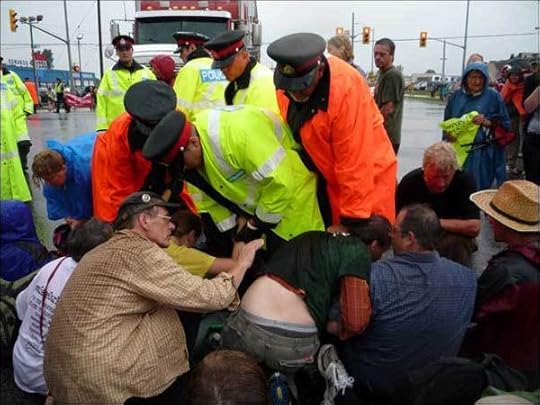
Protesters trying to block the removal of dairy cattle from the Frontenac Institution farm in Kingston, Ontario, in August 2010 are arrested by police (photo courtesy Alec Ross)
The feds seemed unprepared for angry protests that the pen farm closings sparked in Kingston, Ontario, where demonstrators blockaded the entrance to minimum-security Frontenac Institution in a bid to prevent trucks from removing the prison farm’s dairy cattle. Police hauled off protestors and the cattle were trucked away. Two dozen people were arrested and charged, including a 14-year-old girl and an 87-year-old woman. The protesters vowed to keep up the fight against the closings. They have held a vigil outside the prison every week for the past five years.
When the dissent first erupted in 2010, the Conservative government offered a new, preposterous argument that the pen farms had to be closed because they were money losers, costing taxpayers $4 million yearly. Toews never explained publicly why, following this absurd logic to its conclusion, the entire penitentiary system, a money-losing operation that costs taxpayers more than $2.3 billion yearly, wasn’t a target of closure.
Apart from the operational rationale to restore the pen farms, there’s political capital at stake for the Liberals, who campaigned on the slogan: “Real Change.” After nearly a decade of punitive and regressive correctional policies implemented by the tough-on-crime Tories, Canada’s prison system is more violent, less humane, and, importantly, less effective, if we believe the objective is keeping communities safe. Goodale can, with this one small measure, make clear that the Grits will preside over a more humane and more effective system. He can say: ‘It’s still punishment, but smart punishment with an eye to rehabilitation and the safety of our communities.’
Goodale also can reopen the penitentiary farms because he knows how to get it done and, if Justin Trudeau is to be believed, because cabinet ministers are being given wide latitude and autonomy. Goodale is a veteran MP, first elected in 1974, who has held key cabinet portfolios, including finance. He knows how the bureaucracy works and which levers to pull to engage the machinery. Goodale could easily get the process started to reopen some or all of the pen farms. He may want to do it before there’s significant public pressure to do so.
Diane Dowling, the president of the National Farmers Union local in Kingston, Ontario, one of the key figures in the 2010 Save Our Prison Farms movement, told me, before the cabinet announcement, that the group will contact the minister.
“We will be pressing the government to act on their commitment,” Dowling said.
Dowling said a committee of local farmers worked with Kingston’s former Liberal MP, Ted Hsu, to draft a business plan for a revived pen farm at Frontenac institution with a herd of 50 cows and an artisan cheese factory. Before the Tory axe fell, there were also pen farms at Joyceville Institution in Ontario, Bowden Institution in Alberta, Riverbend Institution, near Prince Albert, Sask., Rockwood Institution, near Winnipeg, Man., and at Westmorland Institution in New Brunswick.
The Kingston-area activists secured a signed letter from Liberal MP Wayne Easter (who was re-elected on Oct. 19, 2015), the former Liberal Public Safety critic, who committed to reopening the Frontenac Institution prison farm.
“It is our intent as a future Liberal Government to support the re-opening of this facility,” Easter wrote, in the letter, dated April 1, 2015. “Proven human rehabilitation paired with the net benefit of a sustainable food source for the prison is indisputable.”
Here’s the April 1 letter signed by Wayne Easter (on mobile? click here to read doc):
Here’s my story from Feb. 24, 2009, published in the Kingston Whig-Standard newspaper that broke the news of the impending pen farm closings:
Union and farm leaders yesterday condemned a decision to close six prison farms – including two in Kingston.
“Our six Corcan farms are going to be gradually phased out … over a period of two years, starting immediately,” Christa McGregor, speaking in Ottawa for the Correctional Service of Canada, said yesterday.
Corcan is the prison service’s manufacturing arm.
McGregor said the decision follows a strategic review done last year to ensure that spending is focused in areas where it’s most needed.
“It was decided that this was one of the programs that’s possibly not meeting the needs of offenders,” she said. “We recognize the need to provide offenders with marketable employment skills for today’s employment realities, so we will be looking at developing alternative training that will provide more relevant and practical employability skills.”
The farms employ 300 inmates across the country. McGregor couldn’t provide any details about what kinds of inmate training would take the place of agricultural work or how swiftly it would be created.
“It’s very early right now,” she said.
McGregor said no decisions have been made about the future of the farm properties.
The decision to close the prison farms “absolutely makes no sense,” said John Edmunds, national president of the Union of Solicitor General Employees.
Members of his union supervise inmates in the farm operations.
“Does this mean the Harper government doesn’t believe in farming, the cornerstone of our country?” wondered Edmunds.
“The government’s giving orders to shut down the farm annexes across Canada that are in federal corrections, saying that it’s not a good trade now, I guess, it’s not meaningful employment.
“It’s a joke.”
McGregor defends the decision.
“[Inmates] do gain farming skills from this program and they also gain employability skills such as responsibility, teamwork, punctuality, but it’s believed that relatively few offenders gain work in this area and we want to be able to provide programs to inmates that reflect the realities of the employment world, the current needs in the labour market,” she said.
Edmunds disagreed.
“This is just a slap in the face to farmers,” he said, rejecting the notion that the farm work does not teach valuable skills.
“It’s an awesome training ground,” he said. “It teaches people good work ethics.
“You have to be responsible working on a farm [because] you’re not just responsible for yourself, you’re responsible for livestock.”
Andrea Cumpson, an Inverary farmer and president of the local chapter of the National Farmers Union, was saddened by the news.
“It’s a huge loss, certainly disheartening to think this is where we’re going as a community at a time when there’s awareness of eating locally and supporting local farms,” Cumpson said.
She said the Frontenac Institution farm, a 455-hectare complex, sits on the some of the best agricultural land in Frontenac County.
“We find it quite upsetting that agriculture is undervalued,” she said. “It’s hard to understand where some of these decisions are coming from.”
She noted that the security of Canada’s food supply and control over production are vital and are issues where government is expected to lead by example.
This decision “doesn’t make sense,” she said.
Edmunds said he doesn’t blame the commissioner of Corrections. He believes the decision is an edict from the Conservative government, which accepted the findings of a private task force it commissioned two years ago to review the prison system.
The report was critical of current inmate training programs.
“There is a need to move from employing large numbers of offenders in general maintenance jobs to providing more meaningful skills development to prepare the offender for employment upon release,” the report stated.
It did not specifically call for the elimination of agricultural training programs.
The 2007 task force report concluded Corrections Canada could pocket $2 million from the sale of farmland in Ontario, part of a plan to create super prison complexes, including a facility to be built on the grounds of Millhaven Institution with 2,200 cells, roughly the size of five prisons.
The report suggests closing and consolidating a number of aging prisons.
Pittsburgh Institution, home to one of the farm operations, was identified as one prison that would close. It opened in 1963 as the Joyceville farm annex.
Bruce Wallace, who has operated an abattoir at Pittsburgh Institution for 14 years, was told last week that the prison farm will close, meaning he’ll likely have to move his operation.
“That’s all we heard,” said Wallace, who doesn’t know when he will have to relocate his operation, Wallace Beef.
Wallace, a private businessman who runs the operation in a novel relationship with Corrections, employs 10 Pittsburgh prisoners full time. They are paid by Corrections. Wallace employs another five full-time workers he pays who are not inmates.
Inmates who work in the abattoir gain valuable skills.
“I’ve had some [prisoners] leave here and get into this business, whether a packing plant or abattoir,” he said. “It’s not only that they’re given a job, [it’s] creating a work ethic.”
If Wallace Beef is disrupted or forced to close, it will have a ripple effect locally.
All of the roughly 50 cattle processed each week come from area farms.
The meat is sold locally to restaurants, butcher shops and to Corrections.
The prison service buys some of the beef for its kitchens at six area prisons.
Frontenac Institution’s farm opened in 1962 as the Collins Bay farm annex. It was renamed Frontenac Institution in 1975.
It was the second of six farm camps opened across the country.
Cumpson said it is a sizable tract of prime farm land within city limits, exactly the kind of property that should be maintained for agricultural use.
“It’s really important that land be protected … we need to be able to feed ourselves,” she said.
She rejects the notion that farm jobs don’t teach prisoners valuable skills.
“That doesn’t make sense to me,” she said.
Giving inmates usable job skills is vital to keeping them out of prison in future.
Studies done by Corrections show a strong correlation between recidivism and unemployability.
A 10-year review of newly admitted male offenders, beginning in 1995, showed that 65% of the prisoners were unemployed at the time of arrest. For men under age 25, joblessness is higher, at 77%.
McGregor said senior Corrections officials from across Canada are meeting in Ottawa today to discuss the phase-out plan for the prison farms.
– – –
Prison farms to be closed
* Pittsburgh Institution, Kingston
* Frontenac Institution, Kingston
* Westmorland Institution, New Brunswick
* Rockwood Institution, near Winnipeg.
* Riverbend Institution, near Prince Albert, Sask.
* Bowden Institution, Alta.
» All of Cancrime’s coverage of the pen farm issue
October 31, 2015
Property crime reports to police skyrocket at Halloween
 Halloween crime is still a problem for police across Canada, according to Statistics Canada. The national number crunching agency has released another analysis of scary crime data showing that during Halloween 2014, property crime reports to police skyrocketed roughly 52 per cent from a week earlier. Other crimes spiked, but not at the dramatic rate for property offences. Across all categories, crime reports to police increased 4.5 per cent at Halloween 2014.
Here’s StatsCan’s Halloween crime report, part of a bigger – and fascinating – statistical snapshot of Halloween (did you know, for instance, that in 2011 there were 4,535 funeral directors and embalmers in Canada):
Devil’s night
There is a general increase in the number of criminal incidents reported to police on October 31, compared with October 24.
Note: Data are provided by police services representing 99% of the population of Canada.
4.5% — The percentage increase in the number of criminal incidents reported to police during Hallowe’en 2014 (October 31, 2014), compared with a week earlier (October 24, 2014).
51.9% — The proportion of all criminal incidents reported to police during Hallowe’en 2014 that were violations against property.
16.4% — The proportion of all criminal incidents reported to police during Hallowe’en 2014 that were violations against the person.
18.4% — The proportion of all criminal incidents reported to police during Hallowe’en 2014 that were Other Criminal Codeviolations.
6.5% — The proportion of all criminal incidents reported to police during Hallowe’en 2014 that were Criminal Code Traffic violations.
5.5% — The proportion of all criminal incidents reported to police during Hallowe’en 2014 that were Drug violations.
Source: Uniform Crime Reporting Survey, Canadian Centre for Justice Statistics.
It appears that the last time StatsCan mined its data for Halloween crime numbers was in 2009, when it released figures from the previous year that showed a dramatic, 49-per-cent jump in property crime reports to police.
October 14, 2015
Convicted Shafia killers seek new trial, complain of “cultural stereotyping”
 A Montreal father, mother and son convicted nearly four years ago of murdering four other family members in an honour killing argue, in an appeal to Ontario’s top court, that they were victims of “cultural stereotyping” and “overwhelmingly prejudicial evidence” that should not have been admitted at their murder trial. In a 110-page document filed with the Court of Appeal for Ontario, Mohammad Shafia, 62 (inset), his wife Tooba, 45, and their son Hamed, 24, claim they’re entitled to a new trial. The document is a concise outline of the evidence and legal argument that lawyers for the three will present at a hearing scheduled for Dec. 14.
The trio, who were tried together, complains that the trial judge, Justice Robert Maranger, made numerous errors of “misdirection and non-direction” that may have permitted jurors to make improper conclusions.
The three were each convicted in January 2012 of four counts of first-degree murder in the deaths of Shafia sisters Zainab, 19, Sahar, 17, Geeti, 13, and Rona Amir, 50, Shafia’s first wife in the polygamous 10-member Afghan family that came to Canada in 2007 and settled in Montreal. The three were sentenced to life in prison with no chance of parole for 25 years. They have been behind bars since the convictions.
The case attracted international attention and was among events that sparked the Conservative government’s crackdown on what it calls “barbaric cultural practices.”
The victims were found dead in June 2009 inside a Nissan Sentra that belonged to Mohammad Shafia and was submerged at the bottom of a three-metre deep canal in Kingston, in eastern Ontario.
The sensational three-month long trial heard that Shafia was enraged because he felt his teenage daughters had violated cultural rules requiring sexual modesty, they were disobedient and the two eldest girls had boyfriends. Rona wanted a divorce and supported the girls in their pursuit of western lifestyles. Rona wrote in a diary entered as evidence that she and Tooba clashed frequently; she was abused, humiliated and isolated.

The victims, (from left) Zainab, Sahar, Geeti, Rona
Jurors were told that Shafia concocted a plan to murder the four in a bid to restore his tarnished honour, in an ancient cultural practice that places family honour above human life. This honour is rooted in the modesty and subservience of the female family members to the patriarch. Several witnesses testified during the trial that Shafia spoke openly, before the four died, of wanting to kill Zainab. Prosecutors told jurors that Shafia enlisted the help of his eldest son and second wife in the elaborate but flawed plot to conceal the killings as a car crash.
Fearing jurors wouldn’t be able to fathom that a father would conspire to murder nearly half his family; prosecutors recruited an expert on honour killing. Despite defence objections, University of Toronto professor Shahzrad Mojab was permitted to testify about the origins of the practice but she wasn’t permitted to offer an opinion about whether the deaths of the four Shafia family members were honour killings.
The lengthy document filed with the appeal court includes a pointed, 13-page attack on Mojab’s testimony.
“Dr. Mojab’s evidence was overwhelmingly prejudicial and should not have been admitted,” states the document. “Her evidence invited the jury to improperly find that the Appellants had a disposition to commit family homicide as a result of their cultural background and to reject their claim that they held a different set of cultural beliefs.”
The manner in which Mojab’s evidence was presented “created enormous prejudice” and invited jurors to decide contested factual issues by relying on “cultural stereotyping,” according to the document.
“By reinforcing pre-existing stereotypes of violent and primitive Muslims, it created the risk that the jury’s verdict would be tainted by cultural prejudice,” the document states. It was prepared jointly by three lawyers representing the convicted family members and argues that while some of Mojab’s evidence may have been admissible, the judge failed to “limit its scope and its potential for prejudice.”
The Toronto lawyers, Michael Dineen representing Shafia, Frank Addario for Tooba and Scott Hutchison for Hamed, declined to comment on the appeal.

The convicted killers (from left) Mohammad Shafia, son Hamed, wife Tooba
Shafia and Tooba both testified at the trial and rejected claims that they were abusive, conspired to kill their family members or that they subscribed to the notion of family honour above all. Tooba repudiated parts of a statement she made to a police interrogator after her arrest, including the admission that she was at the canal when the car went into the water on June 30, 2009. During Tooba’s trial testimony, she said parts of her police statement “were all lies” designed to convince the interrogator to leave her alone and to protect her son Hamed from torture she feared he’d face from police.
Hamed did not testify so prosecutors were not able to cross-examine him on two starkly different accounts he gave of the night his family members died.
During hours of police interviews, Hamed said he had no idea how the four ended up dead. In a conversation with a man who was paid by Shafia to investigate after the three were arrested, Hamed said Zainab took the family’s Nissan Sentra for a late night joyride – with her sisters and Rona as passengers – after the family stopped in Kingston on the way home to Montreal from a vacation in Niagara Falls.
Hamed said he drove another Shafia family vehicle and followed the four. Near the canal, he claimed that he rear ended the Sentra in a small fender bender and then stood by after they accidentally drove into the canal and drowned. He didn’t call 9-1-1 or jump in the water and claimed that he didn’t tell his parents what happened because he was afraid his father would be angry with him.
Though never proved conclusively, prosecutors theorized that the killers incapacitated the victims, perhaps by drowning them elsewhere, placed the bodies inside the Sentra and pushed it over a stone ledge into the canal with the other family vehicle. Forensic tests concluded all of the victims drowned but the time and place they died could not be established.
(the story above was first published by the Montreal Gazette)
» Want the full story of the Shafia family killings, including many details that did not emerge during the trial? You really should read my book on the case, Without Honour.
» For all of my coverage of the case online and in print, visit the Without Honour page
August 11, 2015
McDonald’s murders mastermind shows “some psychopathic traits”
 There is a kind of poetic brilliance in the sterile simplicity of written decisions of the Parole Board of Canada. The federal agency has the unenviable task of cataloguing horrors inflicted on society by figures who are both tragic and frightening. Derek Anthony Wood (inset) is one of these – a teenage mastermind of multiple murder. Wood was just 18 years old on May 7, 1992 when he and two accomplices set out to rob the McDonald’s Restaurant where he worked in tiny Sydney River, Nova Scotia. Wood believed, wrongly, that the safe held hundreds of thousands of dollars. The trio slaughtered three restaurant workers –shooting, stabbing and bludgeoning them – and left a fourth permanently disabled. They fled with roughly $2,000 but were soon caught and convicted. Wood, who was convicted of two counts of first-degree murder, appears to have “some psychopathic traits,” according to the written record of his parole hearing (read document after the jump) convened earlier this year. He was denied any form of release.
The horror of the McDonald’s murders, as they came to be known, is vividly recounted in this thorough story, by writer Mary Ellen MacIntyre, published in 2012 in the Halifax Chronicle Herald, on the occasion of the 20th anniversary of the crimes. According to MacIntyre, 20-year-old Arleen MacNeil was the lone survivor, though she was left permanently disabled after being shot in the face. McDonald’s manager Donna Warren, 22, was forced to open the safe, then was shot twice in the head. Neil Burroughs, 29, was shot in the back of the head, then shot twice more, beaten with a shovel and his throat was cut. Jimmy Fagan, 27, was shot in the forehead as he was arriving for work at the fast food outlet.
After 23 years behind bars, Wood appears an empty vessel that has not filled with remorse or guilt. The Parole Board says as much, in one stark paragraph in the four-page written record of his March 31, 2015 parole hearing.
At your hearing, in regard to the murders, you stated that you originated the idea to rob the McDonald’s, your place of work. You advised the Board that you were ignorant and immature and you did not know what would happen. You didn’t see the consequences at the time. The Board considers your inability to express or understand, beyond attitude, immaturity and ignorance, the contributing factors to your criminality, indicates your lack of insight to your criminality.
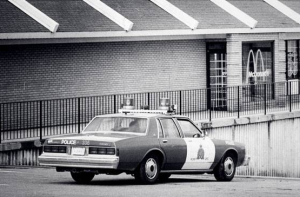
The Sydney River McDonald’s Restaurant was later torn down (Chronicle Herald photo)
Wood has not been well behaved in prison. In 2006, he assaulted two correctional officers. In 1998, he assaulted a fellow prisoner with sharpened artist brushes and a toothbrush. He has remained in maximum security, and for long stretches in segregation, during his two-decades-plus incarcerated. Yet he insists he is overclassified and shouldn’t have to follow the correctional plan set for him by his keepers. He went to court in 2013, while he was confined at Kingston Penitentiary, to attempt to overturn Corrections Canada’s insistence in keeping him classified as a maximum-security prisoner. The Federal Court of Canada rejected his claim, in a decision released in 2015 (read it below).
Corrections told the Parole Board that Wood’s “violence is unpredictable and usually occurs with no warning signs.” A psychiatric assessment completed in October 2014 stated that “extreme caution should be exercised” in considering Wood for early release.
That head-shrinking analysis appears to have found, for the first time since the killings in 1992, a simple explanation for Wood’s monstrous actions. An assessment found that Wood appears “to have some psychopathic traits usually found with psychopaths however you do not meet the cut off point.”
One of Wood’s accomplices, Darren Muise, was paroled in 2012. The other killer, Freeman MacNeil, remains in prison.
Here is the written record of the Parole Board of Canada decision from March 2015, denying Wood any form of release from prison (on mobile? click here to read doc):
Here is the judgment of the Federal Court of Canada, released January 2015, denying Wood’s bid to have his security status in prison reduced from maximum to medium (on mobile? click here to read doc):
» How did the murders affect those who were involved in the criminal case? Read this excellent column by journalist Phonse Jessome, who also wrote a book about the case, Murder at McDonald’s: The killers next door
July 29, 2015
Prison service suffers embarrassing break-in at regional facility
 The federal agency entrusted to keep 15,000 criminals safely locked behind bars in more than 50 penitentiaries across Canada apparently can’t safeguard one of its key administrative buildings from simple burglars. The facility in Kingston, Ontario – a site that, according to my sources, houses dozens of high-powered weapons and thousands of rounds of ammunition – was burgled recently by a thief who made off with keys to a prison service vehicle. The bandit got away largely because, remarkably, the Correctional Service of Canada regional staff college does not have a security officer on duty at the site overnight because of cost cutting.
Last year, Corrections Canada stopped paying a Commissionaire to patrol the staff college and neighbouring regional headquarters building after 8 p.m., a move that likely saved a few thousand dollars yearly. The headquarters building contains sensitive and confidential files but the staff college building, according to my sources, may contain as many as 50 9 mm pistols, 50 AR 15 .223 rifles, more than a dozen tear gas guns and dozens of 12 gauge shotguns. In addition, there may be 100,000 or more rounds of ammunition, including tear gas shells, on site. Corrections uniforms also are stored in the building. The firearms and ammunition are held in secure vaults and were never within reach of the burglar, sources tell me. According to an internal memo obtained by Cancrime (read it below), the thief broke into the building on April 22 by kicking out a pane of glass in a front entrance window.
“The unknown person(s) searched through the commissionaires desk, took one set of keys belonging to a Staff College GMV [government motor vehicle] and exited through the kitchen,” wrote Therese Lalonde, director of the staff college, in a memo to CSC staff dated April 22, 2015. “Alarms were activated in both locations. The GMV was not taken, only the keys were stolen.”
When the alarms went off, the Commissionaire headquarters dispatched a guard in a patrol vehicle. When the guard arrived, the broken front door was spotted and city police were called. Officers arrived quickly but the thief was not caught.
Admittedly, this is not a scandal of sweeping proportion, but it’s troubling evidence of a bureaucratic operation with immense public responsibility that makes questionable decisions and evades disaster by good fortune more than smart management. If thieves were to break into the staff college and penetrate those firearms vaults, it could be catastrophic, since the weapons likely would make their way into the hands of organized crime and gangs.
Corrections Canada has a 2015 budget of $2.3 billion, down significantly from the $2.6 billion spent three years ago, the result of system-wide cost cutting ordered by Ottawa.
Below is the CSC memo detailing the April 22, 2015 break-in at the staff college in Kingston, Ontario (on mobile? click here to read doc):
July 22, 2015
Predator claims he didn’t know coercing sex acts was wrong
 Just weeks before he’ll be freed from prison, a prolific sex predator boldly told authorities that he didn’t know his actions were wrong when he preyed on hundreds of young girls over the Internet to feed his deviant sexual desires. Mark Bedford, 29, (inset) made the startling admission at a parole hearing 20 days ago, a document obtained by Cancrime shows (read it after the jump). Bedford will be released from a penitentiary in Ontario late in August after serving his second federal prison sentence.
Bedford’s seemingly absurd statement is consistent with his ongoing attempts to rationalize his crimes and his desire to shake the label pedophile and sex predator. In one of his crimes, he coerced a 12-year-old girl into simulating sex with the family dog in front of her webcam. In some cases, he coerced young girls to insert items, including pencils and combs, into their vaginas. When his victims wouldn’t do as asked, Bedford would threaten to kill them or other family members – and yet, he claims, he didn’t know what he was doing was wrong. He once told a probation officer that his victims were liars. The parole board members didn’t swallow Bedford’s claim.
“The Board challenged you on this statement and then you changed it to say you blocked the knowledge that this was wrong,” according to a written record of the July 3 hearing. “Credibility and transparency became an issue for the Board.”
A recent report concluded Bedford is a “high risk for sexual recidivism” yet he told the parole board he believes he’s a low risk to commit new sex crimes.
“This statement indicates that you have limited insight and are over confident in your ability to control your deviant sexual interests,” the parole document states.
Since he was first convicted in 2008, Bedford has resisted treatment, tried to trick experts who sought to assess his deviance, denied responsibility for his crimes and blamed his victims. Bedford was convicted of 10 crimes, including commit/incite bestiality, luring a child under age 14 by computer, several child pornography offences, two charges of extortion and criminal harassment. Authorities believe he may have preyed on hundreds of young girls in five countries though his parole and prison files document only 63 victims. In Canada, he had victims in Alberta and Ontario. Bedford is part of a wave of so-called sextortionists who trick young victims online. It is a problem that has drawn the attention of law enforcement worldwide. In November 2014, a Florida man was sentenced to 104 years in prison for producing child pornography. He was believed to have extorted 350 victims over four years in three countries, including Canada.
Bedford’s first conviction earned him a three-year prison sentence. He was released March 2011 but was back behind bars in August 2012, charged with sexually assaulting a four-year-old girl and breaching rules imposed in a special judicial order. He pleaded guilty to the breaches in a plea bargain that saw the sex assault charges dropped.
An August 2014 parole board report noted: “Apparently this was to avoid the possibility of convictions for the sexual assault and sexual interference offences which could lead to an application for a dangerous offender designation.” If Bedford were declared a dangerous offender, he could be kept in prison indefinitely.
The July 3 parole hearing was required, under law, to review a previous decision to keep Bedford locked up until he had served every day of his 26-month sentence (Bedford lost an appeal of that decision, in which he argued his detention was “totally unreasonable” because he had no plans to reoffend). The parole board members ruled July 3 that the detention order would remain in place. It will keep Bedford in prison until his sentence expires August 22. Bedford, who turns 30 on July 25, told the board at a previous hearing that he hopes to live with his parents again after his release.
Below is the written record of Bedford’s most recent July 3, 2015 parole hearing (on mobile? click here to read doc)
» Read all of Cancrime’s coverage of Bedford
July 21, 2015
What the national crime stats don’t tell us
 They come with more caveats than an over-the-counter libido booster, but Canada’s national crime statistics will be delivered Wednesday, July 22. The Canadian Centre for Justice Statistics, a branch of Statistics Canada, will reveal its yearly compilation of data, part of the Juristat, from which much will be inferred that should not or can not. Much will be written that misleads, misinterprets and miscalculates what the numbers tell us. There’s much more that these frail figures do not tell us than what they reveal.
For starters, the statistics reflect only crimes reported to police and we know from another major survey done by Statistics Canada every five years that many crimes go unreported. StatsCan estimates that nearly nine out of every 10 sex assaults is never reported to police, seven out of every 10 “violent victimizations” is not reported and seven of every 10 personal property thefts isn’t reported. It’s likely that most crime that occurs in Canada each year is not reported to police. Sometimes, a police agency will acknowledge publicly that it really has no idea how much crime is happening in the community
The Juristat survey does not, in fact, tell us exactly how many crimes are known to police, because of the counting method used by StatsCan. It employs a “most serious” offence rule. In a single event that involves several crimes against one victim, only the most serious crime is counted. StatsCan has revised this process to allow the counting of up to four crimes per incident, although they’re recorded in an additional crime survey,
The Juristat survey does not tell us how effective our police departments are, despite what some police and civic leaders insist each year when the crime stats are released. How could police brass and politicians claim that the yearly variance (crime is up, or down) means something, if we don’t really know how many crimes occur? We don’t know what effect police activities are having on crime, since most crime isn’t reflected in the Juristat.
The crime stats report does not tell us how “severe” crime is in each community, despite the introduction in 2009 of a “crime severity index,” in addition to the long-reported crime rates (the number of crimes factored by population). As I’ve explained before, the crime severity index is built on the same wobbly foundation; it is based only on crimes reported to police.
July 15, 2015
71-year-old child molester, Canada’s worst, a “significant risk”
 Child molester Gary Walker (inset) has languished behind bars for nearly half his 71 years, tormented by his desire for sex with young boys. The septuagenarian has never had a sexual relationship with an adult. He has confounded keepers. Despite undergoing a battery of treatment programs to root out his sexual deviance, experts say he grapples still with “intrusive sexual thoughts” and remains a “significant risk” to molest more young boys if he is released.
I have written previously, at length, about his crimes and the swath of destruction wrought by the former police officer, Scout leader, hockey coach, Judo club official and school bus driver who may be Canada’s most prolific child molester. It is believed that he victimized 2,000 children during a 30-year span. He preferred 12- and 13-year-old boys. At least three victims committed suicide. Walker’s case has fallen from public view, largely because he is no longer a threat. Declared a dangerous offender, he has spent the past 33 years confined in penitentiaries in Ontario. By law, his case must be reviewed every two years. Walker’s latest review was conducted on June 26, 2015. The parole board ruled that he must remain behind bars.
He remains notable for what he has demonstrated, a remarkable immunity to treatment and deviant resilience despite advanced age. Prison authorities have given up on treatment, noting that Walker has now completed all recommended programs. His “deviant sexual preference” for children is intact and a psychologial risk assessment completed in in December 2014 concluded he is a “high-moderate to high risk for sexual recidivism.”
Though Walker may never get out of prison – and, statistically speaking, most dangerous offenders die behind bars – he is a reminder of how little is understood about the most intractable and persistent child sex predators. Despite decades of assessment and treatment, Walker is no less a threat to society than he was when he was first imprisoned in 1992. Strides have been made in treating sex offenders, even pedophiles, with some success in reducing the likelihood they will commit new crimes. But Gary Walker appears to be, simply, incurable.
Here is the written record of the parole decision June 26, 2015, denying Walker any form of release (on mobile? click here to read doc):
Cancrime

- Rob Tripp's profile
- 8 followers

