
Kathy Collard Miller's Blog, page 5
September 30, 2023
This Is What Happened 56 Years Ago Today!

“Exciting” just didn’t express fully how I felt dating Larry as we graduated from high school and began attending college. We’d been enjoying each other’s company for about ten months and when the subject of our different churches came up, it seemed simple enough: “let’s visit each other’s church so that we can get to know each other better.” Sounded great to me.
Larry came to my church that Sunday and I was thrilled to show him off to my church friends. I looked forward to visiting his church the next Sunday and when we walked into his church, everyone seemed friendly. But during the service, I felt stirred by the obvious close relationship these people seemed to have with God.
They somehow referred to Him with more familiarity than the people at my church. I was intrigued, especially when someone mentioned being “born again.” I’d never heard that phrase before. Fascinating!Fascinating, yes, but I also felt disturbed. “I’m already a Christian,” I comforted myself. “After all, I go to church every Sunday and I was born in America, a Christian nation. That makes me a Christian, doesn’t it?” It seemed like a war was being waged in my mind and I didn’t know who I was fighting. Looking back now, I should have realized that if being born in a Christian nation made you a Christian, then if I’d been born in a garage, that would make me a car. It didn’t make sense and for the next seven days, all I could think about was, “I wonder whether I really am a Christian?”
“Of course, I am,” I argued but I knew I didn’t have a close relationship with Jesus Christ.
The next Saturday evening, Larry and I went with his church’s youth group to a Billy Graham film called “For Pete’s Sake.” Watching that movie made me reflect even more on how I really wanted a personal relationship with Christ—the theme of the movie. At the end of the film, the audience was invited to go forward to hear more about asking Jesus into their lives.
“I’ve never done that,” I mused. But I looked over at Larry and he wasn’t going forward. What would he think if I did? I couldn’t risk losing him as my boyfriend. But all I could think was, “I wonder whether I really am a Christian after all.”
That thought continued to haunt me as I returned to Larry’s church the next morning and sat through the service. At the end of the sermon, the pastor said, “Please bow your heads and close your eyes.”
I obediently did and then heard him say, “Is there anyone here who’s wondering whether they really are a Christian?”
My heart started pounding hard. “Oh my!” I almost gasped. “That’s what I’ve been thinking all week. How did he know?”I gulped down my nervousness. “Oh, I know! Larry must have told him.” But I realized with a start that I hadn’t told Larry my thoughts.
In the quiet of the moment, I suddenly thought, “God is trying to get my attention. I need to ask Jesus into my heart—but I don’t know how.”
Since the pastor was talking about me, I raised my hand suddenly without really thinking. Then I looked up at my hand. “Wait a minute, I don’t do crazy things like this!” I quickly pulled down my hand and tried to disappear into the seat.
The pastor didn’t say anything else, but within seconds of closing the service, he was standing at the end of my row as Larry and I moved out of the pew and said, “Hi there! I’m Pastor Folden. You’re new here, right?”
I smiled but felt my face burn in embarrassment.
Pastor Folden replied, “I’d like to introduce you to our youth pastor, Wes Anderson. He can answer the questions you have about what I asked.”
I wanted to slide right under the pew. I wanted to murmur, “Oh, you saw my hand? Well, it was nothing” and slip away. But the man he introduced as Wes, shook my hand and motioned for Larry and I to follow him. I was caught! And Larry was going to be in on it. How embarrassing!
But it didn’t turn out to be embarrassing at all. Wes explained how Jesus died on the cross for my sins and that I could know for sure I was a Christian by asking Jesus to come into my heart. And incredibly, Larry said that he had already done that years earlier.
Within fifteen minutes, Wes had answered my questions and I took a deep breath. “Yes, I do want to receive Christ as my Lord and Savior,” I said softly. As Wes prayed, I repeated his words out loud telling God I was a sinner and that I needed His forgiveness. And I asked Jesus who died on the cross for me to come into my heart and life and be my Savior and Master.
As I finished, I had to brush away tears from my cheeks and I shyly looked up, wondering if Larry would be laughing at me. But he wasn’t. He was grinning so broadly that I thought his cheeks would break and he gave me a big hug.I didn’t feel any different in my heart—other than crying—and I wondered if anything had really happened, but over the next days and weeks, I knew something very significant had happened. I looked at everything different and I no longer had that void-kind-of feeling in my heart, as if I was missing something. I’d found it! God was in my life for real and I never had to wonder again, “Am I really a Christian?”
Today as I post this, October 1st, 2023, I rejoice in reflecting on what God did 56 years ago–October 1st, 1967. I never could have imagined what the journey would be over these many years. I praise God for saving me, loving me, sanctifying me, and faithfully teaching me. I’m grateful for sustaining Larry and I in our 53 years of marriage.What about you? Have you made that commitment to Jesus Christ, the Messiah, Lord, and God as your Savior and Lord? He loves you and sent Jesus to die on the cross for your sins. Talk to Him in prayer, confessing your need for forgiveness and cleansing. Ask Him to be your Lord–the Master of your life.
Please let me know if you have any questions about salvation or you prayed to receive Christ. I will rejoice with you!


September 26, 2023
Book Drawing: “Growing a Joyful Heart” by Karen Whiting and Pam Farrel

Need more joy? Everyone can appreciate having more joy. I have great news for you.
Growing a Joyful Heart shares how to cultivate joy! Joy is a gift from God, a fruit of the Holy Spirit. In a tumultuous world we can Rejoice and increase our joy.
We choose joy as we focus on what God has done and will do, rather than our circumstances.Start the process of being joyful with developing inner joy.Then it’s easier to bring joy into relationships to have more meaningful connections with the people in our lives.We choose to respond with joy in all circumstances, even in the midst of our grief and pain, through trusting that God is working in our lives with a plan and purpose.Once joy overflows in our hearts, we share that abundance and become joy givers.To enter the drawing to possibly win a copy of this great book, read on! And to whet your appetite, here’s an excerpt from the book.
Joyful Family Devotions After Disasterby Karen Whiting and Pam Farrel
Let the message about Christ completely fill your lives, while you use all your wisdom to teach and instruct each other. With thankful hearts, sing psalms, hymns, and spiritual songs to God. Colossians 3:16
Jim and Karen wove daily faith into ordinary days. They often chose texts that coordinated with problems or topics to which their children could relate. But they never expected to face a huge natural disaster like a category four hurricane and great damage to their home and community. They chose to study Nehemiah as they rebuilt.They spent hours cleaning debris and pulling out old carpets. The children understood Nehemiah’s weeping at the thought of the rubble and broken wall around Jerusalem (Nehemiah 1:3). They could envision what he saw as he inspected the damage (Nehemiah 2:11–13).
They read how Nehemiah carried letters from the king for supplies (Nehemiah 2:7–8). Checks and approvals from the insurance company seemed almost as precious. Like Nehemiah, the letters gave hope that repairs would begin soon. “Nehemiah” means “God has comforted,” in past tense, and they rejoiced and trusted God already knew the repairs would soon be history.
As Jim read about enemies attacking Nehemiah, teasing them, and trying to trick Nehemiah into disobeying God (Nehemiah 3–5), they chatted about what was happening in their area. They waited on permits and inspections. The children doubled up, and one slept in a closet. They understood that unexpected problems challenge our faith.
Their sons and scouting friends helped repair homes where people lost their insurance money to scammers. They realized why Nehemiah was so upset at usury, when people took advantage of the poor situations of neighbors.
But they also rejoiced with any completed work, including their home. After the restoration they rededicated their home to the Lord and enjoyed a party.Miracle ScrapbookHabakkuk 3:17–19 BSB
Things were very bleak for this minor prophet. Ever been there? Bill and Pam Farrel could relate! They married at age twenty with very few worldly goods but a goal to complete college. “We lived from miracle to miracle!”
What does Habakkuk recommend when you are in dire straits?Exalt in the Lord: Become jubilant and triumphant in who God is.Rejoice in God: Joyfully exalt about what God does.In their early years, money was very tight. They were finishing their education, then headed to seminary so Bill could become a pastor. Pam’s way to exalt God was to track every answer to prayer and every miracle blessing in a scrapbook. These included the following:
The congratulations: “You won a sewing machine!”The list of youth parents who donated monthly to send them to seminaryThe bumper sticker that read, “I believe in miracles” that our youth group gave us as they prayed for God to give us a car. We rode bikes everywhere and prayed for nearly a year until we got a phone call from a parent of one of our youth. They said, “My husband’s mom passed away and she has a car with low mileage, but it needs a brake job. We’ve arranged the servicing for a price of$42.” Bill and Pam had about $45 to their names, so it was quite the celebration as the youth gathered to place their bumper sticker on the car God provided.According to Habakkuk, God gives much more than the minimum: God makes your feet sure like a deer on a mountaintop. God elevates your life to the heights!
Thank you for sharing the excerpt from your book, Karen and Pam.For my readers: To purchase “Growing a Joyful Heart” CLICK HERE
I know you’re excited about this book like I am. To win a copy, enter the drawing by making a comment on the blog post by the evening of Sunday, October 2, 2023 . Only USA addresses can win.

The authors: Pam Farrel (left) and Karen Whiting (right)
Karen Whiting (www.karenwhiting.com) rejoices as she writes and speaks to inspire families to thrive.She’s an international speaker, former television host, columnist, and award-winning author of more than thirty books for women, children, and families. She has a heart to nurture the growth of wholesome families and promote the development of strong bonds of faith.
Pam Farrel is an international speaker and author of 60 books including bestselling Men are like Waffles, Women are like Spaghetti. She and her husband Bill Co-direct Love-Wise ministry helping people in their vital relationships. They are parents to three sons, 3 daughters in law and 7 grandkids. The Farrels make their home on a live aboard boat docked in Southern California.
September 20, 2023
What Should You Immediately Do With New Thoughts?

One of the many of Bible verses I most use often is Second Corinthians 10:5:
We destroy arguments and every lofty opinion raised against the knowledge of God, and take every thought captive to obey Christ,
When we first read Paul’s phrase “casting down imaginations,” we might wonder if God is encouraging us to not use our imaginations. Although it’s true our imaginations can be misused, Paul is emphasizing a different spiritual concept for every Christian to prevent believing in lies.
Paul’s phrase is encased in three very important verses in 2 Corinthians 10:3-5:
“For though we walk in the flesh, we are not waging war according to the flesh. For the weapons of our warfare are not of the flesh but have divine power to destroy strongholds. We destroy arguments and every lofty opinion raised against the knowledge of God, and take every thought captive to obey Christ” (ESV).
As we’ll see, the weak Christians located in Corinth have adopted certain ideas that have captured their “imaginations”—their thinking. These wrong ideas have been accepted into their belief system as if they are true. But the ideas are against everything Paul introduced to them and taught them. They are of the world, not God.
Context of 2 Corinthians 10:5One of the primary purposes of Paul’s letters (yes, there were two or three) to the Corinthians is to fight against the wrong thinking of the false teachers who are spiritually harassing the believers in that pagan city. Being at a physical distance from his spiritual brothers and sisters, Paul is determined to convince them they are cooperating with a destructive influence that is tearing down their faith in Jesus Christ. He also knows the false teachers have been critical of himself as God’s appointed messenger.
Since the weak believers are easily swayed by these false doctrines, Paul is firmly and yet gently reminding them of the truths he taught them while he was with them. He is wondering, since they trusted him then, how they could be influenced against him now. He is shocked. Paul writes this letter to remind them of the spiritual doctrines he taught them while with them.Paul is treading on dangerous ground. He doesn’t want to seem mean-spirited or critical. He wants to come across with the meekness of Christ. Yet he also passionately desires to shake the Corinthians free from the stronghold of falsehoods the other teachers have heaped upon them. Paul is limited to handwritten letters being personally delivered by his trusted helpers. He is walking a tightrope of showing love and yet speaking the truth.
That’s why he begins this section of his letter (2 Corinthians 10:1) referring to “the meekness and gentleness of Christ.” He is reminding them that in person he represented Christ’s nature and neither he nor Jesus have changed. Because of his concern for them, he must teach them how to examine the wrong beliefs—the “imaginations”—the false teachers are throwing at them. Those ideas represent the way the world thinks, not the way Paul taught them that God thinks.
What Does “Casting Down Imaginations” Mean?The Greek words making up the phrase “casting down imaginations” is kathaireo logismos. “Kathaireo” is defined as “demolish” and bring down. God prompts Paul to use the concept of bringing down since many unbelievers worshipped their gods in “high places” which were elevated areas where altars were built. Paul continues his instruction, writing, “Casting down imaginations, and every high thing that exalteth itself against the knowledge of God,” (2 Corinthians 10:5, italics added).
Each of us “exalts” or “lifts up” our preferences by making choices we consider most beneficial for us.
We choose that which we think will meet our needs. But if we are Christians, the ideas we “exalt” above others should be God’s perspective and how He wants us to think and act. That’s why the most effective way of living a godly life is to immediately evaluate thoughts that come into our minds.Paul taught the Corinthian believers from the beginning of their salvation to lift high the value of Jehovah God, find salvation only through His Son Jesus Christ’s death and resurrection, and obey God’s principles. But because of the influence of the false teachers, they have now replaced their high value of Christ with incorrect ideas. These ideas include questioning Paul’s authority as an apostle, believing they can live immoral lives and have a division between believers.
The second Greek word of the phrase for “imaginations” is logismos which is defined as arguments, thoughts, and reasonings. Just as Satan questioned Eve’s perceptions, challenged God’s words, and reasoned with her to confuse her in the Garden of Eden (Genesis 3:1-6), Satan was using the deceptive reasoning of false teachers to cause the Corinthians believers to question who God is and how He defines salvation and walking in the power of the Holy Spirit.
Thankfully, Paul’s letter to his beloved people was effective. The large majority of the Corinthian believers stayed true to the message of the Gospel claiming only Jesus could save them from their sins. They also turned away from the ungodly and immoral choices they had begun accepting. To Paul’s great relief, they kept their allegiance to Paul as God’s official messenger of the Good News.
How Can Christians “Cast Down Imaginations”?In II Corinthians 10:5, Paul continues his thoughts with how to cast down imaginations by urging his readers adding “and bringing into captivity every thought to the obedience of Christ.”
Every day, every one of us has thousands, even millions, of thoughts which could be identified as a variety of goals, plans, questions, ideas, conclusions, and analysis of circumstances. Like arrows being flung toward our minds and hearts, we are bombarded. Many of those arrows are truth. Many of them are lies. The truths foster trust in God and acknowledgment of his Lordship in our lives. The lies create doubt, confusion, wrong conclusions, and ultimately questioning God’s nature—his goodness, motives, faithfulness, and many other attributes.
Ephesians 6:16 tells us, “Above all, taking the shield of faith, wherewith ye shall be able to quench all the fiery darts of the wicked.” Those “darts,” our inner dialogue, come from many sources, including our own analysis, our hearts’ desires, the opinions we hear from others, what we read, watch, and hear. Without being viewed through the filter of truth, the influence of the darts turns us toward worry, hate, lack of self-control, criticism, discontent, and many other responses which are the opposite of the fruit of the Spirit (Gal. 5:22-23). When we use the filter of the truth of Scripture and who God is, we experience the fruit of the Spirit: love, joy, peace, longsuffering, gentleness, goodness, faith, meekness, and temperance.
Of course, when Paul wrote God’s words down, he was referring specifically to accepting the godly “imaginations” he taught the Corinthians and to reject ungodly lies from the false teachers. He wanted the believers to take their thoughts into “captivity.” But the concept Paul envisioned for the Corinthian believers is a spiritual practice necessary for all of us.
Think of it this way. We are going about our day and different ideas arise within us or we hear something said. In our “imagination,” we can grab a particular thought as if it were a dart, and ask, “Is this the truth?” Or, “What does the Bible say about this?” Or, “Am I thinking the truth about who God is?” When we ask any questions like that and then reject the lies and accept God’s truths, we are “casting down imaginations.”
Here’s a practical application. You could wear a rubber band on your wrist and when you notice it throughout your day, ask, “Where is my mind going? To truth or to ideas ‘that exalteth itself against the knowledge of God’?”
This is a life-long process. We might determine to do this and not question our thoughts all day. But several times the next day, we notice a thought which seems correct but upon examination is actually a lie about God or how He works. Within days and then weeks, we are more often alert about whether our ideas are biblical. Then we will be more diligent to choose casting down imaginations that are not of the Lord.
Prayer for Casting Down ImaginationsAlmighty God of the Universe, thank you for wanting to empower me to be casting down imaginations that plague me and draw me away from you. You are worthy to be trusted because you are wise, gentle, and yet strong. You know the lies destroying me. Thank you that you want to set me free so that I can exalt you. Open my eyes to the truths of your Word. Strengthen my heart to resist Satan’s questioning of your worth and value. Deliver me from the sinful strategies plaguing me. Only you offer everything truthful, worthwhile, and good. I’m so grateful that you are my God and are empowering me to cast down wrong imaginations. In Jesus Name, Amen.
God led the Apostle Paul to empower the Corinthian believers with a very practical spiritual discipline that was effective for them and is effective for us. Many of the ideas of every Christian’s inner dialogue and the messages reaching them from “outside” their minds are attempting to be a kind of “false teacher.” God, on the other hand, is strengthening His child with truth from the Holy Spirit to fight Satan’s lies. The believer can call upon His help to receive truth and cast down lies. How blessed we are that God does not leave us defenseless. The God of truth is with us.
(Previously published in Crosswalk)
To explore these ideas more, check out my books (click on)
September 16, 2023
How God Blesses: 40 Ways to Know He is Blessing You

Since we can be spiritually blind to how God blesses us, here are verses and quotes about how God blesses us. After all, who wouldn’t want to be aware of how God is blessing them and then be inspired to give blessings to others! We may not be capable of blessing others in all the ways God blesses us, but there are many ways we can. Even if it’s saying “God bless you” after someone sneezes.
You most likely won’t be surprised to learn that in the ESV version of the Bible, there are 496 references to the multiple variations of “bless” (blessing, blessed, etc.). From Genesis to Revelation, God names how he blesses us over and over again. The first one is in Genesis 1:22: “And God blessed them, saying, ‘Be fruitful and multiply and fill the waters in the seas, and let birds multiply on the earth.’”
The last one is Revelation 22:14: “Blessed are those who wash their robes, so that they may have the right to the tree of life and that they may enter the city by the gates.”
From the beginning to the end of the Bible, God recounts how He blesses. And we are told to return the favor by blessing God: “Bless the Lord, O my soul, and all that is within me, bless his holy name!” (Psalm 103:1).
But what exactly does the word “bless” mean? According to Easton’s Bible Dictionary, there are five primary meanings.
God bestowing some temporal or spiritual gift.We bless God when we thank him for his mercies.A man blesses himself when he invokes God’s blessing or rejoices in God’s goodness.One blesses another person when he expresses good wishes or offers prayer for another’s welfare.The Jewish custom of the thank-offering is referred to as “a cup of blessing” (I Corinthians 10:16) where the master of the feast takes a cup of wine and blesses God. Then everyone drinks from the cup.10 Quotes from the Bible about How God Blesses UsAs we consider this very familiar concept of blessings, let’s first consider 10 quotes from the Bible about how God blesses us.
God blesses us with the seventh day rest. “So God blessed the seventh day and made it holy, because on it God rested from all his work that he had done in creation.” –Genesis 2:3God blesses us with the provision we need. “Then the women said to Naomi, ‘Blessed be the Lord, who has not left you this day without a redeemer, and may his name be renowned in Israel!’”—Ruth 4:14God blesses us with opportunities to be generous to the poor. “Whoever despises his neighbor is a sinner, but blessed is he who is generous to the poor.—Proverbs 14:21God blesses us through trusting Him. “Whoever gives thought to the word will discover good, and blessed is he who trusts in the Lord.”—Proverbs 16:20God blesses us with the promise of His grace, mercy and justice. “Therefore the Lord waits to be gracious to you, and therefore he exalts himself to show mercy to you. For the Lord is a God of justice; blessed are all those who wait for him.”—Isaiah 30:18God blesses us with the joy of supporting God’s work. “Bring the full tithe into the storehouse, that there may be food in my house. And thereby put me to the test, says the Lord of hosts, if I will not open the windows of heaven for you and pour down for you a blessing until there is no more need.”—Malachi 3:10God blesses us with satisfaction when we hunger and thirst for righteousness. “Blessed are those who hunger and thirst for righteousness, for they shall be satisfied.—Matthew 5:6God blesses us with the Bible. “But he said, “Blessed rather are those who hear the word of God and keep it!”—Luke 11:28God blesses us through our obedience. If you know these things, blessed are you if you do them.”—John 13:17God blesses us by forgiving us. “Blessed are those whose lawless deeds are forgiven, and whose sins are covered;”—Romans 4:7God blesses us through our spiritual blessings of our inheritance in Christ. “Blessed be the God and Father of our Lord Jesus Christ, who has blessed us in Christ with every spiritual blessing in the heavenly places,”—Ephesians 1:3God blesses us with the assurance of Jesus’s return. “Waiting for our blessed hope, the appearing of the glory of our great God and Savior Jesus Christ,”—Titus 2:13God blesses us with good even in the midst of suffering. “But even if you should suffer for righteousness’ sake, you will be blessed. Have no fear of them, nor be troubled,”—I Peter 3:1415 Classic Christian Quotes about How God Blesses Us
All of history gives us research for classic Christian quotes about how God blesses us. We’ll only include 15 here but there are many more available.
“Prosperity is the blessing of the Old Testament; adversity is the blessing of the New.”—Francis Bacon
“How little do my countrymen know what precious blessings they are in possession of, and which no other people on earth enjoy.”—Thomas Jefferson
“Never undertake anything for which you wouldn’t have the courage to ask the blessings of heaven.” G.C. Lichtenberg
“Taken separately, the experiences of life can work harm and not good. Taken together, they make a pattern of blessing and strength the like of which the world does not know.” V. Raymond Edman
“We have forgotten the gracious Hand which has preserved us in peace and multiplied and enriched and strengthened us, and have vainly imagined in the deceitfulness of our hearts that all these blessings were produced by some superior wisdom and virtue of our own.” Abraham Lincoln
“Have you ever thought that in every action of grace in your heart you have the whole omnipotence of God engaged to bless you?” Andrew Murray
“The best things are nearest: breath in your nostrils, light in your eyes, flowers at your feet, duties at your hand, the path of God just before you.” Robert Louis Stevenson
“God bestows His blessings without discrimination. The followers of Jesus are children of God, and they should manifest the family likeness by doing good to all, even to those who deserve the opposite.” F.F. Bruce
“Blessedness consists in the accomplishment of our desires, and in our having only regular desires.” St. Augustine
“Blessed is the man who has a skin of the right thickness. He can work happily in spite of enemies and friends.” Henry T. Bailey
“There is in man a higher than love of happiness; he can do without happiness, and instead thereof seek blessedness.” Thomas Carlyle
“Reflect upon your present blessings, of which every man has many; not on your past mis-fortunes, of which all men have some.” Charles Dickens
“Blessed is that man who has done with chance, who never speaks of luck, but believes that from the least even to the greatest, all things are ordained of the Lord.” Charles Spurgeon
“It is generally true that all that is required to make men unmindful of what they owe to God for any blessings, is, that they should receive that blessing often and regularly.” Richard Whately
“The unthankful heart discovers no mercies; but the thankful heart will find, in every hour, some heavenly blessings.” Henry Ward Beecher
“The hardest arithmetic to master is that which enables us to count our blessings.” Eric Hoffer
15 Modern Christian Quotes about How God Blesses UsNow we’ll consider 15 modern Christian quotes about how God blesses us.
“This is the great paradox of living the blessed life: when we give without thought to whether or not we will receive, then we receive.” Robert Morris
“When you refuse to retaliate and instead respond in love at work or with somebody who doesn’t like you, God will be pleased. And you’re going to be blessed.” Rick Warren
“Blessed are they who see beautiful things in humble places where other people see nothing.” Camille Pissarro
“There is no blessing until we look deep down in our own soul and see our spiritual life as it really is.” Alan Redpath
“When you focus on being a blessing, God makes sure that you are always blessed in abundance.” Joel Osteen
“Count your blessings, not your problems. Count your own blessings, not someone else’s. Remember that jealousy is when you count someone else’s blessings instead of your own.” Roy T. Bennett
“When we lose one blessing, another is often most unexpectedly given in its place.” C.S. Lewis
“Not what we say about our blessings, but how we use them, is the true measure of our thanksgiving.” W. T. Purkiser
“The blessedness of waiting is lost on those who cannot wait, and the fulfillment of promise is never theirs. They want quick answers to the deepest questions of life and miss the value of those times of anxious waiting, seeking with patient uncertainties until the answers come. They lose the moment when the answers are revealed in dazzling clarity.” Dietrich Bonhoeffer
“There are so many blessings that go along with tithing, but it is the principle of putting God first and the principle of faiththat initiates the blessings. It is the trigger.” Robert Morris
“Blessed is the man who gets the opportunity to devote his life to something bigger than himself and who finds himself surrounded by friends who share his passion.” Andy Stanley
“But in God’s kingdom the first will be last, and those who serve Him daily, with humble hearts, will experience real, eternal blessings.” Sarah Francis Martin
“Desiring what others have keeps us from being personally grateful for God’s many blessings.” Lilliet Garrison
“I have had to learn to follow God, even when I could not feel his blessing on my life.” Christopher Roberts
“Concentrate on counting your blessings and you’ll have little time to count anything else.” Woodrow Kroll
A Prayer to Remember How God Blesses UsGod wants us to pray about how to remember how God blesses us. We can’t remember on our own and He wants to help us, as He does with everything.
Father God, I bless your holy name. I’m so grateful that you want me to see how you bless me, especially since my spiritual eyes are often blinded and my mind is alert only to what I declare a blessing. Remind me often that you know best and your definition of a blessing might be different than mine. You know I struggle with that sometimes, Father. Give me courage and confidence in your wise nature that I will have peace no matter what happens.
Help me remember how so many in the Bible thought their adversity couldn’t work out for good but you faithfully created good things beyond what they imagined. I surrender to you, my Lord and Master. Thank you for both the obvious blessings and the hidden ones. In Jesus’s name I pray. Amen.
For additional resources about blessings, check out:
Pure Hearted: The Blessings of Living Out God’s Glory.
Partly Cloudy with Scattered Worries: Finding Peace in All Kinds of Weather.
(Previously published at https://www.ibelieve.com/faith/god-bless-quotes.html)
September 12, 2023
The Surprising Underlying Message about Rahab’s Story

Do you have a habit of looking for the underlying message about who God is within every biblical story?
So many times we read or study our Bible and come away committing to:
I’ll be wise like DanielI want to be strong like JoshuaI will become more content like NaomiThere is indeed great wisdom and value in that. But I know you would agree the Bible is about God and His Son Jesus and their “His Story”–the history of God showing who He is in truth.
That is certainly true about the story of Rahab and how she lied. What can we emphasize about who God is in this story? Seem a little vague. But let’s take a look.
Read Joshua 2 for the story.
You’ll remember Rahab intentionally lied and misled the king’s messengers to protect and save the two Israelite spies. Canaanite culture approved of lying; she most likely didn’t think twice about it. Regardless of cultural standards (or lack of them), the commands of the Bible stand firm. We can never use cultural viewpoints as an excuse to diminish our commitment to God’s holiness. God wants to strengthen our courage to stand for him regardless of any consequences we fear.
As we study this story, we could wonder why the king’s messengers did not search all of Rahab’s home, especially her bedroom. The customs of the day included the belief a woman’s bedroom was a private place no one could enter. Rahab was known as a harlot, and some commentators think the Hebrew word zonah for harlot can also indicate an innkeeper, which would go along with the fact the spies “lodged there” (v. 1). What better place for them to stay, because a lot of people would be going in and out. God used these aspects of the Canaanite culture for His own purposes and advantages.
Even though Rahab’s lying was wrong, we must acknowledge her courage. She knew very little about the God of the Israelites, and yet what she knew was enough to prompt her to risk her own life.
CLICK TO TWEET:Rahab didn’t know God well enough to trust she didn’t have to lie. He could provide some amazing plan to protect his people.
Our goal as Bible students should not be to vindicate her lying. She did sin. But her knowledge about God was limited. If she was indeed an innkeeper, she’d heard stories from travelers about the Israelites and their powerful God. The stories weren’t the only influence to inspire her belief. The very Spirit of God was at work.
Her belief didn’t mean she became completely victorious over every sin. We might try to reason, “Well, lying was the only option available to save the spies.”
Here’s the subtle messages about who God is from the story about Rahab.LIE: Rahab believed she had initiated the only solution available. TRUTH: As a creative God, he could have fashioned any number of solutions.God saves a sinner and gives her courage to protect His people even if imperfectly. God drew her to Himself through the stories of His favor for His chosen people. He gave her faith, but it didn’t mean she would never sin.God emphasizes His faithful commitment to a sinner saved by grace through using her to encourage her faith.God highlights His ability to work in a saved sinner for her sanctification–growth in faith–no matter how little she knows in the beginning.What a marvelous assurance for us because we come to Christ for salvation, and God knows the process of spiritual dependence upon him has only begun. Rahab is included in the “hall of faith” (Hebrews 11:35) because of her faith, not her perfect behavior. We are saved based upon our faith in Jesus as our Savior, not because we earned our way through perfect living. God saves and works in all of us because His faithfulness spotlights His perfect characteristics.
After the Israelites protected Rahab and her family as they destroyed Jericho, Rahab married Salmon, who most commentators believe was one of the spies. This couple are a part of the lineage of Jesus. Matthew 1:5-6 tells us, “… and Salmon the father of Boaz by Rahab, and Boaz the father of Obed by Ruth, and Obed the father of Jesse, and Jesse the father of David the king.” What a fascinating love story giving God glory.
Rahab is an example of God’s grace in using a forgiven sinful woman in the ancestral line of Jesus. May we never forget no one is beyond God’s gracious touch or unable to receive His courage.How can you become more courageous as you think of God’s creative faithfulness demonstrated in the life of Rahab?
(This is an excerpt from my women’s Bible study Heart of Courage: Daughters of the King Bible Study Series which contains 10 lessons examining the courage  God gives biblical characters in different areas of their lives. This study is perfect for group and individual study with questions to answer, commentary, and inspirational application).
September 1, 2023
Book Drawing: “Holy Interruptions” by Debbie Dufek

I’m so pleased to have the opportunity to feature Holy Interruptions by Debbie Dufek. Her story is an exciting memoir of God’s work, along with an abundance of wisdom, inspiration, and encouragement.
Read below for instructions for entering the drawing.
Blind to My Bleedingby Debbie DufekWe can walk with Jesus for decades and not recognize the need for a deeper work in our hearts. Just like this woman was losing blood and life was seeping out of her, I was bleeding emotionally, internally, but only God could see it–the bleeding of a still broken heart affecting relationships years later. He knew I needed to reach out and touch Him––it was a healing He alone could do. When I asked the Lord how this pain and grief could still be in me without me recognizing it, he brought back a memory—an analogy of a boil.
Physical Analogy of a Spiritual Condition
Once my husband had a nasty boil on his thigh. His leg was fire-red, swollen, and painful. He couldn’t walk without excruciating pain. The doctor gave him an antibiotic. After a week the pain was relieved, and the inflammation went away. About two weeks later, he was playing with the grandchildren, and stepped down hard on the leg that had been infected. Out popped a dark green, hard core. He wiped it off and discovered a clean crater-––an actual ¼ inch deep hole in circumference and depth in his leg where the infection had been. By all outward appearances, his leg looked as if it had been healed but that core, covered by skin on the surface, was still there and needed to be removed.
I had a core like that. The death of my father, losing him so quickly, left me with a hidden wound. The Lord brought healing in stages—even forty years later.I had an invisible, deep-seated fear of abandonment. I saw myself as a healthy, Christian woman who loved the Lord and His people, yet I had this unseen wound that was festering under the surface, keeping me from fully opening my heart to the one I was supposed to love and trust the most–––my husband. Until that day, I had made an unconscious choice to seal off part of me that could be affected by the loss of the one I loved. I didn’t even know it. In the deepest part of me hidden pain festered. A place in my heart remained locked–––– like a locked room I was unaware of. But Jesus has the master key, and He unlocked that room and brought His healing light in, obliterating the darkness.
I had a freeing holy interruption that morning. I’m happy to say, that was the last (and deepest) work the Lord did in my heart regarding the loss of my father. I will always miss him, but the sting is gone now. I look forward to the day I am reunited with Daddy in Heaven. I can’t wait to hug him.
The crater left from that cleansing has been filled with a deeper holy assurance that God is my forever Father, and He will never leave me. I will never be abandoned.
Our emotions affect our physical health. Jesus brings healing.If you’re struggling with lingering illness, it is His promise to bring streams in the desert and a path in the wilderness. Even if healing lingers or never comes this side of Heaven, Jesus will draw us close to His heart, giving us deeper understanding if we will allow Him to. My experiences traveling this road for several decades waiting for healing for my child is this: Jesus is faithful.
Never Abandoned
Are you bleeding? Do you feel your life is seeping out of you? Do you feel isolated or ostracized?
Don’t be afraid to crawl through your struggles and reach out to touch Jesus. He’ll know it’s you who touched Him.
He will do what it takes, in His perfect timing, to stop the bleeding. He knows your name. He calls you Daughter.
Excerpt taken from Chapter Six, He Called Me Daughter
Click on “Holy Interruptions” to learn more about Debbie’s book.
To enter the drawing, make a comment on this blog post. The drawing closes Wednesday evening, September 6th, 2023. Only USA addresses can win. Debbie Dufek is an author, a conference and retreat speaker, an inspirational storyteller, a Bible study writer and teacher, and the founder and coordinator of The Mom’s Luncheon, an annual all-day event that has remained a favorite day for 150+ women for 35 years. Debbie is a certified Advanced Writers and Speakers Association (AWSA) P.O.W.E.R. Speaker and an AWSA Writing and Speaking Coach. Her first book, Holy Interruptions: When God Taps You on the Shoulder, published by Bold Vision Books, Friendswood, Texas, was released in October 2022.
Deb’s passion is encouraging others to live deliberately, living out our days for what matters to Jesus. She believes every person’s story is significant and inspires others to share their stories with whoever the Lord brings their way. We are all part of a larger picture. Embracing God’s plans and purposes for our lives, Jesus will use our stories to change the course of history which will affect the outcome of eternity-–-one heart at a time.
Debbie finds joy living in upstate New York, in the rambling 1840’s house where she and her husband, Bob, raised their family. They are surrounded by their seven children, twenty-two grandchildren, and nine great grandchildren most of whom live nearby.
Connect with her at: www.debbiedufek.com
August 19, 2023
Why Is Marriage in God’s Plan?
 Does this question seem idiotic? Marriage is such an intrinsic part of life.
But … why marriage? Why marriage? Why did God create the concept? He didn’t have to. He doesn’t call everyone to be married. He could have accomplished everything he wanted without designing a commitment between one man and one woman.
As we study the answers to such an unusual question, we will find deep reasons revealing God’s perfect commitment to us—the body of Christ. The answers hold far more significance than we can imagine and are applicable for every Christian, whether or not the person is married. You won’t be disappointed. After all, you are his Bride, and he is your Bridegroom.
That is the introduction in Lesson 1 of my women’s Bible study, God’s Heart for Your Marriage. In the title, I specifically worded it referring to the heart God has for your marriage. He is “for” you and your husband—your marriage. He wants to empower your marriage to be successful because he loves you and he will be glorified through the success of your marriage.To go along with that concept, here’s the commentary for the question applying Ephesians 5:25-32. Here’s the passage.
Husbands, love your wives, as Christ loved the church and gave himself up for her, that he might sanctify her, having cleansed her by the washing of water with the word, so that he might present the church to himself in splendor, without spot or wrinkle or any such thing, that she might be holy and without blemish. In the same way husbands should love their wives as their own bodies. He who loves his wife loves himself. For no one ever hated his own flesh, but nourishes and cherishes it, just as Christ does the church, because we are members of his body. “Therefore a man shall leave his father and mother and hold fast to his wife, and the two shall become one flesh.” This mystery is profound, and I am saying that it refers to Christ and the church. However, let each one of you love his wife as himself, and let the wife see that she respects her husband. (Ephesians 5:25-32 ESV)
Read Ephesians 5:25-32. What are the husband’s instructions and how are his responses to his wife supposed to represent the Bride’s love for her Bridegroom?From these passages in Ephesians 5, we learn the two different commands indicating how the church (representing every individual believer) is to respond to God.
God created men to most value respect and God created women to most value love. TWEET THAT!!!!!
The two different commands point to God’s commands to his church: respect and love God.
Respecting God results in obeying him. Respect and “fear of the Lord” (Acts 9:31) should cause everyone to be in awe of his authority and control. Even though people reject him doesn’t shrivel his sovereignty.
Respect for God also stems from recognizing his perfect character qualities including kindness, wisdom, joy, generosity, excellence, and a long list of everything good. Obeying such a wonderful, loving God, who deserves respect and appreciation, should be easier. No husband can have perfect qualities but if he did, his wife should have no trouble respecting him.
When we disobey God, we are saying we find fault in him. He doesn’t want the best for us. Jesus had no trouble obeying his Father because he knew only good would come from it. Jesus said, “For I have come down from heaven, not to do my own will but the will of him who sent me” (John 6:38).
He also connected love with obedience. “By this we know that we love the children of God, when we love God and obey his commandments” (I John 5:2).
Marriage is both a representation of the relationship between God and his people and God’s example how to love. Unbelievers can see what is gained by respecting and loving God.
What do you think about these ideas? Are any of them meaningful to you? Why do you think God included marriage in his plan when he didn’t have to?
women’s Bible study with 10 lessons on various topics referring to marriage (click on cover to go to Amazon)
August 8, 2023
My NEW Women’s Bible Study! “God’s Heart for Your Marriage”

“God’s Heart for Your Marriage” is a Bible study offering commentary, questions, and my signature “Letter from God.” It is appropriate for individual or group study. The questions refer to both Scripture and practical application. Here are the 10 lessons:
Lesson 1—Marriage: Revealing God’s Relationship with His Church
Lesson 2—Can We Talk? Rebekah and Isaac
Lesson 3—How Do I Love You? Gomer and Hosea
Lesson 4—Do We value the Same Thing? Abigail and Nabal
Lesson 5—Let’s Face Temptation Together. Eve and Adam
Lesson 6—Can We Work This Out? Sarah and Abraham
Lesson 7—We Are Committed. Michal and David
Lesson 8—I’m Here For You. Zipporah and Moses; Job and His Wife
Lesson 9—Let’s Grow Together. Priscilla and Aquila; Jezebel and Ahab
Lesson 10—Let’s Celebrate Our Marriage. The Bride and Solomon
As you can tell, lessons include topics like communication, love, temptation, conflict resolution, commitment, support, spiritual growth and sexual intimacy.
Here is a sample chapter of Lesson 2 which is on communication. I trust it will be a blessing for you. You can check out more details about the book on Amazon. Available both in print and Kindle. CLICK ON:
PrintKindleCan We Talk? Focus on Communication and Rebekah and IsaacMany newly married women see in their husbands an opportunity for endless conversation. In contrast, men often marry to stop courting—and stop talking (without realizing it). These two cross-purposes can quickly result in disappointment and bitterness.
Every bride and groom enter marriage with expectations in every area. The expectations about communicating are especially fraught with active mine fields.
A woman believes communication is a vehicle for heart exchange. She wants her beloved to listen attentively and for as long as she needs to feel heard and understood. A man tends to want to quickly fix his wife’s dilemma and share facts and figures. God created these opposites for his purposes. If a wife and husband can see God’s design and incorporate his wisdom into their daily lives, their relationship will be more solid.
Before you were married, what were your expectations regarding conversation? In your early marriage? Now?What is your definition of good basic communication between anyone?What is your definition of good communication between a husband and wife?What are the elements of good, clear, open communication in your viewpoint?Let’s now examine a biblical couple, Isaac and Rebekah. They could easily claim their spouse didn’t know how to communicate since they not only met in an unique way but came from different backgrounds. As far as we know, Rebekah’s family members were not Jehovah-worshipers. But Isaac grew up as a Jehovah-worshiper because he is the son of Abraham and Sarah and the predicted child who fulfills God’s promise of a son who would be in the line of the coming Messiah. Rebekah was a distant relative, the great-niece of Abraham and sister of Laban. Tradition says her grandfather, Nahor, is Abraham’s brother.
2. Read Genesis 24. Summarize how Rebekah and Isaac were brought together for marriage.
What kind of person does Rebekah seem to you?Even though their marriage was arranged by others, and were strangers when they met, how did Isaac feel about Rebekah (v. 67)?What need did Rebekah fulfill for Isaac (v. 67)?God in his sovereignty brings together every husband and wife, just like Isaac and Rebekah, for his unique sanctification plan.
For instance, after the honeymoon we may think, “What I loved about the way my husband communicated with me before the wedding is now really irritating.” These initial discoveries are only the beginning of God working to help the newlyweds understand their spouse can’t be their total source; only God can be.
Rebekah and Isaac married with few expectations. We could say they couldn’t be disappointed. Their culture molded clear definitions of their roles with few variations. Yet Rebekah became dissatisfied with aspects of their relationship, especially about her husband’s responses to their children (Genesis 25:27-28). Both were not trusting God.
Just as Isaac and Rebekah suffered consequences from not trusting God, all of us face the same kind of challenges. Thankfully, God wants to empower us to become more content with our marriages. All of us can grow in releasing our expectations as we are more confident God will provide our true needs. Even if our husband cannot fulfill our need for conversation, God listens, cares, and can provide a female friend to meet the need.
3. Rebekah and Isaac may have done a lot of talking to get to know each other after their wedding. Do you think the culture of that day encouraged expectations of great emotional intimacy from talking?
How does our current culture contribute to unrealistic expectations about a couple’s need or ability to communicate intimately?Do you think our culture communicates the importance of intimacy through communication?4. Compare Genesis 26:7-9 and Genesis 20:2-18. What similar weaknesses did Isaac and his father, Abraham, have?
What similar responses did Rebekah and Sarah have in those situations?Do you agree or disagree with their responses? Why?How would a “helper” (Genesis 2:18) assist her husband best during such situations?We don’t know if Rebekah made any effort to discuss this situation with Isaac. We do know from Genesis 26:8 they did have interaction together, even laughing together. What a fascinating and confusing juxtaposition of examples of their relationship. We might even think, “How could Rebekah possibly be laughing with her husband when he has put her in a horribly dangerous situation?” Like Sarah, Rebekah must be deeply trusting God.
Just as Isaac repeated the sinful self-protective strategy of lying used by his father, you can understand the sinful tendencies of your husband by learning about his parents’ struggles.
Understanding those influences can help you resist expecting quick and permanent change. You must be patient knowing you are not perfect either.
Another aspect of knowing your spouse’s history is recognizing how his family’s communication styles are different than your family’s. There are good and bad responses in your husband’s patterns and in your family. Recognize what is good and give him credit. Don’t think your family’s style is superior.
Always remember God’s purpose in connecting you and your husband, as different as you are, is for your growth and increased dependence upon God.
5. How does Genesis 25:27-28 describe different perspectives between Isaac and Rebekah? Do you think Isaac and Rebekah talked about how they each had a favorite son?
What did Isaac and Rebekah agree on (26:34-35)?So far in what you’ve read, do you think this couple had good communication?Can you identify similar constructive and destructive patterns in your marriage?6. Read Genesis 27:1-28:10. After Rebekah heard Isaac’s instruction to Esau (27:5-6), what should she have done?
Why do you think Rebekah chose manipulation instead of open communication?Have you ever made that same choice? If so, what happened?Are there any circumstances you can think of when you would choose Rebekah’s path?7. What obstacles do you think might have kept Rebekah from talking to Isaac about his disobedience to God?
Have you ever found the same obstacles preventing you from communicating with your husband?Were you able to overcome any of them? If so, how? If not, why not?8. How does Rebekah’s choice reflect a lack of trust in God (25:23)
How does trusting God enable you to express disapproval of your mate’s behavior in godly ways?How does speaking the truth in love (Ephesians 4:15) relate to that?What consequences did Rebekah suffer because of her deceit (28:10) and how did God discipline Jacob (29:21-25)?Because of Rebekah’s plan to deceive her husband and force God’s plan to occur in her own power, there was strife between Esau and Jacob (27:41-46). Rebekah feared Esau would kill her favorite son. She told Jacob to flee to her brother’s home, expecting a short separation. Then instead of wisely suggesting to Isaac their son should leave the area, she subtly suggested (v. 46) he shouldn’t remain because they would be miserable if Jacob married a Hittite woman. Isaac seems to think it was his idea for Jacob to go to Laban’s house and sends Jacob away (Genesis 28:1-5). We can almost imagine Rebekah’s victorious smirk. She had manipulated things again instead of honestly offering wisdom.
9. What experiences and/or struggles have you and your husband faced that have been easier to handle because you had good communication? Or more difficult to face because of poor communication?
What have you found effective in encouraging your husband to talk with you?What have you found to be ineffective?When Isaac prayed for Rebekah to become pregnant (Genesis 25:21), we don’t know if Isaac prayed over her or with her. Most wives consider praying with their husbands within their definition of intimate conversation. They also include wanting him to initiate prayer together.
A wife is usually more motivated than her husband to desire time together praying, having a devotional time, and discussing spiritual topics. God designed women to value relationship, therefore, spiritual activity feels like building up their relationship.
Men may not value such interaction as much because they don’t see something to be solved. Adding to the problem, a wife can feel more insecure if she doesn’t think her husband is seeking God through spiritual disciplines like prayer and Bible study. She concludes her own well-being is less secure. In her fear, she may not trust God enough to believe he is still in charge.
Unfortunately, because of a woman’s ability to talk more freely and profusely, her prayers might seem more spiritual. A man often feels intimidated by his wife’s abundance of words. As a result, he often is less likely to initiate spiritual interaction. A wife can easily become frustrated further diminishing her husband’s desire for spiritual connection.
If your marriage is in this downward cycle, trust God, knowing he can work in your husband according to his will. You are not alone. Most women desire more spiritual communication. Your own private prayer and personal Bible study are your best responses.
At God’s prompting, you might ask your husband a question like, “When we pray together, what do you like best?”
Most important, express your desires calmly without accusation. If given the opportunity to pray as a couple, choose fewer words. Share how meaningful any spiritual interaction is to you. Also resist complaining to other women about your husband’s spiritual inadequacies. Believe God is using your disappointment for your growth in trusting him by resisting ungodly responses.
10. Sometimes wives shut down their husband’s deep sharing with inappropriate reactions. Check any of these you’ve done in the past.
_____Yelling_____Frowning_____Rolling your eyes_____Asking, “Why would you feel that way?”_____Saying, “I can’t believe you think that.”_____Not supporting his right to dream big_____Being dissatisfied with the level of sharing he gives_____Telling him to think realisticallyA. For each one you checked, can you identify why you react in that way?
B. How might your reactions be harmful to your marriage and his willingness to share?
C. Have you ever asked your husband’s forgiveness for your unloving responses?
D. Sometimes a wife is supposed to act as her husband’s “reality check.” How can a wife do that gently and constructively?
11, How do Proverbs 16:24 and 25:11 give insights for intimate conversation?
In Proverbs 16:24, the word “gracious” in the Hebrew is no‘am is also defined as pleasantness, favor, beauty, kindness, delightfulness. If a wife has trouble speaking in those terms, she should examine her heart for the source. Bitterness, resentment, childhood anger, unrealistic expectations, taking her husband’s behavior personally, jealousy, being offended, and other motives can fuel an inability to obey these two verses.
12. Of the following conflict confronting guidelines, what is easy and what is difficult for you? Use one of three choices for each one: never, always, often.
_____No name calling_____No raised voice_____Right motives_____Firmness_____Want best for your husband_____Desire his repentance_____Not wish to hurt him_____No expectations of a particular response_____Willing to forgive_____Pick the best time_____Choose place with least distractions_____Prepare what you will say: write it out, practice it_____Eliminate unrealistic expectations_____Admit your wrongdoing_____Don’t exaggerate or threaten_____Stay on the issue; don’t drag in other issues_____Don’t use absolute words like never, always, all the time, every day, constantl13. James 5:16 talks about confessing our own sins.
Do you willingly acknowledge your part of a misunderstanding?How do you think your confession might encourage your husband to talk more freely?14, Read James 3. What do the following verses say about words and how they are used?
25-61015, What do the following verses, also from James 3, indicate are the characteristics of wise communication and/or the character of ineffective communication?
131415-1617A. From the information given in James 3, what challenge do you find for your communication skills?
B. What specific step to do better will you incorporate this week?
Assuming your husband holds the same opinions and view points as you can increase destructive communication. Whenever your husband shares with you, especially on difficult topics, don’t think in terms of right or wrong, but as different. Different isn’t necessarily right or wrong. If you call your husband’s communication style wrong, then you are calling God’s design wrong. Although your husband could be responding hurtfully based on what he has experienced, the basic male perspective is not wrong. Separating the two can be helpful.
16, What do you think your body language and facial expressions communicate when you talk with your husband? (Consider asking him if you don’t know or are guessing.)
What underlying feelings or emotions does your body language reveal?Are there any changes you should make in resolving or communicating those feelings?17. In your communication, what should you strive for according to these verses?
Proverbs 15:4Proverbs 15:23Proverbs 15:28Proverbs 19:13Proverbs 25:15Proverbs 26:18-19Ephesians 4:29Ephesians 4:31Place a checkmark next to the descriptive words you are strong in and circle the one(s) you are weak in.What one small goal can you concentrate on over the next week to diminish your weaknesses?In Ephesians 4:29, the word “corrupt” (ESV and other versions) is the Greek word sapros meaning unwholesome, bad, rotten, worthless (literally and morally). In contrast, the phrase “building up” is oikodome. Metaphorically, it refers to the process of building a structure. The Apostle Paul frequently refers to how believers should “build up” their fellow believers (Romans 14:19; 15:2; I Corinthians 14:3, 5, 12, 26). If we can think of each of our words as either building up or tearing down the worth and value of our husband, we will be able to more often choose to speak the truth in love.
18. What further insights into communication do you find in these verses from Proverbs? Which one is most difficult for you to apply?
19. As you think of the ideas in this lesson, what one change in your communication skills will you concentrate on this week?
Taking even small steps may seem overwhelming but take heart. You are not fighting only one battle in order to win the war of better communication. Many battles on conflicting fronts with many contributing factors make the challenges seem overwhelming.
But God knows every godly strategy he will use to strengthen you, make you victorious, and bring glory to his name. He values your marriage as his representation of his body being the Bride and Jesus being the Bridegroom too much to lose the war.
My Precious Princess and Daughter,
I am an expert in communication. I gave my only Son to tell you how much I love you. Trust me. Follow my example.
I want your marriage to be a blessing and source of joy for you. I know your marriage isn’t perfect and I understand your frustrations. I made men and women different. And one of those differences is their level of desire for conversation and communication.
Be patient with your husband. He may never be able to express his feelings in the way you desire. He may have a completely different definition of love and not even know how to express his perspective, but I’m working in your relationship. Let me draw you closer to each other and to me.
In the meantime, these difficulties will draw you closer to me. Rest in my love. Let me meet your needs. Then clearly and concisely share your desires with your husband. Your trust in my ability to work in his life will open the door for better communication.
Rejoice and don’t discount small improvements when your communication with your husband is warm and open. This is my loving plan for you. I will deepen your intimacy even more.
Remember, too, the heart of your communication lies in our relationship—you and me. Stay close to my heart and be more confident of my good plans. Never forget I want only the best for you.
Lovingly,
Your Heavenly Father, the King
July 27, 2023
Book Drawing: “Rerouted: Caring for Missionaries When Unexpected Trials Bring Them Home”
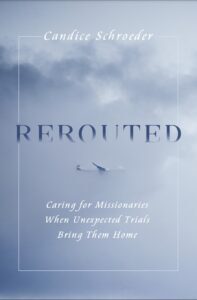
I’m very pleased to be able to feature Candice’s book because it offers a unique perspective that all of us should know about: how to respond and encourage a missionary who has returned from the field. For many missionaries, they experience misunderstanding, criticism, and other discouraging responses. You and I don’t want to be in that group of people. Rerouted can prepared all of us with wisdom to build up these servants in the Body of Christ.
Continue reading and find out how to enter the drawing to win this valuable book. And seriously consider buying a copy to have on hand to make available to others.
Here’s a description of Rerouted:
Have you ever wondered what happens to a missionary family when their overseas work unexpectedly ends? In this eye-opening book, the curtain is pulled back to reveal the struggles many missionaries face when returning home earlier than anticipated. With practical suggestions and real-life examples, this book is a must-read for anyone who wants to help their missionaries thrive when faced with this painful transition. If you’re a supporter, a member of a sending church, in Member Care for a mission agency, or someone who simply cares and prays for missionaries, you will find stories and ideas in these pages that will stir your heart to action.“This is a Nightmare” by Candice Schroeder (an excerpt from her book)“Every Christ follower with a passion for supporting missionaries should read this book.”
–Jonathan Montgomery
Director of Missionary Care, BMA Missions
“This is a nightmare.”
I whispered the phrase as I sat at my computer, its bluish light glaring back at me. I ran my fingers through my hair and kept trying to think of more positive ways to frame our situation in the email I was about to send our ministry partners. I had agonized over every word of this message, trying to read and reread each draft through the eyes of this or that supporter. The names and faces of those dear friends clouded my weary mind, but I knew I could not sit and edit forever. Feeling groggy without my coffee but with nerves too shot to go back to sleep, I hit “send.”
With one click, over 500 inboxes worldwide started dinging. I found myself feeling numb but unable to turn back. On this uncommonly cool June morning in 2020, everyone on our support team would read about the most painful and unexpected plot twist we had ever experienced. The limited words of a painfully scripted email could scarcely capture the emotions flooding our broken hearts:
“We can’t believe we are sending this newsletter.
Due to medical issues with one of our children, we are not going to be able to return to the mission field. We’ve been told by the mission agency’s doctors in Papua New Guinea that they simply cannot recommend we pursue living in the jungle with our child’s current issues. If we moved into a tribal location, we’d have zero access to medical specialists who could help, and it would be to the detriment of our child’s long-term well-being.
Friends and supporters, we are heartbroken. We are grieving deeply. We feel like we are experiencing a death. Not only with not being able to return to the mission field for what we trained several years to do, and what we have huge hearts for—but also concerning our child’s future.
We will be sharing more details in the days to come. Thank you for keeping our family in your prayers at this time.”
Though I had just sent the email, I quickly checked the read receipts. Had anyone seen it yet? What would everyone say? What would people think?
The turbulence of this moment remains indelibly imprinted on my memory. I remember breathing quickly and feeling anxious. I needed to calm down and take my thoughts captive. I laid my head back down on the pillow, covered up with an old blanket that looked just as distressed as I felt, and whispered a prayer:
“Lord, I’m so nervous because I feel we’re disappointing everyone. Please help me. My heart is breaking.” My prayers eventually trailed off as weariness overtook my rattled nerves. The Lord graciously granted me a little rest as I dozed for the next half hour or so.When I woke up, I reached for my phone and saw email after email from our supporters, reassuring me that the Lord had indeed heard the cry of my weary heart:
“Stephen and Candice, I am heartbroken for you and your family…and I’m honestly speechless. I will be praying for you so much in the days ahead.”
“It was with deep sadness and heaviness of heart for your family that we read your newsletter. We are so sorry, dear friends…please know you are loved and are being prayed for.”
“I am sure you have been rocked with this news. May God comfort you as you grieve and lament. We are grieving with you.”..Thank you, Candice, for your vulnerable sharing. And to my readers: to win a copy of this book, make a comment on the blog post page. The drawing ends Tuesday, August 1st. 2023 at 7pm EST. Only US addresses can win. Candice Schroeder and her husband, Stephen, devoted a decade of their marriage to prepare to move to Papua New Guinea with the intent to serve in a church-planting role. Despite their desire to serve for life, they had to return home with their two young children after only fourteen months due to medical concerns. This experience motivates Candice to write and share about the importance of caring for missionaries, particularly when unforeseen difficulties force them to return home to stay. Today, Candice and her family live in southeast Missouri, where Candice is a full-time homemaker.
July 24, 2023
Sneak Peek! “God’s Heart for Your Marriage” Available Soon!

Yes, it’s a women’s Bible study with ten lessons covering 10 topics about marriage. You’ll find a list of the topics below in the Table of Contents. I hope you are as excited as I am.
In the lesson on how a couple can grow into valuing the same godly things, I feature Abigail and Nabal who, of course, don’t value the same things. In the midst of the biblical account, David enters the scene and we learn how Abigail handles a stressful situation. Those qualities are the same ones which help her have godly reactions to her ungodly husband, Nabal. (Examination of how things go for Abigail and Nabal are also addressed in the Lesson.)
First, here’s the biblical back story.
Here’s the excerpt from “God’s Heart for your Marriage.” See what qualities you can identify about Abigail which will help you.When Abigail saw David, she hurried and got down from the donkey and fell before David on her face and bowed to the ground. She fell at his feet and said, “On me alone, my lord, be the guilt. Please let your servant speak in your ears, and hear the words of your servant. Let not my lord regard this worthless fellow, Nabal, for as his name is, so is he. Nabal is his name, and folly is with him. But I your servant did not see the young men of my lord, whom you sent.Now then, my lord, as the Lord lives, and as your soul lives, because the Lord has restrained you from bloodguilt and from saving with your own hand, now then let your enemies and those who seek to do evil to my lord be as Nabal. And now let this present that your servant has brought to my lord be given to the young men who follow my lord. Please forgive the trespass of your servant. For the Lord will certainly make my lord a sure house, because my lord is fighting the battles of the Lord, and evil shall not be found in you so long as you live. (I Samuel 25:23-28 ESV)
Abigail’s wisdom was remarkable, and we could easily wonder if she was surprised by David’s softened response. She must have been nervous as anyone would be. She was bold and yet humble. The fact David later proposes marriage indicates he regards her courage in a positive light. Knowing he would be king later, he recognized his wife must not be a threat to his decisions (as his wife Michal is in 2 Samuel 6:16–22). Being too bold could be a thorn in his side.
We don’t know what Abigail already knows about David, but apparently, she has heard about his calling from God. She points out God’s work in preventing David from acting in an ungodly way (v. 26) and emphasizes the right ways David responded so far, even though his attitude has not been perfect. In this whole account, she is an example of grace that is not “all or nothing.” She honestly points out both the good and the unwise emphasizing how God is involved even more than David recognizes.
She also urges David to think of God’s chosen role for him as future king (1 Samuel 16:13).She affirms his heart’s desire for a righteous reign. Although we don’t know how she can identify his motives, she beautifully calls out the best in this man.
Read that again. She beautifully calls out the best in this man even though she knows he is imperfect.
A wise wife will do the same by speaking of ways God might want to use her husband, even if he has no spiritual vision for the future. Her job is not to force such a future but to affirm the spiritual gifts and abilities God wants to use. Doing this for God’s glory requires facing the fear saying anything positive will only encourage him to focus on neglecting her needs. Trusting God as Abigail did gives confidence and peace in God who can motivate an imperfect man to turn from his selfish ways.
What did you think of the excerpt?
Wow! What a powerful work of God to strengthen Abigail to give wisdom to David to trust God. What qualities did you see? How about humble? Trusting God? Non-defensive? Gives a blessing to David. Sees his good qualities yet knew he is imperfect.
I’m encouraged to evaluate whether I am that kind of encourager to my husband Larry?
I hope you’ll be ready to purchase my book when it’s ready. Let me know what you think.
Table of Content
Lesson 1—Marriage: Revealing God’s Relationship with His Church
Lesson 2—Can We Talk? Rebekah and Isaac
Lesson 3—How Do I Love You? Gomer and Hosea
Lesson 4—Do We Value the Same Thing? Abigail and Nabal
Lesson 5—Let’s Face Temptation Together. Eve and Adam
Lesson 6—Can We Work This Out? Sarah and Abraham
Lesson 7—We Are Committed. Michal and David
Lesson 8—I’m Here For You. Zipporah and Moses; Job and His Wife
Lesson 9—Let’s Grow Together. Priscilla and Aquila; Jezebel and Ahab
Lesson 10—Let’s Celebrate Our Marriage. The Bride and Solomon
Each chapter ends with a “Letter from God.” Here is the one for Lesson 4.
My Precious Princess and Daughter,I know you feel strongly about certain values. I know conflicting opinions with your husband cause you anguish. You may think going to church as a family is essential, yet he would rather golf on  Sunday mornings. You may think consistent discipline of the children is necessary, yet your husband is far too lenient–or harsh—in your opinion. You may love to spend extended time praying over an issue, yet your husband prefers one or two sentences.
I would ask you, my precious one, to relax a bit and let me work. Let me be his Holy Spirit rather than your many words of wisdom. I know the work I’m doing, and I’m not in a hurry. Share your ideas as tantalizing tidbits, not as the final say. Remember, I gave him the headship responsibilities in your marriage and family. He must answer to me. And I expect you to honor him as you would me.
I know you want to please me. Trust my power and ability to work. Hold your values up to the standard of my Word. But if I have not spoken in my Word on a topic, and I lead your husband in a different direction, will you trust me? Remember. I want only the best for you.
Lovingly, Your Heavenly Father, the King


