
Kathy Collard Miller's Blog, page 3
April 30, 2024
Need a Deeper Sense of Security?

When I realized Ephesians 1:5 offers a deeper sense of security, I was extremely excited and grateful.
Here is the verse: “he (God) predestined us for adoption as sons through Jesus Christ, according to the purpose of his will.
Interestingly, in the Roman culture when Paul wrote this Epistle, a Roman father could disinherit a son born into the family. But an adopted child could not be disinherited. The idea was a father had no choice as to what he received when a baby was born naturally into the family. If the child grew up and disgraced the family, the father could justify disinheriting him by saying, “I didn’t know he had all these flaws, otherwise I wouldn’t have chosen him.”
But an adopted child was chosen specifically with full knowledge of his strengths, weaknesses, appearance, and anything else a family considered important. Therefore, a father could not justify disinheriting him. A father could never say, “I didn’t know what I was getting.”Paul’s wording didn’t just say we are sons (or daughters). He included the fact we are adopted. Paul fully knew the Roman culture—he was Jewish yet had Roman citizenship.
Paul's readers knew the significance of not only becoming a son but an adopted son—a position which could not be taken away regardless of performance or flaws. (Ephesians 1:5) #Bible #grace #Jesus https://bit.ly/44nInQz
Click To Tweet
When you read through Ephesians 1, it’s striking how often God’s glory is mentioned. You’ll find it in:
vs. 6: his grace brings him glory
vs. 12: we are to the praise of his glory
vs. 14: the gift of the Holy Spirit brings praise to his glory
vs. 17: God is the Father of glory
vs. 18: we can know the riches of his glory revealed in our inheritance.
What glorious connections to our inheritance.
If you are a Christian, you are secure. You may not always “feel” it, but you are regardless of your feelings. As we more fully develop joy and a sense of security we enlarge God’s generosity in the eyes of others.
If you aren’t a Christian, you can receive Christ as your Savior and become His child–a Christian. Admit your sin and need of a Savior. Jesus died on the cross for your sins and rose from the grave to demonstrate we can have eternal life in heaven after we die. Let me know if you would like to hear more about this wonderful gift.
(This excerpt is from my book Pure-Hearted: The Blessings of Living Out God’s Glory. Check out that book for more information)


April 22, 2024
Feeling Alone Can Bring Shame?

Shame is a subtle feeling of “not enough” and “never enough.” A sense of dirtiness or wanting to hide can accompany those lies when we are alone or feel lonely. This shame in us can cause us to want to react in anger as a way to communicate “don’t see me as shameful.” Just as we’ll see that Jesus knew He wasn’t alone because His Father was with Him, you and I can have that same assurance in order to fight against the lies of shame.Jesus could have felt shame because He experienced many times being alone and on His own
Let’e examine Matthew 26:50-54.
Then they came up and laid hands on Jesus and seized him. And behold, one of those who were with Jesus stretched out his hand and drew his sword and struck the servant of the high priest and cut off his ear. Then Jesus said to him, “Put your sword back into its place. For all who take the sword will perish by the sword. Do you think that I cannot appeal to my Father, and he will at once send me more than twelve legions of angels? But how then should the Scriptures be fulfilled, that it must be so?” (Matthew 26:50-54)
Two of the powerful characteristics of shame is the isolation and helplessness we feel. The dirtiness of shame makes us want to hide, be invisible, and unknown. We find it almost impossible to think anyone could be on our side or understand our battle.
In the Scripture above, Jesus tells angry Peter to stop trying to protect what God doesn’t want protected. Jesus is not angry, helpless nor isolated. Jesus does not accept any identity of shame when those around Him might think, “Jesus isn’t too smart. He picked some out-of-control guy to represent him. Doesn’t he know he’s caught and can’t escape?”Calm Jesus tells Peter amidst all the confusion His Father is protecting His Son, just not the way Peter thinks of protection. If Jesus asked, the Father could send twelve legions of angels. A legion is a division of the Roman army including more than 6,000 men; therefore, Jesus could have asked for the help of 72,000 angels. Regardless whether this is symbolic or meant to be exact doesn’t matter. It is enough. More than enough. Jesus refuses to receive even heavenly help because he is sold out on God’s plan.
We can confidently believe God will supply our strength to resist anger because He is with us. His empowering in us comes from us seeing life with an eternal perspective: our guilt and shame are already destroyed and we are viewed as holy and blameless in God’s eyes (Ephesians 1:4). If 72,000 angels are needed to deliver us from our shame, God would cheerfully send them. But the only thing needed is one sinless Son of God dying on the cross and rising from the dead.
We see the theme of Hebrews 12:1-3. Jesus didn’t want deliverance because otherwise He would not fulfill His Father’s salvation plan. He also would be without the joy of pleasing His Father and providing for believers who will be welcomed into His kingdom.
Be assured, if it is better for you in your fight against shame to have 72,000 angels fight for you, God will provide. You are not alone.God never wants you to buy into the lie you are on your own and there is no hope. The Holy Spirit within you offers you your greatest hope and help.
(This is an excerpt from my soon-to-be published book, Anger Management: Jesus Style. In my book, we look at Jesus’s examples of dealing with anger in righteous ways. One of the topics will be how anger can result from feeling shame.) 
March 26, 2024
3 Lies I Believed When I Became A Christian

On the morning of October 1st, 1967, at the age of 18 (you can do the math), I heard the good news–the Gospel–that I didn’t need to earn God’s love by being perfect in order to enter heaven. God the Father had provided the way through His Son Jesus’s death and resurrection. What great news to that spiritually weary 18-year-old.
Although I’m still facing wrong ideas after these many years, several stand out that adversely affected me for years in the beginning. I think most young Christians can struggle with these same ideas.
I’ll become perfect.I thought I’d become a Christian so that God could make me instantly perfect. But then I learned Philippians 1:6: “being confident of this, that he who began a good work in you will carry it on to completion until the day of Christ Jesus” (NIV). That let me know that I would always be in a process of growth.
I’ll figure out God.It seemed like learning God’s attributes and reading about Him in the Bible would enable me to know how and why He did things. The Bible said God answers prayers and is dependable. Therefore, if I ask, God will answer.
Then came a short term missionary trip to Jamaica. One evening I needed to decide where our witnessing team would work the next day. I prayed and sensed God’s leading clearly. What a thrill!
But the next day it rained such a torrent that even the locals weren’t out and about. I was discouraged. Could I ever trust that I could know God’s voice?
There have been many situations like that, and also, times when it turned out well. I learned I might not always know God’s will perfectly but I could trust God knew what He was doing, even when I didn’t.
The Bible will become boring.“After all, you can only read a book so many times,” I thought.
Many years ago I was furious at a Christian company which reneged on giving a refund. I tried to surrender knowing it was God’s money to do with as He pleased, yet I slipped back into old patterns of wanting revenge and our money.
One day I surrendered again, crying out to God by writing in my journal, “Father God, this is not hidden from Your sight and neither are Your eyes closed and uncaring. Thank you, Lord, that I can surrender all my cares to You—and the money.”
I suddenly felt directed by the Holy Spirit to look at Jeremiah 17. At the top of that page a verse jumped out at me: “My eyes are on all their ways; they are not hidden from me, nor is their sin concealed from my eyes” (Jeremiah 16:17, NIV).
I was shocked. That verse confirmed the very thing I had written in my journal just moments before.
I realized that the Word of God applied by the Spirit of God gives all Christians an entire lifetime of finding the Bible relevant for every situation and challenge.Of course, these three lessons are only a few of many. I trust that there will be many more lessons ahead.
What truth have you found that is most important to you as you have progressed in your Christian life?To learn more about ideas like these, check out my book, “Pure-Hearted: The Blessings of Living Out God’s Glory” https://www.amazon.com/Pure-Hearted-Blessings-Living-Gods-Glory/dp/1946638420/ Available in print, Kindle (only $2.99) and Audio/Audible
March 20, 2024
Feeling Hopeless as a Mom?

Every mother at one point or another feels like a hopeless failure but that doesn’t mean God doesn’t have help available to improve her parenting skills.
If anyone could say they are a failure as a mom, it would be me.
Over 40 years ago, I was an abusive mom of our toddler daughter. I felt hopeless. I feared I would kill her in one of my rages. It seemed God had given up on me because no matter how much I prayed to be a godly mother, nothing changed. Suicide seemed the only option and I almost took my life. But God intervened, gave me hope, and also gave me biblical and practical help to become the loving mom I wanted to be. Today, our family is intact and has healthy relationships.
So what can you do when mothering is overwhelming and feels hopeless?The story isn’t finished. This might sound like a pat answer but we feel hopeless because everything is going wrong. We believe our child’s life is ruined forever. Think of the disciples while Jesus is in the grave. For three days they had no clue God was going to bring hope to the whole world through an astounding, unexpected act—the resurrection.
I certainly had no clue that God would not only help me become a patient mom and heal my daughter’s wounded heart, He would also open ministry doors that has included sharing my story in 9 foreign countries, having over 60 books published, and sharing God’s hope in over 30 US states. None of us can predict how our powerful Father will use what seems hopeless. Because then His glory is brighter than ever.
What you are struggling with is only preparation for sharing help and hope with others.Initially I prayed for an instantaneous deliverance of my anger. I couldn’t possibly comprehend any good coming from struggle. But as I learned more and more about godly parenting, I could teach parenting classes and workshops.
I Peter 1:6-7 (ESV) tells us, “In this you rejoice, though now for a little while, if necessary, you have been grieved by various trials, so that the tested genuineness of your faith—more precious than gold that perishes though it is tested by fire—may be found to result in praise and glory and honor at the revelation of Jesus Christ.”
Have courage to share your struggle knowing you are not alone. Satan loves to keep sin in the darkness of secrets. I thought I was the only one struggling. I remember sitting during a church service after being angry toward our daughter that morning. I sat trying not to sob and yet my heart was breaking.
The woman sitting next to me seemed visibly disturbed because I was so upset. I knew she didn’t know what to do, but I feared sharing because she would condemn me. In time, God gave me the courage to share in the neighborhood Bible study I led and my friends didn’t condemn me. They began to pray for me and hold me accountable.
James 5:16 (ESV) commands us, “Therefore, confess your sins to one another and pray for one another, that you may be healed. The prayer of a righteous person has great power as it is working.” I saw God keep His promise of delivering me when I accepted His courage to tell others.
Whatever struggle you have is absolutely weak in comparison to your Heavenly Father’s power. You will feel intimidated but be courageous to share with others. If no one will help, keep sharing until you find the wise counselor you need.
There is hope–for any challenge you are facing.(For more about God’s work in my life, check out my memoir, No More Anger: Hope for an Out-of-Control Mom available in print, Kindle, and audio.
Also look for my next book, Anger Management–Jesus Style.
March 16, 2024
Friendships Are Gifts From God. How to Treasure Them

Friendships are gifts from God. That may sound very basic but it’s when we remember God orchestrated every human contact we can be grateful even when it’s a challenging connection.
When we are tempted to grumble instead, let’s remember…
1. Friendships are God’s gift.Sometimes we define “good” as “trouble-free.” We can easily assume God made a mistake or is mean-spirited when He connects us with an “unlovable” person. And certainly God might lead us to limit our availability but every person has a purpose in our lives and we have God’s purpose in their lives. There might be a specific talent or perspective you offer few others can offer. Look for that kind of opportunity.
Proverbs 27:17 tells us, “Iron sharpens iron, and one man sharpens another.”
2. Friendships are an invitation to draw closer to God.For instance, if boundaries are needed, seek His plan and don’t immediately assume you should cut off the friendship.
I remember a challenging friendship which seemed her fault. I thought of requirements for her behavior which would eliminate my uncertainty.
Suddenly, I saw my plan of not needing to seeking God’s guidance at each challenge. I released my control and learned to be more loving and kind empowered by God’s love for me. I remembered James 1:2: “Count it all joy, my brothers, when you meet trials of various kinds.”
In different situations, people have different perspectives. That can feel stressful and we might want to withdraw or control. God’s power can give us a gracious perspective of honoring others and see how we depend upon God because of it.
3. Friendships are examples to encourage us.Is there someone who handles stress better than you by depending upon God? Ask her how she maintains her peace. Is there someone who sets up priorities more effectively than you? Ask her about how she makes plans. Is there someone who sets goals more thoughtfully? Ask her to share her ideas.
Most of us resist asking for help but we need to humble ourselves. One humble question can open the door within another person’s heart to help us.
4. Friendships aren’t for comparisons.You may have a friend who is trained in interior decorating. Don’t belittle your lack of designing skills. Another friend is a fabulous gourmet cook and you can’t seem to remember to take the neck and giblets out of the cavity of the Thanksgiving turkey. Don’t apologize or diminish what you can do. God has given you unique skills others think are great.
God never wants you to compare with another. I Corinthians 12:5-6 tells us “there are varieties of service,… but it is the same God who empowers them all in everyone.” You are uniquely suited for God’s service to others.
Be grateful for the God-given skills He’s given you even if they seem lacking in comparison. You have ideas others lack and are impressed by. Use them for God’s glory.
What do you appreciate the most about God’s gift of friendships?(For more biblical encouragement and ideas about friendships in the Bible, consider my women’s Bible study “At the Heart of Friendship: Daughters of the King Bible Study Series“. It is designed for individual and small group study with 10 lessons with commentary and questions based on Scripture about biblical women.)
March 11, 2024
Telling My Story in a YouTube Interview. Join Me.
March 5, 2024
Book Drawing!! “Praying Personalities” by Janet McHenry
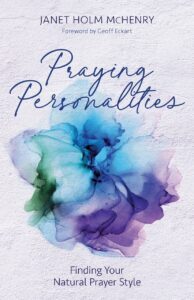
I’m so excited to feature a wonderful book titled “Praying Personalities.” This powerful book by Janet McHenry examines biblical people’s praying lives, eight different personality theories, generational praying practices, learning styles, and spiritual gifts to help the reader find grace and freedom for her praying life. By providing the Praying Personalities Quiz and hundreds of Prayer Pointers, Janet guides you toward developing your very own praying lifestyle that will sync beautifully with your God-given personality.
Would you like to win a copy of this great book? You can enter the drawing by writing a comment on the blog page. Read below for more details.
In the meantime, here’s an excerpt to acquaint you with a taste of Janet’s book.
Find Your Natural Prayer Styleby Janet Holm McHenry© 2024 by Janet Holm McHenry
The simple practice [of prayerwalking] that I began over twenty-five years ago changed me. I lost two dress sizes and . . . aches and pains. Depression that had clouded most of my adult life disappeared, and paralyzing fears did as well. But prayerwalking also shifted my mindset. Because I prayed for what I saw when I walked, I learned that wherever I am, there’s a need for prayer, so my prayerwalking helped me have more of a praying-without-ceasing lifestyle. Instead of having a prayer life—pockets of time for prayer—I began to have a praying life.
Because the changes in me were so dramatic, I tried to convince others to give prayerwalking a chance. Many have over the years, and many are sold on the practice.
However, here’s the thing I discovered: a prayerwalking lifestyle works for me, but it may not work for many others. Each of us is different in personality, daily routines, and interests.
I fell into prayerwalking rather circumstantially after years of trying prayer journals and notebooks (I couldn’t keep up), scheduled prayer sessions (I fell asleep), and creative prayer drawing (I can’t draw). But after years of studying praying people in the Bible, I believe it’s possible to find a praying lifestyle that will work for the rest of your life—a natural practice that makes sense with your God-given personality . . .
What’s Personality Got to Do with It?My personality has a lot to do with the fact that prayerwalking works for me. I can’t sit still and I’m impatient and unable to relax well. When we go on a vacation to the beach, while I say I want to sit in a chair by the water and read books, in actuality I cannot do that for more than an hour, if even that. I am a driven do-er.
What Do Spiritual Gifts Have to Do with It?Three passages in Scripture (found in Rom. 12, 1 Cor. 12, and Eph. 4) provide lists of spiritual gifts, which are prophecy, teaching, apostleship, evangelism, shepherding, helping, wisdom, knowledge, faith, healing, miracles, discernment, tongues, interpretation of tongues, service, exhortation, giving, leadership, and mercy. Questions that help us decide what spiritual gifts we may have include the following:
Why do you do what you do?What motivates you?Do you do what you do because of love?Do you want to strengthen others?Are you more word-oriented or deed-oriented?Do you see how these questions come back again to the idea of personality—the person God has made us to be? While it’s not healthy to obsess about ourselves and our personality continually, understanding how God designed us is helpful in guiding us to a natural prayer style . . .
What Do Biblical People Have to Do with It?As I began to make . . . connections in the Bible, I came to understand there is not one prayer practice that is better than another. Different people in the Bible prayed in different manners that seemingly reflected the kind of person they were. The same would be true for you and me . . .
Understanding who you are in Christ will help you shed false expectations and guilt about what others say your prayer life should be or even some false ideal you have created in your own mind. Instead, you can just pray—and find freedom as you meet God with the very best offering: yourself.
Thank you, Janet!
My friends, you can take Janet’s “Praying Personalities Quiz” at https://prayingpersonalities.com
And you can enter the drawing by making a comment on this blog post. The drawing ends Monday evening, March 11, 2024. Only US addresses can win.
 Janet McHenry is the author of 27 books–eight on prayer, including the bestselling PrayerWalk and her newest, Praying Personalities. She serves on the California leadership team for the National Day of Prayer and as prayer ministries coordinator at The Bridge Church in Reno. Her prayerwalking has been featured in national magazines such as Health, and she is the creator of an online Teachable course called Prayer School.Janet’s business name is called Looking Up! because she loves helping others develop a deeper relationship with God through the study of His Word and a praying lifestyle
Website: https://www.janetmchenry.com
Looking Up! mini-mag with free e-book Prayer Helps: https://www.janetmchenry.com/mini-magazine
Facebook: https://www.facebook.com/pg/JanetMcHenryAuthor/
Instagram: https://www.instagram.com/janetmchenry/
Twitter: https://twitter.com/LookingUpFirst?lang=en
Pinterest: https://www.pinterest.com/janetmchenry/
LinkedIn: https://www.linkedin.com/in/janet-mchenry-18793b24/
Instagram: https://www.instagram.com/janetmchenry/
February 26, 2024
Examine Your Heart: Do You Really Believe Jesus Cares?

Recently, I felt anger rise within me when my husband, Larry, had promised several times to help me with a computer problem. Although the problem didn’t really affect my work much, it still seemed like I needed help right then!
“Larry, I really need you to help me.”
“Okay, Kath. No problem. I can’t right now but I’ll help later.”
Later came and went along with several other “laters.” Each time, my anger increased. But then as I prayed asking the Lord why it bothered me so much, I realized I wasn’t so much bothered by the delay as feeling like Larry didn’t really care about me and my needs. I remembered what happened when the disciples felt like Jesus didn’t care for them. Here’s the story.On that day, when evening had come, he [Jesus] said to them, “Let us go across to the other side.” And leaving the crowd, they took him with them in the boat, just as he was. And other boats were with him. And a great windstorm arose, and the waves were breaking into the boat, so that the boat was already filling. But he was in the stern, asleep on the cushion. And they woke him and said to him, “Teacher, do you not care that we are perishing?” And he awoke and rebuked the wind and said to the sea, “Peace! Be still!” And the wind ceased, and there was a great calm. He said to them, “Why are you so afraid? Have you still no faith?” And they were filled with great fear and said to one another, “Who then is this, that even the wind and the sea obey him?” Mark 4:35-41 (ESV)
I can certainly understand the disciples’ terror. Even though most of them were seasoned fishermen, this storm was obviously way beyond their comfort zone and they knew the danger. The Sea of Galilee was famous for sudden windstorms and many of their friends had most likely perished. Plus, the boat was not just taking on water — it was “already filling.” As they looked around for help, what did they see? Jesus asleep on a cushion. The man who should have been the first to take care of them was completely oblivious to their need and fear.
After waking him, they asked, “Teacher, don’t you care we are perishing?”
Their question is often what our heart is crying out to know: do you care?We can be tempted to express it through emotional outbursts because we’re afraid we’ll hear, “No, I don’t care because you don’t deserve it.” As my anger showed the other day, my heart was actually crying out, “Show me you care about me! Maybe my anger, distress, or craziness will get your attention!”
After Jesus calms the storm and the danger is past, the disciples are filled with wonder and awe. They rightly ask, who is this who can calm the wind and sea? If they had asked that question at the beginning, they wouldn’t have become distressed. Because the answer is: “This is no surprise to Jesus. Even though he seems to be asleep on a cushion, he hasn’t stopped loving us or caring for us because he is the powerful and omniscient God. We can trust whatever reason he is allowing this.”
When you feel like you’ve asked Jesus, “Do you care?” he isn’t upset about your question but he does want you to hear, “Child, I do care! Trust me. I know exactly what I’m doing and it’s for your good and my glory.”February 21, 2024
Why Did It Seem I Shouldn’t “Want” Jesus to be My Shepherd?

When I was in first grade, I was challenged to memorize the Twenty-Third Psalm at Sunday school. And being the good little girl, of course I did. But the first verse perplexed me. “The Lord is my shepherd, I shall not want.” I wondered, I’m not supposed to want Jesus to be my shepherd? I thought I was supposed to. I don’t understand. I didn’t ask my teacher, not wanting to be seen as ignorant.
I think there’s a story in Matthew 16:8 that reminds me of my experience as a little girl.
Jesus asks the disciples, “Why are you discussing among yourselves … that you have no bread?”
Before Jesus says that, Jesus leaves the disciples after they feed the five thousand. The disciples cross Lake Galilee and find Him on the other side. As they join Him, they realize they forgot to bring any bread. Their stomachs must be rumbling with hunger.
Then Jesus says, “Watch and beware of the leaven of the Pharisees and Sadducees” (v. 6).
In response, we’re told the disciples start talking amongst themselves and apply it to their immediate problem: “We brought no bread” (v. 7).Obviously, they immediately focus on the word “leaven” because bread is on their minds—and their stomachs. They are confused. They can’t “hear” Jesus’s spiritual warning about the lies of the religious teachers because they fear a possible rebuke for forgetting food. They think Jesus can’t hear them, but of course, He can. As soon as Jesus talks about leaven, they think their worst fear has come to pass. He knows the truth about us—we didn’t plan well. We are in big trouble.
The beginning of verse eight says, “But Jesus, aware of this, said, ‘O you of little faith …’” (italics added)
Jesus was aware the disciples were confused and He was also aware I was confused about the Twenty-Third Psalm. He knew He would help me understand in his timing. He is aware the disciples misunderstand.
He helps them figure it out by reminding them He just provided bread miraculously for five thousand. Bread isn’t the real problem. The lies of the false teachers are.
Interestingly, Jesus, who as omniscient God knows the disciples would misunderstand, could have chosen to rephrase his words from the beginning but He doesn’t. Their misunderstanding must have a purpose. It holds a life lesson they will use later.
I can appreciate now God’s purpose for my confusion about Jesus being my Shepherd which gave me a hunger for spiritual understanding. And when later I figured out the correct meaning, even though I didn’t know God was leading me into truth, I was not only relieved but enjoyed solving the spiritual puzzle. I like a spiritual challenge even now, recognizing Jesus builds my faith as I study the truth of the Bible.
Is the thought of God being aware good news or bad news for you?Can you think of a time when forgetting God’s past provision caused you to misunderstand God’s intentions? How did God bring understanding?My loving God, I praise you for your perfect awareness yet not with the intention of causing me fear. Thank you for understanding me as no one else can.
The disciples could have avoided anxiety if they had spoken up instead of trying to figure it out on their own. God wants us to come to Him. After all, He is already aware of what we are going through. #trustGod #anxiety @elklakepubinc…
Click To Tweet
(This is a excerpt from Larry and my book, God’s Intriguing Questions: 60 New Testament Devotions Revealing Jesus’s Nature)
February 15, 2024
How Can Your Faith be Stronger Because “The Earth is the Lord’s” (Psalm 24:1)?
 How Can Your Faith be Stronger Because “The Earth is the Lord’s” (Psalm 24:1)?
Psalm 24:1 tells us, “The earth is the Lord’s, and everything in it, the world, and all who live in it.”
But when we observe the degenerating condition of the earth, its chaotic world systems, and the people who do evil, it seems everything is out of control and God isn’t in control.
These ideas might be difficult challenges to our faith, especially when many people sincerely question the authority of God and His Word, the Bible. But a close examination of the biblical principles God reveals to us can assure us God’s authority has not diminished at all. We’ll find the answers in the more than 850 times the word “earth” is used in the Bible (ESV).
What Does ‘the Earth Is the Lord’s’ Mean?As I scrolled through those verses on an online Bible source, I became even more assured about what God means when He says, “the earth is the Lord’s.” He is in charge of how long the earth continues. His possession and sustaining power is demonstrated by the fact that without His continuing total control, our planet would explode out of existence along with the whole universe (or multiverse if you prefer). The atoms cannot hold themselves together without His active power.
From those Bible verses, I noticed the variety of verbs describing God’s intimate involvement: founded, established, made, created, hands stretched out, marshaled the starry host, fashioned, possesses, judges, blesses, rules over, gives life, laid earth’s foundation, in charge, keeps steady, helps, defends and weaves. Incredible!
What is God’s purpose in Him emphasizing His possession of the earth in so many examples?
First, to show there is no other god. Isaiah 45:18 tells us:
For thus says the Lord,
who created the heavens
(he is God!),
who formed the earth and made it
(he established it;
he did not create it empty,
he formed it to be inhabited!):
“I am the Lord, and there is no other. (ESV)
Second, God stresses “the earth is the Lord’s” in order to assure us His created glories reveal He is a mighty, wise and powerful (Joshua 4:24) God. If He is indeed creator and sustainer over every atom, we can trust He is in control of our own lives. We can trust Him with both the little and the big things of life.
Third, no one can claim there’s not enough evidence to acknowledge Him. “For his invisible attributes, namely, his eternal power and divine nature, have been clearly perceived, ever since the creation of the world, in the things that have been made. So they are without excuse” (Romans 1:20).
Everything God did in creation is intended to reveal Himself to His created beings and give us confidence to trust Him. https://ctt.ac/Z35Nb
Click To Tweet
First John 5:19 tells us that Satan has control of the earth: “We know that we are from God, and the whole world lies in the power of the evil one.” We know the control Satan has is limited because believers are empowered to resist his temptations. And we know it’s temporary because one day Satan will be defeated and thrown into the lake of fire. (Revelation 12:7-9; 20:2-10)
What Is the Context of Psalm 24:1-3?King David is the acknowledged author of Psalm 24 and begins his psalm with “The earth is the Lord’s and the fullness thereof, the world and those who dwell therein” (verse 1). Then David continues this praise song which is most often described as a processional song to be sung as people travel to the temple in Jerusalem.
Although the idea can’t be proven, many commentators believe this psalm was written to celebrate David entering the gates of Jerusalem with the ark of the covenant and delivering it to the tent (2 Samuel 6:12-15).
Regardless, it is often used as a processional kind of song in churches when the clergy enters. Other times it might be used for celebrating Jesus’s ascension, for He is entering into heaven (God’s permanent temple) as the victorious Messiah to take His place seated at the right hand of God the Father.
The significance of entering the “ancient doors” (vs. 7) is how the victorious kings of Israel entered through the gates of Jerusalem after a successful war. And then David explains, “Who is this King of glory? The Lord, strong and mighty, the Lord, mighty in battle” (vs. 8). David starts out praising God for being the sovereign King, creator of everything, and ends by telling everyone to be willing to allow Him entrance (vs. 9).
What better King can we possibly allow to enter our lives and reign?
in Revelation, the final declaration states, “Then I saw ‘a new heaven and a new earth,’ for the first heaven and the first earth had passed away, and the sea was no more.” (Rev. 21:1 ESV)
In the meantime, our earth belongs to God and assures us of how mighty, generous, and loving He is. We enjoy His gifts of beautiful nature, good food, and fellowship, acknowledging He is the source. We can praise Him and acknowledge He is worthy to be praised and trusted.
It is interesting that after Peter and John were released from prison, all the disciples and followers who welcomed them home rejoiced. And what did they emphasize in their gratitude? “Sovereign Lord, you made the heavens and the earth and the sea, and everything in them” (Acts 4:24). Based upon that foundational thought, they continued praising God for how He was protecting them and how He deserved their recognition.
I’ve recently become even more aware of how many times Scripture refers to God Almighty as the creator of heaven and earth. My faith has grown.
If God could create and sustain the earth, universe, and everything spinning, then He can do all things good in my life. https://ctt.ac/o6GIe
Click To Tweet


