
Lori Hatcher's Blog: Refresh Blog, page 38
May 6, 2019
When Jesus Flew First Class
I’ve often envied first class travelers.
 Gate attendants invite them to board before all the other passengers. Employees greet them by name and always smile. They enjoy perks and privileges like extra-large, comfy seats; their own restroom; and luxury food and beverages.
 By the time ordinary passengers like me trudge our way through their special seating area to economy class, first class passengers have already kicked back and are enjoying a snack.
On a recent flight from Charlotte to Pittsburgh, I noticed a flight attendant pull a mesh Do-Not-Enter curtain to separate first class from the rest of the plane. Although I could see through the curtain into the cabin, the message was clear—you aren’t allowed in. This area is off limits.
In some ways, heaven is like first class.
Because of my sin (everything I've done, said, or thought that goes against God’s Word, or the good things that I’ve failed to do), I’m not allowed in. No amount of fast talking or good behavior can earn me a coveted boarding pass that would allow me into that hallowed place.
One day, however, a man named Jesus saw me through the veil. He wanted me to sit where he sat, with him.
He rose from his extra-large, comfy seat next to his Father. Stepping out of first class into economy, he walked the length of the plane to the back—the very back—near the restroom where the air was smelly and the turbulence was great.
Laying a gentle hand on my shoulder, he called my name. He reached into his garment and pulled out his boarding pass—the one that said first class. Then he exchanged mine for his, leading me to the front, where he had torn the dividing curtain in half and made a way for me to enter.
“I can’t pay you for this,” I said.
“You don’t have to. It’s a gift.”
And what a gift it was, the privilege of sitting there with Jesus, in the presence of God the Father. Positionally I’m already there— seated with God in heavenly places.
"And God raised us up with Christ and seated us with him in the heavenly realms in Christ Jesus" (Ephesians 5:6).
One day I’ll be physically there, too.
In the meantime, I want to tell everyone I encounter about the Man who left first class to come and fetch me.
What about you? Have you ever flown first class? If not, I’d be glad to introduce you to someone who’d love to exchange his boarding pass for yours. All you have to do is say yes.
CLICK HERE for more information on how to have a relationship with Jesus Christ.
 Are you hungry for God, but starving for time?
 I’d love to send you a 5-minute e-mail devotion twice a week to start your day off with the Lord.
Sign up for a free subscription to Hungry for God by CLICKING HERE.
Then, be sure to VALIDATE the confirmation email you receive.
Note: I promise never to spam you or share your email address.
Because busy women need to connect with God in the craziness of everyday life.

If this post was meaningful to you, would you consider sharing it with a friend by clicking on one of the buttons below? Did you know you can receive bi-weekly Hungry for God posts sent directly to your email inbox? Visit http://www.lori-benotweary.blogspot.com and click on the link in the right hand corner to Subscribe Via Email.
Copyright 2018 by Lori Hatcher


May 1, 2019
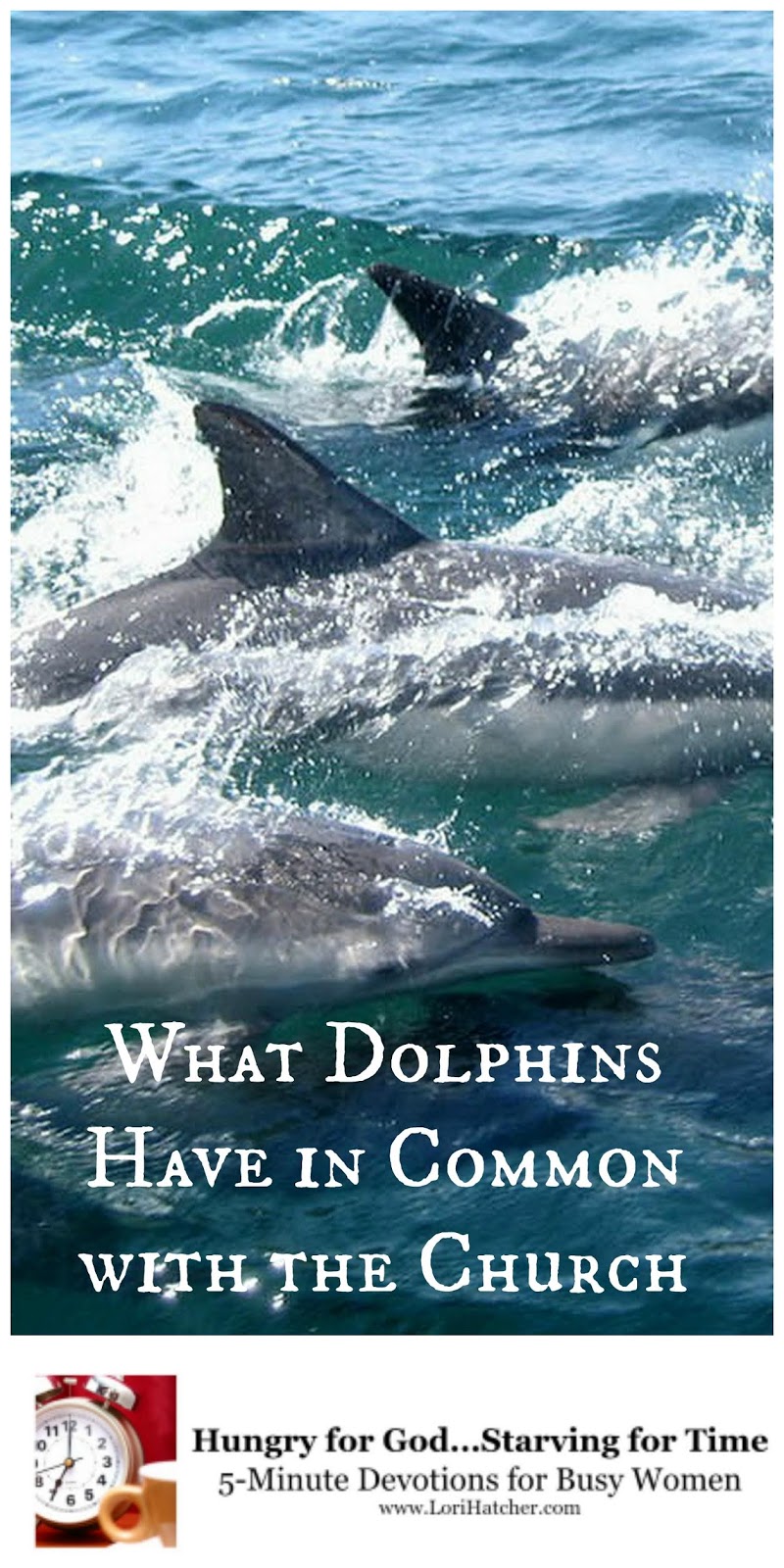
What Dolphins Have in Common with the Church
It’s a beautiful thing to see what happens when people work as a team.
A well-executed series of plays that leads to a touchdown. An orchestra of musicians playing the same composition on different instruments. A platoon of soldiers walking in precision rank and file.
The nature world displays similar examples of teamwork and community. A herd of elephants circles to defend its young against predators. A colony of ants scouts for food, nurtures their larva, and protects their home. Did you know dolphins also work together to find and capture food?
 In the Everglades, after a pod of dolphins identifies a school of fish using echolocation, they form a circle around their prey. Knowing that fish out of the water are easier to catch, one dolphin breaks off from the circle and executes a surprise maneuver. Beating its tail hard against the water, it circles the ring of dolphins.
The up and down motion of its tail stirs up silt on the bottom of the ocean, forming a cloudy ring. The fish, startled and confused by the murky water, panic. They leap from the water, right into the hungry mouths of the dolphins.
Within a few minutes, the pod of dolphins swims off with their tummies full of fresh fish.
Even more graceful than sleek dolphins fishing together is the picture of community Paul paints in 1 Corinthians 12.
“The body is a unit, though it is made up of many parts; and though all its parts are many, they form one body. So it is with Christ. For we were all baptized by one Spirit into one body—whether Jews or Greeks, slave or free –and we were all given the one Spirit to drink” (v. 12-13).
Some are evangelists, Paul says, sharing the good news with the world. Others are pastors, teachers, and preachers. Others give, serve, or pray.
Whatever our gift, he encourages us to use it in tandem with other members of the church, sharing the good news, and advancing the kingdom. When we collaborate, we become God’s hands and feet in the world. Or, in the case of our dolphin friends, the fins and tails. Working together ensures everyone’s needs are met and the world witnesses a beautiful testimony of God’s people doing life together.
When the world looks at your church, what does it see? Lone wolves drawing boundaries around their territories? Or clever dolphins joining forces for the greater good?
What's your part in the family?
If you’re reading by email, CLICK HERE to watch a 1-minute video that captures this amazing dolphin technique.
 Are you hungry for God, but starving for time?
I’d love to send you a 5-minute e-mail devotion twice a week to start your day off with the Lord.
Sign up for a free subscription to Hungry for God by CLICKING HERE.
Then, be sure to VALIDATE the confirmation email you receive.
Note: I promise never to spam you or share your email address.
Because busy women need to connect with God in the craziness of everyday life.

If this post was meaningful to you, would you consider sharing it with a friend by clicking on one of the buttons below? Did you know you can receive bi-weekly Hungry for God posts sent directly to your email inbox? Visit http://www.lori-benotweary.blogspot.com and click on the link in the right hand corner to Subscribe Via Email.
Copyright 2018 by Lori Hatcher
A well-executed series of plays that leads to a touchdown. An orchestra of musicians playing the same composition on different instruments. A platoon of soldiers walking in precision rank and file.
The nature world displays similar examples of teamwork and community. A herd of elephants circles to defend its young against predators. A colony of ants scouts for food, nurtures their larva, and protects their home. Did you know dolphins also work together to find and capture food?
 In the Everglades, after a pod of dolphins identifies a school of fish using echolocation, they form a circle around their prey. Knowing that fish out of the water are easier to catch, one dolphin breaks off from the circle and executes a surprise maneuver. Beating its tail hard against the water, it circles the ring of dolphins.
 The up and down motion of its tail stirs up silt on the bottom of the ocean, forming a cloudy ring. The fish, startled and confused by the murky water, panic. They leap from the water, right into the hungry mouths of the dolphins.
Within a few minutes, the pod of dolphins swims off with their tummies full of fresh fish.
Even more graceful than sleek dolphins fishing together is the picture of community Paul paints in 1 Corinthians 12.
“The body is a unit, though it is made up of many parts; and though all its parts are many, they form one body. So it is with Christ. For we were all baptized by one Spirit into one body—whether Jews or Greeks, slave or free –and we were all given the one Spirit to drink” (v. 12-13).
Some are evangelists, Paul says, sharing the good news with the world. Others are pastors, teachers, and preachers. Others give, serve, or pray.
Whatever our gift, he encourages us to use it in tandem with other members of the church, sharing the good news, and advancing the kingdom. When we collaborate, we become God’s hands and feet in the world. Or, in the case of our dolphin friends, the fins and tails. Working together ensures everyone’s needs are met and the world witnesses a beautiful testimony of God’s people doing life together.
When the world looks at your church, what does it see? Lone wolves drawing boundaries around their territories? Or clever dolphins joining forces for the greater good?
What's your part in the family?
If you’re reading by email, CLICK HERE to watch a 1-minute video that captures this amazing dolphin technique.
Are you hungry for God, but starving for time? I’d love to send you a 5-minute e-mail devotion twice a week to start your day off with the Lord.
Sign up for a free subscription to Hungry for God by CLICKING HERE.
Then, be sure to VALIDATE the confirmation email you receive.
Note: I promise never to spam you or share your email address.
Because busy women need to connect with God in the craziness of everyday life.
If this post was meaningful to you, would you consider sharing it with a friend by clicking on one of the buttons below? Did you know you can receive bi-weekly Hungry for God posts sent directly to your email inbox? Visit http://www.lori-benotweary.blogspot.com and click on the link in the right hand corner to Subscribe Via Email.
Copyright 2018 by Lori Hatcher
April 28, 2019
David's Secret Can Be Our Secret, too
 If Time magazine polled its readers, looking for the 950 B.C. Man of the Year, I’m pretty sure King David would have been a shoe in.
 A military man, he was handsome, clever, and brave. He had political smarts and charisma. He played an instrument well enough to be invited to perform before heads of state. The ladies swooned over him, and the men respected him.
And did I mention he could dance? Yep, this guy had it all. Slap his handsome face on the cover and watch the papyrus rolls fly off the newsstands.
What I like most about King David, however, doesn’t have anything to do with what’s listed on his LinkedIn profile. I admire his faith. Now you’d think with a nickname like “man after God’s own heart,” (bestowed upon him by God, no less), he’d be depressingly perfect. Instead, he’s surprising ordinary.
He prays mighty prayers. Then he grumbles and complains. He lists a multitude of God’s promises. Then he wavers in doubt. He chronicles God’s faithfulness, then he acts as though God has never done anything for him.
David’s story is my story. (Minus the impressive resume.)
Perhaps it’s your story, too.
If so, we can learn from David’s faith life and apply the lessons to our own.
 If you’ve spent much time in David’s songbook, the biblical book of Psalms, you’ve seen the key to David’s perseverance and faith—even when he lifts his voice in lament, he ends up praising God. This central theme runs through most of David’s psalms: Praise and remember. Praise and remember. Sometimes he switches it up. Thank and remember. Thank and remember.
Consider the psalm he composed when he brought the ark into Jerusalem:
“Oh, give thanksto the Lord! . . .
Remember his marvelous words which he has done. . .
Remember his covenant forever; the word which he commanded, for a thousand generations.
Sing to the Lord, all the earth.
Declare his glory among the nations, His wonders among all peoples.
Give to the Lord the glory due His name.
Oh, give thanksto the Lord, for He is good! For His mercy endures forever.”
Like David sometimes did, I get into the greatest spiritual trouble when I focus on my circumstances instead of focusing on God. But when I turn my eyes toward God, the cloud lifts. I remember what’s true—that God is in control, and I can trust him.
If you’re struggling to make sense of the circumstances in your life, put on the garment of praise for the spirit of heaviness. Take a page from David’s (song) book. Scratch out his name on Psalm 103 and insert yours. Offer it up to God, out loud or in your heart, as a statement of faith, proving that you’re choosing to walk by faith, not by sight today.
King David may qualify for Time magazine’s 950 B.C. Man of the Year, but now that we’ve gotten a glimpse of his secret to success, we can enjoy the same close walk with the Lord he did.
Psalm 103___________(insert your name), Bless the Lord, O my soul;Bless the Lord, O my soul;And all that is within me, bless His holy name!Bless the Lord, O my soul,And forget not all His benefits:Who forgives all [my] iniquities,Who heals all [my] diseases,Who redeems [my] life from destruction,Who crowns [me] with lovingkindness and tender mercies,Who satisfies [my] mouth with good things,So that [my] youth is renewed like the eagle’s.The Lord executes righteousnessAnd justice for all who are oppressed.He made known His ways to Moses,His acts to the children of Israel.The Lord is merciful and gracious,Slow to anger, and abounding in mercy.He will not always strive with [me],Nor will He keep His anger forever.He has not dealt with [me] according to [my] sins,Nor punished [my] according to [my] iniquities.For as the heavens are high above the earth,So great is His mercy toward [me];As far as the east is from the west,So far has He removed [my] transgressions from [me].As a father pities his children,So the Lord pities [me]. For He knows [my] frame;He remembers that [I am] dust.As for {me, my] days are like grass;As a flower of the field, so [I] flourish.For the wind passes over [me], and [I am] gone,And its place remembers it no more.But the mercy of the Lord is from everlasting to everlastingOn [me],And His righteousness to [my] children’s children,To such as keep His covenant,And to those who remember His commandments to do them.The Lord has established His throne in heaven,And His kingdom rules over all.Bless the Lord, you His angels,Who excel in strength, who do His word,Heeding the voice of His word.Bless the Lord, all you His hosts,You ministers of His, who do His pleasure.Bless the Lord, all His works,In all places of His dominion.Bless the Lord, O my soul!
Are you hungry for God, but starving for time? I’d love to send you a 5-minute e-mail devotion twice a week to start your day off with the Lord.
Sign up for a free subscription to Hungry for God by CLICKING HERE.
Then, be sure to VALIDATE the confirmation email you receive.
Note: I promise never to spam you or share your email address.
Because busy women need to connect with God in the craziness of everyday life.

If this post was meaningful to you, would you consider sharing it with a friend by clicking on one of the buttons below? Did you know you can receive bi-weekly Hungry for God posts sent directly to your email inbox? Visit http://www.lori-benotweary.blogspot.com and click on the link in the right hand corner to Subscribe Via Email.
Copyright 2018 by Lori Hatcher
April 24, 2019
How to Have the Best Day Ever
 “Gigi,” Lauren said, purple Popsicle juice dripping from her chin. “This is the best day ever.”
 Her simple declaration made me smile. The best day ever.
Thinking back over the events of her day, I found nothing that should have prompted such a statement. No great expenditure of money. No lavish displays of entertainment. No exotic travel or unusual events. Just sharing simple pleasures with someone she loved.
I think King David had a heart like Lauren.
“Praise is awaiting you, O God, in Zion,” he penned in Psalm 65. Then he listed what made his heart happy and full:
God hears our prayers (v. 2).
He atoned for our sins (v. 3).
He chose us to have a relationship with him (v. 4).
He allows us unlimited access to his presence (v. 4).
He satisfies us with his goodness (v. 4).
He answers when we call (v. 5)
His ways are always right (v. 5).
He is our confidence (v. 5).
He is strong and powerful (v. 6).
He provides our needs (v. 9-11).
“You crown the year with Your goodness,” David declared, “and Your paths drip with abundance” (v. 11).
David’s praise reminds me of a story I heard about an elderly man. Although he had little to boast of materially, he’d experienced the joy of walking with God all the days of his life. As he prepared to eat his meager breakfast of coarse bread and cool water, he paused and bowed his head. He prayed with a heart of gratitude, “Oh Lord, you have given me bread, and water, and Jesus, too?”
 Or, to borrow Lauren’s words, “Fun Fridays with Gigi and Popsicles, too?”
 Whether or not there’s a Popsicle in your freezer, today is a good day. If you know Christ as our Savior, you have much to be thankful for. It’s fitting, then, to take a moment and thank God for God’s goodness around us.
I've discovered that praising and thanking God doesn’t change a thing about our circumstances, but it does make our hearts so full of gratitude they will overflow. This encourages not only us, but those around us.
It may even prompt us to declare, like Lauren did, “This is the best day ever.”
Are you hungry for God, but starving for time? I’d love to send you a 5-minute e-mail devotion twice a week to start your day off with the Lord.
Sign up for a free subscription to Hungry for God by CLICKING HERE.
Then, be sure to VALIDATE the confirmation email you receive.
Note: I promise never to spam you or share your email address.
Because busy women need to connect with God in the craziness of everyday life.

If this post was meaningful to you, would you consider sharing it with a friend by clicking on one of the buttons below? Did you know you can receive bi-weekly Hungry for God posts sent directly to your email inbox? Visit http://www.lori-benotweary.blogspot.com and click on the link in the right hand corner to Subscribe Via Email.
Copyright 2018 by Lori Hatcher
April 20, 2019
It's Friday, But Sunday's Comin'
 On Good Friday my five-year-old granddaughter Lauren and I created an Easter centerpiece for our table. As I hot glued sticks together to make crosses, she asked, “Gigi, why are you making three crosses? Jesus only needed one.”
 “On the day Jesus died,” I said, “two thieves were also crucified, one on Jesus' right, and one on his left. One man was prideful. He yelled at Jesus and made fun of him. ‘If you’re the Son of God like you say, why don’t you come down off this cross?’
“The other man was humble, and sorry for what he’d done. He believed Jesus was God’s Son, and he asked him to forgive him for his sin. He told the other man, ‘We’re being punished for our crimes, but this man has done nothing wrong. Jesus, will you remember me when you get to heaven?”
“'Today,’ Jesus said, ‘you will be with me in paradise.’”
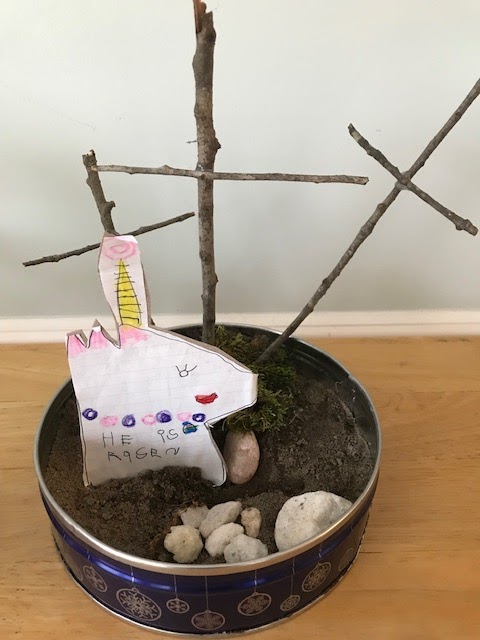 Lauren's 3 Crosses, complete with a unicorn announcement
declaring, "He Is Risen! :)Finishing the story, I pushed three crosses into the soil. “Whenever we see three crosses, we need to ask ourselves, ‘Am I the prideful man who made fun of Jesus? Or am I the humble man who asked Jesus to forgive him and take him to heaven one day?'”
I love how working on this craft with my granddaughter gave us a natural opportunity to talk about Jesus’ death and how, one day, God will call us each into account with one piercing question,
“What did you do with my Son?”
We tucked moss around the crosses and placed a stone beside the opening to the empty tomb.
“You know why I love this craft?” I asked Lauren. She shook her head.
“Because we can see what it looked like on earth—the very sad day when Jesus died on the cross. But we can also see what was getting ready to happen—on the very happy day when Jesus rose from the dead. I think this is what they saw in heaven.
And now, because we know history, this is what we see, too.”
It’s Friday, but Sunday's comin'.
If you're reading by email, CLICK HERE to watch "It's Friday, but Sunday's a Comin'."
Happy Easter!
Are you hungry for God, but starving for time? I’d love to send you a 5-minute e-mail devotion twice a week to start your day off with the Lord.
Sign up for a free subscription to Hungry for God by CLICKING HERE.
Then, be sure to VALIDATE the confirmation email you receive.
Note: I promise never to spam you or share your email address.
Because busy women need to connect with God in the craziness of everyday life.
If this post was meaningful to you, would you consider sharing it with a friend by clicking on one of the buttons below? Did you know you can receive bi-weekly Hungry for God posts sent directly to your email inbox? Visit http://www.lori-benotweary.blogspot.com and click on the link in the right hand corner to Subscribe Via Email.
Copyright 2018 by Lori Hatcher
April 17, 2019
Are We Guilty of Presumptuous Sins?
When you hear the word presumptuous, what comes to mind?
 I think about the acquaintance who felt compelled to share her low opinion of homeschooling—in front of my homeschooled children. Or the house sitter who decided to reorganize my kitchen—without my permission. Presumptuous brings to mind rude house guests, meddling coworkers, and opinionated “experts.”
The Cambridge English Dictionary defines presumptuous as “someone who shows little respect for others by doing things they have no right to do.”Psalm 19:13 uses the word presumptuous in an intriguing way:
“Keep back Your servant also from presumptuous sins;” David prayed. “Let them not have dominion over me. Then I shall be blameless, And I shall be innocent of great transgression.”
Presumptuous sins.
David knew them well. Perhaps this is why he prayed so earnestly to be shielded from them. Fresh in his mind may have been the horrifying incident that occurred when he decided (without seeking the Lord) to transport the ark of God to Jerusalem.
Although God had given the Israelites clear and detailed instruction about how to handle this symbol of God’s presence, David didn’t consult the Scriptures for guidance. Nor did he pray to God. He just thought up a plan, decided it was good, and barreled forward. The resulting calamity ended with one man dead and the rest of them scared to death. You can read more of this story in 1 Samuel 6.
When the funeral was over and the last casserole dish washed and sent home, David pondered his hasty actions. He realized how presumptuous he had been to plan to do something for God without even talking with God.
What if God had a different plan? (He did.)
What if God wanted to use different people in his plan? (He did.)
What if David was to have a lesser role, and God a greater one? (He was.)
We get into trouble every time we assume God needs our help.
It’s important to note that David wasn’t doing anything wrong. He wanted to honor God by moving the ark to a place of respect. His plans went astray, however, when he didn’t include the Lord in them. If he had, the outcome would have been much different. This is an example of the sin of presumption.
I’m often guilty of the same sin that plagued David. I hatch a plan, declare it brilliant, and set it in motion. Only later, when it fails (or succeeds at accomplishing something very different than what I’d intended) do I seek the Lord and realize my sin.I wonder how many disasters I’d avoid if I prayed with David, “Keep back your servant also from presumptuous sins”?
I remember a time when a friend of mine was struggling mightily. I knew I could make it better if I could go to her. To be there to hug and cry and pray. To speak truth and remind her God had a plan for her life. To convince her, by the power of my will and the strength of my personality, that she could trust him.
I desired good things, but I presumptuously assumed I was the only person who could make them happen. In God’s good providence, circumstances, distance, and money kept me from coming to her rescue. My inability to minister in person forced me to do what I should have been doing all along—asking God to meet her needs and quiet her heart.
“Lord, I can’t be there, but you can,” I prayed. “Speak to her heart. Comfort her. Show her in some tangible way that you love her, you’ll provide for her, and you have a good plan for her life. Protect her, Lord. Show yourself real to her today.”
 Only later did I learn how God answered my prayer. In his mercy, he sent a sensitive soul across her path, gave the woman holy boldness to reach out to her. “She came out of nowhere,” my friend said. “She was kind and caring. I think God sent her to remind me that he's aware of my struggles, and he cares.”
Every time I think of this story, I remember that God doesn’t need me. That’s not to say he doesn’t want to use me—but in his time and in his way. God didn’t need David to organize the ark’s relocation to Jerusalem, but he used him—after he sought God’s face, searched God’s Word, and submitted his plans to the much-wiser, all-knowing God.
Every day we face choices. Do I act or do I pray? If God wants me to act, what should I do, and how should I do it? If I am to pray, what specifically should I pray for? Most times, God will call us to act and to pray. Only by seeking God’s will in prayer, in the Scriptures, and through wise counsel will we be able to determine what our part in God’s work is.
I’m learning to apply this three-step method of seeking God’s direction. I hope it will keep me from presumptuous sins. Like David, I have no desire to be known as “someone who shows little respect for others (or God) by doing things they have no right to do.”
How about you? In what area do you struggle most with surrendering to God and seeking his way instead of your own? Leave a comment below and share your thoughts. If you’re reading by email, click HERE to visit Hungry for God online and leave a comment.
Are you hungry for God, but starving for time?
I’d love to send you a 5-minute e-mail devotion twice a week to start your day off with the Lord.
Sign up for a free subscription to Hungry for God by CLICKING HERE.
Then, be sure to VALIDATE the confirmation email you receive.
Note: I promise never to spam you or share your email address.
Because busy women need to connect with God in the craziness of everyday life.

If this post was meaningful to you, would you consider sharing it with a friend by clicking on one of the buttons below? Did you know you can receive bi-weekly Hungry for God posts sent directly to your email inbox? Visit http://www.lori-benotweary.blogspot.com and click on the link in the right hand corner to Subscribe Via Email.
Copyright 2018 by Lori Hatcher
 I think about the acquaintance who felt compelled to share her low opinion of homeschooling—in front of my homeschooled children. Or the house sitter who decided to reorganize my kitchen—without my permission. Presumptuous brings to mind rude house guests, meddling coworkers, and opinionated “experts.”
 The Cambridge English Dictionary defines presumptuous as “someone who shows little respect for others by doing things they have no right to do.”Psalm 19:13 uses the word presumptuous in an intriguing way:
“Keep back Your servant also from presumptuous sins;” David prayed. “Let them not have dominion over me. Then I shall be blameless, And I shall be innocent of great transgression.”
Presumptuous sins.
David knew them well. Perhaps this is why he prayed so earnestly to be shielded from them. Fresh in his mind may have been the horrifying incident that occurred when he decided (without seeking the Lord) to transport the ark of God to Jerusalem.
Although God had given the Israelites clear and detailed instruction about how to handle this symbol of God’s presence, David didn’t consult the Scriptures for guidance. Nor did he pray to God. He just thought up a plan, decided it was good, and barreled forward. The resulting calamity ended with one man dead and the rest of them scared to death. You can read more of this story in 1 Samuel 6.
When the funeral was over and the last casserole dish washed and sent home, David pondered his hasty actions. He realized how presumptuous he had been to plan to do something for God without even talking with God.
What if God had a different plan? (He did.)
What if God wanted to use different people in his plan? (He did.)
What if David was to have a lesser role, and God a greater one? (He was.)
We get into trouble every time we assume God needs our help.
It’s important to note that David wasn’t doing anything wrong. He wanted to honor God by moving the ark to a place of respect. His plans went astray, however, when he didn’t include the Lord in them. If he had, the outcome would have been much different. This is an example of the sin of presumption.
I’m often guilty of the same sin that plagued David. I hatch a plan, declare it brilliant, and set it in motion. Only later, when it fails (or succeeds at accomplishing something very different than what I’d intended) do I seek the Lord and realize my sin.I wonder how many disasters I’d avoid if I prayed with David, “Keep back your servant also from presumptuous sins”?
I remember a time when a friend of mine was struggling mightily. I knew I could make it better if I could go to her. To be there to hug and cry and pray. To speak truth and remind her God had a plan for her life. To convince her, by the power of my will and the strength of my personality, that she could trust him.
I desired good things, but I presumptuously assumed I was the only person who could make them happen. In God’s good providence, circumstances, distance, and money kept me from coming to her rescue. My inability to minister in person forced me to do what I should have been doing all along—asking God to meet her needs and quiet her heart.
“Lord, I can’t be there, but you can,” I prayed. “Speak to her heart. Comfort her. Show her in some tangible way that you love her, you’ll provide for her, and you have a good plan for her life. Protect her, Lord. Show yourself real to her today.”
 Only later did I learn how God answered my prayer. In his mercy, he sent a sensitive soul across her path, gave the woman holy boldness to reach out to her. “She came out of nowhere,” my friend said. “She was kind and caring. I think God sent her to remind me that he's aware of my struggles, and he cares.”
 Every time I think of this story, I remember that God doesn’t need me. That’s not to say he doesn’t want to use me—but in his time and in his way. God didn’t need David to organize the ark’s relocation to Jerusalem, but he used him—after he sought God’s face, searched God’s Word, and submitted his plans to the much-wiser, all-knowing God.
Every day we face choices. Do I act or do I pray? If God wants me to act, what should I do, and how should I do it? If I am to pray, what specifically should I pray for? Most times, God will call us to act and to pray. Only by seeking God’s will in prayer, in the Scriptures, and through wise counsel will we be able to determine what our part in God’s work is.
I’m learning to apply this three-step method of seeking God’s direction. I hope it will keep me from presumptuous sins. Like David, I have no desire to be known as “someone who shows little respect for others (or God) by doing things they have no right to do.”
How about you? In what area do you struggle most with surrendering to God and seeking his way instead of your own? Leave a comment below and share your thoughts. If you’re reading by email, click HERE to visit Hungry for God online and leave a comment.
Are you hungry for God, but starving for time? I’d love to send you a 5-minute e-mail devotion twice a week to start your day off with the Lord.
Sign up for a free subscription to Hungry for God by CLICKING HERE.
Then, be sure to VALIDATE the confirmation email you receive.
Note: I promise never to spam you or share your email address.
Because busy women need to connect with God in the craziness of everyday life.

If this post was meaningful to you, would you consider sharing it with a friend by clicking on one of the buttons below? Did you know you can receive bi-weekly Hungry for God posts sent directly to your email inbox? Visit http://www.lori-benotweary.blogspot.com and click on the link in the right hand corner to Subscribe Via Email.
Copyright 2018 by Lori Hatcher
April 14, 2019
Sucker Punched on Palm Sunday
I never expected to be sucker punched on Palm Sunday.
 There I was, minding my own business, reading three simple verses in the book of Matthew. Palm Sunday verses.
“Now when they drew near Jerusalem, and came to Bethphage, at the Mount of Olives, then Jesus sent two disciples, saying to them, ‘Go into the village opposite you, and immediately you will find a donkey tied, and a colt with her. Loose them and bring them to Me.
"'And if anyone says anything to you, you shall say, "The Lord has need of them,' and immediately he will send them’” (Matthew 21:1-3).
In commentary notes, I discovered that owning a colt in Bible days was today’s equivalent of owning a car or maybe a work truck. A colt (a young horse or donkey) was probably the most valuable thing a person could own. It was their transportation, their beast of burden, and their means of earning a living. Many families were so poor they couldn’t afford to buy or support an animal.
When Jesus asked to use someone’s colt, he was asking to use something very valuable.Yet we see in this passage, because “the Lord ha(d) need of them,” the unnamed owner agreed without question. If Jesus needed them, that was reason enough to say yes immediately and generously.
I’ve probably read this passage a hundred times, but I’ve never truly understood the implications of the third verse. Until today, when it sucker punched me in my spiritual gut.
As the echoes of Jesus’ instructions to his disciples resounded in my spirit, I heard Jesus whisper a heart-stopping question: If I asked to use something of yours, how willing would you be to say yes? Immediately? No questions asked?
If I asked for your car. Or your house. Or some money—a lot of money—would you let me use it?
What if I asked for a chunk of your time? Or asked you to inconvenience yourself to serve someone else, would you do it? Cheerfully? Right away?
Most of the time, I’m willing to serve the Lord when it suits me. If it’s convenient, relatively easy, and not-too-sacrificial. But what about when it costs me something?
Like a significant amount of time, money, or effort? When those I serve aren’t appreciative or easy to love? When I have to yield my rights and privileges and honor someone else’s instead?
All of a sudden, the warm gooey feelings evaporate, and serving God isn’t so fun anymore. One man said we all want to serve God—until someone treats us like a servant.
 I suspect it cost the owner of the donkey something to loan it to Jesus that Sunday. Maybe he missed a day’s work because he couldn’t use his beast of burden. Or had to walk everywhere instead of ride. Maybe he had to plow his field by hand because he didn’t have an animal to hook his plow to.
Despite the cost, he responded yes immediately, “because the Lord had need of it.”
This man knew all he had belonged to God. “What do you have that you did not receive?” Paul reminds us in First Corinthians 4:7. If it wasn’t for the gracious and generous hand of God, we’d have nothing.
Instead, he blesses us with time, resources, and abilities—not for our own use only, but to bless others and advance God’s kingdom.
Think for just a moment what it would be like to watch Jesus’ triumphant entrance into Jerusalem and know it was your donkey that carried him.
What a privilege. What an honor. What a joy.
This week, as we follow Jesus’ footsteps on the way to the cross, I encourage you to ask God, “What do I have that you can use? What are you asking me to release to you so you can use it in your kingdom?”
If he reveals something to you, say yes immediately. Surrender it to him joyfully and generously. Then watch and see how he uses it. Even if you don’t see results right away, you can trust God will use your sacrifices to accomplish his will and his work in the world.
“Hosanna! Hosanna! Blessed is he who comes in the name of the Lord.”
If you'd like to watch the video post that led me to this passage, click HERE. Thanks, Jean Wilund, for setting me up for the punch :)
Are you hungry for God, but starving for time?
I’d love to send you a 5-minute e-mail devotion twice a week to start your day off with the Lord.
Sign up for a free subscription to Hungry for God by CLICKING HERE.
Then, be sure to VALIDATE the confirmation email you receive.
Note: I promise never to spam you or share your email address.
Because busy women need to connect with God in the craziness of everyday life.

If this post was meaningful to you, would you consider sharing it with a friend by clicking on one of the buttons below? Did you know you can receive bi-weekly Hungry for God posts sent directly to your email inbox? Visit http://www.lori-benotweary.blogspot.com and click on the link in the right hand corner to Subscribe Via Email.
Copyright 2018 by Lori Hatcher
 There I was, minding my own business, reading three simple verses in the book of Matthew. Palm Sunday verses.
 “Now when they drew near Jerusalem, and came to Bethphage, at the Mount of Olives, then Jesus sent two disciples, saying to them, ‘Go into the village opposite you, and immediately you will find a donkey tied, and a colt with her. Loose them and bring them to Me.
"'And if anyone says anything to you, you shall say, "The Lord has need of them,' and immediately he will send them’” (Matthew 21:1-3).
In commentary notes, I discovered that owning a colt in Bible days was today’s equivalent of owning a car or maybe a work truck. A colt (a young horse or donkey) was probably the most valuable thing a person could own. It was their transportation, their beast of burden, and their means of earning a living. Many families were so poor they couldn’t afford to buy or support an animal.
When Jesus asked to use someone’s colt, he was asking to use something very valuable.Yet we see in this passage, because “the Lord ha(d) need of them,” the unnamed owner agreed without question. If Jesus needed them, that was reason enough to say yes immediately and generously.
I’ve probably read this passage a hundred times, but I’ve never truly understood the implications of the third verse. Until today, when it sucker punched me in my spiritual gut.
As the echoes of Jesus’ instructions to his disciples resounded in my spirit, I heard Jesus whisper a heart-stopping question: If I asked to use something of yours, how willing would you be to say yes? Immediately? No questions asked?
If I asked for your car. Or your house. Or some money—a lot of money—would you let me use it?
What if I asked for a chunk of your time? Or asked you to inconvenience yourself to serve someone else, would you do it? Cheerfully? Right away?
Most of the time, I’m willing to serve the Lord when it suits me. If it’s convenient, relatively easy, and not-too-sacrificial. But what about when it costs me something?
Like a significant amount of time, money, or effort? When those I serve aren’t appreciative or easy to love? When I have to yield my rights and privileges and honor someone else’s instead?
All of a sudden, the warm gooey feelings evaporate, and serving God isn’t so fun anymore. One man said we all want to serve God—until someone treats us like a servant.
 I suspect it cost the owner of the donkey something to loan it to Jesus that Sunday. Maybe he missed a day’s work because he couldn’t use his beast of burden. Or had to walk everywhere instead of ride. Maybe he had to plow his field by hand because he didn’t have an animal to hook his plow to.
 Despite the cost, he responded yes immediately, “because the Lord had need of it.”
This man knew all he had belonged to God. “What do you have that you did not receive?” Paul reminds us in First Corinthians 4:7. If it wasn’t for the gracious and generous hand of God, we’d have nothing.
Instead, he blesses us with time, resources, and abilities—not for our own use only, but to bless others and advance God’s kingdom.
Think for just a moment what it would be like to watch Jesus’ triumphant entrance into Jerusalem and know it was your donkey that carried him.
What a privilege. What an honor. What a joy.
This week, as we follow Jesus’ footsteps on the way to the cross, I encourage you to ask God, “What do I have that you can use? What are you asking me to release to you so you can use it in your kingdom?”
If he reveals something to you, say yes immediately. Surrender it to him joyfully and generously. Then watch and see how he uses it. Even if you don’t see results right away, you can trust God will use your sacrifices to accomplish his will and his work in the world.
“Hosanna! Hosanna! Blessed is he who comes in the name of the Lord.”
If you'd like to watch the video post that led me to this passage, click HERE. Thanks, Jean Wilund, for setting me up for the punch :)
Are you hungry for God, but starving for time? I’d love to send you a 5-minute e-mail devotion twice a week to start your day off with the Lord.
Sign up for a free subscription to Hungry for God by CLICKING HERE.
Then, be sure to VALIDATE the confirmation email you receive.
Note: I promise never to spam you or share your email address.
Because busy women need to connect with God in the craziness of everyday life.

If this post was meaningful to you, would you consider sharing it with a friend by clicking on one of the buttons below? Did you know you can receive bi-weekly Hungry for God posts sent directly to your email inbox? Visit http://www.lori-benotweary.blogspot.com and click on the link in the right hand corner to Subscribe Via Email.
Copyright 2018 by Lori Hatcher
April 10, 2019
Bombs or Balms? How to Use our Words for Restoration, not Retribution
 Some days it’s hard to believe I craft words for a living. During moments of weakness, carelessness, or selfishness, I stick my wordsmith foot into my undisciplined mouth and produce sentences that wound those around me. I might share an unfiltered observation, an unwanted piece of advice, or an unkind criticism. Sometimes I speak in anger or self-defense, intentionally hurting those who have hurt me.
 How I manage to spit out such words around my size 9 foot, I’ll never know, but I do. And I always regret it. Sometimes as soon as the words leave my mouth. Other times not until later, when the debris field clears, and I can see what’s left in the aftermath of my word bomb.
“Life and death are in the power of the tongue,” Proverbs 18:21 says. More than anything, I want my words—every single one of them—to bring life to those who hear them.
If you share this desire, we can learn from a woman in the Bible named Abigail.
Abigail's life wasnt' easy. Married to a surly, foul-mouthed, selfish man named Nabal (which, in God’s divine sense of humor, means “fool”). I don’t know what size sandal Nabal wore, but I suspect it was a size 14EEE, because one day he stuck his big foot in his big mouth in a really big way.
David and his band of warriors had generously guarded Nabal’s flocks and herds, providing protection from animal and human predators. When the time came to reward David with bounty from the harvest, however, Nabal developed amnesia. He denied David’s request for food, heaped insults on him, and sent his men away in disgrace.
Enter Abigail.
When she heard about the exchange between Nabal and David’s men, she knew no self-respecting warrior would endure such treatment. Her household was in danger. She must act quickly.
First she gathered food—lots of it—and sent it on ahead.
 Then she prepared herself. She leaped onto her donkey and tore out to meet David, thinking, thinking, thinking while she rode. I suspect Abigail had become a master communicator while living with cantankerous Nabal all those years. She’d learned how to deflect his anger during his drunken rages and present her requests with humility and respect, honoring him as her husband despite his behavior.
 All the lessons she’d learned about successful communication swirled in her head as she prepared to meet the man who had pledged to destroy the household of Nabal.
“So it was, as she rode on the donkey, that she went down under cover of the hill; and there were David and his men, coming down toward her, and she met them.”
Dismounting from her donkey and prostrating herself before David, she began her eloquent plea. “Please let your maidservant speak in your ears, and hear the words of your maidservant.”
She acknowledged Nabal’s offense toward David. She accepted partial responsibility for failing to meet the needs of his men. She asked his forgiveness, challenging him to overlook Nabal’s sin.
Then she spoke God’s blessing over him. In this blessing we see evidence of Abigail’s skill as a godly communicator.
“… the lives of your enemies He shall sling out, as from the pocket of a sling” (v. 29).
I don’t know if Abigail had heard of David’s history as a shepherd, or if the Lord put the words in her mouth, but like the stone that felled Goliath, they struck the mark. By referring to a sling similar to the one David had used so long ago in his battle against the Philistine enemy, she pierced David’s heart.
When she reminded him of his victory against his past enemy, she reinforced God’s promise – that he would one day triumph over all who opposed him and take his place as the next king of Israel. He needn’t smear his integrity with petty skirmishes against foolish men. God had greater things planned for him.
By choosing her words carefully, Abigail deflected David’s anger, earned his respect, and saved Nabal’s household. And although she didn’t know it at the time, she also secured her own future. (You can read about the interesting and romantic turn of events only God could orchestrate in 1 Samuel 25.)
Oh, that we would become like Abigail.
With God’s help, we can. We can prayerfully seek God’s wisdom, search for just the right words to best communicate our message to that particular individual, and speak humbly, keeping in mind the goal of restoration, not retribution.
Instead of opening our mouths and blurting out the first thing that comes to mind, we can intentionally choose our words and responses to bring life and healing to those we are speaking. By doing so, we not only honor the one to whom we’re speaking, we honor the Lord.
If you sometimes struggle with your words, invite God to set a watch over your lips. Pray, search, and speak words of life, not death into the ears of those around you. Like Abigail, use your words for restoration, not retribution.
Are you hungry for God, but starving for time? I’d love to send you a 5-minute e-mail devotion twice a week to start your day off with the Lord.
Sign up for a free subscription to Hungry for God by CLICKING HERE.
Then, be sure to VALIDATE the confirmation email you receive.
Note: I promise never to spam you or share your email address.
Because busy women need to connect with God in the craziness of everyday life.

If this post was meaningful to you, would you consider sharing it with a friend by clicking on one of the buttons below? Did you know you can receive bi-weekly Hungry for God posts sent directly to your email inbox? Visit http://www.lori-benotweary.blogspot.com and click on the link in the right hand corner to Subscribe Via Email.
Copyright 2018 by Lori Hatcher
April 7, 2019
Never Underestimate the Power of Encouragement
 Your friend is in trouble. Big trouble. I’m not talking thrown-in-jail kind of trouble, although that certainly could be the case. I’m talking about life circumstance trouble. Maybe she’s struggling through cancer treatment, trying to stay strong in a fractured marriage, or battling depression. Or perhaps she’s unemployed, hopeless, or desperate.
 Even from a distance her situation seems too broken to fix. You don’t have a clue how to ease her pain. You’re powerless to change anything, and you fear that if you try to say or do something, you might trivialize her struggle. The last thing you want to do is add sorrow upon sorrow. Because you don’t know what to do, you don't do anything.
Which is probably the worst thing any of us can do.
The book of First Samuel describes the biblical equivalent of one of the scenarios above. Chapter 23 opens with David running from the maniacal King Saul. Although David has conducted himself toward Saul with loyalty, courage, and integrity, Saul has treated David as an enemy. Time after time Saul mustered his army and marched out to destroy David and his followers. Although David had multiple opportunities to kill Saul, he chose not to, recognizing that Saul was God’s anointed king over Israel as long as the Lord allowed.
But David was growing weary.
Always on the run. Separated from his family. Responsible for the men who followed him. Struggling to feed everyone. Exhausted from battle. Discouraged from persecution. Doubting God’s call on his life and wondering what’s next, David described himself in Psalm 63 as being “in the wilderness.”
Then Jonathan.
Jonathan, the son of Saul, but the best friend of David. A righteous, God-fearing man, Jonathan balanced the weight of his lineage with the weight of his integrity. Although he remained loyal to his father until they died together in battle, he remained a committed friend of David until death also parted them.
During one of the darkest times of David’s life, Jonathan went to him. In the wilderness. Defying his father. Disregarding his inability to change anything about David’s circumstances. Bringing nothing with him but his faith and his friendship, Jonathan entered into David’s pain and eased his sorrow.
“Then Jonathan, Saul's son, arose and went to David in the woods and strengthened his hand in God” (1 Samuel 23:16).
This is what he did:
“And he said to him, ‘Do not fear, for the hand of Saul my father shall not find you. You shall be king over Israel, and I shall be next to you. Even my father Saul knows that’” (v. 17).
Jonathan reminded David of God’s promises. Years earlier Samuel had prophesied that David would one day be king over Israel. But it hadn’t happened yet. In the waiting years, when the path seemed to lead in the opposite direction, David may have found it easy to lose sight of God’s promises. This is why God sent Jonathan.
 When a friend is struggling, stooped under the weight of circumstances and isolated in the wilderness of trial, it’s easy for them to lose sight of God’s promises. We can remind them.
 When their dreams are dying, we can remind them that no plan of God’s can be thwarted (Job 42:2).
When they’re battling an illness and unsure of the outcome, we can remind them though they walk through the valley of the shadow of death, they need not fear, for God is with them (Psalm 23:4).
When they’re struggling with a broken marriage, a prodigal child, or a hopeless situation, we can remind them that nothing is too hard for God (Luke 1:37).
Then we can pledge our loyalty and friendship, vowing to walk beside them through their trial.
“So the two of them made a covenant before the LORD” (v. 18).
Jonathan’s visit didn’t change David’s circumstances. Scripture tells us, “David stayed in the woods, and Jonathan went to his own house” (v. 18). But by entering into David’s pain, reminding him of God’s promises, and renewing their friendship, he “strengthened his hand in God.”
What a gift to someone who is struggling.
Now it’s your turn. Who in your life needs a friend like Jonathan?
Be that friend today.
Are you hungry for God, but starving for time? I’d love to send you a 5-minute e-mail devotion twice a week to start your day off with the Lord.
Sign up for a free subscription to Hungry for God by CLICKING HERE.
Then, be sure to VALIDATE the confirmation email you receive.
Note: I promise never to spam you or share your email address.
Because busy women need to connect with God in the craziness of everyday life.

If this post was meaningful to you, would you consider sharing it with a friend by clicking on one of the buttons below? Did you know you can receive bi-weekly Hungry for God posts sent directly to your email inbox? Visit http://www.lori-benotweary.blogspot.com and click on the link in the right hand corner to Subscribe Via Email.
Copyright 2018 by Lori Hatcher
April 3, 2019
Struggling to Know God's Will?
 “I’ve been chasing this dream for years,” a friend said, “but I’m not convinced it’s God’s will for me. And I’m afraid I’m running right past the really important stuff sitting right in front of me.”
 It’s a common dilemma, one I struggle with, too. Our world offers so many opportunities. How do we know what’s God’s will for us?
A dozen requests to serve on a board, volunteer for a ministry, or work with needy individuals. And opportunities to give? Oh my. Every month I receive requests for support from missionaries, non-profits, and ministries. And then there are the needs of my family. And friends. My church, my neighbors, and my circle of influence. Everyone wants a share of my time and energy, and I want to help them all. They’re all good causes.
But my time, energy, and money isn’t as expansive as my heart. They have limits.
How do I decide where to spend the resources I have? How do I know, like my friend, which dreams to chase without missing the calling sitting right there in front of me? How can I determine what is God’s will for this day, this season, this time in my life?
“The good is the enemy of the best,” Oswald Chambers said, and it is true. It’s so easy to say “Yes” to a hundred good things. But every time we say “Yes” to one thing, we say “No” to two or three others. Every choice we make has trickle down effects.
An event in 1 Samuel 15 reminded me of this good versus best principle. As King Saul prepared to lead the Israelites into battle against the Amalekites, God gave him very specific instructions through the prophet Samuel: “I will punish the Amalekites for what they did to Israel when they waylaid them as they came up from Egypt. Now go, attack the Amalekites and totally destroy everything that belongs to them” (v. 2).
Saul had clear instructions, but he chose not to obey. He instructed his men to kill the Amalekites, “but Saul and the army spared Agag and the best of the sheep and cattle, the fat calves and lambs-- everything that was good” (v. 15:9). Saul chose the good instead of the best.
The good, in his mind, was to spare King Agag’s life and keep the best of the livestock. History tells us otherwise.
The best is to obey the Lord. Every time.
So how can we, 21st-century Christians with no prophet to speak God’s words into our ears, know what is best? We begin with obedience.
“To obey is better than sacrifice,” Samuel said as he viewed the evidence of Saul’s sin. God doesn’t care whether we’re rich, successful, or highly-esteemed. He cares if we obey him. Every day, in every way.
And how do we know what he wants us to do? We can’t, like King Saul, consult our resident prophet for advice. But we have something better—the Holy Spirit who lives inside us. “He will guide you into all truth,” Jesus promised.
With the help of the Holy Spirit, God the Father speaks to his children in a variety of ways:
 Through his Word (Psalm 119:105).
 Through his people (Proverbs 11:14).
Through circumstances (Acts 16:6-10).
And through the still, small voice of the Holy Spirit (James 1:5).
James 1:5 promises, “If any of you lacks wisdom, he should ask God, who gives generously to all without finding fault, and it will be given to him.”
So the next time you wonder what God’s will is, large or small, begin with prayer. Ask him to show you. Then search his Word for principles to apply. Seek the advice of godly people, especially if it’s a big decision. Watch how the circumstances unfold around you. Do they confirm or challenge the direction you think you should go? Finally, sit quietly before the Lord so you can hear the still, small voice of the Holy Spirit speak to your soul.
If you sincerely seek God’s will, he will reveal it to you. Your obedience will still require a measure of faith, but he will guide you. It’s his nature. The Good Shepherd never sends his sheep on alone. Instead, he goes before us every step of the way.
“He calls his own sheep by name and leads them out. And when he brings out his own sheep, he goes before them; and the sheep follow him, for they know his voice” (John 10:3-4).
Now it’s your turn. In what area are you struggling to discern God’s will? Which of the steps above might help bring further clarity?
Are you hungry for God, but starving for time? I’d love to send you a 5-minute e-mail devotion twice a week to start your day off with the Lord.
Sign up for a free subscription to Hungry for God by CLICKING HERE.
Then, be sure to VALIDATE the confirmation email you receive.
Note: I promise never to spam you or share your email address.
Because busy women need to connect with God in the craziness of everyday life.

If this post was meaningful to you, would you consider sharing it with a friend by clicking on one of the buttons below? Did you know you can receive bi-weekly Hungry for God posts sent directly to your email inbox? Visit http://www.lori-benotweary.blogspot.com and click on the link in the right hand corner to Subscribe Via Email.
Copyright 2018 by Lori Hatcher
Refresh Blog

A place to refresh your faith, hope, and prayers with 5-minute weekly posts.
- Lori Hatcher's profile
- 101 followers

