Nicholas Fox Weber's Blog, page 22
August 19, 2013


August 9, 2013
Press Release
FOR IMMEDIATE RELEASE:
The Josef and Anni Albers Foundation Congratulates
Nicholas Fox Weber
On His Chevalier de l’Ordre des Arts et des Lettres
From the French Ministry of Culture
Ceremony on Wednesday, October 16, 2013
Bethany, CT, August 9, 2013 – The Josef and Anni Albers Foundation congratulates Nicholas Fox Weber, Executive Director of the Foundation, on his Chevalier de l’Ordre des Arts et Lettres (the Order of Arts and Letters) from the French Ministry of Culture. A ceremony to mark the honor will take place in Paris on Wednesday, October 16, 2013. The Order of Arts and Letters was established in 1957 to recognize eminent artists and writers, as well as people who have contributed significantly to furthering the arts in France and throughout the world.
Nicholas Fox Weber has been running the Josef and Anni Albers Foundation since Josef’s death in 1976, initially in close collaboration with Josef’s wife Anni, and, from 1979, with the title of Executive Director. In 1999, with the support of his fellow trustees of the Foundation, Fox Weber organized the construction of its headquarters in Bethany, Connecticut. In this role of Executive Director, Fox Weber has maintained the artistic practices and the devotion to the understanding and appreciation of the arts for which the Alberses envisioned for the organization.
In 2005, Fox Weber and the Josef and Anni Albers Foundation established the American Friends of Le Korsa (AFLK) to further the work by Dr. Gilles Degois, a Paris-based physician, to improve the quality of everyday life in Senegal, one of the poorest regions of the world. Since 2011 under the direction of Fox Weber as Founder and President, AFLK has expanded the scope of its activities to help construct medical centers and educational facilities that provide lifesaving health services and key learning opportunities to villages deep in the African bush where such facilities and programs were previously nonexistent.
In addition, Fox Weber is a dedicated scholar and the author of more than ten books, including The Bauhaus Group: Six Masters of Modernism (2011) and Le Corbusier: A Life (2008). He holds a B.A. from Columbia College, New York, New York; an M.A. with a Fellowship in American Art from Yale University, New Haven, Connecticut; and is an alum of Loomis School, Windsor, Connecticut, from which he graduated Cum Laude. Throughout his career, he has contributed to publications such as ARTnews, The New York Times, The New York Times Book Review, Le Monde, The Los Angeles Times Book Review, The Wall Street Journal, and Vogue. Fox Weber has curated numerous exhibitions in the U.S. and Europe and has given lectures all over the world on topics including the works and legacy of Josef and Anni Albers and the Bauhaus. He is also currently a member of Conseil Administratif, Le Kaïcédrat, Paris, a member of the Conseil Administratif, Leeket Bi, Paris, and member of the Museum of Modern Art Committee on Archives, New York, New York.
The Josef and Anni Albers Foundation
In 1971, Josef Albers established a not-for-profit organization to further “the revelation and evocation of vision through art.” Today, the organization – The Josef and Anni Albers Foundation – is devoted to preserving and promoting the enduring achievements of both Josef and Anni Albers, and the aesthetic and philosophical principles by which they lived. It serves as a unique center for the understanding and appreciation of the arts and of all visual experience – with the combined legacies of Josef and Anni Albers at its heart.
The Foundation carries out its mission by working on exhibitions and publications, primarily focused on the art of Josef and Anni Albers; assisting with research; and supporting education. It conserves the Alberses’ art and archives, and serves as an information resource for artists, scholars, students, and the general public. It helps sponsor other activities inspired by Josef and Anni Albers’s interests and concerns.
The Albers Foundation is located in Bethany, Connecticut, near New Haven – thanks to funds acquired by Anni Albers for the restitution of family property in the former East Berlin. The Bethany campus includes a central research and archival storage center to accommodate the Foundation’s art collections, library and archives, and offices, as well as residence studios for visiting artists. The rural property provides a venue for educational outreach programs.
The Foundation is open by appointment to interested individuals, scholars, and curators for tours, study, and research.
Further information about the Josef and Anni Albers Foundation can be found at: www.albersfoundation.org
Media Contacts
For more information on The Albers Foundation, images, or to arrange interviews, please contact:
Elizabeth Reina-Longoria or Rachel Patall-David
Blue Medium Inc.
elizabeth@bluemedium.com
rachel@bluemedium.com
+1 (212) 675-1800
August 8, 2013
Publicolor Comes to The Albers Foundation
On March 5, an article about Publicolor appeared in the New York Times, and its program and philosophy sounded so wonderful that I got in touch with some of the people running the organization to say that I was sure that there were ways that we could work together. As the Times reported, Publicolor’s design-based programs and academic support engage at-risk youth in their education and combat the lack of job-preparedness that fuels poverty.
Publicolor will be selecting the recipient of a Josef Alber’s scholarship, which will 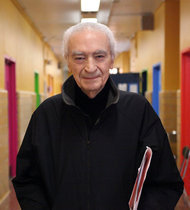 enable a student to continue his or her art education well into the future, and I was given the wonderful chance to lecture along with Massimo Vignelli, the world-renowned architect and designer, known among other things for having created the map and all of the graphics for the New York City subway system and the logo for American Airlines, to all of the students in Publicolor’s summer program held at Pratt Institute in Brooklyn. It was a pleasure to follow Massimo, who had enumerated so many of Josef’s most important beliefs in a wonderful talk he gave on graphic design.
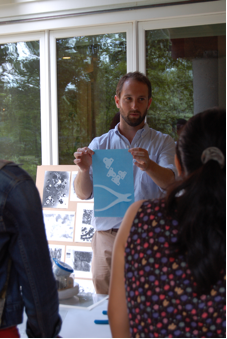
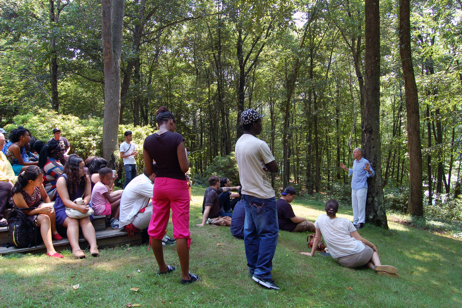
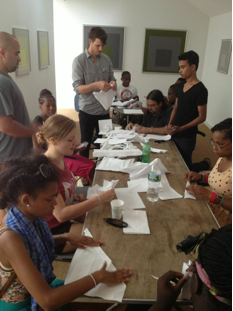
On July 19, some 60 Publicolor students and 10 staff members arrived from New York in two large buses in order to spend the better part of a day here at the Foundation. What a spectacular team effort it was. I cannot tell you how proud I am of absolutely everybody on the staff of the Albers Foundation. Everything had been thought through – - including talks about ticks and poison ivy given in both buses as the students came northward; a terrific box lunch; and, above all, a series of wonderful workshops in which Josef’s ideas on experimentation and the use of materials was put to great effect. The photos below give a richer impression of that day than anything I could say in words.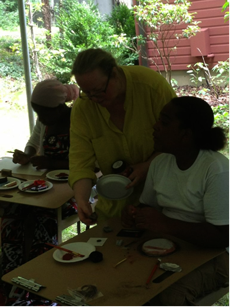


August 7, 2013
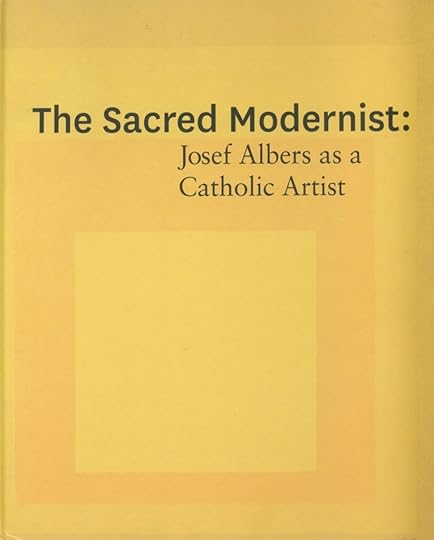
The Sacred Modernist Josef Albers as a Catholic Artist
 To distribute material possessions is to divide them.
To distribute spiritual possessions is to multiply them.
Easy to know that diamonds are precious.
Good to know that rubies have depth.
But more to see that pebbles are miraculous.
Josef Albers wrote these aphorisms, and then rewrote them frequently.
Sometimes he scribed them by longhand; on other occasions he pecked them out with the manual typewriter he used to imprint texts on the thin white tissue paper he preferred heavier stock. That translucent, feather–weight paper, like the flowing strokes of his fountain pen, hadsome of the same charm and ethereality as his art and words: for all of his adamant practicality, Albers lived in a mystical realm. He was reverential about the mysteries and wonders of existence, the holiness he found in
earthly life.
Words like “spiritual” and “miraculous” were vital to him. The great Bauhaus-trained modernist was the quintessential
craftsman, devoted to technical capability, rigorous in his standards concerning materials and the way one worked, but
he also was profoundly interested in the other-worldly. For his was a deeply religious sensibility.
Albers was born and raised a Catholic. (His native Westphalia was then, as it remains, one of the strongly Catholic regions of Germany, even if the country had a Protestant majority.) At the end of his life, when I knew him, he regularly attended Sunday Mass, and went to confession. Yet the role of Christian belief, the strong connection to liturgy, the vital function of the Trinity in his art, has never before been explored.
The Sacred Modernist: Josef Albers as a Catholic Artist presents this abstract artist’s work in a new way…
July 30, 2013
July 29, 2013
July 27, 2013
Jeanneret Family, 1905
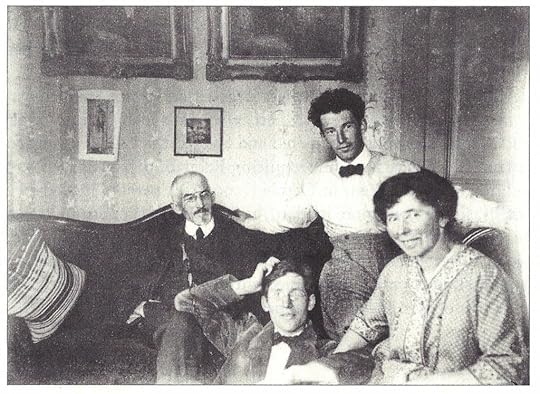
In front, next to his mother, with his father and Albert behind, in the family
apartment on the rue Léopold-Robert in La Chaux-de-Fonds, ca. 1905
July 25, 2013

July 24, 2013
Mysterious Works From A Mysterious Man
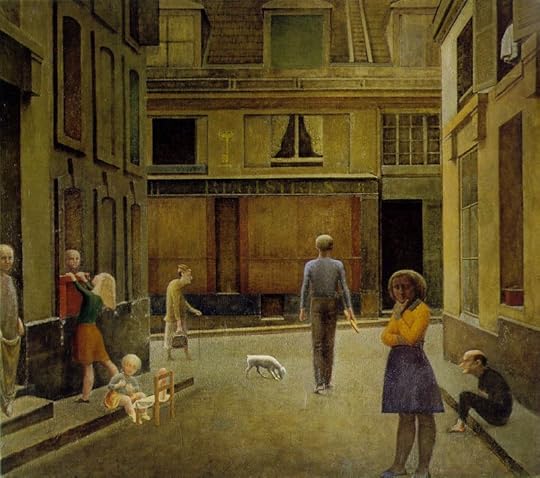 “While not quite as inaccessible as the man, Balthus’s works are scarce and exhibitions a rarity.”
– Nicholas Fox Weber, Mysterious Works From A Mysterious Man, New York Times
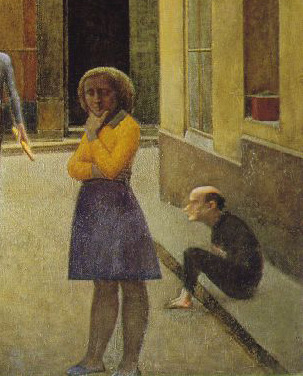
Detail of Balthus’s “Passage du Commerce Saint André” – A Metaphor?