Nicholas Fox Weber's Blog, page 19
November 2, 2013
These 14 books appear on the best seller lists of featured booksellers on Designers & Books


October 29, 2013
Tolstoy’s What Is Art?
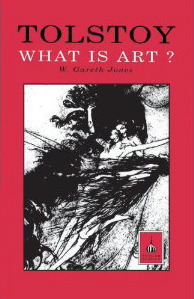 I was reading parts of Tolstoy’s What is Art? this morning.
I know he wrote it in the late 1890s — it was one of his last texts — but it feels as if he had just walked
out of one of the art auction houses today. Mondrian and Josef and Anni would have agreed with him a hundred percent.
See some bits and pieces below.
“Art is one of the two organs of mankind’s progress. Through the word, man communicates in thought, through the images of art he communicates in feeling with all people, not only of the present, but of the
past and the future.”
“The organ of art has been perverted, and as a result the society of the upper classes has in considerable measure been deprived of the activity which this organ should have accomplished. On the one hand, artistic counterfeits, serving only for people’s amusement and corruption, have spread in our society at an enormous scale, and, on the other hand, works of worthless, exclusive art, valued as the highest art, have perverted the capacity of the majority of people in our society for being infected by true works of art, and have therefore deprived them of the possibility of knowing the highest feelings to which mankind has attained and which can be conveyed to people only by art.”
“All the best that mankind has produced in art remains foreign to people deprived of the capacity for being infected by art, and is replaced by false counterfeits of art or by worthless art which they mistake for genuine.”
“Owing to the loss of the capacity for being infected by works of art, people of the upper-class milieu grow up, are educated, and live without the softening, fertilizing effect of art, and therefore they not only do not move toward perfection, do not become better, but on the contrary they become ever more savage, coarse, and cruel.”
NFW, October 2013
American Friends of Le Korsa – How It Works
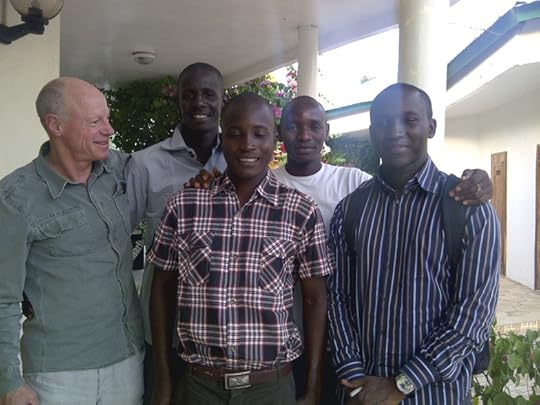
Nick with the 3 students and Moustapha
The way that AFLK works is that our full-time Director,
Moustapha Diouf, who is based in Dakar, is in touch on a regular basis with each of the institutions we try to assist.
Read about Projects in Senegal
October 25, 2013
Balthus – Dalkey Archive Press
The post Balthus – Dalkey Archive Press appeared first on www.nicholasfoxweber.com.
October 22, 2013
October 17, 2013
MODERNISTA SACRO / THE SACRED MODERNIST
Distilling is beautiful. First of all, because it is a slow, philosophic, and silent occupation, which keeps you busy but gives you
time to think of other things, somewhat like riding a bike. Then, because it involves a metamorphosis from liquid to vapor
(invisible), and from this once again to liquid; but in this double journey, up and down, purity is attained, an ambiguous and
fascinating condition … And finally, when you set about distilling, you acquire the consciousness of repeating a “ritual
consecrated by the centuries.
Primo Levi
 Why start out with Primo Levi, a Jewish Italian writer, when considering Josef Albers, a Catholic German painter?
It is because Josef’s sense of the sacred, his redolent spirituality, was “universal and timeless” his wife Anni’s
favorite two words – and had less to do with a specific place, epoch, creed, or profession than with a general quality
of reverence.
Yet his strong faith in forces he worshipped bnt did not fully understand, his profound sense of appreciation, was rooted
in Catholicism. Late in his life, when Josef was best known for the Homages to the Square he had started in 1950 at age
sixty-two, and was asked how he finally selected his colors -he had thousands of tubes of paint, sometimes as many as
eight with the same precise name, like “Mars Yellow”, but each made by a different manufacturer, which he would apply
straight to the panel with a painter’s knife – he would answer, “I work, and I work, and I try this one, and that one, and
then I just use one and look up and praise God.” The God he worshipped was in some way the same one to whom he
had prayed ever since he was a little boy, attending the Catholic church in his home town, Bottrop, in the region of
Germany which is, as is much of Westphalia, more Catholic than Protestant. He was brought up in a devoutly
religious family – first his father and mother, and then, following his mother’s death when he was still a child, his father
and stepmother – and he remained observant, to varying degrees, for his entire life.
And so we bring the Catholic Josef to Italy -where the religious traditions would have been so familiar to him. This artist
who devoted his life to revealing miracles with purely abstract art is at home here in nany ways.
October 13, 2013
E-Flux
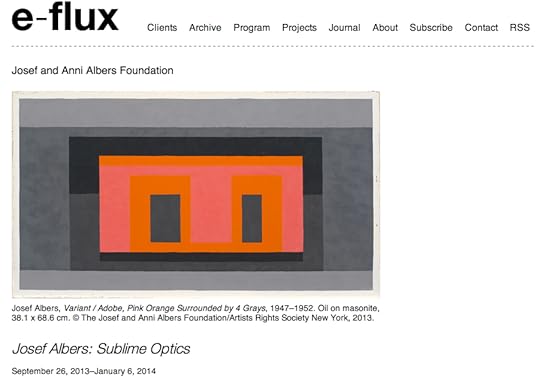
Josef Albers: Sublime Optics September 26, 2013–January 6, 2014 Fondazione Stelline
Corso Magenta 61 Milan Hours: Tuesday–Sunday 10am–8pm
www.stelline.it
Learning to See: Josef Albers as a Teacher, from the Bauhaus to Yale
October 2–December 1, 2013
Academia di Belle Arti di Brera
Via Brera 28 Milan
Hours: Monday–Friday 9am–6:30pm,
Saturday 9am–2pm
www.accademiadibrera.it
www.albersfoundation.org
From September 26, 2013 to January 6, 2014, the Fondazione Stelline, in collaboration with the
Josef and Anni Albers Foundation, will host Milan’s first ever monographic exhibition of the work
of the great modernist and Bauhaus artist Josef Albers.
Josef Albers: Sublime Optics explores the spiritual elements in Albers’s art. Maintaining his religious
practice lifelong, Albers incorporated traditional imagery in a lot of his work, and, even when he did not,
regarded transformation of color and line as spiritual, even mystical, events.
It is the less religious sense of Albers’s spirituality that this exhibition addresses. Sublime Optics
considers Albers’s experiments with line, form, and color, in turn, and evaluates how he was able to
create further mysteries in the world—ones that can act as spiritual exercises for our eyes. He is like
a mystic optician, fitting us with lenses to better see the sublime around us.
Curated and installed by Nick Murphy, and based on an exhibition conceived and selected by
Nicholas Fox Weber (Executive Director of the Josef and Anni Albers Foundation),
Josef Albers: Sublime Optics offers a unique perspective on the Bauhaus Master.
At the Bauhaus, Italy was an important source of inspiration. In 1934, the year following the closing
of the Bauhaus, Wassily Kandinsky organized an exhibition of Albers’s prints in Milan. This is the
first time there has been an exhibition of Josef Albers’s work in Milan since that exhibition nearly
80 years ago.
The exhibition will present 78 works from Albers’s entire career—from his very first known drawing
to his very last Homage to the Square. This includes rare early drawings, stained-glass assemblages,
sandblasted glass constructions, and a range of pure abstract paintings. Underlying all these works is
Albers’s reverence for clear and honest thinking, and his firm belief that devotion to craftsmanship and
truthfulness can transform the everyday miraculously.
Albers always declared the need to make arts accessible to the greatest possible number of people,
including those that cannot freely enjoy this privilege. Both the Fondazione Stelline and the Josef and
Anni Albers Foundation are pleased to announce that this exhibition will partner with the Prison of Milan
to work with inmates on numerous components of the exhibition process, from the preparation of the
exhibition to the attendance at artistic events and stage plays.
Concurrent with this exhibition, from October 2 to December 1, 2013, the Josef and Anni Albers Foundation
has collaborated with the Accademia di Brera to bring Milan an exhibition of Josef Albers’s teaching methods
and students’ work, Learning to See: Josef Albers as a Teacher, from the Bauhaus to Yale.
This additional exhibition will reveal the vibrancy and extraordinary impact of Albers’s groundbreaking pedagogical
methods and will feature works spanning four decades of his teaching career.
For Albers, the origin of art was “the discrepancy between physical fact and psychic effect.” The heightened
visual attentiveness that Albers’s work creates in the visitor is the perfect tool for handling the contemporary
cacophony of distractions that surrounds us.
Josef Albers was born on March 19, 1888, in Bottrop, Westphalia. He enrolled in the Bauhaus in Weimar in 1920.
In 1923, Albers was appointed instructor of the Preliminary Course.
In 1933, Albers immigrated with his wife, Anni Albers, to the United States, where he created an art department at
Black Mountain College in North Carolina.
In 1950, Albers started his “Homage to the Square” series of paintings and in the same year he accepted the
appointment as Chair of the Department of Design at Yale University.
In 1963, Yale University Press published Albers’s Interaction of Color, demonstrating the principles of Albers’s
exploration of the mutability and relativity of color and based on his renowned teaching of color.
In 1971, Josef Albers was the first living artist to have a retrospective exhibition at the Metropolitan Museum of Art, New York.
October 12, 2013
Sublime Optics
From 26 September 2013 to 6 January 2014, the Fondazione Stelline in collaboration with the Josef and Anni Albers
Foundation, is hosting Milan’s first ever monographic exhibition of the work of the great modernist and Bauhaus Artist,
Josef Albers.
At the Bauhaus, where Albers was both student and teacher, from 1920-1933, Italy was an important source of inspiration.
In 1934, the year following the closing of the Bauhaus, Wassily Kandinsky organized an exhibition of Albers’s prints in Milan.
This is the first time there has been an exhibition of Josef Albers’s work in Milan since that exhibition nearly 80 years ago.
Albers would be thrilled to have his work shown so close to ‘The Last Supper’, a great masterpiece of the artist he so
intensely respected – Leonardo.
Curated and installed by Nick Murphy (Projects Director of the Josef and Anni Albers Foundation), and based on an
exhibition conceived and selected by Nicholas Fox Weber (Executive Director of the Josef and Anni Albers Foundation),
Josef Albers: Spirituality and Rigor, Josef Albers. Sublime Optics offers a unique perspective on the Bauhaus Master.
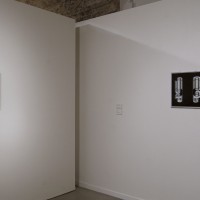
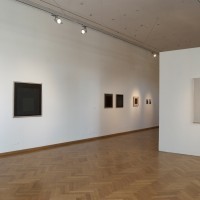
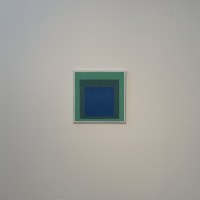
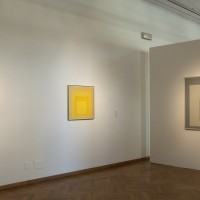
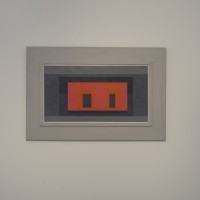
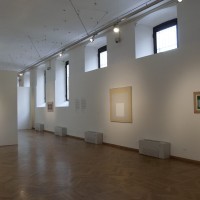
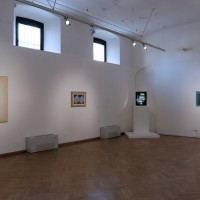
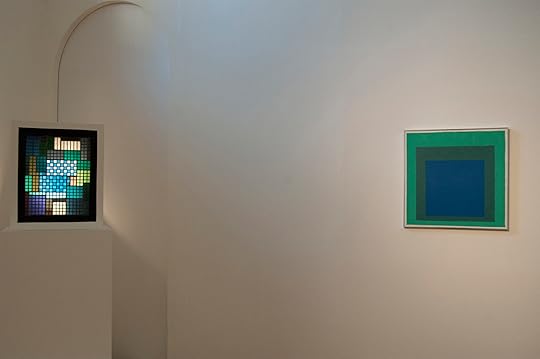
See photographs from the exhibition below.