
Marc Weidenbaum's Blog, page 71
February 23, 2024


Crafting a Prompt
It’s funny how words get usurped. We talked about drone music long before the word “drone” came to be associated with small flying objects. And in the Disquiet Junto, we used the term “prompt” to refer to creative composition concepts for individual and collaborative music-making projects for a decade before the term became widely associated with engaging a nascent artificial intelligence to respond with some desired output. But the older meanings linger, especially in communities and scenes where a definition is baked into the lingua franca. In such realms, the earlier meaning can still evolve in its own way, even when the newer meaning gains prominence. On the discussion board llllllll.co (aka Lines), where a lot of Disquiet Junto community discussion takes place, someone raised the topic of a visual equivalent to the Disquiet Junto — that is, weekly composition prompts aimed at visual artists, rather than at musicians. In the resulting (and ongoing) conversation, a longtime Lines and Junto participant, Jason Wehmhoener, made a comment about the development of prompts, the substance of which I appreciated:
I think there’s more to be said about building a community around creative prompts. I’ve attempted, privately, to build up a backlog of weekly prompt ideas for visual arts, and I’ve spoken with @disquiet at length about what makes a good prompt, and I have to say, I personally found the task to be an immense challenge. One of the things Marc really emphasizes in his prompts is accessibility. He takes care to make prompts that don’t necessarily require specialized skill, or prior experience. There’s a very zen like beginners mind approach to the Junto, an aspect of the experience that I think may be under appreciated. I think it explains a lot of the Junto’s success. Anybody can jump in anytime. And yet it’s always engaging and often surprising.
It’s often the case that I learn the most about the Junto not just by watching people participate and listening to their work, but also by witnessing what participants themselves say about the Junto: how they describe it, how they position it, what stands out to them. The language they use is often language I later adopt myself.
February 22, 2024
Disquiet Junto Project 0634: Bust a Move
Each Thursday in the Disquiet Junto music community, a new compositional challenge is set before the group’s members, who then have five days to record and upload a track in response to the project instructions.
Membership in the Junto is open: just join and participate. (A SoundCloud account is helpful but not required.) There’s no pressure to do every project. The Junto is weekly so that you know it’s there, every Thursday through Monday, when your time and interest align.
Tracks are added to the SoundCloud playlist for the duration of the project. Additional (non-SoundCloud) tracks appear in the lllllll.co discussion thread.
These following instructions went to the group email list (via juntoletter.disquiet.com).
Disquiet Junto Project 0634: Bust a Move
The Assignment: Record a piece of music on top of a muffled recording of a piece of classical music.
Step 1: Locate a public domain recording of a piece of classical music, perhaps at archive.org.
Step 2: In some manner, muffle the original until it sounds like it is being heard from underground or through a thick wall. Perhaps run it through a low-pass filter. Or actually record it through a thick wall.
Step 3: Listen closely to what remains of the recording after Step 2.
Step 4: Record a piece of music on top of the audio that resulted from Step 2, leaving that foundation audible to some degree.
Tasks Upon Completion:
Label: Include “disquiet0634” (no spaces/quotes) in the name of your track.
Upload: Post your track to a public account (SoundCloud preferred but by no means required). It’s best to focus on one track, but if you post more than one, clarify which is the “main” rendition.
Share: Post your track and a description explanation at https://llllllll.co/t/disquiet-junto-project-0634-bust-a-move/
Discuss: Listen to and comment on the other tracks.
Additional Details:
Length: The length is up to you. Optimally, it will be exactly the same length as the source audio.
Deadline: Monday, February 26, 2024, 11:59pm (that is: just before midnight) wherever you are.
About: https://disquiet.com/junto/
Newsletter: https://juntoletter.disquiet.com/
License: It’s preferred (but not required) to set your track as downloadable and allowing for attributed remixing (i.e., an attribution Creative Commons license).
Please Include When Posting Your Track:
More on the 634th weekly Disquiet Junto project, Bust a Move — The Assignment: Record a piece of music on top of a muffled recording of a piece of classical music — at https://disquiet.com/0634/
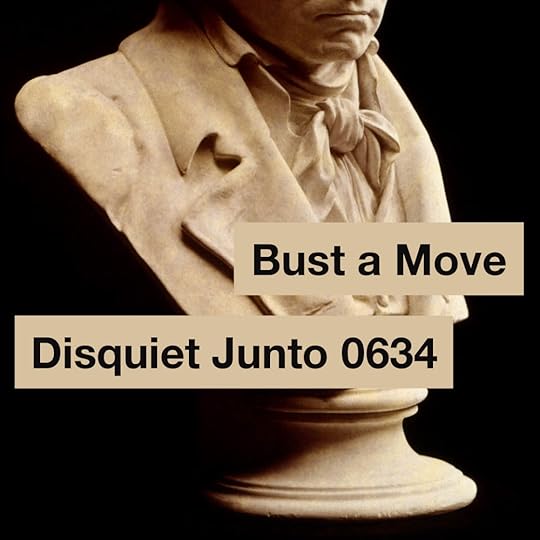
The image associated with this track is in the public domain, via Wikipedia: https://en.wikipedia.org/wiki/File:Beethoven_bust_statue_by_Hagen.jpg
February 21, 2024
Looking for Sound
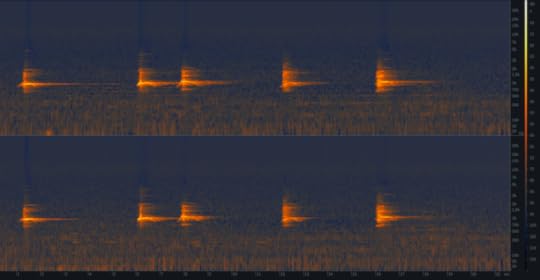
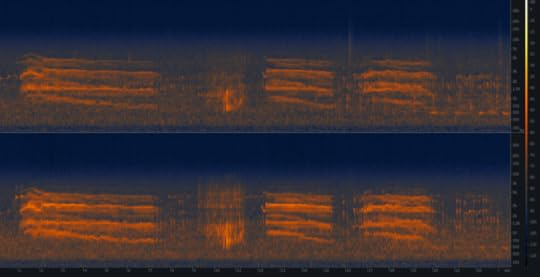
In this past Friday’s issue of This Week in Sound, I shared a link to an example of a field recording practice in which spectrograms aid in the isolation of instances of activity within massive amounts of audio. Mat Eric Hart, whose work I had linked to, subsequently gave me permission to share examples of that technique.
This is the appearance of a fox:
This marks the arrival of a little grebe:
And this is an owl:
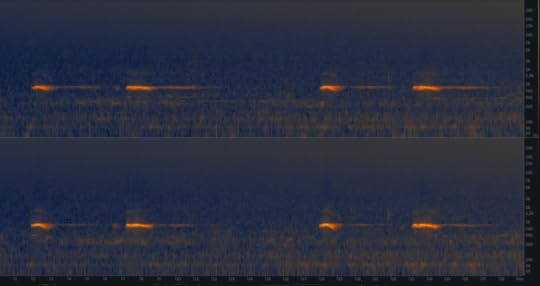
I love the concept of looking for sound in advance of hearing it, since the approach reverses how the brain can work — we experience sound more quickly than we might see something. I also love how these images resemble objects surfacing in a night vision camera. Visit Mat’s post to hear audio from the session that yielded these results.
This Week in Sound: Entrainment, Radio, Fungi
These sound-studies highlights of the week originally appeared in the February 20, 2024, issue of the Disquiet.com weekly email newsletter, This Week in Sound. This Week in Sound is the best way I’ve found to process material I come across. Your support provides resources and encouragement. Most issues are free. A weekly annotated ambient-music mixtape is for paid subscribers. Thanks.
▰ THAT’S ENTRAINMENT: To answer the question as to whether electronic music might inherently “alter the consciousness” of listeners, “researchers used electroencephalography, which measures electrical activity in the brain via electrodes attached to the scalp, to gauge the participants’ neural entrainment to the music.” As described in New Scientist, the effort, which explored the concept of “entrainment,” may have medical applications, such as for therapy and in intensive care units. “Entrainment occurs when synchronisation arises between an external rhythmic stimuli, such as electronic music, and the firing of neurons in the brain.” (Thanks, Paolo Salvagione!)
▰ ADIOS, RADIO: “Who in the world steals a radio tower?” asks the station manager of a radio station, WJLX in Jasper, Alabama. He asks because the station’s tower has gone missing: “The tower, all 190 feet of it, had vanished — its 3,500 pounds of spindly steel beams possibly sliced into pieces and dragged away earlier this month by thieves, the police said. … There are, however, some precedents in Alabama. In 2021, the police in Dothan arrested a man who had stolen a 30-foot aluminum trailer with a collapsible radio tower that reached up to 100 feet. And in the summer of 2013, the police in Talladega said that a 75-foot steel radio tower and other equipment had been stolen from a broadcasting group.”
▰ QUICK NOTES: Vitamin Z: Scientists are exploring the role of zinc in causing and addressing hearing loss. ▰ Roots Music: “A pair of experiments has found that fungus grows much more quickly when it’s blasted with an 80 decibel tone, compared to fungus that receives the silent treatment.” ▰ Physics Ed: The discussion of newly confirmed “second sound” (thanks to everyone who sent this — along with related — links to me) in fluid dynamics made me think about the first and second cracks in coffee roasting. ▰ Root, Root, Root: For the first time, a woman is the lead voice in Major League Baseball play-by-play: Jenny Cavnar of the A’s. ▰ Bird Brain: The Shriek of the Week is that of the wren, “one of our tiniest and yet loudest resident songbirds.” ▰ Don’t Worry, Be Haptic: Learn about vibrational suits, which translate music (and sound in general) into full-body experiences. (Thanks, Rich Pettus!) ▰ Cry It Out: Exploring how infant marmosets use sound to communicate to caregivers.
February 20, 2024
Sound Ledger
82,000,000: Number of people in the U.S. who listen to AM radio monthly
20: Number of microphones used to capture sounds in a house in the film Zone of Interest
266: Percent increase in sperm mobility as a result of ultrasound treatment
Source: Radio: nytimes.com. Zone: variety.com. Sperm: newscientist.com.
On the Line: Two Poems and a Film
That is the opening of a poem, “Upon the Furthest Slope You Know,” by Jorie Graham in a recent issue of the London Review of Books. Later she says of something “almost” said by the wind: “Listen to it / when it speaks to you – it is / the next world.”
. . .
"Almost every artistic direction and decision was guided by the sound. The construction of the shot was not so much the point of view of where he fell but where the music is looking from."That is Justine Triet, director of the film, Anatomy of a Fall, speaking to the LA Times of the influence of a steel band cover of a 50 Cent song on her movie.
. . .
"... I felt most myself when I was least loved. Cast into the night like a half-formed sound, I was falling toward sleep when I heard a faint rustling as if it were calling from a distant world, near enough to startle me awake."That is from “Shadow Study,” a poem by Jennifer S. Cheng published by The Atlantic.
February 19, 2024
Visiting The Visitors
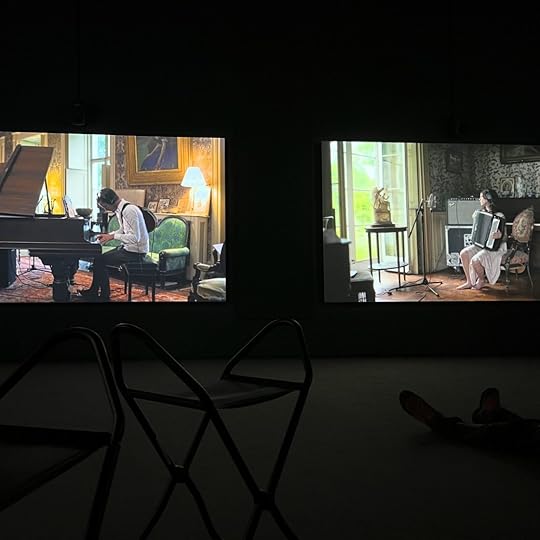
I spent the final afternoon of this three-day weekend on the floor of a dark gallery at SFMOMA, yet again (I’ve officially lost track) basking in the wonder of Ragnar Kjartansson’s The Visitors in all its simultaneous nine-screen glory (two screens shown here).
February 18, 2024
On Celtic Frost
I was invited by editor Heather Quinlan to write a short essay for the ongoing “Mösh Your Enthusiasm” series — topic: “metal records from the Eighties (1984–1993, in our periodization schema)” — running at hilobrow.com. I wrote about a song by the band Celtic Frost dating from 1987. Read the full piece on the Hilobrow website.
I don’t usually do dedications of this sort, but I added a shout-out at the end of the piece to an old — and long-deceased — friend of mine, Eric Engelhardt, one of my closest friends from high school, who died in 2007, barely into his 40s. I remember wandering around an amusement park in Los Angeles with him toward the end of his life — before his ailments had been discerned — and finding myself at the top of a staircase, looking back down toward him, as he took it one step at a time, pausing now and then. I’d never had more energy than Eric in my entire life until that moment, and I knew then something was wrong. I also know the corner where I was standing in San Francisco when I got the call on my cellphone that he had died, and I find myself still avoiding it. I couldn’t attend Eric’s funeral in New York because there was a terrible rainstorm the night prior and I was stuck at the San Francisco airport, where all flights had been summarily cancelled. Eric had a ferocious affection for metal, and his love for music in general had an enormous impact on me at an age when such impact can set the course of one’s entire life. (Fun fact: Eric, an accomplished puppeteer, built the original Pepe the King Prawn for the Muppets.)
My Celtic Frost tribute is the 15th in the Mösh Your Enthusiasm series at Hilowbrow, so there are another 10 to come. (For the purposes of Disquiet.com’s emphasis on electronic music: the drum machine on “One in Their Pride,” so seemingly out of place on a metal album, was absolutely addictive to me when I first heard it. And still is.) Below are the first two paragraphs:
Much marks the Swiss doom metal band Celtic Frost’s 1987 album, Into the Pandemonium, as strange. The record is a powerful assemblage of rock mysticism, all occult caterwauling, angular solos, battle-ready drums, and arrangement wizardry. It’s the sort of thing that, at proper volume, promises to tap into the very fabric of myth — or at least lend a climactic soundtrack to a weekend Dungeons & Dragons campaign.
And no track on Into the Pandemonium embraces the band’s strangeness quite like its choice of a 12” single, a song that melds Sprechstimme narrative, Greek chorus portent, and louche metal: “I Won’t Dance.” And that’s saying something, since the album opens with a peculiar cover of “Mexican Radio” (Wall of Voodoo’s novel new wave hit from five years prior) and the single also highlighted “One in Their Pride,” which threads Apollo mission vocal samples, a screeching string section, and an admirably stark drum machine beat.
And the song:
And the other song I mention:
Full piece at hilobrow.com.
February 17, 2024
This Week in Sound: Reverberation Mapping & Singing Bacteria
These sound-studies highlights of the week originally appeared in the February 16, 2024, issue of the Disquiet.com weekly email newsletter, This Week in Sound.
I’ve been a bit busy — shifting tools around, and plotting, and working, and moderating, and writing, and staring at PCB boards (yes, that’s redundant), and practicing guitar (poorly, but enthusiastically), and reading. The tail end of winter exerts its own sort of cleansing, the digital in advance of the physical. Among those activities, this email newsletter has a new home on the web: it’s henceforth at thisweekinsound.disquiet.com. Nothing has changed about how This Week in Sound is published, but now the domain is my own (I’ve been at Disquiet.com since late 1996) and, thus, should I choose to alter my publication infrastructure down the road, the (virtual) location itself can persist. (This shift has been on my mind in anticipation of TinyLetter.com finally shutting down many years after Mailchimp bought it.)
And so I’m ending this week with 10 key sound-related things:
▰ 1. A STAGE DIRECTION: Fascinating interview with a theater director who emphasizes accessibility for the deaf and hard of hearing. The work being discussed here is a musical, Private Jones, about a deaf soldier, a sharp shooter, who fought in World War I: “‘If the piano does something that is supposed to evoke an emotion and there’s not a visual equivalent of that, we haven’t done our job,’ Pailet says. ‘Theater is taking psychology and turning it into behavior. So everything is visual, everything is behavioral, and it’s also therefore a perfect medium for sign language, which is a visual language. It exists to be seen.’” (Thanks, Mike Rhode!)
▰ 2. A MICROSOUND: Roberto Kolter, Professor of Microbiology, Emeritus, at Harvard Medical School, tracks his interest — via the Small Things Considered group blog — in the question of whether bacteria can sing, and upon learning that they can, ponders in turn what that might mean. Apparently “cells emit sound waves to carry information about their metabolic status,” he notes, quoting Gemma Reguera, another STC contributor: “Cells in communal settings, such as colonies, biofilms and microbial mats, are likely candidates to benefit from sound communication. Such close populations would allow the rapid propagation and detection of sounds, even at low intensities, and could cooperate to amplify the sound signal from individual cells.” (Thanks, Nicola Twilley!)
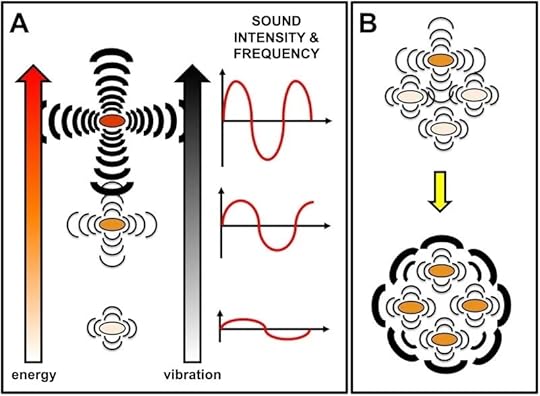 Cell Phonetics: A detail from Reguera’s research
▰ 3. A VISUALIZATION: Follow through to a recent post by field recordist Mat Eric Hart who shares an example of how he sifts through more than half a day’s wildlife audio by first looking at the sound in a spectrogram to identify “significant audible events.”
▰ 4. A SCORE: After a long wait, the music — composed by Nicolas Snyder — from the first season of the fantastic animated series Scavengers Reign is finally available as a standalone album. In the show, the music is often indistinguishable from the on-screen activity, so it’s wonderful to hear the elegant music fully extracted from the story. Unless I’m mistaken, the release, from Milan Records, is not (yet) on Bandcamp, but it’s on all the streaming services. I previously wrote about the show’s sonic ecosystem.
▰ 5. A FLASHBACK: There is an intriguing creative tension between social media and ASMR, given that one is associated with dopamine rushes and the other with a more attenuated somatic state. Kate Lindsay of Embedded earlier this month shared a nine-year-old Q&A she did (apparently her first published freelance article, way back when) with the frequent ASMR poster CozyLotusASMR, who discusses how engagement varies by platform: “On TikTok, though, people could come across that video and you have no control if they like ASMR, if they know what that is. So sometimes you need to post something there that’s gonna grab somebody much faster, ’cause you have such a limited time to grab your audience. Whereas YouTube, they’re there for that. You don’t have to work so hard to grab their attention.”
▰ 6. A METAPHOR: Sound plays multiple roles in the research of MIT observational astrophysicist Erin Kara. For one she employs the increasingly common approach of sonification to “hear” the data that results from, in her case, research into black holes. But sound also provides a metaphor for her work with what is called reverberation mapping: “It’s akin to how bats use echolocation.They can’t see the dark cave that they’re flying through, but they know that the echo will come back at them with some delay, and they can use the fact that the echo is traveling at the speed of sound to map out the dark cave. We’re doing that, except with light traveling at the speed of light.”
▰ 7. A PROTEST: The word “deepfake” has become inherently associated with malfeasance, but parents of children killed in school shootings are employing AI to revive their deceased offsprings’ voices in order to enlist them in efforts to impact legislation. “It sounds like an episode of ‘Black Mirror,’” wrote Joanna Stern in the Wall Street Journal, “and the surreality seems to be at least partially the point.” (Tangential: “FTC Wants to Penalize Companies for Use of AI in Impersonation.”)
▰ 8. A LESSON: It’s not a musician’s duty to be eloquent about their music, but when they are, it is a unique and palpable pleasure, an example being when pianist Brad Mehldau discusses such topics as his early education, playing in groups where others stake out his harmonic territory, and distinctions he has noted between jazz standards and newer pieces (such as those by Radiohead and Neil Young he has covered), a key characteristic being that the latter generally originated on guitar.
▰ 9. A QUESTION: I’m currently reading two books about guitar pedals: Pedal Crush and Boss Book (which surveys the entire Boss line). Have you read a good book that provides insights into the transition from analog to digital guitar pedals? I’m especially interested in devices that store audio in memory (loopers, memory buffers — I think I’m wondering about delays, too). Thanks.
▰ 10. A STUDY: This will blow your mind, but cities are noisy — among other congestion-related problems — and science shows that green spaces ease the impact. A study in Nature involving 190,200 participants helped confirm the assumed: “The evidence points to the need for nature-based interventions, such as optimizing urban greenness for healthy cities with lower stress levels and related health burdens.”


