
This Week in Sound: Reverberation Mapping & Singing Bacteria
These sound-studies highlights of the week originally appeared in the February 16, 2024, issue of the Disquiet.com weekly email newsletter, This Week in Sound.
I’ve been a bit busy — shifting tools around, and plotting, and working, and moderating, and writing, and staring at PCB boards (yes, that’s redundant), and practicing guitar (poorly, but enthusiastically), and reading. The tail end of winter exerts its own sort of cleansing, the digital in advance of the physical. Among those activities, this email newsletter has a new home on the web: it’s henceforth at thisweekinsound.disquiet.com. Nothing has changed about how This Week in Sound is published, but now the domain is my own (I’ve been at Disquiet.com since late 1996) and, thus, should I choose to alter my publication infrastructure down the road, the (virtual) location itself can persist. (This shift has been on my mind in anticipation of TinyLetter.com finally shutting down many years after Mailchimp bought it.)
And so I’m ending this week with 10 key sound-related things:
▰ 1. A STAGE DIRECTION: Fascinating interview with a theater director who emphasizes accessibility for the deaf and hard of hearing. The work being discussed here is a musical, Private Jones, about a deaf soldier, a sharp shooter, who fought in World War I: “‘If the piano does something that is supposed to evoke an emotion and there’s not a visual equivalent of that, we haven’t done our job,’ Pailet says. ‘Theater is taking psychology and turning it into behavior. So everything is visual, everything is behavioral, and it’s also therefore a perfect medium for sign language, which is a visual language. It exists to be seen.’” (Thanks, Mike Rhode!)
▰ 2. A MICROSOUND: Roberto Kolter, Professor of Microbiology, Emeritus, at Harvard Medical School, tracks his interest — via the Small Things Considered group blog — in the question of whether bacteria can sing, and upon learning that they can, ponders in turn what that might mean. Apparently “cells emit sound waves to carry information about their metabolic status,” he notes, quoting Gemma Reguera, another STC contributor: “Cells in communal settings, such as colonies, biofilms and microbial mats, are likely candidates to benefit from sound communication. Such close populations would allow the rapid propagation and detection of sounds, even at low intensities, and could cooperate to amplify the sound signal from individual cells.” (Thanks, Nicola Twilley!)
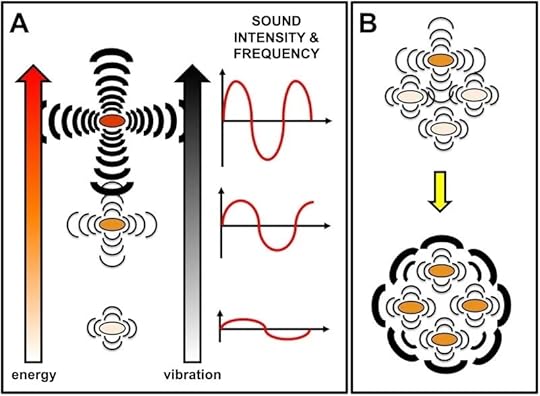 Cell Phonetics: A detail from Reguera’s research
▰ 3. A VISUALIZATION: Follow through to a recent post by field recordist Mat Eric Hart who shares an example of how he sifts through more than half a day’s wildlife audio by first looking at the sound in a spectrogram to identify “significant audible events.”
▰ 4. A SCORE: After a long wait, the music — composed by Nicolas Snyder — from the first season of the fantastic animated series Scavengers Reign is finally available as a standalone album. In the show, the music is often indistinguishable from the on-screen activity, so it’s wonderful to hear the elegant music fully extracted from the story. Unless I’m mistaken, the release, from Milan Records, is not (yet) on Bandcamp, but it’s on all the streaming services. I previously wrote about the show’s sonic ecosystem.
▰ 5. A FLASHBACK: There is an intriguing creative tension between social media and ASMR, given that one is associated with dopamine rushes and the other with a more attenuated somatic state. Kate Lindsay of Embedded earlier this month shared a nine-year-old Q&A she did (apparently her first published freelance article, way back when) with the frequent ASMR poster CozyLotusASMR, who discusses how engagement varies by platform: “On TikTok, though, people could come across that video and you have no control if they like ASMR, if they know what that is. So sometimes you need to post something there that’s gonna grab somebody much faster, ’cause you have such a limited time to grab your audience. Whereas YouTube, they’re there for that. You don’t have to work so hard to grab their attention.”
▰ 6. A METAPHOR: Sound plays multiple roles in the research of MIT observational astrophysicist Erin Kara. For one she employs the increasingly common approach of sonification to “hear” the data that results from, in her case, research into black holes. But sound also provides a metaphor for her work with what is called reverberation mapping: “It’s akin to how bats use echolocation.They can’t see the dark cave that they’re flying through, but they know that the echo will come back at them with some delay, and they can use the fact that the echo is traveling at the speed of sound to map out the dark cave. We’re doing that, except with light traveling at the speed of light.”
▰ 7. A PROTEST: The word “deepfake” has become inherently associated with malfeasance, but parents of children killed in school shootings are employing AI to revive their deceased offsprings’ voices in order to enlist them in efforts to impact legislation. “It sounds like an episode of ‘Black Mirror,’” wrote Joanna Stern in the Wall Street Journal, “and the surreality seems to be at least partially the point.” (Tangential: “FTC Wants to Penalize Companies for Use of AI in Impersonation.”)
▰ 8. A LESSON: It’s not a musician’s duty to be eloquent about their music, but when they are, it is a unique and palpable pleasure, an example being when pianist Brad Mehldau discusses such topics as his early education, playing in groups where others stake out his harmonic territory, and distinctions he has noted between jazz standards and newer pieces (such as those by Radiohead and Neil Young he has covered), a key characteristic being that the latter generally originated on guitar.
▰ 9. A QUESTION: I’m currently reading two books about guitar pedals: Pedal Crush and Boss Book (which surveys the entire Boss line). Have you read a good book that provides insights into the transition from analog to digital guitar pedals? I’m especially interested in devices that store audio in memory (loopers, memory buffers — I think I’m wondering about delays, too). Thanks.
▰ 10. A STUDY: This will blow your mind, but cities are noisy — among other congestion-related problems — and science shows that green spaces ease the impact. A study in Nature involving 190,200 participants helped confirm the assumed: “The evidence points to the need for nature-based interventions, such as optimizing urban greenness for healthy cities with lower stress levels and related health burdens.”


