Marc Weidenbaum's Blog, page 73
February 9, 2024
Rear View
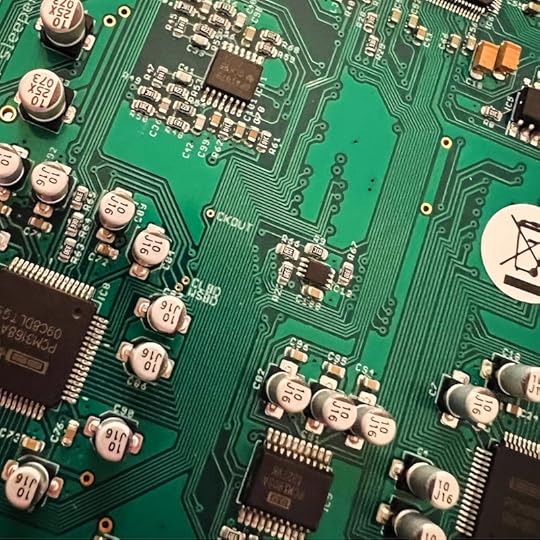
Just enjoying the pretty side of my new (used) synthesizer module before I plug it in and, you know, actually use it


February 8, 2024
Adding a #Blogging Tag to Disquiet.com
I mention these three following posts on occasion when the topic of blogging comes up, and I sometimes group them together, but only today did it occur to me — when responding via email to two different people inquiring about their newly started blogs on sound and music — that despite this blog, Disquiet.com, having been around since late 1996, it’s never actually had a tag specifically for blogging. So, now it does.
I’ve written more about blogging than just these (as of today) three* posts, but these are the key items for the time being. I may add some older posts to the #blogging tag here over time, and I also may do some occasional blogging-specific writing. We’ll see. The key thing is that if you appreciate that blogging is about working out ideas in public, then there’s no evidence of that in action quite like recognizing topic clusters after the fact in your own writing — which is to say, in your own thinking.
“Bring Out Your Blogs”
The 20th anniversary of a habit worth renewing
June 16, 2019
“Q: Why Blog? A: Blogs Are Great.”
Great for you, and great for the internet
April 10, 2021
“How I Got from Mastodon’t to Mastodon”
Getting started is a hassle, but it’s a darn interesting realm of social media
May 2, 2022
*Well, technically four posts, not three, because I’m also tagging this one appropriately.
Email List Migration (Disquiet Junto)
This note — complete with a few minor repetitions I might have dealt with had I had more time — was included in today’s issue of the weekly Disquiet Junto project announcement email list:
As you should by now know, the email newsletter for Disquiet Junto project announcements has migrated from one service provider to another — from TinyLetter.com, which is closing down on February 29, 2024, to Buttondown, about which you can learn more at buttondown.email.
One nice thing about Buttondown is that I can use my own URL, so the home for the newsletter is now juntoletter.disquiet.com, which means that down the road, should I choose to change service providers again, the newsletter itself can retain its URL.
Another nice thing about Buttondown is that I can schedule posts to send automatically, meaning that much as this week’s project popped up at disquiet.com/0632 while I was sleeping, thanks to my blog’s powers of automation (it’s on WordPress), so too can I set this email to go out while I’m asleep. I sleep fairly soundly, and now I’ll sleep even more soundly, knowing that I have one fewer chores come morning. I’ve set this one to go out at 6:32am Pacific. We’ll know tomorrow how that has worked out.
A third nice thing about Buttondown is that I have less of a limit on the number of emails I can send out. So, while I promise not to abuse such newfound freedom, I look forward to occasionally sending notes of encouragement or with additional information off the weekly Thursday cycle. This is great.
Nice things, however, are generally balanced by downsides. Which is to say, Buttondown is not free. It’s not terribly expensive, when thought of at an annual rate, but it does cost, and will cost more as the subscriber list continues to grow. I may at some point add a paid option to this list, simply as a way for folks to chip in on the infrastructure costs that support the Junto — and perhaps pay for additional such infrastructure, such as a dedicated web presence, down the road. (In the meanwhile, if supporting the Junto in such a manner appeals to you, you could in the meanwhile subscribe to my This Week in Sound email letter. I’m remembering now that I dislike talking about money, so why don’t I stop there?)
And that covers it. I don’t think I mentioned that there was an academic article about the Disquiet Junto in the Cambridge University Press journal Organised Sound, and you can read it online. If you have any thoughts, please let me know.
Oh, and we’ve had a new slew of subscribers, so if you have any questions or thoughts, just shoot me an email.
And that really covers it. I hope this email goes out smoothly, and your year is going smoothly, as well. And thanks, as always, for your generosity with your time, creativity, and curiosity. The project instructions appear below.
Best from a chilly — by local standards — San Francisco,
Marc
Disquiet Junto Project 0632: Shear Wind

Each Thursday in the Disquiet Junto music community, a new compositional challenge is set before the group’s members, who then have just under five days to upload a track in response to the assignment. Membership in the Junto is open: just join and participate. (A SoundCloud account is helpful but not required.) There’s no pressure to do every project. It’s weekly so that you know it’s there, every Thursday through Monday, when you have the time and interest.
Deadline: This project’s deadline is the end of the day Monday, February 2, 2024, at 11:59pm (that is, just before midnight) wherever you are. It was posted on Thursday, February 8, 2024.
Tracks are added to the SoundCloud playlist for the duration of the project. Additional (non-SoundCloud) tracks appear in the lllllll.co discussion thread.
These following instructions went out to the group’s email list (at juntoletter.disquiet.com). Note that this service will change shortly, likely to Buttondown, due to Tinyletter shutting down.
Disquiet Junto Project 0632: Shear Wind
The Assignment: Make the most of the disturbance within a field recording.
Step 1: Consider how when making a field recording, there can be disturbances in it, such as a passing car or plane, or a noise you didn’t notice until you listened back, or a malfunction in the recording equipment. A common such problem is wind shear.
Step 2: Make a recording that has wind shear in it, perhaps by standing in the wind, or recording from a moving vehicle, or through some other technique. Or locate a pre-existing field recording with wind shear, perhaps on freesound.org.
Step 3: Make a piece of music employing the recording you made in Step 2, and make the wind shear a focus of the piece. That is, pay attention to, rather than avoid, this sound that you would likely in other circumstances identify as a shortcoming.
Seven Important Steps When Your Track Is Done:
Step 1: Include “disquiet0632” (no spaces or quotation marks) in the name of your tracks.
Step 2: If your audio-hosting platform allows for tags, be sure to also include the project tag “disquiet0632” (no spaces or quotation marks). If you’re posting on SoundCloud in particular, this is essential to subsequent location of tracks for the creation of a project playlist.
Step 3: Upload your tracks. It is helpful but not essential that you use SoundCloud to host your tracks.
Step 4: Post your track in the following discussion thread at llllllll.co:
https://llllllll.co/t/disquiet-junto-project-0632-shear-wind/
Step 5: Annotate your track with a brief explanation of your approach and process.
Step 6: If posting on social media, please consider using the hashtag #DisquietJunto so fellow participants are more likely to locate your communication.
Step 7: Then listen to and comment on tracks uploaded by your fellow Disquiet Junto participants.
Note: Please post one track for this weekly Junto project. If you choose to post more than one, and do so on SoundCloud, please let me know which you’d like added to the playlist. Thanks.
Additional Details:
Length: The length is up to you.
Deadline: This project’s deadline is the end of the day Monday, February 12, 2024, at 11:59pm (that is, just before midnight) wherever you are. It was posted on Thursday, February 8, 2024.
Upload: When participating in this project, be sure to include a description of your process in planning, composing, and recording it. This description is an essential element of the communicative process inherent in the Disquiet Junto. Photos, video, and lists of equipment are always appreciated.
Download: It is always best to set your track as downloadable and allowing for attributed remixing (i.e., a Creative Commons license permitting non-commercial sharing with attribution, allowing for derivatives).
For context, when posting the track online, please be sure to include this following information:
More on this 632nd weekly Disquiet Junto project, Shear Wind — The Assignment: Make the most of the disturbance within a field recording — at: https://disquiet.com/0632/
About the Disquiet Junto: https://disquiet.com/junto/
Subscribe to project announcements: https://juntoletter.disquiet.com/
Project discussion takes place on llllllll.co: https://llllllll.co/t/disquiet-junto-project-0632-shear-wind/
February 7, 2024
This Week in Sound: “Synchronizing the Bodies and Emotions”
These sound-studies highlights of the week originally appeared in the February 6, 2024, issue of the Disquiet.com weekly email newsletter, This Week in Sound. This Week in Sound is the best way I’ve found to process material I come across. Your support provides resources and encouragement. Most issues are free. A weekly annotated ambient-music mixtape is for paid subscribers. Thanks.
▰ ONE WORLD IS ENOUGH: “Music can be felt directly in the body. When we hear our favorite catchy song, we are overcome with the urge to move to the music. Music can activate our autonomic nervous system and even cause shivers down the spine. A new study from the Turku PET Center in Finland shows how emotional music evokes similar bodily sensations across cultures,” per a study shared in the Proceedings of the National Academy of Sciences. “People move to music in all cultures and synchronized postures, movements and vocalizations are a universal sign for affiliation. Music may have emerged during the evolution of human species to promote social interaction and sense of community by synchronizing the bodies and emotions of the listeners.” (Thanks, Rich Pettus!)
▰ SOUND AND VISION: An app for the new Apple Vision Pro, inspired by the theremin. (Thanks, Dan Sim!)
▰ CALL OF THE WILD: “Claiming that everything that sounds like music is music isn’t just circular; it also opens up an entirely new can of worms. Are those sounds that do not sound like human music, then, by default, non-music (or nachtmusik, as [composer Dave] Soldier calls them)? What about the sounds that have similarities to our music but are the result of entirely different processes, such as the rhythmical stridulations of cicadas and crustaceans?” That’s Tobias Fischer writing on the subject of animal music.
▰ QUICK NOTES: Bar None: A lawyer named Lori Cohen, who lost her voice, is using AI to regain the ability to speak in the courtroom. ▰ Shriek of the Week: Great Spotted Woodpecker: “It may prompt a sense of anticipation in the listener — did I really hear that? Will it sound again? Has it gone? And there it is again.” ▰ Out of the Loop: Aside from listing the latest Disquiet Junto music community project, I don’t spend much time on the Junto in this newsletter, but I do need to note this participant’s ingenuity: “I have a lamp that interferes with my guitar-cable-amp loop. So, I decided to cut the guitar out of the loop and just use the lamp, cable, and amp.” ▰ Transistor Sisterhood: The New York Review of Books profiles electronic musicians Ruth Anderson and Annea Lockwood. (Thanks, Mike Rhode!) ▰ Robo Cop: The FCC may outlaw robocalls that use AI voices. ▰ Sound Barrier: “The [Detroit] Lions broke the sound-level record of the 22-year-old Ford Field four times during the Rams game, topping out at 133.6 decibels, roughly equal to a jackhammer or jet engine.” The record they beat was their own.
February 6, 2024
On the Line
That is Nick Harkaway from his science fiction novel Titanium Noir (2023). I’ve wanted to read something by Harkaway for some time, and news that he’s writing a character based on his father’s most famous character (his dad was John le Carré, the character being George Smiley) led me to finally do so. It may be worth noting that a central figure in Titanium Noir is a literally towering giant of a post-human (it is science fiction) who draws family members close and into the broadly defined business. Perhaps there’s, I dunno, some subtext. In any case, this is one of several sonically expressive moments in the novel. Another key one is when a giant (called Titans) attacks the protagonist with the power of a laugh.
. . .
"Talking this way is formal, in both senses of the word: formalizing conversation, rendering it visible and tangible, can sometimes make it feel strangely serious."That is Max Norman writing in The New Yorker about the experience, when interviewing the artist Joseph Grigely, who is deaf, of doing so by writing things down, and thus taking greater pains than were they merely communicating with spoken words. “I found myself weighing my words,” he continues, “choosing not to ask a question that wasn’t perfectly phrased.”
. . .
"As I write this now at my flat in Edinburgh, I can hear the single toll of the tram bell as it heads along Leith Walk. (The ‘ding’ is singular but not resonant. It is a recording of a bell, and there is no tintinnabulation, as Edgar Allan Poe named it, no lingering sound, because the recording cuts it off. The tram bell is like a bad music hall singer, always in the middle of a note.)"That is Andrew O’Hagan from his recent essay, “Stevenson in Edinburgh,” in the London Review of Books. (The Stevenson is, naturally, Robert Louis Stevenson.)
Sound Ledger (Freesound.org Edition)
40,940: The number of sounds newly added to freesound.org in 2023
237: The number of hours of sound uploaded by the Freesound contributor (username: Philip_Goddard) who added the longest total amount of recordings in 2023
2,961: The number of individual sound files uploaded by the Freesound contributor (username: Hewn.Marrow) who added the most sound files in 2023
Source: blog.freesound.org
Other Minds 2023 Review (Preview)

My review of the last two nights of the 2023 Other Minds festival is in the brand new issue (the one with the Haxan Cloak on the cover) of The Wire. I’ll post the full article online when the next issue of the magazine is published.
The final two nights of the annual Other Minds festival were split between two quite different venues: the tony Taube Atrium Theater, which is secluded deep inside the stately War Memorial building across from gleaming City Hall, and Gray Area, a revivified, hollowed-out, long-defunct movie theater on a commercial stretch of Mission Street. It’s a half hour walk between them, but they are worlds apart.
Other Minds ran for six nights total, its opening evening dedicated to a screening of a Morton Subotnick documentary, Subotnick: Portrait of an Electronic Music Pioneer. This all occurred in mid-November, from the 14th through the 19th, those dates placing it in neatly between the Recombinant Festival the month prior and the Tape Music Festival, which fleshed out the first week of 2024. The rapid-fire collection of multiple multi-night, international series gave lie to the monotonous death knell that media outside San Francisco keep ringing, whether lasciviously or with rehearsed concern. A testament to longevity and fortitude, the November events marked the 27th festival for Other Minds, which remains overseen by Charles Amirkhanian, who co-founded it back in 1993.
The Taube show featured works by composers Neil Rolnick, Bora Yoon, and Eivind Buene performed respectively by pianist Geoffrey Burleson (with support from Rolnick), Yoon herself (with visuals by Joshue Ott — whose Thicket app I wrote about a lot back in 2010, including an interview with his collaborator on it, Morgan Packard), and the Friction Quartet. The Gray Area show featured Carl Stone in collaboration with Japanese vocalist Akaihirume.
February 5, 2024
Less < — > More

Excellence in interface design. I should mention: this is a real guitar pedal (it’s the Dead Bat from Audio Alchemy). You place this device between a power source and an analog pedal and it simulates a drained battery. Well, that’s how it is described. What it does is steadily reduce the power that is sent to the analog pedal — to “choke” or “strangle” or “starve” it, just to mention a few of the less than tasteful metaphors I’ve encountered. I’d guess there are fluctuations inherent in an actually dying battery, especially as it nears the end, that are more random/interesting/chaotic. I’m just getting started with this one. I’ll report back. So far I’ve tried it with an analog tremolo pedal, and it worked quite nicely. Which is to say, it sounded horrible — in a good way. I want to try it on a delay pedal. I’m wondering what the most complicated / sensitive analog pedals there are that I might apply this to.