
Marc Weidenbaum's Blog, page 56
June 30, 2024
Recent TWiS Highlights
My This Week in Sound newsletter has been back after a little hiatus for book-writing. I wanted to point out a few recent stories of particular interest:
June 8: (1) a great Washington Post piece about mitigating restaurant noise and (2) a John Cage kids book
June 12: (1) the individual names of elephants and (2) the truth behind the story about creaky floors in shogun-era Japan serving as surveillance devices
June 19: (1) a SoftBank AI project that dampens heightened emotions on customer complaint phone calls and (2) YouTube videos being demonetized because home appliance noises trigger copyright detection bots
June 26: (1) whether loud sound in museums damages paint and (2) failing sonic weapons in South Korea
June 27: paid subscribers got a bonus issue in the form of a three-part ambient/adjacent mixtape: two live recordings plus music from Shanghai for contemporary dance


Visions of the Future

I live in San Francisco, where new futures are minted daily, for better and worse. And yet nothing quite hits me like the future than does the regular sight of these massive vessels just off the coast. They always look like generation ships, self-contained ecosystems hovering on the horizon. I just don’t know if they’re readying for takeoff or recently arrived from offworld.

June 29, 2024
Scratch Pad: CMS, “Rez,” AFX
I do this manually at the end of each week: collating most of the recent little comments I’ve made on social media, which I think of as my public scratch pad. I mostly hang out on Mastodon (at post.lurk.org/@disquiet), and I’m also trying out a few others. And I take weekends off social media.
▰ Afternoon trio for foghorn, tea timer, and washing machine
▰ It seems like it shouldn’t matter that I can now quickly post and to update Disquiet.com, which for a few months had a laggy thing going with its CMS. I should be able to just write and post, and a 30-second or even minute-long delay shouldn’t matter. But it really does. That’s how online-first writing, especially blogging, differs from (old-school) writing writing. There’s something fluid to the process of sketching a post, adding links and embeds, making sure it works, hitting post — and often tweaking slightly after. It’s just its own medium, and its own flow.
▰ The readymade haiku of Wikipedia’s notable death listings:
Maldivian footballer
Irish Gaelic games commentator
Cuban judoka
▰ I just learned that you can drag a specific note to the right-hand sidebar in Obsidian, and now all is right in the world
▰ The barber’s electric razor is expressing its sentience by performing a cover of Underworld’s “Rez”
▰ A reflection on the music of Aphex Twin by Alarm Will Sound percussionist Craig Thompson — all about the question of its “beatless”ness, to the nature of tempo, and much more. He’s played Aphex Twin arrangements for many years and has a unique perspective as a result.
▰ I’ve self-published Disquiet.com since the end of 1996. Some articles are backdated prior. I’ve been thinking about reading back through it from start to present, thousands of posts. Tidying it up as I go (a recent upgrade messed some markdown). Anyone here with a longtime blog done such a revisit?
▰ You know you’ve watched a lot of Bill Frisell live performance videos when you’ve graduated from “Yeah, cool socks as always” to recognizing specific shirts, as if they’re as much a part of his repertoire as a given piece of music
▰ Uh, so I’ve been working in an old version of Obsidian for months, not aware there’d been several updates, which explains why tables weren’t working as I’d expected. I must be missing somewhere in the app where it tells you there’s an update available.
▰ Have a good weekend, folks. Listen to an old favorite record. Identify a musician who played a secondary role on that record and listen to a second record that also features the musician. Then listen to a third record, one that’s from same label and time period as the second record. Happy hunting.
▰ And, another week during which I read a ton but finished nothing. Lots of books-in-progress.
June 28, 2024
#NoiseLife

As Bill Bragg sang, “What is that sound? Where is it coming from?” If you’re reading this, then you may very well be acquainted with Shazam not knowing what the heck it is that catches your ear. Though when it works, it works.
June 27, 2024
TWiS Listening Post (0023)

This little ambient (and adjacent) mixtape just went out to paid subscribers. Thanks, folks.
Disquiet Junto Project 0652: By the Tale
Each Thursday in the Disquiet Junto music community, a new compositional challenge is set before the group’s members, who then have five days to record and upload a track in response to the project instructions.
Membership in the Junto is open: just join and participate. (A SoundCloud account is helpful but not required.) There’s no pressure to do every project. The Junto is weekly so that you know it’s there, every Thursday through Monday, when your time and interest align.
Tracks are added to the SoundCloud playlist for the duration of the project. Additional (non-SoundCloud) tracks also generally appear in the lllllll.co discussion thread.
Disquiet Junto Project 0652: By the Tale
The Assignment: Set a favorite story to music.
Step 1: Choose a favorite short story.
Step 2: Compose a piece of music that follows the arc of the story’s narrative or otherwise conveys something about the story you want to express. You may closely follow plot points, or convey an overall atmosphere, or incorporate related sound effects, or do something else entirely.
Tasks Upon Completion:
Label: Include “disquiet0652” (no spaces/quotes) in the name of your track.
Upload: Post your track to a public account (SoundCloud preferred but by no means required). It’s best to focus on one track, but if you post more than one, clarify which is the “main” rendition.
Share: Post your track and a description/explanation at https://llllllll.co/t/disquiet-junto-project-0652-by-the-tale/
Discuss: Listen to and comment on the other tracks.
Additional Details:
Length: The length is up to you. Your finished recording needn’t last as long to listen to as the story does to read.
Deadline: Monday, July 1, 2024, 11:59pm (that is: just before midnight) wherever you are.
About: https://disquiet.com/junto/
Newsletter: https://juntoletter.disquiet.com/
License: It’s preferred (but not required) to set your track as downloadable and allowing for attributed remixing (i.e., an attribution Creative Commons license).
Please Include When Posting Your Track:
More on the 652nd weekly Disquiet Junto project, By the Tale — The Assignment: Set a favorite story to music — at https://disquiet.com/0652/
June 26, 2024
This Week in Sound: Listening to Dry Paint

These sound-studies highlights of the week originally appeared in the June 25, 2024, issue of the Disquiet.com weekly email newsletter, This Week in Sound. This Week in Sound is the best way I’ve found to process material I come across. Your support provides resources and encouragement. Most issues are free. A weekly annotated ambient-music mixtape is for paid subscribers. Thanks.
▰ LISTENING TO DRY PAINT: Or perhaps the opposite. Can sound damage art? That is the question on the cover of the June-July 2024 issue of the journal News in Conservation: “Although this issue is not new, it has perhaps become more urgent with the more frequent use of amplification and electronically generated music near artworks. Does exposure to sound pose an immediate or cumulative risk? And are there ways to mitigate or reduce any risk, for example, by avoiding certain types of music, setting limits on the sound or vibration levels experienced by artworks or introducing measures to reduce transfer from source to object?” While the article makes it clear there is much further research to be done, initial findings are worrisome: “Our pilot study provided clear evidence that airborne sound can have a direct impact on canvas paintings, causing not only the canvas but also the stretcher and frame (if present) to vibrate; as such, airborne transmission routes must be considered alongside structure-borne routes when assessing the impact of sound on artworks. As has been observed before, the vibration levels measured within the canvases were higher than those measured in the stretchers or frames. These observations are important, both in trying to define criteria for sound levels in the vicinity of artworks, along with its character (time and/or frequency specific), and in thinking about how to approach sound-induced vibration mitigation.” The article’s main authors are Catherine Higgitt, principal scientist at the National Gallery in London, and Tomasz Galikowski and David Trew, of the firm Bickerdike Allen Partners.
▰ SEOUL MUSIC: South Korea recently restarted a sonic weapon project aimed at North Korea. The program was banned back in 2018 as the result of an agreement between the two countries. However, the revived program is already beset with problems: “The loudspeakers deployed by South Korea to wage psychological warfare against North Korea faced audits and legal battles claiming they are too quiet, raising questions over how far into the reclusive North their propaganda messages can blast.” The program’s 40 speakers “were designed to blare pop music and political messages as far as 10 kilometres (6.21 miles), enough to reach the city of Kaesong and its nearly 200,000 residents.” Meanwhile, “North Korea’s own loudspeakers in the area further diminish the reach of South Korea’s psychological warfare.” (Via Warren Ellis)
▰ CAR GUISE: Bringing heavy hitters in to make sounds for electric vehicles may have been overkill: “The two top-ranking sounds [in a recent survey of consumers] were both non-tonal and could best be described as white noise with slightly different pitches. The survey’s respondents preferred the non-tonal sounds over the tonal ones, which they perceived as being ‘alarming,’ ‘ugly,’ and ‘unappealing.’ In contrast, people liked the non-tonal sounds because they sound more like white noise or ‘nature-derived.’ Indeed, some respondents said they wanted sounds that most closely resembled a conventional car noise.”
▰ MOVIE MAGIC: The British Film Institute explains how it preserves and restores the sound of old films: “Optical soundtracks could be on cellulose triacetate, polyester or the exceedingly combustible pre-1951 nitrate cellulose base. With exceptional safety and care, optical soundtracks are digitised using white-light LED and photocell replay machines, red-light LED scanners with Sondor Resonances which offers digital image processing technology to digitise directly from a positive copy or an original negative, and a multitude of magnetic replay options.” The full article isn’t that technical, and it provides a solid overview of early film sound history, including an 1898 — you read that right, as in back when Victoria was still queen (I had this wrong when I first sent out the newsletter, and mistakenly thought Edward VII had already ascended) — wax cylinder. And from even earlier: an 1894 experiment by Thomas Edison and W. K-L. Dickson, inspired by none other than Eadweard Muybridge. Fun fact: “A 90-minute feature film soundtrack can typically take up to 100 hours or more to completely restore or remaster.”
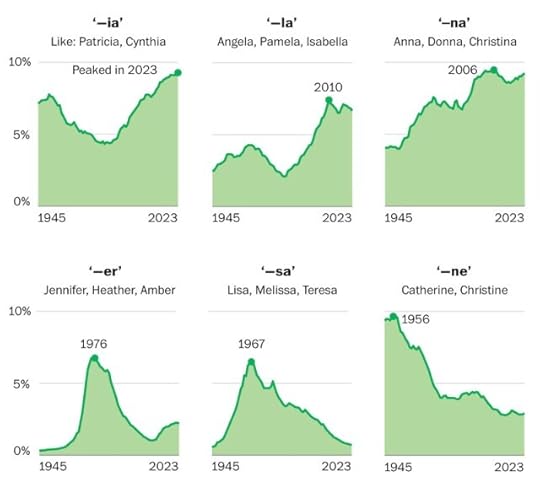
▰ ALL’S WELL THAT ENDS WELL: When it comes to naming one’s child, that is. The data hounds at the Washington Post (full article via gift link) did a deep dive into popular names for children in the US, building on observations by Laura Wattenberg, an expert on baby-naming. This is a particularly valuable story, because the insights manage to talk about language in the context not so much of meaning or etymology, but in terms of sound. The patterns in naming being tracked here are about how certain phonemes, specifically the ones that end names, are the crux of naming trends.
▰ A NEW LEAF: “The challenge before Johns Hopkins University engineering students: Take a leaf blower, but make it quiet. Make it work as powerfully as ever, but do not allow it to emit the ear-piercing caterwaul that has gotten leaf blowers banned in some communities and cursed in many others.” The students have made a “silencer” for leaf blowers. “Their improved leaf blower drops the overall noise level by nearly 40% while almost entirely erasing the most obnoxious frequencies. The design is patent-pending and Stanley Black & Decker expects to be selling them in two years.”
▰ SOUND BITES: Chants Operations: Why music Ph.D. candidate Katherine Scahill talks about sound and voice, rather than music, when discussing Thai Buddhist chanting (“one of the ethical precepts that monks undertake is not to sing or play musical instruments” — “They wouldn’t call it music, and it might give the wrong impression”). ▰ Water Log: The New Yorker visited a lifestyle-brand sound bath, led by Sara Auster, whom I first learned about via her work with turntablist Maria Chavez; about two years ago she “sonified” a line of paintsfrom Sherwin-Williams. ▰ Talk Central: Pocket FM partners with ElevenLabs to turn “writing into audio.” ▰ Order Up: While McDonald’s may have hit pause on its AI-voice program for drive-thru orders, SoundHound has bought Allset, a “food-ordering platform.” ▰ Switched On: The Criterion Collection has a set of movies up currently related to their synth scores (e.g., Manhunter, Liquid Sky, Merry Christmas Mr. Lawrence, and Danz CM breaks down the history of the synth in movies. ▰ On the Clock: The bells of Westminster move from the pages of Virginia Woolf’s Mrs. Dalloway to the ballet, courtesy of a field recording, as guided by choreographer Wayne McGregor. ▰ Green Day: Lonely planet recommends quiet parks around the world. ▰ Tune Out: The New Yorker had a fun cicada cartoon on June 24th. ▰ Copy Cats: If record labels win this AI lawsuit, the payment could reach $150,000 per song. ▰ Over Load: How “irrelevant speech”in the form of background noise increases the perception of workload, due to “disturbed concentration, impaired performance, and hampered efficient working” (research: sciencedirect.com). ▰ Going Deep: A bill in the works to make non-consensual deepfakes illegal. ▰ Dusk to Dawn: It’s probably OK to have that white noise machine going all night. ▰ Pressed to Play: At press time, OpenAI reported “it would delay the launch of voice and emotion-reading features for its ChatGPT chatbot because more time was needed for safety testing.”
June 25, 2024
On the Line: WNBA, Cicadas, More
▰ GAME ON:
“The elements I love most about basketball are grounded in the bare physical nature of the sport: forced air, its sound shaped from a mouth, after a particularly powerful dunk or a devastating chase-down block; sneaker squeaks on hardwood; the expressions of strain-to-triumph in a tricky sequence.”That’s Katie Heindl writing in The Believer.
. . .
▰ BUGGED OUT:
“With their bulging red eyes and their alien-like mating sound, periodical cicadas can seem scary and weird enough. But some of them really are sex-crazed zombies on speed, hijacked by a super-sized fungus.”Often the best drama is in the business section and the best horror is in the science section. Speaking of the latter, that’s the Associated Press’ Seth Borenstein on the modern cicada problem.
. . .
▰ LISTEN UP:
“I always try to notice what my first reactions are, but I don’t privilege them too much, because music is a repetitive form. I guess these days you can 'repeat' most anything. But with music, I think there’s an invitation to repeat. I’m interested in how my thoughts and feelings continue to evolve through multiple listens.”That’s essayist Carina del Valle Schorske, interviewed by Merve Emre, in The New York Review of Books. The topic in this instance is delaying judgment when hearing music.
Sound Ledger: Ocean Noise & More
30: Estimated volume increase in the Santa Barbara Channel since the Industrial Revolution, impacting whales and other sea life
1.55: Numbers of times higher likelihood of depressive symptoms among people living in highest environmental noise areas versus lowest, per South Korean scholars
12,000: Estimated annual premature deaths in the EU each year due to noise
Sources: Channel: independent.com; depression: nature.com; premature: bbc.com.
June 24, 2024
On Repeat: Oval, Henriksen, Owl Song
On Sundays I try to at least quickly note some of my favorite listening from the week prior — things I’ll later regret having not written about in more depth, so better to share here briefly than not at all. I had this entry mostly done last night, but the book reading I attended went later than I’d expected, so I’m finally posting it today.
▰ Space Man: Glitch progenitor Oval has delivered the 8th in his series of occasional mini-EPs, under the Now / Never / Whenever umbrella, the title seemingly related to the bits largely being archival. This time around that means a 1998 remix of Japanese duo Cappablack, a 2000 piece inspired by 2001: A Space Odyssey, and a previously unreleased track from a scrapped 2012 EP.
▰ Taking a Break: The track title “Morphine flutes all over the place” hints at what’s going on. Norwegian trumpeter Arve Henriksen broke his leg skiing, and recorded an album of edgier-than-usual Fourth World jazz-inflected electronica, Break a Leg!, while recuperating, reworking material he’d stored up on his laptop.
▰ Two Out of Three: On Friday I attended a great trio set by trumpeter Ambrose Akinmusire, guitarist Bill Frisell, and drummer Herlin Riley at the Bing hall at Stanford (their album Owl Song is highly recommended), and while I can’t find much in the way of live footage of them online, there is this clip from 10 years ago of two of the three of them, when the concept was just getting started.


