
Marc Weidenbaum's Blog, page 54
July 13, 2024
Scratch Pad: Polyrhythms, Fonts, Obsidian
I do this manually at the end of each week: collating most of the recent little comments I’ve made on social media, which I think of as my public scratch pad. I also find knowing I will revisit my posts to be a positive and mellowing influence on my social media activity. I mostly hang out on Mastodon (at post.lurk.org/@disquiet), and I’m also trying out a few others. And I generally take weekends off social media.
▰ Afternoon trio from grumbling tummy, squawking crows, and the distant rumbling of internal combustion vehicles
▰ Vehicular polyrhythm of a car alarm going off and then the owner causing it to emit additional bleeps during ongoing failed attempts to sort out which button sequence turns off the car alarm
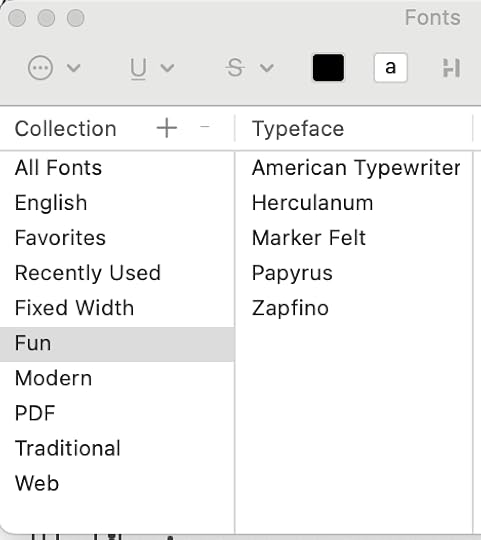
▰ I love that “fun” is a font category on my computer’s OS. Somewhere there’s a typographer thinking: “My font’s friggin’ fun. Why the heck isn’t it on that list?!”
▰ I didn’t expect, when I started using Obsidian, that I’d use its native daily notes, since I’d already been compiling my own into monthly docs. But I’ve switched. This is about as big a change to my note-taking as I can recall in many years. And it’s great. One tip: I recommend adding the abbreviated day of the week (YYYY-MM-DD-ddd) to the file name so they’re more easily identifiable. It really does help me to understand some notes when I consider the day of the week they were written.
▰ And another Obsidian thing: tables. The recent(ish?) upgrade makes them so simple to use, and now I find myself using them all the time: for little to-do lists, to organize key points, to correlate related information. The ability to move rows and columns manually on a whim is fantastic.
▰ Not sure when I became a person who pre-orders books fairly frequently but I’m a person who now pre-orders books fairly frequently. Recently: the new Robin Sloan (Moonbound), the imminent China Miéville/Keanu Reeves (The Book of Elsewhere, related to the Brzrkr graphic novels, which I read earlier this year), and the later-this-year Neal Stephenson (Polostan). Which makes me realize: as much non-genre stuff as I read, I’m not “following” non-genre writers as way I once did. Dunno. Just sort of observing my own reading trends. Currently really digging Ed Parks’ Same Bed, Different Dreams and Virginia Woolf’s Mrs. Dalloway. Yes, she’s dead. I know.
▰ The YouTube video recommendation algorithm generally has my number (or numbers: synthesizers, guitar tutorials, non-comedic TV/movie previews, comics/scifi/literary author interviews, gadget news), except it persistently exhibits an impression that I’m interested in Pink Floyd and Frank Zappa
▰ Who ruled that YouTube videos need to be lit like they were filmed on a Virgin Airlines flight?
▰ How many videos are in your YouTube “watch later” playlist? I’ve got 2,070.
▰ Obsidian-heads: I’ve begun using the inter-file linking, which is quite remarkable (like how files names update within docs). However, I worry that if I use that, I’m locking myself into Obsidian (which runs contrary to its plain-text appeal). Are such links more “portable” than I think they are?
▰ Happiness is waking up to a photo in your email inbox of a sneak peek of a CD insert featuring liner notes you wrote
▰ Reading: apparently I haven’t registered here some of the books I’ve finished reading recently, not since June 8. I’ve read a lot, but just — well, not “just,” but relative to how much I’ve read it feels like just — finished three novels, or a novella and two novels. The novella: The Jade Setter of Janloon by Fonda Lee, set in the world of her excellent Jade trilogy. I hope she puts out one of these every year or so forever. Then Moonbound (more on which this coming week) by Robin Sloan, whose Mr. Penumbra’s 24-Hour Bookstore I re-read in advance of this coming out. And then Max Barry’s Lexicon, which has a lot in common with R.F. Kuang’s Babel: Or the Necessity of Violence: An Arcane History of the Oxford Translators’ Revolution (they’re both about language as a form of magic), which I read earlier in the year. Currently working my way through a bunch of books, of which I’m likely to finish Ed Park’s Same Bed, Different Dreams and Cal Newport’s Deep Work: Rules for Focused Success in a Distracted World first. But we’ll see.


July 12, 2024
The Intimate Sound Technology of ‘Sunny’

The new TV series Sunny, from Apple, stars Rashida Jones as an apparent widow in Japan, her husband and son having disappeared during a plane crash. I say “apparent” because as of this writing we’re two episodes in and very little is certain. Jones’ grieving character, Suzie, is left alone in the family’s Kyoto home until a robot, named Sunny, is delivered by a colleague of Suzie’s husband. The robot is quite advanced, nudging the story from our own Roomba-and-Alexa present to something slightly further into the technological future — along the lines of WALL-E meets Severance.
There is an array of unfamiliar gadgetry in Sunny, from ambiguous handhelds to textile-like product design, and sound is a factor in many of the interfaces. Yes, there’s no small irony to this being an Apple production, all the more so given how fraught some of this technology’s presence is, at least as far as Suzie is concerned. (The series is based on the novel The Dark Manual by Colin O’Sullivan.)
In the first episode of Sunny, the emphasis is on a secondary device, an earbud translator, which lets Suzie, who doesn’t speak much Japanese, participate more freely in society than she might otherwise. The show, which grapples with various forms of new technology, has moments when unintended consequences surface, such as when someone accidentally overhears Suzie and then admonishes her for speaking within earshot while they still have their earbuds in. This happens, as well, with Suzie’s mother-in-law, a fierce yet sympathetic Judy Ongg, and the moment marks Ongg’s character as more stranger than relative.

In the second episode, we witness the meet-cute moment between Suzie and her husband, Masa, who may or may not be an inventor of the robot Sunny and its ilk. At one point Masa, played by Hidetoshi Nishijima (who was fantastic in the movie Drive My Car, by Ryusuke Hamaguchi — who has his own intense relationship with sound in filmed narrative), struggles with the correct English words for something he wants to express, and Suzie reaches for her earbuds to make it easier for him to communicate.
They’re both damaged people. Masa has emerged from his own dark period, whereas Suzie seems to be just now entering her own. Masa stops Suzie from using the earbud, and it’s a touching moment. We see that Masa would rather risk being seen as ineloquent than have their fledgling relationship get mediated by technology. (Maybe he knows something she doesn’t.) I don’t want to give too much away, so let’s just say it’s a double effort on his part, in this scene, to be seen as struggling — and that his concern about technology rubs up against what we at least seem to know about him in the story’s present tense. Again, this scene is their origin story, set a decade earlier.

And then there is, also in the second episode, Suzie’s other main relationship so far — not the one with her nuclear family or her somewhat distant mother-in-law, but the newly arrived robot, Sunny. With Suzie’s husband and son out of the picture, so to speak, most of Suzie’s relationships are with women (there’s also the bartender Mixxy in the first episode), of which Sunny appears to be adjacent, as is de rigueur, problematic as such e-gender modes may be, for domestic virtual servants (not least among them, Apple’s own Siri). At the end of the second episode, Suzie and Sunny end up next to each other in bed — it’s not sexual — and the following brief conversation occurs:
Suzie: “Are you breathing?”
Sunny: “Just a sound effect. I thought you’d like it. I can stop.”
Suzie: “No. I like it.”
Now, Sunny was introduced to us, and to Suzie, as primed for Suzie as her user. There are lingering questions as to whether Masa himself was part if not of Sunny’s overall development and design, then at least of its optimization and personalization for Suzie. In this moment, though, it is not a third party, but Sunny itself/herself who is doing the interpersonal-alignment fine-tuning: adjusting tone to match the needs of not just her interlocutor but, for all intents and purposes, her owner. (The character is voiced by Joanna Sotomura.) It says something about their interaction that Sunny can employ a term as purely functional as “sound effect” without negating the realism of its/her own seeming humanity.
. . .
VOICE ACTIVATED
On the topic of voice, technology, and culture — more items:
▰ AI Tolerance: There’s an actual robot bartender — combining, as it were, two of Sunny’s characters — by a company called Cecilia.ai
▰ Chat Trick: The in-the-works higher-end Alexa, called Remarkable Alexa, may be in jeopardy if it can’t deliver results.
▰ On Background: Google’s Gemini assistant/service/chatbot may have an always-on mode, stoking privacy concerns, based on a peek at the underlying code that revealed “a string that mentions a ‘background_mode.’”
▰ Speaker Box: The Mayo Clinic reports the “first known successful total larynx transplant.”
▰ Logic Branch: Mat Eric Hart wonders “What Sounds Do Trees Make?” — opening with a quote from Richard Powers’ novel The Overstory: “they speak on frequencies too low for people to hear.”
This originally appeared in the July 12, 2024, issue of This Week in Sound.
Oops — ‘Sunny’ (Name Swap)
Note: In the version of the article about the TV series Sunny that I emailed out, I had the name of the robot, Sunny, and the name of the bartender, Mixxy, mixed up. That’s what I get for fact-checking-while Covid. Thanks, Ernie Dulanowsky, for the alert!
Obsidian Graph View
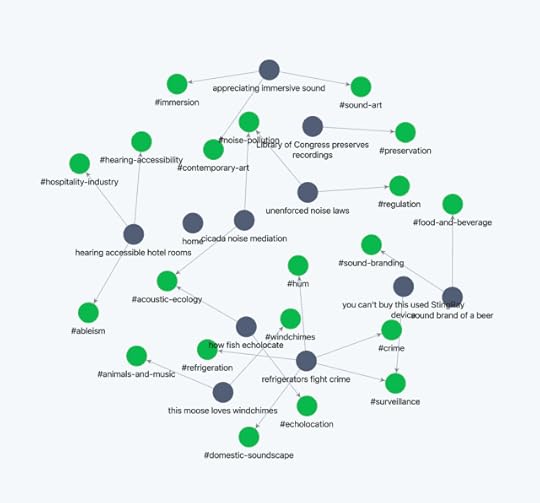
One last note before going quasi-offline for the weekend: I finally found utility in the Obsidian feature called “graph view,” which is that I put a ton of my recent sound studies news items in and I tagged ’em, and that helped me locate clusters of related information by visualizing connections for my This Week in Sound email newsletter. Those examples shown here, by the way, are not from this week’s issue but instead from the previous issue.
Experimenting with Format
As you can tell from the piece on the TV series Sunny in this week’s issue, I’m experimenting with format. I want the newsletter to feel less like I’m offloading homework onto the reader. Much as I like being fairly upstream with news, much as I like observing topics coalesce over weeks and years, data points not necessarily evident as a through-line except in retrospect, I think there’s value in my clustering these sound studies findings. Thus in this issue I have, among other things, a “lead” story about digital voices in Sunny, followed by a variety of other current stories that engage with voice, technology, assistants, and culture but that have no direct ties to Sunny. It’s an experiment.
Jedi Field Recording Expedition

From the seventh episode of The Acolyte
July 11, 2024
Disquiet Junto Project 0654: Just Notation

Each Thursday in the Disquiet Junto music community, a new compositional challenge is set before the group’s members, who then have five days to record and upload a track in response to the project instructions.
Membership in the Junto is open: just join and participate. (A SoundCloud account is helpful but not required.) There’s no pressure to do every project. The Junto is weekly so that you know it’s there, every Thursday through Monday, when your time and interest align.
Tracks are added to the SoundCloud playlist for the duration of the project. Additional (non-SoundCloud) tracks also generally appear in the lllllll.co discussion thread.
Disquiet Junto Project 0654: Just Notation
The Assignment: Interpret a graphic score by Franziska Baumann.
This project is the second of three that are being done over the course of as many months in collaboration with the 2024 Musikfestival Bern, which will be held in Switzerland from September 4 through 8 (details at musikfestivalbern.ch). We are working at the invitation of Tobias Reber, an early Junto participant, who manages the festival’s educational activities. This year is the sixth in a row that the Junto has collaborated with Musikfestival Bern.
Step 1: Spend time observing this graphic score by Franziska Baumann, the Swiss composer and musician who is part of this year’s Musikfestival Bern. It is titled True Glimpses 1. There is a larger version available for download. More on Baumann at franziskabaumann.ch.

Step 2: Consider how the image in Step 1 can be interpreted as a graphic score. (If you’re unfamiliar with the concept of graphic notation, read up and join the conversion at the llllllll.co link below.)
Step 3: Record a piece of music that interprets the graphic score from Step 1.
Tasks Upon Completion:
Label: Include “disquiet0654” (no spaces/quotes) in the name of your track.
Upload: Post your track to a public account (SoundCloud preferred but by no means required). It’s best to focus on one track, but if you post more than one, clarify which is the “main” rendition.
Share: Post your track and a description/explanation at https://llllllll.co/t/disquiet-junto-project-0654-just-notation/
Discuss: Listen to and comment on the other tracks.
Additional Details:
Length: The length is up to you.
Deadline: Monday, July 15, 2024, 11:59pm (that is: just before midnight) wherever you are.
About: https://disquiet.com/junto/
Newsletter: https://juntoletter.disquiet.com/
License: It’s preferred (but not required) to set your track as downloadable and allowing for attributed remixing (i.e., an attribution Creative Commons license).
Please Include When Posting Your Track:
More on the 654th weekly Disquiet Junto project, Just Notation — The Assignment: Interpret a graphic score by Franziska Baumann — at https://disquiet.com/0654/
The cover image for this project is a detail of a graphic score, titled True Glimpses 1, by Franziska Baumann, used with her permission and the support of Musikfestival Bern. More on Baumann at franziskabaumann.ch.
July 10, 2024
Navigating Forums
I spend a solid amount of time on social media — regulated time, meaning not before breakfast or after dinner, and generally not on the weekend. For all the time I do put in, I find myself referencing things from what I’d call the “Twitter mode” (e.g., Mastodon, Threads, Bluesky) more often than I do what I’d call “forum mode.” That doesn’t reflect my activity, more a sense that the former is more public and the latter more private. I thought I’d collect some thoughts about forums (e.g., those on Discourse, Slack, Discord). I’m on too many of each to list in detail, but if you think there’s one I might appreciate knowing about, do lemme know. Thanks.

Discourse is like if the BBS I remember from the proto-Internet mid-1980s had upgraded along the way to a vaguely graphic interface — but not gone so far that it couldn’t wind the clock back to pure text, should it ever want to. Which is to say, Discourse is my favorite online mode; it’s the platform on which I feel most at home. Discourse (mothership: discourse.org) provides simple tools to simplify your engagement. You can opt to just not follow individual threads, and then that little alert number disappears. You can even opt to full-on mute a discussion, which means it doesn’t just go quiet; it disappears from your view entirely — henceforth you’ll have no idea if people are arguing about a topic you have no (or too much) interest in. A signifier of Discourse’s casual tone is that you may very well be on Discourse already and not even know it. It’s a platform, yes, but it’s routinely accessed from another URL entirely. I spend a lot of times at llllllll.co. The VCV Rack forum is on Discourse, as is the Elektronauts board.

Slack is like if social media became an office job — with the ugliest carpet ever. It’s best to set your hours (mothership: slack.com). Don’t participate in everything, just what’s essential and what you feel strongly connected to. Leave channels with ease, or at least turn off notifications. And foremost: feel comfortable changing notifications to just @ mentions, so you only get alerted when someone pings you that you may be missing out.

Discord is like if Slack was a factory job — on the floor of a Las Vegas casino. It is essential, at least for me, to do everything I can to tone it down. My favorite option is to click on a folder and hit “Mark as Read,” which just clears everything out. I assure you, in most Discourses, that won’t last long (mothership: discord.com). For some time, I had folders of all the various Discords I’m in carefully sorted by category. They were very organized, but something felt off. What helped, I figured out, was creating an additional folder of just the main Discords I want to pay attention to. In other words, “places where I actually want to hang out” is an entirely valid typology classification.
July 9, 2024
On Susie Ibarra on Nature’s Rhythms
This is a review I wrote for the July 2024 (Issue 485) of The Wire. It appears here with some very light edits:
Rhythm in Nature: An Ecology of Rhythm
Susie Ibarra
Habitat Sounds Pbk 158 pp
The great drummer and composer Susie Ibarra — born in Anaheim, California, home to Disneyland, among the most artificial environments on Earth — has long embraced the natural world as intrinsic to her music. In 2002, her Songbird Suite, released by John Zorn’s Tzadik label, teamed her with a supergroup (the label’s term) of Jennifer Choi, Ikue Mori, and Craig Taborn. Uncredited were additional participants: the birds whose music could be heard on the title track, not merely sampled, but having provided evident inspiration for her antic percussion and for Taborn’s impressionistic piano playing. Two decades on, Ibarra’s Walking on Water (Innova, 2021) melded a larger ensemble with more birds and, trenchantly, the sounds of glaciers in decline. At times during Walking on Water, a listener might think Ibarra’s music had lost a battle with the field recordings, before coming to recognize the water is, in fact, the music.
There are ecological and musicological facets to Ibarra’s efforts in deploying, as a composer, the sounds of everyday reality. On the one hand, she focuses on the matter of our rapidly changing planet, and to that end has collaborated with Dr. Michele Koppes of the University of British Columbia, most recently for an ongoing project called Listening to Climate Change. On the other hand, as a musician, Ibarra is deeply engaged with how the cycles of the natural world as well as the sounds inform art and the human experience.
In her new book Rhythm in Nature: An Ecology of Rhythm, Ibarra channels her hard-won insights into a sequence of examples that might appeal to numerous readers — listeners, environmentalists and fellow musicians.
The book is as much a supplement to as it is an overview of Ibarra’s work as an educator and composer. It is broken into six main sections, one each on glaciers, oceans, trees, birdsong, deserts, and natural echoes (combining canyons and — stretching the definition of nature — human-made metal cisterns). Throughout, Ibarra exudes a holistic, imperturbable sense of humankind’s place in the larger natural order. An investigation of glaciers leads to the realisation that the rhythms of water are equivalent to that of popular music around the globe: “We are continually playing, listening, and seeing water rhythms while out in the field.”
The book isn’t merely a study of the sound of the world. It’s a study of the structure of sound. An exploration of glass informs her understanding how liminal states — “moving from one moment to another” — are essential to her art. Work with trees yields an appreciation for fractal mathematics. “The anatomy in the tree,” she writes, “reveals the sonic rhythms.” In addition to her descriptions, there are numerous photos (so many, in fact, that you might think they’re included to expand the page count to book length) and fascinating bits of scores (for those who read music).
The book’s main downside is it bears the imperfections of self-publishing, with more than its share of typos, as well as descriptive text that could benefit from an editor. Nonetheless, the reader reaches the conclusion to which Ibarra has served as a naturalist guide: pondering our place in the world. As she puts it at the end, she doesn’t know “if I am the rhythm or maybe I am the landscape.” It’s a small world, after all.
July 8, 2024
An Anatomy of a Flourish
I spend a lot of time watching YouTube tutorials and demos of the sort of equipment either I fiddle with myself or that exemplify the sort of synthesis I like writing about. In a few recent videos from the musician Lightbath, notably this one (“Twist, Slide, Tap | Hybrid Modular • Ep 3”), he has talked a lot about a particular thing he does, which he terms his “flourish.” It’s a sound I love, this sweep through various stages — sometimes octaves, sometimes aspects of an effect, sometimes notes in a chord — that sends my ear back to Laurie Anderson, circa Mister Heartbreak, and that I’ve experimented with thanks to a module called the Bizmuth.
You can dial in to an example at 14:22 in this video. Note that this is a very in-depth tutorial, and it’s just one in a series that provides an even more detailed explanation of the hybrid of computer and physical modular synthesizers that he employs. I’m noting it here specifically because of this one detail that he lingers on. (Thanks to Chris McAvoy for having brought the video to my attention. I subscribe to Lightbath’s YouTube channel and have written about his music in the past, but this one had eluded me.)


