Marc Weidenbaum's Blog, page 53
July 23, 2024
Listening Along with Miéville & Reeves
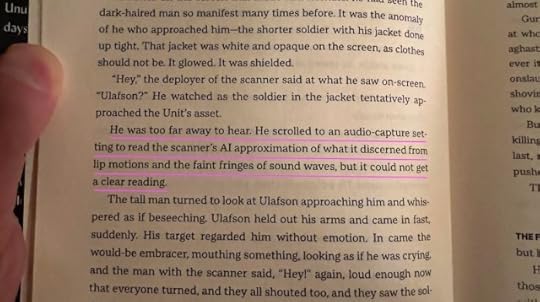
Yes, I’m enjoying the new collaborative novel, The Book of Elsewhere, from Keanu Reeves and China Miéville


July 22, 2024
Not Dreaming About Wires
As I joked last week, while there is a movie about synthesizers titled I Dream of Wires, the truth of the matter is closer to the notion that I can’t sleep because I can’t stop thinking about wires. This is true such that I need to cut off using my synthesizers by the time dinner starts. If I go much later, then ideas start forming in my head — cue the Time Bandits memes — that are hard to shut off, much harder to shut off than is a synthesizer itself. The many little lights and screens on my synth fade and go dark, but the ideas linger.
What if I limit signal W such that signal X fluctuates at a slower pace? What if I route sound Y into my laptop, so I can process it before sending it back out to my synth to become sound Z? Should I take the time to remove module A from my synth so I can tweak the jumper settings, thus altering the underlying sonic physics of what it is capable of? Wow, what if I split signal B into signals C and D and do slightly different things to them and then recombine them? Why isn’t module E connecting to module F the way I expected it to?
This last one is a very recent and real example. I have a module E that I have set up to process inputs from my guitar, which we’ll call instrument G. It turns out that module E has only four inputs, and I need six, which is where module F comes in. I checked in on two different forums, and people were both certain but not entirely certain about the answer. I subsequently read a heap of posts on various other forums, none of which precisely answered my quite precise question.
I should pause here and say that if this sounds draining, if it sounds like exactly why you don’t want to use synthesizers, then please don’t; however, to be clear, I find it fascinating and educational and enjoyable.
This time around, I went so far as to email the creator of both module E and F to get a sense of how they are intended to connect. I promised the creator of those modules that I would eventually write a blog post about my employment of the modules, so that a specific answer to my question — by no means an esoteric question, not within the confines of the esoteric-ish realm in which I was asking it, a realm that once you’re in it no longer feels esoteric — would eventually likely become searchable on the internet. I received a helpful response. I now understand how modules E and F connect.
How synthesizer thinking keeps me up at night isn’t how playing guitar is for me. I can practice right up until I put my head down on my pillow, and I sleep fine. This isn’t how writing is for me. I can write until late — though I generally don’t, though I will jot down ideas quite close to bedtime, and do so almost nightly — and I can still sleep fine. The ideas I jot down are just that, possibilities I want to explore, much as the wiring of my synthesizers are manifestations of ideas. But writing out ideas doesn’t impact my ability to sleep — writing this very post won’t impact my ability to sleep — whereas with synthesizers there is a direct correlation between fiddling with them too late, and not being able to sleep. I don’t understand the distinction. I’m not sure I ever will.
July 21, 2024
Kata, Lesson, Subversion
“Sometimes it turns into a production kata, sometimes it’s a history lesson, sometimes it’s a subversion of muscle memory. It’s just what I need.”
That is Coraline Ada Ehmke on what the Disquiet Junto has supplied. It’s a rewarding summary statement.
July 20, 2024
Scratch Pad: Sirens, Picks, Wires
I do this manually at the end of each week: collating most of the recent little comments I’ve made on social media, which I think of as my public scratch pad. I also find knowing I will revisit my posts to be a positive and mellowing influence on my social media activity. I mostly hang out on Mastodon (at post.lurk.org/@disquiet), and I’m also trying out a few others. And I generally take weekends off social media.
▰ First passing siren of the week
▰ Inevitably after guitar class I write down a bunch of notes on what I’ve learned, and then the only fool*-proof way to find my pick is to stand up and wait for it to fall to the floor
*me being the fool in this equation
▰ Again, it’s not, in fact, “I Dream of Wires.” It’s: “I was using my modular synth too late and then I couldn’t sleep because I couldn’t stop thinking about wires.”
▰ Apparently this artist lived backwards in time (at Stanford Cantor). And yes, as a friend pointed out, kinda love the “a copy of a copy.”

▰ Fun fact: Even when the editor likes your essay a lot and has only made minor edits to it, managing those edits in Track Changes can take a confusing hour-plus. By the end, it becomes the punctuation equivalent of Where’s Waldo.
July 19, 2024
Six More Strings

New machine in the house
July 18, 2024
Disquiet Junto Project 0655: Soothing Sounds II
Each Thursday in the Disquiet Junto music community, a new compositional challenge is set before the group’s members, who then have five days to record and upload a track in response to the project instructions.
Membership in the Junto is open: just join and participate. (A SoundCloud account is helpful but not required.) There’s no pressure to do every project. The Junto is weekly so that you know it’s there, every Thursday through Monday, when your time and interest align.
Tracks are added to the SoundCloud playlist for the duration of the project. Additional (non-SoundCloud) tracks also generally appear in the lllllll.co discussion thread.
Disquiet Junto Project 0655: Soothing Sounds II
The Assignment: Make music for babies.
Step 1: Back in the early 1960s, Raymond Scott released a set of music for infants, titled Soothing Sounds for Baby. We’re going to produce music along those lines. Feel free to revisit Scott’s great collection. (Not one but two Junto participants give birth this month — one did a week-ish ago, and one is due to very soon. We’re doing this project in their honor and with their approval. Perhaps there are other brand new parents in our digital midst, as well. We did a project just like this one way back when we hit the 250th consecutive week, in October 2016.)
Step 2: Compose a piece of music intended for a newborn child, something peaceful as they first experience the world outside the womb.
Tasks Upon Completion:
Label: Include “disquiet0655” (no spaces/quotes) in the name of your track.
Upload: Post your track to a public account (SoundCloud preferred but by no means required). It’s best to focus on one track, but if you post more than one, clarify which is the “main” rendition.
Share: Post your track and a description/explanation at https://llllllll.co/t/disquiet-junto-project-0655-soothing-sounds-ii/
Discuss: Listen to and comment on the other tracks.
Additional Details:
Length: The length is up to you. It can take a child awhile to fall asleep.
Deadline: Monday, July 22, 2024, 11:59pm (that is: just before midnight) wherever you are.
About: https://disquiet.com/junto/
Newsletter: https://juntoletter.disquiet.com/
License: It’s preferred (but not required) to set your track as downloadable and allowing for attributed remixing (i.e., an attribution Creative Commons license).
Please Include When Posting Your Track:
More on the 655th weekly Disquiet Junto project, Soothing Sounds II — The Assignment: Make music for babies — at https://disquiet.com/0655/
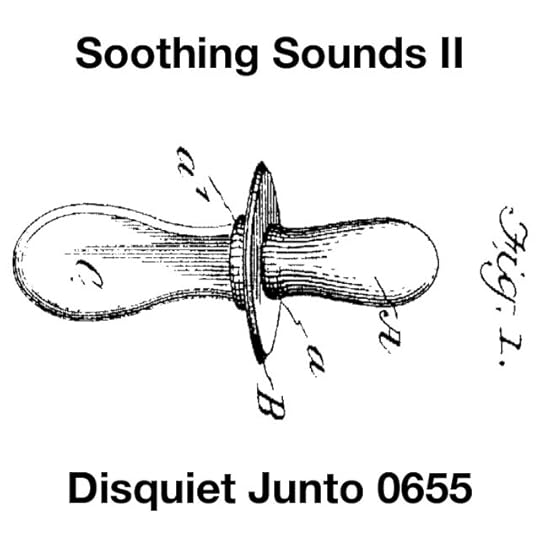
The image associated with this project is from an early patent for a pacifier.
July 17, 2024
‘Sunny,’ Episode 3: Ear Witness
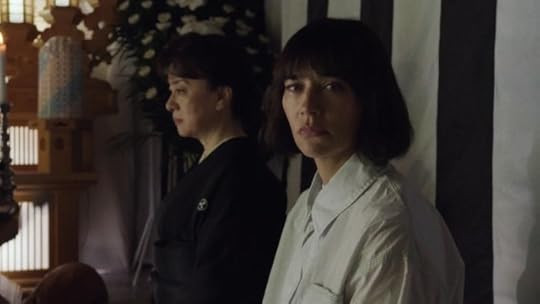
“Shouldn’t you have supersonic hearing or something?” asks the widow of the robot.
That is the question that Suzie directs at Sunny, after Sunny, having been just told not to, goes ahead and opens the door. Suzie (played by Rashida Jones) is a recent widow, Sunny (voiced by Joanna Sotomura) an even more recently arrived robot. The door is the one to the bedroom of Suzie’s son, who may very well at this moment be dead, along with his father, Suzie’s husband, Masa (Hidetoshi Nishijima). We have heard about but not witnessed a plane crash that is assumed to have claimed both. Suzie has been grieving inside the child’s room. Sunny, namesake disposition notwithstanding, is pushy, and quite likely did hear what Suzie said, and is simply acting in the owner/guardian’s perceived best interests.
As with its first two episodes, sound remains a key topic in the Apple TV series Sunny, which takes its name from the robot. The two other key sonic moments in episode three, titled “Mmmm, Hinoki,” belong to Suzie’s mother-in-law, Masa’s mother, Noriko (Judy Ongg), who is pushy in her own right. In fact, there is a sense that if Masa is responsible for having originally programmed Sunny, then Noriko may have provided something of an emotional template. In fact, in this episode we see a flashback to Noriko waiting outside Masa’s room when he was much younger, just as we see Sunny now waiting outside Suzie’s. (Masa, we learned in episode two, was a hikikomori — or shut-in — for several years.)
In the first of this episode’s two essential Noriko sonic moments, we see her talking, seemingly to herself, while two of other elderly Japanese women are one room away. The women listen in, as do we. However, to us viewers, it is only when Noriko’s monologue takes a sudden turn that we realize she has not been talking to herself. She might well have been practicing for a difficult conversation, but she is actually engaged in that conversation: she is on the phone — using one of the ubiquitous earbuds that have become a signifier of the near future where Sunny is set — negotiating the details of Masa’s upcoming funeral.
The other Noriko sonic moment occurs about halfway through the episode, when we again see her in the midst of a form of communication that is initially opaque. She has just finished a call, again using her earbud; it is one among many such calls she is making to inform people about Masa’s funeral. Then, as she straightens a small stack of paper, she freezes, almost as if she has remembered something disturbing, or even had a stroke. An instant passes speedily, and it only becomes clear that she has herself received a call when we hear her say, partially in Japanese and then in English: “Call: Do not answer.”
That inbound call, however, appears to connect nonetheless, and Noriko’s practiced facade drops. She pulls out the earbud, slamming it to the table. Interestingly, while we didn’t hear the call — hence the earlier ambiguity — we do hear the connecting tone, perhaps simply to reinforce what is happening, or perhaps because the earbud is no longer in Noriko’s ear. More likely it’s the latter, because throughout Sunny thus far, earbuds (both during in-person instantly translated communication and during phone calls) are depicted as societally embedded mediators of interactions between humans. (Recall how in episode two, we see Suzie and Masa on their first date, and he declines her suggestion that she use an earbud’s translation feature to make it easier for him to speak to her; we know Masa knows something is up, because he doesn’t want a device to come between them.) This TV series clearly has the unintended impact of technology as one of its subjects, and the earbuds serve as a focal point, as an example of how much such an impact plays out at a daily level — and that the robots, like Sunny, are just part of a larger problem. What’s at the root of it, exactly, we don’t yet know.
One sensory side note: the episode takes its title, “Mmmm, Hinoki,” from a different sense other than hearing. The word hinoki is Japanese for cypress, a scent that is being discussed at the opening of the episode. Now, as far as we know, robots can’t smell. The aficionado of hinoki here is a violent crime boss — which is to say, just because the enjoyment of smells may remain the unique province of living things (in contrast with robots), a refined sense of smell itself isn’t necessarily a sign of any actual underlying humanity.
Another sensory side note: we also know that Sunny the robot can experience inebriation, not through drinking but through digital psychedelic patterns displayed on large video screens.
July 16, 2024
In Ed Park’s ‘Dream’
It is safe to say I am enjoying Ed Park’s novel Same Bed Different Dreams:
After the move to Dogskill, GLOAT replaced most of its management team with Directed Reality “You Be You” modules (hence D-R U-B-U), which, among other things, removed emotion from the equation. Workflow was stabilized, so that goals were attained on time. GLOAT’s high attrition rate was mostly due to the inability of new hires to get used to receiving critiques from a piece of software, no matter how lifelike. The smallest hiccup in the voice synthesizer or flaw in the image could shatter the illusion, reminding you that there was no one behind that mask.
July 15, 2024
TWiS Sound Bites
Little bits from the July 12, 2024, issue of my this Week in Sound email newsletter. I’ve been working on a revised format for the overall issue. Still doing so.
Hum Dinger: An Indian village is shaken by unidentified sounds: “Amit Jirange, a geologist with the Sangli GSDA, told TOI: “We found no sign of any seismic or sub-surface activity that eventually leads to tremors. The possible explanation we thought of was the release of the air trapped inside dried-up borewells.” ▰ Public Speaker: Are people ditching headphones more and listening to devices out in the open? ▰ Sound of Money: Noise from crypto mining apparently out of (regulatory) control in Texas. ▰ Sonic Weaponry: Updates on the Havana Syndrome investigation. ▰ For Eyes: A Chinese robot aids the blind with reportedly 90% accuracy. ▰ Pedal to the Metal: The 99% Invisible podcast covers John Cage’s extremely long organ composition. ▰ Bird Brain: The June 7, 2024, Rhymes with Orange comic strip by Hilary B. Price had my number. (Thanks, Mike Rhode!)

July 14, 2024
On the Line: Marsh, Motorcycle, Blackbird
▰ RIVER SONG:
“London is out there, not muted, but blurred into a saltmarsh soundscape. The sense of being surrounded calls to my drowsy mind a line in Maurice Sendak’s Where the Wild Things Are: ‘That night ... the walls became the world all around.’”The Country Diary in the Guardian is “the oldest newspaper column in the world. This is Amy-Jane Beer writing not from Crook, County Durham, or North Hertfordshire, but from River Roding in London.
. . .
▰ FULL CYCLE:
“‘I ride an 1800cc BMW,’ Sahara said. ‘Of all the BMWs, this one has the highest displacement and the engine makes the nicest, boldest sound.’Kaho didn’t say anything. I couldn’t care less what you ride — a BMW motorcycle, a tricycle, or an oxcart — she silently muttered to herself.”The “silently” carries a nice amount of weight in this moment from “Kaho,” a Haruki Murakami story in the July 1, 2024, issue of The New Yorker.
. . .
▰ SOMETHING BORROWED:
"Music scaled a heightPast fire escapes, so that I heardA tune that scored itselfAcross the paper sky: a birdPerched on the tree's top shelf"That is from “Blackbird at Dawn,” a poem by A.E. Stallings in the July 18, 2024, issue of the London Review of Books.