
Marc Weidenbaum's Blog, page 482
October 24, 2012
Ukulele Ambience (MP3s)

Brian Biggs has posted three experimental duets that appear to have grown out of last week’s Disquiet Junto project. The project, the 42nd in the ongoing weekly series, involved participants employing the oldest and newest instruments in their practice to create a “naive melody.” Taking a cue from Talking Heads, the melody was accomplished by employing the oldest, more familiar instrument in the production of the backing track, and the newer one — on which the performer was, by definition, still something of a novice — in the production of the foregrounded melody. By coincidence in advance of the announcement of the project that led to that piece, Biggs had tried out a variety of modular apparatuses and approaches, in addition to his saxophone and ukulele, yielding three varied tracks:
He explains in brief:
Tracks created with a ukulele, a Harvestman Tyme Sefari (version 2), and a MakeNoise Phonogene. A little four-note strum in F went to the Tyme Sefari, another simple uke thing in A went to the Phonogene. The outs of the two samplers went to the audio input of a Cwejman MMF-1 filter, and then output and recorded to a Zoom H4N with reverb from the Motu 828 interface.
I was on the fence regarding keeping both the Tyme Sefari and the Phonogene until these tracks. The end-of-loop output of each module kept the other in “time” and being able to fool with each independently of the other is worth keeping both.
The technical information aside, especially recommended is the first of the three duets, which uses backmasking to create a sense of timelessness that merges well with the acoustic intonations of the instrument.
Set originally posted for free download at soundcloud.com/dance-robot-dance. More detail on Biggs’ process at dancerobotdance.com, where the above image is sourced from.


October 23, 2012
Live Trio (MP3)
If ever the shape of a recording’s waveform presented the potential listener with a vision of an enticingly varied performance, the April 6, 2011, live concert by a trio of electronic musicians (Ted James, Erik Schoster, Brendan Landis) is a chief contender.
The waveform of the 20-minute set, as shown on Landis’ soundcloud.com/hey-exit account, seems to take every possible visual approach, from sharp changes in amplitude to staccato subsets to extended singularities, from tepid passages to richly dense ones. The instrumentation is loosely described in the accompanying liner note: James on “Synthesizers, Electronics,” Schoster on “Computer, Electronics,” Landis on “vox, guitar.” To begin with, the voice: this isn’t singing, not in the sense of words and songs and melody; the voice, as employed by Landis, is one instrument among many, one source of drones and noise among others. If it at times seems distinct from everything else because of its recognizability, so too is the occasional case with the guitar, which once in a while stops being an anonymous provider of sonic effluvia and comes to resemble what is more immediately recognizable as a guitar. In both situations, though, even when the sound sources become familiar, the music remains abstract, deliberately non-associative. There are, indeed, varied approaches here, from light percussive fields to attenuated drones, from subdued glossolalia to heady shimmers. Furthermore, these sounds are just a few among many others, and overall the performance is less about simultaneous collaborative effort, less about harmony, and more about concentration and communal pursuit, about music that unfolds, that develops, that moves forward.
Track originally posted on October 20, 2012, for free download at soundcloud.com/hey-exit. More on Schoster at hecanjog.com. More on Landis at heyexit.com. More on James at tedjames.info.
October 22, 2012
Scanner 4/4: God Sample the Queen

There is national music, and there are national anthems. There is music that is derived from regional culture, and there is music that is composed with the intention of encapsulating, of standing for, that culture. “God Save the Queen” is a template for national anthems, echoed throughout the globe in various of England’s colonies, vestigial and otherwise — it’s a palimpsest subsumed in the United States’ own “My Country, ‘Tis of Thee” (not its national anthem, of course, but a close second).
“God Save the Queen” was also the source material for Scanner‘s “Anthem,” which subsumes the song even further still. Commissioned for the 2012 Olympics (and Paralymics), “Anthem” slows the British national anthem past the point of recognizability, until it is as thin as the material from which one might cut a flag. It’s ethereal rather than rousing. And, by Scanner’s own design, a bit renegade. The audio was installed at Lancaster House, which, as Scanner (aka Robin Rimbaud) explains, is a high-security building. He infused his work with a double sense of infiltration. First, he had it playing in the Lancaster bathrooms, assuring that every visitor was sure to hear it in an especially intimate manner. And he posted it online for free download, assuring that all who couldn’t penetrate the fortress would still hear its music.
Track originally posted for free download at soundcloud.com/scanner. More on Scanner at scannerdot.com.
October 21, 2012
Scanner 3/4: Vertical Sound
“Mind the doors, please.” If you step into the elevator at the gallery Bonniers Konsthall in Stockholm, Sweden, those familiar words serve as the beginning of your short trip. They are also the opening of a sound work by Scanner, aka Robin Rimbaud, that is currently installed in the elevator, and that will continue to be through December 2 of this year. “Elevator overloaded,” the work continues. “Fourth floor. Second floor.” This isn’t a linear journey by any means.
The work, titled “Hiss Concrète,” brings together the sounds of that specific elevator with similarly sourced audio elements from Rimbaud’s extensive travels. He writes in a brief descriptive note: “The work is installed in the museum elevator, drawing attention to a very specific non place. It uses all the sounds of the elevator itself, doors, motor and ambience, combined with recordings I have made all over the globe of other elevators, bells, buzzers, gates, voice announcements for different floors, in a variety of languages from English, German, Spanish, French, Japanese and Chinese.” It’s part of More Than Sound, an exhibit at Bonniers Konsthall that features work from Tarek Atoui, Hans Berg, Nathalie Djurberg, Malin Bång, Ayşe Erkmen, Carl Michael von Hausswolff, Susan Hiller, Matti Kallioinen, Haroon Mirza, and Susan Philipsz, in addition to Scanner/Rimbaud.
Track originally posted for free download at soundcloud.com/scanner. More on Scanner at scannerdot.com. More on the Bonniers Konsthall exhibit at bonnierskonsthall.se.
October 20, 2012
Scanner 2/4: Joy Re-division
It’s an orchestration minus the orchestra. It’s an imagined myriad-instrumental version of a proto-electronic song rendered here as an electronic protype. It’s early post-punk re-imagined in light of post-rock’s affection for classical music. What it is is Scanner’s version of the band Joy Division’s song “Heart and Soul,” heard as a lightly glitchy expanse, with a gurgling undercurrent. Scanner, aka Robin Rimbaud, explains in a brief liner note that it’s an unreleased demo for the Live_Transmission project with Heritage Orchestra: “This is my early studio demo that was then arranged for the orchestra and live band to be performed on stage at the Brighton Festival in May 2012.”
Track originally posted for free download at soundcloud.com/scanner. More on Scanner at scannerdot.com. More on Heritage Orchestra at theheritageorchestra.com.
And, for reference, the original song, from the album Closer (1980):
October 19, 2012
Scanner 1/4: Voices in the Ether
Some 600 hours of previously unreleased material, newly digitized and awaiting a broader set of ears — this is the status of Scanner’s archival project, which has him diving into his earliest recordings, dating back to 1977, as he describes the situation in a brief liner note to Colofon & Compendium 1991-1994 (Sub Rosa), a compilation that has resulted from this ongoing effort. The album is due out October 30, but in the meanwhile there is “Colofon & Compendium (redux).” It’s a medley of material from the album, an “exclusive collage,” as he puts it. This music dates from the era when Robin Rimbaud earned the name Scanner, in that he used a police scanner to pull voices from the ether and then, in real time and in the studio, would add music to dramatize the overheard conversation, lending emotional and narrative weight and context. Scanner doesn’t employ the scanner as often as he once did, but for longtime listeners to his work, this early eavesdropping gives additional meaning to his subsequent employment of spoken and sung information.
Track originally posted for free download at soundcloud.com/scanner. More on Scanner at scannerdot.com.
October 18, 2012
Disquiet Junto Project 0042: Naive Melody
Each Thursday at the Disquiet Junto group on Soundcloud.com a new compositional challenge is set before the group’s members, who then have just over four days to upload a track in response to the assignment. Membership in the Junto is open: just join and participate.
The assignment was made in the afternoon, California time, on Thursday, October 18, with 11:59pm on the following Monday, October 22, as the deadline. View a search return for all the entries as they are posted: disquiet0042-naivemelody. (There are no translations this week.)
These are the instructions that went out to the group’s email list (at tinyletter.com/disquiet-junto).
Disquiet Junto Project 0042: Naive Melody
You will employ just two instruments in the production of this week’s track: (1) the instrument you have used for the longest period of time and (2) the instrument in your possession that is newest to you. You’ll record a backing track with the oldest instrument, and overlay on it a simple melody of your choosing performed on the newest instrument.
Definition: The term “instrument” can be interpreted as broadly as you’d like; ultimately this is a project about the restraints inherent in the gadgets, tools, and software that you have obtained or created.
Background: The inspiration for this project is the song “This Must Be the Place (Naive Melody)” by the band Talking Heads off the album Fear of Music. For that song, the band members traded instruments, each playing something they were significantly less familiar with than the instrument they normally performed on.
Restrictions: You can use any source material, any instrumentation, except the human voice.
Deadline: Monday, October 22, at 11:59pm wherever you are.
Length: Your finished work should be between 1.5 and 3 minutes in length.
Information: Please, when posting your track on SoundCloud, include a description of your process in planning, composing, and recording it. This description is an essential element of the communicative process inherent in the Disquiet Junto.
Title/Tag: When adding your track to the Disquiet Junto group on Soundcloud.com, please include the term “disquiet0042-naivemelody” in the title of your track, and as a tag for your track.
Download: Please consider setting your track for free download.
Linking: When posting the track, be sure to include this information:
More on this 42nd Disquiet Junto project at:
http://disquiet.com/2012/10/18/disqui...
More details on the Disquiet Junto at:
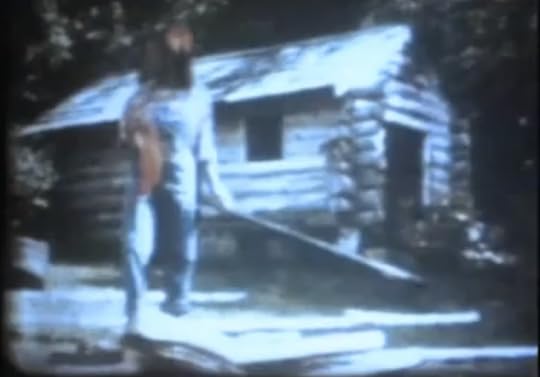
The image up top is a still from the original video for the Talking Heads song “This Must Be the Place (Naive Melody).”
October 17, 2012
Sound and the Tactile Ear
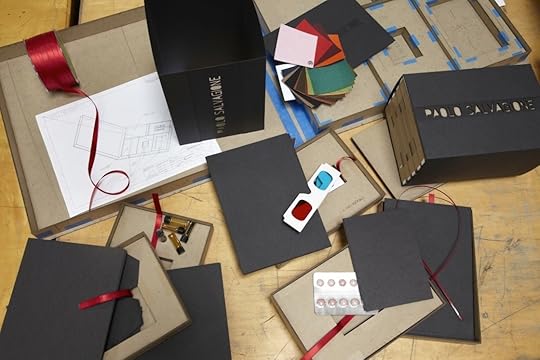
On November 2, 2012, at the San Francisco Center for the book there will be a combination book preview and exhibition opening for artist Paolo Salvagione. His forthcoming book is a contemporary Wunderkammer, or cabinet of curiosity, titled One for Each. As pictured above, while still a work-in-progress, it is a box in the form of five drawers, made of English buckram and black leather. Each drawer contains a different self-contained work, one for each of the five human senses. (More on the opening event, which will run from 6pm until 8pm, at sfcb.org.)

Each drawer also contains a letterpress print of a short essay I wrote for the specific work enclosed therein. Here is the essay I wrote for the “sound” drawer, which contains a series of talking tapes, pictured above; when you rub your nail against one, a spoken phrase can be heard.
“Sound and the Tactile Ear”
All senses are tactile, sound no less so than its four siblings.

Sound is the physical registration of pressure in the ear. Sound is often mistaken as ephemeral. Blame and credit for this confusion date, in equal parts, at least as far back as the conception of the Music of the Spheres: the consensually perceived geometric purity of objects moving harmoniously in the vacuum — sonic and otherwise — of space.
Sounds may count as ephemera, as fleeting, but sound itself is experienced physically. That pressure in the ear differs in no particular or meaningful way from an unfamiliar and flexible physical object against one’s hand, from a vermicelli-width piece of plastic in one’s palm, from a thin strip of raised edges against one’s rigid, determined, and vaguely curious fingernail.
Pull one’s nail along that strip and, self-evidently, a rough sound will be produced. What one hears is not simply words but a voice, a specific voice. Encoded in those ridges, in that rudimentary textural data, isn’t merely syllables and words and grammar, but tone, nuance, association. The sound is rough — appropriately so for something that results from texture. The result is a second layer of information: first a phrase; then meaning, by way of affect.
The item in One for Each itself, the object in hand, adds a third layer, one of novelty. The talking tape, as such items are called, registers as the sort of thing that one might have, once upon a time, exchanged a nickel for in a gumball machine. It would have come wound up tight in a small, semi-opaque eggshell. The talking tape registers as the sort of thing advertised in comic books of yore, when Charles Atlas was king and sea-monkeys ruled the oceans.
The object is a novelty, a curiosity from days gone by. It’s a modest wonder whose primary effect isn’t wonder at the object so much as wonder at the era in which such an object could conjure wonder. Your nail remains curious, and it scratches again and again, hoping to get at the grain of truth.
The other four short essays are titled “Sight and the Media of Immersion,” “Smell and the Threat of Action,” “Taste and the Mechanization of Civility,” and “Touch and the Visceral Silhouette.” I may publish them here at a later date.
More on One for Each at salvagione.com. The project’s typography is by Boon Design (boondesign.com).
Chicago Hip-Hop Built from Paul Simon Sample
“My landlord gave me a stack of records that a tenant had left in a vacated apartment,” writes Joshua Wentz by way of introduction. “Most of them are really scratched, but a few are not too scratched.” The following track, “Piano Slum,” is one of the pieces that resulted when Wentz dug into the vinyl and came up with a variety of instrumental hip-hop excursions. This particular example is built on a small loop of a familiar Paul Simon song. Even as he cuts it and moves parts around, even as he creates a new melody from old, culturally entrenched note formations, he retains the original organ’s loose, analog wavering. As he describes his modus operandi, “I figured these albums would be a good way to scratch a musical itch: create some instrumental hip hop tracks with these albums as the foundation.”
Track originally posted for free download at soundcloud.com/joshuawentz. More on Wentz, who’s based in Chicago, Illinois, at joshuawentz.com. Another Wentz track, in which he played along with a passing train, was featured here last month.
October 16, 2012
Modular Duet (MP3)
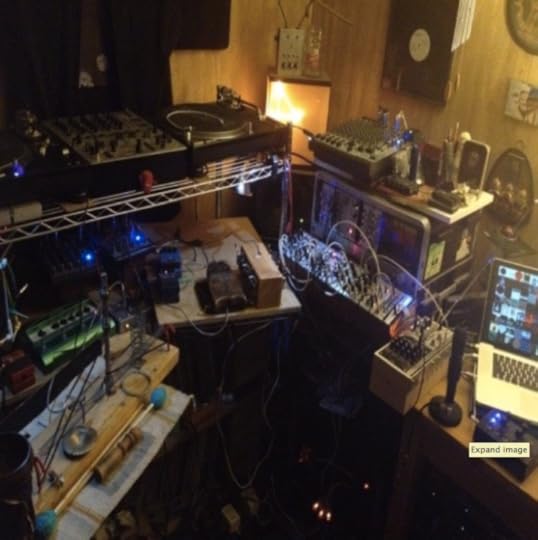
“Eastern Barsmith” is a modular collaboration between Craque and his partner bsmith. The liner note that accompanies the track is on the deep tech/gadget end of the continuum, but the music itself is a pleasing series of warbly reveries, the sort of thing that might accompany video of a robot hobbit making his way through an arcade shire.
The liner note reads as follows:
Dual barton quantizers with custom scales collected by craque and bsmith, programmed by bsmith.
In play: Pressure Points sequence and Doepfer a149 random CV, quantized to several crazy modal/non-western scales. Livewire Bissell Generator providing some ramps (also quantized) and envelopes; filters: Moog MF101, Doepfer a124 Wasp, Bubblesound SeM20; VCOs: ‘Walekko’ Anti-Oscillator, Intellijel Dixie; delay/echo fx: TipTop Z5000.
Track originally posted for free download at soundcloud.com/craque. Craque is Matt Davis of Fullerton, California. More on him at craque.net. Photo above of Craque’s studio.


