Jacqueline Abelson's Blog, page 4
February 29, 2016
Jane Austen Hates Me
In my Spring Semester at King's College London, I was enrolled in a Jane Austen class.
I absolutely hated it.
Primarily because in every single class, my professor would go on diatribes about the history of Regency Era, whereas for me, all I wanted was to sit down and analyze Austen's savvy writing.
I guess I made the mistake into thinking that I was singing up for a Jane Austen Book Club rather than an intellectual academic course. But what made me dislike the course – as with all the rest of the literature courses that I took while abroad – was the fact that anything that I said to contribute to the class was deemed automatically invalid.
"Oh, you wouldn't understand," my professor once said to me in front of everyone during a seminar when I raised my hand in an attempt to tie in a passage from Northanger Abbey with one of her many rants about Georgian architecture. "If you've lived in England for as long as I have, and as long as your classmates have, you would have a better understanding into how Bath incorporated some of Austen's insights into her novels."
What my uppity professor didn't know was that I HAD indeed visited Bath last semester in late October. And – not that she bothered to ask – I had also visited Austen's house in Chawton in early January before classes started six days earlier. Personally, I was slowly mentally clocking out of my literature studies here at King's College. It wasn't that I was enjoying the reading assignments.
On the contrary.
I was living every English major's dream! Last semester I immersed myself in Chaucer, Dickens, Shakespeare and even more Shakespeare! Day and night, I was reading, highlighting and analyzing. The only problem was, no professor wanted to hear me, let alone pick on me whenever I would raise my hand in class. I knew that I wasn't the only American student abroad in my classes, but now that I think back on it, I was THE only American student abroad who would raise her hand during class seminars. The other students who were called on were native Brits.
I didn't see why I was any different than my classmates – besides the obvious. I made time to sit down after finishing one of Austen's many novels to watch the movie adaptations. I even spent an entire day watching the six-hour version of Pride and Prejudice. I didn't leave my room. There's always something satisfying when watching a storyline like that be perfectly adapted into a movie or TV series. It's almost like the screenwriter wrote the script just for you! Because who doesn't want Colin Firth as Mr. Darcy? The thing that I learned after finishing all six of Austen's novels was that her stories are so well written that you can tell them over and over again and people would still listen. You can even adapt them differently and people would still pay a ticket to see it in theaters, or pick up a modern version of one of her novels from a bookshelf.
It's not only Jane Austen who holds this literary power over me, but my friends Chaucer, Shakespeare and Dickens as well. English literature has always been the pride of Britain's history. Unlike American literature that only dates back to the late 1600's, England's literature goes back even farther and is rooted within the very foundation of Britain's upbringing. Which was probably why my professors scolded at me for trying to hack away at the thick roots of their literary heritage. What did this American think she was doing? I could picture my British professor fuming. Pulling apart Jane Austen like she's Edith Wharton! Has she no respect for this country and its writers? The fact was, if you were a British citizen you automatically had a stake in the history of the country, regardless if you forget which British monarchy proceeded George I.
Hint: It was George II.
This was actually what made me into an even bigger threat: My annoying knowledge of the monarchs of Great Britain. In the same Jane Austen class that I was stuck in, with my way too nationalist professor, she gave us a lecture of the people in power during the early 18th century after the Glorious Revolution. This had absolutely nothing to do with Jane Austen, but rather how England changed after the Stuart monarchy switched to the Hanoverian monarchy.
To be brief and not to bore you, my professor was trying to make a point that the Protestants were back in power and she made the mistake of jumping from William and Mary of Orange to George I. My hand shot up, and I could tell that my professor just wasn't in the mood to hear an American open her mouth, but she sighed before saying, "Yes, Jacqueline?"
"The crown didn't go straight to George I after William's death," I said. "Didn't it go to his sister-in-law, Anne?"
Many people actually forget that there was another English queen besides Mary I, Elizabeth I and Elizabeth II. Queen Anne proceeded to the throne, but within months of her reign, another war in Europe had started, which pretty much overshadowed most of her reign.
Sadly, by the look on my professor's face, she too – a native Brit – forgot that Anne existed.
It was priceless.
"Indeed," I could tell that all of the British students had their eyes on their professor, because her cheeks immediately flushed bright red. How was it that an American knew the British monarchy better than the British?
Afterwards, my professor refused to call on me whenever I would raise my hand in class.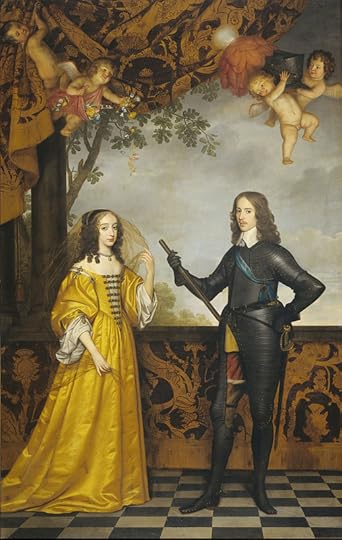
 Anyway, here I was – an American – trying to contribute my Western thoughts and ideas to the London literary scene.
But not getting anywhere.
That didn't mean that I didn't enjoy reading the novels that I was assigned to analyze. I didn't motivate myself to read all six of Austen's novels because I had to for my bias professor. I did it because I loved Austen's writing. All of her characters were memorable and very human. It was like you could slip inside their skin and go back in time to the Regency Era to relive their lives. I guess with Austen's writing, she made everything sound so simple and neat and tightly picturesque. I took the time to read and analyze her writing for my own benefit. It was my form of escapism as I endured my homesickness away from my friends at Mount Holyoke and California.
Yes, I had to sit miserably in that stupid Jane Austen class for the rest of my spring semester, but it was all worth it if it meant picking up the next Jane Austen book on my syllabus and watching Clueless right after dinner. I took the first step into the world of Jane Austen when I was in the sixth grade in middle school. I picked up a copy of Pride and Prejudice from my school's library and only made it to the second chapter. I guess I was too young to understand Austen's writing with a critical eye. After all, I was just barely understanding Gregory Maguire's Wicked. So I returned the book at the end of the week.
My second step was when the glorious Seth Grahame-Smith released a co-authored book of Pride and Prejudice with zombies! I was a freshmen in high school when I got around to pick up a copy of Pride and Prejudice and Zombies. Though my evaluation to examine Austen's writing was just peaking (I'm pretty sure it peaked when I got around to reading The House of Mirth by Edith Wharton my sophomore year) but the zombie scenes appealed to my fifteen year old teenage angst. Plus, because the novel was 60% written by Jane Austen, the other 40% was just really cool and gory zombie scenes that Grahame-Smith wrote and inserted in between Austen's paragraphs.
My third step wouldn't happen until I made it to England for my Junior Year Abroad. And even then, my third step wasn't primarily prompt by Jane Austen, but rather than my father urging me to go out and explore all of Great Britain instead of walling myself up with my studies in my apartment on Stanford Street.
He coaxed me to visit Bath.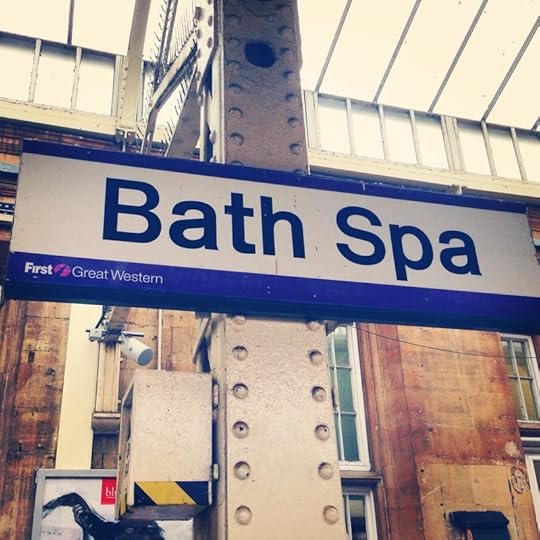 For October Break of my fall semester, I decided to give in to my father's suggestion and leave for Bath. I took a three and a half hour train ride from Waterloo Station to Bath Spa, but wasn't aware of how long the trip would be until I sat down in my seat. This turned out to be a problem because I wouldn't get into Bath until 12 o'clock in the afternoon, and the last train taking me back to Waterloo Station was at 4 o'clock. In short, it meant that I would have only four hours in Bath. In hindsight, I should have planned a little better for this trip. Not just because the night before I made a list of all the things I wanted to see in Bath (I.E. The Roman Baths, The Royal Crescent, The Pump Room, Bath Abbey, The Circus, The Fashion Museum, The Bath Assembly Rooms, The Theatre Royal) but also because once I got off the train at Bath Spa, I was subjected to a violent downpour of rain.
Worse, I forgot my umbrella. I suppose this is what happens when you forget to check the weather before you buy your tickets for a mind numbing three and a half hour train ride.
So I threw my sweatshirt hood over my head, and walked into the city of Bath.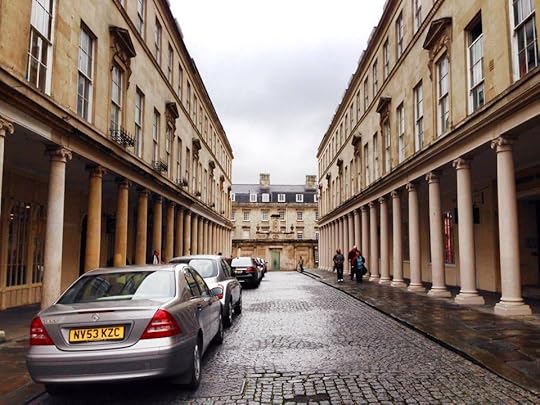 Bath, located in the south west region of England reminded me of a city that was in the middle of an identity crisis. Everywhere you look, the buildings have the same color, but not quite the same architecture. As I walked up the street to The Pump Room, Bath Abbey and the Roman Baths, I noticed that most – if not all – of Bath's buildings were made from the same warm, golden sandy-colored limestone. However, there seemed to be a disagreement in how the style of the buildings should be. Some of the buildings were tailored to its original settlers, the Romans. Every other building on Cheap Street displayed some sort of Palladian revival style structure, reminding me of the front of the White House, but with rough sandpaper colored pillars. In the middle of Cheap Street was Bath Abbey, looking like a rebel against the Roman architecture with its Gothic bell tower. And it took me walking up to Brock Street to witness The Royal Crescent to figure out that the city's dominate architectural style was Georgian.
I had to get drenched from head to foot to come to terms with the city's hybrid design. Well, maybe in the rain, hybrid wasn't the right word. Due to Bath's architectural history, quagmire fitted more suitably.
If Bath, according to my one-sided Jane Austen professor, was the epitome of all things truly British – "Because Austen wanted to write in an environment with a urban design that summed up one of the most English cities in Great Britain" – then she would have known that Bath didn't start off as an English city at all, but rather conquered and inhabited by the Romans and then taken over by the Germanic Angelo-Saxons.
Yeah. So English. But the number one thing that I wanted to check out during the four hours that I would be spending in rainy Bath, was The Jane Austen Centre. Situated in an original Georgian townhouse, just up the street from The Roman Baths, The Jane Austen Centre exhibited the life and story of Jane Austen's time when she was living in Bath.
It's a total tourist trap. And nobody loves tourist traps more than me. Probably because I come from the world's most obvious tourist trap – AKA Hollywood – so really corny tourist traps don't phase me.
Like a scene from Sense and Sensibility, Elinor and Marianne Dashwood were standing outside the Jane Austen center with umbrellas in their hands and waving at the tourists as they sloshed through the puddles of water in the street. The actors were wearing Regency Era period costumes; but because it was raining, their Empire Lines and panniered hips were covered by a very heavy raincoat that looked like it was purchased hastily off the racks from Primark. Plus, their hair was pulled back and covered up by a straw bonnet. They were smiling as they tried to persuade the sightseers inside, but their faces were firm and warn from being outside in the cold rain all morning. You could tell that the Dashwood sisters were hoping for a true warm and pastoral Jane Austen weather. Also, from my recollection, I don't think staying outside in the rain did much help to Marianne Dashwood's health.
Maybe I should've told her to go back inside.
This added to my disappointment of the trip. After watching the Kira Knightly adaption of Pride and Prejudice as well as the Emma Thompson adaptation to Sense and Sensibility, I grew to admire the beauty of all of Jane Austen's heroines. Whenever they would attend a ball with their attendant hair styles and white dresses, they remind me of the classical Greek silhouettes. Whenever they would be outside in the sunshine reading on the grass, I'd sigh with want for their pastel colored dresses or their shawls. On their website the actors who worked at the Jane Austen Centre worn these gorgeous outfits.
Unfortunately, just not today in the pouring rain.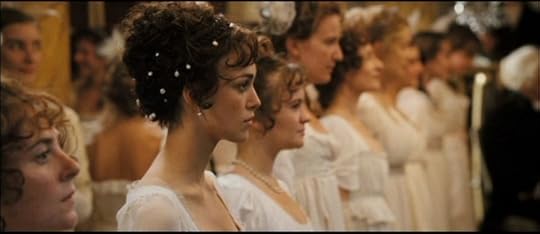
 I climbed the steps up to the Jane Austen Centre and the Dashwood sisters were surprised and happy to see that tourist has fallen into their Regency style tourist trap.
"It sure is a nice little place to get out of the rain," one of the Dashwood sisters told me as I walked inside. I could hear a hint of envy in her voice.
That must've been Marianne.
Being a professional when it comes to tourist traps like these, I've learned that in order to get a full fun experience, it's better to just clam up and listen to whatever the volunteer dressed up as Elizabeth Bennet tells you. I've also learned that the people who volunteer to preserve and interpret such literary works are the true heroes who take time out their modern lives to go back in time and explain the past to present Old Navy jean wearing types like myself.
As my tour guide, Lizzie Bennet, led my group upstairs, I realized that there was a tight command in her voice. She sat us all down in the parlor room in front of a genealogy chart of Jane Austen's family and explained the Austen's family history.
Austen's parents were member of the gentry; and George Austen – Jane's father – served as a cleric of the Anglican parishes.
"Jane was a part of a very large family," Lizzie Bennet told our tour group with the same authoritative tone that a professor would give to her students during a lecture. "She had six brothers and one sister named Cassandra who was Jane's closets and dearest friend throughout the remainder of her life."
Of all her brothers, Lizzie Bennet explained to us, Jane felt closest to her brother, Henry who later became his sister's literary agent. George, Jane's eldest brother, was sent to live with a local family at a young age because he was mentally abnormal. Charles and Frank Austen later served in the Royal Navy, both rising to the rank of admiral; and Edward Austen – the luckiest of the Austen brothers – was adopted by his fourth cousin, Thomas Knight, inheriting Knight's estate and vast fortune in 1812.
"You wanted to be this Austen brother," Lizzie told us, pointing to his silhouette on the genealogy chart. "He ended up having a much better life than Jane and her sister."
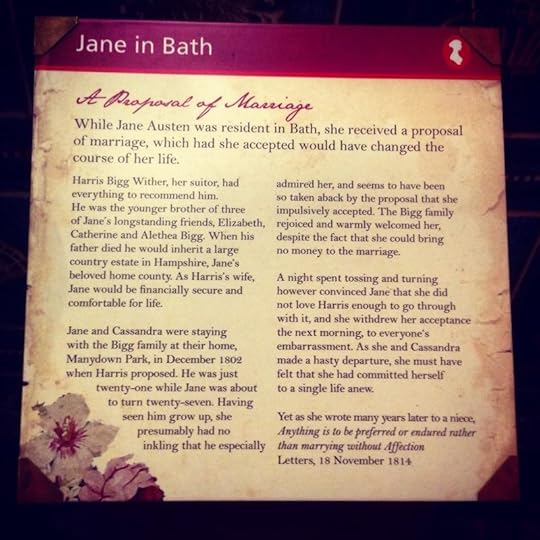
A much better life indeed. While Edward Austen (later Edward Knight) was sitting on a treasure trove of wealth and prosperity, Jane was being belittled by her parents to get married. There were plenty of young men for Jane to choose from in her youth. What with six brothers, they were bound to bring their friends over to the house to introduce them to Cassandra and Jane. There was one suitor who did propose to Jane. On December 2nd, 1802, Harris Bigg-Wither was the 21 year old younger brother to one of Jane's friends who proposed marriage to her . . . and she accepted!
"Yeah, but who in their right mind would marry someone whose last name was Bigg-Wither?" Lizzie Bennet raised an all-knowing eyebrow to us.
It turns out that twelve hours after Austen accepted Bigg-Wither's proposal she then turned him down.
"Can you blame her? She was six years older than Bigg-Wither and a good deal cleverer."
After rejecting Harris Bigg-Wither, the possibility of Jane ever accepting another proposal was nonexistent. Her sister's fiancée, Tom Fowle had died abroad in 1797, forcing Cassandra to withdraw completely from the marriage market afterwards. The two sisters remained unmarried and shared a spinsterhood until their deaths.
 After explaining the Austen family history, Lizzie Bennet led us down to a long hallway with a staircase that led you downstairs to the gift shop. Against the hallways's red walls was a timeline of all of Jane Austen's novels and their publication dates. As I examined the timeline on the wall, Lizzie Bennet was showing the other tourists the display cases of the period attire worn during the Regency Era. There was even a small closet at the end of the hallway where you could try on second-hand Regency Era frocks and hats and pose for a photo. They even had some old Regency chinaware on display, but nothing personally belonging to Jane Austen, herself.
I sighed.
Yet, another disappointment.
Just before I took the staircase downstairs to the gift shop, above me was a small portrait of Colin Firth dressed up as Mr. Darcy. Below the portrait written in white, against the red wall, read the following: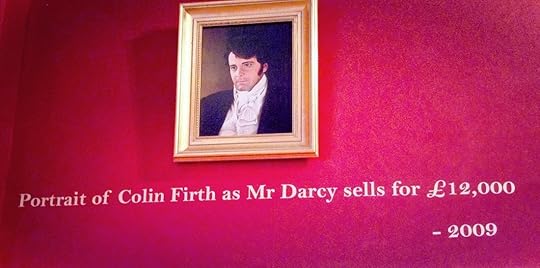 "Is that serious or something?" I turned to Lizzie Bennet who was agreeing with a tourist's fascination of the tea set display next to Harris Bigg-Wither's biography.
"Oh of course," Lizzie said matter-of-factly. It was this kind of tone that I kept encountering while I was in London. It was this very tone that would later drive me up the wall in my Jane Austen class.
Matter-of-factly.
As if I should know. As if I didn't know any better. It was crystal clear that Lizzie Bennet thought of me as a minimalist American. Of course, you would pay £12,000 for a portrait of Colin Firth as Mr. Darcy. But you wouldn't know because you're not around from here, now are you?
Lizzie didn't bother to back up her statement to me. She went back to discussing the tea set with the tourist down the hallway. For some reason everyone else who was part of my tour group was way more interested in trying on the Regency Era costumes and taking selfies in them, than this weird portrait of Colin Firth above the exit to the hallway.
I separated myself from Lizzie and went back downstairs to the gift shop. Only to be bombarded with more than a dozen I ♡ Mr. Darcy T-Shirts and tote bags.
"It's a bestseller," the cashier, dressed up as Emma, said to me when she noticed me looking at the pile of Darcy merchandise.
It almost seemed too overwhelming. It reminded me of that cringeworthy scene from Mean Girls when Regina George sabotages Cady's chances of getting together with Aaron Samuels at the Halloween party.
"[Cady] made this T-Shirt that says 'I Heart Aaron' and she wears it under all her clothes." Regina tells Aaron as Cady waves longingly across the room at him.
Seeing all of those I ♡ Mr. Darcy merchandise gave me that same uncomfortable feeling. The want to meet our ideal Mr. Darcy to the point that we have to advertise it on a T-Shirt and on our bodies.
Or maybe that was just the rainy Bath weather that was putting me in this nihilistic mood.
I love Darcy too.
Just maybe not as much as the people here at the Jane Austen Centre did.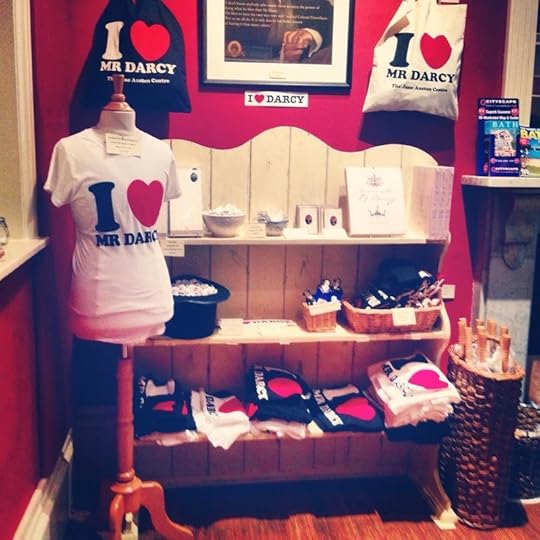 "Which way to the Regency Tea room?" I asked Emma the cashier.
"Just back upstairs on the third floor," Emma directed me.
This was the other reason I was here at the Jane Austen Centre: To experience Bath's famous Regency Tea Room.
It was a whole lot cheaper than going to The Pump Room and spending £15 on braised ox cheek. Besides, the night before my trip to Bath I looked up the menu for the Regency Tea Room and felt my mouth watering at the descriptions of the various selections of finger sandwiches and cakes.
It really didn't take long for me to become an tea addict in England. I even subscribed to a newsletter informing me which places around London were serving Afternoon Tea at a discount.
Besides, I only had three hours left in Bath and I was planning on spending the rest of my hours at The Roman Baths and at Bath Abbey in the rain. I figured that Afternoon Tea in the Regency Tea Room at the top of the Jane Austen Centre would bring my spirits up.
I hiked up the flight of stairs to the third floor and was greeted by a woman – yet again in costume – ready to seat me inside the tea room. The way she was dressed up reminded me a lot of Mrs Patmore from Downton Abbey. But with All Star sneakers underneath the hem of her dress.
As she led me inside the tea room I came face-to-face with the biggest portrait of Colin Firth as Mr. Darcy imaginable. Worse, Mrs. Patmore decided to seat me right across from him in the room.
In summery, it was an awkward but very memorable Afternoon Tea in Bath.
Just me, my tea, and Colin Firth's eyes on me the entire meal.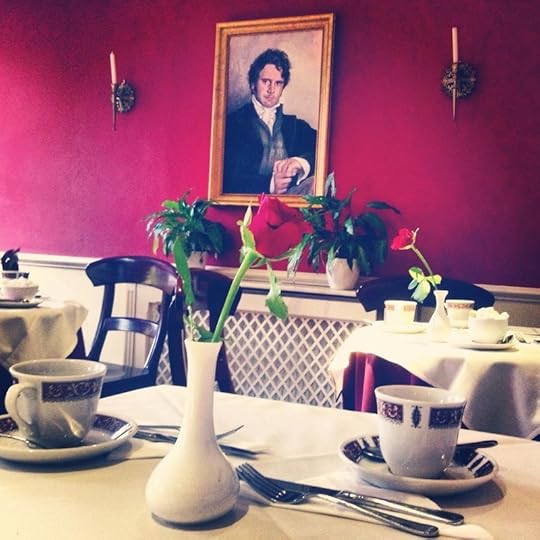 After my trip to Bath, I couldn't figure out if I just had a very bad day in one of the most historical cities of all of England; or if my trip was sabotaged by the spirit of Jane Austen.
Maybe she was like my tour guide Lizzie Bennet, and was predisposition to believe that all Americans knew nothing of her life's work. Maybe she was upset with me because I couldn't understand why anyone would pay £12,000 for a portrait of Colin Firth in the appearance of Mr. Darcy. Or maybe she did't find it funny when I took a selfie of myself with the even bigger portrait of Colin Firth as Mr. Darcy in the Regency Tea Room.
Either way, I felt haunted by the presence of Jane Austen when I returned to London soaking wet from the rain.
Maybe the weather was Jane Austen's way of telling me that she hated me. That I didn't belong in her home country.
In the end, of course I ended up writing the whole trip off as a bad day that progressively got worse.
So, that didn't stop me from taking my fourth step into the world of Jane Austen:
Alton. The first thing an American may ask herself when she gets off the train from Waterloo Station to Alton is this:
"Is this where Alton Brown got his name from?"
Thankfully Alton was only an hour and fifteen minute train ride in comparison to the three and a half hour journey to Bath.
It was January, and my first day of classes for the Spring Semester was only six days away. I decided to take a little trip to a little parish in Hampshire where Jane Austen lived for the last eight years of her life.
It was called the Jane Austen House Museum, located in Chatsworth. From the photos that I looked up online about the place, it was a little red brick cottage at the edge of town. It was this very house that Jane, her sister and their mother lived in until one by one they passed away. It was also this very house that Jane took the time to revise three of the manuscripts that she had written previously, but which had remained unpublished.
I saw this museum as my opportunity to make things right with Jane Austen. I did everything right this time!
At least, I thought that I did everything right.
I checked the weather: Sunny!
I checked the hours of operation at the Jane Austen House Museum: Google said it was open!
So I bought a ticket and hopped on the next train to Alton.
Alton reminded me a lot of the Island of Sodor. This just proves how old I really am when you get me talking about Thomas the Tank Engine. Anyway, Alton Station was nearby the Watercress Line, which was an old railway station where you could ride around the Hampshire countryside by steam train. Essentially, it brought back some of my old childhood memories of Percy and Toby when I walked further into town.
From Alton Station to the Jane Austen House Museum was a 35 minute walk. So I started down the road and followed the signposts up ahead that directed me to the house.
But once I found the house I saw to my great horror a sign on the window that read:
Closed.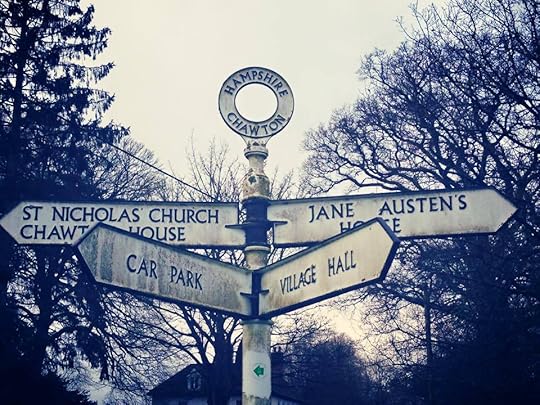 It turns out – I later learned – that it was Google who told me that the House Museum was open.
What I didn't know was that on the museum's website, it stated clearly that the museum was regularly open throughout the year but would be closed during the week for the first six weeks of the year.
It was still the first six weeks of the year.
I felt so stupid.
Again, I screwed myself over!
This confirmed that Jane Austen really did hate me after all!
You wanna know what made this story even better?
It then started to rain as I trudged miserably back all the way to Alton Station.
Why was Jane Austen doing this to me?
Why was she making my life so miserable whenever I would plan a pilgrimage to visit her historical homes?
I didn't understand it. I didn't understand any of it as I sat in my room and pondered why suddenly all things Jane Austen seemed so difficult.
Six days later, my first class of the day was my Jane Austen class with my spiteful professor.
That was the cherry on top of Jane expressing her distaste for me.
But I guess she got bored tormenting me once she started noticing that I was trying to make a dent in my professor's approval for me.
After that, things sort of plateaued.
I kept reading and analyzing her novels. I kept watching the movies and TV series that her books were adapted into.
Even through all the crap that I had to endure in Bath and in Alton, I still remained true to Austen's writing.
I guess in the end, all that I had encountered on my trips paid off in the end.
Maybe Austen was toughening me up. Maybe like her, she was seen as the less important figure because she had no wish to conform with the basic ideals of her society. She was a modern woman, with modern ideas living in the stifling atmosphere of the Regency Era.
And here I was, an American woman with her own opinions and evidence to defend my arguments and analyses. I was going up against an entire classroom full of native born Brits who probably have read all of Jane Austen's novels from cover to cover.
But here's what they don't have:
No experience on how to survive Bath during a downpour.
And no experience when confronting the heartbreaking 'Closed' sign in front of one of your favorite author's historical houses.
I got that all under my belt.
I've experienced it all.
Just you try me.
I absolutely hated it.
Primarily because in every single class, my professor would go on diatribes about the history of Regency Era, whereas for me, all I wanted was to sit down and analyze Austen's savvy writing.
I guess I made the mistake into thinking that I was singing up for a Jane Austen Book Club rather than an intellectual academic course. But what made me dislike the course – as with all the rest of the literature courses that I took while abroad – was the fact that anything that I said to contribute to the class was deemed automatically invalid.
"Oh, you wouldn't understand," my professor once said to me in front of everyone during a seminar when I raised my hand in an attempt to tie in a passage from Northanger Abbey with one of her many rants about Georgian architecture. "If you've lived in England for as long as I have, and as long as your classmates have, you would have a better understanding into how Bath incorporated some of Austen's insights into her novels."
What my uppity professor didn't know was that I HAD indeed visited Bath last semester in late October. And – not that she bothered to ask – I had also visited Austen's house in Chawton in early January before classes started six days earlier.
Personally, I was slowly mentally clocking out of my literature studies here at King's College. It wasn't that I was enjoying the reading assignments. On the contrary.
I was living every English major's dream! Last semester I immersed myself in Chaucer, Dickens, Shakespeare and even more Shakespeare! Day and night, I was reading, highlighting and analyzing. The only problem was, no professor wanted to hear me, let alone pick on me whenever I would raise my hand in class. I knew that I wasn't the only American student abroad in my classes, but now that I think back on it, I was THE only American student abroad who would raise her hand during class seminars. The other students who were called on were native Brits.
I didn't see why I was any different than my classmates – besides the obvious. I made time to sit down after finishing one of Austen's many novels to watch the movie adaptations. I even spent an entire day watching the six-hour version of Pride and Prejudice. I didn't leave my room. There's always something satisfying when watching a storyline like that be perfectly adapted into a movie or TV series. It's almost like the screenwriter wrote the script just for you! Because who doesn't want Colin Firth as Mr. Darcy?
The thing that I learned after finishing all six of Austen's novels was that her stories are so well written that you can tell them over and over again and people would still listen. You can even adapt them differently and people would still pay a ticket to see it in theaters, or pick up a modern version of one of her novels from a bookshelf. It's not only Jane Austen who holds this literary power over me, but my friends Chaucer, Shakespeare and Dickens as well. English literature has always been the pride of Britain's history. Unlike American literature that only dates back to the late 1600's, England's literature goes back even farther and is rooted within the very foundation of Britain's upbringing. Which was probably why my professors scolded at me for trying to hack away at the thick roots of their literary heritage. What did this American think she was doing? I could picture my British professor fuming. Pulling apart Jane Austen like she's Edith Wharton! Has she no respect for this country and its writers? The fact was, if you were a British citizen you automatically had a stake in the history of the country, regardless if you forget which British monarchy proceeded George I.
Hint: It was George II.
This was actually what made me into an even bigger threat: My annoying knowledge of the monarchs of Great Britain. In the same Jane Austen class that I was stuck in, with my way too nationalist professor, she gave us a lecture of the people in power during the early 18th century after the Glorious Revolution. This had absolutely nothing to do with Jane Austen, but rather how England changed after the Stuart monarchy switched to the Hanoverian monarchy.
To be brief and not to bore you, my professor was trying to make a point that the Protestants were back in power and she made the mistake of jumping from William and Mary of Orange to George I. My hand shot up, and I could tell that my professor just wasn't in the mood to hear an American open her mouth, but she sighed before saying, "Yes, Jacqueline?"
"The crown didn't go straight to George I after William's death," I said. "Didn't it go to his sister-in-law, Anne?"
Many people actually forget that there was another English queen besides Mary I, Elizabeth I and Elizabeth II. Queen Anne proceeded to the throne, but within months of her reign, another war in Europe had started, which pretty much overshadowed most of her reign.
Sadly, by the look on my professor's face, she too – a native Brit – forgot that Anne existed.
It was priceless.
"Indeed," I could tell that all of the British students had their eyes on their professor, because her cheeks immediately flushed bright red. How was it that an American knew the British monarchy better than the British?
Afterwards, my professor refused to call on me whenever I would raise my hand in class.
Anyway, here I was – an American – trying to contribute my Western thoughts and ideas to the London literary scene. But not getting anywhere.
That didn't mean that I didn't enjoy reading the novels that I was assigned to analyze. I didn't motivate myself to read all six of Austen's novels because I had to for my bias professor. I did it because I loved Austen's writing. All of her characters were memorable and very human. It was like you could slip inside their skin and go back in time to the Regency Era to relive their lives. I guess with Austen's writing, she made everything sound so simple and neat and tightly picturesque. I took the time to read and analyze her writing for my own benefit. It was my form of escapism as I endured my homesickness away from my friends at Mount Holyoke and California.
Yes, I had to sit miserably in that stupid Jane Austen class for the rest of my spring semester, but it was all worth it if it meant picking up the next Jane Austen book on my syllabus and watching Clueless right after dinner.
I took the first step into the world of Jane Austen when I was in the sixth grade in middle school. I picked up a copy of Pride and Prejudice from my school's library and only made it to the second chapter. I guess I was too young to understand Austen's writing with a critical eye. After all, I was just barely understanding Gregory Maguire's Wicked. So I returned the book at the end of the week. My second step was when the glorious Seth Grahame-Smith released a co-authored book of Pride and Prejudice with zombies! I was a freshmen in high school when I got around to pick up a copy of Pride and Prejudice and Zombies. Though my evaluation to examine Austen's writing was just peaking (I'm pretty sure it peaked when I got around to reading The House of Mirth by Edith Wharton my sophomore year) but the zombie scenes appealed to my fifteen year old teenage angst. Plus, because the novel was 60% written by Jane Austen, the other 40% was just really cool and gory zombie scenes that Grahame-Smith wrote and inserted in between Austen's paragraphs.
My third step wouldn't happen until I made it to England for my Junior Year Abroad. And even then, my third step wasn't primarily prompt by Jane Austen, but rather than my father urging me to go out and explore all of Great Britain instead of walling myself up with my studies in my apartment on Stanford Street.
He coaxed me to visit Bath.
For October Break of my fall semester, I decided to give in to my father's suggestion and leave for Bath. I took a three and a half hour train ride from Waterloo Station to Bath Spa, but wasn't aware of how long the trip would be until I sat down in my seat. This turned out to be a problem because I wouldn't get into Bath until 12 o'clock in the afternoon, and the last train taking me back to Waterloo Station was at 4 o'clock. In short, it meant that I would have only four hours in Bath. In hindsight, I should have planned a little better for this trip. Not just because the night before I made a list of all the things I wanted to see in Bath (I.E. The Roman Baths, The Royal Crescent, The Pump Room, Bath Abbey, The Circus, The Fashion Museum, The Bath Assembly Rooms, The Theatre Royal) but also because once I got off the train at Bath Spa, I was subjected to a violent downpour of rain. Worse, I forgot my umbrella. I suppose this is what happens when you forget to check the weather before you buy your tickets for a mind numbing three and a half hour train ride.
So I threw my sweatshirt hood over my head, and walked into the city of Bath.
Bath, located in the south west region of England reminded me of a city that was in the middle of an identity crisis. Everywhere you look, the buildings have the same color, but not quite the same architecture. As I walked up the street to The Pump Room, Bath Abbey and the Roman Baths, I noticed that most – if not all – of Bath's buildings were made from the same warm, golden sandy-colored limestone. However, there seemed to be a disagreement in how the style of the buildings should be. Some of the buildings were tailored to its original settlers, the Romans. Every other building on Cheap Street displayed some sort of Palladian revival style structure, reminding me of the front of the White House, but with rough sandpaper colored pillars. In the middle of Cheap Street was Bath Abbey, looking like a rebel against the Roman architecture with its Gothic bell tower. And it took me walking up to Brock Street to witness The Royal Crescent to figure out that the city's dominate architectural style was Georgian. I had to get drenched from head to foot to come to terms with the city's hybrid design. Well, maybe in the rain, hybrid wasn't the right word. Due to Bath's architectural history, quagmire fitted more suitably.
If Bath, according to my one-sided Jane Austen professor, was the epitome of all things truly British – "Because Austen wanted to write in an environment with a urban design that summed up one of the most English cities in Great Britain" – then she would have known that Bath didn't start off as an English city at all, but rather conquered and inhabited by the Romans and then taken over by the Germanic Angelo-Saxons.
Yeah. So English.
But the number one thing that I wanted to check out during the four hours that I would be spending in rainy Bath, was The Jane Austen Centre. Situated in an original Georgian townhouse, just up the street from The Roman Baths, The Jane Austen Centre exhibited the life and story of Jane Austen's time when she was living in Bath. It's a total tourist trap. And nobody loves tourist traps more than me. Probably because I come from the world's most obvious tourist trap – AKA Hollywood – so really corny tourist traps don't phase me.
Like a scene from Sense and Sensibility, Elinor and Marianne Dashwood were standing outside the Jane Austen center with umbrellas in their hands and waving at the tourists as they sloshed through the puddles of water in the street. The actors were wearing Regency Era period costumes; but because it was raining, their Empire Lines and panniered hips were covered by a very heavy raincoat that looked like it was purchased hastily off the racks from Primark. Plus, their hair was pulled back and covered up by a straw bonnet. They were smiling as they tried to persuade the sightseers inside, but their faces were firm and warn from being outside in the cold rain all morning. You could tell that the Dashwood sisters were hoping for a true warm and pastoral Jane Austen weather. Also, from my recollection, I don't think staying outside in the rain did much help to Marianne Dashwood's health.
Maybe I should've told her to go back inside.
This added to my disappointment of the trip. After watching the Kira Knightly adaption of Pride and Prejudice as well as the Emma Thompson adaptation to Sense and Sensibility, I grew to admire the beauty of all of Jane Austen's heroines. Whenever they would attend a ball with their attendant hair styles and white dresses, they remind me of the classical Greek silhouettes. Whenever they would be outside in the sunshine reading on the grass, I'd sigh with want for their pastel colored dresses or their shawls. On their website the actors who worked at the Jane Austen Centre worn these gorgeous outfits.
Unfortunately, just not today in the pouring rain.
I climbed the steps up to the Jane Austen Centre and the Dashwood sisters were surprised and happy to see that tourist has fallen into their Regency style tourist trap. "It sure is a nice little place to get out of the rain," one of the Dashwood sisters told me as I walked inside. I could hear a hint of envy in her voice.
That must've been Marianne.
Being a professional when it comes to tourist traps like these, I've learned that in order to get a full fun experience, it's better to just clam up and listen to whatever the volunteer dressed up as Elizabeth Bennet tells you. I've also learned that the people who volunteer to preserve and interpret such literary works are the true heroes who take time out their modern lives to go back in time and explain the past to present Old Navy jean wearing types like myself.
As my tour guide, Lizzie Bennet, led my group upstairs, I realized that there was a tight command in her voice. She sat us all down in the parlor room in front of a genealogy chart of Jane Austen's family and explained the Austen's family history.
Austen's parents were member of the gentry; and George Austen – Jane's father – served as a cleric of the Anglican parishes.
"Jane was a part of a very large family," Lizzie Bennet told our tour group with the same authoritative tone that a professor would give to her students during a lecture. "She had six brothers and one sister named Cassandra who was Jane's closets and dearest friend throughout the remainder of her life."
Of all her brothers, Lizzie Bennet explained to us, Jane felt closest to her brother, Henry who later became his sister's literary agent. George, Jane's eldest brother, was sent to live with a local family at a young age because he was mentally abnormal. Charles and Frank Austen later served in the Royal Navy, both rising to the rank of admiral; and Edward Austen – the luckiest of the Austen brothers – was adopted by his fourth cousin, Thomas Knight, inheriting Knight's estate and vast fortune in 1812.
"You wanted to be this Austen brother," Lizzie told us, pointing to his silhouette on the genealogy chart. "He ended up having a much better life than Jane and her sister."
A much better life indeed.
While Edward Austen (later Edward Knight) was sitting on a treasure trove of wealth and prosperity, Jane was being belittled by her parents to get married. There were plenty of young men for Jane to choose from in her youth. What with six brothers, they were bound to bring their friends over to the house to introduce them to Cassandra and Jane. There was one suitor who did propose to Jane. On December 2nd, 1802, Harris Bigg-Wither was the 21 year old younger brother to one of Jane's friends who proposed marriage to her . . . and she accepted!"Yeah, but who in their right mind would marry someone whose last name was Bigg-Wither?" Lizzie Bennet raised an all-knowing eyebrow to us.
It turns out that twelve hours after Austen accepted Bigg-Wither's proposal she then turned him down.
"Can you blame her? She was six years older than Bigg-Wither and a good deal cleverer."
After rejecting Harris Bigg-Wither, the possibility of Jane ever accepting another proposal was nonexistent. Her sister's fiancée, Tom Fowle had died abroad in 1797, forcing Cassandra to withdraw completely from the marriage market afterwards. The two sisters remained unmarried and shared a spinsterhood until their deaths.
After explaining the Austen family history, Lizzie Bennet led us down to a long hallway with a staircase that led you downstairs to the gift shop. Against the hallways's red walls was a timeline of all of Jane Austen's novels and their publication dates. As I examined the timeline on the wall, Lizzie Bennet was showing the other tourists the display cases of the period attire worn during the Regency Era. There was even a small closet at the end of the hallway where you could try on second-hand Regency Era frocks and hats and pose for a photo. They even had some old Regency chinaware on display, but nothing personally belonging to Jane Austen, herself.I sighed.
Yet, another disappointment.
Just before I took the staircase downstairs to the gift shop, above me was a small portrait of Colin Firth dressed up as Mr. Darcy. Below the portrait written in white, against the red wall, read the following:
"Is that serious or something?" I turned to Lizzie Bennet who was agreeing with a tourist's fascination of the tea set display next to Harris Bigg-Wither's biography. "Oh of course," Lizzie said matter-of-factly. It was this kind of tone that I kept encountering while I was in London. It was this very tone that would later drive me up the wall in my Jane Austen class.
Matter-of-factly.
As if I should know. As if I didn't know any better. It was crystal clear that Lizzie Bennet thought of me as a minimalist American. Of course, you would pay £12,000 for a portrait of Colin Firth as Mr. Darcy. But you wouldn't know because you're not around from here, now are you?
Lizzie didn't bother to back up her statement to me. She went back to discussing the tea set with the tourist down the hallway. For some reason everyone else who was part of my tour group was way more interested in trying on the Regency Era costumes and taking selfies in them, than this weird portrait of Colin Firth above the exit to the hallway.
I separated myself from Lizzie and went back downstairs to the gift shop. Only to be bombarded with more than a dozen I ♡ Mr. Darcy T-Shirts and tote bags.
"It's a bestseller," the cashier, dressed up as Emma, said to me when she noticed me looking at the pile of Darcy merchandise.
It almost seemed too overwhelming. It reminded me of that cringeworthy scene from Mean Girls when Regina George sabotages Cady's chances of getting together with Aaron Samuels at the Halloween party.
"[Cady] made this T-Shirt that says 'I Heart Aaron' and she wears it under all her clothes." Regina tells Aaron as Cady waves longingly across the room at him.
Seeing all of those I ♡ Mr. Darcy merchandise gave me that same uncomfortable feeling. The want to meet our ideal Mr. Darcy to the point that we have to advertise it on a T-Shirt and on our bodies.
Or maybe that was just the rainy Bath weather that was putting me in this nihilistic mood.
I love Darcy too.
Just maybe not as much as the people here at the Jane Austen Centre did.
"Which way to the Regency Tea room?" I asked Emma the cashier. "Just back upstairs on the third floor," Emma directed me.
This was the other reason I was here at the Jane Austen Centre: To experience Bath's famous Regency Tea Room.
It was a whole lot cheaper than going to The Pump Room and spending £15 on braised ox cheek. Besides, the night before my trip to Bath I looked up the menu for the Regency Tea Room and felt my mouth watering at the descriptions of the various selections of finger sandwiches and cakes.
It really didn't take long for me to become an tea addict in England. I even subscribed to a newsletter informing me which places around London were serving Afternoon Tea at a discount.
Besides, I only had three hours left in Bath and I was planning on spending the rest of my hours at The Roman Baths and at Bath Abbey in the rain. I figured that Afternoon Tea in the Regency Tea Room at the top of the Jane Austen Centre would bring my spirits up.
I hiked up the flight of stairs to the third floor and was greeted by a woman – yet again in costume – ready to seat me inside the tea room. The way she was dressed up reminded me a lot of Mrs Patmore from Downton Abbey. But with All Star sneakers underneath the hem of her dress.
As she led me inside the tea room I came face-to-face with the biggest portrait of Colin Firth as Mr. Darcy imaginable. Worse, Mrs. Patmore decided to seat me right across from him in the room.
In summery, it was an awkward but very memorable Afternoon Tea in Bath.
Just me, my tea, and Colin Firth's eyes on me the entire meal.
After my trip to Bath, I couldn't figure out if I just had a very bad day in one of the most historical cities of all of England; or if my trip was sabotaged by the spirit of Jane Austen. Maybe she was like my tour guide Lizzie Bennet, and was predisposition to believe that all Americans knew nothing of her life's work. Maybe she was upset with me because I couldn't understand why anyone would pay £12,000 for a portrait of Colin Firth in the appearance of Mr. Darcy. Or maybe she did't find it funny when I took a selfie of myself with the even bigger portrait of Colin Firth as Mr. Darcy in the Regency Tea Room.
Either way, I felt haunted by the presence of Jane Austen when I returned to London soaking wet from the rain.
Maybe the weather was Jane Austen's way of telling me that she hated me. That I didn't belong in her home country.
In the end, of course I ended up writing the whole trip off as a bad day that progressively got worse.
So, that didn't stop me from taking my fourth step into the world of Jane Austen:
Alton.
The first thing an American may ask herself when she gets off the train from Waterloo Station to Alton is this:"Is this where Alton Brown got his name from?"
Thankfully Alton was only an hour and fifteen minute train ride in comparison to the three and a half hour journey to Bath.
It was January, and my first day of classes for the Spring Semester was only six days away. I decided to take a little trip to a little parish in Hampshire where Jane Austen lived for the last eight years of her life.
It was called the Jane Austen House Museum, located in Chatsworth. From the photos that I looked up online about the place, it was a little red brick cottage at the edge of town. It was this very house that Jane, her sister and their mother lived in until one by one they passed away. It was also this very house that Jane took the time to revise three of the manuscripts that she had written previously, but which had remained unpublished.
I saw this museum as my opportunity to make things right with Jane Austen.
I did everything right this time!At least, I thought that I did everything right.
I checked the weather: Sunny!
I checked the hours of operation at the Jane Austen House Museum: Google said it was open!
So I bought a ticket and hopped on the next train to Alton.
Alton reminded me a lot of the Island of Sodor. This just proves how old I really am when you get me talking about Thomas the Tank Engine. Anyway, Alton Station was nearby the Watercress Line, which was an old railway station where you could ride around the Hampshire countryside by steam train. Essentially, it brought back some of my old childhood memories of Percy and Toby when I walked further into town.
From Alton Station to the Jane Austen House Museum was a 35 minute walk. So I started down the road and followed the signposts up ahead that directed me to the house.
But once I found the house I saw to my great horror a sign on the window that read:
Closed.
It turns out – I later learned – that it was Google who told me that the House Museum was open. What I didn't know was that on the museum's website, it stated clearly that the museum was regularly open throughout the year but would be closed during the week for the first six weeks of the year.
It was still the first six weeks of the year.
I felt so stupid.
Again, I screwed myself over!
This confirmed that Jane Austen really did hate me after all!
You wanna know what made this story even better?
It then started to rain as I trudged miserably back all the way to Alton Station.
Why was Jane Austen doing this to me?
Why was she making my life so miserable whenever I would plan a pilgrimage to visit her historical homes?
I didn't understand it. I didn't understand any of it as I sat in my room and pondered why suddenly all things Jane Austen seemed so difficult.
Six days later, my first class of the day was my Jane Austen class with my spiteful professor.
That was the cherry on top of Jane expressing her distaste for me.
But I guess she got bored tormenting me once she started noticing that I was trying to make a dent in my professor's approval for me.
After that, things sort of plateaued.
I kept reading and analyzing her novels. I kept watching the movies and TV series that her books were adapted into.
Even through all the crap that I had to endure in Bath and in Alton, I still remained true to Austen's writing.
I guess in the end, all that I had encountered on my trips paid off in the end.
Maybe Austen was toughening me up. Maybe like her, she was seen as the less important figure because she had no wish to conform with the basic ideals of her society. She was a modern woman, with modern ideas living in the stifling atmosphere of the Regency Era.
And here I was, an American woman with her own opinions and evidence to defend my arguments and analyses. I was going up against an entire classroom full of native born Brits who probably have read all of Jane Austen's novels from cover to cover.
But here's what they don't have:
No experience on how to survive Bath during a downpour.
And no experience when confronting the heartbreaking 'Closed' sign in front of one of your favorite author's historical houses.
I got that all under my belt.
I've experienced it all.
Just you try me.


January 23, 2016
Third Wheeling In Norway
Gazing at Edvard Munch's The Scream hanging on the wall of the National Gallery in Oslo, Norway, made me feel like I was witnessing a miracle, while also craving a hamburger.
Two miracles in fact.
The first miracle – the obvious one – was the painting of The Scream itself. Before me, no less!
Back in 1994, at the opening of the Winter Olympics in Lillehammer, two men broke into the National Gallery and stole The Scream right from the museum's very wall. These two bandits were so pleased with the ease of this crime that they added insult to injury by leaving a note that read:
"Thanks for the poor security."
Thankfully, the painting was recovered within three months, miraculously undamaged!
And as if The Scream couldn't possibility endure anymore excitement, 10 years later the painting was stolen . . . again! During daylight hours, no less!
On August 22nd, 2004, two masked gunmen rushed into Oslo's Munch Museum and made off with not only The Scream but another of Munch's painting called, Madonna. For two years, The Scream went missing. Suspects were arrested in connection with the theft, but The Scream and Madonna's whereabouts remained unknown. Worse, the city government of Oslo heard a rumor that the robbers had burnt and destroyed both paintings. The Munch Museum was closed for a cold ten months for a security overhaul. By 2006, the Norwegian Police recovered both of Munch's paintings in better-than-expected conditions. According to the reports, The Scream had moisture damage on the lower left corner, while Madonna suffered several tears on the right side of the painting as well as two holes in the Madonna's arm.
Wounded, survival victims no less.
Miracles.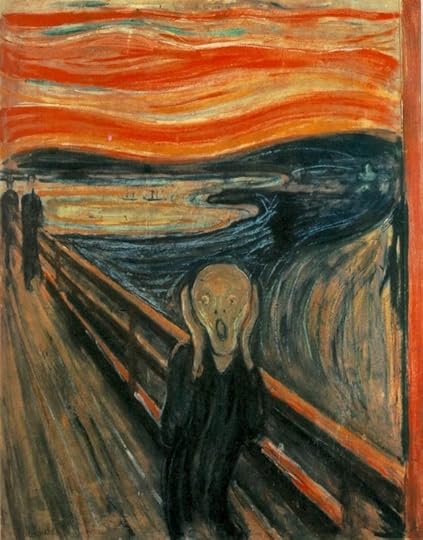 The Scream
  Madonna The second miracle, was the fact that I was here in Oslo, Norway with my best friend from elementary school, Ines.
Ines and I met when we were in the fifth grade in California. She and her family moved from Oslo, Norway to sunny Southern California when her dad was offered a possession to teach at CalTech. The very fact that she was from Norway, was cool in it of itself. I NEEDED to be her friend.
Sure enough, after moving our desks next to each other, attending the other's house for playdates or sleepovers and celebrating each other's birthdays, Ines and I grew as close as friends could be. She told me about Norway, the Viking Age that spread all across Scandinavia, but more importantly she told me about the snow.
From the way Ines described her home country to me – especially to a girl from Southern California – it sounded like an undiscovered Ice Kingdom. Diamond-paned windows with frosted glass, gusts of arctic air that made you breathless, snowcapped mountains that interrupted the painful bright blue sky. And because I had never seen snow before, I imagined the city of Oslo as a little wooden town nestled in a valley with a marshmallow blanket of white snow everywhere, and icicles hanging from the roofs.
Oh, and there was a big ice castle as well. You can't have an undiscovered Ice Kingdom without a fancy ice castle. I think it was Ines and her stories about Norway that would later on inspired me to look and apply to schools on the East Coast. You know, that place in America where it constantly snows.
But there was also something else in the way that Ines recounted her tales about Norway to me. She spoke with passion about Oslo, she reminiscent about playing in the snow with her younger brother, Alek when they were younger. She told me how funny it was whenever she would throw rocks into the frozen lake outside her house, and listen to the sound the stones would make whenever they smashed through the ice.
"It sounds like a single fat drop of water echoing in a cathedral," she told me with a sigh.
It was obvious that Ines missed her undiscovered Ice Kingdom. I could imagine that if you're from a place where it snows a lot, a part of you misses the cold weather and glittering white of fresh new snow of the ground. This was something I learned after spending two years on the East Coast at Mount Holyoke – snow and all! When I was in London, I missed that feeling of wonderment when small white flurries gently summersault from the sky. To my disappointment, the most snow that I got when I was in London was at Somerset House, and it looked like someone had dropped a snow cone at my feet.
After four years of living in California, Ines broke the news to me that she and her family were moving back to Norway. Tearful goodbyes were exchanged, letters were written back and forth to each other – later upgraded to emails. Birthday care packages were sent, but it was a temporary fix to the missing hole I was feeling after Ines's departure.
Ironically, before I could tell Ines that I had gotten into Mount Holyoke, and was excited to see real snow for the first time, she wrote me first full of excitement.
"Guess what? I got into Stanford! I'm coming back to California!!!" She wrote me with several exclamation marks.
"That's great, I'm moving to Massachusetts," I responded.
So once again, we were separated from each other, but we kept writing to one another. I told her about the friends I made at Mount Holyoke, the adjustments I had to make, the confusion I felt whenever someone would say 'wicked' instead of just 'cool' or 'rad.' And I definitely told her about the snow.
"It's pretty cold," I wrote to her. "Is it always like this?"
"Let me put it to you this way," Ines wrote back. "I'm really enjoying the winter here in Palo Alto." But before I decided to go abroad and before I decided to move from California to Massachusetts, I remembered those first few weeks after Ines and her family left for Norway. Thinking back, those were the longest and saddest days that I could remember. In a way, I felt like The Scream – the painting, not the reaction that the subject's face made. If I could personify the painting, I could image the fear Mr. Scream must have felt that morning of 1994. Being removed from his home and being held hostage, not knowing if he would ever be mounted on the museum's wall again. Well I can't say that I'm a priceless work of art, nor can I say that I've never been held for ransom, but that separation anxiety of never being reunited with a person who made you feel so at home is – I can tell you from personal experience – the most heartbreaking feeling imaginable.
That's why on the day of Ines's birthday – and as soon as I was accepted into King's College London – I wrote on her Facebook wall: "It should be a crime not to see you after so many years." Followed by this photo: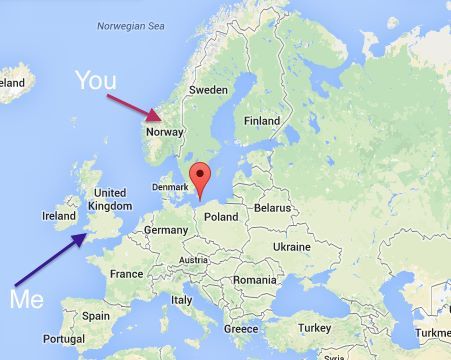 We made plans to meet up in Oslo, Norway for New Years.
That was exciting and everything, but I was more ecstatic over the fact that I would be reunited with my best friend after six years!
The Scream was finally going to be reunited with his home!
There was just one thing that I wasn't quite expecting.
Have you ever come across a picture of Munch's The Scream – either in person or just on the Internet – and wondered what the hell the main subject in the painting was screaming about?
Well, okay. Looking at The Scream the subject looks more horrified and shocked, than actually psychically yelling his lungs off in fright. Both his hands are like flippers, cupping both sides of his upside down pear-shaped head; and his mouth is opened in the shape of a slightly stretched zero. His face definitely reminds you off a that Halloween grim reaper mask from Wes Craven's Scream – interesting that even Ghostface had the same screaming expression as the subject in Munch's painting.
 But I guess when you look closer at the painting you notice that there are two figures in the background who look like their walking toward the screaming subject.
Who are these two figures and why is Munch's subject screaming at their approach?
Nobody knows.
But as soon as my plane landed at Sandefjord Torp Airport, the first person to greet me was Ines! I had imagined this day, being reunited with her after six long years. I was already crying at baggage claim with joy and excitement.
I was here. She was here. Together again . . . with her friend, Anna from Stanford.
Now, to be fair, Ines did give me a heads up a month after I finalized my plans to come out to Norway for New Years. She informed me that a third person would be staying at her house when I would arrive.
And to be straightforward, a part of me was a little bit crushed by this news.
I was looking forward to catching up with Ines – in Norway of all places! – then to receive a Facebook message from her explaining that one of her good friends from Stanford would be joining us as well.
"She's studying abroad in Germany next semester," I could hear her apologetic tone in her message. "I figured it would be easier for her to come and stay with my folks and I before she takes off for Berlin. After all, if she stays with my folks and I in Norway, it will help her get use to the time change, than if she stays in California and flies from there all the way to Europe."
As irritated as I was – not at Ines nor at her friend – but with the picture of the three of us having a meaningful conversation about our lives, I could absolutely understand Ines's actions.
If the roles were reversed, I would probably do the same thing.
Gladly, in fact.
While I was hoping for a one-on-one long week with Ines, (because I can be an extremely selfish person) I would also try my best to get along with Ines's Stanford friend (because I can also be an open-minded person if I try hard enough).
I just socialize differently.
Or at least when it comes to socializing with my best friend and her friend. In which case, I felt even more like The Scream – the reaction that the subject's face made, not the painting, this time – as the two figures in the background, Ines and Anna, I imagined, approached me.
But whatever would happened between Ines's Stanford friend and me, I refused let that cloud my excitement from the bigger picture: Ines, herself.
I reminded myself that when Ines walked with me out from Sandefjord Torp Airport, helped me load my luggage into the back of her car, and introduced me to her Stanford friend, Anna.
Here we were. The three of us. In Oslo, Norway. The first few days in Norway made me feel like I was back at Mount Holyoke. For the first time since I left my beloved college for London, England, I had encountered real snow and the real cold weather. I felt at home. Ines's house was a petite two story bungalow that looked over the water to the Grønsund – a strait in Denmark. The interior of the house was covered all over in oak, bringing warmth to even the smallest corners of the room. Better yet, whenever Ines, Anna and I would sit down on the floor to watch a movie on Netflix, Ines's black Portuguese Water Dog, Baloo would lay down on my feet and keep my toes nice and toasty.
But while Ines and her family provided me with the comforts of a homely environment, Ines also made sure I got the whole tourist experience as well. The three of us took the train into the heart of Oslo where Ines showed Anna and I the Oslo Opera House.
It was a huge square glass building made up of white granite. The roof of the building was angled to ground level, creating a plaza that invited pedestrians to walk up and witness the panoramic views of the Bjørvika, a borough in Oslo, the advertising building of Eniro Norge, and the fjords in the watery distance. The Oslo Opera House Promptly, as soon as we made it to the snow covered roof of the Opera House, my phone died. I had to use my portable charger that I stowed away inside my snow jacket, only to discover to my great distress that my phone decide to not charge fast enough to take more pictures of the Oslo skyline.
While my gloved fingers fumbled to plug my charging cord, in and out from my phone – while also silently praying to Steve Jobs to grant my phone a miracle and turn it back on – I saw Anna and Ines walking away together further along the rooftop.
For starters, I should just explain that I'm the type of person who appreciates having a strong network of friends. After graduating from a high school with 100 students – and 27 students in my graduating class – I've become really good at recognizing quickly which friends were loyal and solid anchors in my life, and which ones were just flippant, physical toxic things who were more concern about climbing the social ladder than getting an A+ on their chemistry homework. Unfortunately, I found myself in a hostile high school environment in which most – if not all – my classmates only cared about was being popular. So as you might already guess, there was a lot of third wheeling going around in my former high school class in regards to putting people off for the better more "sough-after" individuals.
And maybe it was because of this close-knit environment of backstabbers, gossipers and cliques that I had suffer throughout my four years of high school, that made me more aware that every now and then I would be the third wheel to every hangout that involved a trio. Scratch that. I am the queen of third wheels. If I was a motorcycle, I would be the big unattractive wheel in the front. In the British Monarchy, I would probably be Prince Harry to William and Kate. In Taylor Swift's Squad, I would be Lena Dunham. Which was why – because after all I am the Third Wheel Queen – I was uneasy to meet Anna at first. Even though since enrolling at Mount Holyoke, third wheeling for me has been a thing of the past, I always worry that I would one day find myself being the unnecessary third leg of a group again.
In which case, I suddenly felt less like The Scream and more like the less credible, third wheeling Madonna on the rooftop of the Oslo Opera House.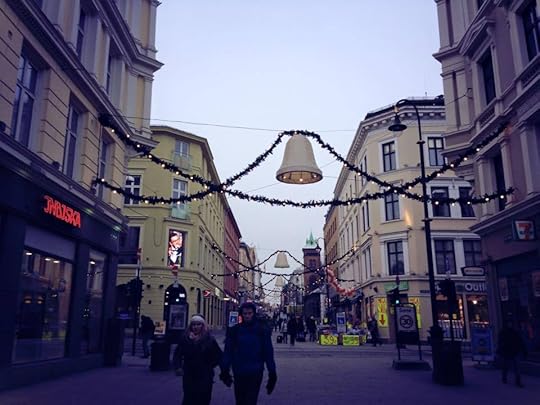 Oslo We later walked into town and Ines showed Anna and I Oslo Cathedral, a 15th century church that Ines later told me was the site of the wedding of Haakon, the Crown Prince of Norway, to Mette-Marit Tjessem Høiby. It was a curved long building built of red bricks, with a tower covered in green copper.
Outside, the streets of Oslo still had their Christmas decorations up and I suddenly felt like I was walking through a small village. Oslo, I learned, definitely gives you that feeling that although their storied legacy stretched back to the Viking era, Oslo never tossed out the old for the new. Though they reinvented themselves – via their architecture – the city remained just as charming as the nestled village in the valley that I had originally built up Norway in my mind.
"That's the Grand Hotel," Ines informed me as she points to a building with a classical architectural style that reminded me of a toned down version of a palace. It had a white granite facade with a clock tower smacked dab in the middle. "That's where all the winners for the Nobel Peace Prize come to stay to accept their award."
"You mean Obama has stayed at that hotel?" I asked her, suddenly really excited.
"Yeah," Ines said as we continued walking down main street toward the Royal Palace. "But I personally believe that the only reason why they awarded Obama with the Peace Prize was because they needed an excuse to have Obama come and stay at their hotel."
Interestingly enough, as the three of us walked all the way up the main street, I noticed that the Grand Hotel was situated between the Norwegian Parliament building, the National Theatre, Oslo University and the Royal Palace – which we were walking toward right now.
I found it so odd that a building established for hosting the most important people of world who have made it their lifelong dedication to spread the word of peace, was within close vicinity to one building that promoted the encouragement of education, another building that was primarily erected for the entertainment in the arts, a third building nearby that passed the laws of the land and finally, crowning the top of the hill that Anna, Ines and I were hiking up to, was the building that housed the mandate of heaven.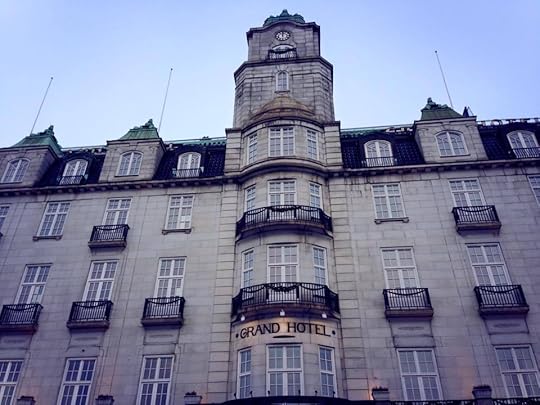 The Grand Hotel It was the exact opposite of Buckingham Palace. Whereas all the important buildings were spread out all over London, Oslo's most notable buildings were crowded around the hill that led straight up the Royal Palace.
Probably the most famous hotel in London I could think of was the Savoy, located on The Strand once you crossed over Waterloo Bridge. The theater district was stationed on the West Side of London, a good 10 minute walk if you left directly from the hotel. Luckily though, you would be nearby both the National Gallery and the National Portrait Gallery which – depending on which direction you take – would be a 4 minute walk if you took Charing Cross Road, or a 5 minute walk if you left from Leicester Square to St. Martin's Street. And even though if you stood in the middle of Trafalgar Square and saw Big Ben and Parliament, that would be a long 15 minute walk – 12 if you ran through every cross walk. Then there was Buckingham Palace, and honest to God it is the farthest building between Parliament and the National Gallery. To get there – at least from Trafalgar Square – you have to go through the stone archway that leads you straight down to the Royal Mall (AKA: THE LONGEST GODDAMN ROAD IN ALL OF LONDON!) I don't know what genius decided to build Buckingham Palace away from all of centralized London – probably the Royal family I'm guessing – but it was as if Buckingham Palace was just "too cool" to associate itself with the other momentous buildings and landmarks in the area.
Then again, the Royal Family and Parliament haven't always seen eye to eye (Magna Carta, anyone?) so I guess if Parliament were to ever establish itself nearby Buckingham Palace, they would be the world's worst neighbors to the Royal Family. The Ned Flanders of neighbors, I would assume. Which is why I theorized that in order for Buckingham Palace to distance itself from all things political in Parliament, weird theatrical nonsense from the West End, and suave pretentious tourists from the Savoy, they created the Royal Mall as a way to distance themselves from their annoying neighbors. With the exception of the National Gallery of course. The Royal Family's portraits are there after all so they need the Gallery to be nearby every now and then to check to see how their portraits are hanging.
As if the Mall wasn't enough to emphasize the distance Buckingham Palace wants to keep between itself and all things London, they also have St. James's Park. A tranquil place that tricks tourists into renting out deckchairs – as they do in every Royal Park in London – and watch pelicans bother the swans in the lake. More so, Buckingham Palace also has a large iron gate that encircles the entire palace. "Keep away," Buckingham Palace seems to tell everyone in London. "I'm way too good for you."
But here, in front of the Royal Palace of Norway, is entirely different. Yes, the Royal Palace is placed on top of a small hill that is free-standing from the other famous buildings down on either side at the base of the street; but there is no park blockading it's path, no Royal Mall that forces you to walk 20 minutes to reach a cold iron gate that separates you from the palace.
It looked independent, but stood as part of the city. Whereas Buckingham Palace was gated off and seemed almost out of place in the middle of London. The Royal Palace's front facade had the same neoclassical architecture that reflected the stuccoed brick north face of the White House. It was an H-shaped building with a temple front supported by a row of pillars. But where as the White House had more of a Palladian design with a central block to make the building more circular, the Royal Palace of Oslo had two great flanking wings, three stories high on either side.
What I liked the most about the palace, was that it was a friendly shade of cake batter yellow, a color that matched the other light and fun dessert shade buildings within the city of Oslo. Better yet, the yellow of the palace looked even brighter against white the snow on the ground.
"I hate the color," Anna said when we stopped to take our pictures in front of the palace.
"Oh I disagree," I said, keeping my voice light. "I think it's charming."
I did, mostly because Buckingham Palace was just so gray and stoney that it was finally a relief to see a Royal Palace that actually looked like it was trying to have a little fun. Though the Royal Palace stood high on a hill, it was third wheeling a little bit, yet the palace was third wheeling in style, as if it it was trying to be Oslo's equal, not superior. Unlike, Buckingham Palace. The Royal Palace Where we ended up next was The National Gallery.
It was here that Ines showed Anna and I the wall where The Scream was mounted. There was already a line of people in front of us waiting their turn to take their pictures as they mirrored the same shocked expression of the main subject in the painting. The painting itself was encased in a laminated glass box with four iron rods in each corner, bolting the glass against the museum's wall. I could only guess it was just in case there was another attempt to rob the museum of Munch's painting. Third time's the charm! Although from the security that the museum had placed all over The Scream, the chances of that happening, were nonexistent.
As we waited in line to take our picture with The Scream, I looked directly across from where I was standing and saw Munch's other painting, Madonna. Madonna too had the same shatterproof glass encasing that The Scream had, yet nobody bothered to line up and strike the same dream-like ecstasy pose as the subject in the painting.
I remembered when the story broke of The Scream's second disappearance in 2004. It was back when Brian Williams was actually truthful when he reported his stories on ABC's Nightly News, and when his tie collection actually motivated my Dad to go out and buy new ties for his suits for work. But from what I remember from that Nightly News story, was the fact that when Brian Williams began the story, he only focused on the disappearance of The Scream and not Madonna. He said, "[The Scream] by Evard Munch was brazenly walked out the door of a Norway Museum today along with another work by the artist . . ." He didn't even bother to name Munch's other artwork, let alone address it as a painting.
In The Guardian the author goes into great detail of why The Scream was a visionary masterpiece, starting the story by chronicling Munch's written accounts of feeling "a great scream piercing the world" and how that led to the creation of The Scream. But of course the author adds, "They broke the frames off The Scream and the other stolen painting - Munch's darkly sensual Madonna." Where were Munch's written accounts for his inspiration of the blood red halo that surrounded the Madonna's head in his painting? Was "darkly sensual" the only adjectives to describe Madonna rather than analyzing the pain and terror the subject in The Scream was feeling?
Essentially, if nobody on the news nor in the papers elaborated on the equal priceless importance of Madonna to The Scream, then what was the point of standing in line and taking a picture with the third wheel of stolen artwork, when you could just take a picture with the star of the show?
After all The Scream went through when he was stolen the first time, a part of me likes to believe that the second time he was kidnapped, he at least had someone to keep him company. Personifying Madonna this time, I bet she didn't understand what was happening to her. And in my hearts of hearts she was probably more terrified of this kidnapping than Mr. Scream. But at least Mr. Scream had survived his first kidnapping, and would do his best to help Ms. Madonna out through their hostage situation. At least when they were stolen they had each other. Better yet, they were kin made by the same man, which probably made their chances of survival even more important.
Yet, when they were both finally rescued, The Scream got all the praise. Everyone was glad that The Scream had been returned in one piece. Madonna was just third wheeling while The Scream had his moment in the spotlight. Both were returned to their rightful homes. At least the museum saw the worth in preserving Madonna in the same shatterproof glass that The Scream was enclosed in.
Just like Buckingham Palace gating itself off from the rest of the London community, The Scream and Madonna would be separated from the world by a wall. To be looked through but never near enough to be close to its beauty.
It was at that moment when I realized that I had built my own glass case/iron gate around myself from Ines and Anna. I didn't want to separate myself from everyone else like Buckingham Palace, The Scream nor Madonna. I wanted to be a part of this group. I wanted to be one with Ines and accept Anna as a friend. I wanted to be like the Royal Palace: open, fun and welcoming.
I wouldn't allow myself to be third wheeled because, the truth was, there were going to be times when Anna would sometimes would feel like the third wheel, herself. In the next few days leading up to New Years, I predicted that there would be something that I would say to Ines – regarding things back in Pasadena, or our acquaintances from middle school – and Anna would be the odd one out. In consequence, there were going to be things Anna would say to Ines – regarding things back at Stanford, or the classes they were enrolled in – that I just wasn't going to get it.
I had to be okay with that.
After all, Ines was our friend. She was the one that we were connected to. Anna and I were essentially The Scream and Madonna. Ines was Munch, our dear friend who shaped us into the people we were today.
And here we were in Norway, her home, as her friends and guests.
Who knew when we would get another chance to pose with The Scream in Oslo, Norway with her?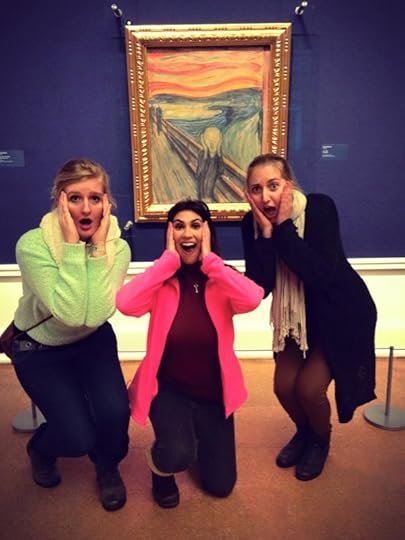 The National Gallery
Two miracles in fact.
The first miracle – the obvious one – was the painting of The Scream itself. Before me, no less!
Back in 1994, at the opening of the Winter Olympics in Lillehammer, two men broke into the National Gallery and stole The Scream right from the museum's very wall. These two bandits were so pleased with the ease of this crime that they added insult to injury by leaving a note that read:
"Thanks for the poor security."
Thankfully, the painting was recovered within three months, miraculously undamaged!
And as if The Scream couldn't possibility endure anymore excitement, 10 years later the painting was stolen . . . again! During daylight hours, no less!
On August 22nd, 2004, two masked gunmen rushed into Oslo's Munch Museum and made off with not only The Scream but another of Munch's painting called, Madonna. For two years, The Scream went missing. Suspects were arrested in connection with the theft, but The Scream and Madonna's whereabouts remained unknown. Worse, the city government of Oslo heard a rumor that the robbers had burnt and destroyed both paintings. The Munch Museum was closed for a cold ten months for a security overhaul. By 2006, the Norwegian Police recovered both of Munch's paintings in better-than-expected conditions. According to the reports, The Scream had moisture damage on the lower left corner, while Madonna suffered several tears on the right side of the painting as well as two holes in the Madonna's arm.
Wounded, survival victims no less.
Miracles.
The Scream Madonna The second miracle, was the fact that I was here in Oslo, Norway with my best friend from elementary school, Ines. Ines and I met when we were in the fifth grade in California. She and her family moved from Oslo, Norway to sunny Southern California when her dad was offered a possession to teach at CalTech. The very fact that she was from Norway, was cool in it of itself. I NEEDED to be her friend.
Sure enough, after moving our desks next to each other, attending the other's house for playdates or sleepovers and celebrating each other's birthdays, Ines and I grew as close as friends could be. She told me about Norway, the Viking Age that spread all across Scandinavia, but more importantly she told me about the snow.
From the way Ines described her home country to me – especially to a girl from Southern California – it sounded like an undiscovered Ice Kingdom. Diamond-paned windows with frosted glass, gusts of arctic air that made you breathless, snowcapped mountains that interrupted the painful bright blue sky. And because I had never seen snow before, I imagined the city of Oslo as a little wooden town nestled in a valley with a marshmallow blanket of white snow everywhere, and icicles hanging from the roofs.
Oh, and there was a big ice castle as well. You can't have an undiscovered Ice Kingdom without a fancy ice castle.
I think it was Ines and her stories about Norway that would later on inspired me to look and apply to schools on the East Coast. You know, that place in America where it constantly snows. But there was also something else in the way that Ines recounted her tales about Norway to me. She spoke with passion about Oslo, she reminiscent about playing in the snow with her younger brother, Alek when they were younger. She told me how funny it was whenever she would throw rocks into the frozen lake outside her house, and listen to the sound the stones would make whenever they smashed through the ice.
"It sounds like a single fat drop of water echoing in a cathedral," she told me with a sigh.
It was obvious that Ines missed her undiscovered Ice Kingdom. I could imagine that if you're from a place where it snows a lot, a part of you misses the cold weather and glittering white of fresh new snow of the ground. This was something I learned after spending two years on the East Coast at Mount Holyoke – snow and all! When I was in London, I missed that feeling of wonderment when small white flurries gently summersault from the sky. To my disappointment, the most snow that I got when I was in London was at Somerset House, and it looked like someone had dropped a snow cone at my feet.
After four years of living in California, Ines broke the news to me that she and her family were moving back to Norway. Tearful goodbyes were exchanged, letters were written back and forth to each other – later upgraded to emails. Birthday care packages were sent, but it was a temporary fix to the missing hole I was feeling after Ines's departure.
Ironically, before I could tell Ines that I had gotten into Mount Holyoke, and was excited to see real snow for the first time, she wrote me first full of excitement.
"Guess what? I got into Stanford! I'm coming back to California!!!" She wrote me with several exclamation marks.
"That's great, I'm moving to Massachusetts," I responded.
So once again, we were separated from each other, but we kept writing to one another. I told her about the friends I made at Mount Holyoke, the adjustments I had to make, the confusion I felt whenever someone would say 'wicked' instead of just 'cool' or 'rad.' And I definitely told her about the snow.
"It's pretty cold," I wrote to her. "Is it always like this?"
"Let me put it to you this way," Ines wrote back. "I'm really enjoying the winter here in Palo Alto."
But before I decided to go abroad and before I decided to move from California to Massachusetts, I remembered those first few weeks after Ines and her family left for Norway. Thinking back, those were the longest and saddest days that I could remember. In a way, I felt like The Scream – the painting, not the reaction that the subject's face made. If I could personify the painting, I could image the fear Mr. Scream must have felt that morning of 1994. Being removed from his home and being held hostage, not knowing if he would ever be mounted on the museum's wall again. Well I can't say that I'm a priceless work of art, nor can I say that I've never been held for ransom, but that separation anxiety of never being reunited with a person who made you feel so at home is – I can tell you from personal experience – the most heartbreaking feeling imaginable. That's why on the day of Ines's birthday – and as soon as I was accepted into King's College London – I wrote on her Facebook wall: "It should be a crime not to see you after so many years." Followed by this photo:
We made plans to meet up in Oslo, Norway for New Years.That was exciting and everything, but I was more ecstatic over the fact that I would be reunited with my best friend after six years!
The Scream was finally going to be reunited with his home!
There was just one thing that I wasn't quite expecting.
Have you ever come across a picture of Munch's The Scream – either in person or just on the Internet – and wondered what the hell the main subject in the painting was screaming about?
Well, okay. Looking at The Scream the subject looks more horrified and shocked, than actually psychically yelling his lungs off in fright. Both his hands are like flippers, cupping both sides of his upside down pear-shaped head; and his mouth is opened in the shape of a slightly stretched zero. His face definitely reminds you off a that Halloween grim reaper mask from Wes Craven's Scream – interesting that even Ghostface had the same screaming expression as the subject in Munch's painting.
But I guess when you look closer at the painting you notice that there are two figures in the background who look like their walking toward the screaming subject.Who are these two figures and why is Munch's subject screaming at their approach?
Nobody knows.
But as soon as my plane landed at Sandefjord Torp Airport, the first person to greet me was Ines! I had imagined this day, being reunited with her after six long years. I was already crying at baggage claim with joy and excitement.
I was here. She was here. Together again . . . with her friend, Anna from Stanford.
Now, to be fair, Ines did give me a heads up a month after I finalized my plans to come out to Norway for New Years. She informed me that a third person would be staying at her house when I would arrive.
And to be straightforward, a part of me was a little bit crushed by this news.
I was looking forward to catching up with Ines – in Norway of all places! – then to receive a Facebook message from her explaining that one of her good friends from Stanford would be joining us as well.
"She's studying abroad in Germany next semester," I could hear her apologetic tone in her message. "I figured it would be easier for her to come and stay with my folks and I before she takes off for Berlin. After all, if she stays with my folks and I in Norway, it will help her get use to the time change, than if she stays in California and flies from there all the way to Europe."
As irritated as I was – not at Ines nor at her friend – but with the picture of the three of us having a meaningful conversation about our lives, I could absolutely understand Ines's actions.
If the roles were reversed, I would probably do the same thing.
Gladly, in fact.
While I was hoping for a one-on-one long week with Ines, (because I can be an extremely selfish person) I would also try my best to get along with Ines's Stanford friend (because I can also be an open-minded person if I try hard enough).
I just socialize differently.
Or at least when it comes to socializing with my best friend and her friend. In which case, I felt even more like The Scream – the reaction that the subject's face made, not the painting, this time – as the two figures in the background, Ines and Anna, I imagined, approached me.
But whatever would happened between Ines's Stanford friend and me, I refused let that cloud my excitement from the bigger picture: Ines, herself.
I reminded myself that when Ines walked with me out from Sandefjord Torp Airport, helped me load my luggage into the back of her car, and introduced me to her Stanford friend, Anna.
Here we were. The three of us. In Oslo, Norway.
The first few days in Norway made me feel like I was back at Mount Holyoke. For the first time since I left my beloved college for London, England, I had encountered real snow and the real cold weather. I felt at home. Ines's house was a petite two story bungalow that looked over the water to the Grønsund – a strait in Denmark. The interior of the house was covered all over in oak, bringing warmth to even the smallest corners of the room. Better yet, whenever Ines, Anna and I would sit down on the floor to watch a movie on Netflix, Ines's black Portuguese Water Dog, Baloo would lay down on my feet and keep my toes nice and toasty.But while Ines and her family provided me with the comforts of a homely environment, Ines also made sure I got the whole tourist experience as well. The three of us took the train into the heart of Oslo where Ines showed Anna and I the Oslo Opera House.
It was a huge square glass building made up of white granite. The roof of the building was angled to ground level, creating a plaza that invited pedestrians to walk up and witness the panoramic views of the Bjørvika, a borough in Oslo, the advertising building of Eniro Norge, and the fjords in the watery distance.
The Oslo Opera House Promptly, as soon as we made it to the snow covered roof of the Opera House, my phone died. I had to use my portable charger that I stowed away inside my snow jacket, only to discover to my great distress that my phone decide to not charge fast enough to take more pictures of the Oslo skyline.While my gloved fingers fumbled to plug my charging cord, in and out from my phone – while also silently praying to Steve Jobs to grant my phone a miracle and turn it back on – I saw Anna and Ines walking away together further along the rooftop.
For starters, I should just explain that I'm the type of person who appreciates having a strong network of friends. After graduating from a high school with 100 students – and 27 students in my graduating class – I've become really good at recognizing quickly which friends were loyal and solid anchors in my life, and which ones were just flippant, physical toxic things who were more concern about climbing the social ladder than getting an A+ on their chemistry homework. Unfortunately, I found myself in a hostile high school environment in which most – if not all – my classmates only cared about was being popular. So as you might already guess, there was a lot of third wheeling going around in my former high school class in regards to putting people off for the better more "sough-after" individuals.
And maybe it was because of this close-knit environment of backstabbers, gossipers and cliques that I had suffer throughout my four years of high school, that made me more aware that every now and then I would be the third wheel to every hangout that involved a trio. Scratch that. I am the queen of third wheels. If I was a motorcycle, I would be the big unattractive wheel in the front. In the British Monarchy, I would probably be Prince Harry to William and Kate. In Taylor Swift's Squad, I would be Lena Dunham. Which was why – because after all I am the Third Wheel Queen – I was uneasy to meet Anna at first. Even though since enrolling at Mount Holyoke, third wheeling for me has been a thing of the past, I always worry that I would one day find myself being the unnecessary third leg of a group again.
In which case, I suddenly felt less like The Scream and more like the less credible, third wheeling Madonna on the rooftop of the Oslo Opera House.
Oslo We later walked into town and Ines showed Anna and I Oslo Cathedral, a 15th century church that Ines later told me was the site of the wedding of Haakon, the Crown Prince of Norway, to Mette-Marit Tjessem Høiby. It was a curved long building built of red bricks, with a tower covered in green copper. Outside, the streets of Oslo still had their Christmas decorations up and I suddenly felt like I was walking through a small village. Oslo, I learned, definitely gives you that feeling that although their storied legacy stretched back to the Viking era, Oslo never tossed out the old for the new. Though they reinvented themselves – via their architecture – the city remained just as charming as the nestled village in the valley that I had originally built up Norway in my mind.
"That's the Grand Hotel," Ines informed me as she points to a building with a classical architectural style that reminded me of a toned down version of a palace. It had a white granite facade with a clock tower smacked dab in the middle. "That's where all the winners for the Nobel Peace Prize come to stay to accept their award."
"You mean Obama has stayed at that hotel?" I asked her, suddenly really excited.
"Yeah," Ines said as we continued walking down main street toward the Royal Palace. "But I personally believe that the only reason why they awarded Obama with the Peace Prize was because they needed an excuse to have Obama come and stay at their hotel."
Interestingly enough, as the three of us walked all the way up the main street, I noticed that the Grand Hotel was situated between the Norwegian Parliament building, the National Theatre, Oslo University and the Royal Palace – which we were walking toward right now.
I found it so odd that a building established for hosting the most important people of world who have made it their lifelong dedication to spread the word of peace, was within close vicinity to one building that promoted the encouragement of education, another building that was primarily erected for the entertainment in the arts, a third building nearby that passed the laws of the land and finally, crowning the top of the hill that Anna, Ines and I were hiking up to, was the building that housed the mandate of heaven.
The Grand Hotel It was the exact opposite of Buckingham Palace. Whereas all the important buildings were spread out all over London, Oslo's most notable buildings were crowded around the hill that led straight up the Royal Palace. Probably the most famous hotel in London I could think of was the Savoy, located on The Strand once you crossed over Waterloo Bridge. The theater district was stationed on the West Side of London, a good 10 minute walk if you left directly from the hotel. Luckily though, you would be nearby both the National Gallery and the National Portrait Gallery which – depending on which direction you take – would be a 4 minute walk if you took Charing Cross Road, or a 5 minute walk if you left from Leicester Square to St. Martin's Street. And even though if you stood in the middle of Trafalgar Square and saw Big Ben and Parliament, that would be a long 15 minute walk – 12 if you ran through every cross walk. Then there was Buckingham Palace, and honest to God it is the farthest building between Parliament and the National Gallery. To get there – at least from Trafalgar Square – you have to go through the stone archway that leads you straight down to the Royal Mall (AKA: THE LONGEST GODDAMN ROAD IN ALL OF LONDON!) I don't know what genius decided to build Buckingham Palace away from all of centralized London – probably the Royal family I'm guessing – but it was as if Buckingham Palace was just "too cool" to associate itself with the other momentous buildings and landmarks in the area.
Then again, the Royal Family and Parliament haven't always seen eye to eye (Magna Carta, anyone?) so I guess if Parliament were to ever establish itself nearby Buckingham Palace, they would be the world's worst neighbors to the Royal Family. The Ned Flanders of neighbors, I would assume. Which is why I theorized that in order for Buckingham Palace to distance itself from all things political in Parliament, weird theatrical nonsense from the West End, and suave pretentious tourists from the Savoy, they created the Royal Mall as a way to distance themselves from their annoying neighbors. With the exception of the National Gallery of course. The Royal Family's portraits are there after all so they need the Gallery to be nearby every now and then to check to see how their portraits are hanging.
As if the Mall wasn't enough to emphasize the distance Buckingham Palace wants to keep between itself and all things London, they also have St. James's Park. A tranquil place that tricks tourists into renting out deckchairs – as they do in every Royal Park in London – and watch pelicans bother the swans in the lake. More so, Buckingham Palace also has a large iron gate that encircles the entire palace. "Keep away," Buckingham Palace seems to tell everyone in London. "I'm way too good for you."
But here, in front of the Royal Palace of Norway, is entirely different. Yes, the Royal Palace is placed on top of a small hill that is free-standing from the other famous buildings down on either side at the base of the street; but there is no park blockading it's path, no Royal Mall that forces you to walk 20 minutes to reach a cold iron gate that separates you from the palace.
It looked independent, but stood as part of the city. Whereas Buckingham Palace was gated off and seemed almost out of place in the middle of London. The Royal Palace's front facade had the same neoclassical architecture that reflected the stuccoed brick north face of the White House. It was an H-shaped building with a temple front supported by a row of pillars. But where as the White House had more of a Palladian design with a central block to make the building more circular, the Royal Palace of Oslo had two great flanking wings, three stories high on either side.
What I liked the most about the palace, was that it was a friendly shade of cake batter yellow, a color that matched the other light and fun dessert shade buildings within the city of Oslo. Better yet, the yellow of the palace looked even brighter against white the snow on the ground.
"I hate the color," Anna said when we stopped to take our pictures in front of the palace.
"Oh I disagree," I said, keeping my voice light. "I think it's charming."
I did, mostly because Buckingham Palace was just so gray and stoney that it was finally a relief to see a Royal Palace that actually looked like it was trying to have a little fun. Though the Royal Palace stood high on a hill, it was third wheeling a little bit, yet the palace was third wheeling in style, as if it it was trying to be Oslo's equal, not superior. Unlike, Buckingham Palace.
The Royal Palace Where we ended up next was The National Gallery. It was here that Ines showed Anna and I the wall where The Scream was mounted. There was already a line of people in front of us waiting their turn to take their pictures as they mirrored the same shocked expression of the main subject in the painting. The painting itself was encased in a laminated glass box with four iron rods in each corner, bolting the glass against the museum's wall. I could only guess it was just in case there was another attempt to rob the museum of Munch's painting. Third time's the charm! Although from the security that the museum had placed all over The Scream, the chances of that happening, were nonexistent.
As we waited in line to take our picture with The Scream, I looked directly across from where I was standing and saw Munch's other painting, Madonna. Madonna too had the same shatterproof glass encasing that The Scream had, yet nobody bothered to line up and strike the same dream-like ecstasy pose as the subject in the painting.
I remembered when the story broke of The Scream's second disappearance in 2004. It was back when Brian Williams was actually truthful when he reported his stories on ABC's Nightly News, and when his tie collection actually motivated my Dad to go out and buy new ties for his suits for work. But from what I remember from that Nightly News story, was the fact that when Brian Williams began the story, he only focused on the disappearance of The Scream and not Madonna. He said, "[The Scream] by Evard Munch was brazenly walked out the door of a Norway Museum today along with another work by the artist . . ." He didn't even bother to name Munch's other artwork, let alone address it as a painting.
In The Guardian the author goes into great detail of why The Scream was a visionary masterpiece, starting the story by chronicling Munch's written accounts of feeling "a great scream piercing the world" and how that led to the creation of The Scream. But of course the author adds, "They broke the frames off The Scream and the other stolen painting - Munch's darkly sensual Madonna." Where were Munch's written accounts for his inspiration of the blood red halo that surrounded the Madonna's head in his painting? Was "darkly sensual" the only adjectives to describe Madonna rather than analyzing the pain and terror the subject in The Scream was feeling?
Essentially, if nobody on the news nor in the papers elaborated on the equal priceless importance of Madonna to The Scream, then what was the point of standing in line and taking a picture with the third wheel of stolen artwork, when you could just take a picture with the star of the show?
After all The Scream went through when he was stolen the first time, a part of me likes to believe that the second time he was kidnapped, he at least had someone to keep him company. Personifying Madonna this time, I bet she didn't understand what was happening to her. And in my hearts of hearts she was probably more terrified of this kidnapping than Mr. Scream. But at least Mr. Scream had survived his first kidnapping, and would do his best to help Ms. Madonna out through their hostage situation. At least when they were stolen they had each other. Better yet, they were kin made by the same man, which probably made their chances of survival even more important.
Yet, when they were both finally rescued, The Scream got all the praise. Everyone was glad that The Scream had been returned in one piece. Madonna was just third wheeling while The Scream had his moment in the spotlight. Both were returned to their rightful homes. At least the museum saw the worth in preserving Madonna in the same shatterproof glass that The Scream was enclosed in.
Just like Buckingham Palace gating itself off from the rest of the London community, The Scream and Madonna would be separated from the world by a wall. To be looked through but never near enough to be close to its beauty.
It was at that moment when I realized that I had built my own glass case/iron gate around myself from Ines and Anna. I didn't want to separate myself from everyone else like Buckingham Palace, The Scream nor Madonna. I wanted to be a part of this group. I wanted to be one with Ines and accept Anna as a friend. I wanted to be like the Royal Palace: open, fun and welcoming.
I wouldn't allow myself to be third wheeled because, the truth was, there were going to be times when Anna would sometimes would feel like the third wheel, herself. In the next few days leading up to New Years, I predicted that there would be something that I would say to Ines – regarding things back in Pasadena, or our acquaintances from middle school – and Anna would be the odd one out. In consequence, there were going to be things Anna would say to Ines – regarding things back at Stanford, or the classes they were enrolled in – that I just wasn't going to get it.
I had to be okay with that.
After all, Ines was our friend. She was the one that we were connected to. Anna and I were essentially The Scream and Madonna. Ines was Munch, our dear friend who shaped us into the people we were today.
And here we were in Norway, her home, as her friends and guests.
Who knew when we would get another chance to pose with The Scream in Oslo, Norway with her?
The National Gallery
December 30, 2015
Why Juliet Capulet Is Actually The Worst
My cousin Sofia and her friends were smoking pot on top of the steps of Scala della Regione at 10 o'clock at night. It was one of the first sites in Verona that Sofia and her parents took me to when I hopped off the plane from London.
In daylight, the Scala della Regione was just as prestigious as its name sounded. It was a grand outdoor staircase blended with late Gothic and early Renaissance detail that swept all the way down to open the courtyard at the foot of the Lamberti Tower. It was built in red and white marble that was evenly loaded on top of one another like the inside of a layered cake. The Scala della Regione Last year, I departed from my apartment on Stamford Street in London to spend Christmas with my relatives in Verona, Italy. While I was enrolled at King's College London for my Junior Year Abroad, Sofia was studying at SOAS at the University of London – which was north of the River Thames and a thirteen minute bus ride if you took the 188 to Russell Square.
I had only been to Italy once when I was fourteen. It was the summer of 2008 before my freshmen year of high school. At that time I was a walking ball of teenage angst and hormonal emotions because I wasn't sure if Eli Loveman – the guy I had a massive crush at school – liked me back. Typical for a fourteen year-old to feel as she walked the streets of Rome with her overwhelming enthusiastic family. But it was also during this time that my Dad gave us some coins to toss into the Trevi Fountain. My Mom – the true Italian of our family – told me and my brother the legendary properties that the Trevi Fountain had when throwing a coin into the fountain's basin.
"If you turn your backs to the fountain and toss the coin over your left shoulder," she told us. "You're guaranteed a return trip to Rome." The Trevi Fountain Well, it turns out that my brother and I didn't care very much about returning to Rome. When we turned our backs and flicked our coins over our shoulders, we each wished for a different thing. My brother wished to graduate at the top of his class – which he did – and I wished that Eli Loveman would date me. A wish that ultimately came true until we ended our relationship after eight months of going out.
The point is, looking back on that first trip to Italy and being in Rome, all I cared about was dating a boy.
You would think that I would have learned my lesson at age 21, now a college student and now living 5,000 miles from my native home of California, that I would focus my mind on enjoying the splendors of what Italy and the world had to offer me.
Well, yes and no. Castlevecchio The truth was, there was someone on my mind.
As I sat with Sofia and her friends at the top of the Scala della Regione I tried to remind myself of all the beauty that I saw that day in Verona.
Sofia's parents owned an apartment that was directly across from the famous Castelvecchio. Built of red bricks, Castlevecchio – as its name suggested meant "Old Castle" – had seven towers, a keep and a bridge that stretched over the Adige River. Earlier that day, Sofia and I walked together across the castle's bridge while we were walking my cousin's French bulldog, Maisy. Like the castle itself, the bridge had the same imposing M-shaped merlons running along its walls. They also had white marble steps where you can actually climb the walls to the bridge and look out over the Adige.
"The bridge was built by Cangrande II della Scala incase of invasions and rebellions," Sofia explained to me when we climbed the walls of Castlevecchio's bridge. "Because Cangrande was a real tyrannical prick back in the day."
 Castlevecchio's Bridge In the afternoon, Sofia's mother, Ida took me Christmas shopping at a place called the Piazza Bra – or Bra for short. It was the largest piazza in Verona, and rightfully so. The piazza was lined with numerous cafés and restaurants, but smacked dabbed in the center was the Arena di Verona, an amphitheater built nearly 2,000 years ago and was now a world-famous music venue.
A white steel arch, 40 feet high, was curved above the open rim of the arena where it ended outside the walls of the amphitheater as a giant, white, iron, comet star.
"See that?" Ida pointed to the erected white star where several tourists stopped to take pictures in front of it. "That's the Stella Cometa. Every Christmas the Arena exhibits this statue. Although, I don't see what's so special about it. It's an eyesore if you ask me." The Stella Cometa at the Arena di Verona I guess my Italian family members were conditioned enough to accept the aesthetics that came with Verona. I noticed that all my native Italian relatives held a quiet appreciation to their beautiful Italian city. I mean, who could blame them? My grandfather, and his father and his father before him – and so on and so on – all lived in Verona. It was already embedded within my family's DNA that Verona was the best city on the planet. If anything, because our family history dated so far back to Verona, they might as well be relics from the city itself.
What my family absolutely didn't like were the loud tourists who "ooed" and "awwed" at the architecture or the history behind the tombs at the Arche Scalier. Ida would always roll her eyes whenever a tourist would come up to her and ask for directions to the Piazza delle Erbe. She'd curse in Italian whenever someone was walking too slow in front of her because they were admiring the buildings, or taking a selfie in front of an authentic Louis Vuitton store.
"That's just pathetic," she said to me. "Don't these idiots know that Louis Vuitton is French?"
Which brought me back to the problem I was facing in dear old and beautiful, Verona:
I was thinking about a boy.
Particularly, a French boy. The Piazza delle Erbe (At night with Christmas lights) Ironically, Sofia herself was also dating a French boy. He was a performer named Baptist, who traveled with his brother around Europe juggling for money. My boy was named Kevin and he was studying computer science in London. Sofia's French man obviously sounded much more cooler than mine. Sofia's father, my cousin Ettore, laughed at the two of us when he found out that the guys we were both dating turned out to be bonafide French men.
"Those grenouilles," Ettore smiled at us. "Stealing our Italian girls away from us."
In case you don't know your French, grenouilles means "frogs."
Sofia shook her head in disapproval of her father's choice of words.
Regardless, Sofia and I were both dating boys from France. But while Sofia seemed comfortable in her relationship with Baptist, I was struggling with some internal conflict with Kevin. Sofia was going to be living in Europe for a longer duration of time than my year abroad. I only had six more months living here in Europe before I packed up my stuff and headed back home to the United States. The Piazza delle Erbe (At daylight) To make a long story short, I met a Kevin back in October and we just started hanging out. He would take the train into Waterloo Station from Surrey whenever he stopped by to visit me in London. I always got chills whenever he would say my name in his native French tongue – ironic since his own name, Kevin, sounded like the least sounding French name imaginable. He was tall with thick black eyebrows and a mass of inky hair. Every time he smiled, or spoke English to me with his thick French accent, was electric. I liked him. A lot in fact.
Yet, I was confronted with this problem:
Was it worth spending time with him if I was just going to up and leave him in May?
After all, I was a ticking clock. My airline tickets back to the United States were already bought and I was due back to watch my friend's graduation at Mount Holyoke in the summer.
I was bittersweet about this whole situation during my week in Verona when one afternoon Ida and I were walking Maisy from the Bra and we went down a street that was swarming with people in front of a particular building.
It was of medieval architecture and the crowd of people were pushing and shoving to get through the gated entrance. Some people were holding pens or pencils, post-it notes or scraps of paper that looked like they had been ripped from the very belly of a notebook.
"What's going on?" I asked Ida.
I heard her back crack as she straightened up and looked at the horde of people – tourists no less – with her jaw locked into a disgusted frown. She tightened her grip on Maisy's red leash and muttered between her teeth, "Dio dannato! Goddamnit! Every time!"
She pushed Maisy's leash into my hands and shoved her way through the massive throng of people. Leave it to Ida to part the Red Sea. Even Moses couldn't divide what was in front of him fast enough from the way Ida marched and cut her way around the tourists. I followed her. Maisy too.
"That was La Casa di Giulietta," Ida sighed with annoyance once we made it to an open space free of tourists at the Piazza delle Erbe. "Every single goddamn morning that place is packed with brainless tourists."
You heard her right. You don't need to know Italian to understand the name of the place that we just passed.
La Casa di Giulietta was supposedly Juliet Capulet's house. La Casa di Giulietta I remembered my Mount Holyoke friend, Emily Kammerlohr visiting the famous Casa di Giulietta when she left to study abroad in Italy her Junior year. From what she had told me about it, the place was absolutely vandalized with love poems, either written in sharpie on the stones to the archway's tunnel, or on post-it notes that were slapped to the walls with a piece of pre-chewed gum. Through the gates was a courtyard where in the middle stood a bronze statue of Juliet Capulet. More so, right above the statue was the legendary balcony that Romeo and Juliet confessed their undying love for each other.
"Ugh, I hate that place," Sofia said to me when we went back to the apartment to finish writing our essays for our finals. I had told her about the chaotic crowd her mother and I had encountered when we tried to walk Maisy through the streets. "In fact I just hate Verona on Valentines Day. It's so cheap and corny. The streets to the piazzas have hearts everywhere and the government tries so hard to make it all 'lovely dovey.' All because the fucking tourists want to relive Giulietta and Romeo's screwed up love story. Not to mention that the statue must be crawling with germs after so many people have touched her tit."
"Come again?"
This was absolutely 100% true.
The legend was that if someone rubbed the bronze breast of the Juliet statue, your luck with love will turn around. That's why after Sofia told me this news about the statue, I looked up an image of the famed sculpture and saw indeed that the tourists might have rubbed off a lot more than just Juliet's right tit. The right side of the statue's arm, torso and chest was 20x more lighter than her practically untouched bronze left side. The Statue of Juliet Capulet Then there was one more crucial thing that I remembered Emily telling me right before I left London for Verona.
"If you ever get a chance to visit Juliet's house," Emily wrote to me via Facebook. "Remember to write her a letter. The Juliet Club, who runs the house, handle and read all of the incoming letters from around the world. They even reply to all of the letters that have been submitted to them."
"But what do I even write?" I had typed back to her.
"Usually people write to The Juliet Club to seek love advice," Emily wrote simply. "They are the letters to Juliet after all. The Juliet! Can you believe it? And Juliet even writes back to you."
Which got me thinking about three things. All three things involved me switching between putting on my English literature cap and my historical fact cap.
The first was, why were so many people seeking love advice from a thirteen year old girl? Romeo and Juliet In case you can't remember the exact details to Shakespeare's Romeo and Juliet, let me refresh your memory with this little factoid:
Juliet Capulet, in Shakespeare's play, is a thirteen-year-old girl.
Do you have any idea how crazy thirteen-year-olds can really be?
When I was thirteen, my solution to everything was pretty much punching people in the face. Not that I actually did punch people in the face, but I would advise my friends to punch their friends in the face if they didn't like what the other person was doing.
See? Thirteen-year-olds cannot be trusted to make a rash decision on anything serious.
And do you know what thirteen-year-olds think about more than anything nowadays?
Boys. Boys. Selfies and more boys.
Don't pretend that isn't true. See the beginning of this very blog post.
And you know what? That's fine. It's perfectly normal to be a thirteen-year-old heterosexual girl and have a constant thought process of just boys. However, entrusting your deepest thoughts about your love life to a straight-up thirteen-year-old girl may not be the best idea. You're better off debating with a thirteen-year-old if One Direction is better than 5 Seconds of Summer, than discussing the complications in your love life.
Especially if that particular thirteen-year-old you are seeking love advice from happens to be Juliet Capulet (AKA: The Worst Person To Seek Any Advice From).
After all, look what ended up happening to her and Romeo at the end of Shakespeare's play. You really want to take advice from some chick who faked her own death and then ended up actually dying herself?
All I'm saying is that it didn't work for Olivia Hussey, sure as hell did jack for Claire Danes, and Hailee Steinfeld just didn't even try. Claire Danes as Juliet Second – just for Devil's advocate sake – yes Juliet in Shakespeare's play is a thirteen-year-old girl. But, also keep in mind that Juliet was a thirteen-year-old girl living in 16th century Verona.
It's been widely debated that Shakespeare wrote Romeo and Juliet around 1595, which means that back then thirteen-year-old girls were seen as mature enough to be married. Legally speaking, girls could actually be married off as young as twelve-years-old. Normally, this happened to only girls from rich families or nobel households – like the Capulet household.
So it would be logical to think that back in the 16th century thirteen-year-old girls like Juliet Capulet would be conditioned at an early age to be more mature in order to be married. That being said, maybe her youth and maturity would give way to deliver intelligent advice.
After all, thirteen-year-olds in Shakespeare's time were – and still are – very much different than the thirteen-year-olds living in the 21st century.
So, all right, maybe a 16th century thirteen-year-old might know a thing or two about love and marriage.
But because I'm a realist, I don't believe that sh*t for a second. Juliet (Age Thirteen) To drive my third and final point home, I do have to explain one crucial thing.
On Christmas Eve I couldn't get anymore work done because I was still thinking about what I should do about Kevin.
At six o'clock at night, Ida, Ettore and Sofia had left the apartment to run their own errands. I was alone with my thoughts, staring at my computer screen with my 15 page essay on the game playing dynamics of courtship in Middlemarch and Jane Eyre.
I found myself stuck in this endless loop of pros and cons of dating Kevin. I even went as far as scribbling my thoughts on paper when I realized what I was doing.
I was writing in the hopes that someone would tell me what to do.
I think in my subconscious of subconscious, a part of me wanted to believe – more than anything – that Juliet could advise me on how I should proceed with my relationship with Kevin.
I mean, Emily did say that if you wrote a letter to Juliet, you would receive a response from The Juliet Club with some kind of words of wisdom on how to proceed with your love life.
I figured that with the limited time that I would be here in Verona, I might as well visit this Casa di Giulietta. Plus, I was a pretty big Shakespeare fan, so I might as well fulfill my obligations as a English major to write a letter and deliver the letter myself at Juliet's house.
So I wrote to Juliet.
I told her about my past relationships and how they had miserably failed. I told her about the numerous boys I dated and the disappoints that I encountered along the way. I told her about how back in California I was in love with a boy who ended up sleeping with one of my close friends in high school; and how damaged I felt after I found out. I told her that I wanted to find a nice, honest boy, and that I felt that I had found that person in Kevin. On page two, I described to Juliet my predicament. How I was a study abroad student in London and how I would only be in Europe for a limited time. I asked her, point blank, "I fear that I will break his heart if I leave him. If that is the case, is it even worth pursuing a serious relationship with him if I am due back home in the summer?"
Once done, I signed the bottom of my letter, found an envelope in Ettore's office where I sealed the message and wrote my London address to my apartment on Stamford Street on the back. My letter to Juliet I remembered the walk Ida and I went on when we first passed Juliet's house. Already it was dark outside on the Verona streets and the weather was chilly. I hugged myself and buried my face into my heavy wool scarf to keep the cold from making me shiver. Juliet's letter was inside my coat's inner pocket. I felt like I was delivering a secret message to someone of great importance and I couldn't stop until the letter was safely in the hands of Juliet herself.
Or at least, personally delivered to her mailbox.
To get to Juliet's house I had to walk through the Piazza di Erbe, which was decked out in holiday lights. A grand Christmas tree with blue lights held court in the middle of the piazza. However, right above my head as I walked past the pharmacies and cafés, was a string of icy white icicle lights webbed over the entire square.
I cut through the Christmas themed piazza and turned down the same street where just yesterday people were pushing and shoving to get through the gates of the building.
It was now 7:30 at night and the street was deserted. The dripping white lights from the LED icicles glowed overhead as I approached the gate and entered through the archway and into a dark tunnel.
Emily was not kidding about the place being vandalized. The vandalized wall at Juliet's House Everywhere I looked. On the walls, the ceiling to the tunnel, between the cracks and crevices of the house were messages in multiple languages. But they all had the same intentions: They wanted to be loved.
It was like I was looking at the Western Wall of love messages. Except in Israel, you would stick your prayers to God in between the crevices of the Western Wall. Here, in Verona, at Juliet's house, the prayers for love were a burst of colorful paper right in front of your face, encouraging you to read. To hope. To pray.
I walked into the courtyard and saw the famed balcony on the right side of Juliet's house. Then standing before me, her left side a deep dark shade of bronze and her right side a light golden hue, stood the statue of Juliet.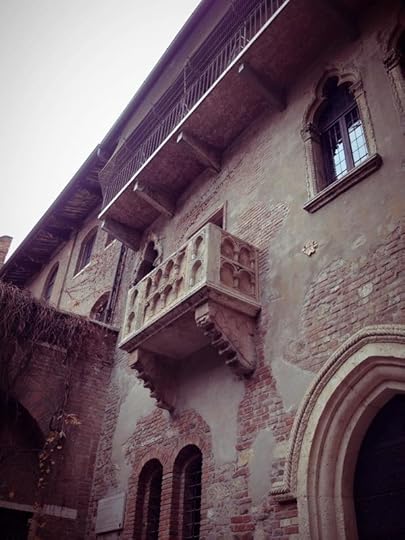 Juliet's Balcony I guess once I actually came face to face with Juliet's statue that I realized that her house was a pilgrimage for all the heartbroken lovers who were in need of Juliet's advice. But like all pilgrims, I had an epiphany once I found the red mailbox to The Juliet Club. The box, to my misfortune, was crammed with letters that people had quickly shoved in. The mailbox itself was defaced with hearts and chicken scratched handwriting of other people's significant others. I had pulled out my letter to Juliet from my jacket and just held it for a second while I stared at that poor mailbox.
 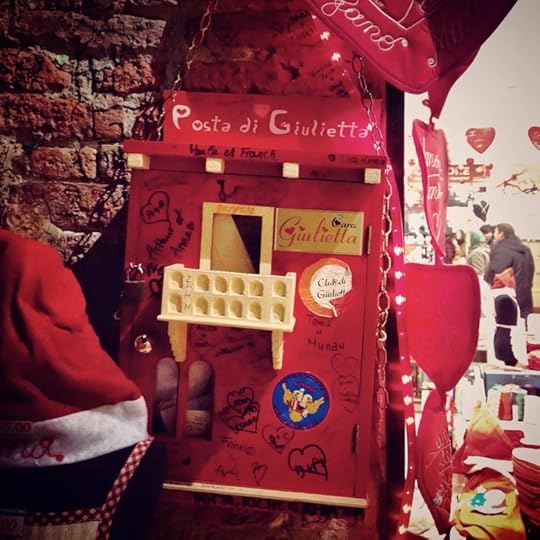 The red mailbox to The Juliet Club This was my third and final point:
Juliet doesn't really exist.
In fact, the supposed "house" that had belonged to Juliet isn't actually her house at all.
That balcony where Romeo and Juliet had their famous scene, was actually an addition that was added to the house in 1936 by the government to attract tourists. Worse, I knew that fact even before I made the effort to come out and deliver my letter to The Juliet Club.
Juliet was actually the worst because she wasn't real. Yet here I was. At some fictional character's house ready to deposit a letter that was full of my intimate thoughts and fears.
So why the hell did I even bother to show up?
The bigger question was, why does anyone make the journey to Verona to seek the advice from a fictional character?
Because the love that Juliet had shared with Romeo is the type of love that everyone strives to achieve in their lives.
For example, when you're done reading a Jane Austen novel, don't you believe that the next boy you'll meet will be THE Mr. Darcy? Or, after you're done watching Moulin Rouge, don't you feel like if you look hard enough you'll eventually find your Christian? Or your Colin Firth? Or your Ryan Gosling?
My point being, is that for hundreds of years people have been reading books, plays and watching movies in the hopes that these forms of entertainment will one day reflect our ideal image of true love.
But I hate to be wet blanket here, but the truth is, these "perfect" ideas of true love are nonexistent – just like Juliet, herself.
As human beings we hold ourselves to this standard that the "perfect" notions of true love are those that we see displayed in books and on TV. When that happens, we forget that these things actually don't exist in real life.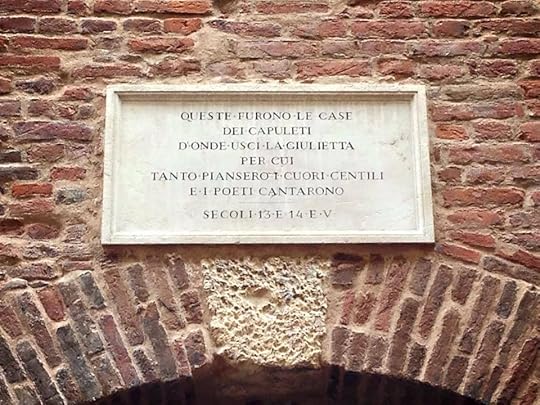 Translation: This is the house of Juliet Capulet were many wept their the kind hearts and made the poets sing. So with these thoughts in mind, do you know what I did next?
I stuffed my letter into that overflowing red mailbox and asked one of the few tourists in the courtyard to take my picture of me fondling the Juliet statue.
Because in all my years as a writer, the one thing that I've learned is that good storytelling will get you far in life.
I mean, look at The Juliet Club! They've profited on the power of Shakespeare's storytelling! And guess what? Even though people know that Romeo and Juliet were just figments of Shakespeare's imagination, nobody cares.
All people want whenever they visit Juliet's home in Verona, is to live a little part of it's dream in the hopes that they themselves might find their perfect form of true love.
If people want to pay €4 to climb up to the balcony and gaze below in the hopes of seeking their Romeo, then they should feel free to do so.
I'll even go as far to admit that a part of me does wish for that perfect form of true love. As an English major, how can I not fall to prey to tales about star-crossed lovers? The stories about Lancelot and Guinevere, Tristian and Isolde or even Harry and Sally are all romantic tales chalk-full of that everlasting hope that our perfect true love is somewhere out there in the world.
However, though I may be a hardcore English major, I am also a pretty pragmatic person to my own disbelief.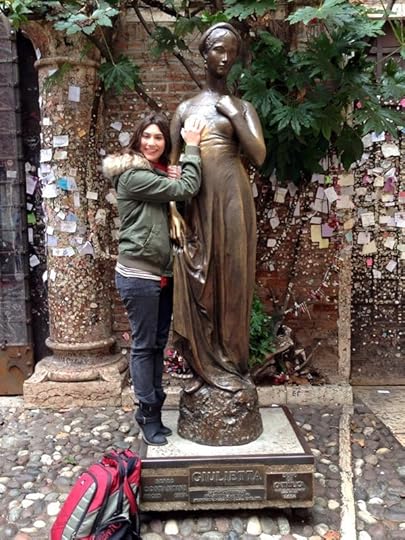 I touched the tit! So, being practical, if I was right about my assumptions about Juliet, then I would have three different outcomes in regards to her response to my letter involving my dilemma with Kevin.
Outcome #1: I would get Juliet's immature thirteen-year-old response, advising me to marry poor Kevin. Then fake my own death, and then kill myself if Kevin should die.
Outcome #2: I would get Juliet's mature 16th century thirteen-year-old response, advising me to do whatever my father ordered me to do.
And Outcome #3: I wouldn't receive any response because Juliet was nonexistent.
So even though, in the end, Kevin and I went our separate ways, I waited every month for that letter to come to my address in London.
I'm still waiting for a response from her.
Not in the hopes that she would answer my question.
But in the hopes, of being delivered with some proof, that she exists.
In daylight, the Scala della Regione was just as prestigious as its name sounded. It was a grand outdoor staircase blended with late Gothic and early Renaissance detail that swept all the way down to open the courtyard at the foot of the Lamberti Tower. It was built in red and white marble that was evenly loaded on top of one another like the inside of a layered cake.
The Scala della Regione Last year, I departed from my apartment on Stamford Street in London to spend Christmas with my relatives in Verona, Italy. While I was enrolled at King's College London for my Junior Year Abroad, Sofia was studying at SOAS at the University of London – which was north of the River Thames and a thirteen minute bus ride if you took the 188 to Russell Square. I had only been to Italy once when I was fourteen. It was the summer of 2008 before my freshmen year of high school. At that time I was a walking ball of teenage angst and hormonal emotions because I wasn't sure if Eli Loveman – the guy I had a massive crush at school – liked me back. Typical for a fourteen year-old to feel as she walked the streets of Rome with her overwhelming enthusiastic family. But it was also during this time that my Dad gave us some coins to toss into the Trevi Fountain. My Mom – the true Italian of our family – told me and my brother the legendary properties that the Trevi Fountain had when throwing a coin into the fountain's basin.
"If you turn your backs to the fountain and toss the coin over your left shoulder," she told us. "You're guaranteed a return trip to Rome."
The Trevi Fountain Well, it turns out that my brother and I didn't care very much about returning to Rome. When we turned our backs and flicked our coins over our shoulders, we each wished for a different thing. My brother wished to graduate at the top of his class – which he did – and I wished that Eli Loveman would date me. A wish that ultimately came true until we ended our relationship after eight months of going out. The point is, looking back on that first trip to Italy and being in Rome, all I cared about was dating a boy.
You would think that I would have learned my lesson at age 21, now a college student and now living 5,000 miles from my native home of California, that I would focus my mind on enjoying the splendors of what Italy and the world had to offer me.
Well, yes and no.
Castlevecchio The truth was, there was someone on my mind. As I sat with Sofia and her friends at the top of the Scala della Regione I tried to remind myself of all the beauty that I saw that day in Verona.
Sofia's parents owned an apartment that was directly across from the famous Castelvecchio. Built of red bricks, Castlevecchio – as its name suggested meant "Old Castle" – had seven towers, a keep and a bridge that stretched over the Adige River. Earlier that day, Sofia and I walked together across the castle's bridge while we were walking my cousin's French bulldog, Maisy. Like the castle itself, the bridge had the same imposing M-shaped merlons running along its walls. They also had white marble steps where you can actually climb the walls to the bridge and look out over the Adige.
"The bridge was built by Cangrande II della Scala incase of invasions and rebellions," Sofia explained to me when we climbed the walls of Castlevecchio's bridge. "Because Cangrande was a real tyrannical prick back in the day."
Castlevecchio's Bridge In the afternoon, Sofia's mother, Ida took me Christmas shopping at a place called the Piazza Bra – or Bra for short. It was the largest piazza in Verona, and rightfully so. The piazza was lined with numerous cafés and restaurants, but smacked dabbed in the center was the Arena di Verona, an amphitheater built nearly 2,000 years ago and was now a world-famous music venue. A white steel arch, 40 feet high, was curved above the open rim of the arena where it ended outside the walls of the amphitheater as a giant, white, iron, comet star.
"See that?" Ida pointed to the erected white star where several tourists stopped to take pictures in front of it. "That's the Stella Cometa. Every Christmas the Arena exhibits this statue. Although, I don't see what's so special about it. It's an eyesore if you ask me."
The Stella Cometa at the Arena di Verona I guess my Italian family members were conditioned enough to accept the aesthetics that came with Verona. I noticed that all my native Italian relatives held a quiet appreciation to their beautiful Italian city. I mean, who could blame them? My grandfather, and his father and his father before him – and so on and so on – all lived in Verona. It was already embedded within my family's DNA that Verona was the best city on the planet. If anything, because our family history dated so far back to Verona, they might as well be relics from the city itself.What my family absolutely didn't like were the loud tourists who "ooed" and "awwed" at the architecture or the history behind the tombs at the Arche Scalier. Ida would always roll her eyes whenever a tourist would come up to her and ask for directions to the Piazza delle Erbe. She'd curse in Italian whenever someone was walking too slow in front of her because they were admiring the buildings, or taking a selfie in front of an authentic Louis Vuitton store.
"That's just pathetic," she said to me. "Don't these idiots know that Louis Vuitton is French?"
Which brought me back to the problem I was facing in dear old and beautiful, Verona:
I was thinking about a boy.
Particularly, a French boy.
The Piazza delle Erbe (At night with Christmas lights) Ironically, Sofia herself was also dating a French boy. He was a performer named Baptist, who traveled with his brother around Europe juggling for money. My boy was named Kevin and he was studying computer science in London. Sofia's French man obviously sounded much more cooler than mine. Sofia's father, my cousin Ettore, laughed at the two of us when he found out that the guys we were both dating turned out to be bonafide French men."Those grenouilles," Ettore smiled at us. "Stealing our Italian girls away from us."
In case you don't know your French, grenouilles means "frogs."
Sofia shook her head in disapproval of her father's choice of words.
Regardless, Sofia and I were both dating boys from France. But while Sofia seemed comfortable in her relationship with Baptist, I was struggling with some internal conflict with Kevin. Sofia was going to be living in Europe for a longer duration of time than my year abroad. I only had six more months living here in Europe before I packed up my stuff and headed back home to the United States.
The Piazza delle Erbe (At daylight) To make a long story short, I met a Kevin back in October and we just started hanging out. He would take the train into Waterloo Station from Surrey whenever he stopped by to visit me in London. I always got chills whenever he would say my name in his native French tongue – ironic since his own name, Kevin, sounded like the least sounding French name imaginable. He was tall with thick black eyebrows and a mass of inky hair. Every time he smiled, or spoke English to me with his thick French accent, was electric. I liked him. A lot in fact.Yet, I was confronted with this problem:
Was it worth spending time with him if I was just going to up and leave him in May?
After all, I was a ticking clock. My airline tickets back to the United States were already bought and I was due back to watch my friend's graduation at Mount Holyoke in the summer.
I was bittersweet about this whole situation during my week in Verona when one afternoon Ida and I were walking Maisy from the Bra and we went down a street that was swarming with people in front of a particular building.
It was of medieval architecture and the crowd of people were pushing and shoving to get through the gated entrance. Some people were holding pens or pencils, post-it notes or scraps of paper that looked like they had been ripped from the very belly of a notebook.
"What's going on?" I asked Ida.
I heard her back crack as she straightened up and looked at the horde of people – tourists no less – with her jaw locked into a disgusted frown. She tightened her grip on Maisy's red leash and muttered between her teeth, "Dio dannato! Goddamnit! Every time!"
She pushed Maisy's leash into my hands and shoved her way through the massive throng of people. Leave it to Ida to part the Red Sea. Even Moses couldn't divide what was in front of him fast enough from the way Ida marched and cut her way around the tourists. I followed her. Maisy too.
"That was La Casa di Giulietta," Ida sighed with annoyance once we made it to an open space free of tourists at the Piazza delle Erbe. "Every single goddamn morning that place is packed with brainless tourists."
You heard her right. You don't need to know Italian to understand the name of the place that we just passed.
La Casa di Giulietta was supposedly Juliet Capulet's house.
La Casa di Giulietta I remembered my Mount Holyoke friend, Emily Kammerlohr visiting the famous Casa di Giulietta when she left to study abroad in Italy her Junior year. From what she had told me about it, the place was absolutely vandalized with love poems, either written in sharpie on the stones to the archway's tunnel, or on post-it notes that were slapped to the walls with a piece of pre-chewed gum. Through the gates was a courtyard where in the middle stood a bronze statue of Juliet Capulet. More so, right above the statue was the legendary balcony that Romeo and Juliet confessed their undying love for each other."Ugh, I hate that place," Sofia said to me when we went back to the apartment to finish writing our essays for our finals. I had told her about the chaotic crowd her mother and I had encountered when we tried to walk Maisy through the streets. "In fact I just hate Verona on Valentines Day. It's so cheap and corny. The streets to the piazzas have hearts everywhere and the government tries so hard to make it all 'lovely dovey.' All because the fucking tourists want to relive Giulietta and Romeo's screwed up love story. Not to mention that the statue must be crawling with germs after so many people have touched her tit."
"Come again?"
This was absolutely 100% true.
The legend was that if someone rubbed the bronze breast of the Juliet statue, your luck with love will turn around. That's why after Sofia told me this news about the statue, I looked up an image of the famed sculpture and saw indeed that the tourists might have rubbed off a lot more than just Juliet's right tit. The right side of the statue's arm, torso and chest was 20x more lighter than her practically untouched bronze left side.
The Statue of Juliet Capulet Then there was one more crucial thing that I remembered Emily telling me right before I left London for Verona. "If you ever get a chance to visit Juliet's house," Emily wrote to me via Facebook. "Remember to write her a letter. The Juliet Club, who runs the house, handle and read all of the incoming letters from around the world. They even reply to all of the letters that have been submitted to them."
"But what do I even write?" I had typed back to her.
"Usually people write to The Juliet Club to seek love advice," Emily wrote simply. "They are the letters to Juliet after all. The Juliet! Can you believe it? And Juliet even writes back to you."
Which got me thinking about three things. All three things involved me switching between putting on my English literature cap and my historical fact cap.
The first was, why were so many people seeking love advice from a thirteen year old girl?
Romeo and Juliet In case you can't remember the exact details to Shakespeare's Romeo and Juliet, let me refresh your memory with this little factoid: Juliet Capulet, in Shakespeare's play, is a thirteen-year-old girl.
Do you have any idea how crazy thirteen-year-olds can really be?
When I was thirteen, my solution to everything was pretty much punching people in the face. Not that I actually did punch people in the face, but I would advise my friends to punch their friends in the face if they didn't like what the other person was doing.
See? Thirteen-year-olds cannot be trusted to make a rash decision on anything serious.
And do you know what thirteen-year-olds think about more than anything nowadays?
Boys. Boys. Selfies and more boys.
Don't pretend that isn't true. See the beginning of this very blog post.
And you know what? That's fine. It's perfectly normal to be a thirteen-year-old heterosexual girl and have a constant thought process of just boys. However, entrusting your deepest thoughts about your love life to a straight-up thirteen-year-old girl may not be the best idea. You're better off debating with a thirteen-year-old if One Direction is better than 5 Seconds of Summer, than discussing the complications in your love life.
Especially if that particular thirteen-year-old you are seeking love advice from happens to be Juliet Capulet (AKA: The Worst Person To Seek Any Advice From).
After all, look what ended up happening to her and Romeo at the end of Shakespeare's play. You really want to take advice from some chick who faked her own death and then ended up actually dying herself?
All I'm saying is that it didn't work for Olivia Hussey, sure as hell did jack for Claire Danes, and Hailee Steinfeld just didn't even try.
Claire Danes as Juliet Second – just for Devil's advocate sake – yes Juliet in Shakespeare's play is a thirteen-year-old girl. But, also keep in mind that Juliet was a thirteen-year-old girl living in 16th century Verona.It's been widely debated that Shakespeare wrote Romeo and Juliet around 1595, which means that back then thirteen-year-old girls were seen as mature enough to be married. Legally speaking, girls could actually be married off as young as twelve-years-old. Normally, this happened to only girls from rich families or nobel households – like the Capulet household.
So it would be logical to think that back in the 16th century thirteen-year-old girls like Juliet Capulet would be conditioned at an early age to be more mature in order to be married. That being said, maybe her youth and maturity would give way to deliver intelligent advice.
After all, thirteen-year-olds in Shakespeare's time were – and still are – very much different than the thirteen-year-olds living in the 21st century.
So, all right, maybe a 16th century thirteen-year-old might know a thing or two about love and marriage.
But because I'm a realist, I don't believe that sh*t for a second.
Juliet (Age Thirteen) To drive my third and final point home, I do have to explain one crucial thing.On Christmas Eve I couldn't get anymore work done because I was still thinking about what I should do about Kevin.
At six o'clock at night, Ida, Ettore and Sofia had left the apartment to run their own errands. I was alone with my thoughts, staring at my computer screen with my 15 page essay on the game playing dynamics of courtship in Middlemarch and Jane Eyre.
I found myself stuck in this endless loop of pros and cons of dating Kevin. I even went as far as scribbling my thoughts on paper when I realized what I was doing.
I was writing in the hopes that someone would tell me what to do.
I think in my subconscious of subconscious, a part of me wanted to believe – more than anything – that Juliet could advise me on how I should proceed with my relationship with Kevin.
I mean, Emily did say that if you wrote a letter to Juliet, you would receive a response from The Juliet Club with some kind of words of wisdom on how to proceed with your love life.
I figured that with the limited time that I would be here in Verona, I might as well visit this Casa di Giulietta. Plus, I was a pretty big Shakespeare fan, so I might as well fulfill my obligations as a English major to write a letter and deliver the letter myself at Juliet's house.
So I wrote to Juliet.
I told her about my past relationships and how they had miserably failed. I told her about the numerous boys I dated and the disappoints that I encountered along the way. I told her about how back in California I was in love with a boy who ended up sleeping with one of my close friends in high school; and how damaged I felt after I found out. I told her that I wanted to find a nice, honest boy, and that I felt that I had found that person in Kevin. On page two, I described to Juliet my predicament. How I was a study abroad student in London and how I would only be in Europe for a limited time. I asked her, point blank, "I fear that I will break his heart if I leave him. If that is the case, is it even worth pursuing a serious relationship with him if I am due back home in the summer?"
Once done, I signed the bottom of my letter, found an envelope in Ettore's office where I sealed the message and wrote my London address to my apartment on Stamford Street on the back.
My letter to Juliet I remembered the walk Ida and I went on when we first passed Juliet's house. Already it was dark outside on the Verona streets and the weather was chilly. I hugged myself and buried my face into my heavy wool scarf to keep the cold from making me shiver. Juliet's letter was inside my coat's inner pocket. I felt like I was delivering a secret message to someone of great importance and I couldn't stop until the letter was safely in the hands of Juliet herself.Or at least, personally delivered to her mailbox.
To get to Juliet's house I had to walk through the Piazza di Erbe, which was decked out in holiday lights. A grand Christmas tree with blue lights held court in the middle of the piazza. However, right above my head as I walked past the pharmacies and cafés, was a string of icy white icicle lights webbed over the entire square.
I cut through the Christmas themed piazza and turned down the same street where just yesterday people were pushing and shoving to get through the gates of the building.
It was now 7:30 at night and the street was deserted. The dripping white lights from the LED icicles glowed overhead as I approached the gate and entered through the archway and into a dark tunnel.
Emily was not kidding about the place being vandalized.
The vandalized wall at Juliet's House Everywhere I looked. On the walls, the ceiling to the tunnel, between the cracks and crevices of the house were messages in multiple languages. But they all had the same intentions: They wanted to be loved. It was like I was looking at the Western Wall of love messages. Except in Israel, you would stick your prayers to God in between the crevices of the Western Wall. Here, in Verona, at Juliet's house, the prayers for love were a burst of colorful paper right in front of your face, encouraging you to read. To hope. To pray.
I walked into the courtyard and saw the famed balcony on the right side of Juliet's house. Then standing before me, her left side a deep dark shade of bronze and her right side a light golden hue, stood the statue of Juliet.
Juliet's Balcony I guess once I actually came face to face with Juliet's statue that I realized that her house was a pilgrimage for all the heartbroken lovers who were in need of Juliet's advice. But like all pilgrims, I had an epiphany once I found the red mailbox to The Juliet Club. The box, to my misfortune, was crammed with letters that people had quickly shoved in. The mailbox itself was defaced with hearts and chicken scratched handwriting of other people's significant others. I had pulled out my letter to Juliet from my jacket and just held it for a second while I stared at that poor mailbox. The red mailbox to The Juliet Club This was my third and final point:Juliet doesn't really exist.
In fact, the supposed "house" that had belonged to Juliet isn't actually her house at all.
That balcony where Romeo and Juliet had their famous scene, was actually an addition that was added to the house in 1936 by the government to attract tourists. Worse, I knew that fact even before I made the effort to come out and deliver my letter to The Juliet Club.
Juliet was actually the worst because she wasn't real. Yet here I was. At some fictional character's house ready to deposit a letter that was full of my intimate thoughts and fears.
So why the hell did I even bother to show up?
The bigger question was, why does anyone make the journey to Verona to seek the advice from a fictional character?
Because the love that Juliet had shared with Romeo is the type of love that everyone strives to achieve in their lives.
For example, when you're done reading a Jane Austen novel, don't you believe that the next boy you'll meet will be THE Mr. Darcy? Or, after you're done watching Moulin Rouge, don't you feel like if you look hard enough you'll eventually find your Christian? Or your Colin Firth? Or your Ryan Gosling?
My point being, is that for hundreds of years people have been reading books, plays and watching movies in the hopes that these forms of entertainment will one day reflect our ideal image of true love.
But I hate to be wet blanket here, but the truth is, these "perfect" ideas of true love are nonexistent – just like Juliet, herself.
As human beings we hold ourselves to this standard that the "perfect" notions of true love are those that we see displayed in books and on TV. When that happens, we forget that these things actually don't exist in real life.
Translation: This is the house of Juliet Capulet were many wept their the kind hearts and made the poets sing. So with these thoughts in mind, do you know what I did next?I stuffed my letter into that overflowing red mailbox and asked one of the few tourists in the courtyard to take my picture of me fondling the Juliet statue.
Because in all my years as a writer, the one thing that I've learned is that good storytelling will get you far in life.
I mean, look at The Juliet Club! They've profited on the power of Shakespeare's storytelling! And guess what? Even though people know that Romeo and Juliet were just figments of Shakespeare's imagination, nobody cares.
All people want whenever they visit Juliet's home in Verona, is to live a little part of it's dream in the hopes that they themselves might find their perfect form of true love.
If people want to pay €4 to climb up to the balcony and gaze below in the hopes of seeking their Romeo, then they should feel free to do so.
I'll even go as far to admit that a part of me does wish for that perfect form of true love. As an English major, how can I not fall to prey to tales about star-crossed lovers? The stories about Lancelot and Guinevere, Tristian and Isolde or even Harry and Sally are all romantic tales chalk-full of that everlasting hope that our perfect true love is somewhere out there in the world.
However, though I may be a hardcore English major, I am also a pretty pragmatic person to my own disbelief.
I touched the tit! So, being practical, if I was right about my assumptions about Juliet, then I would have three different outcomes in regards to her response to my letter involving my dilemma with Kevin.Outcome #1: I would get Juliet's immature thirteen-year-old response, advising me to marry poor Kevin. Then fake my own death, and then kill myself if Kevin should die.
Outcome #2: I would get Juliet's mature 16th century thirteen-year-old response, advising me to do whatever my father ordered me to do.
And Outcome #3: I wouldn't receive any response because Juliet was nonexistent.
So even though, in the end, Kevin and I went our separate ways, I waited every month for that letter to come to my address in London.
I'm still waiting for a response from her.
Not in the hopes that she would answer my question.
But in the hopes, of being delivered with some proof, that she exists.
November 22, 2015
When I Broke Into Tower of London
Usually when I tell this story I like to say that I had “broke into” the Tower of London. Why the hell not? It sounds cooler to say “broken into” than “sneaking into.” And yes, I said The Tower of London, meaning THIS Tower of London:  Before arriving in London for my Junior year abroad, I was transported, in my imagination, to the historical city through an array of British novels. I wasn't aware that the River Thames was pronounced, Tems, nor was I aware that you could visit Parliament (with a £21 fee of course), and nobody actually told me that Windsor Castle wasn't in the City of London, but rather – of course – in Windsor. I'd just assumed that everything of importance and of historical value resided in London.
Go figure. I had been living in London for almost three full weeks and was dying to see the birth place of Queen Victoria (Kensington Palace), the cathedral where all the past kings and queens of England had been coronated (Westminister Abbey) and to get my haircut on the infamous street that Sweeney Todd supposedly wreaked havoc on (Fleet Street). Though I am an English major and revival in the literature of Dickens, Shakespeare, Chaucer and Austen – all of whom I read and studied while I was abroad – I figured that London was the best place for a voracious reader to be.
But there was also a selfish reason that I traveled to England: I am absolute nerd when it comes to English royal history.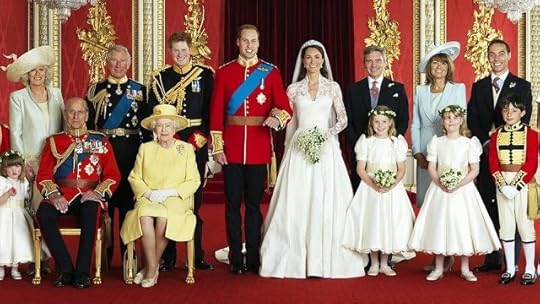 I am one Amazon click away from purchasing the complete series of The Tudors. I post on my Facebook page everyday a blurb about some historical event that had occurred in Elizabethan England that day. I have a genealogy chart of all the Kings and Queens of England in my dorm room – listed from the earlier rulers of the Angelo-Saxons all the way down to the present Queen of England, Her Majesty Queen Elizabeth II. My airport reading material – a Philippa Gregory novel about the Plantagenets or a novel about one of King Henry VIII’s six wives – always receives an approving nod from whatever middle-aged woman on my flight is reading a Gillian Flynn book B.cause obviously every domestic flight requires a middle-aged woman with a Gillian Flynn book in her luggage or carry-on.
It's like approved by the TSA.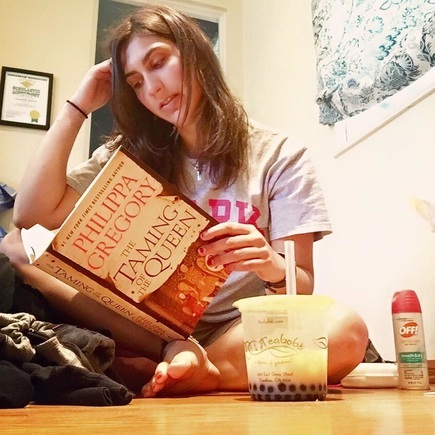 So when I was living in London and daydreaming about Hampton Court and Buckingham Palace, the one place I wanted to go to out of anywhere else in the city was The Tower of London.
You have to understand as a royal history nerd, The Tower of London was the equivalent to Disneyland for me. Which – if you know your history about The Tower of London – is a pretty gruesome comparison when you think about it.
I am a sucker for The War of the Roses and Tudor England, because those two subjects featured the central tension of the people who were imprisoned in The Tower. The conflict between who had a claim to the English throne, who had betrayed the king’s trust and who was a threat to the English crown. The Tower’s most famous guests include The Princes in The Tower during The War of The Roses – Edward and his younger brother Richard who were rumored to be murdered by their uncle, Richard III.
 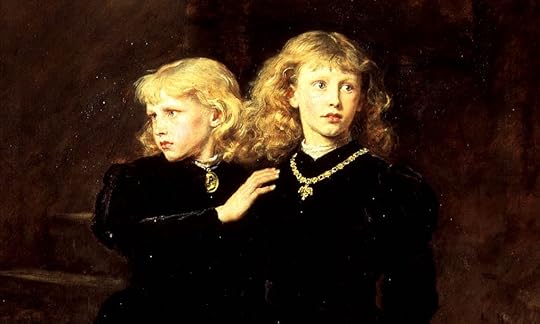 Good old Anne Boleyn was sent to The Tower – Henry VIII’s second wife – when she was found guilty of witchcraft and for being unfaithful to the king. A form of treason, no less.
 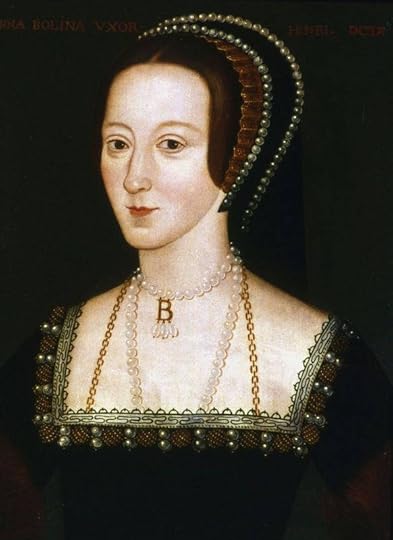 Same went for Katherine Howard, Henry’s fifth and more promiscuous wife.
  I fancied the idea that The Tower of London was pretty much the same as The Hotel California. As they say in the song, “You may check out, but you can never leave.” Unfortunately, that’s what happened to most of the prisoners who were found guilty in The Tower of London. They were immediately executed.
  The most heartbreaking story about a prisoner who was sent to The Tower, was Lady Margaret Pole, King Henry’s older cousin. She was the last heir to the Plantagenet family and was sentenced to be executed for treason. She was dragged kicking and screaming to the execution block, and when she refused to lay her head on it, it was forced down. As she struggled to free herself from the guards, the executioner’s first blow made a gash on her shoulder rather than her neck. It took ten additional blows to complete Margaret Pole’s execution.
She was 67 years old and innocent. So as you can imagine, these people's horrifying deaths made The Tower of London even more of an appealing tourist attraction for me. I went with my friends Jon, Connor and Mel for the day to The Tower. We took the Tube from Waterloo Station to Tower Hill to meet with Jon's study abroad group, which consisted of Connor, Mel and 88 other people from all over the United States who had come to London to study.
I did not apply to any study abroad groups when I decided to travel to London. One, because I didn’t know that study abroad groups liked IFSA Butler or Arcadia existed before applying; and two, if I really wanted to have a true study abroad experience I didn’t want to find myself surrounded by a bunch of Americans. I wanted to be fully immersed in the London way of life, and I would have. If Jon, an American from Northwestern University, hadn’t become my flatmate.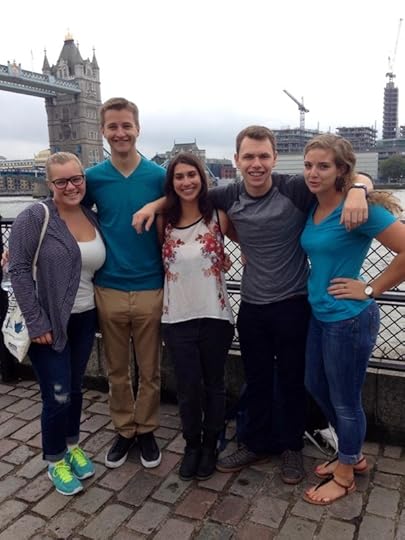 “So Miranda Cannon won’t be able to make it to The Tower with us,” Jon was telling me in between stops on the Tube. “So just tell them that you’re her and they’ll give you a free ticket.”
Jon and his American friends were part of the Arcadia Study Abroad Group that had received free tickets to get into The Tower of London. This was just one of the many perks that I had wished I had known about before I decided to go abroad alone. Jon told me that if you were part of the Arcadia Group you got free mimosas at the very top of The Shard, plus Afternoon Tea at Bea’s of Bloomsbury and free tickets into any of the royal palaces within the city of London. However, since I obviously wasn’t part of the Arcadia Group, I would have to pay for my own ticket to get into The Tower of London. Which was, sadly, an expensive £22 (that’s $32 for one person.)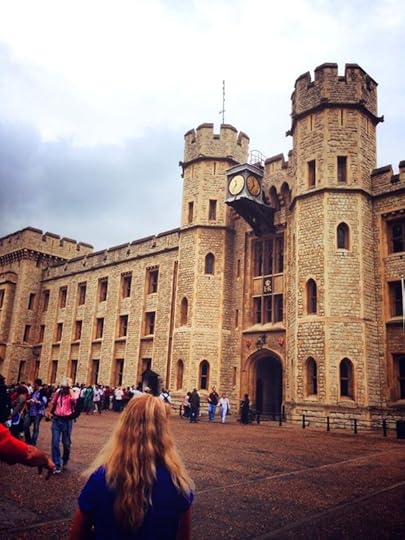 But thankfully because I had made Jon’s ears bleed with countless tales from The Tower of London, he had an idea to help save me some money: By pretending to be Miranda Cannon.
“They won’t ask you for your ID. You just need to tell them you’re Miranda,” Jon said when we left Tower Hill Station and made our way to The Tower.
“You mean they don’t check you?” I asked.
“Jacqueline, it’s the goddamn Tower of London, not Coachella. Not many people are going to show up at nine in the morning on a Saturday to see this place.”
When the four of us crossed the street, The Tower of London was right in front of us.
Thousands of ceramic poppies were carpeted around the moat to The Tower of London. It looked like a sea of red blood was oozing out from the very bottom of the wall. Jon had explained to me before we left the flat that The Tower of London would be decorated with these ceramic poppies to commemorate the 100-year anniversary of the First World War. Each poppy (there were 888,246 poppies to be exact) represented a lost British or Colonial military personal from World War I.
It was eerie and beautiful at the same time.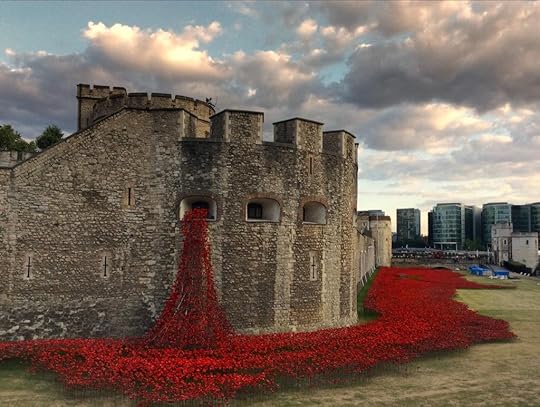 We meet up with Jon’s Arcadia friends in line as they waited for their Arcadia leader to hand out the tickets. The Arcadia leader was a twenty-something year old woman with owl rimmed black glasses and white pasty lacquered skin like candle wax. She had a folded table in front of her with a list of all the Arcadia Group names checking in.
I was so excited to get inside The Tower.
It was a place that I’ve only read about in books and seen on the Discovery Channel with my Dad; and I was actually here!
I was actually going to see the cells where they held Thomas Cromwell, Thomas Moore and Lady Jane Grey.
As my anticipation grew and grew as I stood in line, the unthinkable happen:
I forgot my “fake” name.
The name, Miranda Cannon suddenly had slipped from my memory!
Jon had already gotten his ticket and was waiting with his Arcadia friends near the entrance of The Tower of London.
THE Tower of London and I forgot my name!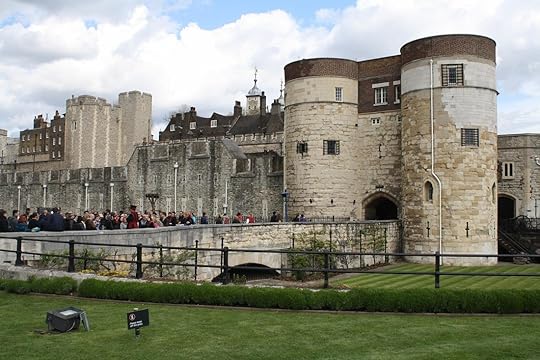 SO CLOSE AND YET SO FAR!!! To make matters worse, I was next in line.
“Name?” The Arcadia leader asked me.
Fuck! Fuck! Fuck!
I dropped my eyes straight down to the list of names and said the first name I saw:
“Penelope Wentworth.”
Could I have been any stupider?
“All right,” the woman said as she checked Penelope’s name off from her list. “For a second there you seemed like you had forgotten your name.”
“Yeah, that tends to happen,” I said quickly, as I grabbed my free ticket to The Tower of London.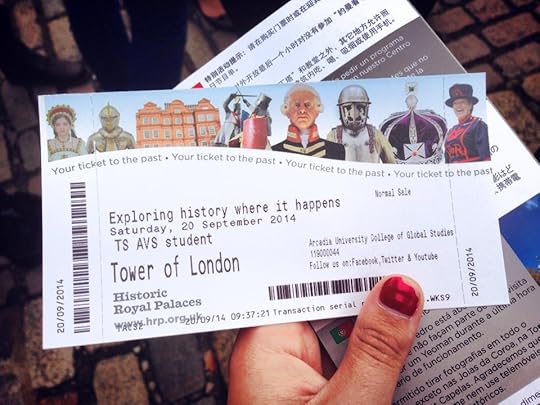 My first attempt at identity thief. I rushed to Jon and his group of friends, dread stewing in the pit of my stomach.
“I got the ticket,” I managed to say.
Jon’s eyebrows hiked up his face. “Are you serious?”
He looked shocked, which confused me because this whole scheme of using someone else’s name was his idea.
“Yeah,” I said.
“You used Miranda’s name?”
“Well . . .” and I explained to him how my excitement for entering The Tower of London deflected me from remembering Miranda’s name.
“I used someone else’s name. Penelope something.”
“Oh good,” Jon released a sigh. “Because I just saw the real Miranda Cannon get in line a few minutes after I bought my own ticket.”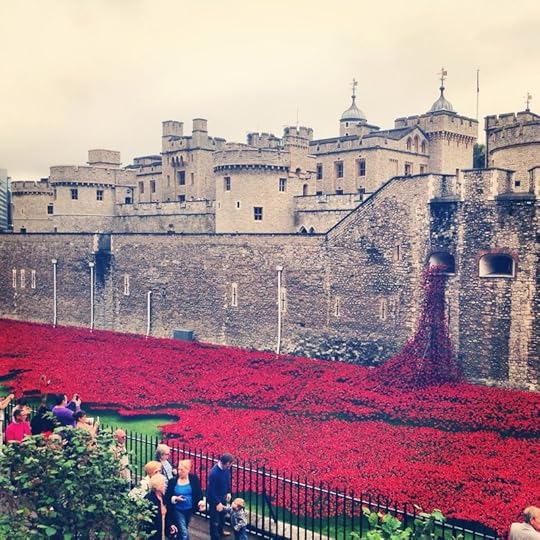 Looking back now, this was actually hilarious. But I was so scared of not getting into The Tower that I didn’t quite laugh immediately. Even when I flashed my free ticket at the Beefeaters at the entrance of the gate, I was afraid that the real Penelope would report me to the guards, and throw my ass in the same cell that Anne Boleyn was held in during her imprisonment. But no one came to throw me in chains or to make me walk the scaffoldings to the executioner's block.
Jon later told me that Miranda just randomly decided to come out to explore The Tower of London – even though she previously told him that she preferred sleeping in.
Thankfully, as the day progressed, the real Penelope Wentworth never showed up to check in with the Arcadia leader.
So for the rest of the day at The Tower of London, I was Penelope Wentworth.
And I had finally made it to The Tower of London!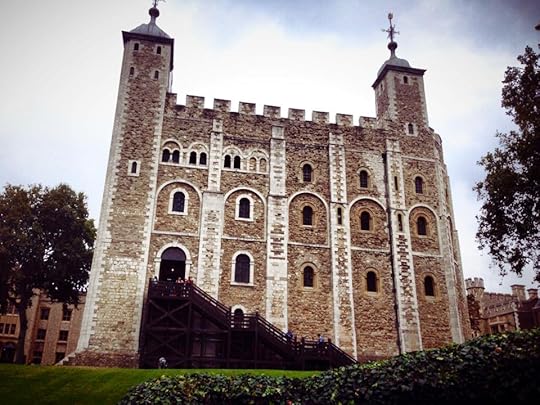 The Tower of London I learned boasts everything you would want from a trip down British memory lane. On the South Lawn, there was the fun kind of bad actors in period costumes emoting through a reenactment of recruits swearing in to join the Royal Fusiliers during World War I. Someone dressed up as Lord Kitchener and proclaimed before a podium that, "those who have been offering their services to King and Country should be well treated. Any man will receive a bonus if they are recruited to fight in the war."
There's The Crown Jewels which – because they are THE Crown Jewels of England – sets you up on a moving walkway so that you can briefly appreciate the regalia and vestments worn by the past sovereigns of the United Kingdom before being forced to move to another equally priceless object for about four to five seconds.
My favorite was the golden punch bowl, a massive vessel engraved with the arms of George IV. It was used to celebrate the christening of Queen Victoria's son, Prince Albert Edward in 1842. Think of all the possibilities Queen Victoria would have done with a golden punch bowl that size. It was so big that you could even bathe in it. But I couldn't help but imagine how fun it would be if the fraternities back at UMass Amherst got ahold of a punch bowl this size. Talk about a bottomless treasure trove of ice cold Heinekens and Budweisers. Bluto from Animal House would have been proud.
The Bloody Tower, where the two Princes where last seen alive before they went missing. Although, I have a feeling that they had renamed that tower AFTER the two Princes had disappeared. Because imprisoning two Princes of the blood in a tower that was originally called The Bloody Tower, is kinda an obvious giveaway that someone was plotting a murder.
And – so that I would feel like a total cheeseball – Jon and his friends and I ransacked the gift shop. I almost bought my God-Sister a book about Paddington Bear visiting The Tower of London, titled Paddington at the Tower, but something stopped me.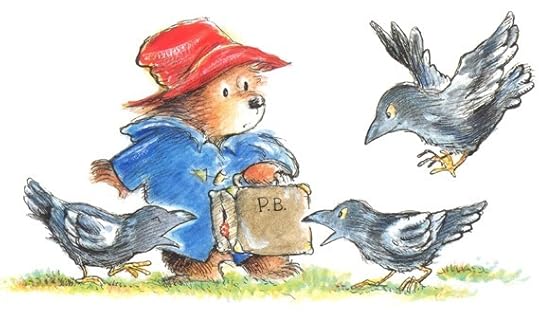 On May 27th, 1541, Margaret Pole, the Countess of Salisbury, had her head forced onto the executioner’s block after resisting the guards. She famously retaliated, wishing not to die and repeating her innocence and her loyalty to the King before the executioner finished her off. Could she have any idea then that, four centuries later, royal fanatics like myself would sip her life story from a souvenir shot glass? What would Anne Boleyn think if she had learned that some parent in London had bought a Queen Anne Boleyn costume for their five year old for Halloween? Or if Catherine Howard saw a cartoonish version of herself being chased by King Henry with a bloodied axe for a children’s coloring book?
  SCARY!!! As I stood on Tower Green, on the exact spot that hundreds of Londoners had witnessed the execution of may of the prisoners in The Tower, on the exact spot that Margaret Pole actively retaliated against her executioner, I suddenly felt the irony at that moment.
 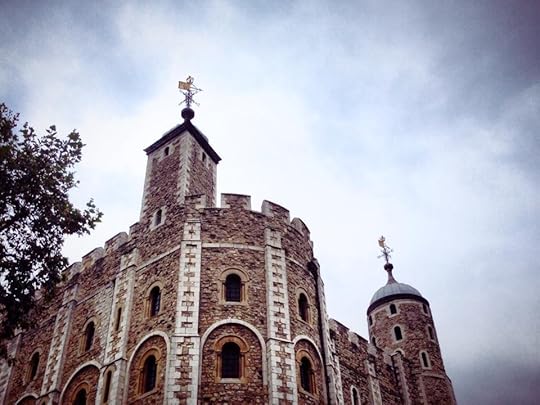 On one level sneaking into The Tower of London was almost a disrespectful affront to the other prisoners who were held and ultimately executed in The Tower of London – including Edward Plantagenet, the 17th Earl of Warwick, who was placed in The Tower when he was only 10 years old by Henry VII, all because Edward was a potential threat to Henry VII’s throne. For 14 years Edward was imprisoned in The Tower until one fine day, Henry VII decided to execute him on November 28th, 1499. Did tourists want to remember him by purchasing a £600 tea set for their dining room? At the time, that didn’t stop me from purchasing several postcards of The Tower of London to send to my friends back in America. But once Jon and I took The Tube back to our flat on Stamford Street, I felt guilty.
Those chilling moments of visiting The Tower's torture chambers, the basket where Lady Jane Grey's head had fallen after her beheading and witnessing the cells that the prisoners were held in, were one of the big draws of visiting The Tower of London in the first place.
I'll admit, one of my happiest and saddest moment at The Tower of London was standing before the glass memorial site on Tower Green. It was a space that centuries ago was once full of crowds jeering before the scaffolds. Now, a glass-sculpted pillow was in its place. It was encompassed by two engraved circles with the names of the ten famous and not so famous individuals who were beheaded on the grounds of Tower Green.
All I could think about as I looked at that glass pillow was how much nicer Lady Jane Grey's head would have looked if her head hadn't landed in a woven basket. What on Earth was wrong with me?
Why was I so fascinated with a place that had killed so many people? Was that normal? How come I never got this excited whenever I visited Hawaii or Santa Barbara? Why did I enjoy seeing the spot that poor Margaret Pole died at nine o’clock on a Saturday afternoon? I’m a pretty happy person, so why did I compare The Tower of London earlier to my version of fucking Disneyland?
“It’s history,” Jon said to me over dinner with our flatmates when I expressed this concern of mine. “You don’t go there to mourn, you go there to be thankful that the United Kingdom isn’t ruled anymore by a Fat Pig going crazy with syphilis. When I went to the gift shop, you know what I bought for myself? Operation. The King Henry VIII version where you pick out tapeworms from his gut. It’s the past. We see it. We remember it, and we move on from it.”
I said, “Why the hell did you buy the King Henry VIII version of Operation?”
“Why the hell wouldn’t I buy it? It looked cool.”
If I had to nail down the objective of my fascination with royal history – primarily with The Tudors – from what Jon had said to me, it would probably be collective evidence to support my gratefulness that we no longer lived in a world where a Fat Pig named Henry VIII was in power.
Though the world is still a small and scary place, nothing is worse than being sent to your own execution, like Margaret Pole. Especially if you are innocent.
When you know such trivia about the prisoners who were held in The Tower of London, you wonder if their innocence in any way shape or form was a real enough hope for them to believe that they would be released out from The Tower unscathed. Now compare that to the mischief I had gotten myself into in order to sneak my way into The Tower of London.
As Margaret Pole carved on the wall on her cell:
For traitors on the block should die;
I am no traitor, no, not I!
My faithfulness stands fast and so,
Towards the block I shall not go!
Nor make one step, as you shall see;
Christ in Thy Mercy, save Thou Me!
For such an innocent soul, look how she turned out. 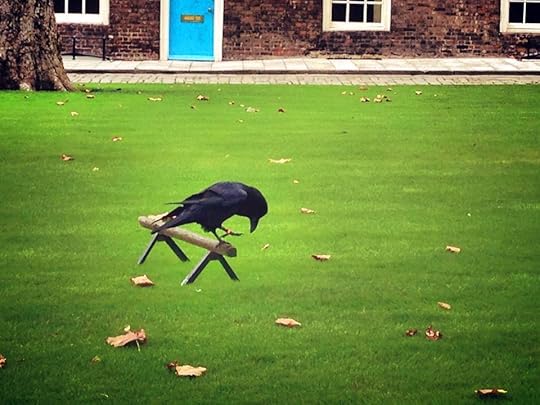 *DISCLAIMER: If anyone from the British government is reading this and is angry at me for not purchasing my own ticket to enter The Tower of London, I owe you guys £21.
Sorry. Not sorry.
Before arriving in London for my Junior year abroad, I was transported, in my imagination, to the historical city through an array of British novels. I wasn't aware that the River Thames was pronounced, Tems, nor was I aware that you could visit Parliament (with a £21 fee of course), and nobody actually told me that Windsor Castle wasn't in the City of London, but rather – of course – in Windsor. I'd just assumed that everything of importance and of historical value resided in London.Go figure.
I had been living in London for almost three full weeks and was dying to see the birth place of Queen Victoria (Kensington Palace), the cathedral where all the past kings and queens of England had been coronated (Westminister Abbey) and to get my haircut on the infamous street that Sweeney Todd supposedly wreaked havoc on (Fleet Street). Though I am an English major and revival in the literature of Dickens, Shakespeare, Chaucer and Austen – all of whom I read and studied while I was abroad – I figured that London was the best place for a voracious reader to be.But there was also a selfish reason that I traveled to England: I am absolute nerd when it comes to English royal history.
I am one Amazon click away from purchasing the complete series of The Tudors. I post on my Facebook page everyday a blurb about some historical event that had occurred in Elizabethan England that day. I have a genealogy chart of all the Kings and Queens of England in my dorm room – listed from the earlier rulers of the Angelo-Saxons all the way down to the present Queen of England, Her Majesty Queen Elizabeth II. My airport reading material – a Philippa Gregory novel about the Plantagenets or a novel about one of King Henry VIII’s six wives – always receives an approving nod from whatever middle-aged woman on my flight is reading a Gillian Flynn book B.cause obviously every domestic flight requires a middle-aged woman with a Gillian Flynn book in her luggage or carry-on.It's like approved by the TSA.
So when I was living in London and daydreaming about Hampton Court and Buckingham Palace, the one place I wanted to go to out of anywhere else in the city was The Tower of London.You have to understand as a royal history nerd, The Tower of London was the equivalent to Disneyland for me. Which – if you know your history about The Tower of London – is a pretty gruesome comparison when you think about it.
I am a sucker for The War of the Roses and Tudor England, because those two subjects featured the central tension of the people who were imprisoned in The Tower. The conflict between who had a claim to the English throne, who had betrayed the king’s trust and who was a threat to the English crown.
The Tower’s most famous guests include The Princes in The Tower during The War of The Roses – Edward and his younger brother Richard who were rumored to be murdered by their uncle, Richard III. Good old Anne Boleyn was sent to The Tower – Henry VIII’s second wife – when she was found guilty of witchcraft and for being unfaithful to the king. A form of treason, no less. Same went for Katherine Howard, Henry’s fifth and more promiscuous wife. I fancied the idea that The Tower of London was pretty much the same as The Hotel California. As they say in the song, “You may check out, but you can never leave.” Unfortunately, that’s what happened to most of the prisoners who were found guilty in The Tower of London. They were immediately executed. The most heartbreaking story about a prisoner who was sent to The Tower, was Lady Margaret Pole, King Henry’s older cousin. She was the last heir to the Plantagenet family and was sentenced to be executed for treason. She was dragged kicking and screaming to the execution block, and when she refused to lay her head on it, it was forced down. As she struggled to free herself from the guards, the executioner’s first blow made a gash on her shoulder rather than her neck. It took ten additional blows to complete Margaret Pole’s execution.She was 67 years old and innocent.
So as you can imagine, these people's horrifying deaths made The Tower of London even more of an appealing tourist attraction for me. I went with my friends Jon, Connor and Mel for the day to The Tower. We took the Tube from Waterloo Station to Tower Hill to meet with Jon's study abroad group, which consisted of Connor, Mel and 88 other people from all over the United States who had come to London to study.I did not apply to any study abroad groups when I decided to travel to London. One, because I didn’t know that study abroad groups liked IFSA Butler or Arcadia existed before applying; and two, if I really wanted to have a true study abroad experience I didn’t want to find myself surrounded by a bunch of Americans. I wanted to be fully immersed in the London way of life, and I would have. If Jon, an American from Northwestern University, hadn’t become my flatmate.
“So Miranda Cannon won’t be able to make it to The Tower with us,” Jon was telling me in between stops on the Tube. “So just tell them that you’re her and they’ll give you a free ticket.”Jon and his American friends were part of the Arcadia Study Abroad Group that had received free tickets to get into The Tower of London. This was just one of the many perks that I had wished I had known about before I decided to go abroad alone. Jon told me that if you were part of the Arcadia Group you got free mimosas at the very top of The Shard, plus Afternoon Tea at Bea’s of Bloomsbury and free tickets into any of the royal palaces within the city of London. However, since I obviously wasn’t part of the Arcadia Group, I would have to pay for my own ticket to get into The Tower of London. Which was, sadly, an expensive £22 (that’s $32 for one person.)
But thankfully because I had made Jon’s ears bleed with countless tales from The Tower of London, he had an idea to help save me some money: By pretending to be Miranda Cannon. “They won’t ask you for your ID. You just need to tell them you’re Miranda,” Jon said when we left Tower Hill Station and made our way to The Tower.
“You mean they don’t check you?” I asked.
“Jacqueline, it’s the goddamn Tower of London, not Coachella. Not many people are going to show up at nine in the morning on a Saturday to see this place.”
When the four of us crossed the street, The Tower of London was right in front of us.
Thousands of ceramic poppies were carpeted around the moat to The Tower of London. It looked like a sea of red blood was oozing out from the very bottom of the wall. Jon had explained to me before we left the flat that The Tower of London would be decorated with these ceramic poppies to commemorate the 100-year anniversary of the First World War. Each poppy (there were 888,246 poppies to be exact) represented a lost British or Colonial military personal from World War I.
It was eerie and beautiful at the same time.
We meet up with Jon’s Arcadia friends in line as they waited for their Arcadia leader to hand out the tickets. The Arcadia leader was a twenty-something year old woman with owl rimmed black glasses and white pasty lacquered skin like candle wax. She had a folded table in front of her with a list of all the Arcadia Group names checking in.I was so excited to get inside The Tower.
It was a place that I’ve only read about in books and seen on the Discovery Channel with my Dad; and I was actually here!
I was actually going to see the cells where they held Thomas Cromwell, Thomas Moore and Lady Jane Grey.
As my anticipation grew and grew as I stood in line, the unthinkable happen:
I forgot my “fake” name.
The name, Miranda Cannon suddenly had slipped from my memory!
Jon had already gotten his ticket and was waiting with his Arcadia friends near the entrance of The Tower of London.
THE Tower of London and I forgot my name!
SO CLOSE AND YET SO FAR!!! To make matters worse, I was next in line.“Name?” The Arcadia leader asked me.
Fuck! Fuck! Fuck!
I dropped my eyes straight down to the list of names and said the first name I saw:
“Penelope Wentworth.”
Could I have been any stupider?
“All right,” the woman said as she checked Penelope’s name off from her list. “For a second there you seemed like you had forgotten your name.”
“Yeah, that tends to happen,” I said quickly, as I grabbed my free ticket to The Tower of London.
My first attempt at identity thief. I rushed to Jon and his group of friends, dread stewing in the pit of my stomach.“I got the ticket,” I managed to say.
Jon’s eyebrows hiked up his face. “Are you serious?”
He looked shocked, which confused me because this whole scheme of using someone else’s name was his idea.
“Yeah,” I said.
“You used Miranda’s name?”
“Well . . .” and I explained to him how my excitement for entering The Tower of London deflected me from remembering Miranda’s name.
“I used someone else’s name. Penelope something.”
“Oh good,” Jon released a sigh. “Because I just saw the real Miranda Cannon get in line a few minutes after I bought my own ticket.”
Looking back now, this was actually hilarious. But I was so scared of not getting into The Tower that I didn’t quite laugh immediately. Even when I flashed my free ticket at the Beefeaters at the entrance of the gate, I was afraid that the real Penelope would report me to the guards, and throw my ass in the same cell that Anne Boleyn was held in during her imprisonment. But no one came to throw me in chains or to make me walk the scaffoldings to the executioner's block.Jon later told me that Miranda just randomly decided to come out to explore The Tower of London – even though she previously told him that she preferred sleeping in.
Thankfully, as the day progressed, the real Penelope Wentworth never showed up to check in with the Arcadia leader.
So for the rest of the day at The Tower of London, I was Penelope Wentworth.
And I had finally made it to The Tower of London!
The Tower of London I learned boasts everything you would want from a trip down British memory lane. On the South Lawn, there was the fun kind of bad actors in period costumes emoting through a reenactment of recruits swearing in to join the Royal Fusiliers during World War I. Someone dressed up as Lord Kitchener and proclaimed before a podium that, "those who have been offering their services to King and Country should be well treated. Any man will receive a bonus if they are recruited to fight in the war." There's The Crown Jewels which – because they are THE Crown Jewels of England – sets you up on a moving walkway so that you can briefly appreciate the regalia and vestments worn by the past sovereigns of the United Kingdom before being forced to move to another equally priceless object for about four to five seconds.
My favorite was the golden punch bowl, a massive vessel engraved with the arms of George IV. It was used to celebrate the christening of Queen Victoria's son, Prince Albert Edward in 1842. Think of all the possibilities Queen Victoria would have done with a golden punch bowl that size. It was so big that you could even bathe in it. But I couldn't help but imagine how fun it would be if the fraternities back at UMass Amherst got ahold of a punch bowl this size. Talk about a bottomless treasure trove of ice cold Heinekens and Budweisers. Bluto from Animal House would have been proud.
The Bloody Tower, where the two Princes where last seen alive before they went missing. Although, I have a feeling that they had renamed that tower AFTER the two Princes had disappeared. Because imprisoning two Princes of the blood in a tower that was originally called The Bloody Tower, is kinda an obvious giveaway that someone was plotting a murder.
And – so that I would feel like a total cheeseball – Jon and his friends and I ransacked the gift shop. I almost bought my God-Sister a book about Paddington Bear visiting The Tower of London, titled Paddington at the Tower, but something stopped me.
On May 27th, 1541, Margaret Pole, the Countess of Salisbury, had her head forced onto the executioner’s block after resisting the guards. She famously retaliated, wishing not to die and repeating her innocence and her loyalty to the King before the executioner finished her off. Could she have any idea then that, four centuries later, royal fanatics like myself would sip her life story from a souvenir shot glass? What would Anne Boleyn think if she had learned that some parent in London had bought a Queen Anne Boleyn costume for their five year old for Halloween? Or if Catherine Howard saw a cartoonish version of herself being chased by King Henry with a bloodied axe for a children’s coloring book? SCARY!!! As I stood on Tower Green, on the exact spot that hundreds of Londoners had witnessed the execution of may of the prisoners in The Tower, on the exact spot that Margaret Pole actively retaliated against her executioner, I suddenly felt the irony at that moment. On one level sneaking into The Tower of London was almost a disrespectful affront to the other prisoners who were held and ultimately executed in The Tower of London – including Edward Plantagenet, the 17th Earl of Warwick, who was placed in The Tower when he was only 10 years old by Henry VII, all because Edward was a potential threat to Henry VII’s throne. For 14 years Edward was imprisoned in The Tower until one fine day, Henry VII decided to execute him on November 28th, 1499. Did tourists want to remember him by purchasing a £600 tea set for their dining room? At the time, that didn’t stop me from purchasing several postcards of The Tower of London to send to my friends back in America. But once Jon and I took The Tube back to our flat on Stamford Street, I felt guilty. Those chilling moments of visiting The Tower's torture chambers, the basket where Lady Jane Grey's head had fallen after her beheading and witnessing the cells that the prisoners were held in, were one of the big draws of visiting The Tower of London in the first place.
I'll admit, one of my happiest and saddest moment at The Tower of London was standing before the glass memorial site on Tower Green. It was a space that centuries ago was once full of crowds jeering before the scaffolds. Now, a glass-sculpted pillow was in its place. It was encompassed by two engraved circles with the names of the ten famous and not so famous individuals who were beheaded on the grounds of Tower Green.
All I could think about as I looked at that glass pillow was how much nicer Lady Jane Grey's head would have looked if her head hadn't landed in a woven basket.
What on Earth was wrong with me?Why was I so fascinated with a place that had killed so many people? Was that normal? How come I never got this excited whenever I visited Hawaii or Santa Barbara? Why did I enjoy seeing the spot that poor Margaret Pole died at nine o’clock on a Saturday afternoon? I’m a pretty happy person, so why did I compare The Tower of London earlier to my version of fucking Disneyland?
“It’s history,” Jon said to me over dinner with our flatmates when I expressed this concern of mine. “You don’t go there to mourn, you go there to be thankful that the United Kingdom isn’t ruled anymore by a Fat Pig going crazy with syphilis. When I went to the gift shop, you know what I bought for myself? Operation. The King Henry VIII version where you pick out tapeworms from his gut. It’s the past. We see it. We remember it, and we move on from it.”
I said, “Why the hell did you buy the King Henry VIII version of Operation?”
“Why the hell wouldn’t I buy it? It looked cool.”
If I had to nail down the objective of my fascination with royal history – primarily with The Tudors – from what Jon had said to me, it would probably be collective evidence to support my gratefulness that we no longer lived in a world where a Fat Pig named Henry VIII was in power.
Though the world is still a small and scary place, nothing is worse than being sent to your own execution, like Margaret Pole. Especially if you are innocent.
When you know such trivia about the prisoners who were held in The Tower of London, you wonder if their innocence in any way shape or form was a real enough hope for them to believe that they would be released out from The Tower unscathed. Now compare that to the mischief I had gotten myself into in order to sneak my way into The Tower of London.
As Margaret Pole carved on the wall on her cell:
For traitors on the block should die;
I am no traitor, no, not I!
My faithfulness stands fast and so,
Towards the block I shall not go!
Nor make one step, as you shall see;
Christ in Thy Mercy, save Thou Me!
For such an innocent soul, look how she turned out.
*DISCLAIMER: If anyone from the British government is reading this and is angry at me for not purchasing my own ticket to enter The Tower of London, I owe you guys £21.Sorry. Not sorry.
October 19, 2015
10 Ways To Get Yourself Hyped Up For Halloween
I don't know about you, but fall is my favorite season. Especially when you live in New England.
Massachusetts's fall foliage is absolutely legendary. Leaves turning from green to a red-gold, farmhouses selling pumpkins and apple cider right at their doorstep and stark white spires from town churches illuminating against the scarlet maple leaf-piles in front yards.
It shouldn’t come to a surprise that the New England milieu has produced the perfect backdrop to the fall season. With russet-red barns and white farmhouses, steepled churches and village greens, every colonial building in Massachusetts is a welcoming sight for the new season.
I absolutely LOVE this time of the year, mainly because this what I get to look forward to every time fall comes to Mount Holyoke's campus: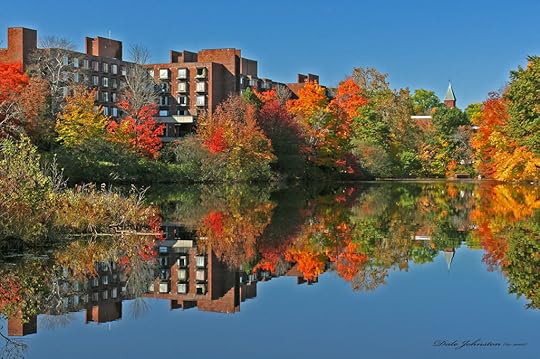 Don't you just want to breathe in that crisp Autumn air after looking at that?
Yes, there are many reasons why so many people love fall – besides ordering a pumpkin spiced latte at Starbucks – but what most people look forward to when this time of year rolls around is Halloween.
So, if you're like me, and love the new fall weather but want to make the most of your Halloween experience, then count on these tips to help you get hyped up for spooky holiday.
#10: Binge Watch A Bunch of Horror Movies Until the End of October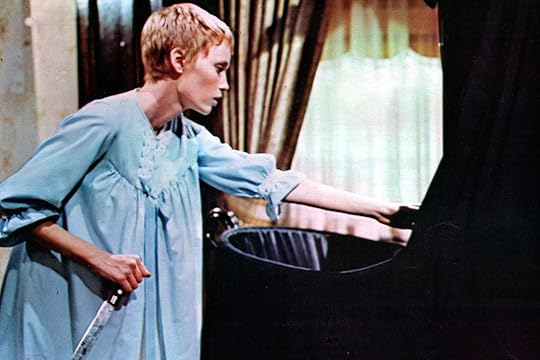 Come on! How can you NOT watch at least one horror movie during the month of October? If you're a true cinephile then you might have taken on the "31 Days of Horror" challenge and attempt to watch a horror movie a day all the way up to Halloween.
But it's a fact when October rolls around that you're not going anywhere – and I don't mean that in a creepy Freddy Krueger way. Sure you might want to jump into a pile of crispy leaves or chill at your local Starbucks with your pumpkin spiced lattes . . . but you could also be watching Roman Polanski's Rosemary's Baby.
Why not stay in with your Netflix and get into the true Halloween spirit by watching Nazi zombies attack and eat stupid college students from Dead Snow. Or watching Regan MacNeil spider-walk downstairs from The Exorcist.
The choice is yours. Although, after watching this scene from The Exorcist, it will scar you for life.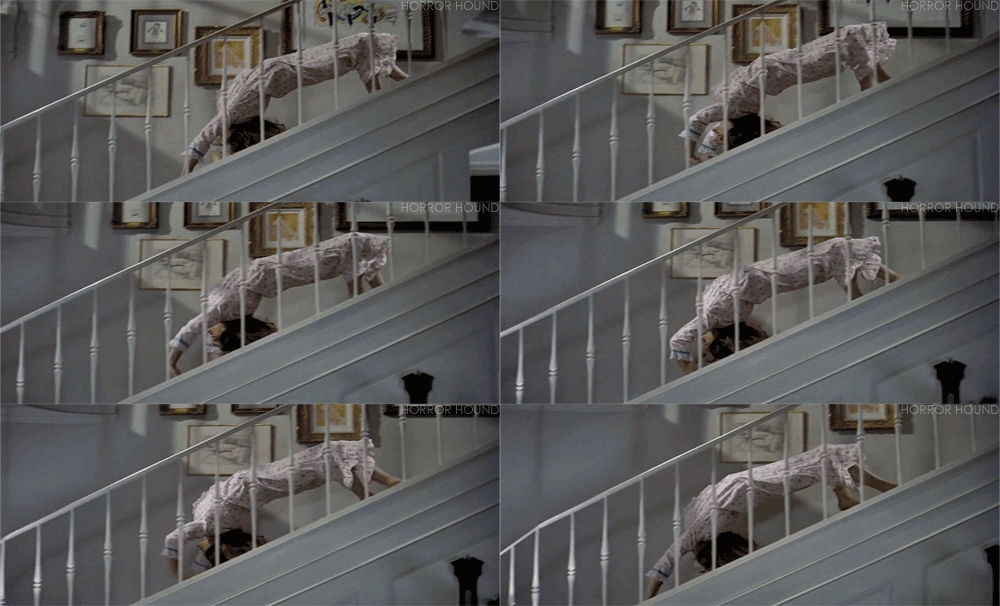 Man, I wish I was that flexible.
And don't get me started on that 180 degree head spin.
#9 Decorate, Decorate, Decorate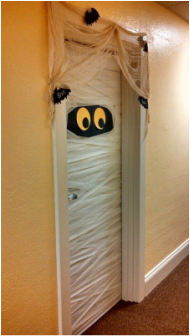
 So you're watching horror movies and stuffing your candy drawer full of king sized Hersey Chocolate Bars and bags of Candy Corn. Now it's time to get your door into the Halloween spirit as well. Whether you live in an apartment complex or a college dorm room, you can get creative with some simple ideas to decorate your door.
Target, Walmart, or any Dollar Store in the area will have a ton of fun and easy Halloween-themed products.
Or if you would rather decorate your window instead, anything from construction paper monsters and and black cat silhouettes will definitely give your windows much more character.
 So take a stab at decorating your dorm room or apartment doors and windows with whatever spooky ideas inspire you.
#8 Get the 4-1-1 On What's Happening On Halloween Around Your Area Corn mazes!
Haunted Houses!
Halloween Parties!
Fright Fest at Six Flags Magic Mountain!
Oh my!!!!
Before you even purchase that costume, it's important to know on a first hand basis what kind of Halloween celebrations are going to be happening in your area. Check the newspaper, bulletin boards and Facebook early in the month to plan your Halloween extravaganza.
The chances of spotting an event for a a Halloween themed pub crawl, costume contest or horror flick are really high. You just have to look in the right places.
 Just remember, stay clear of that spooky abandoned house on the corner of your street. You know, the one that everyone claims in haunted.
Also avoid burials grounds.
That's just asking for trouble if you and your friends are up to mischief.
#7: Cocktails Anyone? Black Devil Martini As the saying goes: It's 5 o'clock somewhere.
As the saying does NOT go: It's Halloween somewhere.
And although it is true that Halloween only happens once a year, whose to say that Halloween can't happen early?
Pick your poison to get you in the mood to do the Monster Mash.
Just to name a few creepy cocktails to get your spine-tingling:
The Mr. Hyde Potion The Morgue-A-Rita
 The Vampire
 The Black Widow
 Aren't these drinks just to die for?
  #6: BUY ALL THE CANDY!!!
 Whether it comes in bulk or king size, having a treasure trove of Halloween candy within reach will put the premium on your personal expression for Halloween.
Or, you know, make you gain weight. But who cares? It's Halloween. You're suppose to eat a lot of candy. Eating Halloween candy essentially prepares you for eating that big Thanksgiving meal come November. So start prepping.
Of course, no one needs to tell you that candy corn (that is, if you like candy corn) is the official candy for Halloween. But if you want to broaden your horizons and break away from the stereotypical Hersey Chocolate Bars and Reese's Peanut Butter Cups then try and resist the urge to eat these delicious snacks when you refill your candy drawer next to your bed:
Pop Rocks Crunch Bars
 Swedish Fish
 Galaxy Bar
 So if you're someone who has a serious sweet-tooth at this time of year, then don't even hesitate. Find that perfect treat without getting tricked.
 #5: Read a Good Horror Novel
 If you are not one for scary movies, but personally enjoy a good book, then why not plan your schedule around a book a week for the month of October? Depending how fast of a reader you are, you can fit in as many suspenseful, thrilling and mind-bending novels that you can get your hands on.
As the fall weather proceeds to get colder, one of the best things you can ever do is curl up with a good book while sipping on some hot cider.
When there is a chill in the air, anything good would be under Edgar Allen Poe's dark poetry and grim stories. Dracula and Frankenstein are obviously two of the best books to read when this time of year rolls around. However, if you want something new and more modern, anything written by the King of Suspense himself, Stephen King, will certainly have you counting down the days to Halloween.
 #4: Pumpkin Carving Party
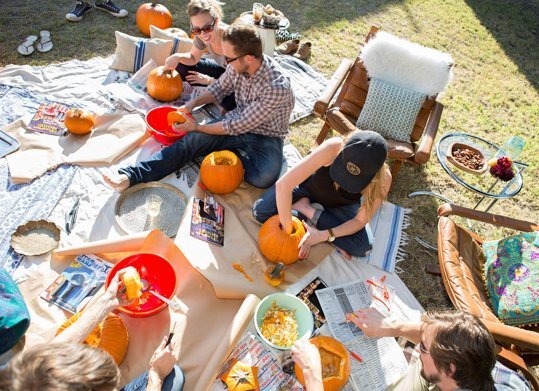 Nothing says Halloween more than carving pumpkins. Whether you want to aim for the standard triangle eyes and toothy grin, or challenge yourself with an intricate design, you'll certainly feel the holiday spirit.
Or, you know, maybe some of that cold pumpkin goo.
Either way, hosting a pumpkin carving party is the best way to get together with your pals. Create a Halloween themed playlist to listen to while you and your friends are carving (i.e. "Ghostbusters," "I Put a Spell on You," "Thriller").

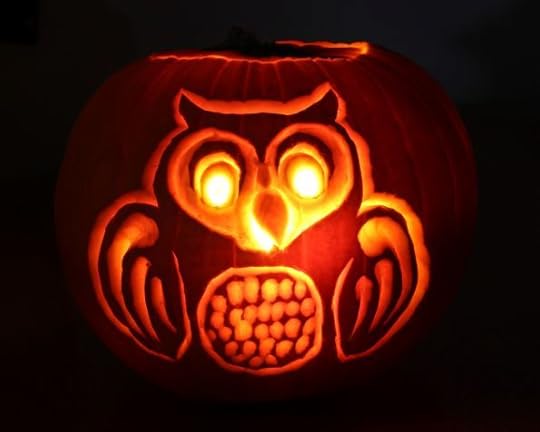 In addition, after you're done carving your pumpkins, you can bake the pumpkin seeds and snack on them!
Just remember, don't carve your pumpkins too early in October or it won' t survive Halloween night. Once cut, a pumpkin lasts for about four to five days before starting to rot.
#3: Participate in a Halloween Themed Bar Crawl Other than New Years Eve, Halloween dominates the nightly bar scene. If you and your friends already have a costume in mind, then there's only one other major decision to make: where are you going to drink first?
Usually these bar crawls happen before Halloween, but most of them begin the day of. In addition, there are some towns who host annual bar crawls, in which you register for the crawl. You pay for a wristband that will gain you free admission into the participating venues along with drink specials. Other bar crawls you just show up and pay for the drinks.
There really is no wrong way to participate in a bar crawl.
Just remember to drink responsibly . . . and avoid making out with anyone dressed up as a zombie. #2: Get Your Snack On
 If you're not a fan of the horror that comes with Halloween, and you're looking to celebrate the holiday in a less gruesome fashion, then cooking Halloween themed snacks is a sure way to savor the holiday spirit.
Here are a few ideas to help inspire you to make that best Halloween culinary treat:
Mini Candy Corn Layer Cake
 Chocolate - Dipped Pumpkin Madeline's
 Sweet and Salty Popcorn
 Halloween Peppermint Patties
 These culinary creation are sure to hit the spot.
  #1: Get Creative with Your Costume
 When it comes to choosing a Halloween costume, it can sometimes be exhausting.
Deciding on what you're going to wear on the only day of the year when it's socially acceptable to dress up and walk around without anyone thinking that you're crazy. It takes a lot of effort to make an executive decision about a costume choice.
Sometimes people will dress up as politicians, celebrities or things that have occurred in our current events (I mean a sexy Donald Trump wouldn't be a bad costume idea).
But if you're like me and I love Halloween, but have been known to put your costume off until the last second, you can still put together some awesome Halloween outfits the week, the day, and even the night before Halloween.

 So as you can see there are plenty things to help get you excited for Halloween.
Enjoy the fall weather as well as the rest of your October.
Because before you know it, it will be Thanksgiving!
Kind of a terrifying thought when you think about it.
Massachusetts's fall foliage is absolutely legendary. Leaves turning from green to a red-gold, farmhouses selling pumpkins and apple cider right at their doorstep and stark white spires from town churches illuminating against the scarlet maple leaf-piles in front yards.
It shouldn’t come to a surprise that the New England milieu has produced the perfect backdrop to the fall season. With russet-red barns and white farmhouses, steepled churches and village greens, every colonial building in Massachusetts is a welcoming sight for the new season.
I absolutely LOVE this time of the year, mainly because this what I get to look forward to every time fall comes to Mount Holyoke's campus:
Don't you just want to breathe in that crisp Autumn air after looking at that?Yes, there are many reasons why so many people love fall – besides ordering a pumpkin spiced latte at Starbucks – but what most people look forward to when this time of year rolls around is Halloween.
So, if you're like me, and love the new fall weather but want to make the most of your Halloween experience, then count on these tips to help you get hyped up for spooky holiday.
#10: Binge Watch A Bunch of Horror Movies Until the End of October
Come on! How can you NOT watch at least one horror movie during the month of October? If you're a true cinephile then you might have taken on the "31 Days of Horror" challenge and attempt to watch a horror movie a day all the way up to Halloween. But it's a fact when October rolls around that you're not going anywhere – and I don't mean that in a creepy Freddy Krueger way. Sure you might want to jump into a pile of crispy leaves or chill at your local Starbucks with your pumpkin spiced lattes . . . but you could also be watching Roman Polanski's Rosemary's Baby.
Why not stay in with your Netflix and get into the true Halloween spirit by watching Nazi zombies attack and eat stupid college students from Dead Snow. Or watching Regan MacNeil spider-walk downstairs from The Exorcist.
The choice is yours. Although, after watching this scene from The Exorcist, it will scar you for life.
Man, I wish I was that flexible. And don't get me started on that 180 degree head spin.
#9 Decorate, Decorate, Decorate
So you're watching horror movies and stuffing your candy drawer full of king sized Hersey Chocolate Bars and bags of Candy Corn. Now it's time to get your door into the Halloween spirit as well. Whether you live in an apartment complex or a college dorm room, you can get creative with some simple ideas to decorate your door. Target, Walmart, or any Dollar Store in the area will have a ton of fun and easy Halloween-themed products.
Or if you would rather decorate your window instead, anything from construction paper monsters and and black cat silhouettes will definitely give your windows much more character.
So take a stab at decorating your dorm room or apartment doors and windows with whatever spooky ideas inspire you.#8 Get the 4-1-1 On What's Happening On Halloween Around Your Area
Corn mazes!Haunted Houses!
Halloween Parties!
Fright Fest at Six Flags Magic Mountain!
Oh my!!!!
Before you even purchase that costume, it's important to know on a first hand basis what kind of Halloween celebrations are going to be happening in your area. Check the newspaper, bulletin boards and Facebook early in the month to plan your Halloween extravaganza.
The chances of spotting an event for a a Halloween themed pub crawl, costume contest or horror flick are really high. You just have to look in the right places.
Just remember, stay clear of that spooky abandoned house on the corner of your street. You know, the one that everyone claims in haunted. Also avoid burials grounds.
That's just asking for trouble if you and your friends are up to mischief.
#7: Cocktails Anyone?
Black Devil Martini As the saying goes: It's 5 o'clock somewhere.As the saying does NOT go: It's Halloween somewhere.
And although it is true that Halloween only happens once a year, whose to say that Halloween can't happen early?
Pick your poison to get you in the mood to do the Monster Mash.
Just to name a few creepy cocktails to get your spine-tingling:
The Mr. Hyde Potion
The Morgue-A-Rita
The Vampire
The Black Widow
Aren't these drinks just to die for?
#6: BUY ALL THE CANDY!!!
Whether it comes in bulk or king size, having a treasure trove of Halloween candy within reach will put the premium on your personal expression for Halloween. Or, you know, make you gain weight. But who cares? It's Halloween. You're suppose to eat a lot of candy. Eating Halloween candy essentially prepares you for eating that big Thanksgiving meal come November. So start prepping.
Of course, no one needs to tell you that candy corn (that is, if you like candy corn) is the official candy for Halloween. But if you want to broaden your horizons and break away from the stereotypical Hersey Chocolate Bars and Reese's Peanut Butter Cups then try and resist the urge to eat these delicious snacks when you refill your candy drawer next to your bed:
Pop Rocks
Crunch Bars
Swedish Fish
Galaxy Bar
So if you're someone who has a serious sweet-tooth at this time of year, then don't even hesitate. Find that perfect treat without getting tricked.
#5: Read a Good Horror Novel
If you are not one for scary movies, but personally enjoy a good book, then why not plan your schedule around a book a week for the month of October? Depending how fast of a reader you are, you can fit in as many suspenseful, thrilling and mind-bending novels that you can get your hands on. As the fall weather proceeds to get colder, one of the best things you can ever do is curl up with a good book while sipping on some hot cider.
When there is a chill in the air, anything good would be under Edgar Allen Poe's dark poetry and grim stories. Dracula and Frankenstein are obviously two of the best books to read when this time of year rolls around. However, if you want something new and more modern, anything written by the King of Suspense himself, Stephen King, will certainly have you counting down the days to Halloween.
#4: Pumpkin Carving Party
Nothing says Halloween more than carving pumpkins. Whether you want to aim for the standard triangle eyes and toothy grin, or challenge yourself with an intricate design, you'll certainly feel the holiday spirit.Or, you know, maybe some of that cold pumpkin goo.
Either way, hosting a pumpkin carving party is the best way to get together with your pals. Create a Halloween themed playlist to listen to while you and your friends are carving (i.e. "Ghostbusters," "I Put a Spell on You," "Thriller").
In addition, after you're done carving your pumpkins, you can bake the pumpkin seeds and snack on them!Just remember, don't carve your pumpkins too early in October or it won' t survive Halloween night. Once cut, a pumpkin lasts for about four to five days before starting to rot.
#3: Participate in a Halloween Themed Bar Crawl
Other than New Years Eve, Halloween dominates the nightly bar scene. If you and your friends already have a costume in mind, then there's only one other major decision to make: where are you going to drink first?Usually these bar crawls happen before Halloween, but most of them begin the day of. In addition, there are some towns who host annual bar crawls, in which you register for the crawl. You pay for a wristband that will gain you free admission into the participating venues along with drink specials. Other bar crawls you just show up and pay for the drinks.
There really is no wrong way to participate in a bar crawl.
Just remember to drink responsibly . . . and avoid making out with anyone dressed up as a zombie.
#2: Get Your Snack On
If you're not a fan of the horror that comes with Halloween, and you're looking to celebrate the holiday in a less gruesome fashion, then cooking Halloween themed snacks is a sure way to savor the holiday spirit. Here are a few ideas to help inspire you to make that best Halloween culinary treat:
Mini Candy Corn Layer Cake
Chocolate - Dipped Pumpkin Madeline's
Sweet and Salty Popcorn
Halloween Peppermint Patties
These culinary creation are sure to hit the spot.
#1: Get Creative with Your Costume
When it comes to choosing a Halloween costume, it can sometimes be exhausting. Deciding on what you're going to wear on the only day of the year when it's socially acceptable to dress up and walk around without anyone thinking that you're crazy. It takes a lot of effort to make an executive decision about a costume choice.
Sometimes people will dress up as politicians, celebrities or things that have occurred in our current events (I mean a sexy Donald Trump wouldn't be a bad costume idea).
But if you're like me and I love Halloween, but have been known to put your costume off until the last second, you can still put together some awesome Halloween outfits the week, the day, and even the night before Halloween.
So as you can see there are plenty things to help get you excited for Halloween.Enjoy the fall weather as well as the rest of your October.
Because before you know it, it will be Thanksgiving!
Kind of a terrifying thought when you think about it.
September 30, 2015
A College Senior's Inner Monologue When Becoming A College Senior
So, you're finally a senior.
How the hell did that happen?
Weren't you a freshmen, like, yesterday?
If you suddenly find yourself, nostalgic, confused, sad, or are experiencing cap-and-gown-phobia, it's probably because you put together the fact that you're A MOTHER F**KING COLLEGE SENIOR! Whoa! No need to get defensive!
Look, I understand that you are feeling ALL THE FEELS at the moment, and that you are ready to punch someone in the face if anyone says the "S" word to you. No need to freak out.
It's okay. It's all going to be okay.
Just take things slow and enjoy the year.
Besides, it might be comforting to know that many other seniors in your grade share same exact thoughts as you.
Don't believe me?
You'd be surprise. The Shock That Dawns On You When You Realize That The Freshmen Are Now Juniors
 Wait? Weren't you a freshmen last time I saw you? Like, seriously, I'm not even kidding. I was a sophomore and you were a freshmen. HOW ARE YOU A JUNIOR?!?!?! That doesn't make any sense! You mean to tell me that you have one more year left at this college? I don't get another year after you! I get kicked out into the adult world! You should at least be a sophomore, not a f**king junior?! Explain to me how that happened!?
The Pain You Get When You Suddenly Find Yourself Saying, "This is my last . . ." Welp, this is my last convocation.
Gee, I guess this is my last first day of classes.
Wow, this is my last Halloween college party.
God, this is also my last college football game.
HOLY CRAP! This is the last time I can ever dress up for The Rocky Horror Picture Show with my friends!
This can't be happening! This actually cannot be happening!
The Thoughts You Have When You Write Up Your Senior Bucket List All right, lets see here.
Go to a Harvard vs. Yale Football Game.
Ooo! Check out the county fair. That definitely needs to be added.
Meet up with my pals in New York City.
Go apple picking. I've always wanted to go apple picking.
Hmm, interesting. Why is this list so long? Did I seriously not take advantage of all the things that my college town had to offer me? I've been living here for, what, four years now, and not once did I ever muster up the energy to check out any of these amazing activities around me?
Either I've been putting everything off until the last minute, or I'm a world-class procrastinator.
The Absolute Power You Feel When You Successfully Avoid Taking A Friday Class (In God's Voice)
THAT'S RIGHT MOTHER F**KERS! BOW BEFORE THE GREATNESS OF MY SENIOR SCHEDULE!
IN IT'S DEVINE RIGHT, I POSSESS ALL THE FREEDOM OF SLEEPING IN AND WATCHING NETFLIX!
FURTHERMORE, UNLIKE YOU MORTAL BEINGS, I CAN GO OUT DRINKING ON THURSDAY NIGHTS!
ALAS, YOU WILL HAVE TO WAIT ANOTHER YEAR BEFORE YOU CAN APPRECIATE THE GREATNESS OF THIRSTY THURSDAYS! TOO BAD YOU HAVE YOUR MATH AND/OR SCIENCE LAB ON FRIDAY MORNINGS. I'LL JUST BE OVER HERE SIPPING SOME GLORIOUS BLUE MOON FROM THE BOTTLE.
I F**KING LOVE THAT I HAVE NOTHING ON FRIDAYS!!!!!!!!!!!!!!!!!
The Stress You Encounter When You Have To Start Thinking About A Job After College Job? Who said anything about a job? Am I suppose to start looking for a job right now? But I don't wanna a real job yet. Having a real job means that I have to have a real plan!
Oh my God! Do people think that I have a plan after I graduate from college! Is that a thing? Was I suppose to have a plan? Are they really that ignorant to think that I have a plan?
I'm not ready to search for a job. I'm fine just living on my parents income. Yeah, I guess I can do that. Oh, but that means sitting down and "talking" during dinner . . . WITH MY PARENTS!
So yeah, maybe I am ready for a job. Oh yay! I guess I can get myself excited for a job.
I think. Maybe. Hopefully. Not really.
The Insane Fantasies You Have When Planning Your Last Spring Break With Your Friends Okay, here's the deal: We need to Spring Break the Sh*t out for our Senior Year!
Let's go to Cabo . . . no, Coachella!
NO WAIT! Florida! We should go to Florida! We can be like those chicks in that Spring Breakers movie! Except we don't get arrested or run into James Franco.
We can ride mopeds, go to the beach . . . or, ride our mopeds on the beach!
I'm getting excited just thinking about it! We can go on a boat, swim with the dolphins or go cage diving and swim with the sharks!
HOW COOL WOULD THAT BE?!?!
WHO IS WITH ME?!?!?!?
The Inner Turmoil You Feel Whenever Someone Asks You What Your Post-Graduation Plans Are MUST. NOT. PUNCH. FRIEND. IN. THE. FACE.
MUST. SMILE.
MUST. SAY: "I. AM. EXPLORING. MY. OPTIONS."
MUST. NOT. PUNCH.
MUST. NOT. PUNCH. IN. THE. FACE.
MUST. SMILE.
MUST. NOD. HEAD.
MUST. PRETEND. TO. KNOW. WHAT. YOU. ARE. DOING.
The Prolonging Sadness You Feel Everyday When You Walk Around Your Campus Wow, look at that tree.
Wow, look at that building.
Wow, look at that library.
So many memories happened on this campus.
Do I have to leave it one day?
Can't I just stay here? Maybe a little longer?
It's such a beautiful campus.
It's such a nice campus.
I guess I should head to class.
Don't wanna be late. Essentially, when you become a college senior you get hit with so many emotions. Because you know that nine months from now you're be walking out of that college as a graduated adult.
And that very thought is absolutely terrifying.
Thankfully we, seniors, are still in the early stages where we haven't quite accepted the fact that we're graduating soon.
So, as much as we are all bittersweet over our senior year, I believe that this is a good opportunity to not press "fast-forward" on the remote control of our lives. Instead, I think that the general consensus would be to "pause." To appreciate all of the memories that you had on your college campus, as well as the memories you will make from now and until you walk across that stage to accept your diploma.
So heed this advice: We shouldn't be stuck in this "limbo" state worrying about what we're going to do after college. You only get one – and I mean ONE – chance to be a college senior IN YOUR LIFE so take advantage of ABSOLUTELY EVERYTHING!!!
ENJOY IT!
After all, this time, next year, you won't be a college senior anymore.
Nope.
You'll be an Individual.
How the hell did that happen?
Weren't you a freshmen, like, yesterday?
If you suddenly find yourself, nostalgic, confused, sad, or are experiencing cap-and-gown-phobia, it's probably because you put together the fact that you're A MOTHER F**KING COLLEGE SENIOR!
Whoa! No need to get defensive!Look, I understand that you are feeling ALL THE FEELS at the moment, and that you are ready to punch someone in the face if anyone says the "S" word to you. No need to freak out.
It's okay. It's all going to be okay.
Just take things slow and enjoy the year.
Besides, it might be comforting to know that many other seniors in your grade share same exact thoughts as you.
Don't believe me?
You'd be surprise.
The Shock That Dawns On You When You Realize That The Freshmen Are Now Juniors
Wait? Weren't you a freshmen last time I saw you? Like, seriously, I'm not even kidding. I was a sophomore and you were a freshmen. HOW ARE YOU A JUNIOR?!?!?! That doesn't make any sense! You mean to tell me that you have one more year left at this college? I don't get another year after you! I get kicked out into the adult world! You should at least be a sophomore, not a f**king junior?! Explain to me how that happened!?The Pain You Get When You Suddenly Find Yourself Saying, "This is my last . . ."
Welp, this is my last convocation.Gee, I guess this is my last first day of classes.
Wow, this is my last Halloween college party.
God, this is also my last college football game.
HOLY CRAP! This is the last time I can ever dress up for The Rocky Horror Picture Show with my friends!
This can't be happening! This actually cannot be happening!
The Thoughts You Have When You Write Up Your Senior Bucket List
All right, lets see here.Go to a Harvard vs. Yale Football Game.
Ooo! Check out the county fair. That definitely needs to be added.
Meet up with my pals in New York City.
Go apple picking. I've always wanted to go apple picking.
Hmm, interesting. Why is this list so long? Did I seriously not take advantage of all the things that my college town had to offer me? I've been living here for, what, four years now, and not once did I ever muster up the energy to check out any of these amazing activities around me?
Either I've been putting everything off until the last minute, or I'm a world-class procrastinator.
The Absolute Power You Feel When You Successfully Avoid Taking A Friday Class
(In God's Voice)THAT'S RIGHT MOTHER F**KERS! BOW BEFORE THE GREATNESS OF MY SENIOR SCHEDULE!
IN IT'S DEVINE RIGHT, I POSSESS ALL THE FREEDOM OF SLEEPING IN AND WATCHING NETFLIX!
FURTHERMORE, UNLIKE YOU MORTAL BEINGS, I CAN GO OUT DRINKING ON THURSDAY NIGHTS!
ALAS, YOU WILL HAVE TO WAIT ANOTHER YEAR BEFORE YOU CAN APPRECIATE THE GREATNESS OF THIRSTY THURSDAYS! TOO BAD YOU HAVE YOUR MATH AND/OR SCIENCE LAB ON FRIDAY MORNINGS. I'LL JUST BE OVER HERE SIPPING SOME GLORIOUS BLUE MOON FROM THE BOTTLE.
I F**KING LOVE THAT I HAVE NOTHING ON FRIDAYS!!!!!!!!!!!!!!!!!
The Stress You Encounter When You Have To Start Thinking About A Job After College
Job? Who said anything about a job? Am I suppose to start looking for a job right now? But I don't wanna a real job yet. Having a real job means that I have to have a real plan!Oh my God! Do people think that I have a plan after I graduate from college! Is that a thing? Was I suppose to have a plan? Are they really that ignorant to think that I have a plan?
I'm not ready to search for a job. I'm fine just living on my parents income. Yeah, I guess I can do that. Oh, but that means sitting down and "talking" during dinner . . . WITH MY PARENTS!
So yeah, maybe I am ready for a job. Oh yay! I guess I can get myself excited for a job.
I think. Maybe. Hopefully. Not really.
The Insane Fantasies You Have When Planning Your Last Spring Break With Your Friends
Okay, here's the deal: We need to Spring Break the Sh*t out for our Senior Year!Let's go to Cabo . . . no, Coachella!
NO WAIT! Florida! We should go to Florida! We can be like those chicks in that Spring Breakers movie! Except we don't get arrested or run into James Franco.
We can ride mopeds, go to the beach . . . or, ride our mopeds on the beach!
I'm getting excited just thinking about it! We can go on a boat, swim with the dolphins or go cage diving and swim with the sharks!
HOW COOL WOULD THAT BE?!?!
WHO IS WITH ME?!?!?!?
The Inner Turmoil You Feel Whenever Someone Asks You What Your Post-Graduation Plans Are
MUST. NOT. PUNCH. FRIEND. IN. THE. FACE.MUST. SMILE.
MUST. SAY: "I. AM. EXPLORING. MY. OPTIONS."
MUST. NOT. PUNCH.
MUST. NOT. PUNCH. IN. THE. FACE.
MUST. SMILE.
MUST. NOD. HEAD.
MUST. PRETEND. TO. KNOW. WHAT. YOU. ARE. DOING.
The Prolonging Sadness You Feel Everyday When You Walk Around Your Campus
Wow, look at that tree.Wow, look at that building.
Wow, look at that library.
So many memories happened on this campus.
Do I have to leave it one day?
Can't I just stay here? Maybe a little longer?
It's such a beautiful campus.
It's such a nice campus.
I guess I should head to class.
Don't wanna be late.
Essentially, when you become a college senior you get hit with so many emotions. Because you know that nine months from now you're be walking out of that college as a graduated adult.And that very thought is absolutely terrifying.
Thankfully we, seniors, are still in the early stages where we haven't quite accepted the fact that we're graduating soon.
So, as much as we are all bittersweet over our senior year, I believe that this is a good opportunity to not press "fast-forward" on the remote control of our lives. Instead, I think that the general consensus would be to "pause." To appreciate all of the memories that you had on your college campus, as well as the memories you will make from now and until you walk across that stage to accept your diploma.
So heed this advice: We shouldn't be stuck in this "limbo" state worrying about what we're going to do after college. You only get one – and I mean ONE – chance to be a college senior IN YOUR LIFE so take advantage of ABSOLUTELY EVERYTHING!!!
ENJOY IT!
After all, this time, next year, you won't be a college senior anymore.
Nope.
You'll be an Individual.
August 7, 2015
Jon Voyage! A Look Back At The Top 10 Memorable Moments From Jon Stewart
Now back in December, I wrote a blog post that chronicled The Top 10 Awesome Things That Stephen Colbert Has Ever Done. It was when Colbert was ending his long running show, The Colbert Report in order to take over David Letterman's spot for The Tonight Show on CBS.
But before The Colbert Report had aired, and even before Stephen Colbert became a household name, there was Colbert's mentor and friend, Jon Stewart. Stewart, who hosted The Daily Show, bid farewell as the show's host after an extended 16 year run.
 It was Stewart who had turned The Daily Show into a sharp-edged commentary on current events, and delivering the news in layers upon layers of hilarity and sarcasm. In becoming the nation's satirist in chief, Jon Stewart embedded his program with a personal sense of justice and vigilance. For a segment of the nation's viewers who had lost all its faith in broadcast news outlets, many people had turned to Jon Stewart's show. Stewart was a trusted figure who was able to bring the truth to light and to educate young viewers about the actions happening in our world.
So even though his show has now ended, let us remember the the Top 10 Memorable Moments that Jon Stewart had given us, on and off the air:
#10: That Time Jon Stewart Was on Crossfire Back in 2004, Jon Stewart appeared on CNN's Crossfire, a debate show hosted by Paul Begala and Tucker Carlson. Stewart appeared on the program to critique the program and its hosts, whom he blamed for reducing complex social issues and breaking them down to insincere, theatrical shallow arguments. Essentially, Crossfire was more of a show about bickering than actual intellectual debating. On the show, Stewart told the hosts, " I made a special effort to come on this show today because I have privately amongst my friends, and occasional newspapers and television shows, mentioned this show as being 'bad.' . . . It's not so much that [Crossfire] is bad, as it's hurting America. . . . Stop hurting America." Several months later after Jon Stewart's appearance on the show, CNN announced it was canceling Crossfire. The Crossfire incident alone, was proof that Jon Stewart was the news's most reliable critic. Watch the video here.
#9. That Time Jon Stewart Interviewed Jim Cramer When America was suffering from the subprime loan-fueled economic collapse, the nation tuned in to CNBC's Mad Money, an American financed television program hosted by Jim Cramer. The main focus for Mad Money was what to invest in, and how to successfully speculate publicly trade stocks. Remember, Mad Money had aired when American's economy was at it's lowest point. People were so desperate to survive the recession that they would turn on Mad Money and listen to the advice and aid from Jim Cramer. However, most of the things that Jim Cramer said on his show turned out not to be true. This caught Jon Stewart's attention, and he primarily aimed his scorn at Jim Cramer for his unreliable counseling on Mad Money. Cramer agreed to appear on The Daily Show where Jon Stewart used Cramer's own clips from Mad Money to use his own past assertions against him. The interview was so long that Comedy Central had to cut the interview into three parts (all three parts are on The Daily Show's website). Overall, the interview not only displayed Jon Stewart's brilliance as a comedian, but also showed that he can be just as cutthroat as other anchors on television. Watch the video here.
#8: That Time Jon Stewart Sparred With Bill O'Reiley Who knew that watching two white guys fight for 13 minutes could be so entertaining? Bill O'Reilly from Fox News's The O'Reilly Factor, appeared on The Daily Show to talk about his new book. O'Reilly and Stewart had been longstanding rivals and have outspoken their distaste for each other's viewpoints. After briefly plugging O'Reilly's new book Killing Patton, Jon Stewart got right down to making the first punch. "I want you to admit that there is such a thing as white privilege . . . I just want you to say that I'm terribly, terribly wrong on this." O'Reilly shot back that if there's such a thing as white privilege, there's also Asian privilege, since according to him, "they make more money than white people." Stewart dismissed the notion, noting white people had "set the system," which generated a history lesson from O'Reilly, pointing out that slavery in America has ended. The interview eventually spun out of control, leading to a shouting match. Watch the video here.
#7: That Time Malala Yousafzai Left Jon Stewart Speechless
 Twice has Jon Stewart invited Pakistani activist and 2014 Nobel Peace Prize winner Malala Yousafzai to appear on his show. But Malala's first appearance on the show, back in 2013, was exceptionally memorable, because her answer to one of Jon Stewart's questions left him utterly speechless. At a young age, Malala was the subject of an attempted assassination at the hands of a Taliban gunman because she was unafraid to speak out about the educational rights for girls in her native Swat Valley. When she was just 14 years old, a Taliban fighter boarded her bus, pointed a pistol at her head and pulled the trigger. Malala survived, made a full recovery in England and had become a transformative figure on human rights, leading her to become the youngest Nobel Peace laureate ever. In the key moment of the interview Stewart asked her how she reacted when she learned that the Taliban wanted her dead. She answered with this remarkable response:
"I started thinking about that, and I used to think that the Talib would come, and he would just kill me. But then I said, 'If he comes, what would you do Malala?' then I would reply to myself, 'Malala, just take a shoe and hit him.' But then I said, 'If you hit a Talib with your shoe, then there would be no difference between you and the Talib. You must not treat others with cruelty and that much harshly, you must fight others but through peace and through dialogue and through education.' Then I said I will tell him how important education is and that 'I even want education for your children as well.' And I will tell him, 'That's what I want to tell you, now do what you want.'" – Malala Yousafzi Wow. Seriously. Wow. Watch the video here.
#6: When Jon Stewart Changed Television With "Indecision 2000" Six days after Election Day 2000, America was in chaos as the government scrambled to figure out whether George W. Bush or Al Gore would be the next president. Enters Jon Stewart, who astutely summed the recount in Florida with gleeful, alarmed observations. And thus The Daily Show's newest segment, "Indecision 2000" was born! Frustrated with the presidential sideshow, Jon Stewart created "Indecision 2000" for television viewers who were exhausted by the traditional media coverage of the election. But Jon Stewart felt the viewer's pain and would try to ease the anxiety that many Americans were feeling about the election. The success of "Indecision 2000" would guide and inform Stewart's next 16 years on The Daily Show, which in turn helped changed political journalism. It was when many Americans concluded that it was not only acceptable, but sometimes critical for entertainers to seriously delve into politics. Watch the video here.
#5: When Jon Stewart Published Not ONE, Not TWO, BUT THREE Books


 If you have never picked up any of these three books, then shame on you! Also, who wouldn't want to pick up a book that was titled,
Naked Pictures of Famous People
? Well, if you were hoping to actually see naked pictures of famous people from Jon Stewart's first book, then you're out of luck, buddy. NPOFP was the first book that Jon Stewart wrote back in 1998. It's a collection of essays known for its wit and political satire that was later followed up by his second book, America (The Book). Back in 2004, Jon Stewart had the help with his Daily Show staff writers to create and publish America (The Book) that parodied and satirized American politics. An updated trade paperback edition was released later in 2006 as a "Teacher's Edition" with updated coverage of the Supreme Court Justices and annotating the paperback with red marks appearing throughout the pages of the paperback, correcting the satirical "mistakes" from the original edition of the book. Then finally, in 2010, Jon Stewart and his Daily Show writers released
Earth (The Book)
which was a parodied sequel to America (The Book). All three books are laugh-out loud hilarious and instantly capture their reader's attentions.
If you have never picked up any of these three books, then shame on you! Also, who wouldn't want to pick up a book that was titled,
Naked Pictures of Famous People
? Well, if you were hoping to actually see naked pictures of famous people from Jon Stewart's first book, then you're out of luck, buddy. NPOFP was the first book that Jon Stewart wrote back in 1998. It's a collection of essays known for its wit and political satire that was later followed up by his second book, America (The Book). Back in 2004, Jon Stewart had the help with his Daily Show staff writers to create and publish America (The Book) that parodied and satirized American politics. An updated trade paperback edition was released later in 2006 as a "Teacher's Edition" with updated coverage of the Supreme Court Justices and annotating the paperback with red marks appearing throughout the pages of the paperback, correcting the satirical "mistakes" from the original edition of the book. Then finally, in 2010, Jon Stewart and his Daily Show writers released
Earth (The Book)
which was a parodied sequel to America (The Book). All three books are laugh-out loud hilarious and instantly capture their reader's attentions.
#4: When Jon Stewart and Stephen Colbert Hosted The "Rally To Restore Sanity And/Or Fear"
 In October of 2010, Comedy Central aired a live staged rally at Washington's National Mall called the "Rally to Restore Sanity and/or Fear." The rally was hosted by Jon Stewart and Stephen Colbert as a goofy, star-studded three-hour variety show with a serious message: “The image of Americans that is reflected back to us by our political and media process is false,” Stewart declared. “It is us, through a fun house mirror.” The rally was a combination of what initially were announced as two separate events. First, Jon Stewart announced that he would create a "Rally to Restore Sanity," while secondly, Stewart's counterpart, Colbert, announced he would create a "March to Keep Fear Alive." Eventually, the two hosts merged their events, creating the "Rally to Restore Sanity and/or Fear." The rally's purpose was a spoof of Glenn Beck's "Restoring Rally" and Al Sharpton's "Reclaim the Dream" rally. Stewart and Colbert's rally was groundbreaking, not to mention Jon Stewart's speech at the rally is still inspiration to this day. "The light at the end of the tunnel isn't the promise land," he says. "It's just New Jersey." His speech was even made into an auto-tuned song by The Gregory Brothers called
Sanity Song
, which was quite popular. Watch the full 3 hour coverage of the "Rally to Restore Sanity and/or Fear" here.
In October of 2010, Comedy Central aired a live staged rally at Washington's National Mall called the "Rally to Restore Sanity and/or Fear." The rally was hosted by Jon Stewart and Stephen Colbert as a goofy, star-studded three-hour variety show with a serious message: “The image of Americans that is reflected back to us by our political and media process is false,” Stewart declared. “It is us, through a fun house mirror.” The rally was a combination of what initially were announced as two separate events. First, Jon Stewart announced that he would create a "Rally to Restore Sanity," while secondly, Stewart's counterpart, Colbert, announced he would create a "March to Keep Fear Alive." Eventually, the two hosts merged their events, creating the "Rally to Restore Sanity and/or Fear." The rally's purpose was a spoof of Glenn Beck's "Restoring Rally" and Al Sharpton's "Reclaim the Dream" rally. Stewart and Colbert's rally was groundbreaking, not to mention Jon Stewart's speech at the rally is still inspiration to this day. "The light at the end of the tunnel isn't the promise land," he says. "It's just New Jersey." His speech was even made into an auto-tuned song by The Gregory Brothers called
Sanity Song
, which was quite popular. Watch the full 3 hour coverage of the "Rally to Restore Sanity and/or Fear" here.
#3: When Jon Stewart Grew Some Fluff On His Chin
 Mind you, the only other time you might have seen Jon Stewart with a beard was when he played the science teacher in The Faculty. But on July 26, 2010, Jon Stewart grew out a full fledged white beard on The Daily Show and kept it for several weeks. Then when John Oliver was hosting The Daily Show in Jon's absence, Jon had skyped Oliver with yet another one of his white bearded looks while he was away directing his movie, Rosewater. Suffice to say that nothing really important happened while Jon had his white beard, but it's still funny to remember when he had a little white scruff on his chin as he hosted his show. Watch the video here.
#2: When Jon Stewart Used The Choir to tell Fox News to "Go F**K Yourselves"
 Who can forget this memorable moment on The Daily Show? Ever since Jon Stewart started making jokes about the roll-out of the Affordable Care Act, Fox News pundits had reacted as though Jon Stewart was responsible of the ACA's failure. So when Fox News correspondent Bernie Goldberg called Jon Stewart a "safe Jay Leno" with an "unsophisticated audience," Stewart got back at Goldberg. He got back at him real good. Stewart hired a gospel choir to send Bernie Goldberg and the rest of the Fox News team a very simple message: "[Fox News], go f**k yourselves!" Needless to say, Stewart's definitive message to Fox News made viewers all across America appreciate Jon and The Daily Show even more. Watch the video here. And here's a more recent version of the choir on The Daily Show telling Fox News to go f**k themselves here.
#1: When Jon Stewart Impersonated Glenn Beck
 This is possibly the best thing Jon Stewart had EVER DONE! Ever since Fox News brought crazy wacko Glenn Beck to their network, all Jon Stewart ever wanted to do is turn Glenn Beck's bullsh*t into pure comic gold. Beck had been the yin to Jon Stewart's yang, as Beck embodied everything that was wrong with America as well as spewing ridiculous conspiracy theories on the air. But in April of 2009, Beck announced that he would be leaving Fox News, which then gave Jon Stewart the ultimate pay off. For one entire episode of The Daily Show, Jon Stewart impersonated Glenn Beck perfectly. He donned on the signature thick-rimmed glasses that Beck wore on his show, and took to the blackboard to prove that Hitler was planning to steal Beck one organ at a time and reprogram him as a weapon. Following that, Stewart parodied Beck's "hidden meaning" behind conservative libertarians. Everything was on point. If anything, Stewart out did himself by satirizing Beck's show. It's certainly the best Daily Show episode ever written. Watch the video here.
There are seriously hundreds of other great things that Jon Stewart did on his show during the 16 years that he was on the air. When he took the position to host The Daily Show in 1999, Stewart began to transform not only the show, but television into something more substantial. He created a show that prompted conversation among current events, politics and the media.
As he said goodbye to the show on Thursday evening with a farewell broadcast, he signed off with wit and sincerity to all of his viewers. His final remarks to his audience: "Nothing ends," he said. "It's just a continuation. It's a pause in the conversation. So rather than saying goodbye or good night, I'm just going to say: I'm going to go get a drink. And I'm sure I'll see you guys before I leave."
Jon Stewart had certainly been our moment of zen.

But before The Colbert Report had aired, and even before Stephen Colbert became a household name, there was Colbert's mentor and friend, Jon Stewart. Stewart, who hosted The Daily Show, bid farewell as the show's host after an extended 16 year run.
It was Stewart who had turned The Daily Show into a sharp-edged commentary on current events, and delivering the news in layers upon layers of hilarity and sarcasm. In becoming the nation's satirist in chief, Jon Stewart embedded his program with a personal sense of justice and vigilance. For a segment of the nation's viewers who had lost all its faith in broadcast news outlets, many people had turned to Jon Stewart's show. Stewart was a trusted figure who was able to bring the truth to light and to educate young viewers about the actions happening in our world. So even though his show has now ended, let us remember the the Top 10 Memorable Moments that Jon Stewart had given us, on and off the air:
#10: That Time Jon Stewart Was on Crossfire
Back in 2004, Jon Stewart appeared on CNN's Crossfire, a debate show hosted by Paul Begala and Tucker Carlson. Stewart appeared on the program to critique the program and its hosts, whom he blamed for reducing complex social issues and breaking them down to insincere, theatrical shallow arguments. Essentially, Crossfire was more of a show about bickering than actual intellectual debating. On the show, Stewart told the hosts, " I made a special effort to come on this show today because I have privately amongst my friends, and occasional newspapers and television shows, mentioned this show as being 'bad.' . . . It's not so much that [Crossfire] is bad, as it's hurting America. . . . Stop hurting America." Several months later after Jon Stewart's appearance on the show, CNN announced it was canceling Crossfire. The Crossfire incident alone, was proof that Jon Stewart was the news's most reliable critic. Watch the video here. #9. That Time Jon Stewart Interviewed Jim Cramer
When America was suffering from the subprime loan-fueled economic collapse, the nation tuned in to CNBC's Mad Money, an American financed television program hosted by Jim Cramer. The main focus for Mad Money was what to invest in, and how to successfully speculate publicly trade stocks. Remember, Mad Money had aired when American's economy was at it's lowest point. People were so desperate to survive the recession that they would turn on Mad Money and listen to the advice and aid from Jim Cramer. However, most of the things that Jim Cramer said on his show turned out not to be true. This caught Jon Stewart's attention, and he primarily aimed his scorn at Jim Cramer for his unreliable counseling on Mad Money. Cramer agreed to appear on The Daily Show where Jon Stewart used Cramer's own clips from Mad Money to use his own past assertions against him. The interview was so long that Comedy Central had to cut the interview into three parts (all three parts are on The Daily Show's website). Overall, the interview not only displayed Jon Stewart's brilliance as a comedian, but also showed that he can be just as cutthroat as other anchors on television. Watch the video here.#8: That Time Jon Stewart Sparred With Bill O'Reiley
Who knew that watching two white guys fight for 13 minutes could be so entertaining? Bill O'Reilly from Fox News's The O'Reilly Factor, appeared on The Daily Show to talk about his new book. O'Reilly and Stewart had been longstanding rivals and have outspoken their distaste for each other's viewpoints. After briefly plugging O'Reilly's new book Killing Patton, Jon Stewart got right down to making the first punch. "I want you to admit that there is such a thing as white privilege . . . I just want you to say that I'm terribly, terribly wrong on this." O'Reilly shot back that if there's such a thing as white privilege, there's also Asian privilege, since according to him, "they make more money than white people." Stewart dismissed the notion, noting white people had "set the system," which generated a history lesson from O'Reilly, pointing out that slavery in America has ended. The interview eventually spun out of control, leading to a shouting match. Watch the video here. #7: That Time Malala Yousafzai Left Jon Stewart Speechless
Twice has Jon Stewart invited Pakistani activist and 2014 Nobel Peace Prize winner Malala Yousafzai to appear on his show. But Malala's first appearance on the show, back in 2013, was exceptionally memorable, because her answer to one of Jon Stewart's questions left him utterly speechless. At a young age, Malala was the subject of an attempted assassination at the hands of a Taliban gunman because she was unafraid to speak out about the educational rights for girls in her native Swat Valley. When she was just 14 years old, a Taliban fighter boarded her bus, pointed a pistol at her head and pulled the trigger. Malala survived, made a full recovery in England and had become a transformative figure on human rights, leading her to become the youngest Nobel Peace laureate ever. In the key moment of the interview Stewart asked her how she reacted when she learned that the Taliban wanted her dead. She answered with this remarkable response:"I started thinking about that, and I used to think that the Talib would come, and he would just kill me. But then I said, 'If he comes, what would you do Malala?' then I would reply to myself, 'Malala, just take a shoe and hit him.' But then I said, 'If you hit a Talib with your shoe, then there would be no difference between you and the Talib. You must not treat others with cruelty and that much harshly, you must fight others but through peace and through dialogue and through education.' Then I said I will tell him how important education is and that 'I even want education for your children as well.' And I will tell him, 'That's what I want to tell you, now do what you want.'" – Malala Yousafzi Wow. Seriously. Wow. Watch the video here.
#6: When Jon Stewart Changed Television With "Indecision 2000"
Six days after Election Day 2000, America was in chaos as the government scrambled to figure out whether George W. Bush or Al Gore would be the next president. Enters Jon Stewart, who astutely summed the recount in Florida with gleeful, alarmed observations. And thus The Daily Show's newest segment, "Indecision 2000" was born! Frustrated with the presidential sideshow, Jon Stewart created "Indecision 2000" for television viewers who were exhausted by the traditional media coverage of the election. But Jon Stewart felt the viewer's pain and would try to ease the anxiety that many Americans were feeling about the election. The success of "Indecision 2000" would guide and inform Stewart's next 16 years on The Daily Show, which in turn helped changed political journalism. It was when many Americans concluded that it was not only acceptable, but sometimes critical for entertainers to seriously delve into politics. Watch the video here. #5: When Jon Stewart Published Not ONE, Not TWO, BUT THREE Books
If you have never picked up any of these three books, then shame on you! Also, who wouldn't want to pick up a book that was titled,
Naked Pictures of Famous People
? Well, if you were hoping to actually see naked pictures of famous people from Jon Stewart's first book, then you're out of luck, buddy. NPOFP was the first book that Jon Stewart wrote back in 1998. It's a collection of essays known for its wit and political satire that was later followed up by his second book, America (The Book). Back in 2004, Jon Stewart had the help with his Daily Show staff writers to create and publish America (The Book) that parodied and satirized American politics. An updated trade paperback edition was released later in 2006 as a "Teacher's Edition" with updated coverage of the Supreme Court Justices and annotating the paperback with red marks appearing throughout the pages of the paperback, correcting the satirical "mistakes" from the original edition of the book. Then finally, in 2010, Jon Stewart and his Daily Show writers released
Earth (The Book)
which was a parodied sequel to America (The Book). All three books are laugh-out loud hilarious and instantly capture their reader's attentions. #4: When Jon Stewart and Stephen Colbert Hosted The "Rally To Restore Sanity And/Or Fear"
In October of 2010, Comedy Central aired a live staged rally at Washington's National Mall called the "Rally to Restore Sanity and/or Fear." The rally was hosted by Jon Stewart and Stephen Colbert as a goofy, star-studded three-hour variety show with a serious message: “The image of Americans that is reflected back to us by our political and media process is false,” Stewart declared. “It is us, through a fun house mirror.” The rally was a combination of what initially were announced as two separate events. First, Jon Stewart announced that he would create a "Rally to Restore Sanity," while secondly, Stewart's counterpart, Colbert, announced he would create a "March to Keep Fear Alive." Eventually, the two hosts merged their events, creating the "Rally to Restore Sanity and/or Fear." The rally's purpose was a spoof of Glenn Beck's "Restoring Rally" and Al Sharpton's "Reclaim the Dream" rally. Stewart and Colbert's rally was groundbreaking, not to mention Jon Stewart's speech at the rally is still inspiration to this day. "The light at the end of the tunnel isn't the promise land," he says. "It's just New Jersey." His speech was even made into an auto-tuned song by The Gregory Brothers called
Sanity Song
, which was quite popular. Watch the full 3 hour coverage of the "Rally to Restore Sanity and/or Fear" here. #3: When Jon Stewart Grew Some Fluff On His Chin
Mind you, the only other time you might have seen Jon Stewart with a beard was when he played the science teacher in The Faculty. But on July 26, 2010, Jon Stewart grew out a full fledged white beard on The Daily Show and kept it for several weeks. Then when John Oliver was hosting The Daily Show in Jon's absence, Jon had skyped Oliver with yet another one of his white bearded looks while he was away directing his movie, Rosewater. Suffice to say that nothing really important happened while Jon had his white beard, but it's still funny to remember when he had a little white scruff on his chin as he hosted his show. Watch the video here. #2: When Jon Stewart Used The Choir to tell Fox News to "Go F**K Yourselves"
Who can forget this memorable moment on The Daily Show? Ever since Jon Stewart started making jokes about the roll-out of the Affordable Care Act, Fox News pundits had reacted as though Jon Stewart was responsible of the ACA's failure. So when Fox News correspondent Bernie Goldberg called Jon Stewart a "safe Jay Leno" with an "unsophisticated audience," Stewart got back at Goldberg. He got back at him real good. Stewart hired a gospel choir to send Bernie Goldberg and the rest of the Fox News team a very simple message: "[Fox News], go f**k yourselves!" Needless to say, Stewart's definitive message to Fox News made viewers all across America appreciate Jon and The Daily Show even more. Watch the video here. And here's a more recent version of the choir on The Daily Show telling Fox News to go f**k themselves here.#1: When Jon Stewart Impersonated Glenn Beck
This is possibly the best thing Jon Stewart had EVER DONE! Ever since Fox News brought crazy wacko Glenn Beck to their network, all Jon Stewart ever wanted to do is turn Glenn Beck's bullsh*t into pure comic gold. Beck had been the yin to Jon Stewart's yang, as Beck embodied everything that was wrong with America as well as spewing ridiculous conspiracy theories on the air. But in April of 2009, Beck announced that he would be leaving Fox News, which then gave Jon Stewart the ultimate pay off. For one entire episode of The Daily Show, Jon Stewart impersonated Glenn Beck perfectly. He donned on the signature thick-rimmed glasses that Beck wore on his show, and took to the blackboard to prove that Hitler was planning to steal Beck one organ at a time and reprogram him as a weapon. Following that, Stewart parodied Beck's "hidden meaning" behind conservative libertarians. Everything was on point. If anything, Stewart out did himself by satirizing Beck's show. It's certainly the best Daily Show episode ever written. Watch the video here.There are seriously hundreds of other great things that Jon Stewart did on his show during the 16 years that he was on the air. When he took the position to host The Daily Show in 1999, Stewart began to transform not only the show, but television into something more substantial. He created a show that prompted conversation among current events, politics and the media.
As he said goodbye to the show on Thursday evening with a farewell broadcast, he signed off with wit and sincerity to all of his viewers. His final remarks to his audience: "Nothing ends," he said. "It's just a continuation. It's a pause in the conversation. So rather than saying goodbye or good night, I'm just going to say: I'm going to go get a drink. And I'm sure I'll see you guys before I leave."
Jon Stewart had certainly been our moment of zen.
July 20, 2015
Is It Worth Reading Go Set A Watchman?
So if you have been living under a rock – for the past, oh let's say five months – then you should know that To Kill a Mockingbird author Harper Lee released a sequel to her critically acclaimed first novel titled, Go Set a Watchmen.
 Not to be confused by this Watchman:
  See that? I made a joke.
I'm just trying to make up for that depressing blog post last month when I discussed The Top 10 Killed Off Literary Characters That You're Still Emotionally Scarred Over.
I guess this month's blog post is a little bit of a step up.
So anyway, Harper Lee's Go Set A Watchman.
The title comes from a phrase in the Book of the Prophet Isaiah which states:
"For thus hath the Lord said unto me, Go, set a watchman, let him declare what he seeth." - Isaiah 21:6
Back in February, Lee's publisher confirmed the sequel announcing that the novel takes place 20 years after the events in To Kill a Mockingbird.
The new novel is set in the same Alabama town of Maycomb in the early 1950s, where Scot returns to her hometown from New York to visit her aging father, Atticus Finch. Except, her visit takes an unexpected turn when she learns her father's dark attitude toward society.
You can probably already guess what it is.
Anyway, the novel was finally released on Tuesday, July 14th and there has been many mixed reviews about Lee's sequel. Especially the uproar many people had when they found out that Atticus Finch was a racist.
Yes. You read that right. That Atticus Finch. But there are several things to keep in mind before you do decide to pick up the book.
The first and foremost is that you have to understand the origins of Go Set a Watchman. Go Set a Watchman (GSAW) was the original rough draft to Harper Lee's To Kill a Mockingbird when she submitted it for publication. This novel was written a little over 50 years ago.
To make a long story short, Lee had submitted the rough draft of her manuscript to her then editor, Tay Hohoff. Hohoff read the manuscript and suggested that Lee rewrite the novel so that she approached the book from the perspective of Scout in her youth. That's how To Kill a Mockingbird was born.
So then what did Lee ended up doing with her original manuscript?
Well, like all early rough drafts, she abandoned GSAW and set on rewriting her novel. It took Lee two years to update the draft of her novel. It ending up becoming the literary classic that every child in high school and middle school was assigned to read, and later write an in-depth literary analysis on.
Good times.
 So after work last week, I ran over to Vroman's Bookstore to buy a copy of Harper Lee's newest novel.
And because I already learned before that this novel was essentially the rejected first draft of To Kill a Mockingbird, I was not surprised to find the entire novel . . . dry.
This was the main problem that I had with GSAW.
As someone who is familiar when it comes to reading rough draft manuscripts before, I really did feel like I was reading a draft to a novel – or poorly done fan-fiction – that I was suppose to edit.
Not going to lie, there were times when I felt like I should have broken out the red pen on this book.
Mind you, I haven't felt that way since I forced myself to finish reading Breaking Dawn.
But there were several lines in this novel, which I was like . . . um, okay?
Like this line in Chapter 1 when Jean Louise is on the train back home to Maycomb: "She sternly repressed a tendency to boisterousness when she reflected that Sidney Lanier must have been somewhat like her long-departed cousin, Joshua Singleton St. Clair . . ." (page 5). Or like this other line here in Chapter 2 when Jean Louise and Atticus are reunited, and Atticus tries to silently hush a now twenty-six year old Scout from prying into her Aunt Alexandra's private life: Atticus raised his eyebrows in warning. He watched his daughter's daemon rise and dominate her . . . When she looked thus, only God and Robert Browning knew what she was likely to say." (pages 19 – 20). And finally, my favorite weird line from this book comes from the beginning of Chapter 8, when the author foreshadows to her readers the realization that comes across Jean Louise Finch when she finds out her father is a racist :
"With the same suddenness that a barbarous boy yanks the larva of an ant lion from its hole to leave it struggling in the sun, Jean Louise was snatched from her quiet realm and left alone to protect her sensitive epidermis as best she could on a humid Sunday afternoon at precisely 2:28 p.m." (page 100). So there is a definite feeling when reading GSAW that the novel isn't really a completed novel. You're reading a published manuscript that isn't in its sleek, final form.
That being said, I will say that there is something sort-of cool about reading a manuscript that was later revised to launch one of the best-selling books of all time. You can truly see how this novel was later progressed to spawn To Kill a Mockingbird.
As much as so many fans of To Kill a Mockingbird wanted to like this novel, their disappointed was met when the novel just fell too short on the plot and some of the dialogue that was exchanged between several of characters.
The truth of the matter, is that you're not reading a novel, but a draft of what could have been To Kill a Mockingbird if Lee hadn't revised it.
But there are some good lines in GSAW that are still a testimony to how appealing a writer Harper Lee can be. Even throughout the mess of GSAW, Lee still has the charm in her writing that first appealed to readers when they picked up To Kill a Mockingbird.
In Chapter 3, when Jean Louise recognizes the town's attitude reflected in her Aunt Alexandra, she describes how the daughters in Maycomb were suppose to act when they became women: "Alexandra saw what Maycomb saw: Maycomb expected every daughter to do her duty. The duty of [Atticus's] only daughter to her widowed father after the death of his only son was clear: Jean Louise would return and make her home with Atticus; that was what a daughter did, and she who did not was no daughter." (page 30). Or this amazing speech Jean Louise gives to her presumed fiancé, Hank about her opinion on marriage in Chapter 6: "I learned from watching sleek, Madison Avenuey young marrieds . . . they go through a kind of tribal fandango, but the application's universal. It begins by the wives being bored to death because their men are so tired from making money they don't pay any attention to 'em. But when their wives start hollering, instead of trying to understand why, the men just go find a sympathetic shoulder to cry on. Then when they get tired of talking about themselves they go back to their wives. Everything's rosy for a while, but the men get tired and their wives start yelln' again and around it goes. Men in this age have turned the Other Woman into a psychiatrist's couch, and at far less expense, too." (page 48). Or finally, this heartbreaking line at the end of Chapter 10 from Jean Louise when she can't fathom the idea of why race hadn't been an issue for her: "Had she insight, could she have pierced the barriers of her highly selective, insular world, she may have discovered that all her life she had been with a visual defect which had gone unnoticed and neglected by herself and those closest to her: she was born color blind." (page 122). So Harper Lee is still able to arrest your attention with GSAW. The tone is the same as the one we have been used to since we've read To Kill a Mockingbird, along with pastoral scenes (although they are mostly told from flashbacks) about Scout's childhood with Jem and Dill.
But there is too many clichés that pop up here and there among the pages. So much so that it nearly drives you to the point of irritation. There's no genuine dramatic climaxes, there's not enough development on the new characters that Lee introduces in GSAW and the plot – as simple as it is – lacks immensely.
However, you have to give Lee's editor some credit when she first gotten her hands on Lee's original manuscript. Talk about how Hohoff saw a few paragraphs in GSAW referring to the trail of a young black man and pushed Lee to write a classic masterpiece.
 So now the question is: IS THIS BOOK WORTH READING?
The answer: NO.
As I said before, the entire novel is a drafted original version of To Kill a Mockingbird, published and then tailored to be released into a sequel.
It isn't an outstanding novel, but thankfully it doesn't ruin the majestic thoughts and ideas that To Kill a Mockingbird has. Think of GSAW as the Behind the Scenes selection when you pop in a DVD to your favorite movie. As much as you love the film in its originality, the Behind the Scenes breaks it down and explains to you where most of the inspiration for the film came from.
So if you do not wish to read Go Set a Watchman, that is entirely your choice.
But hey, at least we can always turn to Gregory Peck to keep our spirits up! Lee, Harper. Go Set a Watchman: A Novel. HarperCollins, Print 2015.
Not to be confused by this Watchman: See that? I made a joke.I'm just trying to make up for that depressing blog post last month when I discussed The Top 10 Killed Off Literary Characters That You're Still Emotionally Scarred Over.
I guess this month's blog post is a little bit of a step up.
So anyway, Harper Lee's Go Set A Watchman.
The title comes from a phrase in the Book of the Prophet Isaiah which states:
"For thus hath the Lord said unto me, Go, set a watchman, let him declare what he seeth." - Isaiah 21:6
Back in February, Lee's publisher confirmed the sequel announcing that the novel takes place 20 years after the events in To Kill a Mockingbird.
The new novel is set in the same Alabama town of Maycomb in the early 1950s, where Scot returns to her hometown from New York to visit her aging father, Atticus Finch. Except, her visit takes an unexpected turn when she learns her father's dark attitude toward society.
You can probably already guess what it is.
Anyway, the novel was finally released on Tuesday, July 14th and there has been many mixed reviews about Lee's sequel. Especially the uproar many people had when they found out that Atticus Finch was a racist.
Yes. You read that right. That Atticus Finch.
But there are several things to keep in mind before you do decide to pick up the book. The first and foremost is that you have to understand the origins of Go Set a Watchman. Go Set a Watchman (GSAW) was the original rough draft to Harper Lee's To Kill a Mockingbird when she submitted it for publication. This novel was written a little over 50 years ago.
To make a long story short, Lee had submitted the rough draft of her manuscript to her then editor, Tay Hohoff. Hohoff read the manuscript and suggested that Lee rewrite the novel so that she approached the book from the perspective of Scout in her youth. That's how To Kill a Mockingbird was born.
So then what did Lee ended up doing with her original manuscript?
Well, like all early rough drafts, she abandoned GSAW and set on rewriting her novel. It took Lee two years to update the draft of her novel. It ending up becoming the literary classic that every child in high school and middle school was assigned to read, and later write an in-depth literary analysis on.
Good times.
So after work last week, I ran over to Vroman's Bookstore to buy a copy of Harper Lee's newest novel. And because I already learned before that this novel was essentially the rejected first draft of To Kill a Mockingbird, I was not surprised to find the entire novel . . . dry.
This was the main problem that I had with GSAW.
As someone who is familiar when it comes to reading rough draft manuscripts before, I really did feel like I was reading a draft to a novel – or poorly done fan-fiction – that I was suppose to edit.
Not going to lie, there were times when I felt like I should have broken out the red pen on this book.
Mind you, I haven't felt that way since I forced myself to finish reading Breaking Dawn.
But there were several lines in this novel, which I was like . . . um, okay?
Like this line in Chapter 1 when Jean Louise is on the train back home to Maycomb: "She sternly repressed a tendency to boisterousness when she reflected that Sidney Lanier must have been somewhat like her long-departed cousin, Joshua Singleton St. Clair . . ." (page 5). Or like this other line here in Chapter 2 when Jean Louise and Atticus are reunited, and Atticus tries to silently hush a now twenty-six year old Scout from prying into her Aunt Alexandra's private life: Atticus raised his eyebrows in warning. He watched his daughter's daemon rise and dominate her . . . When she looked thus, only God and Robert Browning knew what she was likely to say." (pages 19 – 20). And finally, my favorite weird line from this book comes from the beginning of Chapter 8, when the author foreshadows to her readers the realization that comes across Jean Louise Finch when she finds out her father is a racist :
"With the same suddenness that a barbarous boy yanks the larva of an ant lion from its hole to leave it struggling in the sun, Jean Louise was snatched from her quiet realm and left alone to protect her sensitive epidermis as best she could on a humid Sunday afternoon at precisely 2:28 p.m." (page 100).
So there is a definite feeling when reading GSAW that the novel isn't really a completed novel. You're reading a published manuscript that isn't in its sleek, final form.That being said, I will say that there is something sort-of cool about reading a manuscript that was later revised to launch one of the best-selling books of all time. You can truly see how this novel was later progressed to spawn To Kill a Mockingbird.
As much as so many fans of To Kill a Mockingbird wanted to like this novel, their disappointed was met when the novel just fell too short on the plot and some of the dialogue that was exchanged between several of characters.
The truth of the matter, is that you're not reading a novel, but a draft of what could have been To Kill a Mockingbird if Lee hadn't revised it.
But there are some good lines in GSAW that are still a testimony to how appealing a writer Harper Lee can be. Even throughout the mess of GSAW, Lee still has the charm in her writing that first appealed to readers when they picked up To Kill a Mockingbird.
In Chapter 3, when Jean Louise recognizes the town's attitude reflected in her Aunt Alexandra, she describes how the daughters in Maycomb were suppose to act when they became women: "Alexandra saw what Maycomb saw: Maycomb expected every daughter to do her duty. The duty of [Atticus's] only daughter to her widowed father after the death of his only son was clear: Jean Louise would return and make her home with Atticus; that was what a daughter did, and she who did not was no daughter." (page 30). Or this amazing speech Jean Louise gives to her presumed fiancé, Hank about her opinion on marriage in Chapter 6: "I learned from watching sleek, Madison Avenuey young marrieds . . . they go through a kind of tribal fandango, but the application's universal. It begins by the wives being bored to death because their men are so tired from making money they don't pay any attention to 'em. But when their wives start hollering, instead of trying to understand why, the men just go find a sympathetic shoulder to cry on. Then when they get tired of talking about themselves they go back to their wives. Everything's rosy for a while, but the men get tired and their wives start yelln' again and around it goes. Men in this age have turned the Other Woman into a psychiatrist's couch, and at far less expense, too." (page 48). Or finally, this heartbreaking line at the end of Chapter 10 from Jean Louise when she can't fathom the idea of why race hadn't been an issue for her: "Had she insight, could she have pierced the barriers of her highly selective, insular world, she may have discovered that all her life she had been with a visual defect which had gone unnoticed and neglected by herself and those closest to her: she was born color blind." (page 122).
So Harper Lee is still able to arrest your attention with GSAW. The tone is the same as the one we have been used to since we've read To Kill a Mockingbird, along with pastoral scenes (although they are mostly told from flashbacks) about Scout's childhood with Jem and Dill. But there is too many clichés that pop up here and there among the pages. So much so that it nearly drives you to the point of irritation. There's no genuine dramatic climaxes, there's not enough development on the new characters that Lee introduces in GSAW and the plot – as simple as it is – lacks immensely.
However, you have to give Lee's editor some credit when she first gotten her hands on Lee's original manuscript. Talk about how Hohoff saw a few paragraphs in GSAW referring to the trail of a young black man and pushed Lee to write a classic masterpiece.
So now the question is: IS THIS BOOK WORTH READING?The answer: NO.
As I said before, the entire novel is a drafted original version of To Kill a Mockingbird, published and then tailored to be released into a sequel.
It isn't an outstanding novel, but thankfully it doesn't ruin the majestic thoughts and ideas that To Kill a Mockingbird has. Think of GSAW as the Behind the Scenes selection when you pop in a DVD to your favorite movie. As much as you love the film in its originality, the Behind the Scenes breaks it down and explains to you where most of the inspiration for the film came from.
So if you do not wish to read Go Set a Watchman, that is entirely your choice.
But hey, at least we can always turn to Gregory Peck to keep our spirits up!
Lee, Harper. Go Set a Watchman: A Novel. HarperCollins, Print 2015.June 28, 2015
The Top 10 Killed Off Literary Characters That You're Still Emotionally Scarred Over
SPOILER ALERT: EVERYONE DIES!
I don't know about you, but I'm still pretty traumatized from the season 5 finale of Game of Thrones.
*NOTE: If you are not up to date on watching Game of Thrones and seek to avoid any spoilers, I suggest you stop reading this month's blog post right now.*
**Or, you know, continue at your own risk . . .
Anyway, after Jon Snow gets stabbed (told you there will be spoilers) it seemed like the entire Internet broke down into madness.

 Now noticed that I said before that Jon Snow was "stabbed" not necessarily "killed."
We still don't know the exact details if Jon Snow is really dead or not – although he looked pretty dead to me. Regardless, dead, alive, maybe something in between, when you saw him lying in the snow surrounded by a pool of his own blood, you fell into a deep emotional pit of despair.
While also constantly asking yourself why George R.R. Martin keeps finding new and creative ways to ruin your life. So I kept thinking about the last time I fell into a deep emotional pit of despair after one of my favorite characters got killed off.
You know, after these favorite characters of mine were killed off as well:


 You can already tell that this month's blog post is oozing with cheerfulness.
I promise that next month's blog post will be a little more uplifting than this one.
Until then, let's take a quick walk down memory lane to revisit our favorite literary characters who died too soon.
Because, let's be honest, you're still not quite over their deaths.
#10: Everyone Who Has Ever Died In The Harry Potter Books


 Yup.
Yup.
Doesn't this just make you want to crawl in a hole and drown in your own tears?
Way before Game of Thrones conditioned us to lower our standards of developing close attachments to any characters, our childhood was briefly tainted by the deaths of the literary characters in the Harry Potter books.
Where were you when you read The Goblet of Fire and came across this line:
"A blast of green light blazed through Harry's eyelids, and he heard something heavy fall to the ground beside him. Cedric was lying spread-eagled on the ground beside him. He was dead." – The Goblet of Fire I can tell you exactly where I was.
In my room, freaking out and throwing the book against the wall.
I was also crying, and scarred for life.
Or when you read The Order of the Phoenix and couldn't fall asleep because you just finished reading this:
" 'Come on, you can do better than that!' . . . And Harry saw the look of mingled fear and surprise on his godfather's wasted, once-handsome face as he fell through the ancient doorway and disappeared behind the veil, which fluttered for a moment as though in a high wind and then fell back into place." – The Order of the Phoenix Is Sirius dead? Is Sirius alive?
You kind of had a Jon Snow moment when you weren't quite sure if Harry Potter's godfather had survived Bellatrix Lestrange's killing curse. But sure enough, after you got tired from convincing yourself that Sirius Black wasn't dead, you gave up and begrudgingly accepted that yes, Sirius Black was in fact very dead.
You also almost lost faith in the books by this point in the series.
But of course, how can you forget Snape's death in The Deathly Hallows:
" 'Look . . . at . . . me . . .' he whispered. The green eyes found the black, but after a second, something in the depths of the dark pair seemed to vanish, leaving them fixed, blank, and empty. The hand holding Harry thudded to the floor, and Snape moved no more." – The Deathly Hallows We're still crying over that one.
ALWAYS! #9: Anna Karenina from Anna Karenina
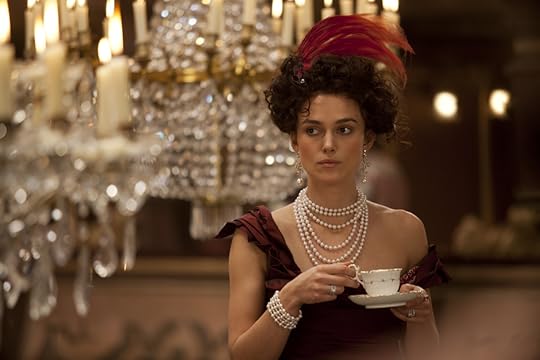 After reading Leo Tolstoy's Russian masterpiece, you can't help but pick a bone with the author over Anna's death. I mean, if you have ever picked up the book Anna Karenina, you would know that a thick book like that might work better as a doorstop than leisurely reading. To be fair it's pretty hard to imagine putting Tolstoy and leisurely reading into the same sentence.
Think about it.
If you think George R.R. Martin is bad, imagine dedicating yourself to read this paperweight of a novel – clocking in at about 864 pages, longer than Harry Potter and the Deathly Hallows. Most people would give up in weeks or months, but if you're truly committed to finishing this novel, it might even take years off your life to read.
UNTIL . . .
Tolstoy kills Anna off at the end.
But not only did Tolstoy kill off your favorite character, he also wasting you time caring for that very character he ends up killing.
If anything, Tolstoy ends up killing you at the end! To recap, at the end of Anna Karenina, Anna and Vronsky get into this huge fight. He leaves to visit his mother, Anna tries to apologize to him for quarreling with him and ends up going to the train station to meet Vronsky. But then in a sudden morphine-fulled despair, Anna resolves to throw herself under an approaching train in order to punish Vronsky. So when the train approaches, Anna impulsively throws herself under the wheels.
Only to feel a pang of confusion and regret when its too late.
And Tolstoy ruins your life for good. " . . . she threw away her red bag, drawing her head between her shoulders, and, with outstretched hands, threw herself on her knees under the car. For a second she was horror-struck at what she was doing. 'Where am I ? What am I doing ? Why ?' She tried to get up, to draw back; but something monstrous, inflexible, struck her head, and threw her on her back. 'Lord, forgive me all!' she murmured, feeling the struggle to be in vain. . . . And the candle by which she had read the book that was filled with fears, with deceptions, with anguish, and with evil, flared up with greater brightness than she had ever known, revealing to her all that before was in darkness, then flickered, grew faint, and went out forever." – Anna Karenina Yeah, thanks a lot Tolstoy.
 #8: Emma Bovary from Madam Bovary
 Sex!
Sex!
Lies!
Literature!
Gustav Flaubert's French bourgeois novel of life and all its inglorious banality introduces his readers to his main character, Emma Bovary, a bored provincial housewife who abandons her husband to pursue the libertine Rodolphe in a desperate love affair . . .
All leading up to her suicide at the end of the novel.
Thankfully – unlike Tolstoy – Madam Bovary clocks in at 384 pages, so at least you don't feel like you've wasted half of your life reading about an adulteress woman who ends up poisoning herself.
But hey, at least it's a less gruesome death than THROWING YOURSELF UNDER A TRAIN ANNA KARENINA!
Anyway, what made Emma's death all the more tragic is her idyllic nature. Since her girlhood in a convent, she had read romantic novels that fed her discontent with her ordinary life. In a way, she's like Catherine Morland from Jane Austen's Northanger Abbey; except Catherine was obsessed with Gothic novels and acknowledged the fact that her imagination could sometimes get the best of her.
For Emma Bovary, it was already too late.
She dreams of the purest most impossible forms of love and wealth, while ignoring whatever beauty is already present in the world around her. Her fundamental error is that she mistakes literature for life and she is so desperate to merge the two together to create her ideal version of romantic love.
And when her expectations are not met by her husband, she attempts to escape through adultery, which consequently leads to her demise.
Flaubert breaks your heart into pieces because you yourself end up wanting to believe in Madam Bovary's beliefs of romantic love yourself.
Except Flaubert give you a harsh wake up call to reality by dragging his readers into the light of the real world of the misogynistic society that Madam Bovary lives in.
Talk about ruining the mood.
 To recap, near the end of her life, Emma learns to her horror that the only power she has over the men in her life is sexual. At the most desperate moment of her life, Emma is searching for money and finds herself asking men for it. But the only thing she can do to persuade them to give it to her, is through sex.
Thus from Emma prostituting herself, leads to her self-destruction by poisoning herself.
"Her chest soon began panting rapidly; the whole of her tongue protruded from her mouth; her eyes, as they rolled, grew paler, like the two globes of a lamp that is going out, so that one might have thought her already dead but for the fearful labouring of her ribs, shaken by violent breathing, as if the soul were struggling to free itself. . . . She fell back upon the mattress in a convulsion. They all drew near. She was dead." – Madam Bovary Screw you Flaubert for making us hope for that perfect, impossible love out there in the world! #7: Lily Bart from The House of Mirth
 Enters Lily Bart from Edith Wharton's classically acclaimed novel, The House of Mirth.
You hate her, but unfortunately you're stuck with her because she is the main character of Wharton's novel.
Bent on securing herself with a man in possession of a vast fortune in late nineteenth New York City, Lily is the type of character who you hate but acknowledge.
As a character, she knows that she's dull, self-involved and incapable of true charity. She pridefully contrasts the beauty of other women to her own looks and she constantly places the kindred character, Lawrence Selden, in the friend-zone whenever she tries to pin down a wealth man to marry her.
Yet, you find yourself sympathizing with her because her real downfall comes from her own bad decisions. Unlike Emma Bovary who gets caught up in her own imagined world of romantic love, Lily is the polar opposite. She understands the seriousness of her circumstance – an unmarried woman who is financially unstable and is almost to the brink of desperation to hook a rich husband. She has to jump through hoops in order to keep her head above water in New York's high society.
Yet, her desperation gets the better of her and she sinks lower and lower in society until she is virtually penniless.
You would think that because Wharton had built such a strong character in the beginning of a novel, that Lily would seem to have access to opportunities to live the life she desires. But as Wharton continues to expose all of Lily's flaws and poor decisions, she hints that this life may not remain as desirous to her.
Plus, she is given SO many opportunities to marry Selden. Yet she always reminds herself that there might be someone better and richer than him in the world for her to marry. To recap, near the end of the novel, Lily lives in a lowly boarding house in a small room. She struggled throughout the novel to find someone to marry her, only for her to realize that if she got married, she would lose her freedom. Although the thought of a marriage would mean financial stability, it doesn't compare to allowing her life be defined by a man. So she turns down proposals and knowingly ruining other marriage opportunities as well.
So the only way that Lily would be able to be free would be through – yes, you guessed it – suicide.
She overdoses on sleeping medications, and in the escape of sleep, Lily finds freedom. "Slowly the thought of the word faded, and sleep began to enfold her. She struggled faintly against it, feeling that she ought to keep awake on account of the baby; but even this feeling was gradually lost in an indistinct sense of drowsy peace, through which, of a sudden, a dark flash of loneliness and terror tore its way. She started up again, cold and trembling with the shock: for a moment she seemed to have lost her hold of the child. But no—she was mistaken—the tender pressure of its body was still close to hers: the recovered warmth flowed through her once more, she yielded to it, sank into it, and slept." – The House of Mirth
And then she died.
Goddamnit Wharton! #6: Hamlet from Hamlet
 You cannot go through high school without knowing the entire plot to William Shakespeare's Hamlet.
In fact, it comes to no surprise when you figure out that Hamlet gets it at the end.
From your experience with Shakespeare in the classroom you've probably already guessed that when Shakespeare says "tragedy" it's essentially The Red Wedding all over again. I mean you've seen how brutal Shakespeare can be in his tragedies. Killing off his characters in Romeo and Juliet, Julius Caesar, Macbeth etc. in just about every horrible way imaginable.
But what makes Hamlet stand out amongst the characters in Shakespeare's plays, is that he has a calling. You know he ends up dying in the end, but you want him to fulfill his thirst for revenge against his Uncle Claudius for murdering Hamlet's father.
Of course, we've all seen this before.
The vengeful son who must avenge against the man who killed his father.
Although, we all know that that NEVER EVER EVER EVER ends well . . .
Unless, I guess, your Inigo Montoya. But unfortunately, Hamlet isn't as awesome as Inigo Montoya and ends up getting himself killed.
Yet, if you know about the play but you've never picked it up to read, you end up finding yourself telling Hamlet to grow a f**king pear!
Seriously, Hamlet is like the original emo kid who just constantly talks about death, suicide, and mopes around his fancy castle all day.
You WANT SOMEONE TO JUST KILL HIM.
Yet, when he's finally dead, you suddenly have this empty space inside of you.
Because deep down, you wanted stupid gloomy Hamlet to take the initiative. And just when it looks like he might actually have a chance to exact retribution against his evil uncle, everything goes to hell.
Not only does Hamlet die, but his evil uncle, his mother, Laertes and a huge slew of other people.
So yeah, Hamlet did it. He killed his uncle, but in the process ended up dying himself.
To which you're quite not sure how to feel after that.
Was it worth it?
To recap, Hamlet and Laertes are sword-fighting but Laertes had poisoned the tip of his sword in order to kill Hamlet. Of course, Laertes wounds Hamlet and Hamlet wounds Laertes with Laertes' own poisoned blade. Next the queen drops dead because she accidentally drank from the poisoned cup, and Hamlet stabs his uncle Claudius through with the poisoned sword – while also forcing him to drink down the rest of the poisoned wine.
Kinda sadistic when you really think about it.
Plus, I've never used the word "poisoned" so many times in one paragraph.
But of course, what ends up happening?
Hamlet himself drops dead before exchanging his last words with his friend Horatio. HAMLET: O, I die, Horatio.
The potent poison quite o'ercrows my spirit.
I cannot live to hear the news from England.
But I do prophesy the election lights
On Fortinbras. He has my dying voice.
So tell him, with th' occurrents, more and less,
Which have solicited. The rest is silence.
O, O, O, O. (dies) – Hamlet
Thanks Shakespeare for killing that one character that we loved to hate.
Now what the hell are we suppose to do with the rest of our miserable lives? #5: Piggy from Lord of the Flies
 AKA: Hurley from Lost.
Or at least the equivalent to Hurley from Lost if he didn't end up dying in William Golding's novel, Lord of the Flies.
Just like Hurley, Piggy was the sweetest, down-to-earth character on the island of misfit castaways.
But man, this poor child could't catch a break.
What makes Piggy's death so painful is the fact that he's the only kid on the island who represents the goodness as well as the scientific and intellectual aspects of civilization.
Yet, he's stuck on a deserted island with a bunch of stupid teenage boys who are all immature and never listen to him! That's like the equivalent to being in high school all over again, and having Piggy be at the bottom of the totem pole of social hierarchy. He gets constantly picked on for being fat (hence his nickname, Piggy), his glasses always get stolen, and none of the other boys ever appreciates his suggestions on how to lead a stable community.
In other words: Teenage boys can sometimes be mean. Like, really mean.
And they were indeed very, very, mean to poor Piggy during his time on the island.
Yet, two other boys in Lord of the Flies ended up dying too. But Piggy's death stands out the most to readers because it was the first death in the novel that was the result of a completely intentional act.
The teenage kids on the island hated him so much that they killed him on purpose.
Kind of a terrifying thought, when you think about it.
To make matters worse, Piggy's death in Lord of the Flies is symbolic in it of itself.
His death symbolized the complete end of civilization, leading the rest of the boys on the island to become savages.
Again, kind of a terrifying thought of having an entire civilization crumble under the wrath of a bunch of teenage boys.
 To recap, two of the boys on the island, Ralph and Jack are fighting, and Piggy tries to remind the two boys the importance of the rules of the island and how they need to get along if they want to get rescued. But another boy Roger throws a rock at Piggy's head and it hits him, knocking him down.
Poor Piggy ends up falling forty feet from the cliff he was standing on, and lands dead on his back by the water. "The rock struck Piggy a glancing blow from chin to knee: the conch exploded into a thousand white fragments and ceased to exist. Piggy, saying nothing, with no time for even a grunt, traveled through the air sideways from the rock, turning over as he went. The rock bounded twice and was lost in the forest. Piggy fell forty feet and landed on his back across the square red rock in the sea. His head opened and stuff came out and turned red. Piggy's arms and legs twitched a bit, like a pig's after it had been killed." – Lord of the Flies Goddamnit William Golding! Why did you have to make Piggy's death so awful?
This would never have happened to Hurley on Lost! #4: John the Savage from Brave New World
 Yet, another novel that discusses how fragile society can be.
John the Savage from Aldous Huxley's classic novel, Brave New World examines how the state controls the behaviors and actions of its people in order to preserve its own stability and power. Through technological interventions in a dystopian world, the government in Brave New World makes its citizens so happy and so superficially fulfilled that they don't care about their own personal freedom nor their own humanity.
But then John the Savage arrives on the scene.
You end up caring for John because he's an outsider in his own way. He's an outsider among the natives who've raised him – because he's not really a native – and he's an outsider among the government because they see his tribal culture as disgusting. He's essentially rejected by both the "savage" culture he was born and raised in, and the "civilized" culture of the government he soon enters.
But he doesn't develop a "savage" behavior like you would expect. Instead, John is well-rounded because he takes his values from the written words of William Shakespeare, making it easier for him to verbalize his own complex feelings and emotions. In a way, the literature he reads helps him to criticize the government's actions. Yet, John's insistences of his opinion of the world through Shakespeare, sometimes blinds him to the reality of the characters that he meets in the World State.
You could also say that maybe Shakespeare was his ultimate downfall.
He's almost like Emma Bovary, except instead of being obsessed with romance novels, he's obsessed with Shakespeare and takes his ideals and words a bit too literary. He develops this idea that all of Shakespeare's passages about love, death, life, and hate are going to be somehow applied and respected in the World State.
But when those Shakespearian expectations are not met by his standards – as well as John finding himself morally damaged – he is nearly driven insane.
His suicide even reflects the themes from a tragic Shakespeare play!
Goddamnit Shakespeare, why do you have to ruin everything!
You have this character, John the Savage, who tries his best to stay true to his own values and morals. Yet, no one understands him because everyone he meets is all high on Soma and don't have the same level of care as he does.
No wonder he's driven to kill himself.
The readers are the only ones who actually understand him before it's too late.
Then you start craving for a hit of Soma to get out from your depression.
 To recap, John decides to seclude himself in an abandoned lighthouse in the wilderness. He's doing all right for himself. He plants his own garden, continues to carry out some of the customs he was used to when he lived with the natives, lives a secluded life, and then everything gets screwed up.
He's minding his own business until some Delta-Minus workers witness John whipping himself – an activity that he partook with the natives. And before John knows it, he loses all sense of privacy. Reporters come to his lighthouse to interview him, and John just loses all sense of serenity and gets violent with these people.
Then an orgy suddenly happens in front of his lighthouse.
Then John suddenly finds himself joining the orgy.
And when he awakens the next day, he is ashamed for giving into his lust and ends up hanging himself.
" 'Savage!' called the first arrivals, as they alighted from their machine. 'Mr. Savage!' There was no answer. The door of the lighthouse was ajar. They pushed it open and walked into a shuttered twilight. Through an archway on the further side of the room they could see the bottom of the staircase that led up to the higher floors. Just under the crown of the arch dangled a pair of feet. 'Mr. Savage!' Slowly, very slowly, like two unhurried compass needles, the feet turned towards the right; north, north-east, east, south-east, south, south-south-west; then paused, and, after a few seconds, turned as unhurriedly back towards the left. South-south-west, south, south- east, east . . .." – Brave New World
So don't due orgies.
Or drugs called Soma.
But how dare you Huxley for killing off a very nice young man!
And how dare you Shakespeare for f**king things up again!
Haven't we been tortured enough? #3: Fantine from Les Misérables
 Man, this one hits home.
If Piggy couldn't catch a break from those mean teenage boys from Lord of the Flies, and John the Savage couldn't find anyone else in the world who could understand his pure sense of humanity from Brave New World, Fantine from Victor Hugo's Les Miserables possibly has the worst run when it comes to her misfortunes.
And unfortunately, Les Misérables only brings worse and worse news.
The bad news, is that everyone in this entire novel is absolutely miserable (hence the title, Les Misérables – The Miserables).
Worse news, all of Fantine's problems stem from the callousness or greed of others, eventually leading up to her death.
But the news that is of the worst of the worst, is that the actual novel, Les Misérables clocking in at around 1,504 pages.
A THOUSAND PAGE NOVEL?!?!?!?!?!?!
I don't know what's worse, the fact that you would even bother to pick up a thousand page novel.
Or the fact that you are reading a thousand page novel about a group of unhappy people living a nightmare of a life.
Well, congratulations Tolstoy! You're wimpy 864 page novel isn't long enough to send your readers down a spiral of their own despair. Victor Hugo has you easily beaten on this one. He will TORTURE his readers after reading a thousand pages of his own miserable novel.
I take back what I said before about Tolstoy.
It's actually Victor Hugo who is the ultimate George R.R. Martin.
Anyway, back to Fantine.
Fantine embodies everything that French society demands the most from.
She's barely staying afloat because she's a poor, working-class orphan, with no education and no literacy and comes from the very debase of society. She's struggling to survive and the only way she can is by trusting all of the wrong people:
Tholomyés abandons her when she gets pregnant.
The Thénardiers take Fantine's daughter, Cosette, into their household, and use the child to extort more money from the already penniless Fantine.
Fantine's co-workers have her fired for indecency.
She becomes a prostitute in order to obtain more money that she could send to the Thénardiers.
She sells her hair, teeth and basically everything she owns, all because she's focused on taking care of her daughter.
That alone, is heartbreaking.
And when she dies it's even worse.
She catches tuberculoses and manages to hold on while she's at the hospital because she wants to see Cosette one last time.
How can someone have the heart to kill off such a character like that?
 To recap – although I really wish we wouldn't – Valjean goes to the hospital to see Fantine. She asks about Cosette, and the doctor lies to her saying that Cosette is at the hospital bit cannot see Fantine until she gets better. Of course, Javert comes to the hospital to question Valjean. This happens just around the time Fantine suffers from a severe fit of trembling and falls back on her bed and dies. "Fantine raised herself in bed with a bound, supporting herself on her stiffened arms and on both hands: she gazed at Jean Valjean, she gazed at Javert, she gazed at the nun, she opened her mouth as though to speak; a rattle proceeded from the depths of her throat, her teeth chattered; she stretched out her arms in her agony, opening her hands convulsively, and fumbling about her like a drowning person; then suddenly fell back on her pillow. Her head struck the head-board of the bed and fell forwards on her breast, with gaping mouth and staring, sightless eyes. She was dead." – Les Misérables
I'm just going to say this once:
F**K YOU VICTOR HUGO!!!!
YOU HEARTLESS BASTARD!!! #2: Billy Budd from Billy Budd
 Can't you just tell that I'm angrier and angrier as we advanced near the end of this poor list?
And one of the things that makes me so angry – besides everyone else whose death made the list – is Billy Budd's death.
Yes, everyone loved Herman Melville's classic novella, Billy Budd because of the main character, Billy Budd.
Innocent, young and handsome, Billy Budd was Melville's golden child. Upon becoming a seaman, Billy Budd grows to become this kind, gentle young man. On board the ship, he inspires love and admiration from his fellow sailors. He's adorable, even his personal flaws are kind of charming. He develops an unpredictable tendency to stutter and is sometimes rendered completely speechless.
But all these cute and charming flaws of his, end up getting him killed.
Even when he's at the age of twenty-one, Billy Budd had never directly confronted evil. Which could explain why Billy Budd's innocence leads him to his very demise. He's constantly blinded by his own openhearted nature and misjudges the evil-doings of Claggart as a friend.
He has a naïve trust in others and his speech impediment – the one that you thought was kind of cute – renders him unable to defend himself when Claggart accuses him of mutiny.
Worse, Billy Budd is even driven by anger and ends up killing Claggart himself.
And this is what breaks every reader's heart when they come across Billy Budd.
You want Billy Budd to defend himself, you want him to speak up and call Claggart a lying asshole that deserved to die. But he doesn't. He just can't because it's impossible for him to understand that Claggart's evil and that he can't formulate any clear thoughts about him. He probably didn't understand why he even killed Claggart.
But Billy Budd's innocence is portrayed as something to be both admired and pitted. Unfortunately, in the end, Billy dies because he cannot comprehend evil or defend himself against it.
In a way, Billy Budd's death is kind of terrifying. It almost resembles something that could happen to us, and for that the readers find themselves pitying and empathizing with him more strongly.
 To recap, after Billy accidentally kills Claggart, Vere resolves to appoint a small drumhead court in order to give Billy Budd a fair and equal trail. As sole witness, Vere relates the details of Claggart's accusations against Billy, and Billy's reaction when he killed Claggart. He says that he did kill Claggart but that he was never involved in a mutiny. Vere passionately tells Billy that he believes him, and it seems like Billy Budd might win the trail. Until, Billy fails to mention why Claggart disliked Billy in the first place, but he has no idea. While the court is extremely compassionate toward Billy, Vere reminds the court that their duty is to enforce the law. Even though the court doesn't agree with Vere, they agree to uphold the law and Billy is sentenced to hang in the morning. "The hull deliberately recovering from the periodic roll to leeward was just regaining an even keel, when the last signal, a preconcerted dumb one, was given. At the same moment it chanced that the vapory fleece hanging low in the East, was shot thro' with a soft glory as of the fleece of the Lamb of God seen in mystical vision, and simultaneously therewith, watched by the wedged mass of upturned faces, Billy ascended; and, ascending, took the full rose of the dawn. In the pinioned figure, arrived at the yard-end, to the wonder of all no motion was apparent, none save that created by the ship's motion, in moderate weather so majestic in a great ship ponderously cannoned." – Billy Budd
WHY MELVILLE?
JUST WHY??????????? #1: Little Nell from The Old Curiosity Shop
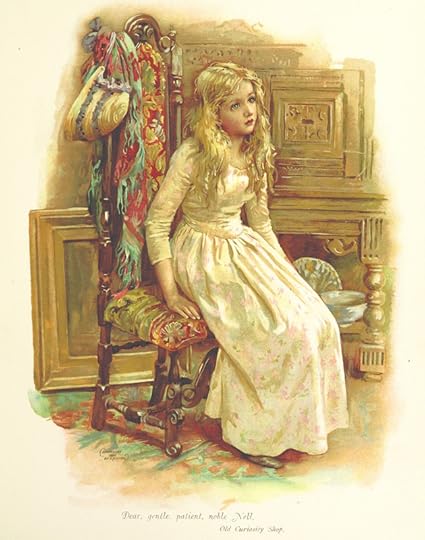 Nothing is more tragic than the death of the orphaned Little Nell.
NOTHING!!!!
Nell Trent is Charles Dickens's angelic heroine from The Old Curiosity Shop. She lives with her grandfather in his shop, and ends up paying a terrible price for her grandfather's gambling habit.
So in 1841 – WAY before America fell in love with Harry Potter – American readers were so desperate to learn of Little Nell's fate that they would stand on the docks of New York and literally wait all day for the British ship bearing the latest installment of Dickens's story.
These American fans were so obsessed with Little Nell and her fate that they would storm the city's piers, shouting to the sailors:
"Is Little Nell alive!?!?!?!?!?"
I'm sure that was all of our exact reactions when we all saw Jon Snow get stabbed.
But again, we're not sure if he's actually dead.
But Little Nell was definitely very dead.
What makes Little Nell's death tragic, is the fact that she risks her own life to save her weary old grandfather.
However, it was Little Nell's grandfather who was obsessed with ensuring that Nell had some money to live off from after he died, so he started building an inheritance for her through gambling at cards. He kept his gambling a secret from Nell and borrowed heavily from the evil Daniel Quilp. In the end, Nell's grandfather gambled away every penny that they owned and Quilp seized the opportunity to take possession of the shop and evict Nell and her grandfather. Bereft of his wits, Nell saved her grandfather by taking him away to the Midlands of England.
But during her journey to the countryside with her grandfather, Nell's health begins to deteriorate, giving her a one-way trip when she ends up dying at the end of the novel.
"They moved so gently, that their footsteps made no noise ; but there were sobs from among the group, and sounds of grief and mourning. For she was dead. There, upon her little bed, she lay at rest. The solemn stillness was no marvel now. She was dead. No sleep so beautiful and calm, so free from trace of pain, so fair to look upon. She seemed a creature fresh from the hand of God, and waiting for the breath of life ; not one who had lived and suffered death, Her couch was dressed with here and there some win- ter berries and green leaves, gathered in a spot she had been used to favor. 'When I die, put near me something that has loved the light, and had the sky above it always.' Those were her words. She was dead. Dear, gentle, patient, noble Nell was dead. Her little bird — a poor slight thing the pressure of a finger would have crushed — was stirring nimbly in its cage ; and the strong heart of its child mistress was mute and motionless forever." – The Old Curiosity Shop
You cut us deep, Dickens.
You cut us deep. So, I hope you had fun reliving your most painful, scarring moments of your favorite dead literary characters.
But it's okay to feel that pain.
If anything that character's death only made you appreciate how much you loved that character.
But . . . you also want to punch the author in the face.
Regardless, if you could look past the heartbreak, the tears, when your favorite character got the axe, at least accept that while they were alive they served an important purpose in your life.
Real or not, you at least cared deeply for them.
And isn't that how a fictional character obtains its immortality?
Though they might be dead, you'll always think about them at the best of times and at the worst of times.
They will always be there in your heart forever.
ALWAYS. But seriously.
Jon Snow better be alive.
Otherwise George R.R. Martin and I are going to have a problem.
I don't know about you, but I'm still pretty traumatized from the season 5 finale of Game of Thrones.
*NOTE: If you are not up to date on watching Game of Thrones and seek to avoid any spoilers, I suggest you stop reading this month's blog post right now.*
**Or, you know, continue at your own risk . . .
Anyway, after Jon Snow gets stabbed (told you there will be spoilers) it seemed like the entire Internet broke down into madness.
Now noticed that I said before that Jon Snow was "stabbed" not necessarily "killed." We still don't know the exact details if Jon Snow is really dead or not – although he looked pretty dead to me. Regardless, dead, alive, maybe something in between, when you saw him lying in the snow surrounded by a pool of his own blood, you fell into a deep emotional pit of despair.
While also constantly asking yourself why George R.R. Martin keeps finding new and creative ways to ruin your life.
So I kept thinking about the last time I fell into a deep emotional pit of despair after one of my favorite characters got killed off. You know, after these favorite characters of mine were killed off as well:
You can already tell that this month's blog post is oozing with cheerfulness.I promise that next month's blog post will be a little more uplifting than this one.
Until then, let's take a quick walk down memory lane to revisit our favorite literary characters who died too soon.
Because, let's be honest, you're still not quite over their deaths.
#10: Everyone Who Has Ever Died In The Harry Potter Books
Yup.Doesn't this just make you want to crawl in a hole and drown in your own tears?
Way before Game of Thrones conditioned us to lower our standards of developing close attachments to any characters, our childhood was briefly tainted by the deaths of the literary characters in the Harry Potter books.
Where were you when you read The Goblet of Fire and came across this line:
"A blast of green light blazed through Harry's eyelids, and he heard something heavy fall to the ground beside him. Cedric was lying spread-eagled on the ground beside him. He was dead." – The Goblet of Fire I can tell you exactly where I was.
In my room, freaking out and throwing the book against the wall.
I was also crying, and scarred for life.
Or when you read The Order of the Phoenix and couldn't fall asleep because you just finished reading this:
" 'Come on, you can do better than that!' . . . And Harry saw the look of mingled fear and surprise on his godfather's wasted, once-handsome face as he fell through the ancient doorway and disappeared behind the veil, which fluttered for a moment as though in a high wind and then fell back into place." – The Order of the Phoenix Is Sirius dead? Is Sirius alive?
You kind of had a Jon Snow moment when you weren't quite sure if Harry Potter's godfather had survived Bellatrix Lestrange's killing curse. But sure enough, after you got tired from convincing yourself that Sirius Black wasn't dead, you gave up and begrudgingly accepted that yes, Sirius Black was in fact very dead.
You also almost lost faith in the books by this point in the series.
But of course, how can you forget Snape's death in The Deathly Hallows:
" 'Look . . . at . . . me . . .' he whispered. The green eyes found the black, but after a second, something in the depths of the dark pair seemed to vanish, leaving them fixed, blank, and empty. The hand holding Harry thudded to the floor, and Snape moved no more." – The Deathly Hallows We're still crying over that one.
ALWAYS!
#9: Anna Karenina from Anna Karenina
After reading Leo Tolstoy's Russian masterpiece, you can't help but pick a bone with the author over Anna's death. I mean, if you have ever picked up the book Anna Karenina, you would know that a thick book like that might work better as a doorstop than leisurely reading. To be fair it's pretty hard to imagine putting Tolstoy and leisurely reading into the same sentence.Think about it.
If you think George R.R. Martin is bad, imagine dedicating yourself to read this paperweight of a novel – clocking in at about 864 pages, longer than Harry Potter and the Deathly Hallows. Most people would give up in weeks or months, but if you're truly committed to finishing this novel, it might even take years off your life to read.
UNTIL . . .
Tolstoy kills Anna off at the end.
But not only did Tolstoy kill off your favorite character, he also wasting you time caring for that very character he ends up killing.
If anything, Tolstoy ends up killing you at the end!
To recap, at the end of Anna Karenina, Anna and Vronsky get into this huge fight. He leaves to visit his mother, Anna tries to apologize to him for quarreling with him and ends up going to the train station to meet Vronsky. But then in a sudden morphine-fulled despair, Anna resolves to throw herself under an approaching train in order to punish Vronsky. So when the train approaches, Anna impulsively throws herself under the wheels. Only to feel a pang of confusion and regret when its too late.
And Tolstoy ruins your life for good. " . . . she threw away her red bag, drawing her head between her shoulders, and, with outstretched hands, threw herself on her knees under the car. For a second she was horror-struck at what she was doing. 'Where am I ? What am I doing ? Why ?' She tried to get up, to draw back; but something monstrous, inflexible, struck her head, and threw her on her back. 'Lord, forgive me all!' she murmured, feeling the struggle to be in vain. . . . And the candle by which she had read the book that was filled with fears, with deceptions, with anguish, and with evil, flared up with greater brightness than she had ever known, revealing to her all that before was in darkness, then flickered, grew faint, and went out forever." – Anna Karenina Yeah, thanks a lot Tolstoy.
#8: Emma Bovary from Madam Bovary
Sex!Lies!
Literature!
Gustav Flaubert's French bourgeois novel of life and all its inglorious banality introduces his readers to his main character, Emma Bovary, a bored provincial housewife who abandons her husband to pursue the libertine Rodolphe in a desperate love affair . . .
All leading up to her suicide at the end of the novel.
Thankfully – unlike Tolstoy – Madam Bovary clocks in at 384 pages, so at least you don't feel like you've wasted half of your life reading about an adulteress woman who ends up poisoning herself.
But hey, at least it's a less gruesome death than THROWING YOURSELF UNDER A TRAIN ANNA KARENINA!
Anyway, what made Emma's death all the more tragic is her idyllic nature. Since her girlhood in a convent, she had read romantic novels that fed her discontent with her ordinary life. In a way, she's like Catherine Morland from Jane Austen's Northanger Abbey; except Catherine was obsessed with Gothic novels and acknowledged the fact that her imagination could sometimes get the best of her.
For Emma Bovary, it was already too late.
She dreams of the purest most impossible forms of love and wealth, while ignoring whatever beauty is already present in the world around her. Her fundamental error is that she mistakes literature for life and she is so desperate to merge the two together to create her ideal version of romantic love.
And when her expectations are not met by her husband, she attempts to escape through adultery, which consequently leads to her demise.
Flaubert breaks your heart into pieces because you yourself end up wanting to believe in Madam Bovary's beliefs of romantic love yourself.
Except Flaubert give you a harsh wake up call to reality by dragging his readers into the light of the real world of the misogynistic society that Madam Bovary lives in.
Talk about ruining the mood.
To recap, near the end of her life, Emma learns to her horror that the only power she has over the men in her life is sexual. At the most desperate moment of her life, Emma is searching for money and finds herself asking men for it. But the only thing she can do to persuade them to give it to her, is through sex. Thus from Emma prostituting herself, leads to her self-destruction by poisoning herself.
"Her chest soon began panting rapidly; the whole of her tongue protruded from her mouth; her eyes, as they rolled, grew paler, like the two globes of a lamp that is going out, so that one might have thought her already dead but for the fearful labouring of her ribs, shaken by violent breathing, as if the soul were struggling to free itself. . . . She fell back upon the mattress in a convulsion. They all drew near. She was dead." – Madam Bovary Screw you Flaubert for making us hope for that perfect, impossible love out there in the world!
#7: Lily Bart from The House of Mirth
Enters Lily Bart from Edith Wharton's classically acclaimed novel, The House of Mirth.You hate her, but unfortunately you're stuck with her because she is the main character of Wharton's novel.
Bent on securing herself with a man in possession of a vast fortune in late nineteenth New York City, Lily is the type of character who you hate but acknowledge.
As a character, she knows that she's dull, self-involved and incapable of true charity. She pridefully contrasts the beauty of other women to her own looks and she constantly places the kindred character, Lawrence Selden, in the friend-zone whenever she tries to pin down a wealth man to marry her.
Yet, you find yourself sympathizing with her because her real downfall comes from her own bad decisions. Unlike Emma Bovary who gets caught up in her own imagined world of romantic love, Lily is the polar opposite. She understands the seriousness of her circumstance – an unmarried woman who is financially unstable and is almost to the brink of desperation to hook a rich husband. She has to jump through hoops in order to keep her head above water in New York's high society.
Yet, her desperation gets the better of her and she sinks lower and lower in society until she is virtually penniless.
You would think that because Wharton had built such a strong character in the beginning of a novel, that Lily would seem to have access to opportunities to live the life she desires. But as Wharton continues to expose all of Lily's flaws and poor decisions, she hints that this life may not remain as desirous to her.
Plus, she is given SO many opportunities to marry Selden. Yet she always reminds herself that there might be someone better and richer than him in the world for her to marry.
To recap, near the end of the novel, Lily lives in a lowly boarding house in a small room. She struggled throughout the novel to find someone to marry her, only for her to realize that if she got married, she would lose her freedom. Although the thought of a marriage would mean financial stability, it doesn't compare to allowing her life be defined by a man. So she turns down proposals and knowingly ruining other marriage opportunities as well. So the only way that Lily would be able to be free would be through – yes, you guessed it – suicide.
She overdoses on sleeping medications, and in the escape of sleep, Lily finds freedom. "Slowly the thought of the word faded, and sleep began to enfold her. She struggled faintly against it, feeling that she ought to keep awake on account of the baby; but even this feeling was gradually lost in an indistinct sense of drowsy peace, through which, of a sudden, a dark flash of loneliness and terror tore its way. She started up again, cold and trembling with the shock: for a moment she seemed to have lost her hold of the child. But no—she was mistaken—the tender pressure of its body was still close to hers: the recovered warmth flowed through her once more, she yielded to it, sank into it, and slept." – The House of Mirth
And then she died.
Goddamnit Wharton!
#6: Hamlet from Hamlet
You cannot go through high school without knowing the entire plot to William Shakespeare's Hamlet. In fact, it comes to no surprise when you figure out that Hamlet gets it at the end.
From your experience with Shakespeare in the classroom you've probably already guessed that when Shakespeare says "tragedy" it's essentially The Red Wedding all over again. I mean you've seen how brutal Shakespeare can be in his tragedies. Killing off his characters in Romeo and Juliet, Julius Caesar, Macbeth etc. in just about every horrible way imaginable.
But what makes Hamlet stand out amongst the characters in Shakespeare's plays, is that he has a calling. You know he ends up dying in the end, but you want him to fulfill his thirst for revenge against his Uncle Claudius for murdering Hamlet's father.
Of course, we've all seen this before.
The vengeful son who must avenge against the man who killed his father.
Although, we all know that that NEVER EVER EVER EVER ends well . . .
Unless, I guess, your Inigo Montoya.
But unfortunately, Hamlet isn't as awesome as Inigo Montoya and ends up getting himself killed.Yet, if you know about the play but you've never picked it up to read, you end up finding yourself telling Hamlet to grow a f**king pear!
Seriously, Hamlet is like the original emo kid who just constantly talks about death, suicide, and mopes around his fancy castle all day.
You WANT SOMEONE TO JUST KILL HIM.
Yet, when he's finally dead, you suddenly have this empty space inside of you.
Because deep down, you wanted stupid gloomy Hamlet to take the initiative. And just when it looks like he might actually have a chance to exact retribution against his evil uncle, everything goes to hell.
Not only does Hamlet die, but his evil uncle, his mother, Laertes and a huge slew of other people.
So yeah, Hamlet did it. He killed his uncle, but in the process ended up dying himself.
To which you're quite not sure how to feel after that.
Was it worth it?
To recap, Hamlet and Laertes are sword-fighting but Laertes had poisoned the tip of his sword in order to kill Hamlet. Of course, Laertes wounds Hamlet and Hamlet wounds Laertes with Laertes' own poisoned blade. Next the queen drops dead because she accidentally drank from the poisoned cup, and Hamlet stabs his uncle Claudius through with the poisoned sword – while also forcing him to drink down the rest of the poisoned wine.
Kinda sadistic when you really think about it.
Plus, I've never used the word "poisoned" so many times in one paragraph.
But of course, what ends up happening?
Hamlet himself drops dead before exchanging his last words with his friend Horatio. HAMLET: O, I die, Horatio.
The potent poison quite o'ercrows my spirit.
I cannot live to hear the news from England.
But I do prophesy the election lights
On Fortinbras. He has my dying voice.
So tell him, with th' occurrents, more and less,
Which have solicited. The rest is silence.
O, O, O, O. (dies) – Hamlet
Thanks Shakespeare for killing that one character that we loved to hate.
Now what the hell are we suppose to do with the rest of our miserable lives?
#5: Piggy from Lord of the Flies
AKA: Hurley from Lost. Or at least the equivalent to Hurley from Lost if he didn't end up dying in William Golding's novel, Lord of the Flies.
Just like Hurley, Piggy was the sweetest, down-to-earth character on the island of misfit castaways.
But man, this poor child could't catch a break.
What makes Piggy's death so painful is the fact that he's the only kid on the island who represents the goodness as well as the scientific and intellectual aspects of civilization.
Yet, he's stuck on a deserted island with a bunch of stupid teenage boys who are all immature and never listen to him! That's like the equivalent to being in high school all over again, and having Piggy be at the bottom of the totem pole of social hierarchy. He gets constantly picked on for being fat (hence his nickname, Piggy), his glasses always get stolen, and none of the other boys ever appreciates his suggestions on how to lead a stable community.
In other words: Teenage boys can sometimes be mean. Like, really mean.
And they were indeed very, very, mean to poor Piggy during his time on the island.
Yet, two other boys in Lord of the Flies ended up dying too. But Piggy's death stands out the most to readers because it was the first death in the novel that was the result of a completely intentional act.
The teenage kids on the island hated him so much that they killed him on purpose.
Kind of a terrifying thought, when you think about it.
To make matters worse, Piggy's death in Lord of the Flies is symbolic in it of itself.
His death symbolized the complete end of civilization, leading the rest of the boys on the island to become savages.
Again, kind of a terrifying thought of having an entire civilization crumble under the wrath of a bunch of teenage boys.
To recap, two of the boys on the island, Ralph and Jack are fighting, and Piggy tries to remind the two boys the importance of the rules of the island and how they need to get along if they want to get rescued. But another boy Roger throws a rock at Piggy's head and it hits him, knocking him down. Poor Piggy ends up falling forty feet from the cliff he was standing on, and lands dead on his back by the water. "The rock struck Piggy a glancing blow from chin to knee: the conch exploded into a thousand white fragments and ceased to exist. Piggy, saying nothing, with no time for even a grunt, traveled through the air sideways from the rock, turning over as he went. The rock bounded twice and was lost in the forest. Piggy fell forty feet and landed on his back across the square red rock in the sea. His head opened and stuff came out and turned red. Piggy's arms and legs twitched a bit, like a pig's after it had been killed." – Lord of the Flies Goddamnit William Golding! Why did you have to make Piggy's death so awful?
This would never have happened to Hurley on Lost!
#4: John the Savage from Brave New World
Yet, another novel that discusses how fragile society can be.John the Savage from Aldous Huxley's classic novel, Brave New World examines how the state controls the behaviors and actions of its people in order to preserve its own stability and power. Through technological interventions in a dystopian world, the government in Brave New World makes its citizens so happy and so superficially fulfilled that they don't care about their own personal freedom nor their own humanity.
But then John the Savage arrives on the scene.
You end up caring for John because he's an outsider in his own way. He's an outsider among the natives who've raised him – because he's not really a native – and he's an outsider among the government because they see his tribal culture as disgusting. He's essentially rejected by both the "savage" culture he was born and raised in, and the "civilized" culture of the government he soon enters.
But he doesn't develop a "savage" behavior like you would expect. Instead, John is well-rounded because he takes his values from the written words of William Shakespeare, making it easier for him to verbalize his own complex feelings and emotions. In a way, the literature he reads helps him to criticize the government's actions. Yet, John's insistences of his opinion of the world through Shakespeare, sometimes blinds him to the reality of the characters that he meets in the World State.
You could also say that maybe Shakespeare was his ultimate downfall.
He's almost like Emma Bovary, except instead of being obsessed with romance novels, he's obsessed with Shakespeare and takes his ideals and words a bit too literary. He develops this idea that all of Shakespeare's passages about love, death, life, and hate are going to be somehow applied and respected in the World State.
But when those Shakespearian expectations are not met by his standards – as well as John finding himself morally damaged – he is nearly driven insane.
His suicide even reflects the themes from a tragic Shakespeare play!
Goddamnit Shakespeare, why do you have to ruin everything!
You have this character, John the Savage, who tries his best to stay true to his own values and morals. Yet, no one understands him because everyone he meets is all high on Soma and don't have the same level of care as he does.
No wonder he's driven to kill himself.
The readers are the only ones who actually understand him before it's too late.
Then you start craving for a hit of Soma to get out from your depression.
To recap, John decides to seclude himself in an abandoned lighthouse in the wilderness. He's doing all right for himself. He plants his own garden, continues to carry out some of the customs he was used to when he lived with the natives, lives a secluded life, and then everything gets screwed up. He's minding his own business until some Delta-Minus workers witness John whipping himself – an activity that he partook with the natives. And before John knows it, he loses all sense of privacy. Reporters come to his lighthouse to interview him, and John just loses all sense of serenity and gets violent with these people.
Then an orgy suddenly happens in front of his lighthouse.
Then John suddenly finds himself joining the orgy.
And when he awakens the next day, he is ashamed for giving into his lust and ends up hanging himself.
" 'Savage!' called the first arrivals, as they alighted from their machine. 'Mr. Savage!' There was no answer. The door of the lighthouse was ajar. They pushed it open and walked into a shuttered twilight. Through an archway on the further side of the room they could see the bottom of the staircase that led up to the higher floors. Just under the crown of the arch dangled a pair of feet. 'Mr. Savage!' Slowly, very slowly, like two unhurried compass needles, the feet turned towards the right; north, north-east, east, south-east, south, south-south-west; then paused, and, after a few seconds, turned as unhurriedly back towards the left. South-south-west, south, south- east, east . . .." – Brave New World
So don't due orgies.
Or drugs called Soma.
But how dare you Huxley for killing off a very nice young man!
And how dare you Shakespeare for f**king things up again!
Haven't we been tortured enough?
#3: Fantine from Les Misérables
Man, this one hits home.If Piggy couldn't catch a break from those mean teenage boys from Lord of the Flies, and John the Savage couldn't find anyone else in the world who could understand his pure sense of humanity from Brave New World, Fantine from Victor Hugo's Les Miserables possibly has the worst run when it comes to her misfortunes.
And unfortunately, Les Misérables only brings worse and worse news.
The bad news, is that everyone in this entire novel is absolutely miserable (hence the title, Les Misérables – The Miserables).
Worse news, all of Fantine's problems stem from the callousness or greed of others, eventually leading up to her death.
But the news that is of the worst of the worst, is that the actual novel, Les Misérables clocking in at around 1,504 pages.
A THOUSAND PAGE NOVEL?!?!?!?!?!?!
I don't know what's worse, the fact that you would even bother to pick up a thousand page novel.
Or the fact that you are reading a thousand page novel about a group of unhappy people living a nightmare of a life.
Well, congratulations Tolstoy! You're wimpy 864 page novel isn't long enough to send your readers down a spiral of their own despair. Victor Hugo has you easily beaten on this one. He will TORTURE his readers after reading a thousand pages of his own miserable novel.
I take back what I said before about Tolstoy.
It's actually Victor Hugo who is the ultimate George R.R. Martin.
Anyway, back to Fantine.
Fantine embodies everything that French society demands the most from.
She's barely staying afloat because she's a poor, working-class orphan, with no education and no literacy and comes from the very debase of society. She's struggling to survive and the only way she can is by trusting all of the wrong people:
Tholomyés abandons her when she gets pregnant.
The Thénardiers take Fantine's daughter, Cosette, into their household, and use the child to extort more money from the already penniless Fantine.
Fantine's co-workers have her fired for indecency.
She becomes a prostitute in order to obtain more money that she could send to the Thénardiers.
She sells her hair, teeth and basically everything she owns, all because she's focused on taking care of her daughter.
That alone, is heartbreaking.
And when she dies it's even worse.
She catches tuberculoses and manages to hold on while she's at the hospital because she wants to see Cosette one last time.
How can someone have the heart to kill off such a character like that?
To recap – although I really wish we wouldn't – Valjean goes to the hospital to see Fantine. She asks about Cosette, and the doctor lies to her saying that Cosette is at the hospital bit cannot see Fantine until she gets better. Of course, Javert comes to the hospital to question Valjean. This happens just around the time Fantine suffers from a severe fit of trembling and falls back on her bed and dies. "Fantine raised herself in bed with a bound, supporting herself on her stiffened arms and on both hands: she gazed at Jean Valjean, she gazed at Javert, she gazed at the nun, she opened her mouth as though to speak; a rattle proceeded from the depths of her throat, her teeth chattered; she stretched out her arms in her agony, opening her hands convulsively, and fumbling about her like a drowning person; then suddenly fell back on her pillow. Her head struck the head-board of the bed and fell forwards on her breast, with gaping mouth and staring, sightless eyes. She was dead." – Les MisérablesI'm just going to say this once:
F**K YOU VICTOR HUGO!!!!
YOU HEARTLESS BASTARD!!!
#2: Billy Budd from Billy Budd
Can't you just tell that I'm angrier and angrier as we advanced near the end of this poor list?And one of the things that makes me so angry – besides everyone else whose death made the list – is Billy Budd's death.
Yes, everyone loved Herman Melville's classic novella, Billy Budd because of the main character, Billy Budd.
Innocent, young and handsome, Billy Budd was Melville's golden child. Upon becoming a seaman, Billy Budd grows to become this kind, gentle young man. On board the ship, he inspires love and admiration from his fellow sailors. He's adorable, even his personal flaws are kind of charming. He develops an unpredictable tendency to stutter and is sometimes rendered completely speechless.
But all these cute and charming flaws of his, end up getting him killed.
Even when he's at the age of twenty-one, Billy Budd had never directly confronted evil. Which could explain why Billy Budd's innocence leads him to his very demise. He's constantly blinded by his own openhearted nature and misjudges the evil-doings of Claggart as a friend.
He has a naïve trust in others and his speech impediment – the one that you thought was kind of cute – renders him unable to defend himself when Claggart accuses him of mutiny.
Worse, Billy Budd is even driven by anger and ends up killing Claggart himself.
And this is what breaks every reader's heart when they come across Billy Budd.
You want Billy Budd to defend himself, you want him to speak up and call Claggart a lying asshole that deserved to die. But he doesn't. He just can't because it's impossible for him to understand that Claggart's evil and that he can't formulate any clear thoughts about him. He probably didn't understand why he even killed Claggart.
But Billy Budd's innocence is portrayed as something to be both admired and pitted. Unfortunately, in the end, Billy dies because he cannot comprehend evil or defend himself against it.
In a way, Billy Budd's death is kind of terrifying. It almost resembles something that could happen to us, and for that the readers find themselves pitying and empathizing with him more strongly.
To recap, after Billy accidentally kills Claggart, Vere resolves to appoint a small drumhead court in order to give Billy Budd a fair and equal trail. As sole witness, Vere relates the details of Claggart's accusations against Billy, and Billy's reaction when he killed Claggart. He says that he did kill Claggart but that he was never involved in a mutiny. Vere passionately tells Billy that he believes him, and it seems like Billy Budd might win the trail. Until, Billy fails to mention why Claggart disliked Billy in the first place, but he has no idea. While the court is extremely compassionate toward Billy, Vere reminds the court that their duty is to enforce the law. Even though the court doesn't agree with Vere, they agree to uphold the law and Billy is sentenced to hang in the morning. "The hull deliberately recovering from the periodic roll to leeward was just regaining an even keel, when the last signal, a preconcerted dumb one, was given. At the same moment it chanced that the vapory fleece hanging low in the East, was shot thro' with a soft glory as of the fleece of the Lamb of God seen in mystical vision, and simultaneously therewith, watched by the wedged mass of upturned faces, Billy ascended; and, ascending, took the full rose of the dawn. In the pinioned figure, arrived at the yard-end, to the wonder of all no motion was apparent, none save that created by the ship's motion, in moderate weather so majestic in a great ship ponderously cannoned." – Billy BuddWHY MELVILLE?
JUST WHY???????????
#1: Little Nell from The Old Curiosity Shop
Nothing is more tragic than the death of the orphaned Little Nell.NOTHING!!!!
Nell Trent is Charles Dickens's angelic heroine from The Old Curiosity Shop. She lives with her grandfather in his shop, and ends up paying a terrible price for her grandfather's gambling habit.
So in 1841 – WAY before America fell in love with Harry Potter – American readers were so desperate to learn of Little Nell's fate that they would stand on the docks of New York and literally wait all day for the British ship bearing the latest installment of Dickens's story.
These American fans were so obsessed with Little Nell and her fate that they would storm the city's piers, shouting to the sailors:
"Is Little Nell alive!?!?!?!?!?"
I'm sure that was all of our exact reactions when we all saw Jon Snow get stabbed.
But again, we're not sure if he's actually dead.
But Little Nell was definitely very dead.
What makes Little Nell's death tragic, is the fact that she risks her own life to save her weary old grandfather.
However, it was Little Nell's grandfather who was obsessed with ensuring that Nell had some money to live off from after he died, so he started building an inheritance for her through gambling at cards. He kept his gambling a secret from Nell and borrowed heavily from the evil Daniel Quilp. In the end, Nell's grandfather gambled away every penny that they owned and Quilp seized the opportunity to take possession of the shop and evict Nell and her grandfather. Bereft of his wits, Nell saved her grandfather by taking him away to the Midlands of England.
But during her journey to the countryside with her grandfather, Nell's health begins to deteriorate, giving her a one-way trip when she ends up dying at the end of the novel.
"They moved so gently, that their footsteps made no noise ; but there were sobs from among the group, and sounds of grief and mourning. For she was dead. There, upon her little bed, she lay at rest. The solemn stillness was no marvel now. She was dead. No sleep so beautiful and calm, so free from trace of pain, so fair to look upon. She seemed a creature fresh from the hand of God, and waiting for the breath of life ; not one who had lived and suffered death, Her couch was dressed with here and there some win- ter berries and green leaves, gathered in a spot she had been used to favor. 'When I die, put near me something that has loved the light, and had the sky above it always.' Those were her words. She was dead. Dear, gentle, patient, noble Nell was dead. Her little bird — a poor slight thing the pressure of a finger would have crushed — was stirring nimbly in its cage ; and the strong heart of its child mistress was mute and motionless forever." – The Old Curiosity Shop
You cut us deep, Dickens.
You cut us deep.
So, I hope you had fun reliving your most painful, scarring moments of your favorite dead literary characters. But it's okay to feel that pain.
If anything that character's death only made you appreciate how much you loved that character.
But . . . you also want to punch the author in the face.
Regardless, if you could look past the heartbreak, the tears, when your favorite character got the axe, at least accept that while they were alive they served an important purpose in your life.
Real or not, you at least cared deeply for them.
And isn't that how a fictional character obtains its immortality?
Though they might be dead, you'll always think about them at the best of times and at the worst of times.
They will always be there in your heart forever.
ALWAYS.
But seriously.Jon Snow better be alive.
Otherwise George R.R. Martin and I are going to have a problem.
May 26, 2015
The Top 20 Gems of London
So it has officially been a week and three days since my departure from London, England.
Following that, I had a quick stop in Massachusetts for my friend's graduation at Mount Holyoke (Hey Guys!), then a 5 hour flight from JFK to wonderful Los Angeles. Upon my arrival back to the City of Angels, I was swept away from the traffic and craziness of LAX to the delicious and calming atmosphere of California's most priceless gem: In-in-Out Burger.
Over the course of the week that I had to adjust to West Coast time, and preventing myself from saying, "pounds" instead of "dollars" whenever I would ask someone how much a dress was at H&M, I reflected back on my time in good old London and reminisced over the handful of small but meaningful places that made my trip abroad memorable.
Now that I had survived London's nightlife, its arts and leisures, sights and museums, I can safely say that there are a few places within the city that are worth visiting for anyone. Especially my friends who are JUST gearing up to go abroad to London themselves.
Whether you are looking for that special place to experience a real British Afternoon Tea, an English pub that serves the best drinks in town or just some plane old good restaurants or landmarks to check out, London is stock full of gems that are definitely worth seeing.
Below are some of my favorite London treasures off the beaten-track, just to name a few for your own interest: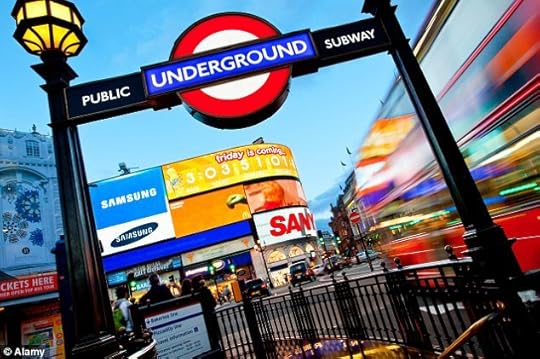 #20: Primrose Hill
Primrose Hill Road
NW3
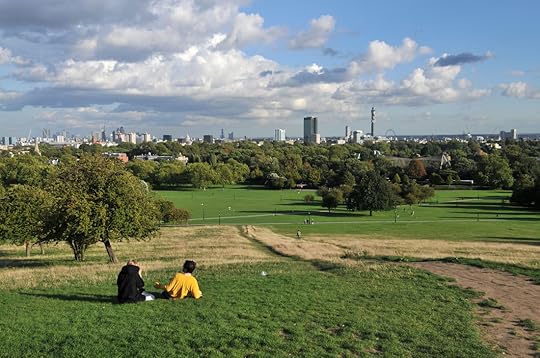 When sitting on top of the summit of Primrose Hill, you have the opportunity to witness a clear panorama view of the city of London. Located on the Northern side of Regent's Park, the hill is perfect for picnics on a warm and sunny day. Its location is great just to take a stroll through or even for workouts with its steep slopes. The rewards that each visitor witnesses when they climb to the top of Primrose Hill are the well-known London landmarks such as The Shard, the London Eye, St. Paul's Cathedral, the Telecom Tower, and many more fantastic sights. It's one of London's finest treasures, especially when the weather is on your side.
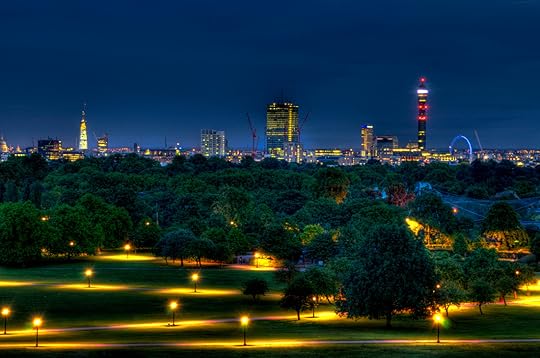 #19: Twinings Tea Shop and Museum
216 Strand
WC2R 1AP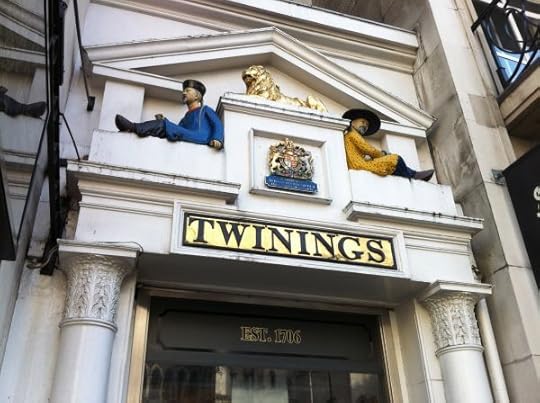 Calling all tea lovers who are coming to London to experience their first taste of authentic English tea, Twinings is the one place that you cannot miss. Located on The Strand, the Twinings name is renowned for their world-class teas. Inside, shelves upon shelves of every Twinings brand tea is packaged and sealed. Furthermore, in the back of the shop is a tea bar where you can sample any of the Twinings's tea that you desire. Alongside the bar is a small museum that catalogs the history of the Twinings family and their success. Though the shop is small, their selection of teas is extensive. Take a moment to relish in the fresh, aromatic smell of every type of tea in the shop. You might just want to bring it back home with you.
 #18: Banksy's Falling Shopper
Bruton Lane
Mayfair
W1S 4EH The notorious and celebrated graffiti artist, Banksy has numerous artworks hidden all over London. One of his most famous pieces is the "Falling Shopper" which can be found on an abandoned building in upmarket Mayfair. The graffiti shows a woman and her shopping chart plummeting from a great height. Painted a couple of floors up with an elegant drop shadow, this piece has survived much better than Banksy's other artwork in the city. From outlaw graffiti rebel to respected artist of the fine arts, Banksy's "Falling Shopper" is a type of artwork that you cannot find anywhere else inside a museum. It needs to be appreciated outside in the open air.

 #17: The Understudy
The National Theatre
Southbank
 Although the best pubs in London are usually the ones that date back to the 17th century, The Understudy (circa 2014) is the type of pub you would go to with a relaxed atmosphere. As part of the National Theatre's renovations, you can grab a quick pint of beer at The Understudy before heading over to enjoy a performance at the theatre next door. Or, if you're just there to chill on one of the many sofas or armchairs inside the pub, you can take your pint and grab a seat on the river terrace. The prices aren't outrageous – two pints for £9.50, what a bargain! – and the staff are more than happy to indulge their customers with tasters on their tap. It's the perfect stop to refuel after a long riverside walk up and down the Thames. Plus, you'll be able to watch the sun go down over a leisurely glass of whiskey, cider, beer, or maybe all three together.
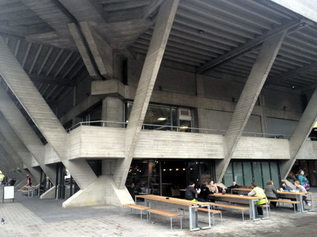 #16: Portobello Crêpes on Portobello Road
Portobello Road
W11 1AN
Notting Hill London may have a lot of street-side crêpe stands, but one of the best ones in the city is on Portobello Road in Notting Hill. This sweet treat alone conjures up long lines around the corner of the world famous street market. Portobello Road not only hosts very popular antique shops and stall, but also shares the street with a vast array of stands selling freshly made food, each with its own atmosphere, selection of drinks and live music. So if you're looking for a quick bite – for a crêpe that is – Portobello Crêpes will offer you a selection of Nutella with bananas, strawberries or even both with a small additional price. Their mouthwatering crêpes will be worth every penny.
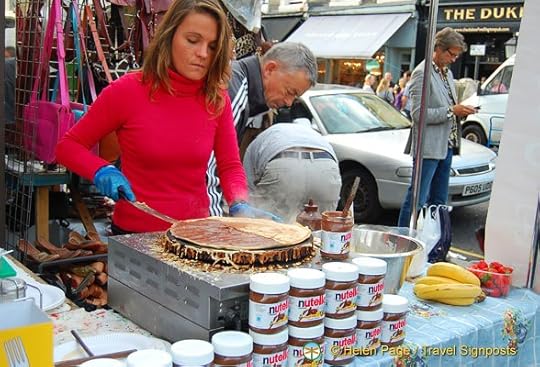
 #15: Tower Bridge Glass Floor
Tower Bridge Exhibition
Tower Bridge Road
SE1 2UP
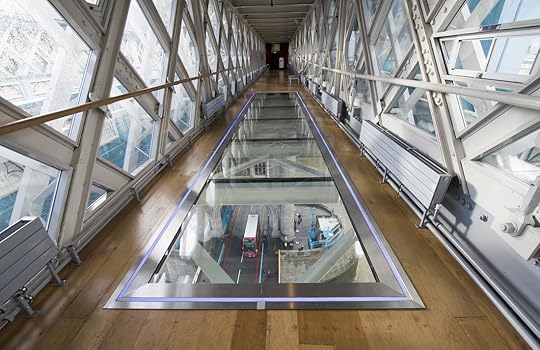 Tower Bridge is one of London's most well known landmarks in the city and is home to a very extensive Exhibition right at the top. Visitors are invited to step inside London's famous bridge to observe the spectacular London view, the Victorian Engine Rooms, and the Exhibition's newest popular attraction, the glass floor that looks directly down over the bridge. This see-through walkway was unveiled on November 10th, 2014, revealing the world of the Thames, and the road and pedestrian life just 138 feet below. You can finally have the city of London literary beneath your feet.

 #14: Pillars of Hercules
7 Greek Street
W1D 4DF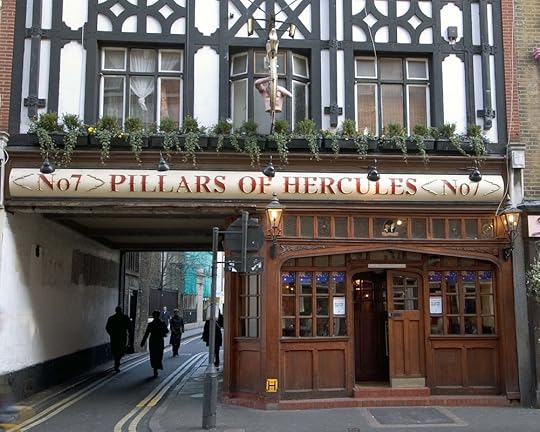 For any fans of Dickens who took the time to read A Tale of Two Cities, Dickens refers to this very pub in his novel. Pillars of Hercules was established in 1733 and then renovated in 1910. It has been a favorite pub among many literary London figures. Dickens himself spent some time at this pub as well as Ian McEwan (Atonement) probably either to write or just to enjoy a nice pint as they people watched from outside the pub's timber framed windows. A visit today at Pillars of Hercules will grant you a laid-back mostly quiet pub. But if you ever find yourself debating on what to get at Pillars of Hercules, go try Old Mout Cider, a New Zealand sweet cider that is every bit tasty.
 #13: Tea at the Victoria and Albert Museum
Cromwell Road
SW7 2RL
 The V&A without a doubt one of the best places to visit in London. But if you're still looking for a nice place to have Afternoon Tea – and you're kinda on a budget – the V&A Café offers a wide selection of all kinds of food. Set in 3 beautiful rooms, the V&A Café has high stained glass windows, gorgeous paneled walls and chandeliers, making you feel like you've been transported back to the Victorian era. You can either buy yourself a meal at the V&A, or you can pick and choose what you would like for your Afternoon Tea. A full pot of tea to yourself is £5 and from there you can select pastries such as millionaires shortbread (£2.75) or scones with jam and butter (£3.15). All together is roughly an easy but delicious £10 Afternoon Tea in one of the first cafés in any museum in the world.
 #12: The British Library
96 Euston Road
NW1 2DB
 The British Library is the national library of the United Kingdom. It provides over 150 million titles in most known languages for research and exhibition. It's the perfect literary haven for every bookworm out there in the world. It's stock full of rare collections, serene reading rooms and exhibits. But what the British Library is famous for, is its six-story glass library of all the manuscripts, maps and literature that used to belong to King George III. If that's not enough to get a book-lover hooked, a stunning free exhibition showcases all of the original written works of numerous famous British writers. You can see with your own eyes rough draft lyrics written by The Beatles, Jane Austen's lap desk, first editions of Shakespeare's plays and annotated notes from Beowulf, The Canterbury Tales and Jane Eyre. Even the Magna Carta is there!
 #11: Southbank Centre Book Market
Belvedere Road
SE1 8XX
 One of London's best kept secrets, the Southbank Centre Book Market is tucked underneath Waterloo Bridge on Queen's Walk. It's one of the only outdoor second-hand book markets in southern England and is open daily. Rain or shine, the Book Market holds a wide selection of novels to choose from. You can find hard or paperback versions of the classics, contemporary titles maps and posters. It's seriously one of the places in London where you will find yourself browsing every book spine for hours. It's an enjoyable stop full of cool finds.

 #10: Bubbledogs
70 Charlotte Street
W1T 4QG
 If you never thought that a restaurant would mix gourmet hotdogs together with sparkling champagne, Bubbledogs will pleasantly – if not, deliciously – surprise you. You get to pick your own dog (pork, beef or veggie) and then select from a dozen styles from plain "naked" to the more adventures toppings such as mac 'n' cheese, sloppy Joe's, or fried egg with tomato relish and black pudding. While the hotdogs on their menu might sound like an abominable Frankenstein creation, it is sinfully delicious. If that's not enough to satisfy you, Bubbledogs' champagne selection are the perfect foil for the greasy but delightful meal. But get there early, because a line starts forming at the front door before it even opens.

 #9: Yumchaa
Berwick Street Market
45 Berwick Street
W1F 8SF
 Although the building is small, Yumchaa is the perfect place to sit down, enjoy a cup of tea and get together with friends. But what makes Yumchaa so unique compared to other tea stops is that they create their own tea flavors for their customers to enjoy. As their website states: "Yum + Chaa = Tasty Tea." By using their recipe for loose leaf teas, Yumchaa blends new excellent teas that are both creative and experimental. So if you only enjoy a standard Earl Grey or Green Tea, Yumchaa has you covered. But if you feel like being daring, you can try one of the many indulgent tea leaf mixes such as Carmel Sweetheart (a black tea that contains caramel chunks and white chocolate that melts in your cup), or Wild Rose (a white tea that mixes together rose petals and mint to create a smooth sipping tea). While the tea is the main attraction at Yumchaa, you can also enjoy their pastries, sandwiches and salads along with your drink. In addition, if you happen to love one of Yumchaa's tea blends you can purchase a bag of their tea leaves for you to take back home and brew yourself.
 #8: Cubana
48 Lower Marsh
SE1 7RG
 A good mojito can sometimes be hard to find around London. But if you're looking for an excellent cocktail with a Latin-American vibe, Cubana is the place to be. You'll know you've found Cubana by its gigantic mural, which dominates the entrance to Lower Marsh, and once you've found it you'll be swept away into Mojito-madness. As their website claims: they are the "Home of mojitos" and have introduced the drink to the UK in the 1990's. Inside, Cubana's bar resembles a pre-revolutionary Havana, offering the best fresh cocktails and smoothies alongside their Cuban and Latin-American dishes. They are open seven days a week with live Salsa music most days, and from 4 p.m. – 7 p.m. cocktails are 2 for 1. You'll definitely come back for more.

 #7: George Inn
The George Inn Yard
77 Borough High Street
Southwark
SE1 1NH
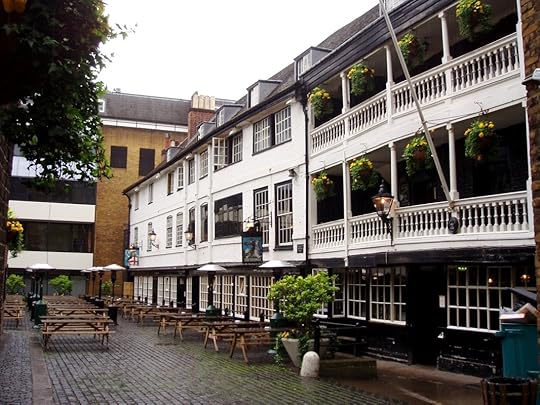 Protected by The National Trust, the George Inn is the last remaining galleried inn in London. Established in the medieval period, the George Inn is one of the oldest and most historic pubs in London. Writers such as Shakespeare and Charles Dickens used to visit. In 1677, the George Inn was rebuilt after a fire destroyed most of the medieval architecture in Southwark. Mentioned briefly in Dickens's novel, Little Dorrit, the George Inn is divided into a number of connected bars: The Parliament Bar, the Middle Bar and the Coffee Room, which Dickens visited frequently. Today, the George Inn holds a great selection of ales and food, all of which you may either enjoy inside or outside in the cobbled courtyard.
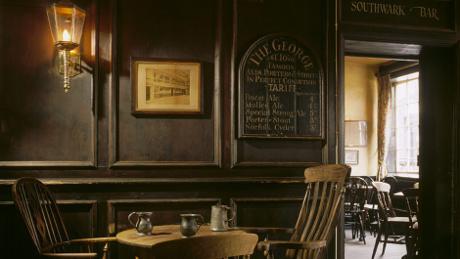 #6: Kew Palace and Gardens
Kew
Richmond, Surrey
TW9 3AB
 The Royal Botanical Gardens is not only the home to Kew Palace and Kew Gardens, but also the breathtaking landscapes. Founded in 1840, Kew Gardens in the world's largest collection of living plants and stretches over 300 acres. You will need a full day to explore this grand garden, as well as a sunny day. Wonderful for picnics or for lounging on the grass, the gardens instantly capture your attention with its immense beauty. And if that's not enough, you can go inside and visit the historic Kew Palace. Once used as a family retreat for the Hanoverians, Kew Palace is a large manor house made out of bricks with a spellbinding garden. Also, keep an eye out for any peacocks roaming about.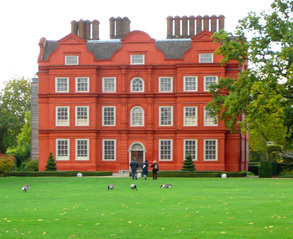
 #5: The Cellarium Café and Terrace
20 Dean’s Yard
Westminster Abbey
SW1P 3PA
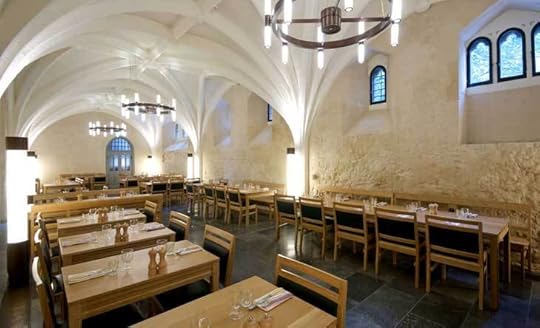 Just a few steps from the Houses of Parliament, The Cellarium is the type of restaurant that has been touched by history. Set within the 14th century store house of Westminster Abbey, The Cellarium has a wonderful Afternoon Tea service underneath the abbey's graceful steeped arches. The wait for a table can sometimes be long, especially with the flow of visitors coming in after their tour of the abbey. But it's worth the wait. Serving finger sandwiches, savory scones, finger-licking pastries and a pot of loose leaf tea of your choice, you will feel satisfied and relaxed after your long trek around London. Or, if you're looking to celebrate, there is also an option to have your Afternoon Tea with a glass of Prosecco or a glass of champagne.

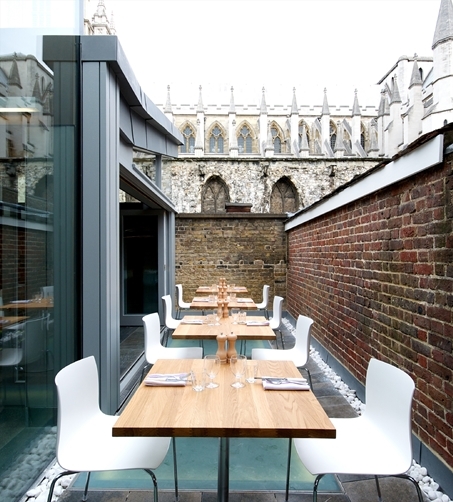 #4: Up at the O2
Peninsula Square
SE10 0DX
 Make sure you're not afraid of heights before you take on the climb up on the O2 Arena. This attraction gives visitors a chance to go on a guided expedition across the roof of the arena via a fabric walkway. Right up at the summit is an observation platform that displays a 360 degree view of London's landmarks. Before embarking on the climb, jumpsuits, shoes and safety harnesses will be provided for visitors. In addition, there are different climbs at different times that you can select on going. Trek up the O2 during the Sunset Expedition and witness the backdrop of London under the auburn sky, or even the Twilight Expedition where the city of London will light up before your very eyes. Bring on the adrenaline rush.
 #3: Bea's of Bloomsbury
83 Watling Street
EC4M 9BX
 One of the best tea rooms in the United Kingdom, Bea's of Bloomsbury provide their customers the essence of what Afternoon Tea should be. Set in a casual café setting with an open-air pastry kitchen, Bea's is a mini-chain of cafés near St. Paul's Cathedral and in Farringdon. The original Bea's – and the best of the Bea's chain – is in Bloomsbury. Compared with the other two locations, the Bea's on Bloomsbury is small and quaint with a very friendly staff. Known best for their famous service of Afternoon Tea, Bea's offers crumbly scones, full on sandwiches and of course, Bea's world famous moist cupcakes. All made impeccably and tasting divine. And once your done licking your plate, you might also want to consider taking home one, two, maybe six of those glorious cupcakes.
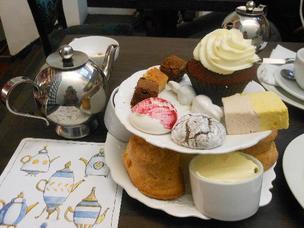
 #2: Daawat at the Strand Palace Hotel
2 Burleigh Street
WC2R 7PX
 If you're tired of the standard scones, finger sandwiches and English pastries that you have with every Afternoon Tea, Daawat will pleasantly surprise you. This restaurant not only serves one of the best Indian foods in London, but their Afternoon Tea is tailored to their cuisine. They serve Indian Afternoon Tea, which consists of small finger foods such as Bombay chicken, seasonal vegetable rolls, lamb wraps and punjab pasties. For dessert try the Chocolate Samosa with mango purée or the Chocolate Éclair. But of course, no Afternoon Tea would be complete without a scone or two. This will definitely be one of the best Afternoon Teas you will ever have.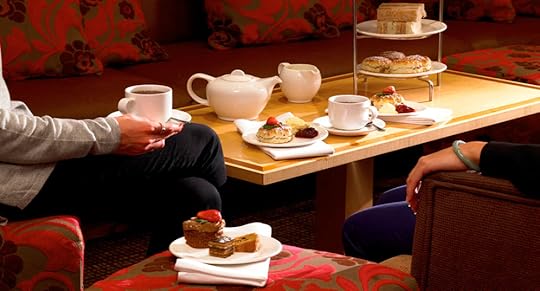
 #1: Speedy's Sandwich Bar & Café
187 North Gower Street
NW1 2NJ
 Look familiar? If not, then this might help a bit:
  Now starting to look familiar?
Yes, that is indeed the one and only Speedy's Sandwich Bar & Café that appears on the BBC hit show, Sherlock.
And yes, this place is very much real.
Having been featured in all 3 seasons of Sherlock, this small but charming café on North Gower Street – not Baker Street! – has now become a pilgrimage for all fans of Sherlock. The staff inside is beyond nice and are very courteous to their customers. You can order the one and only Sherlock & Watson wraps or select among their delicious pastas or omelettes. Keep an eye out for the distinctive red canopy and grab a seat right outside Speedy's where you can have lunch next to Sherlock and Watson's home.
 Despite its massive size, London is a city where straying from the tourist's path my be a little difficult. London is chalk-full of tourists attractions, and I mean good ones. There are just some places around London that you HAVE to see for yourself before you head home to the states. But despite your friends always telling you, "Go to the Shard" or "St. Paul's Cathedral," that is all well and good, but you might be missing out on all of the hidden treasures scattered around London. Those small little gems might just be as equally amazing as going up on the London Eye. So uncover the city's hidden spots; and because you are in the middle of London, you're bound to stumble across something spectacular.
Following that, I had a quick stop in Massachusetts for my friend's graduation at Mount Holyoke (Hey Guys!), then a 5 hour flight from JFK to wonderful Los Angeles. Upon my arrival back to the City of Angels, I was swept away from the traffic and craziness of LAX to the delicious and calming atmosphere of California's most priceless gem: In-in-Out Burger.
Over the course of the week that I had to adjust to West Coast time, and preventing myself from saying, "pounds" instead of "dollars" whenever I would ask someone how much a dress was at H&M, I reflected back on my time in good old London and reminisced over the handful of small but meaningful places that made my trip abroad memorable.
Now that I had survived London's nightlife, its arts and leisures, sights and museums, I can safely say that there are a few places within the city that are worth visiting for anyone. Especially my friends who are JUST gearing up to go abroad to London themselves.
Whether you are looking for that special place to experience a real British Afternoon Tea, an English pub that serves the best drinks in town or just some plane old good restaurants or landmarks to check out, London is stock full of gems that are definitely worth seeing.
Below are some of my favorite London treasures off the beaten-track, just to name a few for your own interest:
#20: Primrose Hill
Primrose Hill Road
NW3
When sitting on top of the summit of Primrose Hill, you have the opportunity to witness a clear panorama view of the city of London. Located on the Northern side of Regent's Park, the hill is perfect for picnics on a warm and sunny day. Its location is great just to take a stroll through or even for workouts with its steep slopes. The rewards that each visitor witnesses when they climb to the top of Primrose Hill are the well-known London landmarks such as The Shard, the London Eye, St. Paul's Cathedral, the Telecom Tower, and many more fantastic sights. It's one of London's finest treasures, especially when the weather is on your side.
#19: Twinings Tea Shop and Museum
216 Strand
WC2R 1AP
Calling all tea lovers who are coming to London to experience their first taste of authentic English tea, Twinings is the one place that you cannot miss. Located on The Strand, the Twinings name is renowned for their world-class teas. Inside, shelves upon shelves of every Twinings brand tea is packaged and sealed. Furthermore, in the back of the shop is a tea bar where you can sample any of the Twinings's tea that you desire. Alongside the bar is a small museum that catalogs the history of the Twinings family and their success. Though the shop is small, their selection of teas is extensive. Take a moment to relish in the fresh, aromatic smell of every type of tea in the shop. You might just want to bring it back home with you.
#18: Banksy's Falling Shopper
Bruton Lane
Mayfair
W1S 4EH
The notorious and celebrated graffiti artist, Banksy has numerous artworks hidden all over London. One of his most famous pieces is the "Falling Shopper" which can be found on an abandoned building in upmarket Mayfair. The graffiti shows a woman and her shopping chart plummeting from a great height. Painted a couple of floors up with an elegant drop shadow, this piece has survived much better than Banksy's other artwork in the city. From outlaw graffiti rebel to respected artist of the fine arts, Banksy's "Falling Shopper" is a type of artwork that you cannot find anywhere else inside a museum. It needs to be appreciated outside in the open air.
#17: The Understudy
The National Theatre
Southbank
Although the best pubs in London are usually the ones that date back to the 17th century, The Understudy (circa 2014) is the type of pub you would go to with a relaxed atmosphere. As part of the National Theatre's renovations, you can grab a quick pint of beer at The Understudy before heading over to enjoy a performance at the theatre next door. Or, if you're just there to chill on one of the many sofas or armchairs inside the pub, you can take your pint and grab a seat on the river terrace. The prices aren't outrageous – two pints for £9.50, what a bargain! – and the staff are more than happy to indulge their customers with tasters on their tap. It's the perfect stop to refuel after a long riverside walk up and down the Thames. Plus, you'll be able to watch the sun go down over a leisurely glass of whiskey, cider, beer, or maybe all three together.
#16: Portobello Crêpes on Portobello Road
Portobello Road
W11 1AN
Notting Hill
London may have a lot of street-side crêpe stands, but one of the best ones in the city is on Portobello Road in Notting Hill. This sweet treat alone conjures up long lines around the corner of the world famous street market. Portobello Road not only hosts very popular antique shops and stall, but also shares the street with a vast array of stands selling freshly made food, each with its own atmosphere, selection of drinks and live music. So if you're looking for a quick bite – for a crêpe that is – Portobello Crêpes will offer you a selection of Nutella with bananas, strawberries or even both with a small additional price. Their mouthwatering crêpes will be worth every penny.
#15: Tower Bridge Glass Floor
Tower Bridge Exhibition
Tower Bridge Road
SE1 2UP
Tower Bridge is one of London's most well known landmarks in the city and is home to a very extensive Exhibition right at the top. Visitors are invited to step inside London's famous bridge to observe the spectacular London view, the Victorian Engine Rooms, and the Exhibition's newest popular attraction, the glass floor that looks directly down over the bridge. This see-through walkway was unveiled on November 10th, 2014, revealing the world of the Thames, and the road and pedestrian life just 138 feet below. You can finally have the city of London literary beneath your feet.
#14: Pillars of Hercules
7 Greek Street
W1D 4DF
For any fans of Dickens who took the time to read A Tale of Two Cities, Dickens refers to this very pub in his novel. Pillars of Hercules was established in 1733 and then renovated in 1910. It has been a favorite pub among many literary London figures. Dickens himself spent some time at this pub as well as Ian McEwan (Atonement) probably either to write or just to enjoy a nice pint as they people watched from outside the pub's timber framed windows. A visit today at Pillars of Hercules will grant you a laid-back mostly quiet pub. But if you ever find yourself debating on what to get at Pillars of Hercules, go try Old Mout Cider, a New Zealand sweet cider that is every bit tasty.
#13: Tea at the Victoria and Albert Museum
Cromwell Road
SW7 2RL
The V&A without a doubt one of the best places to visit in London. But if you're still looking for a nice place to have Afternoon Tea – and you're kinda on a budget – the V&A Café offers a wide selection of all kinds of food. Set in 3 beautiful rooms, the V&A Café has high stained glass windows, gorgeous paneled walls and chandeliers, making you feel like you've been transported back to the Victorian era. You can either buy yourself a meal at the V&A, or you can pick and choose what you would like for your Afternoon Tea. A full pot of tea to yourself is £5 and from there you can select pastries such as millionaires shortbread (£2.75) or scones with jam and butter (£3.15). All together is roughly an easy but delicious £10 Afternoon Tea in one of the first cafés in any museum in the world.
#12: The British Library
96 Euston Road
NW1 2DB
The British Library is the national library of the United Kingdom. It provides over 150 million titles in most known languages for research and exhibition. It's the perfect literary haven for every bookworm out there in the world. It's stock full of rare collections, serene reading rooms and exhibits. But what the British Library is famous for, is its six-story glass library of all the manuscripts, maps and literature that used to belong to King George III. If that's not enough to get a book-lover hooked, a stunning free exhibition showcases all of the original written works of numerous famous British writers. You can see with your own eyes rough draft lyrics written by The Beatles, Jane Austen's lap desk, first editions of Shakespeare's plays and annotated notes from Beowulf, The Canterbury Tales and Jane Eyre. Even the Magna Carta is there!
#11: Southbank Centre Book Market
Belvedere Road
SE1 8XX
One of London's best kept secrets, the Southbank Centre Book Market is tucked underneath Waterloo Bridge on Queen's Walk. It's one of the only outdoor second-hand book markets in southern England and is open daily. Rain or shine, the Book Market holds a wide selection of novels to choose from. You can find hard or paperback versions of the classics, contemporary titles maps and posters. It's seriously one of the places in London where you will find yourself browsing every book spine for hours. It's an enjoyable stop full of cool finds.
#10: Bubbledogs
70 Charlotte Street
W1T 4QG
If you never thought that a restaurant would mix gourmet hotdogs together with sparkling champagne, Bubbledogs will pleasantly – if not, deliciously – surprise you. You get to pick your own dog (pork, beef or veggie) and then select from a dozen styles from plain "naked" to the more adventures toppings such as mac 'n' cheese, sloppy Joe's, or fried egg with tomato relish and black pudding. While the hotdogs on their menu might sound like an abominable Frankenstein creation, it is sinfully delicious. If that's not enough to satisfy you, Bubbledogs' champagne selection are the perfect foil for the greasy but delightful meal. But get there early, because a line starts forming at the front door before it even opens.
#9: Yumchaa
Berwick Street Market
45 Berwick Street
W1F 8SF
Although the building is small, Yumchaa is the perfect place to sit down, enjoy a cup of tea and get together with friends. But what makes Yumchaa so unique compared to other tea stops is that they create their own tea flavors for their customers to enjoy. As their website states: "Yum + Chaa = Tasty Tea." By using their recipe for loose leaf teas, Yumchaa blends new excellent teas that are both creative and experimental. So if you only enjoy a standard Earl Grey or Green Tea, Yumchaa has you covered. But if you feel like being daring, you can try one of the many indulgent tea leaf mixes such as Carmel Sweetheart (a black tea that contains caramel chunks and white chocolate that melts in your cup), or Wild Rose (a white tea that mixes together rose petals and mint to create a smooth sipping tea). While the tea is the main attraction at Yumchaa, you can also enjoy their pastries, sandwiches and salads along with your drink. In addition, if you happen to love one of Yumchaa's tea blends you can purchase a bag of their tea leaves for you to take back home and brew yourself.
#8: Cubana
48 Lower Marsh
SE1 7RG
A good mojito can sometimes be hard to find around London. But if you're looking for an excellent cocktail with a Latin-American vibe, Cubana is the place to be. You'll know you've found Cubana by its gigantic mural, which dominates the entrance to Lower Marsh, and once you've found it you'll be swept away into Mojito-madness. As their website claims: they are the "Home of mojitos" and have introduced the drink to the UK in the 1990's. Inside, Cubana's bar resembles a pre-revolutionary Havana, offering the best fresh cocktails and smoothies alongside their Cuban and Latin-American dishes. They are open seven days a week with live Salsa music most days, and from 4 p.m. – 7 p.m. cocktails are 2 for 1. You'll definitely come back for more.
#7: George Inn
The George Inn Yard
77 Borough High Street
Southwark
SE1 1NH
Protected by The National Trust, the George Inn is the last remaining galleried inn in London. Established in the medieval period, the George Inn is one of the oldest and most historic pubs in London. Writers such as Shakespeare and Charles Dickens used to visit. In 1677, the George Inn was rebuilt after a fire destroyed most of the medieval architecture in Southwark. Mentioned briefly in Dickens's novel, Little Dorrit, the George Inn is divided into a number of connected bars: The Parliament Bar, the Middle Bar and the Coffee Room, which Dickens visited frequently. Today, the George Inn holds a great selection of ales and food, all of which you may either enjoy inside or outside in the cobbled courtyard.
#6: Kew Palace and Gardens
Kew
Richmond, Surrey
TW9 3AB
The Royal Botanical Gardens is not only the home to Kew Palace and Kew Gardens, but also the breathtaking landscapes. Founded in 1840, Kew Gardens in the world's largest collection of living plants and stretches over 300 acres. You will need a full day to explore this grand garden, as well as a sunny day. Wonderful for picnics or for lounging on the grass, the gardens instantly capture your attention with its immense beauty. And if that's not enough, you can go inside and visit the historic Kew Palace. Once used as a family retreat for the Hanoverians, Kew Palace is a large manor house made out of bricks with a spellbinding garden. Also, keep an eye out for any peacocks roaming about.
#5: The Cellarium Café and Terrace
20 Dean’s Yard
Westminster Abbey
SW1P 3PA
Just a few steps from the Houses of Parliament, The Cellarium is the type of restaurant that has been touched by history. Set within the 14th century store house of Westminster Abbey, The Cellarium has a wonderful Afternoon Tea service underneath the abbey's graceful steeped arches. The wait for a table can sometimes be long, especially with the flow of visitors coming in after their tour of the abbey. But it's worth the wait. Serving finger sandwiches, savory scones, finger-licking pastries and a pot of loose leaf tea of your choice, you will feel satisfied and relaxed after your long trek around London. Or, if you're looking to celebrate, there is also an option to have your Afternoon Tea with a glass of Prosecco or a glass of champagne.
#4: Up at the O2
Peninsula Square
SE10 0DX
Make sure you're not afraid of heights before you take on the climb up on the O2 Arena. This attraction gives visitors a chance to go on a guided expedition across the roof of the arena via a fabric walkway. Right up at the summit is an observation platform that displays a 360 degree view of London's landmarks. Before embarking on the climb, jumpsuits, shoes and safety harnesses will be provided for visitors. In addition, there are different climbs at different times that you can select on going. Trek up the O2 during the Sunset Expedition and witness the backdrop of London under the auburn sky, or even the Twilight Expedition where the city of London will light up before your very eyes. Bring on the adrenaline rush.
#3: Bea's of Bloomsbury
83 Watling Street
EC4M 9BX
One of the best tea rooms in the United Kingdom, Bea's of Bloomsbury provide their customers the essence of what Afternoon Tea should be. Set in a casual café setting with an open-air pastry kitchen, Bea's is a mini-chain of cafés near St. Paul's Cathedral and in Farringdon. The original Bea's – and the best of the Bea's chain – is in Bloomsbury. Compared with the other two locations, the Bea's on Bloomsbury is small and quaint with a very friendly staff. Known best for their famous service of Afternoon Tea, Bea's offers crumbly scones, full on sandwiches and of course, Bea's world famous moist cupcakes. All made impeccably and tasting divine. And once your done licking your plate, you might also want to consider taking home one, two, maybe six of those glorious cupcakes.
#2: Daawat at the Strand Palace Hotel
2 Burleigh Street
WC2R 7PX
If you're tired of the standard scones, finger sandwiches and English pastries that you have with every Afternoon Tea, Daawat will pleasantly surprise you. This restaurant not only serves one of the best Indian foods in London, but their Afternoon Tea is tailored to their cuisine. They serve Indian Afternoon Tea, which consists of small finger foods such as Bombay chicken, seasonal vegetable rolls, lamb wraps and punjab pasties. For dessert try the Chocolate Samosa with mango purée or the Chocolate Éclair. But of course, no Afternoon Tea would be complete without a scone or two. This will definitely be one of the best Afternoon Teas you will ever have.
#1: Speedy's Sandwich Bar & Café
187 North Gower Street
NW1 2NJ
Look familiar? If not, then this might help a bit: Now starting to look familiar?Yes, that is indeed the one and only Speedy's Sandwich Bar & Café that appears on the BBC hit show, Sherlock.
And yes, this place is very much real.
Having been featured in all 3 seasons of Sherlock, this small but charming café on North Gower Street – not Baker Street! – has now become a pilgrimage for all fans of Sherlock. The staff inside is beyond nice and are very courteous to their customers. You can order the one and only Sherlock & Watson wraps or select among their delicious pastas or omelettes. Keep an eye out for the distinctive red canopy and grab a seat right outside Speedy's where you can have lunch next to Sherlock and Watson's home.
Despite its massive size, London is a city where straying from the tourist's path my be a little difficult. London is chalk-full of tourists attractions, and I mean good ones. There are just some places around London that you HAVE to see for yourself before you head home to the states. But despite your friends always telling you, "Go to the Shard" or "St. Paul's Cathedral," that is all well and good, but you might be missing out on all of the hidden treasures scattered around London. Those small little gems might just be as equally amazing as going up on the London Eye. So uncover the city's hidden spots; and because you are in the middle of London, you're bound to stumble across something spectacular.