Nancy S. Thompson's Blog, page 5
May 1, 2013
IWSG: My Daily Addiction

It’s the first Wednesday of the month, time forAlexj J Cavanaugh’s Insecure Writer’s Support Group.
Hi, my name is Nancyand I am an addict…
I never wrote my novel with publishing in mind. It was simply a lark, something I wanted to accomplish. Once I got into it, though, I found I loved it. Keep in mind, I knew nothing about writing fiction, but I did have a good education and was an avid reader.
I was fortunate enough to have all the critical plot points, so once I was finished and thought, “Hey, I might have something here,” all I needed to do was research what it takes to get published. Trouble was, there was a lot on that list. But I did it. I jumped through most of the hoops.
I found querying to be an especially brutal one, demoralizing, really. But I made it through, not the wholly traditional way—I bypassed the agent—yet I still managed to snag a book deal. I thought, after edits are done, I’ll have all the hard parts behind me. Yeah, not so much.
I always thought publishing would bring me this huge sense of accomplishment, that I’d be nothing but happy, happy, happy. But then I became obsessed. Addicted. It’s a daily struggle really. They don’t tell you that once you’re published it’s all about selling. But I didn’t know how to do that. Marketing is not in my tool belt. I’ve had to learn as I go, and I’ve learned I suck. But still, I make progress, even though it is a struggle.
To gauge that war, I check my rankings on Amazon, constantly, both US and UK. I hop on Goodreads to see how many people have added my book to their TBR list, how many new ratings, new reviews. Same with Amazon. I’m always worrying about where the next review will come from, will it suck, will it be amazing? Will it spike my sales?

So, as you can imagine, each day brings either a huge high of happiness or a face-planting low of failure. One day, I’m up, the next, I’m down. Some days, it’s up and down and up and down all within a few hours. Oh cool, a great 5-star review on Amazon, YAY! Let’s watch my book climb up Amazon’s Top-Rated in Romantic Suspense list, or Mysteries and Suspense, where it can really be seen. Happy dance time! Then I watch as my ranking gets higher and higher, which, of course, means no one has bought a copy that day. When it goes above a certain threshold, I practically have a coronary.
It’s driving me CRAZY!!! I feel like an addict who craves the bottle or the needle or the pipe. The information on Amazon and Goodreads is my drug. I have to know. I have to know! Now, now, now!

Well, I’ve reached my breaking point, I think. I can’t do it any more. I’ve had a lot of highs in the last week. One of them was that my fans expect another book. My readers message, email, text, and Facebook me, telling me this, yet I sit on my ass and obsess over numbers and rankings, and I’m getting nothing done. I’ve been told, it’s easier to sell if you have multiple titles. Well, that’s what I want to focus on, giving my readers another roller coaster to ride.

So I’m disconnecting, pulling back from the Internet. Not completely. But a lot. I’ll still try to post to my blog on Mondays, but only if I have something important to say. I won’t be around as much, to chat and comment, but I’ll be lurking. I don’t want what I’ve been experiencing to be what publishing is all about for me. I want that feeling I had way back in the beginning, when I sat at my desk, writing my book, living with my characters, creating a brand new world.
My name is Nancy, and I am a writer. So watch me write.


April 30, 2013
A to Z Challenge: Z is for Zealous
Welcome to the 2013 A to Z Challenge!
This year, I’m focusing on two themes: Emotions and grammar,depending on which letter we’re on each day.
Today’s an emotion day! Or, perhaps, more accurately, an EMOTIONAL day, ‘cause it’s over.
This is the end. The letter Z. The Omega. And just like last year, I am tired. Beyond tired. So much so, I can barely think. So have a little patience with my very last A to Z Challenge post. Okay, here goes…
__________
Z is for Zeal: fervor of a person, cause, or object; eager desire or endeavor; enthusiastic diligence; ardor
Yesterday, I wrote about yearning and how to effectively convey a character’s yearning, no matter how despicable, in such a way as to make the reader not only sympathize with him, but empathize, as well, even going so far as to want the same thing.
One of the best attributes a character—and his author—can employ to indoctrinate the reader in this way is with zeal. A character, and again, his author, must utilize their confidence and utter conviction in whatever cause or yearning they are fighting for.
Of course, zeal requires knowledge, but knowledge without understanding can come off as madness. Just look at the very definition of a zealot—one who is excessivelyenthusiastic, a fanatic. It’s what we call those crazies who protest war by bombing the innocent.
So while your characters, and you, as their creator, should express a certain amount of zeal in order to impress your reader with the characters’ cause, make sure you not only believe it, no matter how awful it is, but understand it, as well. Readers can detect a writer who simply phones it in.
With that said, I hope you have enjoyed my A to Z Challenge series. I think it will probably be my last one. Thanks to all of you who dropped by for a visit and left a comment. You are the reason I saw it through to the end. I will be back tomorrow for another IWSG entry and next week for my A to Z Reflections post.
Until then...Goodbye and God bless!
April 29, 2013
A to Z Challenge: Y is for Yearning

Welcome to the 2013 A to Z Challenge!
This year, I’m focusing on two themes: Emotions and grammar,depending on which letter we’re on each day.
Today’s an emotion day!
__________
Y is for Yearning: a deep longing, especially when accompanied by tenderness or sadness
I think yearning is likely at the core of every plot ever imagined. It’s what drives the characters, their yearning for whatever it is they want or need. It’s at the heart of every human being. We each have our own dreams, our own desires, and we yearn for them to come true, to be made whole, to be fully realized.
The key to making your reader accept your character’s yearning is to not only have them sympathizewith his underlying belief system, but fully empathize, as well. That which makes us each unique also forms our personal mythos, and those internal principles define not only how we perceive the world, but how we react to it and the choices we make.
So the writer must indoctrinate the reader to a certain extent, temporarily instilling the character’s ideology into the mind of reader. For that to happen, the yearning, his choice, his desires, must make sense, or at least the author has to make it seem like it makes sense.
I believe a strong and very close POV helps with this difficult task. It’s why I write in first person and not third. I deal with some pretty horrific human flaws and frailties in my novels. Hard for most people to comprehend and commiserate with. But if I can get the reader to live in the protagonist’s head, she’s more likely to understand where he’s coming from, to accept that’s what’s best, to hope and pray he achieves it, even yearn for it herself.
How do you make your readers understand your characters’ yearnings?

April 27, 2013
A to Z Challenge: X is for Xenophobic
Welcome to the 2013 A to Z Challenge!
This year, I’m focusing on two themes: Emotions and grammar,depending on which letter we’re on each day.
Today’s an emotion day!
__________
X is for Xenophobic: Unreasonably fearful of or hating anyone or anything foreign; irrationally fearful of that which is strange; intolerant, prejudice
Oy—X! What to do for X. There are no grammar topics for X, and xenophobia is the only emotion word I could think of. I’ve never had to deal with it myself in any of my own writing, but after last week’s bombings during the 2013 Boston Marathon and the revelations since, I thought it relevant.
Wikipedia says “Xenophobia can manifest itself in many ways involving the relations and perceptions of an ingroup towards an outgroup, including a fear of losing identity, suspicion of its activities, aggression, and desire to eliminate its presence to secure a presumed purity.”
I think this can be applied to both the young terrorists as well as those in this country who automatically jumped to conclusions about who they were and why they did what they did. It’s about being conditioned, either by those we are closest to or by events that have somehow affected our lives and shaped our worldview.
Xenophobia is about mistrust and fear, angerand hatred, anxiety and worry. It’s more than just being prejudiced. It’s having a totally biased opinion of an entire culture and is a relatively new phenomena since the media has made our world a very small place.
We are fully aware now, and that awareness sometimes makes us uncomfortable, because awareness does not mean we understand. In fact, this awareness makes many feel threatened because they do not understand; they do notagree with that culture’s way of life, whether that life is defined by race, creed, or sexuality.
None of us like to think that we share or exhibit any form of xenophobia, but think about it for a moment. When those bombings happened in Boston, did you instantly point to any one group as responsible? Did you believe religion to be at the core? Were you surprised by who the culprits really were and why they did it? Truth is, it’s human nature to be suspicious of those we do not understand, because we are tribal and feel the most comfortable around those most like ourselves.
I think what’s relevant here is what is reasonable, and while we all might exhibit tribal tendencies from time to time, we also know right from wrong, what is rational and what is unacceptable. That’s the big difference between xenophobes and the rest of us.

April 26, 2013
A to Z Challenge: W is for Worry
Welcome to the 2013 A to Z Challenge!
This year, I’m focusing on two themes: Emotions and grammar,depending on which letter we’re on each day.
Today’s an emotion day!
__________
W is for Worry: to torment oneself with or suffer from disturbing thoughts; to torment with cares or anxiety; plagued by fret.
We’ve all experienced that dreadful feeling of anxiety eating at our gut. It’s kind of like fear, but more about what we don’tknow, what might happen, expectation. Anticipation. When including it in our writing, I think it helps to show the entire process, from the first nagging thoughts to full-blown terror, if that’s where the situation leads.
But try not to hit your reader over the head with it all at once. Worry calls for a bit of subtlety, easing into it at first, antagonizing the anxiety with outside forces, then ratcheting it up until the character breaks into a more extreme emotion, like fear, or somehow finds relief.
There is a plethora of ways in which to show the reader how a character experiences worry. I bite my nails, chew on the inside of my cheeks, or pull my hair out, strand by stand. Others pace or chain smoke, rub hands through their hair or scrub down their face, they blink and fidget, or just stare out into space with a furrowed brow, their lip drawn in between their teeth as they wring their hands or crack their knuckles.
The list is extensive, and I do think a few should be employed to reinforce the feeling, but since worry is such an internalized emotion, a lot of the wordplay might be better suited to the character’s internal monologue, the questions that plague him, what might happen, the consequences, and how he will handle it.
But when the worry is being shared between two or more characters, the best way to express it is with dialogue that barks back and forth, snapping questions, demanding answers, challenging accountability, even to the point of quarreling or perhaps an awkward silence.
In The Mistaken, I have one scene where the main character anxiously awaits a call from his wife after a day of bickering. He answers every call, hoping it might be her. When he discovers she’s been in a horrific accident, he barges into the emergency room, calling out her name in high-pitched hysteria. Then, as he watches the medical team futilely attempt life-saving procedures on her, he reacts internally as if each maneuver is being performed on him instead.
The book is packed with anxiety-riddled scenes where the characters worry about who’s out to get them, how close they’re getting, and how they’ll ever manage to stay alive against unimaginable and insurmountable odds.
Have you ever written a worry-filled scene? What imagery did you depend on to bring that anxiety to life?
April 25, 2013
A to Z Challenge: V is for Verb
Welcome to the 2013 A to Z Challenge!
This year, I’m focusing on two themes: Emotions and grammar,depending on which letter we’re on each day.
Today’s a grammar day!
__________
V is for Verb: in language, a class of words that typically express action, state, or a relation between two things, and that which may be inflected for tense, aspect, voice, mood, and to show agreement with their subject or object.
There are a dozen topics I could discuss in regards to the almighty verb. Just look at this list of verb types: Causative, copula, ditransitive, dynamnic, finite, inchoative, intransitive, irregular, modal, non-finite, performative, phrasl, regular, stative, and transitive.
I even hit on one type in my discussion of tense last Tuesday, but I think I’ll keep this limited to the issues I see most often when editing. Primarily—and, as writers, we’ve all been warned against this—the biggest issue I see is the use of passive verbs versus active ones.
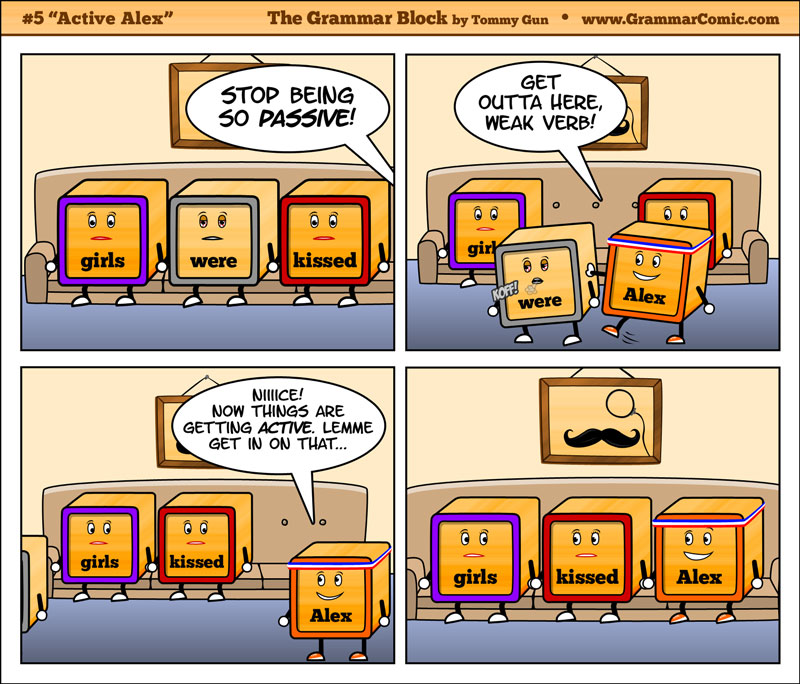
First, allow me to show the difference. Active: I threw the ball. The subject (I) performs the action (threw) on the object (the ball)Passive: The ball was thrown by me. The subject (ball) receives the action (was thrown) instead of performing it and is typically aided by a helping verb (is, was, been, are, were.)Inert: The ball is round. The verb “is” describes a state of being and is neither active nor passive.
Now, allow me to say one more thing—passive verbs are not necessarily wrong, but they do weaken the sentence. And a sentence with a passive voice uses far more words than one with an active voice. Compound this by every sentence in your manuscript, and you’ve got a lot of space taken up by wasted words, space where you could explore plot and character more deeply with active verbs.
There is another form of passive verb I see quite often. And honestly, I use it myself. Everyone does. For the most part, it’s not too egregious, that is, if you don’t overuse it and if revising it to the more active form changes the meaning or doesn’t quite fit. I’m talking about the use of gerunds or –ing verbs.
Why say her shoulders were shaking when her shoulders shookwill work? But if you say her life was unraveling at the seams, it really doesn’t work to revise it to her life unraveled at the seams, because you’re trying to show something currently happening in the moment, not in the past, even though the story is told in the past. Make sense? I know, it’s confusing, and that’s why so many writers have a problem with it, including me.
Do you overuse passive verbs or have a hard time identifying them in your own writing?

April 24, 2013
A to Z Challenge: U is for Unnecessary Words

Welcome to the 2013 A to Z Challenge!
This year, I’m focusing on two themes: Emotions and grammar,depending on which letter we’re on each day.
I’ll be sharing mostly what I’ve learned about writing emotion into a novel, but I’ll also be throwing in a few key grammar lessons, pet peeves I’ve picked up while working as an editor.
Today’s a grammar day! (Sort of.)
__________
U is for Unnecessary words: words that are not essential or requisite; indispensable
Thomas Jefferson once said, “Don’t use two words when one will do.” After missing commasand the overuse of present participle phrases, the use of unnecessary words is probably the third most common mistake I see as an editor.
I think this is because, as writers, we love words—our words—and if we happen to compose a beautiful string of them, we loathe deleting a single one. We believe it’s perfect just the way it is, so eloquent, so clever, so impressive. But if you can remove one of those words and have the meaning remain intact, then it’s unnecessary.
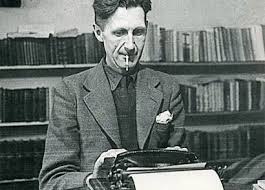
George Orwell once said, “If it is possible to cut a word out, always cut it out.” Less is always better, because words that don’t contribute meaning to a sentence actually weaken it instead.
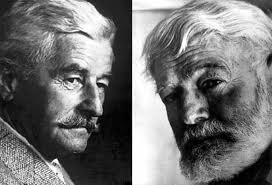
Orwell also said, “Never use a long word where a short one will do.” When William Faulkner criticized Ernest Hemingway for his narrow use of words, Hemingway replied, “Poor Faulkner. Does he really think big emotions come from big words? He thinks I don’t know the ten-dollar words. I know them all right. But there are older and simpler and better words, and those are the ones I use.”
I could go on and on, but that would be counterintuitive, wouldn’t it? So I’ll leave you with this: Read each and every sentence you’ve written again and again. If there is a simpler way to write it with shorter and fewer words, do it.
Do you find you can often delete a certain amount of words in your own writing without altering the meaning? Do you do it or leave them because you find them pretty or witty?
April 23, 2013
A to Z Challenge: T is for Tense

Welcome to the 2013 A to Z Challenge!
This year, I’m focusing on two themes: Emotions and grammar,depending on which letter we’re on each day.
Today’s a grammar day!
But first, check out this review by Literary Mania Reviews.
And please, give her a follow.
She’s an up and coming book blogger with LOTS of Facebook likers. And if you know anything about the power of book bloggers on FB, you'll get why that's so important. ;)
__________
T is for Tense: in grammar, a category of verbal inflection that serves chiefly to specify the time of the action or state expressed by the verb; a category that locates a situation in time: past, present, or future
Writers and readers alike have definite preferences in verb tense, typically past, which is the most common, or present, which is becoming ever more popular, especially in Middle Grade and Young Adult genres. Keep in mind, these tenses can also be more specifically broken down into either simple or non-auxiliary verbs (I sit, I sat, or I will sit), perfect or auxiliary verbs (I have sat, I had sat, or I will have sat), or progressive or auxiliary gerund (I am sitting, I was sitting, orI will be sitting.)
Some say present tense feels more immediate, more in the moment, and I can see the logic in that. The narrator is telling the story as if it’s happening right then and there. Personally, I find it distracting and that it actually has the opposite effect, taking me out of the story rather than pulling me in.
I’m not sure why exactly. Maybe because my logical brain is telling me that the action is obviously not happening right then and there. I find it more believable that the narrator has just come from a harrowing event and is retelling it—in the past tense.
This is probably why present tense is more convincing in MG and YA, because young minds don’t rely on this rationale. Everythingis in the moment for them. With very little in their personal past, it’s allan adventure. But for adults, it’s more about escape, and past tense seems to work better in that respect. Still, like most aspects of literature, it’s very subjective, much the same way narration point-of-view is subjective.
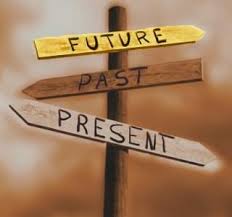
But no matter what you prefer, if you’re a writer, you have to be careful to maintain verb tense consistency. That is to say, don’t waffle back and forth between present and past. I know that might seem obvious to most of you—it certainly does to me—but you’d be surprised how often I see it when editing manuscripts, sometimes within one sentence. So perhaps it’s not obvious to everyone.
Which tense do prefer to write and read in? Do you ever have trouble maintaining tense? If so, do you have any tricks you’d like to share?
Psst…don’t forget to check out the review!
April 22, 2013
A to Z Challenge: S is for Sympathy
 Welcome to the 2013 A to Z Challenge!
This year, I’m focusing on two themes: Emotions and grammar,depending on which letter we’re on each day.
Today’s an emotion day!
__________
S is for Sympathy: harmony of or agreement in feeling between persons; the fact or power of sharing feelings of another, especially in sorrow or trouble; compassion, commiseration.
Sympathy and empathy are closely related, but the difference between them is this: When you actually experience another person’s feelings within yourself, that is empathy. When you do not feel it, yet still experience compassion for them, that is sympathy. This is something I use a lot in my novel, The Mistaken.
The main male character commits a heinous offense against the main female one. You’d think she’d despise him for it, but, after learning the reasons behind his actions, she actually feels sorry for him. But if you think about it, sympathy is a difficult emotion to effectively convey without the character coming off as simply uncomfortable with the situation.
When you come across someone who is suffering, you feel obligated to offer a hug or a rub along the back, to spew polite platitudes of sympathy, because you feel bad for them. “I’m sorry. I’m here for you. It’s probably for the best. How can I help?” Sounds nice, but it’s hardly comforting and only serves to make the speaking character feel more at ease with the situation.
I think one effective way to demonstrate sympathy is to attempt to bridge that gap toward empathy. While it might be impossible for the character to truly feel what the other is feeling, she can certainly imagine herself in that position, say, if her husband had died in tragic circumstances. True, her spouse is alive and well, but what if he were not? How would she feel if something she had done had indirectly led to his death?
In The Mistaken, the female character observes her attacker’s remorse and regret. It’s plainly etched on his face. She sees a level of fragility and vulnerability there and it makes the mother in her ache at what has caused it.
But what makes her truly sympathize with him is how closely her own life has paralleled his, how her husband’s betrayal had made her feel so many of the same emotions, and how easy it would have been for her to give in and give herself over to revenge. While she feared him, her heart held a degree of sympathy, telling her to be compassionate toward his tortured soul. “There but for the grace of God,” she says to herself.
And that, I think, is what sympathy is all about—There but for the grace of God.
April 20, 2013
A to Z Challenge: R is for Revenge

Welcome to the 2013 A to Z Challenge!
This year, I’m focusing on two themes: Emotions and grammar,depending on which letter we’re on each day.
Today’s an emotion day!
__________
R is for Revenge: (noun or verb) to exact punishment or atonement for a wrong on behalf of, especially in a resentful or vindictive spirit; retaliation, vengeance.
Come on, you knew I’d write about this, didn’t you? After all, it’s front and center in my novel, The Mistaken, and what motivates the main character—normally a decent, upstanding man—to act out violently after the reckless death of his pregnant wife. Frankly, I can’t think of anything more visceral than revenge.
We’ve all had that aggravating feeling of wanting—even needing—to get even with someone who’s wronged us or someone we care about. Most of the time, though, it’s just a fantasy, and that’s typically enough. But what if it’s not?
And there’s the rub when you utilize revenge in fiction, at least with the story’s protagonist. You want your reader to at least like your main character, but that could be difficult if he gives in to his vengeful fantasies.
The trick, I think, is to get the reader to care about him first and foremost, then when he’s crossed, you feel his pain and resentment, and when he considers crossing over to the dark side, you can sympathize, even if you disagree. But it’s important to show that transition, what’s provoking him and why fantasizing is not enough.
Here’s a passage from The Mistaken (edited for length):
Whereas I once spoke to Nick about Jillian—my memories of her and our life together—I now shared my fantasies about gaining revenge on the woman who had provoked Jill into such reckless behavior... They started simple, as visions of setting her house on fire with her trapped inside, or perhaps I would run her car off the road and down into a steep ravine where she would lie immobilized, entangled in the wreckage, unseen from the roadway far above. I had an endless reservoir filled with pernicious scenarios. I found that when I fantasized about a long, tortuous death, I felt a greater sense of vengeance and a considerable awareness of relief, as sick as that was. And I knew it was sick. But I didn’t care anymore. I wanted Erinto suffer.... At first, it gave me some relief to savor the vision of retribution. Yet, I always woke up the next day with the realization that Erin Anderson was still alive and well, walking the earth, enjoying her life, enjoying her family, while my wife was not, while my child lay eternally buried in Jillian’s cold womb six feet beneath the heavy earth, a tiny speck of immeasurable possibility heartlessly quashed into nothingness. I spoke to Nick about... how utterly enraged I felt, powerless and impotent. At this point, Nick tries to talk Tyler into getting even, but he balks at the idea.
“…Ty, she’s the reason your wife is dead. She’s the reason you drink yourself into unconsciousness every goddamn day of your pathetic life…Why you can’t get the image of Jillian’s broken body out of your head.“Remember Jill on that hospital bed, brother, the way they pounded on her chest, shoved tubes down her throat, and needles into her arms. You said it yourself. She died alone and afraid…How can you not want to be brutal right back?...”Alone now, I sat back in my chair with a full bottle of tequila and drank… I thought about what Nick had suggested...She’d be gone forever. She’d lose her freedom, her identity, and her humanity… The more I drank, the more reasonable it seemed. God, I wanted to do it, but how could I live with the decision? Wouldn’t I be compromising my own humanity, as well? Jill would be ashamed and disappointed if she knew what I was thinking. But then again, she was gone. She would never have the opportunity to live out her dreams. She would never see our child born. Everything that ever gave me reason to live had been stripped away, carelessly ground under the heel of a ruthless stranger. My humanity seemed insignificant compared to that.
But vengeance is not sweet. It’s bitter and vile. So if your character goes through with his plans, like mine does, you have to scuttle hard to show how it was a grave mistake, how remorse and regret urge him forward in his need for redemption, to set everything right, if he can. And that, my friends, is not easily done.
Have you ever loved a character who went too far? Were you able to forgive him?