A to Z Challenge: V is for Verb

Welcome to the 2013 A to Z Challenge!
This year, I’m focusing on two themes: Emotions and grammar,depending on which letter we’re on each day.
Today’s a grammar day!
__________
V is for Verb: in language, a class of words that typically express action, state, or a relation between two things, and that which may be inflected for tense, aspect, voice, mood, and to show agreement with their subject or object.
There are a dozen topics I could discuss in regards to the almighty verb. Just look at this list of verb types: Causative, copula, ditransitive, dynamnic, finite, inchoative, intransitive, irregular, modal, non-finite, performative, phrasl, regular, stative, and transitive.
I even hit on one type in my discussion of tense last Tuesday, but I think I’ll keep this limited to the issues I see most often when editing. Primarily—and, as writers, we’ve all been warned against this—the biggest issue I see is the use of passive verbs versus active ones.
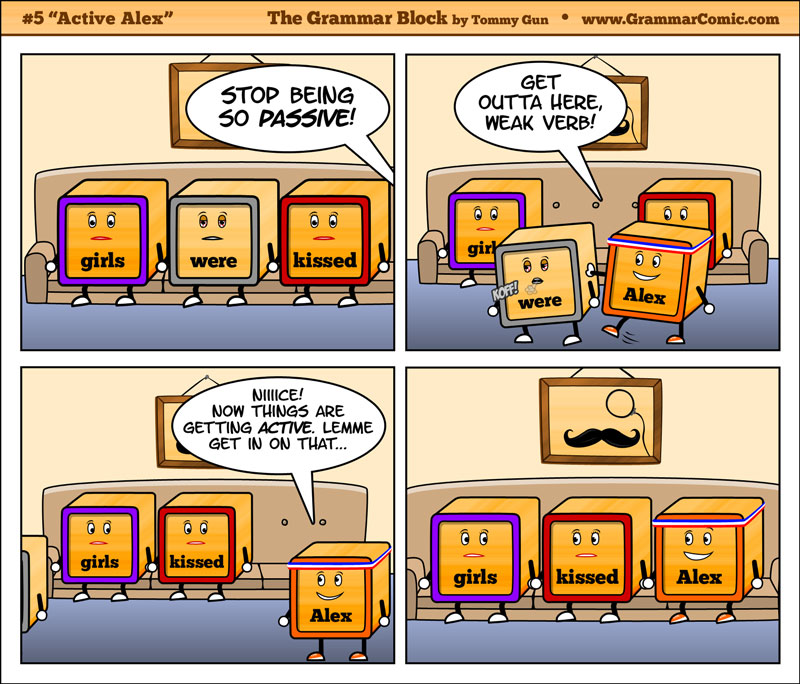
First, allow me to show the difference. Active: I threw the ball. The subject (I) performs the action (threw) on the object (the ball)Passive: The ball was thrown by me. The subject (ball) receives the action (was thrown) instead of performing it and is typically aided by a helping verb (is, was, been, are, were.)Inert: The ball is round. The verb “is” describes a state of being and is neither active nor passive.
Now, allow me to say one more thing—passive verbs are not necessarily wrong, but they do weaken the sentence. And a sentence with a passive voice uses far more words than one with an active voice. Compound this by every sentence in your manuscript, and you’ve got a lot of space taken up by wasted words, space where you could explore plot and character more deeply with active verbs.
There is another form of passive verb I see quite often. And honestly, I use it myself. Everyone does. For the most part, it’s not too egregious, that is, if you don’t overuse it and if revising it to the more active form changes the meaning or doesn’t quite fit. I’m talking about the use of gerunds or –ing verbs.
Why say her shoulders were shaking when her shoulders shookwill work? But if you say her life was unraveling at the seams, it really doesn’t work to revise it to her life unraveled at the seams, because you’re trying to show something currently happening in the moment, not in the past, even though the story is told in the past. Make sense? I know, it’s confusing, and that’s why so many writers have a problem with it, including me.
Do you overuse passive verbs or have a hard time identifying them in your own writing?



No comments have been added yet.