
Sarahbeth Caplin's Blog, page 33
July 13, 2016
“Hate the sin, love the sinner” sounded radical once, but it isn’t anymore.
**As with any of my posts on controversial subjects, “I could be wrong” is always an implied caveat.**
My friend Cassidy has been writing a series of reviews based on People to be Loved by Preston Sprinkle: a book that purports to describe a “radical love and acceptance” of gay Christians in a way that has never been done before.
Long story short: there is nothing new regarding mainstream evangelical rhetoric about homosexuality in this book. Same-sex relationships are still sinful. What Sprinkle actually does is rephrase his anti-gay stance in flowery, user-friendly language so he doesn’t come across as bigoted. He described a phone call in which he deliberately dodged answering a woman’s question, “Would your church welcome my lesbian daughter?”
Instead, he writes that he invited her to join him in a series of coffee dates to “get to know each other,” almost as if he intended to soften her up before delivering the bad news: yes, your daughter is welcome, but if she’s in a same-sex relationship, she will be encouraged to repent.
“Hate the sin, love the sinner” sounded radical once, but it isn’t anymore.
Mean what you say, say what you mean
I see nothing to be gained by this approach. Sprinkle may think it’s “radical” to show kindness in the form of buying someone coffee as opposed to shouting “Get behind me, Satan!” But I wouldn’t be surprised if this felt like a bait-and-switch to the coffee recipient. In the context of same-sex relationships being sinful, there is no gentle way to break that sort of news when it’s bound to be personal.
I’ve been in Sprinkle’s shoes before: not as a pastor, but as an acquaintance confronted with the question “Does your ministry welcome gays?” from a fellow classmate. I’d hem and haw and struggle to find some way to essentially say “Yes, but no” without sounding mean. Ideally, I’d want to answer the question in such a way that conveyed a parent’s struggle to tell their adult child he cannot live at home anymore if he refuses to go to rehab to kick his drug habit. You know, “tough love.”
In other words, I was struggling with a way to say, “We hate the sin, but love the sinner” without sounding cliché.
It’s taken several years for me to see, however, that the “consequences” of committed same-sex relationships are really nothing like a drug habit. In Evangelical World, it’s as if there is no difference.
The destructive nature of drugs is tangible, measurable, and can be seen with the naked eye. The only “consequences” of homosexuality that I’ve gleaned from Scripture are symbolic – “against God’s design,” arguably because two people of the same sex cannot produce children (neither can all straight couples), and because with two of the same gender, there is confusion regarding who the “head” of the family is, and whose job it is to submit (a complementarian idea that has been debunked).
While I in no way profess that my understanding of the Bible is perfectly clear on this subject, it does seem to me that the type of relationships gay Christians seek – committed, consensual, for better or worse, richer or poorer – is likely not what is being referred to in Leviticus 18:22 or 1 Corinthians 6:9, the two biggest “clobber verses” that are pulled out for debate.
Two scholars, three opinions
I can speak with a bit more confidence (but only a bit) regarding Leviticus, simply because I have a bias toward Hebrew translations from Jewish scholars – I trust the translation of the Old Testament through a Jewish lens more than I do with Christian ones, and many Jewish experts believe “Do not lie with a man as one lies with a woman” refers to unlawful sex; perhaps even rape.
In his book Torn, Justin Lee rightly points out that the word “homosexuality” did not exist until about the 18th century, so it couldn’t have been used in the Bible. Additionally, same-sex prostitution was a part of ritual pagan worship, which was common at the time, and condemned by the apostle Paul as behavior unbecoming of Christians – hence why he wrote that this category of offenders “will not inherit the Kingdom of God.”
I write all this to explain that, contrary to mainstream evangelical thought, it is possible to be affirming of same-sex relationships for reasons that are not purely self-seeking. Don’t take my word about the above exegesis being correct, however – it’s an alternative interpretation that I, a seminary dropout, have no way of confirming for complete authenticity. But it does make sense to me. And if Sprinkle really wanted to show “radical love” in his book, perhaps he ought to have included both sides of the issue. If Scripture were easy and simple to comprehend, we wouldn’t have the 40,000 denominations that exist, and have existed, over the last two thousand years.
As I read about the controversies of bakers and florists refusing services to gay couples, and in some cases, gays being fired or denied housing because of their orientation, the more I come to believe that we are living in a pivotal time in American history: a new kind of Jim Crow, if you will.
The minds, they are a’changin’
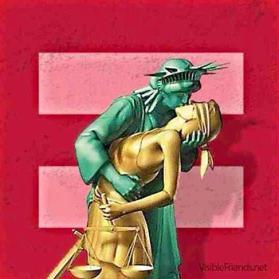
And speaking of Jim Crow, it must be acknowledged just how many Christians were unapologetically racist, believing integration and interracial marriages were just as sinful as gay marriage is considered today. They cited Scripture and predicted the collapse of society if black people were recognized as equal citizens.
Society is indeed facing the threat of collapse. But it’s coming from those stuck in their bigotry, not from black people. And not from gays.
While it’s not my goal to try and change anyone’s mind, it will do Christians some good to remember our history of disagreements (many of which resulted in burnings at the stake!) and be honest about how many times our ancestors have revised their understanding of Scripture right around the time that their respective cultural tides began to turn.
Today, Christians insist that slaveholders and KKK members interpreted their Bibles through a lens of hate. If I’m still around fifty years from now, I wonder if the majority of American Christians will be saying the same about the “hate homosexuality, love the homosexual” crowd.
Filed under: Social Issues, Theology Tagged: Christian culture, Christianity, Controversy, evangelicals, gay marriage, Homosexuality, Judaism, LGBT, social justice, Spiritual Abuse





July 12, 2016
When grief and Bible study collide
Two years ago at this time, I had my father-daughter dance five months before my actual wedding. I tried on my dress in the Catan’s Bridal suite, gathered my un-hemmed skirt, and shuffled over to Dad’s wheelchair to ask him to dance with me. Mom played Pachelbel Canon on her iphone while we “danced” as much as his advanced illness would allow, reducing all the employees to tears. But no one cried as much as us.

I have moments like these every now and then – sudden spurts of memory that sometimes coincide with anniversary dates, such as this one. Others come to me at random: when I hear a Billy Joel song on the radio. When I see a young father with a blonde, curly-haired toddler who looks like I did at that age. When I have the occasional dream about him and remember his voice.
It’s during these moments, which sometimes result in a passing sadness, a sore smile, or at worst, intense heartache, that I might retreat from the one place it would be expected for me to go to seek comfort: church. Specifically, my bible study. I’ve been known to withdraw from time to time, not always with advanced notice, because it’s not like I can predict this episodes with accuracy. But when they happen, sometimes it’s just best for me to be alone. Sometimes, being with other Christians is the worst thing for my still painful grief.
There are many reasons for this, and with these reasons I would like to offer some helpful suggestions:
Please be aware that praising God for healing your aunt’s cancer is very painful for me. It’s not that I’m not happy for you. Cancer is something I would never wish even on my worst enemy. But the implication I hear is that your loved one was healed and mine was not because your prayers were more effective, the patient had more faith, or maybe God just liked your relative better than mine. I get that that’s not what you think you’re saying, but that is nonetheless what I hear from you.
It hurts when you gloss over my concerns about hell. Please don’t tell me I just “need more faith.” Please don’t once again remind me that God is just, when everything I’ve heard about this place of eternal punishment sounds anything but just. Please be aware that there are people in your study groups who have non-Christian relatives, and this may be a spiritual issue that is wrestled with for a lifetime with no hope of resolution. This does not make us “bad” Christians. It means we are struggling.
On that note, if I tell you that my father has passed away, please do not immediately ask, “Was he a believer?” My knee-jerk response to this question is, “He had beliefs,” but I know what is meant by it. You’re asking if my father was a Christian, and the answer is no. This question is asked on the assumption that my answer will be “yes,” in which case I assume you mean to comfort me with the knowledge that Dad is in heaven, and I will see him again someday. But even if my father were a Christian, that kind of statement does nothing to help a person’s grief on this side of heaven. It also implies that there’s something wrong with grieving when instead we should be happy that our loved one is now free from the bondage of this world and is partying it up with Jesus.
When I was a member of Campus Crusade for Christ, I was hounded by several well-intentioned (I have to believe this, for the sake of my sanity) people who pressured me to get him “saved” so I wouldn’t be held responsible for his damnation, which could possibly result in my damnation. They reminded me that, because his cancer kept returning with increasing aggressiveness, the clock was ticking and time was running out. The effects of these confrontations haunt me to this day; I still have some residual form of spiritual PTSD from it.
There was a time when any mention of hell would invoke an anxiety attack, and those days are not completely over. I have increased my dosage of anxiety pills just to be able to hear about it without collapsing into hysterics. The implications behind “Was he a believer?” also does not assuage my doubts of whether or not God is good. And God’s goodness is an anchor I desperately need to hold onto right now.
I have good days and I have crappy days when the pain is so big it physically hurts. Not everyone grieves the same – not even people of faith.
Filed under: Religion Tagged: Campus Crusade for Christ, cancer, Christian culture, Christianity, depression, evangelicals, grief, hell, prosperity gospel, self-care, Spiritual Abuse





July 11, 2016
“I don’t know” is a truth, not a cop-out
This is my weekly conundrum when I meet with my small group for Bible study: do I ask the questions that I really want to ask, at the risk of derailing the discussion and starting a debate? Do I say what I really want to say, at the risk of accusations that I have “bad theology,” or that I lack faith?
It’s my willingness to ask the uncomfortable, and often unanswerable, questions that make me feel more at home among skeptics than with conservative Christians. I took the “Christian” identifier out of my Facebook “religious views” because I know that this term implies certain assumptions about me that just aren’t true. Beyond a shared love of God, I often feel that there’s not much I have in common with the tribe I’m supposed to belong to.
I’ve found that skeptics are more inclined to understand the hurt I’m still dealing with from my seminary fallout and borderline spiritually abusive college ministry. My skeptic friends are more inclined to appreciate my questioning of doctrines that are assumed to be “no brainers” in conservative, evangelical circles. There is no tension with them to be a committed Christ follower or a perpetual doubter, but not both. They understand that it’s possible to be both at the same time.
In Conservative Christendom, I’ve run into scorn for still piecing together a Jewish identity when I’m not “supposed” to seek an identity outside of Jesus. My band of loyal skeptics see no contradiction with my recent purchase of a book on secular Judaism – a concept I once considered heretical, back in my wannabe rabbi days – because one’s familial background can’t help but shape the person you become. Clearly, a spiritual Jewish identity is off the table, but a secular, cultural one beckons me with increasing fervency. It’s how I keep a sense of my father with me.
In Benefit of the Doubt, which I’m reading for the second time, Gregory Boyd writes, “If I am confident that God unconditionally loves me based on what he did for me on Calvary, then wouldn’t I be confident that his love for me does not increase or decrease based on how accurate or inaccurate my other beliefs are?” Those words help ease my fear that “being saved” = “being right.”
Of course, I can’t leave the above thoughts alone without mentioning that the idea of humans being so depraved we essentially murdered God is another concept I struggle with, but it’s not a focus on depravity that gives life to my faith. It’s the knowledge that God suffers with us, and that suffering itself can be redemptive.
Beyond that, there’s not much else I’m certain about. If I had a quarter for every time I’ve been told, “You’re trying to evaluate God by your standards, not his,” and “God’s ways are higher than our ways,” I’d be a rich woman. The thing is, my “human standards” are all I have to work with. I believe that God gave me an inquisitive mind, and that it would be wasteful not to use it.
Therefore, it is one of my few steadfast beliefs that “I don’t know” is a truth, not a cop-out.
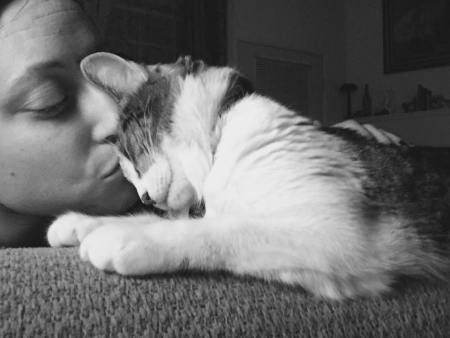
One more thing I’m certain about: the unconditional love of a kitty can also be a reflection of God.
Like this post? Check out Confessions of a Jew-ish Skeptic, now available on Amazon.
Stay in touch via Facebook and Twitter.
Filed under: Religion Tagged: Christian culture, Christianity, Controversy, evangelicals, Judaism, Seminary, Spiritual Abuse





July 8, 2016
“God will never forsake you”
Some people use Facebook to keep in touch with their relatives and post baby pictures. My timeline is almost exclusively silly memes, cat pictures, and questions like these:
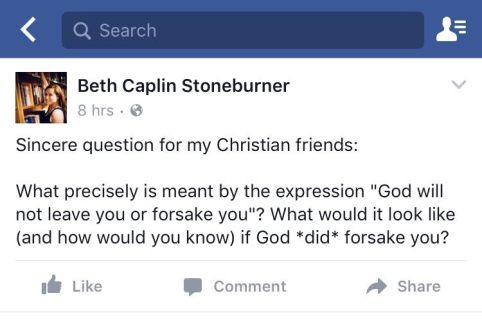
So I guess that makes me that Facebook friend…whatever that means. I can get away with this only because the people I knew would respond are people who can carry on a religious-themed discussion without fireworks. Inevitably, there was disagreement, but none that made me have to step in as a mediator.
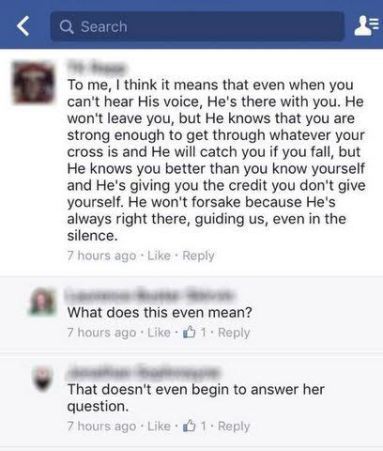
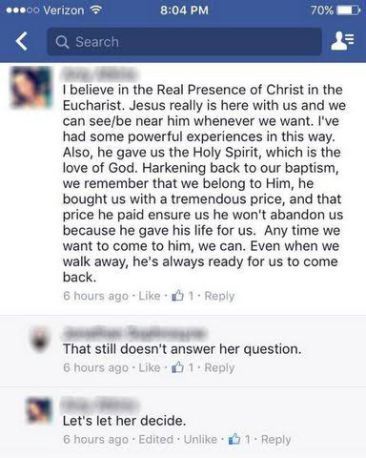

I’ve used variations of these responses myself. But if someone asked me a few years ago, “What does that even mean?” as some of my friends did, I’d have found myself tongue-tied. The word “forsake” means to not forget, sacrifice, or give up on. In that sense, no matter what mess I might find myself in, God is always with me.
Except that doesn’t mean bad things won’t happen to me. After the tragic events of this week – two black men killed by police, and several officers killed at what should have been a peaceful protest in Dallas – I’m revisiting this question once more: what do we mean by “God will not forsake us”? Were the officers at the protest told this by their friends and family members who prayed for their safety while on duty? How many black families repeat this every time their children leave home, knowing how dangerous and unpredictable society can be?
Though they all meant well, I can’t say any of the above answers persuaded me one way or the other. There’s still a great deal of “Christian speak” I struggle to understand beyond just an abstract picture. Day by day, moment by moment, I’m not sure how to tell if I’ve been abandoned or if I’m being protected; if God is indeed with me or has withdrawn himself from me.
I suppose those answers vary person by person.
Truthfully, there have been moments in my life when I felt “a presence,” though I can’t elaborate much more on what I mean by that, because 1) those moments were quite some time ago, and 2) this sort of conviction is a personal one. But if we use “God will not forsake us” to convey that God will always protect us physically, we might need to reevaluate. Plenty of innocent people succumb to tragedy with faith perfectly intact.
How would I know if God is with me? I don’t. I can’t.
The world beyond my apartment is chaotic, but the more I learn to accept that faith is not a security blanket designed to bounce bullets off of me (and ricochet toward someone else?) the more easily I can accept that the world operates by both natural law and free will. I’d have surely lost my faith by now if it were built on a trust that tragedy can’t touch me.
Violence like what happened this week is bad enough – I find it more worthwhile to fight against the racism embedded in American society than anxiously ponder why God apparently forsook the innocent people whose lives were ended so cruelly.
Like this post? Check out Confessions of a Jew-ish Skeptic, now available on Amazon.
Stay in touch via Facebook and Twitter.
Filed under: Religion Tagged: Christian culture, Christianity, evangelicals, Facebook, grief, prayer, social justice





July 5, 2016
Self care, unemployment, and what I’ve been reading
This summer, Josh and I made the biggest and scariest step in adulting: we bought a house (one step less scary than having a baby, in my opinion). So now the pressure is on to start saving money: a difficult task for a book hoarder like me. Luckily, I don’t mind rereading old favorites.
Reading and freelance writing are pretty much taking over my summer. As is typical with a new release, the buzz for Confessions of a Jew-ish Skeptic has slowed, though it did pretty well for a solid month and a half: #25 in Judaism, #26 in Ecumenism on Amazon. It even ranked #6 in Judaism a month before release, which has never happened with one of my books before (then again, I’ve never had a book available for pre-order until this one). So really, I don’t have much to complain about in the way of book sales. I’ve out-bested my original goal to just have people other than my mom read my work, and that’s no small feat.
Still, most writers supplement their writing with a day job, since book sales alone don’t pay bills (unless you’re JK Rowling) and that search hasn’t been going too well. I won’t be looking for a full-time job until next year, after I graduate with my master’s, but even seasonal work at coffee shops is hard to find. Also complicating matters is my anxiety, which has gotten progressively worse since my father died, almost to the point where I couldn’t leave my apartment without having panic attacks. Not surprisingly, I’ve had difficulty holding jobs because of this. Now that school is out and I finally have the time, I’m shopping around for doctors who specialize in mental illness, and the ideal prescription cocktail with minimal side effects: something I’ve put off because I didn’t want said side effects to disrupt my schoolwork.
Fortunately for me, I have a husband who earns enough money to support us both, and is okay with me using this summer as a period of much-needed self-care. While it’s not earning me any money, it is granting me sanity, which is pretty damn priceless. It’s my hope that by this time next year, I will be able to manage my symptoms enough to hold a stable job – hopefully something in the field of publishing.
With all this extra time, I’ve read a lot of new books, and I’m almost at the end of the to-read pile, which is another source of panic by itself.
An indie friend of mine absolutely raves about Unteachable by Leah Raeder, a novel that took the indie world by storm a few years ago and has recently re-released with a major publishing house. Now that it’s finally available at the library, I checked it out. The writing itself is pretty good. The storyline, however, did not live up to my expectations. Maybe I expected too much out of a teacher-student romance. I was hoping the book would explore, even subtly, the ethical dynamics of the power imbalance at play, even if the student was eighteen and the relationship perfectly legal. Instead, it was sex scene after sex scene after sex scene – well-written sex scenes, I’ll say that, but there was way more sex than development of a relationship that was intended to be Real Love. Maise and Evan hardly did or talked about anything but sex, so much that I couldn’t figure out what else made them click in the first place. Disappointing. But it kept me intrigued until the end, so that’s something.
Jesus > Religion: Why he is so much better than trying harder, doing more, and being good enough by Jefferson Bethke. I won this at a Christmas party last year, and finally got around to reading it. Admittedly, my guard went up when I read a review on the back cover from Mike Huckabee, but I didn’t let that keep me from reading it.
Sadly, I didn’t find anything original here. The “it’s a relationship, not a religion” trope has been done before, many times, but my biggest complaint about this book is how Bethke brings up the violence of the Old Testament when describing the occasional doubts about God’s goodness…and never mentions it again. No deconstruction, no wrestling with the text. This is not uncommon with books that are a hit within evangelical circles, I’ve noticed, and that bothers me. Considering that violence is a starting point for the path to atheism for many, it ought to be handled with a bit more depth than just one paragraph could allow.
When Breath Becomes Air by Paul Kalanithi. Tearjerker, this one, but then again, I read it from the perspective of a still-grieving daughter. Knowing Kalanithi already passed away before the book was published did color the reading experience a bit, because the words I read were, as far as the rest of the world is concerned, his last: his carefully-chosen legacy. The contrast of going from established neurosurgeon to cancer patient in his own hospital was jarring, but well done.
Despite having – let’s be honest – a privileged life (he earned degrees from quite a few Ivy League universities), Kalanithi writes about finding more meaning in his marriage, his journey toward parenthood, and the limited amount of time he had with his infant daughter. It seemed like something my father would have written, which is what started the waterworks for me. By far the best part of this book was the epilogue written by his now-widowed wife, Lucy. If she doesn’t plan on writing books herself, she should.
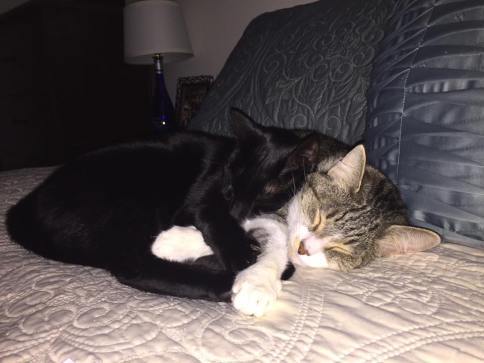
Hope everyone had a good and safe Independence Day. My apartment complex did not allow fireworks, which spared my girls the trauma of thinking that the world is ending. They both turn two in a matter of weeks. Where has the time gone?
Filed under: Other stuff, Religion, Writing & Publishing Tagged: Author Sarahbeth Caplin, cancer, cats, Christian culture, Christianity, depression, evangelicals, grief, Indie Author Life, self-care, self-publishing, Writing





June 28, 2016
Grace and eternal conscious torment
I’m blogging at Off the Page today with my fourth column on the ever-pleasant subject of hell as eternal conscious torment. Enjoy!
One week before my father died of cancer, I received an email from a family friend— we’ll call her G—wanting to know if he had been “saved” yet; the implication being there wasn’t much time left before it would be too late. By that point, Dad had succumbed to a comatose-like state, with occasional hallucinations and unintelligible ramblings. In other words, though technically still alive, he had already left us—and if this “friend” knew him at all, she’d have known he was never comfortable talking about religion.
That email sent me down a rabbit hole of anxiety, which I’m still wandering through, nearly two years later. Having been involved in evangelical church groups for years, I knew G probably had good intentions. In her view, the most loving thing a Christian could do was warn nonbelievers about their eternal fate, but her timing could not have been worse. As far as I know, my father died as the agnostic I always knew him to be.
Considering my entire family is Jewish, you would think the doctrine of hell would have kept me from becoming a Christian altogether. Indeed, it is one of the most exclusive, horrifying, and offensive aspects of the Christian faith from an outsider’s perspective, yet I never allowed myself to think about it. I was instead drawn to the person of Jesus, the radical Jewish teacher who flipped tables and pissed off the righteous gatekeepers of religiosity. He was a feisty mensch, like me. By my sophomore year of college, I had made the decision to count myself among his followers.
Read the rest here.
Filed under: Religion Tagged: cancer, Christian culture, Christianity, evangelicals, grief, hell, Judaism, Spiritual Abuse





June 25, 2016
The agnostic and the believer in my head
 I remember going to my local book store as a kid, eagerly seeking books that would teach me about God. I remember the bitter disappointment I felt when, time and time again, the “Jewish” shelf contained The Diary of Anne Frank, a handful of other Holocaust books, and little else – nothing pertaining to the study of the faith itself.
So I’d reluctantly go to the “Christian” section, which never had a shortage of devotionals and what seemed like spiritual “self help” manuals. I remember flipping through the books that seemed to be written for a teenage audience, trying to figure out which ones contained the least amount of references to Jesus so it would be applicable to me. Sometimes, after I purchased them, I’d go through each book with a pencil and cross out “Jesus,” and squeeze in “God.” But the references to dying on the cross weren’t such an easy fix.
You can see how Christianity was sort of a default for a young kid who wanted a relationship with God. As much as I’d love to say I was being lead on a path to discover The Truth, the reality is, if I grew up Jewish in Utah, I might have found “truth” in Mormonism, or maybe in Hinduism if I grew up in India.
I didn’t choose Christianity because it was convenient (although it was) – it was a religion with a community ready and waiting to help me and guide me. As introverted as I am, it’s pretty difficult to do faith in complete isolation, with no communal guidance whatsoever. Growing up Jewish in Hudson, Ohio, there was no one to build me up when I doubted, no one to pray with me or for me in the only language I knew. No youth group, no Bible studies (Torah studies?), no field trips. It was a frustrating spiritual journey. A lonely one.
Today, I frequently turn to the words of Lauren Winner, the only Jewish-to-Christian writer I’ve been able to identify with, in her memoir Still: “Maybe it’s not that my faith is riddled with doubt, but that my doubt is riddled with faith.” I can’t think of a better summation for the place I find myself now.
For the last several months, I’ve felt a pull toward the Anglican church. The liturgical structure of the service, the call-and-response participation from the congregation, and dependence on ritual reminds me of the synagogue (which was, for years, a borrowed church) where I grew up. I’ve missed being part of a tradition that spans back thousands of years, threading the past to the present, refreshing the words of saints and sages that, despite the antiquated language, are still relevant today.
I recently purchased the Book of Common Prayer, and have found a spiritual intimacy there that I just wasn’t finding in the evangelical church I’d been attending with my husband since I moved to northern Colorado.
But even discovering a new tradition doesn’t take away the lingering question, Is this even true? It doesn’t take away my questions about projecting antiquated ethics on a modern society. It doesn’t take away my doubts about this way being the only way, and that everyone who does not follow it is doomed to eternal punishment.
It is for that reason why, even though “Anglican” feels like a more appropriate spiritual label than “Christian,” it’s actually “agnostic” that better describes where I am spiritually. Not because I doubt the existence of God. Not because I have any issues with Jesus. Only because some aspects of this faith I’ve chosen make perfect sense to me, while others border on disturbing and obscene. I don’t know how to reconcile all those things: redemption with hell, human decency with original sin. I fear turning into the sort of cherry-picking believer that I used to despise.
But if “agnostic” is my identity now (the word still tastes a bit like chalk), I’m a very unusual one. I still participate in small group at my former church, the one my husband still attends, because theological discussions are what I live for. I still snatch up every commentary, every spiritual memoir, every new devotional I can get my hands on, because I’m still enchanted by the message of redemption; still fascinated by a God in human skin; still, more than anything else, clinging to the hope that eventually, the spark of faith will return. I still write in my prayer journal on a regular basis. Still read my Bible and attend a Bible study.
I guess, to quote my friend Laura, I still have the heart of a Jesus-follower even if I possess the brain of a skeptic. And it’s Judaism that produced my inner skeptic, I think: the best rabbis and scholars have mastered the art of debate and disagreement when interpreting ancient texts. A tradition that is genetic as it is spiritual can’t be etched out like lasering off a tattoo. The drive to ask questions and refuse to settle for easy answers is in my blood.
For that reason, I don’t think I could ever become an atheist – I don’t think I could ever comfortably believe that all this spiritual stuff is nonsense when there’s no hard evidence either way. I do still have faith. Shaky faith, but even a faint pulse signifies life.
Filed under: Religion Tagged: agnosticism, atheism, Christian culture, Christianity, evangelicals, Judaism





June 17, 2016
Please support the work I do through this site
I debated for a long time about writing a post like this, even though plenty of bloggers I follow have done it. Writing initially started as a hobby, long before the notion of self-publishing ever occurred to me. When I published my first book in 2012, I had no idea if anyone would ever read it. Now, thanks to my readers, I have results like this:

Those are the stats of my most recent book, Confessions of a Jew-ish Skeptic, as of one week ago. However, it didn’t end up there through my own efforts. I enlisted the help of several advertising companies, as well as boosted Facebook posts. Self-publishing itself is also a pricey endeavor, with the costs of cover design, editing, and formatting. True, I don’t have to keep publishing on my own – a traditional publisher could take care of that for me. But the reason I continue to choose the indie route is because I enjoy writing the stories I want to write, not just what’s trending.
This may not always be the case – I may try querying someday. But even in traditional publishing, the bulk of marketing still falls onto the author (unless I happen to be picked up by one of the Big Six).
So in the meantime, should you feel moved to do so, your contributions will help me continue to do the work I love full-time. I’m extremely grateful to everyone who has purchased and reviewed my work, taken the time to comment on this blog, and sent me personal messages. From the bottom of my heart, thank you. Catniss and Zoey, my two furry co-workers, thank you, too.
I’ve added a “Tips appreciated” button on the right sidebar of this page, or you can donate here.
Filed under: Other stuff, Writing & Publishing Tagged: Author Sarahbeth Caplin, Indie Author Life, self-publishing, Writing





June 5, 2016
‘Me Before You’ was flawed, but not in the way I expected
 The trailer pretty much gives away the entire plot, but if you haven’t seen/read it, this post gives away spoilers.
I went to see Me Before You with every intention of hating it. The criticisms I’ve read about its pro-euthanasia message are valid and worth reading. I haven’t yet read the book, so my opinion is two-dimensional at best.
But honestly? What I saw did not communicate “All physically disabled people should kill themselves because their lives are not as meaningful as those of able-bodied people.” What I saw was a story of one man’s decision to end his life, for reasons that the criticisms I read neglected to mention.
The critics gave me the impression that Will Traynor was healthy in every way except that his legs didn’t work. Had that been the case, and he chose euthanasia anyway, I would have been angry. But the reviews didn’t mention the other complications from his motorcycle accident: being paralyzed from the neck down, the bouts of pneumonia from a weakened immune system, the dangerous roller coaster of body temperature, the constant physical pain and, most pertinent of all, the prognosis of the doctors that Will’s condition would kill him sooner rather than later. This, I’m assuming, is not the prognosis of most people who live the majority of their lives in wheelchairs.
I don’t condone or celebrate Will’s decision as “brave” (a sticky adjective that leaves a bad taste in my mouth). But I understand it. It’s a decision my father considered, as the cancer metastasized and reduced his life to mere existence, not real living. In the end, euthanasia was not the course he chose, but in the final weeks he remained alive he was not the father I knew. He was a shell of the person who raised me. If there is anything remotely positive to glean from euthanasia in this circumstance, it’s that my father and the rest of my family would have been spared the suffering of having to watch as he literally wasted away.
That being said, I understand why the decision remains controversial. I don’t think I could ever do it. It will likely always make me uneasy, and should never be the go-to solution without careful consideration of prognoses given by medical experts. It is, ultimately, a choice one makes between his family, his doctors, and God.
There was a time when this issue was black and white for me. As a self-described pro-lifer, the idea of ending a life by unnatural means abhorred me. But I don’t have the luxury of certainty anymore, after what I’ve seen. I wager that many people who consider euthanasia no different than cold-blooded murder have never been in a situation like the one I had during the summer of 2014. Everything looks simple from the outside looking in, when real feelings and real suffering are hypothetical, not a daily reality.
The reality is that not all medical conditions are manageable. The slippery slope argument “What about depressed people who think they’re better off dead?” doesn’t hold water, since depression is a manageable illness. You can only manage cancer, among other life-threatening conditions, for so long. That euthanasia should only be considered for life-threatening situations is the only thing I’m certain about. As a chronic sufferer of depression, I have resources that enable me to keep living my life. My father didn’t. Neither, it seems, did Will Traynor.
Still, I raged with Louisa Clark when she accused Will of being selfish – she did make him happy. She did give him hope. She tried so hard, and took his final decision as a personal failure on her part. It’s a moral mess of a story in that the feelings of the sufferer and those who love him are all valid, and in the end I really didn’t know how to feel about the whole thing. Though I did feel annoyed that I fell right into the trap of “the most romantic tear-jerker of the year!” and tried to hide my sniffle-snorts as my friend, who came prepared, kept offering me a box of Kleenex.
I’m not endorsing or condemning euthanasia, but I am saying that the issue is more complex from the inside looking out, rather than the other way around. It’s an issue that deserves empathy and compassion even if one believes it’s morally wrong. If it’s not your life, not your direct experience, you don’t know. You can never know.
As for Me Before You, it provided inspiration for a blog post, so I guess it wasn’t all bad, but it’s definitely far from perfect. Its biggest flaw is continuing the Hollywood trend of using illness to drive a romantic plot (it’s been rightly called ‘sick-lit’), along with other inconsistencies with real life – how many quadriplegics can afford private jets and exotic vacations? Individualized care from multiple care-givers? A more realistic story would have been nice, but of course that never would have been made into a movie. I’d much rather read or watch a story about the Bethany Hamiltons of the world who survive tragic accidents and eventually get back on their surf boards (literal or figurative ones).
Filed under: Other stuff Tagged: cancer, Controversy, depression, euthanasia, grief, self-care, social justice





May 30, 2016
Your miracle story could be a trigger
 In honor of Memorial Day, I want to touch on a subject that has become deeply personal ever since the death of my father: the practice of praising God for saving a loved one’s life, healing a disease, diverting a tornado, or dissolving any other dangerous situation, supposedly in the name of “having a plan” for that person.
Today is a day for honoring those who were not chosen by God to “save.” They gave their lives – bravely and not without suffering. This kind of sacrifice is reminiscent of Jesus’ command to his disciples: Take up your cross and follow me. It is also an example of the verse from John 15:13: Greater love has no man than this, than one who lays down his life for his friends.
If there is anything that Christianity has taught me, it’s that death is not the end of the story. Death does not have the last word, and suffering does not have to be in vain. God, instead, suffers with me. Furthermore, if Jesus Christ himself was not spared agony, why should any of us?
What I often see as I scroll through my Facebook newsfeed is praise for God healing a tumor, but no thanks to the doctors and oncologists for their roles in the treatment process. Most recently, the mother of a boy who fell into a gorilla exhibit praised God for protecting her child, but did not give any credit to the zoo officials who had to kill the gorilla to save her toddler.
I get that these statements come from a place of gratitude. The person saying them likely has no clue that people like me could receive their words negatively. But people who lose a loved one due to tragic circumstances are likely already questioning God’s goodness; the last thing they need is additional trauma to their faith by hearing, even implicitly, that God must value some lives over others. This is the message that is being communicated to the bereaved, regardless of the speaker’s intent. This is the message that triggered a massive anxiety attack at my church last fall, and has made me too afraid to return.
The expression “Everything happens for a reason” is not in the Bible, although many Christians seem to believe it is. I think this verse gets confused with Romans 8:28, He will make all things work for the good of those who love Him. But if this meant sparing people from pain and suffering, no one would die despite prayers all around the world requesting healing. That is not the reality of the world we live in, or else Christians would be stationed at every hospital to pray for patients (and possibly run medical staff out of business).
I don’t exactly know what that verse means, but I don’t see anything in it that suggests believers are exempt from suffering and death. I agree with Rabbi Harold Kushner that God designed nature to function a certain way, which gives credence to the verse from Matthew 5:45: The rains fall on the just and unjust alike. And we may never know why that is.
If believing that God personally reached out and plucked you from a sinking ship is vital to your faith, I won’t try to take that hope away from you. All I ask is that you consider how it might sound to grieving families before you post that story on Facebook.
Filed under: Religion Tagged: cancer, Christian culture, Christianity, evangelicals, grief, Memorial Day, self-care, social justice, Spiritual Abuse





