Alexander Jablokov's Blog, page 3
May 9, 2019
Needed: a newer, bigger god
On his blog, Gene Expression, Razib Khan occasionally writes about religion and its role in human history and culture.
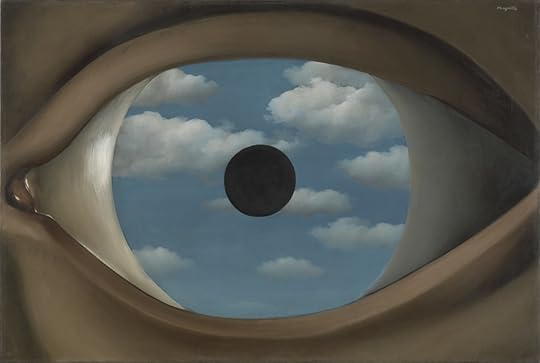
Someone’s got to keep an eye on us
Recently he's had a couple of interesting posts about the emergence of moralizing gods in complex society. A paper, Complex societies precede moralizing gods throughout world history says that big gods come from big societies, not the other way around.
Khan identifies this as societies reaching a certain level of complexity and needing to develop a prosocial toolkit to manage and maintain wider and more complex forms of organization, those beyond the clan. Gods are an important component of that toolkit.
He even thinks its possible that ritual religion emerged before the gods themselves. Rituals are a powerful organizing force, and they really do bind groups together. I guess the situation would have been that someone asked "why are we here killing these oxen like this?" and someone else said, "because God requires it". Not sure that's quite how it played out, but they could have co-evolved, with ritual bringing you into a mental state that makes accepting a high god seem not only possible, but inevitable.
The paper claims that moralistic high gods appear right as social complexity rises. I gather there is a lot of debate about both the data and the interpretations of it.
Untrue, but plausibleThe debate over facts and analysis doesn't need to deter us here. We write and read science fiction, so it doesn't need to be true, just plausible. In fact, "untrue but plausible" kind of characterizes our genre. And, more importantly, the best SFnal ideas are not just plausible but fruitful. The ideas are fun, the characters have to deal with the consequences of them, and the results are entertaining.
Because, here in the real world, we are in a period of cultural complexity and interdependence far beyond those of ancient agrarian empires—and all of our gods emerged not only before computation and communication but even before steam engines, worldwide travel, or widespread suffrage. I suspect they are longing to retire.
We have not yet developed the kinds of gods that will help us hold this civilization together. Or, from the point of the future worshippers, these gods have not yet made themselves manifest. To the dismay of prosocial liberal atheists (like me) it might be only the arrival of a new, demanding, weirdly unexpected god that can assist society in maintaining the next level of complexity. But without that arrival, the entire system may well collapse.
I'm trying to think my way through this, since it is potentially fruitful. The new god is not the only updated instrument in the toolkit, but perhaps an unexpectedly important one.
By the way, Razib Khan is a useful source for all sorts of interesting ideas that can spark SF stories. I'm hoping I manage to write this one.
What do you think this god/gods might be like?Will they even be visualizable? Will they require human face to face interactions as the price of their appearance? What sacrifices will they ask us to make?


May 7, 2019
Toward the Mandatory Blog Post Date Act of 2___

If you want an image for “frustrated” there are many choices, but a cute kid seemed best
In my freelance marketing content-writing life (aka day job) I often do online research on a wide range of topics, from industrial applications of augmented reality to work visa rule changes in Australia. Many of these topics are time-sensitive, that is, things are changing quickly, and it is important for me to know what the current state of play is.
Which is why it drives me batty when people don't put the date of the blog post or article clearly, right at the top. I actually had one client redo their blog so that none of the posts have dates on them.
I think this is to make them seem somehow evergreen. That's cheesy, like tricking people into clicking on something, but it also misses a category point.
Understanding the point of these thingsThere certainly are evergreen pieces, which explain the basics of something, provide a guide to a complex area, or are funny (though even those should have dates on them). But there are also up-to-the-minute pieces that derive their interest from being fresh. And, like fish, they go bad quickly.
So I want to know, how recent is this information, particularly when it contains an interesting recommendation or course of action. Does that recommendation refer to the current state, or some past state? Is the information still valid? Don't make the reader sniff the fish.
WorkaroundsCertainly there are ways of digging out the information, though they don't always work. In Firefox, right clicking on the post and selecting View Page Info might show you the published_time and modified_time metatags (don't get excited about the Modified above the tag list—that's right now, the modification you made by looking at the page). If that doesn't work, sometimes a dig into View Page Source might show you something, but that's pretty tormenting.
Make no lawI'm not serious about the law thing, just so you know. For a long time there was a two-panel comic strip called There Oughta Be A Law that got at this weird urge to petition the legislature to pass more laws preventing things that annoy us. My town of Cambridge, for example, has a complex law regulating when you can use leaf blowers, because someone was annoyed by them.
No, think if this as more of a plea. Please, put the date on the post! Not just for researchers, but for everyone. The older the internet gets, the more obsolete material there will be on it. Don't make it harder for everyone.
If you still blog, do you date your posts?How about leftovers in the refrigerator? I fall down on that one, I will admit.
April 9, 2019
Another Elizabeth Holmes Predecessor
I'm fascinated by Elizabeth Holmes' self-presentation, using her striking, if odd, looks, and her voice, natural or not.
In an earlier post, about how Theranos used its lawyers to terrorize anyone who opposed it, I compared Elizabeth Holmes' big-eyed stare to that of a Sumerian statue.
Now I have a more reasonable ancient world comparison. And we always need one of those, don't we? Surely you remember that I'm the one who pointed out how much Anthony Weiner and Huma Abedin look like Akhenaten and Nefertiti..
And that is to the Ptolemaic queen Arsinoe II. Now you can be forgiven for not knowing which Ptolemaic queen that was, exactly, because they were all named Arsinoe and Berenike, or, later, Cleopatra (the famous one is Cleopatra VII).
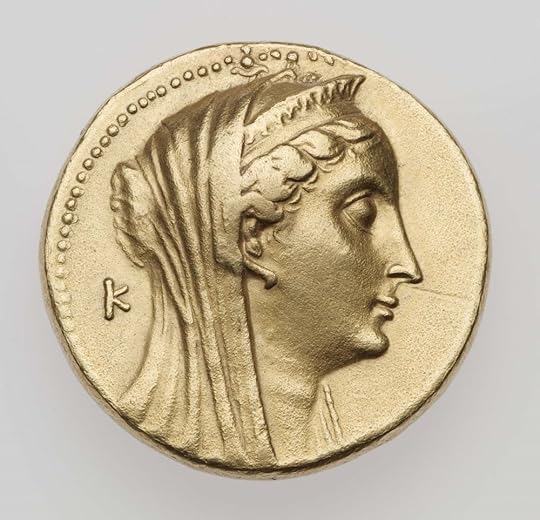
The Hellenistic kingdoms really had great portrait coins, because they knew self-presentation too
She murdered her political opponents and married her brother, Ptolemy II (the naming convention for males of the family was even more restrictive than that of the women, they were all named Bruce) but that doesn't really make her stand out either.
She was apparently beautiful and quite compelling, becoming the the goddess prayed to by sailors for safe voyage, even by non-citizens of Egypt, had temples dedicated to her, and even won chariot races at the Olympic Games.
But by the coin images, she had the big-eye thing going pretty significantly. Maybe it's a stylistic thing, and of course scholars of the ancient world love to make medical diagnoses based on minimal evidence, but maybe she really did have big eyes, or at least used them in a way that made them seem that way. And she was blond.
The Hellenistic Age is insufficiently looked to for historical examples, because we all think we are Rome, who eventually conquered all those self-indulgent, extravagant, too-clever-for-their-own-good Greek states, but maybe we should be looking a bit more closely at the other side of that equation.
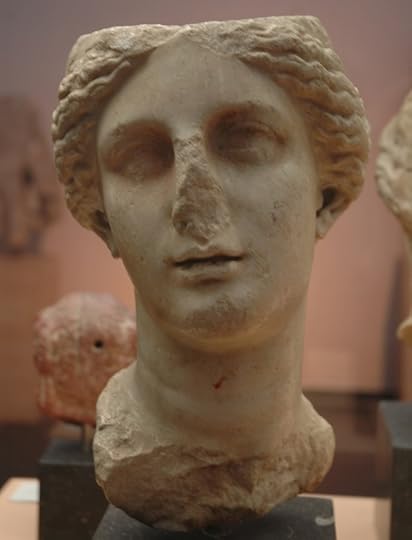
I don’t know, there certainly is a resemblance
In some possible future statues of Elizabeth Holmes will be prayed to by the sick, who will prick their fingers to let a single drop fall on her sacred foot, at which time they will be healed.
When one of those statues is recovered by some even further future archeological expedition, maybe it will look like this.
What contemporary figures remind you of someone specific from the ancient world?No, the resemblance does not need to be particularly close.
April 4, 2019
The Pleasures of the Occasional Tiny Improvement
I use and like Microsoft Word (now 2016). A lot of online commentary indicates that that makes me crazy, dumb, or a replicant.

Did Word throw you again?
I've mentioned this before, but when devotees of Scrivener (among which I number myself, to be clear) talk about it, they say how much better it is than Word. Way better. Immensely better.
But they never actually get around to saying what makes it better, and in what way Word falls short. Now, it's true, a lot of Word's biggest advantages are for corporate work, like organizing documents, organizing and managing versions and revisions, and incorporating spreadsheets and data, so fiction writers may not gain as much benefit.
The Parable of PhaethonNow that I mention it, most people in the corporate world have no idea of how to use Word either. All MS Office programs are insanely powerful, and most of us, like Phaethon attempting to drive the chariot of Helios, find ourselves overmastered by them. I provide my clients with guides on how to most effectively provide me with comments and edits so I can ensure an accurate document, and they almost never do anything of the sort, leaving me to do a document compare to figure out who wants what, and often never figuring it out. I don't charge by the hour, so that might be part of it. Why should they care how much longer it takes me?
And sometimes you look at the Styles in a document and see dozens of them, with each heading slightly different in some weird way, so the styles are not useful for organization. Currently Scrivener does not do styles in that sense, and I'm hoping Scrivener 3 for Windows will have some sort of capability for it. But then, even OneNote, a Microsoft product, does not do styles, so don't get me started on that.
And, for heaven's sake, kids, at least learn to use paragraph styles, so that each paragraph is indented properly without having to...grrr...tab. Tabs, or at least tab stops, have their uses, but doing brute formatting isn't one of them. Converting to electronic formats is a nightmare, with Calibre or Jutoh having heartburn and showering error messages all over yours screen.
But that's not actually what I started writing about.
Sometimes smart quotes get even smarterRecently, Word had an update, and a pet peeve of mine vanished, giving me a feeling of slight but distinct joy. I do write a lot of fiction, and one thing I do is sometimes end dialog with an em dash (the long one), showing that the speaker has been interrupted without completing their sentence.
For years, Word would put an opening quotation mark at the end after the dash, not a closing quotation mark. It drove me nuts. I finally developed a reflex where, if I wanted to end with a dash then close quote I would type the dash (two hyphens, which Word, if set that way, will covert to an em dash), then a letter, then a space so that the two hyphens turned into an em dash, then the close quote. Then I would delete the letter and the space. It got to be pretty reflexive.
But after the update Word now seems to know to put the right quote in.
Yes, this is exactly as interesting as most writers turn out to be.
What minor improvements have recently made your life a tiny bit better?A lot of people are working on these things behind the scenes, and it is worth noting their efforts.
March 28, 2019
The New England Interiors of Edmund Tarbell
Last weekend I took my offspring to the Museum of Fine Arts, in Boston. We each had something we wanted to see. My daughter wanted to see the Buddhas in the Temple Room, a tremendously evocative space, I wanted to see the wonderfully named Boston Green Head (a story for another time), and my son, as always, wanted to see the late 19th/early 20th century American art.
And there, I discovered an artist I had overlooked before, Edmund Tarbell (1862–1938). He painted portraits, and a lot of New England interiors. Clearly influenced by Vermeer, he showed interiors much more elegant and spare than one thinks of as characteristic of the late Victorian era, all ormolu and hippopotamus-foot umbrella stands.
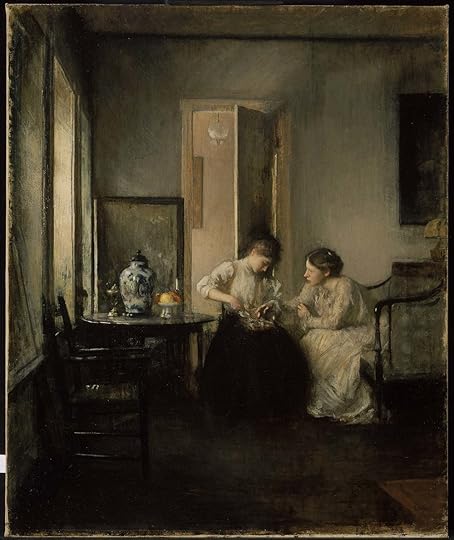
The luxury of space. But he has kind of stolen Vermeer’s window.
Here is the one that struck me first, called, with no particular originality, "New England Interior". The light streams through the windows, a cold northern light, shining on the acquisitions of world trade, and doors are open to other rooms, all just as in Antwerp so many centuries before. The elegance and clarity of the space are striking.
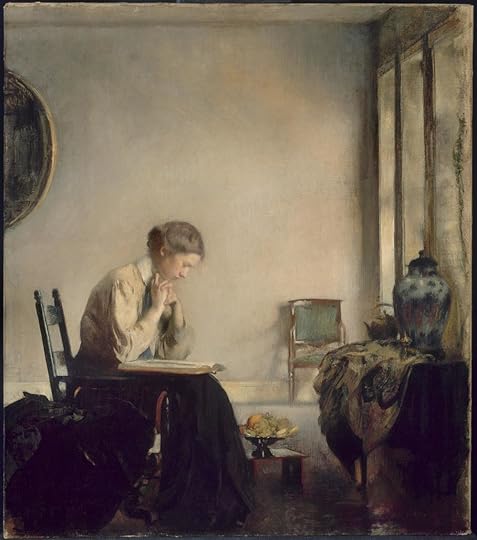
Paradise: a good book, good light, and no distractions
Then, one of a common topic, a woman reading. The artists of this school, called the Boston School, loved the Eros of intellect, as do I. Again, a spare elegant interior, cool light, and prestige items of great beauty.
Luxury is not having to have too much stuff
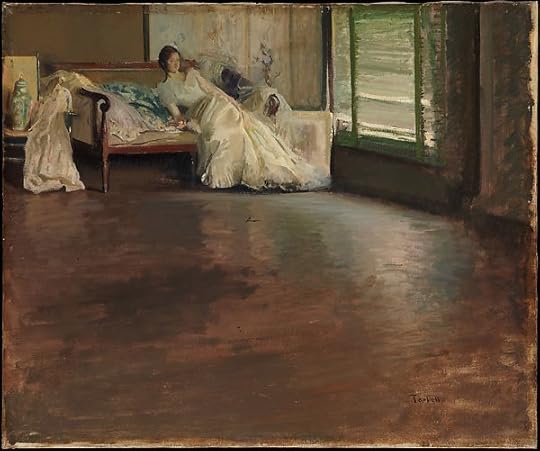
He also loved reflective floors. Here is one from the Met, called "Across the Room", that shows that to full effect.
I hope he didn’t make her stand around like that when he wasn’t painting
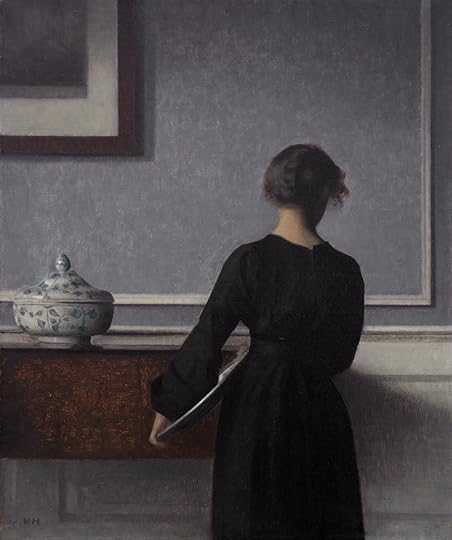
Interiors decorated by austere women who don't care we are there was a big theme for the era, or at least a fashion. I like it a lot, and to the extent that I have any acquisitive tendency, it would be directed at paintings like these. Another practitioner was the Danish Vilhelm Hammershøi (1864-1916)—the MFA does have one Hammershøi, which, since it was European, I missed. He also decorated rooms with women, but did not like them as much as Tarbell did. He showed them only from the back, as in "Interior with Young Woman Seen from the Back" (1904). If he'd really cared about this woman (probably his servant, he used her and his wife for a lot of paintings), he would have spent a bit more time on her cervical vertebrae. Though maybe that would have led to trouble in other the rest of the composition. It is an incredible painting, it's no wonder he's so popular.
In general, what strikes me is the proportions of these interiors, their well-chosen furniture and decorations, and the clarity of the natural light. Now, clearly, these were interiors that belonged to men with a distinct aesthetic sense. I'm not much on interior decoration, but these rooms inspire me more than any spread I see in Architectural Digest.
Who is your favorite painter of interiors?
And have they inspired you to do anything about your own surroundings?
March 26, 2019
Vicious Fights Over Oncoming Disasters: the Coming of World War II
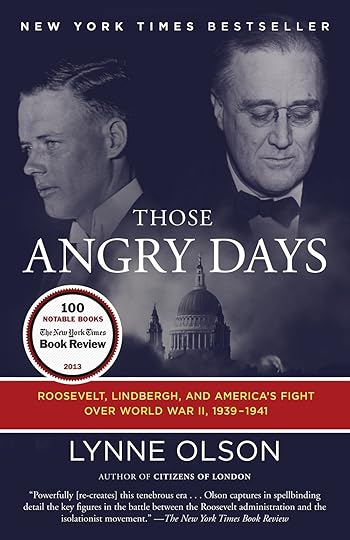
It really doesn’t look like they’re getting along
In the two years leading up to the attack on Pearl Harbor, FDR was a timid President, unwilling to take any chances. After winning the 1936 election in a stunning landslide, with increased majorities in both the House and the Senate, FDR pissed it away, first with his ridiculous plan to pack the Supreme Court, then by losing vast numbers of seats in 1938, campaigning vigorously but unsuccessfully against prominent members of his own party who he felt were less than committed to the New Deal.
FDR had clearly lost his mojo. He was terrified of opposition to aid to Britain against Germany, and so moved with glacial slowness, retreating quickly if he sensed opposition.
A viciously divided country
Those Angry Days: Roosevelt, Lindbergh, and America's Fight Over World War II, 1939-1941, by Lynne Olson, goes through those two years almost day by day, describing the bad behavior on both sides. Everybody screamed at each other in apocalyptic terms, threatened opponents and their families, and ended lifelong friendships. And, given the state of the world 1939-1941, it's hard to claim that what they were arguing about wasn't important.
The typical narrative is dumb duped isolationists and noble staunch interventionists. But everyone still remembered the US's disastrous intervention in the Great War, which had killed more the 100,000 American soldiers on the other side of the Atlantic for very little visible benefit.
No more dumb wars
It's important to remember what a miserable botch the Great War had been, and how bad the consequences. It killed something between 15 and 19 million people, annihilated the political structure that had ruled Europe, and thus the world, for a century. Russia was a now a murderous Soviet dictatorship, Germany and Italy fascist and increasingly aggressive, France in a virtual civil war between communists and fascists. And no one could get their stupid economies moving again.
So the refusal to enter another such war had a lot to recommend it. Everyone knew that the sly and manipulative Brits wanted to trick good-hearted but slow-on-the-uptake American rubes into saving Europeans from the consequences of their own stupid decisions yet again.
Students opposed war in vast rallies. Ardent members of the America First Committee, the main isolationist lobbying group, included future Presidents John F. Kennedy and Gerald Ford. A recent article in The Atlantic about National Security Adviser John Bolton claims that "'America First' was the slogan of Nazi sympathizers during the 1930s". There were certainly Nazi sympathizers among members of the America First Committee, but the overall characterization is less than fair. Plenty of people opposed going to war while hating Nazis as much as anyone else. They might just have hated Communists too, and there was often no good reason for thinking they weren't as big a threat.
Not that the opposition to war was always entirely fact-based. Congressional hearings blamed the Great War on "war profiteers" in a weirdly Leninist analysis of the causes of US involvement.
Charles Lindbergh, theater and reality
Lindbergh was a what is now a fairly rare type of celebrity, one who was famous for having done something. He was a superb pilot, an excellent engineer, and a good manager, who promoted safe air mail, designed medical devices, and seemed to understand everything aside from his fellow human beings.
He never wanted to be a celebrity, and the celebrity culture of that time was just as intrusive, vicious, and absurd as it is now. He was harried and tormented, had his private activities photographed, and had to deal with constant false information about him. He and his wife Anne fled the country for long periods, just to have some peace and quiet.
Lindbergh thought the US should not get entangled in European conflicts, and should devote its efforts to built up its own military.
But he was the most famous isolationist, so he was eventually persuaded to become spokesman for the America First Committee. His speeches revealed that he shared the antisemitism popular at the time (and since), and the exposure did serious damage to his reputation.
But the notion that he was, or could have been some great political force seems absurd. Lindbergh was brilliant, ice cold, always in control, and did not care what other people thought. The contrast between him and the equally brilliant improviser, manipulator, and mountebank FDR could not be greater, save for one feature they shared: the fact that no one, even their intimates, ever could penetrate to who either of these men really was.
We always end up getting pushed around by these twisted, secret men, with their mysterious and ambiguous motivations. But Lindbergh was just the mascot of America First, not its leader or its ideologist. Still, as the book's cover shows, having these two men represent the struggle for decision makes good narrative sense.
A deep dive into a forgotten period
The book clearly has our own period in view. The divisions were deep and, while people more and more felt that the US had to play a role in the war, the move toward deciding what to do was slow and never complete.
It was only the Japanese sneak attack on Pearl Harbor, followed four days later by the German declaration of war on the US, that resolved the situation.
If Hitler had not done this—and he really does seem to have done it in a kind of offhand way, like impulsively buying a Swiffer vac online—the US might not have gotten involved in the European war. Really no one was interested in sending troops to Europe. That was the old world, the Pacific was the new one.
But after that, everyone was all in, isolationism forgotten. Men who were isolationists days before gave fiery speeches in support of the war, and all was forgotten, and everyone could get on with remodeling themselves as the Greatest Generation.
The book is real pleasure, and follows things through as they happened, without a lot of discussion of what is going to happen in the future. It lets you see how contingent these decisions always are.
But the fact that Japanese made the decision for us has left us with a poor model for how to deal with such deep and intractable conflicts. None of our current struggles, whether about global warming, the changing racial and social composition of American society, or whether to spread the gains from growth more widely, will have that kind of fait accompli that takes the decision out of our hands.
What do you think the US would have done if Hitler had left well enough alone?
Would we have allowed the defeat of Britain? Would we have supported the devolution of European empires? Would we have become a more Pacific Ocean power, eventually intervening in China?
March 19, 2019
A Common Reader Question: How Do You Deal With Cretaceous Shales?
Every once in awhile I do try to use the geology I've been reading about to inform the geography or daily life of a story. So far I have not been particularly successful, so maybe I should take some geologic phenomenon and build a story, or at least an incident, around it.
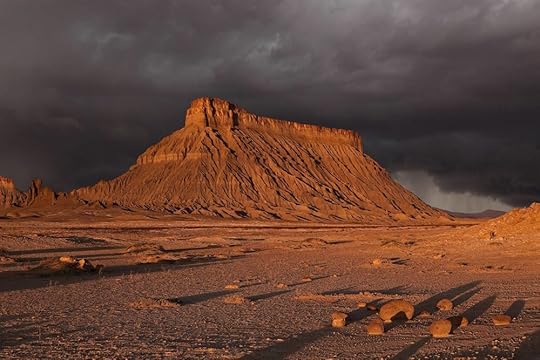
A dramatic stormy image of Factory Butte, where I have not yet been
I like to hike the canyon country of the American Southwest. I usually end up there every other year, sometimes a bit more often.
Much canyon country is colorful, sandstones and limestones in a wide range of reds and yellows. But much of this beauty is invisible from roads, except from scarce overlooks.
That's because, in various periods of the Colorado Plateau's geologic history, it was covered by shallow inland seas that deposited the silts that eventually turned into shales. And the last great period of inland sea was in the late Cretaceous (~100 - 65 million years ago), which deposited the Mancos Shale, which is dark because it contains a lot of organic matter as well as silt
The Mancos erodes to form wide, flat tablelands, easy to build towns and roads on. But much of this landscape is gray and relatively uninteresting. But when it rains, things can get sticky.
Paved roads are fine in all weathers. The problem with the soil that forms from shale is that it turns into muck when wet, what the locals call "gumbo". A cloudburst turns a dirt road into a gray, greasy terror in just a few minutes.
I remember when we climbed out of Escalante Canyon a couple of years ago. It had started raining in the morning and by the time we made the steep climb out and walked across the rock to our car, the road was a nightmare. We had to give up a proposed side trip to a side canyon to get out safely, after a long, sliding, perilous drive.
At the end we met a lovely German woman with a huge amount of blond hair piled on her head who bemoaned the fact that she had not been able to get out to Spooky Gulch, one of the places we had considered going. The way she said those two words, "Spooky Gulch", made it clear that she thought this one of the most delightful places she'd ever heard of. It is a wonderful hike (I took my family there a few years ago), and I'm sorry she had to miss it.
In Robert Fillmore's The Geology of the Parks, Monuments, and Wildlands of Southern Utah he details the geology of a drive north from Hanksville to Capitol Reef National Park. At one point (Mile 10.9 to be exact) he says:
Soon after we enter the gray shale expanse, a well-maintained gravel road heads north, toward the landmark of Factory Butte and farther to the San Rafael Swell. Unlike most roads through Cretaceous rocks of the southwest, this one is quite good because it follows the bench of stable Ferron Sandstone rather than cutting across the shale.
Aside from the fact that I have long wanted to spend some time in the San Rafael Swell, this is the kind of precise geologic detail I would love to work into fiction. Places where a dirt road is harder or easier to drive when wet might seem the result of chance, but really have a cause in the pattern of long forgotten seas.
Have you ever noted the effect of geology on the events in your life?No, I have never used this question on a first date.
March 14, 2019
More Threats to Our Mental Cohesion
Like anyone else who works at a desk, I spend some of my goofing off time reading articles on how to improve my productivity. Some of the other time I spend reading articles on how to do the thing I'm supposed to be doing, rather than actually doing it.

Advice is always easier to accept from a faceless homunculus
But I also see headlines for articles telling me that I am doomed for various reasons, and I usually don't read those. I see pieces telling me how devastating Twitter or Facebook or just checking things on your phone is, and how I am doomed. I am not on Twitter, I find Facebook unbearably dull, and don't participate in much of any online community, and have no social apps on my phone. I will sometimes check if a new podcast has shown up in my feed.
I see articles telling me how everyone is fat, or sitting too much, or has metabolic syndrome. I also see articles on how exercise is good for your brain, or depression, or some other thing.
Of course exercise is good, and so you should do it. Of course being fat is bad, and you should not do that. I know this is controversial in some circles, and I intend to write about the rage such seemingly anodyne advice can arouse. But not now.
So I read articles on how being organized and getting things accomplished is good, and applaud the sentiments, and don't actually do those things. I don't read articles on how staying off social media and exercising instead is good, because I actually do those things.
So our content is consumed by those people who are least likely to act on what we have to say. Even good advice can be consumed as a substitute for actually taking it.
That's actually kind of weird. Most of the advice isn't fake, it's real. These really are things that you might do to improve your productivity, or lose weight, or make friends, or live a longer healthier life, or whatever.
But reading about them removes the urge to do anything about them.
My conclusion? You should read more fiction. That's like reading advice given to people who don't actually exist. What could be better than that?
That is today's PSA.
What advice do you consume rather than acting on?And do you think the people who produce that advice actually expect anyone to take it?
March 12, 2019
Science and Romanticism
It is kind of a cliche that the Romantics disliked science, because it drained the enchantment from everything.
This was never really true, though William Blake did not particularly care for Newton, or for physics. Newton was eccentric and unmanageable in a completely different way than Blake was eccentric and unmanageable, and you know how much unmatching eccentrics despise each other, because of the way their finials and iridescent wings bang against each other. But aside from uncaring quiddity of Newton himself, Blake hated and feared a mechanistic universe, nothing but billiard ball atoms banging against each other.
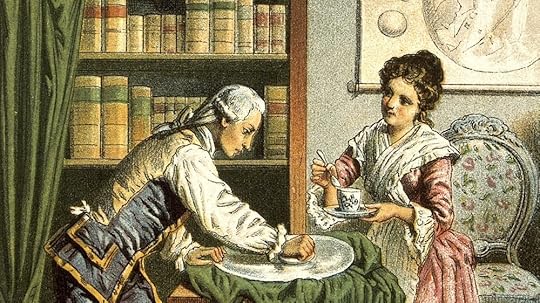
William and Caroline Herschel, though I suspect mirror grinding and tea drinking really don’t mix
But Blake is a bad example. Everyone in his own time thought he was weird, and he became a Romantic only retrospectively, within the calm quads of Academe, long after he was around to object to his ivied imprisonment.
The actual celebrities of the Romantic era were intelligent men and women, and such are always fascinated by discovery, and that was the time of great discovery. The only small-r romantics that say they dislike science are actually obscurantists who are too lazy to reconsider poorly thought-through hypotheses about the world around us. Many people think something dumb and defend it by saying it is romantic, or mysterious, or inspiring. We don't hang out with those people, and, since their opinions are more or less random, we don't need to dispute with them.
In The Age of Wonder the noted biographer of Romantics, Richard Holmes, tells a huge number of entertaining stories about the botanist Joseph Banks, the astronomer William Herschel and his talented and devoted little sister Caroline (literally little, a sprite of less than five feet tall), the solitary and determined explorer Mungo Park, the chemist Humphry Davy and his brilliant assistant, successor, and eventual competitor, the eccentric William Faraday, and William Herschel's son John Herschel, among many others.
Beauty and TerrorThe subtitle of the book is "How the Romantic Generation Discovered the Beauty and Terror of Science", and Holmes, a literary biographer rather than a science writer, gives a great sense of that, of personality, ambition, eccentricity, and obsession.
Everyone is more or less tied together through Joseph Banks. After his early adventures in the South Seas he became a kind of impresario of science, identifying and promoting talent, finding funding, providing opportunities, and being a fan and cheerleader.
A Bad Scientific HolidayAside from the comet-spotting Caroline Herschel, whom I got kind of a crush on, my favorite characters were Humphry Davy, his beautiful socialite wife Jane, and the awkward working-class genius Faraday. They took an ill-fated trip through Europe together which could serve as the basis for a novel. These three vivid characters, none of whom ever understood either of the others, each had a long history. Oddly, there are images available of all these characters save the beautiful Jane, which also seems to be part of a story.
I actually listened to an audio version of it, which was wonderful, though it missed the great photographs in the actual book.
Anyway, I highly recommend the book, not as an antidote to any misapprehensions anyone might have about science and Romanticism, but as a great account of the scientific passions of a fascinating generation.
Do you think that science is unromantic?And do you have an entertaining anecdote of someone's misbehavior that led you to think that?
March 7, 2019
Luckless Pedestrian
According to StreetsBlog, after dropping for many years, pedestrian deaths in traffic have been rising since their low in 2009 (link from Marginal Revolution).
They go on to point out that when pedestrians get hit by SUVs, the accident is more likely to be fatal, because SUVs hit you in the chest rather than lower down. Rate of collisions with SUVs has also gone up, though since more people are buying SUVs, I'm not sure whether the actual rate is going up, or even if the number of overall pedestrian/SUV accidents is going up.

The suburban nickname for us city dwellers, courtesy of Steely Dan
And that is true of a lot of other data. No one knows how many people are walking, or, for that matter, bicycling, how far, and under what conditions. Rates of fatal pedestrian acciddents seem to have climbed for crossing in the middle of the street, on arterials, etc., relative to other locations and road types. I have no idea what any of that might mean, or what actions anyone might conceivably take.
Traffic is political, so the comments below the article find ways to work immigrants, pompous SUV owners, and elites seeking to take away your internal combustion engines into their response. When your only tool is outrage, everything you see is something outrageous.
The relative absence of data
We feel like we live in this totalizing information space, where everything about us is known, but that is really true only of cyberspace. In the real world, no one has a good handle on rates, distances, frequencies, or any of the other parameters of these encounters. Fatalities get reported, injuries less so.
Maybe it's due to distracted driving, bicycling, and walking (I actually have seen people bicycling in Boston traffic while looking at their phones), but who knows?
Traffic is political
Did I mention that? It's interesting what else people can draw from these figures. This 2017 NPR article on pedestrian deaths, for example, mentions that
People of color are over-represented among those pedestrians killed. Non-white people are 34.9 percent of the U.S. population, but make up 46.1 percent of pedestrian deaths.
In certain places, this disparity is especially stark. In North Dakota, Native Americans are five percent of the population, but account for nearly 38 percent of pedestrian deaths.
But the thing I note from the Pedestrian and Bicycling Information Center is that 70 percent of pedestrians and 88 percent of bicyclists killed in 2014 were males. Not too surprising, though what did surprise me is that the average age of those killed has been climbing. The average bicyclist killed in an accident in 1988 was 24, and in 2014 that average age had climbed to 45.
Anyway, when analyzing which groups suffer more from these accidents, you have to take into account how many of them are male, their average age, and how many miles they travel by that means of transportation. Since different social groups differ in their composition and choice (or lack of choice) of transportation, that has to be taken into account.
Are you a luckless pedestrian or bicyclist?
Steely Dan didn't manage to work bicyclists into "Don't Take Me Alive", but no reason why I can't.