
Craig Pirrong's Blog, page 54
August 4, 2019
Pork Wednesday: A Tale of Gilded Age LaSalle Street, With a Heavy Dose of Irony
On Friday, someone tweeted a picture of the front page of the Chicago Tribune from 126 years prior–2 August, 1893. It depicts the trading floor of the Chicago Board of Trade when a pork corner collapsed:
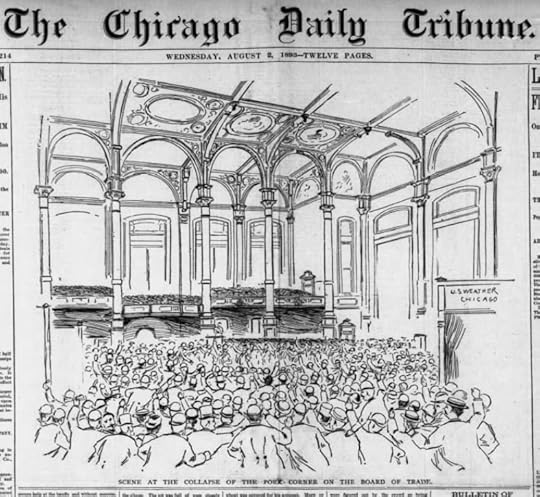
Actually, two corners collapsed on that day: the one in pork, and another in lard. The “provisions” markets (as the futures in pork and its products were called) had been successfully cornered repeatedly in the year running up to August, but the corners failed in August because the Panic of 1893 (which began in May of that year) weakened demand and made it impossible to sustain prices. From 31 July to 2 August, the price of pork futures fell from $19.25/barrel to $10.50, and lard fell from 9 cents/lb. to 5.9 cents/lb. The pork price fell $9 in 30 minutes.
The night prior to the collapse, the cornerers (notably John Cudahy, of the Cudahy family of meat packers) tried to hammer out an agreement with their bankers to secure financing to fund the deal, but Cudahy’s brother Michael (who ran the family packing establishment) refused to sign. Lacking the ability to fund their positions, the cornerers had to sell, and prices collapsed. (A la Silver Thursday when the Hunt Brothers ran out of money and had to sell. So perhaps this event should be called Pork Wednesday.)
I have spent a good deal of my professional career studying manipulation, so I find these things of academic interest. They are also fascinating from a historical perspective. Not only was this front page news in Chicago, it was front page news around the country: this paper from Omaha is just one example. This is not surprising, given the importance of agriculture in the economy at the time. Agriculture was the biggest industry and employer in the country, and food represented the largest share of consumption, so the vicissitudes of trading on the CBOT and the New York Cotton Exchange were of deep interest to most Americans. Events like those of 2 August, 1893 were a major impetus behind efforts to regulate (or ban) futures trading. These efforts failed until the post-WWI agricultural depression.
And look how big the pork pit was! It would give the 1990s-era T-bond and T-note pits a run for their money.
Further, the ag futures markets were of such economic importance at the time that they created systemic risks. The collapse of the pork and lard corner, occurring in particular as it did when banks were under suspicion due to the Panic, and when there was no deposit insurance or lender of last resort, caused runs on several banks in Chicago due to fears that they had extended credit to the cornerers or one of the four brokerage firms that failed due to the collapse, and hence were insolvent. Two prominent private banks run by Jews failed. The owner of one, Herman Scheffner, committed suicide by drowning himself in Lake Michigan. The owner of the other, Lazarus Silverman, had staved off a run at the onset of the Panic in May, but could not secure funding in New York in August, and suspended payments on 3 August. The failure of these banks, and the heavy withdrawals at others, contributed to a decline in economic activity in Chicago and the Midwest and exacerbated the prolonged depression that gripped the country from 1893 to 1897.
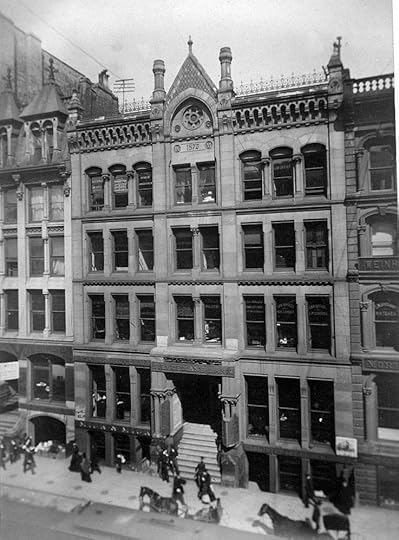
Lazarus Silverman’s story is of particular interest to me, in part due to a family connection (by marriage) and in part due to the compelling nature of the story itself. Silverman had immigrated from Bavaria before the Civil War, and started a business as a bank note broker which developed into one of the premier private banks in Chicago. His bank on Dearborn Street was quite the edifice:
He advised Senator John Sherman on monetary questions, and was a major financier of the development of iron ore in the Mesabi Range. An early investor in Chicago real estate, he was one of the giants of the Chicago financial community during the Gilded Age.
Although his assets exceeded the liabilities of the failed bank, it could not avoid bankruptcy. Nonetheless, due to his great stature and respect in the community, he was basically allowed to serve as his own bankruptcy trustee. Even though the bank’s debts were discharged in bankruptcy and he was therefore under no legal obligation to do so, he spent the remainder of his life repaying its unsecured creditors. After the failure, he conducted his real estate business out a building he had commissioned and whichA now houses the Standard Club.
I have often wondered if Silverman ever pondered the irony that he, a devout Jew who would not conduct business on Saturday (despite the fact that was a working day back then), whose business had survived the Civil War, the Chicago Fire, and the Panic of 1873, was brought low by the collapse of a corner in pork and lard.


August 3, 2019
Renewables Are Expensive Because You Can’t Stick ‘Em Where the Sun Don’t Shine (or the Wind Don’t Blow)
I’m sure you’ve read articles claiming that the cost of renewables electricity generation is approaching that (or even lower than) the cost of traditional thermal generation. I am deeply skeptical of these claims even when evaluated on their own terms (which focus on generation costs alone), but find them particularly misleading because they ignore other costs attributable to the facts that renewables are intermittent and diffuse, and that the siting of renewables generation is sharply constrained because they are energy limited resources; the distribution of energy is dictated by nature; and typically is not closely related to the distribution of load.
In other words, renewables are costly because you can’t stick them where the sun don’t shine (or the wind don’t blow).
Case in point: Australia. As even Bloomberg (a tiresome renewables fanzine) reports:
Australia’s financing of cleaner power is slowing because the country’s aging grid isn’t being upgraded quick enough to accept new, intermittent generation and transport it efficiently to demand centers.
Although Bloomberg attempts to blame an old, creaky transmission system, this is misleading in the extreme. It would be far cheaper to upgrade Australia’s transmission system to accommodate thermal generation than it will be to build transmission to increase the fraction of generation coming from renewables.
This is true for at least a couple of reasons.
First, the energy-limited nature of renewables means that you have to site them where the energy is available–sunny or windy places. This imposes a constraint on the location of generation resources that is not relevant for thermal generation. With traditional fossil-fueled generation, you have more flexibility in trading off transmission costs with generation costs (including the cost of brining fuel to plants) than is the case with wind. This flexibility means that all else (notably the spatial distribution of load) equal, transmission costs are lower with thermal generation than renewable power.
Second, the intermittent and inherently more volatile nature of renewables generation increases the variance in the spatial distribution of generation. This variability in the spatial distribution of generation necessarily requires more transmission capacity per unit of load. This, in turn implies a lower average rate of utilization of transmission resources.
The basic idea here can be illustrated relatively simply. Consider a system with two generation resources. One is highly volatile (e.g., a renewable resource). The other is controllable. There is one load location. The transmission capacity from the volatile location to load must be high enough to carry the power when output is high (because the energy input is high due to the vicissitudes of sun or wind). The transmission capacity from the location with controllable generation must also be high enough to transmit enough power to fill the gap left when the renewable output is low.
Note that when renewable output is high, controllable output will be low and the transmission lines from the latter will operate at low capacity. When renewable output is low, the lines serving it will be operating at low capacity.
It’s possible to expand the example to include multiple variable, energy limited, but imperfectly correlated renewables resources, but the outcome is the same. You need more transmission capacity to deal with the spatial volatility in generation, and given load, higher capacity translates into lower average capacity utilization.
Thus, the problem that Australia is confronting isn’t a function of an old grid: it arises from the fact that increased reliance on renewables requires investment in new transmission capacity even in a system where transmission is optimized relative to (thermal) generation and load.
The need to maintain relatively underutilized transmission capacity to deal with the inherent volatility of renewables generation is mirrored by the need to maintain underutilized thermal generation capacity:
While new clean energy projects struggle to gain access to a congested grid, aging coal and gas-fired generators are being kept running for longer to maintain system stability. AGL Energy Ltd. said Friday it would delay the planned closure of its Liddell and Torrens A plants, both around 50 years old, to help the national energy market cope with peak summer demand, which has seen blackouts in parts of southeastern Australia in recent years.
Who knew?
Yet the renewables industry/lobby continues to flog the dogma that they will inevitably be more efficient:
Despite the challenges facing the industry, it’s not all doom and gloom. A number of coal-fired plants will be retired over the next decade and they will only be replaced by the cheapest cost of energy, which is renewables, Clean Energy Finance Corp. Chief Executive Ian Learmonth said in an interview.
“I’m hoping once some of these issues around the grid and regulations are settled that we’ll see another significant uptick in the renewable energy pipeline,” he said.
What costs is Mr. Learmonth including in his assertion that renewables are the “cheapest” source of energy? His statement that settling “issues around the grid” will lead to increased renewables investment suggests that he is ignoring crucial costs, because settling these issues doesn’t come for free.
It’s not as if the transmission issue is unique to Australia. It is present in every locale that has force-fed renewables. Germany is a prominent example. Wind energy is abundant in the North Sea, but believe it or not, there aren’t a lot of electricity consumers there. Major sources of load are in central and southern Germany, so bringing North Sea wind power to load requires massive transmission investments, which inevitably are not just costly, but politically difficult (Der NIMBY, anyone?). These difficulties inflate the cost.
Renewables boosterism operates in an atmosphere of serious unreality because it consistently glosses over–or ignores altogether–the costs arising from intermittency, diffusiveness, the energy-limited nature of wind and solar, and the caprices of nature that cause a mismatch between where the energy exists and where it is needed. When these facts are considered, sticking renewables where the sun don’t shine makes perfect sense.
July 27, 2019
It’s Not “The Squad”: It’s the New Gang of Four
Someone (@jgibbons74) responding to one of my tweets regarding @AOC’s most recent demonstration of fatuity said that she reminded him of Madam Mao, Jiang Qing. This comparison is very apt. And it set off a series of connections in my mind. Jiang was the leader of the Gang of Four, the hard-core communists who were the driving force behind the insane and evil Cultural Revolution in China. AOC is part of a group of four hard core leftists who aspire at nothing less than a social and cultural revolution in the United States. (Fortunately, I can still use lower case letters.) They call themselves “The Squad,” but given their very real ambitions (about which they are quite explicit), and the historical antecedent in China, this appellation is far too benign and non-descriptive.
No. They really should be called The New Gang of Four.
And here’s the scary thing: I wouldn’t be surprised if they consider that a compliment.
We Haven’t Seen the Rosenstein Letters, So We Still Don’t Know What Mueller’s (I Mean Weissman’s) “Purview” Really Was
The most telling thing to come out of the Mueller hearings is his admission that the Steele dossier, the origins of the FBI counterintelligence operation, and Fusion GPS were never part of his “purview.” When someone charged with finding a body studiously refuses to look in a particular place, you can be sure that (a) said person is either the murderer, or an accessory, and (b) where he refuses to look is exactly where the body is buried. Thus, as Kim Strassel writes, Mueller’s real task was to shelter his buddies in the Deep State. Mueller was an accessory after the fact, and his refusal to look at their actions is dispositive evidence that they engaged in myriad crimes before and after the 2016 election.
It is rather astounding to me that no one has picked up on one crucial fact: we still haven’t seen the Rosenstein letters authorizing Mueller’s (I mean Weissman’s et al) investigation, so we don’t know even at this late date exactly what his “purview” was. We need to see these, and stat, to determine whether Mueller was lying, and if not, to know that Rosenstein deliberately pointed Mueller away from Deep State operators (Brennan, Comey, Clapper, and their creatures like Mifsud and Halper and Downing; Hillary Clinton and her various flying monkeys (e.g., Steele and Simpson); and the DNC), and towards Trump exclusively. Which would mean that the Mueller investigation was merely an extension of this Deep State operation.
The hysteria about Russia continues. The most recent example is the freak out over Mitch McConnell’s torpedoing of bills allegedly intended to secure US elections: according to the establishment, this proves that Cocaine Mitch is a Russian mole. No really. That’s what they are saying. (Apparently these people are trying to do Joseph McCarthy a huge favor by making him appear measured, judicious, and sane in comparison to them when it comes to Russia. Ironic, given that the New McCarthyites have long excoriated McCarthy and the Original McCarthyism as evil incarnate.)
Yet given the ongoing hysteria, we still do not know its origin story. The Mueller testimony makes it clear that this is quite deliberate. The most likely explanation is that the hysteria was the creation of a political black operation. As Pogo said, we have met the enemy and he is us. Or at least, those who claim to be acting in the interests of us.
Yet we really haven’t met the enemy. Not conclusively, anyways. It is far too late in the day to remain so uninformed. So hurry up, Bill Barr. Time’s a wastin’, and every day that the crew behind the Trump-Russia hysteria escapes accountability, is another sin against the republic.
Clean the Augean Stables. Now. The stable boy (Robert Mueller) has made it plain that this is, what’s the phrase again?, oh yes: in your purview.
July 24, 2019
Why Is It “Bombshell” Congressional Testimony Always Blows Up in the Faces of Those Who Call the Witness?
If you want to bet your life on a sure thing, put your money on “bombshell” testimony before a Congressional committee blowing up in the faces of the bloviating legislators who call the witness. Think Ollie North. Any of the Dan Burton hearings on Bill Clinton. And think Robert Mueller.
On the old show You Bet Your Life, Groucho Marx would ask a particularly hapless contestant “who’s buried in Grant’s Tomb?” so they would at least get one question right. Nobody asked Mueller that question today. Probably because no one was quite sure whether he could answer it correctly.
Mueller stumbled through his testimony like an extra in Walking Dead. It was beyond embarrassing, and left no doubt that he was the Special Counsel In Name Only, aka the Titular Head of the Office of Special Counsel.
Astoundingly, he claimed no knowledge of Christopher Steele or Fusion GPS. Beyond his purview, you see.
Cue Sergeant Schultz.
Meaning that Andrew Weissman or some other equally loathsome lawyer was the real driving force here.
It was sickly amusing that at the 11th hour Mueller aide Aaron Zebley was allowed to participate in the hearing. It was sickly ironic that in a hearing that focused on obstruction of justice involved a lawyer who represented one of Hillary’s aides who smashed her Blackberry to bits with a hammer.
The entire thing never even rose to the level of farce. In so doing, it demonstrated the outrageousness of the entire Mueller investigation–pardon, I mean, Weissman investigation. It never should have happened and everyone involved with it should do penance for a thousand lifetimes.
But you know they never will, which is a telling commentary on the sad state of the American republic.
July 22, 2019
A Hollow Nation: A Cockboat in the Wake of the American Man-of-War
In 1823, France and Spain, supported by Russia, Austria, and Prussia, threatened to reverse the independence of the revolutionary states in South America that had broken away from Spain. The British prime minister, George Canning, proposed that Britain and the United States send a joint warning to the continental powers. US Secretary of State, John Quincy Adams, rejected the idea: “It would be more candid, as well as more dignified, to avow our principles explicitly to Russia and France, than to come in as a cockboat in the wake of the British man-of-war.”
How things have changed, in nearly 200 years. Talk about reversal of fortune. The UK now is the cockboat–if that–to the US man-of-war. It now faces humiliation in the Persian Gulf, having to admit after the seizure of a British-flag tanker by Iranian Revolutionary Guards that it hasn’t the means to escort other British ships, or to deter Iran from taking yet more.
A little short of 40 years ago, the British barely had the naval wherewithal to to overcome a third-rate power, Argentina, in the Falklands. Now it cannot even stand up to a fourth-rate (if that) naval power far closer to home, and in a region that had been at the center of British interest since before Adams opined that the US must assert its own interests in the Western Hemisphere. Such are the wages of decades of indifference to one of the primary duties of government: national defense. (Britain has proved increasingly deficient in performing the other as well: maintaining the public safety.)
As a result of its lack of capability, Britain is furiously signaling its desire to tamp down tensions with Iran. Which will only spur the Iranians on.
The United States has been trying to herd its alleged allies into an effort to convoy shipping in the Gulf. But despite all their imprecations against American unilateralism, and their fine words about the transcendent importance of alliances and the vital necessity of maintaining a rules-based international order, they would rather not, thank you very much.
Hollow words. Hollow nations. They deserve only contempt, not deference.
July 21, 2019
Zip It, Fritz
File this under “We didn’t bomb them enough.” (Maybe I should create a new category for easy reference.)
Item One: Angela Merkel expressed “solidarity” with Ocasio-Cortez, Omar, Tlaiba, and Pressley. She then proceeded to pontificate on her views of what makes America strong.
Item Two: to state regretfully that the Bad Orange Man made it impossible to continue to do so.
And, of course, Merkel holds Siemens in the highest standing.
Merkel’s and Siemens’ opinions about US politics and US society are gratuitously offered, and worth less. And considering the source, they have no business lecturing others. So zip it, Fritz.
Twitter: A Shame/Honor Culture From Hell
Social scientists have identified three types of societies/cultures: shame/honor, guilt, and fear/power. They differ in the manner in which individuals regulate their conduct. In a shame/honor society, people evaluate their actions and regulate their conduct based on how it will be perceived by others: they seek to avoid being shamed by those in their society, and strive to be honored by them. In a guilt society, individuals regulate their conduct by reference to an internalized code of morals or justice: violating the tenets of this code self-induces negative affect and emotional/psychic punishment. In a fear/power society, fear of retribution by the more powerful shapes individual behavior.
A key difference between guilt societies on the one hand, and shame/honor or fear/power on the other is that in the former, the guilt mechanism affects behavior even when (or especially when) nobody else is watching, whereas in the latter, the mechanisms affect behavior only if somebody else is watching. Since trust relates to actions that cannot be monitored directly, guilt societies are more likely to be high trust than the other two. Moreover, since the enforcement mechanism in a guilt society is internal to the individual, and not dependent on external approbation or punishment, it can support a higher degree of individualism and individual autonomy.
So perhaps you are say, OK, prof–makes sense, but this is kind of out of the blue here. Well, there was a prompt, and is a purpose.
The prompt was a conversation over coffee with a Boston Baptist, a Texas Catholic (no I didn’t mix those two up), and a Turk. And no, we weren’t walking into a bar. Anyways, the Catholic said “I have to confess to telling a little white lie, and I feel guilty about it.” Well, the lie was about as innocent and harmless as you could imagine. But the mention of guilt sparked a thought: I know Arab society is of the shame/honor variety (see David Pryce-Jones, The Closed Circle: An Interpretation of the Arabs), but I wasn’t sure about the Turkish, so I asked. The Turk responded that Turkey is a shame/honor society.
And that sparked another thought. Specifically, that Twitter is a shame/honor society of the most vicious sort. And when it is not a shame/honor society, it is a fear/power society.
The mechanism of social control on Twitter is vicious shaming of those who offend the self-appointed arbiters of discourse. This mechanism induces many either to avoid Twitter altogether, or self-censor to a considerable degree. (Many of those who are shamed suffer because of inadvertent remarks that they did not recognize would result in massive attack.) The “honor” part of Twitter (and I put that term in quotes for a reason) is that people signal furiously in order to obtain approbation from the crowd.
Twitter can shame even conduct that does not occur on the platform, e.g., the poor sod who had a grocery-line confrontation with an obnoxious harridan in Georgia. By this means, Twitter extends its shame/honor dynamic into society at large.
The shame/honor enforcement mechanism in Twitter is backed up by fear/power. The power is exerted by Twitter itself, with its shadow banning, and especially in its outright banning of those who offend it.
I unabashedly say that a guilt society with internalized rules that regulate individual conduct even when no one is watching is superior to the alternatives. (This wrongthink is no doubt a trigger for Twitter shaming, but IDGAF.) Not least because this is a necessary condition for individualism, individual autonomy, and a large scope for individual freedom.
And this is why I think that Twitter (and to a considerable degree Facebook, which is more power/fear than shame/honor) are highly deleterious, especially in the United States and other western countries, which (via Christianity, primarily) are predominately guilt societies. The shame/honor dynamic that Twitter creates, and extends beyond the platform itself, is socially corrosive and undermines the mechanisms that support high-trust societies, and those that extend considerable degrees of personal freedom and autonomy.
July 17, 2019
Have “Issues” With the Gadsden Flag?: GFY
Post-Charlottesville, I have often stated that the war on American history would not end with Confederate generals, or Confederate privates. Every American historical figure is at risk. Recent evidence of this was the city of Charlottesville’s decision to end its observance of Jefferson’s birthday. But almost every day some American figure or symbol is being targeted.
Around July 4th, it was the Betsy Ross flag. he Navy Jack is probably a misrepresentation of the actual flag flown over the first ships of the Continental Navy. There is no doubt that Commodore Hopkins’ fleet flew a flag with the rattlesnake/Don’t Tread on Me symbols, but it was the Gadsden Flag, given to Hopkins by Gadsden himself. The uncoiled rattlesnake on a banner with 13 alternating red and white stripes was depicted in a 1776 British print of Hopkins, engraved by someone who had never seen either Hopkins or his ships. This print was used as the basis for a modern representation in the 1880s. John Adams and Benjamin referred to a South Carolina ships with a rattlesnake over 13 stripes.
July 15, 2019
President Pavlov and His Tweets, AKA The Matador
About 6AM this morning I emailed a friend saying that Trump tweeted at AOC, Ilhan Omar, et al to “go back” whence they came (hell?) in order to “force all the Dems to embrace these clowns after they had been trying to get them into line. ”
But very few figured this out. They were too intent on being outraged and outrageously demonstrating their outrageous outrage to consider whether there was method behind what they perceived as yet more Trump madness.
Gradually, a few got clued in. Notably David Axelrod:
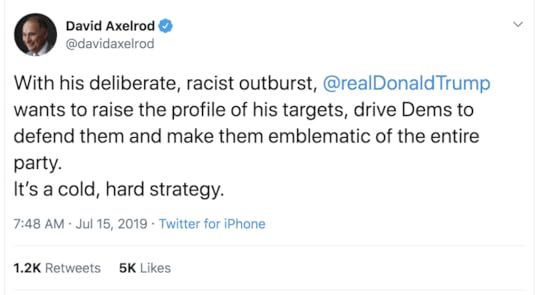
Is it just me, or is there some grudging admiration there? Axelrod, after all is a master at cold, hard strategy, e.g., getting Obama’s Senate election opponents’ divorce records unsealed.
But some, notably those on the right, remained stubbornly clueless:
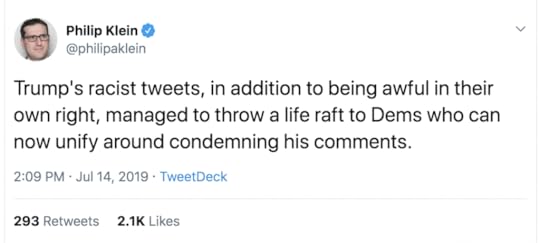
Yo! Moron! That was exactly the point! He forced the Democrats to unify behind four lunatic leftists who are as popular among the general populace as root canals or the clap, at the very moment–the precise moment–that Pelosi and others who pass for adults in the Democratic Party were trying to yank them from center stage in order to present a more moderate face to the public, precisely because they realized that “the Squad” is electoral poison outside of Wokistan.
To the astonishment of many, Trump doubled down this afternoon, and rather than kowtow to the outrage, stoked it by saying that Omar et al hate America, and if so, they should leave.
But then Trump had to spoil it all, and announce to the world (via Twitter) that getting the Democrats and the media to rush to the defense of AOC and Omar and Tlaib and Ayanna Pressley was precisely what he intended all along:
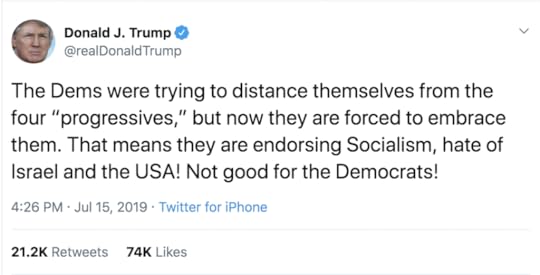
Suckas. You done got played. Again. When are you ever going to learn? That’s right–nevah.
Trump is like Dr. Pavlov, ringing the bell for his dogs, except that Trump uses Twitter rather than a bell. His foes are so conditioned to respond with sputtering, drooling, foaming outrage to his tweets that they don’t stop to think. To think about how he has played them in the past. About how they reacted viscerally, only to find that their reaction was exactly what he had intended. To consider whether he might be baiting them into doing exactly what he intends.
Another metaphor: Trump is the matador who gets the enraged bulls to rush the red cape, only to see him step aside and plunge another blade into their backs.
Trump is undoubtedly an narcissist, and perhaps that is why he is able to read and manipulate his adversaries so well. For they are narcissists too, convinced of their own superiority and his utter inferiority and depravity. This makes them an easy mark for his provocations.
No doubt Trump is behaviorally conditioned as well. He gets positive reinforcement from the extreme negative reaction his tweets elicit from his enemies. Which means that he will continue this until said enemies wise up and stop rising up to take the bait. Which means he will continue it for the foreseeable future, for they will never wise up. They revel in their outrage, even though it is counterproductive.
Craig Pirrong's Blog

- Craig Pirrong's profile
- 2 followers

