
Craig Pirrong's Blog, page 42
September 19, 2020
Her Way of Leaving It Does Not Become Her
When someone of prominence passes, I often think of Malcolm’s remark in Macbeth about the Thane of Cawdor, executed for treason: “Nothing in his life became him like the leaving it.” How did someone depart this mortal coil, and what does it say about him (or her)?
One one level, one could say that Ruth Bader Ginsberg’s leaving became her. She fought a long battle against cancer with courage.
But at a deeper level, there is something deeply disturbing about her last hours, months, and even years. This is captured by her dying wish: “My most fervent wish is that I will not be replaced until a new president is installed.”
This is disturbing for several reasons. For one thing, her seat on the Supreme Court was never hers to bestow or bequeath. The lifetime appointment of judges is problematic enough: to allow them to dictate, or even influence, that seat from the grave is intolerable, and intolerably presumptuous.
With respect to lifetime tenure, Richard Posner had some good insights:
“I believe there should be mandatory retirement for all judges at a fixed age, probably 80,” Posner writes in the online debate with U.S. District Judge Jed Rakoff. And that retirement age should include justices on the U.S. Supreme Court, Posner says.
“There are loads of persons capable of distinction as Supreme Court justices; no need for octogenarians,” Posner says.
“While many judges and justices have performed OK in old age, I don’t think any of them improved with age, which means they could readily have been replaced with equally good or better judges,” Posner says.
Even beyond the presumptuousness of believing that one individual’s dying wish should bind the living on a matter of such public import, this wish, and Ginsberg’s insistence on remaining on the court despite suffering a devastating illness, suggests twisted priorities that are all too characteristic of this age, and of the governing class. Priorities that elevate politics above all else.
When confronted with imminent mortality, I would hope to focus on important things. Family. Friends. Enjoying the world to the extent that my health permits. Coming to peace with my fate. Trying to focus on the sacred, rather than on the very profane: and little is more profane than politics.
But Ginsberg was so focused on politics and her power to influence it that she hung onto her Supreme Court seat when she knew her time on earth was limited, and was so loath to surrender that power that she attempted to extend it into the afterlife through her dying wish.
Her death in the midst of an already combustible political environment was destined to add fuel to the raging partisan fires. But her dying words have only intensified the conflagration. Within minutes of her words being reported, Obama intoned that her wishes should be respected. If you want to risk your mental health, you can scroll through Twitter and find example after example of threats to riot–or worse–if those wishes are not granted, and Trump nominates and the Senate moves to confirm a replacement.
Rioting, of course, now being the default leftist threat when they don’t get their way.
Why are we at this juncture? Because Ruth Bader Ginsberg decided to let politics dictate the way of her leaving. Or more exactly, the way of her not leaving the Supreme Court, as health and human considerations should have led her to do long, long ago, when such a departure would have caused some civil strife, but nothing to compare to what we are facing now. Given the malign contribution this will make to our already poisoned body politic, it does not become her at all.


September 17, 2020
The Projection Election
One of the Democratic drumbeats in the final days of the 2020 campaign is that Trump will refuse to concede the election, and that the military will have to evict him from the Oval Office. Indeed, the mannequin at the head of the ticket says that he is “absolutely convinced” that Trump will not concede and that the military will be needed to secure the transition of power.
This is pure projection. The Democrats have made it known publicly that unless Biden wins by a landslide, that the country will descend into civil chaos, with mass protests and rioting. This is something befitting Don Corleone: “Nice little country you got here. Shame if anything happened to it. Keep that in mind when you vote.” Particularly chilling in the aftermath of months of a twisted version of a Rodney Dangerfield joke: I went to a protest and a riot broke out. (Is that deliberate messaging?)
No, really. This is a thing. Operating under the Orwellian name of the “Transition Integrity Project,” leading Democratic figures (e.g., John “password is my password” Podesta), their funders (including He Who Shall Not Be Names Unless You Want to Be Called an Antisemite), and supposedly conservative fellow travelers (e.g., Bitter Bill Kristol) have “war gamed” (their phrase) four election scenarios. Only under the Biden landslide scenario does the country avoid a slide towards civil war.
The Hag of Chappaqua has also weighed in, croaking that Biden “should not concede under any circumstances.” Any circumstances.
The party has readied over 600 lawyers to descend on every contested state and major municipality on November 4. You think Florida 2000 was bad? What happened then and there will happen–only worse–in every state that Trump wins.
Wins on November 3, that is. One of the arguments will be that mail in votes have yet to arrive or be counted, thereby precluding declaration of a winner. This will give time to sow more chaos, pressure more judges, and maybe even manufacture more votes, a la Richard Daley for Kennedy in 1960 or “Landslide Lyndon” in the 1948 Texas Senate race.
Some have compared the TIP “war game” to the blueprint for “color revolutions” authored in 2005 by throne sniffing academic, and former pitiful ambassador to Russia, Michael McFaul. And indeed, the similarities are quite pronounced.
McFaul gave a wink and a nod on Twitter last week:
“Trump has lost the Intelligence Community. He has lost the State Department. He has lost the military. How can he continue to serve as our Commander in Chief?”
(I would link to the Tweet, but the little weasel blocked me in July 2016 for mocking (a) his nauseating defense of Hillary’s handling of her emails, and (b) his inability to master the incredible intricacies of Google to figure out who I am.)
In sum, the Democrats have broadcast, quite openly, their post-election plans. They argue a priori that Trump cannot win. If he gets more electoral votes, it’s because he cheated, or suppressed the vote, or hijacked the USPS, or on and on and on. That is, they reject anything but a decisive Harris-Biden—whoops, Biden-Harris–victory as illegitimate, and in the event will use any means necessary to make the White House a memory care facility.
All this talk about Trump not conceding, and having to be ejected by the military, is just preparing the battle space. When he contests their Operation Chaos, they’ll shout: “See, we told you! He isn’t leaving! He must be removed!” Gaslighting in its purest form. Projection in its purest form.
All of the hysteria over the USPS is another example of preparing the battle space.
You might argue that some Democrats have said that only if Trump doesn’t concede the election, military intervention would be required. But given that the Democrats clearly and openly reject any Trump victory as illegitimate a priori, such a contingency will arise under any scenario even where Trump can legitimately claim victory. Because the Democrats believe that “legitimate Trump victory” is an oxymoron.
In sum, the Democrats have clearly threatened–and continue to threaten–insurrection unless they win. Meaning, vote right. And if you don’t, your vote won’t count.
We are staring into an abyss. The past four months have just been a pale preview of what waits in store in November.
September 12, 2020
I’m So Old I Can Remember When Trying to Prevent Panic Was Considered a Hallmark of Leadership
In what perhaps may become a new feature, in response to a Twitter request by @Esq_SD, here are my thoughts regarding (a) the new Woodward book, and (b) the Israel-UAE (and now Israel-UAE-Bahrain) peace deals.
With respect to the Woodward book, I wouldn’t read his has-been droning on a dare, a bet, or for a date with Gisele Bündchen. So all I can do is respond to the alleged bombshell in the book, namely that “Trump lied [about COVID] and people died!”:
“To be honest with you…I wanted to always play it down. I still want to play it down, because I don’t want to create a panic.”
This is a completely defensible, and indeed laudable, course to take. Panic makes bad situations worse. Panic kills. Always.
Historically, those in authority who have panicked, or more importantly through intemperate word or deed, caused those who they led or governed or ruled to panic, have created disaster. Those who contributed to maintaining calm even in dire straits have often proven instrumental in overcoming those circumstances.
I’m so old that I can remember being taught in school about a president who said “the only thing we have to fear, is fear itself”–and that he was admired for saying so.
But now, that president’s political heirs are saying in effect “the only thing we have to sell is fear.”
I am reminded of the first lines of Kipling’s If:
If you can keep your head when all about you
Are losing theirs and blaming it on you,
Kipling thought this was admirable. It’s now apparently worthy of contempt.
And ain’t it an accurate description of the situation Trump faces?
My criticism–more of a lament, actually–is that Trump did not succeed in stemming panic. Even before Trump spoke to Woodward on 19 March, I had started to call the policy response to COVID-19 a “panicdemic.”
And it only got worse from there. And in certain quarters, the panic continues unabated. This is particularly appalling, given that perhaps, given the ignorance of the early days, there were grounds for fear in March. But given all of the evidence amassed in the past six months, it is now beyond obvious that those fears were vastly overblown.
Yet the fear mongers keep mongering. Just look at the UK, where BoJo (whose erratic behavior makes Trump look like Seneca the Younger) has clamped down again. Or Victoria, in Australia (I’m being specific as an acknowledgement to Ex-Global Super-Regulator on Lunch Break’s admonition that there is more to Australia than Melbourne), or New Zealand, both of which have adopted the insane eliminate-the-virus strategy
The panicked policy responses have wreaked havoc, and inflicted far more damage than the virus itself. So would that Trump’s efforts to tamp down the panic been far more successful. But I certainly will not join the baying chorus attacking him for going against character, and choosing understatement over hyperbole.
As for the Mideast peace deals. What? You haven’t heard about them? Well, that’s understandable, because the media has been speaking sotto voce on the subject. And that tells you just how epochal the deals are.
They obviously can’t say the deals are a bad thing. They clearly are a good thing, but they can’t say that, because that would be a boon for Trump, and we can’t have that, can we? Especially with an election in 7 weeks. So the media silence (and the silence of the Democrats) is as ringing an endorsement as one could imagine.
You can bet your bottom dollar that if Obama had shepherded such a deal to completion, the media would be singing his praises from the rooftops. (As if Obama ever could have achieved this, given his inveterate hostility to Israel and his obsession in consummating a deal with Iran.) But since Trump’s fingerprints are on it, the most substantive diplomatic realignment in the Middle East in decades is all but ignored.
As is the deal in another allegedly intractable conflict, between Kosovo and Serbia. Richard Grenell’s scathing takedown of the press for its indifference to and palpable ignorance of the the importance of the rapprochement was fully justified. (Ironically, Grenell would check various intersectional boxes, but one box that he checks–Trump Republican–puts him beyond the pale of the pale.)
These two achievements also give the lie to the oft-repeated slander that the Trump administration is isolationist, withdrawing America from the world, and in particular, abandoning the Middle East.
Letting Syria go to shit–stay shit would be more accurate–is not abandoning the Middle East. It is prudent to avoid getting involved in . . . what’s the word that Democrats always used to throw around? . . . ah . . . quagmires, that’s it. Drawing down in Iraq–after largely vanquishing ISIS–is prudent. Economy of force and concentration on strategic priorities is prudent: getting involved and staying involved everywhere is strategic idiocy.
It is particularly ironic that Trump has been routinely savaged as a war monger, yet he–in the teeth of furious opposition from the Pentagon and the State Department apparatchiks other elements of the Deep State–has steadfastly–and patiently–whittled away at American military presence in fruitless conflicts, and used diplomacy to advance American interests and reduce conflicts, thereby avoiding additional military commitments.
We are well into a new era of great power rivalry, specifically with China. Prudent strategy focuses on those arguably existential conflicts, and avoids peripheral ones, or attempts to mitigate them through diplomacy. The peace deals, the drawdowns in Iraq and Afghanistan, and the waging of asymmetric conflict against China (cf., TikTok, Huawei, visas to Chinese students, prosecuting academics who whore for China) are all elements of such a prudent and foresightful strategy. Trump’s adoption thereof is more likely instinctual than intellectual, but his instincts are correct and he has had the fortitude to pursue them despite the inveterate opposition of the idiots in the Establishment. These policies do not represent an abandonment of American influence, but a concentration on The Objective.
Clauswitz would understand, even if the DC Mandarins are clueless.
September 6, 2020
Batting 500: Striking Out on Evictions, A Four-Bagger on Coercive Critical Theory Indoctrination
The Trump administration announced two policies over the last week. It batted 500, and its slugging percentage is 2000. It had one strikeout and one home run.
The strikeout was the CDC moratorium on evictions, due to the covid panicdemic. The short term political benefits are manifest here, but the longer term consequences are malign–as is usually the case with emergency measures.
This is a classic case of the seen and unseen. The seen will be fewer evictions prior to the election–although it should be noted that to the extent that there are gains from trade between landlords and tenants in adjusting the terms of rental contracts due to exigent circumstances, the main impact of this is to change the balance of negotiating power between them, rather than to affect the number of evictions. In a frictionless Coasean world, the policy would not affect the number of evictions. In the real world, there are bargaining frictions, so the policy will reduce the number of evictions, but I am guessing that this (efficiency) impact will be small. Thus, the main impact of the policy will be distributive.
But perhaps that is not surprising, because the primary engine of politics is the distribution of wealth and income.
The longer run impacts are unseen. To the extent that this “emergency” policy is considered to be a precedent, and that such moratoria are more likely in the future, the effect will be to cause rents to rise, and the quality and quantity of rental units to decline. That’s what expropriation of property rights does. These higher costs will be borne by all renters.
Thus, in the long run, the policy is inefficient. The welfare losses will be borne not primarily by landlords (due to essentially free exit from the sector in the long run), but by the alleged beneficiaries–renters. But those people–and pretty much everybody–will not connect the higher rents and crappier apartments to the policies allegedly adopted for their benefit.
The four-bagger is the ban on requiring federal workers to take courses rooted in “critical race theory” or theories of “white privilege” or “systemic racism” and the like. These programs are beyond malign. They are oppressive and sow strife, rather than ameliorate it.
Moreover, they are based in lies.
Any “theory” that is self-labeled “critical” is pseudo-scientific rubbish. If you want to do a deep dive into the subject (warning: you are risking your mental health if you do!), I recommend the New Discourses website. I will just hit a few highlights–or, more accurately, lowlights.
As New Discourses points out, critical theories tend to be rooted in Marxism, post-modernism, or a Frankenstein amalgam of both. To dive into the distinctions between Marxist and post-modern flavors of these theories is to court migraine. But there are some broad similarities that can be expressed succinctly.
To greatly oversimplify, but at the same time to capture the essence, critical theories deny objective truth. Instead, everything is “narrative,” and the narratives are simply brainwashing/propaganda intended to rationalize, justify, and perpetuate the power of certain classes. In the case of critical race theory, the class is white people.
These theories are essentially gnostic. The theorists claim to have special insights into hidden structures of power relationships, based on their unique ability to “deconstruct” (i.e., decode) hidden meanings in ordinary speech, literary texts, and even scientific works.
Ironically, the theorists claim that nothing that anyone else says is objectively true–but you are expected to take their deconstructions as truth.
The mechanism by which this process works is also unspecified. At least classic conspiracy theories involve identifiable conspirators, and acts of coordination among them. Theories claiming vast Masonic plots, for example, can at least point to secretive meetings among powerful people at Masonic lodges. But just how, exactly, do all white people (or all men, or all cis-people, or all hetero people, depending on the particular brand of critical theory) agree on the narrative, and agree to oppress The Other?
It is notorious that collusive arrangements are hard–and frequently impossible–to maintain, especially among large numbers of far-flung individuals, even if it is putatively in their collective interest for the conspiracy to succeed. How do these massive conspiracies survive the forces that make collective action very difficult to maintain, even within small groups, let alone within massive groups of strangers separated by space and time?
Critical theories do not even pose the question, let alone answer it: they basically advance a deus ex machina theory of causation.
Moreover, these theories tend to have the feature of pseudoscience that Popper pointed out eons ago: they are not refutable. The theory of “white privilege” (yeah, tell that one to my hillbilly ancestors and relatives, e.g., the Hatfields) is a perfect example. The premise is that all white people are racist. If you admit you are racist, well, QED. But if you deny you are racist, well, QED! Everyone is a winner! Your denial merely reflects your internalization of the white power structure and your steadfast refusal to admit it exists. Proof of how powerful that structure is!
The theory is always right. It cannot be disproven. That is the essence of pseudoscience.
The related theory of “systemic racism” is also pseudoscientific. It takes evidence of differences in outcomes among races as irrefutable evidence of racism (again produced by some unspecified coordination mechanism across hundreds of millions of individuals). Yes, one implication of the theory is that in a systemically racist society, blacks will experience worse outcomes (income, health, mortality, etc.) than whites. But there are alternative explanations for the same patterns that do not involve systemic racism. (Cf., inter alia, Thomas Sowell’s numerous books.)
That is, there are other hypotheses that are observationally equivalent to some implications of the systemic racism hypothesis. Rejection of the no-systemic-racism null does NOT imply acceptance of the systemic racism alternative hypothesis–a logical error that advocates of this theory repeat, usually at high volume and in high dudgeon. Other alternative hypotheses are also consistent with the rejection of the null. What is necessary is to find implications of systemic racism theory that differ from other theories that imply disparate outcomes, and to see which theory best explains the data.
But that’s where the Popperian element of pseudoscience kicks in: only racists deny that evidence of disparate outcome is not due to systemic racism.
The denial of objective truth in critical theories is a denial of all the premises of the Enlightenment, and all the methodologies of the Enlightenment–including the scientific method. Look around you, and witness all of the products of the Enlightenment that have freed you from the poverty, drudgery, and ignorance of the pre-Enlightenment. If you embrace critical theories, you are willingly throwing away all of those things.
Talk about Died of a Theory.
I would also note that there is a huge element of projection in critical theories, critical theorists, and those who embrace them. Recall that the core of critical theories is that they claim that social and cultural institutions, norms, and beliefs are merely instruments to advance and protect the power of one group (e.g., “white people” as if that is some kind of homogeneous group, cf., Ireland) over The Other. But it is abundantly clear that the advocates of critical theories have an overwhelming will to power. Deconstruction is merely a mechanism for them to dissolve existing institutions so that the gnostics can achieve the power to order things as they will. Thus, when those spouting critical theory say that everything is about power, they are revealing far more about themselves, than about the things and people that they critique.
And the fact that critical theories are merely a cloak to the will to power is exactly why the administration is absolutely correct in its efforts to banish the coercive propagation of such ideas to federal employees. Would that the administration find the legal means to banish it in other spheres as well, higher education included.
September 2, 2020
Bullshit Data, Part II: The Government We Deserve?
Two big covid-related stories have come out in the past few days. The first is that the CDC announced that only about 6 percent of those counted among the covid-19 death toll had no other cause of death listed. The vast majority of those counted as covid casualties had other co-morbidities, notably respiratory problems, diabetes, and obesity. Indeed, the average number of co-morbidities was 2.6 across the 150,000 or so deaths.
Some, like Trump, immediately seized upon this as evidence that only 9000 people had died from covid. We can’t have that, now can we? So immediately the usual suspects, notably Fauci and the media, pushed back, claiming that no, 150,000 is the true death toll. Media outlets in particular began “fact checking” the claim. (Quis custodiet ipsos custodes?)
Anyone who has done serious science, especially social science, knows that proving causation is difficult. Even defining what is meant by “to cause” is difficult to pin down. So arguments about how many deaths covid has caused are more likely to generate heat than light. In particular, in common parlance the idea of causation is zero/one, on/off: X caused Y, or it didn’t.
It’s better to think in terms of probability, e.g., what is the impact of covid the probability someone dies. A fair reading of the CDC report is that covid increases materially the probability that an aged, unhealthy, and especially aged unhealthy person dies prematurely, but it has a minor impact on the probability that an otherwise healthy person dies. (Even that conclusion is dicey, due to the lack of control groups, but leave that aside.)
Even though such a characterization could support an assertion that covid “caused” 150,000 deaths in the US, it is a devastating indictment of past, present, and likely future covid policy, in the US and elsewhere. Why? Because it means that one-size-fits-all-shut-everyone-in policies are grotesquely costly.
If covid is a very slight risk to healthy individuals, but a big risk to unhealthy ones (especially the elderly) then measures should be targeted at the at-risk population, leaving the rest of us to go about our daily lives pretty much normally. The indiscriminate, draconian measures involve huge pain for little gain, and arguably no gain relative to targeted policies.
As death rates–even based on the dubious policy of categorizing the death of anybody with covid as being from covid–have fallen, the bondage fetishists in government and the media have pivoted to another metric: covid cases, i.e., positive test results.
And that brings me to the next big story, one from the NYT no less: because of the nature of the standard testing method, polymerase chain reaction (PCR), it is possible to return a positive test when you are not presently sick, and/or not contagious–and never were!
According to the Times:
The PCR test amplifies genetic matter from the virus in cycles; the fewer cycles required, the greater the amount of virus, or viral load, in the sample. The greater the viral load, the more likely the patient is to be contagious.
This number of amplification cycles needed to find the virus, called the cycle threshold, is never included in the results sent to doctors and coronavirus patients, although it could tell them how infectious the patients are.
In three sets of testing data that include cycle thresholds, compiled by officials in Massachusetts, New York and Nevada, up to 90 percent of people testing positive carried barely any virus, a review by The Times found.
Think of it like distillation: the tests aren’t making wine, they’re making 199 proof stuff.
In other words, the case numbers are bullshit, if they are intended to measure how many sick, or more importantly, how many contagious people there are. A large fraction of the positives are in no danger, and pose no danger to others. (In previous posts, I outlined other reasons why case numbers are bullshit, e.g., the nature of the test regime, and changes therein over time.)
Put this together with the first story–that the risk of death from from covid among the healthy is small–and the one-size-fits-all policies that are currently justified based on the number of positive test results look even more insanely destructive. If you are healthy and get it, you are unlikely to die: if you have a positive test result, you are highly unlikely even to be sick or make anyone else sick. So why continue highly restrictive policies imposed on virtually everyone (particularly in places like California, let alone Australia and New Zealand which have descended into police states) based on something (a positive test result) that indicates negligible risk?
Thus it is particularly insane that very low risk populations (primary and secondary students, college students, professional athletes, college athletes) are subjected to severe limitations on their normal activities based on “spikes” in positive tests. The hysteria among college administrators is particularly idiotic: they are freaking out and cracking down over such spikes. University life has not returned to anywhere resembling normal even at universities, which, like mine, are formally “open” and offering some in person classes: on what are usually the busiest days of the year, the first couple of days of the semester, the UH campus is still a ghost town. (Not that I am surprised about the idiocy of administrators, mind you. Thirty years in academia means that I am anything but surprised.)
The bullshit nature of death coding–if someone tests positive for covid and dies, it is coded as a covid death–raises another serious question when combined with the hypersensitivity of the test results: the incremental impact of covid positivity on mortality may be smaller than the official numbers suggest, even among at-risk populations, because the “dose” of virus that generates a positive test may be far too small to have a meaningful health effect even on the sick.
Here’s where things get even more interesting. It is clear that there have been large numbers of excess deaths (i.e., deaths above historical averages) during the covid period. Indeed, the number of excess deaths exceeds the number of official covid deaths, leading some to conclude covid deaths have been undercounted.
But the ubiquity of testing in hospitals, plus the extreme sensitivity of tests, makes it highly likely that covid did not materially contribute to many of the deaths officially counted as covid casualties. Presumably a lot of the people who died after testing positive had too little viral load to suffer from the virus.
Which would mean that the difference between excess deaths and covid deaths is likely an underestimate of excess mortality attributable to the “non-pharmaceutical interventions” (e.g., lockdowns). Indeed, if deaths counted as covid are overstated because of the hypersensitive tests, excess deaths minus covid deaths undercounts the deaths attributable to lockdowns, including the deaths for which the economic collapse was a materially contributing factor.
In other words, if covid is listed for some as a cause of death, for others “government policy” should be. (And of course, for some, e.g., nursing home residents in NY, “both” would apply.)
In one of my early posts, where I was among the first to raise serious doubts about the prudence of lockdowns, I said that it was a matter of trade offs. Trade-offs not just between death and income/wealth, but between deaths from one cause and deaths from another. It is now becoming clear that tens of thousands, and perhaps over 100,000, of the excess deaths are not the result of covid infection, but from the policy responses to covid.
Yet throughout the country, and indeed throughout the world, with a few exceptions, these realities regarding the true risks and the meaninglessness of tests are not causing those in power to slacken their grip. States of emergency continue throughout the US, especially in places like California, Michigan, New York, Illinois, and Rhode Island. Travel quarantines exist worldwide. (Though why the Europeans are keeping out Americans but letting in Chinese is totally beyond my comprehension.)
Why? Well, for one thing, admitting this now would be to confess that the previous measures were unnecessary, cruel, and excessively destructive of life and economic welfare. This is not a good look for politicians:
Not to admit error is human. Especially for the subspecies of humanity (I’m being generous) called politicians and bureaucrats. But I think there is something more sinister going on here.
They like the power over our lives. They are intoxicated by the power over our lives. They revel in the power over our lives. And they are goddamned if they are going to give up that power over our lives.
Especially when so many people ovinely submit to them running roughshod over our lives and our liberties. If Joseph de Maistre was right, and we get the government we deserve, the governments we have now speaks very poorly of us indeed.
August 27, 2020
Is-Ought on the Streets
The Cancel Klan is going after Tucker Carlson. Again.
His thought crime? This:
“We do know why it happened, though. Kenosha devolved into anarchy because the authorities abandoned the people,” Carlson said. “Those in charge, from the governor on down, refused to enforce the law. They’ve stood back and watched Kenosha burn. Are we really surprised that looting and arson accelerated to murder?”
For which he was accused with advocating vigilantism.
Rather than judging him on the basis of one part of a 7+ minute monologue, watch the entire thing:
Kenosha devolved into anarchy because the authorities abandoned the people. Those in charge, from the governor on down, refused to enforce the law. They’ve stood back and watched Kenosha burn. Are we really surprised that looting and arson accelerated to murder? pic.twitter.com/oul2KUiDi3
— Tucker Carlson (@TuckerCarlson) August 27, 2020
The criticism of Carlson is a classic example of the is-ought fallacy. Carlson was, in essence, saying what is–explaining the reason for what is–by solving for the equilibrium. It’s not rocket science. It’s not game theory that requires elaborate equilibrium concepts or refinements.
It’s very basic: when authorities fail to keep peace and order, people will act in what they perceive to be self-defense. When the civil law breaks down, the law of the jungle–the state of nature, under some theories–takes over.
What’s amazing is that this sun-rises-in-the-east insight is considered an incitement. In fact, it is a lament. It is clear that Carlson is hardly happy at the prospect. Nor am I. He is not advocating it. Nor am I. He is saying, merely: you reap what you sow.
Is that so complicated?
And America’s cities are sowing a grim harvest of violence and despair as the result of two very bizarre and seemingly incompatible failures of the governing classes: the complete abdication of law and order in many major cities, combined with the draconian exercise of government power allegedly intended to achieve the (entirely futile) goal of eradicating covid-19.
That is, the governing classes in myriad states and cities have completely inverted the proper roles of government. They fail to exercise power and authority to perform their proper functions, but exercise the full power of the state to perform functions which are not just improper, but counterproductive. They kneel before the lawless, and crush the law-abiding under their heels.
The signs are everywhere. Look at Portland, which has been devastated by riots for nigh on to three months. Every night. (NB: protests happen during the day; riots happen at night.) The response of Oregon authorities–to shriek at the attempts of the Federal government to protect Federal property, and a complete unwillingness to get the riots under control. The mayor–with a sickly ironic choice of words–says that the riots will “burn out” eventually.
Yeah, Nero of the Columbia (ironic!): they will burn out figuratively because the city you allegedly govern will be burned out. Literally.
Or consider my hometown, Chicago, which has seen spasms of bacchanalia of violence over the past months. The looting has devastated the Magnificent Mile shopping district.
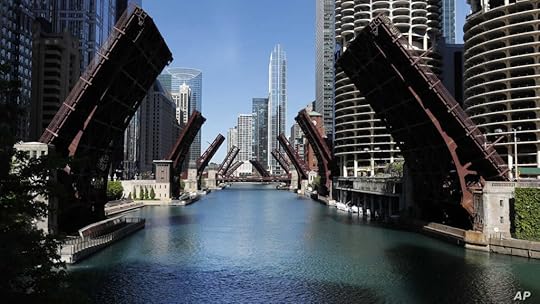
In a richly symbolic act, on several occasions the city raised the bridges over the Chicago River to prevent marauding looters from the South Side easy access to the ritzy north side of the river. Like a besieged medieval town raising the drawbridges over the moat in an attempt to stymie invading barbarians:
The devastation of riots and looting is tag teaming with the devastation wrought by the insane lockdown policies of local governments who compensate for their surrender of the streets by oppressing you, and the myriad restaurants, sellers of personal services (e.g., hair care), and small retailers that you patronize.
It was recently reported that 50 percent of the businesses in San Francisco have closed. Most will probably never reopen. If you live in the various Lockdown Lands–e.g., California, NY–you see boarded up store after boarded up store. 5th Avenue has become a shuttered ghost town. So have many other places.
Homelessness has exploded in many places–again, largely as a result of the abdication of civil authorities. San Francisco and Austin are two prominent examples.
It is so hard to build, so easy to destroy. I first went to NYC in the late-1970s, and traveled there a lot on business in the mid-1980s. It was a dangerous, dirty, dystopian place. In the late-1980s, the rejuvenation began. Notably, the first and crucial step of the process was restoration of public order, a process that hapless administration after hapless administration (crowned by the king of haplessness, David Dinkins) claimed was impossible. But the Giuliani administration started a virtuous cycle that made the city an attractive place to live (for people who like that kind of living) and a major destination for tourists.
And those three decades of progress have been erased, in a little over three months, due to a failure to keep order (e.g., the release of thousands of criminals back on the streets) and the imposition of a crushing order on the law abiding, especially law abiding small businesses. Crime has skyrocketed, and people–productive people–are leaving, almost certainly never to come back.
These are the wages of the most colossal government failure in American history. Failure from coast-to-coast; failure in the large cities on the coasts in particular.
You can cancel Carlson for pointing out the obvious, but you can’t cancel the obvious: when the duly constituted institutions of collective action fail to protect the lives, liberty, and property of large numbers of people, large numbers of people will take individual action, or emergent, unsanctioned, spontaneous collective action, to do what governments have failed to do.
In short, governments ought to protect lives, liberty, and property. When they do not, people will do so themselves. And that’s just the way it is.
August 18, 2020
California: Boom, Boom, Out Go the Lights
Twenty years ago, California experienced its Electricity Crisis. Or, given current events (which will be the subject of what follows), may be known as the First Electricity Crisis. The problem in 2000-2001 was, in the main, a problem of insufficient generation, caused by a variety of factors. The ramifications of the supply shortage and resulting high prices for California utilities, ratepayers, and state finances were greatly exacerbated by a dysfunctional market design implemented only a few years before, in the mid-1990s. (When I gave talks about the subject, I used to quip: “California wanted to deregulate its power markets in the worst way. And it succeeded!”)
The lore of the crisis is that it was caused by Enron and other Houston bandits and their manipulative schemes. These schemes were not the cause of the crisis: they were the effect, and the effect of the dysfunctional market design, which created massive arbitrage opportunities which will always be exploited.
California is experiencing another crisis. It cannot yet rival the first, which went on week after week, whereas the current one has lasted about a week. But for the first time since Crisis I, the state is experiencing rolling blackouts due to a shortage in generating capacity.
The proximate cause of the problem is a massive heatwave which is causing high demand. A contributing proximate cause is low hydroelectric supply driven by a lower than average snowpack. But the underlying cause–and the cause that should get the attention of most Americans, including those who experience schadenfreude at the Insufferable State’s misery–is the Green Mania that has taken root in California which has made it impossible for the state to respond to demand spikes in the way power systems have done around the world for nigh onto a century.
In particular, California has adopted policies intended to increase substantially the share of power generated by renewables. This has indeed resulted in massive investments in renewables, especially solar power, which alone now accounts for around 12,338 MW.
But this capacity number is deceiving, because unlike a nuclear or coal or combined cycle natural gas plant, this is not available 24/7. It’s available, wouldn’t you know, when the sun shines. Thus, during the mid-morning to late afternoon hours, this capacity is heavily utilized, but during the evening, night, and early morning contributes nothing to generation. At those times, California draws upon the old reliables.
But that creates two problems, a short term one (which California is experiencing now) and a long term one (which contributed to the current situation and will make recurrences a near certainty).
The short term problem is that during hot weather, demand does not set with the sun. Indeed, as this chart from the California Independent System Operator shows, today (as on prior days) demand has continued to grow while solar generation ebbs. This figure illustrates “net demand” which is total demand net of renewables generation. Notice the large and steady increase in net demand during the late afternoon hours. This reflects a rise in consumption and not matched by a rise in solar generation before 1400, and a fall thereafter.
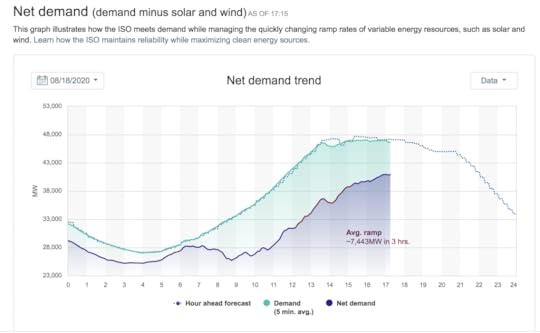
Go figure, right? Who knew that the hottest time of day wasn’t when the sun is at its height, or that people tend to come home (and crank up the AC) when the sun is going down?
Here’s the plot of renewables generation:
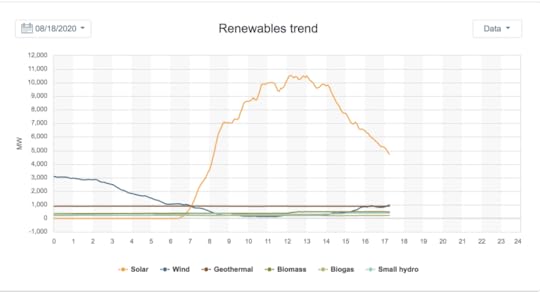
Note the plateau from around 1000-1400, and the decline from 1400 onwards–during which time load increased by about 10,000 MW.
So gas, nuclear, and (heaven forfend!) coal have to fill the growing gap between load and non-dispatchable renewable generation. They have to supply the net demand. Which brings us to the longer term problem.
The growth in solar generation means that conventional and nuclear plants aren’t generating much power, and prices are low, during the hours when solar generation is large. Thus, these plants earn relatively little revenue (and may even operate at negative margins) during these hours. This deterioration in the economics of operating conventional plants, combined with regulatory and political disdain for nuclear and coal has led to the exit of substantial capacity in California. A large nuke plant shut down in 2015, all 10 coal plants in the state have shut down (though three have converted to the environmental disaster that is biomass), as have many gas plants. In 2018 alone, there was a net loss of around 1500 MW of gas capacity, and from 2013 the net loss is about 5000 MW–over 10 percent of the 2013 level. (NB: the shortfall in capacity the last few days has been around 5000MW. Just sayin’.)
And note–demand has been rising over this period.
Notionally, the loss in nuclear and conventional capacity has been roughly matched by the increase in solar capacity. But again–that solar capacity is not available under conditions like the state has experienced over recent days, with hot weather contributing to high and rising demand in the late afternoon when solar output is declining. That is, these forms of capacity are very imperfect substitutes. They are most imperfect in the afternoons on very hot days. Like the last week.
In a nutshell, at the same time it massively incentivized investment in renewables, California has not incentivized the necessary investment in (or retention of capacity in) conventional generation. That mismatch in incentives, and the behavior that results from those incentives, means that from time to time California will have inadequate generation. That is, California has not incentivized the proper mix of generation.
So how do you incentivize the retention of/investment in conventional capacity that will remain idle or highly underutilized most of the time, in order to accommodate the desire to increase renewables generation? There are basically two ways.
The first way is to have really, really high prices during times like this. Generators will make little money (or lose money) most of the time, and pay for themselves by making YUGE amounts of money during a few days or hours. This is the theory behind “energy only” markets (like ERCOT).
The problem is that it is not credible for regulators to commit to allowing stratospheric prices occur. There will be screams of price gouging, monopoly, etc., and massive political pressures to claw back the high revenues. This happened after Crisis I, as more than a decade of litigation, and the payment of billions by generators, shows. Once burned, twice shy: generators will be leery indeed about relying on government promises. (A David Allan Coe song comes to mind, but I’ll leave that to your imagination, memory, or Googling skills.)
Relatedly, who pays the high prices? Having retail customers see the actual price creates some operational problems, but the main problem is again political. So the high prices have to be recovered through regulated retail pricing mechanisms that give rise to the credible commitment problem: how can generators be sure that regulators will actually permit them to reap the high prices during tight times that are necessary to make it worthwhile to maintain the capacity?
That is, for a variety of reasons energy only pricing faces a time consistency problem, and as a result there will be underinvestment in generation, especially when renewables are heavily supported/subsidized, thereby reducing the number of hours that generators can pay for themselves.
The other way is the Klassic Kludge: Kapacity markets. Regulators attempt to forecast into the future how much capacity will be needed, and mandate investment in that amount of capacity. Those with load serving obligations must pay to buy the capacity, usually through an auction mechanism. The idea being that the market clearing price in this market will incentivize investment in the capacity level mandated by the regulators.
A Kalifornia Kapacity Kludge was proposed a few years back, but the Federal Energy Regulatory Commission shot it down.
All meaning that California leapt headlong into the Brave New Green World without the market mechanisms (either relatively pure, like an energy only market with unfettered prices, or a kludge like a capacity market) necessary to bridge the gap between demand and renewables supply.
So what happens? This happens:
California’s political dysfunction makes it a near certainty that it will not implement reasonable market solutions that will provide the right incentives, even conditional on its support for renewables. Indeed, it is almost certain that it will do something that will make things worse.
Milton Friedman once said that inflation is always and everywhere a monetary phenomenon. Given that the major power crises in recent years–in California, in Australia, and a near miss in Texas last year–have involved renewables in one way or another, I have an analog to Friedman’s statement: in the future, always and everywhere power crises will be a renewables phenomenon.
And this is why Americans should pay heed. Whatever ventriloquist has his hand up the back of Biden’s shirt has him promising a massive transition towards renewable electricity generation, beyond the already swollen levels (swollen by years and billions of subsidies). A vision, which realized, would result in California’ s problems being all of our problem.
So look at California like Scrooge did the Ghost of Christmas Future. And be afraid. Be very afraid.
August 12, 2020
The Real Meaning of the Gettysburg Battlefield
After Trump’s suggestion that he would give his nomination acceptance speech at the White House triggered potential legal objections, his campaign mooted the possibility of giving the speech at the Gettysburg battlefield. This triggered paroxysms of insanity that are remarkable even against the background of repeated paroxysms of insanity that have been playing on a loop for almost 4 years now.
Leading the Stupid Parade was CNN’s Jerry Diamond: “This is a President who has consistently positions himself as a defender of Confederate symbols and monuments to Confederate generals.” He was soon joined by assorted leftists, notably Meathead himself, Rob Reiner, who repeated the theme that going to Gettysburg was a dog whistle to racists and Neo-Confederates.
The clownery here is just too much. Anyone making these statements has no clue about Gettysburg, the history of the battlefield, or the monuments there. No. Clue. Whatsoever.
To start with, Gettysburg was the turning point in the war against slavery. Recognizing this, in November 1863 President Lincoln gave a speech at the dedication of the National Cemetery on the battlefield. This speech just happens to be the most famous oration in American political history, and arguably in the entire English language. For those who have forgotten, or never knew (which, alarmingly, is a very real possibility):
Fourscore and seven years ago our fathers brought forth, on this continent, a new nation, conceived in liberty, and dedicated to the proposition that all men are created equal. Now we are engaged in a great civil war, testing whether that nation, or any nation so conceived, and so dedicated, can long endure. We are met on a great battle-field of that war. We have come to dedicate a portion of that field, as a final resting-place for those who here gave their lives, that that nation might live. It is altogether fitting and proper that we should do this. But, in a larger sense, we cannot dedicate, we cannot consecrate—we cannot hallow—this ground. The brave men, living and dead, who struggled here, have consecrated it far above our poor power to add or detract. The world will little note, nor long remember what we say here, but it can never forget what they did here. It is for us the living, rather, to be dedicated here to the unfinished work which they who fought here have thus far so nobly advanced. It is rather for us to be here dedicated to the great task remaining before us—that from these honored dead we take increased devotion to that cause for which they here gave the last full measure of devotion—that we here highly resolve that these dead shall not have died in vain—that this nation, under God, shall have a new birth of freedom, and that government of the people, by the people, for the people, shall not perish from the earth.
“Dedicated to the proposition that all men are created equal.” A paean to Slavocracy if I ever heard one! “A new birth of freedom, and that government of the people, by the people, for the people, shall not perish from the earth.” The authoritarian’s creed, right?
That is what Gettysburg means. That is what those who speak there pay homage to. That is what politicians who speak there want to be associated with.
Speaking of the National Cemetery, it is the resting place of over 3,500 Union dead. Sure, there are seven Confederates buried there. By accident–they were mistakenly identified as Federals. Except for the remains of Confederate dead undiscovered in the years after the war–whose bones still rest in those lost graves–the bodies of the Johnnies were removed to the South, to places like Hollywood Cemetery in Richmond.
So honoring the dead there means honoring the Union dead.
As for monuments, according to the National Park Service, there are 1,328 monuments at Gettysburg. Over 1,100 are to Union units.
Anyone who is remotely familiar with the history of the battlefield (which certainly excludes Meathead and other meatheads who bloviate on the subject), the moving political force behind the creation of the park (and other parks at Chickamauga, Shiloh, and Antietam) were Union veterans. Gettysburg in a particular was intended to be a shrine to the Union cause. The most important single figure in this movement was the notorious Dan Sickels, wounded on July 2, 1863.
Many Union veterans were deeply hostile to any recognition of Confederates on the battlefield. This was a monument to their achievement, in the name of Union, and for some the end of slavery.
Virtually every Union regiment and battery that fought at Gettysburg is memorialized there in granite and bronze. The veterans, and sometimes the states their regiments were recruited in, paid to create these sentinels in stone.
Monuments to any Confederates, or any Confederate figures, were placed in the park much later. The 11 states that contributed soldiers to the Army of Northern Virginia have placed monuments there. Some–like Virginia’s and North Carolina’s–are large and impressive. Some–like Texas’–are more modest.
The larger memorials (notably Virginia’s) do have Lost Cause resonance. But for the most part they recognize the bloody toll that the citizens of these states paid on three days in July, 1863.
Interestingly, one of the most recent additions to the monuments at Gettysburg is a statue of James Longstreet. After the war, Longstreet became a Republican. He defended the Reconstruction government in Louisiana, and attempted to defend blacks against the depredations of white supremacists opposed to said government, and to the civil rights of blacks.
For which he was vilified in the South.
I have been to Gettysburg over two dozen times, the first time when I was 9 years old. I have walked every foot of that field from Benner’s Hill to Big Round Top, and probably seen well over one thousand of these monuments, and read the text on most of them. Based on that, I can state definitively that anyone who believes it is Stone Mountain in Pennsylvania is beyond delusional.
Yes, there are monuments there that might warm the cockles of a Lost Causer’s heart, but overwhelmingly it is a massive memorial to the Union cause and Union sacrifice. Indeed, Gettysburg was arguably the singlemost important milestone in making the Cause a Lost one.
Most importantly, it is the site of the Gettysburg Address, which is the seminal speech that framed the cause for which the Union fought, and set the course for the post-war order. A course (according to the Emancipation Proclamation issued six months before the battle and then months before the speech) that included the end of slavery.
But the left (particularly in the media) is totally obsessed with playing Six Degrees From Slavery. In their twisted, fevered brains, if Trump does anything that is at all associated with the Confederacy, he is doing it because it is associated with the Confederacy. But a sensible person, and one who knows the battlefield, the history of the battle, and the history of the battlefield-as I do, and have since I was a boy-knows that the greatest associations are with the fight for freedom and democracy, and the fight against slavery.
August 5, 2020
Counting the Cost of Covid Hysteria
The covid hysteria continues. There’s really no other word for it. Responses to it have slipped the bonds of reason, and reasoned debate.
There are many manifestations of the hysteria. I will focus on two–hydroxychloroquine and lockdowns.
Hydroxychloroquine has been a hot button issue ever since Trump gave an equivocal endorsement of it months ago. The most recent demonstration of how radioactive it has become was a rally of sorts by practicing physicians in DC whose endorsement of a therapy regimen including hydroxychloroquine, antibiotics, and zinc unleashed a frenzy of criticism, retribution, and censorship.
The most ebullient endorsement of the therapy regimen came from a Houston physician, Stella Immanuel. Now normally Dr. Immanuel would check important boxes in Progland–she’s an African American (literally, born in Ghana) female. But her praise for hydroxychloroquine unleashed a fury of abuse on her. In addition to being a physician, Dr. Immanuel is a devout Christian who believes in demons, and who focuses on spiritual as well as physical health. These views became the focus of criticism, in the style of ad hominem attacks that have become the staple of what now passes for public discourse. The substance of what she said, and her empirical claims–that her treatment using hydroxychloroquine had impressive clinical results–were ignored altogether.
Well, that’s not quite right. Her views were not ignored, exactly. They were actively censored by the only authorities that currently matter–Facebook, Google/YouTube, and Twitter–who consigned the video of her impassioned presentation (which had received around 14 million views) to the Memory Hole. This blatant censorship was accompanied with the by now familiar paternalistic tut-tutting from our tech overlords that Dr. Immanuel’s views were not consonant with the pronouncements of government authorities (e.g., the CDC) and the WHO. (Bodies, it must be emphasized, which have covered themselves in ignominy in the past months, but why should that matter, right?)
If Facebook, Google/YouTube, Twitter have arrogated for themselves the role as enforcement agents for government ukasis, shouldn’t they be subject to the First Amendment, namely its prohibition of infringement on free speech?
I further note that if conservatives had unleashed such a stream of invective against a leftist African American woman the screams of racism and sexism from the very leftists currently imprecating Dr. Immanuel would shake the heavens. But if the left didn’t have double standards, it would have no standards at all.
But Dr. Immanuel should consider herself lucky. She’s still employed One of her fellow physicians on the Supreme Court steps, Dr. Simone Gold, was fired for her temerity in speaking out by her employer of 25 years.
This further illustrates the double standards issue. For months “front line” medical personnel, doctors and nurses, have been lionized, and cloaked with moral and intellectual authority because of their experience, and the risks they ran. It has not been as maudlin in the US as in the UK, with its clap for the NHS nonsense, but the near beatification of health care professionals has been a thing here. But now we have “front line” medical professionals with experience–by now far more experience than those lionized in March or April–speaking against the Party Line, and they are no longer sanctified–they are demonized. (Maybe Dr. Immanuel was onto something.) Block anti-lockdown protests in your scrubs–Hero! Express views on a treatment that contradicts the authorities while dressed in your white coat–charlatan who must be silenced!
The fact is that the evidence on hydroxychloroquine is on balance favorable, and at worst equivocal. Especially if given in the early stages of symptomatic covid, and crucially if given in conjunction with other medications, notably zinc, it does appear to reduce the risk of death. Further, as a drug that has been dispensed billions of times over decades for a variety of conditions its risks are known, and relatively benign.
So what’s the downside of employing the therapy? It offers some prospect of beneficial clinical results. There is not a readily available alternative that has proven superior. The downsides are modest.
One could get the idea that some people don’t want a treatment.
One of the critics of the studies of hydroxychloroquine is the insufferable, and insufferably arrogant, Dr. Anthony “Where’s the Camera?” Fauci. He caviled a study (described at the above link) at the Henry Ford Hospitals, claiming that it was flawed because it was not a controlled random experiment, but an observational study. Well, a controlled random experiment would be preferable, but observational studies can provide valuable information if done properly, as it appears the Henry Ford study was. Further, most of the anti-hydroxychloroquine studies, including the notorious, fraudulent Lancet study, were observational. Further further, Dr. Fauci’s main claim to fame was a study done in the 1980s that happened to be . . . an observational study.
The Insufferable Fauci provides a segue into the next subject of hysteria–lockdowns. Fauci claimed that the US record in combatting covid is inferior to that of Europe because this country did not lockdown as thoroughly.
Bullshit.
This man who claims to be all about the data and evidence can make such statements only by ignoring the data and evidence. There have been numerous studies of how cross-jurisdiction variations in various metrics (deaths, cases, etc.) of the severity of covid outbreaks vary with the timing and severity of lockdowns. (One example is here, but there are many more.) The basic answer is: likely not at all, but at most, hardly at all.
At best the evidence supports the view expressed early in the outbreak (but curiously discarded) that restrictions on social interactions could affect the timing of the progression of the disease, but not its ultimate toll. That is these policies can affect the shape of the curve, but not the integral under the curve.
Why? Because virus gonna virus. A point that I made early on, and many bona fide experts did as well.
But we are seeing continued calls for a resumption of–indeed, and intensification of–lockdowns. One example is the state of Victoria in Australia (where Melbourne is located). The state has gone into a severe lockdown–with little effect on the spread of the virus. In the United States, Fauci insinuates that more intense lockdowns should be considered, and other figures go beyond insinuation. Minneapolis Fed president Neil Kashkari (like Fauci, a long-time apparatchik who has risen to a position of prominence and power despite little demonstrable record of actual achievement) has called for a “really hard” six-week lockdown. You know, to “save the economy.”
We’ve already seen the economic cost of less than really hard lockdowns. In the US, economic output contracted by 9.5 percent, and unemployment skyrocketed. And we’re the lucky ones. In Europe, the contraction was ~12.5 percent. Please spare us any more rescues.
And again, despite variations in the timing, design, and severity of the lockdowns that wreaked this economic devastation, the progress of the illness was remarkably similar. Sweden did worse than Denmark, but better than France and other European countries–and it suffered only an 8.5 percent hit to GDP.
I could go on and recount other manifestations of hysteria. Masks, for instance. But this post is already long enough.
The ultimate question is why the hysteria? This is a subject deserving of books (plural) not blog posts. In the US, the answer is largely political. As Thomas Sowell noted in Conflict of Visions, views on a wide variety of issues are highly correlated, and this is demonstrated in spades by covid. The left is virulently (pun intended) anti-hydroxychloroquine and pro-lockdown (and mask). The right the reverse. This divide is only aggravated by the pro- and anti-Trump divide.
Related to this is the interest of the governing class. The Faucis and Kashkaris and Democratic governors and mayors and county executives of the US (and their foreign equivalents) quite like the vast powers that they have arrogated in the name of public health. They have achieved unchecked authorities that they could only have dreamed of in January. Why should they want to stop now? And why should they want to tamp down hysteria, when it has worked out oh-so-well for them? Of course they don’t–hell, they have every incentive to stoke it, and by all evidence they are doing so with a hearty assist from the hopeless media.
The cost of this hysteria has been high, economically, and in terms of the collateral damage (including health and mortality) of economic collapse. The benefit is imperceptible. And that is almost certainly why our tech overlords are hell-bent on suppressing those who dissent.
July 28, 2020
Reflections on the Revolution in Portland
Although Edmund Burke was initially favorably disposed to the French Revolution, the seizure of King Louis XVI and Queen Marie Antoinette by a crowd of Parisian women (a wall of moms?) in October, 1789 turned him into an ardent foe. After reading a pamphlet by an English divine, Richard Price, which compared the events in France to the English “Glorious Revolution” of 1688–an event that Burke revered–Burke was spurred to action, and in 1790 penned Reflections on the Revolution in France.
The book was a sensation, and effectively defined, intellectually anyways, the divide between contending view of the Revolution. Burke’s book resulted in immediate retorts, notably by Mary Wollstonecraft and Thomas Paine.
In some ways, Burke and his opponents were in complete agreement. Both believed that the Revolution was freeing France from the shackles of the past. The difference was that Burke viewed this with horror, whereas the Wollstonecrafts and Paines (and even some of Burke’s Whig colleagues, like Edward Fox) greeted it with enthusiasm, rapture even.
At the time, Burke’s interpretation was attacked as exaggeration, but events proved that he had a better, and far more realistic, understanding of the revolutionary dynamic, and the consequences of shattering the shackles. Insofar as exaggeration is concerned, yes, Louis and Marie were knocked about a bit, and humiliated, and the scenes between Versailles and Paris were chaotic and shocking to someone of Burke’s sensibilities. But they remained royalty, and remained alive.
But Burke saw that the forces of anarchy and what we now call nihilism (the word was not coined until the mid-19th century, and then in Russia) had been unleashed. He saw that there was no limiting principle in the revolutionary rhetoric. He took seriously the vaulting ambitions of some to revolutionize society root and branch. He had a tragic view of humanity: he referred to “the causes of evil which are permanent,” and believed that the complete dissolution of the institutions that kept these evils in check (perhaps with their own attendant evils) would result in disaster.
Within a few years, events would vindicate him. The execution of Louis and Marie. The Terror. And ultimately, something that Burke had predicted–the emergence of a military strongman who would restore order.
Burke, in other words, was a Cassandra. A seer who accurately foretold doom, but was dismissed and abused by those who were doomed.
Burke was not a reactionary. He had supported the American Revolution, and as I noted already, revered the Glorious Revolution. He was also famous for his prosecution of Warren Hastings for corruption in India and–critics of colonialism take note–accused the East India Company of doing untold damage in India.
But he believed that society required institutions, rules, and morals to restrain ugly human impulses. And he believed that attempts to revolutionize society root and branch would result in chaos and mass human misery.
Burke came to mind in watching the events in Portland–and copycat anarchy in other cities like Seattle and Oakland. The rioters there–I will not dignify them with the moniker “protestors”–avowedly desire the complete eradication of the United States and its institutions. Like the most radical of the French revolutionaries of 1789-1796, they believe that the entire system has to be overturned and replaced by an entirely new, utopian one.
Don’t believe me? Just ask them.
Like Burke’s critics, you might dismiss my attention to the radicals. They are just a fringe, you might say. Hell, if you are of the mind of Jerry Nadler (if so, you have my pity), you will dismiss the above as a “myth” deserving of no attention whatsoever: indeed, you will attribute my attention to partisan malice.
But what Burke perceived is that the radicals, the hard men–and today, hard women–have a decided advantage. Indeed, their hardness is their advantage. In war and politics, will matters. Those of iron will exert influence and power far beyond their numbers.
No major revolutionary movement–not just in France, but in Russia in 1917, or in China in the 1940s, or in Cuba in the 1950s-60s, or in Cambodia in the 1970, and on and on–has been remotely in the majority. Indeed, the defining idea of Leninism is that a small, dedicated elite cadre, not a mass of the people, is the driving force in revolution.
We are already seeing that the ruling class in the United States is largely deferential to the radicals. The Democratic Party defends them: as I write, the spittle-spewing morons on the House Judiciary Committee are hectoring AG William Barr for daring to defend federal property against the New Jacobins.
Fools. Do they not realize that they would be sent to the guillotine if the black-clad “scrawny, pasty white booger-eating communist shitheads” prevail?
Societies that have self-confidence crush such anti-social, radical, extremist thugs. Societies that don’t crumble before them, and pay the price in blood and treasure.
In the US today, many of the elite believe that standing up to anti-social, radical, extremist thugs is supposedly authoritarian. If those voices prevail, the rest of us will reap what the elite have sown.
This isn’t about George Floyd, or any particular episode of injustice. Those on the streets in Portland and elsewhere believe this is about the fundamental, irredeemable injustice–and evil–of America. An original sin for which there is no salvation, and which can be redeemed only by destruction. George Floyd is just a pretext (a concept that Burke explored in detail in Reflections).
Burke said other things that resonate today, in particular the assault on history, and the assessment of guilt on the descendants of alleged sinners of generations past:
They find themselves obliged to rake into the histories of former ages (which they have ransacked with a malignant and profligate industry) for every instance of oppression and persecution which has been made by that body or in its favour, in order to justify, upon very iniquitous, because very illogical principles of retaliation, their own persecutions, and their own cruelties.
And
It is not very just to chastise men for the offences of their natural ancestors; but to take the fiction of ancestry in a corporate succession, as a ground for punishing men who have no relation to guilty acts, except in names and general descriptions, is a sort of refinement in injustice belonging to the philosophy of this enlightened age.
It’s almost as if Burke foretold not just The Terror, but White Privilege and the Six Degrees From Slavery frenzy.
Those things, like many other things he wrote in Reflections, rhyme in America despite the passage of 230 years and the distance of thousands of miles.
So go ahead, and dismiss Portland (and its echoes in other cities) if you will–just as the “enlightened” of 1790 dismissed Burke. But before doing so, read Burke in the light of what happened almost immediately afterwards.
Craig Pirrong's Blog

- Craig Pirrong's profile
- 2 followers

