Rebecca Roland's Blog, page 3
March 31, 2016
Guest Post with Josh Vogt
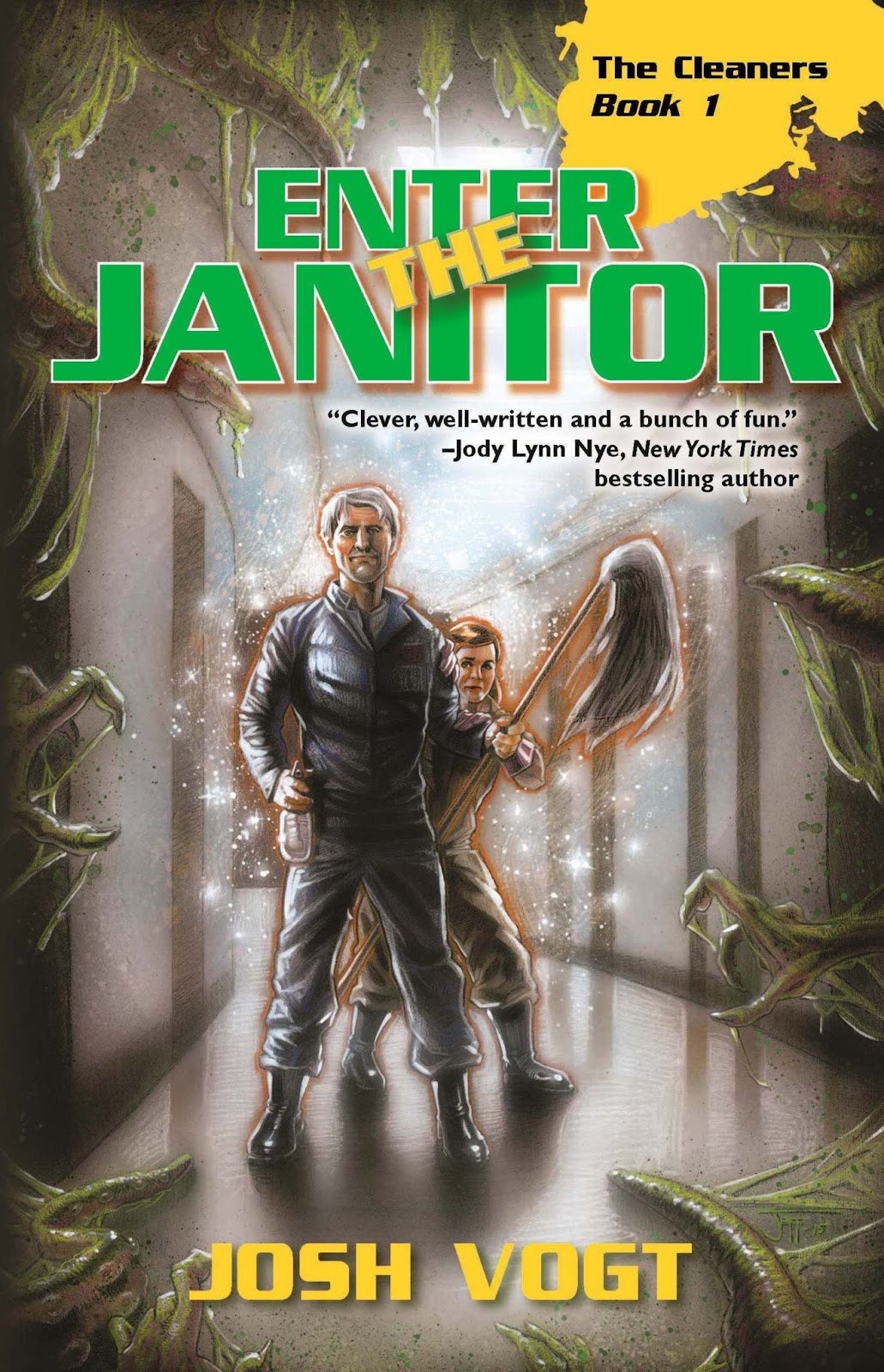
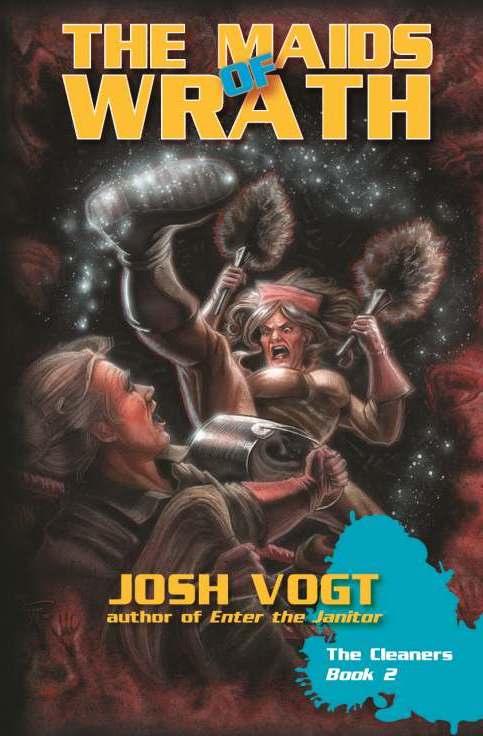 Today I'd like to welcome Josh Vogt to the blog. His latest novel, The Maids of Wrath, comes out on April 11th. Read on to find out why he writes about janitors and maids, how outlining works for him, and which author he'd like to have dinner with.
You've written books featuring dwarves, janitors, and maids. What draws you to 'every day' characters as opposed to larger-than-life characters?
I like taking what we might think of a “ordinary” or mundane people and either stick them in strange situations or shift something about them to make ordinary situations somehow weird or twisted out of true. Partially, it’s just how my mind works. When I see normal people and scenarios, I tend to imagine how things might not be exactly how they seem. Also, it’s just fun to throw a wrench in the reality we’re familiar with and see exactly how much it smokes and sparks.
With the Cleaners, in particular, I enjoy how much their supernatural sanitation company actually fits with modern society. In urban fantasy, a big question is “If there’s magic or mythical creatures in modern day, how do they go unnoticed?” This is my answer, that they conceal themselves in roles few people pay much attention to out in the real world. They’re everywhere, and everyone accepts they have a right to be.
How do you manage your freelance work with fiction writing and other activities? Are there any time management skills you'd like to share?
Actually, I’ve moved back to a full-time job as an editor for Paizo, which publishes the Pathfinder Roleplaying Game (and one of my debut novels, Forge of Ashes). I still do a little game freelancing, but otherwise I’m now re-learning how to manage my personal writing around a day job. The structure of it actually help, because I know exactly when my free time is, morning and evening. So if I’m working on a novel, I can set a word count goal for the final draft, a deadline for finishing it, and then I can determine how many words, minimum, I’d need to write in a week or per day. Having deadlines and concrete goals definitely help me.
Plus, having at least an hour or two a day committed to nothing but writing helps me keep that blocked out. I also use programs like Freedom and Anti-Social to turn off levels of internet connectivity if I find myself getting too distracted.
 On your website you said you've used The Snowflake Method for virtually every novel you've written. How do you keep your WIP fresh and exciting after outlining it in detail? What do you think is the biggest benefit from outlining, and what do you think is the biggest pitfall?
When I outline, yes, I know the intended plot from A to Z, with all major and a few minor characters sketched out. However, when I get into actually writing it, I may come to a scene on the outline that says “Character A argues with Character B, which gets them captured.” I won’t necessarily know what they’re arguing about or how they get captured, so there’s plenty of discovery and wiggle room left in the process that keeps it fun. I still give myself the ability to go off-track a certain amount, shift scenes around, introduce unplanned characters, and the like. But the biggest benefit of outlining, for me, is focus. I know where I’m aiming to reach next in the story.
As far as the biggest pitfall? I’d say inflexibility. Not giving yourself enough breathing space to adapt on the way. To me, an outline is a general map, but it’s not chiseled in stone.
You can have dinner with any author, living or deceased. Who would it be, and why?
Tough one. It’d have to be Ray Bradbury or Terry Pratchett. Bradbury inspired me with his themes of hope, joy, and dreams, with characters who felt so incredibly real and raw. Pratchett, on the other hand, is the only author who has ever made me weep from laughter. He inspired my love of writing humor, which I now bring into a lot of my stories. At the same time, he wrestled with very real issues, making people laugh while see things from new perspectives at the same time.
You can go back in time to when you first started writing. What advice would you give to your past self?

Don’t let your first three novel manuscripts be a trilogy. Don’t invest in a series until the first one is under contract, and even then, try to make it as standalone as possible. Back then, I figured since most fantasy books were becoming trilogies, I should see if I could actually write a full one. But that’s two whole extra books written for something that never actually got published (and, yes, for good reason). I could’ve moved on and played with unique ideas in that time. Nowadays, unless you’re planning to self- or indie-pub your own series, never assume the first book selling is a sure thing.
***
Author and editor Josh Vogt’s work covers fantasy, science fiction, horror, humor, pulp, and more. His debut fantasy novel is Pathfinder Tales: Forge of Ashes, published alongside his urban fantasy series, The Cleaners, with Enter the Janitor and The Maids of Wrath. He’s an editor at Paizo, a Scribe Award finalist, and a member of both SFWA and the International Association of Media Tie-In Writers. Find him at JRVogt.com or on Twitter @JRVogt.


March 28, 2016
Living in Another World
 Spend time in District 12? Nope.I've been thinking about the books I'd want to live in for a while. My first thought was I would definitely never, ever live in The Hunger Games or in Game of Thrones. How funny that I quickly came up with the places I'd stay away from. In contrast, I had to give quite a bit of thought to those places where I'd want to live.
People who know me and my reading habits also know that I'm a huge fan of Lois McMaster Bujold's Vorkosigan series. I love the characters, and I also love the world. It depicts a fascinating future. Years ago I mentioned to a non-sf fan how I would love it if uterine replicators were a real thing, and she thought I was nuts. But imagine a perfect environment for one's developing baby, with the right balance of nutrients, located in a safe place. A woman could go on working in any kind of job, she could drink or eat whatever she wanted, and most importantly, she wouldn't have to go through the stresses on her body that carrying a baby can bring. When I was pregnant with my son, I was diagnosed with pre-eclampsia. It would have been nice to have never experienced that or the uncertainty and fear that goes along with it. My blood pressure was so high before, during, and after delivery that I could feel my heartbeat in my face. My lips throbbed in time with my heart. I nearly wept with joy when I filled my prescription for blood pressure medication and took that first pill. With a uterine replicator, though, my son could have developed in a healthy environment, and I could have stayed healthy myself.
That detail aside, the books also have space travel, other worlds, and fantastic characters. People have better health, and so have longer life spans. One of the main characters, Cordelia, has a life expectancy of somewhere in the neighborhood of 130 years old. How much could a person learn in that lifetime? How many careers could a person have? How much wisdom could a person gain? You could see your grandchildren grow up and have grandchildren of their own.
There's conflict in the Vorkosigan series, and war, but the overall themes are hopeful. There's an underlying current of joy in the stories. While I enjoy novels like The Hunger Games or the Game of Thrones series, they don't make the same impression or give me the same sense of happiness as the Vorkosigan series does. And I certainly wouldn't want to spend any time there.
March 21, 2016
Spring Fever
It is spring. Spring! I definitely get spring fever every year. It starts after the new year when the franticness of the holidays are behind me and the next joyous thing to look forward to is this time of year. I grew up in south Texas, where winter lasts about two weeks, and the rest of the year is hot and humid. In New Mexico, I get to experience all of the seasons. Early spring is wild and unpredictable, where days can be warm and sunny, or windy, or cloudy and rainy, or snowy. My son's birthday is around this time of year, and I like to tell him the story of how it was sunny and around 70 degrees the day he was born... and the next day, it snowed.
I get the urge to Clean All The Things and Plant All The Things and Write All The Things.
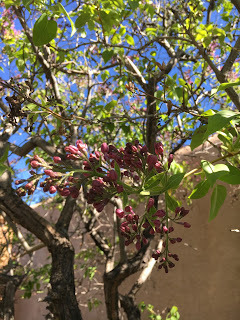 The lilacs are blooming!Every year I have the intention of giving the house a good cleaning from top to bottom. Every year I get started, and often accomplish a few tasks, like reorganizing and cleaning closets, but then life pulls me along, and spring cleaning is forgotten. This year, I'm at least trying to concentrate on the kitchen. There's so much junk in the cabinets... But I feel better knowing that I at least tended carefully to one part of the house.
Last year I had a couple of successful, small container gardens. This year, I will grow more vegetables. It was so nice to go out, pick green beans, and sauté them with a little butter and season them with salt and lemon pepper. So delicious! I'd like to plant some lavender out front to (a) make it smell pretty, (b) make it look pretty because it's rather barren right now, and (c) because the bees like it.
And don't get me started on wanting to Write All The Things. There's a line in the song "Me, Myself, and I" performed by G-Eazy and Bebe Rexha that says, "...if time is money I need a loan." Yassss!!! I need more time to do everything I want, to write everything I want, to edit and publish everything I want. I have such a long list of stories to edit and submit right now, and a series I plan to self-publish under a pseudonym, and new stories to write, and...
And of course, with the weather warming up, I want to spend more time outdoors. I want to run, and play, and bask in the sun (in healthy doses, of course). Spring renews my energy and my drive.
I get the urge to Clean All The Things and Plant All The Things and Write All The Things.
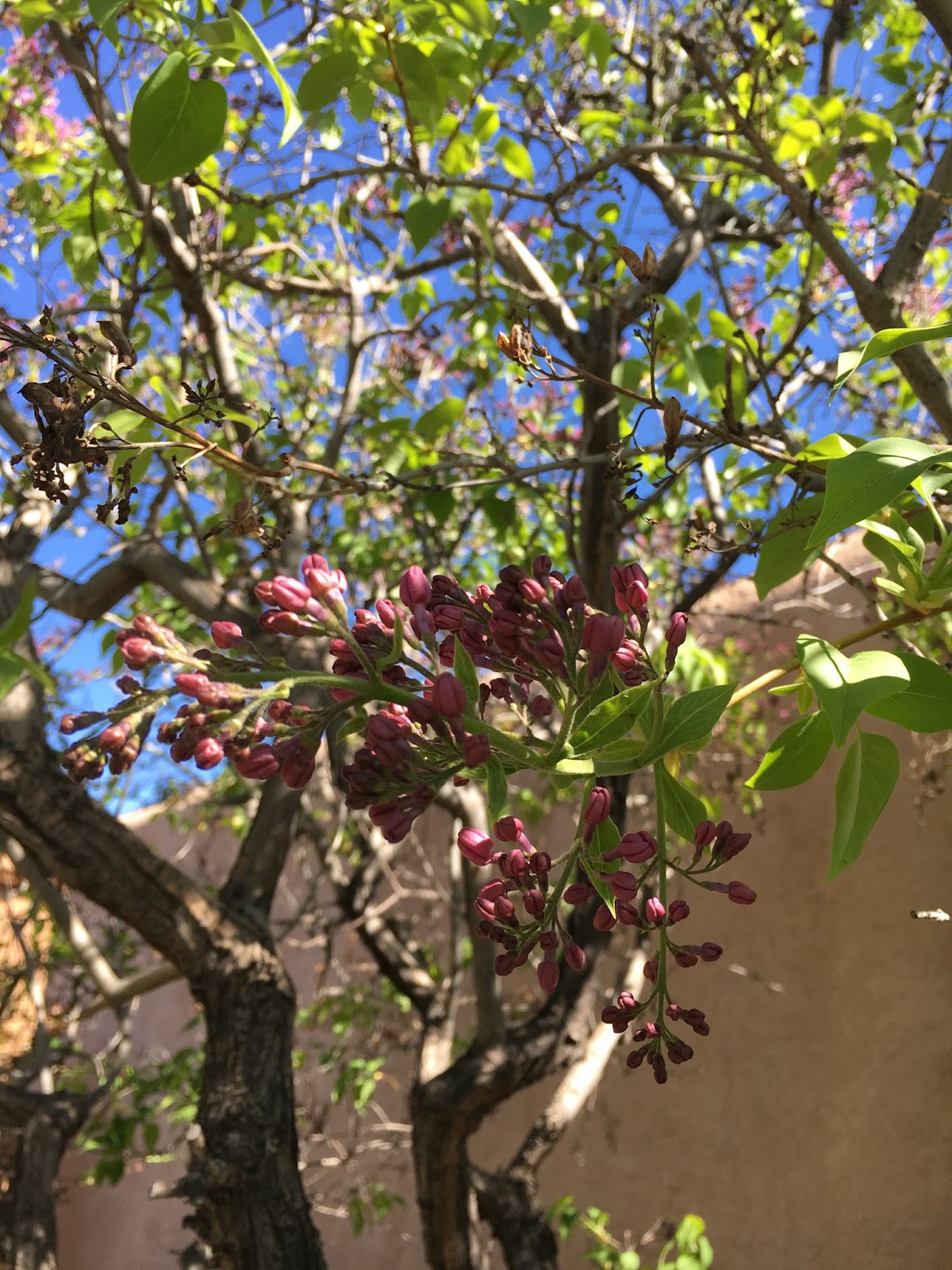 The lilacs are blooming!Every year I have the intention of giving the house a good cleaning from top to bottom. Every year I get started, and often accomplish a few tasks, like reorganizing and cleaning closets, but then life pulls me along, and spring cleaning is forgotten. This year, I'm at least trying to concentrate on the kitchen. There's so much junk in the cabinets... But I feel better knowing that I at least tended carefully to one part of the house.
Last year I had a couple of successful, small container gardens. This year, I will grow more vegetables. It was so nice to go out, pick green beans, and sauté them with a little butter and season them with salt and lemon pepper. So delicious! I'd like to plant some lavender out front to (a) make it smell pretty, (b) make it look pretty because it's rather barren right now, and (c) because the bees like it.
And don't get me started on wanting to Write All The Things. There's a line in the song "Me, Myself, and I" performed by G-Eazy and Bebe Rexha that says, "...if time is money I need a loan." Yassss!!! I need more time to do everything I want, to write everything I want, to edit and publish everything I want. I have such a long list of stories to edit and submit right now, and a series I plan to self-publish under a pseudonym, and new stories to write, and...
And of course, with the weather warming up, I want to spend more time outdoors. I want to run, and play, and bask in the sun (in healthy doses, of course). Spring renews my energy and my drive.
March 14, 2016
Change is the Only Constant
Ah, poor neglected little blog. I've been busy using all of my spare moments to revise and rewrite my third Shards of History book, so I let the blog and many other things slide. But heavy revisions are done, and so I feel like I'm waking after a long sleep, stretching and looking around, and trying to figure out where the heck I am and what on earth I should write about here.
I enjoy hearing about other people's writing processes, like what time of day people have to write, how they fit it in among their other obligations, whether they draft with a computer or long hand, whether they outline or not, etc. I used to think that processes were rather stagnant and changed little, but my processes have changed a lot over the years for various reasons.
I used to be able to write at any time of day. But recently I have found that I'm too mentally exhausted at the end of the day to do anything beyond answering simple emails, and sometimes I shouldn't even attempt that because the message makes no sense. I give a lot of brain energy to the day job and to my family, so I often end up with none left in the evening. Sometimes I get excited about an idea and write some at night, but this is the exception to the rule these days.
I also used to be able to write in long chunks of time. I could write for forty-five minutes or even longer without a break. Now if I try to push myself that long, I slow down a lot. Instead, I set a timer for fifteen minute intervals and go, go, go while it's counting down. I get much more written that way than I do lingering over the keyboard for forty-five minutes. So writing has become more of a series of sprints than a marathon.
For a while there, every time I tried establishing a writing routine, something would interrupt. I'd try getting up earlier to write, and my son would get up earlier. I'd try writing at night, and the next day when I'd read the previous day's words, they would be awful because I had tried writing while tired. This mostly had to do with the child's ever-changing habits. Every time I thought I had his schedule--and thus mine--figured out, he'd throw a wrench into the works. But things seem to have settled (she says as she knocks on wood).
I used to write new words every day. That meant I would often switch from revising to writing new words to submitting stories to any number of other writing-related tasks. But these days I focus on one or two tasks and stick with those, even if it means I don't write new words for a while. I might be heavily revising instead, or critiquing, or planning the next story or book. That's one of the reasons I don't keep track of words written per day like some do. It's not a bad idea, but it's not for me. Instead, I have a checklist of things to work on in descending order of urgency and tackle some each day. Often that includes writing new words, but sometimes it does not.
So, as with many things in life, flexibility is key. Processes change. Sometimes it takes some experimentation to find what works, and then it works for a while, and then it needs to change again.
I enjoy hearing about other people's writing processes, like what time of day people have to write, how they fit it in among their other obligations, whether they draft with a computer or long hand, whether they outline or not, etc. I used to think that processes were rather stagnant and changed little, but my processes have changed a lot over the years for various reasons.
I used to be able to write at any time of day. But recently I have found that I'm too mentally exhausted at the end of the day to do anything beyond answering simple emails, and sometimes I shouldn't even attempt that because the message makes no sense. I give a lot of brain energy to the day job and to my family, so I often end up with none left in the evening. Sometimes I get excited about an idea and write some at night, but this is the exception to the rule these days.
I also used to be able to write in long chunks of time. I could write for forty-five minutes or even longer without a break. Now if I try to push myself that long, I slow down a lot. Instead, I set a timer for fifteen minute intervals and go, go, go while it's counting down. I get much more written that way than I do lingering over the keyboard for forty-five minutes. So writing has become more of a series of sprints than a marathon.
For a while there, every time I tried establishing a writing routine, something would interrupt. I'd try getting up earlier to write, and my son would get up earlier. I'd try writing at night, and the next day when I'd read the previous day's words, they would be awful because I had tried writing while tired. This mostly had to do with the child's ever-changing habits. Every time I thought I had his schedule--and thus mine--figured out, he'd throw a wrench into the works. But things seem to have settled (she says as she knocks on wood).
I used to write new words every day. That meant I would often switch from revising to writing new words to submitting stories to any number of other writing-related tasks. But these days I focus on one or two tasks and stick with those, even if it means I don't write new words for a while. I might be heavily revising instead, or critiquing, or planning the next story or book. That's one of the reasons I don't keep track of words written per day like some do. It's not a bad idea, but it's not for me. Instead, I have a checklist of things to work on in descending order of urgency and tackle some each day. Often that includes writing new words, but sometimes it does not.
So, as with many things in life, flexibility is key. Processes change. Sometimes it takes some experimentation to find what works, and then it works for a while, and then it needs to change again.
January 25, 2016
Half Marathons, Star Wars, and the Post Race Zombie Shuffle
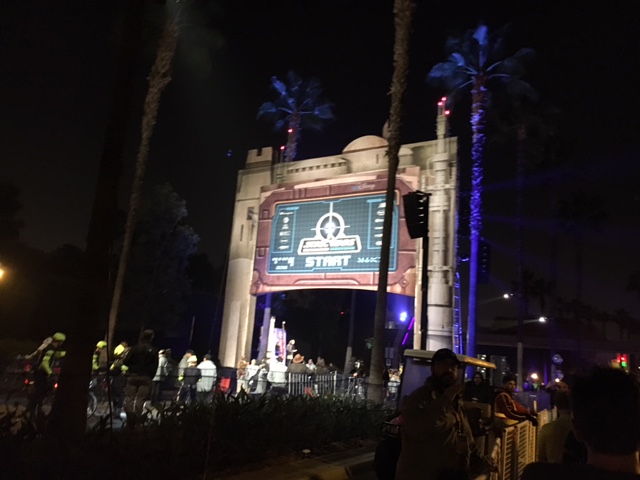 Did I mention it started at 5:30 & I'm not a morning person?It's been a few days since I ran my first half marathon, and I still can't quite believe I did it. I actually went thirteen point one miles. When I signed up for it months ago, it seemed like a perfectly reasonable goal. But as the race drew closer and the long runs grew, well, longer, it started to seem like the craziest idea I'd ever had.
I did a pretty good job of making a training plan and sticking to it. When I really started on the long runs, though, I came down with strep throat and a sinus infection, and that threw me off. But fortunately, I had considered the fact that something like that might happen and accounted for it in my training plan, so it wasn't a big deal in the end. My longest run before the race ended up being ten miles. I figured if I could get to ten miles, I could surely do another three and change after that. Besides, I'm pretty slow, so I didn't want to take up a lot of time running on my weekends leading up to the race. And I'm lazy. Did I mention that? I'm probably the laziest person to ever run a half marathon.
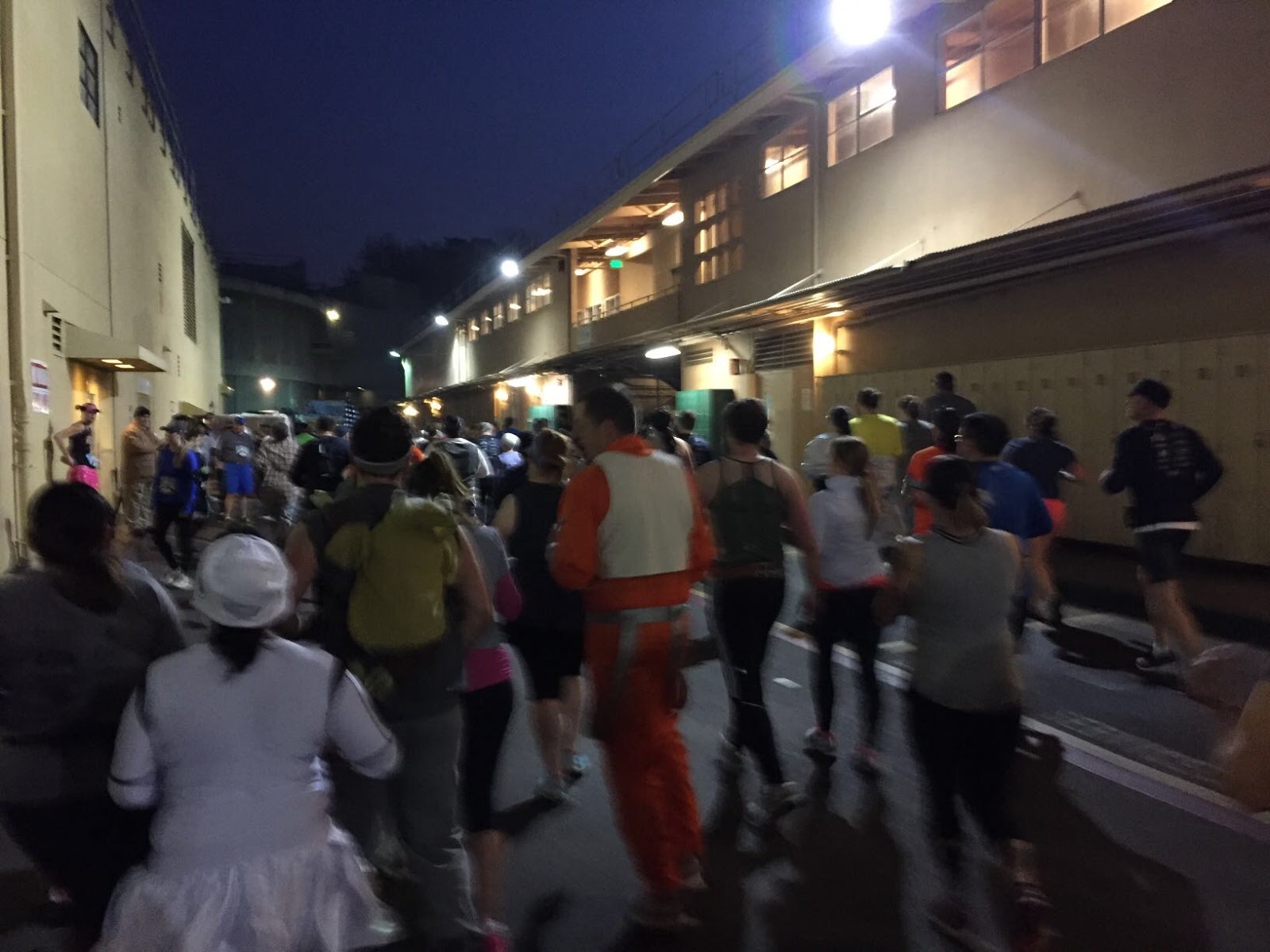 Follow that Rebel pilot!I used my love of Star Wars as a motivating factor for this race and signed up for the Disney Star Wars half along with a friend of mine. I spent a lot of time figuring out what to wear. Seriously, I probably spent more time on this outfit than I did on any other, with the exception of my wedding. I even pulled my hair back in a Rey-inspired fashion, with three little ponytails (my hair is too short to make the loops like hers). But I wasn't the only one obsessed with finding the perfect Star Wars/running outfit. Popular outfits included R2D2, Princess Leia, Rey, Chewie and Han, and BB8.
The run started just outside the park and then made its way inside. Initially we ran 'behind the scenes' where the service vehicles and park employees go. It was dark, and in some places bumpy, but doable. There was one grumpy guy who shouted a reminder about walkers to the right, runners to the left, before invoking Jesus, and not in prayer. That guy needed the endorphins to kick in, stat.
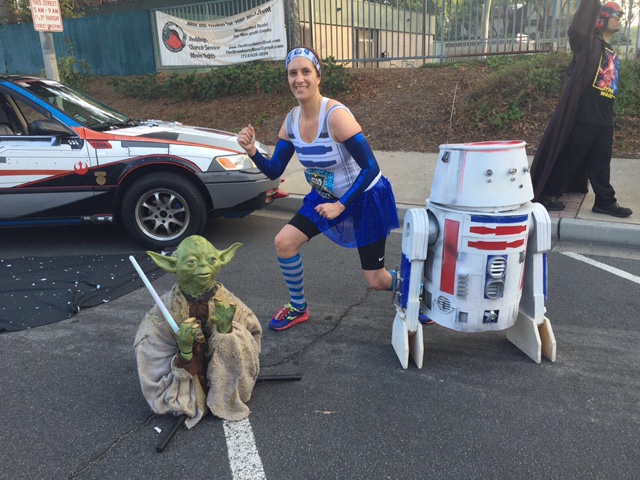 Stop for photos you must. Excuse to rest, it is.Star Wars music played the whole time we ran through the park. It was great! And of course there were photo opportunities with some of the characters, also known as good excuses to stop and rest for a minute while waiting in line. Once we left the back roads of Disney for the main parts, it became downright magical. We ran through the castle, past Toon Town, and out of Disneyland and into California Adventures. We ran through Radiator Springs and the boardwalk area. I kept thinking, "Ooh, we've got to come back here!"
I ran without headphones, which I've done before, but not for such a long distance. Still, I didn't miss them at all in the park because there was so much to see and hear.
And then we ran out of the park.
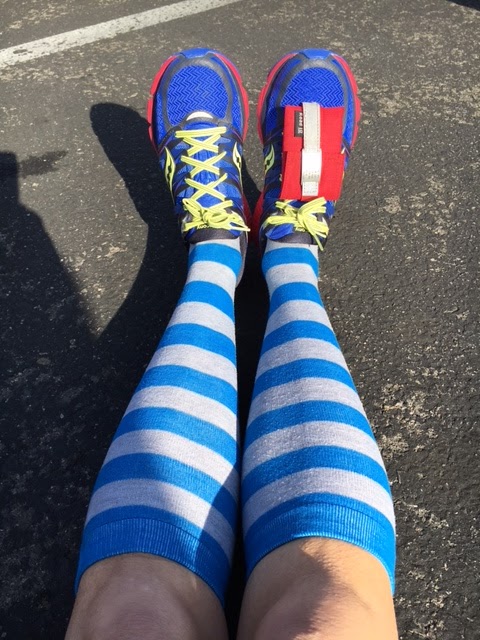 These are tired legs.The Star Wars music died away, and there was only the sound of feet shuffling on pavement, tired breathing, and conversation drifting around us as the sun came up. We ended up on Harbor Blvd, and we were on that road for a long time. A long, long time. Did I mention we were on that road for a long time? I panicked for a bit there, wondering how I was going to make it with roughly nine more miles without headphones, no more Disney park, no more characters.
But wait! There was more. Bands lined up a couple of miles down the road. They played for us and cheered us on along with some cheerleaders. They held up signs like "Worst Parade Ever!" Ha! They were enthusiastic and great. And then there were other people cheering us on, and a guy randomly handing out Red Vines. Thanks for the Red Vine, random guy.
But one of the best parts was one area of the course where a bunch of people dressed as Star Wars characters had gathered. There were characters from all of the movies out there with props and their cars painted to look like droids, and there was steampunk Star Wars, and just so many people dressed up and having a great time. It was like running past an SF convention. I loved it. Geeks and runners coming together, sharing their love of Star Wars!
With about a mile and a quarter to go, we passed our hotel. Our families were out there, cheering us on. By then, I was pretty sure I was actually going to make it to the finish line. It was so close! We left Harbor Blvd behind (thank goodness, I had seen enough of that street) for the side streets leading to Disney. The crowds grew thicker, and at one point, one person shouted, "You're only 400 yards from the finish! Only 400 yards from Starbucks!" It was like he knew exactly how to motivate me. My friend took my hand when the finish line came into view, and we crossed together. It was done! Over! That race was in the books!
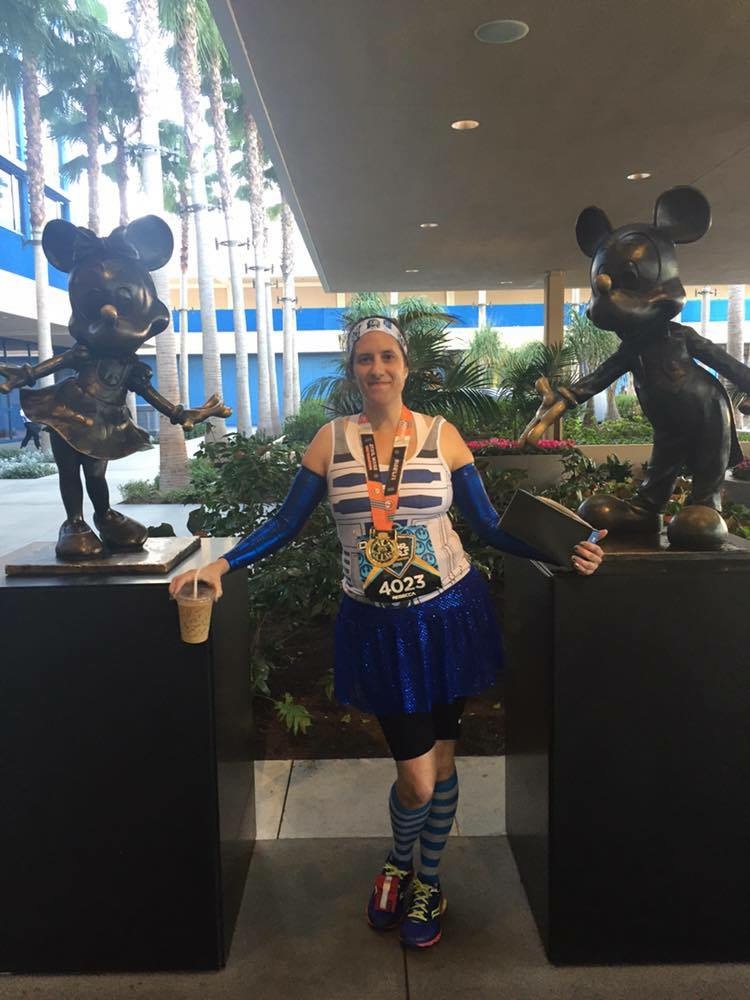 Tired? Check. Proud of myself? Check!And let me tell you, if you ever want to see a great example of what shambling zombies might look like, watch the people who have just finished a half marathon. I don't think any of us could walk straight, or very fast, or move a whole lot. We sort of shuffled past the ice and Biofreeze tent, grabbed our bananas and snack packs and water, paused for pictures, and then shuffled to the parking lot where we found an empty piece of asphalt and parked it. And getting to my feet after sitting? It wasn't pretty. There was a lot of moaning, just like zombies. And later when I took a shower, I was extremely grateful that grab bars exist.
Right after the race, my friend congratulated me and told me I had just done what only 2% of the population had done. I said, "Yeah, I can see why. It's hard!" I was glad to have it behind me. I swore I would never do another race that long ever again.
Today, I looked at signing up for a half marathon in October. Running a half is apparently like childbirth. Afterwards, you forget how painful it was and want another one.
January 11, 2016
A Guest Post With Daniel M. Bensen
Today I'd like to welcome Daniel M. Bensen to the blog to talk about how dinosaurs can fix your writing routine.
***
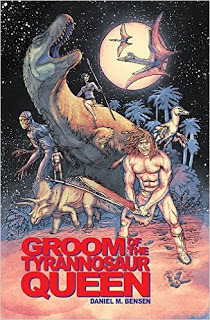 I wrote my newest book, Groom of the Tyrannosaur Queen, while my wife was pregnant, and by the time I got around to publishing it, I had two daughters, 3 years two months old, respectively. Needless to say, my work habits suffered many changes in this harsh environment, but like small mammals at the end of the Mesozoic, anything left must be pretty good at surviving. If your house is inhabited by shrieking children (or something as distracting, such as war-cyborgs or velociraptors), you might appreciate some of the writing habits I've evolved.
1. Do what you can with what you have where you are.
Theodore Roosevelt got things accomplished, didn't he? And so can I!
In order to write, I need privacy, time, and energy. Sometimes I can predict when the three will converge, but most often, I can't. I have to make sure I am equipped (mentally and physically) to write in whatever free time falls to me, no matter where I am. I got a device I can use to take notes (I've tried my phone and a pocket-sized notebook, but what works best for me is the note-taking function on my kindle). I got another device I can use to word-process wherever I am (a small Asus laptop). I also leave bread-crumbs for myself like "describe the swamp" or "how does Andrea feel about her neighbors?" so I can pick up the thread of whatever thought process I was in when I was interrupted. When that isn't possible, I go back and read through what I wrote already, making line-edits. By the time I hit the place where I stopped writing last time, I usually have enough inertia to keep going.
2. Manage your expectations
But the other mental thing I have to do is acknowledge that in this place at this time, I won't be able to finish that climax scene with super-powered titans battling in a flood while a Tyrannosaur stalks them and life and love hang in the balance. It's just too big and complicated and damn it, this bus ride is only 15 minutes long. I'll just jot notes for an essay for my blog instead.
The hard part is when you don't know how long this window of writing time is going to be. Fifteen minutes? Two hours? Am I going to spend that time writing emails and taking notes, or will I be able to dig down into that bad-guy sex scene, where the formerly unassuming paleontologist sinks ever further into debauchery? Twenty-four five-minute chunks of writing time do not equal one continuous two-hour block. Even worse is a two hour period in which you might be interrupted at any minute. There's nothing more frustrating than spinning your brain up to speed to deal with the psychological horrors your character is experiencing and then getting yanked away from the computer because your daughter peed on the floor. Then, by the time you've cleaned it up and changed her pants and given her some more apple juice and cajoled her into coloring in her books again, you have totally forgotten what you were going to write. What you need is …
3. Routine
My very understanding wife and I have worked out a schedule. There are certain times of day when I'm "on duty" and taking care of the kids, and other times when she's "on duty," giving me an hour-and-a-half of predictable writing time that I can more or less count on. I'm also lucky enough to be in control of my own schedule at work, so I know when I have a long gap between classes. Before a big chunk of time, I can put myself in the mood by doing some sort of ritual. That ritual used to be "take a shower," but if I'm not at home, "drink a cup of coffee and chew mint gum" works as well, especially if all I'm doing is incremental changes to stuff I've already written. "Take a walk, and take notes while walking" turned out to be a great way to break writers block and write something from scratch. When I grow up, I'm getting me a writing treadmill like Brandon Sanderson!
So that's how I manage to keep writing as well as working and fathering. Of course, your mileage may vary. Some people won't be able to write during the work day. Other people will be able to work early in the morning or late at night while their kids are asleep (I can't. I just produce garbage until my body shuts down in protest). Maybe you have worked out another trick to squeeze that extra bit of writing in. Please tell me in the comments!
Please, please tell me. They'll be waking up from their naps any minute. And they'll be hungry.
***
Daniel M Bensen is a father, English teacher, and author. His new book, Groom of the Tyrannosaur Queen is available now from Amazon. It has a baby in it! And some dinosaurs.
***
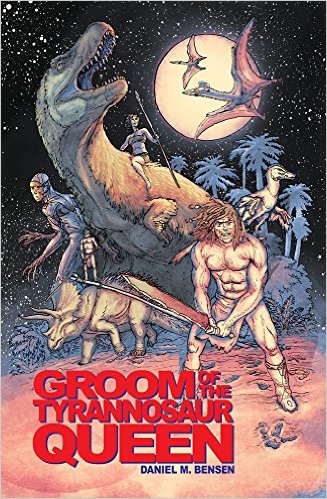 I wrote my newest book, Groom of the Tyrannosaur Queen, while my wife was pregnant, and by the time I got around to publishing it, I had two daughters, 3 years two months old, respectively. Needless to say, my work habits suffered many changes in this harsh environment, but like small mammals at the end of the Mesozoic, anything left must be pretty good at surviving. If your house is inhabited by shrieking children (or something as distracting, such as war-cyborgs or velociraptors), you might appreciate some of the writing habits I've evolved.
1. Do what you can with what you have where you are.
Theodore Roosevelt got things accomplished, didn't he? And so can I!
In order to write, I need privacy, time, and energy. Sometimes I can predict when the three will converge, but most often, I can't. I have to make sure I am equipped (mentally and physically) to write in whatever free time falls to me, no matter where I am. I got a device I can use to take notes (I've tried my phone and a pocket-sized notebook, but what works best for me is the note-taking function on my kindle). I got another device I can use to word-process wherever I am (a small Asus laptop). I also leave bread-crumbs for myself like "describe the swamp" or "how does Andrea feel about her neighbors?" so I can pick up the thread of whatever thought process I was in when I was interrupted. When that isn't possible, I go back and read through what I wrote already, making line-edits. By the time I hit the place where I stopped writing last time, I usually have enough inertia to keep going.
2. Manage your expectations
But the other mental thing I have to do is acknowledge that in this place at this time, I won't be able to finish that climax scene with super-powered titans battling in a flood while a Tyrannosaur stalks them and life and love hang in the balance. It's just too big and complicated and damn it, this bus ride is only 15 minutes long. I'll just jot notes for an essay for my blog instead.
The hard part is when you don't know how long this window of writing time is going to be. Fifteen minutes? Two hours? Am I going to spend that time writing emails and taking notes, or will I be able to dig down into that bad-guy sex scene, where the formerly unassuming paleontologist sinks ever further into debauchery? Twenty-four five-minute chunks of writing time do not equal one continuous two-hour block. Even worse is a two hour period in which you might be interrupted at any minute. There's nothing more frustrating than spinning your brain up to speed to deal with the psychological horrors your character is experiencing and then getting yanked away from the computer because your daughter peed on the floor. Then, by the time you've cleaned it up and changed her pants and given her some more apple juice and cajoled her into coloring in her books again, you have totally forgotten what you were going to write. What you need is …
3. Routine
My very understanding wife and I have worked out a schedule. There are certain times of day when I'm "on duty" and taking care of the kids, and other times when she's "on duty," giving me an hour-and-a-half of predictable writing time that I can more or less count on. I'm also lucky enough to be in control of my own schedule at work, so I know when I have a long gap between classes. Before a big chunk of time, I can put myself in the mood by doing some sort of ritual. That ritual used to be "take a shower," but if I'm not at home, "drink a cup of coffee and chew mint gum" works as well, especially if all I'm doing is incremental changes to stuff I've already written. "Take a walk, and take notes while walking" turned out to be a great way to break writers block and write something from scratch. When I grow up, I'm getting me a writing treadmill like Brandon Sanderson!
So that's how I manage to keep writing as well as working and fathering. Of course, your mileage may vary. Some people won't be able to write during the work day. Other people will be able to work early in the morning or late at night while their kids are asleep (I can't. I just produce garbage until my body shuts down in protest). Maybe you have worked out another trick to squeeze that extra bit of writing in. Please tell me in the comments!
Please, please tell me. They'll be waking up from their naps any minute. And they'll be hungry.
***
Daniel M Bensen is a father, English teacher, and author. His new book, Groom of the Tyrannosaur Queen is available now from Amazon. It has a baby in it! And some dinosaurs.
December 28, 2015
A Guest Post With Lawrence M. Schoen
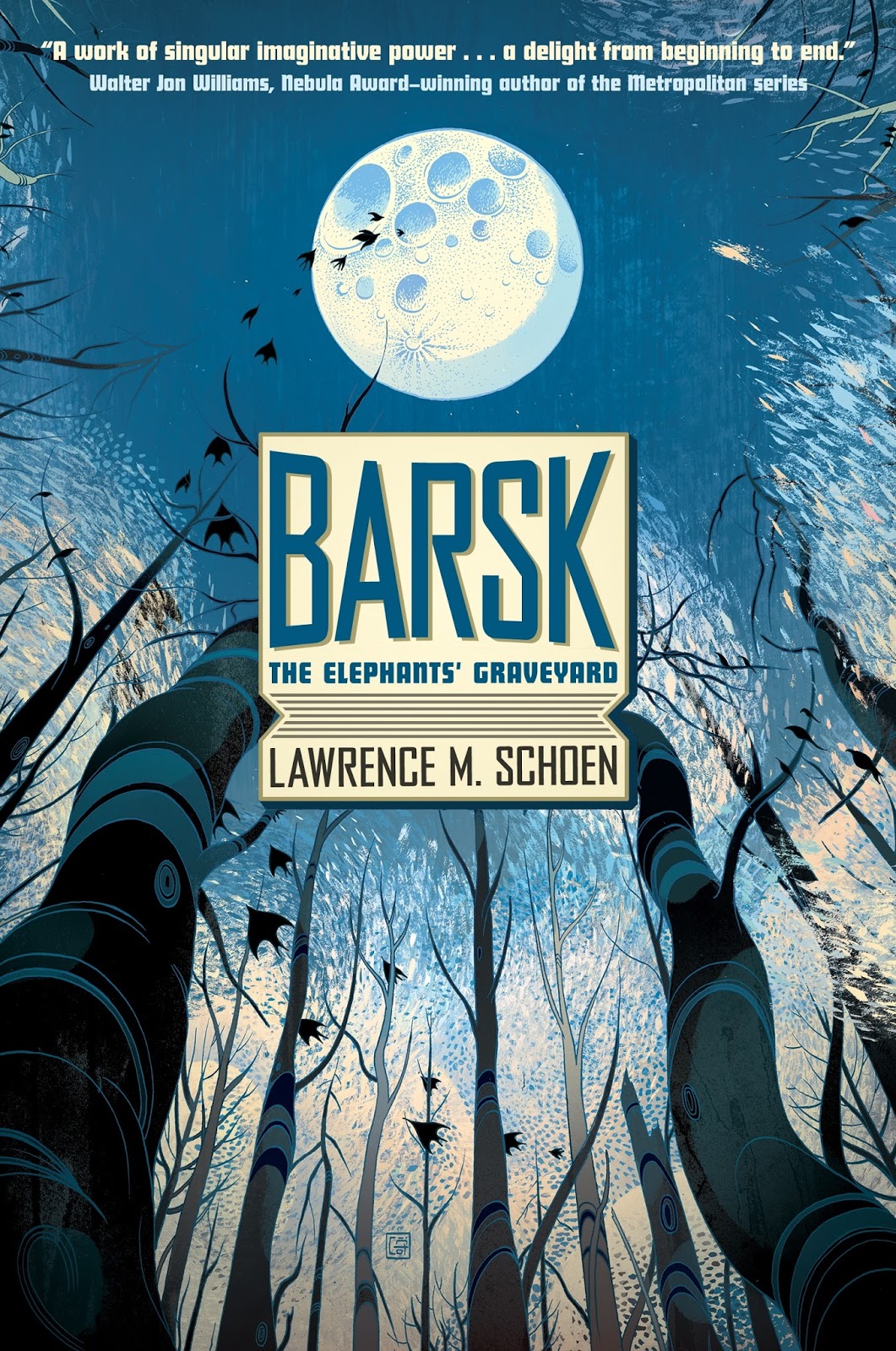 I'd like to welcome Lawrence M. Schoen to the blog. His latest novel,
Barsk: The Elephants' Graveyard
, is coming out this week from Tor. From Amazon and Barnes & Noble: The Sixth Sense meets Planet of the Apes in a moving science fiction novel set so far in the future, humanity is gone and forgotten.
I'd like to welcome Lawrence M. Schoen to the blog. His latest novel,
Barsk: The Elephants' Graveyard
, is coming out this week from Tor. From Amazon and Barnes & Noble: The Sixth Sense meets Planet of the Apes in a moving science fiction novel set so far in the future, humanity is gone and forgotten.Lawrence is a psychologist, an authority on the Klingon language, and a hypnotherapist. I asked him to write up a little something about how hypnotherapy can help authors. When I was pregnant with my son, I used self-hypnosis to cope with anxiety and with pain during labor. One of the interesting side benefits was how, while I was pregnant, my writing productivity suddenly increased. I realized it was due to my practicing hypnosis every time I sat down to write. It helped me focus, and it helped that pesky internal editor take a hike. But don't take my word for it. Here's Lawrence, discussing how hypnosis works and what it can do for writers:
Hypnosis and Writing
Okay, so the first thing you need to know is that if you're like 99% of the world, everything you think you know about hypnosis is flat out wrong. It's not exotic. It's not mind control. It's not difficult to do. It's involves a perfectly natural phenomenon that occurs to each of us in one form or another nearly every single day. And yes, everyone can be hypnotized.
Hypnosis involves easing someone into a particular altered state of consciousness, commonly know as a “trance.” A trance is simply a dissociation of your conscious awareness from your immediate environment. Every time you’ve been immersed in a good book, or lost track of the movie theatre around you when caught up watching a film, you’ve been in a state of trance. It happens when you’re waiting for the elevator door to open and when you’re driving that familiar route home from work at the end of the day. Your conscious awareness goes somewhere else. That’s trance. When I’m working as a hypnotist (and most of that work is with authors), I’m using trance to mediate between a client’s conscious and unconscious minds, facilitating communication between the two parts, getting them on the same side so they’re not working at cross purposes and can move together to produce more satisfying life results. With authors this typically means exploring why they’re experiencing writer’s block, or helping them to turn off the internal editor, or creating a habit of putting in time every day (or on whatever schedule they want), or overcoming performance anxiety associated with reading in public, or getting them past thoughts of imposter syndrome, fear of failure, and/or fear of success. The thing to remember is that the unconscious mind is the repository for a lifetime of emotionally charged memories and behavioral patterns that may have been brilliant choices at some time in the past but have long since lost some or all of their utility. It doesn’t operate by the same rules as your conscious awareness, which is part of why it’s distinct from it.
But it’s also incredibly powerful, and with a little coaxing you can have your unconscious do all kinds of back-breaking work in the background of your mind or while you’re asleep. Most people have had the experience of going to bed with a problem on their mind and waking up to discover the solution in front of them. With hypnosis, you can have this as a regular tool in your toolbox. Imagine laying out the questions you need to resolve in order to make a plot point work or a character’s motivations make sense, and then yawning, stretching, turning out the light, and falling asleep, secure in the knowledge that an answer will “magically” present itself in the morning when you sit down to write.
The style of hypnosis that I employ — both for myself and my clients — is often referred to as Conversational Hypnosis, or even as “Covert” Hypnosis, and is usually credited to Milton H. Erickson, the father of American Hypnotherapy (which is why it’s also sometimes called Ericksonian Hypnosis). When I began my study of this type of hypnosis I discovered it was essentially a blend of storytelling techniques and cognitive psychology. I already had my doctorate in cognitive psych, and I’d been writing and selling fiction for more than twenty years, so for me it all felt as easy as breathing. I’d already acquired all the pieces and mostly just had to assemble them in new ways.
Generally that takes the form of having a simple conversation with my clients. I especially like working with authors because they are, by definition, creative people. They’re already experienced in employing their imaginations, and a lot of facilitating change involves positing new possibilities.
It’s incredibly satisfying to help other writers “get out of their own ways.” Indeed, time and time again we find the obstacles that are keeping us from what we want are things we’ve created ourselves. At first glance, that can seem very frustrating, even hopeless, but one of Erickson’s major lessons was that each of us possesses all the resources we need to resolve any of our problems. And again, when you realize that we’re the source of them this only makes sense. This applies not just to authors, but to all of us, butcher, baker and that guy at the mall who makes candles
But part of why I especially like helping other writers to achieve their goals is because their resulting stories will go on to inspire so many others. It takes “paying it forward” to a whole new level.
***
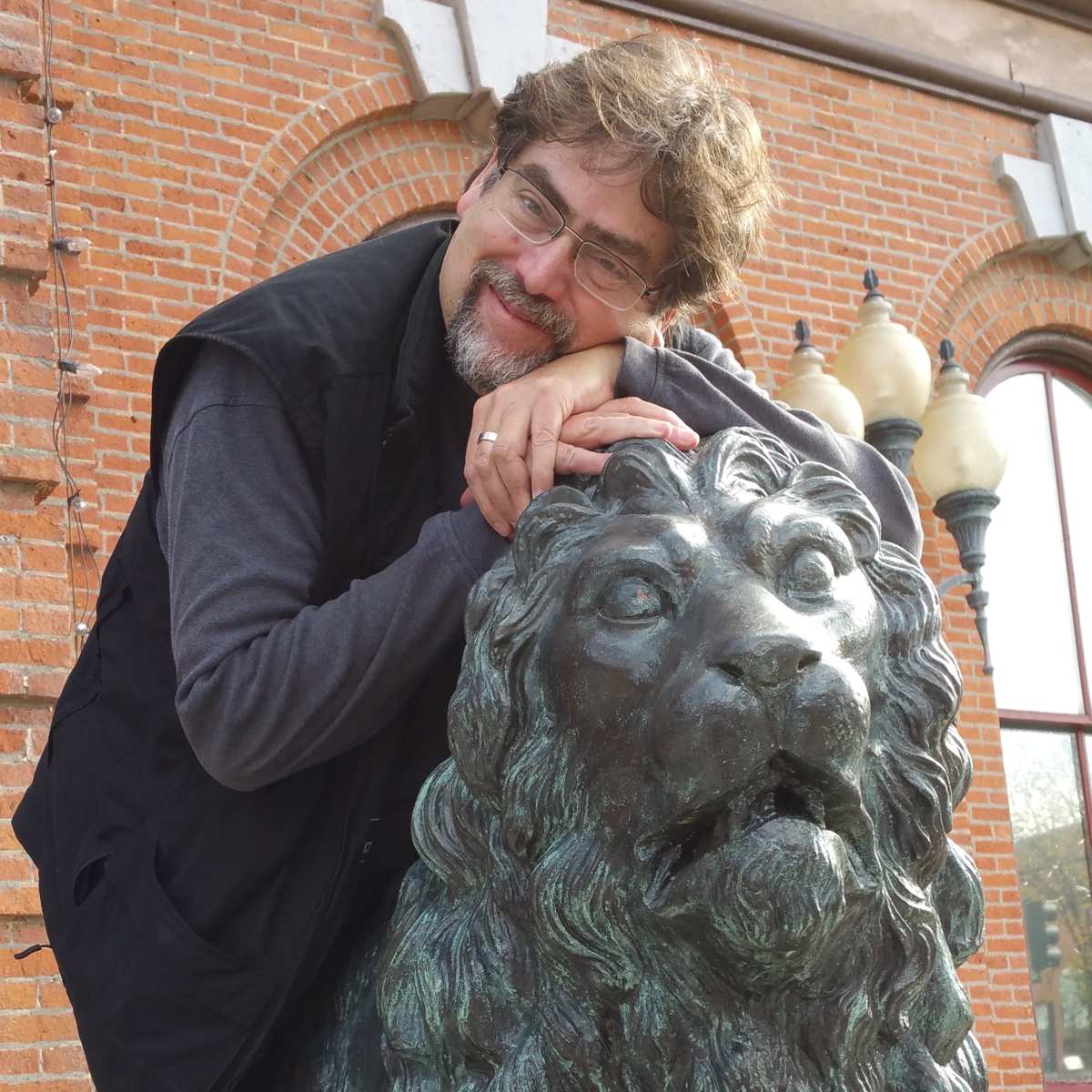 Lawrence M. Schoen holds a Ph.D. in cognitive psychology, has been nominated for the Campbell, Hugo, and Nebula awards, is a world authority on the Klingon language, operates the small press Paper Golem, and is a practicing hypnotherapist specializing in authors’ issues.
His previous science fiction includes many light and humorous adventures of a space-faring stage hypnotist and his alien animal companion. His most recent book, Barsk, takes a very different tone, exploring issues of prophecy, intolerance, friendship, conspiracy, and loyalty, and redefines the continua between life and death. He lives near Philadelphia, Pennsylvania with his wife and their dog
December 15, 2015
Becoming a Renaissance Woman
At some point in middle school or thereabouts, we learned about the Renaissance, and about the Renaissance man. Being a Renaissance man sounded fun. It sounded like the best way to achieve a full life. I decided right then and there to become a Renaissance woman. I wanted to meet challenges, become good at art and science and sports, and travel the world.
I started thinking about this recently because I read through Flow by Mihaly Csikszentmihalyi (I bet he had fun learning how to spell his name in Kindergarten). I didn't find a lot of new information in the book, but the entire thing reminded me of the Renaissance man and the idea of opening oneself to fully experiencing life, whether that be working on a factory assembly line or making art or even cleaning one's house. What I got out of the book was that life is to be engaged, and not passively experienced.
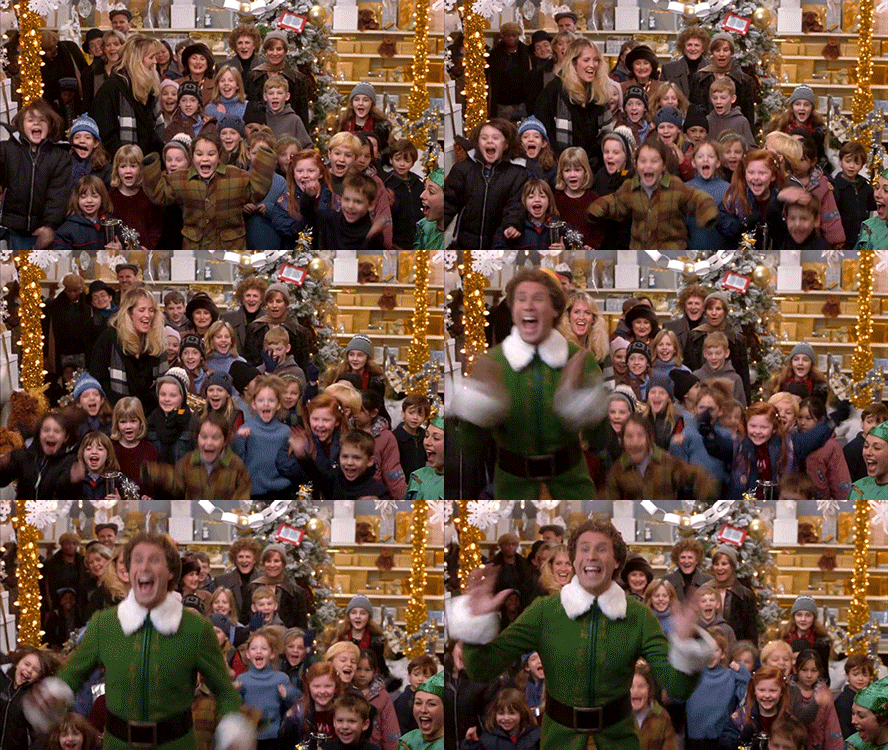
 DO ALL THE THINGS!!!For me, being a Renaissance woman means learning new things continuously. Becoming a physical therapist took a lot of time and mental energy. I spent years taking prerequisites and then learning the science and techniques specific to that job. I spent the first couple of years out of school honing those skills. And then I reached a plateau where, while there was still more to learn, it was minimal.
So my brain turned back to one of my childhood dreams... becoming a writer. Just like any other career, there is a learning curve when it comes to the skills specific to the craft of writing. In another book, Talent is Overrated by Geoff Colvin, he discusses how just about any skill--whether it's playing an instrument, mastering golf, whatever you can think of--takes a minimum amount of practice for one to become good at it. This breaks down to continuously practicing the skills necessary for about a decade. Want to become the best golfer you can be? Give it ten years. Want to become the best writer you can be? Give it about ten years. And so on. Not that you don't improve after that, but you should be fairly proficient.
I took up writing seriously about ten years ago. See a pattern here? I do. Last year I decided it was time to take up another challenge--running. So I've achieved proficiency in a science/medical field, I'm close to achieving that in an art, and now I'm working on something athletic. Now, I certainly don't think I'll be competing in the senior Olympics in ten years, but I should be the best runner I can possibly be, and I'll be happy with that.
And what comes after that? Well, I have about a decade to figure that out.
I started thinking about this recently because I read through Flow by Mihaly Csikszentmihalyi (I bet he had fun learning how to spell his name in Kindergarten). I didn't find a lot of new information in the book, but the entire thing reminded me of the Renaissance man and the idea of opening oneself to fully experiencing life, whether that be working on a factory assembly line or making art or even cleaning one's house. What I got out of the book was that life is to be engaged, and not passively experienced.
 DO ALL THE THINGS!!!For me, being a Renaissance woman means learning new things continuously. Becoming a physical therapist took a lot of time and mental energy. I spent years taking prerequisites and then learning the science and techniques specific to that job. I spent the first couple of years out of school honing those skills. And then I reached a plateau where, while there was still more to learn, it was minimal.
So my brain turned back to one of my childhood dreams... becoming a writer. Just like any other career, there is a learning curve when it comes to the skills specific to the craft of writing. In another book, Talent is Overrated by Geoff Colvin, he discusses how just about any skill--whether it's playing an instrument, mastering golf, whatever you can think of--takes a minimum amount of practice for one to become good at it. This breaks down to continuously practicing the skills necessary for about a decade. Want to become the best golfer you can be? Give it ten years. Want to become the best writer you can be? Give it about ten years. And so on. Not that you don't improve after that, but you should be fairly proficient.
I took up writing seriously about ten years ago. See a pattern here? I do. Last year I decided it was time to take up another challenge--running. So I've achieved proficiency in a science/medical field, I'm close to achieving that in an art, and now I'm working on something athletic. Now, I certainly don't think I'll be competing in the senior Olympics in ten years, but I should be the best runner I can possibly be, and I'll be happy with that.
And what comes after that? Well, I have about a decade to figure that out.
December 7, 2015
2015 Writing Year in Review
The year's end is nearly upon us, NaNoWriMo just ended, and I have a ton of stories to edit. For a while there, I was just producing new words and doing very few edits. So, editing will most likely fill my time for the next couple of months or so. Since I don't plan on writing any more new stories for what remains of this year, I thought I'd post my numbers.
 I wrote eleven new short stories this year, four novelettes (or really long short stories, depending on your definition), and one novel. I don't keep track of words written, but I probably produced about 125,000 words this year. And so far this year I've made 43 short story submissions.
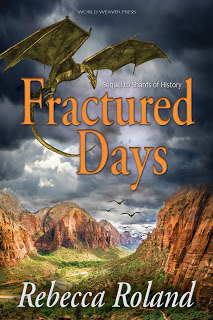
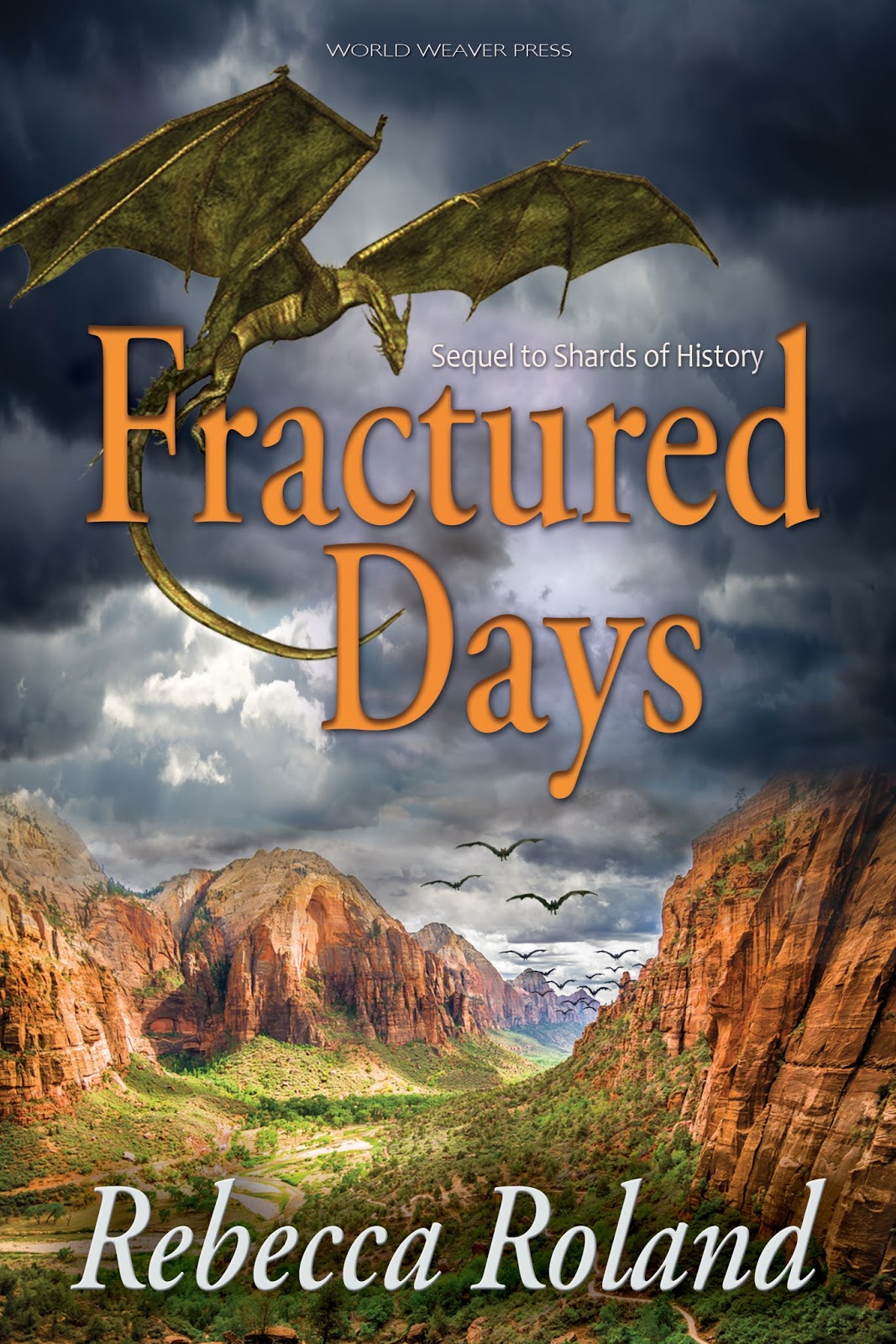
Publication and sales-wise for short stories, this was a sparse year. I made one reprint sale and had one other publication. I think part of the drop was due to having several sales last year, and part of it is just the fickle nature of publishing. But, I had two novels published this year. Fractured Days , the sequel to my fantasy novel Shards of History came out, as did the final book in my Necromancer's Inheritance series, The Necromancer's Book of Magic .
I guess the image for this year has been of a duck in water. Everything looks calm above, but my feet have been madly moving below. Hopefully it all pays off next year with more sales, more publications, and more writing awesomeness.
 I wrote eleven new short stories this year, four novelettes (or really long short stories, depending on your definition), and one novel. I don't keep track of words written, but I probably produced about 125,000 words this year. And so far this year I've made 43 short story submissions.
Publication and sales-wise for short stories, this was a sparse year. I made one reprint sale and had one other publication. I think part of the drop was due to having several sales last year, and part of it is just the fickle nature of publishing. But, I had two novels published this year. Fractured Days , the sequel to my fantasy novel Shards of History came out, as did the final book in my Necromancer's Inheritance series, The Necromancer's Book of Magic .
I guess the image for this year has been of a duck in water. Everything looks calm above, but my feet have been madly moving below. Hopefully it all pays off next year with more sales, more publications, and more writing awesomeness.
November 3, 2015
The Ride for the Silenced
There's a beautiful Mexican tradition known as Dia de Los Muertos, or Day of the Dead, in which people remember those who have passed away. The dead are not gone, and they're not in the past; they're here with us, always.
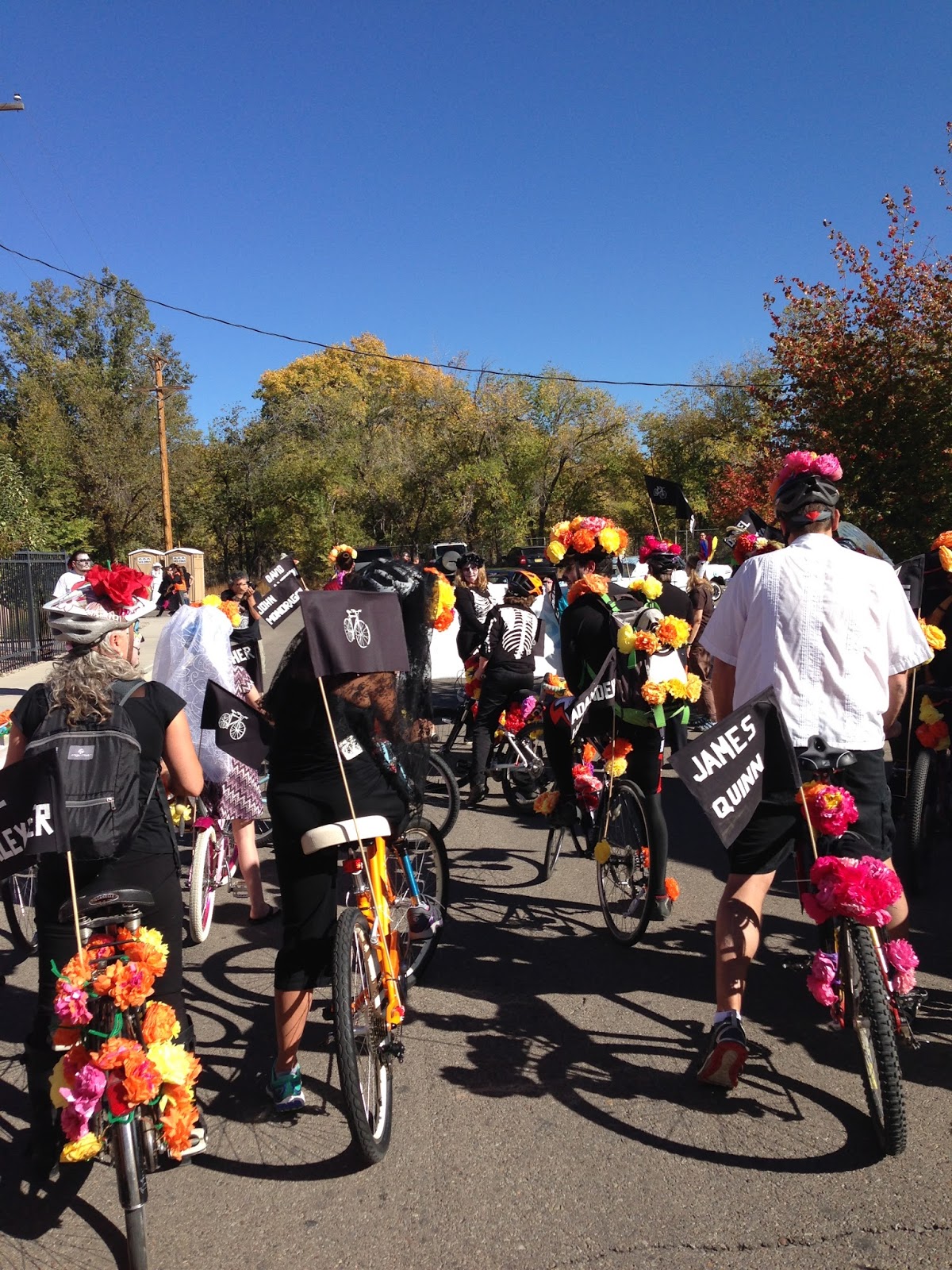
This year a friend of mine had the idea of putting together a unique float for the Dia de Los Muertos parade in Albuquerque's South Valley. It was the 23rd annual parade, and the theme this year was "Silence is Death." My friend wanted to put together a memorial to those who have died in cycling accidents. There are ghost bikes all over Albuquerque to remember deceased cyclists. They are all white, and decorated with flowers. The empty seat always makes me think of other empty seats that the riders have left behind--empty seats at holiday tables, empty seats at work, empty seats beside their loved ones on car trips/vacations, at the movies. The empty seat means there are empty hearts out there.
 My friend made flags for each local rider who has a ghost bike. On one side of the flag was a white bike, and on the other was their name. A teacher she knows in Florida had his students make marigolds for us to decorate our bikes with. Florida and New Mexico might be halfway across the country from one another, but they both share top billing when it comes to bicycle deaths in the U.S. So he sent along marigolds along with the names of people killed in Florida in cycling accidents so we could attach them to the flowers and remember them, too.
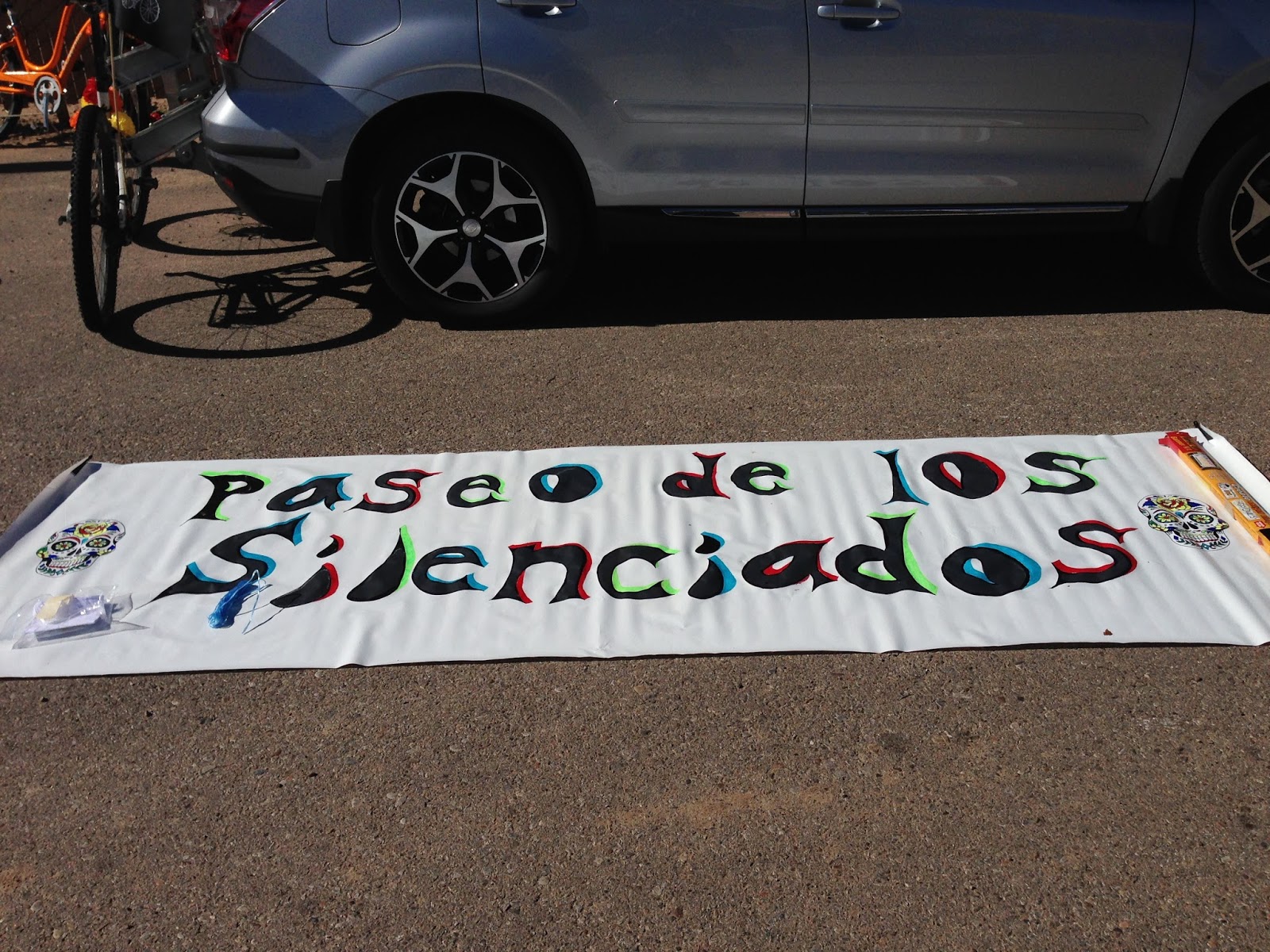
We took our spot behind the low riders and in front of a brass band. There were a good number of people on bikes, a handful of dedicated walkers handing out candy, and a couple of people holding a banner reading "Paseo de los Silenciados," or "Ride of the Silenced."
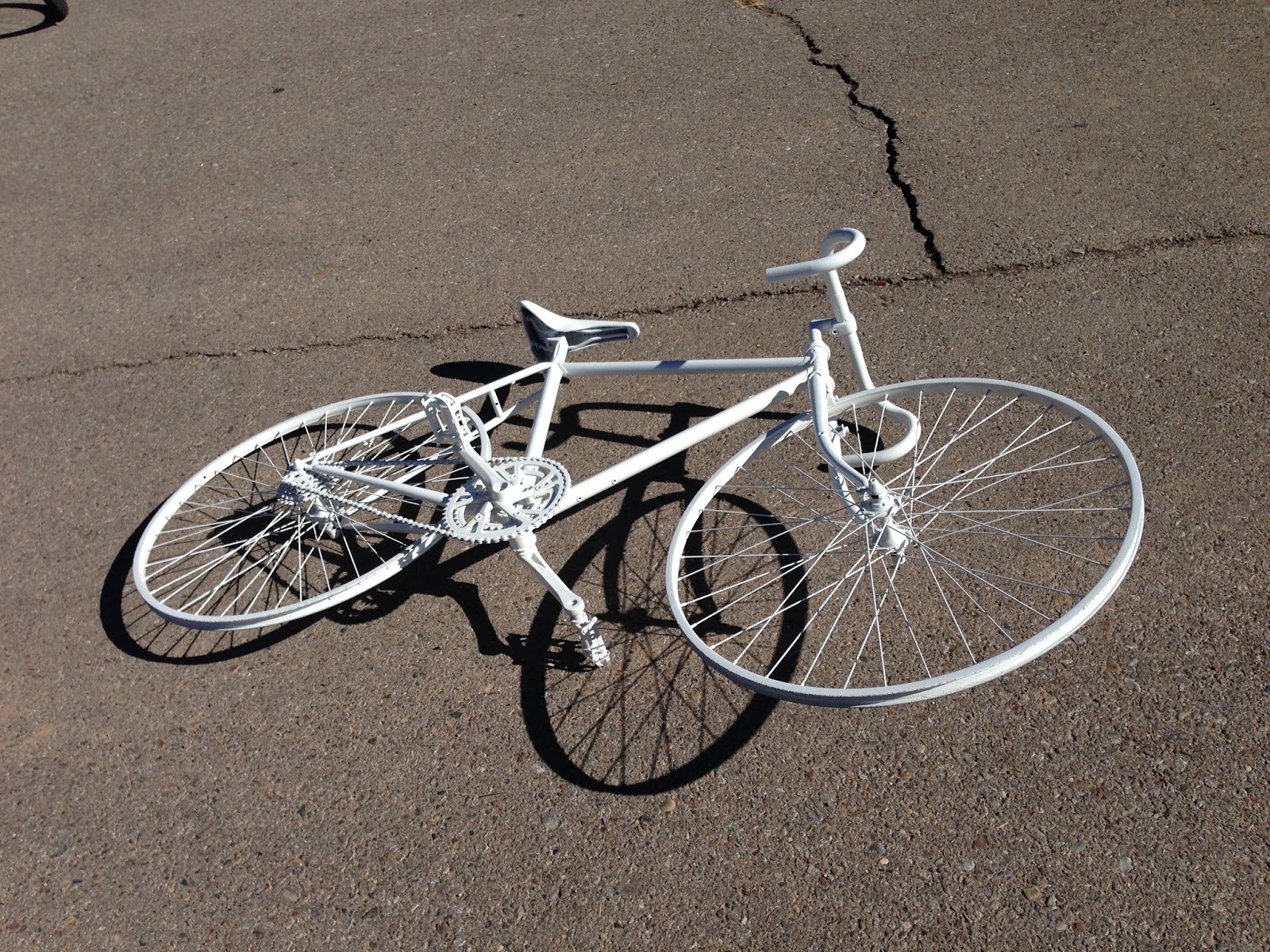 We rode for about a mile through some pretty thick crowds. We received applause and people telling us, "Thank you," and, "What a wonderful way to honor the dead." I heard people talking about the ghost bikes, and sometimes explaining what they were to others. One thing I noticed was that a lot of people rode their bikes to the parade. I like to think that we gave the parade-goers something to think about, which was reinforced when they saw people headed home on their bikes. I like to think those people will get into their cars in the morning to go to work or take their kids to school, or they'll climb behind the wheel of their work vehicle, and they'll remember us riding with the names of the dead, and an empty, white bike at the front. I like to think they'll give the proper space to commuters on bikes, or watch out for pedestrians crossing the road, because after all, people on bikes and on foot have as much a right to safe travel as people in cars. I like to think they'll notice the ghost bikes around town, and their gaze won't slide over them without noticing them because they've seen them so many times before. I like to think there won't be any need for more ghost bikes.