John A. Heldt's Blog, page 24
September 23, 2013
Review: Esperanza by Sandra C. Lopez
If there is one thing I've discovered in producing four novels in two years, it's that writing leaves precious little time for reading. It leaves even less time for reading works outside my favorite genres, such as historical fiction and thrillers. As I learned last week, however, it's sometimes wise to make that time and wander out of literary comfort zones.
 Sanda C. Lopez's delightfully written debut novel,
Esperanza: A Latina Story
, follows a Mexican-American girl through four turbulent years of high school in east Los Angeles in the late 1990s.
Sanda C. Lopez's delightfully written debut novel,
Esperanza: A Latina Story
, follows a Mexican-American girl through four turbulent years of high school in east Los Angeles in the late 1990s.
From the beginning, Esperanza Ignacio commands admiration and respect. She stays true to herself despite the demands imposed on her by a controlling single mother, two needy younger siblings, and several not-so-admirable friends, relatives, and classmates, who try to badger and bully her in unproductive directions.
As a reader, I had no difficulty imagining the obstacles the girl faced. Esperanza's world is a mostly bleak place, filled with bullying, broken families, alcoholism, poverty, and the myriad temptations of youth. Lopez does a masterful job in describing them all.
What makes this story compelling, however, is not the description but rather the uplifting tone. The author gives readers a protagonist we can root for from start to finish. She reminds us that even those living in challenging environments can succeed by remaining focused, optimistic, and compassionate.
I received a copy of the book in exchange for an honest review. Rating: 4/5.
 Sanda C. Lopez's delightfully written debut novel,
Esperanza: A Latina Story
, follows a Mexican-American girl through four turbulent years of high school in east Los Angeles in the late 1990s.
Sanda C. Lopez's delightfully written debut novel,
Esperanza: A Latina Story
, follows a Mexican-American girl through four turbulent years of high school in east Los Angeles in the late 1990s.From the beginning, Esperanza Ignacio commands admiration and respect. She stays true to herself despite the demands imposed on her by a controlling single mother, two needy younger siblings, and several not-so-admirable friends, relatives, and classmates, who try to badger and bully her in unproductive directions.
As a reader, I had no difficulty imagining the obstacles the girl faced. Esperanza's world is a mostly bleak place, filled with bullying, broken families, alcoholism, poverty, and the myriad temptations of youth. Lopez does a masterful job in describing them all.
What makes this story compelling, however, is not the description but rather the uplifting tone. The author gives readers a protagonist we can root for from start to finish. She reminds us that even those living in challenging environments can succeed by remaining focused, optimistic, and compassionate.
I received a copy of the book in exchange for an honest review. Rating: 4/5.


September 16, 2013
Back to the Bitterroots

The mountains are calling and I must go. -- John Muir
As one who has spent nearly his entire life in the Pacific Northwest, I am no stranger to mountains. I've lived in the shadow of the Cascades, the Olympics, the Big Belts, and the Blues. But I don't think I've ever been as impressed by a mountain range as I was last weekend when I got a birds-eye view of the Bitterroots.
I returned to Wallace, Idaho, on Friday -- officially -- to celebrate my wife's 50th birthday and cheer her on as she rode 150 miles in Bike MS, a fundraising event for the National Multiple Sclerosis Society. Unofficially, I returned to enjoy the mountain range that served as a backdrop for The Fire -- the recently-released fourth novel of my Northwest Passage time-travel series.
No matter where I went, I couldn't escape the majesty of the Bitterroots, which divide the states of Idaho and Montana and nourish numerous communities mentioned in the book: Wallace, Mullan, Osburn, Mace, and Burke. The mountains that once gave up their silver and gold so that these towns could thrive now provide unlimited opportunities for sportsmen, hikers, bikers, photographers, and history buffs.
Nothing, however, compared to the views from the Route of the Hiawatha, a 17-mile rails-to-trails bike path I experienced for the first time on Friday. When I emerged from the sheer darkness of the 1.7-mile St. Paul Pass Tunnel at the start of the trail, I saw the mountains and lush forests that had been devastated by the Great Fire of 1910, the climactic event of the novel.
I was able to see firsthand what drew so many to this corner of the United States a century ago and continues to draw them today. When I will have the opportunity to return to this magnificent setting, I don't know. But after weekend of taking in the mountains named for the Lewisia rediviva, Montana's state flower, I do know one thing: I will be back.
August 31, 2013
The series continues
More than five months of work come to fruition today with the release of
The Fire
, the sequel to
The Journey
and the fourth book in the Northwest Passage series. At 367 pages, this is my biggest work to date and, I believe, my best.
The Fire continues the story of the Johnson clan, who we left in the recovering hills around Mount St. Helens in August 1999. Kevin Johnson, 8 at the end of The Journey , is now a 22-year-old college graduate poised for an adventure of his own. He finds it in Wallace, Idaho, where he stumbles upon a time portal that takes him back to 1910, the year of Halley's comet and the largest wildfire in U.S. history.
While in the age of nickelodeons, high-wheel bicycles, telegraph offices, and tea dresses, the science major meets his great-great-grandfather, finds his calling as an educator, and becomes invested in two beautiful young women: Sarah, a first-year English teacher, and Sadie, the orphaned daughter of a bankrupt merchant.
Filled with humor, heartbreak, romance, and fantasy, The Fire chronicles one man's journey through an eventful but often overlooked year in American history.
The novel is available as an ebook on Amazon.com.
The Fire continues the story of the Johnson clan, who we left in the recovering hills around Mount St. Helens in August 1999. Kevin Johnson, 8 at the end of The Journey , is now a 22-year-old college graduate poised for an adventure of his own. He finds it in Wallace, Idaho, where he stumbles upon a time portal that takes him back to 1910, the year of Halley's comet and the largest wildfire in U.S. history.
While in the age of nickelodeons, high-wheel bicycles, telegraph offices, and tea dresses, the science major meets his great-great-grandfather, finds his calling as an educator, and becomes invested in two beautiful young women: Sarah, a first-year English teacher, and Sadie, the orphaned daughter of a bankrupt merchant.
Filled with humor, heartbreak, romance, and fantasy, The Fire chronicles one man's journey through an eventful but often overlooked year in American history.
The novel is available as an ebook on Amazon.com.
August 8, 2013
Riders with a cause

One of the things I like most about blogging is that I can draw attention to persons, places, and things that deserve all the attention they can get. One such thing is Bike MS, an annual function of the National Multiple Sclerosis Society.
In five weeks about a hundred people, including my wife, Cheryl, will participate in one of Bike MS's regional events. The cyclists will ride across northern Idaho to raise money to fight MS, an autoimmune disease that affects 400,000 Americans and 2.5 million people worldwide.
Cheryl raised more than two thousand dollars last year and hopes to double that total in 2013. Participants nationally have raised more than 600 million dollars for support programs, services, and research since 1980.
The Idaho cyclists will ride 150 miles in two days on the world-famous Trail of the Coeur d'Alenes. They will pass a number of scenic and historic sites, including the mining town of Wallace, the setting for my upcoming novel, The Fire.
Those who wish to contribute to this worthy cause can do so by going to Cheryl's Bike MS page or giving directly to the national organization.
July 20, 2013
Covering another essential
Now that I've written The Fire and sent it to the first of several beta readers, I've had the opportunity to devote more time to the other things authors must do in preparing a book for market. One of those things is picking a cover. After weeks of consideration, I've decided to go with a comet theme for the cover of the fourth book of the Northwest Passage series.
 In doing so, I'm taking my cues not from images of the Great Fire of 1910, the climactic event of the novel, but rather the title of a 1978 made-for-television movie. In
A Fire in the Sky
, the fire is a comet that is discovered just eight days before it makes face time with Phoenix, Arizona.
In doing so, I'm taking my cues not from images of the Great Fire of 1910, the climactic event of the novel, but rather the title of a 1978 made-for-television movie. In
A Fire in the Sky
, the fire is a comet that is discovered just eight days before it makes face time with Phoenix, Arizona.
No comets collide with the Earth in The Fire, but one does take center stage in the first part of the novel. Halley's comet dazzles the community of Wallace, Idaho, and the world, for several weeks in the spring of 1910, presages historic events, and alters how several principal characters interact with each other.
The Fire, the sequel to The Journey , is scheduled for an early September release.
 In doing so, I'm taking my cues not from images of the Great Fire of 1910, the climactic event of the novel, but rather the title of a 1978 made-for-television movie. In
A Fire in the Sky
, the fire is a comet that is discovered just eight days before it makes face time with Phoenix, Arizona.
In doing so, I'm taking my cues not from images of the Great Fire of 1910, the climactic event of the novel, but rather the title of a 1978 made-for-television movie. In
A Fire in the Sky
, the fire is a comet that is discovered just eight days before it makes face time with Phoenix, Arizona.No comets collide with the Earth in The Fire, but one does take center stage in the first part of the novel. Halley's comet dazzles the community of Wallace, Idaho, and the world, for several weeks in the spring of 1910, presages historic events, and alters how several principal characters interact with each other.
The Fire, the sequel to The Journey , is scheduled for an early September release.
June 22, 2013
Walking in Wallace
Perhaps the biggest challenge facing a writer of historical fiction is creating a sense of time and place. How do you write about a time that occurred decades before your own and a place you've seen mostly from a freeway? The answer is simple. You research the time and, if you have the opportunity, you visit the place.
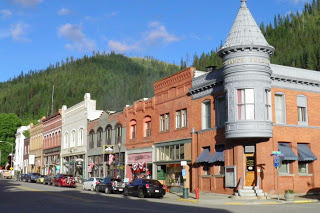 This week, I had the opportunity to visit the place. I paid not one, but two visits to Wallace, Idaho, the setting of The Fire, my next novel. I found the community every bit as fascinating in person as I had found it in literature.
The town is different, of course, than it was in August 1910, when it stared down the largest wildfire in U.S. history and captured the nation's imagination. It is smaller, less commercial, and far more touristy. It serves primarily as a stopping point for motorists, skiers, and bicyclists riding the famed Route of the Hiawatha and the Trail of the Coeur d'Alenes.
You don't have to walk far, however, to see that Wallace is more than a pit stop on Interstate 90. It's a living museum, with numerous attractions that celebrate everything from its rich mining heritage to the actions of heroes like Ed Pulaski, a forest ranger who saved forty firefighters by leading them into a mine and holding them there at gunpoint.
Of most interest to me as a writer were the buildings in town. Many of the oldest structures still stand, thanks in part to preservation efforts and the city's designation as a National Historic District. When you walk through Wallace, you see the town not only as it is today but also as it was in the past.
You see the brick facades on Bank Street, the row houses on Cedar, the courthouse that withstood the inferno, and the original Northern Pacific Railroad depot, where hundreds once gathered to catch rescue trains. You see Wallace in 1910, when it became part of history, lore, and literature.
I hope to use what I've learned to convey the same sense of time and place when I publish The Fire. The fourth book in the Northwest Passage series is still scheduled for a September release.
 This week, I had the opportunity to visit the place. I paid not one, but two visits to Wallace, Idaho, the setting of The Fire, my next novel. I found the community every bit as fascinating in person as I had found it in literature.
The town is different, of course, than it was in August 1910, when it stared down the largest wildfire in U.S. history and captured the nation's imagination. It is smaller, less commercial, and far more touristy. It serves primarily as a stopping point for motorists, skiers, and bicyclists riding the famed Route of the Hiawatha and the Trail of the Coeur d'Alenes.
You don't have to walk far, however, to see that Wallace is more than a pit stop on Interstate 90. It's a living museum, with numerous attractions that celebrate everything from its rich mining heritage to the actions of heroes like Ed Pulaski, a forest ranger who saved forty firefighters by leading them into a mine and holding them there at gunpoint.
Of most interest to me as a writer were the buildings in town. Many of the oldest structures still stand, thanks in part to preservation efforts and the city's designation as a National Historic District. When you walk through Wallace, you see the town not only as it is today but also as it was in the past.
You see the brick facades on Bank Street, the row houses on Cedar, the courthouse that withstood the inferno, and the original Northern Pacific Railroad depot, where hundreds once gathered to catch rescue trains. You see Wallace in 1910, when it became part of history, lore, and literature.
I hope to use what I've learned to convey the same sense of time and place when I publish The Fire. The fourth book in the Northwest Passage series is still scheduled for a September release.
June 15, 2013
Reviews and revisions
There is undoubtedly a point where every author stops reading the reviews of his or her works. The reviews become too numerous or, in some cases, too painful to read.
I am not one of those authors. I take the time to read every one. I love getting feedback from those who enjoy my books and constructive criticism from those who can help me improve as a writer. Both are important.
Rachel of The Reading Cafe offers two of the better reviews of late with a double take on The Mine and The Show , the Nos. 1 and 3 books of the Northwest Passage series. Each novel will be featured on an ebook site next week and offered at a reduced price, with The Mine going on sale Sunday and The Show Monday and Tuesday.
Work continues on The Fire, book four of the series. I have finished a complete rough draft and will spend most of the summer revising it. I expect to have the novel out by the third week of September.
I am not one of those authors. I take the time to read every one. I love getting feedback from those who enjoy my books and constructive criticism from those who can help me improve as a writer. Both are important.
Rachel of The Reading Cafe offers two of the better reviews of late with a double take on The Mine and The Show , the Nos. 1 and 3 books of the Northwest Passage series. Each novel will be featured on an ebook site next week and offered at a reduced price, with The Mine going on sale Sunday and The Show Monday and Tuesday.
Work continues on The Fire, book four of the series. I have finished a complete rough draft and will spend most of the summer revising it. I expect to have the novel out by the third week of September.
June 6, 2013
IRDA winners
Today the winners of the third-annual Indie Reader Discovery Awards were announced.
The Mine
fell short of an award in the Popular Fiction category but was among the books receiving a positive review. A list of the winners in each genre can be found here. Author Hugh Howey will announce the results of the competition at the Book Expo America in New York this Saturday.
May 4, 2013
Lighting The Fire
One of the things I most enjoy about starting a new work of historical fiction is jumping into a time that is not my own. I learned a lot about 1941 when writing
The Mine
and 1918 when producing
The Show
and rediscovered my youth in
The Journey
, set in 1979 and 1980.
In each project, I was able to lose myself in an era that had its own conventions, vocabulary, and public issues. I was able to see a vastly different historical period through the eyes of a modern time traveler.
This spring and summer I'll have the opportunity to see a different world again. I've begun writing The Fire, the fourth book in my Northwest Passage series and the sequel to The Journey . Set in Wallace, Idaho, in 1910, this novel will follow Kevin Johnson, a recent college graduate in 2013, through an important but often overlooked year in American history.
In The Fire, Kevin, an accomplished but luckless science major, will fall in love, witness Halley's Comet, find his calling as a teacher, and experience the largest wildfire in U.S. history. He will see the Pacific Northwest as his great-great-grandfather saw it and wrestle with the impact he has on everyone he meets.
I'm about halfway through a first draft that will likely exceed 100,000 words. This will be the largest book in the series to date and hopefully the best. I hope to finish a final draft by August and publish in September. The Fire will be available in Kindle format on Amazon.com.
In each project, I was able to lose myself in an era that had its own conventions, vocabulary, and public issues. I was able to see a vastly different historical period through the eyes of a modern time traveler.
This spring and summer I'll have the opportunity to see a different world again. I've begun writing The Fire, the fourth book in my Northwest Passage series and the sequel to The Journey . Set in Wallace, Idaho, in 1910, this novel will follow Kevin Johnson, a recent college graduate in 2013, through an important but often overlooked year in American history.
In The Fire, Kevin, an accomplished but luckless science major, will fall in love, witness Halley's Comet, find his calling as a teacher, and experience the largest wildfire in U.S. history. He will see the Pacific Northwest as his great-great-grandfather saw it and wrestle with the impact he has on everyone he meets.
I'm about halfway through a first draft that will likely exceed 100,000 words. This will be the largest book in the series to date and hopefully the best. I hope to finish a final draft by August and publish in September. The Fire will be available in Kindle format on Amazon.com.
April 1, 2013
Remembering a grandfather

Today the only grandfather I ever knew would have turned 120. Andy Hoeme was one of those elderly icons every family seems to have: a good-humored, sometimes cranky man of simple tastes and uncommon wisdom who seemed torn from the canvas of a Norman Rockwell painting. He was a man who rarely had to search for an interesting story and, as one who died 100 days shy of 100 years, had more than a few to choose from.
As I learned shortly before he passed, Andy was something of a rebel as a young man. Born into a family of nine children on the Kansas plains in 1893, he ran off to see the world at 18 and lived by his wits for more than a year. He sailed on rat-infested lumber ships, rode the rails, sheared sheep Thornbirds style, hunted moose, and explored Yellowstone on foot when horses and wagons, not automobiles, plied its freshly-minted roads.
He maintained this spirit of independence even at age 24, when, as a conscientous objector at the height of World War I, he left a Texas Army base with his newlywed wife for an Indiana Jones-like life on the run in post-revolution Mexico and the unsettled Canadian frontier. Even as a family man, inventor, and entrepreneur, Andy (pictured above at left) seemed more like a character from a Steinbeck novel than a family album.
Much of what I know about this remarkable man I learned in 1989, when I interviewed him over a span of three days. Even at age 96, he was able to recall events seventy years in the past with the clarity of a historian. I hope to someday turn his stories -- since verified by documents, news accounts, and statements -- into a non-fiction book.
But today, I simply want to remember the man who taught me to fish, appreciate patience, and see life as an adventure. You are gone but not forgotten. Happy birthday, Grandpa!