Beth Alvarez's Blog, page 44
July 14, 2015
4 fantasy animals that are totally real
With a wealth of fantasy fiction at our fingertips, it’s easy to see how the lines can blur between fiction and reality. After all, a poll in the UK a few years back revealed that twenty percent of British people believed Sherlock Holmes was a real person. But sometimes, the pendulum swings the other direction.
It’s amazing what people think might be made up–I had a great conversation with a friend who had always thought four-leaf clovers were fiction, while another friend of mine shared a conversation in which someone asked if mountain lions were real. Having seen both of those things in the wild, I can verify that yes, they do exist. But what about some other creatures that might be more real than you thought? Here’s a few that really exist.
Sea serpents
We’ve seen them on just about every fantasy map, and a few real maps as well. But those long, sinewy bodies with ragged dorsal fins depicted arcing over the waves aren’t as far-fetched as you’d think. The giant oarfish is a real-life sea monster, with specimens confirmed at sizes of up to 36 feet in length. While sightings can’t be confirmed, they’ve been reported in sizes longer than 50 feet. And why not? They’re primarily deep sea creatures, and heaven only knows what’s down there. But seeing a video of even a small oarfish swimming in the shallows, it’s no wonder they obtained such a mythical status.
Dragons
While depictions of these creatures have been historically fanciful, in early tales of knights and dragons, the fire-breathing beasts often lacked wings. In many countries, such as most of Asia, they never acquired them at all. It stands to reason that early dragons were most likely just large reptiles that weren’t commonly seen. Alligators and crocodiles present one possibility, and giant monitors like komodo dragons quite another. But what if the idea of flying lizards wasn’t so crazy? Turns out they do exist. 42 recognized species, in fact, all part of the genus Draco. Yes, they’re even named dragon! Although they’re small, some species–such as draco volans–are brightly colored, fierce-looking little beasts. They traverse the air using membranes that extend from the ribs and allow them to glide. Gliding might not sound impressive, but after watching one catch an updraft and sail 200 feet before stopping in another tree, you might change your mind.
Dire wolves
Although popularized because of series like Dungeons & Dragons and Game of Thrones, there’s nothing fictitious about these beasts–but you won’t be seeing them any time soon. Native to North America, dire wolves are long extinct, but well-documented as having existed. Thousands of complete skeletons have been retrieved from the La Brea tar pits in Los Angeles. Although related to modern-day gray wolves and thought to look similar, dire wolves were around 25% larger than the biggest modern-day wolves, making them around 5 feet long and weighing up to 200 pounds. You can rest easy, though: dire rats are made up for D&D, so you won’t run into any R.O.U.S. any sooner than you’ll cross paths with a dire wolf.
Narwhals
Narwhals are popular on the internet, and why not? They’re pretty fantastic. But despite their popularity, a stunning number of people think the remarkable unicorn of the sea is as made-up as any other unicorn. Both real and near threatened, narwhals can be found in the icy Arctic ocean. The horn they sport is actually a tusk that grows through the upper lip, usually grown by males, though females occasionally bear small tusks as well. While most narwhals have only one tusk, around one in 500 have two, and some have none at all.
Have you ever encountered an animal someone thought was fake?


July 7, 2015
Eiri and the Dragon
Too long she waited, bowstring drawn taut beside her ear. Fingers cramped and muscles burned, but she waited. Too close to move without being heard, too far for a killing shot unless the angle was just right. But she waited, breath held, body still, arrow ready and eyes on the target that stirred below.
The stag’s head turned and the creature let out a bellow and whine, collapsing to the earth with an arrow in its eye.
Snarling, Eiri let her bowstring go lax. “Kolfhe!”
Her shout was answered by laughter from elsewhere in the trees.
Sliding her arrow back into its quiver, she slid from her perch, landing in the soft bed of decaying leaves. The pleasant scent of moist earth rose to greet her as she strode toward the stag. She took her time, though Kolfhe sprinted, the two of them reaching the beast at the same time.
“Head too far in the clouds to take a shot again, eh?” he teased, kneeling to inspect his work.
It was a good shot, she had to admit; she just wouldn’t out loud. Instead she rubbed her nose to discourage the tickling smell of the forest, unfastening her bowstring. “There’s a difference between daydreaming and caution.”
“And both slow you down. We’ve discussed this before, Eiri. There’s a time for thinking, and it’s not when your weapons are drawn.” Gentle teasing became stern admonition, though she saw the way his brow puckered with concern. “This time it was a deer, nothing to fear. But next time, it might be raiders. Or worse.”
Eiri slipped her bow into its sling on her back. “And when it is something to fear, my draw will never be too slow.”
Kolfhe shrugged and said nothing more, scooping the stag onto his shoulders and grunting as he stood. Had he been kinder, she might have offered to help. Instead, she led the way back to the village.
New thatch stood bright against the weathered wood of cabins, a handful of men still working on the roof of the mead hall in the center of the village. Children clustered around the stairs to listen to the stories shared by grandmothers while the men and women of the village worked, hunting and foraging in the comfortable cool that whispered of winter to come.
Most homes already had game strung up from the eaves, though Kolfhe carried this catch toward the mead hall. A wild boar and a brace of rabbits already decorated his cabin, enough to feed him for the winter. Had he still shared his home with his mother it would have been different, but fever had claimed her in the spring. Not a sorrowful thing, he insisted; his mother had lived long and lived well. With that in mind Eiri felt little sadness for the kind woman’s departure, but winter was coming, and she hated to think of Kolfhe whiling away the bitter nights on his own.
“A good meal for tonight, I’d say,” he remarked as he tied the stag’s hind feet. “And good for the stew pot tomorrow.”
Eiri laughed, helping him raise the animal to hang from the corner of the roof. “And what would you know about stew pots? Yours has been empty all summer. You’ve eaten every meal in the mead hall.”
“And I’ve every right to, when I’m the one catching all the food!” He waved her away with a smirk, drawing his belt knife and sizing the deer up for cleaning.
She gave him his space, sitting on the steps with the grandmothers and children, though she watched him work.
Kolfhe was pleasant to watch; the spirit of hard work was a good trait in a man. He wore furs and leather hunted by his own hand, well cut and finely finished. He took pride in his skills, and he had many. But he was pleasant to look at in other ways, too, with his lively earth-brown eyes and his wind braids the color of new straw.
Had she the nerve, she’d have offered to tend his stew pot for him.
Sighing, she pulled herself away and strode into the mead hall to assist with preparation of the evening’s feast.
Sixteen houses ringed the longhouse, all of them full, most with more than one generation under its roof. Some preferred the privacy of their own homes, but often the entire village met for meals within the mead hall. Long stone-walled fire pits divided the single room lengthwise and barrels of wine, mead and ale reached to the rafters at the far end. Tables sat in orderly rows, some lining the walls beneath the rich tapestries that told the history of the village. An elder or two could almost always be found there crafting another, and now was no exception. The two women greeted her pleasantly and Eiri responded in kind, though she didn’t let herself become distracted by the image they worked into cloth. Everyone in the village dreamed of their exploits being woven into the tapestries, but dreaming was for another time.
Banking the fire beneath the spit, she aided the elders in peeling vegetables and grinding herbs for seasoning as she always did. Her own father was often there for preparation, but his joints pained him more as winter approached and his absence likely meant the ache in his knees would keep him by his own hearth tonight.
Her mother managed most business around the house and she and her brothers saw to the hunting and foraging. All of them agreed it was past time for him to retire and work as part of the elder council, though Eiri expected he would resist until he was no longer able to walk. By that time, she thought her brothers would be married, some in their own cabins. And she… well, who could say? She watched as men carried the cleaned deer in and mounted it on the spit, laughing amongst themselves.
“Let Kolfhe steal your game again, eh?” one of the men teased.
Another laughed. “Maybe she should ask him for hunting lessons.”
“Or pay attention while they’re out there, she might learn something just from looking. She brought home what this week, one pheasant?”
“Three,” Kolfhe corrected as he cleaned his hands, giving the other two a glance and frown. “And one was given to Elder Narral, since his boy can’t hunt with that broken arm.”
“I can hunt fine on my own,” Eiri said.
The first man laughed again. “The problem is you just don’t hunt alone!”
She did not reply to that, leaving them to laugh amongst themselves while village folk filtered into the longhouse and settled for the evening meal.
Her plate was just emptied when Kolfhe sought her again, seating himself across from her without invitation while the rest of the diners laughed and sang as they always did after night fell.
“They don’t mean harm.” He rested his arms on the table, leaning forward to catch her eye. “You don’t have to eat alone.”
Eiri raised a brow, draining the last of her mead and thunking her wooden cup back to the table. “And what makes you think I’m alone because of what anyone says?”
He nodded. “Of course. You’re alone because it lets you keep thinking, eh?”
She sneered. “I eat alone so I don’t have to worry about some sorry, drunken huntsman spilling his ale in my lap.”
“Well,” he laughed, “I’m not drunk. But I am sorry, just the same.”
Reaching for her cup again as she gathered her tin cutlery onto her plate, Eiri considered getting more mead instead of putting her things away. If the two of them were going to talk, conversation over a drink might be pleasant. “For what this time?”
“For stealing your kill. Again.” He smiled sheepishly, scratching the golden stubble on his chin with a thumbnail. “The boys like to tease, but we all know you’re a fine hunter. And I know you could fill my stew pot as well as I do myself.”
“Why, Kolfhe,” she murmured. “I could do that and more. Your pot is missing an ingredient, you know.”
Kolfhe’s eyes sparkled with a joke and he opened his mouth to share it, but all that could be heard was a roar that shook the dishes on the tables and rattled the lamps hung from the rafters overhead.
Screams of livestock mingled with the cries of children, the men and women of the village flying to their feet, many already stringing bows. Eiri shoved herself from the table, scrambling through the push of people to retrieve her bow and arrows from where she left them leaning against the mead barrels by the wall.
The village streets were already filled with people calming animals and aiming weapons by the time she ran down the stairs, though following the point of their arrows to the sky showed her only open air. Eiri turned, scanning the forest and the horizon, squinting against the dusky shadow of deepening night.
Wing beats and another roar drove the animals to renewed frenzy, and as a shadow sailed overhead, Eiri gasped.
The night-dragon’s claws raked through thatch as it flew above the village, its eyes gleaming gold in the night. A flurry of straw spun on currents raised by its wings, obscuring vision, though dozens of bows still swiveled to follow the beast’s path. Bows that were useless in such tight quarters, where no one could be sure of what—or who—could be struck by a stray arrow.
“Lure it out!” Kolfhe shouted, waving an arm to rally attention. “Take it beyond the village, away from the trees!”
A lone arrow flew, striking the great shadow that wheeled overhead, making it shriek in rage.
Eiri knew the bands of color painted on the shaft without looking. Only one other archer in the village was skilled enough to strike a moving target in the dark like that. But the last night-dragon to have attacked had been fought by her grandfather; the last night-dragon was why he no longer sat with the elder council.
“Kolfhe!” she shouted. Arrows beckoned the beast toward the western sky and she followed.
Too late, she reached the grazing field as the dragon plunged from the sky, falling on him with claws as daggers and teeth as knives.
Stifling a cry, she threw her bow and quiver aside, darting forward.
But the night-dragon didn’t kill him, instead pivoting with its paw on Kolfhe’s chest, its golden eyes shining as it dropped its head to her level. Twice as tall as any horse, it hunched uncomfortably, a forked tongue flicking from its mouth.
“Foolish girl!” the creature called, its voice rasping and deep. “You come to face me without any weapon?”
Eiri froze in place, her mouth falling open. “You can speak?”
The dragon’s head jerked back. “Of course I speak! Do I look a fool? Night-dragons are an ancient wisdom, rivaled by none!”
Curling her hands to fists at her sides, she strode forward. “If you’re so wise, then you can be bargained with! What must I offer to make you go away and leave Kolfhe unharmed?”
Kolfhe coughed against the pressure on his chest, tearing at the earth in effort to pull himself free. “Now is no time for cleverness, Eiri. Leave your thinking and let the others fight, they won’t take aim with you on the field!”
The dragon shifted, its claws pricking at his throat, and he grew still. “Cleverness, the little man says. Do you think yourself clever, girl?” Again the dragon’s tongue flicked before its nose, the sight sending a chill down her spine.
“I am as clever as I must be,” she said.
Throwing its head back, the dark-scaled beast cackled. It was a cold, grating sound, interrupted by wheezing breath. “A human, a human! A human thinks she’s clever! And all the faith your friend has in you, hmm?” It leered down at Kolfhe and laughed again.
Gritting her teeth, she steeled her resolve, striding closer still. “Will you bargain or not, dragon?”
“I will, clever girl. If only for a laugh. Since you doubt the wisdom of a dragon. You will have one chance to outwit me, and only one. Should you succeed, you may have your man.” The dragon’s lips curled back in a mockery of a smile. “And when you fail, you will have the pleasure of watching me feast on his innards before I have yours.”
Eiri’s heart skipped a beat. She was clever enough as far as humans went, but night-dragons were ageless; there was no way of knowing how much knowledge one creature held. How was she to outsmart a mystery?
“You will ask me one question,” the dragon continued, lifting a forepaw and raising a single claw. Kolfhe grunted as the beast shifted more weight onto him. “And then you will see how wise night-dragons are.”
Swallowing hard, she stared at the creature, studying it from head to barbed tail-tip. It was a frightful thing, its scales dusky blue-black to blend in with the sky, its head horned and ridged and its wide golden eyes glittering in the feeble light that came from villagers’ torches. A night creature, through and through. Blinking, she straightened. “If I am to ask one question, you may only have one guess as to the answer.”
The dragon’s eyes narrowed. “What trickery do you have up your sleeve, girl?”
“No trickery, only fairness. If you want more guesses, then I shall have more questions.”
The beast scoffed. “Fine! One answer it is. I won’t need any more.”
“Very well, then.” Eiri cleared her throat. “It always rains on the day of your birth, but all are eager to celebrate outdoors if only for a glimpse of you. What must you be?”
Startled, the dragon twisted its neck and peered at her with its head upside down. “What must I be? What must I be… Something only seen in the rain, of course…”
She smirked. “What’s the matter, night-dragon? I thought you knew the answer?”
“Silence!” The dragon’s tongue flickered as it hissed. “Such knowledge as mine takes time to sort through. It always rains… What’s in the rain? Snails, geese…”
“Is that your answer?”
“No!” Grumbling beneath its breath, the creature bowed its head. “And all celebrate outside for a glimpse… a glimpse of… ah!” Cackling, the beast thumped its tail against the earth. “You must be lightning!”
Kolfhe burst into laughter.
Releasing her held breath, Eiri grinned. “Wrong, dragon. Humans fear lightning.”
The dragon screeched in anger, rearing onto its hind legs and clawing at its horns in distress. “What? What?! I cannot be wrong! What else could it be? There is nothing! Nothing!”
Leaping to his feet, Kolfhe bolted away from the beast. “Now!” he roared, throwing his arms around Eiri and dragging her to the ground. Dozens of bowstrings twanged behind them, arrows lit with burning oil streaking through the night sky.
Cries of distress became a bellow of anger as arrows struck home. The dragon flailed, tearing burning arrows from its flesh, reeling backwards. Eiri staggered back to her feet as the villagers advanced, retrieving her bow as they lit new arrows and fired again.
“Strike true,” she whispered to herself as she took aim, leveling her arms, tracking the wild movements of the angry dragon’s head.
The villagers loosed arrows and Eiri’s flew straight, striking the beast just below its eye.
Shrieking in agony of pain and defeat, the dragon launched itself into the air, wings beating frantically to carry it away.
Kolfhe was not the first to raise a cheer, though he found her before anyone else, sweeping her into his arms. “Eiri, my clever girl!” he crowed, squeezing her to his breast. “How in the world did you know what to ask?”
Eiri flushed but met his eyes readily. “Because it was a night-dragon, of course. If they only come out after dark, how could they have ever seen a rainbow?”
Laughing, he kissed her hair.
“Now,” she said with a smirk, laying a hand on his cheek. “Where were we?”
June 30, 2015
Why I gave up television
Moving to the city was a shock in a lot of ways. I’ve gotten used to being here and have to admit some of the perks are nice. On the other hand, there are annoyances you have to deal with in the city that you never get in the country. Things like door-to-door salesmen, for example.
Back in early spring I was ambushed on my way to the mailbox by a guy trying to sell DirecTV subscriptions and despite me repeating “No thanks” and trying to keep the baby on my hip happy, he kept talking, kept pushing, and followed me up the driveway to the house trying to sell me on it. Finally, since “no thanks” wasn’t getting the message across, I said those words that seem to confuse so many people: We don’t have television.
This is where I always have to clarify, because people can’t seem to wrap their minds around the concept, which seems simple enough to me. We have A television. We have a really nice 42 inch television, in fact, which is just the right size for our living room and suits our needs perfectly. But that television doesn’t have any channels. We don’t have an antenna. No receiver box. No satellite dish and no cable. No Smart TV internet connection. The television is hooked to our video game consoles and that’s it.
The salesman asked why not. I said I had better things to do. Because he hadn’t dug himself a deep enough hole with me yet, he crossed his arms and said “Like what?”
Yikes.
Needless to say, my responses suddenly weren’t so polite any more. There are a lot of reasons to cut TV out of your life, though, and they shouldn’t be difficult to grasp. Here are a few that come to mind right away.
Too much negativity
More bad news greets you every time you turn on the TV. And because bad happenings in the real world aren’t enough, networks bombard us with dark and heavy subjects in entertainment media, too. Some people love that, but as someone who frequently struggles with anxiety and depression, I can’t handle it. Cutting TV let me reduce my daily intake of discouragement and drama, which helps my mood incredibly. In turn, improving my mood improves my health and gives me the energy to pursue the things I want to accomplish in life.
Too many ads
When I still had my day job, my coworkers would sometimes start conversations with things like “Have you seen that commercial where…” and inevitably would look at me like I had two heads when I said we don’t do television in my household.
I get that some advertisements can be funny, but that’s kind of the point. Their entire goal is to make an ad that resonates and sticks with you, so that their brand name stays rooted in your mind. My mind is full enough without making room for advertisements, which compose up to one quarter of a show’s air time.
Expenses
I don’t know many people who are content with standard network television, but the next step up is money out of the monthly budget. And even then, are you really winning anything? You might have access to more of the shows you’re interested in with cable or dish TV, but the choices become overwhelming fast and it’s easy to lose time browsing the TV guides or just channel surfing to see what’s on. Which brings me to the most important point…
Time to spare
Trying to find time is constant battle for everyone I know. Everyone faces a time crunch and no one ever has the time to do everything they want or need to do. But as soon as people start talking about all the shows they follow, I start losing sympathy for the ones who find themselves perpetually short on time. Mind you, I’m not criticizing fandoms or interest in programming, since I’ve had plenty of shows I loved in the past. But I abhor the idea of being a slave to airing dates, especially when streaming services like Netflix and HBOGo give you access to programs you like while allowing you to work it into your schedule. You can watch from the passenger seat during a trip or watch five minutes here and there as you have time to sit and take it easy. But people who find themselves rearranging their lives to fit network airing schedules are rearranging to fit the wrong things. They can shuffle everything around to make sure they have an hour to spare for commercial-laden viewing, but they can’t seem to make room for 15 minutes of dream chasing anywhere else in the day.
On top of that, television is a huge time sink. Watching a movie is one thing. That’s something you can fit in on a weekend and have the whole viewing experience done in two hours on average. Two hours on a weekend here and there is nothing when you consider as many as thirty hours you might invest during the course of just one viewing season. I can do a lot with that much time, and cutting television programs out of my life has left me with time to do things much more important to me, like writing books, improving my artwork, and spending more time with my loved ones. And when I look back at the time I’ve been without TV, I realize I’ve done a lot of those things!
So there you go, TV sales guy. “Like what”, he says…
June 23, 2015
Devil Breaker
Years ago, before I got married, I had a necklace I loved. At the time I bought it, I didn’t know my future husband had the same necklace, or that he would end up with a tattoo of the emblem before we wound up together. I wore it a lot then and I wore it all the time after we became a couple, as it was one more link between us, something valuable when we were on opposite sides of the globe.
Generally speaking, nobody noticed me wearing it. Occasionally I received comments from people who recognized it. And then there was one evening at work where an elderly gentleman took notice of it while I was ringing up his purchases. He didn’t comment, though, just staring until I found myself so unnerved that I stopped what I was doing. That was when he finally looked me in the eye and said “Where did you get that?”
“This?” I asked, trying to be polite, though I knew what he was looking at.
“Yes,” he said. “Your devil breaker. Where did you get it?”
 I told him I found it online and bought it there. He looked at me oddly and asked if I knew what it was. I laughed nervously, telling him I was under the impression it was a cool necklace from a video game.
“It’s a devil breaker,” he said. “See? It’s just like mine.” He reached into his pocket and pulled out a green stone. I don’t know what sort of stone it was. It looked too dark to be jade, though the color was smooth and uniform, so I’m not sure what else it could have been.
It was badly chipped and scratched, missing a piece from the tip, and most of the carving’s details had been worn away from years of being touched. But it was there, and he was right. Whatever it was made of, it was carved into the shape of a lion’s head on a cross.
I was surprised, and also confused. I’d never seen the symbol anywhere but this game, nor heard it called by any names but those that related to the game it was from. So I asked him what it meant and he smiled, telling me the story.
He had served in the military when he was younger and, near the end of the war, it was given to him by a Vietnamese refugee. He said the refugee had carved it while the war was going on. He claimed it had been his protector, and now he wanted to pass it on as a gift, because he knew the soldier in front of him would have many demons and hardships to face–both during the end of the war and long after it. The lion would be his protector, the refugee said. He called it a “devil breaker.”
The gentleman told me he was skeptical at first, but as the war drew to an end and he went through a lot of close calls that should have taken his life, he always felt like he was safe. And after the war, when he was struggling with post-traumatic stress disorder, it helped more than anything else. Every time he’d have a flashback or nightmare, he’d touch it and his panic and fear would be gone in an instant. And so he never left home without it, keeping it with him since it was gifted to him by its creator. A treasure kept always in his pocket, and laid at his bedside when he sleeps. He said he was happy that I have my own and told me I should always keep it close.
When I got home, I spent a great deal of time trying to find information on the symbol and the name the gentleman had used for it. But I turned up nothing, no matter how I phrased the search. But the story spoke to me, and made me stop and think about why I was wearing the necklace in the first place.
Out of all the symbolism in the world, it was a lion on a cross. An emblem that just happened to be tattooed on my fiancé’s arm.
Something strong and reassuring, something to protect me and help me feel safe. Something to encourage me and help me find peace in troubled times.
My love, my guardian given flesh.
My devil breaker stands beside me every day.
June 16, 2015
Keepers
Sunday was an exciting day for me, since it marked completion of the first draft of Born of the Moon–the sequel to my first novel, Death of the Sun. It’s sort of funny, since Death of the Sun’s first draft was also completed on a Sunday. I don’t recall what day of the week I completed my two fantasy novels, but since they’re floating in limbo until I either have success with querying or decide to give them another overhaul, Born of the Moon has had my full focus for the past two and a half months.
When working through the first draft, there was originally another character: Thaddeus. But he wasn’t introduced until late in the story, and as I worked through writing the book, I eventually decided to go a different direction with the last few chapters, rendering his role useless. With that in mind, I cut him from the book completely.
Sometimes removing characters makes me sad because just like the characters that make the final cut, these are fictional people who have grown with the story and grown on me, as well. Sometimes, like with Thaddeus, they’re still present in the story in my head, just not in the final product. And sometimes, like with Thaddeus, I like the character well enough to consider putting them in future works.
Alas, for Thaddeus, it probably isn’t meant to be. I don’t intend for there to be another book that takes place after Born of the Moon (but there probably will be one set before Death of the Sun) so he doesn’t get that kind of option. Instead, we’ll talk about him here–particularly, talk about his job.
Thaddeus is a Keeper. A vampire who turned in the early 1800s, and the only vampire the others have ever encountered who is physically old. His job is vital and, while distinguished, it’s not a profession pursued by many of the undead. The name “Keeper” is a simplification of their many jobs, but mostly refers to the organization’s fondness for paperwork and bookkeeping.
Being a vampire comes with its own set of hurdles, you see. Things we take for granted as being part of the everyday–credit cards, driver’s licenses, leases or purchasing property–are suddenly made difficult by living forever. This is one area where Keepers come in. From managing money to organizing relocation, they exist for the sole purpose of making vampire lives (or unlives, I guess you could say) easier.
Keepers are not bound by the rules of the various clans, but as they are expected to remain a fully neutral party, they are forbidden from mingling with vampires outside their organization. The largest reason for this is that they are also responsible for minding the best interests of vampires as a whole, which sometimes leads to the most weighty part of their duties: extermination.
From time to time, you might encounter a vampire hunter who takes their work too seriously. As Keepers are the only vampires allowed to kill humans for reasons other than feeding, they are the ones expected to deal with threats such as these. Conversely, in the event a vampire takes to their new undead life with too much vigor, Keepers are allowed to slay their own kind–as long as it serves the purpose of preserving secrecy or sheltering a clan from further harm. Although there are frequent feuds between various clans, no clans allow vampires to kill or feed off one another, meaning Keepers are the sole defenders of order among their own kind.
Although their services are considered necessary by the other undead, Keepers do not work for free. Monetary compensation is both accepted and encouraged, but Keepers are also well known for using a barter method, trading favors for favors, which often helps them complete their work somewhere farther down the road.
For now, this is it. Just another idea that didn’t make the final cut. But it was there for a while, and who knows–Born of the Moon won’t be getting a sequel, but with ideas like this floating in the tank, I suppose there’s always room for a spinoff.
June 9, 2015
Persimmon Tree Tea’s Genmaicha green tea
Genmaicha was one of those teas that sounded interesting based on the description. The name means “Brown rice tea” and, true to its name, it’s a mix of green tea and toasted grains of rice.
 I wasn’t sure what to expect from this tea, though I knew it would have plain green tea as its base. I didn’t know what to expect from the toasted rice. I expected something kind of like Rice Krispies, for whatever reason, and couldn’t have been farther off the mark!
There’s just as much rice as there is green tea in this drink, so the tea flavor was very mild and the drink brewed very pale. Most of the flavor I noticed was that of the rice, which was warm and almost nutty in flavor. It also tasted definitely “toasted” in that I noticed a hint of burnt flavor, probably from a piece or two of overcooked rice. That aside, it wasn’t unpleasant.
I meant to add a little sugar, just to see what would happen, but my toddler took such a liking to this cup that it was all gone before I even had a chance.
Not bad, definitely unique, and has the 2-year-old stamp of approval.
June 2, 2015
Disposable Bodies
“What about this one?” I turned so he could see me, but he didn’t seem interested. I couldn’t be angry; I was picking my new body for me, not for him. It didn’t bother me that he didn’t look. I turned back to the mirror, examining this body’s hips one more time.
I came here often of late, perhaps every few weeks. Countless bodies lay draped in chairs behind me, discarded after trying them on. My room would have looked much the same if not for this boutique’s trade-in policies. I looked to the salesman’s reflection while the thought was in my head. “What do you do with all the old bodies people trade in?”
“We destroy them,” he said. “What else would we do?”
Of course they destroyed them. There were second-hand shops, though they were often of ill repute. Besides, I couldn’t imagine why anyone would want an old body. I nodded in satisfaction and resumed my twisting and turning. I’d chosen a female body again. Not because my boyfriend liked it, but because they were more fun to dress. I’d had all sorts of bodies before, slender and curvy, athletic and apathetic, male and female. I didn’t care if he found them attractive. If I wanted him to touch me, I’d have just slipped on his old favorite, the slim and bronze-skinned form I kept in the closet at home. It was my only backup, I didn’t care to keep as many as most. There were some I knew who changed bodies every three weeks to avoid the part of having a female body nobody liked. That was the way it worked; you picked a body, used it up, then switched it for something new.
The bell on the door rang. The salesman looked toward it. “Do you want to take that one?” It was his polite way of saying he needed to attend whoever just came in.
“I’m not sure. You go ahead.”
He skittered across the room like a dry leaf. It was none of my business what other people visited the boutique for, but when I saw her reflected in my mirror, my new eyebrows climbed my forehead.
“I want to return this body,” she said, already scanning the racks for a new skin to wear. “It’s defective.”
The salesman worried his hands. “Whatever is the matter with it? You’ve only had it a week!”
“It’s too finicky about food. It becomes shaky, weakened and cold if I don’t eat right on time.” A curious problem, one I’d never heard of. There was a time when people existed who could fix problems like those. Doctors, I think they were called. But that was before people could change their bodies as easily as changing clothes.
“Oh dear, oh dear.” The salesman twisted his hands harder. Out of concern for his business’s reputation more than his client’s experience, I’m sure. “Come along, we’ll fetch you a new one straight away!”
I watched them move toward the newest bodies, tucked away in their glass cases, and bemoaned my poor luck. She had it. The perfect body, the one I wanted. The one I was too late for. I reevaluate my opinion on second-hand bodies before I catch myself. It was defective. Useless, no good.
But what if it isn’t? The thought nagged at me without relent. What if she’s wrong? And even if it is defective, what if it can be fixed? My brows crumpled together as I watched the salesman pull a new body from its case to show her the fine shape of its fingernails.
What did people do when their favorite body broke? How could you keep it from breaking? The thought came like a hammer blow. I could almost hear the ringing fall of glass as my fragile perception shattered. Maybe they weren’t meant to be broken. Maybe what we declared broken or wrong was fixable or misunderstood.
I was told once of women who kept their worn and used-up bodies after having children. I never understood why they might. Yet here I was, looking at a body that was used, broken and imperfect, and wanting it more than anything in the world. I understood now.
“I’ll take it,” I said, stepping down from the mirror.
The salesman blinked. “The body you have on?”
“No.” I lifted my hand and, as my finger marked her in front of me, even my boyfriend looked up. “Hers.”
May 26, 2015
Making a couch for dolls (and small children)
I tried to draw a picture a while ago that just didn’t turn out as I wanted. Though it had its shortcomings, it became the inspiration for a different sort of creative project — building a miniature sofa.
It’s hard to find scale props for dolls the size of mine, and it gets expensive fast. So the idea was making something that looks decent for a minimal amount of money. I’d never tried to make furniture before, so I decided to start simple, taking inspiration from IKEA and basing my project off the Karlstad loveseat. The first step was the hardest part for me: math.
Since I wanted everything to be in scale for my largest doll, I knew it needed to be a little larger than 1:3. One-third scale dolls (typically referred to as SD sized dolls) are usually about 60cm tall, which meant that by comparison, my largest doll would appear to be around 6’8″. Unusually tall, and a little too tall for my characters, as well. Rune is supposed to be 6’3″, so I started by working out the size difference. In the end, the numbers said that to make the loveseat appear proportionally correct and make him look the right height, I’d need to build it 8% larger than 1:3 scale. After I worked out the size increase, I went digging in the shed for wood I could use.

I was able to find some pieces of a 1×4 board, as well as a good sized sheet of scrap plywood. I purchased another 8 foot 1×4 and an 8 foot 2×2 to use for the rest, spending a total of $6.
After we got it home, I measured and marked everything and my husband helped me cut the wood. Which is to say, he cut it while I watched the baby, so she wouldn’t be underfoot.
Once the boards were cut, I glued the pieces of 1×4 together to create the back and sides of the couch, letting them cure overnight. While I was at it, I used some clear Minwax Polycrylic sealant I had left over from another project to seal the legs cut for the couch. We used the 2×2 to create the legs, and also to make a frame for the plywood to sit on top of. If this were just for dolls, the sort of stability I planned for this thing would be major overkill, but I also wanted to make sure it was stable enough to support a child, since I knew she’d want to be on it too!
I nailed the 2×2 frame together and screwed the back and sides together, checking to make sure they still fit together after I was done. The 2×2 was pretty warped, but in a project so small, it didn’t really matter.

Then I put the plywood in between, screwing it first to the sides and back, then screwing it down onto the frame and adding the legs.
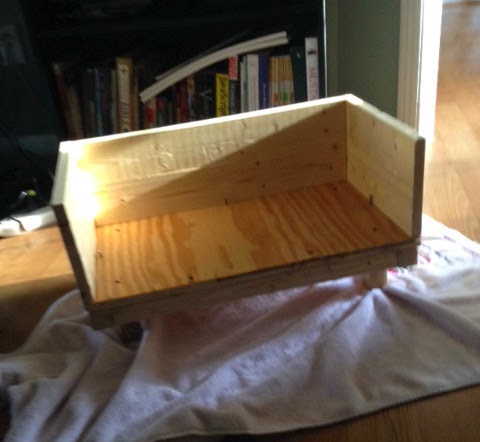
The next step was adding a little padding to the outside, and a lot to the inside. I had some great foam saved from boxes that came from the local Apple store, which I hot glued to the inside of the back and sides, then glued scrap fleece to the outside for just a little cushion. I also created removable seat cushions by layering the foam pieces together.

Once I was happy with the thickness, I cut the cushion blocks to size and created removable cushions for the back, as well. Then came time for upholstering.
I knew I wanted the look and feel of canvas duck, but canvas would have been way too stiff. Instead I purchased a yard and a half of black cotton linen, since the texture was similar but the fabric was much softer. I also purchased black felt to put underneath the cushions, as it would add more friction and keep the cushions in place. I spent $13 on fabric and felt, bringing the project cost up to $19.

Using a roll of Swedish tracing paper (which every seamstress should have!) I created a pattern for the upholstery and fitted the cut fabric to the couch. I pinned everywhere I’d need to put a seam, then sewed the whole thing together by machine. It was just enough fabric to cover everything I needed it to, since the space under the seat cushions was covered in felt and the bottoms of the seat cushions were a slightly stretchy scrap fabric I had on hand, making it easier to slide the cushions in. The cushions for the back of the couch were all black linen and harder to put on. The cushion covers were sewn shut by hand, using a hidden stitch. Once the fabric for the body of the couch was sewn, I pulled it on, nice and snug, and folded it under to glue to the bottom of the 2×2 frame.
All in all, for my first furniture project, I think it turned out great!

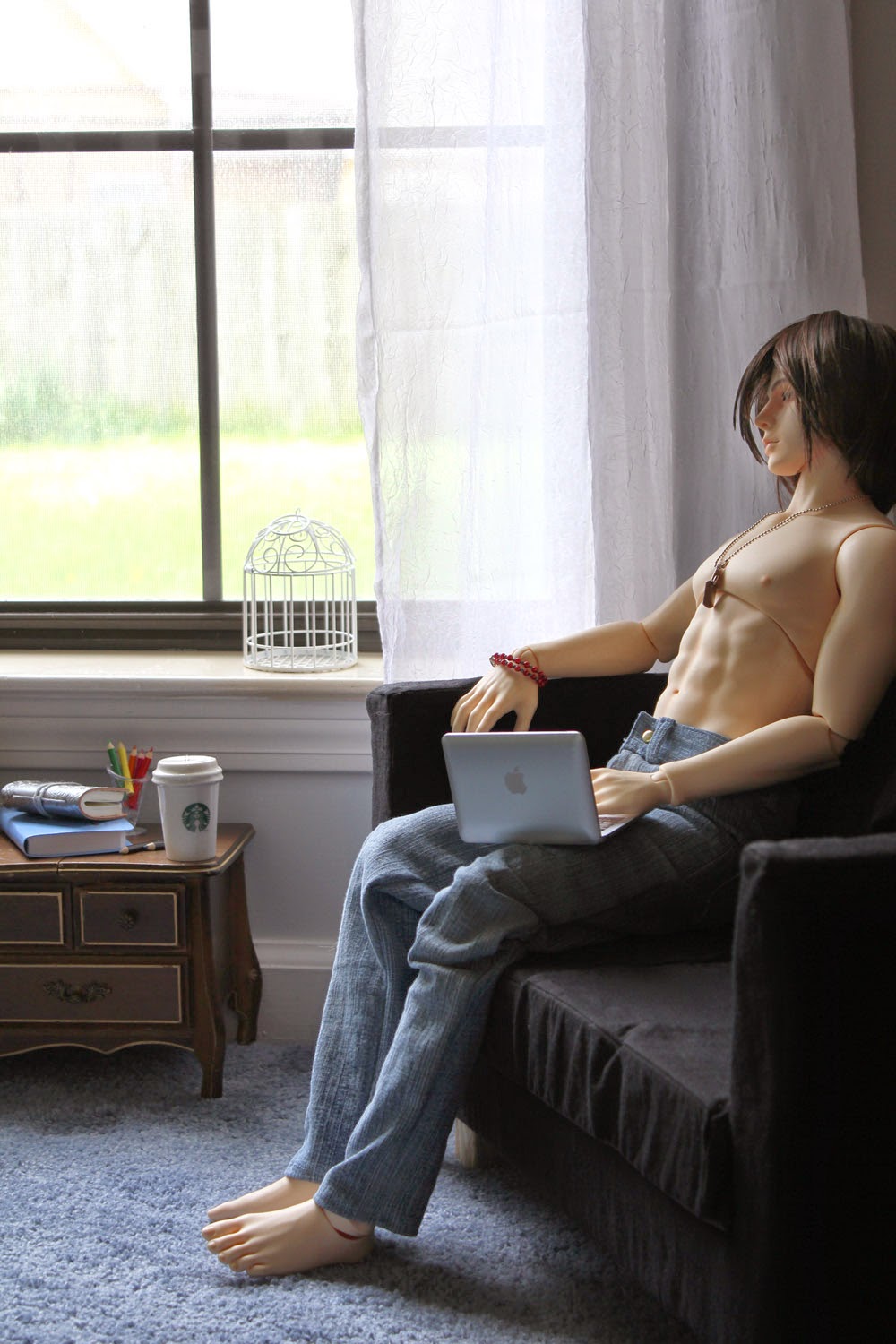
It works beautifully with my very large EID doll…
…and it works great for my 2-year-old, too.

Not bad for $19!
May 19, 2015
Teavana’s Pineapple Kona Pop
While I’m still working my way through the huge number of samples I got from Persimmon Tree Tea, I had an itch for something really fruity that those teas just couldn’t scratch. I recalled the bag of Pineapple Kona Pop I got for my husband (that he never drank) on a trip to Teavana, and decided to give it a try.
 An herbal blend made with candied pineapple, bits of apples and just a bit of orange, it was definitely fruity, but I expected something sweet. Yikes!
This blend was very tart. The orange blossoms provided just a hint of citrus, but the primary flavor is pineapple, with the rest of the mix creating a taste similar to passion fruit. There’s hibiscus in there somewhere, but the other flavors are so bold that you can’t really taste it.
I added a half teaspoon of rock sugar, which took the edge off the tartness so I wasn’t puckering quite so much. Even sweetened, this brew didn’t do much for me, but my 2-year-old was a big fan. She gulped down all of her share and asked for more, then finished what was left in my cup after she was done with her refill. I’ve decided this one will be a good treat to keep on hand for her, especially since as an herbal blend, it’s caffeine free. Also, after I described the flavor to my husband, he seemed more interested in drinking it. So this one might not be for me, but it’s definitely not going to go to waste.
In my opinion, this was better sweetened and mixed with the Blueberry Bliss, like the sample offered in the store.
May 12, 2015
Decoden sweets as BJD props
In early March, I earned an Etsy gift card by participating in a survey. I was delighted, but it was surprisingly hard to find something to buy. There were dozens of things I wanted, but most places didn’t accept Etsy gift cards as payment. After considering for a while, I decided to take a gamble with my free money and get some decoden supplies I’d been eyeing as potential ball-jointed doll props.

They come in a wide variety of shapes and sizes, so I spent an afternoon looking and decided to buy from a shop called HappyKawaiiSupplies. It took me a while to pick what I wanted, but I’m happy with most of my choices. Here’s a full shot of what I got:

The two big splurges were the decoden cream, silicone mold and the colored hot glue sticks. I also got some eye screws for other projects, which aren’t pictured here. Though I’ve heard you can use caulk as decorating cream for decoden, it doesn’t smell the greatest. Since I do all my crafting around a toddler, I decided the $5 for non-toxic simulated cream was worth it. The mold is the blue thing to the right. It’s just the right shape for making the bases of pies for very small dolls or tarts for very large dolls. Everything you see here doesn’t come cheap, though – It’ll set you back a solid $50. And I bought it on sale. So what works and what doesn’t?
 I bought a few things hoping they’d work for my biggest dolls. Since they’re EID, SID and Feeple65 sizes, it can be tough to find props in a decent scale. The parfait cups work great, as does the raspberry dessert. To the right, you can see them in my EID’s hands.
The parfait cups weren’t my first choice, but they were the largest available in the shop and I didn’t think the smaller ones would work for such big dolls, though they’d be great for MSD or YoSD. The raspberry tart would be laughably big for any smaller sizes, though.
 The cake slice is also a great size for the big dolls, though the ice cream dishes are pitifully small. EIDs have large hands, but they were tiny even in my F65’s grasp. They did, however, work well for my YoSD-sized Littlefee, so I don’t feel like that purchase was a waste. I keep all sorts of dishes on hand that are my baby’s size, so why wouldn’t Lulu have dishes her size too?

Without a doubt, the orange slices are my favorite. They’re a great size for both my large dolls and my Littlefee.
The detail on the slices is great and unlike many of the pieces I got, they’re detailed on both sides. As a result, I think I’ll be keeping them loose instead of putting them on top of the cake slice like I originally planned. They’re actually very pretty to look at, beautifully translucent. They look like normal orange slices in a YoSD’s hand, and look like mandarin slices in the grasp of my larger dolls, like my F65 below.

 I got quite a few bagel / unfinished donut pieces thinking they’d work well for the big dolls, but they were a bit smaller than I expected. They’ll still work in a pinch, but they aren’t scaled as well as I hoped. Mini donuts, maybe? The fudge stripe cookies, on the other hand, are spot-on! I kind of wish I’d gotten a few more.
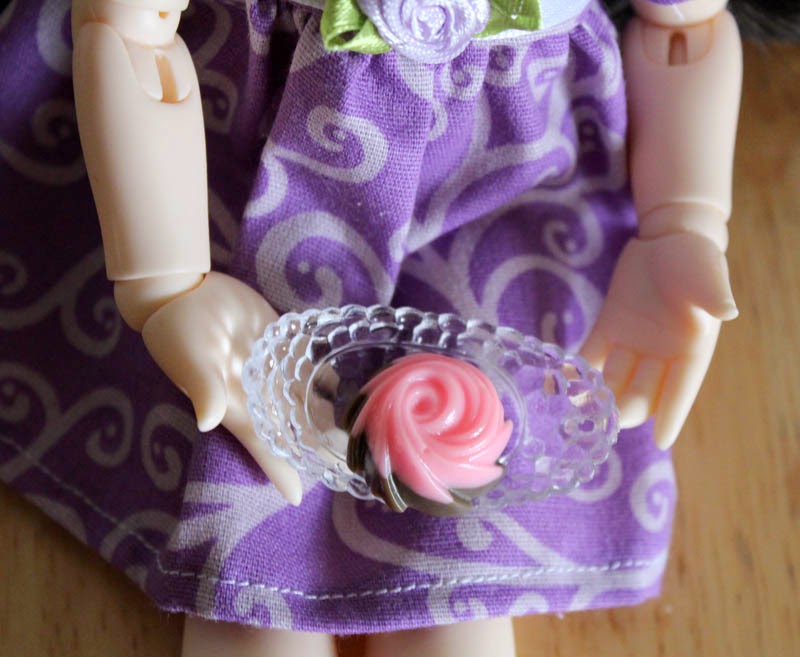
Everything else was laughably too small for the large dolls, though a number of things worked nicely for my Littlefee. The ice cream dishes and the pudding pieces make a nice dessert that’s just her size. Unfortunately, the pudding pieces are the one thing I was disappointed with, as 5 out of 6 have very visible bubbles in the top. It’d be okay for using as actual decoden embellishments, but not so great for doll props.

But Lulu has plenty of other delightful desserts that are a perfect size for her, like the white donuts and these adorable cupcakes:


That couldn’t be scaled more perfectly! The donut is almost as good. The fudge stripe cookies are a bit on the big side, but I find them acceptable for her specifically, as she’s supposed to be a small toddler in comparison to my other dolls. Some of the very small cakes look like snack cakes in her hands, too, meaning Lulu has a lot of options for treats in her photoshoot future. I particularly love how they look in her hands, so here’s a few shots of those:


 Most of the small cakes are meant for Lillibelle’s bakery, though. While the raspberry dessert is hilariously almost as large as she is, the little cakes suit her beautifully. I chose a few favorites this time, but definitely plan to go back and order more to stock the shelves of her little bakery, which sits beside my workshop table most of the time.

The cupcake is just a little too big, and looks sort of like those “mile high pies” I see advertised on billboards along the interstate. It won’t look out of place in her bakery, I don’t think, but a scale cupcake would be maybe half that size. Still, it’s better than the white donut, which is as big as her whole face, and the orange slices, which are bigger than her dainty little hands. The little cakes are best:


The pudding is an okay dessert for her, though the ice cream tray looks more like a serving platter. Not bad, as I have two–it just means I have one for Lilli’s bakery displays and one for Lulu’s snacks.
Last of all is the set of polymer fruit canes I got thinking to use as embellishments for PukiPuki-sized desserts I want to try making in the future. The orange canes aren’t as attractive as the others, but they’re better than I could do and scaled beautifully for use with Lillibelle.

On the whole, I’m happy with the order, though I can only recommend use of decoden cabochons as props for YoSD and smaller BJDs. The others are just too tough to match, though I was lucky to get as close as I did. If I had it to do over, I’d get fewer of the unfinished donuts and white donuts, skip the puddings and ice cream dishes, and get more tiny cakes for my PukiPuki instead.