Beth Alvarez's Blog, page 41
November 20, 2015
Obsession
There had to be a key, she simply hadn’t found it yet. Twisting a curl of her black hair, the mage girl mumbled to herself as she paged back through her book. That was the way with everything; no matter how complicated a knot, as long as you kept picking at it, it would eventually give way.
Envesi didn’t recall how long she’d been studying. It was her uncle’s notes that had first intrigued her, drawing her into this field of study. His peers thought him odd, but they’d never spent as much time working with him as she had. At first, her position as Tanvar’s apprentice had only been to keep her out of trouble. It wasn’t that she’d been in trouble, precisely, but that was just the sort of people her parents were.
Had it not been for her uncle’s superior strength in magic, she might have thought herself an oddity. Neither of her parents made particularly powerful mages, and as far as she knew, none of her younger siblings had yet manifested any sort of Gift. Her family preferred politics to sorcery, as they called it. But they recognized the value in having mages in the family, and so had indulged her desire to learn, placing her beneath Tanvar’s tutelage.
It was then that she’d become acquainted with his work.
It was a fascinating notion, the idea someone could loosen the ties of magic. Anyone who knew anything about magecraft knew that an affinity to a particular type of power was permanent; only her uncle had thought to challenge the idea.
Magic was a river, they said. Once it cut its path, it was impossible to change the flow. This was how the bonds of affinity worked, limiting the path one’s power could take, the same way a river was limited by its banks.
Tanvar thought it worked differently. Rather than a river, the forces of magic were but droplets on a windowpane, tracing a path downward. As it traveled, it gained momentum, drawing in the droplets around it. But, like a rivulet streaming down the window, enough force could change its direction.
Of course, there was little reason to try. Even if Tanvar’s suspicion proved correct, shifting the direction of one’s magic would only push them into a different affinity, and what difference did that make? Perhaps with enough practice, a mage could learn to shift affinities on demand, but there had to be a better solution.
If there weren’t, there wouldn’t still be free mages.
“Still here, little blossom?” Tanvar chuckled as he stepped into the room.
“Yes, uncle.” Sometimes Envesi forgot that her study space was his office; she spent more time there than he did.
He turned down one of the lamps, making the office just dim enough that she couldn’t keep reading. “You know you ought to be sleeping. Your parents will be here early in the morning, and they have important news.”
Envesi tried not to groan. “I already know what they’re going to say, and I don’t care.”
“You’re nearly twenty pents, blossom. You should be happy to marry.”
“And at nearly twenty pents, I’m one of the youngest women to ever wear Master white,” she replied, mindful not to be curt. Tanvar was kind to her; it wouldn’t do to snap at him for something that wasn’t his fault. “I have no intention of being married off.”
“And what do you intend, child?” her uncle asked, raising a brow.
To determine what truly limited power. To discover how to manipulate it. It was not a knot that tied their magic to one element, but a tapestry of something, woven and thrown over their Gift to leave only a narrow channel exposed. To understand the limitations her uncle hadn’t yet determined. To find the woven powers that held them, and determine how to pull them apart. To find the tapestry’s edge and rend it.
Only then could she understand the true nature of magic, understand the power that flowed in her veins as surely as her blood.
Only then could she harness it all.
She licked her lips. “To expand on your research, Uncle. That’s all.”
And all she could now imagine.
This week’s prompt was “Obsession.”
The lovely Megan Cutler covered this prompt back in September!


November 17, 2015
Alchemy
When I was a child, I had a fascination with potions. I don’t know if it stemmed from my reading habits, video games, or something else, but as far back as I can remember, I was always mixing something.
I developed a love for tiny bottles, test tubes, apothecary jars, anything that looked like a fictional witch might have it hidden in her lair for mixing concoctions. I also went through phases of fancying myself to be one of those witches, hovering over a cauldron, mixing up some sort of brew. But like Glinda, I was going to be a good witch. More like a fairy, really; just maybe with a gauzy black dress instead of pink.
I spent a lot of time gathering ingredients for my potions. I dug up roots and picked odd looking plants, plucked petals off of flowers and sorted everything meticulously. I dried things out, pretending they were herbs for my potions, and practiced grinding herbs into pastes and seeds into powders, using two particularly nice rocks. I made my own dyes and inks from things I found in the yard and stored them in all sorts of nooks and crannies, under the back porch or in the crook of a tree. Mostly I just stained my fingers, but I occasionally tried to use feathers found in the yard to make tiny quill pens. The only one that ever worked came from a vulture.
 Some aspects of this interest stayed with me, manifesting in the form of my collection of odd bottles and jars, my beautiful marble mortar and pestle, and the home-grown herbs drying in my kitchen. But as I grew up, I learned to attach another word to this interest: Alchemy.
Despite its connections to modern chemistry, I was never interested in plain old chemistry, taught in every school. I was interested in something older, something that helped lead us to understanding chemistry in the first place, something that helped us find medicines. And despite my interest, I’ve never devoted much time to actually studying alchemy.
I’ve been reading a little the past few weeks, never in-depth studies, but casual browsing while I wait for ideas to pull themselves together in my head. If you’ve been keeping up with my flash fiction Fridays, you’ve probably noticed that one of the characters appearing in the short stories is an alchemist. She’s the reason I’m finally looking into alchemical things more seriously; her and the book she will be in.
Superstition attaches the name “alchemy” to a bad reputation, something perceived as fantasy or plain old flim-flam. Part of it comes from old beliefs about what alchemy was and what it could do, but a larger part comes from that “chemistry” and “alchemy” were declared separate things, with chemistry taking everything useful to its name, leaving only falsehoods to its mother.
Being that the book I’m writing is a fantasy tale, I can attach alchemy to something else, coloring its results with shades of magic. It’s not a new idea, but it’s still fun to explore, and studying the history of alchemy in our world is certainly an interesting trip. I don’t know yet where this story is going to take place; magical alchemy might not fit into Ithilear any better than it fits here.
But that’s part of the journey, and part of the fun of being a writer is creating something that indulges that small part of my inner child, quietly working the idea over between two grindstones in the corner of my mind.
November 13, 2015
How They Relate to Their Race
Demons.
It was a foolish name for them, though he understood why humans called them that. He didn’t doubt that the sirens singing their lonely songs among the rocks earned themselves the same label. Humans didn’t always understand things that were different, and they couldn’t relate to his people. Not that he would correct them; his kind had no name for themselves. And the longer he was out of the sea, the more he thought the label might fit.
The ocean lapped at his bare feet, beckoning him, calling him home. The gills on the sides of his neck had been dry so long they barely showed, folded closed, leaving little more than shadowed lines on his cyan skin. He longed for the water, for the tropical currents and blessed warmth of aquatic vents. He’d been on land too long to venture into cooler waters, his layer of insulating fat dwindled to nothing.
It was just one of many trade-offs he’d needed to survive.
Foam clung to his toes, whispering promises of freedom in the sea. He ignored it; there was nothing for him there. Not now. He’d not regained his strength, nor had he grown used to the itching of the leather patch where his left eye used to be. He’d told his host little of his life before, only that he’d been betrayed. The man praised him for waiting to exact revenge, muttering one of those odd human sayings about cold food. But years flowed differently for those with magic, and Elulyan did not wait.
He cloaked himself in magic during the day, hiding his brilliantly blue flesh and one crimson eye, but he did not wait. He was weakened without the power of his Overseer to feed upon, but he was coming into his own power; in time, it would be enough.
But he did not wait.
He worked, growing stronger, making allies, making plans. He studied, scouring the Great Coast for every sliver of information that could bring his Overseer to ruin. And every night, he stood at the sea, watching the waves and burning with resentment for the tight scars that lined his fingers, where the Overseer had cut away the webbing that let him swim.
The sound of the ocean shifted now, the song of the waves becoming mockery. Clenching his fists, Elulyan turned away from the surf, shutting out the sweet melody of the sirens that still drifted to the shore.
In time, he would be well.
And then he’d teach his people what the name demon meant.
This week’s prompt was “How They Relate to Their Race.”
The lovely Megan Cutler addressed this prompt back in September. Check it out!
November 10, 2015
Editing is hard, but it does get easier
Regardless of the genre they write or how long they’ve been at it, all the writers I’ve met have something in common. At one point or another, they’ve all told me that they hate editing.
I used to share the sentiment, a long time ago. Now I don’t see what the fuss is about. In fact, I much prefer editing to the actual writing part. I hate writing itself, struggling to get the words out in a way that makes at least enough sense that I can whip it into shape later. The editing process is much easier for me; it’s not difficult for me to edit 10 pages in an evening without straining myself or getting tired. For me, the hardest part is over. I’ve filled the sandbox, now I get to play in it.
But it wasn’t always that way.
Editing can be hard, but like everything else in life, it’s something that gets easier with practice. Aside from just practice, though, there are two important things that have to happen to improve your editing and make your writing what it really needs to be. Number one: You have to get feedback from other people. And number two: You have to grow a thicker skin.
There’s nothing like the first time you get a manuscript back from a friend or colleague, only to find your hours of work red-penned into oblivion. If you’re anything like me, you’ve probably had it happen and cried when it did. And that’s understandable; this is your ambition, probably your greatest life’s work up until this point. It hurts to see your efforts hacked to pieces and bleeding that red ink all over the page, but it gets better. In more ways than one.
It might feel like a blow to your ego, but they don’t mean it personally. They most likely don’t mean to hurt your feelings, and if your friends are the ones doing the beta reading for you, they say what they do only because they want to help you make your work the best it can be. One of the first times I sent manuscript to a friend for proofreading, the chapter that was hit the hardest was one of my favorite chapters out of the entire book. I had been proud of it until then, and when she was done with it, there was barely a sentence that had escaped unscathed. At first I was upset, and I was offended. I thought she didn’t understand what I was trying to do, or maybe didn’t appreciate everything I put into that chapter. Fuming, I put her notes aside for a few weeks, too annoyed to even look at them. But when I picked them up again after cooling off, I discovered that everything she said had merit, and I had a lot of rewriting to do.
I’ve written a handful of books since then. Now when I open reader notes to find a sea of red, I hardly bat an eye. I don’t growl or puff my cheeks when someone picks my words to pieces, and I don’t take time to walk away, either. I don’t need to, because seeing I’ve made mistakes doesn’t hurt any more. It’s just part of the process, but it’s growth that wouldn’t have come about if I hadn’t started having peers review my work.
But this isn’t just about the benefit of having a thicker hide. There’s a greater benefit that comes from having others read your work and help you edit, and it’s that you learn your shortcomings and biggest weaknesses. As you become familiar with where you struggle most, as you spend time editing those mistakes out of existence, you stop making them. Each manuscript I’ve written has been cleaner than the last, needing less and less editing, and coming back from readers with fewer markings on the page. Sometimes there won’t even be a comment for several pages! This wouldn’t have happened without the feedback that helped me develop my editorial skills, and definitely wouldn’t have happened if I hadn’t been open minded to their suggestions and my need to rewrite things I loved.
This is why more experienced writers tell you to “kill your darlings,” and why that continues to be one of the most prevalent pieces of writing advice. Unfortunately, only experience will show you they’re right. Years from now you’ll look back and realize people have been telling you that for years, but you never understood what they meant until that moment. It’s a rite of passage for all writers, and another lesson that always has to be learned the hard way. That’s why I just say this: Keep editing. It gets easier.
Eventually.
November 6, 2015
Mixtures
Sometimes, no matter how many precautions she took, things went wrong.
They were not the explosive accidents of her novice days, but they were mistakes, nonetheless. Improper measurements happened, sometimes from a fuzzy head after a late night. Delicate mixtures bubbled over when her back was turned for only a second. Reagents scorched when the burner’s flame was set just a little too high. Accidents were part of experimentation, and experimentation was the heart of progress.
It was benevolence that made Laele first pursue alchemy. Medics and true healers were sometimes few and far between, rarely able to travel, rarely able to attend people in isolated villages. It was one of many situations where her potions and elixirs could be of help. They would last for months on a cool cellar shelf, kept handy for the inevitable night when a child’s fever wouldn’t break and there were no medics to be found.
It was determination, however, that kept her struggling on through trial and error, mistake after mistake, and more failed mixtures than she could recall.
Months had been spent on this particular concoction. A fortune spent on herbs and distilled essences, too. She could have made them herself, but that took time, and every minute spent making her own reagents was minutes spent away from the troublesome brew she simply couldn’t conquer.
Colorful herbs stained her fingertips and her collection of mortars, each of the bowls a different color, a streak of yellow from a crushed flower marking her forehead from where she’d absently wiped away the sweat of concentration. From the moment she sat down, she’d known it would be a goal-changing night. Either she accomplished what she’d set out to do, creating one of the most powerful anti-toxins ever designed, or she’d know once and for all which of the herbs was to blame for the foul sludge she’d poured out every night for ages.
One by one, she’d tested them. Each and every one. Leaves, stems, roots, fruit and blossom all had to be tested individually; each part of the plant contained its own unique properties. And one after another, she’d found everything stable, performing exactly what she’d hoped for. Up until the last one.
Was it the shoot’s leaves or the stem she needed for that potion?
Was it the leaves or stem that had reacted badly with the mixture?
Her fingers wriggled above the reagents laid out on the counter. One or the other, she just had to take a chance. No matter what she picked, she’d have her answer, a long-plaguing problem finally solved.
She jammed the last ingredient into the glass beaker and scooped up the narrow tube of blue fluid, sucking in a deep breath before she poured it in and put it all together.
Plumes of color spread from the paste of herbs and powders in the bottom of the beaker, darkening as they expanded to fill the glass. She exhaled, beaming.
It exploded.
This week’s prompt was “A memory linked to their occupation/profession.” As usual, my companions are far ahead of me! You can read the lovely Megan Cutler’s take on this prompt at her blog.
November 3, 2015
Simplifications of time: Creating a calendar for Ithilear
A friend on Facebook recently asked for opinions while doing world building for her story, which set me off in an interesting direction. Her question was how she should determine a calendar for her world. My suggestion was that she didn’t bother.
 Some worlds greatly benefit from having a calendar shaped to their usage of time, but for many, it doesn’t seem to make any difference. Custom calendars appear to be more prevalent in sci-fi, and for good reason; most space explorers we read about originate here on Earth, making it important for us to distinguish the differences in how time is handled on other planets.
While I’ve read quite a few fantasy stories that create their own calendar, it ultimately has little impact on how the story plays out. The main reason for this seems to be that we default our understanding of weeks, months and years to what we practice in our own lives. It’s a system that’s arbitrary and complex, complete with half days, extra seconds, leap years, and lots of mathematics. But because we’re familiar with it, it’s easy to understand. So regardless of whether or not Robert Jordan took the time to add a tidbit about the Wheel of Time’s world featuring ten-day weeks to the appendices, it doesn’t do a thing to change how the story plays out. And because it’s never mentioned in the body of any book’s text, every time a character mentions a week, what do we think of?
Seven days.
At the same time, authors like Tolkien have often been criticized for using Earth’s calendar for their books. So what’s a writer supposed to do? I suppose the answer is simple: Do whatever makes you happy.
The main reason I recommended that my friend not create a custom calendar was because of her story’s ties to Earth, and that the people within the story will hear mention of Earth’s methods of time keeping, but never be told how long a week is supposed to be. This could, of course, go either way; the characters in the story will default to assuming a week on Earth is the same length as their week. But unless their concept of time is clearly mentioned and emphasized as being different, readers will default to assuming time is measured the same way there as it is here.
For me, though, there’s not much excuse, aside from that I’d never actually considered it.
There’s a lot of thought that has to go into creation of a world’s calendar, things that may not initially cross your mind. To an outsider, our methods of defining a day probably makes sense. And a year is defined by the number of days in our planet’s orbit of the sun, which also makes sense. But 52.14 weeks is a little odd, and then the way we sort our months–February with 28 (or sometimes 29) days, July and August back-to-back with 31, throwing off the rhythm of alternating numbers of days–would be very peculiar to an extraterrestrial visitor.
But you also can’t stray too far from Earth’s calculations without incurring some serious math and study. Some people might be interested in working out the speed of planet rotation and orbit, coupled with the size of their planet and the planet’s sun to determine that sun’s “Goldilocks zone.” Then comes considering how a faster or slower orbit would affect things like gravity, plant life, weather and seasons.
I’m not. So when I started working out a calendar for Ithilear, I decided to base a lot of planetary information off our home world.
Their founding race is smitten with order, so I figured it only made sense for their year to align itself for neat division. This division works as one of the founding reasons for their fondness of organization, and the simplification of time measurements makes it easier for both me and my readers. So Ithilear ends up with 7 days in a week, 28 days in a month, and 13 months in a year, giving me a total of 364 days per year. It’s scientifically unrealistic, but since I’ve also got people throwing fireballs out of their fingertips and tearing holes in reality to traverse the globe in a step, I’m not too concerned with the realism of it.
After working out all sorts of calendar information, I considered reworking the number of hours in an Ithilean day, but ultimately discarded the idea. The number of hours in a day never really comes up within the books, and it doesn’t ultimately make a difference in the flow of the story, so that’s one that I’m not going to touch. I’ll just leave it open to interpretation, because sometimes simplification is best.
In any event, the calendar information for Ithilear is now available for perusal by either checking the link to the left (Located under the “Serpent’s Tears” category) or by clicking here.
Happy reading!
October 30, 2015
The job of the artist
“The job of the artist doesn’t end with drawings of structure and anatomy.”
Rolling his eyes, Rhyllyn resisted the urge to sigh. “What does that have to do with—Ow!” He jerked forward, holding his head with both hands. “What was that for?”
“I saw that.” His brother leveled a claw with his nose, scowling. “Now shush, I’m trying to talk.”
Rhyllyn lowered his eyes, shifting his guitar on his lap. He wasn’t in the mood for a lecture after hours of fruitless practice, but there wasn’t any avoiding it. There was no one as bullheaded as his elder brother. “But what does that have to do with what I’m doing?”
“Everything.” Rune dropped to sit on the couch opposite, resting his elbows on his knees and frowning at the low table between them. “Accuracy isn’t even the most important thing, but that’s what you’re stuck on. You’re putting so much effort into having every note perfect that you’re forgetting everything else. But go sit and watch the painters studying at that college of yours, and you’ll see they have the same problem as you. No matter how perfect their form, they’re still missing something. All they’re doing is replicating work done by masters.”
Snorting, Rhyllyn slid his fingers over the strings, listening to the whisper of sound that echoed in the instrument’s body. “Having every note right should count for something.”
“If it did, would you be here sulking right now?”
He didn’t reply, running his hand over the strings again. It was a trick question, anyway. Either he accidentally acknowledged that he was sulking, or he denied it and proved himself sulky.
“Your problem is that there’s no passion in what you’re doing,” Rune continued. “No feeling. If a piece can’t evoke emotion, then what purpose does it have?”
“You sound like one of my professors when you talk like that,” Rhyllyn said. “Did you study with them?”
Rune shook his head. “No, but I had a thorough education.”
Shrugging, Rhyllyn pretended it didn’t matter. “Anyway, how am I supposed to have any passion for it? This song was assigned to me, I didn’t pick it. I wouldn’t have picked a love ballad, I don’t know anything about love.”
“Well, maybe you should learn.”
The suggestion made a chill run right through him. It took everything Rhyllyn had not to shudder. “You know how old I am, right?”
His brother only raised a brow.
It was an ambiguous question, anyway; his growth had slowed after his magic stirred, and he’d been stuck in the body of a teenager for longer than he liked. It wasn’t as bad as it could be, since he was surrounded by mages at the college, but he’d always thought he’d be old and grown and married when he was thirty. Not that he would look half his age and feel it, too.
Of course, in retrospect, maybe magic slowing his aging was a blessing. He couldn’t picture trying to live like an adult. Goodness knew he didn’t feel like one.
“What would you know, anyway?” Rhyllyn muttered, looking away. “You don’t have any women in your life, either.”
The corner of Rune’s mouth twitched. Rhyllyn thought he’d struck a nerve until his brother shrugged, pushing himself up from the couch.
“Maybe you should read on it,” Rune said. “There are plenty of books in the study. Maybe reading some of the old romantic legends would help get you in the spirit of the song before you have to perform it.”
“Where are you going?” Rhyllyn turned to watch him leave.
“Upstairs. I’ll see you in the morning. If you don’t keep me up all night with that thing.” Rune gave the instrument a dirty look before slipping out of the parlor.
Rhyllyn frowned. Perhaps he had struck a nerve after all.
He didn’t mean to rile his brother; it just couldn’t be avoided, sometimes. The man was foul-tempered and incredibly stubborn, and as Rhyllyn came into his own, he found they clashed more often.
And yet the bond between them was unwavering. They shared no blood and aside from their claws, scales and unusual eyes, there was no resemblance between them. Rune had adopted him as brother by choice and had always treated him as a sibling might, though his role had been closer to that of father in the early years. He’d related a lot of wisdom in the years they’d been together, Rhyllyn admitted; he just didn’t want to hear any of it right now.
Instead he sulked, hunching over his guitar, picking at the strings without letting them sing. The way he saw it, he was allowed a little sulking. None of this had been his choice. He’d wanted to learn the lute, but his instructor thought his claws and missing fingers would hinder him on the strings, so he’d been given a guitar instead. He’d wanted to play a war ballad for his performance, but his instructor thought his preferred piece too advanced, so he’d been assigned a traditional love ballad instead. He’d wanted to make his music into his career, but his brother and Alira—the mage being the closest thing to a mother Rhyllyn had—both pushed him to prioritize his magic studies first.
It wasn’t that he didn’t understand their reasoning. He understood perfectly. The problem was that he just didn’t agree. Regardless of what Rune and Alira said, music was his greatest gift, not his magic. Rune had often told him that there would be time for music after he had the foundations of magic beneath his belt, but he didn’t see why he couldn’t study them in tandem.
But he had his assignments now, and he couldn’t sulk over them forever. Sulking didn’t excuse him from having to play the piece in public.
He stretched and sighed, sliding off the couch and padding across the soft carpet. The rest of the house was quiet, as usual; it was just the two of them at the manor, plus Alira, whenever she visited from the Royal City. Most of the oil lamps had been extinguished, but the one in the entryway was still lit, as was the one in the study. Rhyllyn snorted at that, shifting his guitar to his other hand as he moved in that direction. His brother knew him well.
Books already waited on the desk, all with unfamiliar titles. Unlike his brother, Rhyllyn didn’t read for pleasure. He leaned his guitar against the edge of the desk, settling on the chair before it and reaching for the first book on the pile. Reading wasn’t how he wanted to spend the night, but Rune was right; it was a good way to make himself familiar with the work ahead of him.
Turning a few pages in, he skimmed the words without real interest. Here and there he found pages with notes on the margins, written in a strange script he couldn’t read. His brow furrowed. The farther into the book he went, the more notes there were, coupled with tiny drawings.
The next book was filled with the same, empty spaces around the page filled with the same looping script and drawings. The illustrations were odd, little more than fleeting glimpses of something. The shape of an eye, the impression of a woman’s profile, dark hair cascading over a shoulder.
And then the written text changed. No longer the strange letters that hovered on the edge of familiarity, the notes were scrawled in the letters of the trade tongue. Words he knew, written in a hand he recognized.
All of a sudden it made him uncomfortable, as if he were viewing something he shouldn’t.
The meanings of the stories on the pages changed, no longer the frivolous tales he’d assumed. Instead he saw fervor, hurt and longing; a dissonance of emotions that consumed a person who never showed anything but strength.
Slowly, he turned the pages of all the books before him, finally settling on a page that showed a fine-featured silhouette.
Passion, his brother had said.
Rhyllyn hadn’t understood, mistaking passion for romance. It was something else, something more powerful, something that swept someone up and burned within them for the rest of their days.
His music lacked passion, and yet passion was what had driven him to it in the first place.
The weight of what sat before him didn’t escape his notice; it was intensely personal, private, and yet had been shared. Squeezing his eyes closed, he exhaled. “Thank you, brother,” he murmured.
Studying the woman’s silhouette on the page before him, he picked up his guitar.
******
This week’s prompt was a little unusual, directing me to use the first line of the last paragraph of page 51 in the book nearest to me. The book nearest to me was actually a paperback copy of Death of the Sun, and it felt really weird trying to do a prompt off a line I’d written! So I used the second-closest book, instead.
My line is from Imaginative Realism: How to Paint What Doesn’t Exist by James Gurney: “The job of the artist doesn’t end with drawings of structure and anatomy.”
October 27, 2015
Connections
I’ve been to the local zoo several times in the past year, and each visit has been a very different experience. Some zoos are better than others, both in what they have to offer and how they treat the animals, but our local zoo is often praised for both. Personally speaking, I have mixed feelings on zoo practices; some animals take to it better than others. The wolves here, for instance, always act happy when I see them. Same with the elephants, who have plenty of stimulation and interaction. The jaguars and servals appear less content, always restless and pacing.
And then there are the gorillas.
Generally speaking, I don’t like apes or monkeys. I don’t think most of them are cute, and the smell is simply unpleasant. I don’t like movies or TV shows that show chimpanzees baring their teeth in a sign of nervousness that we misinterpret as a smile, and I always feel like my distaste for these creatures is vindicated whenever I hear freakish stories of chimps ripping people apart.
Because of my dislike, I typically avoid monkey and ape exhibits. But I have a two-year-old now, and like most toddlers, she loves monkeys. So of course, we had to go. And to her delight, one of the apes was close to the side of the enclosure.

My husband and I discussed how you’re not supposed to look a gorilla in the eyes; it can be seen as an act of aggression. After seeing that viral video of an annoyed silverback cracking the glass of his enclosure earlier this year, the last thing I wanted to do was annoy a gorilla. But the lady on the other side of the glass had other ideas.
I tried to take a picture for my little one, averting my eyes every time she looked at me. She rocked forward, leaned back, tilted her head, then started pretending not to be interested–only to look at me suddenly, trying to catch my gaze. Eventually, I gave in. She leaned forward again, trying to catch my attention, and I met her eyes.
I’ve met a lot of animals, some with more personality than others. They were nothing like this. A warm, rich russet, hers were more expressive than the eyes of some people I’ve known. I saw deep thought and emotion enough to wrench my heart. I could have known from her eyes alone, but she touched her face too, expressing in one gesture what some can’t seem to say in a dozen breaths.
She was sad.
All of a sudden, it was a terrible thing to be on the other side of that glass. I knew she was unhappy, but I didn’t know why. Was it captivity? Loneliness? Missing her family? She kept looking at my daughter, was she saying she was sad because she didn’t have a baby? I couldn’t understand the why of it, and she had no way to tell me. But it didn’t matter. She was sad, and that, I understood. And then I was sad too.
I didn’t know why she’d picked me, out of all the people visiting the zoo that day, but she inclined her head, not quite a nod. My face reflected what she felt, and she seemed to take comfort in knowing I understood. Then she looked away, and she didn’t try to catch my eye–or the eye of anyone else–again.
The whole thing was fast and fleeting, something over in less than a minute. But it was moving, powerful, and reinforced my belief that while breeding programs might be important for species preservation, normal zoos aren’t the sort of place gorillas belong.
October 23, 2015
What she found under the snow
The fat snowflakes that drifted on the morning wind still seemed foreign, even after all these years.
Kaia lifted her hand, catching one on her fingertip and watching it melt. She’d grown weary of snow, though she wouldn’t admit it. The landscape in this world was always the same; dark, snowy, gloomy. Even the evergreens appeared dreary after a while, as if they, too, awaited a spring that would never come.
Few of this world’s natives seemed to notice or care. It was rare for anyone to leave their home world, rarer still for someone to be in her situation, where she no longer had a world to return to. She longed for its sun, the salty tang of ocean air, the feeling of warm sand beneath her feet while the blue seas lapped at her toes. Her sun-kissed skin and raven hair were out of place here, but she was grateful; not everyone forced to flee had found a new home.
Not everyone forced to flee had survived.
The stars faded from the sky as rosy pinks filled the horizon. Kaia had been told that other worlds had both day and night, though she found it difficult to imagine. There was no daytime here, just as there had been no nighttime back home. Having both sounded like a fantasy, the sun and moon taking turns traversing the sky, even bringing about a change of seasons. That was how she’d learned about what they called spring, an idea she’d found charming, something she yearned for with every fiber of her being. It heralded summer and the life she’d once known.
But then there was autumn, a dismal time of year where everything withered and died, the world fading into the bitter depths of winter. Thinking of it made her more aware of the cold and, shivering, she pulled the fur-lined hood of her coat tighter. Then she stood, brushing snow from her knees and turning toward the stone palace that loomed out of the icy cliffside.
She didn’t want to spend the rest of her life in the kitchens, but at least the kitchens were warm. It was the only place she ever felt comfortable, able to shed her many layers and warm her skin beside the fire. The work was difficult, but it wasn’t all bad. She was free to stir the coals more than necessary, the dancing embers reminding her of fireflies, filling her head with memories of song-filled nights on the beach.
Already one of her father’s songs stirred in her throat. It was too cold to sing; the frosty air burned enough just breathing to hum, but the melody brought cheer and warmth, things that were sparse here. Kaia started to reach for the door’s latch, pausing when she noticed a fresh heap of snow atop one of the barrels outside. Her friends were few, but they were dear, and they always hid their notes and gifts beneath mounds of snow. The piles were so commonplace that everyone else ignored them, or didn’t notice they existed at all. But to Kaia, the snow was still foreign. She never missed their signs.
Tugging her glove tight, she stepped to the side of the door, digging into the pile of white to see what had been left for her this time. She blinked in surprise when she saw the splash of color, her dark eyebrows climbing her forehead.
Flowering quince, the reddish-pink blossoms covered in ice. The closest thing to spring one could find, and a plant only found growing in the queen’s private garden.
Oh, Gerel, she thought with a sigh, though she couldn’t help smiling. She shook snow from the tiny blossoms, tucking the little twig into her hair as she slipped inside.
He’d get himself in trouble yet.
******
This week’s prompt was “What [they] found under the snow.”
You can find my friends’ takes on this prompt here and here.
Happy reading!
October 20, 2015
Born of the Moon – Releasing December 1st!
This project has been a long time coming. I’ve been talking about the book in passing since late 2013, but since that was also my first year of being a mother, I made the difficult discovery that finding time to write wasn’t as easy as it used to be. I was honored and humbled by the number of people that contacted me after they read Death of the Sun, asking about whether or not they should get their hopes up for a continuation of the story. I refrained from giving a straight answer for as long as I was able, not because I didn’t plan to continue the series, but because I wasn’t sure when I could. It took me longer than I wanted, but it’s easier to get writing in these days, so I hope to have more regularity in my work from now on.
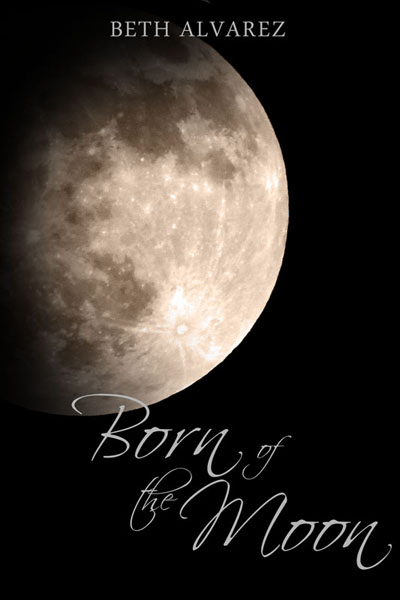
Some of you have already had a peek at this, but now it’s public and official: the cover for Born of the Moon, the sequel to Death of the Sun and the second installment in the After Undeath series!
I fleetingly mentioned this project while talking about taking pictures of the full moon through a telescope a few years back, and I’m glad to have had the opportunity to do it! I enjoy making my own book covers, though I tend to lean toward sleek and simple.
Anyway, the word series might have caught your eye up above, so I’ll expand on that a bit. I never intended for Death of the Sun to spawn a series, but it became evident pretty quick after I put the book out that there was a little more story to tell. This is the only direct sequel to Death of the Sun there’s going to be, but there are going to be more stories–short stories, maybe a novella or two–that will be considered part of the series. When they’ll come out, though, I can’t say right now. Some may pop up here as part of my collection of short stories, or might end up posted as a novelette, similar to what I did with Gale’s Gift.
Ready to see what’s coming? Read on.
Life after death isn’t all it’s cracked up to be.
It’s been six years since Blaine Moreau returned to the world of the living, keeping only his fangs as a souvenir. Though he didn’t expect the transition to be easy, a heartbeat comes with health problems, a sea of red tape, and the shine of new silver developing at his temples. Dealing with insurance claims and explaining away a shady employment history is enough without the added grief of being unable to satisfy his wife’s dreams of having a family.
Never mind old problems coming back to haunt him.
Without their vampire god to lead them, the clan is subject to a slow extinction, one Grace isn’t willing to accept. Clinging to her memories of their time together, she seeks Blaine, the only one who can help her have the life she wants.
But he’s not so eager to help. With everything else in shambles, the last thing he needs is undead on his doorstep.
Especially when one has a simple suggestion that could solve all his problems–or destroy everything he’s worked to build.
Sequel to Death of the Sun and second book in the After Undeath series, Born of the Moon is scheduled to release on December 1st.
Happy reading!