Maura Casey's Blog, page 3
June 11, 2025
The countryside, quiet? Nope
I’ve lived in bucolic rural areas for more than 30 years. But don’t be fooled. Those who think that there is nothing going on here aren’t paying attention.
The drama that occurs outside is absolutely endless.
I divide my time between reading the four newspapers to which I either subscribe or are addicted to and worrying about America’s government, which is an idiocracy sliding into authoritarianism. Then I become fascinated by the goings on of the furred and feathered animals in our neighborhood.
Guess which preoccupation is more relaxing?
Because no matter what happens, Mother Nature doesn’t give a damn about what we think is important. She cares for neither our priorities nor the anguished public hand-wringing of the day. She is not at all interested at what is in The New York Times or on Fox News.
But drama, she’s got. She has floods, fires and famine. She has murder, mayhem and tender love stores. And at least some of it is going on outside my barn office windows.
Since early spring we have been the happy landlords for a few ducks, who dabble in our pond undisturbed. For awhile we hosted two couples. Then one pair found a better place and moved on, perhaps one with a doorman or a health club.
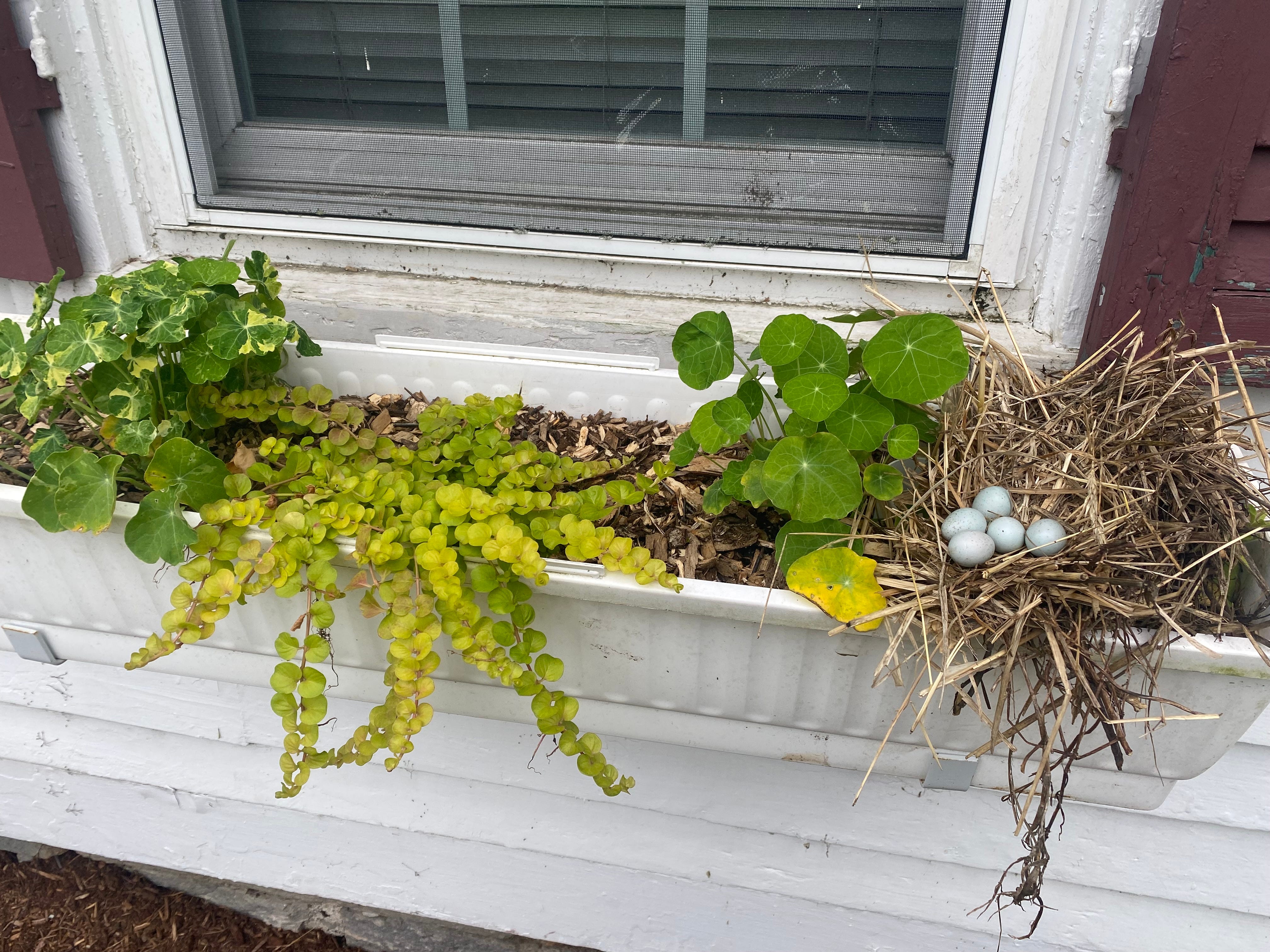 Abandoned nest, now in our window box
Then, suddenly, there was only one. One male. All alone. Swimming in circles in the pond. Where was the female?
For awhile my husband and I worried about what happened to our duck friend. There’s a lot of critters out here, after all. The reeds and meadows look harmless, but hide predators galore.
Then the answer became obvious. Motherhood happened. The female duck returned to the pond, with five little ducklings swimming after her. Sighs of relief! She was absent because she was being a good mom, guarding her clutch of eggs.
Given the carnivores in this area, both Pete and I were surprised the little ducks managed to survive. Even as we admired them, a red tailed hawk swooped by. They are extremely territorial, which we found out one spring when three hawks fought over the area encompassing our barn and farmland. Every morning for a week they screeched at one another, diving, soaring and doing the raptor equivalent of pounding their chests, until two gave up and left, or the biggest one had driven them both out of the area. Then things settled down.
The country isn’t quiet all the time. It’s just that our noise is different.Instead of honking horns and traffic, we have honking geese, screeching hawks, hooting owls, howls of coyotes… you catch my drift.
The coyotes unnerved me when I first moved out to the country. I thought coyotes were only found in Western states and knew them only as a backdrop to cowboy shoot-em-up movies. That changed the first week of moving away from a city. Connecticut is the third-smallest state in the United States, but where I live, far from the gold coast near New York City, trees and valleys abound. Plenty of places for the “American jackal” to settle and flourish, and they have. Their howling still gives me the creeps.
Another country vs. city revelation occurred three months after we first moved to rural Scotland, Connecticut, a little town tucked like an Easter egg into the lush hills. I was passing our living room reclining chair when I did a double-take. There, on the chair, looking ready to ask me for a beer and just about to reach for the TV remote, was the biggest spider I had ever seen outside a zoo. I am not afraid of spiders but this was big, hairy, had stripes and - I discovered later - eight eyes. I put a jar over the arachnid to remove it from its comfy perch and called the local university to find out what on Earth had gotten into my house.
“It’s a wolf spider,” said the calm professor over the phone. “They are typically shy, but great to have around to keep down the mouse population! Be sure and let him go.”
I did let him go, far away from the house, but it made me rethink the joys of living in the country. I didn’t like the idea of living near spiders big enough to eat mice. Would such spiders’ visits be a regular occurrence? I wondered. In that case, what was I doing there?
That was 35 years ago. I have not seen a wolf spider either in the wild or in my house in all the days since. Not even once. Maybe the incident was a hazing ritual Mother Nature inflicts on city people aiming to tame the untamable.
Finally, there are the smaller dramas, but dramas all the same.
We had someone out to work on our gutters last week. It was apparent they were no longer working well, and it was time to hire someone to do the repair work. One of the men on ladders 30 feet above the ground found a problem right away, and very gently, brought it down.
A nest. With eggs. He couldn’t bear to toss the nest and eggs away and neither could I, so he put them in a window box, hoping Mama would return.
She hasn’t. And probably won’t. Another example of the life-and-death drama outside my window, and now on my window box.


June 1, 2025
The impact of one life
I admit it. I am an addict.
I’m not talking about booze. After almost 40 years of not drinking, that is an old story by now.
Not just to words alone, either. Specifically, I am addicted to keeping diaries. I’ve done it since the age of 13. Not every day, of course. Sometimes not even every week.
And I almost never re-read them. Once I am done with a notebook, I toss it in aone of several boxes with the other 10 or 20, put the top on, and start a fresh notebook.
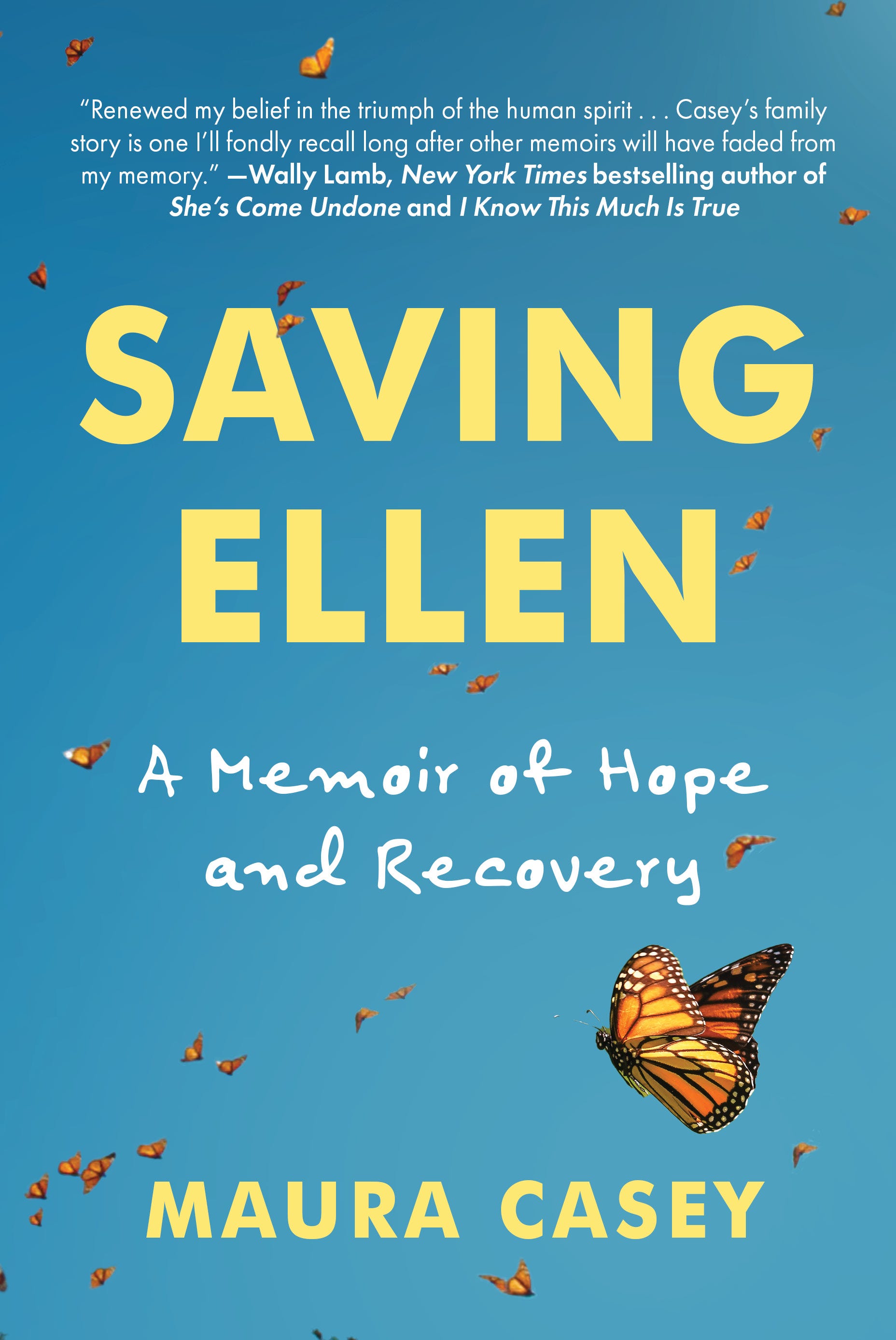
This habit of mine helped me a lot when it came to writing my book, “Saving Ellen: A Memoir of Hope and Recovery.” I dug out the journals I wrote in high school and college and found, to my astonishment, that they recorded pages of dialogue and scenes, some lovely, some bordering on violence, that occurred in and around our Buffalo, N.Y., home and summer cottage on Lake Ontario. Each entry was a primary source that came in handy.
Last week on a day when the news seemed particularly depressing (yes, it even gets to me sometimes), I pulled a few more journals I haven’t read in 40 years and began to read.
What I didn’t expect to find was inspiration during a time when, too often, I feel helpless before the onslaught of events that are both negative and unjust.
Journalists often get to meet interesting and even historic figures. Because I am a compulsive note taker I wrote about them all in my journals and in the pages of newspapers. Yet once I met a truly great woman, not because I am a journalist, but because I went to church at the right moment.
‘Who decides who gets the condo and who gets the cardboard box?’Kip Tiernan was and is a legend around Boston for helping the homeless. She began Rosie’s Place in the mid-1970s when she realized homeless women were disguising themselves as men just to get help — otherwise, they would be refused, as the services were for men only. Think about that kind of discrimination - even if you were in desperate need, being a woman meant you would be turned away.
Because Pete and I worked together for three years at a homeless shelter before we married, we were particularly interested in what she had to say. So we were seated in a pew when this tiny woman with short white hair wearing a hat approached the pulpit.
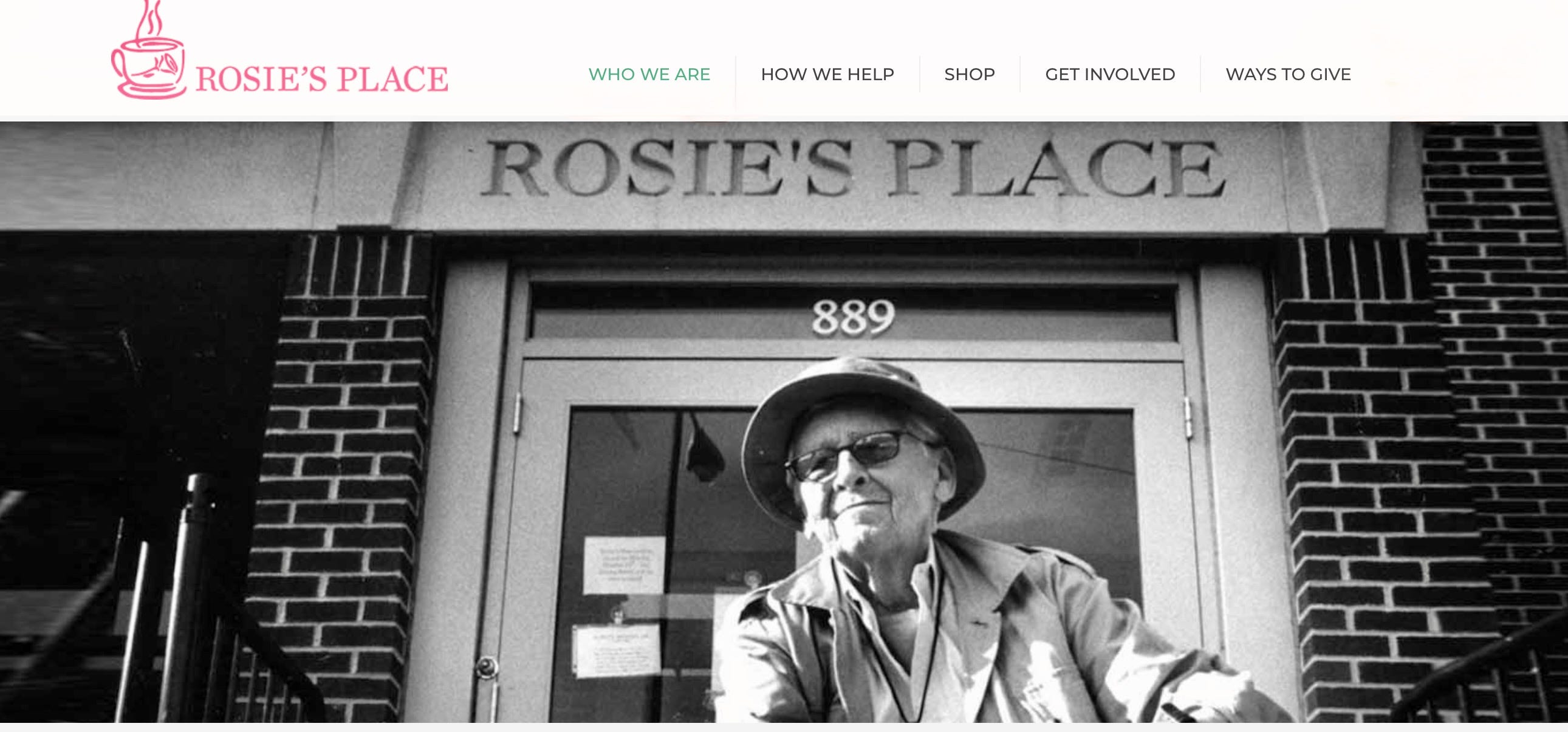 Rosie’s Place website with a picture of Kip Tiernan
Her words still are meaningful, so here is what I wrote 41 years ago this month:
June 29, 1984, Sunday
Pete and I went to the Arlington Street Unitarian Church today. A woman named Kip Tiernan gave the homily and we were eager to hear what she had to say. Around 10 years ago she founded Rosie’s Place in Boston, a shelter for homeless women, the first of its kind in the country. Kip is a small woman, smaller than me, with a fedora tilted over her short white hair. She wore brown pants, a man’s shirt and had a cigarette butt dangling from her fingertips as she talked, paced and gestured.
Hers is a social gospel, blunt, searing words uttered with eloquence and anger as only 16 years working on the street as “an urban minister without portfolio” can bring. She spoke of a society that is quickly becoming a two-class society, divided between, “the crucified and the crucifiers.” She spoke about Christ as if she had just had a beer with him yesterday.
“He was a radical, you know. He knew that a religion exists for its members, not the convenience of institutional theology,” she said. “He was not a rabbi or a minister. His message was for the poor. And there was a direct relationship between the longevity of his life and the threat of his message to the authorities.”
She spoke about the awful day Rosie’s Place burned down last year. The shelter has temporary quarters now, awaiting a permanent location. The day after the fire, Kip said, guests (those who use the shelter’s services), volunteers, and friends sifted through the ruins, salvaging what they could.
“There we were,” she said. “With the walking, waltzing wounded of the street, standing in the cold, drinking coffee in paper cups. We kept our spirits up by toasting ourselves and each other. We stood with the presence of Jesus, our friend, lover, brother, sister, father.
“And just then an Orange Line subway car passed by on the street. And as the car passed the smoking ruins, it gave a toot. And we all looked up to see the driver give us the ‘thumbs up’ sign. Then we know that Rosie’s, like a phoenix, would rise from the ashes, dust itself off, and be on its way to the sun.”
Kip Tiernan died of cancer at the age of 85 in 2011, yet her mark lingers even beyond Rosie’s Place, which now serves 12,000 women a year with a variety of services, support and classes. In 2018 a memorial sculpture in Boston was dedicated to her example and her life. The sculpture is a series of three stainless steel, interconnected arches representing growth and awareness of issues. Etched on the memorial are quotes from Kip, all of them with the same bluntness I remembered.
“Cui Bono?” (Latin for “Who benefits?”), one of the quotes on the memorial reads, “Who sets the terms of the debate around poverty and homelessness?
“Who decides who gets the condo and who gets the cardboard box?”
Who, indeed. One more quote from Kip, this from the Rosie’s Place website:
”Never forget that charity is scraps from the table and justice is a seat at the table. Charity is giving to others what belongs to you. Justice is giving others what belongs to them.”
Book stuff:
I was honored to be a guest to talk about my book on a recorded podcast for the American Kidney Foundation, It posted last week and it is here.
Buffalo peeps, looking forward to seeing you at my West Side Rowing Club author talk in Buffalo, June 12, 8-9 p.m. I will donate 25 percent of every book sold that night to the Club, which my sister Ellen adored and at which she coached for years.
Connecticut friends, I’ll see you at RJ Julia on Boston Post Road, Madison, Conn., July 16, 6:45 p.m. I’ll be a grateful guest at the store’s Debut Author book club, but it’s open to the public and anyone can join the discussion that evening.
May 27, 2025
Keep Memorial Day for the Fallen
My mother-in-law, Peggy (whom I always just called “Mom”), for much of her adult life had a picture in her bedroom of a gap-toothed, dimple-cheeked young man wearing the jaunty head cover of a Marine: her cousin, Private First Class Thomas E. Tehan. In the photo he is as handsome as a movie star.
She called him Tommy.
He was born in 1926 and was exactly the same age as she. I imagine that Tommy was much like a brother to her, as she was an only child.
Decades ago she told me about him, briefly, while in the kitchen of her Tonawanda, N.Y., home preparing one of her wonderful dinners, feeding a full house as usual. (We all miss those dinners.)
Tommy, she said, was in the South Pacific when a Japanese kamikaze hit his ship, killing him instantly. Kamikazes were suicide planes, and terrifiying; they were steered by pilots who sacrificed their own lives in an attempt to sink ships.
Mom didn’t dwell on it, but I could tell that the loss of her cousin still hurt.
She didn’t have much more information than that. It is easier to find information now, of course. A few clicks of the computer mouse revealed that the ship on which her cousin died was an aircraft carrier, the USS Saratoga. It was hit by five Japanese bombs in three minutes and then struck by not one, but three kamikazes Feb. 21,1945. The ship was supporting the U.S. invasion of Iwo Jima that had begun just two days before.
The tough ship didn’t sink, but had to head home to the United States for repairs. Mom’s cousin never made it back, though. An online digital collection at East Carolina University shows horrifying photos of the attack and its aftermath, along with a moving picture of hundreds of men assembled for the funeral service for the 123 men who died. It was Tommy’s funeral service. At 18, he wasn’t even old enough to vote.
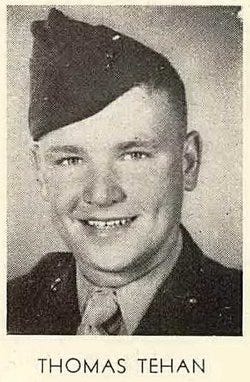 PFC Thomas Edward Tehan ","title":null,"type":null,"href":null,"belowTheFold":true,"topImage":false,"internalRedirect":null,"isProcessing":false,"align":null}" class="sizing-normal" alt="PFC Thomas Edward Tehan " title="PFC Thomas Edward Tehan " srcset="https://substackcdn.com/image/fetch/w_424,c_limit,f_auto,q_auto:good,fl_progressive:steep/https%3A%2F%2Fsubstack-post-media.s3.amazonaws.com%2Fpublic%2Fimages%2F74673305-006f-4a54-8445-16b83a730db6_250x382.jpeg 424w, https://substackcdn.com/image/fetch/w_848,c_limit,f_auto,q_auto:good,fl_progressive:steep/https%3A%2F%2Fsubstack-post-media.s3.amazonaws.com%2Fpublic%2Fimages%2F74673305-006f-4a54-8445-16b83a730db6_250x382.jpeg 848w, https://substackcdn.com/image/fetch/w_1272,c_limit,f_auto,q_auto:good,fl_progressive:steep/https%3A%2F%2Fsubstack-post-media.s3.amazonaws.com%2Fpublic%2Fimages%2F74673305-006f-4a54-8445-16b83a730db6_250x382.jpeg 1272w, https://substackcdn.com/image/fetch/w_1456,c_limit,f_auto,q_auto:good,fl_progressive:steep/https%3A%2F%2Fsubstack-post-media.s3.amazonaws.com%2Fpublic%2Fimages%2F74673305-006f-4a54-8445-16b83a730db6_250x382.jpeg 1456w" sizes="100vw" loading="lazy">
I think there was a piece of my mother-in-law’s heart that always mourned him.
I mention this because we have just celebrated Memorial Day here in the United States.
Memorial Day was once called Decoration Day due to the practice of decorating graves of the fallen with flowers. Memorial Day for decades used to be the day to exclusively remember the sacrifice of those who died in war.
Now, somehow, it has become a decidedly different day — to celebrate all veterans.
Hey, I love veterans. My favorite two are my sister Claudia and my brother Tim. Between them they served in the Army, Marine Corps and Navy. Not bad for one family. And my mother was an upstanding member of the Women’s Army Corps in World War II. Until the day she died she was justifiably proud of the two years she spent as a WAC.
All three did a noble thing in joining. That’s why we have Veteran’s Day in November – to honor people’s sense of duty in doing what they didn’t want to do and going where they necessarily did not want to go in order to serve in the military. It’s a sacrifice, no doubt about it.
Of course, it pales in comparison to the sacrifice of PFC Tommy Tehan. He is listed on a monument in Honolulu, Hawaii, as having been buried at sea. Remembering him and those like him was why we had Memorial Day, I always thought.
But it isn’t like that anymore.
The National Memorial Day Concert on the Mall in Washington, D.C., televised Monday, was a case study in the melding of remembering those who died, celebrating veterans and recruiting people to join the military. The music stopped occasionally for “Why I Serve” videos so soldiers could recite why they were motivated to join the Armed Forces.
The concert felt like one, long recruiting infomercial, a bald sales pitch for enlistment in the military. After a time, I just couldn’t watch anymore.This isn’t what Memorial Day is supposed to be. Celebrating all veterans, no matter what their jobs or risks they took, dilutes the day’s meaning. It makes remembrance of those whose lives were cut short in battle secondary.
Tommy may have been buried at sea, but he has a memorial headstone in a cemetery outside of Buffalo, in Cheektowaga, N.Y. My mother-in-law died too young, at 69, 30 years ago, but she has children and grandchildren who remember her and miss her. And although her beloved cousin died so long ago, with no children, he isn’t forgotten.
After the war, vets founded American Legion Post 1449 in Buffalo and named it the Thomas E. Tehan American Legion Post. It remains so today. Tommy’s face still smiles from photos, still heartbreakingly handsome and forever young.
May 21, 2025
When broken trust is hard to fix
It was August. My house was sweltering and the humidity made me feel like I was almost underwater. Normally not sensitive to heat, I was five months pregnant and already felt like a beluga whale. As I drove home from school with my daughter, then 5, just as I was thinking, “My car is air-conditioned but my house isn’t – how did this happen?” a sign on a tree caught my eye.
“Air Conditioner, For Sale, $200,” it said. I stopped, turned down a driveway, and knocked on the door.
A couple in their 70s answered. They explained they had only used the air conditioner a few times, and they preferred fans after all. I told them I only had a few dollars with me for a cash deposit so they could hold the air conditioner and not sell it to anyone else, but I promised to send my husband with money to pick it up after work that very day.
Deposit? They said, bewildered. Why do you think we need that?
“You gave us your word,” the woman said. “We trust you,” the man said. “We wouldn’t think of taking a deposit. We will hold it for whenever your husband can pick it up.” They took the sign down from the tree.
Trust. From time to time I’ve thought how moved I was over that nice couple to whom the word of a total stranger was good enough. There was something so lovely and old-fashioned about their willingness to believe me, to accept my promise as ironclad. It was a little thing, but a big thing all the same.
 Photo by Murewa Saibu on Unsplash
Which brings me to the latest revelations over how top Democrats and White House staff covered up the decline of Joe Biden. Despite his stumbles and mumbles and aging before their eyes, they enabled his outrageous decision to break his promise that he would be a “bridge” – i.e., stick to one term. Instead, he opted to run for a second term, at least until his disastrous June 2024 debate with Donald Trump made his decay obvious. The recent announcement that Biden has 4th-stage prostate cancer compounded suspicions that he may have had the disease for years but hid it from the public, although his office said his last test for prostate cancer was in 2014. Really? If he were still in office, would he and his people have hidden that, too?
Which brings me back, once again, to trust. I’m a Democrat and I am as angry as I have ever been at the party.
Yes, I know, Trump is a lunatic who is taking a sledgehammer to government, firing employees with no regard to what they do, tearing apart anything that helps ordinary people – health care for the poor and elderly in nursing homes, food for the poor, here and overseas, even staffing for the weather service, for God’s sake. Yes, he wants to do away with due process and send undocumented immigrants, and anyone he doesn’t like, to overseas prisons. Yes, he is using the presidency to enrich himself with his personal cryptocurrency and enhance his family’s deals in the Middle East while he destroys our traditional alliances around the world. Nothing Biden ever did could come close to the obscene abuse of power we witness every day.
Still, the idea that nobody in power -- in the White House or inner circles of the Democratic Party -- put us, the American people, ahead of their desire to cling to power and their own ambitions has left me utterly appalled.
I am reading the book about all this, “Original Sin: President Biden’s Decline, Its Cover-up, and His Disastrous Choice to Run Again,” by Jake Tapper and Alex Thompson, but my opinion was formed last year. That’s when I had lunch with a high-level Democratic elected official after Biden’s debate and she asked me, “So, what did you think?” After I expressed my horror, she said, “Gee, I thought Biden looked great … compared to a fundraising dinner I attended with him a month before the debate. He needed a teleprompter to greet attendees and didn’t recognize people he has known for decades.”
So. Trust, again. Democrats who knew, and said nothing, need to apologize. Hell, somebody needs to. What feels impossible right now for our democracy is that we need to figure out how to keep this from happening again, even as it probably is happening again, with Trump acting like the vindictive, crazy uncle in the attic. And Democrats need to make the case that voters can trust the party to put their interests first, which is no small thing. It’s a lot bigger than buying an air conditioner, but still involves giving -- and standing by – one’s word.
Book news: Washington, D.C.-area peeps, I will do a book reading/author signing at Busboys and Poets Takoma at 235 Carroll Street NW July 17, 6-8, and I would love to see you! Please RSVP here. It’s free, of course. But if 25 kind souls don’t RSVP by a week before the reading, the bookstore will postpone the whole thing. Sooo… sign up, and I will mow your lawn!
Buffalo, NY, friends, I will do a book reading/author signing at the West Side Rowing Club, where my sister Ellen was a coach, June 12, 8-9 pm, no RSVP necessary.
For those interested, the redoubtable Julie Gammack (of Julie Gammack’s Iowa Potluck on Substack) recorded this podcast with me this week. I’ve done about eight podcasts about my book so far, but honestly, Julie could be an FBI interrogator. Thank God we only had an hour; she got so much information out of me that heaven only knows what I would have told her if we had more time! She is also the founding mother of the Okoboji Writers and Songwriters Retreat in Iowa, which attracts hundreds of writers to the shores of Lake Okoboji in September for writing workshops on everything you can think of. It’s fabulous. This year’s retreat is Sept. 28-Oct. 1. Early bird rates are still available and it always sells out. I’ll me there, waxing eloquent on opinion writing and memoir. Join us!
May 12, 2025
Weeds, in fields and in life
My husband started a farm on our 10 acres almost 14 years ago. Over those years I have learned that farmers are always a little bit overwhelmed during the warm months, and grapple with the feeling of falling behind and needing to catch up – whether they truly are behind or not
But some years, it isn’t Pete’s imagination. This year he started late because he was laid up with a broken leg most of the winter, although, if a farmer has to resort to hobbling, winter isn’t a bad time to do it. Then, spring rains fell longer and heavier than usual. That makes planting late, and also sparks the growth of one crop that is not welcome at all – weeds.
In recent years I’ve pulled back somewhat from helping on the farm. I have things to write, after all. I don’t assist with as many farmer’s markets as I once did. I help with some of the planting in spring and harvesting week to week.
But weeds are mortal enemies. About 10 years ago, the weeds got the best of our garlic field and really damaged the crop, reducing it by 70 percent. We learned that you can’t take your eyes off these evil plants for a minute.
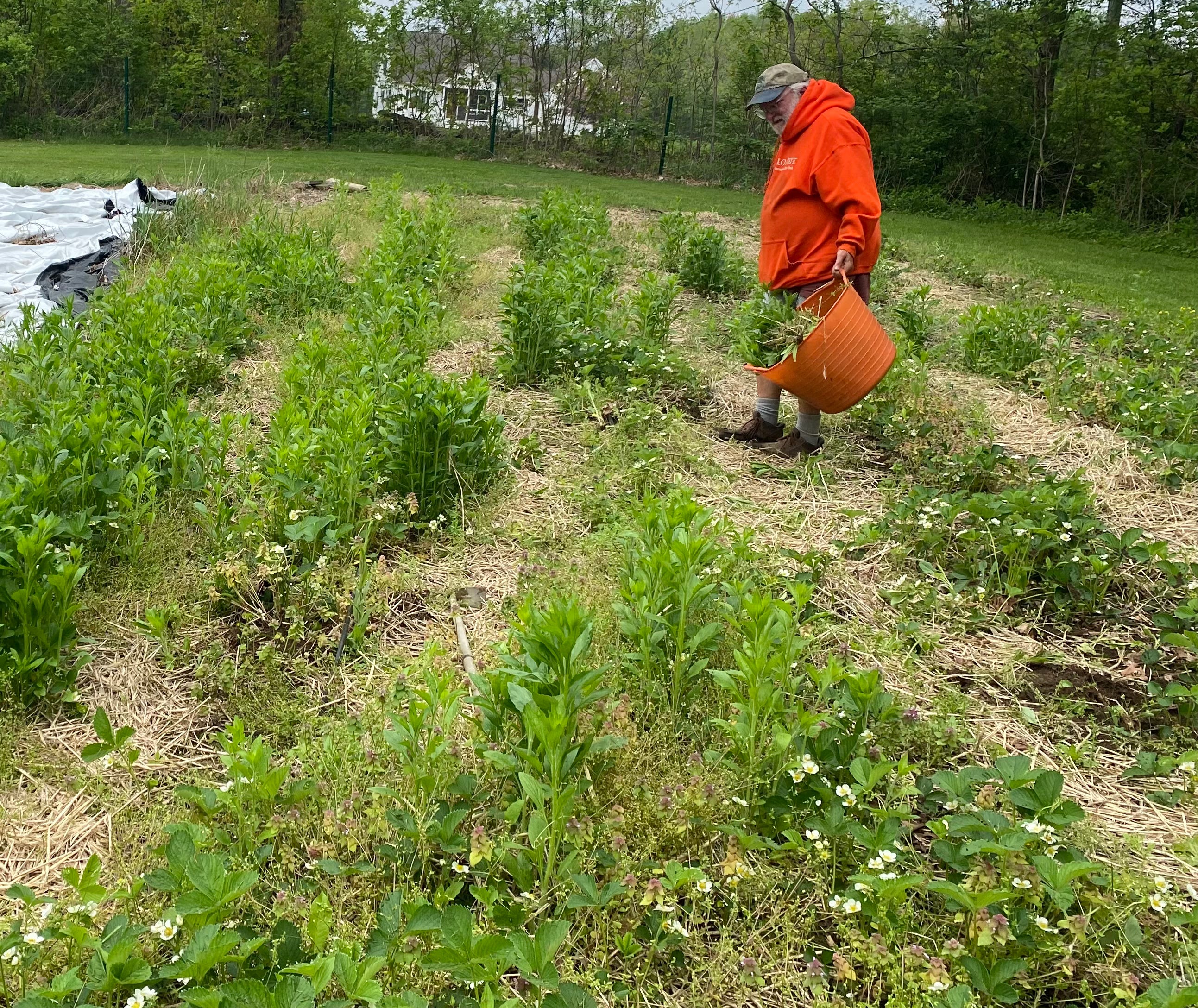 This is what a few days of rain will do. The white flowers are the strawberry plants; the tall, malevolent plants are the rampaging weeds. They are gone now! Here, Pete holds a container full of weeds he has pulled out.
 After days of rain, Pete said to me, in his understated way, “I could use help weeding the strawberries.” I went out to take a look and realized the situation was close to an emergency. The weeds had shot up after just a few days of rain. Last year, we planted 800 strawberry plants knowing that the second year - this year - the fruit would produce in earnest. The weeds threatened what we thought would be a good spring harvest. I grabbed some tools and headed out to the field.
Pulling weeds used to make me nuts, but the task was almost a healing balm in the early days of the COVID-19 lockdown. I could go out into the fields and lose myself in the mindless work, gradually shedding my sense of crisis-fueled panic about how long the quarantine would last and when I could see my granddaughter again. I would hoe or pull out the tiniest shoots of the destructive plants and feel soothed at having accomplished something.
But there was nothing small about these weeds, and I brought big and small tools to battle them. Pete started at one end and I at another. The labor, away from screens and cell phones, gave me time for self-reflection. After a while, as my hamstrings ached from bending and I filled buckets with weeds for disposal far from the field, I began to see the invasive plant as a metaphor.
What were the weeds in my life that I needed to yank out?Well, I thought, as I get older I certainly am gaining the bad habit of doling out to my two adult children advice they haven’t asked for. Sometimes I hear myself dispense bromides on autopilot and mid-sentence, I want to stuff a sock in my mouth. That’s one weed I could live without. My guess is that Anna and Tim would agree.
And though I try to be grateful, I need a reset when my innate impatience rises. I can use reminders that I am lucky; lucky to have a family to care for, that I feel a sense of purpose in writing, and when it comes to having enough money, I always recall my mother’s response. “Hey, we’re eating, aren’t we?” Yep. We’re eating.
Impatience is a weed. So is seeing the glass half empty.
When having two large dogs gets under my skin, I tell myself that I have rarely had a day with fewer than 10,000 steps since Pete insisted on getting the golden retrievers three years ago. Like it or not, they are gym memberships on paws. I get all the aerobic exercise I need the moment I grab a leash, dodge a furiously wagging tail, hook the leash onto a collar and open the door.
My musings were interrupted when rain began to fall again. We had finished one field. The rest we will get to this week. When it comes to my own personal “weeds,” though – well, they are a work in progress. Disposing of them will take more than a shovel and a bucket.
I’ll tackle them one weed at a time.
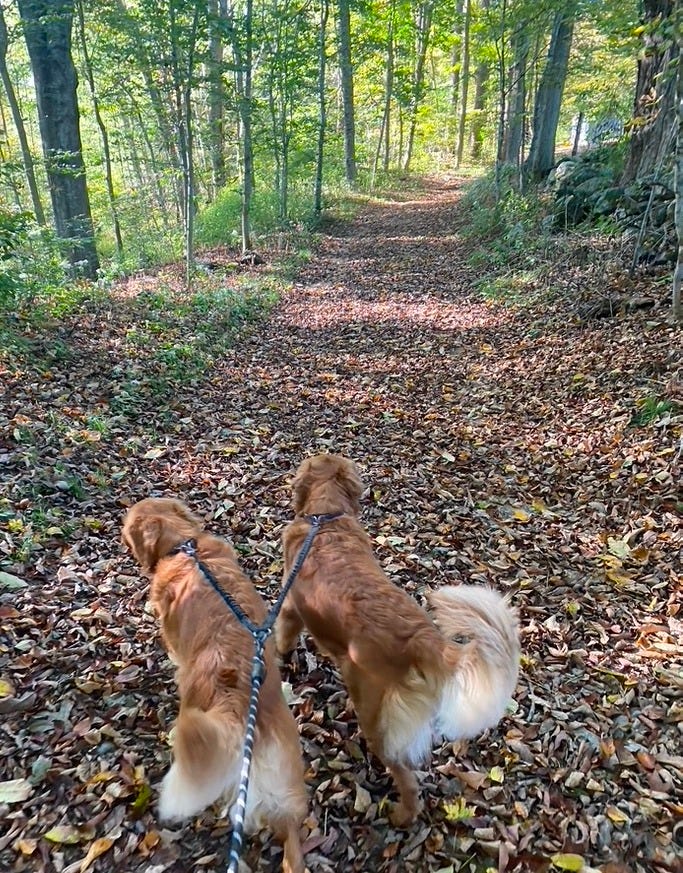 This is how I walk Bella, left, and Zoey, right, in the morning on a path next door to our farm. The dogs are pretty good on the leash because they have been walking together since they were puppies. It still gives me a workout!
May 5, 2025
Standing in a Sacred Space
There is something utterly sacred about a public library, because it is dedicated to sharing knowledge freely, belongs to the community and is a steadfast, quiet presence. It is a still point in a turning world. At least, that’s what my neighborhood library was to me growing up in Buffalo, N.Y. The James L. Crane Library was just two blocks from my house, and it became my refuge in a childhood full of turmoil.
So I got chills last week when I arrived a few hours before my book launch and author reading of my book, “Saving Ellen: A Memoir of Hope and Recovery.” I went right to the corner of the library where I once would spend hours reading dozens of my beloved juvenile biographies of famous people like scientist Marie Curie, suffragist Elizabeth Cady Stanton and baseball player Babe Ruth. Those books, always my favorites, allowed me to dream big dreams while the quiet, kindly atmosphere of the library gave me a place to breathe and to think.
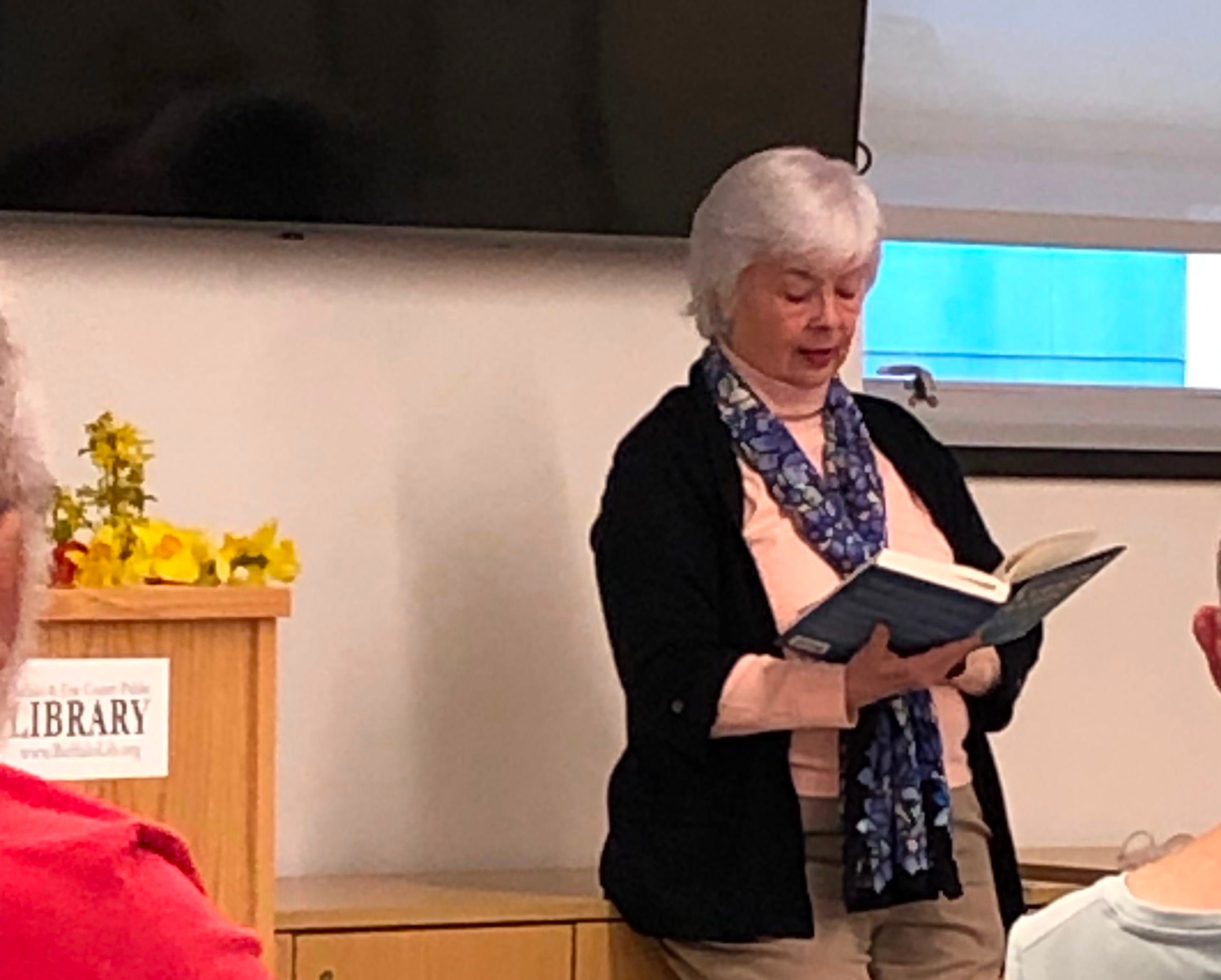
Fifty years later, as I stood there, it felt like holy ground. I felt so grateful to this place for helping me grow up as an eager reader, and eventually, a writer.
Later, in the community room upstairs I was able to read a portion or two of my book before a generous crowd of about 40 people -- relatives, two siblings, high school classmates, former neighbors that I hadn’t seen in many years and many strangers I didn’t know but was glad to meet. It felt like more than a homecoming; it felt something like Christmas morning.
I haven’t lived in my home city for 42 years, ever since my husband and I loaded a U-Haul truck and moved to Boston 10 days after our wedding. The morning newspaper in Buffalo, the beloved Courier-Express, had closed eight months before and I knew the odds of finding a reporting job in my hometown were slim. So Pete and I hit the road. In Boston, he would attend graduate school and I was determined to find a journalism job to support us. We never intended to leave the area where we both had grown up for more than two years.
We were sure we would move home eventually.That didn’t happen. We never made it back, instead making a life together in New England. Four moves, four decades, four houses, two kids and two grandkids later we love living in Connecticut, but retain an abiding affection for the Buffalo area. Often all that outsiders think about the city is its national reputation for snowstorms during winter. But that overlooks its beauty, its parks, its beautiful old homes and the fact that the people are warm. All reasons why, despite living two-thirds of my life in New England, I still refer to the city as home.
So it was a privilege to be among friends and relatives in the old neighborhood. Talking Leaves Bookstore sold out of books at my launch at the library, despite sending an employee back to the shop to grab every last copy. And I basked in the security in being with the people who knew me when I was 12, who laughed with my mother and who loved my sister Ellen as I did. Even a threatened rainstorm held off just long enough for nearly 20 of us to go to a watering hole two blocks away. By the time sheets of rain fell, we were dry, with plates of food, a pint or two, conversation and laughter to warm us.
Who knew? Maybe you can go home again, for at least one day.
April 29, 2025
Repulsed by the rich
Watching the clips of Pope Francis’ funeral reminded me of my only close friendship with a Catholic priest. Like Francis, he was a Jesuit. I wrote a column for The Day of New London in the early 1990s when Bernard J. Bush called me. He liked my column, he said, and wondered if we could meet. We soon did.
I was delighted with the wide-ranging nature of our conversations and his unflappable nature, despite my frequent criticism of the Church’s limited roles for women (“Maura,” he once sighed. “You are so hard on priests.”). My husband, too, liked him immediately and we formed an unlikely friendship, based on shared dinners and fueled by curiosity on both sides. We talked about the nature of good and evil and whether Satan existed. (Bernie said yes, and told several hair-raising stories to back it up.)
But it was our conversation about home financing and bank practices that remains fresh in my mind. One day, Bernie asked me to explain home mortgages. I laughed; despite his doctorate, he had never had to pay a mortgage and didn’t understand how it worked.
We then had bought three houses in 10 years, so I showed him our bank statements. When I pointed out the tiny amount of principle a homeowner pays to the bank for many years because banks front-load interest payments onto early years of the loan, he became outraged.
“That’s immoral,” he sputtered.
Absolutely, Pete and I agreed, or at the very least, unfair. But perfectly legal. It works out if a house rises in value. But if a home price drops – as had once happened to us – you may have to sell at a loss. Bernie remained utterly appalled.
I thought Bernie just a bit naïve at the time. It turns out, I am, too.
“Maura,” Bernie sighed. “You are so hard on priests.”I realized this while watching a new show on Apple TV called, “Your Friends and Neighbors,” starring Jon Hamm. The series is an eye-opener. The plot, in a nutshell, is when a wealthy hedge fund manager (Andrew “Coop” Cooper) is fired, he doesn’t tell his ex-wife, or his kids, or his friends. Instead, to cover the bills, he begins to steal from residents in his old, ultra-exclusive neighborhood.
The series illustrates the lives of the rich by going beyond merely depicting the mansions, the luxury cars, the private schools, or the over-the-top nature of their frequent parties. It gets very, very specific. “Coop” is smart; when he steals, he only takes one thing amid the vast and opulent possessions of the uber-rich. He opens a drawer holding numerous watches and rolls of hundred-dollar bills. He ignores the money and instead takes a Patek Philippe Nautilus 5811 watch, worth $175,000. During a second heist, he takes a rare Richard Mille RM011 sports watch, worth $250,000. On another occasion, he steals one woman’s Hermes handbag, worth six figures. On his way to a party, he steals a bottle of chardonnay, worth $32,000.
 Photo by Ashwin Vaswani on Unsplash
Watching episodes that reveal of how the 1 percent spends money makes me every bit as appalled as was my friend Bernie was over mortgages so long ago. The idea that someone would buy a watch with a price tag that could send a dozen students to a community college or pay the bills of the food banks that are now struggling with federal cuts is, frankly, repulsive. Add to that revulsion is the fact that the richest man in the world, Elon Musk, gleefully crows about cutting off American aid to the poorest of the poor here and around the world to save pennies a person, even if they die as a result. That American voters have, with their eyes wide open, elected a billionaire president with the empathy of a crocodile is even more disgusting.
Of course, it’s a capitalist system and people with more money than I could ever imagine can do whatever they damn well please and always do. But I could not help but reflect on Pope Francis, who wore an iron cross rather than one made of silver or gold; how he lived in a humble room, shunning opulent papal apartments and how he took the subway when he was a cardinal in Buenos Aires.
We need more leadership like that. We could certainly use more moral outrage about the rich bastards in power in the United States who are molding government policy guided only by their narcissism and lack of morals and casting aside whatever shreds are left of American compassion.
Bernie moved to California to direct a retreat center and we were in contact only sporadically until his death in 2020. But he did send me a postcard in 2013 after the papal election.
“Francis has come just in time,“ he wrote.
Yes, he did. Would that we had more leadership like that.
April 21, 2025
No such thing as too many potatoes
April “comes like an idiot, babbling and strewing flowers” the poet Edna St. Vincent Millay famously wrote.
But the poet left out a few things. On our farm, April strews not only flowers, but also seed potatoes.
Yes, April is when our landscape finally becomes green again after a too-long winter (and at my age, they are all too long). Crocuses arrive first, followed by violets and daffodils; but to me, April means the planting of kale, lettuce and broccoli, onions and potatoes.
Especially potatoes. It’s the one crop I am happy to help my husband get in the ground.
My husband has a glorious, four-syllable Italian last name that I gratefully declined to take when we married. The fact that his mother was half Irish went a long way towards reassuring my farmer cousin in County Mayo that he was okay. But when Pete started a farm himself 14 years ago and began to plant potatoes, approval from across the pond was guaranteed.
From me, too. It must be in my DNA.
Pete orders potatoes in midwinter from a company with the melodious name of “The Maine Potato Lady.” If he delays ordering, he can’t obtain the varieties popular with his customers at the farmer’s market because the company sells out of many kinds of the tubers by spring.
But this year, while paying the bills, I noticed the bill from Maine was higher than usual. A lot higher. I raised an eyebrow, then shrugged. Everything is going up, I figured.
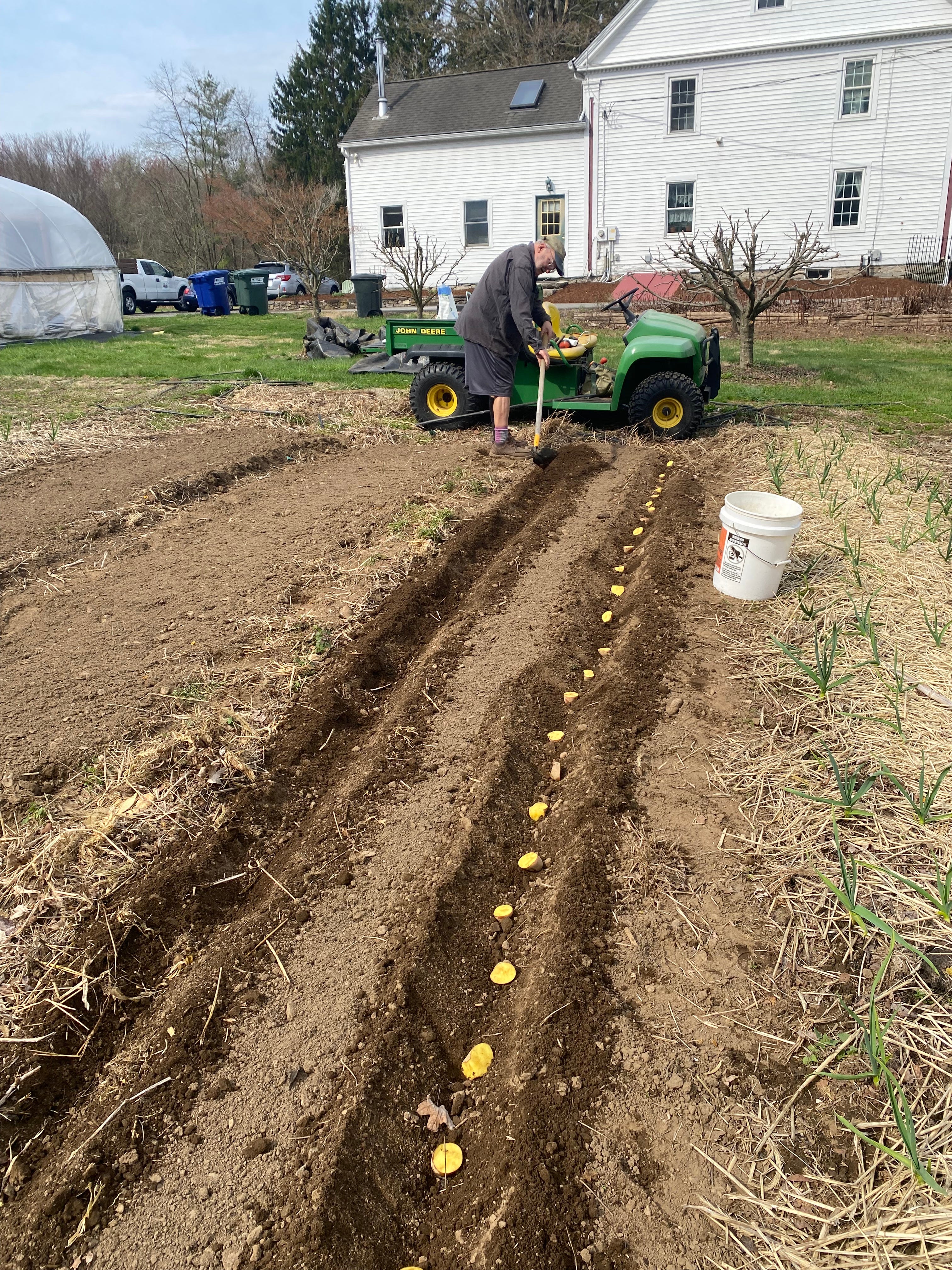 A partial row of potatoes, with Pete cutting others. The pail is for the rocks we find in the soil, which are endless. The row of potatoes is next to a row of garlic, which will be harvested in July.
 The mystery was solved when the seed potatoes began to arrive. Five-and 10-pound bags of Magic Mollies, which are a deep purple, arrived. Red thumbs, which look exactly as described. And Pinto Golds, which are a lovely combination of red and gold potatoes.
Then fingerlings, called banana potatoes for their long and narrow bodies, arrived. A 50-pound bag. Dear God. Will we have room to plant anything else?
Pete acknowledged his error, but remains sanguine. We can plant them in stages, he said. Every two or three weeks. And I saw his point. After all, by the end of August last year we ran out of potatoes to sell at the farmers market. This “mistake” guarantees we will be harvesting potatoes until the end of November, which gladdens my Celtic heart. Can an Irish lass ever have too many potatoes? Perish the thought.
So Saturday we spent planting potatoes and onions. We cut up the potatoes first, leaving several eyes in each piece. Pete dug trenches and I followed along, placing the potatoes with eyes facing the soil every 6-10 inches, filling several rows. At this rate we should put out a sign: Potatoes R Us.
The onions, too, are favorites of mine. It is beautiful to watch them grow, bigger and bigger, lifting out of the rows slightly as they swell. And harvesting them is incredibly satisfying, like pulling round Christmas ornaments out of the soil.
When Pete wasn’t looking, I doubled the price on the onions.One year our onions were so gorgeous I didn’t want to sell them. Farmer Pete insisted, though. So, begrudgingly, at the market I set out a stack of our beautiful onions, some the size of softballs. When Pete wasn’t looking, I doubled the price, chortling happily.
There’s more than one way to keep the onions to myself, I thought with satisfaction. Who would buy them at this price?
Alas, the very first customer took one look at my stack of lovely orbs, none of which had ever been sprayed with anything but water, and, paying zero attention to the price, she bought every single onion we had, filling the bags she brought from her car.
Every. Last. One. I mourned as I watched her happily place the bags of my onions in her vehicle. Served me right, I guess.
So now Pete knows to buy many, many sets of onions if only so his wife will be less reluctant to share with customers, or engage in subterfuge. Hundreds of little onion bulbs arrived last week. When we finished planting the first wave of potatoes, we started planting the white, yellow and purple onions.
We planted until the throbbing in our backs and hamstrings became too uncomfortable to ignore, then, too tired to cook, we ordered take-out for dinner.
Pete can take things from here. Writing is so much easier on my aching back!
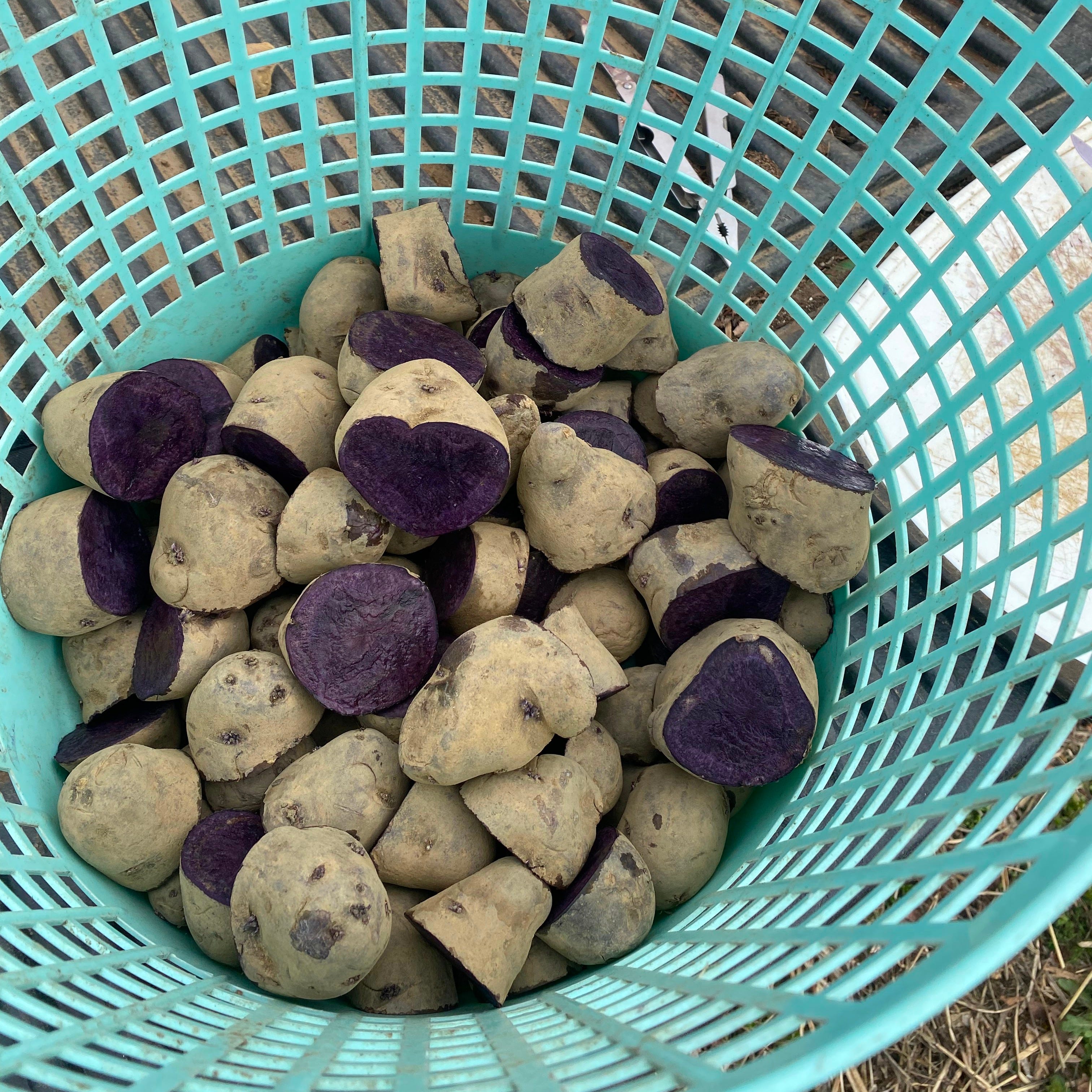 Magic Mollies. Aren’t they pretty?
April 14, 2025
We need strange bedfellows
The phone call came to my office at The Day in New London, Conn. in 1998, the newspaper at which I had then worked for a decade. I knew from caller ID that it came from Congress. The office from which the call originated left me agog.
“Ms. Casey? I am the chief of staff to U.S. Sen. Strom Thurmond, the Republican who represents South Carolina in the Senate,” the caller began. “The senator wants you to know that he read your column from a few weeks ago, and he agrees with you completely.”
That Strom Thurmond? I thought in disbelief. The ardent segregationist who fought civil rights? Who led the South in denouncing the federal government’s integration of public schools? The politician in his 90s who had served in the Senate for more than 40 years?
What could I possibly have written that would make him happy? I wondered.
“Thank you. Tell me which of my columns the senator supports,” I replied.
“You wrote a column tearing apart the wine lobby’s attempts to make wine a recommended part of the American diet, part of government nutritional guidelines. A lot of senators support the issue, especially both senators from California. Frankly, so do most members of the media. But you don’t, and Sen. Thurmond appreciates that,” the caller said. “He wants you to know that his daughter was killed by a drunk driver, and hell will freeze over before he will allow alcohol to be a recommended addition to American diets.”
Then I understood. I had been outraged, in print, over a proposal to include alcohol in part of the “food pyramid” - that along with encouraging us to eat whole grains and fresh fruit, we somehow should include wine as a vital part of a healthy diet. I was no scientist, but I thought studies saying that alcohol was a boon to health were based on sloppy research and wishful thinking. In the years since, such has proven to be the case. But back then, I was swimming against the tide. And so, apparently, was Sen. Thurmond.
This was my biggest lesson in strange bedfellows, the unlikely allies who get together on one or two issues, but disagree on everything else.
Strange bedfellows are critical to politics.They make the gears of democracy run. They toss an element of necessary unpredictability to the process, and keep both sides from being ideologues on all issues.
We need them, now more than ever, because President Donald Trump truly believes in the very core of his being that he is a king. He signed executive orders last week sweeping away regulations from 10 federal agencies and snapped his fingers to do away with any democratic process involved. (Gift link to NY Times article)
One order said, “Notice and comment is unnecessary because I am ordering the repeal,” (italics mine).
Trump is running the government and trade policy according to his basest instincts. He has no plan. He has whims. So far, Republicans have bent the knee to whatever he wants.
We need strange bedfellows.
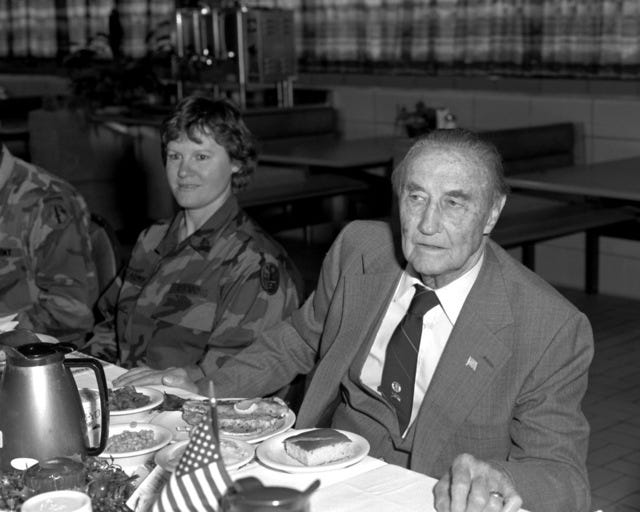 Sen. Strom Thurmond in 1991 as a mere youth of 89, sitting beside Staff Sgt. Cynthia Repenning at Fort Gordon (now Fort Eisenhower) near Augusta, Georgia. .
Opposition from within the Republican Party is desperately needed. The courts can’t stop everything. Democrats don’t have the votes to stop Trump’s upending the economy of the world and eroding democracy. He brags that his bullying and threats over imposing tariffs on 200 countries have resulted in other nations “kissing his ass.” (Please.)
But there are a few tentative signs that some in the GOP are becoming queasy at Trump’s taking a wrecking ball to government. And they should. A handful of senators have opposed tariffs. If the stock market keeps tanking, Trump continues to be erratic, and his chain-saw wielding soulmate, Elon Musk, keeps pushing to close Social Security offices and cut off aid to veterans, opposition should continue to grow.
Thurmond was as good as his word in 1998. He halted attempts to add wine to nutritional guidance for American adults. Early in 1999 he led a fight to reverse the Bureau of Alcohol, Tobacco and Firearms decision to put health messages on wine bottles, calling it “erroneous and irresponsible.” He also helped pass increased taxes on wine. He died in 2003 at the age of 100.
Thurmond’s stance on alcohol didn’t make his politics on race any less loathsome. But politics can be the art of the practical. People who disagree about almost everything can find agreement on something.
Republicans need to realize that there are some things more important than keeping Trump happy. Like, the future of the country.
April 7, 2025
It's about standing up
Several years ago, I was asked to give a speech about my career to an audience that mostly consisted of fellow newspaper journalists - ink-stained wretches, one and all.
But when I started to write the speech, I got discouraged, particularly after I did some math. I figured out that in 35 years of editorial writing for four newspapers, I had written about 5,000 opinion pieces. Give or take, they added up to around 2 million words. But … I wondered. What had it all meant? At the end of the day, what had I accomplished, really? What had my words changed?
I told my husband, Pete, about my misgivings, my doubts that all those opinions had moved the needle on anything at all, and he had an instant reply that stopped me in my tracks.
“It’s not just what you changed,” he said. “It’s what you stood for.”
I’ve been mulling over his wise answer ever since, because it doesn’t just apply to me.
It applies to all of us. Our actions and our words during this time of real peril for our democracy will express to ourselves, neighbors and the world what we all stand for.
 Protest in New London. The old courthouse is the building behind the green sign. It has been long replaced by more modern facilities, but stands as a testament to the rule of law from the founding of America. Photo provided courtesy of Jerry Fischer.
This past weekend I attended the “Hands Off!” Protest in New London, Conn. I decided to take Bella, one of our two golden retrievers. Since my hands would be full just controlling her, I made her wear a sign. Because what is a protest without signs?
It looked like more than 500 were gathered around the old courthouse in New London when Bella and I arrived, with more streaming in from the nearby streets. The courthouse is a wooden structure built in 1784, just a few years after the Revolutionary War. It was constructed during the same time that the nation was being built and just beginning to find its own way as a republic. And here we were, 241 years later. Worried. Upset. But together during this moment. And trying to construct our own responses, pushing back against the chaos and crudeness of the last nearly three months of an incomprehensible second term for Donald Trump.
The signs said it all.
“Stocks down, measles up.”
“Facts over Fiction.”
“America has no Kings.”
“Nobody elected Musk.”
“Dear Canada: We hate him too!”
“Donald Trump is a Russian Asset,”
And finally:
“No sign is big enough for all the reasons I’m here.”
Amen to that last one.
Bella had a sign too, of course, which made her popular with the protestors who wanted to take her picture and pet her. It was, “Dogs against Dictators,” my tongue-in-cheek swipe at the entire ridiculous situation in which we find ourselves.
There was one man at the protest not carrying a sign at all, but an enormous Canadian flag. That did my heart good. Of all the allies he has abused, Trump’s insults against Canada make me the most irate.
I was proud of New London, because it is a town of 27,000 and yet the street in front of the courthouse was jammed. Like others in hundreds of protests across the country, people in the crowd seemed relieved to be demonstrating against the irrational actions originating from the Oval Office, and the cowering toadies in the Republican Party who are enabling Trump’s amoral power grab.
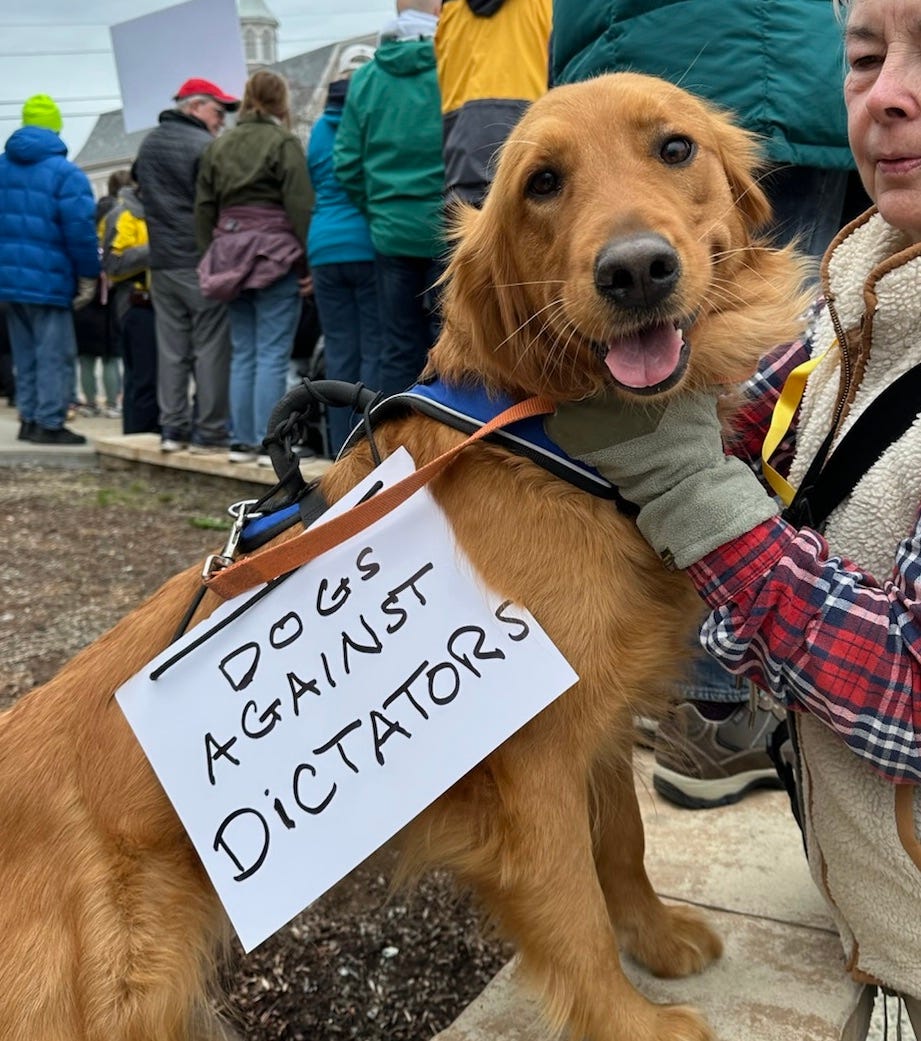 Bella, wearing her protest with pride.
I have no illusions about the change that one protest can bring about. I attended the Washington, D.C. Women’s March in 2017 when Trump first took office along with hundreds of thousands of others. I’m not sure that it did much in the end.
Yet we have to start somewhere.
We have many more things to do, but we have to go at this one step at a time. We have to make resistance a habit. Our institutions – Congress, political parties – are proving to be flimsy defenses against Trump’s onslaught. But in the history of the United States, the people lead. Citizens have made the difference long before political institutions acted: Those who have refused to be silenced, who have refused to sit in the back of the bus, who have decided not to go along in the face of injustice.
People who have stood up.
We have to act first, and sooner or later, the change will follow.
We won’t see change immediately. But we have to act anyway. Like the wise words that have been my security blanket for years:
It’s not just what we change. It’s what we stand for.