Kath Middleton's Blog, page 8
May 14, 2016
Books and sausages
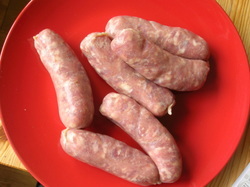 I read recently that books are like sausages; it’s better not to see them being made. This is a twist of a quotation from Otto von Bismarck who said the same thing about laws.
I don’t suppose many of us would want to witness the slaughtering, chopping, mincing and squeezing involved in sausage-making. Book production is slightly less gruesome, but unlike the manufacturing of the foodstuff, books don’t all follow the same method. It’s a safe bet that if you asked a group of authors how they go about writing a book (and I often chat to writers here on the blog) there’d be as many explanations as writers.
There seem to be two main processes, but it’s a spectrum. At one extreme are the plotters; those who plot everything very tightly. They will have pages of notes, flow-charts, biographies of characters – in fact, before they write the first word, the story is laid out and they just have the task of putting flesh on the bones.
At the other end of the spectrum from the plotters are the pantsters; those who write by the seat of their pants. They come up with a story idea. It’s usually something you could outline in a few sentences. Then they start writing. Sometimes they don’t even know how it will end. The story evolves and the characters start to live. It’s amazing how many people say that their characters ‘told them what to write’. It’s a kind of ‘voices in your head’ situation in which they don’t take you away.
I suspect most of us are somewhere along that arc. We know what will happen. We know the result. Some people even write the end first. It’s a journey and if the author enjoys it, there’s a good chance the reader will too.
Now I’ve got to have sausages for tea!


April 13, 2016
Talking to Ourselves - a chat between myself and Jonathan Hill
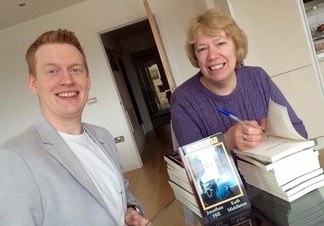 Jonathan and I began an email conversation about the book we have recently jointly published. I wonder if you can tell the point at which we met up in person?
KATH: Jonathan, let’s talk about our new release, Is it Her?, based on a painting you bought. I could immediately see why you bought this picture. It holds a lot of detail without being over-fussy, so the people and the place are able to speak to the viewer. Are you a visual person? Do you think out scenes in words, or in pictures in your head?
JONATHAN: Well, if I may be so bold as to answer that question. Literally. My side of the conversation is all in bold. It’s a great picture because there’s no knowing how each viewer will interpret it. I love that art can mean different things to different people. If you remember, we considered asking the artist what he envisaged when he painted the scene, but I think knowing that might somehow detract from the magic of it.
I think writers have to visualise to some extent; only then can you be sure that a scene is authentic and plausible. It’s a difficult question to answer as it all just ‘happens’ while I write and trying to deconstruct what happens is not easy. I am certain, though, that when lost in writing, I see the scene play out before me as if it is real. And when you DO see it unravelling in that way, you know you’re writing something good.
How long after looking at the painting did it take for you to come up with your story?
KATH: I'm not sure I can remember. It certainly wasn't very long. Maybe ten or fifteen minutes. I used the car's general shape and style to set the story around the second world war. Then I asked myself, why ask the question, Is it Her? Why does he wonder if it's a special woman? Why were they separated? That led me on to looking at a reunion from both sides.
Did you find that working with another person put any restraints on you? Would your story have been different if you'd published it on your own?
JONATHAN: I can honestly say, no, I don’t think I did feel any restraints. It was refreshing writing in tandem with someone else, knowing we were both working on the same project. Would my story have been different if I’d published alone? I’m pretty sure it would have been non-existent as the project came to life using two heads and not one!
Did you ever worry that comparisons would be made between our stories? Did you feel any pressure in writing your own story?
KATH: Yes, I did. I have the usual self-doubts and wondered whether mine would stand comparison with yours. When I read yours, and the intensity and tension it contained, I felt that even more. When someone asked whether they should vote for the best, I was biting my nails! Strangely, we both turned out stories of almost the same length.
You write dramatic stories and also successful comedies. Did it ever occur to you that the painting could have been the spur for a funny story?
JONATHAN: I always had confidence in you! I’ve read enough of your work to know you can turn out a good, well-written story. And we are comfortable in telling each other what works and doesn’t work so, between us, we could iron out any issues in both our stories.
Actually, no, I never considered humour for the story. I did, however, have a moment where I was convinced I was going to write a horror as the scene reminded me of the one at the end of ‘Don’t Look Now’. Those who have seen that film will know the feeling of sickly dread when the red figure reveals itself!
KATH: So, that won’t be me, then! I fall asleep in films!
JONATHAN: Are there any genres you haven't yet tackled that you want to have a go at?
KATH: There are several genres that appeal to me that I’ve already had a go at but they haven’t yet been published. I’m quite drawn to the supernatural. I don’t mean horror. I don’t want to keep myself awake at night, let alone others. I mean the sort of thing which can’t be explained by science. As someone with a scientific education, it’s intriguing to consider those parts of our experience we can’t explain. Instead of the usual writing prompt of, ‘What if…?’ I started with ‘Wouldn’t it be weird if…?’ and that got me going.
Now another for you. You’re a creature of opposites. I think of your writing sometimes as though you’re balancing at the edge of the abyss and about to kick a stone down there to see how deep it is. Yet at other times it’s much more light-hearted and great fun. The Anniversary was definitely one of the former. Do you alternate? Or does it just depend on your mood?
JONATHAN: I don’t intentionally alternate but, yes, I think the subject matter is a reflection of my current mood. FAG, for example, was incredibly intense to write and at times it felt as if my feelings were literally pouring out onto paper. I think you have to be in the right frame of mind to write something otherwise it just doesn’t have the essential authenticity readers expect. I guess I’m lucky that I feel comfortable in writing in a wide range of genres. Of course, this doesn’t make it easy for readers who follow my work!
Kath, you’re widely known as a prolific reader and reviewer. Do you ever find there’s a conflict between reading and writing, where you have to make a choice about which to devote your time and attention to?
KATH: No.
*JONATHAN stares and blinks once*
KATH: What’s your favourite cake?
JONATHAN: The one we ate not ten minutes ago. List three things you can see right now.
KATH: MacBook Pro; Salford Cathedral; oh, and a kettle. *meaningful stare*
JONATHAN: *rises and walks over to kettle, switching it on deftly* While the kettle boils, Kath, tell me what makes you boil with rage?
KATH: Injustice and cruelty, mainly. And politicians. And people who don’t read.
*JONATHAN throws cold water over Kath’s raging head*
JONATHAN: Oh now look what you’ve done. There’s water everywhere!
KATH: You threw the water!
JONATHAN: Well, excuse me for extinguishing the rage from your head. Anyway, let’s not argue. The damage to my immaculate floor is already done and now it is merely a floor.
Kath, thanks for taking part in this interviewie - it’s the new selfie, don’t you know!
KATH: Don’t I know it. Cheers! *KATH raises mug to JONATHAN*
*JONATHAN walks off to fetch mop*
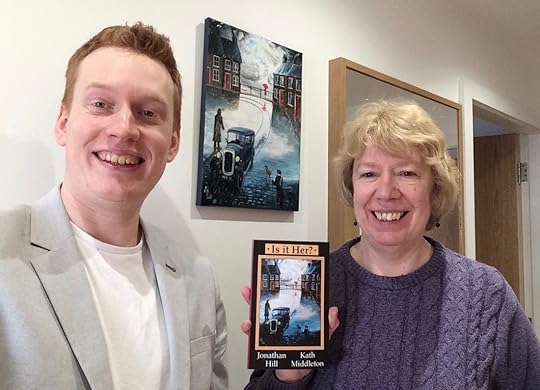
If you're still with us and fancy reading the book, you'll find it on our Amazon Author pages - Kath's and Jonathan's. And here's the actual painting, with the book and authors.
March 13, 2016
Author Chat - Maggie James
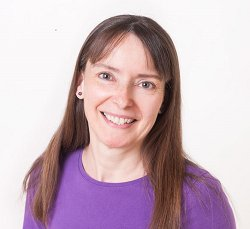 Hello, Maggie. Welcome to my blog. You’re a new writer to me though you’ve written lots (more for me to catch up on). Can you tell us a bit about your writing history?
Thank you so much for featuring me! Yes, I’d be happy to talk about my writing history. I’ve always wanted to be a full-time novelist; as a child, I never doubted I’d write books as an adult. When I left school, however, I became an accountant, a career I followed for nearly thirty years. Why? Because in my twenties, I fooled myself into thinking I lacked the necessary life experience to be a novelist. Back then, completing a novel had morphed in my mind from a childhood dream into an insurmountable task. How the hell could I manage 80,000 words, and on what theme? Later on, my excuses changed; I persuaded myself I didn't have the time (despite getting the same twenty-four hours per day as everyone else!) Decades went by without anything changing.
The urge to write never deserted me, however. It nagged me, reminding me that my life was flying by and I was no nearer to achieving my ambition. Fed up with my procrastination, I dipped my toe in the water by penning short fan-fiction pieces, which, to my delight, were well-received, thus boosting my confidence.
Not long afterwards, I had a disagreement with my employers, one that proved impossible to resolve. Outwardly I pretended everything was fine but inside I seethed. Unable to find a way forward, I decided this contretemps might prove itself a blessing. From that moment, my attitude changed. I resolved to quit accountancy and indulge my lifelong wanderlust for a year, and to write a novel whilst away.
Almost three months into my trip, I still hadn’t written a word, thanks to the constant travelling. One night, disgusted by my ongoing procrastination, I had an epiphany. As a result, I travelled to Sucre, a Bolivian city I’d heard was stunning, with the intention of staying there until I completed my novel. I already had the germ of an idea for the plot, gleaned from a conversation I’d had in Vietnam. So that’s what I did. I found a quiet hotel in Sucre and wrote every day until I finished His Kidnapper’s Shoes. An emotional moment for me; five years later, I still get tearful every time I remember it.
Upon my return to the UK I set up a dog-walking business to support myself whilst I carried on writing. Since then I’ve published three more novels, a novella, a box-set and five non-fiction books, finally becoming a full-time author in December 2014. I’m now working on my fifth novel.
Sometimes you need your life to change before you can grasp the big dream and run with it.
You write psychological thrillers. These, although they usually contain a crime or two, aren’t the standard police procedural or detective story. What made you look at the idea from a different angle?
I’m primarily drawn to the psychological aspect. Human psychology is, I believe, incredibly complex, beyond what conventional theories can explain, and I’m fascinated by its quirks. I love writing about strong emotions, and to do so, I need to examine the events that inspire them. For me, the most interesting provocations involve crime. Abduction and murder hold the power to invoke heart-rending emotions: anguish, rage and hatred. Wonderful material for any novelist!
I agree! You need to make readers feel it too.
Do you read thrillers and crime books yourself, or do you ever stray into new territory?
My reading tastes are broad but my preference is for thrillers and suspense novels. I think it’s essential for novelists to read widely in their chosen genres, as we learn so much that way. Whether a novel is good, bad or indifferent, it teaches me something.
Although not a thriller or crime writer, Stephen King is a master of his craft. I’m enthralled by his story-weaving abilities. I also love many of the classics, such as those from George Orwell, Thomas Hardy, George Gissing and Jane Austen.
I’m a great Austen fan myself. Do you ever have a hankering to write in a different genre yourself? If so, what.
Yes, it’s something I’ve considered. For years, I always thought I’d write erotica. Somewhere along the way, I lost the desire (no pun intended) to write steamy sex stuff. When I got the idea for His Kidnapper’s Shoes, it was the story that appealed, not the genre. It's possible I may explore dystopia or science fiction in the future. I can’t imagine writing romances or historical novels, though.
I love science fiction but despite a science background, I never feel competent to get the facts right!
Do you design your own covers? They have a real ‘house style’ to them and always look menacing. Don’t you ever hanker for something bright?
My artistic skills fall far short of the level required to design my own covers! Instead, except for Blackwater Lake, for which I bought a pre-made version, I have a lovely woman who designs my fiction covers. She’s fun to work with and we’ve ensured they have a consistent style in keeping with my genre. As for their colours, I can’t imagine my novels with pastel shades or hot pink tones on their covers. Bright hues wouldn’t fit my dark themes!
True. That would surprise readers. If it’s not a state secret, what are you working on at the moment?
My sixth fiction title, Burning Obsession, is undergoing revision with a view to publication this summer. This part always takes the longest due to me tweaking every word a thousand times! I’ve completed the first draft and am now working on various plot amendments, before the detailed editing starts. Burning Obsession examines a serial arsonist at work in my home city of Bristol, involving a dead body that turns up along the way…
I’m also getting my titles narrated into audio format, and I’d like them translated into other languages. Spanish would be my first choice, as that opens up Spain and Latin America to me. I’m also putting together a non-fiction work aimed at encouraging
would-be novelists. If I can help other people to fulfil their writing dreams, I’ll be very happy.
That’s great. I must catch up on some of your other work. Thanks for sitting under my spotlight and I look forward to Burning Obsession when it’s published.
If you'd like to check out Maggie's brilliant books, you can find them here, on her Amazon page.
February 28, 2016
Out soon... Is it Her?

A collaboration between me and my friend Jonathan Hill, 'Is it Her' is a pair of novellas based upon the picture you see here. It's by artist Rod Buckingham who has given his permission for us to use it as a cover. Jonathan bought the picture for his new flat, sent me a link and I said I love it because it looks as though it tells a story. Unable to resist a challenge, we began to write.
They are very different in style and theme but because of the look of the picture, they are both set in the second world war. Although I was born after the war, my parents were involved and I was able to draw on little stories told to me by my late father. He was a toolmaker and was in a reserved occupation so, like one of the characters here, he wasn't called up. It's still history to me, but so close I can almost touch it.
Watch out for it and we hope you enjoy it.
Is it Her? by Jonathan Hill
Tonight four sit round a table playing cards. Tomorrow two leave to fight. Over an evening already fraught with tension, emotions run deep and life-shattering secrets threaten to escape.
Is it Her? by Kath Middleton
Frank and Vera fall in love the summer before the war. They vow that when it's all over they'll marry. But war has a way of tearing lives apart.
February 7, 2016
Author Chat - G J Reilly (Gaff)
 Hi Gaff. Or GJ. Or Sir! You’re a teacher and you’ve written books which are probably going to be called Young Adult fiction, in spite of the fact that this Old Adult really enjoyed them. What made you choose this YA genre?
Hi, Kath and thanks for having me. It’s really exciting to be in ‘the chair’ having read your other interviews. Especially since those interviews have helped me to discover some brilliant authors and some extremely compelling works.
Being a teacher was part of what drove me to write for the Young Adult age group. Up to that point, the advice I’d heard given most often had been ‘write what you know’; and being surrounded by a thousand potential characters every day meant that I had no shortage of inspiration to draw on. Young people aren’t constrained by the boundaries of possibility we impose on ourselves as adults. They have this wonderful way of believing in the fantastic (if only for the length of a book) that we lose as we get older.
The main reason I chose this age group was that I remembered how I felt when I picked up a copy of ‘The Book of the Thousand Nights and a Night’ for the first time. The stories were so full of wonder and magic that I couldn’t help daydreaming that I was Aladdin, or Sinbad, or any one of a hundred other characters, and it was the feeling I looked for every time I turned the cover on a new adventure. That feeling has stayed with me over the years, and it’s the feeling I hope one of my stories will inspire in someone else someday. But I’m a firm believer that that feeling only comes from the part of us that still gets excited about gifts or bubble-wrap. It’s the childish place in all of us that still lets us believe in magic, even though we’re supposed to know better and, enviably, young adults can find that place without having to try too hard.
I know what you mean. Once you stop caring what's inside a wrapped gift you might as well give up. Your books concern young people with magical powers who are educated in a school especially set up for such children. You are bound to invite comparisons. Does the name JK Rowling set your teeth on edge?
*Laughs* not at all. I’d be quite flattered if anyone mentioned me in the same breath as J.K. Rowling – so long as it was positive, of course.
I felt quite bereft when I’d closed the cover on ‘Harry Potter and the Deathly Hallows’ and worse when the end credits of the last movie had rolled by. It felt like the end of an era, the same as it had done when I’d finished the last book in Jill Murphy’s Worst Witch series that I’d owned. However, I didn’t want to recreate either of them - mainly because I admire them and could never do them justice if I did.
When I started writing ‘The Book of Jerrick’ series, I wanted each part to be a snapshot of the important events in the ongoing war. In that respect, when your protagonists are twelve years old, it would be less realistic if they weren’t at school; especially since we follow them for the better part of a year. But the academy isn’t Rowling’s Hogwarts by any means. Only one house is capable of the supernatural elements that are taught by the Inquisition, and those are very much a part of something clandestine.
Besides, I don’t think any one author has the monopoly on a school of supernatural ability. Pratchett’s Unseen University (mayherestinpeace) and Miss Cackle’s Academy for witches were enchanting imaginations long before J.K. Rowlings magnificent series was in print. Even then, I’d bet a steak dinner that they weren’t the first. But you’re right, readers will draw comparisons and it’s perfectly natural and right for them to do so. I can only hope that they will recognise and enjoy the differences between them as well.
True. Yours is very different. One thing I’ve enjoyed about your books is that it’s very difficult to tell the goodies from the baddies. What’s your take on characters? Do you actually enjoy pulling the rug from under readers?
Not only do I like pulling the rug from under readers (as long as it enhances the reading experience), but I think it’s a necessary tool sometimes. It’s healthy for a writer to use tension to build a good narrative. The best stories I’ve ever read are the ones I’ve invested in emotionally, even if I’ve hated the author at times for killing off a favourite character. For me, that connection makes the difference between a good book and a great book. It’s going to take a long time to master that skill, if I ever do, but it’s something I’ll continue to work on.
As for my take on characters, one of the advantages of writing characters in a contemporary setting, is that they can be caricatures of people you know, in surroundings and situations that you’re familiar with. This time, I’ve tried to pick on personal traits that we all have in common. One of which is this tendency to lie when it suits us – whether it’s the little white ones with good intentions or the whopping great big ones. In part 1 particularly, I’ve taken that tendency and exaggerated it until it’s hopefully no longer something we recognise within ourselves.
In my opinion, whether we see a character or a group as good or evil, is a point of view dictated to us by our sense of morality. So far both the Inquisition and the Elder Council as whole factions are as bad as each other, which is why it’s so difficult to tell the difference between them. It’s the actions of individuals within those groups that colour or views. People are not straightforward beings and I hope my characters reflect that.
Do you have any ambitions to write in other genres? Something more mainstream? Horror? Or is teaching satisfying your need for a good fright?
I love to read so many other genres, so I think it would make sense to explore them for myself. Like many writers who are fans of Fantasy, I’m a big fan of Science Fiction too and I have a few storylines in mind for the future.
There are a few places I wouldn’t venture – Comedy for example. I have a reputation for terrible and often obscure jokes that make people groan instead of laugh, so it’s probably best that I don’t go there. I don’t think I’d attempt Historical Fiction either, mainly because the amount of research involved is prohibitive at the moment and I’d want to insist that the details were accurate. Nothing pushes me out of a good narrative more than a few bad details. For now, though, I’m committed to finishing this series ... and perhaps a few standalones in another universe before I’ll have the courage try my hand at a different genre.
Well, when you do, I'll be reading them.
I know it’s a cliché to say that teachers have loads of time but do you find your holiday times become big writing-fests and if so, how do you explain that to your other half?
One of the perks of supply teaching (at the moment anyway) is that I have a good amount of free time. But I don’t want to perpetuate the myth that all teachers have it in excess. Most of the teachers I know work hard throughout the half-term breaks, marking, or preparing work for the following half-term/term. In their shoes, I’m sure I wouldn’t have written as much as I have up to now.
Thankfully, I have a very understanding wife who supports my writing one hundred percent. But I suspect a part of the reason for it is that I tend to write after she’s tucked up in bed with a hot water bottle at night. On the days I’m on my own, I make sure that the household chores are done before I sit down to write and, on the rare occasions Mrs Gaff and I are off on the same day, I don’t let any actual writing interfere with our time together, even if plot ideas manage to creep into the conversation from time to time.
It’s fair to say that during the summer holidays I spend most of my waking hours behind a keyboard, usually with a movie on in the background for company. I’m a bit of a night-owl, so some of my best writing seems to happen between 11 pm and 2 am. The following mornings are usually spent cleaning up chunks of what I’ve written the night before, or writing drabbles and outlines for other stories and catching up with other human beings.
That's actually when I do my best sleeping!
If it’s not a state secret, what’s your work-in-progress?
Oh, that’s easy ... Part 3 – or to give it its proper title ‘Cull; The Book of Jerrick – Part 3’. I’m dying to tell you more than I should about it, but I just know that Mrs Gaff would slap my wrists if anyone were to find out what was going to happen before she does. What I can tell you is, we’ll definitely see some big changes for both the characters and their respective factions as the war spills out of the shadows and into the streets. And who knows, by the end of this part, we might finally be able to root for ‘the good guys’.
I'm always rooting for the good guys, until I find out they were a bad lot after all. I quite like a bit of misdirection. Thanks for the natter, Gaff. Its been a pleasure.
You can find G J Reilly's work on his Amazon Author page here.
February 2, 2016
Author Chat - Michael Brookes
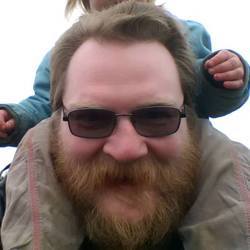 Hi Michael. You have a new book out – The Church of Virtual Saints. You seem to be drawn to religious and metaphysical subjects. What are your inspirations?
I’m drawn by the great mysteries in life – why do we exist? How did we come to be? What makes us who we are? Such questions have no simple answers, but the journey in exploring them is never wasted. By nature I appreciate the process of science in exploring how things are, although it is a little lacking in the why. Although I’m not a religious person I do have a fascination for it, not just the theology, but also the more personal aspects like faith.
My personal inspiration comes from exploring these ideas. I don’t like to look just back though, it’s as much fun seeing what could happen!
The new book follows on from Faust 2.0 in which a spontaneously evolved artificial intelligence infests the internet. I found that fascinating. What gave you that idea?
The nature of intelligence is another one of those fundamental questions that I love to ponder. With Faust 2.0 there were a few concepts I wanted to cover. The first was the technological singularity – this is the idea that technology will reach a point where its evolution is beyond our capability to understand or control it. This is a frightening possibility, yet also a fascinating one.
A common theme with such a future is the evolution of artificial intelligence – although I have to say that I’m not a fan of that term, it makes it sound like a machine’s intelligence is mimicry, rather than real and I think that’s rather short sighted.
The idea that an intelligence could spontaneously emerge is based on the idea of complexity. The basic mechanisms of the brain are simple in principle and become more complicated as they are combined.
I certainly wonder sometimes if my computer is thinking for itself!
Do you have any pet projects you haven’t yet tackled? Any genres you’re drawn to that you haven’t tried yet?
I’ve not done a Space Opera yet – although I do have plans for one. As you can imagine I have something a little different in mind for it :-)
I'll look out for that.
You have two books of short stories out. Are there any plans to write more of these?
Oh yes – I love writing short stories. In fact I’m writing one at the moment to submit for a coming anthology. I haven’t written one for a while and I’d almost forgotten how liberating writing short fiction can be. I think I’ll have to make more time to write more and put another collection together.
I enjoy reading short stories. It's nice to ponder different ideas without taking a week to read them.
As well as writing, you’re a demon reader and reviewer. I’ve heard it suggested that you’ve cloned yourself! Do you have time for any other hobbies?
I like to keep busy. Work occupies a lot of my time, writing fills most of the rest. I also have my Old Ones Productions venture for celebrating artwork and supporting my other endeavours like making chess sets. I do believe that to be a good writer, you need to be a good reader as well and so I make sure that I read for at least an hour a day.
I've seen some of the chess figures on Facebook. Very different!
So what next? What’s on the top of your ‘to do’ list?
As well as the short story submission I’m writing the first draft of The Space Inbetween which is a pet project I’ve wanted to write for some time. It’s a cosmological horror with a blend of Lovecraft and Milton influences.
I’m also planning to get myself out more to promote my books and this starts in February with Bolton Comic Con – so if you’re in the area come and say hello.
So there's our invitation! Thanks Michael. You can see Michael's books on his Amazon profile here.
January 24, 2016
Author Chat: David Hadley
 Hi David. Make yourself at home. I’ve just read your latest publication, In The Beginning. It’s a great premise for a story. How did you come up with it?
Thanks, glad you liked it. I wish I knew where it came from. Even though I walked out of Sunday School when I was six years old, not believing a word of it, I’ve always been fascinated by religion and why some people have it and I don’t.
Another part of it, no doubt comes from playing Populous a lot, back in the earlier days of computer games. For those that don’t know, Populous was a ‘God Game’, a strategy game where you take on the role of a god for your tribe of people, helping them grow and spread and killing their enemies with floods, volcanoes, earthquakes and so on.
The rest of it grew from this Although, as you can see the novel turned out very different to that original idea.
I think playing that kind of game has given many a kid a God complex.
I’ve also read some of your more serious work, such as What Dreams May Come, but even here, you can’t suppress the occasional laugh. Do you have difficulty taking life seriously?
Yes.
The universe doesn’t seem to want to take me seriously, so I refuse to take it seriously.
I once said, only half-joking, that I learnt more from Monty Python than I ever did from the educational system.
I think I feel happier writing funny books and I recently gave up working on the outline of a more serious one because I realised I wouldn’t enjoy writing it as much as I would a funny one. So, for the foreseeable future I think they will be more or less all funny ones of some shape or form.
I agree. If you aren't enjoying it, a reader won't.
Much of your output is humorous but you’ve ventured into what could be called speculative fiction. Is there another genre you’re itching to try?
I don’t know. I don’t really think of things in terms of genre as such. I’ll quite happily read anything from chick-lit to historical fiction to horror, science fiction to literary fiction to erotica and all points in-between as long as the story engages me. I see genre as an artificial boundary created for marketing purposes than anything significant or real. So I could see myself writing more or less anything, that is if I could be bothered to do the research for a genre that demands it. I’d much rather make things up than research them, though.
So, you don't like spitting writing into genres, but for the sake of argument, is there any genre you’d definitely not feel drawn to writing?
I suppose, if anything, Young Adult, New Adult or whatever they are calling it this week. Mainly because I don’t understand what it is. Back in my day, I read kids’ books until I was about 12 or 13 or so, and then I wanted to read proper grown up books, so I can’t really get my mind around having a sort of in-between category. Having said that though, I have read a fair few books classed as YA and loved them, so it is not the books themselves, just the category/genre that confuses me. But like I sad above, I’m not much of one for genre limitations.
I've always enjoyed Young Adult fiction. You can't get away with waffle or youngsters won't read it. And, if it’s not a state secret, what are you currently working on?
Ah.
I have a four-stage process: outline, first draft, second draft and final draft. I always try to have at least one project at each stage. The current final draft is one based on characters and situations from an old blog of mine – a very silly one indeed: combined with a sort of Dan Brown Da Vinci Code type story. The World famous antique treasure: The Golden Sex Spatula has been stolen from the British Museum of Perversion and it is feared that the erotic potential it possesses could – if misused - cause a cataclysmic destruction of all the sex particles in the universe. That is unless the UK’s leading investigators of the rude and naughty – Norbert and Maureen Trouser-Quandary, can recover it in time. There is a secret society, high-end physics, cream cakes, a very well-endowed blacksmith and a charabanc trip to the Naughtie Islands and its ancient monument, Stoneminge in it. It is very silly indeed and should be out in a few months.
The second draft one is about a bloke who writes a book and things get complicated.
The first draft one is my short story Twisting the Night Away, expanding out into a novel.
The current outline is going to be about a collision between magic and bureaucracy – possibly, although at the moment it is only a handful of sentences.
Thanks, David. I look forward to seeing those, and best of luck with In The Beginning, which I enjoyed very much.
You can find David and his writings on Amazon here.
January 15, 2016
Author Chat - Tim Arnot
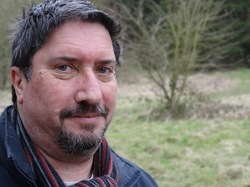 Come in, Tim. Take a seat. Your new publication, Stranded, is the third in the Flick Carter series, set in a Britain after a technological collapse. What is it about the Post-apocalyptic genre that draws you?
Why thank you, it’s very nice to be here. This might sound a little strange, but “Post Apocalyptic” in its traditional sense doesn’t actually interest me all that much. Rubble-strewn ruined wastelands filled with war-weary characters struggling to survive the indefatigable onslaught of enemy soldiers / monsters / aliens / zombies / mutant germs / regular germs / insert baddie here, has been done to death. I’ve read that story a hundred times.
I’m far more interested in what I call “Post-Post-Apocalyptic”. Wind the clock on a century or two until whatever happened is just a distant memory. People will have a vague idea of what happened, but not the details, and it won’t be relevant to daily life. Rather like the Battle of Waterloo (yes, that was 200 years ago) to people today. And so the Flick Carter stories are set around 200 years in our future, and 150 years after “the end of the world”.
It’s kind of Robin Hood meets Survivors!
Yes, I have to say that your 'future' world appears to have taken a step back in time. It's had the opportunity for its civilisation to strike a balance. Tell me a bit about Flick. She’s not your typical girlie heroine, is she?
Flick, or Felicity Anne Carter, to give her full name is an ordinary teenage girl living in this somewhat dystopian post-post apocalyptic society. She’s not a kid in the sense that we might think of teenagers today—life is short and often brutal. 40 is considered old, and everything happens younger. 15 is the age of majority, when people can marry, vote, get apprenticed, get executed and so on. It’s celebrated every year with the Choosing ceremony, when every fifteen year old legally becomes an adult, and often leaves home to start a new life.
Flick missed out on her Choosing, because her mum died when she was young, and she had to become surrogate mother to her younger siblings. She just slipped into helping her dad with the family business, but legally she was unchosen. That becomes important later.
Her idea of relaxation is getting on her old bike (three new frames, five new sets of wheels, but it’s still the best bike a girl could have…), going up into the chalk hills and finding nodules of flint, which she uses to make stone knives and arrowheads that she can sell. It’s on one of these trips that she discovers something that gets her into a world of trouble.
I do like a feisty heroine! Another of your characters, Socko, seems to have taken up a life of his own too. Why do you think he’s become popular?
Socko is one of those minor characters that, for some reason, gets a life of his own. He’s a Kingsman, which in story terms makes him one of the bad guys, but he’s also a KSI (my equivalent to a CSI, or forensic scientist), and a proponent of what he calls “experimental forensics”. This usually involves things that go bang, or catch fire.
Socko isn’t his real name—that’s Andy Garrett. He’ll swear blind that his nickname came about because he always wore odd socks. But in reality, it’s a case of nominative determinism: SOCO, from which Socko is corrupted, stands for “Scenes Of Crime Officer”, which is the UK version of a CSI.
Socko becomes more important in book 2, which leads to him becoming a full POV character in book 3. And of course he has his own spinoff series of novellas and novelettes, which are more police procedural/cosy mysteries.
I love the way this character grew, all on his own. Do you ever feel like pulling away from this world you’ve created or do you feel there’s more there to discover?
The first two books are basically set close to home: Oxford, Faringdon, Swindon, Bristol. Book 2 has a scene in Madrid, which opens us up to some of the politics in this world. Book 3 opens this up even further. But that also poses new questions that somehow demand to be answered: How come “we” have an airship base in Cherbourg (currently part of France) Whatever happened to Scotland, and parts north? There’s clearly trade going on, with ships in and out of Bristol and Liverpool. Where did they come from, and what’s happening there? Also some people seem to have “easy” access to old technology, how come?
So yes, I do feel there’s lot more to explore, and more stories to be told. we’ll probably leave Flick at the end of this trilogy, but there are certainly ways that she and other characters can make an appearance down the line.
Any hankerings to write something totally different – and if so, what?
I’m an avid reader of science fiction, and particularly space opera. But I don’t think I could write it — I don’t have the military / naval background that that kind of story seems to demand. But having had a taste of detective fiction with Socko, maybe something along those lines, but in a contemporary setting … After all, it’s not like there are any detective series set in/around Oxford, is it? (Okay, Morse. Lewis. Endeavour. Midsomer Murders….)
Thanks, Tim, and good luck with the new trilogy.
You can find Tim's Amazon author page, and links to all his books, here.
December 20, 2015
Author Chat - Will Macmillan Jones
 Come in, Will. Are you sitting comfortably? We’ll soon fix that! Your latest book, Portrait of a Girl, is a horror story. Your first in this genre, The Showing, was based on your own experience, I believe. Would you like to tell us something about them?
I always sit comfortably, thank you! Well, except for the times I sneak out of bed to my study at 3 am and forget to put any clothes on first: leather chairs are quite cold at 3am, you know. At least it concentrates the mind (as well as parts of the body!) and I get my inspiration noted down as quickly as possible! Yes, The Showing is based on my childhood experiences in my Grandfather’s house. The book has a great deal of fact in it – so much so that in fact writing it was a hard experience. The book twisted and fought back every step of the way. I even had to keep copies of the file on two separate external memory sticks as the draft kept deleting itself from the laptop’s hard drive overnight. The result was worth it, though, as I’d feel that a lot of the fear I had of that house comes through in the book.
Portrait of a Girl is different though. Whilst some of the same characters from The Showing come back out to play, the story itself is entirely fiction. At least, I hope it is: who knows what some of these strange art galleries contain? Whilst writing one of my other fantasy books (Have Frog, Will Travel – book 6 in The Banned Underground collection), I spent a day in Glastonbury doing some research. Whilst in the shops there, I took note of some of the darker side of the things available. Then, online, I came across an image of a painting called ‘Lucy Brydges’. There were some oddities in that portrait, and an idea came into my head. What if…
The main characters are back again in The House Next Door, about a demon possessed – no, I’ll keep it under wraps for a bit longer as it isn’t quite frightening enough just yet. Suffice it to say that it’s aimed at a late spring release. With added gore.
Oooh, gore! My favourite!
Portrait is released just before Christmas. There’s a bit of a tradition of Christmas ghost stories. Would you like to speculate on why this is?
I’m actually a big fan of the ghost stories of M R James. His classic ‘Oh Whistle, and I’ll come to you’ is sometimes quoted as being one of the best ghost stories ever, and has been both rewritten and filmed a number of times. James originally devised his stories to be read aloud at Christmas, at night and in front of a roaring fire, with the wind raging outside. Of course, he picked up on a much older tradition, when our ancient ancestors gathered around their fires to keep out the winter cold, and told stories of the horrors that lurked in the darkness that hung outside the mall circle of firelight, the terrors that waited for them in the wild wood, and so on. Very pagan, very traditional, great fun for all. There’s nothing like sending people to bed terrified of the dark, is there?
I saw a version of ‘Oh Whistle’ on telly many years ago. Scared me, I can tell you!
Your earlier works are humorous fantasy and you definitely have a serious sense of humour (can I say that – hell, it’s my blog!). What made you turn to horror?
I take my jokes very seriously. So, unfortunately, do others which probably explains why they don’t laugh in the right places. I actually have a stand up comedy routine I sometimes gig, based on the gags I’ve written through The Banned Underground series and it is quite instructive seeing how different audiences laugh at different things. For example, I once told the gag ‘I used to tell my husband to think for himself – until I saw what happened when he did’ to an audience largely made up of middle aged ladies, and not one of them even sniggered. Can’t win them all.
It was my experience doing stand up comedy that drew me to Horror, I think. It’s a different way of causing fear and alarm in an audience. Actually, I sometimes tell some of the short flash fiction horror stories when I do some traditional story-telling locally, and they work well as a change. Of course, a lot of traditional stories – like Grimm’s original fairy tales – are very dark and scary, so that is probably an influence too. My girlfriend tells me I have quite a dark imagination, but I’m not sure that she means it in a positive way. During the last storm we had I made up a piece about thin fingers scratching at a window, seeking a way in and she complained it kept her awake for ages. Hope I’ve got that one written down for use somewhere, actually…
I have to confess I enjoy writing the suspense. One of my favourite passages in Portrait of a Girl is one in which absolutely nothing happens. But in a very scary way.
Sounds like my life story…
You’ve also got a couple of children’s books to your credit, which I have to say, my grandchildren loved – especially the grizzly bits! Do you have any other genres you’re itching to tackle?
I’m really glad your grandchildren love the Snort & Wobbles books. I rather hope mine will when they are a little older, too. I have a historical fiction, with a healthy dose of romance, about half planned, too. Maybe it will turn into a bodice-ripper? Although I have to say that if my ex were to be told that I was writing a romance, I would achieve my secret ambition – someone would fall out of their chair laughing. It’s based in the Presceli hills close to where I live, and takes place in pre Roman Britain. That is partly because I’m drawn to that period of pre history, and partly because I’m bone idle and since it is set before written records were the norm, research is a lot easier! There’s another Romance planned in a lot of detail too, called The Last Viking which I do plan to write into draft in the Spring, after I’ve finished writing the climax of the current horror novel (The Curse of Cliffe House) and the next in The Banned Underground series, which is provisionally called Working Title.
As you know, I also write quite a lot of flash fiction, and have a small collection planned for re issue soon, and I do write and perform poetry on a regular basis. In fact there is some cross-over here, as much of the poetry can be a bit dark, and so I can be very ecologically sound and recycle it into the horror books.
And finally, as you’re a vegetarian, can I ask what you’re having for Christmas dinner?
Ha! I’ve been a vegetarian of sorts for over forty years, so I’m used to cooking differently at Christmas. I do eat fish, so the centre piece will be salmon, with plenty of other trimmings. I’m assured that I can actually cook quite well, and I usually do make an effort at Christmas. This will be my first year without children turning up and demanding to be fed, so I’ll have to be careful with the quantities for once. Maybe not with the chocolate, though…
Thanks, Will. Good luck with Portrait of a Girl.
You can find Will's Amazon page here with all his book details.
December 6, 2015
Author Chat - Jonathan Hill
 Today I’m delighted to chat to my friend and publisher, Jonathan Hill. Come in, Jonathan. Take a seat. No! That's just an expression. Bring it back and sit down. It's been a while since Pride, your last publication. Why the delay?
But it’s such an ornate chair! Yes, it’s been what feels an age since my last book. I’ve had an incredibly busy year. Work - I’m a pharmacist - has been intense and I’ve had the added strains (and delights) of settling into a new apartment. Now settled, I’m thrilled to be releasing another book at last.
And your readers are thrilled too. This one, at least.
So the new book. How would you describe the genre?
Well, The Anniversary isn’t really like any of the books I’ve published so far. I describe it as a chilling thriller. Its non-linear narrative adds a decidedly nightmarish, almost hallucinatory, quality and I can’t wait to see what readers make of this psychological novella.
I'm sure they'll let you know! You're known for the Maureen books - those funny stories of the lady of a certain age with delusions of grandeur. Have you written your last Mo or are there more in the pipeline?
I haven’t finished with Maureen. She won’t let me finish with her! I can’t say anything definite yet but there will be more from this special lady. I’m too fond of writing about her to stop now. Watch this space.
Yes, she is the woman I might be if I weren’t careful!
Would you say you prefer the funny stuff, like the Maureen novellas, or are you drawn to the dark side, my padawan learner?
Tough question. I enjoy writing both and I suppose it just depends on my mood at the time. I do seem to be drawn to the dark side - have you seen my drabbles?! - but writing successful humour can be immensely rewarding.
Tell me something about the new book, The Anniversary.
It’s told in first person and the character is a bit of a loner, I suppose. He attracts the attention of a work colleague who is rumoured to have murdered her previous partner. And the nightmare just unfolds from there. Be warned, this book has the ability to mess with your head. I performed one of the read-throughs of the book after an alcoholic drink and it freaked me out and left me asking myself what the hell I’d created!
I must try reading it after a couple!
I see from Facebook that you've started painting. Is it comparable to writing or does it satisfy a different urge? That's not rude, by the way.
I’d never connect rudeness with you, dear. Yes, it’s true I’ve picked up a paintbrush recently. I’ve completed several paintings and found the whole process therapeutic. I think there’s a great deal of overlap with writing and both satisfy the same creative urge in me. Writing has taught me to pay attention to the finest detail of the world in which we live and painting has further enhanced this.
Thanks for taking (and returning) my hot seat, Jonathan, and good luck with The Anniversary. You can find Jonathan's work on his Amazon Author page here.