Kath Middleton's Blog, page 12
August 2, 2014
 This blog post was first published on Alex Roddie's website

July 27, 2014
Writing Process Blog Tour
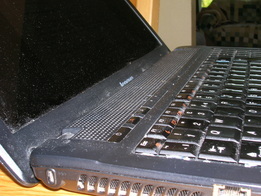 My dusty laptop - rarely closed!
I was recruited to write something on this subject by Michael Brookes whose blog you can read here. Michael is a prolific reader, writer, reviewer and film buff. He’s also a great supporter of his fellow indie authors.
1. What am I working on?
I’m currently writing what I hope will be an unnerving supernatural story. It’s a genre I haven’t really played about with yet although it’s one I enjoy reading. I’m a reader who is happy to read a story where all the ends aren’t necessarily neatly tied up and I’m left guessing. With the supernatural, there isn’t an explanation. I just want to explore the inexplicable.
2. How does my work differ from others in its genre?
Oh, a hard question there! I have just started my sixth piece of fiction and there aren’t two that you’d put in the same genre. In fact, when I attempt to categorise my work on publication, it’s a harder job than writing it. I read many genres so once I came to the conclusion that I’d like to write things which I hoped other people would want to read, it seemed obvious that I would write in many genres too. Traditional publishing steers a writer down a certain path and publishers have the whip hand. They can demand more of the same. The beauty of indie publishing is that we can write what we choose. It’s very liberating.
3. Why do I write what I do?
For the same reason most people write what they do, I imagine. I start with ‘What if…’ and it goes from there. I’m interested in many subjects and topics so I’d find it hard to concentrate my writing on just one or two genres. If I analyse what I’ve written so far, there’s always a bit of my personal interests in there. I think if you write at least partly from your own experience it makes the story seem more solid. Some of the characters say what I think or speak with my voice. Of course, most of them don’t. Writing is a wonderful way of exploring opposing stances in an argument. I’ve never managed to change my own mind yet, though.
4. How does my writing process work?
So far, (and I’ve not been doing this for very long) I begin with the original ‘What if…’ or ‘Just suppose…’ and take it from there. In some cases, it’s begun with a phrase, as with my recent novella Message in a Bottle. I was thinking about beachcombing because I love wandering along the local beaches and the idea of finding a message came to me. The rest followed.
My next book, due out towards the end of the year, also began with a phrase which is now the title. I follow the idea up from the point of view of several people in the story. I need tension. The characters mustn’t all agree and even if I don’t use it all, I need to feel I know their backstories. Once I have an outline in my head I tell someone my story. It concentrates my ideas. At this point, I begin to make notes.
The notes are a very thin outline. With a couple of books I tried to be disciplined but it’s not part of my nature. I put down a chapter outline and by chapter three I’d strayed way off track. I’ve not bothered since. I take the outline and begin at the beginning. Usually I think of another little twist or two to add in as I’m writing so they go into the outline and I deal with them when I get to them. I can’t write scenes out of order. I need the continuity. To that end, before I write a single word each day I read what I wrote the day before.
When I feel I’ve finished I put the story away, so that I can come back to it afresh after a couple of months. I also have friends who read it through for me before I get anywhere near the publishing process. I am lucky enough to work with a writing partner and we share our work and comment and suggest improvements. He sees my first chapter as soon as it’s written and I trust him to tell me if it’s interesting, worth pursuing, full of waffle or just plain cheesy! To do this, you really need someone on the same wavelength but if you find that person, it’s a massive benefit to you both.
And then who's next.
My writing partner, Jonathan Hill. Without his technical assistance I wouldn’t have any books out there in the wide world. He’s immensely versatile in his own writing and can go from funny to dark to serious without breaking stride. He also has high standards in terms of grammar and punctuation and he has more experience than I have in the structure of narrative. I return the favour and get to read and comment on his work in its infancy. It wouldn’t work for everyone but it does for us. You’ll find him here.
July 18, 2014
Proofs
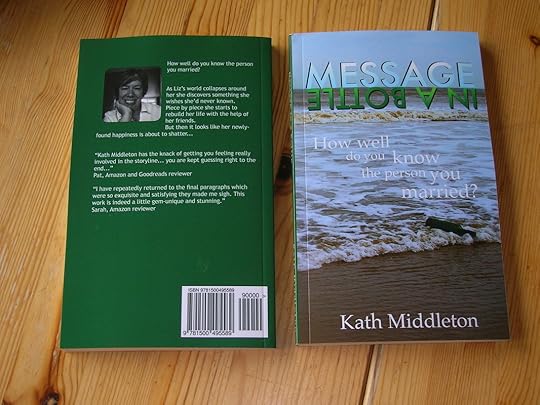 I've just opened an exciting parcel! Two proof copies of Message in a Bottle are now sitting on my dining table. I shall scrutinise them at my leisure and then I think we're good to go for paperbacks of my second publication. It's a great feeling and another big smile has been added to an amazing week.
July 13, 2014
Why do we write?
Why do we write? I think the short answer is because we can’t help it.
I began to tell stories less than a year ago. Since then I’ve not stopped, and although two are longer, most would be classed as novellas, having under forty thousand words. I finished my fifth on Friday morning. It’s a first draft, of course. I tucked it up in its little folder and thought I’d start to give it a first read-through on Monday.
Who do I think I’m kidding? Early last week I jokingly said I was going to write a horror story next. The following morning, the wisps of a tale were winding through my morning brain and by the time I’d had breakfast I had the outlines of another story. I asked myself if I could wait until November for NaNoWriMo, the clunkily titled National Novel Writing Month. I wrote my first novella last November.
Fat chance. I couldn’t even wait till next week!
July 5, 2014
SpaSpa Awards 2013
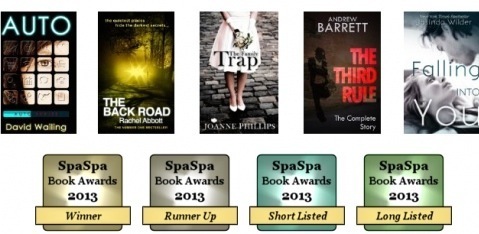 SpaSpa Awards 2013
Nothing to do with mud-packs and bubble-baths – SpaSpa is Self-Published and Small-Press Authors. I’m not a year out in my calculations either – these are awards for books published last year.
I'm new to writing but I am very pleased to be able to say that I had a story in Off the KUF, a runner-up in the anthology section. The book of Drabbles to which I contributed, published by my friend Jonathan Hill, was also a runner-up in this category.
This award, run by Indie Book Bargains, is an excellent showcase for indie published work and makes a one-stop book buying site for readers. If you choose something from this list you will be reading a book that many others have enjoyed.
You can see all the award winners here.
June 28, 2014
Message in a Bottle - Releasing a book
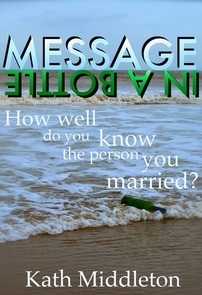 My second solo book hits the whispernet and I’m discovering the truth universally acknowledged by self-published authors. Writing the book is the easy part!
This story started its life during a walk along the east coast’s pebbly beaches. I have never seen a message in a bottle and I wondered what circumstances would prompt a person to throw one into the sea. What would I do if I found one? If a return address, or in this case, email, appeared at the end, would I reply?
I also wondered how far I could push a character. How much could I take away from her before she crumbled. Would she crumble? I’m a great believer in the power of the human spirit to survive. We want to keep going, however hard the journey seems. However far down we are pushed, we still struggle to come up for air.
This is the story of a woman who bobbed up again but thought that fate would push her back. I enjoyed writing this very much. I’m a bit mean to my characters!
http://authl.it/B00LCNBHSI?d
June 17, 2014
June 17th, 2014
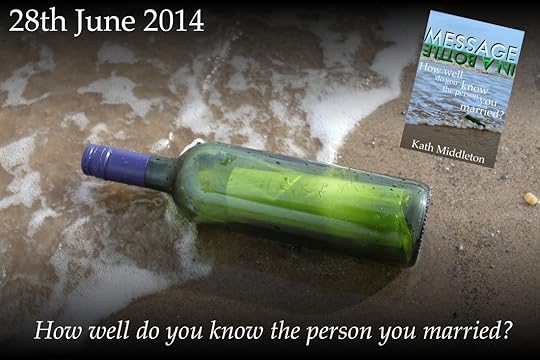
Message in a Bottle will be available for the Kindle (or Kindle app) on June 28th 2014. Here's a little 'teaser' made for me by Jonathan Hill, who publishes my books.
And yes, I did get my feet wet running backwards through the surf trying to get this photograph just as I wanted it. The problem with those dratted waves is that they keep coming!
May 8, 2014
When is a book finished?
 I mentally wrote ‘The End’ under a short novel, my third book, some months ago. I left it to mature – some would say fester – and read it through and edited it for the first time over Easter. I put it to one side again, thinking it just needed another pair of eyes or two to see whether I’d said anything silly. I can, you know.
A couple of nights ago, I was walking along the raised bank of the River Hull near the village of Tickton in that state some people call daydreaming and some call nodding off. It occurred to me that at the end of that book I could bring back something which came into the story much earlier. It would tie things up. It would bring things full circle. I was already happy with the ending which hasn’t changed. The new couple of sentences make it more satisfying though.
If I hadn’t put the book aside and started to write another, I might have published this and then missed a nice little twist. I hope it’s finished now!
April 24, 2014
New site - new blog
Recently I’ve been offered the opportunity to share blog space with other generous bloggers. I’ve not taken them up on it because my blog isn’t the kind you can drop a couple of posts on someone else’s. It’s a book review blog http://www.ignitebooks.blogspot.co.uk/ and I keep five star indie reviews at the top of my agenda there, and don’t appear in it very much myself.
That got me thinking. I should have a blog about my own books. Now I’m sitting here like I used to do at school when the teacher gave us an essay topic. I’m looking at my blank sheet of paper and thinking, ‘What shall I put?’
I might start by saying that my first book, Ravenfold, is going to prove atypical. I’m currently writing my fourth book and my second and third are in various stages of editing. All of these are set in the present day.
So why did I set Ravenfold in mediaeval times? Because it first saw the light of day as a 500 words story. It turned itself into a novella but by then it was set in the deep past and I wouldn’t have it any other way. It’s a period I’ve been interested in and I enjoyed writing it. I’m hoping to have my second novella available in June.
As the man said, ‘And now for something completely different!’
That got me thinking. I should have a blog about my own books. Now I’m sitting here like I used to do at school when the teacher gave us an essay topic. I’m looking at my blank sheet of paper and thinking, ‘What shall I put?’
I might start by saying that my first book, Ravenfold, is going to prove atypical. I’m currently writing my fourth book and my second and third are in various stages of editing. All of these are set in the present day.
So why did I set Ravenfold in mediaeval times? Because it first saw the light of day as a 500 words story. It turned itself into a novella but by then it was set in the deep past and I wouldn’t have it any other way. It’s a period I’ve been interested in and I enjoyed writing it. I’m hoping to have my second novella available in June.
As the man said, ‘And now for something completely different!’