Adam Morgan's Blog, page 4
July 8, 2014
Read this book: THE BLACK HOUR by Lori-Rader Day
 THE BLACK HOUR by Lori Rader-Day hits shelves and e-readers today, July 8th. You can buy it here. She also has a gorgeous website over here.
Lori is a friend of mine from graduate school in Chicago, so I had the pleasure of reading her debut novel from Seventh Street Books several months ago. I read it in one sitting. It’s that good.
Over at Bookpage, I called it “a perfect thriller for the summer.” It combines three of my favorite things: Chicago, academia, and mystery.
THE BLACK HOUR is a mystery set in modern-day Chicago, on the lakeshore campus of a distinguished university with more than a few dark secrets. The world needs more Chicago-based fiction, and THE BLACK HOUR, is a welcome addition to the city’s canon alongside Michael Harvey, Jim Butcher, and Veronica Roth. Except this novel is better than any of theirs, because it goes beyond the genre’s cliches and archetypes, and really showcases Chicagoland instead of relegating it to background scenery.
The dialogue crackles like Mamet’s. The characters are fascinating and true-to-life. The minimalist prose flows like a well-honed screenplay. And the mystery…THE MYSTERY. It’s a killer.
It’s a perfect thriller to cuddle up with this summer, preferably at night, in the quiet of your own home. Just don’t expect to get much sleep.
Lori will be appearing at a variety of events throughout the Midwest this summer, so stop by and get her to sign that beautiful softcover.



June 11, 2014
Where To Visit Riven in Real Life

Last month, I showed you were to find the ages of Myst in real life. Compared to the islands of Riven (the sequel to Myst) that was a piece of cake. Riven is one kooky place, with landscapes and images right out of your strangest dreams, but here’s the closest you can get to its five islands in real life.
General landscapes: Phang Nga Bay, Thailand

Nothing evokes the fractured islands of Riven better than Thailand’s beautiful sea stacks. Can’t you just picture a marble dome up there?
Temple Island: Power Plant IM Cooling Tower, Belgium

Unfortunately, there aren’t a lot of massive gold domes in the real world (although there are a few). But the interior of this abandoned cooling tower takes me right back to that creepy, cavernous room that powered Gehn’s fire marble domes.
Jungle Island: California Institute of Earth Art and Architecture

You won’t find any submarines or whark gallows, but Nader Khalili‘s experimental adobe dwellings in the Mojave Desert–with applications ranging from the Moon and Mars to third-world villages and emergency shelters on earth–sure do look a lot like Rivenese homes. Their Rumi Dome also looks like something straight out of a Cyan world.
Book Assembly Island: Whakaari/White Island, New Zealand

This rocky island’s discolored caldera lake is about as close as you could get to Gehn’s book-making headquarters. If only a steampunk-esque laboratory were perched on the rim…
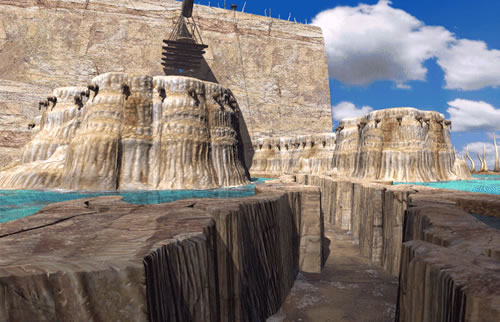
Survey Island: Hammam Meskhoutine, Algeria

These hot springs don’t even have an english Wikipedia page, but the travertine formations are nearly identical to the ones in Survey Island’s geothermal lake. Sans black spikey rocks, of course. And if you’re looking for Gehn’s whark throne room, Okinawa Churami Aquarium in Japan is just missing a few stalagmites.
Prison Island: El Árbol del Tule, Mexico

You won’t find any giant half-trees growing out of the ocean in real life, so kudos to Cyan for their imagination. But the Tree of Tule in Mexico–the world’s second-stoutest–is definitely wide enough to hold Catherine’s prison if anyone would like to spend the rest of their lives chopping it in half.
—-
Next time, I’ll track down the ages of Uru.


May 27, 2014
What Writers Can Learn from ‘THE THREE’ by Sarah Lotz

THE THREE, a creepy globe-spanning thriller from Sarah Lotz, is an addictive book. It grabs you by the neck and doesn’t let go. I found it extremely hard to put down.
Four planes crash for unknown reasons on the same day, “Black Thursday,” in Japan, South Africa, Florida, and off the coast of Portugal. The only survivors are three children, all on different flights. And they seem a bit…different when they return home. A bit…not themselves.
A bit horrifying.
An epistolary “book within a book” called Black Thursday: From Crash to Conspiracy makes up 99% of THE THREE, a collection of “real-world” documents and accounts (a la WORLD WAR Z) of the plane crashes, the survivors, and the far-right religious movement that believes the children are three of the Four Horsemen of the Apocalypse.
If you have trouble keeping up with all four plane crashes and their survivors, here’s a cheat sheet (see also: this great tie-in site).
Sun Air Flight 678: crashed in Japan’s “Suicide Forest”
Survivor: Hiro Yanagida, son of renowned AI/robotics expert
Go!Go! Airlines Flight 270: crashed off the coast of Portugal
Survivor: Jessica Craddock, niece of actor Paul Craddock
Maiden Airlines Flight 364: crashed in the Florida Everglades
Survivor: Bobby Small, grandson of Lillian and Reuben Small
Dalu Air Flight 467: crashed in the Khayelitsha township of Cape Town, South Africa
Survivor: None. But rumors of a fourth survivor persist.
The central mystery of THE THREE–why the planes crashed, why these children survived, and why they seem not-quite-human afterwards–provides plenty of horror and suspense, and the high-concept premise is particularly topical in 2014 thanks to the disappearance of Malaysian Airlines Flight 370.
And while the plot flirts with science fiction and paranormal fantasy, the book isn’t too concerned with clear answers to its speculative mysteries. Rather, it explores (quite deftly) the ripple effect that history-making incidents like 9/11 make on individual people, the media, religion, and politics during the age of 24-hour news networks and social media, where conjecture, conspiracy theories, and personality cults can spread like wildfire overnight.
Readers drawn to THE THREE by its genre trappings will not find clear answers. Even though I loved the book, I almost threw it across the room in frustration after reading the last page.
However, I once threw my all-time favorite book–THE MAGUS by John Fowles–across the room when I first read it in college.
Some novels require time to germinate in the mind. While my initial response was one of frustration, after thinking about THE THREE for a few days I came to appreciate Sarah Lotz’s decision to leave so many loose ends. After all, the book isn’t about the children. It’s about the impact they make. And if we learned anything from LOST, it’s that clear answers aren’t always a good thing.
Plus, I’m sure the sequel will clear a few things up.
In the meantime, here are a few things writers can learn from THE THREE. Also, check out a great post by Lotz over on John Scalzi’s blog.
Use More Than One Voice
Giving your readers multiple points of view breathes life into your prose. It distances them from you, the author, by another order of magnitude (see CLOUD ATLAS, THE HISTORIAN, and THE PRESTIGE).
In THE THREE, Sarah Lotz writes from the perspective of a Jewish grandmother in the United States, a narcissistic actor in London, two misanthropic teenagers in Japan, a charismatic Christian pastor in Texas, and at least a dozen other characters spread across the globe.
Each narrator speaks with a distinct cadence and vocabulary, like the Yiddish phrases of Lillian Small, the British slang of Paul Craddock, and the webspeak of Ryu and Chiyoko.
You don’t have to be as ambitious as Sarah Lotz, and you don’t have to use an epistolary structure, either. You don’t even have to use first-person point of view. My novel in progress, THE HIDDEN CITY, alternates between the perspective of two characters using close third-person. In addition to breathing life into your prose, the switching back and forth also creates suspense by frustrating your readers’ appetites for more of a particular character’s story.
Do Your Research
Since THE THREE involves four plane crashes, Sarah Lotz had to do a lot of research on air travel, aviation accidents, and emergency response.
And it shows.
In black box transcripts, newspaper articles, and eyewitness accounts from characters who are experts in their fields, Lotz’s research pays off by seamlessly immersing us in the world of her novel.
Whatever specialized world your novel takes place in, details matter. They create a sense of realism that is absent from too many stories and manuscripts that only brush the surface of a place, topic, or person.
The protagonist of THE HIDDEN CITY is an archer, so I signed up for archery lessons to get first-hand knowledge of the sport, to understand the perspective of an archer in a way that I could never glean from reading about it online.
Is your novel about a veterinarian? Call one and ask if you can shadow her for a day or two. Your readers will thank you.


May 22, 2014
Where to Visit Myst Ages in Real Life

On a hike in South Carolina last weekend, I had the uncanny sensation of walking through my favorite world from Myst, the classic CD-ROM adventure game by Cyan, Inc.
Which got me thinking…where could I visit the other four ages in real life? What are the closest real-world approximations to Myst Island and the Stoneship, Mechanical, and Selenitic ages?
The Channelwood Age: Congaree National Park, SC

The resemblance is staggering. Congaree National Park, a few miles southeast of Columbia, SC, features a boardwalk trail through a verdant wetland filled with towering cypress trees. Add a few water valves, rope bridges, and treehouses, and you’ve got the Channelwood Age. Click here for more details and images.
Myst Island: Wizard Island, Crater Lake National Park, OR

It’s got everything. The conical peak, sloping profile, and coniferous trees. It just needs a few bizarre structures and the creepiest music of all time. I’m lucky enough to have visited Crater Lake in person, but the ferry to Wizard Island was closed during my trip.
The Mechanical Age: Maunsell Forts, UK

You may have seen these amazing ruins years ago on Robyn Miller’s blog. The forts pictured above are actually just one of seven complexes scattered across the southeastern coast of England, constructed during World War II.
The Selenitic Age: Cave of the Crystals, Mexico

They may not be rising out of the ocean off the coast of a desolate island, but these enormous selenite crystals are the namesake of the Selenitic Age. The largest crystal in the cave, where temperatures often reach over 130 degrees, is nearly 40 feet long.
The Stoneship Age: SS America Shipwreck, Canary Islands

Well…it’s not a seventeenth-century galleon split into halves, but the eerie wreck of the SS America, surrounded by sharp black rocks, is the closest real-world analogy to the Stoneship Age I could find.
Ready to book a vacation yet? Sometime soon, I’ll take a look at where you can find the five islands of Riven in real life.


May 15, 2014
What Writers Can Learn from ‘Fracture’ by Megan Miranda

You wouldn’t know it from her YA thrillers set in small-town Maine, but author Megan Miranda lives in Charlotte, North Carolina. Her well-received debut novel FRACTURE was published by Bloomsbury in 2012 to a Starred Review in Publishers Weekly, followed by a sequel this year and a standalone thriller in between.
Miranda will be speaking and signing books at the South Carolina Book Festival this Saturday in Columbia, on a panel with fellow Carolina authors Jessica Khoury and Megan Shepherd called “Science and the Supernatural in YA Fiction.”
FRACTURE is a creepy page-turner that seeks to blur the line between scientific phenomena and the paranormal. High school bookworm Delaney Maxwell (what a name!) falls into one of Maine’s frozen lakes and stops breathing for eleven minutes. By the time her friends rescue her and the paramedics take over, she’s declared dead.
But not for long. Delaney’s body miraculously recovers before slipping into a six-day coma. When she wakes up in the hospital, she feels perfectly fine. Despite MRIs indicating massive neurological damage to Delaney’s brain, everything seems to be working fine, until she’s inexplicably drawn to people who are near death.
Somehow, Delaney knows when someone near her is going to die. First in the hospital, and later in her neighborhood and all over town. But it gets even creepier: someone else is always on the scene before she is. A man named Troy Varga.
Here are a couple things writers can learn from Miranda’s slick YA debut:
Pick a Season
Too many short stories and novel manuscripts I’ve workshopped and consulted on could have taken place at the height of summer or in the darkest days of winter, but I couldn’t tell you which, because the writer couldn’t either.
The rhythms and textures of our lives are inseparably dependent on the time of year. Good fiction is, too. Setting a novel–or a few chapters–near Christmastime infuses your prose with a completely different feeling than setting it around the Fourth of July does. The sights, smells, and sounds of winter are remarkably different than those of spring, summer, and fall.
Grounding your fiction in a specific place in time is just as important as grounding it in a specific place in space. Seasons breathe life into your prose, like the wintry landscapes and intimate interiors in FRACTURE.
Hold Your Cards
Some novels tell you exactly what to expect on page one. And that can be a good thing, especially for the readers who “page-browse” bookstores, reading the first few paragraphs of a number of books until they find something they like.
But sometimes, particularly when your novel depends on mystery and suspense, it’s okay to “hold your cards to your chest” for a few chapters. Your readers don’t have to know, on page one, that they’re reading a paranormal romance or a psychological thriller. You can ground them in reality first, and keep them guessing as to what direction your story’s going to take, as long as you infuse those early pages with some foreshadowing.
FRACTURE uses a literary device called prolepsis in its first chapter, flashing forward to the story’s inciting incident (Delaney’s “death”), before starting the narrative a little earlier in time. After this “flash-forward,” nothing particularly paranormal or supernatural happens for a while, as the story focuses instead on character- and world-building.
Agents reading your novel manuscript don’t necessarily need to be hit over the head by the tropes of your genre on page one. That’s what a query letter is for: use the synopsis in your query to clearly position your novel in the market, and focus on writing the best prose possible on page one of your manuscript.
…..
Miranda has another novel due out next year, SOULPRINT, which sounds like a real doozy.


May 13, 2014
Calling All Tolkien Fans: Hiking Middle-Earth Is Live

You might not know this about me, but I’m a certified Tolkien geek. As in, literally certified: I’m a member of the Tolkien Society, an educational charity and literary society based in the UK.
Today I launched a companion site for a creative nonfiction book proposal I’m putting together called Hiking Middle-Earth: A Naturalist’s Guide to the Realms of Tolkien, which combines my expertise as a nature author with my love of Tolkien’s work.
HikingMiddleEarth.com explores the landscapes, climates, flora, and fauna you might encounter if you could step into the realms of Tolkien’s vast literary canon. All observations are based strictly on the texts, not conjecture.
The book will feature guided nature walks through Middle-Earth’s most-celebrated regions in The Lord of the Rings and The Hobbit:
1. Hobbiton and the Shire
2. Rivendell
3. The Misty Mountains
4. Lothlórien
5. Isengard and Fangorn Forest
6. Mirkwood and the Lonely Mountain
7. Emyn Muil and the Anduin River
8. Rohan
9. Gondor
10. Mordor
If you’re a fellow Tolkien geek (or if you just like me a lot), please stop by the site, leave a comment, and share the posts on social media to help me build a platform before the book proposal goes to publishers.


May 12, 2014
What Writers Can Learn from ‘Origin’ by Jessica Khoury

South Carolina is best-known for its “beach reads,” like Nicholas Sparks’ coastal romances and Pat Conroy’s lowcountry epics.
But a 23-year-old novelist in Columbia, SC–Jessica Khoury, who is of Syrian and Scottish descent–is quickly changing the state’s literary reputation. This Saturday, May 17th, she’ll be speaking and signing books at the South Carolina Book Festival.
Khoury is the Michael Crichton of young-adult fiction: she infuses high-concept thrillers with the dark side of scientific and technological progress. Her debut novel ORIGIN was published in 2012 to widespread acclaim, spawning additional books set in the same fictional universe, this year’s VITRO and the forthcoming KALAHARI.
In ORIGIN, 17-year-old Pia is “perfect” in every quantifiable way: her senses and reflexes are heightened, her skin is impenetrable, and most importantly…she will never die, thanks to a century-long effort by scientists to imbue human DNA with the near-magical properties of a rare flower (echoes of 2013′s THE PEOPLE IN THE TREES).
At a secret Amazonian laboratory known as “Little Cambridge,” Pia’s mentors have taught her everything they know about biology and genetics, preparing Pia for the day when she joins them as a scientist in their mission to perfect humanity.
But they haven’t told Pia anything about the world beyond her corner of the rainforest, or about the costs of making her immortal.
Why? And what happens when she breaks out of the lab?
You’ll have to read ORIGIN. Trust me, it won’t take you long…the book is impossible to put down. It would (will?) make for an excellent film adaptation in the hands of the right screenwriter (cough).
Here are three things writers can learn from Khoury’s impressive debut:
Limited Point-of-View
Khoury’s protagonist has grown up in a glass box, behind fences, sheltered from the outside world. All references to geography or history in her textbooks have been blacked out.
By severely limiting Pia’s perspective, Khoury creates tension in two ways: via dramatic irony (we know more than Pia) and “iris-out” suspense (there’s more than meets the eye).
Like Jeff VanderMeer’s ANNIHILATION and the early seasons of the television series LOST, Khoury’s novel uses an “iris-out” technique to gradually reveal more and more of the mystery, eventually leading to a host of surprising revelations. The most celebrated use of this technique in young-adult fiction is probably in THE GIVER, where (SPOILER ALERT) we don’t realize the narrator sees in black-and-white until he realizes it.
Your novel doesn’t have to be written in the first person, like Khoury’s and VanderMeer’s, to utilize this effect. Using free indirect style, you can seamlessly embed a character’s perspective into third-person narration, limiting your prose to any character’s unique style of thinking and observing.
Competing Desires
Beginning writers tend to cast their characters as one-dimensional archetypes. The mild-mannered geek. The cynical hipster. The sweet old man.
But real people are never so singular. We all have competing desires that fight for a say in how we behave. In my work-in-progress, THE HIDDEN CITY, the main character has been teased for most of his life because he’s a short, scrawny bookworm who’s bad at team sports. But at the same time, despite his low self-esteem, he wants desperately to be a bold man of action instead of a weak-willed boy. The novel gives both sides of the character a chance to manifest.
Similarly, in ORIGIN, Pia thinks of herself as a dutiful, self-serious student with no time for her innermost desires. Simultaneously, she wants both to belong to a cloistered scientific community, and to break free and travel the world. A protagonist without this kind of inner conflict is dead from page one, because the reader can always predict exactly how she’ll behave in any given circumstance.
Consider Real-World Consequences
Too often, novels featuring characters with superhuman, supernatural, or paranormal abilities fail to realistically depict the impact said abilities would have in the real world, both on a micro- and macro-level. In ORIGIN, Pia’s immortality isn’t just a cool superpower that gives Khoury an excuse to orchestrate grandiose action sequences.
Instead, Khoury takes the concept of immortality and considers the psychological consequences it might have on a real-life teenage girl. Loneliness. Detachment. Guilt. Knowing you will watch everyone you love die. Fearing the eventual ennui and boredom that might result from centuries of existence. Spending decades trapped inside a hungry anaconda.
Don’t limit the speculative nature of your fiction to the concept or the plot. Explore how the unnatural, supernatural, unknown, and impossible might affect human beings.
…
Khoury’s next two novels, VITRO and the forthcoming KALAHARI, feature the same Dharma Initiative-esque corporation (Corpus) at the center of ORIGIN. I’ll blog about the former soon.


April 30, 2014
‘Appalachian Gothic’ Wins Charlotte Film Festival

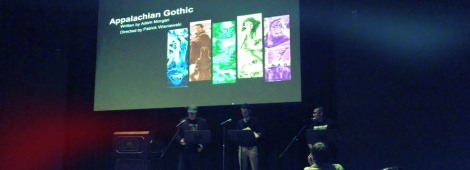
My script for APPALACHIAN GOTHIC won Best Screenplay last night at the University of North Carolina Charlotte Gold Reel Film Festival.
A group of local actors (pictured below) performed the script during the three-hour festival that featured short films, documentaries, experimental films, and other screenplays by filmmakers and writers from all over the state of North Carolina.
APPALACHIAN GOTHIC was adapted from one of my short stories, A CREATURE SO LOVELY, about a homesteader’s last encounter with nature in the Blue Ridge Mountains of North Carolina. The story relies quite a bit on the main character’s inner thoughts, so it was challenging to reduce the narrative down to pure imagery and dialogue.
There were some great films on display at the festival, particularly FILIUS by Rolando Gil; CONSUMPTION by Derek Donovan; 3101, a short documentary by Sara Karimipour; and VIRGINIA, 1877, an experimental film by Andrew Huggins.
A huge thanks to the festival, the judges, and the actors.



April 28, 2014
Five North Carolina Poets You Need to Read

April’s almost over, but did you know April is National Poetry Month? In celebration, I present five must-read poets who hail from North Carolina. Read their work. Read it all.
Robert Morgan Cornell University (from Hendersonville, NC)
Morgan (no relation that I’m aware of) is to North Carolina what Frost was to Massachusetts. His latest collection, TERROIR, is an ode to the natural beauty of the Blue Ridge Mountains. He’s written some fantastic novels (GAP CREEK) and nonfiction (BOONE) as well.
From The Living Tree
I like to think
that when I’m gone the chemicals
and yes the spirit that was me
might be searched out by subtle roots
and raised with sap through capillaries
into an upright, fragrant trunk
Kathryn Stripling Byer Western Carolina University, Cullowhee (formerly)
Byer’s collections BLACK SHAWL and WILDWOOD FLOWER are some of the first North Carolina poetry I can remember reading. Think of O’Conner and Faulkner’s Southern Gothic set to verse in the North Carolina mountains.
From Halloween Again
and time slides like silk
against silk.
Easy to get lost
in letting go
this time of year.
Cathy Smith Bowers Queens University, Charlotte
LIKE SHINING FROM SHOOK FOIL brings together the best poems from Bowers’ first four chapbooks. Her voice is distinctly Southern without sounding clichéd.
From Kingdom
When my brother
finally spoke its name,
the white cells of his body
having relinquished
their ancient
instruments of war
the small bombs
silenced
Ron Rash Western Carolina University, Cullowhee
Rash is famous for his novels SERENA and THE COVE, but he’s also prolific poet and short story writer. His latest collection, WAKING, is his best yet.
From Fall Creek
As though shedding an old skin,
Fall Creek slips free from fall’s weight,
clots of leaves blackening snags,
back of pool where years ago
local lore claims clothes were shed
by a man and woman wed
Joseph Bathanti Appalachian State University, Boone
North Carolina’s newest Poet Laureate, Bathanti’s poetry is decidedly haunting. Try THIS METAL.
From Burn Season
Smoke fills the house with musk.
Ants spill from the wood
at the first trickle of flame.
Beneath the buckling bark,
grubs and glowworms disintegrate.


April 27, 2014
What Writers Can Learn From ‘Authority’ by Jeff VanderMeer

ANNIHILATION, the first book in Jeff VanderMeer‘s Southern Reach trilogy, was a thrilling challenge to the division between science fiction and literary fiction, and one of the most visceral and refreshing reading experiences I’ve had in quite some time.
I wrote about it in February, and I’m far from the only one who loved it. A movie is already in development.
Now, mere weeks after ANNIHILATION’s release, the second volume is upon us.
AUTHORITY is not the sequel readers will expect. If you’re hoping for another breathless adventure through the wilderness, you’ll be surprised. AUTHORITY is claustrophobic, confining itself primarily indoors. Instead of Area X, the novel explores the Orwellian headquarters of the Southern Reach, full of secrets, lies, and the truly strange.
You’ll watch footage from the first mission, visit the border, and learn a lot more about the expedition members from the first book and the scientific experiments performed over the past few decades.
The setting may have changed, but reality and perception prove to be just as slippery as in ANNIHILATION.
Here are a few things writers can learn from AUTHORITY.
Don’t Give ‘Em What They Want
Writing good fiction is all about creating appetites, frustrating those appetites, and then–eventually–satisfying them in unexpected ways. The first part of that equation means getting your readers to ask questions. Instead of force-feeding a bunch of exposition, AUTHORITY creates knowledge gaps that lead to suspense when the reader asks who, what, where, when, and why.
Take Twin Peaks. Who was Laura Palmer? Who killed her? Why? And what’s the deal with her mother’s visions?
The next step is to frustrate the reader’s appetite for answers. It’s a hard balance to strike. On the one hand, you can’t delay satisfaction for too long (see AMC’s The Killing). On the other, you can’t give your readers exactly what they want, when they want it.
AUTHORITY strikes this balance well. For one, the entire book represents the frustration of an appetite (MOAR AREA ECKS!) by pivoting from the forest to the office. And then, while a few of the biggest questions from the first book are answered, they never come when–or how–you might expect them.
Suggest Instead of Describe
In his treatise on writing fiction, THE HALF-KNOWN WORLD, Robert Boswell implores writers to “suggest a dimension to the fictional reality that escapes comprehension.” No one does this better than VanderMeer and his Weird Fiction contemporaries, like China Miéville and Jeffrey Ford. They do not supply a glossary, or a labeled map, or a historical timeline. They invite you to write in the margins of their books as you try to piece their stories together.
VanderMeer’s world-building techniques are subtle and implicit. He invokes the idea of a place–or a feeling–within the reader’s psyche. Explicit world-building (i.e., fully known worlds and fully known characters) are boring.
“The audience must participate in the creation of the world,” Boswell says, and the techniques VanderMeer used in ANNIHILATION to create atmosphere and suspense are just as effective in AUTHORITY.
Polyphony
If you’ve just finished writing the first book in a series, but aren’t sure how to start the second, it may help to think of your sequel as a response instead of just a continuation. Narratively, the story must progress forward (even if it wanders backward in time), but conceptually and stylistically, it need not be more of the same. In fact, good sequels rarely are.
Sequels that merely mimic the formulae of their predecessors (e.g., Taken 2, Iron Man 2, The Lost Symbol) are often doomed to fail. Sequels that provide an entirely different experience (e.g., The Godfather Part 2, The Dark Knight, A Subtle Knife) succeed in part because they explore the story from a new and different angle.
AUTHORITY deepens the mystery of Area X by establishing a polyphony of perspectives on the trilogy’s overarching narrative.
….
AUTHORITY is due out May 6. The third and final novel in the series, ACCEPTANCE, won’t hit shelves until September, but kudos to FSG Originals for publishing all three books in a single calendar year.