
Ripley Entertainment Inc.'s Blog, page 51
December 15, 2022


December 14, 2022
Was Egyptian Mummification Really About Preserving Bodies?
Featured in Ripley's Believe It or Not!

Even a fifth grader could tell you why Egyptians mummified the dead bodies of their loved ones: They took the measure to preserve the final remains of family members and important people for the Afterlife, right?
Surprisingly, the answer’s a big, fat “no,” as a new exhibition about mummification premiering on February 18, 2023, in Manchester, United Kingdom, will demonstrate.
Entitled the Golden Mummies of Egypt, the exhibition dives into the exotic embalming practice, providing new insights into its ultimate goal. The topic is also explored in greater depth in the recently released book Egypt’s Golden Couple by Dr. Colleen Darnell.
Keep reading to learn more about the real reason Egyptians mummified the dead and what it means for our understanding of this bygone culture.
Blame the Victorians!How could such a massive misnomer about Egyptian mummification persist for so long? And where did the notion come from in the first place? Blame the Victorians! You see, Victorian researchers ranked among the first to start delving into examining and analyzing ancient tombs in Egypt. And it appears they made some grand assumptions from the get-go.
Nineteenth-century archaeologists mistakenly saw a link between the preservation of fish using salt and mummification employing a similar substance, and they ran with it. Unfortunately, these Victorian researchers didn’t prove the most scrupulous detectives. (Where was Sherlock Holmes when you needed him?) But as pioneers of Egyptology, they still wielded a disproportionate influence regarding many of the things people believe about Egypt to this day. Even when they were dead wrong.

The inner crater (caldera) of Mount Emi Koussi (Tibesti, Chad). Mineral precipitation (natron) on the ground is visible. Via Wikimedia Commons.
So, what’s the deal with salt preservation of fish and human remains? The relationship between these two practices is tenuous at best. The Victorians neglected to mention that the dead bodies in question had desiccated in a different substance than that used for sardines or salmon jerky.
Known as “natron,” this mineral proved abundant in Egypt’s Natron Valley, and it did a remarkable job of arresting decay and inhibiting the growth of bacteria. But unlike table salt (a.k.a. sodium chloride), natron contains sodium carbonate, sodium chloride, sodium sulfate, and sodium bicarbonate.
Preservation Proved a ByproductAlthough no one can argue that the application of natron contributed to mummification, preserving the dead body was beside the point. Researchers reached this conclusion after examining the spiritual significance of natron to the Egyptian people. “In some cultures, especially Pharaonic Egypt, [natron] was thought to enhance spiritual safety for both the living and the dead.”
This special significance ensured natron was present throughout the transition from the Earth to the Afterlife. They offered it at funerals, used it to “awaken” the dead, and saw it as critical to transporting a body into the next realm. Artists working inside tombs relied on natron mixed with castor oil to light the rooms where they painted murals. And natron was an active ingredient in soaps, proto-toothpastes, and early mouthwashes. So, natron also symbolized cleansing.
Ancient Egyptian mummification process. #Thread pic.twitter.com/zqBB6DE2QY
— Africa Archives ™ (@Africa_Archives) January 21, 2022
The natron applied to the deceased served many functions besides preservation. The same goes for other substances rubbed on dead bodies — like myrrh, frankincense, and incense resins — that inadvertently contributed to mummification. In each case, these substances had associations with the gods. In other words, Egyptians believed application on corpses facilitated the transition from human being to divine entity, making an individual’s remains god-like.
Deification Through MummificationWhat’s the takeaway? Think of mummification as a pathway to deification. Its ultimate purpose represented a caterpillar-to-butterfly–like metamorphosis from mortal to immortal. Moreover, steps in the process, such as removing internal organs, aided in remaking a corpse into a sacred statue.
Dr. Colleen Darnell explains, “Mummification in ancient Egypt was intended to transform a corruptible human body into an eternally existing statue that could then be the focus of rituals like the Opening of the Mouth. The corpse, properly preserved, wrapped, and placed in a coffin or coffins, became the most personalized sculpture possible.” The idealized masks placed on mummies after death support these conclusions. These masks portrayed the people beneath them in highly realistic but idealized ways.
No sarcophagus better demonstrates this than that of King Tutankhamun. While Tut’s burial mask portrays him as preternaturally handsome and well-proportioned, a 2014 facial reconstruction falls short of this image. Created relying on physiological information obtained during a “virtual autopsy” of the mummy via CT scans, the reconstruction presents a homely and flawed visage. Nevertheless, the embalmers who interred the young pharaoh did their best to render him a sacred god, providing him with a mask of such timeless beauty it still appeals to us today.
Interested in exploring more of Dr. Colleen Darnell’s work? Check out her brand new book Egypt’s Golden Couple: When Akhenaten and Nefertiti Were Gods on Earth.
Fascinated by all things Egyptian? Check out the Lost Civilization Gallery at Ripley’s Believe It Or Not! Orlando where you can unwrap the history of a mummified African ibis using Interspectral’s 3D-visulization technology!
By Engrid Barnett, contributor for Ripleys.com
EXPLORE THE ODD IN PERSON! Discover hundreds of strange and unusual artifacts and get hands-on with unbelievable interactives when you visit a Ripley’s Odditorium!Source: Was Egyptian Mummification Really About Preserving Bodies?

December 13, 2022
Emperor’s Top-Secret Assassination Letter Finally Decoded
Featured in Ripley's Believe It or Not!

It’s the kind of case the fictional professor of symbology at Harvard, Robert Langdon, would sink his teeth into. A 500-year-old mystery message from an imperiled emperor to an ambassador in France. But this isn’t the premise of another Dan Brown book in The Da Vinci Code series, although it would certainly make for a juicy tale.
Instead, it’s the story of a lost missive from 1547 filled with unintelligible symbols and codes. Rediscovered in 2019, it has sparked one of the most painstaking and elaborate code-cracking cases since Nazi Germany’s World War II-era Enigma Machine.
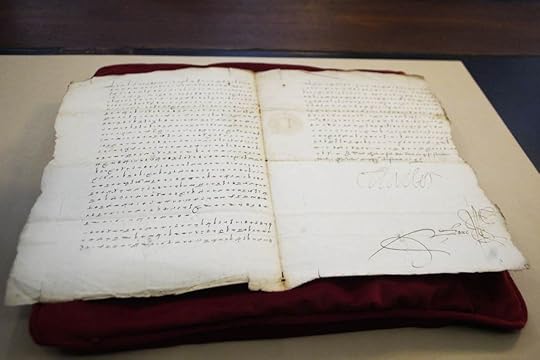
The encrypted letter from Charles V. Credit: Stanislas Library
Keep reading to find out how researchers finally cracked the code and why the message in the letter remained closely guarded for so long.
A Kingdom and Empire in CrisisCharles V, Emperor of the Holy Roman Empire and King of Spain, reigned over a veritable hornet’s nest. But this didn’t stop him from nursing lofty ambitions. His career as Holy Roman Emperor began in 1519, just three years after taking the Spanish throne. But by 1556, he surrendered it all through abdication.
In the interim, he attempted to establish a universal European empire to recapture the glory of the Roman Empire. But his eventual plans proved even loftier. Not only did the Old World tease his desire for total control, but he also sought to actively establish colonies in the New World. While this sounds like the stuff of greatness, he ruled over a kingdom rotting from within.
After unsuccessfully quelling the Protestant Reformation, Charles V witnessed the long and steady fragmentation of Latin Christendom. Any steps he took to stop the process remained hampered by deep-seated tensions with France. To make matters worse, Charles V never knew for sure whether the papacy’s army would side with him or Francis I, King of France.

Francis I and Charles V at the Truce of Nice in 1538.
Conquering North Africa didn’t work out for the Holy Roman Emperor, and his colonial endeavors in the Americas yielded little revenue. Moreover, continued pressures from the Ottoman Empire (modern-day Turkey) made the emperor feel sandwiched between enemy powers. These events represented the perfect storm for removing a global leader, even one who wore two crowns simultaneously.
Decoding a Top-Secret Message from a Bygone EraUntil recently, scholars underestimated the animosity between Charles V and Francis I, which may have included an assassination plot. At least that’s what computer scientists and cryptographers recently announced in a press conference at the Stanislas Library in Nancy, France.
The team spent more than half a year attempting to make sense of the weird symbols and signs interspersed with intelligible text in the letter. The endeavor started after the letter was rediscovered in 2019 in the Stanislas Library archives. For centuries, the letter from Charles V to Jean de Saint-Mauris, ambassador to France, went unnoticed.
But after library staff miraculously rediscovered it, they decided it was time to get to the bottom of the strangely coded passages. To do this, they called in a team of experts skilled in computer science and cryptography. Despite having the latest technology at their fingertips, these researchers still had much work to do.
Why did the letter’s coded passages prove so difficult to decipher? For two primary reasons: First, the symbols represented entire words rather than letters of the alphabet, which threw the application of linguistic patterns out the door. Second, Charles V included decoy or dummy symbols throughout the letter to throw off potential codebreakers!
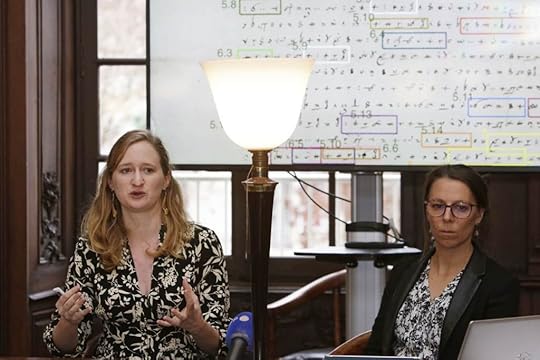
Researchers unveiling the decoded letter. Credit: Stanislas Library
A Royal Assassination PlotWhat information in the letter proved so inflammatory that it required Charles V to take such precautions? The letter highlighted a fragile peace between the Holy Roman Empire and the Gallic nation. But it also detailed intrigues at the French court that alarmed him. He felt insecure despite ruling over Spain, Austria, Germany, the Netherlands, Belgium, and regions of Italy.
Part of this insecurity sprang from whispers of a possible assassination attempt on Charles V. In the code, he urged his ambassador to France to do whatever possible to maintain the peace. But he also asked him to learn more about the potential plot so it could be thwarted.
This is the first time in 500 years such a plot has come to light, and it’s already rewriting history books. Camille Desenclos of France’s University of Picardy Jules Verne explains, “It’s rare as a historian to manage to read a letter that no one had managed to read for five centuries.”
Although Charles V expressed concerns about a possible murder plot, 1547 would turn out to be fruitful for the Holy Roman Emperor. Francis I died that year, and Charles V also managed to put down a pesky rebellion by German princes.
Nevertheless, the letter provides a “snapshot of Charles V’s strategy in Europe.” The researchers remain enthusiastic about unlocking more mysteries hidden in his letters. As it turns out, Charles V proved fond of writing in code. Desenclos notes, “It is likely that we will make many more discoveries in the coming years.”
By Engrid Barnett, contributor for Ripleys.com
EXPLORE THE ODD IN PERSON! Discover hundreds of strange and unusual artifacts and get hands-on with unbelievable interactives when you visit a Ripley’s Odditorium!Source: Emperor’s Top-Secret Assassination Letter Finally Decoded

December 12, 2022
The Burial Cliffs of Sagada and their Hanging Coffins
Featured in Ripley's Believe It or Not!

Believe It or Not!, there are cemeteries suspended from cliffs in Sagada, Philippines! They were put there by indigenous people following ancient traditions which are said to stem from the belief that the higher the dead are to the sky, the more elevated their spirits are in the afterlife!
Because the coffins are attached and suspended at incredibly high points on the cliffs, they are seemingly unreachable and have attracted tourists from all over the world.
Six Feet… Up?The practice dates back thousands of years but is no longer prevalent, with burials on the cliffs only taking place once every few years!
When it does occur, the body is wrapped tightly in fabric and carried up the mountain to be placed in its coffin. Some coffins are noticeably shorter; this is because it was once common practice to fold the deceased into the fetal position — sometimes breaking bones in the process — since it was believed the body should leave this world as it entered it.

Nearly all of the coffins are marked with the name of the person inside it. Overtime, the coffins deteriorate from exposure to the elements and fall to the ground below. Believe It or Not!, some of the coffins are over a century old!
Since the hanging structures draw a number of tourists, many of the local residents will accompany tourists on the hike to witness the burial cliffs and offer insight into their traditions and culture.

No one is completely sure why the practice began. One belief is that the cemeteries served to place the bodies closer to their ancestral spirits, while others think they provided a creative way to keep bodies out of the waterlogged soil.
Escape the Ordinary With Ripley’s Latest Book!Find this story and more inside Ripley’s all-new book! Escape the Ordinary‘s 256 pages spark curiosity, challenge perception, celebrate differences, and curate a sense of wonder for the weird world around us! Available now on Amazon and at most major retailers.

Source: The Burial Cliffs of Sagada and their Hanging Coffins

December 11, 2022

December 10, 2022

December 9, 2022

Ripley Entertainment Inc.'s Blog

- Ripley Entertainment Inc.'s profile
- 52 followers

