Michael K. Rose's Blog, page 21
April 22, 2012
CONTEST! Win a Copy of Inner Lives
This is a very simple contest. I will send a free eBook copy of
Inner Lives: Three Short Stories
to the first ten people who email me with the correct answer to the following question:
The title of the third story in Inner Lives is "If I Profane with My Unworthiest Hand." Where does this phrase come from?
Send your answers to myriad_spheres@yahoo.com with "CONTEST" in the subject line. Also mention your eBook format preference: epub (for Nook) or mobi (for Kindle).
This contest ends on Monday April 30, 2012, or when I have received ten correct answers. Good luck!
Oh, and please don't post the answer in the comments section. Let others find it out for themselves. Thanks!


The title of the third story in Inner Lives is "If I Profane with My Unworthiest Hand." Where does this phrase come from?
Send your answers to myriad_spheres@yahoo.com with "CONTEST" in the subject line. Also mention your eBook format preference: epub (for Nook) or mobi (for Kindle).
This contest ends on Monday April 30, 2012, or when I have received ten correct answers. Good luck!
Oh, and please don't post the answer in the comments section. Let others find it out for themselves. Thanks!


April 21, 2012
Teri Heyer is "Talking About Reviews"
Writer Teri Heyer wrote a great blog post about reviews. Check it out
here
. I wanted to share her post because she pretty much sums up how I feel on the issue as well. I particularly agree with her on the point regarding 5-star reviews. I hate reading those comments that imply that the reviewer must be a friend/family member of the author. It seems some people are just unable to accept the fact that pretty much any work of art will have some who love it and some who hate it. I've heard people rail against Beethoven, for crying out loud!
If you're a writer, this blog post is definitely a worthwhile read. Go have a look and leave your own thoughts in the comments section.
If you're a writer, this blog post is definitely a worthwhile read. Go have a look and leave your own thoughts in the comments section.
April 17, 2012
David Nevin's Adding Value Interviews
I was pleased when David Nevin asked to interview me for a series of interviews he has conducted on the topic of adding value to the writing community. The first of these interviews with Melissa Foster, a well-known and respected writer in the Indie community, was posted on April 10th. My interview went live earlier today and I would encourage you all to read both of the interviews, as well as those to come, and think about how helping other writers is not only a good thing to do because it is the right thing to do but because, ultimately, it is a way of helping yourself as well. I have had such wonderful experiences interacting with other writers ever since I published my first eBook in November of 2011 and I look forward to continued positive interaction and mutual support.
Visit this link to go directly to Mr. Nevin's interview with me:
http://davidnevin.net/2012/04/adding-value-interview-with-michael-k-rose/
The interview with Melissa Foster, as well as future interviews, can be found here:
http://davidnevin.net/category/adding-value/
Visit this link to go directly to Mr. Nevin's interview with me:
http://davidnevin.net/2012/04/adding-value-interview-with-michael-k-rose/
The interview with Melissa Foster, as well as future interviews, can be found here:
http://davidnevin.net/category/adding-value/
April 13, 2012
NEW RELEASE: Verliege by Micheal Rivers

Micheal Rivers has just released his new paranormal thriller, Verliege ! I'd just like to say a quick personal word, then I'll let Micheal's official bio and and an excerpt from the novel do the rest. I am currently reading Verliege and it is an absolutely absorbing and, at times, terrifying adventure. At every turn the unexpected may happen and there is enough of a psychological element to leave the reader wondering who--or what--is behind it all. I hope the tantalizing excerpt that follows the biography leaves you wanting for more!
Author Biography
Micheal Rivers, author of paranormal thrillers, announces his new release Verliege . The novel is based on a haunted castle in Verliege, Germany. Murder, mystery, and intrigue will keep you spellbound as you journey through the castle in search of the secret of the nine.
Rivers is the author of three previous books, The Black Witch , Moonlight on the Nantahala , and Ghosts of the North Carolina Shores . His books can be purchased at Amazon.com.
Micheal, an American author, was born in Ahoskie, North Carolina in 1953. He served his country during the Viet Nam war in the USMC. Later, his travels provided over thirty years of investigating and collecting stories of the paranormal. His genres include horror and thriller with an element of paranormal in all of his novels. The Smokey Mountain Ghost Trackers of Western North Carolina was founded by him and he is the lead investigator. Micheal currently resides in the mountains of North Carolina along with the love of his life and his Boxer he fondly calls Dee Dee.
Micheal Rivers' books may be found at http://amzn.to/uHpPD6
Visit his website here: http://michealrivers.com/
Please enjoy the following excerpt from Verliege:
Near the center of the cemetery the mausoleum beckoned them to draw closer. From their position they could not see the front of the mausoleum. Two sides could be clearly seen, appearing unusually clean. Emery did not approach the mausoleum immediately. He stood squinting in the morning sun, trying hard to find a reason why the stone structure had not aged over the years.
He had learned early in his career not to advance too quickly upon a scene that did not feel right. Raising his camera to his eye, he adjusted the long-distance lens to bring the mausoleum closer. Something was wrong. The stone was too perfect in every way. He could not find a single flaw.
Weis spoke softly. “We may find something of interest within the tomb.”
Emery spoke without taking his eye off of the mausoleum. “I think we should skirt around it and approach it from the front. It doesn’t feel right to me. Take a look through your camera and tell me what you see.”
Weis raised his camera and inspected the walls of the mausoleum carefully. “I don’t see anything unusual.”
Emery laughed lightly. “Look again. The stonework has not aged a day. There are no cracks or signs of erosion as there should be.”
Weis looked once more, realizing Emery had been correct in his observations. Carefully they walked in a large circle to enable them to see the front of the mausoleum. Standing a safe distance away, they saw that one of the doors was partially open, allowing them to see the darkness of the interior.
Stepping slowly forward toward the open door, each man prepared himself for a possible intruder. Emery approached the open door at an angle to help protect himself. Time slowed to a crawl. Reaching for the door to open it farther, Emery’s fingers had barely reached the handle when it slammed shut violently.
They both jumped back away from the door, and Weis fell over a broken headstone behind him. A loud moan echoed through the air around them.
Weis gained his feet, shaking his head. “I am not going in there. Whatever it is, I’m happy to leave it in there.”
Emery grinned. “Sorry, Weis, but I have to see what the moaning is about.” He reached forward and jerked the door open with a vengeance. Shining his light inside, he found the mausoleum empty except for the neatly stacked burial coffins. Emery turned, questioning what he was seeing. “There is nobody there, Weis. I guess the moan was the rusty hinges and a little imagination.”
Weis disagreed. “The door was shut before we heard the moan. Do you think you can tell me who shut the door? I think not. It is too heavy to close on its own. I’m leaving.”
Emery watched as Weis started to walk away. The incident had shaken him badly. Weis was glad he had taken pictures of the open door before it had slammed shut. It was hard for him to shake the feeling that there was someone close behind them as they made their way back across the bridge. Turning back toward the cemetery when he was at the foot of the bridge, he glimpsed a large black shadow disappearing into the trees.
***
Get your copy of Verliege here: http://www.amazon.com/Verliege-ebook/dp/B007QOB0V6/


April 11, 2012
A Guide to Attending the Symphony or Opera, Part II
Welcome to the next exciting installment of "A Guide to Attending the Symphony or Opera!" The first part, which can be found
here
, covered the basic guidelines one should follow when attending one of these events. This part will go over the musical forms one is likely to hear when attending a symphonic performance. Believe it or not, when you go to the symphony you aren't necessarily going to hear a symphony! But if your knowledge of classical music is minimal, there is no need to worry about this. I'll walk you through the five most common musical forms performed by today's symphony orchestras.
1. The Symphony - This is the obvious one. Wikipedia defines a symphony as "an extended musical composition in Western classical music, scored almost always for orchestra." Most symphonies are in multiple movements, or parts, with four movements being the "standard" organization. Typically, there are thematic elements that run through the entire symphony. These musical themes can be very apparent or they can be subtle and picked up only after repeated listenings. This is why, as I recommend in Part I, it is valuable to listen to a recording of the piece you're going to hear. It is truly exhilarating when you first pick up on a theme in a piece of music. You then begin to hear the piece as a whole, how each element relates to all the others, rather than as a series of nice-sounding notes. As also mentioned in Part I, do not applaud until the entire symphony is over. There will usually be breaks between each movement so if you are unsure, wait for the majority of the audience to clap, not just a few scattered clappers. A warning: some symphonies will try to trick you. There can be more (or fewer) than four movements, one movement can lead to the next attacca (meaning without pause; see the last two movements of Beethoven's 5th Symphony) or the movements may be atypically arranged. Tchaikovsky's 6th Symphony is a superb example. It has a rousing third movement which leads many to believe it is the finale. However, there is a fourth movement, a beautiful and mournful adagio. If there is raucous applause after the third movement, the solemnity of the fourth movement can be affected.
2. The Concerto - Symphonies and concertos are the most common musical forms you will encounter when going to see a live performance. Wikipedia defines a concerto as "a musical work usually composed in three parts or movements, in which (usually) one solo instrument (for instance, a piano, violin, cello or flute) is accompanied by an orchestra." So, very simply, it is like a symphony but with a soloist playing a virtuoso part along with the orchestra. As mentioned it is usually in three movements, typically arranged fast-slow-fast. The solo instrument can be anything but you will most commonly encounters violin concertos, cello concertos and piano concertos because they are the most popular. One of my favorite concertos is actually a guitar concerto by Joaquin Rodrigo called "Concierto de Aranjuez." The second movement, the adagio, is often heard in movies, TV shows and commercials. Miles Davis brilliantly interpreted the movement for trumpet on his Sketches of Spain album.
3. Choral Music - Sometimes a symphony orchestra will pair with a choral group to present choral music which can be a nice change of pace. Some choral works include soloists singing certain parts of the work. Choral music forms some of the most beautiful and uplifting music in the Western canon, particularly the cantatas by Bach. And, of course, one of the most spectacular choral works is Mozart's Requiem. It is even more moving when one considers that it is the last piece of music he ever worked on. Beethoven's 9th Symphony is both a symphony and a choral work, with the chorus entering during the last movement to sing Schiller's inspiring words.
4. Chamber Music - It is not too common for a symphony orchestra to perform chamber music and there is a very good reason for this. Chamber music gets it's name from the fact that these works were meant to be played in a chamber, or room, of a house. So, what is chamber music? Most pieces of chamber music are called trios, quartets, quintets, septets, octets, etc. It depends on how many instruments are used to play the piece with the configurations of instruments varying wildly. However, the most common form of chamber music you will hear is the string quartet, consisting of two violins, a viola and a cello. As mentioned, symphony orchestras do not often put on programs of chamber music but in any large city there will be groups of chamber musicians or organizations that put on performances. Again, most chamber music is in several movements (four movements are typical for string quartets). This is also a nice change of pace from orchestral music because one gets to hear each player individually as well as in combination with only a few other instruments. The harmonies that can be produced by a string quartet border on the divine. Also, if you want to prepare a quiet, romantic dinner at home, chamber music is an ideal choice for the stereo.
5. Lieder or Songs - This is another rare treat, especially if you like vocal music. A song can be sung by one or more soloists and can be accompanied by just a solo piano or a full orchestra. Often, songs will be arranged in cycles by a composer, with each song telling part of a larger story or following a common theme. Some famous song cycles include Schubert's Die schöne Müllerin (The Lovely Miller Maid) and Mahler's moving Kindertotenlieder (Songs on the Death of Children). If a symphony orchestra performs a program that includes songs, it will often only be part of the program, say the first half, with the second half devoted to orchestral music.
I hope this post has encouraged you to get out and support your local symphony! I am by far an expert on classical music, I am merely an enthusiast. However, if there are any questions you may have feel free to ask them in the comments section. I also welcome corrections to anything I have written here. Part III, coming at some undisclosed future date, will focus exclusively on opera.
See Also:
A Guide to Attending the Symphony or Opera, Part I
1. The Symphony - This is the obvious one. Wikipedia defines a symphony as "an extended musical composition in Western classical music, scored almost always for orchestra." Most symphonies are in multiple movements, or parts, with four movements being the "standard" organization. Typically, there are thematic elements that run through the entire symphony. These musical themes can be very apparent or they can be subtle and picked up only after repeated listenings. This is why, as I recommend in Part I, it is valuable to listen to a recording of the piece you're going to hear. It is truly exhilarating when you first pick up on a theme in a piece of music. You then begin to hear the piece as a whole, how each element relates to all the others, rather than as a series of nice-sounding notes. As also mentioned in Part I, do not applaud until the entire symphony is over. There will usually be breaks between each movement so if you are unsure, wait for the majority of the audience to clap, not just a few scattered clappers. A warning: some symphonies will try to trick you. There can be more (or fewer) than four movements, one movement can lead to the next attacca (meaning without pause; see the last two movements of Beethoven's 5th Symphony) or the movements may be atypically arranged. Tchaikovsky's 6th Symphony is a superb example. It has a rousing third movement which leads many to believe it is the finale. However, there is a fourth movement, a beautiful and mournful adagio. If there is raucous applause after the third movement, the solemnity of the fourth movement can be affected.
2. The Concerto - Symphonies and concertos are the most common musical forms you will encounter when going to see a live performance. Wikipedia defines a concerto as "a musical work usually composed in three parts or movements, in which (usually) one solo instrument (for instance, a piano, violin, cello or flute) is accompanied by an orchestra." So, very simply, it is like a symphony but with a soloist playing a virtuoso part along with the orchestra. As mentioned it is usually in three movements, typically arranged fast-slow-fast. The solo instrument can be anything but you will most commonly encounters violin concertos, cello concertos and piano concertos because they are the most popular. One of my favorite concertos is actually a guitar concerto by Joaquin Rodrigo called "Concierto de Aranjuez." The second movement, the adagio, is often heard in movies, TV shows and commercials. Miles Davis brilliantly interpreted the movement for trumpet on his Sketches of Spain album.
3. Choral Music - Sometimes a symphony orchestra will pair with a choral group to present choral music which can be a nice change of pace. Some choral works include soloists singing certain parts of the work. Choral music forms some of the most beautiful and uplifting music in the Western canon, particularly the cantatas by Bach. And, of course, one of the most spectacular choral works is Mozart's Requiem. It is even more moving when one considers that it is the last piece of music he ever worked on. Beethoven's 9th Symphony is both a symphony and a choral work, with the chorus entering during the last movement to sing Schiller's inspiring words.
4. Chamber Music - It is not too common for a symphony orchestra to perform chamber music and there is a very good reason for this. Chamber music gets it's name from the fact that these works were meant to be played in a chamber, or room, of a house. So, what is chamber music? Most pieces of chamber music are called trios, quartets, quintets, septets, octets, etc. It depends on how many instruments are used to play the piece with the configurations of instruments varying wildly. However, the most common form of chamber music you will hear is the string quartet, consisting of two violins, a viola and a cello. As mentioned, symphony orchestras do not often put on programs of chamber music but in any large city there will be groups of chamber musicians or organizations that put on performances. Again, most chamber music is in several movements (four movements are typical for string quartets). This is also a nice change of pace from orchestral music because one gets to hear each player individually as well as in combination with only a few other instruments. The harmonies that can be produced by a string quartet border on the divine. Also, if you want to prepare a quiet, romantic dinner at home, chamber music is an ideal choice for the stereo.
5. Lieder or Songs - This is another rare treat, especially if you like vocal music. A song can be sung by one or more soloists and can be accompanied by just a solo piano or a full orchestra. Often, songs will be arranged in cycles by a composer, with each song telling part of a larger story or following a common theme. Some famous song cycles include Schubert's Die schöne Müllerin (The Lovely Miller Maid) and Mahler's moving Kindertotenlieder (Songs on the Death of Children). If a symphony orchestra performs a program that includes songs, it will often only be part of the program, say the first half, with the second half devoted to orchestral music.
I hope this post has encouraged you to get out and support your local symphony! I am by far an expert on classical music, I am merely an enthusiast. However, if there are any questions you may have feel free to ask them in the comments section. I also welcome corrections to anything I have written here. Part III, coming at some undisclosed future date, will focus exclusively on opera.
See Also:
A Guide to Attending the Symphony or Opera, Part I
April 10, 2012
A Excerpt from Sullivan's War: Book II
Dear Friends,
Following this introduction is Chapter 1 of Sullivan's War: Book II - A City without Walls . If you like action-packed science fiction, you will love Sullivan's War ! The series has been receiving rave reviews on Amazon and has been a regular inhabitant of Amazon's Bestsellers in Science Fiction Series list. If you enjoy this preview, please consider purchasing Book II from Amazon or Barnes & Noble ( links here ). If you've yet to read Book I, links to purchase it can be found here .
Best,Michael
---
Trenton was a miserable place. So miserable that not even the corporate mining interests would touch it. They had touched it at one time, briefly, just long enough to build a habitation and mining complex that covered twelve square kilometers. And they had touched it just long enough to let two thousand men and women die when the planet’s highly unstable tectonic plates shifted, destroying a quarter of that complex as the planet’s surface split apart and lava flowed up through the fissure and into the streets. They could send automated machines, steel behemoths that could mine and process fifteen tons of rock per hour, but their accountants had convinced them that it wasn’t worth the risk. The loss of a dozen machines would break any mining interest. The loss of two thousand men had been quite a bit less costly. No, there were other worlds to exploit. It was best not to risk it. Because of this, all this and a dozen other reasons, Harvey cursed under his breath when he saw the tracking data on the stolen freighter. It had left Damaris after Richard Sullivan had stolen it and, presumably, killed its owner, a freight runner named Oscar Jones. Then the ship had disappeared. It was only a matter of time before it would turn up again, though. Harvey had been waiting ever since, waiting for a probe or any other passing ship to pick up the freighter’s identification signal. It was finally detected by a private ship that had done a fly-by over Trenton. They were sight-seeing, looking at the impressive lava flows, but when their ship flew within range of the freighter it had silently logged the ID signal, as was routine, then uploaded that information to Damaris’s planetary database upon its return. Harvey had flagged the ID signal and when the freighter’s location finally reached him he was ready to go within six hours. He didn’t know what Sullivan was doing on that god-forsaken world but he hoped he’d still be doing it long enough for Harvey to find him. Harvey had cursed again when he and Ross arrived at Trenton. He’d never been there but the sight was overwhelming. It was a Mars-sized rock covered in a thick atmosphere. It had boasted life a million years ago but now the tectonic shifts, the eruptions and the continent-wide lava flows had killed off all but the simplest of microbes. It was technically a moon, not a planet, orbiting a gas giant that shared the same sun as Damaris. Sullivan had not gone far. It was clear he wanted to keep close to Damaris for some reason. Harvey didn’t much care why. As Harvey’s ship dipped below the cloud layer and the forbidding surface came into view, a notice popped up on the screen in front of him. The freighter’s ID signal had been detected. Sullivan was still here, or at least the ship was. Harvey programmed the ship to touch down near the freighter. “Alright,” he said, turning to Ross. “You ready for this?” Ross, in response, tapped the firearm at his side and smiled. “Good.” Harvey checked his own gear. “But if we’re lucky, he’ll already be dead. It would mean no bounty, but I have a bad feeling about this one.”
Rebreathers weren’t absolutely necessary on Trenton but Harvey and Ross wore them anyway. Keeping clean air in their lungs would help them if they had to confront Sullivan. They touched down in a landing zone next to the freighter. This part of the complex had been one of the industrial sections. Massive warehouses lined the streets in each direction. This was where the minerals extracted from the ore had been transferred to ships for transport off-world.Ross scanned the freighter and the area around it. There were no life signs. Cautiously, he and Ross exited their ship. A lack of life signs didn’t necessarily mean anything; bioshrouds were technically illegal but Sullivan could have easily picked one up on Damaris. That planet wasn’t a member of the Stellar Assembly and the legality or illegality of devices like bioshrouds didn’t concern them too terribly. Harvey approached the stolen freighter, gun drawn. The number written across the side of the hull in white matched the number Harvey had on record. This was definitely Oscar Jones’s ship. Harvey knew Jones had been the man who’d smuggled Sullivan off of Earth after Sullivan had killed the assemblymen. Why Sullivan would, almost a year later, track down and kill Jones wasn’t known. Harvey didn’t much care about that either. The death of Jones only meant that Harvey’s bounty would be bigger. The Stellar Assembly paid good money for multiple murderers. After searching the freighter, Harvey and Ross entered one of the warehouses. There was nothing in it. A search of several of the other structures revealed those to be empty as well. The mining company had kept men on the ground long enough after the disaster to make sure all the equipment was loaded onto ships and taken off-world.Harvey took out his tablet and studied a map of the mining complex. If Sullivan was still alive he’d be in the residential zone. Despite the company’s removal of all their equipment, Trenton had been abandoned hastily after the accident. There would probably still be a fair amount of canned and dehydrated food left in the miners’ apartments.
Slowly, deliberately, Harvey and Ross made their way to the residential zone. Harvey studied his bioscanner carefully every few meters. Even if Sullivan did have a bioshroud they didn’t always function perfectly. Contraband items weren’t necessarily manufactured to exacting standards and all Harvey needed was a temporary glitch for Sullivan to register as a blip on the scanner. Ross didn’t need any such gadgets. He’d been Harvey’s right-hand man for six years and the bounty hunter’s ability to sense his prey was uncanny. Harvey could count a dozen perps that would have gotten away if Ross hadn’t been with him. There were two or three more that would have taken Harvey’s life if Ross hadn’t been watching his back. So when Ross held up a fist as they entered the residential zone, Harvey halted. He followed as Ross silently padded up to the side of an apartment building and ducked into the building’s entryway. Harvey lifted his rebreather from his nose and mouth. “What is it?” “This building. I saw movement in a fourth floor window.” Harvey looked through the glass doors of the apartment building. Aside from a thick layer of dust, the lobby looked as it might have when the miners and their families had lived here. But the dust revealed that someone had been here more recently than that. A trail of footprints led from the doorway to what Harvey assumed was the stairwell. The elevator wouldn’t be operational, of course. There was no power in the city.Harvey scanned the lobby. “Alright,” he said. “I’ll go around and find a back exit and make sure there’s not another way up. You watch the main stairwell from here. I’ll let you know if I find a way inside. If I do, take a position just to the side of the stairwell door. If I don’t, I’ll meet you back here.” Ross nodded and drew his gun. Harvey hugged the side of the building as he made his way around it, watching the windows above him. He arrived at the rear of the building and found the emergency exit. He pulled at the handle. Locked. He continued on around the building to make sure there were no other doors. He rounded back to the main street, took another glance at the windows above him and made his way back to the front entrance. Ross wasn’t there. Harvey peered into the lobby. There was no sign of his partner. Harvey hadn’t signaled, so Ross should have stayed put. No, Ross would have stayed put. The only thing that would have moved Ross from his position would have been Sullivan. Sullivan must have come down the stairs; Ross must have seen him and taken chase. Harvey drew his gun and opened the door to the lobby. Once inside he could more clearly see Ross’s boot prints in the dust leading toward the stairwell. Harvey traced those steps and peered through the small square window of the stairwell door. All clear. He pulled open the door and winced as the hinges creaked. He opened it just enough to slip through then held it so it closed quietly behind him. A central shaft ran down the stairwell. Looking up it he could see the top floor ten, maybe twelve, stories up. He watched carefully for any movement on the stairs before cautiously making his way up. Ross had to be in the stairwell. He would have followed Sullivan until he exited onto one of the floors. Ross would have then waited for Harvey in the stairwell before pursuing Sullivan further. Harvey worked his way up the stairwell. When he reached the halfway point between the ninth and tenth floors he then knew that Ross wasn’t in the stairwell. For some reason he had pursued Sullivan into one of the dark corridors alone. The fourth floor. That’s where Ross had seen the movement, so that’s where Harvey would look for Ross. He thought about radioing his partner but decided against it. If Ross was close to Sullivan, Harvey didn’t want to give away his position. Worse, if Sullivan had gotten ahold of Ross’s earpiece… no. That wasn’t possible. Sullivan, from what Harvey had read, was good. But Ross was better. Harvey inched opened the door to the fourth floor. Thankfully, this one didn’t squeak. The corridor was almost completely dark, illuminated only by the light coming in through two or three open doors. Harvey came to the first open door and peered inside. It was a small but comfortable apartment. A love seat sat facing a holographic projector. To the right a kitchenette looked out over a counter into the living room. Harvey cleared the living room then approached the open door of the bedroom. As he peered in he heard a faint noise behind him. He made a quarter of a turn but before he could fully bring himself around something struck the back of his head. Harvey reeled from the blow and landed hard against the wall. He used his momentum to push back against the wall as he landed and flung himself at his attacker. It was too dark for him to see the man clearly but there was only one person it could be: Richard Sullivan. Harvey barreled into Sullivan with his shoulder, knocking the gun from his hand. He used his weight to try and land hard on Sullivan as he fell but Sullivan managed to roll away. Harvey’s knee struck the floor, sending a bolt of agony through his leg. As Harvey was temporarily incapacitated by the pain, Sullivan retrieved his gun and pistol-whipped Harvey across the side of the head. Harvey went down. He struggled to maintain consciousness but lost. The dim light in the apartment faded even further and then all was black.
---
I hope you enjoyed this preview of Sullivan's War: Book II - A City without Walls. Please follow these links to purchase the books in the Sullivan's War series.
Sullivan's War: Prologue - Sergeant Riley's Account This stand-alone novella doesn't directly involve the Sullivan's War story line but it is a great introduction to Rick Sullivan's universe.Sullivan's War: Book I - All Good Men Serve the Devil Sullivan's War: Book II - A City without Walls Sullivan's War: Book III - Edaline's Dawn Coming in May, 2012!
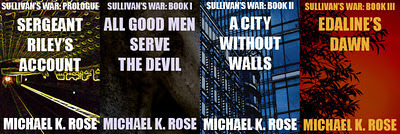

Following this introduction is Chapter 1 of Sullivan's War: Book II - A City without Walls . If you like action-packed science fiction, you will love Sullivan's War ! The series has been receiving rave reviews on Amazon and has been a regular inhabitant of Amazon's Bestsellers in Science Fiction Series list. If you enjoy this preview, please consider purchasing Book II from Amazon or Barnes & Noble ( links here ). If you've yet to read Book I, links to purchase it can be found here .
Best,Michael
---
Trenton was a miserable place. So miserable that not even the corporate mining interests would touch it. They had touched it at one time, briefly, just long enough to build a habitation and mining complex that covered twelve square kilometers. And they had touched it just long enough to let two thousand men and women die when the planet’s highly unstable tectonic plates shifted, destroying a quarter of that complex as the planet’s surface split apart and lava flowed up through the fissure and into the streets. They could send automated machines, steel behemoths that could mine and process fifteen tons of rock per hour, but their accountants had convinced them that it wasn’t worth the risk. The loss of a dozen machines would break any mining interest. The loss of two thousand men had been quite a bit less costly. No, there were other worlds to exploit. It was best not to risk it. Because of this, all this and a dozen other reasons, Harvey cursed under his breath when he saw the tracking data on the stolen freighter. It had left Damaris after Richard Sullivan had stolen it and, presumably, killed its owner, a freight runner named Oscar Jones. Then the ship had disappeared. It was only a matter of time before it would turn up again, though. Harvey had been waiting ever since, waiting for a probe or any other passing ship to pick up the freighter’s identification signal. It was finally detected by a private ship that had done a fly-by over Trenton. They were sight-seeing, looking at the impressive lava flows, but when their ship flew within range of the freighter it had silently logged the ID signal, as was routine, then uploaded that information to Damaris’s planetary database upon its return. Harvey had flagged the ID signal and when the freighter’s location finally reached him he was ready to go within six hours. He didn’t know what Sullivan was doing on that god-forsaken world but he hoped he’d still be doing it long enough for Harvey to find him. Harvey had cursed again when he and Ross arrived at Trenton. He’d never been there but the sight was overwhelming. It was a Mars-sized rock covered in a thick atmosphere. It had boasted life a million years ago but now the tectonic shifts, the eruptions and the continent-wide lava flows had killed off all but the simplest of microbes. It was technically a moon, not a planet, orbiting a gas giant that shared the same sun as Damaris. Sullivan had not gone far. It was clear he wanted to keep close to Damaris for some reason. Harvey didn’t much care why. As Harvey’s ship dipped below the cloud layer and the forbidding surface came into view, a notice popped up on the screen in front of him. The freighter’s ID signal had been detected. Sullivan was still here, or at least the ship was. Harvey programmed the ship to touch down near the freighter. “Alright,” he said, turning to Ross. “You ready for this?” Ross, in response, tapped the firearm at his side and smiled. “Good.” Harvey checked his own gear. “But if we’re lucky, he’ll already be dead. It would mean no bounty, but I have a bad feeling about this one.”
Rebreathers weren’t absolutely necessary on Trenton but Harvey and Ross wore them anyway. Keeping clean air in their lungs would help them if they had to confront Sullivan. They touched down in a landing zone next to the freighter. This part of the complex had been one of the industrial sections. Massive warehouses lined the streets in each direction. This was where the minerals extracted from the ore had been transferred to ships for transport off-world.Ross scanned the freighter and the area around it. There were no life signs. Cautiously, he and Ross exited their ship. A lack of life signs didn’t necessarily mean anything; bioshrouds were technically illegal but Sullivan could have easily picked one up on Damaris. That planet wasn’t a member of the Stellar Assembly and the legality or illegality of devices like bioshrouds didn’t concern them too terribly. Harvey approached the stolen freighter, gun drawn. The number written across the side of the hull in white matched the number Harvey had on record. This was definitely Oscar Jones’s ship. Harvey knew Jones had been the man who’d smuggled Sullivan off of Earth after Sullivan had killed the assemblymen. Why Sullivan would, almost a year later, track down and kill Jones wasn’t known. Harvey didn’t much care about that either. The death of Jones only meant that Harvey’s bounty would be bigger. The Stellar Assembly paid good money for multiple murderers. After searching the freighter, Harvey and Ross entered one of the warehouses. There was nothing in it. A search of several of the other structures revealed those to be empty as well. The mining company had kept men on the ground long enough after the disaster to make sure all the equipment was loaded onto ships and taken off-world.Harvey took out his tablet and studied a map of the mining complex. If Sullivan was still alive he’d be in the residential zone. Despite the company’s removal of all their equipment, Trenton had been abandoned hastily after the accident. There would probably still be a fair amount of canned and dehydrated food left in the miners’ apartments.
Slowly, deliberately, Harvey and Ross made their way to the residential zone. Harvey studied his bioscanner carefully every few meters. Even if Sullivan did have a bioshroud they didn’t always function perfectly. Contraband items weren’t necessarily manufactured to exacting standards and all Harvey needed was a temporary glitch for Sullivan to register as a blip on the scanner. Ross didn’t need any such gadgets. He’d been Harvey’s right-hand man for six years and the bounty hunter’s ability to sense his prey was uncanny. Harvey could count a dozen perps that would have gotten away if Ross hadn’t been with him. There were two or three more that would have taken Harvey’s life if Ross hadn’t been watching his back. So when Ross held up a fist as they entered the residential zone, Harvey halted. He followed as Ross silently padded up to the side of an apartment building and ducked into the building’s entryway. Harvey lifted his rebreather from his nose and mouth. “What is it?” “This building. I saw movement in a fourth floor window.” Harvey looked through the glass doors of the apartment building. Aside from a thick layer of dust, the lobby looked as it might have when the miners and their families had lived here. But the dust revealed that someone had been here more recently than that. A trail of footprints led from the doorway to what Harvey assumed was the stairwell. The elevator wouldn’t be operational, of course. There was no power in the city.Harvey scanned the lobby. “Alright,” he said. “I’ll go around and find a back exit and make sure there’s not another way up. You watch the main stairwell from here. I’ll let you know if I find a way inside. If I do, take a position just to the side of the stairwell door. If I don’t, I’ll meet you back here.” Ross nodded and drew his gun. Harvey hugged the side of the building as he made his way around it, watching the windows above him. He arrived at the rear of the building and found the emergency exit. He pulled at the handle. Locked. He continued on around the building to make sure there were no other doors. He rounded back to the main street, took another glance at the windows above him and made his way back to the front entrance. Ross wasn’t there. Harvey peered into the lobby. There was no sign of his partner. Harvey hadn’t signaled, so Ross should have stayed put. No, Ross would have stayed put. The only thing that would have moved Ross from his position would have been Sullivan. Sullivan must have come down the stairs; Ross must have seen him and taken chase. Harvey drew his gun and opened the door to the lobby. Once inside he could more clearly see Ross’s boot prints in the dust leading toward the stairwell. Harvey traced those steps and peered through the small square window of the stairwell door. All clear. He pulled open the door and winced as the hinges creaked. He opened it just enough to slip through then held it so it closed quietly behind him. A central shaft ran down the stairwell. Looking up it he could see the top floor ten, maybe twelve, stories up. He watched carefully for any movement on the stairs before cautiously making his way up. Ross had to be in the stairwell. He would have followed Sullivan until he exited onto one of the floors. Ross would have then waited for Harvey in the stairwell before pursuing Sullivan further. Harvey worked his way up the stairwell. When he reached the halfway point between the ninth and tenth floors he then knew that Ross wasn’t in the stairwell. For some reason he had pursued Sullivan into one of the dark corridors alone. The fourth floor. That’s where Ross had seen the movement, so that’s where Harvey would look for Ross. He thought about radioing his partner but decided against it. If Ross was close to Sullivan, Harvey didn’t want to give away his position. Worse, if Sullivan had gotten ahold of Ross’s earpiece… no. That wasn’t possible. Sullivan, from what Harvey had read, was good. But Ross was better. Harvey inched opened the door to the fourth floor. Thankfully, this one didn’t squeak. The corridor was almost completely dark, illuminated only by the light coming in through two or three open doors. Harvey came to the first open door and peered inside. It was a small but comfortable apartment. A love seat sat facing a holographic projector. To the right a kitchenette looked out over a counter into the living room. Harvey cleared the living room then approached the open door of the bedroom. As he peered in he heard a faint noise behind him. He made a quarter of a turn but before he could fully bring himself around something struck the back of his head. Harvey reeled from the blow and landed hard against the wall. He used his momentum to push back against the wall as he landed and flung himself at his attacker. It was too dark for him to see the man clearly but there was only one person it could be: Richard Sullivan. Harvey barreled into Sullivan with his shoulder, knocking the gun from his hand. He used his weight to try and land hard on Sullivan as he fell but Sullivan managed to roll away. Harvey’s knee struck the floor, sending a bolt of agony through his leg. As Harvey was temporarily incapacitated by the pain, Sullivan retrieved his gun and pistol-whipped Harvey across the side of the head. Harvey went down. He struggled to maintain consciousness but lost. The dim light in the apartment faded even further and then all was black.
---
I hope you enjoyed this preview of Sullivan's War: Book II - A City without Walls. Please follow these links to purchase the books in the Sullivan's War series.
Sullivan's War: Prologue - Sergeant Riley's Account This stand-alone novella doesn't directly involve the Sullivan's War story line but it is a great introduction to Rick Sullivan's universe.Sullivan's War: Book I - All Good Men Serve the Devil Sullivan's War: Book II - A City without Walls Sullivan's War: Book III - Edaline's Dawn Coming in May, 2012!

April 9, 2012
Classic Science Fiction 04: “The Last Question” by Isaac Asimov
(Note: After writing this I realized that it is less an examination of "The Last Question" than it is an expression of the thoughts and feelings the story inspired in me. But after all, isn't that what fiction is for?)
What is the ultimate fate of humanity? Annihilation. If our descendants are still around in five billion years and even if they somehow manage to escape our solar system when the sun expands to incinerate the Earth, they will eventually die, along with the rest of the universe. Some 100 trillion years from now star formation will cease. The universe will slowly die. Entropy will be irreversible. I doubt we would be recognizable as humans by that point but it wouldn't matter. Everything we had accomplished, all our scientific advances, all the great art and music, the books and poems, would all have been for naught. Even if the universe then collapses back upon itself and gives birth to a new big bang, a new universe, all matter will have been reverted to the molecular state. Nothing that existed before will exist any longer.
Isaac Asimov's "The Last Question" chronicles several generations of humans and their descendants pondering the question of how the entropy of the universe can be decreased. They address this question to various incarnations of supercomputers and the answer is always the same: "INSUFFICIENT DATA FOR MEANINGFUL ANSWER." I will not reveal the ending in case you haven't read it (you can read it here ) but the asking of the question, not the ultimate answer, is what fascinates me most about this story.
Everything humankind has accomplished will eventually be destroyed. No matter what happens to the universe, every trace of us will ultimately vanish. What does this mean? How does one process this information?
I suppose most people just end up ignoring it. They may read about entropy, etc., may briefly realize what this means, then slip comfortably back into their lives. Perhaps this is the most logical response. After all, what can you do about it? Nothing. Why let if affect you?
But I do not believe this is the correct response. What we should do is realize that no matter what happens in the future, we have today. We have the people around us that we love and care about, we have the ability to make today better not just for ourselves but for others. When you look at life on the scale of the entire history of the universe, isn't it a bit mind-boggling that of all the possible outcomes, your life is one of them? Doesn't it give you pause to think that the chain of events that led to your existence goes back nearly fourteen billion years in an unbroken line?
As Carl Sagan said, "[s]ome part of our being knows this is where we came from. We long to return. And we can. Because the cosmos is also within us. We're made of star-stuff. We are a way for the cosmos to know itself."
What do we take away from this? How should we live our lives, knowing this? I've written before about wishing to leave a literary legacy. I've expressed the hope that my work is read a hundred years from now or more. It is an egotistical wish, to be sure. But I think about legacy in more ways than one. If there is some message I can impart to future readers, if one of them reads my work and goes away thinking about notions of right and wrong, thinking about what could be done to make our little corner of the universe more just, more peaceful, then my legacy will have been secured. But I need not write a single word to accomplish this. If I can have a positive influence on the lives of the people I know, if I can live by example and show them that a life of joy and contentment can be had without exploiting or hurting others--that, in fact, the joy is more pure than if I had gained it on the backs of others--I will have left a legacy. If they, in turn, try to live their lives according to the same ideals, they can leave a legacy when they are gone.
The future illuminates the present. What can happen tomorrow tells us very clearly and without hesitation what we must do today. If tomorrow we may die, then today we must live. If tomorrow a child will go hungry, then today we must arrange to feed her. If tomorrow a war may begin, then today we must ensure peace. These are not difficult things to grasp. We have the means to largely rid the world of misery. Why haven't we? Is it the nihilistic strain within humanity that says that ultimately it won't matter? No. It is the selfishness that says whatever I give to them, I cannot have for myself. Well, that ultimately won't matter either. But if you can bring a little joy, a little happiness to someone's life, if you can remove a little misery from the world, that does matter. That will have an effect here and now. And if enough of us do it, it can have an effect until the universe comes to an end.
Perhaps we shouldn't ask "how can entropy be decreased?" but rather "how can joy be increased?" And let it not be the last question, but the first. Humanity's joy is my joy, humanity's accomplishments are my accomplishments. What benefits the planet benefits me in a very nontrivial way. Maybe that is what I am after when I speak of legacy. I want a way for my life to have not been trivial. To do this, I write. But I also live my life as well and as ethically as I can. I suppose that even if I don't leave behind a literary legacy, this will have been enough. This will have made a difference and my life, in that unbroken chain leading from the beginning of the universe to its end, will have been a link worthy of that legacy.
What is the ultimate fate of humanity? Annihilation. If our descendants are still around in five billion years and even if they somehow manage to escape our solar system when the sun expands to incinerate the Earth, they will eventually die, along with the rest of the universe. Some 100 trillion years from now star formation will cease. The universe will slowly die. Entropy will be irreversible. I doubt we would be recognizable as humans by that point but it wouldn't matter. Everything we had accomplished, all our scientific advances, all the great art and music, the books and poems, would all have been for naught. Even if the universe then collapses back upon itself and gives birth to a new big bang, a new universe, all matter will have been reverted to the molecular state. Nothing that existed before will exist any longer.
Isaac Asimov's "The Last Question" chronicles several generations of humans and their descendants pondering the question of how the entropy of the universe can be decreased. They address this question to various incarnations of supercomputers and the answer is always the same: "INSUFFICIENT DATA FOR MEANINGFUL ANSWER." I will not reveal the ending in case you haven't read it (you can read it here ) but the asking of the question, not the ultimate answer, is what fascinates me most about this story.
Everything humankind has accomplished will eventually be destroyed. No matter what happens to the universe, every trace of us will ultimately vanish. What does this mean? How does one process this information?
I suppose most people just end up ignoring it. They may read about entropy, etc., may briefly realize what this means, then slip comfortably back into their lives. Perhaps this is the most logical response. After all, what can you do about it? Nothing. Why let if affect you?
But I do not believe this is the correct response. What we should do is realize that no matter what happens in the future, we have today. We have the people around us that we love and care about, we have the ability to make today better not just for ourselves but for others. When you look at life on the scale of the entire history of the universe, isn't it a bit mind-boggling that of all the possible outcomes, your life is one of them? Doesn't it give you pause to think that the chain of events that led to your existence goes back nearly fourteen billion years in an unbroken line?
As Carl Sagan said, "[s]ome part of our being knows this is where we came from. We long to return. And we can. Because the cosmos is also within us. We're made of star-stuff. We are a way for the cosmos to know itself."
What do we take away from this? How should we live our lives, knowing this? I've written before about wishing to leave a literary legacy. I've expressed the hope that my work is read a hundred years from now or more. It is an egotistical wish, to be sure. But I think about legacy in more ways than one. If there is some message I can impart to future readers, if one of them reads my work and goes away thinking about notions of right and wrong, thinking about what could be done to make our little corner of the universe more just, more peaceful, then my legacy will have been secured. But I need not write a single word to accomplish this. If I can have a positive influence on the lives of the people I know, if I can live by example and show them that a life of joy and contentment can be had without exploiting or hurting others--that, in fact, the joy is more pure than if I had gained it on the backs of others--I will have left a legacy. If they, in turn, try to live their lives according to the same ideals, they can leave a legacy when they are gone.
The future illuminates the present. What can happen tomorrow tells us very clearly and without hesitation what we must do today. If tomorrow we may die, then today we must live. If tomorrow a child will go hungry, then today we must arrange to feed her. If tomorrow a war may begin, then today we must ensure peace. These are not difficult things to grasp. We have the means to largely rid the world of misery. Why haven't we? Is it the nihilistic strain within humanity that says that ultimately it won't matter? No. It is the selfishness that says whatever I give to them, I cannot have for myself. Well, that ultimately won't matter either. But if you can bring a little joy, a little happiness to someone's life, if you can remove a little misery from the world, that does matter. That will have an effect here and now. And if enough of us do it, it can have an effect until the universe comes to an end.
Perhaps we shouldn't ask "how can entropy be decreased?" but rather "how can joy be increased?" And let it not be the last question, but the first. Humanity's joy is my joy, humanity's accomplishments are my accomplishments. What benefits the planet benefits me in a very nontrivial way. Maybe that is what I am after when I speak of legacy. I want a way for my life to have not been trivial. To do this, I write. But I also live my life as well and as ethically as I can. I suppose that even if I don't leave behind a literary legacy, this will have been enough. This will have made a difference and my life, in that unbroken chain leading from the beginning of the universe to its end, will have been a link worthy of that legacy.
April 8, 2012
5 MORE Ways to Help Authors Without Spending a Dime
I have received great feedback and a lot of hits on my blog post
5 Ways to Help Authors without Spending a Dime
so I thought I'd run a part two, taking into account some of the suggestions left by readers in the comments section. I hope you enjoy these suggestions and put them into practice!
1. Jennifer wrote: "And also don't forget that at the end of the day, a short note to the author letting him/her know how much you enjoy that author's writing can be just the right amount of encouragement at just the right time." She is absolutely right! A few kind words can make all the difference to a writer if sales have been down or s/he's received a negative review. If you enjoy something you read, let the author know!
2. Rachel wrote: "Also how about hitting Yes if you find a review helpful or No if you don't." This is not something I had thought about until recently, when I received my first (and so far only) negative review. Several of my fans and friends rallied around me to click "unhelpful" on that review and reassure me that the reviewer was completely off-base. The fact that the review was so nasty and vindictive made this support particularly welcome.
3. Jeff wrote: "For Twitter, I try to get the most value out of those 140 characters that I can, so whenever possible for thank you's or welcomes, replies, retweets, etc., etc., it helps to add the authors book title, link, whatever you can get your hands on." A great idea! If your followers see a unique tweet coming from you--someone they know and trust--rather than an RT, which a lot of people tend to ignore, it might make them look at it a bit more closely. For authors who have been really supportive of me, I've even made up a file of tweets about their books, which I try to send out once a day.
4. Jeff also wrote: "Don't forget to join an author's blog site (which I just now did btw)." Authors blog. A lot. It's part of that whole attention whore thing I mentioned in the first 5 Ways to Help Authors... post. Now, following a blog helps you because if you like that author and the content s/he provides, you won't miss anything. But it can help the author as well. Here's how: say a prospective reader happens across the blog and sees that many people are following it. This will let him or her know that this author has something worthwhile to say and they may be more likely to stick around and see what it's all about and, perhaps, buy a book or two.
5. Tell Your Friends! This one is so basic that I overlooked it the first time around. If you enjoy a book, write a review, of course. But people you know from work, the PTA, old school friends, etc. may never get around to trolling Amazon for your reviews. Tell them about books that you love and, most importantly, tell them how to get a copy! Send them emails or DMs with the link so they don't forget!
Keep the suggestions coming in the comments section!
Best,
Michael
1. Jennifer wrote: "And also don't forget that at the end of the day, a short note to the author letting him/her know how much you enjoy that author's writing can be just the right amount of encouragement at just the right time." She is absolutely right! A few kind words can make all the difference to a writer if sales have been down or s/he's received a negative review. If you enjoy something you read, let the author know!
2. Rachel wrote: "Also how about hitting Yes if you find a review helpful or No if you don't." This is not something I had thought about until recently, when I received my first (and so far only) negative review. Several of my fans and friends rallied around me to click "unhelpful" on that review and reassure me that the reviewer was completely off-base. The fact that the review was so nasty and vindictive made this support particularly welcome.
3. Jeff wrote: "For Twitter, I try to get the most value out of those 140 characters that I can, so whenever possible for thank you's or welcomes, replies, retweets, etc., etc., it helps to add the authors book title, link, whatever you can get your hands on." A great idea! If your followers see a unique tweet coming from you--someone they know and trust--rather than an RT, which a lot of people tend to ignore, it might make them look at it a bit more closely. For authors who have been really supportive of me, I've even made up a file of tweets about their books, which I try to send out once a day.
4. Jeff also wrote: "Don't forget to join an author's blog site (which I just now did btw)." Authors blog. A lot. It's part of that whole attention whore thing I mentioned in the first 5 Ways to Help Authors... post. Now, following a blog helps you because if you like that author and the content s/he provides, you won't miss anything. But it can help the author as well. Here's how: say a prospective reader happens across the blog and sees that many people are following it. This will let him or her know that this author has something worthwhile to say and they may be more likely to stick around and see what it's all about and, perhaps, buy a book or two.
5. Tell Your Friends! This one is so basic that I overlooked it the first time around. If you enjoy a book, write a review, of course. But people you know from work, the PTA, old school friends, etc. may never get around to trolling Amazon for your reviews. Tell them about books that you love and, most importantly, tell them how to get a copy! Send them emails or DMs with the link so they don't forget!
Keep the suggestions coming in the comments section!
Best,
Michael
April 6, 2012
What Science Means to Me
I am a science fiction writer. I write in other genres, but science fiction is my first love. I love the possibilities, I love, as I said in a recent interview, asking and answering the "what ifs?" But this is the fiction part. Let's examine the science part for a moment.
It is an ironic fact that science makes science fiction more difficult. The pulp science fiction stories of the '30s did not have to adhere to the truths of the universe because those truths were not known. Rocketry was in its infancy, there was still very serious speculation about life--nay, civilizations--on Mars and Venus and the relationship between time and space that Einstein had proposed was not fully--or even partially--understood outside of the offices and laboratories of physicists.
So we had rockets taking off then landing vertically on Mars or Venus and encountering bizarre alien creatures. We had ships travelling to distant stars via standard propulsion and returning a mere months or years later.
But as science progressed, as we learned that Mars was a cold and barren landscape with little liquid water, as we learned that the atmosphere of Venus was poisonous and oppressive, as aeronautics advanced and the vast distances between the stars became insurmountable with any technology the mind of man could then dream of, those stories came to seem... ridiculous. Especially reading from our 21st century perspective, those stories are not just implausible but laughably so.
But those stories laid the groundwork for something wonderful. Future thinkers read them and let their imaginations run rampant. Some of them went on to become the physicists who showed the implausibilty of those stories. I think that for many, science fiction opened up the world of science. I recall a television program that interviewed several scientists and engineers who were directly inspired by Star Trek. Science fiction, even in its infancy, was mind-expanding stuff!
And so it was--it is--for me. But here I must make a confession: while I am endlessly fascinated by science, while I would say I know more than the average American about the evolution of the universe, much of it I find completely baffling. I simply cannot comprehend how a human mind was able to come up with relativity or string theory just by observing the universe and conducting thought experiments. I cannot do it. I am not a genius. I received my degree in anthropology, a safe, secure discipline. There are many questions still to be answered, of course, but it is much easier to get a grasp on human civilization and culture than it is the formation of the cosmos.
And here's another confession: the science in my science fiction is not "hard" by any means. I rely on tried and true tropes such as hyperspace travel. However, I think I did come up with an interesting way to explain how hyperspace travel works and if you've read Sullivan's War: Book II you can let me know what you think of it.
But despite this, despite my vast lack of understanding and my reluctance to use science rigorously in my fiction, science still means a great deal to me. It means that as a species we are beginning to get a grasp on the true origins of the universe. The physical laws that we observe are a part of the creation and if one believes in a creator, as I do, then those laws can be seen as a kind of guidepost toward the truth. Those laws have repeatedly struck down the fears and superstitions of less-enlightened ages. Science, and the knowledge that we receive through it, is a gift.
For example, an intellectually honest person cannot rigorously study biology, geology, astronomy, anthropology, archaeology, primatology, paleontology, linguistics, physics, history, mythology, genetics, medicine or theology and still believe in creationism, that the Earth, and by extension the universe, simply came into being fully-formed, or very near it. One may still believe in a creator, that there was some impetus for the creation of matter, but all of the ancient creation myths--and the modern ones--must be cast aside through the use of the greatest gift given to humanity, be that gift from a creator or otherwise. They must be cast aside by the gift of knowledge.
Through science, the truth is illuminated. Through science, ignorance can be left in the past if we so choose. Through science, we can make the world a better place for our descendants and leave a legacy of striving to understand the marvelous universe that surrounds us.
What does science mean to you? I'd love to hear your thoughts in the comments section below.
It is an ironic fact that science makes science fiction more difficult. The pulp science fiction stories of the '30s did not have to adhere to the truths of the universe because those truths were not known. Rocketry was in its infancy, there was still very serious speculation about life--nay, civilizations--on Mars and Venus and the relationship between time and space that Einstein had proposed was not fully--or even partially--understood outside of the offices and laboratories of physicists.
So we had rockets taking off then landing vertically on Mars or Venus and encountering bizarre alien creatures. We had ships travelling to distant stars via standard propulsion and returning a mere months or years later.
But as science progressed, as we learned that Mars was a cold and barren landscape with little liquid water, as we learned that the atmosphere of Venus was poisonous and oppressive, as aeronautics advanced and the vast distances between the stars became insurmountable with any technology the mind of man could then dream of, those stories came to seem... ridiculous. Especially reading from our 21st century perspective, those stories are not just implausible but laughably so.
But those stories laid the groundwork for something wonderful. Future thinkers read them and let their imaginations run rampant. Some of them went on to become the physicists who showed the implausibilty of those stories. I think that for many, science fiction opened up the world of science. I recall a television program that interviewed several scientists and engineers who were directly inspired by Star Trek. Science fiction, even in its infancy, was mind-expanding stuff!
And so it was--it is--for me. But here I must make a confession: while I am endlessly fascinated by science, while I would say I know more than the average American about the evolution of the universe, much of it I find completely baffling. I simply cannot comprehend how a human mind was able to come up with relativity or string theory just by observing the universe and conducting thought experiments. I cannot do it. I am not a genius. I received my degree in anthropology, a safe, secure discipline. There are many questions still to be answered, of course, but it is much easier to get a grasp on human civilization and culture than it is the formation of the cosmos.
And here's another confession: the science in my science fiction is not "hard" by any means. I rely on tried and true tropes such as hyperspace travel. However, I think I did come up with an interesting way to explain how hyperspace travel works and if you've read Sullivan's War: Book II you can let me know what you think of it.
But despite this, despite my vast lack of understanding and my reluctance to use science rigorously in my fiction, science still means a great deal to me. It means that as a species we are beginning to get a grasp on the true origins of the universe. The physical laws that we observe are a part of the creation and if one believes in a creator, as I do, then those laws can be seen as a kind of guidepost toward the truth. Those laws have repeatedly struck down the fears and superstitions of less-enlightened ages. Science, and the knowledge that we receive through it, is a gift.
For example, an intellectually honest person cannot rigorously study biology, geology, astronomy, anthropology, archaeology, primatology, paleontology, linguistics, physics, history, mythology, genetics, medicine or theology and still believe in creationism, that the Earth, and by extension the universe, simply came into being fully-formed, or very near it. One may still believe in a creator, that there was some impetus for the creation of matter, but all of the ancient creation myths--and the modern ones--must be cast aside through the use of the greatest gift given to humanity, be that gift from a creator or otherwise. They must be cast aside by the gift of knowledge.
Through science, the truth is illuminated. Through science, ignorance can be left in the past if we so choose. Through science, we can make the world a better place for our descendants and leave a legacy of striving to understand the marvelous universe that surrounds us.
What does science mean to you? I'd love to hear your thoughts in the comments section below.
April 2, 2012
Inventing a Universe
"If you wish to make an apple pie from scratch,you must first invent the universe." - Carl Sagan
Let me begin with a confession: I believe in parallel universes. I believe that any possible universe that can exist, does exist. There are people much smarter than I am who could tell you all about string theory and probabilities and lots of other stuff that it requires a degree in physics to pretend to fully understand, so I won't get into that. I will only say that I have no proof for this belief. There is nothing supporting it besides faith. Just as I have faith that there is a creator, I have faith that there are parallel you's, parallel me's.
As a writer I am completely astounded by the fact that everything I write, everything that I put down on the page, has or is or will happen to someone in one of these universes. The Myriad Spheres universe in which the Sullivan's War story line takes place is really out there (or over there, as the case may be). When I write, do I somehow subconsciously tap into this reality? Probably not, but it's an idea that I fancy.
So when I find myself writing about this universe, I feel like I owe something to the people in it to get it right. And this is where another confession comes in: I didn't get it right.
The very first story I wrote in this Myriad Spheres universe is a short story called Sleep . All the elements were there that would eventually lead to this fully-realized universe, encompassing forty-six inhabited planets, most of them governed by an interplanetary body called the Stellar Assembly. This idea of thousands of freighters traversing the cosmos via hyperspace was also there. But I didn't quite know why all these freighters would be, for the most part, privately owned. In fact, the justification for this system wouldn't come until much later, in Sullivan's War: Book I - All Good Men Serve the Devil :
First, I list the travel time between Silvanus and Faris as thirty days aboard the Ares, which I mention is an older ship and isn't moving as fast as newer vessels. When I finally sat down and plotted out all the distances using tokens and a tape measure (writing science fiction is sophisticated work!) I discovered that it would have to be one month and twenty-seven days for all the other travel times in Sullivan's War to make sense. Oops! I highly doubt that any reader would ever realize this (or care) but it made me realize that it is very difficult to invent a universe, even if it is already out there, fully formed, just waiting for my psyche to tap into it.
The second mistake I made has to do with the planet Faris itself. In Sleep, the main character Jane searches the Freight Transporters' Database and finds out that Faris allows for orbital disposal of waste. If you've read Book II of Sullivan's War you'll know that the Farisians are highly protective of their planets' environment and probably wouldn't cotton to this sort of thing. Oops!
I know that as I continue with the Rick Sullivan novels and write other stories in this universe (I have half a dozen ideas to develop) I will make more mistakes. But you should know that I really am trying to get it right. I am trying to keep the details of this universe consistent, I am trying to create a believable world, given a few not-outrageous suspensions of disbelief. And I think that readers are responding to this. I have had several nice reviews commenting that they enjoyed the political nuances that are at play throughout the Sullivan's War series and that the universe seems plausible and authentic. I am trying to make this universe as real as possible, and that includes creating a full history that takes into account politics, technology, the biology, geology and environments of various planets, inter-planetary conflict and more than a few remarkable individuals like Rick Sullivan who are destined to have a greater impact on history than most other people.
I take great pride in inventing this universe and if you have read Sleep or the Sullivan's War series, I want to tell you a secret: there are many elements within each story that, if you like my writing and continue with it, you will see come into play in future stories. It is my hope that each story I release will contain a small nugget of information that savvy readers will pick up on and remember when they read the next book. Just to reveal a couple, the hyperspace entities that are introduced in Sullivan's War: Book II will play a very big role in Rick Sullivan's future adventures. And the Squamata, the species native to Edaline that were introduced in the Prologue to Sullivan's War, Sergeant Riley's Account , will make an appearance in Sullivan's War: Book III.
If you haven't read any of my work but do decide to pick up one of my books, I hope this information will enrich your reading experience and bring the Myriad Spheres universe alive for you. It is very much alive for me and despite the unsavory elements that inhabit some planets (and the Stellar Assembly) I think it's a place full of wonder and excitement. If you would like a glimpse of it, please see the links below.
Best,
Michael K. Rose
Related Links:
Sullivan's War: Prologue - Sergeant Riley's Account
Sullivan's War: Book I - All Good Men Serve the Devil
Sullivan's War: Book II - A City without Walls
Sleep - A Science Fiction/Psychological Horror Short Story

Let me begin with a confession: I believe in parallel universes. I believe that any possible universe that can exist, does exist. There are people much smarter than I am who could tell you all about string theory and probabilities and lots of other stuff that it requires a degree in physics to pretend to fully understand, so I won't get into that. I will only say that I have no proof for this belief. There is nothing supporting it besides faith. Just as I have faith that there is a creator, I have faith that there are parallel you's, parallel me's.
As a writer I am completely astounded by the fact that everything I write, everything that I put down on the page, has or is or will happen to someone in one of these universes. The Myriad Spheres universe in which the Sullivan's War story line takes place is really out there (or over there, as the case may be). When I write, do I somehow subconsciously tap into this reality? Probably not, but it's an idea that I fancy.
So when I find myself writing about this universe, I feel like I owe something to the people in it to get it right. And this is where another confession comes in: I didn't get it right.
The very first story I wrote in this Myriad Spheres universe is a short story called Sleep . All the elements were there that would eventually lead to this fully-realized universe, encompassing forty-six inhabited planets, most of them governed by an interplanetary body called the Stellar Assembly. This idea of thousands of freighters traversing the cosmos via hyperspace was also there. But I didn't quite know why all these freighters would be, for the most part, privately owned. In fact, the justification for this system wouldn't come until much later, in Sullivan's War: Book I - All Good Men Serve the Devil :
The interstellar passenger ships were among the largest of the space-faring vessels. There were, of course, larger cargo vessels operated by a few corporations but most freight was transported by smaller ships. Due to the vast distances and long travel times between markets a system of small-fleet operations, or even individually-owned cargo ships, had developed. A corporation, no matter how organized, simply couldn’t keep track of its ships and cargo on such a large scale, especially when news of any problems or delays took months to reach headquarters.Now, this is something that worked to my advantage when it came time to write Sullivan's War. Rick Sullivan needed a way to get from planet to planet under the radar and he could do this on freighters but not on passenger ships. But this has nothing to do with my mistake. In fact, in Sleep there are two.
Passenger operations were a little different. Flights didn’t have to be arranged on short notice to fulfill the varying demands of the interstellar marketplace. The passenger flights were scheduled years in advance. Every Monday a flight left Earth for Faris, every Tuesday for Oceanus and so on. And with an estimated sixty billion people spread out across forty-six inhabited worlds, there was never any shortage of passengers.
Often, those who needed to make last-minute plans would have to book passage on the much more frequent and flexible freighters.
First, I list the travel time between Silvanus and Faris as thirty days aboard the Ares, which I mention is an older ship and isn't moving as fast as newer vessels. When I finally sat down and plotted out all the distances using tokens and a tape measure (writing science fiction is sophisticated work!) I discovered that it would have to be one month and twenty-seven days for all the other travel times in Sullivan's War to make sense. Oops! I highly doubt that any reader would ever realize this (or care) but it made me realize that it is very difficult to invent a universe, even if it is already out there, fully formed, just waiting for my psyche to tap into it.
The second mistake I made has to do with the planet Faris itself. In Sleep, the main character Jane searches the Freight Transporters' Database and finds out that Faris allows for orbital disposal of waste. If you've read Book II of Sullivan's War you'll know that the Farisians are highly protective of their planets' environment and probably wouldn't cotton to this sort of thing. Oops!
I know that as I continue with the Rick Sullivan novels and write other stories in this universe (I have half a dozen ideas to develop) I will make more mistakes. But you should know that I really am trying to get it right. I am trying to keep the details of this universe consistent, I am trying to create a believable world, given a few not-outrageous suspensions of disbelief. And I think that readers are responding to this. I have had several nice reviews commenting that they enjoyed the political nuances that are at play throughout the Sullivan's War series and that the universe seems plausible and authentic. I am trying to make this universe as real as possible, and that includes creating a full history that takes into account politics, technology, the biology, geology and environments of various planets, inter-planetary conflict and more than a few remarkable individuals like Rick Sullivan who are destined to have a greater impact on history than most other people.
I take great pride in inventing this universe and if you have read Sleep or the Sullivan's War series, I want to tell you a secret: there are many elements within each story that, if you like my writing and continue with it, you will see come into play in future stories. It is my hope that each story I release will contain a small nugget of information that savvy readers will pick up on and remember when they read the next book. Just to reveal a couple, the hyperspace entities that are introduced in Sullivan's War: Book II will play a very big role in Rick Sullivan's future adventures. And the Squamata, the species native to Edaline that were introduced in the Prologue to Sullivan's War, Sergeant Riley's Account , will make an appearance in Sullivan's War: Book III.
If you haven't read any of my work but do decide to pick up one of my books, I hope this information will enrich your reading experience and bring the Myriad Spheres universe alive for you. It is very much alive for me and despite the unsavory elements that inhabit some planets (and the Stellar Assembly) I think it's a place full of wonder and excitement. If you would like a glimpse of it, please see the links below.
Best,
Michael K. Rose
Related Links:
Sullivan's War: Prologue - Sergeant Riley's Account
Sullivan's War: Book I - All Good Men Serve the Devil
Sullivan's War: Book II - A City without Walls
Sleep - A Science Fiction/Psychological Horror Short Story