Michael K. Rose's Blog, page 17
September 7, 2012
An Interview with Scott Fitzgerald Gray
Today, I am very pleased to share this interview I conducted with Scott Fitzgerald Gray, author of the science fiction novel We Can Be Heroes (see the SpecFicPick Book Feature
here
). Scott describes himself as a specially constructed biogenetic simulacrum built around an array of experimental consciousness-sharing techniques—a product of the finest minds of Canadian science until the grant money ran out. Accidentally set loose during an unauthorized midnight rave at the lab, the S.F. Gray entity is currently at large amongst an unsuspecting populace, where his work as an author, screenwriter, editor, RPG designer, and story editor for feature film keeps him off the streets.
Michael K. Rose: Scott, I'd like to start by asking a question I ask the writers I interview for my webzine SpecFicPick . I know you already answered it when I interviewed you for the site in July , but I'd like to ask it again because I think it offers a fantastic insight into not only the mind of a particular writer, but into the shared culture of speculative fiction writers: What role do you believe speculative fiction plays in society?
 Scott Fitzgerald Gray: I mostly just repeat what people far smarter than me have already said in response to this question, which is that speculative fiction is a literature of unrestricted ideas. SF is a place where literally any question can be asked dramatically—questions of technology, sociology, culture, ethics, morality—with the ramifications and repercussions of those questions generating new questions in the reader. A kind of catalytic cycle of ideas and philosophy, as it were. When I answered the same question on the site in July, I mentioned how the use of “speculative fiction” as opposed to “science fiction” sums up my own personal take on the genre, which at its best is about wrapping the live wires of raw ideas in the protective sheath of narrative so that we can grab onto them without killing ourselves. Speculative fiction is an exchange of raw ideas and unbridled imagination, and shows us how to map those ideas onto the framework of human experience. There's absolutely nothing wrong with analyzing or exposing the big questions of life through philosophy or history or sociology or any other strictly academic pursuit. But in the end, academic analysis can rarely hit us in the heart like speculative fiction can—and it's when we get hit in the heart that we really start to care about things.
MKR: I, too, am drawn to speculative fiction because of it's ability to act as a catalyst for ideas. I believe that if we want our society to continue in a generally positive direction, we need more literature that does this as opposed to the generally meaningless pop fiction that seems to dominate the bestsellers lists. Do you think it is the responsibility of all writers to hit someone "in the heart," as you say? How much room should we allow for those who only want to entertain? In other words, what would be your ideal ratio for meaningful fiction versus entertaining pop fiction?
SFG: I don’t have a problem with people who want to write solely to entertain, or with people whose purpose in reading is just to be entertained. But I think stories that pack a real emotional punch are invariably better stories than those that shoot for mere entertainment—and as writers, I think we should all be obsessed with telling the best possible stories. I don’t view it merely as a social or intellectual obligation. To me, there’s never been a conflict between stories that entertain and stories rich in meaning and ideas, because I think the best stories do both. Whether you’re talking about George R.R. Martin or Frank Herbert, André Norton or Marion Zimmer Bradley, Hemingway or Joseph Conrad, there’s a vast field of popular writers whose works manage to marry exciting narrative and bold ideas, and those are the writers whose creative example I desperately try to follow.
Having said that, though, I’m not sure that there is an optimal ratio, just because the balance really depends on the story. As an example, it’s interesting to think about The Lord of the Rings and the films based on that novel. A book like The Lord of the Rings is necessarily built on the intellectual foundations of its historical backstory. Without that backstory, it’s hard to imagine the book being as amazing as it is. But at the same time, the films were forced to dispense with a lot of that backstory strictly because of time constraints, yet the films still managed to create a story that’s emotionally compelling in its own way.
MKR: I fully agree with you that the best stories contain both elements. However, it is my opinion that (unfortunately) much of what is "popular" is geared almost exclusively for entertainment as opposed to delivering meaningful ideas. As a writer, do you find yourself intentionally trying to insert meaning into your work, or does it happen naturally? Do you give serious thought to elements like themes and motifs?
SFG: Full (and equally unfortunate) agreement. But from my perspective, I think it’s important to say that I don’t think it’s all that much harder to write emotionally compelling, thoughtful, character-driven fiction than it is to write fiction that’s just entertaining. I think some writers might believe otherwise, though, and I think writers are sometimes reluctant to dig deeper into their stories because they’ve gotten used to simply writing on the surface. Delivering meaningful ideas in fiction is really just a matter of wanting to explore those meaningful ideas. As writers, if we have the will to push a story, the story will respond.
As far as analyzing the process by which I cram meaning into my own work, I’m not sure that “intentionally” is as apt a word as “compulsively.” It’s not like I craft a story and then look for places to nail down the thematic elements and the big ideas and the deeper character story. Those elements just kind of come together in the process of digging into the story. Sometimes you start out with an idea or theme that you know you want to explore, whether it be something like emotional loss, the perspective of madness, political allegory, or what have you. But sometimes you just start out with raw plot and the inclination to tell a story that’s exciting and memorable—only to discover that themes and motifs you never expected to focus on have woven themselves into the work and demand that you address them. One of the things I’m very evangelistic about as a writer is outlining, and I think that my own process of outlining has a lot to do with how my stories unfold and expand on different levels. Working on an outline, I feel like I’m working with story at its most primal, and it’s easy to see themes and motifs unfold at that level of raw narrative energy.
MKR: Can you tell me a bit about your most recent work, We Can Be Heroes, and the meaningful ideas you compulsively explore in it?
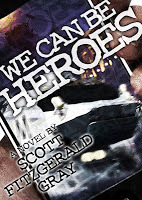 SFG: LOL, etc. But the new book is actually a pretty good example, because it was a story in which I both started with some specific themes I wanted to explore, then found myself exploring new things in the course of the writing that I hadn’t expected to. Without giving too much away, one of the Big Points in the book is to examine the notion of what it means to be truly alive versus what it means to just go through the motions of life. What is human versus what only appears to be human—which is a concept I hope a lot of people know because it’s a big part of the work of Philip K. Dick, and his books were a huge inspiration for We Can Be Heroes. Not in the sense that I think the book feels in any way like a PKD novel, but because my inspiration for that underlying theme came about as a response to his work, and to parallel questions raised by William Gibson in Neuromancer. But even as I knew from the get-go that those ideas were ones I wanted to explore in the story, I discovered that as the story took shape, I was inspired to dig a lot more into personal themes of isolation, alienation, and love than I had originally intended.
In its earliest outline-level incarnation, the story was more focused on the action/adventure side of things. And though there’s still plenty of that in the book, and though the characters were strong enough in the original concept, the character story got stronger as I reworked the outline and the writing eventually kicked into gear. A couple of the darker plot points and the mechanics of the relationships between the characters were things that came very late to the narrative mix, because I discovered that the more things I threw at the characters, the more resilient they were forced to become and the stronger their story became. There’s a line very near the front of the book (in the chapter that relates the significance of the title) that talks about living in a world in which telling someone you love them is the bravest thing you’ll ever do. That became one of the key meaningful ideas in the book, and was one of the last parts of the book I wrote, and I would never have predicted at the outset that it would have become as important an idea as it did.
MKR: Thank you for your great answers, Scott. Is there anything else you'd like to mention or links you’d like to share?
SFG: Thanks to you for the questions, and for the chance to prattle on. As far as links to share, I’d be cementing my reputation as the worst self-promoter on earth if I didn't mention my website as a good place to go for more info on my writing and other projects (including an extended free sample of We Can Be Heroes . But for more useful information of benefit to the struggling writer, I’m a big fan of the collective of voices that is the AmWriting blog (to which I’m an occasional contributor), Phil Athans’ Fantasy Writer’s Handbook , David Farland’s Writing Tips , and Chuck Wendig’s TerribleMinds . I don’t think there’s ever been a better time to be a part of the community of writers, and particularly the community of fantasists. Being able to share the experience of, and the ideas underlying, a book like We Can Be Heroes is a huge treat, so thanks.
Michael K. Rose: Scott, I'd like to start by asking a question I ask the writers I interview for my webzine SpecFicPick . I know you already answered it when I interviewed you for the site in July , but I'd like to ask it again because I think it offers a fantastic insight into not only the mind of a particular writer, but into the shared culture of speculative fiction writers: What role do you believe speculative fiction plays in society?
 Scott Fitzgerald Gray: I mostly just repeat what people far smarter than me have already said in response to this question, which is that speculative fiction is a literature of unrestricted ideas. SF is a place where literally any question can be asked dramatically—questions of technology, sociology, culture, ethics, morality—with the ramifications and repercussions of those questions generating new questions in the reader. A kind of catalytic cycle of ideas and philosophy, as it were. When I answered the same question on the site in July, I mentioned how the use of “speculative fiction” as opposed to “science fiction” sums up my own personal take on the genre, which at its best is about wrapping the live wires of raw ideas in the protective sheath of narrative so that we can grab onto them without killing ourselves. Speculative fiction is an exchange of raw ideas and unbridled imagination, and shows us how to map those ideas onto the framework of human experience. There's absolutely nothing wrong with analyzing or exposing the big questions of life through philosophy or history or sociology or any other strictly academic pursuit. But in the end, academic analysis can rarely hit us in the heart like speculative fiction can—and it's when we get hit in the heart that we really start to care about things.
MKR: I, too, am drawn to speculative fiction because of it's ability to act as a catalyst for ideas. I believe that if we want our society to continue in a generally positive direction, we need more literature that does this as opposed to the generally meaningless pop fiction that seems to dominate the bestsellers lists. Do you think it is the responsibility of all writers to hit someone "in the heart," as you say? How much room should we allow for those who only want to entertain? In other words, what would be your ideal ratio for meaningful fiction versus entertaining pop fiction?
SFG: I don’t have a problem with people who want to write solely to entertain, or with people whose purpose in reading is just to be entertained. But I think stories that pack a real emotional punch are invariably better stories than those that shoot for mere entertainment—and as writers, I think we should all be obsessed with telling the best possible stories. I don’t view it merely as a social or intellectual obligation. To me, there’s never been a conflict between stories that entertain and stories rich in meaning and ideas, because I think the best stories do both. Whether you’re talking about George R.R. Martin or Frank Herbert, André Norton or Marion Zimmer Bradley, Hemingway or Joseph Conrad, there’s a vast field of popular writers whose works manage to marry exciting narrative and bold ideas, and those are the writers whose creative example I desperately try to follow.
Having said that, though, I’m not sure that there is an optimal ratio, just because the balance really depends on the story. As an example, it’s interesting to think about The Lord of the Rings and the films based on that novel. A book like The Lord of the Rings is necessarily built on the intellectual foundations of its historical backstory. Without that backstory, it’s hard to imagine the book being as amazing as it is. But at the same time, the films were forced to dispense with a lot of that backstory strictly because of time constraints, yet the films still managed to create a story that’s emotionally compelling in its own way.
MKR: I fully agree with you that the best stories contain both elements. However, it is my opinion that (unfortunately) much of what is "popular" is geared almost exclusively for entertainment as opposed to delivering meaningful ideas. As a writer, do you find yourself intentionally trying to insert meaning into your work, or does it happen naturally? Do you give serious thought to elements like themes and motifs?
SFG: Full (and equally unfortunate) agreement. But from my perspective, I think it’s important to say that I don’t think it’s all that much harder to write emotionally compelling, thoughtful, character-driven fiction than it is to write fiction that’s just entertaining. I think some writers might believe otherwise, though, and I think writers are sometimes reluctant to dig deeper into their stories because they’ve gotten used to simply writing on the surface. Delivering meaningful ideas in fiction is really just a matter of wanting to explore those meaningful ideas. As writers, if we have the will to push a story, the story will respond.
As far as analyzing the process by which I cram meaning into my own work, I’m not sure that “intentionally” is as apt a word as “compulsively.” It’s not like I craft a story and then look for places to nail down the thematic elements and the big ideas and the deeper character story. Those elements just kind of come together in the process of digging into the story. Sometimes you start out with an idea or theme that you know you want to explore, whether it be something like emotional loss, the perspective of madness, political allegory, or what have you. But sometimes you just start out with raw plot and the inclination to tell a story that’s exciting and memorable—only to discover that themes and motifs you never expected to focus on have woven themselves into the work and demand that you address them. One of the things I’m very evangelistic about as a writer is outlining, and I think that my own process of outlining has a lot to do with how my stories unfold and expand on different levels. Working on an outline, I feel like I’m working with story at its most primal, and it’s easy to see themes and motifs unfold at that level of raw narrative energy.
MKR: Can you tell me a bit about your most recent work, We Can Be Heroes, and the meaningful ideas you compulsively explore in it?
 SFG: LOL, etc. But the new book is actually a pretty good example, because it was a story in which I both started with some specific themes I wanted to explore, then found myself exploring new things in the course of the writing that I hadn’t expected to. Without giving too much away, one of the Big Points in the book is to examine the notion of what it means to be truly alive versus what it means to just go through the motions of life. What is human versus what only appears to be human—which is a concept I hope a lot of people know because it’s a big part of the work of Philip K. Dick, and his books were a huge inspiration for We Can Be Heroes. Not in the sense that I think the book feels in any way like a PKD novel, but because my inspiration for that underlying theme came about as a response to his work, and to parallel questions raised by William Gibson in Neuromancer. But even as I knew from the get-go that those ideas were ones I wanted to explore in the story, I discovered that as the story took shape, I was inspired to dig a lot more into personal themes of isolation, alienation, and love than I had originally intended.
In its earliest outline-level incarnation, the story was more focused on the action/adventure side of things. And though there’s still plenty of that in the book, and though the characters were strong enough in the original concept, the character story got stronger as I reworked the outline and the writing eventually kicked into gear. A couple of the darker plot points and the mechanics of the relationships between the characters were things that came very late to the narrative mix, because I discovered that the more things I threw at the characters, the more resilient they were forced to become and the stronger their story became. There’s a line very near the front of the book (in the chapter that relates the significance of the title) that talks about living in a world in which telling someone you love them is the bravest thing you’ll ever do. That became one of the key meaningful ideas in the book, and was one of the last parts of the book I wrote, and I would never have predicted at the outset that it would have become as important an idea as it did.
MKR: Thank you for your great answers, Scott. Is there anything else you'd like to mention or links you’d like to share?
SFG: Thanks to you for the questions, and for the chance to prattle on. As far as links to share, I’d be cementing my reputation as the worst self-promoter on earth if I didn't mention my website as a good place to go for more info on my writing and other projects (including an extended free sample of We Can Be Heroes . But for more useful information of benefit to the struggling writer, I’m a big fan of the collective of voices that is the AmWriting blog (to which I’m an occasional contributor), Phil Athans’ Fantasy Writer’s Handbook , David Farland’s Writing Tips , and Chuck Wendig’s TerribleMinds . I don’t think there’s ever been a better time to be a part of the community of writers, and particularly the community of fantasists. Being able to share the experience of, and the ideas underlying, a book like We Can Be Heroes is a huge treat, so thanks.


September 1, 2012
Michael K. Rose's September Sale & Giveaway Extravaganza!
 Last month, I exceeded my sales goal for my novel
Sullivan's War
! I have therefore decided to make September a month-long celebration of all things me! The best part is, this celebration--which I'm calling "Michael K. Rose's September Sale & Giveaway Extravaganza!"--means big savings for you.
Last month, I exceeded my sales goal for my novel
Sullivan's War
! I have therefore decided to make September a month-long celebration of all things me! The best part is, this celebration--which I'm calling "Michael K. Rose's September Sale & Giveaway Extravaganza!"--means big savings for you.Here is the schedule for all upcoming sales, Kindle Select free days and giveaways. Mark your calendar!
 All Month Long: Buy signed print copies of
Sullivan's War
and
Short Stories
for a combined price of just $17 (plus S&H). That's $6 off the regular cover prices. Each order also comes with bookmarks and signed cards featuring the books' covers. Order
here
.
All Month Long: Buy signed print copies of
Sullivan's War
and
Short Stories
for a combined price of just $17 (plus S&H). That's $6 off the regular cover prices. Each order also comes with bookmarks and signed cards featuring the books' covers. Order
here
.Sept. 2 (Sun) - My short story "Sleep" will be FREE at all Amazon Kindle stores. Links here .
Sept. 7 (Fri) - A Goodreads giveaway of a signed copy of Sullivan's War begins. Go here to enter (US only). Giveaway ends on Sept. 30.
Sept. 8 (Sat) - My short story "The Tunnel" will be FREE at all Amazon Kindle stores. ( US , UK , .de , and all others)
 Sept. 8-14 (Sat-Fri) - My collection
Short Stories
will be on sale for just 99 cents (reg. $3.99) at Amazon for just one week! If you get "Sleep" and "The Tunnel" when they're free, you'll get a good sampling of what's inside. Links
here
.
Sept. 8-14 (Sat-Fri) - My collection
Short Stories
will be on sale for just 99 cents (reg. $3.99) at Amazon for just one week! If you get "Sleep" and "The Tunnel" when they're free, you'll get a good sampling of what's inside. Links
here
.Sept. 15 (Sat) - "Sergeant Riley's Account," the stand-alone prologue to Sullivan's War , will be FREE at Amazon. Links here .
 Sept. 21 (Fri) - All day long I'll be running contests to give away eBook copies of Sullivan's War at my Facebook author page. Go
here
and like my page so you don't miss out!
Sept. 21 (Fri) - All day long I'll be running contests to give away eBook copies of Sullivan's War at my Facebook author page. Go
here
and like my page so you don't miss out!Sept. 22-23 (Sat & Sun) - My short story "Sleep" will be FREE at all Amazon Kindle stores again. Links here .
Sept. 22-28 (Sat-Fri) - Sullivan's War: The Complete Adventure will be on sale for just 99 cents (reg. $4.99)! One week only at Amazon Kindle stores and B&N's Nook store. Links .
Sept. 29-30 (Sat & Sun) - My short story "The Tunnel" will be FREE at all Amazon Kindle stores again. ( US , UK , .de , etc.)
If you've yet to read any of my work, this is a great opportunity to do so. I've received over 100 4- and 5-star reviews on Amazon, so I don't think you'll disappointed. And as always, I must thank all of you who have bought and read my work. This month is as much a celebration of you, because without you, I would have nothing to celebrate.
My Best to You All,Michael K. Rose

August 24, 2012
Fill Your Weekend with Sci-Fi Adventure: Sullivan's War
Sullivan's War
is still going strong! In fact, after I released it last month,
Sullivan's War: The Complete Adventure
quickly overtook all of my other titles, becoming my best-seller. If you'd like to check it out, eBook copies are available from:Amazon US
Amazon UK
Barnes & Noble
Links to the other international Kindle stores--and my web store, if you would like a signed print edition--can be found here.
See what reviewers are saying about Sullivan's War :
"Michael K. Rose nailed it with nonstop action, great characters, and an enticing plot line."
"Michael K. Rose has renewed my interest in science fiction with Sullivan's War."
"A sci-fi thriller that definitely delivers!"

August 21, 2012
Is Your Novel "Too Long?"
"Wait just a tick," you've just said to yourself. "Didn't he recently write a blog post entitled 'Is Your Novel "Long Enough?"'" Yes, that elaborately-punctuated query is correct. I did, and it is
here
. But I have been perusing the book blog
Book Riot
(which is fantastic, by the way) and came across these two posts: "
Every Book I Read Needs to be at Least 50 Pages Shorter
"and "
The Problem with 500-Page Books
." These are two readers who, generally speaking, do not like long books. They find them fluffy and meandering. The comments to those posts consisted of those who agreed whole-heartedly and those who felt it was their duty to berate the authors for not having attention spans of steel. Comments from my post "Is Your Novel 'Long Enough'" also came down on both sides of the argument, which is to be expected.
So I'd like to ask those of you who prefer novels over novellas and short stories: How long is too long? Does it depend on the story, or will you simply pass on a book that has too many pages, no matter how good it looks? I have Stephen King's expanded edition of The Stand sitting on my shelf, which comes in at a doorstop-ian 1150 pages. And I do have to admit, I'm reluctant to begin it. I also notice that the three books that make up The Lord of the Rings are about the same combined length.
A question for all readers: If an author has a 1000-plus-page tale in the works, do you prefer it to be broken up into three or more books, or would you rather sit down with a tome in your lap? Discuss.
So I'd like to ask those of you who prefer novels over novellas and short stories: How long is too long? Does it depend on the story, or will you simply pass on a book that has too many pages, no matter how good it looks? I have Stephen King's expanded edition of The Stand sitting on my shelf, which comes in at a doorstop-ian 1150 pages. And I do have to admit, I'm reluctant to begin it. I also notice that the three books that make up The Lord of the Rings are about the same combined length.
A question for all readers: If an author has a 1000-plus-page tale in the works, do you prefer it to be broken up into three or more books, or would you rather sit down with a tome in your lap? Discuss.
August 20, 2012
Why I Won't Follow You on Twitter (with Lame Jokes)
A while back I wrote "
My Twitter Manifesto (with Jokes)
." I had to append that with "
A Difficult Decision Regarding Twitter
," which explains why I don't personally thank you for retweeting me. It's not because I'm a narcissistic jerk, either. I am, but that has nothing to do with it. Well today, I release the third installment in my never-ending quest to figure out how to most effectively use Twitter without going mad in the process.
First of all, I have to admit that the title is a bit of lie. (No, not that part. The jokes are lame). But if you're reading my blog, chances are I will follow you on Twitter. But when one gets a certain number of followers, a lot of the leeches come out to play. So for them (and for your amusement) here are the reasons why I won't follow you (but probably not you) on Twitter.
1.You do not have a profile photo. I realize that not everyone wants to reveal their mugs to the anonymous world, but put something in there, a picture, a cartoon, something. I don't follow eggs.
2. You have no information in your bio. You need not tell me where you live, where you work, what your children's names are or what debilitating diseases you're suffering from, but give me something that indicates you're a person I want to connect with. Something like—oh, I don't know—"I like books." Or "I am a sci-fi nerd."
3. You lead off your bio with a sentence containing any of the following words: marketer, marketing, entrepreneur, consultant, optimization, mentor, coach, e-commerce or followers. I reserve the right to add words to this list.
4. You call yourself a "guru."
5. You are the Twitter account of a business completely unrelated to what I do or in a location that is not easily accessible to me (sorry, dry goods store in Topeka, Kansas).
6. Any other damn reason I want. Seriously, though, I'll probably end up following back most of those who follow me. If you're into writing, books, sci-fi or speculative fiction in general or anything else in the realm of nerd-dom, I'll probably want to connect with you. If I have not followed you back, send me a Tweet and I'll rectify the situation. I would also suggest that if you think I'm an interesting person to follow, check out the people I follow myself. I don't go through and just follow random people, I try to find those who I would genuinely be interested in talking with. I think it's only fair that if I will not follow back those who have nothing to do with my interests, I shouldn't follow someone who mentions, oh, nothing but chainsaw sculpture in their bio just to increase the number of my Followers. Actually, chainsaw sculpture is kind of cool. I probably would follow that person. But I think my point is clear. I hope that together we can make our Twitter community a community of value. I'd also like to make a quick plug for the #BuyIndie hashtag. It's the brainchild of Benjamin X. Wretlind; search for it if you like to support other indie writers.
Best,Michael K. Rose
First of all, I have to admit that the title is a bit of lie. (No, not that part. The jokes are lame). But if you're reading my blog, chances are I will follow you on Twitter. But when one gets a certain number of followers, a lot of the leeches come out to play. So for them (and for your amusement) here are the reasons why I won't follow you (but probably not you) on Twitter.
1.You do not have a profile photo. I realize that not everyone wants to reveal their mugs to the anonymous world, but put something in there, a picture, a cartoon, something. I don't follow eggs.
2. You have no information in your bio. You need not tell me where you live, where you work, what your children's names are or what debilitating diseases you're suffering from, but give me something that indicates you're a person I want to connect with. Something like—oh, I don't know—"I like books." Or "I am a sci-fi nerd."
3. You lead off your bio with a sentence containing any of the following words: marketer, marketing, entrepreneur, consultant, optimization, mentor, coach, e-commerce or followers. I reserve the right to add words to this list.
4. You call yourself a "guru."
5. You are the Twitter account of a business completely unrelated to what I do or in a location that is not easily accessible to me (sorry, dry goods store in Topeka, Kansas).
6. Any other damn reason I want. Seriously, though, I'll probably end up following back most of those who follow me. If you're into writing, books, sci-fi or speculative fiction in general or anything else in the realm of nerd-dom, I'll probably want to connect with you. If I have not followed you back, send me a Tweet and I'll rectify the situation. I would also suggest that if you think I'm an interesting person to follow, check out the people I follow myself. I don't go through and just follow random people, I try to find those who I would genuinely be interested in talking with. I think it's only fair that if I will not follow back those who have nothing to do with my interests, I shouldn't follow someone who mentions, oh, nothing but chainsaw sculpture in their bio just to increase the number of my Followers. Actually, chainsaw sculpture is kind of cool. I probably would follow that person. But I think my point is clear. I hope that together we can make our Twitter community a community of value. I'd also like to make a quick plug for the #BuyIndie hashtag. It's the brainchild of Benjamin X. Wretlind; search for it if you like to support other indie writers.
Best,Michael K. Rose
August 17, 2012
Signed Copies of Sullivan's War Now Available!
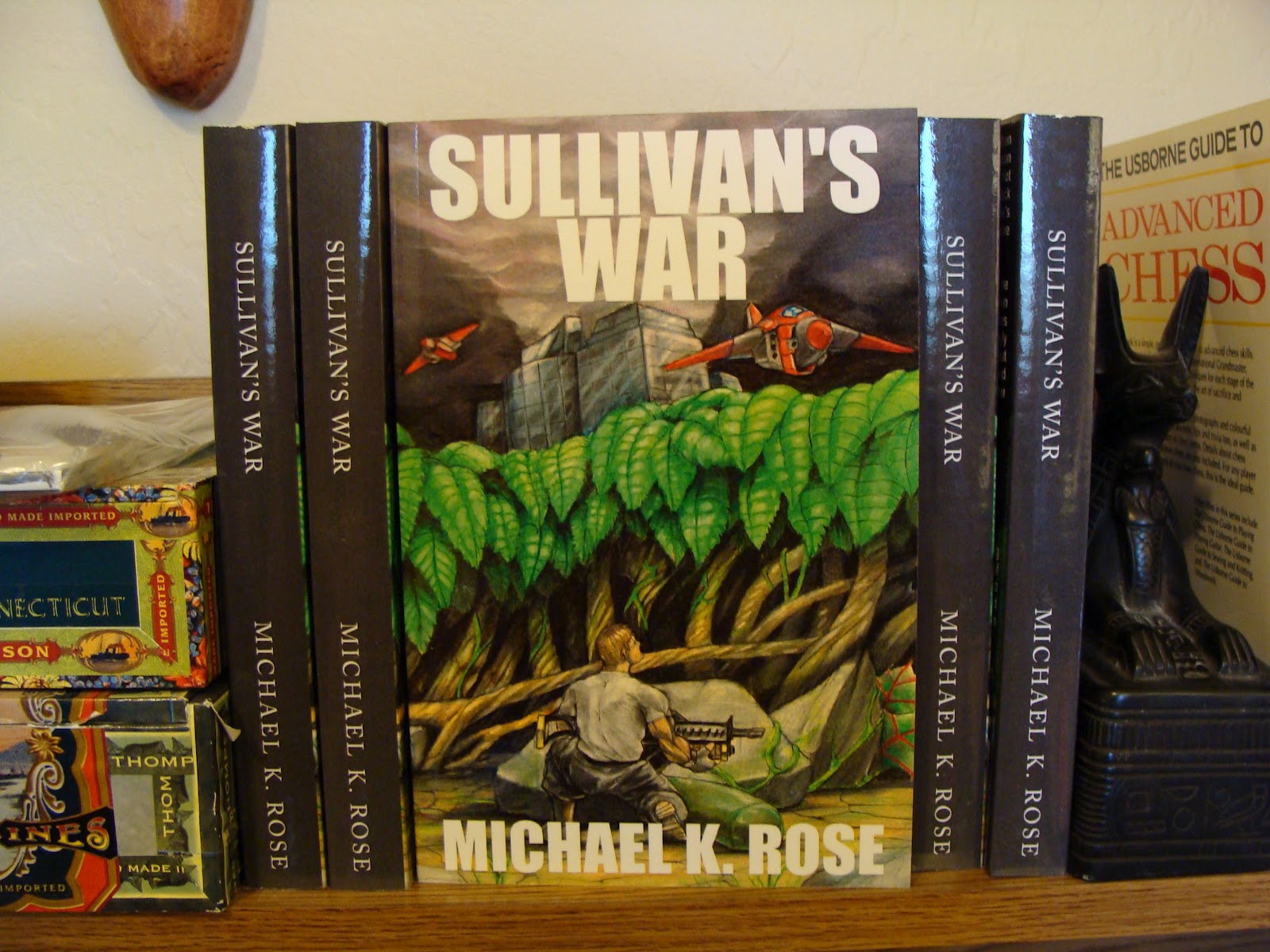 Yesterday, I received my shipment of
Sullivan's War
. If you head over to my
web store
you can order a signed copy. I also have a cool new bookmark design and each book ordered comes with a Collector's Pack (which includes three different bookmarks and a signed card featuring the cover of the book). You'll also see that
Sullivan's War
and my collection
Short Stories
are available together at a discount. Order this weekend and your book(s) will be mailed out on Monday.
Yesterday, I received my shipment of
Sullivan's War
. If you head over to my
web store
you can order a signed copy. I also have a cool new bookmark design and each book ordered comes with a Collector's Pack (which includes three different bookmarks and a signed card featuring the cover of the book). You'll also see that
Sullivan's War
and my collection
Short Stories
are available together at a discount. Order this weekend and your book(s) will be mailed out on Monday.Please do check it out: Michael K. Rose's Web Store .
And for those of you who prefer eBooks, you can get a copy for the Kindle or the Nook. Links to all stores can be found here .
Thank you to all who have supported me thus far! Without my readers, none of this would be possible.
Best Wishes,
Michael K. Rose

August 9, 2012
Bad, Amazon Reviewer! BAD!
No! You cannot leave a 1-star review on a book you have not read. I said "no!" Stop it... stop! I had to firmly make this point to a reviewer recently who admitted, in her three-sentence review, that she did not get through the first chapter of a book (not mine) because she encountered the word "anyways." Her unpithy review:
Addendum: Some people think this is a review left on one of my books and have advised me against interacting with negative reviewers. This is not the case. It is a review I came across on another book. I of course know that it is not wise to respond to negative reviews on one's own work, but in my capacity as a reader who buys books on Amazon, it is fully justifiable to take other reviewers to task when their reviews are pointless and unfair to the author.
I couldnt even gt through one chapter. Someone please tell this author that "anyways" is not a word. Enough said.No, gentle reviewer, enough certainly has not been said. Quite the opposite, actually. My pithy response:
I searched my copy for use of the word "anyways" and found only one, in a bit of dialogue. It may not be an official word, but it is slang that is used by teenagers--who are the main characters in this book--so this complaint is a bit ridiculous. If one doesn't approve of the way teenagers speak, perhaps one shouldn't read YA paranormal fantasy.That should have shut her up, no? No. Her most unpithy reply:
I will stick with the YA authors who leave the usage of slang to dialog, where slang is appropriate. Books like Harry Potter and the Twilight series.And, after I recovered from an exploded brain, my most excellent, pithier remark:
I suppose I didn't make the first statement in my reply clear enough. The only instance of the word you objected to, "anyways," is in a line of dialogue. I find it odd that you encountered this single use of the word and it stopped you cold, made you put the book down and upset you so much that you decided to leave a three-sentence, one-star review that gives potential readers absolutely no information about the book. Perhaps the forty-eight positive reviews indicate that you should read past the first chapter before deciding that the entire effort deserves only one star. I do not wish to pick on you specifically, but it is reviews like this that make me suspicious of all of a given person's reviews. It is an abuse of the ratings system to review a book you have not read, and it is highly unfair. As I said, I do not wish to pick on you, but I see far too many reviews like this on Amazon. Would you review an album after listening to part of a single song? Would you review a movie after watching the first few minutes? I'm sorry, but unless you can actually make intelligent, informed comments about a book, you have no business reviewing it. If you don't like the writing style and decide not to read further, that is fine. But you cannot, in good conscience, review a book which you have not read.And that, for those of you who are keeping track, is "enough said." She has yet to reply. How much do you believe one should read before leaving a review? 25%? 50%? 100%?
Addendum: Some people think this is a review left on one of my books and have advised me against interacting with negative reviewers. This is not the case. It is a review I came across on another book. I of course know that it is not wise to respond to negative reviews on one's own work, but in my capacity as a reader who buys books on Amazon, it is fully justifiable to take other reviewers to task when their reviews are pointless and unfair to the author.
August 8, 2012
Another Scam "Marketing" Deal
We've all seen the firms offering to promote and advertise your book for a "modest" or "nominal" fee. That "nominal" fee is usually in the range of $500 or more. But now they're calling me on my cell phone! Yes, earlier today I received a call from someone at BookWhirl. I never answer unfamiliar numbers, but the message assured me that the caller had some "important questions" about my book. It only took a brief internet search to find out that all they seem to do is send out spam emails to thousands of people. Tell me, have any of you ever bought something because of an unsolicited spam email that was sent to you? If you have, I have some timeshare properties on Mars for sale, along the south rim of the Valles Marineris:

Stay vigilant, fellow authors. If you do decide to buy advertising, do your homework, know exactly what you're getting for your money and, if possible, talk to other authors who've used the service before. As in anything in life, there is a troglodytic, sub-human race of creatures who subsist only on the naivety of those who are new to the game. Please spread the word about them. There is no reason any new author should fall prey to their schemes. We, as a community, need to stand together and ensure that we offer new authors a hand up before these creeps reach a hand into their pockets. Again, please help spread the word about not only this particular company but all who seek to earn their living by taking advantage of others.
Best,Michael K. Rose

Stay vigilant, fellow authors. If you do decide to buy advertising, do your homework, know exactly what you're getting for your money and, if possible, talk to other authors who've used the service before. As in anything in life, there is a troglodytic, sub-human race of creatures who subsist only on the naivety of those who are new to the game. Please spread the word about them. There is no reason any new author should fall prey to their schemes. We, as a community, need to stand together and ensure that we offer new authors a hand up before these creeps reach a hand into their pockets. Again, please help spread the word about not only this particular company but all who seek to earn their living by taking advantage of others.
Best,Michael K. Rose
August 6, 2012
SULLIVAN'S WAR Signed Print Editions
Hello, all! I released
Sullivan's War: The Complete Adventure
as an eBook around the middle of July, and the response has been phenomenal! Sales of this book, combined with sales of my other titles, gave me my highest-grossing month ever. My work also continues to attract glowing 4- and 5-star reviews.To all who have bought and read my books, thank you for helping me toward my goal of being able to support myself as a writer. I still have over a year to accomplish that goal, and I can already see it on the horizon.
Today, I'm pleased to announce that signed print editions of
Sullivan's War
are now available for preorder. You can buy it alone for regular price ($12.99 + S&H) or in combination with my collection Short Stories for just $18 + S&H, a discount of $5 off the combined price of the books.
Short Stories
is also available individually and is currently on sale as well.Each order also comes with signed postcards featuring the covers of the books and a selection of bookmarks. All options can be viewed at my web store, here .
If you prefer an eBook edition of Sullivan's War , it can be purchased for the Kindle or the Nook. Links to all eBook stores can be found here . EBook links for Short Stories can be found here .
Thank you again to all my readers. Your support has been overwhelming, and the only way I know how to repay it is by writing books that you'll hopefully enjoy. Up next is a novel called Chrysopteron, followed by the sequel to Sullivan's War , Sullivan's Wrath . Look for Chrysopteron in October and Sullivan's Wrath near Christmas.
Best,Michael K. Rose

August 4, 2012
SULLIVAN'S WAR: PROLOGUE Free Aug. 4-5
 Hello, all. This weekend, August 4th and 5th,
Sullivan's War: Prologue - Sergeant Riley's Account
will be free at all Amazon Kindle stores. This is a prologue to the
Sullivan's War
series because while it is a stand-alone story and one does not need to read one to understand what's happening in the other, they deal with some of the same events that take place on the planet of Edaline. If you've read and enjoyed
Sullivan's War
, definitely pick up a copy of
Sergeant Riley's Account
while it's free.
Hello, all. This weekend, August 4th and 5th,
Sullivan's War: Prologue - Sergeant Riley's Account
will be free at all Amazon Kindle stores. This is a prologue to the
Sullivan's War
series because while it is a stand-alone story and one does not need to read one to understand what's happening in the other, they deal with some of the same events that take place on the planet of Edaline. If you've read and enjoyed
Sullivan's War
, definitely pick up a copy of
Sergeant Riley's Account
while it's free.Get it at Amazon US and Amazon UK . More information and links to all the international Kindle stores can be found here .
Also, if you haven't seen it,
Sullivan's War: The Complete Adventure
is now available. This collects all three
Sullivan's War
books into a single edition at a discounted price. It is available at
Amazon US
,
Amazon UK
and
Barnes & Noble
. More info can be found
here
.