Michael K. Rose's Blog, page 20
May 23, 2012
CONTEST: Win The Entire Sullivan's War Series!
Hello, all! I am giving away eBook editions of the entire
Sullivan's War
series (The Prologue plus Books I, II & III) to three random people who enter the contest. How do you enter? Well, it's quite simple. Just send me an email (myriad_spheres@yahoo.com) with the correct answer to the question.
The title of Sullivan's War: Book II is A City without Walls . It comes from a quote which reads, in part, "...as far as death is concerned, we men live in a city without walls."
Question: This is a quote from which ancient Greek philosopher?
Mail your answer to myriad_spheres@yahoo.com with CONTEST in the subject line and the following information in the text of the email:
1. Your Name
2. Your Email Address
3. Your Preferred eBook Format (mobi for Kindle, epub for Nook and most other eReaders)
4. The Answer to the Question (Note: The Answer is not "42")
You have until June 8th to enter. On June 9th, the winners will be chosen from the eligible entries.
Three randomly-chosen winners will receive eBook editions of the following:
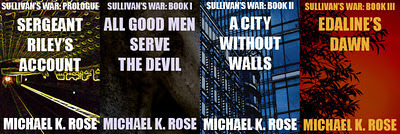
Sullivan's War: Prologue - Sergeant Riley's Account
Sullivan's War: Book I - All Good Men Serve the Devil
Sullivan's War: Book II - A City without Walls
Sullivan's War: Book III - Edaline's Dawn
All books in the series have an average Amazon rating of 4.3 stars or higher!
Check out the reviews here .
Only one entry per person, please. All entries must be received by 11:59 PM Pacific Standard Time on June 8, 2012.
For more information about Sullivan's War please visit: http://www.michaelkrose.com/sullivan-s-war

The title of Sullivan's War: Book II is A City without Walls . It comes from a quote which reads, in part, "...as far as death is concerned, we men live in a city without walls."
Question: This is a quote from which ancient Greek philosopher?
Mail your answer to myriad_spheres@yahoo.com with CONTEST in the subject line and the following information in the text of the email:
1. Your Name
2. Your Email Address
3. Your Preferred eBook Format (mobi for Kindle, epub for Nook and most other eReaders)
4. The Answer to the Question (Note: The Answer is not "42")
You have until June 8th to enter. On June 9th, the winners will be chosen from the eligible entries.
Three randomly-chosen winners will receive eBook editions of the following:
Sullivan's War: Prologue - Sergeant Riley's Account
Sullivan's War: Book I - All Good Men Serve the Devil
Sullivan's War: Book II - A City without Walls
Sullivan's War: Book III - Edaline's Dawn
All books in the series have an average Amazon rating of 4.3 stars or higher!
Check out the reviews here .
Only one entry per person, please. All entries must be received by 11:59 PM Pacific Standard Time on June 8, 2012.
For more information about Sullivan's War please visit: http://www.michaelkrose.com/sullivan-s-war


May 18, 2012
NEW RELEASE: Sullivan's War: Book III

With the release of All Good Men Serve the Devil , the first book of the series Sullivan’s War , science fiction readers were sent on an adventure that would span the galaxy as Rick Sullivan, Frank Allen and Kate Alexander came up against ruthless gang leaders, assassins, bounty hunters and highly-trained soldiers from Edaline, Sullivan’s home planet.
Now, with Book III - Edaline’s Dawn , all that Rick Sullivan has worked for comes to a head. In this action-packed finale to the series, Sullivan finally returns to Edaline to overthrow the planet's oppressive regime. Will he be able to help organize a new uprising against the government? How do the mysterious hyperspace entities figure into Sullivan’s future? And what will be the fate of Frank Allen?
Find out in Sullivan's War: Book III - Edaline's Dawn !
Buy it from: Amazon US Amazon UK Barnes & Noble and all international Amazon stores
Praise for the series:
"Gritty, hardcore sci-fi with a fascinating twist, guaranteed to please!""A sci-fi thriller laced with action and political undertones. A Must Read!""Mr. Rose knocks another one out of the galaxy….""The writing style is engaging and creative….""…this thrill-a-minute ride will keep you glued to your seat until the very end."
For more information please visit: http://www.michaelkrose.com/sullivan-s-war


May 17, 2012
FREE EBOOK: Sgt. Riley's Account (May 17-19)
For the next three days (May 17-19)
Sergeant Riley's Account
, the prologue to the
Sullivan's War
series, will be free on Amazon. It is a stand-alone story and you do not need to read
Sullivan's War
to enjoy it, or vice versa.
It can be downloaded from Amazon US here and Amazon UK here .
For links to the other Amazon stores and to read more about Sergeant Riley's Account , please visit this page: http://www.michaelkrose.com/sgt-riley-s-account
Also look for Sullivan's War: Book III , available May 18th! More information and links (when they become available) can be found here: http://www.michaelkrose.com/sullivan-s-war
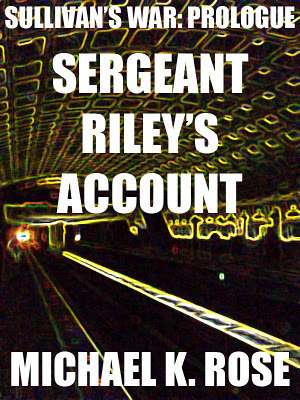

It can be downloaded from Amazon US here and Amazon UK here .
For links to the other Amazon stores and to read more about Sergeant Riley's Account , please visit this page: http://www.michaelkrose.com/sgt-riley-s-account
Also look for Sullivan's War: Book III , available May 18th! More information and links (when they become available) can be found here: http://www.michaelkrose.com/sullivan-s-war

May 16, 2012
Being Garrulous (again) with Benjamin X. Wretlind (Part 2)
This is the second part of a conversation between author Benjamin X. Wretlind and myself. Please see Part 1 here .
---
MKR: Besides leaving a legacy through your writing, is there anyone you hope to inspire? Is there any message you hope to convey, any ideas you want to put out into the world?
BXW: I think you touched on a sort of running theme when you interviewed me way back when. I like to say people are the sum total of their experience and if we just look at the outside, we'll never really understand them. That often leads to stereotypes, discrimination and even bullying. For example, in each sketch in my novel Sketches from the Spanish Mustang, there is one man who is seen through the eyes of each character. Most assume he's a crazy nut, a homeless man who talks to himself. However, there's a very long history to that man--war vet, disabled, wife and child, etc. Why does he act in a particular way, and why does he appear the same, yet different, in strangers' eyes?
I used to think people were generally bad. There was no good in them, so why bother to understand them. The older I get, however, the more I've started to see each person as that sum total of their history. If that's the case, if I interact with that person don't I become another summand in their equation? Shouldn't I want to instill something of value to their present?
I do have a lot to say on this subject, but I'll leave it at that right now. For your part in writing science fiction, what do you want people to see in your characters? Do you have a central theme you're running off right now?
MKR: When one is a child, it seems that everything and everyone is good and beautiful. Sadly, some children learn too soon that that is not the case, like Maggie, in Castles . I think that as we age the misery in the world overshadows the beauty of it. We may remember a beautiful spring day for a short while, but we'll really remember the tornado that took out ten houses the next block over and swept a family of four into oblivion. A kindness done to us by a fellow human being may linger in our memory for a day, but an act of vicious cruelty can haunt us for a lifetime. I fully understand, then, the inclination to see people as inherently evil, especially considering the influence of Christianity on our culture that very explicitly states that the reason we no longer reside in Paradise is because of our wickedness. And it was this view of humanity as inherently base, as our bodies essentially worthless when weighed against the immortal soul, that led to the terrible conditions of Medieval Europe during which most everyone's life was "solitary, poor, nasty, brutish, and short," to quote Thomas Hobbes. And the worst part was, that was accepted!
In my view, it really took Enlightenment thinking, humanism and deism, to introduce to the Western world the idea that every human life has worth, every human being deserves to live peacefully and free of oppression. Here was an idea that if there is no immortal soul, if this body, this life, is all we have, how can any one of us justify bringing misery to another human being? We still haven't achieved the ideal of the Enlightenment but we are much closer and at least now the goal is there, where before there was only doom and gloom.
I love your view of human interaction. Yes, we each play a part in the lives of everyone else we encounter. Some of these roles may seem trivial but suppose it is something as simple as smiling at a stranger who looks sad? We may have brought a little joy, a little hope, to that person. We must always attempt to give value to one another's lives rather than take value from them. This is the foundation for forming a more-ideal society.
Now, after all that, I will answer your question. I realize I do go on. You asked "...in writing science fiction, what do you want people to see in your characters? Do you have a central theme you're running off right now?" In Sullivan's War , I hope that readers go away asking two very simple questions: what makes a man good? and what makes a man bad? This is touched on in Book I but explored in more depth in Book II. I don't have an answer for that. I am reminded of the difference between morality and ethics: if one is moral in the Christian sense, one does not lie. So, if one were living in Nazi Germany and a Jew ran by followed by the SS who asked which way he went, you would have to tell them the truth to remain moral. But if you are to be ethical, you must lie and send them in the wrong direction. I know situational ethics get a bad rep and I do believe there are universal ethical laws, just as there are universal physical laws. But it's something to think about. To whom do you owe your ethical fealty?
Another idea I explore in Sullivan's War is that of justification. Is it acceptable to do a "bad" thing if it ultimately leads to a greater good? In your stories, it seems your characters engage in an awful lot of justification but of a more personal, selfish kind. This also interests me. We seem to be able to justify an awful lot if it serves our own greater good. Counteracting this is one of the key challenges of society, I think. Is this a theme you have intentionally been exploring in Sketches from the Spanish Mustang ?
BXW: I don't know if that internal justification is a subconscious result of turning 40, but Sketches from the Spanish Mustang is filled with it. I'd like to think I've been impervious to middle age, but the more I write, the more I realize I'm probably not. I really enjoy exploring a character's inner child, what makes them who they are. In A DifficultMirror, which I started when I turned 28, actually, the history of a person is forced out in the open and how they deal with whatever mistakes they've made is explored in depth. That's dark fantasy, however, not reality. In reality, we all have our skeletons, our histories we hide away so no one can see. However, no matter what we do, we are the sum total of our parts and we can either accept what we've done or try to justify it in some way.
As I sit here talking about this, I realized that the characters in my upcoming novel Driving the Spike must justify their actions. Are they good, are they bad? Much like you explored in Sullivan'sWar, there is a difference between morality and ethics. Did you start out with that theme before you penned the first word of Sullivan's War or did it come out as you wrote it?
MKR: It evolved. Sullivan's War started as the story about Frank Allen investigating the murder of Assemblyman Gene Palmer. From there it got tied in to Sergeant Riley's Account , then a third story I had written called "Promises," the story of a bounty hunter tracking down a criminal, got incorporated into the beginning of Sullivan's War: Book II. Now, early on I must have decided that Sullivan's War would address these issues of right and wrong because the title All Good Men Serve the Devil was there from nearly the beginning. I actually wrote out a bit of dialogue to incorporate that line before I got to that scene in the book. By the time Book I was finished, however, I felt that it was heavy on action but character development and exploration of theme were a bit lacking. I attempted to correct that with Book II.
My next project, Chrysopteron , started a bit aimlessly but as I wrote the overarching theme began to reveal itself. It was at that point that I wrote an outline to make sure I hit on all the thematic points I wanted to address: hope, loss, faith, sacrifice, right and wrong (again). I ended up shuffling the organization a bit and added another story line but the thematic structure remained intact. I hope readers will pick up on it and appreciate what I am trying to do. Of course, the reader applies additional meaning based on his or her own perceptions. I think the best authors are able to convey their own meaning but be subtle enough about it that the reader happens upon it without explicitly being told. But I guess some readers will completely miss the point, no matter what you do. Do you worry that readers will completely miss the point of your work? Do you care, as long as they pull some meaning from it? Or are you even content for your work to be perceived as just an interesting story, with the reader taking nothing away?
BXW: I really don't worry about what readers get out of my novels, as long as they get something. There's a meme that's been passed around regarding meaning that you've probably seen. "What the author meant" vs. "What your English teacher thinks the author meant." While I can laugh at the simplicity of the author's statement ("The curtains were blue") and the teacher's meaning ("The curtains represent his immense depression and his lack of will to carry on"), I find this meme more telling of what literary snobs think we should get from a novel. For example, if the New York Times says Castles reeks of abuse and discord, then to me they didn't get it. Conversely, if the Colorado Springs Gazette says Castles is a view into the growth of a woman through abuse and neglect and carefully questions how environment can affect genetic mutations in the brain, then I think they're pretty close. Now, what do my readers come away with? I would hope the literary snobs don't mutate my message, and I hope I write it clear enough that it sinks in with the masses.
I've been very focused on the themes presented in Sketchesfrom the Spanish Mustang. As I mentioned before, it's important to me that I impart the idea that people are the sum total of their days and not just a present manifestation with or without obvious merit. I do worry the message won't reach the reader, but all I can do is try.
Do you ever worry?
MKR: Do I worry about the message not reaching the reader? I wouldn't say I worry, per se, but I do make a point of writing afterwords for my major works. I do this not so the readers "gets it" but because I want to communicate with the readers on a more personal level. I want them to know what went into creating the story, the inspirations, etc. I think that knowing these things does enrich a text.
I like how the focus of much of your work is trying to make the point that a person is the sum of his or her experiences. It's a profound message, and yet so simple. For example, I am the product of very fortunate circumstances. Because of where and when and to whom I was born, I have been able to cultivate a life of ease and comfort in which I can spend a great deal of my time writing, reading, traveling, focusing on art, philosophy, etc. rather than worrying about where my next meal is going to come from. Reading about the problems that the characters in Sketches from the Spanish Mustang face really reinforces how good my life is, how petty my problems.
Do you think that you are trying to point humanity (or America, at least) in a different direction? Do you want readers to go away thinking that if people are the sum of their experiences, perhaps society as a whole could do something to make some of those experiences more positive? Or is it up to individuals to engage one another and help their fellow human beings along?
BXW: Afterwords are often my favorite part of a book, and I really enjoy reading them. James Rollins typically puts in a fact or fiction section at the end based on his research. I know it sounds petty, but that's cool.
I really never thought my writing could point America or the world toward any lofty goal, however I would like to reach at least one person. It's very important I leave a mark on someone's life, whether or not that's with Sketches from the Spanish Mustang, Castles, the upcoming A Difficult Mirror or the next novel I'll start working on this summer. That next novel--Driving the Spike--is probably going to be the closet I get to pointing humanity at anything, but I sincerely doubt it'll have the lofty impact I want it to have.
I think there's something to be said about a person who engages another without expectation of reward, and even the smallest attempt to help another can make the biggest impact. To help without expectation of reward, I truly believe, makes a man (or woman). Most of us drop money into the Salvation Army bucket during the holiday season, but how many take a full Saturday and sort donations in a food bank warehouse or stand on a serving line at a soup kitchen or walk ten miles for autism research? These things are small and there is no reward save the feeling you get for helping. Sadly, there are a lot of people who don't look at life this way; they expect something tangible in return for their effort--getting paid to be a foster parent, getting a t-shirt from a MS walk, showing off some certificate from the two hours they did something for someone. Helping shouldn't be like that.
I guess I got on my soapbox again. I tend to do that.

May 15, 2012
Being Garrulous (again) with Benjamin X. Wretlind(Part 1)
For those few of you who read Chewing the Cud in the Myriad Spheres , the previous conversation between Benjamin X. Wretlind and myself, here is another exciting installment! Due to its lack of brevity (which is chiefly my fault) we have decided to break it into two parts. Enjoy!
BXW: So I was reading over your latest blog post, Inventing a Universe, and a thought popped into my head: during the writing of Sketches from the Spanish Mustang I spent a great deal of time getting into the characters' heads, walking the paths they might take, looking at the town through their eyes. Likewise, with the novel I intend to start this summer, Driving the Spike, I have already started the process by walking some railroad tracks where an accident occurred 108 years ago. The idea, of course, is to see the world through the eyes of my characters. However, with Science Fiction, especially with imagined worlds (or parallel universes like you discuss), how do you see the world though your character's eyes?
MKR: What I like to keep in mind is that people are people, whether they lived ten thousand years ago or ten thousand years from now. If I were a Clovis hunter following herds of mammoth across the Great Plains I think that, despite the vastly different way of life, my fellow hunters and I would sit around the campfire at night and shoot the breeze just as I do with my friends today. The technology would be different, our clothes, our language, our way of perceiving the universe would all be different but we would still be human beings. A heart not unlike mine would beat in the breast of my Clovis twin. I would want food, shelter, love, companionship. In the two hundred thousand years our species has wandered this Earth that has not changed and there is no reason to believe it will change in the near future.
Now, I have never taken down a mammoth with a spear. But I can imagine it. As a writer, imagination is key to understanding other people, people who eventually become "characters." Would it help if I could go back in time and see how a hunting party surrounded and felled a mammoth, where they jabbed their spears, how many of them it took? Of course. But I can't, so if I were to write a mammoth-hunting scene my imagination would fill in the blanks that the archaeological record has left behind. So it is with science fiction. When we write about the future we are not writing from a blank slate. We have all of human history to draw on to understand how human beings will react in different situations. For example, we know that we tend to be suspicious and aggressive when encountering intelligent beings not like ourselves (from history, we have the sad lesson of the Europeans' encounter with the indigenous Americans. In my fiction, look at the treatment of the Squamata in Sergeant Riley's Account and Sullivan's War: Book II .) Another example from history that I draw on is the simple fact that people generally want to be free of oppression. The entire Sullivan's War series is about this and how many times throughout history has a power structure has fallen due to the discontent of the oppressed? Here where I live in the Southwest, Hohokam civilization collapsed around 1400 CE and there are Pima legends that indicate that the people rose up against the powerful.
So writing science fiction is simply writing about people. I cannot see alien worlds or travel through hyperspace in a ship but my brain is capable of understanding what they might be like. My imagination can fill in the gaps left after taking the entire shared experience of human culture into account. I see their worlds because their eyes are like mine. I share their hopes and desires because those are common to all human beings across history. And my invented universe is not that different from our own, when you really examine it. There are real-life parallels to many of the things I write about.
Now, what I find interesting is that in Castles you described experiences unfamiliar to you despite the fact that those experiences are real for all too many young women across the country, across the world. For me, that is as remarkable a feat as bringing to life an alien landscape. We've talked about this before, but would you care to talk a bit about Maggie's story?
BXW: As I've mentioned before, I believe Maggie spoke through me in a way that's really hard to describe without coming off sounding--how should I put it?--bat-shit crazy. The fact I squirrel away information that comes to me via media may have enabled my subconscious to postulate how a woman might view a certain situation more so than a man who is trying to force the character into action. For example, I had a lot of trouble near the middle of the story related to Maggie's view of abuse at the hand of her boyfriend because that's just not something I'd ever experienced. Somehow after a few months or years, though--and after dealing with abusive people as a manager--Maggie spoke up.
Getting into a character's head is important to me, and that's one reason I like to interact with their supposed environment if I can, and if I can't, then to spend an inordinate amount of time researching that environment. However, in A Difficult Mirror, a dark fantasy epic novel to be released (hopefully) next winter, I couldn't walk around the environment since it didn't exist. Not that I couldn't take clues from other stories, but that the environment just didn't exist. (That's a bit vague, I know, but the novel isn't out yet.)
You brought up something I'm curious about. I've mentioned to you before that I was never a huge fan of science fiction; that distinction fell to my brother. I was the fantasy type, the one who believed in dragons and wizards and spells, oh my! However, some historic science fiction I've read has held a sort of special place in my heart simply because of the impact on our present. I am, of course, talking about the work of Jules Verne, H.G. Wells, or Arthur C. Clarke. Even Philip K. Dick. Their imaginations of technological advances helped pave the way for our present. Writers like Ray Bradbury or George Orwell, on the other hand, wrote people into the future--much like you describe--and did so without the need to characterize or build up technology that didn't exist.
How do you view technology in your stories? How do you imagine worlds without borders or limitations, and do you hope to one day create something that would inspire some future geneticist or engineer?
MKR: Technology. Well, let me first point out that I am not technologically-minded at all. I am endlessly fascinated by it but if I had to actually try to describe how an intricate piece of software or hardware operated, I'd probably be trying to do it with sticks and a length of string. So, the technology in my stories isn't particularly original. I'll readily admit that. I rely on many tried and true tropes of the genre: hyperspace travel, energy weapons, fold-up tablet computers, three-dimensional displays. Now, since the Sullivan's War story line is supposed to take place about five hundred years in the future, this may seem like pretty low-tech stuff. I actually have a reason for this that will eventually reveal itself as I continue to explore this universe. I will just say that just because a technological advance is made doesn't mean it will be readily accepted.
I suppose I am comfortable with a certain level of technology, a level that has already been explored by many science fiction writers and is accepted and liked by a great many science fiction readers. Again, my own ignorance about technology prevents me from currently writing anything like cyberpunk. I just don't have the background to do it justice. So I really don't see my science fiction as the type that will inspire future engineers. Rather, I see my work as inspiring (if, in fact, it inspires anyone at all) future humanitarians, future philosophers. Remember, science fiction is about exploring how humans respond to fantastical situations as much as it is about inventing and describing cool technology. This is one of the reasons I consider 2001: A Space Odyssey to be my favorite book. Clarke had the scientific knowledge to make the technology one hundred percent plausible but the story is, essentially, about humanity. I mean, it begins with the dawn of consciousness, with the evolution (via external means in his story) of creatures that would one day become human beings! Because of his invented world of the near future, his characters--Dave Bowman in particular--are able to have experiences that no other humans have before experienced. How it affects them is just as fascinating as how future technology, such as the HAL 9000 computer, might work (or not work). How does the realization that an alien intelligence has visited our solar system affect them?
I often think about what would happen if we were to wake up one day and have undeniable proof that we were not alone in the universe. What effect would it have on world religions? I mean, in the 16th century Copernicus developed a heliocentric model of the solar system and while no one with any sense would deny the truth of this model today, there are many who still have a very geocentric, or Earth-centric, view of reality: that we, human beings, are at the center of God's divine plan, that, in fact, we are created in God's image and are his chosen species. Remember, it was only two thousand years ago that not only were humans God's chosen species on the planet, but a very specific group inhabiting the Levant were his chosen race. I speak from a Judeo-Christian perspective, of course, because it is the tradition that has most shaped the Western world. Now, this type of thinking has been used to justify and explain our dominance on this planet. But what if another, intellectually superior species managed to cross the vast distances between star systems and arrive at ours? God wouldn't seem to favor us so strongly then, would he?
I do believe in a creator. To believe in a specific god requires more faith than I have, though. I must trust that the creator, whatever it may be, gave me the ability--via evolution--to observe the world empirically for a reason. We are a species that is meant to question the world around us, not invent angels and devils to which to ascribe the mysteries of the universe. To return to my main point, this is my focus when I write science fiction. I hope to inspire future dreamers, people who will look at our world and see it for what it really is but also see what it can be if we throw off the shackles of tribe, of clan, of race, of nation, even of species. I know that to date my work hasn't explored this as fully as I would like but I am working toward it and my next project, Chrysopteron, will fully explore these ideas.
Look for Part 2 soon!

May 11, 2012
SULLIVAN'S WAR: BOOK III Arrives May 18!

Hello, all! I am very excited to officially announce that Sullivan's War: Book III - Edaline's Dawn will go live next Friday, May 18! The journey began in December with the release of the prologue to the series, Sergeant Riley's Account , and was followed by Book I in January and Book II in March. Combined, those books have received over twenty 4- and 5-star reviews and have been a nearly constant presence on Amazon's "Bestsellers in Science Fiction Series" list.
Book III sees the end of the Sullivan's War story line. Rick Sullivan will finally return to his home planet of Edaline and fight to free Edaline's people of their oppressive government. It will also reveal the fate of Frank Allen. And what of the bounty hunter Harvey? Will he continue to be a thorn in Sullivan's side? And what role do the mysterious hyperspace entities have to play in Sullivan's future?
To find out, get Sullivan's War: Book III - Edaline's Dawn next Friday! Please visit the Sullivan's War page on my official website for more information and for links to purchase Books I & II:
http://www.michaelkrose.com/sullivan-s-war


April 30, 2012
NEW RELEASE: Reign of Blood by Alexia Purdy
 Reign of Blood
is a Young Adult Urban Fantasy/Horror novel with a dark and edgy paranormal theme that will appeal to the YA and crossover YA audience. Ever since Alexia Purdy released her debut novel
Ever Shade: A Dark Faerie Tale
in February of 2012, it has received rave reviews and has been a frequent presence on Amazon’s “Best Sellers in Mythology” list.
Reign of Blood
is a Young Adult Urban Fantasy/Horror novel with a dark and edgy paranormal theme that will appeal to the YA and crossover YA audience. Ever since Alexia Purdy released her debut novel
Ever Shade: A Dark Faerie Tale
in February of 2012, it has received rave reviews and has been a frequent presence on Amazon’s “Best Sellers in Mythology” list.Reign of Blood begins an new series that takes place in a post-apocalyptic world. A viral epidemic has wiped out most of humanity and April, one of the last humans left alive, has become a vicious vampire hunter. Despite her desire to live as normal a life as possible, she finds herself on a mission to save her family from the clutches of the unknown. Her world is infested with wild vampires but she soon discovers that something else lurks in the city, something that wants her blood even more.
Alexia says “I’m very excited about Reign of Blood ; it’s a suspenseful thriller with a touch of horror to keep you on the edge of your seat and definitely begging for more.”
Praise for Reign of Blood:
“Alexia has created an end of world scenario right out of your nightmares, filling this new world with a multitude of mutations and action that will have you willingly falling deeply into the story.”
- Author J.T. Lewis
“WICKED AWESOME!!!!! Reign of Blood will BLOW YOU AWAY!!!!”- Amy Conley
“...such a page turner…..This is a fascinating read for all ages!”- Bella (Paranormal Book Club)
“Another masterpiece from Ms. Purdy.” - Jacquie Talento
Reign of Blood is now available in e-book format via Amazon's Kindle Store , Barnes & Noble's Nook Store and Smashwords.com . A print edition is coming soon.
For more information on Reign of Blood please visit the author’s websites:
http://alexiapurdy.blogspot.com
http://www.alexiapurdy.com
Alexia Purdy resides in Las Vegas, Nevada and is the author of Ever Shade: A Dark Faerie Tale , a contributor to the Dark Light Anthology with Crushing Hearts and Black Butterfly Publishing. She is also the author of the poetic collection Whispers of Dreams . To receive a review copy of Reign of Blood , arrange an interview, guest blog, or event, please contact Alexia Purdy at alexeea@yahoo.com

April 25, 2012
How Many More Must Die of Hunger?
Today, around 25,000 people will die of hunger (source). It is estimated that around 16,000 of them will be children. Look at that number again: 25,000. That's one person every three and a half seconds. Count slowly to three. Someone, probably a child, has just died. Do it again. And again. The number will be around seventeen over the course of a minute.
25,000 people. How many of you live in towns or cities smaller than that? Can you imagine your entire neighborhood literally starving to death? In some African villages, that is exactly what is happening. Can you imagine having to choose which of your children to feed, having to choose which ones will live and which ones will die? Today, thousands of mothers will have to make that choice.
Why? Well, there's a simple answer and there's a complex answer. But I'll just give you the simple answer: greed. That's it. There's nothing unfamiliar about it. It's the same thing that does a good job of making peoples' lives miserable everywhere. It's simply that some people think they are more deserving of the Earth's resources that everyone else. Some of those people are African dictators and warlords. Some of them are Western politicians who don't think they can justify sending aid to the hungry, they don't think their constituents will re-elect them and that would mean losing the political influence that'll get them cushy lobbying jobs when they retire. Some of them are CEOs of large corporations who would rather pay unsustainable wages than risk the bottom line. And some of them.... well, they're you and me. They're those of us who rail against any increase in taxes that might affect our comfortable way of life. They're those of us who think it's not the government's business to help people and we make that point when we vote, electing those who see the world through the same "us versus them" lens. We're the ones who buy the products made with cheap labor, furthering the exploitation of the poor.
So, what's the point? Am I just trying to make you feel bad? No. And do I think that America, or any developed nation, can solve the world's hunger problem simply by changing the way we do things, changing the way our system works? Of course not. But it's something to think about, at least. Those 25,000 lives, perhaps twenty or twenty-five since you began reading this article, are something to think about.
I am not a politician. I do not know all the logistics of sending food aid to poor nations. Yes, I know the causes of hunger are complex. Yes, I know those warlords and dictators steal food meant for the poor. Yes, I know it's mighty hypocritical of me to write about people starving to death as I sit here with a full belly inside my comfortable home. But I know wrong when I see it. And I know that by myself, I, as an individual, can do very little to bring an end to world hunger. But I also know that because of my writing I have quite a few people who follow me on social networking sites, people who read this blog. And maybe I can ask all of you to do one thing.
There is a website called The Hunger Site . You can read their information on the site but basically, they have advertising sponsors who donate money to provide food aid every time you click on the "Click Here to Give" button. You can click once per day and can also go through the tabs to support several other causes. It is important to note that this site is not non-profit but they are doing good work and last year (2011) 52.8 million cups of food were paid for by sponsors because of daily clicks by people like you and me. An additional 4.1 million cups of food were funded through purchases at the site's store.
This costs you nothing, only a few seconds of your time each day. If you are skeptical about the veracity of these claims, please read the Wikipedia article (here) and the Snopes.com entry (here). And please visit the The Hunger Site to help provide food for those who can't afford it. There is no reason 25,000 people have to die of hunger. But why haven't we stopped it yet? How many more must die of hunger? We have the resources to feed the entire population of the world. All we need now is the will.


25,000 people. How many of you live in towns or cities smaller than that? Can you imagine your entire neighborhood literally starving to death? In some African villages, that is exactly what is happening. Can you imagine having to choose which of your children to feed, having to choose which ones will live and which ones will die? Today, thousands of mothers will have to make that choice.
Why? Well, there's a simple answer and there's a complex answer. But I'll just give you the simple answer: greed. That's it. There's nothing unfamiliar about it. It's the same thing that does a good job of making peoples' lives miserable everywhere. It's simply that some people think they are more deserving of the Earth's resources that everyone else. Some of those people are African dictators and warlords. Some of them are Western politicians who don't think they can justify sending aid to the hungry, they don't think their constituents will re-elect them and that would mean losing the political influence that'll get them cushy lobbying jobs when they retire. Some of them are CEOs of large corporations who would rather pay unsustainable wages than risk the bottom line. And some of them.... well, they're you and me. They're those of us who rail against any increase in taxes that might affect our comfortable way of life. They're those of us who think it's not the government's business to help people and we make that point when we vote, electing those who see the world through the same "us versus them" lens. We're the ones who buy the products made with cheap labor, furthering the exploitation of the poor.
So, what's the point? Am I just trying to make you feel bad? No. And do I think that America, or any developed nation, can solve the world's hunger problem simply by changing the way we do things, changing the way our system works? Of course not. But it's something to think about, at least. Those 25,000 lives, perhaps twenty or twenty-five since you began reading this article, are something to think about.
I am not a politician. I do not know all the logistics of sending food aid to poor nations. Yes, I know the causes of hunger are complex. Yes, I know those warlords and dictators steal food meant for the poor. Yes, I know it's mighty hypocritical of me to write about people starving to death as I sit here with a full belly inside my comfortable home. But I know wrong when I see it. And I know that by myself, I, as an individual, can do very little to bring an end to world hunger. But I also know that because of my writing I have quite a few people who follow me on social networking sites, people who read this blog. And maybe I can ask all of you to do one thing.
There is a website called The Hunger Site . You can read their information on the site but basically, they have advertising sponsors who donate money to provide food aid every time you click on the "Click Here to Give" button. You can click once per day and can also go through the tabs to support several other causes. It is important to note that this site is not non-profit but they are doing good work and last year (2011) 52.8 million cups of food were paid for by sponsors because of daily clicks by people like you and me. An additional 4.1 million cups of food were funded through purchases at the site's store.
This costs you nothing, only a few seconds of your time each day. If you are skeptical about the veracity of these claims, please read the Wikipedia article (here) and the Snopes.com entry (here). And please visit the The Hunger Site to help provide food for those who can't afford it. There is no reason 25,000 people have to die of hunger. But why haven't we stopped it yet? How many more must die of hunger? We have the resources to feed the entire population of the world. All we need now is the will.
April 24, 2012
April Writing Update
I haven't done a writing update since January. Why? The honest answer is that I forgot. I've been quite busy writing, editing and formatting for eBook release my
Sullivan's War
novellas, as well as marketing, giving interviews and making connections with readers and other writers. It's been a busy year so far!
And here I am, six months--more or less--since I became a published author. It's been a fun and exciting ride, to be sure. My work has received an overwhelmingly positive response. As I write this I have over forty 4- and 5-star reviews on Amazon and I have been very happy with sales.
Earlier this month I finished Sullivan's War: Book III - Edaline's Dawn , and sent it out to my beta readers. This wraps up a project that I began working on last November. It has occupied my writing time almost completely, with only an occasional foray into short stories to pull me from the world of Rick Sullivan. I knew the basic story line, of course, but a few surprising things have happened to Sullivan and friends along the way. I have also decided that Sullivan's War is not the end of the story. The current plot will, of course, be wrapped up with Book III. But there will be an element from Sullivan's War left unresolved, something to look forward to in Sullivan's Wrath , which I hope to have out in time for Christmas. Sullivan's Wrath will not be a serial as Sullivan's War has been but will be a complete novel, released in one volume. But before you get too excited, there are other things happening before that!
First, of course, Sullivan's War: Book III comes out around the middle of May. Then, the complete Sullivan's War story line will see release in June or July as both an eBook and in print. Yes, those of you who have asked me for autographs will finally have something for me to autograph! I am currently working with a wonderful artist to design a custom cover for it. Finally, my science fiction novel Chrysopteron will be released in September (possibly sooner, depending on how lazy I feel like being).
So, as you can see, I have lots of projects in the works. At the beginning of the year I committed myself to writing and publishing three full novels (which will be Sullivan's War , Chrysopteron and Sullivan's Wrath ) and so far I am on schedule to do that. I also plan on releasing three novels next year, including at least one more Rick Sullivan novel. There are also two short story projects that I'd like to put out, hopefully one this year, one next year. They are Inner Lives: Volume II and a collection called Visitors .
Stay tuned to this blog for updates! You can also send me an email asking to be put on my contact list to be informed of new releases or other important news. I don't send these out very often so I won't be inundating you with spam. Contact me at: myriad_spheres@yahoo.com
Thanks to all of you for your continued support and encouragement!
Wishing You All the Best,
Michael K. Rose
And here I am, six months--more or less--since I became a published author. It's been a fun and exciting ride, to be sure. My work has received an overwhelmingly positive response. As I write this I have over forty 4- and 5-star reviews on Amazon and I have been very happy with sales.
Earlier this month I finished Sullivan's War: Book III - Edaline's Dawn , and sent it out to my beta readers. This wraps up a project that I began working on last November. It has occupied my writing time almost completely, with only an occasional foray into short stories to pull me from the world of Rick Sullivan. I knew the basic story line, of course, but a few surprising things have happened to Sullivan and friends along the way. I have also decided that Sullivan's War is not the end of the story. The current plot will, of course, be wrapped up with Book III. But there will be an element from Sullivan's War left unresolved, something to look forward to in Sullivan's Wrath , which I hope to have out in time for Christmas. Sullivan's Wrath will not be a serial as Sullivan's War has been but will be a complete novel, released in one volume. But before you get too excited, there are other things happening before that!
First, of course, Sullivan's War: Book III comes out around the middle of May. Then, the complete Sullivan's War story line will see release in June or July as both an eBook and in print. Yes, those of you who have asked me for autographs will finally have something for me to autograph! I am currently working with a wonderful artist to design a custom cover for it. Finally, my science fiction novel Chrysopteron will be released in September (possibly sooner, depending on how lazy I feel like being).
So, as you can see, I have lots of projects in the works. At the beginning of the year I committed myself to writing and publishing three full novels (which will be Sullivan's War , Chrysopteron and Sullivan's Wrath ) and so far I am on schedule to do that. I also plan on releasing three novels next year, including at least one more Rick Sullivan novel. There are also two short story projects that I'd like to put out, hopefully one this year, one next year. They are Inner Lives: Volume II and a collection called Visitors .
Stay tuned to this blog for updates! You can also send me an email asking to be put on my contact list to be informed of new releases or other important news. I don't send these out very often so I won't be inundating you with spam. Contact me at: myriad_spheres@yahoo.com
Thanks to all of you for your continued support and encouragement!
Wishing You All the Best,
Michael K. Rose
April 23, 2012
My Twitter Manifesto (with Jokes)
or A Public Declaration of Intent Regarding My Use of the Social Networking Site Twitter.
Article I. On Following
To paraphrase Mr. Alfred Doolittle in Pygmalion/My Fair Lady: I'm willing to follow you, I'm wanting to follow you, I'm waiting to follow you. That is, assuming the following criteria are met:
1. You have followed me and continue to follow me. To be blunt, I despise those who go through and follow hundreds of people a day to get follow backs, only to unfollow them the next day and repeat the vile process.
2. You are a real person. I can't tell you how many lonely, attractive women wanting to "chat" or "fuck" have followed me. I should only be so lucky! These immediately get reported for spam and will have no help from me in building a list of schmucks to exploit. I also report for spam any account whose tweets consist of unexplained links to websites with an .ru suffix.
3. You are a real person who posts things relevant to my interests. If you are a writer, I will follow you. Period. Post as many links as you like to your books, your blog posts, etc. These are the things I want to see! However, if you're just trying to shill accounting/home business/advertising services on me, look elsewhere. As no one I've ever known has said, "That dog don't hunt."
Providing you meet the above criteria, I would love to be your Twitter friend. If, for some reason, you are eligible for my Follow but I haven't followed you, let me know! Contrary to what I've written in "The Cult of Michael" Handbook ($29.99 + shipping and handling) I am not perfect. I miss things. Also, believe it or not, Twitter isn't perfect either! I know! Sometimes it decides that I shouldn't be following certain people. I might think otherwise, but it doesn't really want to give me a say in the matter, so there you go.
Article II. On Mentions and Retweets
I love it when people mention me or retweet me. It makes me all tingly inside. So if you do one of these things, do so knowing that I am grateful for your support. I will do my very best to thank you and retweet something of yours in return but it is not always possible. Sometimes, it is just a matter of me not having the time and by the time I do have the time, assuming I haven't lost track of the time, I won't remember the time you took the time to help me out. It happens. Sometimes. So, if you have been sending out a stream of tweets saying how wonderful I am only to be met with cold, disdainful silence, I apologize. I really do try and if you don't hear back from me it means nothing other than I am busy and/or lazy.
Article III. On Self-Promotion
I do a fair bit of self-promotion (get the exciting SciFi/Horror short story Sleep for only 99 cents!) but I try not to be obnoxious about it. I balance tweets about my books with tweets about books by other writers and links to useful blog posts (like this one). So, I am not one of those who will huff and click the unfollow button if you are spreading the good word about your latest masterpiece every five minutes. I have found many wonderful books via such shameless self-aggrandizement. Not that you're doing that. No, I'm sure your book tweets and humble and self-deprecating. But if they aren't, I don't mind! I love supporting Indie authors and if you follow me on Twitter, that's what I'll be doing! Get used to it. Run, jump, shout and scream about your book. I might just join in the revelry with a retweet or two. If such enthusiastic drum-beating about how great my writer friends and I are bothers you, you probably don't want to follow. But if you want to read some great books (like Sullivan's War: Book I ) then I'm your man. If you want me to retweet something, let me know! Tweets are sometimes easy to miss, so send me a DM if there's something in particular you want me to share. As I said, I love supporting fellow Indie writers and if I end up reading and liking your book, watch out, because the world is going to hear about it.
Article IV. On Friendship
I have met many people on Twitter that I now consider friends. It is a great forum for self-promotion, sure, but friendship is an even greater thing than that. I am very liberal in who I will consider a friend and if you share some of my interests, there's a good chance I'll consider you one. I love joking with people and chatting about books, science fiction, classical music and nerd stuff in general. Feel free to chat me up any time!
You can Follow me on Twitter by going here:
https://twitter.com/#!/MichaelKRose
I look forward to engaging with you!
Best,
Michael

Article I. On Following
To paraphrase Mr. Alfred Doolittle in Pygmalion/My Fair Lady: I'm willing to follow you, I'm wanting to follow you, I'm waiting to follow you. That is, assuming the following criteria are met:
1. You have followed me and continue to follow me. To be blunt, I despise those who go through and follow hundreds of people a day to get follow backs, only to unfollow them the next day and repeat the vile process.
2. You are a real person. I can't tell you how many lonely, attractive women wanting to "chat" or "fuck" have followed me. I should only be so lucky! These immediately get reported for spam and will have no help from me in building a list of schmucks to exploit. I also report for spam any account whose tweets consist of unexplained links to websites with an .ru suffix.
3. You are a real person who posts things relevant to my interests. If you are a writer, I will follow you. Period. Post as many links as you like to your books, your blog posts, etc. These are the things I want to see! However, if you're just trying to shill accounting/home business/advertising services on me, look elsewhere. As no one I've ever known has said, "That dog don't hunt."
Providing you meet the above criteria, I would love to be your Twitter friend. If, for some reason, you are eligible for my Follow but I haven't followed you, let me know! Contrary to what I've written in "The Cult of Michael" Handbook ($29.99 + shipping and handling) I am not perfect. I miss things. Also, believe it or not, Twitter isn't perfect either! I know! Sometimes it decides that I shouldn't be following certain people. I might think otherwise, but it doesn't really want to give me a say in the matter, so there you go.
Article II. On Mentions and Retweets
I love it when people mention me or retweet me. It makes me all tingly inside. So if you do one of these things, do so knowing that I am grateful for your support. I will do my very best to thank you and retweet something of yours in return but it is not always possible. Sometimes, it is just a matter of me not having the time and by the time I do have the time, assuming I haven't lost track of the time, I won't remember the time you took the time to help me out. It happens. Sometimes. So, if you have been sending out a stream of tweets saying how wonderful I am only to be met with cold, disdainful silence, I apologize. I really do try and if you don't hear back from me it means nothing other than I am busy and/or lazy.
Article III. On Self-Promotion
I do a fair bit of self-promotion (get the exciting SciFi/Horror short story Sleep for only 99 cents!) but I try not to be obnoxious about it. I balance tweets about my books with tweets about books by other writers and links to useful blog posts (like this one). So, I am not one of those who will huff and click the unfollow button if you are spreading the good word about your latest masterpiece every five minutes. I have found many wonderful books via such shameless self-aggrandizement. Not that you're doing that. No, I'm sure your book tweets and humble and self-deprecating. But if they aren't, I don't mind! I love supporting Indie authors and if you follow me on Twitter, that's what I'll be doing! Get used to it. Run, jump, shout and scream about your book. I might just join in the revelry with a retweet or two. If such enthusiastic drum-beating about how great my writer friends and I are bothers you, you probably don't want to follow. But if you want to read some great books (like Sullivan's War: Book I ) then I'm your man. If you want me to retweet something, let me know! Tweets are sometimes easy to miss, so send me a DM if there's something in particular you want me to share. As I said, I love supporting fellow Indie writers and if I end up reading and liking your book, watch out, because the world is going to hear about it.
Article IV. On Friendship
I have met many people on Twitter that I now consider friends. It is a great forum for self-promotion, sure, but friendship is an even greater thing than that. I am very liberal in who I will consider a friend and if you share some of my interests, there's a good chance I'll consider you one. I love joking with people and chatting about books, science fiction, classical music and nerd stuff in general. Feel free to chat me up any time!
You can Follow me on Twitter by going here:
https://twitter.com/#!/MichaelKRose
I look forward to engaging with you!
Best,
Michael