David Gullen's Blog, page 21
September 3, 2014
Writers and their Cats: Pangur Bán
I came across this old poem in the Book of Kells exhibition in Trinity College, Dublin. Written in the 9th century by an Irish monk while he was in St. Gallen, Switzerland, it shows the relationship between writers and their cats goes back quite a long way.

Schrodinger
I’m a writer but I don’t ‘get’ cats. They’re nice enough creatures but I don’t feel that affinity other people obviously do. The cat that lives in our house definitely belongs to Gaie, and he, (Schrodinger*), is, if nothing else, a one-person cat and that person is not me. I come a poor second in his affections. Unless he’s hungry.
I and Pangur Bán my cat
‘Tis a like task we are at:
Hunting mice is his delight
Hunting words I sit all night.
Better far than praise of men
‘Tis to sit with book and pen;
Pangur bears me no ill will
He too plies his simple skill
Oftentimes a mouse will stray
In the hero Pangur’s way;
Oftentimes my keen thought set
Takes a meaning in its net.
‘Gainst the wall he sets his eye
Full and fierce and sharp and sly;
‘Gainst the wall of knowledge I
All my little wisdom try.
Practice every day has made
Pangur perfect in his trade;
I get wisdom day and night
Turning darkness into light.
I expect many cat lovers out there already know this poem. It was new to me and I thought it was lovely.
~
* Yes, we have a cat called Schrodinger, the only cat on Earth that refuses to sit in boxes.


September 1, 2014
Success! Or: The Strange Sex Life of Ferns
OK, so this may not be much to look at, but for a fern geek like me this is exciting stuff.
I’ve  been growing and propogating ferns and their ilk since my early teens, and this is the first time I have ever been able to grow tree ferns. The oval green thing in the centre of the picture, and the smaller round one below it, are the first proper leaves of two baby ferns.
They are tiny, the lower one is not much more than 1mm across, right at the limit of my not very advanced camera’s macro setting..
Ferns reproduce with spores. Like us humans (and most multicellular life), ferns chromosomes come in pairs. Spores, however, only have unpaired chromosomes, and when they germinate they grow into a simple plant, a flat, heart-shaped scale-like plant called a prothallus. You can see some prothalli in the second picture, the flat green scales scattered across the centre/top line.
Fern reproduction a little strange. The prothalli grow male and female sex organs, the male ones produce free-swimming sperm, which fertilize the eggs. With chromosomes now back in pairs, the fertilised egg grows into a new fern and the cycle continues.
If you didn’t already know about this from your biology lessons, this is a classic example of alternation of generations.
Tree ferns produce hundreds of thousands of spores each year. It’s a mystery why they reproduce so poorly where they normally grow. My tray initially had hundreds of little prothalli. After a few weeks most disappeared until only a couple of dozen were left. From these came my two ferns. I might get a few more, but it doesn’t look like it.
Now I know what works I’ll try sterilised earth next time in case fungi or bacteria are killing the baby prothalli. But for now – Yay! Tree ferns!
~
August 25, 2014
EuroCon – A Great Time in Dublin
Dublin’s a friendly city, friendly enough to wait for EuroCon to finish before the rain started! The Dead Dog party is over, I have partied hard and slept well, and I am really looking forwards to the next one.
This was the 36th convention (Shamrokon) of the European Science Fiction Society (ESFS). We went there looking to meet people from the European SF fandom and found so much more. On the surface EuroCon does what all the other SF&F cons do, and does it well – panels, parties, interviews and workshops. What it sets out to do specifically is create a place for people around the world to meet and talk. I met people from Spain, Lithuania, Germany, Ireland, China, Finland, the Netherlands and New Zealand. And a few American refugees from WorldCon too.
Chinese SF fandom is in its infancy, the energetic Regina Kanyu Wang from Shanghai is part of the Beijing WorldCon bid. Regina agreed to write about SF in China, so hopefully more of that later.
Who was great? Pretty much everyone was. What was wrong? Not much at all. The city was nice, the hotel good, the staff friendly and helpful, as a simple con-attendee everything seemed to go as it should. It was disappointing to hear people talk about the slim chances of the more ambitious WorldCon bids – Finland, Beijing, New Zealand. WorldCon needs to be more international, it’s huge, it’s influential, and it should be setting the standard. You can’t call it WorldCon if it only steps outside the USA every few years, and virtually never outside the Anglophone countries.
EuroCon seemed to me to be exactly what SF&F conventions should be about – connecting together people with common interests from all over the world. I loved it and it left me wanting more. Like any good convention, it’s left me with a head full of ideas. In a way it was a ‘first’ con for me because it was so international. I spoke to a lot of people, I should have been braver and spoken to more.
Will we be in St Petersburg in 2015? That would be a bigger adventure than Dublin, but I hope so. We shall almost certainly be in Barcelona in 2016 however.
August 19, 2014
Life -There’s a Revolution
I trained as a Plant Biologist. Life, living things, have ever been the fascination in my own life. When Anthony Evan’s Glowing Plants Kickstarter project came along I immediately contributed. So did many other people – the project asked for $65,000 and raised $484,000.
Right from day one the project broke new ground. The ethics and legality of the project were questioned, and advocacy groups wanted it banned. Kickstarter themselves decided to change their own rules.
This is what happens when technology leap-frogs law, culture, our own understanding of the world and where we stand in it as individuals and societies. Synthetic biology is now so broadly based and offers so much potential, whatever you think of it, you have to accept it is here to stay.
The Glowing Plants project continues to break new ground. Their latest update reveals they have been accepted by Y Combinator, the seed-funding organisation. Y Combinator traditionally works with software startups, now it’s started to work with biotech. Glowing Plants was one of the very first projects. Here in brief, are some of the reasons:Y Combinator is investing in what the Glowing Plants team call ‘the coming synthetic biology revolution’
1. Falling Cost. Startup costs were $100,000,000 per project in 2000. Last year it was $500,000. That’s a 99.5% reduction.
2. Falling Timescales. Time to launch is down from 70 months to 12 months in the same period.
3. Scalability. Make once, copying is virtually free, just like software.
4. Genomics and Proteomics allow biology to be turned into data, and back again. (I might blog about this specifically later, the potential is incredible.)
There’s more on this, so please do read the full article. It’s not that long.
With the renaissance of space exploration, the transformations of society by the internet, incredible advances in materials science, and others, I think we are living in the most exciting era of science and technology since the Enlightenment.
The world has some serious problems, these tools have some real focused work to do. And there is still the rise of synthetic biology to come. I’ve said it before, I’m convinced. There’s a genuine revolution coming, and it is biological. It’s still under the radar, and when it arrives it will utterly transform the world, us, everything. It won’t be long. Honestly, I don’t think we’ve seen anything yet.
~
August 12, 2014
Readings at WorldCon (LonCon3)
 Anyone going to WorldCon this weekend?
Any writers going? (I suspect there may be one or two.)
If so, would you like the chance to showcase your work with a short reading?
Following their success at World Fantasy last year, the Pirate Program returns to LonCon3 with a series of pop-up reading sessions. If you would like to read from your work (10 mins/1500 words) please come along, join in, and be welcome. You don’t need to have been published, just pick an extract from your work you think the audience will enjoy. You’ll also get a badge as a mark of your courage. Yar!
Details on how to sign up on the day, when and where the sessions are, etc are here:
http://pirateprogram.wordpress.com/
You can also join in and follow progress on Facebook : Pirate Program, and on Twitter @pirateprgram.
Feel free to spread the word!
~
August 8, 2014
The T Party – 20 Years in Genre Fiction
The last few years have been terrific ones for the T Party, the London writing group I’ve belonged to since I can’t remember when (about 15 years – I think). Web sites always need more work, so I decided a nice way to celebrate would be to make up some banners of all the novels published by current members as page headers.
This one highlights my books, there’s a different one for every writer with published books, presented randomly as you navigate.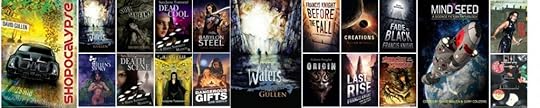 Looking at them like that made me realise how far we’d come. The current group has a total of twenty novels, collections, and anthologies. Included there are the three anthologies the group has published over the years. The latest one, Mind Seed, is hot off the press, and I think it’s terrific. Although I would say that, being one of the two editors, it’s the stories that make an anthology, and they come from the writers.
So, twenty, and that’s not counting all the short story sales – I’ve no idea how many of those there are, but there must be hundreds (Thirty from me alone, how did that happen?). And it’s also not counting former members such as Aliette de Bodard, and Tom Pollock (who launched Our Lady of the Streets, the third book in his Skyscraper Throne series this week).
Most of this has happened in the last three to four years – with at least another year before that with the authors working with their agents and publishers on various projects. And as any writer will tell you, before any of that, before the day when the Man or Woman say ‘Yes’, before contracts are signed, and before anything gets published, there are also years, and sometimes decades, of hard work beforehand.*
When the group first started, there were a handful of keen and bright-eyed young hopefuls. When I joined I knew three-quarters of fuck-all about publishing, and only slightly more about writing. The group grew, it shrank, it grew again. We learned, we got better. Now we have 35 members, nine of whom have published novels, and fair few more have agents.
It’s been a good few years, and there’s more to come. Huzzah!
And yes, we’re always open for new members.
~
* Agreed, things are different today. If you want, you can self-publish the first thing your ever write. That is a good thing in some ways, not so good in others. That’s a different conversation to the Traditional vs Sel-publishing conversation, and equally important. Two big conversations, both very interesting, and they are not over. Whatever you think, there’s room for both ways. There always was.
~
August 5, 2014
World Building – The Real Point
For the past couple of years there has been a fascination with world-building in genre fiction, with many discussions on forums, blog posts, and panels at conventions. It’s become the Need-to-Know thing about writing SF and Fantasy, with half the world wanting to learn how to design a fictional world and the other half happy to tell them.
I think the whole conversation is missing the point. As the Monk With No Name might say, the question you should have asked is ‘How do I Write about Worlds?’
This is because writing, in the end, is what it is all about. The point of building a world is not that you simply create one, it’s that you then write a story, or stories, set there.
You may well be able to design the most beautiful world in all fictional creation, but if you can’t then describe what happens there in an engaging and compelling way, then it’s like designing an aeroplane and not knowing how to fly. You can show people around the thing, and it might be lovely indeed, but you can’t take them anywhere.
The idea that if you could only get all the rules about how to build a magnificent world then you too could write a good book, is simply wrong. Knowing the rules* won’t help you write like Tolkien, or Hobb, or Holdstock, Vance, Martin, or any of the other renowned world-building authors.The old saw about good and bad plots and writers is just as true for worlds – a good writer will bring a mundane world alive, a bad one will take something magnificent and turn it into a walk across an empty car park.
How do you learn to swim? First of all you have to get into the water. Designing a perfect swimming pool won’t help you. Though if you want to push the metaphor, a nice pool might tempt you to dip a toe more than something full of dirty cold water will, (Not that worlds should be nice, they should be more like the bad pool you’d never swim in, full of half-seen motion and threat; or a hollow drained space with leaf-litter, broken sunglasses and loose change in the bottom; or so big you need a ship to sail across it – and it’s a lake of frozen ice or mercury, and it’s not a ship, anyway,it’s a submarine. And the pool is underground, a flooded cave system full of cannibal bats and white-eyed mermaids.)
With world building the Devil really is in the detail because you don’t need most of it. Unwanted detail is a dangerous trap. Both Klingon and Dothraki started off as a handful of words and phrases, the fuller vocabulary and language structure only came later, when it was needed (which was outside the original concept in both cases). The real risk of focussing on world-building is that it will absorb you completely and simply become another form of prevarication. As a result you run the risk of never getting around to telling your stories.
Rather than spend days, weeks, or even months designing a world, it’s cultures, history, myths, magic, science etc, try this: Start with a handful of over-arching concepts that inform the stories you want to tell – then let the specific detail of the worlds you build come flow from those, and from your own background, both fact and fiction. Your life, those of people you’ve met, the hundreds and hundreds of stories you’ve read, and all the non-fiction too (because the real world can come up with madder stuff than you’ll ever imagine). Bubbling up out of this great big melting pot in your subconscious will come all the ideas and suggestions you’ll need. Maybe not on demand, but certainly when you need them. This is what ‘Write What You Know’ means – writing about what you’ve lived, seen, felt, experienced, read, and learned, and your opinions of all that. Put these ideas up against each other and see how they fit, push them to the edge, and then take one more step and push them over.
Writing a story is like going on holiday. You plan where you’re going to go, and you might have a good idea about what you’re going to see and do, but until you arrive you won’t know the memorable detail, the colours, scents and textures. All that will reveal itself to you when you arrive. Just like writing about a world, you neither need nor want to know all of that in advance.
One thing I learned from writers I loved, the ones who left me aching for more of the beauty and dread of their worlds, was that they treated description like seasoning. I re-read some of their books to see how they did it, and I learned from that too. Good world writing doesn’t come at you in great big chunks of exposition, paragraph after solid paragraph (sorry, Mr JRRT), it’s a spice, sprinkled through the text like a dusting of cayenne pepper. A phrase here, a few sentences there, stirred through the whole mix to give highlight and contrast, depth and structure.
Like all seasoning, you only ever use the right amount, at the right time. And like all cooks, you need to take that recipe and make it yours.
~
* And there is a fundamental flaw in thinking there are rules. (Except, that is, for Rule #2.)
~
July 22, 2014
7 Tips for a New Publisher – The Mind Seed Experience
 Mind Seed was my first experience as an anthology editor, publisher, typesetter, and commissioner of art, everything to do with production of a book from concept to finished product. I had some good help, but I was involved in every stage and I did much of it myself. Was it complicated? In places, though much of that was because I’d never done it before. Was it difficult? Sometimes, but I made some of those difficulties for myself. I learned a huge amount. It was hard work but it was good fun. I lost sleep, I’d wake up in the middle of the night with a list in my head. I’d definitely do it again.
There were two things I knew about publishing before I started: You need a good cover, and you need good editing. And you need good stories.
So – Among the many things…
Mind Seed is the third anthology from my writing group, the London, UK based T Party. Early in 2013 one of the group, Denni Schnapp, died. For many of us this was out of the blue and, although the group is twenty years old, this was the first time we’d lost one of our own. It had been a while since the last anthology, so I suggested we do one now, for Denni. From the outset this was intended to be a group project, with invitations to contribute from other writers who knew Denni. Denni was a biologist, a traveller, and she wrote SF. Living things fascinated her. The anthology needed to reflect that, and also to be a celebration.
Looking back, the whole project was a learning process. Things I thought would be hard were easier, and vice-versa. Other things I thought would be hard were even harder. I found rejecting stories very difficult. (I know very well from experience being rejected can be tough, saying ‘No’ wasn’t easy either.) From the outset, because of the origins of the anthology, I really hoped everyone who wanted to contribute would be able to do so. In the end that simply was not possible. Some stories were just not going to work.
There’s so much to say, so I have concentrated on what I think are the big things. Otherwise, we’d be here all day. I could write a book…
Editorial.
In some ways this was the easy bit. I’ve a lot of experience of critique from the writing group, and I had some help – my co-editor was Gary Couzens, editor of the award-winning Extended Play: The Elastic Book of Music, and other anthologies. We both knew what we liked and were happy to say so. While some stories needed little work, others needed some work, and some to-and-fro. Without exception that was a straightforward process. Obviously negotiation was involved, but we got what we wanted. Any request needs to be justified. From anthology theme through to the editorial detail: Know what you want, and explain why you want it.
Arrangement.
Story order is important. This is one of the things I learned from Gary. There are a few basic guidelines: you need to lead with a great story, and if you have a novelette-length story, as we did, then that often sits most comfortably somewhere in the middle. Apart from that, there are multiple ways to arrange story order.
As the story we chose to open with was very close to the modern era, and Denni’s story, which we wanted to end with, was far-future, we decided that with those anchor-points, our story order should move further and further away from today, and into the future.
It’s as much about gut feel as design, but I think the rule here is: Think about flow and balance, theme and concept, mood, length, and tone.
Proof-reading.
Dear God, you have to get this right. Books might survive a poor cover but they will live and die by good or bad proofing.
Obviously a conscientious writer will proof their own work, but spotting mistakes in your own writing is not easy, you know it too well and so you see what is meant to be there rather than what you actually wrote. Gary and I proof-read the stories but we also knew that wasn’t enough. I’m lucky in that my partner, fantasy writer Gaie Sebold, spent many years proof-reading as part of her day job. As soon as she heard about the anthology she more or less insisted that she be allowed to proof it. We were happy to oblige. So: Get a professional proof-reader.
Cover art.
This was brilliant. It was exciting and wonderful. Eventually.
I’d originally hoped to use a cover from Mick Van Houten, one of my favourite cover artists. He was very happy to let me re-use the cover I asked about for free, but the book publisher put various obstacles in my way. I didn’t want any constraints on what we could or could not do with the book, so decided to commission original art.
I found Ian Stead from the work he did on the Mindjammer RPG and thought his style fit perfectly with the anthology. Ian was the brilliant bit, because he came up with an amazing cover and was fantastically accommodating with text layout and changes to detail in the cover. Seeing the final version was one of the highlights of the whole experience.
Ask any publisher, editor or agent and they will tell you: Good cover art still sells books.
Typesetting.
I’d no experience of this but by looking at existing books and reading around I found enough information to understand what I needed to do. (Lulu has much good advice – more of Lulu later.) In the past I’ve done a lot of costume and armour design, working mainly in leather. This might not sound useful, but I learned about proportion and balance of items within a space.
As this was my first project I didn’t want to be overambitious and decided to do layout in Microsoft Word. By default I use .RTF format and found I could do everything I needed.
A very important thing to remember is that odd-number pages are always the right-hand page of a book. Therefore things like the title page, acknowledgements, table of contents, and the first page of each story, will all be on odd-number pages.
Section Breaks let you do useful and professional things such as have different headers on odd and even pages, drop the headers on blank and title pages, and span page numbering across sections.
One thing I restricted myself on was choice of fonts. I could have embedded fonts in a PDF for the publisher, but at the time I felt I was already doing enough new things. So I limited myself to the supported fonts the publisher accepted, and selected two that worked well together (again, there’s good advice available out there).
A few important things are:
- Set your document page size to the book size before formatting.
- Odd numbers on the right.
- Don’t use too many fonts.
Simple tools work well. Do your research, design a simple theme, and stick to it. Pay attention to detail.
Publishing.
I started out intending to use Lightning Source. Many of the UK small press and other publishers use this advanced service, including Clarion, who published my SF novel Shopocalypse. Unfortunately my registration was not straightforward, and I never heard back from them. I decided to look at Lulu. My short story collection (Open Waters, theEXAGGERATEDpress) was produced on Lulu, so I knew you could create a very nice product.
Publishing on Lulu was straightforward, once you have everything ready you just press the buttons and there is plenty of opportunity to revise and check what you’re doing. Before releasing Mind Seed to the world I ordered a copy as a final proof. It was definitely worth it – I needed to tweak the spine and back cover design, and of course it was lovely to get to hold of the real thing!
Lulu also offers distribution via Amazon, B&N, Ingrams, etc., so you get a full and proper distribution service. I am sure there are other very good services out there, and I’d like to take another look at Lightning Source, but for me: Lulu was a good experience.*
The Road Goes Ever On.
There’s always something else to do.
- We’re planning an official launch at LonCon3. With over 8,000 9,000 people attending we’re hoping to sell some books!
- I need to create E-book and PDF versions.**
- And then there’s publicity. This, perhaps, is one of the hardest jobs of all, and one where there is the least advice. What I’ve learned from this book, and others, is that no one event will do the job. Publicity is a process.
~
Those three essential things I thought you needed at the outset are still very true, and there are plenty of other things too. None of it is horribly difficult, but there’s lots of it. In the end it comes down hard work, vision, and attention to detail. Don’t cut corners, there’s lots of good advice and help out there, use it, and go make some lovely books you can be proud of!
~
* And continues to be. I ordered 140 copies for the LonCon launch last Saturday, and they were delivered today, Tuesday. Super service.
** The E-book version is done – that was a whole separate experience. PDF is still in progress, and as I am discovering, this too has its own particular formatting wants and needs – just like print and e-pub.
July 14, 2014
Mind Seed – A Science Fiction Anthology
I’m pleased, thrilled, chuffed and delighted to announce that Mind Seed, the anthology I 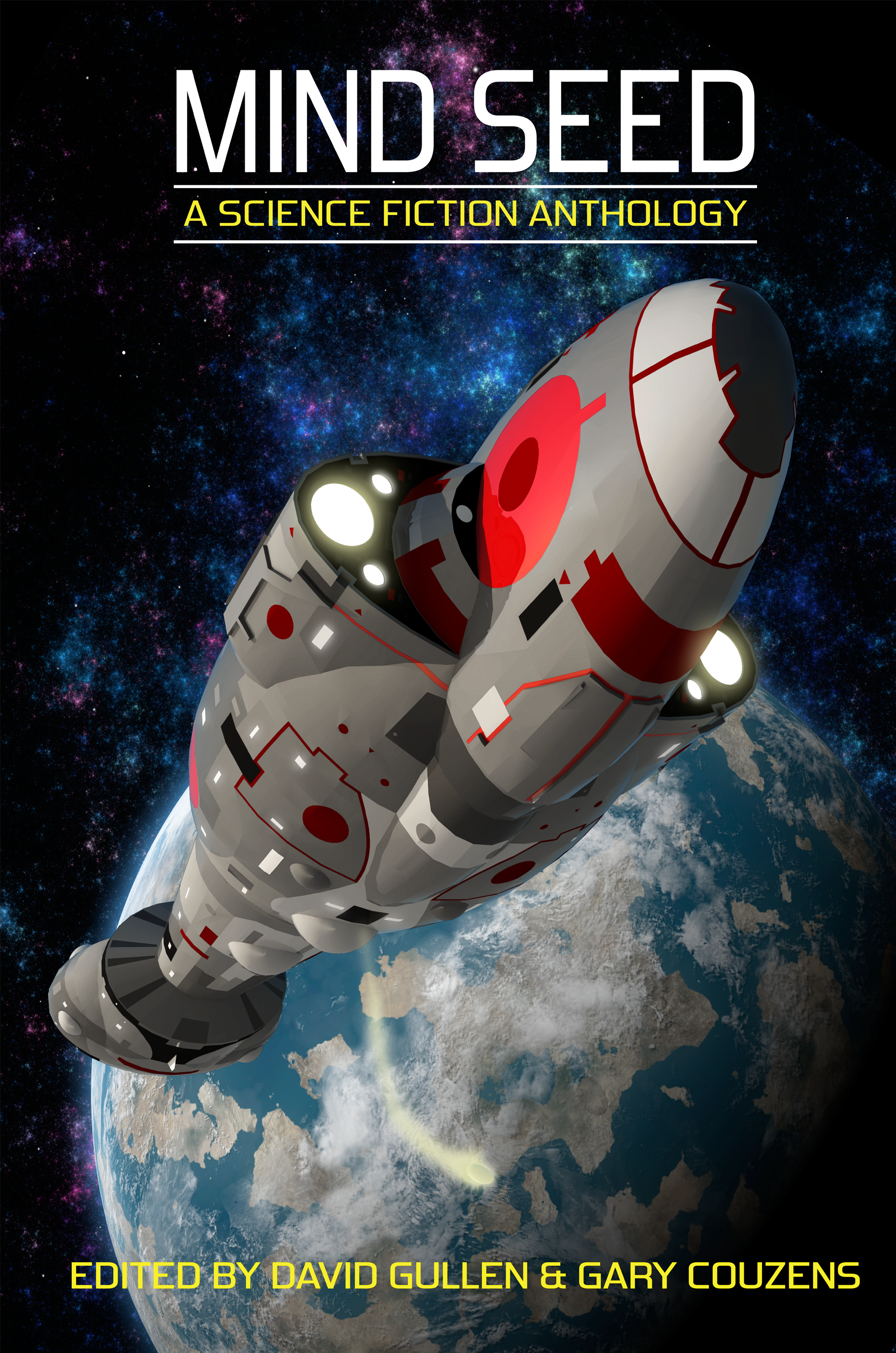 co-edited with Gary Couzens*, and also published, is now born, hatched, germinated and in full bloom as a brand-new paperback.
We’ve some great stories here, all from excellent writers, (some not as well-known as they deserve to be). There’s Shirley Jackson Award nominated Rosanne Rabinowitz, Aeon Award winner Nina Allen, and that one-man publishing phenomenon Ian Whates, of NewCon Press. And we also have stories from Helen Callaghan, Fox McGeever, Martin Owton, Markus Wolfson, Deborah Walker, and Denni Schnapp. (Gary also has a credit, with a story he co-wrote with Martin.)
Everyone deserved mentioning by name not only because they are contributors and deserve it, but because every writer here gave us their stories for free. Mind Seed is a charity anthology and every penny of profit is going to the anti-child-trafficking charity, Next Generation Nepal.
The reason we’re doing this is Denni Schnapp. Denni was a member of the writing group I, and many of the contributors to the anthology, belong to. When she died in early in 2013 we, and her husband, John Howroyd, thought this would be the perfect way to remember her, and celebrate her life. Denni was a biologist, SF writer and traveller, Next Generation Nepal is a charity that meant a great deal to her.
And so Mind Seed came into being.
Nine stories that will take you to the worlds we may live in tomorrow, into deep space, and towards the far future of humanity.
Nine different explorations of what it is to be human.
You can get your copy here.
~
* Award-Winning editor of Extended Play: The Elastic Book of Music
June 3, 2014
A New And Not Very Sinister Plot
When I moved into my new home in winter 2010 the garden had two greenhouses. One was a brand new metal frame, with automatic vents, the other, bigger one, was an ancient wooden one that needed much TLC. So I did the sensible thing. I gave away the new one and renovated the old. 
The plan was to lift the paving stones the greenhouse was set on and have a new planting area. I was a little dismayed to find six inches of concrete beneath.
Why would anyone do that? For a greenhouse? Being writers, Gaie and I immediately suspected Foul Play. Whatever the reason, this was now a project temporarily beyond my enthusiasm.Instead of a spare greenhouse I now had a spare patio.
Early this year a nice man with a pneumatic drill spent two days cutting up the concrete and taking it away. Lovely chap. I mentioned our theory about the concrete, he looked worried and crossed himself.
So now we had this: 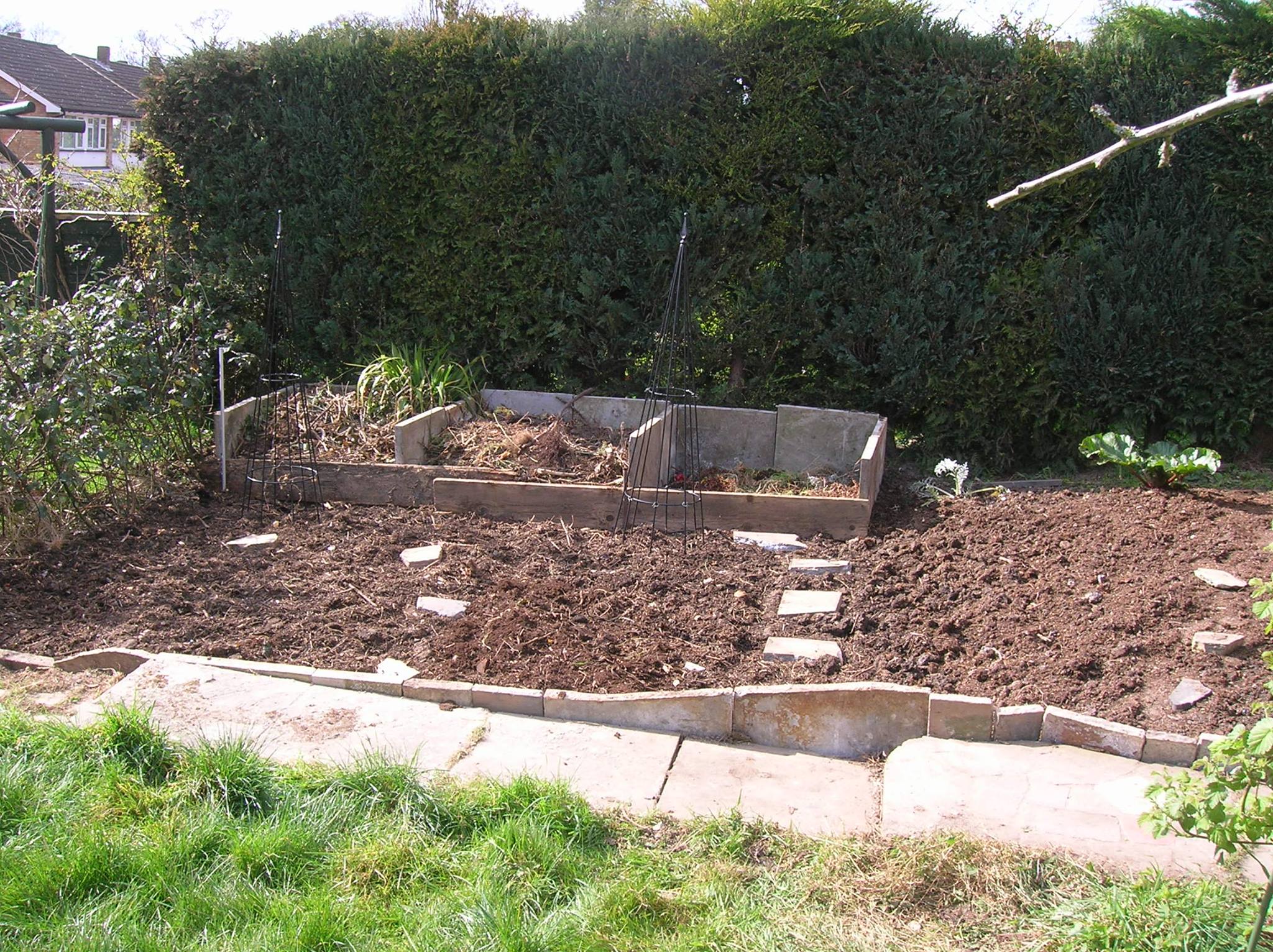
I’d re-used some of the paving stones to make my long dreamed of 3-box compost heap. The rest of it was a solid lump of London clay, compressed under the concrete for the past six or seven years. And not a worm in sight.
Digging (much digging), horse and chicken manure (the flies, Carruthers, those damned flies), and compost (lovely worms), even more digging, and we were ready to plant.
The weeds grew, but the veg was thin, and a bit yellow.

More digging, and weeding, and feeding, and watering, and double-strength feeding (bless you, Miracle-Grow), and now we have this

And I can proudly present the first marrow of the year:
~
PS: I love my three-prong cultivator.