Eric C. Sheninger's Blog, page 60
March 27, 2014
A Glimpse Into What's Possible
The following post was written by Bill Brennan and originally appeared on Peter DeWitt's Finding Common Ground blog found at Education Week. The post was titled Schools...the New Digital Age Learning Organization? In my case and that of New Milford HS anything now seems possible thanks to the unequivocal support from Central Office, a staff that has embraced meaningful change, and a student body yearning for a better way to learn.
We are truly on an exciting journey in Farmingdale Schools. Our "Institution of Learning" is morphing into a digital age learning organization - one that is continuously learning and unlearning. Fueled by social media, collaboration, and other online/offline learning endeavors, teachers and principals have quickly become the ambassadors for technology, initiating and catalyzing conversations in their buildings. I'm inspired by how they are pushing the edges of learning and embracing new approaches in the classroom.
 Image credit: ww.aditif.com
In fact, in an effort to celebrate much of this work and continue to build our collective learning capacity, we are hosting Long Island Connected Educators' Conference on April 5th - an event that has attracted over 160 participants ambitious to connect, share and learn together. Events like this are truly amazing. Many describe it as empowering, liberating, life changing, and a new paradigm for professional learning. My own experiences at events like this have unleashed a boundless journey of professional learning.
Speaking of journeys, today I traveled to New Jersey with my middle school principal, Luis Pena (@principalpena) and high school principal, Glen Zakian. Under any other circumstance, embarking on a trip to New Jersey from Long Island is nothing short of dreadful as visions of bumper-to-bumper traffic float through my head. Today was different. We were headed to a place called New Milford High School. I couldn't wait to get in the car to talk about the future of our schools and how this visit might completely recalibrate our perspectives.
When we arrived to New Milford High School, Laura Fleming (@NMHS_LMS) greeted us. Laura had returned to New Milford this past September and is literally constructing a modern day Library Media Center. Within a few minutes of us arriving students flooded the Library, a space for conversation, research, learning and inventing.
In speaking with Laura, I was inspired by how she continuously shapes her vision for this space. In describing this she said, "I spent my first few months here just talking to teachers and students about their interests." This reminded me of a recent tweet of mine, and served as a reminder of the importance of asking teacher and students what they think.
Shortly after, Eric Sheninger, (@NMHS_Principal), greeted us in the library and took us on a tour of the building. As we walked the hallways, entered classrooms and visited the cafeteria it occurred to us that there was something unique about New Milford High School. We couldn't quite put our finger on it.
For those of you that may know me, you know that I love to study organizations. In fact, I've become deeply interested in understanding how we cultivate and accelerate organizational intelligence. The essence of my experience can be best summarized through the lens of Albrecht's Law on Organizational Intelligence. Albrecht (2003) borrows two terms from physics - Entropy and Syntropy. He states,
"In the field of thermodynamics entropy is defined as the amount of a system's energy that is unavailable for conversion to work." What we observed was the opposite of entropy. Albrecht states, "Syntropy denotes the gain made possible by the intelligent integration of resources, the coming together of people, ideas, resources, systems, and leadership in such a way as to fully capitalize on the possibilities of each."
In the midst of education reform efforts, many of us educators may feel as if we are stuck in the proverbial quicksand. As we spoke with Eric, his students and teachers, it was strikingly apparent there is a common purpose and a feeling of joy and pride of being in New Milford High School. On the ride home, we discussed a level of order, calmness, and flow that we've never quite observed in a school.
Where are we going and why?
Can you and your faculty answer this question in just one sentence? And is there synergy around the response? Not to minimize it, but meaningful change starts with a willingness to change and a clear picture of where we are going.
Interestingly, what emerged from our dialogue on the way home was the idea of being equipped for the journey. As much as technology is ubiquitous in New Milford, it's not about technology. I applaud the educators of New Milford who recognize the "Holy Grail" is not a thing or a device, yet it's is the people of the organization. Under Eric's stewardship, there are organizational conditions to support a culture of emergent leadership and at the heart of this is a significant level of autonomy.
Allow me to share one final thought as highlighted in my National Study I lead at Fordham University on Schools Principals, Social Learning and Leading Change. I think it captures the essence of digital leadership and constructing a digital age learning organization.
Envisioning a Digital Age Learning Organization
I'm sure you have seen the pictures or video of the Tour de France. There are packs of riders all clumped together, appearing to pedal in unison. At some point, someone realized it's much easier, and requires a lot less energy, if you follow behind a rider rather than lead the pack all the time. If you want another good example of drafting, just watch the start of a swim during a triathlon. Also known as drafting it involves the activity of swimming closely behind someone, allowing you to coast on their wake and expending less energy. I believe this is a good metaphor as it relates to being a connected educator. As I also reflect on digital leadership, I think we have to ask ourselves - Are our schools institutions of learning or learning institutions? And, what does that look like in the Digital Age?
Although the bike race or swim race will eventually end, our journey as a learning organization won't. As we envision a digital age learning organization, we see something more akin to the peloton. Consider the following points and please add to the list.
While there is leadership in the peloton, there is not just one leader;Leadership will and must constantly change throughout the peloton;There is an on-going back and forth exchange of resources, but all towards a common goal;The peloton resembles a flexible group prepared to co-create/respond with their environment;There is great trust between athletes;These groups are complex, often appearing to be in unison and maintaining homeostasis, but perhaps more close to the edges of chaos.
The time has come to reinvent schools, education and learning. I'm thrilled to be living this journey right now at Farmingdale Schools, NY with the outstanding students and educators. Thank you Eric and Laura for opening your doors and expanding our perspectives. Lets do this!
Reference
Albrecht, Karl. The Power of minds at work: Organizational intelligence in action. New York: Amacon, 2003.
We are truly on an exciting journey in Farmingdale Schools. Our "Institution of Learning" is morphing into a digital age learning organization - one that is continuously learning and unlearning. Fueled by social media, collaboration, and other online/offline learning endeavors, teachers and principals have quickly become the ambassadors for technology, initiating and catalyzing conversations in their buildings. I'm inspired by how they are pushing the edges of learning and embracing new approaches in the classroom.
 Image credit: ww.aditif.com
In fact, in an effort to celebrate much of this work and continue to build our collective learning capacity, we are hosting Long Island Connected Educators' Conference on April 5th - an event that has attracted over 160 participants ambitious to connect, share and learn together. Events like this are truly amazing. Many describe it as empowering, liberating, life changing, and a new paradigm for professional learning. My own experiences at events like this have unleashed a boundless journey of professional learning.
Speaking of journeys, today I traveled to New Jersey with my middle school principal, Luis Pena (@principalpena) and high school principal, Glen Zakian. Under any other circumstance, embarking on a trip to New Jersey from Long Island is nothing short of dreadful as visions of bumper-to-bumper traffic float through my head. Today was different. We were headed to a place called New Milford High School. I couldn't wait to get in the car to talk about the future of our schools and how this visit might completely recalibrate our perspectives.
When we arrived to New Milford High School, Laura Fleming (@NMHS_LMS) greeted us. Laura had returned to New Milford this past September and is literally constructing a modern day Library Media Center. Within a few minutes of us arriving students flooded the Library, a space for conversation, research, learning and inventing.
In speaking with Laura, I was inspired by how she continuously shapes her vision for this space. In describing this she said, "I spent my first few months here just talking to teachers and students about their interests." This reminded me of a recent tweet of mine, and served as a reminder of the importance of asking teacher and students what they think.
Shortly after, Eric Sheninger, (@NMHS_Principal), greeted us in the library and took us on a tour of the building. As we walked the hallways, entered classrooms and visited the cafeteria it occurred to us that there was something unique about New Milford High School. We couldn't quite put our finger on it.
For those of you that may know me, you know that I love to study organizations. In fact, I've become deeply interested in understanding how we cultivate and accelerate organizational intelligence. The essence of my experience can be best summarized through the lens of Albrecht's Law on Organizational Intelligence. Albrecht (2003) borrows two terms from physics - Entropy and Syntropy. He states,
"In the field of thermodynamics entropy is defined as the amount of a system's energy that is unavailable for conversion to work." What we observed was the opposite of entropy. Albrecht states, "Syntropy denotes the gain made possible by the intelligent integration of resources, the coming together of people, ideas, resources, systems, and leadership in such a way as to fully capitalize on the possibilities of each."
In the midst of education reform efforts, many of us educators may feel as if we are stuck in the proverbial quicksand. As we spoke with Eric, his students and teachers, it was strikingly apparent there is a common purpose and a feeling of joy and pride of being in New Milford High School. On the ride home, we discussed a level of order, calmness, and flow that we've never quite observed in a school.
Where are we going and why?
Can you and your faculty answer this question in just one sentence? And is there synergy around the response? Not to minimize it, but meaningful change starts with a willingness to change and a clear picture of where we are going.
Interestingly, what emerged from our dialogue on the way home was the idea of being equipped for the journey. As much as technology is ubiquitous in New Milford, it's not about technology. I applaud the educators of New Milford who recognize the "Holy Grail" is not a thing or a device, yet it's is the people of the organization. Under Eric's stewardship, there are organizational conditions to support a culture of emergent leadership and at the heart of this is a significant level of autonomy.
Allow me to share one final thought as highlighted in my National Study I lead at Fordham University on Schools Principals, Social Learning and Leading Change. I think it captures the essence of digital leadership and constructing a digital age learning organization.
Envisioning a Digital Age Learning Organization
I'm sure you have seen the pictures or video of the Tour de France. There are packs of riders all clumped together, appearing to pedal in unison. At some point, someone realized it's much easier, and requires a lot less energy, if you follow behind a rider rather than lead the pack all the time. If you want another good example of drafting, just watch the start of a swim during a triathlon. Also known as drafting it involves the activity of swimming closely behind someone, allowing you to coast on their wake and expending less energy. I believe this is a good metaphor as it relates to being a connected educator. As I also reflect on digital leadership, I think we have to ask ourselves - Are our schools institutions of learning or learning institutions? And, what does that look like in the Digital Age?
Although the bike race or swim race will eventually end, our journey as a learning organization won't. As we envision a digital age learning organization, we see something more akin to the peloton. Consider the following points and please add to the list.
While there is leadership in the peloton, there is not just one leader;Leadership will and must constantly change throughout the peloton;There is an on-going back and forth exchange of resources, but all towards a common goal;The peloton resembles a flexible group prepared to co-create/respond with their environment;There is great trust between athletes;These groups are complex, often appearing to be in unison and maintaining homeostasis, but perhaps more close to the edges of chaos.
The time has come to reinvent schools, education and learning. I'm thrilled to be living this journey right now at Farmingdale Schools, NY with the outstanding students and educators. Thank you Eric and Laura for opening your doors and expanding our perspectives. Lets do this!
Reference
Albrecht, Karl. The Power of minds at work: Organizational intelligence in action. New York: Amacon, 2003.


March 24, 2014
Making to Learn in Physics
Ms. Fleming recently hosted Mr. Fowler’s Conceptual Physics classes for some hands-on experiences with electronics in the Makerspace at New Milford HS. Prior to their experience in this space, students had worked with the pHET DC Circuit Simulator. They were able to explore current flows through light bulbs in circuits powered by batteries and controlled by switches. This simulation experience gave the students some cause and effect experiences allowing them to witness the interplay between voltage, current, and resistance. Despite these experiences, they missed the reality of low batteries, poor electrical connections, and other real world experiences that impact circuits. This all changed dramatically when students were afforded a hands-on, authentic learning experience in the Makerspace that allowed them to create artifacts of learning to demonstrate conceptual mastery.
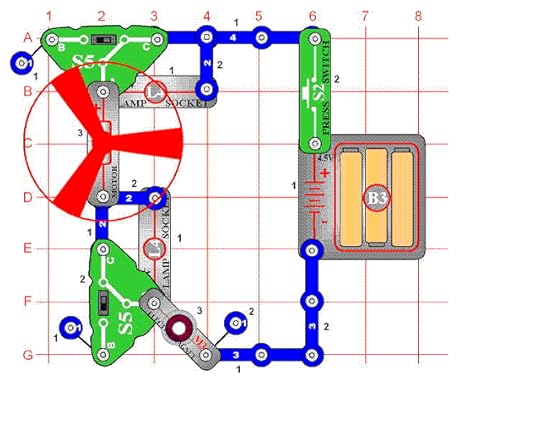 Image credit: http://www.snapcircuits.net
Once in the Makerspace students began to create, tinker, and invent to learn concepts related to circuitry When they made the Little Bits circuits that rotated paper hands and Snaptricity circuits that launched propellers, they experienced success that usually followed some initial impediments. They had to troubleshoot to find a broken lead on a connection to the battery, or find an open circuit because a connection that appeared to be made was electrically disconnected. The support provided by Ms. Fleming was excellent and pivotal to the success of the lesson. Kits were readily available for the students to use. When batteries ran low she had backups on hand for all of the groups. Two students were pulled more towards the Legos and she immediately improvised by having electronic motors available that they could work with.
This experience has provided a reservoir of learning opportunities for both of Mr. Fowler's classes that they continue to draw from when working through series and parallel circuits. The Makerspace in the library is an oasis for student self-directed learning. It serves as a rejuvenation center for inspiring of love for both formal and informal learning. In my opinion a space like this should be a priority for all schools in the 21st Century and you do not have to break the bank to create one.
 Image credit: http://www.snapcircuits.net
Once in the Makerspace students began to create, tinker, and invent to learn concepts related to circuitry When they made the Little Bits circuits that rotated paper hands and Snaptricity circuits that launched propellers, they experienced success that usually followed some initial impediments. They had to troubleshoot to find a broken lead on a connection to the battery, or find an open circuit because a connection that appeared to be made was electrically disconnected. The support provided by Ms. Fleming was excellent and pivotal to the success of the lesson. Kits were readily available for the students to use. When batteries ran low she had backups on hand for all of the groups. Two students were pulled more towards the Legos and she immediately improvised by having electronic motors available that they could work with.
This experience has provided a reservoir of learning opportunities for both of Mr. Fowler's classes that they continue to draw from when working through series and parallel circuits. The Makerspace in the library is an oasis for student self-directed learning. It serves as a rejuvenation center for inspiring of love for both formal and informal learning. In my opinion a space like this should be a priority for all schools in the 21st Century and you do not have to break the bank to create one.
March 19, 2014
An Open Letter to NJDOE Commissioner David Hespe #NJED
Over the years, and in my latest book, I have written about how social media has presented me and my school with numerous opportunities that I never could have imagined would be possible. I stress the fact that we now have a plethora of free tools that compel leaders, or all educators for that matter, to become the storyteller-in-chief. Regardless of whether the stories are being penned by myself, my staff, or the students of New Milford High School, we have done just that at NMHS. We have taken control of our public relations for our school and now actively promote all of the great work we are doing to prepare students for success in a global, digital world. Not only has the local media taken notice of the impactful work we are doing, but others around the world have as well. I’m not going to lie, one of the best parts of my job as a Principal is being able to put my school in a position to be a model for the types of changes education needs and deserves.
 Image credit: http://www.strongchurch.org/wp-conten...
Well, I have digressed a bit from the purpose of why I am writing this post. Not only has social media allowed us to flip the script and drown out the negative rhetoric that surrounds education all across the country, but it has also helped me find my voice. This still fascinates me, as I never thought that my opinions and ideas would have much traction outside Bergen County, NJ. After my dear friend Ken Royal gave me a nudge, over four years ago I began to share my thoughts through blogging. I have not shied away from sharing my opinions on educational technology, leadership, politics, policy, and reform. The opinions of all educators matter and it is through platforms such as blogs and Twitter that I, and colleagues across the state, hope to engage all stakeholders in a meaningful conversation on how we can improve education.
Time to get back to my point. Earlier this week I saw an article from NJ Spotlight titled THE LIST: NEW JERSEY'S 'EDUBLOGGERS' TALK POLICY, POLITICS -- AND TECHNOLOGY. To my surprise I was identified as a blogger in NJ with some influence. Whether or not I do is besides the point. I immediately saw an opportunity to leverage this so-called influence to engage David Hespe, the new NJDOE Commissioner, in a conversation about the state of education in NJ. The previous Commissioner did not seem very concerned about what those of us in the trenches thought about the current state of education in our great state. To my knowledge there was little to no discourse with students who have and will continue to be impacted by the flurry of changes enacted in a short period of time. We can change this now Commissioner Hespe.
It is my hope that my network can assist me with getting him a message that we welcome an open dialogue so that together we can create teaching and learning cultures that work for our students. My goal is to have David Hespe visit New Milford HS in the near future to see firsthand the innovative work we are doing here. Then I would like to set up a forum with other state educators so we can share our thoughts on some of the reforms that have been implemented as of late. This would not be a gripe session, but instead an open conversation about how we can find a common group to accomplish the same goal we all possess – the success of our students.
I compel Commissioner Hespe to answer my call to action. Visit with us here at New Milford HS, engage in a dialogue with an array of educators and students, and listen to some of the ideas, as well as concerns, we have. Let’s talk about the roll-out of Achieve NJ, Common Core, PARCC, SGO’s as well as some amazing innovative initiatives that inspire a passion for learning among our students. The previous We can work out the details through email and then the phone, but let’s get this conversation started. There is no better time than now for us to unite and move NJ to educational greatness as nothing less is expected. Please email me at esheninger@newmilfordschools.org.
 Image credit: http://www.strongchurch.org/wp-conten...
Well, I have digressed a bit from the purpose of why I am writing this post. Not only has social media allowed us to flip the script and drown out the negative rhetoric that surrounds education all across the country, but it has also helped me find my voice. This still fascinates me, as I never thought that my opinions and ideas would have much traction outside Bergen County, NJ. After my dear friend Ken Royal gave me a nudge, over four years ago I began to share my thoughts through blogging. I have not shied away from sharing my opinions on educational technology, leadership, politics, policy, and reform. The opinions of all educators matter and it is through platforms such as blogs and Twitter that I, and colleagues across the state, hope to engage all stakeholders in a meaningful conversation on how we can improve education.
Time to get back to my point. Earlier this week I saw an article from NJ Spotlight titled THE LIST: NEW JERSEY'S 'EDUBLOGGERS' TALK POLICY, POLITICS -- AND TECHNOLOGY. To my surprise I was identified as a blogger in NJ with some influence. Whether or not I do is besides the point. I immediately saw an opportunity to leverage this so-called influence to engage David Hespe, the new NJDOE Commissioner, in a conversation about the state of education in NJ. The previous Commissioner did not seem very concerned about what those of us in the trenches thought about the current state of education in our great state. To my knowledge there was little to no discourse with students who have and will continue to be impacted by the flurry of changes enacted in a short period of time. We can change this now Commissioner Hespe.
It is my hope that my network can assist me with getting him a message that we welcome an open dialogue so that together we can create teaching and learning cultures that work for our students. My goal is to have David Hespe visit New Milford HS in the near future to see firsthand the innovative work we are doing here. Then I would like to set up a forum with other state educators so we can share our thoughts on some of the reforms that have been implemented as of late. This would not be a gripe session, but instead an open conversation about how we can find a common group to accomplish the same goal we all possess – the success of our students.
I compel Commissioner Hespe to answer my call to action. Visit with us here at New Milford HS, engage in a dialogue with an array of educators and students, and listen to some of the ideas, as well as concerns, we have. Let’s talk about the roll-out of Achieve NJ, Common Core, PARCC, SGO’s as well as some amazing innovative initiatives that inspire a passion for learning among our students. The previous We can work out the details through email and then the phone, but let’s get this conversation started. There is no better time than now for us to unite and move NJ to educational greatness as nothing less is expected. Please email me at esheninger@newmilfordschools.org.
March 16, 2014
Persuasion as a Catalyst for Change
I’m not going to lie; Daniel Pink is one of my heroes. After reading his book Drive a few years back my professional practice was significantly changed for the better. His work really made me critically reflect upon my leadership practices. This led to a decision to give my staff and students more autonomy, which resulted in a greater sense of ownership of their learning. The power of social media then connected the both of us leading to him Skyping with the students at New Milford High School, a personal dialogue over the years, and his endorsement of my new book on Digital Leadership. Pink was the morning keynote on the opening day of the Annual ASCD Conference in Los Angeles, CA. His presentation focused on the research presented in his new book To Sell is Human. This post will be my best attempt to summarize his keynote.
 Image credit: http://www.brandingstrategyinsider.co...
Persuasion is a huge component of what we do in education. Roughly 40% of our time is spent moving other people from point A to point B or in another direction. The change process and its success for that matter lie in our ability to persuade people to embrace new ideas, concepts, and strategies. We are currently trying to accomplish this in a radically different landscape in a world dominated by technology. All ideas and information can be fact checked immediately as society continues to become more connected by the day. There is no longer a monopoly on information. Everyone has it, which makes the art of persuasion and moving people in a better direction much more difficult as there is no longer an information advantage. Instead of information imbalance there is information parody.
So with these challenges what do we do about it in the field of education? One way is to look at current research, especially the work of Robert Cialdini. His research into influence and behavioral science allows us to piece together more effective ways to persuade, or embrace change, as I would prefer. Social science suggest three core qualities to move people towards change:
Attunement – Can you get out of your own head and see a different point of view? We must learn to accept and embrace different perspectives.Buoyancy – If we are facing an ocean of rejection how do we stay afloat?Clarity – How do we make sense of information? We must move from just accessing information to curating information.
Instead of having “big, hairy goals” Pink suggests that we should focus on small wins. As we continue to find success through these small wins they will eventually culminate into moving people where we want, and need, them to be. For this to happen we must relinquish a certain amount of power and control. It is important for us to not let power overtake our core values, as it will negatively impact our willingness to be open to the perspectives of others. We can become more effective by reducing our feelings of the need for power. This was extremely refreshing for me to hear as we have moved away from directives and mandates at NMHS, both heavily aligned to power hungry leadership. This, in combination with giving up control and trusting both students and teachers, has allowed us to initiate sustainable change at my school leading to transformation.
So who is better at selling stuff, introverts, extroverts, or ambiverts? Well the answer was ambivert, but what the heck is this? According to Pink ambiverts are in the middle of both extroverts and introverts. None of us really possess all of the qualities and characteristics that define either an introvert or extrovert. What this really means is that we have to become a better version of ourselves in order to improve our ability to persuade. Or better yet, to move people to where they need to be.
You can do this! Well actually this might not be the best course of action. Buoyancy in this frenetic world rests on interrogative self-talk. A change in mindset that has us ask the question can I do this actually leads to better outcomes related to change. Interrogative self-talk is actually more instructional and can spark the autonomous intrinsic motivation to pursue and accomplish a goal. Pink provided a great analogy in Bob the Builder, who asks the question can we fix this? Taking this perspective can really assist educators move people towards a better way.
Persuasion and motivation are not done to someone; it is actually something they want to do. Context drives behavior more than we realize. Sometimes changing people’s minds is what we focus on when instead we need to give them an off ramp to act. When we try to lead there is a tendency to focus on the how. This is important, but it shortchanges the why. The cheapest persuasive tool we have is explaining the why. Pink recommends having tow conversations on why to every on how. As others understand the why the road the change becomes clear.
March 13, 2014
QR Codes in the Math Classroom
In Mrs. Chellani’s continual efforts to create an engaging learning experience for her students, she has found utilizing QR codes to facilitate collaboration to be highly beneficial. In order to review material discussed in an assigned video and in class in her Pre-Calculus and Calculus courses, she created QR codes with relevant questions on the material and its’ applications. Students were placed in groups of four to five; and, using a QR reader app on their phone, they were able to view the question. Once the students worked on the problem together, they would confirm the result with Mrs. Chellani. When the solution was correct, they would be given the next QR code (i.e. question). The level of engagement increased dramatically with the use of QR codes and simply allowing students to utilize their cell phones in the learning process!
 Image credit: http://www.youngupstarts.com/wp-conte...
Mrs. Chellani has been a pioneer in flipping her classes at New Milford High School where her tools of choice have been Adobe Captivate and Edmodo. Be sure to check out her class website at Learn Math Easily. In addition to the interactive videos she has created to flip her class you will also find case studies and online resources on her site.
 Image credit: http://www.youngupstarts.com/wp-conte...
Mrs. Chellani has been a pioneer in flipping her classes at New Milford High School where her tools of choice have been Adobe Captivate and Edmodo. Be sure to check out her class website at Learn Math Easily. In addition to the interactive videos she has created to flip her class you will also find case studies and online resources on her site.
March 10, 2014
Moving Beyond 140 With Google+ #digilead
The following was written by Evan Scherr and the original post can be accessed at Just Thinking Out Loud.
I love Twitter. I have connected with some really amazing practitioners because of it. I have become friends with some really fantastic people as a result of it. Twitter serves as the bridge to my connecting and my learning. It is a beautiful bridge. It is not a very long bridge to walk across. Sometimes, I just want to take a longer walk.
Eric Sheninger wrote a great book on Digital Leadership. The timing of the book was fantastic. I had just accepted my first admin position with a large international school in Germany. I wanted a way to discuss the book with other leaders out there. So I started a Google Plus Community in the hopes of connecting with other leaders out there to discuss the book and leadership in general.
 Image credit: http://i2.cdn.turner.com/
Why Google Plus?
Twitter is great for those shorter walks. 140 characters of quick, rapid fire, tweets. That works well for me at times. The other times I just want to dig in and really begin to discuss a topic and not be limited by the 140 character limit. G+ communities provide me a way to accomplish all of this and so much more.
Other benefits of the G+ community are:
The ability to hold threaded discussionsThe ability to add video chats (called Hangouts)The ability to remain in the Google Ecosystem and leverage other Google products like Calendars and Docs.The ability to further grow and deepen the PLN experience.Adding New Layers
The Digital Leadership community centers around Eric’s book. Last week we held our first BookOut (probably not a name that will stick) Hangout. Four of us, including Eric, connected and discussed chapter one of the book. This added a layer to the community that I really enjoyed. It was a great experience to have face to face (via video chat) conversations with other leaders and hear their thinking and ideas. Eric added more back story to the chapter and provided us with even more of his thinking and experience with the tools that he discussed in the chapter.
Beyond 140
The goal of the community is to go beyond 140 characters. It is a place where you can share your thoughts on the book, on leadership/digital leadership, or connect in new ways with new people from around the world. The community experience can be anything that you would like it to be. That is the beauty of it. You can even be a lurker, though I am hoping that you become an active participant and add your voice, ideas and knowledge to our growing thinktank.
I love Twitter. I have connected with some really amazing practitioners because of it. I have become friends with some really fantastic people as a result of it. Twitter serves as the bridge to my connecting and my learning. It is a beautiful bridge. It is not a very long bridge to walk across. Sometimes, I just want to take a longer walk.
Eric Sheninger wrote a great book on Digital Leadership. The timing of the book was fantastic. I had just accepted my first admin position with a large international school in Germany. I wanted a way to discuss the book with other leaders out there. So I started a Google Plus Community in the hopes of connecting with other leaders out there to discuss the book and leadership in general.
 Image credit: http://i2.cdn.turner.com/
Why Google Plus?
Twitter is great for those shorter walks. 140 characters of quick, rapid fire, tweets. That works well for me at times. The other times I just want to dig in and really begin to discuss a topic and not be limited by the 140 character limit. G+ communities provide me a way to accomplish all of this and so much more.
Other benefits of the G+ community are:
The ability to hold threaded discussionsThe ability to add video chats (called Hangouts)The ability to remain in the Google Ecosystem and leverage other Google products like Calendars and Docs.The ability to further grow and deepen the PLN experience.Adding New Layers
The Digital Leadership community centers around Eric’s book. Last week we held our first BookOut (probably not a name that will stick) Hangout. Four of us, including Eric, connected and discussed chapter one of the book. This added a layer to the community that I really enjoyed. It was a great experience to have face to face (via video chat) conversations with other leaders and hear their thinking and ideas. Eric added more back story to the chapter and provided us with even more of his thinking and experience with the tools that he discussed in the chapter.
Beyond 140
The goal of the community is to go beyond 140 characters. It is a place where you can share your thoughts on the book, on leadership/digital leadership, or connect in new ways with new people from around the world. The community experience can be anything that you would like it to be. That is the beauty of it. You can even be a lurker, though I am hoping that you become an active participant and add your voice, ideas and knowledge to our growing thinktank.
March 5, 2014
Global Connections Made Possible Through Technology
Mrs. Collentine’s Global Perspectives in Literature had a different spin on their research paper this year. In previous years, students had selected a charity to research and then, where possible, were to work for that charity in some capacity as part of the research paper experience. This year, students were to select a charity from a different part of the world—namely the country that is their own heritage and background.
 Image credit: http://www.refresh-marketing.co.uk/ta...
After they selected their charities and then began their research, students were having amazing “real world” experiences. Senior Raechel Sontag actually set up an interview with the CEO of the charity she selected in Scotland and held it via Skype! Senior Leah Subrizi emailed her charity, located in Italy, back and forth and corresponded completely in Italian! Senior Christopher Learn was so touched by his charity and their work—done in Germany—that he actually donated to the cause and plans on attending a conference the organization is holding when they come to New York City! Research papers are more than a paper this year in Global Perspectives Honors!
 Image credit: http://www.refresh-marketing.co.uk/ta...
After they selected their charities and then began their research, students were having amazing “real world” experiences. Senior Raechel Sontag actually set up an interview with the CEO of the charity she selected in Scotland and held it via Skype! Senior Leah Subrizi emailed her charity, located in Italy, back and forth and corresponded completely in Italian! Senior Christopher Learn was so touched by his charity and their work—done in Germany—that he actually donated to the cause and plans on attending a conference the organization is holding when they come to New York City! Research papers are more than a paper this year in Global Perspectives Honors!
February 28, 2014
The Next Generation in Student Flashcards
People have been using flashcards as a revision aid for decades, but now it is time for learners to step away from their papers and pens, and move towards using internet-based flashcards instead. But why step away from a tried and tested method, and put your faith in something new? The reason that you should give it a go is that there are a number of important reasons why online flashcard systems, such as that which is provided by Cardkiwi, are better than the old-fashioned pen and paper method.

One of the reasons why Cardkiwi is so effective is because it utilizes a memory building technique known as spaced repetition. Numerous studies (Spitzer: 1939, Cepeda et al: 2008,) into human memory have shown that memory retention can be improved by spacing out your exposure to information, so that you review the information again at the optimal moment. Whilst pen and paper flashcards allow you to space out your exposure to new material, working out when would be the best time to look at the material again could be a waste of your time. Clever algorithms used by online flashcard systems mean that the flashcard app will know when to show you each flashcard for maximum effect. By allowing you to rate your understanding/memory of each specific card, the Cardkiwi app will start to show you the cards that you have a better understanding of less frequently, and the cards that you don’t understand yet, more frequently! For more information on spaced repetition, take a look HERE.
Cardkiwi also allows you the opportunity to share your flashcards with others so that you can build your knowledge with collaborative learning strategies. You can share your cards with anyone else in the world, without having to hand copy them out and send them over, and your friends can also share their flashcards with you. This can help you to develop a whole new perspective on the material that you are trying to learn. "I need flashcards for 10 chapters in my biology book. If I invite 9 friends to collaborate with me, I only have to do 10 % of the work. Amazing!"
Cardkiwi will also keep your flashcards safe, in the right category and out of the way, so that they are not cluttering up your desk or bag. You can create hundreds of different sets of flashcards on Cardkiwi without having to worry about getting them mixed up or running out of drawer space to keep them all in. Best of all, you don’t have to worry about wasting paper, because all of your flashcards are displayed on a computer screen.
With so many great reasons to try using flashcards online, it would be foolish not to take the opportunity to try out this new method of learning. When you consider that Cardkiwi is free to use and always will be free to use, there is nothing standing in your way.

One of the reasons why Cardkiwi is so effective is because it utilizes a memory building technique known as spaced repetition. Numerous studies (Spitzer: 1939, Cepeda et al: 2008,) into human memory have shown that memory retention can be improved by spacing out your exposure to information, so that you review the information again at the optimal moment. Whilst pen and paper flashcards allow you to space out your exposure to new material, working out when would be the best time to look at the material again could be a waste of your time. Clever algorithms used by online flashcard systems mean that the flashcard app will know when to show you each flashcard for maximum effect. By allowing you to rate your understanding/memory of each specific card, the Cardkiwi app will start to show you the cards that you have a better understanding of less frequently, and the cards that you don’t understand yet, more frequently! For more information on spaced repetition, take a look HERE.
Cardkiwi also allows you the opportunity to share your flashcards with others so that you can build your knowledge with collaborative learning strategies. You can share your cards with anyone else in the world, without having to hand copy them out and send them over, and your friends can also share their flashcards with you. This can help you to develop a whole new perspective on the material that you are trying to learn. "I need flashcards for 10 chapters in my biology book. If I invite 9 friends to collaborate with me, I only have to do 10 % of the work. Amazing!"
Cardkiwi will also keep your flashcards safe, in the right category and out of the way, so that they are not cluttering up your desk or bag. You can create hundreds of different sets of flashcards on Cardkiwi without having to worry about getting them mixed up or running out of drawer space to keep them all in. Best of all, you don’t have to worry about wasting paper, because all of your flashcards are displayed on a computer screen.
With so many great reasons to try using flashcards online, it would be foolish not to take the opportunity to try out this new method of learning. When you consider that Cardkiwi is free to use and always will be free to use, there is nothing standing in your way.
February 23, 2014
Creating Our Own Unique Learning Environments #DigiLead
Over the past couple of months, the staff at New Milford High School has been diligently creating our own unique learning environments for our students. Building on the success of our Bring Your Own Device (BYOD) initiative and with the addition of a new, innovative staff member two noteworthy advancements have been made since September 2013. That new staff member is Laura Fleming and she has done nothing less than blaze a trail since joining the NMHS team. She embraced the autonomy that she was given in a position that functions as a librarian, media specialist, and educational technology integrator to push the envelop. Lucky for her, NMHS already had many innovative teachers on staff and students yearning for changes in how and where they can learn since NMHS is an ancient building (i.e. 1928).
 LED stools at the Little Bits bar
One of the most amazing transformations that has taken place at NMHS is the creation of the Makerspace in what was our traditional library. A space that could once be compared to a barren wasteland is now a thriving learning metropolis where students flock to tinker, invent, create, collaborate, work, and most importantly, learn. When I hired Laura I basically told her what her budget was and that she had complete control of how she wanted to use the money. I could never have imagined how quickly she could radically transform this outdated space, using money that in the past had always been spent on books, magazines, and electronic databases. Some quick highlights include the following:
Makey-Makey kitsLittle Bits barTake apart then put back together technology stationLEGO table3D Printer (Makerbot) and design stationShe just launched an updated site for the Makerspace at NMHS that I highly suggest you visit. Not included on the site is the recent purchase and addition of an LED chessboard and cafe style seating. This has resulted in many spirited chess matches between students and NMHS teachers over the past couple of weeks. For more information on our Makerspace check out this post that I wrote earlier in the year.
Laura is also working on bringing the campus of New Milford High School into the cloud. This 3-D virtual learning space will enable students to participate, create content, and to collaborate with others, physically and virtually, nearby or anywhere across the globe, through their chosen media. We will be exploring how we can use the virtual terrain for face-to-face collaboration, and how we can embed collaboration into the planning and the outcomes of instructional design and the learning process. Our virtual environment will be made possible by a solution called ProtoSphere, a 3-D collaboration environment created by a company called ProtonMedia that connects people from all around the globe, at any moment in time, from virtually any device. Mrs. Fleming will be collaborating with Ms. Jennifer Lyons, Ms. Vicki Smith, Ms. Lisette Morel, and Ms. Rebecca Luzuriga along with some of their students. This project was recently featured on Getting Smart.

 I'd say we are well on our way to creating learning environments that our students need, deserve, and value. Stay tuned as we continue our transformation!
February 17, 2014
Difference in Perspective: An Interdisciplinary Project
Mrs. Westbrook and Mrs. Morel continue their collaboration to address the Common Core literacy standards within our fine arts program, with the goal of increasing the rigor of the writing assignments across the curriculum. Building on the success of their past work with students writing artist statement's for exhibition of their work, this semester Explorations in Art students will create photo essays to demonstrate their knowledge of the progression among styles and techniques from ancient to modern art. Students will analyze pieces from the online gallery provided by the Metropolitan Museum of Art and compare the works in terms of perspective, realism, subject matter, imagery, scale, and the use of space.
 Image credit: http://artfulartsyamy.blogspot.com/20...
These teachers have provided students with writing scaffolds and exemplars to help them achieve this goal. You can view the entire project using the links below:
Difference in Perspective (assignment description)Photo Essay Linear Perspective (rubric)One Point Linear Perspective (example)The following Common Core Standards were addressed and assessed:
Reading Standards CCSS.ELA-Literacy.RH.9-10.1 Cite specific textual evidence to support analysis of primary and secondary sources, attending to such features as the date and origin of the information.CCSS.ELA-Literacy.RH.9-10.9 Compare and contrast treatments of the same topic in several primary and secondary sources.CCSS.ELA-Literacy.RH.9-10.10 By the end of grade 10, read and comprehend history/social studies texts in the grades 9–10 text complexity band independently and proficiently. Writing Standards CCSS.ELA-Literacy.WHST.9-10.1 Write arguments focused on discipline-specific content.CCSS.ELA-Literacy.WHST.9-10.1a Introduce precise claim(s), distinguish the claim(s) from alternate or opposing claims, and create an organization that establishes clear relationships among the claim(s), counterclaims, reasons, and evidence.CCSS.ELA-Literacy.WHST.9-10.1d Establish and maintain a formal style and objective tone while attending to the norms and conventions of the discipline in which they are writing.
 Image credit: http://artfulartsyamy.blogspot.com/20...
These teachers have provided students with writing scaffolds and exemplars to help them achieve this goal. You can view the entire project using the links below:
Difference in Perspective (assignment description)Photo Essay Linear Perspective (rubric)One Point Linear Perspective (example)The following Common Core Standards were addressed and assessed:
Reading Standards CCSS.ELA-Literacy.RH.9-10.1 Cite specific textual evidence to support analysis of primary and secondary sources, attending to such features as the date and origin of the information.CCSS.ELA-Literacy.RH.9-10.9 Compare and contrast treatments of the same topic in several primary and secondary sources.CCSS.ELA-Literacy.RH.9-10.10 By the end of grade 10, read and comprehend history/social studies texts in the grades 9–10 text complexity band independently and proficiently. Writing Standards CCSS.ELA-Literacy.WHST.9-10.1 Write arguments focused on discipline-specific content.CCSS.ELA-Literacy.WHST.9-10.1a Introduce precise claim(s), distinguish the claim(s) from alternate or opposing claims, and create an organization that establishes clear relationships among the claim(s), counterclaims, reasons, and evidence.CCSS.ELA-Literacy.WHST.9-10.1d Establish and maintain a formal style and objective tone while attending to the norms and conventions of the discipline in which they are writing.