Eric C. Sheninger's Blog, page 36
July 22, 2018
Selfless Acts Exemplify Who We Are
"A candle loses nothing by lighting another candle." - James Keller
The other day I headed out to run some errands. It is common practice for me to use this time listening to a variety of radio stations. If there is any talk between the disc jockeys (are they even still called this) or commercials I quickly press the tuning button to get some real music playing. As I fiddled around on this particular day, I couldn’t find anything in particular that piqued my listening interests. After searching and searching, I just settled on my favorite Houston station hoping that when a song began to permeate from the car speakers that it would be something I liked.
Well since it was a weekday morning, dialogue between the on-air personalities persisted. I was about to change the station yet again out of frustration but the story they began to share caught my attention. Firefighters and first responders were sent to the home of a Florida man who had suffered a heart attack while laying new sod down on his property. As the man was being treated he kept carrying on about the fact that he had to finish the job as the grass would quickly dry up and die if it was not installed and watered.
The firefighters and first responders were like “Come on dude, you just had a heart attack. Your life is more important than grass.” The man continued to carry on and eventually let it be known why he was so worried about getting the job done. Apparently, he had recently been warned by his local Home Owners Association (HOA) to fix his grass or suffer a fine. Being that my wife and I are part of an HOA we can attest to the fact that we get stupid letters threatening fines all the time. Who knew though that HOAs could stress people out to the point where they continue to worry even after suffering a heart attack?
The firefighters and first responders were utterly dumbfounded during this ordeal but patiently worked to treat the man and desperately tried to get him into the ambulance. All he could still think about was getting the sod installed and avoiding the fine. Eventually, the man’s wife persuaded her husband to get in the ambulance as she assured him that her brother would come over and finish the job. The man who suffered the heart attack was finally on the way to the hospital to get real treatment.
Now comes the good part. After getting the man to the hospital each firefighter and first responder went back to the man’s house and worked side by side with his brother-in-law until the job was done entirely. WOW! This selfless act is not only inspirational, but it also provides an opportunity for us to reflect on our purpose in life.

Don’t pursue perfection. Pursue growth. One area where there are continuous opportunities for growth is selflessness. Pulled from an article titled How The Power of Selflessness Can Transform Our Lives here is was what we could learn and take away from partaking in this act.
The other day I headed out to run some errands. It is common practice for me to use this time listening to a variety of radio stations. If there is any talk between the disc jockeys (are they even still called this) or commercials I quickly press the tuning button to get some real music playing. As I fiddled around on this particular day, I couldn’t find anything in particular that piqued my listening interests. After searching and searching, I just settled on my favorite Houston station hoping that when a song began to permeate from the car speakers that it would be something I liked.
Well since it was a weekday morning, dialogue between the on-air personalities persisted. I was about to change the station yet again out of frustration but the story they began to share caught my attention. Firefighters and first responders were sent to the home of a Florida man who had suffered a heart attack while laying new sod down on his property. As the man was being treated he kept carrying on about the fact that he had to finish the job as the grass would quickly dry up and die if it was not installed and watered.
The firefighters and first responders were like “Come on dude, you just had a heart attack. Your life is more important than grass.” The man continued to carry on and eventually let it be known why he was so worried about getting the job done. Apparently, he had recently been warned by his local Home Owners Association (HOA) to fix his grass or suffer a fine. Being that my wife and I are part of an HOA we can attest to the fact that we get stupid letters threatening fines all the time. Who knew though that HOAs could stress people out to the point where they continue to worry even after suffering a heart attack?
The firefighters and first responders were utterly dumbfounded during this ordeal but patiently worked to treat the man and desperately tried to get him into the ambulance. All he could still think about was getting the sod installed and avoiding the fine. Eventually, the man’s wife persuaded her husband to get in the ambulance as she assured him that her brother would come over and finish the job. The man who suffered the heart attack was finally on the way to the hospital to get real treatment.
Now comes the good part. After getting the man to the hospital each firefighter and first responder went back to the man’s house and worked side by side with his brother-in-law until the job was done entirely. WOW! This selfless act is not only inspirational, but it also provides an opportunity for us to reflect on our purpose in life.

Don’t pursue perfection. Pursue growth. One area where there are continuous opportunities for growth is selflessness. Pulled from an article titled How The Power of Selflessness Can Transform Our Lives here is was what we could learn and take away from partaking in this act.
"Selflessness means we act without thought for how we will profit or be rewarded. If we give help to others but expect recognition or the favor to be returned, this is not a selfless action. True selflessness means we would do the action, even if it were never known to anyone else. Selflessness means we identify with others. Our service to others is not an act of condescending charity; our action is motivated by a feeling of oneness. We help others because we identify with their problems and their suffering. Selflessness is its own reward."Random acts of kindness will not just make you feel good, but also those who you help out. To create a better world for our learners and ourselves, we need to begin by modeling it at the individual level. In the words of Aesop, "No act of kindness, no matter how small, is ever wasted."


July 15, 2018
How to Make Better Decisions
Conversations on effective leadership are varied although they focus more or less on the same general points, yet in different contexts. One saying revolves around the notion that the buck stops with the leader. This is true in the case of important decisions that have to be made because that is just the nature of certain positions. Gathering input from a variety of stakeholder groups is vital if the goal is to initiate and sustain transformative change. Abusing authority, not listening, or going at it alone will not lead to embracement of new ideas and strategies to move a learning culture forward.
I remember as a principal in 2010 my pursuit of a tool that I wanted to purchase to improve communications with parents and students. A focus on growth in this area was central to our overall goal of building better relationships. Even though I had been using Twitter for over a year by this time to do just this, the embracement by my staff as a whole just wasn’t where I wanted it to be. This new tool seemed like the perfect solution to help scale efforts to accomplish this goal. The premise was simple. My staff would be able to streamline communications with parents and students alike, and there would be an expectation to use the service each day. I was so excited about the possibilities and couldn’t wait to present it to my staff and get their approval.
Now I am not going to get into the nitty-gritty about the functionality of the tool. That is not the point of this post. What I want to discuss is how my staff reacted. I thought this was a slam dunk going into the meeting. In my mind, the majority was going to celebrate the fact that I was investing in a tool that would significantly support them all. Then reality slapped me right in the face. I would say that at least half of them were entirely against the adoption of this tool. I’m not going to lie. I was a bit uneasy with some of the adverse reactions that were shared. Instead of reacting myself, I listened and took notes focusing on legitimate concerns. A few of the gripes were ridiculous, but many of the comments were valid.
Instead of just listening and then making the decision to move forward because I thought it was best, I wrapped up the meeting by telling my staff that I would reflect on the conversation we had as a group. It was also reiterated that I appreciated their feedback. If you truly listen to anyone you then take the time to reflect on what was said. I went back to my notes from the meeting and compared the concerns my staff raised to the positives that I saw. It was a tough decision. In the end, it came down to making a decision that would best serve everyone, including parents and students.

In the end, I decided that adopting a communications tool for all my staff to use daily was not in the best interests of the school. Upon reflection, I saw validity in many of their points as well as alternatives to still achieve the outlined goal. To successfully lead change across schools, districts, and systems we must not rush to judgment if the situation does not require it. Getting into the habit of listening, reflecting, and then deciding goes a long way towards creating a culture of trust and empowerment. By improving our listening skills, we can become better communicators in our respective positions while simultaneously building better relationships with students, colleagues, and other stakeholders. Taking the time to reflect before, and even after, decisions lead to improved performance. How one indicates is a personal decision, but it is something that must become a part of routine practice across all aspects of leadership.
There is nothing easy about leading change. Sometimes it requires taking a deep breath or gaining the perspective of others to avoid making a rash decision. Always keep in mind that leadership is not about what is best for one person, but instead the collective. When it comes to leadership.....Listen intently, spend time reflecting, then make the best decision.
I remember as a principal in 2010 my pursuit of a tool that I wanted to purchase to improve communications with parents and students. A focus on growth in this area was central to our overall goal of building better relationships. Even though I had been using Twitter for over a year by this time to do just this, the embracement by my staff as a whole just wasn’t where I wanted it to be. This new tool seemed like the perfect solution to help scale efforts to accomplish this goal. The premise was simple. My staff would be able to streamline communications with parents and students alike, and there would be an expectation to use the service each day. I was so excited about the possibilities and couldn’t wait to present it to my staff and get their approval.
Now I am not going to get into the nitty-gritty about the functionality of the tool. That is not the point of this post. What I want to discuss is how my staff reacted. I thought this was a slam dunk going into the meeting. In my mind, the majority was going to celebrate the fact that I was investing in a tool that would significantly support them all. Then reality slapped me right in the face. I would say that at least half of them were entirely against the adoption of this tool. I’m not going to lie. I was a bit uneasy with some of the adverse reactions that were shared. Instead of reacting myself, I listened and took notes focusing on legitimate concerns. A few of the gripes were ridiculous, but many of the comments were valid.
Instead of just listening and then making the decision to move forward because I thought it was best, I wrapped up the meeting by telling my staff that I would reflect on the conversation we had as a group. It was also reiterated that I appreciated their feedback. If you truly listen to anyone you then take the time to reflect on what was said. I went back to my notes from the meeting and compared the concerns my staff raised to the positives that I saw. It was a tough decision. In the end, it came down to making a decision that would best serve everyone, including parents and students.

In the end, I decided that adopting a communications tool for all my staff to use daily was not in the best interests of the school. Upon reflection, I saw validity in many of their points as well as alternatives to still achieve the outlined goal. To successfully lead change across schools, districts, and systems we must not rush to judgment if the situation does not require it. Getting into the habit of listening, reflecting, and then deciding goes a long way towards creating a culture of trust and empowerment. By improving our listening skills, we can become better communicators in our respective positions while simultaneously building better relationships with students, colleagues, and other stakeholders. Taking the time to reflect before, and even after, decisions lead to improved performance. How one indicates is a personal decision, but it is something that must become a part of routine practice across all aspects of leadership.
There is nothing easy about leading change. Sometimes it requires taking a deep breath or gaining the perspective of others to avoid making a rash decision. Always keep in mind that leadership is not about what is best for one person, but instead the collective. When it comes to leadership.....Listen intently, spend time reflecting, then make the best decision.
Listen. Reflect. Decide.
Conversations on effective leadership are varied although they focus more or less on the same general points, yet in different contexts. One saying revolves around the notion that the buck stops with the leader. This is true in the case of important decisions that have to be made because that is just the nature of certain positions. Gathering input from a variety of stakeholder groups is vital if the goal is to initiate and sustain transformative change. Abusing authority, not listening, or going at it alone will not lead to embracement of new ideas and strategies to move a learning culture forward.
I remember as a principal in 2010 my pursuit of a tool that I wanted to purchase to improve communications with parents and students. A focus on growth in this area was central to our overall goal of building better relationships. Even though I had been using Twitter for over a year by this time to do just this, the embracement by my staff as a whole just wasn’t where I wanted it to be. This new tool seemed like the perfect solution to help scale efforts to accomplish this goal. The premise was simple. My staff would be able to streamline communications with parents and students alike, and there would be an expectation to use the service each day. I was so excited about the possibilities and couldn’t wait to present it to my staff and get their approval.
Now I am not going to get into the nitty-gritty about the functionality of the tool. That is not the point of this post. What I want to discuss is how my staff reacted. I thought this was a slam dunk going into the meeting. In my mind, the majority was going to celebrate the fact that I was investing in a tool that would significantly support them all. Then reality slapped me right in the face. I would say that at least half of them were entirely against the adoption of this tool. I’m not going to lie. I was a bit uneasy with some of the adverse reactions that were shared. Instead of reacting myself, I listened and took notes focusing on legitimate concerns. A few of the gripes were ridiculous, but many of the comments were valid.
Instead of just listening and then making the decision to move forward because I thought it was best, I wrapped up the meeting by telling my staff that I would reflect on the conversation we had as a group. It was also reiterated that I appreciated their feedback. If you truly listen to anyone you then take the time to reflect on what was said. I went back to my notes from the meeting and compared the concerns my staff raised to the positives that I saw. It was a tough decision. In the end, it came down to making a decision that would best serve everyone, including parents and students.
In the end, I decided that adopting a communications tool for all my staff to use daily was not in the best interests of the school. Upon reflection, I saw validity in many of their points as well as alternatives to still achieve the outlined goal. To successfully lead change across schools, districts, and systems we must not rush to judgment if the situation does not require it. Getting into the habit of listening, reflecting, and then deciding goes a long way towards creating a culture of trust and empowerment. By improving our listening skills, we can become better communicators in our respective positions while simultaneously building better relationships with students, colleagues, and other stakeholders. Taking the time to reflect before, and even after, decisions lead to improved performance. How one indicates is a personal decision, but it is something that must become a part of routine practice across all aspects of leadership.
There is nothing easy about leading change. Sometimes it requires taking a deep breath or gaining the perspective of others to avoid making a rash decision. Always keep in mind that leadership is not about what is best for one person, but instead the collective.
I remember as a principal in 2010 my pursuit of a tool that I wanted to purchase to improve communications with parents and students. A focus on growth in this area was central to our overall goal of building better relationships. Even though I had been using Twitter for over a year by this time to do just this, the embracement by my staff as a whole just wasn’t where I wanted it to be. This new tool seemed like the perfect solution to help scale efforts to accomplish this goal. The premise was simple. My staff would be able to streamline communications with parents and students alike, and there would be an expectation to use the service each day. I was so excited about the possibilities and couldn’t wait to present it to my staff and get their approval.
Now I am not going to get into the nitty-gritty about the functionality of the tool. That is not the point of this post. What I want to discuss is how my staff reacted. I thought this was a slam dunk going into the meeting. In my mind, the majority was going to celebrate the fact that I was investing in a tool that would significantly support them all. Then reality slapped me right in the face. I would say that at least half of them were entirely against the adoption of this tool. I’m not going to lie. I was a bit uneasy with some of the adverse reactions that were shared. Instead of reacting myself, I listened and took notes focusing on legitimate concerns. A few of the gripes were ridiculous, but many of the comments were valid.
Instead of just listening and then making the decision to move forward because I thought it was best, I wrapped up the meeting by telling my staff that I would reflect on the conversation we had as a group. It was also reiterated that I appreciated their feedback. If you truly listen to anyone you then take the time to reflect on what was said. I went back to my notes from the meeting and compared the concerns my staff raised to the positives that I saw. It was a tough decision. In the end, it came down to making a decision that would best serve everyone, including parents and students.
In the end, I decided that adopting a communications tool for all my staff to use daily was not in the best interests of the school. Upon reflection, I saw validity in many of their points as well as alternatives to still achieve the outlined goal. To successfully lead change across schools, districts, and systems we must not rush to judgment if the situation does not require it. Getting into the habit of listening, reflecting, and then deciding goes a long way towards creating a culture of trust and empowerment. By improving our listening skills, we can become better communicators in our respective positions while simultaneously building better relationships with students, colleagues, and other stakeholders. Taking the time to reflect before, and even after, decisions lead to improved performance. How one indicates is a personal decision, but it is something that must become a part of routine practice across all aspects of leadership.
There is nothing easy about leading change. Sometimes it requires taking a deep breath or gaining the perspective of others to avoid making a rash decision. Always keep in mind that leadership is not about what is best for one person, but instead the collective.
July 8, 2018
A Practical Way to Increase Access to Mobile Technology Regardless of Age
More and more schools are either installing or improving WiFi networks in schools. We still have a long way to go in many places, but the increase in access provides kids with an array of innovative learning opportunities that continue to evolve. With a pedagogy first, technology second if appropriate, approach to instructional design, educators can begin to support and enhance lessons with an array of tools. Sites like Common Sense Education and edshelf make it easy to find the right alignment to the right instructional strategy. However, if a well-designed assessment is in place, then the natural course of action is to allow learners to select the best tool for the task.
Even though the cost of mobile devices has gone down, considerable purchasing challenges persist. With that being said I do want to share a pretty cool and practical idea I stumbled upon during one of my coaching visits with Wells Elementary School. As I was conducting some learning walks with the admin team I noticed some kindergarten students in Deborah Weckerly’s class engaged in blended learning activities using smartphones. As a successful Bring Your Own Technology (BYOT) campus, I wouldn’t have been surprised if in fact some of the students were learning with devices that they had brought in from home. Knowing though that it is never safe to assume, I asked Deborah if the kids were using their own devices. She laughed and said no in a way that affirmed the apparent observation that these students were kindergarteners. I was then left wondering why I even assumed that they might have brought devices to school.
Since the kids weren’t bringing in the devices, I inquired as to how they made it into the classroom. Deborah then showed me a basket that had at least five devices in it at the time but held a total of eight or so when full. She then explained that over the years she had asked her family and friends to donate older smartphones for use in her class instead of trading them in for cash or towards an upgrade. I thought this was a genius idea! She now had enough devices connected to the district’s secure WiFi network to support individual or station-rotation blended learning.
 Image credit
For many learning activities, it’s not the device that matters but instead what learners can do with access to an array of interactives accessible on the Web. I can relate to this as well. As my wife was preparing to upgrade her iPhone, she asked me if I wanted to as well. I thought about this briefly until settling on just inheriting her older 6 Plus. For what I use my smartphone for all I needed was a right amount of storage and the ability to access the Internet for the few apps that I depend on regularly.
Innovative educators like Deborah Weckerly are always looking for ways to improve the learning experience for kids. Regardless of your position, think about reaching out to your family and friends to acquire mobile devices before they are ready to upgrade. These tools can then be used as part of pedagogically sound blended learning or used to support BYOT initiatives where students forget to bring their device or do not have one of their own. In the end, it is essential to always look for ways to improve access and ensure equity so that all learners are provided with a relevant and challenging learning experience.
For more mobile learning resources check out this Pinterest board.
Even though the cost of mobile devices has gone down, considerable purchasing challenges persist. With that being said I do want to share a pretty cool and practical idea I stumbled upon during one of my coaching visits with Wells Elementary School. As I was conducting some learning walks with the admin team I noticed some kindergarten students in Deborah Weckerly’s class engaged in blended learning activities using smartphones. As a successful Bring Your Own Technology (BYOT) campus, I wouldn’t have been surprised if in fact some of the students were learning with devices that they had brought in from home. Knowing though that it is never safe to assume, I asked Deborah if the kids were using their own devices. She laughed and said no in a way that affirmed the apparent observation that these students were kindergarteners. I was then left wondering why I even assumed that they might have brought devices to school.
Since the kids weren’t bringing in the devices, I inquired as to how they made it into the classroom. Deborah then showed me a basket that had at least five devices in it at the time but held a total of eight or so when full. She then explained that over the years she had asked her family and friends to donate older smartphones for use in her class instead of trading them in for cash or towards an upgrade. I thought this was a genius idea! She now had enough devices connected to the district’s secure WiFi network to support individual or station-rotation blended learning.
 Image credit
For many learning activities, it’s not the device that matters but instead what learners can do with access to an array of interactives accessible on the Web. I can relate to this as well. As my wife was preparing to upgrade her iPhone, she asked me if I wanted to as well. I thought about this briefly until settling on just inheriting her older 6 Plus. For what I use my smartphone for all I needed was a right amount of storage and the ability to access the Internet for the few apps that I depend on regularly.
Innovative educators like Deborah Weckerly are always looking for ways to improve the learning experience for kids. Regardless of your position, think about reaching out to your family and friends to acquire mobile devices before they are ready to upgrade. These tools can then be used as part of pedagogically sound blended learning or used to support BYOT initiatives where students forget to bring their device or do not have one of their own. In the end, it is essential to always look for ways to improve access and ensure equity so that all learners are provided with a relevant and challenging learning experience.
For more mobile learning resources check out this Pinterest board.
July 1, 2018
Are You Driven by “What If” or Held Back by “Yeah But”?
Imagine if only everything went as planned in life. If this was the case, I am not sure that there would be any lengthy discussion on a growth vs. fixed mindset. As we are all acutely aware, even if you diligently take into account many potential variables, things might not still work out. When this happens, it is not only frustrating, but it also impacts our psyche resulting in apprehension to try something new or different in the future. The saying what gets planned gets done still holds water to some extent. However, the outcome might be impacted in a way that motivation to continue to innovate is tempered or even drowned.
Planning aside, there is another inhibitory element lurking in every organizational culture including education, and that is excuses. We all face challenges in the professional workplace such as not enough time, lack of funds, socioeconomics, limited support, too many initiatives or mandates, lack of collaboration, naysayers, and antagonists, to list a few. Now I am not saying that anything contained in the previous sentence is not a legit challenge. They most certainly are, and we have to work even harder and more diligently to find workable solutions to overcome them. My concern is when challenges that will always be present in some form or another morph into excuses. It is excuses that hold us back.
So why is it a part of human nature to make excuses? I like this summary provided by Forever Conscious:
 Image credit
With a firm grasp on our purpose, it is easier to approach challenges with a “what if” attitude instead of “yeah but” disposition. The former is what epitomizes a growth mindset and provides the needed motivation to move innovative change forward even if the desired outcome is not guaranteed. Think about how important this shift in thinking is when it comes to helping our learners find success. All kids have greatness hidden inside of them. It is the calling of all educators to help them find and unleash it. A “what if” approach looks beyond any challenges to assist kids that need it the most. It also helps to unlock our potential and hidden talents.
Celebrate where you are and what you have accomplished, but never become complacent. The pursuit of being where you ultimately need and want to be is a never-ending journey. We need to focus on the “what ifs” instead of the “yeah buts” to help get our learners and ourselves to the desired destination.
Planning aside, there is another inhibitory element lurking in every organizational culture including education, and that is excuses. We all face challenges in the professional workplace such as not enough time, lack of funds, socioeconomics, limited support, too many initiatives or mandates, lack of collaboration, naysayers, and antagonists, to list a few. Now I am not saying that anything contained in the previous sentence is not a legit challenge. They most certainly are, and we have to work even harder and more diligently to find workable solutions to overcome them. My concern is when challenges that will always be present in some form or another morph into excuses. It is excuses that hold us back.
So why is it a part of human nature to make excuses? I like this summary provided by Forever Conscious:
There are times when we may find ourselves in the midst of a life crisis, experiencing issues with employment or with money, with health, or relationships. No matter what the situation, using it as an “excuse” can only last so long. Eventually, these excuses become habits and patterns that may forever hold us back if we don’t address them. The most common reason we use excuses, however, is when there is some programming in our subconscious mind that makes us feel that we are not good enough, or not smart enough, or not talented enough to have what it is we want. It is through this line of thinking that we start viewing these external situations or events as excuses for why we can’t do what we want to do.What struck me about the summary above is that if we continue to make excuses, they can become a habit. This can prohibit us from developing a growth mindset and instead keep it in a perpetually fixed state. To overcome this potential trap, we must either find or further expand our purpose as it relates to what we do. In the words of comedian Michael Junior, “When you know your why, your what has more impact, because you are walking in or towards your purpose.”
 Image credit
With a firm grasp on our purpose, it is easier to approach challenges with a “what if” attitude instead of “yeah but” disposition. The former is what epitomizes a growth mindset and provides the needed motivation to move innovative change forward even if the desired outcome is not guaranteed. Think about how important this shift in thinking is when it comes to helping our learners find success. All kids have greatness hidden inside of them. It is the calling of all educators to help them find and unleash it. A “what if” approach looks beyond any challenges to assist kids that need it the most. It also helps to unlock our potential and hidden talents.
Celebrate where you are and what you have accomplished, but never become complacent. The pursuit of being where you ultimately need and want to be is a never-ending journey. We need to focus on the “what ifs” instead of the “yeah buts” to help get our learners and ourselves to the desired destination.
June 24, 2018
Backchanneling: The Why, How, and What (Best Tool)
As I wrote previously, digital tools can support and enhance discussion among learners and adults. As a supplement to traditional discussion strategies technology can serve as a catalyst to increase engagement by getting more people actively involved during lessons. It can also take conversations to new levels of interactivity and expression. Below are some of the ways I highlighted that digital discussion represents an improvement over traditional pathways:
Allows creativity in responses (video, images, online research citations)Provides an avenue for open reflectionAffords more people an opportunity to answer and ask questionsBetter meets the needs of shy and introverted studentsCan extend conversations and learning beyond the traditional school day Welcomes participation from others beyond the physical locationCan be used to show parents and stakeholders the learning that is taking placeWorks to create a culture grounded in trust and responsibilityBackchanneling is a conventional digital discussion strategy that has gained popularity since the rise of social media. So why and how should one incorporate backchanneling during workshops, presentations, faculty meetings, after hours, or in classrooms? Backchannel Chat has some good answers to both of these questions below:
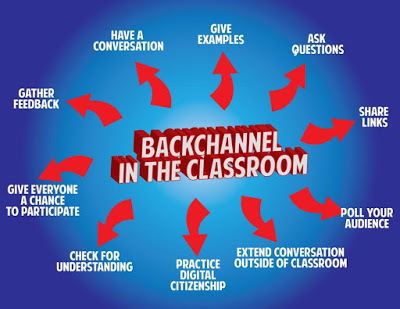 Image credit
With the why and how in place the final step is to focus on what tool is best to use to facilitate a backchannel. In many cases, especially during conferences, presentations, and workshops, Twitter is the preferred medium for this. The issue with Twitter though is that not everyone might be signed up to are comfortable with using this tool. In the case of classrooms, this issue is prevalent as well as the fact that some schools still block Twitter while age restrictions can prohibit younger learners from leveraging the benefits of a backchannel. So, what is the right tool that is free, accessible with an Internet connection, can work on any device, and is easy to set up?
In the past TodaysMeet served as the de facto tool to use to set up and facilitate an active backchannel in all contexts. However, like many tools, we have come to love this one no longer exists. The lesson learned here is never fall in love with a specific tool, but instead, focus on an improved learning experience our outcome that is provided. In this case, it is the backchannel experience. After trying out many different tools I have settled on Padlet as my recommended application for backchanneling. Say what?
I know what many of you are thinking. Isn’t Padlet a tool for sharing responses in a digital Post-It note format? This is in fact how many of us have come to know and use the tool predominantly in the past. You can still use it this way, but as I was setting up a Padlet for one of my recent presentations, I stumbled upon the backchannel feature. When this option is enabled your board becomes a real-time, threaded conversation just like you would have seen in TodaysMeet. Once your board is set up create a shortened link with, share out with your audience, and in a snap, you have a backchannel set up. Other tools that can be used include Mentimeter and Tozzl.
Whatever tool you decide on keep in mind the improved outcome you are attempting to facilitate with backchanneling. Whether it be asking questions, enhanced collaboration, reflection, or more transparent engagement the key is putting the goal front and center and selecting a tool last.
Allows creativity in responses (video, images, online research citations)Provides an avenue for open reflectionAffords more people an opportunity to answer and ask questionsBetter meets the needs of shy and introverted studentsCan extend conversations and learning beyond the traditional school day Welcomes participation from others beyond the physical locationCan be used to show parents and stakeholders the learning that is taking placeWorks to create a culture grounded in trust and responsibilityBackchanneling is a conventional digital discussion strategy that has gained popularity since the rise of social media. So why and how should one incorporate backchanneling during workshops, presentations, faculty meetings, after hours, or in classrooms? Backchannel Chat has some good answers to both of these questions below:
A backchannel is a conversation that takes place alongside an activity or event. Backchannels or back-channeling is common at conferences where attendees use tools like Twitter to discuss the various presentations in near real time. This gives the audience a real voice and helps to include and engage the audience in ways not seen before.
In an educational context, a backchannel can provide quiet students with a place to ask questions without speaking up. A backchannel is a place that teachers can share supporting resources such as video's, links and photos. Teachers can ask questions and watch the response of students to determine if they understand the concepts being discussed. Students can search the backchannel for notes and resources without having to scribble personal notes on paper.
 Image credit
With the why and how in place the final step is to focus on what tool is best to use to facilitate a backchannel. In many cases, especially during conferences, presentations, and workshops, Twitter is the preferred medium for this. The issue with Twitter though is that not everyone might be signed up to are comfortable with using this tool. In the case of classrooms, this issue is prevalent as well as the fact that some schools still block Twitter while age restrictions can prohibit younger learners from leveraging the benefits of a backchannel. So, what is the right tool that is free, accessible with an Internet connection, can work on any device, and is easy to set up?
In the past TodaysMeet served as the de facto tool to use to set up and facilitate an active backchannel in all contexts. However, like many tools, we have come to love this one no longer exists. The lesson learned here is never fall in love with a specific tool, but instead, focus on an improved learning experience our outcome that is provided. In this case, it is the backchannel experience. After trying out many different tools I have settled on Padlet as my recommended application for backchanneling. Say what?
I know what many of you are thinking. Isn’t Padlet a tool for sharing responses in a digital Post-It note format? This is in fact how many of us have come to know and use the tool predominantly in the past. You can still use it this way, but as I was setting up a Padlet for one of my recent presentations, I stumbled upon the backchannel feature. When this option is enabled your board becomes a real-time, threaded conversation just like you would have seen in TodaysMeet. Once your board is set up create a shortened link with, share out with your audience, and in a snap, you have a backchannel set up. Other tools that can be used include Mentimeter and Tozzl.
Whatever tool you decide on keep in mind the improved outcome you are attempting to facilitate with backchanneling. Whether it be asking questions, enhanced collaboration, reflection, or more transparent engagement the key is putting the goal front and center and selecting a tool last.
June 17, 2018
Using Feedback Logs to Empower Learners
The most successful companies are successful because they are always looking for ways to improve. When it comes to their employees, there is no ceiling as they are continually pursuing pathways and allocating resources to help the best get even better. The same philosophy can be applied to our schools. Continuous feedback for all learners, regardless of their abilities or where they are at, is pivotal if the goal is to help them evolve into their best. The research fully supports this proclamation. Goodwin & Miller (2012) provided this summary:
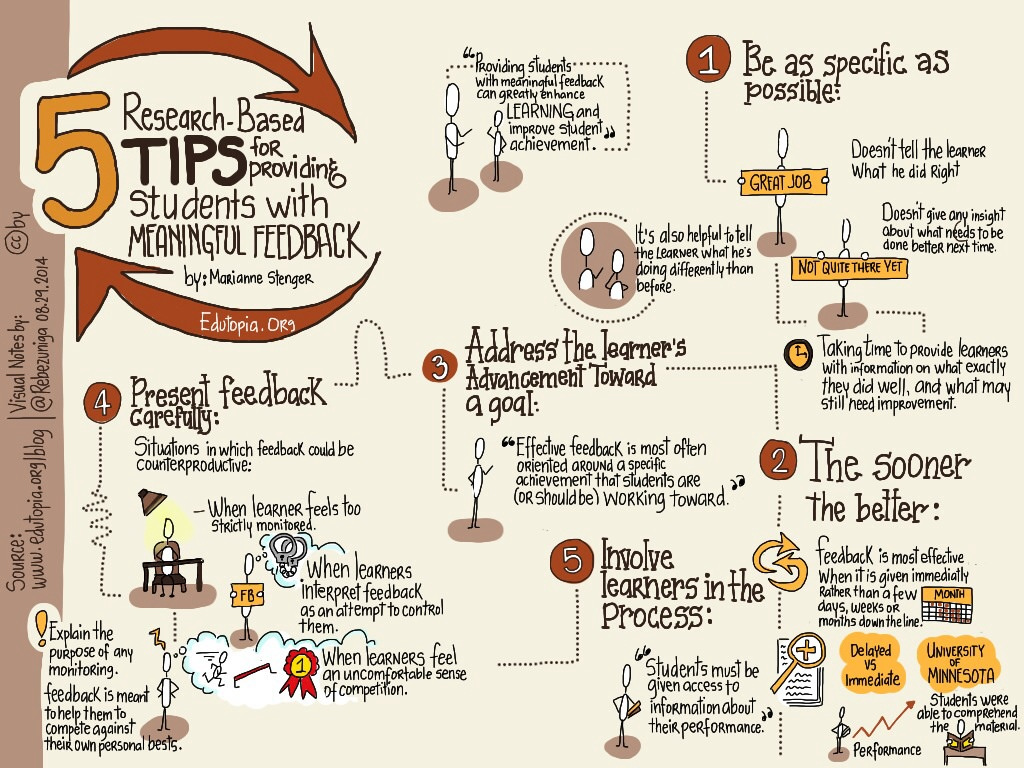
In my opinion, you can never provide learners with too much feedback. However, the way in which it is delivered matters significantly. Nicol (2010) found that feedback is valuable when it is received, understood and acted on. How students analyze, discuss and act on feedback is as important as the quality of the feedback itself. I couldn’t agree more. In a recent post I identified the following five components of good feedback:
Positive deliveryPractical and specificTimelyConsistencyUsing the right medium
For some more research-based tips on providing students meaningful feedback check out this Edutopia article by Marianne Stenger and the excellent image below.

Knowing what the research has found, how can educators realistically provide learners with quality feedback during every lesson? The answer lies in placing the responsibility on them. During my work as an instructional and leadership coach, I typically see teachers monitoring students during cooperative learning activities or working with specific groups face-to-face in blended learning station rotations. During debriefs, I often ask how feedback is given. The response is that it is presented verbally. Now I am not saying that this is an ineffective strategy at all, but something was missing. This is where I came up with the idea of feedback logs.
Think about all the conversations that educators have with learners on a daily basis. The valuable information in many cases aligns with what the research has said constitutes good feedback. The problem though is the reasonable possibility that learners forget what they have been told regarding progress or improvement and they don’t have the ability to later reflect on the feedback that was given. You know how the saying goes, out of sight out of mind. Having students create a feedback log solves this issue by helping them remember, retain, reflect upon, and chart their progress of improvement. Best of all it requires no extra time on the part of the teacher.
A feedback log can be created in many ways and aligned to skills, concepts, or standards. Students can then use this as a means to track their progress and growth over time as more feedback is provided over the course of the year. If students genuinely own their learning, then they must be put in a position to reflect and then act on the feedback they are given. The use of a log can also strengthen partnerships with parents. By making them aware of the log, parents have an opportunity to be more involved in their child’s learning each day.
Implementing feedback logs as a part of consistent professional practice saves precious time, can be seamlessly aligned with research-based strategies, will help students monitor their understanding of essential learnings, and can be used to provide more targeted support to those students who don’t show reasonable growth over time. Best of all they can serve as an empowerment tool to help kids exert more ownership over their learning.
Nicol, D. (2010). From monologue to dialogue: improving written feedback processes in mass higher education. Assessment & Evaluation in
Higher Education, 35(5), 501-517.
In Marzano, Pickering, and Pollock's 2001 meta-analysis, McREL researchers found an effect size for feedback of 0.76, which translates roughly into a 28-percentile point difference in average achievement (Beesley & Apthorp, 2010; Dean, Pitler, Hubbell, & Stone, 2012). John Hattie (2009) found a similar effect size of 0.73 for feedback in his synthesis of 800 meta-analyses of education research studies; in fact, feedback ranked among the highest of hundreds of education practices he studied.The bottom line here is that feedback matters in the context of learning. It should also be noted how it differs from assessment. Feedback justifies a grade, establishes criteria for improvement, provides motivation for the next assessment, reinforces good work, and serves as a catalyst for reflection. The assessment determines whether learning occurred, what learning occurred, and if the learning relates to stated targets, standards, and objectives. In reality, formative assessment is an advanced form of feedback.
In my opinion, you can never provide learners with too much feedback. However, the way in which it is delivered matters significantly. Nicol (2010) found that feedback is valuable when it is received, understood and acted on. How students analyze, discuss and act on feedback is as important as the quality of the feedback itself. I couldn’t agree more. In a recent post I identified the following five components of good feedback:
Positive deliveryPractical and specificTimelyConsistencyUsing the right medium
For some more research-based tips on providing students meaningful feedback check out this Edutopia article by Marianne Stenger and the excellent image below.
Knowing what the research has found, how can educators realistically provide learners with quality feedback during every lesson? The answer lies in placing the responsibility on them. During my work as an instructional and leadership coach, I typically see teachers monitoring students during cooperative learning activities or working with specific groups face-to-face in blended learning station rotations. During debriefs, I often ask how feedback is given. The response is that it is presented verbally. Now I am not saying that this is an ineffective strategy at all, but something was missing. This is where I came up with the idea of feedback logs.
Think about all the conversations that educators have with learners on a daily basis. The valuable information in many cases aligns with what the research has said constitutes good feedback. The problem though is the reasonable possibility that learners forget what they have been told regarding progress or improvement and they don’t have the ability to later reflect on the feedback that was given. You know how the saying goes, out of sight out of mind. Having students create a feedback log solves this issue by helping them remember, retain, reflect upon, and chart their progress of improvement. Best of all it requires no extra time on the part of the teacher.
A feedback log can be created in many ways and aligned to skills, concepts, or standards. Students can then use this as a means to track their progress and growth over time as more feedback is provided over the course of the year. If students genuinely own their learning, then they must be put in a position to reflect and then act on the feedback they are given. The use of a log can also strengthen partnerships with parents. By making them aware of the log, parents have an opportunity to be more involved in their child’s learning each day.
Implementing feedback logs as a part of consistent professional practice saves precious time, can be seamlessly aligned with research-based strategies, will help students monitor their understanding of essential learnings, and can be used to provide more targeted support to those students who don’t show reasonable growth over time. Best of all they can serve as an empowerment tool to help kids exert more ownership over their learning.
Nicol, D. (2010). From monologue to dialogue: improving written feedback processes in mass higher education. Assessment & Evaluation in
Higher Education, 35(5), 501-517.
June 10, 2018
Reflective Learning as the New Normal
The quest to improve pedagogy, and in turn learner outcomes, is a focus of many schools. We toil away at chasing the next big innovative idea, trend, or tool as a path to improvement yet little changes. Maybe success lies in taking a more detailed look at daily practice. The key to future-proofing education is to empower students to not only think, but to apply their thinking in relevant ways to demonstrate what has been learned. Whether you call this rigorous, deeper, personalized, or just plain learning is of no concern to me. Semantics aside, the goal of all schools should be to equip students with the appropriate knowledge, skills, mindset, and behaviors to help them develop into competent learners. Getting better at this seems to be a potential rallying cry.
We can have students learn to do or flip the experience and have them do to learn. The question then becomes not a conversation as to what pathway is better, but whether or not learning has occurred. Sure, we can slap a grade on it and in many cases that become the evidence that learning did or did not happen. There are flaws inherent here. As many grading practices still are entirely arbitrary and do not provide an accurate indication of learning, we need to re-think our practice. Now I am not saying to do away with grades or tests, as that is just not realistic right now, although it might be at some point in the future. The question then becomes what can be integrated into daily practice to help students learn?
To get to where you want to be, you need to be honest about where you are right now. This leads me to ask the following question: Are your students provided an opportunity during every lesson to reflect on what he or she has learned? As John Dewey stated, “We do not learn from experience... we learn from reflecting on experience.” It is not a hard ask at all to ensure that students are provided with an opportunity to reflect on the learning target for the day. As I work with schools and districts as a job-embedded coach, one of my main focus areas is to help improve pedagogy both with and without the use of technology. More often than not I do not see opportunities for student reflections through countless walk-throughs, lesson plan reviews, or audits of how digital tools are being used. This is an easy fix if an approach is taken where there is a combination of self-efficacy and commitment to a school-wide goal.
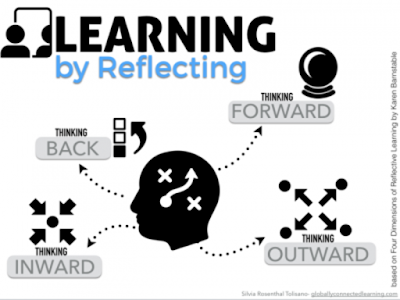
Something so simple can have a significant impact on learning. The University of Sheffield provides the following synopsis that validates the importance of this pedagogical strategy:
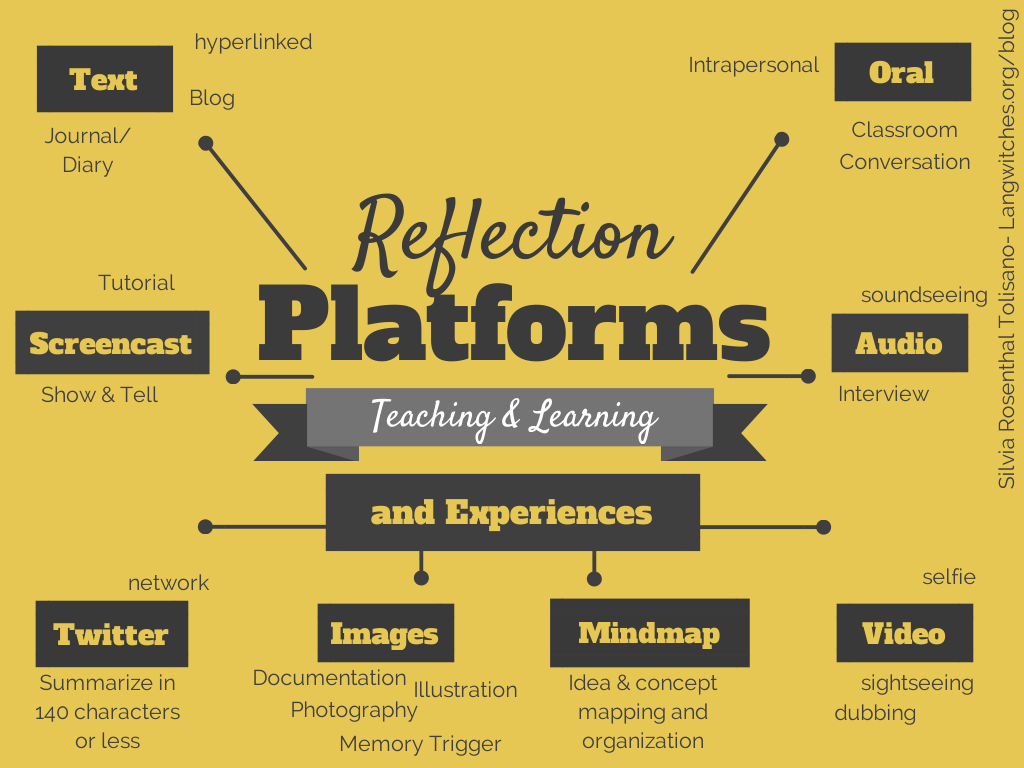
Writing - A daily journal, blog, and LMS (i.e., Google Classroom) can be added as a means to not just review, but also reflect on prior learning. It can also be used as a form of closure. Simple reflective prompts can also be used. During a coaching visit I observed Zaina Hussein, a 4th-grade teacher at Wells Elementary, use this with her students (see image below). A great deal of research reviewed by Lew & Schmidt (2011) in their study suggests the positive impact of reflective writing on cognitive development.

Video – Flipgrid fever has overtaken many schools. This tool can allow students to use video to reflect on their learning. They can be guided with simple prompts like the ones used by Ms. Hussein. All of the videos are then easily accessible for review on a grid. Think about the value of having students see and hear from their peers about what they either learned or struggled with during the lesson. In their research, Rose et al. (2016) found that video made the reflection experience more authentic and meaningful for both student and teacher.Peer interaction – Research by Hatton & Smith (1995) indicated that engaging with another person in a way that encourages talking with, questioning, or confronting, helps the reflective process by placing the learner in a safe environment so that self-revelation may take place. Consider implementing the critical friends’ strategy or more opportunities for discussion as a means to reflect.
For more strategies and ideas on how to incorporate reflection into pedagogical practice check out this article. If you are interested in learning more about how technology can be used as a catalyst for reflection the check out this post by Silvia Rosenthal Tolisano HERE. She also created a great summary image, which you can view below.
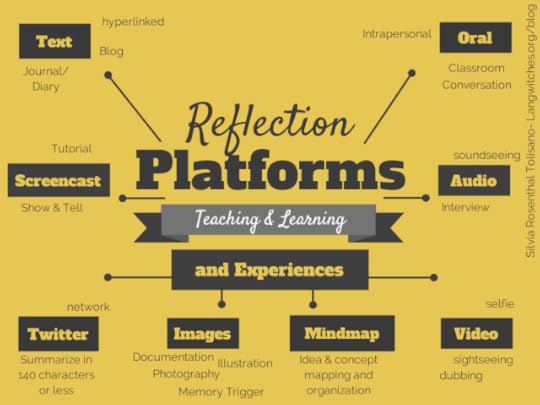
Making the time for students to reflect on their learning leads to more ownership of the process, builds essential connections between both present and past experiences, provides teachers with valuable information related to standard attainment or mastery, and compels them to exert a degree of self-management as they become more capable of regulating their own learning. With these positive outcomes, reflective learning should become the new normal.
Hatton, N., & Smith, D. (1995). Reflection in Teacher Education: Towards Definition and Implementation.
The University of Sydney: School of Teaching and Curriculum Studies.
We can have students learn to do or flip the experience and have them do to learn. The question then becomes not a conversation as to what pathway is better, but whether or not learning has occurred. Sure, we can slap a grade on it and in many cases that become the evidence that learning did or did not happen. There are flaws inherent here. As many grading practices still are entirely arbitrary and do not provide an accurate indication of learning, we need to re-think our practice. Now I am not saying to do away with grades or tests, as that is just not realistic right now, although it might be at some point in the future. The question then becomes what can be integrated into daily practice to help students learn?
To get to where you want to be, you need to be honest about where you are right now. This leads me to ask the following question: Are your students provided an opportunity during every lesson to reflect on what he or she has learned? As John Dewey stated, “We do not learn from experience... we learn from reflecting on experience.” It is not a hard ask at all to ensure that students are provided with an opportunity to reflect on the learning target for the day. As I work with schools and districts as a job-embedded coach, one of my main focus areas is to help improve pedagogy both with and without the use of technology. More often than not I do not see opportunities for student reflections through countless walk-throughs, lesson plan reviews, or audits of how digital tools are being used. This is an easy fix if an approach is taken where there is a combination of self-efficacy and commitment to a school-wide goal.
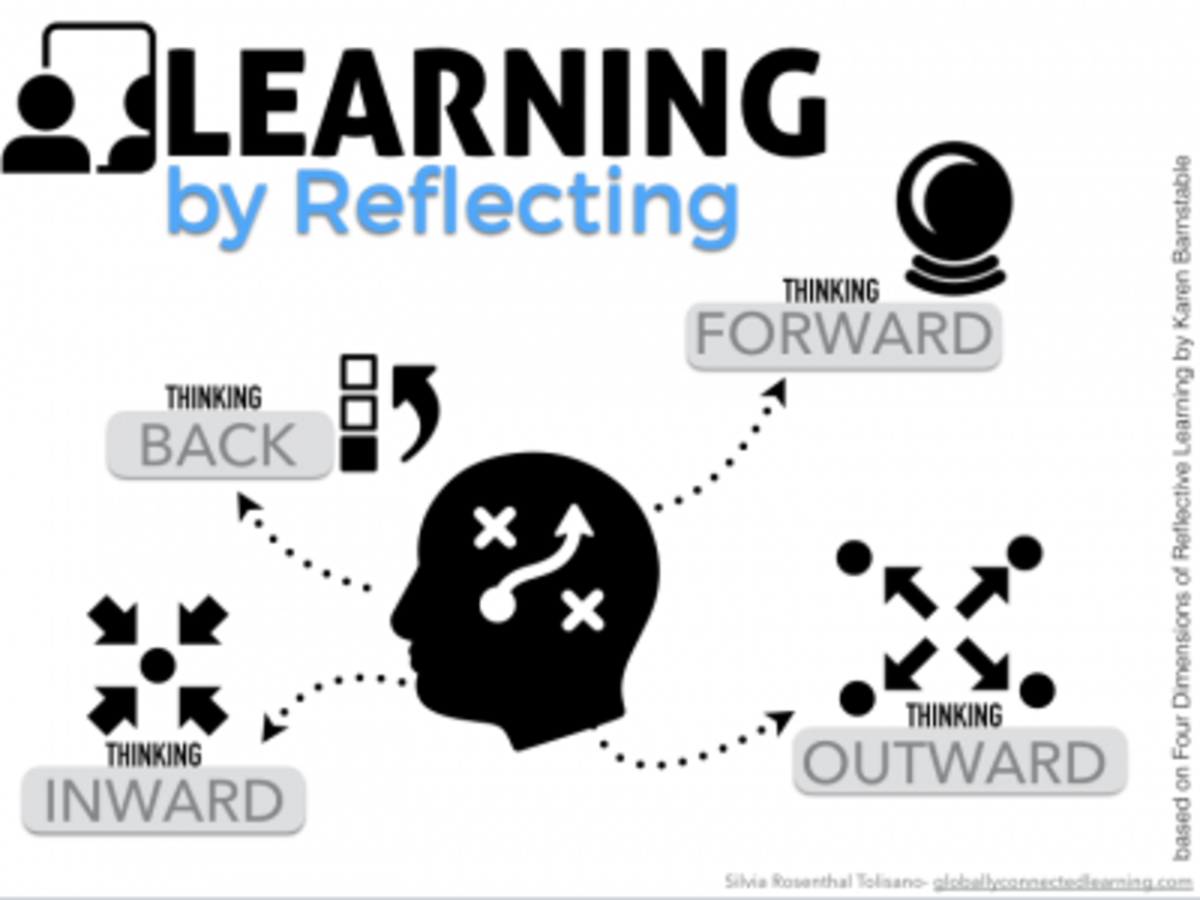
Something so simple can have a significant impact on learning. The University of Sheffield provides the following synopsis that validates the importance of this pedagogical strategy:
Reflective learning is a way of allowing students to step back from their learning experience to help them develop critical thinking skills and improve future performance by analyzing their experience. This type of learning helps move the student from surface to deep learning.Daily reflection provides students with an opportunity to exert more ownership over their learning. Below are some simple strategies that can be used to integrate reflection into any lesson:
Writing - A daily journal, blog, and LMS (i.e., Google Classroom) can be added as a means to not just review, but also reflect on prior learning. It can also be used as a form of closure. Simple reflective prompts can also be used. During a coaching visit I observed Zaina Hussein, a 4th-grade teacher at Wells Elementary, use this with her students (see image below). A great deal of research reviewed by Lew & Schmidt (2011) in their study suggests the positive impact of reflective writing on cognitive development.

Video – Flipgrid fever has overtaken many schools. This tool can allow students to use video to reflect on their learning. They can be guided with simple prompts like the ones used by Ms. Hussein. All of the videos are then easily accessible for review on a grid. Think about the value of having students see and hear from their peers about what they either learned or struggled with during the lesson. In their research, Rose et al. (2016) found that video made the reflection experience more authentic and meaningful for both student and teacher.Peer interaction – Research by Hatton & Smith (1995) indicated that engaging with another person in a way that encourages talking with, questioning, or confronting, helps the reflective process by placing the learner in a safe environment so that self-revelation may take place. Consider implementing the critical friends’ strategy or more opportunities for discussion as a means to reflect.
For more strategies and ideas on how to incorporate reflection into pedagogical practice check out this article. If you are interested in learning more about how technology can be used as a catalyst for reflection the check out this post by Silvia Rosenthal Tolisano HERE. She also created a great summary image, which you can view below.
Making the time for students to reflect on their learning leads to more ownership of the process, builds essential connections between both present and past experiences, provides teachers with valuable information related to standard attainment or mastery, and compels them to exert a degree of self-management as they become more capable of regulating their own learning. With these positive outcomes, reflective learning should become the new normal.
Hatton, N., & Smith, D. (1995). Reflection in Teacher Education: Towards Definition and Implementation.
The University of Sydney: School of Teaching and Curriculum Studies.
June 3, 2018
The Pedagogy of Digital Discussion
I wasn’t an overly confident student when it came to engaging in open conversations during class. If one of my teachers posed a question, I only raised my hand if I was 99.9% sure that I knew the correct answer. I guess you can chalk this up to the fact that I lacked a certain degree of confidence in my knowledge acquisition or the fact that I was a relatively shy student when it came to class participation. Perhaps it was a combination of both. There were other issues at play that impacted my level of engagement. Not only was I averse to answering questions, but I also rarely directed any to my teachers outside of a one on one conversation. Discussions with my peers were limited to the rare occasion when a cooperative learning activity was planned. Such was life in a classroom back in the day.
I often reflect on what my learning experience might have been like had my teachers had access to and used the many interactive tools that are available today to enhance classroom discussion. During every single workshop I facilitate, I have participants in both peer and randomly selected groups engage in face-to-face conversations on numerous question prompts. It is during this time that they get to share their ideas on the topic, discuss implementation strategies, reflect on what others have said, or provide positive reinforcement. I am always inspired when I eavesdrop on these conversations. There is no substitute for real human interaction as this is the ultimate relationship builder. After a set amount of time, they are then all asked to share their responses using one of many different digital tools.
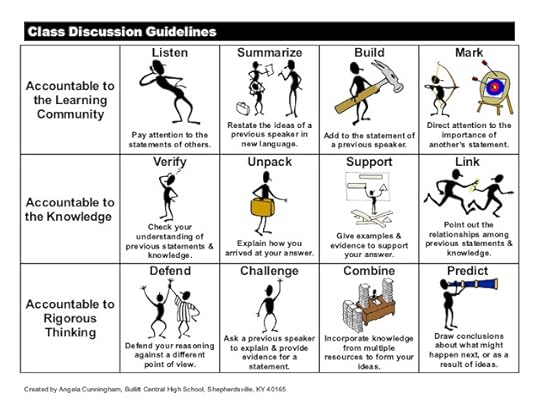
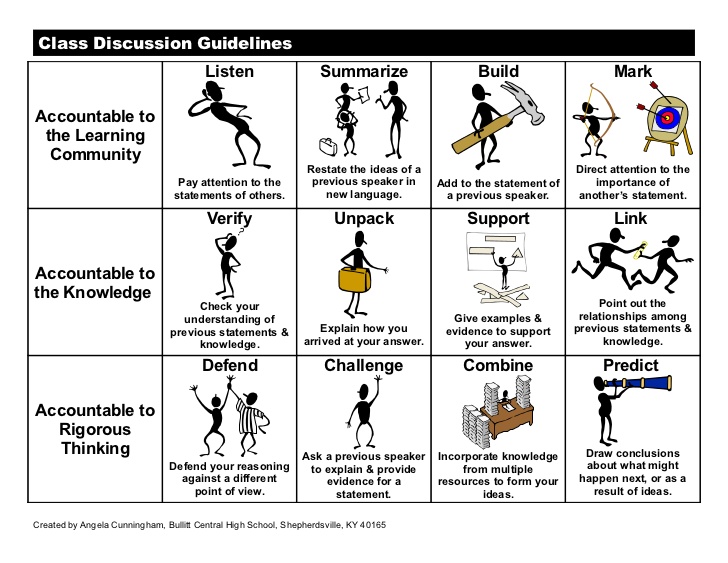
Let me take a step back now and share some insights on why classroom discussion is so meaningful. As I was researching for some solid pedagogical links, I came across this wonderful article that Todd Finley wrote for Edutopia titled Rethinking Whole Class Discussion. It is not only a great read but also what he cites aligns with the strategies that I described previously in this post. Here is one piece that he shared:
Research supports the importance of discussion when backed by the purposeful use of technology. Smith et al. (2009) found the following:
Allows creativity in responses (video, images, online research citations)Provides an avenue for open reflectionAffords more learners an opportunity to answer and ask questionsBetter meets the needs of shy and introverted studentsCan extend conversations and learning beyond the traditional school dayWelcomes participation from others beyond the brick and mortar classroomCan be used to show parents and stakeholders the learning that is taking placeWorks to create a culture grounded in trust and responsibility
Now that I have covered the many ways digital discussion serves as a sound pedagogical strategy, the next step is to begin implementing various tools into daily lessons and learning activities. Some of my favorites include Mentimeter, Gsuite, GoSoapBox, Tozzl, and Padlet (check out the backchannel option). Many learning management systems (Google Classroom, Schoology, Microsoft Teams) have opportunities to facilitate digital discussion as well. Harness the power of digital to take conversations to the next level while empowering both students and adult learners in the process.
Smith, M. K., Wood, W. B., Adams, W. K., Wieman, C., Knight, J. K., Guild, N. & Su, T. T. (2009) Why peer discussion
improves student performance on in-class concept questions. Science 323 (5910):122–24.
I often reflect on what my learning experience might have been like had my teachers had access to and used the many interactive tools that are available today to enhance classroom discussion. During every single workshop I facilitate, I have participants in both peer and randomly selected groups engage in face-to-face conversations on numerous question prompts. It is during this time that they get to share their ideas on the topic, discuss implementation strategies, reflect on what others have said, or provide positive reinforcement. I am always inspired when I eavesdrop on these conversations. There is no substitute for real human interaction as this is the ultimate relationship builder. After a set amount of time, they are then all asked to share their responses using one of many different digital tools.
Let me take a step back now and share some insights on why classroom discussion is so meaningful. As I was researching for some solid pedagogical links, I came across this wonderful article that Todd Finley wrote for Edutopia titled Rethinking Whole Class Discussion. It is not only a great read but also what he cites aligns with the strategies that I described previously in this post. Here is one piece that he shared:
Quality discussion, according to the University of Washington's Center for Instructional Development and Research, involves purposeful questions prepared in advance, assessment, and starting points for further conversations. Teachers are also advised to:Below are some strategies to enhance classroom discussion. For even more research-based ideas click HERE.
Distribute opportunities to talk Allow discussants to see each other physically Ask questions that "may or may not have a known or even a single correct answer.” Foster learners talking to peers Encourage students to justify their responses Vary the types of questions
Research supports the importance of discussion when backed by the purposeful use of technology. Smith et al. (2009) found the following:
When students answer an in-class conceptual question individually using clickers, discuss it with their neighbors, and then revote on the same question, the percentage of correct answers typically increases. Our results indicate that peer discussion enhances understanding, even when none of the students in a discussion group originally knows the right answer.As a supplement to traditional discussion strategies technology can serve as a catalyst to increase engagement by getting more learners actively involved during lessons. It can also take conversations to new levels of interactivity and expression. There are so many great tools to choose from, but we have to be focused first on the improved outcomes that can result from purposeful use. Digital discussion:
Allows creativity in responses (video, images, online research citations)Provides an avenue for open reflectionAffords more learners an opportunity to answer and ask questionsBetter meets the needs of shy and introverted studentsCan extend conversations and learning beyond the traditional school dayWelcomes participation from others beyond the brick and mortar classroomCan be used to show parents and stakeholders the learning that is taking placeWorks to create a culture grounded in trust and responsibility
Now that I have covered the many ways digital discussion serves as a sound pedagogical strategy, the next step is to begin implementing various tools into daily lessons and learning activities. Some of my favorites include Mentimeter, Gsuite, GoSoapBox, Tozzl, and Padlet (check out the backchannel option). Many learning management systems (Google Classroom, Schoology, Microsoft Teams) have opportunities to facilitate digital discussion as well. Harness the power of digital to take conversations to the next level while empowering both students and adult learners in the process.
Smith, M. K., Wood, W. B., Adams, W. K., Wieman, C., Knight, J. K., Guild, N. & Su, T. T. (2009) Why peer discussion
improves student performance on in-class concept questions. Science 323 (5910):122–24.
May 27, 2018
Power Up Your Spaces
Times are a changing in case you haven’t noticed. We have seen disruptive innovation across so many different sectors of society. If you were to go back in time and pinpoint when disruption began to take off, I would wager that it correlates with the proliferation of the smartphone. Pause a second and think about companies such as Uber and Airbnb. Had it not been for the smartphone their innovative apps might never have come to fruition or experienced immense scalability as they have. Where would many of us be without these or similar apps today?
Now we know that across the world adults have pretty much embraced the smartphone. Some would even go as far to say it has become an additional appendage of many. Statista predicts that approximately five billion people will use a smartphone by 2019. Imagine what this number will be in years to come. With all of this predicted usage, I was curious to know how many of our learners owned a smartphone. Well, I did find some stats for kids in the United States and am willing to bet that other developing countries have similar numbers. The site eMarketer found that 41% of students ages 0-11 and 84% ages 12-17 owned a smartphone in 2016. These numbers are predicted to increase to 49.7% and 92.9% respectively by 2020. Before we know it almost everyone that wants a smartphone across the globe will have one.
The increase in smartphone ownership is a good indicator as to where many schools are headed. Over the years we have seen more embracement of Bring Your Own Device (BYOD) and 1:1 device rollouts. Cost and ease of access will only lead to more schools and districts going down this path. The USDOE’s Office of Educational Technology places emphasis on students and educators having access to a robust and comprehensive infrastructure when and where they need it for learning. The National EdTech Plan goes on to state the following:
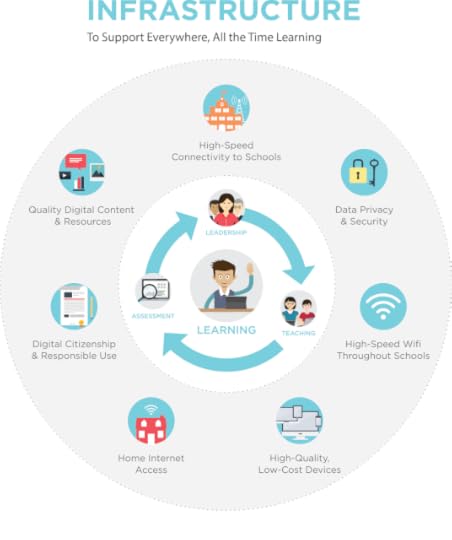
Image credit
Now don’t get me wrong, all of the above are great. However, there is one crucial aspect that needs to be considered. A focus on logistics must complement the pursuit of a more enriched and challenging learning experience for students in the digital age, which Tom Murray and I lay out in Learning Transformed. In laymen’s terms, this means having enough power to support all of the connected devices. I know it’s not flashy, aligned to research, or even directly connected to pedagogy….but it is a necessity if the goal is to support learning.
To begin, consider conducting an audit consisting of walk-throughs with IT, maintenance staff, teacher leaders, and administrators to determine where there are areas of opportunity. Many outlet additions can be completed over summer and holiday breaks. Polling students to gain their insight is a good move as well. The next step is to determine if there are excess funds in the budget (there is almost always money to spend at the end of the year) to make changes immediately. If not, then this should be worked into the budget for the following year. Below are some practical suggestions to power up your school.
Transform blocks of hallway lockers into charging bars. During a coaching visit to the Downingtown Area School District, I saw how Lionville Middle School has begun to transition some of their obsolete locker spaces into charging bars (pictures above). Many lockers go unused as our digital learners don't find a need for them so converting them seems like wise decision. Overhaul old typing rooms and computer labs. If your middle or high school building isn’t relatively new, then the chances are that there were at least one typing room and numerous computer labs. These rooms had numerous outlets throughout to power devices so a little innovative design can transform these spaces into power hubs. Purchase furniture and accessories that have built-in electrical outlets. This strategy seems like a no-brainer when schools are looking to refurbish libraries and comfortable furniture for common areas. Check out Steelcase for an array of ideas and solutions specific to education. Replace standard outlets with multi-functional USB combos – When assessing power needs through an audit, count the number of outlets in classrooms, hallways, and common spaces. You can then purchase and replace those outlets with dual USB tamper-resistant models, which will essentially double the available power in any room or space. Invest in school branded charging stations – As the principal, I invested in a few of these mobile stations from a company called Kwikboost and placed them in common areas throughout the building (picture below). One of the benefits was that each station already came with every type of charging cable pre-installed. During events like concerts, plays, and art shows these devices can easily be temporarily placed in these spaces to meet the power needs of stakeholders visiting the school while showing off some school pride in the process.
When more devices, whether school or student-owned, are integrated to support learning an infrastructure must be in place to support the need for power. What unique ideas and strategies have you seen that you would add to the list above?
Now we know that across the world adults have pretty much embraced the smartphone. Some would even go as far to say it has become an additional appendage of many. Statista predicts that approximately five billion people will use a smartphone by 2019. Imagine what this number will be in years to come. With all of this predicted usage, I was curious to know how many of our learners owned a smartphone. Well, I did find some stats for kids in the United States and am willing to bet that other developing countries have similar numbers. The site eMarketer found that 41% of students ages 0-11 and 84% ages 12-17 owned a smartphone in 2016. These numbers are predicted to increase to 49.7% and 92.9% respectively by 2020. Before we know it almost everyone that wants a smartphone across the globe will have one.
The increase in smartphone ownership is a good indicator as to where many schools are headed. Over the years we have seen more embracement of Bring Your Own Device (BYOD) and 1:1 device rollouts. Cost and ease of access will only lead to more schools and districts going down this path. The USDOE’s Office of Educational Technology places emphasis on students and educators having access to a robust and comprehensive infrastructure when and where they need it for learning. The National EdTech Plan goes on to state the following:
Preparing students to be successful for the future requires a robust and flexible learning infrastructure capable of supporting new types of engagement and providing ubiquitous access to the technology tools that allow students to create, design, and explore. The essential components of an infrastructure capable of supporting transformational learning experiences include the following:
Ubiquitous connectivity. Persistent access to high-speed Internet in and out of school.
Powerful learning devices. Access to mobile devices that connect learners and educators to the vast resources of the Internet and facilitate communication and collaboration.
High-quality digital learning content. Digital learning content and tools that can be used to design and deliver engaging and relevant learning experiences.
Responsible Use Policies (RUPs). Guidelines to safeguard students and ensure that the infrastructure is used to support learning.

Image credit
Now don’t get me wrong, all of the above are great. However, there is one crucial aspect that needs to be considered. A focus on logistics must complement the pursuit of a more enriched and challenging learning experience for students in the digital age, which Tom Murray and I lay out in Learning Transformed. In laymen’s terms, this means having enough power to support all of the connected devices. I know it’s not flashy, aligned to research, or even directly connected to pedagogy….but it is a necessity if the goal is to support learning.
To begin, consider conducting an audit consisting of walk-throughs with IT, maintenance staff, teacher leaders, and administrators to determine where there are areas of opportunity. Many outlet additions can be completed over summer and holiday breaks. Polling students to gain their insight is a good move as well. The next step is to determine if there are excess funds in the budget (there is almost always money to spend at the end of the year) to make changes immediately. If not, then this should be worked into the budget for the following year. Below are some practical suggestions to power up your school.

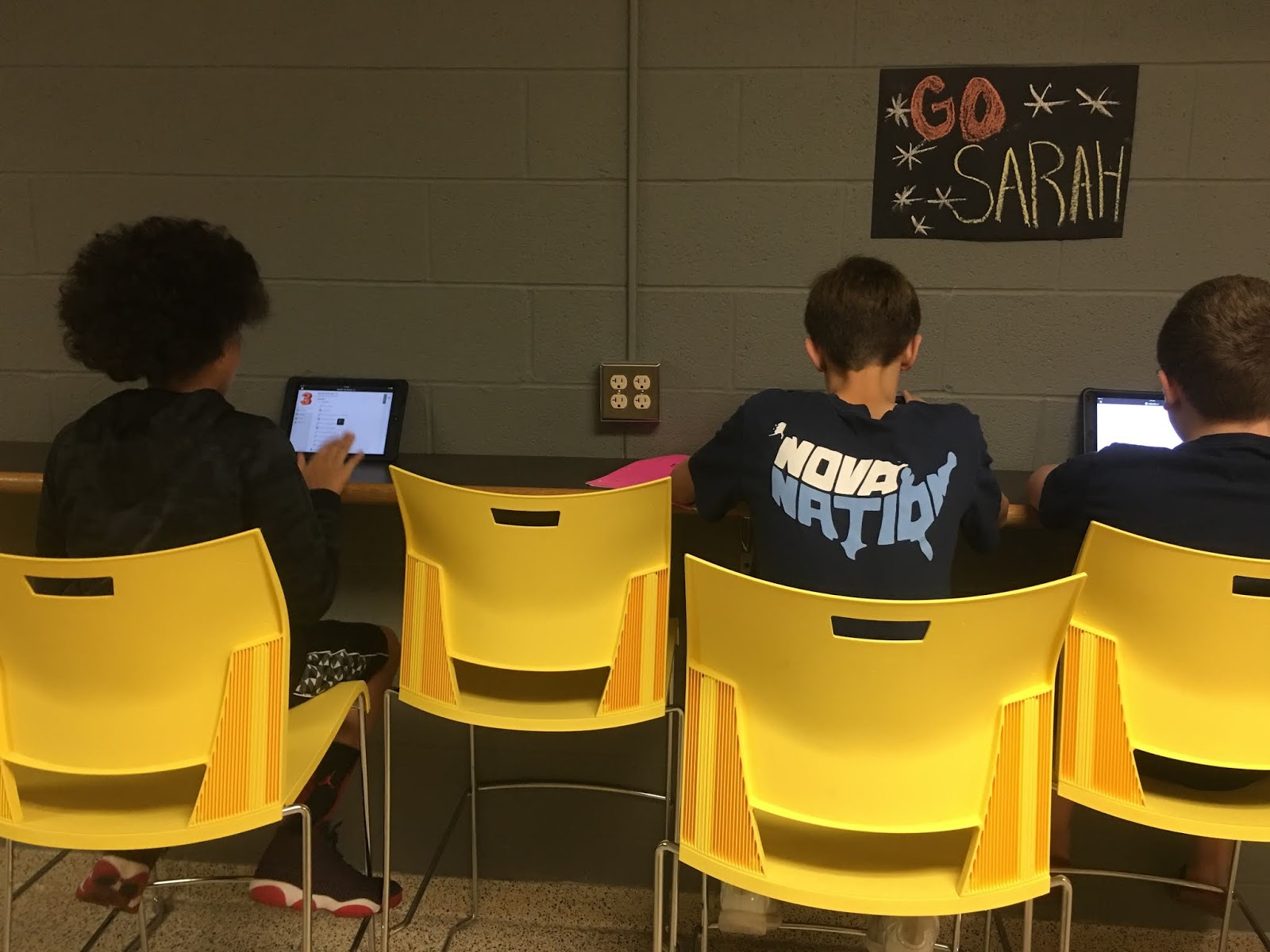
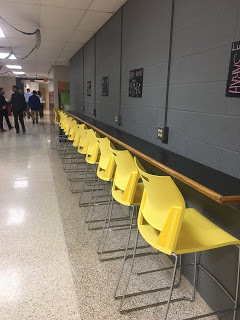
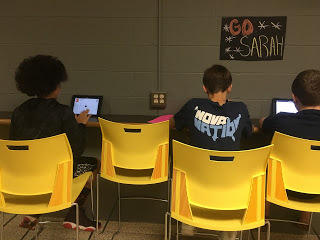
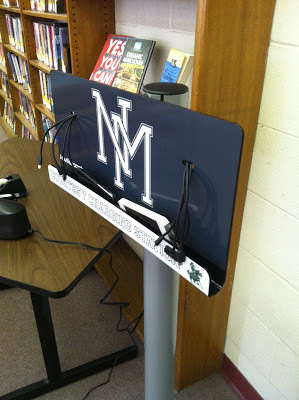
Transform blocks of hallway lockers into charging bars. During a coaching visit to the Downingtown Area School District, I saw how Lionville Middle School has begun to transition some of their obsolete locker spaces into charging bars (pictures above). Many lockers go unused as our digital learners don't find a need for them so converting them seems like wise decision. Overhaul old typing rooms and computer labs. If your middle or high school building isn’t relatively new, then the chances are that there were at least one typing room and numerous computer labs. These rooms had numerous outlets throughout to power devices so a little innovative design can transform these spaces into power hubs. Purchase furniture and accessories that have built-in electrical outlets. This strategy seems like a no-brainer when schools are looking to refurbish libraries and comfortable furniture for common areas. Check out Steelcase for an array of ideas and solutions specific to education. Replace standard outlets with multi-functional USB combos – When assessing power needs through an audit, count the number of outlets in classrooms, hallways, and common spaces. You can then purchase and replace those outlets with dual USB tamper-resistant models, which will essentially double the available power in any room or space. Invest in school branded charging stations – As the principal, I invested in a few of these mobile stations from a company called Kwikboost and placed them in common areas throughout the building (picture below). One of the benefits was that each station already came with every type of charging cable pre-installed. During events like concerts, plays, and art shows these devices can easily be temporarily placed in these spaces to meet the power needs of stakeholders visiting the school while showing off some school pride in the process.

When more devices, whether school or student-owned, are integrated to support learning an infrastructure must be in place to support the need for power. What unique ideas and strategies have you seen that you would add to the list above?