Gretchen C. Hohmeyer's Blog, page 52
June 23, 2015
Bibliomancy for Beginners Season 3: An Ember in the Ashes by Sabaa Tahir
This week is my pick and I’m super excited about it! Watch this episode to listen to me staunchly defend the YA industry against my fellow Bibliomancers. Was this book perfect? No. But I will stand up for deserving YA debuts until I die, and An Ember in the Ashes by Sabaa Tahir is one of them. ONCE MORE UNTO THE BREACH DEAR FRIENDS!



June 16, 2015
Bibliomancy Begins Season 3! 2AM in the Cat’s Pajamas by Marie-Helene Bertino
 I am the worst. Why? I apparently never got this post up when we actually DID this episode last week. Like you, I guess the fact that we were starting SEASON THREE of Bibliomancy for Beginners snuck up on me.
What is Bibliomancy for Beginners, you ask? Well, if you’re new around here, it’s the book club I run with two of my college friends. This season we’re doing a lot of fun, new stuff that front-runner Michaela has lovingly detailed in this here blog post, but I would like to quote her on one of the most exciting things:
“The next change is that we will be following a theme this summer. The internet has blown up with the need for #diversebooks and we want to promote that
as well. We hope to read books that will cover a variety of genres, languages, genders, sexualities, and ethnicities. We all benefit from more and varied stories so let’s show our support for the authors who break the parade of dead white men!”
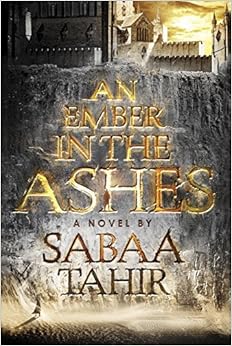
Are you excited? Be excited. In the bottom of this post is the video for our first episode, 2AM in the Cat’s Pajamas by Marie-Helene Bertino. Don’t forget to tune in with us on June 23rd for MY PICK, An Ember in the Ashes by Sabaa Tahir! For more info:
Twitter: @bibliomancy101 and we use the #beginbibliomancy for discussion/live tweets
Vine: Bibliomancy For Beginners
Instagram: bibliomancy4beginners
Goodreads: Bibliomancy for Beginners
And now, the video!


May 6, 2015
Perusing Poetics: End of the Poetics Journey
I started out this blog talking about the two different parts of me, and how they work together. I’m going to end it by talking about how they stand apart. Granted, I’m going to be focusing more on my Writing major, just because the Poetics is a Writing Department class, but trust me when I say that the point I’m about to make is applicable to my English major too.
Yes, this post is required as a final project. Yes, there are question guidelines. I’m about to do a very odd thing and copy them out for you (sorry Professor. I swear there’s a reason for this):
What do you make and is it similar in any way to the art practices we���ve read and/or talked about in class?
Why do you make it, and do you see your ideas aligning with or being similar to the ���why��� of anyone we have read and/or talked about in class?
What is the relationship of language to what you make, and is this relationship in any way similar to anyone we have read and/or talked about in class?
Using your digital archive and ideas, address
What are your influences and how have they influenced what you have made up to this point? Who or what do you admire in your field, and why? (Use videos, images, other archives, etc.)
What do you aspire to create, and what have you learned or encountered in class (if anything) that may affect your processes going forward? (Note: this can be a negative effect. That is, ���Now that I���ve seen how horribly wrong thing XYZ can go, I want to avoid that route���)
What was the most influential/important reading and/or concept to your own processes of making?
You know what I’m absolutely sick of? Realizing there are two ways I want to answer these questions. Then realizing that one of them is just another story I’m afraid to tell.
“What I mean is that within the University there could exist a relationship with word, language, thought, tradition, and power that might run counter to the relationship a poet might want to have with word, language, thought, tradition and power.” – Sarah Vap, End of The Sentimental Journey
Recently, in my Renaissance Literature class, the professor asked us what we were going to be reading over the summer. My answer would have been Sarah J. Maas’s A Court of Thorns and Roses. But I didn’t answer, because people starting saying “Milton” or “Absalom, Absalom.” My answer didn’t seem like it fit.
So, today, when I answer these questions, I’m not going to do any of us the disservice of lying or telling you half-truths. I’m going to tell you BOTH truths. I’m going to answer you from the
Academic
and from the
Personal
Bear with me.
What do you make and is it similar in any way to the art practices we���ve read and/or talked about in class?
I write fiction, not poetry. In generic terms, this might make it seem as though few of the readings of this semester would be similar to what I make, since it has (mostly) all been about poetry. However, though the aesthetic qualities are very different, any writer will tell you that we are all just that–writers. We tell stories. We use language for certain goals. As Wordsworth says, “the language of a large portion of every good poem, even of the most elevated character, must necessarily, except with reference to the metre, in no respect differ from that of good prose” (Wordsworth). When Pound talks about “imagism,” for example, or Coleridge talks about “suspension of disbelief,” they are discussing the concepts in terms of poetry but it means little different for prose. In fact, one of the most interesting thing about make of the readings these semester was going through the readings that seemed hyper-poetry-specific and realizing that writing as an art is not so different as one might think.
I did not think of my art having a “process,” necessarily, when the semester started. I have trouble aligning what I do think of as my process now to anything as radical as the Futurist Manifesto or something that thinks about language as Craig Dworkin does. If I were to look at one and see a “theory” of some kind that I apply to my own work, I would have to take William Cronon’s discussion of how “where one chooses to begin and end a story profoundly alters its shape and meaning” (Cronon 1364). I have found myself multiple times this semester having to repeat to other writers in my Fiction I class: “A short story is a snapshot, a novel is a picture album.” Whether I’m creating a novel or a short story, my brain has to think about this concept in two very different ways. However, by accepting Cronon as my “theory” here, I must also acknowledge the complication of constantly thinking this way. I had never applied this thinking to topics such as history until I read Cronon, and it reminded me to think more carefully about the narratives I read outside of fictions.
*
You know every time someone asks me this question, I usually just say fiction unless I think I’m among friends because listen buddy do you have any idea what it’s like to tell an academic that you aspire to write young adult fantasy fiction? They laugh at you. They kick you out. They turn up their nose and in the background there’s an echo of Ezra Pound saying, “Oh yes I suppose sometimes ‘the modern poet is expected to holloa his verses down a speaking tube to the editors of cheap magazines'” (Pound). So I say fiction, because it’s simpler. It’s cleaner. They nod and assume you are discussing some kind of work that re-imagines the cosmos of the universe or something. Well, Mr. and Mrs. Walt-Whitman-Wannabes, you can take your expectations of “the poet to indicate more than the beauty and dignity which always attach to dumb real objects” and “indicate the path between reality and their souls” and look elsewhere (Whitman 4).
What I write isn’t senseless, or careless or purposeless. Every story, every character, every word–it says something. But it doesn’t say it in the way that academia wants me to say it, in the form that they want me to say it, and therefore it becomes: senseless, careless, and purposeless. But that isn’t what I write. That isn’t why I write.
***
Why do you make it, and do you see your ideas aligning with or being similar to the ���why��� of anyone we have read and/or talked about in class?
Sometimes I feel like there isn’t a particular reason why I make a piece of fiction. Sometimes I sit up in bed and am moved by something. My ideas align a lot with William Carlos Williams, especially when he talks about how “the imagination is an actual force comparable to electricity or steam” (Williams 49). (I cannot agree entirely with him because he says some choice things about prose v. poetry that am not sure I believe.) Usually, however, a story idea is based in only one question: why? For me, this is often expanded in the direction of “Why people do what they do?” in particular. This semester I have written fiction trying to answer questions such as, “Why do women return to abusive boyfriends?”, “Why do we cling to friendships that are dying?” and “Why do we fight losing battles for people who no longer love us?” When I list them out, there is an obvious theme. I am not writing something simply because it was due in class that week. I am asking myself a question and writing my way through to some kind of answer (hopefully!). Again, as Williams would say, “there is no confusion – only difficulties” (Williams 78). Writing is a way to work through difficulties.
*
When I started writing, I wrote for me. This is still generally true. I wrote the stories that came to me from other things I had read. I went through that phase of writing about dragons and trying to come up with my own language and giving my characters names that I couldn’t pronounce. They were about war and adventure and romance. As I’ve gotten older, however, the reasons have changed.
Now the reasons are a lot more driven by the “who” and not the “what.” I have multiple characters that I’ve created that will not leave me alone until I write them. They control the narrative, in a way–I’ve never been able to outline in any constructive way. I write to discover who these characters are and what they want. In doing so, I find out about myself and other people. The fantasy element, for me, is just a bigger way to attack these issues. I never have been able to write in “real world” boxes.
The young adult part stems from me “writing what I read,” in a way–and wanting to make it better. I’ve been immersed in the genre for so long that there is this personal investment that I can’t even quantify what it is anymore. I know that the genre has issues. It gives me something to aim for. I want to write better, for myself and others.
Also, side-note, being a writer is just … amazing. To quote Williams again, the writer can use the power of imagination to “give created forms reality, actual existence” (Williams 49). For some variety, Toni Morrison also references the test of a writer’s power “to imagine what is not the self, to familiarize the strange and mystify the familiar” (Morrison 15). Writing is magical. Being “in the zone” and creating a whole new world is a feeling like no other. Sometimes, if I’ve been blocked for a while, I get the urge to find some learn-to-type program just for an excuse to hit the keys of my laptop, to engage in the act. It’s that powerful.
***
What is the relationship of language to what you make, and is this relationship in any way similar to anyone we have read and/or talked about in class?
Language is the building blocks of all literature. That said, oftentimes people do not realize how close this relationship is. As a writer, language is the key “small edit” for which��every story must be read and reread. For example, dialogue in stories can be difficult. You have to make sure that the characters do not sound like the same person. Language is also the only method you have for showing the reader a picture of what you are describing, whether it be person, place, or thing.
I have also become convinced that writing could also be seen as author psychology, and that often has to do with language. Benjamin Whorf and Toni Morrison talk wonderfully about this concept in both their works, in their own way. Whorf, for example, states that “our linguistically determined thought world not only collaborates with our cultural idols and ideals, but engages even our unconscious personal reactions in its patterns and gives them certain typical characters” (Whorf 154). Morrison offers an example of these “certain typical characters” by describing them as “the��languages they use and the social and historical context in which these languages signify are indirect and direct revelations of that power and its limitations��� (Morrison 15). I have discussed Whorf and Morrison’s concepts in other blog posts, but I have also seen this concept show up in my own work. I always become conscious, after a work is written, that even my most fantastical pieces show off an aspect of myself that I did not intend. I learn about the way I think about things when I write about stories that are not mine–and all that subtext appears in subtle language choices.
*
Now, don’t look at me funny, but language isn’t usually something I think about until the last draft is done. The words have to come out of my head, first, and then I can play with them. I sit in writing classes where they talk about extended metaphors and unique images and it occurs to me that perhaps this is something about young adult literature that gets on their nerves. Young adult literature uses these conventions, but not particularly in the same way. It’s faster, cleaner–there isn’t any room for fluff. Now, I’m not saying that literary fiction doesn’t have some beautiful passages, I just … get bored. I hate to equate myself with Whitman in any way, but I snap my fingers when he says that in his poetry “What I tell I tell for precisely what it is” (Whitman 6). If that happens to be a land where dragons are real and the language is made up, then so be it.
It honestly amused me when Longinus said that “the effect of elevated language upon an audience is not persuasion but transport” (Longinus 97). It was the first clue that his idea of elevated language might not be what I assumed it was, which was like some high fantasy description of one castle wall that goes on for four pages or one of those ridiculously long descriptions of something that is supposed to be beautiful but instead just has me skipping pages. Like Game of Thrones. I assume that is what elevated language looks like, but if I was calling it? Game of Thrones puts me to sleep. Young adult novels like to take me places. So, I suppose I mean to say that I don’t write in what would stereotypically be considered elevated language, but man do I go for transport over persuasion.
***
What are your influences and how have they influenced what you have made up to this point? Who or what do you admire in your field, and why? (Use videos, images, other archives, etc.)
 The last thing that I remember directly influencing me was Lorrie Moore’s “How to Be a Writer.” I wrote my own version, a very meta and ‘formally innovative’��piece that I rather enjoyed writing. The nature of that piece speaks to a larger influence of mine, post-modernism��and conceptual art. For example, a while ago my book club did a vlog about Jonathan Safran Foer’s Tree of Codes and I never got over the impact of reading it. The book was die-cut from another book, and it had been printed with the holes intact, so you could choose to read it as either a page by page story or the sentences that sometimes appeared through the holes. I have yet to consider writing anything that spectacular, but the concept behind it and other “less-traditional” methods of storytelling are always on my mind.
 I cannot give a specific person that I admire, mostly because I admire things that are done. I admire risks. I am a terrible English major in that I cannot stand classics. I know it is an oxymoron to say that I hate Shakespeare, since he was a risk taker for his time, but–though I respect that–I cannot read anymore of it. I especially like things that, like many readings in this class, make me think about something I had not thought of before. Sarah Vap’s The End of the Sentimental Journey, for example, is something I want to wallpaper my apartment with��next year.
*
Okay, are we talking influences RIGHT NOW or OF ALL TIME because listen I’ve got a list I think will be longer than this long as all get out blog post. In brief, I suppose I should start with Eragon by Christopher Paolini. The fact that he published that book when he was fifteen encouraged little 12 year old me to write my own novel. I’ve since grown up enough to learn that the books has many, many faults (that were somehow made worse by the movie). After that, my world expanded. Tamora Pierce will forever be one of my earliest and greatest influences, with her strong fantasy females. My new favorite voice is Sarah J. Maas, because her books are fabulous to begin with but I also enjoy being able to grow with her as a writer with each new book.
The project that I plan to write for my next semester’s Writing Senior Project is potentially one of the most complicated stories I’ve ever attempted, especially in terms of issues of culture and sexuality. It’s also a YA dystopian novel, which is weird to be because at this point I hate that stupid concept, but then again that is the only way the story I want to write fits. Thanks, characters in this story, for telling be that this is where you live. Right now, I’m being influenced for this novel by a wide range of subjects that looks like this…


If you can figure out how all this fits together, you are one��step ahead of me.
***
What do you aspire to create, and what have you learned or encountered in class (if anything) that may affect your processes going forward? (Note: this can be a negative effect. That is, ���Now that I���ve seen how horribly wrong thing XYZ can go, I want to avoid that route���)
I aspire to create fiction that answers questions. Perhaps, initially, they will only be the answers to the questions that I ask myself, but I do believe that they are questions that at least one other person will be asking. At the highest level I do believe that it is “through storytelling, very often, that people articulate their cherished values and, by playing with modes of reality other than the merely palpable, make possible a future that differs from what now exists” (Niles 2). Of course, here John Niles is talking specifically about oral litrature, but I do not think that power is only given to that particular genre.
At the same time, I do not attempt to write anything thinking that it will “please all and always” (Longinus 100). While I respect those like Harryette Mullen, who writes while thinking about “unknown readers [she] can only imagine” and their ability to connect with her text, I find that task too … all-encompassing, too frightening (Mullen 8). I write to connect to a current problem, to connect to a current audience. Perhaps that it too “low brow” of me for the likes of Whitman and Longinus, but it is what interest me. I am asking this question now. Maybe later I will ask a different question–and perhaps I have come to it because I have answered a previous question. In my sophomore year I wrote a short story I could not end because I did not know the answer yet. I wrote the ending to it a year later.��Realizing why I could now write that ending answered more questions than the story itself.
*
I aspire to create something that is undeniably me. One of my most visceral, negative reactions to a reading came when T.S. Eliot said that “the progress of an artist is a continual self-sacrifice, a continual extinction of personality” (Eliot). Sure, I’ll give you the self-sacrifice–but only if you mean to say that this is because you are giving up part of yourself and placing it into the work, not erasing it. Erasure is what gets this earth into some of the biggest, fattest messes. Stop. I want to tell stories that are me and everything that I’ve learned. I want people to learn with me.
When you say you write YA, people think that you can’t write good enough to write “real fiction” or you’re just looking to “cash in.” Has it occurred to anyone that to write to a growing generation is one of the most powerful things in the world? There are people whose childhoods are defined by Harry Potter. Multiple��generation were��changed by JK Rowling. That is power.��If we do it write, young people going through some of the most tumultuous, defining years of their lives can reach out to a bookshelf and find someone else like them, someone struggling like them. YA has been one of the best places for books that leap in diversity, sexuality and gender. They can teach a life and they can save a life. They can do both. If, someday, I create something that touches just one person, I will have achieved my goal.
***
What was the most influential/important reading and/or concept to your own processes of making?
There were so many readings throughout this course that made me stop and think that, in terms of my critical knowledge, I feel as though my brain exploded. Off the top of my head, I am thinking of the Genocide of the Mind readings, Jerome Rothenberg’s “Ethnopoetics,” Benjamin Whorf, Toni Morrison–the list goes on and on. In terms of the writing I personally will go on to do, however, I am sticking to the first text that popped into my head: surprisingly (to me) William Carlos Williams’ Spring and All. I know he said some choice things about prose that I do not agree with entirely, and half the book is entirely poetry with the point of conveying no emotion but there is just … something about it. The innovative way it is put together, the variety of phrases I wish I could get tattooed to my body (“There is no confusion, only difficulties” being top of the list)–just … that thing. Longinus calls it the sublime, Whitman calls it kosmos. Whatever it is, I already have the feeling that this is a text I will return to for pleasure, to read when I am feeling stuck or frustrated with the craft of writing. Williams says that when he reads he looks “for ‘something’ in the writing which moves [him] in a certain way”–and that is his book for me.
*
In terms of the novel I am about to attempt to write, I know that I will need to keep Toni Morrison’s Playing in the Dark close by me. There are so many underlying notions and consequences that something I could write, as a straight, white female, that do not occur to me because they never have to–yet by only writing generic white characters I am doing my fictions–realistic or not–a disservice. It’s like when I wrote my first novel at the age of 12 and I wrote a battle scene, yet in the aftermath I forgot to describe the bodies on the ground. I wrote about death without actually killing anyone. How naive.
In terms of me as a human? Most certainly Sarah Vap’s End of The Sentimental Journey, from which I drew the name of this blog post. I wish I could quote the whole thing in here so you could know why. (By which I mean, go away and read the entire text and then come back, I’ll wait.) If you’ve never read it, the reason will make sense when I say: the entire poem is about Vap struggling to figure something out, to find answer. The entire piece is her asking questions of herself and trying to answer them with varying levels of success and clarity. She embraces what she doesn’t know and uses it to move the poem forward. It is a physical representation of what I want to do in my fictions. I think I’m going to buy a copy to put next to Williams on my bookshelf.
***
Are you still here with me? That’s pretty impressive, I’ll be honest. I hope that maybe you’ve learned a lot more about me then you ever needed, but I hope you also understand. When I make something, I have to choose who I’m making it for. What I make for myself I can’t always make for academia. What I make for academia I don’t always want to make for myself. Yet, the two sides aren’t disparate. They make up a whole. They make up me and my writing. This is my poetics.
“Because language isn’t, at least always, the thing we’re actually conveying.” – Sarah Vap, The End of The Sentimental Journey
The follow is my Works Cited List. You aren’t forced to stick around for this.
Cronon, William. “A Place for Stories: Nature, History, and Narrative.” The Journal of American History 78.4 (1992): 1347-376. Sakai. Web. 5 May 2015.
Eliot, T.S. “Tradition and the Individual Talent (1920).” Sakai. Ithaca College. Web. 5 May 2015.
Longinus. “On The Sublime.” Unknown. Sakai. 95-108. Print.
Morrison, Toni. Playing in the Dark: Whiteness and the Literary Imagination. New York: Vintage Books, 1992. Print.
Mullen, Harryette. “Imagining the Unimagined Reader.” The Cracks Between What We Are and What We Are Supposed to Be: Essays and Interviews. U of Alabama, 2012. 3-8. Print.
Niles, John D. “Making Connections.” Homo Narrans: The Poetics and Anthropology of Oral Literature. Philidelphia: U of Pennsylvania. 1-32. Print.
Vap, Sarah. End of the Sentimental Journey: A Mystery Poem. Noemi Press, 2013. Print.
Whitman, Walt. “Preface to Leaves of Grass.” Sakai. Ithaca College, 1855. Web. 5 May 2015.
Whorf, Benjamin Lee. Language, Thought, and Reality: Selected Writings. Ed. John B. Carroll. Cambridge: MIT, 1956. Print.
Williams, William Carlos. Spring and All. New York: New Directions, 2011. Print.
Wordsworth, William. “Preface to Lyrical Ballads (1802).” Sakai. Ithaca College. Web. 5 May 2015.


April 22, 2015
Perusing Poetics: You Don’t Know What You’ve Got ’til it’s Gone
“A degree from UC Berkeley will never change the fact that I cannot understand my grandfather when he asks for more coffee” – Esther G. Belin

This isn’t actually a quote from the direct reading this week, which was selections from Genocide of the Mind, but its the one that connects most directly to what I want to talk about, so here we go!
I’ve discussed before that I’m a grandchild of immigrant  grandparents. They came from Germany after World War II. They had two daughters at the time, but my dad was born after they landed in New Jersey. He grew up speaking German, but he didn’t live in the country himself. I’m told his New Jersey-German accent was something to behold, though. (He sadly doesn’t have that anymore. Now he just can’t say “Mississippi” right.)

Actual things I did in “school”
My mom’s family was also of German descent, but a way long time ago. She was still super into the culture, though, and I’m pretty sure she’s actually��the reason me and my brothers have such super German names and also were put into a Waldorf school to, among other things, learn German.
I grew up being babysat by my Omi and Opa, and as  a result my German teachers would tell me I didn’t have an American accent. I had started saying the guttural German sounds so young that they came naturally and I didn’t have to reshape my mouth for them. I spoke German pretty okay for a while, but then I had to switch schools and got put into Spanish–and stopped learning German. I lost a lot of the ability I had learned to string together my own sentences. I had the sounds but not the speech.
 Now, right here this story could take an uplifting turn where I say, “And in order to honor my Omi (read: make her stop yelling at me about forgetting my heritage), I picked up German again and am now fluent,” but it doesn’t. But the important thing is that it COULD. The fact that I don’t speak German is self-inflicted, not societally inflicted.
 That is what struck me so strongly about the Genocide of the Mind readings. It’s never comfortable to be reminded of your own privilege, but it’s a damn good thing. My Omi is still with me, but when she isn’t, German won’t be lost to be. It will be there, accessible to me, in as many different forms as I want it. I can watch German films, listen to German music, read German books. I CAN.
No, I’m not saying anything that isn’t common sense. I know that. But that’s also why I consistently am staggered by comments like Carol Snow Moon Bachofner being told that her Native American recuperation attempts is her “little Native American project” (146). It well and truly is a “cultural genocide” that not many people see besides those that are being gutted from the inside out (146). It will not be seen until someone realizes some profit is being lost unless things are radically changed.
They need to be changed.



April 15, 2015
Perusing Poetics: Say Nothing, See Nothing
 I promise that this week’s post will be an actual intellectual piece of reading material. I promise. Read on and see.
This week we read two really awesome things, and I had so many things to say about both of them. First we read excerpts from Book of Rhymes:��The Poetics of Hip Hop by Adam Bradley, and then we read an essay by Jerome Rothenberg from The Politics of Poetic Form: Poetry and Public Policy. My initial reaction was, “Oh yeah totally doing something from Bradley because the only thing that Rothenberg’s got going is A REALLY ANNOYING USE OF THE AMPERSAND AGAIN AND AGAIN” but actually … I was wrong.
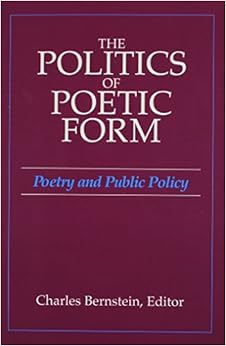 If you’re into Bradley’s book, I do highly recommend it. But my rant about persona and Truth and all that jazz got sidelined when Rothenberg gave me this little quote:
“The hypothesis would be: I see through language. And its corollary: without language, I am blind��� (13).
Now, the quote that I instantly connected to before this  one was “‘a new language must be found’ … not only for the sake of speaking but of seeing, knowing” and I was like “YEAH THAT SOUNDS AWESOME” (12). Then the one in block quotes came around a few sentences later and then I was like, “Hang on. What?”
 At first, I took a step back and said, “Uh, no.” Because what sense does seeing with language make outside of reading? (I should probably have explained that a lot of Rothenberg’s focus is on “‘wordless’ oral poetries” [14].) My immediate reaction is that when I see a red flower, it doesn’t matter if the person next to me can communicate our shared vision or not because we’re both looking at the same red flower. (Also, I am aware I am working under the assumption we are both in possession of our sight. That is not a slight against those with blindness but rather I simply relating my own thought process given my privileged of having my sight mostly intact.)
Now let me back up a little bit. You may or may not know that I was abroad last year.  Though I lived in London, I traveled in Europe a lot. The favorite question for people to ask when I came back is which place I went was my favorite. I always hedged this question by replying that I loved everywhere I went, but I was just more comfortable in places where I could adequately communicate, like Ireland and Scotland.��When I traveled to Paris, Barcelona and Italy, I always had at least one travel buddy who spoke the language we needed. It is this experience that I drew on to refine this “hypothesis and corollary” in my own mind.
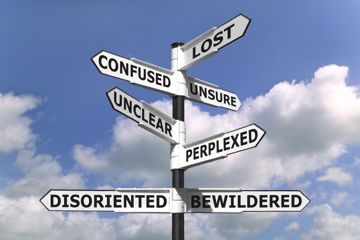 See, when traveling to new country where you don’t��speak the language, the inability to communicate does feel like a type of blindness and a sense of invisibility all at the same time. Especially on public transportation, you feel removed from reality in a sense. There is all this chatter happening around you, but you can’t understand a word of it. You can’t overhear a funny story someone is telling or engage with a shopkeeper about buying a silly souvenir. Sure, you can get by with pointing and playing charades, but it is the most physical feeling of living in an alternate reality that I have ever had.
This is especially potent when someone you’re traveling with DOES speak the language.  They end up ordering for the group at dinner or getting directions or navigating the public transportation. This isn’t a bad thing; I’m forever thankful for my friends for this. I might have died from anxiety otherwise. But when someone else can jump into a dialogue before you can, the muzzling effect is deafening. Perhaps this is just me, being someone who is not accustomed to taking a backseat for extended periods of time–and really wanting to be in complete control of every situation–but that is the deepest truth I can admit about traveling in those countries.
Again, I don’t regret those travels. They were some of the most amazing experiences of my life. But this was also certainly a part of my experience. It just wasn’t something I connected with the act of seeing until Rothenberg said it. I think of the five senses as five separates. But the truth is, as with much of the human experience, nothing is separate. Everything we do or don’t do feeds into something else with simple cause and effect.



April 8, 2015
Perusing Poetics: What Happens When I Break (Dance)
 Alright, so here’s the thing, folks. I’m not having the best brain week. It’s Wednesday and I’m already shot to all hell. So this is what happens when I break down/dance.
Let me back up here. For class this week we read an article by Susan Stewart about “Graffiti as Crime and Art” and also this fabulous documentary called Style Wars. (You can watch it on YouTube here.) These are both fabulous–especially Style Wars–and deserve more than I’m going to give them, but hey. I haven’t collapsed once this semester (unlike last spring) and I’d like to keep it that way. Anyways. Here’s the quote from Steward that interested me for this blog post:
“…we should note that the function of individuation, stylization, and uniqueness
would also seem to be served by the appropriation of the metaphor of the robot in both graffiti and it’s sister art, break dancing.”

Stewart here makes reference to the “freeze-frame stopping found in break dancing” and the “mixture of body movement and the imitation of mechanical action.”
The former dancer that I am, I departed entirely from the focus on graffiti (whoops) to the mentions of break dancing in both the article and the documentary. When I presented on this homework in class (for forty five effing minutes, why did no one stop me) I may or may not have used videos from the Step Up movie franchise to illustrate the relationship of body movement and machinery, as well as the commercialization of hip hop culture. In particular, I used this dance from Step Up All In:
 I also, however, showed the final dance from the original Step Up movie in comparison, and was shocked at the stark contrast between the way that the two of them looked. I began to look at other dances from throughout the five movies, and realized that the more commercial the movies got, the more obvious the connection to machinery and robotics. More fascinatingly, a lot of this connection ceased to show up specifically in the dancing. Like a lot of other representations of hip hop cultures in the movies, the connection was bastardized and linked to something other than body movement–something Aristotle would call “spectacle.” It really strikes me sometimes, in the later movies, the emphasis really isn’t on dancing in these so-called dance movies at all.
Want to see what I’m talking about? WAIT NO MORE.
1. When the most technical thing in the movie was the fact that the music was supplied by a pit orchestra AND synthesizers and people actually danced: Step Up
2. Look! They used technology to record DANCING: Step Up 2: The Streets
3. THE MOVIE IN WHICH TECHNOLOGY F*CKED UP EVERYTHING (by which I mean they made this one in 3D and everything is 3D vision fodder but specifically check out those suits at 8:45): Step Up 3D
4. The movie that did this awesome thing by using robotic dance styles to characterize the corporate world but also like totally copped out in its finale dance by using cheap contraptions with trampolines and harnesses for wow effect: Step Up 4 Revolution
5. The movie that had earlier dances as non-dancy as the first one I showed and yet also had this steam-punk themed ending with some dancing but also crazy effects, fire and other nonsense: Step Up 5 All In
Personally, in movie quality, I felt like it’s all downhill from 1-3 and then 4 and 5 make an attempt to be better. It directly correlates to what I’ve just laid out about the dances. Coincidence? Perhaps. But only if you believe in such a thing.
I hope you have enjoyed this blog post brain break. I did!



April 1, 2015
Perusing Poetics: You Write What You Know, Even if You Don’t Know You’re Doing It
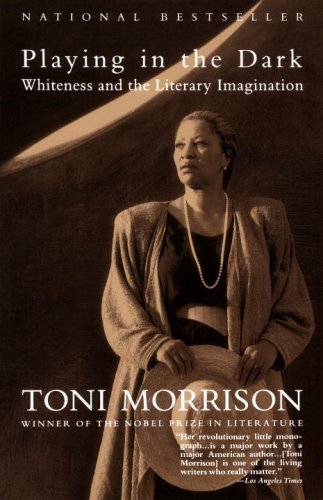 So, I’m usually not a fan of big block quotes. They’re clunky, take up space and it’s REALLY HARD to dissect them properly. For this week’s post, however, I might have to make an exception. This is potentially just what happens when you’re quoting Toni Morrison. The following is from her book on literary criticism, Playing in the Dark: Whiteness and the Literary Imagination–
“Writers are among the most sensitive, the most intellectually anarchic, most representative, most probing of artists. The ability of writers to imagine what is not the self, to familiarize the strange and mystify the familiar, is the test of their power. The languages they use and the social and historical context in which these languages signify are indirect and direct revelations of that power and its limitations” (15).
Morrison herself is speaking specifically about why she is looking at white literature to  discover the effect of the constructed idea of African-Americans on the world at the time. If you’ve been following these blog posts, you might already see where I’m going with this post … in which case I hope you stick around to read this for my sheer sparkling personality.
 First off, look at that. Writers with power. Just look at how she describes writers. Isn’t that beautiful? Okay, so Morrison herself is a writer and that might make her biased, but I don’t think that makes it any less true. (I am also a writer and I admit my own bias.) But just think about it. Why do we read at all? It isn’t to read the same story again and again (unless you have fallen into guilty love with some YA trend). We read to find some exciting story that at once captures our imaginations and yet also catches our heart. To be exciting, it must be new, but to capture our hearts it must be filled with some kind of emotion we recognize. Otherwise we’d just be confused.
 Secondly, look at what she wants us to look at: languages used and social and historical context. This is SO IMPORTANT. Anyone who says that they can look at just the text and only the text and get the full meaning is a liar. Looking at just the text gives you ONE meaning–also, a one dimensional reading. If you remember back to my post about Whorf, I went on and on about how we understand our world and also how we construct it. These constructions don’t just exist in our lives. A writer constructs worlds, but no matter how fantastical they always reach back to something they know or at least believe in.
Morrison has some really great examples in her book about how white writers were writing about African-Americans and what it says–more about the writer than the actual constructed character. Ernest Hemingway makes such an effort to deny the black sailor in To Have and Have Not agency or speech that he writes this grammatically disastrous line: “I looked and saw [the black sailor] had seen a patch of flying fish burst out ahead” (qtd 72).

Love him or hate him, you cannot tell me that Hemingway looked at that line in editing and thought, “Yes, this makes grammatical sense.” He made the choice to leave it there, instead of allowing the black sailor to even shout a few words.
 Does this mean Hemingway is a racist? No. It’s one quote from one novel and conclusions drawn from that would be factually inaccurate. But what it DOES say is that Hemingway felt that he had to write the scene and the character that way. It could be his choice, it could not be. After all, you can’t tell me that every YA author believes that every story should have a love triangle shoehorned in. But there they are, because they believe that’s what people want to read. (Hint, they are not but for some reason they sell.)
Yes, that’s a shallow example to compare to all the centuries of silenced African-American characters and writers, but my point here is not to enter into race politics. My point is that we can look at the way certain things are written and extrapolate massive amounts of information in the way that language is shaped and what it says about writing in the social and historical context of the writer. The difficulty of writing is that it must be both exciting and familiar, and people must also want to read it. Even in the most fantastical of settings, the human experience must resemble the majority of the readership or no one will read it, love it or understand it.
As a final note, if you’re ever looking for enjoyable, interesting and easy-to-read literary criticism, go pick up Morrison’s book. You won’t be disappointed.


March 25, 2015
Perusing Poetics: Why I Write and Other Passionate Rants
 If you’ve been reading these posts for a while, you know a couple of things–I hope. The thing pertinent to this discussion, however, is that I have no problem trashing the readings that I do for this class a lot of the time. So when I say I enjoyed William Carlos Williams’ Spring and All, you know I’m telling the truth.
This is an entire long work, so there were a lot of things that spoke to me in here. However, one thing that I want to talk about is this quote right here:
“Complete lack of imagination would be the same at the cost of intelligence, complete.” (28)
This is one of many things that Williams says about the relationship between intelligence  and imagination–one of the more succinct and easier to understand without context. However, the basic gist of the idea is that intelligence cannot exist without the imagination. If you have no imagination, you can’t get smarter.
Right about here, I put the book down and smiled.
See, the thing about being a Writing and English double major is that you get a lot of flack–especially with the Writing portion. At least when I say English people say, “So you’re going to try to be a teacher before you start collecting unemployment.” When I say writing? Hahahahahaha that’s funny.
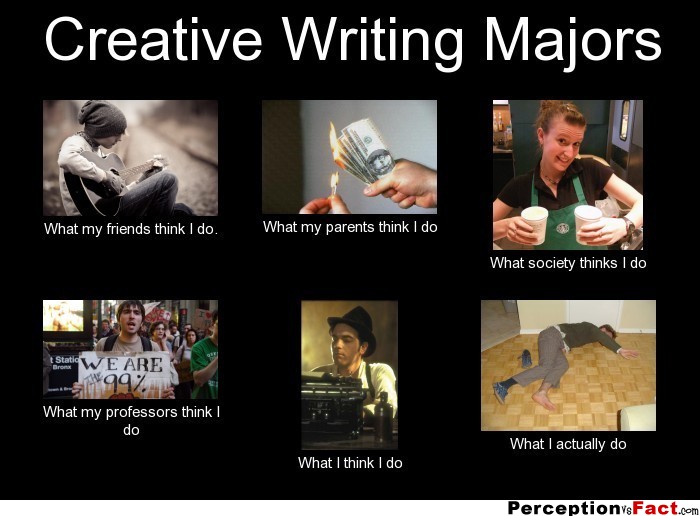 Before I go any further, I need to clarify what I’m not saying. I’m NOT saying that if you are in some kind of technical field you have no imagination. I’ve seen my brother building a computer and I know that would be IMPOSSIBLE without imagination. Scientists have to be able to dream, etc. But what I AM saying is that I’m sick and tired of being told that because I have an overactive imagination, I’m not smart.
Perhaps one of the biggest things I’ve learned in my readings so far (relating to my own  personal life; the scholastic portion is gigantic) is that people have spent THOUSANDS of years recognizing the power of the storyteller and then tearing them down. Thanks, Plato. You can’t say “writer” and have people recognize that you sit there and create up realistic people who are not real who, in their plots, can explain something about humanity to you or illicit some kind of emotional response. No, you say “writer” and people just think “…oh.”
 So when Williams says that intelligence depends on imagination, I feel just a little bit more justified. I have another set of quotes for my quiver of arrows to shoot against Those-Who-Need-To-Shut-Up. When ever Plato is scared of storytellers, you should know something’s up anyways, but sometimes people forget that. People write “apologies” and justify their craft and don’t stop to think for a second, “Hey. Plato banished poets because of how much power they had. That’s pretty damn cool.”
I’m not saying that I write to change the world. I’m not saying that you could. What I am  saying is that if you deny the talent and the intelligence of a writer, you’re denying a human tradition. You’re denying how our stories are what connect us and explain our humanity. You deny your own personal story.
So maybe I, as a writer, will never make as much money as a neurosurgeon (sadly). I didn’t become a writer to do that. I also didn’t become a writer because I wasn’t smart enough to do anything else.
I became a writer to tell our stories.


March 18, 2015
Perusing Poetics: All the World is Speech (and Humans are Really Strange Creatures)
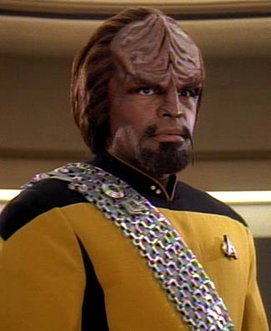 When I was born, my parents got one of those dumb baby book things. Under family resemblances, my father wrote “Worf from Star Trek.” I HAVE A BIG FOREHEAD, OKAY?
This has absolutely nothing to do with this blog post,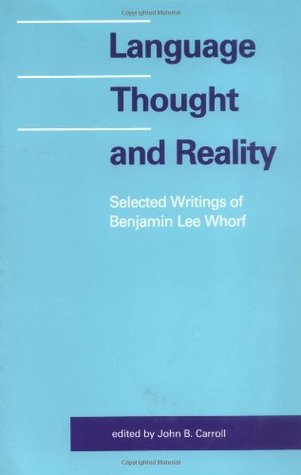 except for the fact that this week I’m talking about Benjamin Lee Whorf’s Language, Thought,and Reality and I keep thinking of Whorf from Star Trek instead of this really smart linguist. So now you know something really weird about me.
 How I arrived at my topic for this week’s post is also kind of weird. It’s a convergence of three things, really. Firstly, there’s Whorf. One of his essays in this collection is titled “On the Connection of Ideas,” and it’s basically him writing to this compiler of psychological terminology asking for a better term for connected words and ideas than “association,” which he finds lacking for a multitude of reasons. The takeaway here is that he, a linguist, is asking for help not from another linguist, but a psychologist. Kind of weird, right? (Not to me, as you’re about to see.) Then, there’s this craft class I had today with poet Li-Young Lee. He said today that he thinks that art is really just another version of psychology, since all art comes from an inner psyche. Finally, there’s me, and my now three-year-long maintaining that if I wasn’t an English and Writing major, I’d be a psychology major.
When I first had a little wonder, as a freshman, if I should major in psychology (preferably educational), I threw it out of hand almost instantly. “I’m not science-y!” I said. “I’d never survive. The connection makes no sense!” So I continued on my merry English-and-Writing way. And I’m glad for it.

Me. Doing science.
 But the thing is that there is a major connection between art and psychology. A BIG ONE. I’m going to focus on writing here, because I can’t art in any other way, but I’m sure an artist or musician–for example–would probably have a connection to make as well. What is a writer, but a creator of character? When you’re in a writing class, one of the major things you are told you have to figure out is “What do your characters want?” Writing–especially, for me personally, fiction–is simply accessible psychology. (The good stuff, anyways.) You sit down, you read a story, and you understand step by step why a person or a group of people do what they do within the story. You learn how people change, grow, fail or succeed through story arcs. To me, it’s pretty bloody magical. It’s why I write. The human brain fascinates me. Psychology is only one access point to the crazy questions humanity poses about WHY. Writing is another.
Whorf, however, is a linguist, so we have to break this down a little bit further. Sure, the  connection between stories and psychology might make sense, but Whorf is operating on the word level. He’s seeing a connection to humanity through not just whole stories but single words and syllables. He suggests this hypothesis about how someone’s language is a major part of how��they understand reality and behave within it. This collection basically admits that this hasn’t been proven, but it hasn’t been disproved.
To me, what he’s saying just makes sense. (Okay, well, not some of the time. But what I can understand from him, I like.)
 It’s why I still wish I’d gone into psychology sometimes. It’s why I want to find some way to get a PhD where I can explore the links that Whorf talks about, between language, society, culture, etc. It’s because when I engage in my area of specialty (the young adult book world), I see the connection between cultural norms, young adult reception of these stories, and society at large. YA novels work in massive trends, but it’s fascinating how the slightest shift in language can make or break one vampire novel to the next.
At the reading by Li-Young that I attended tonight, he said that he was currently engaged in a massive back and forth with a minister friend of his because Li-Young is trying to convince him that all the world is speech. Well, that’s the world I choose to see, too.


March 4, 2015
Perusing Poetics: Sadly, You Didn’t Get Murdered Like You Wanted
 This blog is going to be a combination of that title, the Futurist Movement and my trip to Italy last semester. (Specifically, Venice. Read more about that here.) How, you might ask? Hang on to your hat!
First, our poetical beginnings. This week in class we were 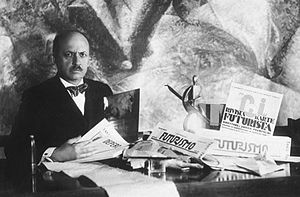 reading about the Futurists and their CRAZY AS HELL movement of art. If you want to know how crazy, go ahead and look up the Manifesto as written by F.T. Marinetti. That’s what I’ll be quoting from.
 These guys had a lot of crazy, cool, and crazy-cool ideas kicking around. Among the stranger ones was their desire to destroy “museums, libraries, [and] academies of every kind” (22). This is not to mention “moralism, feminism, [and] every opportunistic or utilitarian cowardice”, but that’s another blog post for another time (22).
I want to focus on the word “museums” here, but first a little bit of context. One, this  manifesto was written in 1909. These young men were glorifying war and violence, among other things, but they probably had no idea about what was coming around the corner for all of Europe. Second point of interest–and where I got my blog post title from–was that they were so into new ideas that they hoped that “other, younger and stronger men” would come around when they were forty or so and “hurtle to kill” them so as to become their “successors” (23).
 So there’s your picture. Young, frenzied men in 1909 with a lot of wild ideas that actually go on to have a lot of impact on the world. They want to knock down every old edifice that remains in the world and make it new. They look forward to being destroyed by their successors.
It’s funny what they got and what they didn’t. A lot of their thinkers would be killed in the war that was to come, but not in the way that they wanted. A lot of old things would be destroyed and made new after the war, for better or for worse. Successors would arise and carry on some of their ideas, but not in the way they would have preferred if they all lived.
How can I say that? Well, when I visited the Peggy Guggenheim Museum in Venice, their special exhibition was on Futurist art. Some of the most famous pieces of their movement were there.

In a museum.

Photo credit: Samantha Guter
On display.

Photo credit: Samantha Guter
Sure, The Peggy Guggenheim is a modern art museum. There are no dusty Greek or Roman pieces there, but rather Dali, Pollock and Ernst. Yet, as far as the Futurists were concerned, anything past was old. Even their work, now, is “old” because it isn’t now. Hanging that art there, exhibiting it like that … all those artists were probably turning over in their graves.
 It’s just fascinating how the world picks and chooses what it wants to remember about movements and ideas and people. There are plenty of Futurist ideals that many artists still carry, like themes of destroying the old or violence in art, but this one they forgot. The Futurists were murdered, all right, but the radical movement they hoped would continue on after them did not–or it would not be the pieces of Marinetti’s contemporaries on the walls, but rather those young, vicious murderers for which they prayed. Now the only violence they can enact is the one which Marienetti lambasted museums for containing: where “absurd abattoirs of painters and sculptors ferociously [slaughter] each other with colour-blows and line-blows, the length of the fought-over walls!” (22).