Randy Alcorn's Blog, page 221
November 26, 2011
Pursue Your Pleasure in God
This blog of Jon Bloom’s from a couple of months ago is right on target. Years ago I taught a seminary course called “A Theology of Desire,” and Pascal’s quote was one of the many I cited.
Pleasure Is the Measure of Your Treasure
by Jon Bloom
No one puts it as bluntly as Blaise Pascal in his Pensées:
All men seek happiness. This is without exception. Whatever different means they employ, they all tend to this end. The cause of some going to war, and of others avoiding it, is the same desire in both, attended with different views. The will never takes the least step but to this object. This is the motive of every action of every man, even of those who hang themselves.
There you are. Warrior, pacifist, suicide, sluggard, workaholic; if you’re a human, you’re a hedonist. You can try to deny it, but you can’t change it.
If you want to try your hand at stoicism, forget the Bible. It has little for you. Scripture does not support the idea that our motives are more pure the less we are pursuing our own joy. Nope. In fact, according to the Bible, unless we are pursuing our happiness we cannot even come to God: “for whoever would draw near to God must believe that he exists and that he rewards those who seek him” (Hebrews 11:6).
God blatantly entices us to seek happiness, joy, pleasure (whatever you want to call it) in him with verses like this: “Delight yourself in the Lord, and he will give you the desires of your heart.” (Psalm 37:4), and “in his presence is fullness of joy, and at his right hand are pleasures forevermore” (Psalm 16:11). We’re supposed to want pleasure.
Why does God want us to want pleasure? Because it is a crucial indicator. Pleasure is the meter in your heart that measures how valuable, how precious someone or something is to you. Pleasure is the measure of your treasure.
Your treasure is what you love. Your greatest treasure is what you love the most. “For where your treasure is, there your heart [what you love] will be also” (Matthew 6:21). You will never be a true stoic because you can’t help experiencing pleasure in what you treasure. God wired you that way.
Pleasure is the whistleblower of your heart. More than anything else it exposes what you really love. If something sinful gives you pleasure, it’s not a pleasure problem. It’s a treasure problem. Your pleasure mechanism is likely functioning just fine. It’s what you love that’s out of whack. And pleasure is outing you. It’s revealing that, despite what your mouth says and the image you try to project to others, something evil is precious to you.
That’s what sin is at the root: treasuring evil. Which makes the fight of faith in the Christian life a fight for delight. It’s a fight to believe God’s promises of happiness over the false promises of happiness we hear from the world, our fallen flesh, and the devil. And yes, it often involves denying ourselves pleasure, but only denying ourselves a lesser, viler pleasure in order to have a much higher pleasure (Luke 9:23-25).
So be a full, unashamed, bold Christian Hedonist! Pursue your pleasure in God, the greatest Treasure, with all your heart (Matthew 22:37). “For where your treasure is, there your heart will be also” (Matthew 6:21)


November 24, 2011
What I'm thankful for: a Thanksgiving greeting
In this two minute video, I share about how there are so many things for Nanci and me to be thankful for this year.
 Nanci and I have talked about how grateful we are for our family—we have two daughters who are married to godly men, as well as four grandchildren already born and the fifth one on his way. (So that will make five grandsons after raising two daughters!) We’re so grateful for them and their love for Christ.
We are also thankful for the goodness of God. Psalm 106:1 says, “Praise the Lord. Give thanks to the Lord, for He is good; His love endures forever.”
Romans 8 tells us that nothing can separate us from the love of Christ, no matter how tough life gets. Let’s face it—some people reading this right now are going through the most difficult times of their lives. But no matter how difficult those times are, remember we have eternal life in Christ if we’ve placed our faith in Him, confessed our sins, and embraced Jesus as our Savior and Lord. One day, He will make all things right. One day, in retrospect, we are going to see that He caused all things to work together for good for those who love Him—for us.
So we can be thankful not only for what God is doing in our lives right now, but also for what He promises we will experience for all eternity. There’s nothing better than that! We’re going to spend eternity with Christ, and He is going to wipe away the tears from every eye.
 If this Thanksgiving is a cause for great rejoicing for you because it is a wonderful time in your family’s life—or, if it is the toughest Thanksgiving you’ve ever faced and you’re feeling alone and rejected, have financial problems, are suffering from an illness, or perhaps you’ve lost a loved one—remember the promise of Jesus Christ. He will be with you always. And if you love Him, one day you will be with Him forever in a new world where there will be no more pain or suffering.
God bless you, and have a Happy Thanksgiving.
November 22, 2011
Lessons learned from Mississippi's failed Personhood Amendment
In light of the recent failed Personhood Amendment in Mississippi, the most prolife state in the union, this excellent article by Al Mohler is worth reading.
We’re All Harry Blackmun Now — The Lessons of Mississippi
By Albert Mohler
When voters in Mississippi voted down the human personhood amendment last week, they sent a clear and undeniable message — the pro-life movement is not as pro-life as it thinks it is. The truth is that, even in what may be the most pro-life state in the union, the most basic moral logic of the pro-life movement is not fully embraced or understood.
The voters spoke loudly. State-wide, 58 percent of voters cast ballots against the amendment. This came after polls had indicated that the amendment, once thought almost certain to pass, was fast losing support among Mississippians in the last days of the campaign.
The idea behind the personhood amendments is clear. Proponents frame the constitutional amendments as a moral statement, as a direct challenge to Roe v. Wade, and as a means of prompting legislation that will defend unborn life. Similar efforts failed twice in Colorado in recent years, but Mississippi looked like a sure thing. The state is already, as one leading pastor there told me, “the safest place in America to be an unborn child.” The state adopted pro-life legislation in the wake of Roe v. Wade, and there is only one abortion clinic in the state. The candidates for governor nominated by both major parties both supported the amendment.
After that, it got more complicated. The Roman Catholic church in Mississippi took the position that its members were not bound to vote for the amendment. Within the pro-life movement, there was a division over the personhood amendment. Some believed the amendment to be the best way of building support for the overthrow of Roe v. Wade. Others believed that an incrementalist approach is wiser, deferring any direct assault on Roe.
Make no mistake, the human personhood amendment is not an incrementalist approach — it is a head-on assault against the logic of Roe v. Wade and the denial of human dignity at every stage of human development.
November 21, 2011
Visit to Upland, and fun with grandsons Matt and Jack
 The weekend of November 13 I was in California, and had a great time with grandson Matt on his seventh birthday in his new home town of Upland, where his father Dan Franklin is now the teaching pastor at Life Bible Fellowship Church. We gave him this batting helmet.
But actually, while the church is in Upland, they are going to live in another nearby town. No one can say the name of that town any better than Matt’s little brother Jack. As we were driving to lunch, and I was sitting with him behind his parents, I asked Jack where he was going to live. Here’s his answer:
November 18, 2011
Eagerly Anticipating the New Heavens to Come
 Astronomy has been my hobby since childhood. Years before I came to know Christ, I was fascinated by the violent collisions of galaxies, explosions of stars, and implosions into neutron stars and black holes. On the one hand, these cataclysms declare God’s greatness. On the other hand, they reflect something that is out of order in the universe on a massive scale.
In Isaiah 65:17, God says, “Behold, I will create new heavens and a new earth." This corresponds to Genesis 1:1, indicating a complete renewal of the same physical universe God first created. The new heavens will surely be superior to the old heavens, which themselves are filled with untold billions of stars and perhaps trillions of planets. God’s light casts the shadows we know as stars, the lesser lights that point to God’s substance. As the source is greater than the tributary, God, the Light, is infinitely greater than those little light-bearers we know as stars.
The Bible’s final two chapters make clear that every aspect of the new creation will be greater than the old. Just as the presentJerusalemisn’t nearly as great as the New Jerusalem, no part of the present creation—including the earth and the celestial heavens—is as great as it will be in the new creation.
While some passages suggest that the universe will wear out and the stars will be destroyed, others indicate that the stars will exist forever (Psalm 148:3-6). Is this a contradiction? No. We too will be destroyed by death, yet we will last forever. The earth will be destroyed in God’s judgment, yet it will last forever. In exactly the same way, the stars will be destroyed, yet they will last forever. Based on the redemptive work of Christ, God will resurrect them.
On the inside of my office door is a beautiful photograph of a menagerie of several hundred galaxies (there are more than three thousand detectable in the full picture), averaging perhaps a hundred billion stars each, never seen with any clarity until photographed by the Hubble space telescope. The photograph represents the deepest-ever view of the universe, called the Hubble Deep Field. In addition to the spiral and elliptical shaped galaxies, there’s a bewildering variety of other galaxy shapes and colors. This is a tiny keyhole view of the universe, covering a speck of sky one-thirtieth the diameter of the moon. When I look at this picture, I worship God.
We are not past our prime. The earth and planets and stars and galaxies are not past their prime. They’re a dying phoenix that will rise again into something far greater—something that will never die. I can’t wait to see the really great meteor showers and the truly spectacular comets and star systems and galaxies of the new universe.
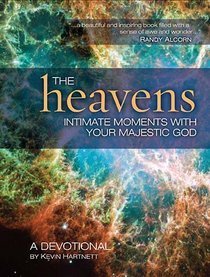
If you enjoy looking at pictures of the heavens, Kevin Hartnett has produced a beautiful and inspiring book called The Heavens Devotional, which is filled with a sense of awe and wonder that deeply honors God. Kevin and I both share a lifelong love for astronomy. He is not only an accomplished amateur astronomer and astro-photographer; he is also an outstanding poet. Above all, he is a God-worshiper, and his book leads the heart to praise and worship. (You can check out some of the photos of the book at the Christianbook.com site.)
November 16, 2011
Blessed Savior: a Prayer by Thomas Reade
I love the Puritans for their emphasis on God's greatness and grace. Listen to this prayer of Thomas Reade.
Blessed Savior! Oh lover of my soul, give me grace to love you. Never, oh, never let me forget what you have done for an unworthy sinner! Let me never forget your bloody sweat, your cross and passion, your known and unknown agonies, when you made your soul an offering for sin. Oh! that I had a heart to love you with a supreme affection. Come, blessed Spirit, shed abroad in my heart a Savior’s love, and that will kindle mine. Sit as a refiner’s fire, as a purifier of silver, until the dross of sin is consumed, and your holy image be reflected on my soul; yes, until I be made fit for the inheritance of the saints in light. Give me a hatred of sin; preserve me from the wiles of Satan; deliver me from the workings of pride; save me from a worldly spirit, from a carnal mind, from sensualized affections.
Oh! fountain of all spiritual life, quicken my dead soul to act with energy in the cause of truth; give me a thirsting after holiness;strengthen my faith in the Redeemer’s righteousness; my reliance on his power;my confidence in his grace; my hope in his promises; my assurance in his love. Fill me with holy joy, tranquility, and peace. Take what you will of earth away, only give me your Blessed Self, and then, through grace, I shall sing in the darkest seasons; triumph in death; and shout hallelujah in glory
—Thomas Reade
November 14, 2011
How pleased will God be to have us with Him in Heaven?
As I’ve often said, A. W. Tozer is one of my favorite all-time authors. I love what he says here, and what I also love is that elsewhere He affirms God’s holiness, justice and wrath in uncompromising ways, then gives us this beautiful depiction of God’s love for His children, and His delight in us. We do not have to choose between God’s holiness and hatred for sin, on the one hand, and His joyful love and affection for us on the other. The Bible is emphatically clear on both. And appreciating His holiness, rather than minimizing it, makes his grace more amazing and His love for us all the more spectacular and enduring. Listen to Tozer:
God takes no pleasure in human tears. He came and wept that He might stop up forever the fountain of human tears. He came and bereaved His mother that He might heal all bereavement. He came and lost everything that He might heal the wounds that we have from losing things. And He wants us to take pleasure in Him. Let us put away our doubts and trust Him.
God wants to please you. He is pleased when you are His child, when you’re surrendered, when your will is His will and His will is yours, when you are not in rebellion and not seeking your own will. God loves to please His people.
Did you ever see a father bringing gifts to his children? Did you ever see a lover bringing gifts to his bride? He wants to please the people He loves, and the people that love Him. The idea that God must always make you miserable is not a biblical idea at all. Jesus Christ knew God and He suffered from the irritations and persecutions of the world, the bitterness of their polluted hearts. They made it hard for Him. But He was pleased with God and God was pleased with Him. “This is my beloved Son, in whom I am well pleased” (Matthew 3:17). “Well done, thou good and faithful servant” (Matthew 25:21). God can say that now to His people.
God isn’t pleased by your being miserable. He will make you miserable if you won’t obey, but if you’re surrendered and obedient, the goodness of God has so wrought through Jesus Christ that now He wants to please you. And He wants to answer your prayers so you will be happy in Him. He wants to do that. Let’s put away all doubts and trust Him…
Did you ever stop to think that God is going to be as pleased to have you with Him in heaven as you are to be there? The goodness and mercy of God, the loving kindness of the Lord—it’s wonderful! He can bring us into such a relationship with Him that He can please us without spoiling us. He pleases us, and He’s pleased when we’re pleased. And when we’re pleased with Him, He’s pleased.
One common joy we will share: “mine to be forever with Him, and His that I am there.” Thank God, thank God! Let us praise the lovingkindness of God forever, for of His goodness there is no end. Amen! Amen!
Tozer, A. W., & Fessenden, D. E., The Attributes of God, Volume 1: A Journey into the Father's Heart (Camp Hill, PA: WingSpread, 2003), 55-57
November 11, 2011
The Persecuted Church: Ignored by the World, Watched by the Eyes of Heaven
 This Sunday, November 13, is the International Day of Prayer for the Persecuted Church, a global day of intercession for persecuted Christians worldwide. It’s a day to remember and pray for the hundreds of men, women, and children killed for Christ each day, ignored by the world but watched by the eyes of heaven—those of whom the world is not worthy. (You can listen to my 49-minute message on the persecuted church, “Those of Whom the World Is Not Worthy.”)
In If God Is Good, I tell the story of Graham Staines, who left his home in Australia to minister to lepers in India for thirty-four years. He and his wife, Gladys, served Christ by serving the poorest of the poor.
 At midnight on January 23, 1999—a year and a half before my wife, daughters, and I met Gladys and her daughter, Esther—a mob of militant Hindus murdered Graham and his two sons, Phillip, age eleven, and Timothy, age six. The killers invaded a Christian camp in the jungle, where Graham had ministered, and set fire to the Jeep in which Graham and his sons slept. When the fire finally cooled, believers found the charred body of Graham Staines with his arms around the bodies of his sons.
In the most appalling way, Gladys and Esther found themselves alone. Their response to the tragedy appeared on the front page of every newspaper in India.
“I have only one message for the people of India,” Gladys said. “I’m not bitter. Neither am I angry. But I have one great desire: That each citizen of this country should establish a personal relationship with Jesus Christ who gave his life for their sins.... Let us burn hatred and spread the flame of Christ’s love.”
When asked how she felt about the murder of her dad, thirteen-year-old Esther said (in words that sound straight off the pages of the book of Acts), “I praise the Lord that He found my father worthy to die for Him.”
 Gladys stunned a nation by saying that God had called her and Esther to stay in India for that season. “My husband and our children have sacrificed their lives for this nation; India is my home. I hope to be here and continue to serve the needy.”
At the funeral, masses of people filled the streets—Hindus, Muslims, and Christians. They came to show respect for the Staines family and demonstrate solidarity against the killers. Although persecution of Christians had recently increased, the president of India stated, “That someone who spent years caring for patients of leprosy, instead of being thanked and appreciated as a role model should be done to death in this manner is... a crime that belongs to the world’s inventory of black deeds.”
At the conference where we met them, after Gladys and Esther spoke, an Indian national leader told us about the impact of their response to the murders. He said the people of India asked, “Why would a man leave his wealthy country and serve lepers in India for thirty-four years? Why would his wife and daughter forgive the killers of their family? Why would they choose to stay and serve the poor? Who is this God they believe in? Could it be that all we’ve been told about Christians has been lies? Could it be that Jesus really is the truth?” He stated that many Hindus had come to Christ through their witness.
The Staines carried on a long tradition of God’s people: “Others were tortured and refused to be released, so that they might gain a better resurrection. Some faced jeers and flogging, while still others were chained and put in prison. They were stoned; they were sawed in two; they were put to death by the sword. They went about in sheepskins and goatskins, destitute, persecuted and mistreated—the world was not worthy of them” (Hebrews 11:35–38).
 Christ made it clear that to persecute his people is to persecute him. Whatever others do to his people, positively or negatively, he regards as being done to him (see Matthew 25:40, 45). Christ no longer suffers on the cross, but he suffers with his suffering people.
After his ascension, Jesus says to the Pharisee on the Damascus road, “Saul, Saul why do you persecute me?” (Acts 9:4). Persecution, of course, entails suffering. One verse later Christ says to Saul, “I am Jesus, whom you are persecuting.” Note the present tense—although Christ’s atoning sacrifice occurred in the past, he continues to identify with and participate in his people’s suffering until he returns to end all suffering.
Thank you, King Jesus, for your loyalty to us and to every one of our suffering brothers and sisters. Thank you for promising a kingdom where righteousness will reign and joy will be the air we breathe. May that kingdom come quickly—and until it does, may you find us faithful.
November 9, 2011
The Water of Life for the Thirsty
In C. S. Lewis’s The Silver Chair, a young girl from earth, Jill Pole, is alone, lost, and very thirsty as she wanders through the foreign world of Narnia. Then she sees, for the first time, Aslan, the great and ferocious lion, standing by a stream of fresh water. Naturally, she’s terrified:

“Are you not thirsty?” said the Lion.
“I'm dying of thirst,” said Jill.
“Then drink,” said the Lion.
“Will you promise not to—do anything to me, if I do come?” said Jill.
“I make no promise,” said the Lion.
Jill was so thirsty now that, without noticing it, she had come a step nearer.
“Do you eat girls?” she said.
“I have swallowed up girls and boys, women and men, kings and emperors, cities and realms,” said the Lion. It didn't say this as if it were boasting, nor as if it were sorry, nor as if it were angry. It just said it.
“I daren't come and drink,” said Jill.
“Then you will die of thirst,” said the Lion.
“Oh dear!” said Jill, coming another step nearer. “I suppose I must go and look for another stream then.”
“There is no other stream,” said the Lion.
It never occurred to Jill to disbelieve the Lion—no one who had seen his stern face could do that—and her mind suddenly made itself up. It was the worst thing she had ever had to do, but she went forward to the stream, knelt down, and began scooping up water in her hand.
It was the coldest, most refreshing water she had ever tasted.
Jesus: “To him who is thirsty I will give to drink without cost from the spring of the water of life.” (Revelation 21:6)
November 7, 2011
Signposts of the New Earth
 I’ve never been to Heaven, yet I miss it. Eden’s in my blood. The best things of life are souvenirs from Eden, appetizers of the New Earth. There are just enough of them to keep us going but never enough to make us satisfied with the world as it is or ourselves as we are. We live between Eden and the New Earth, pulled toward what we once were and what we yet will be.
Desire is a signpost pointing to Heaven. Every longing for better health is a longing for the perfect bodies we’ll have on the New Earth. Every longing for romance is a longing for the ultimate romance with Christ. Every thirst for beauty is a thirst for Christ. Every taste of joy is but a foretaste of a greater and more vibrant joy than can be found on Earth now.
That’s why we need to spend our lives cultivating our love for Heaven. That’s why we need to meditate on what Scripture says about Heaven and to read books, have Bible studies, teach classes, and preach sermons on it. We need to talk to our children about Heaven. When we’re camping, hiking, or driving or when we’re at a museum, a sporting event, or a theme park, we need to talk about what we see around us as signposts of the New Earth.
When we think of Heaven as unearthly, our present lives seem unspiritual, as if they don’t matter. When we grasp the reality of the New Earth, however, our present, earthly lives suddenly do matter. Conversations with loved ones matter. The taste of food matters. Work, leisure, creativity, and intellectual stimulation matter. Rivers and trees and flowers matter. Laughter matters. Service matters. Why? Because they are eternal.
Life on Earth matters, not because it’s the only life we have, but precisely because it isn’t—it’s the beginning of a life that will continue without end on a renewed Earth. Understanding Heaven doesn’t just tell us what to do, but why. What God tells us about our future enables us to interpret our past and serve him in our present.