Randy Alcorn's Blog, page 211
July 9, 2012
Ed Welch on How Fighting Sin Hurts
I greatly appreciate the ministry of the Christian Counseling & Educational Foundation (CCEF), located in Philadelphia. Their mission is to “Restore Christ to Counseling and Counseling to the Church.” Besides offering counseling services in their home office, they provide on-site training and distance education for leaders, pastors, counselors, and people with a heart for discipleship. They also produce the Journal of Biblical Counseling and host a national conference each fall.
I love the fact that they are very biblically sound and Christ-centered in their approach to counseling. If you haven’t explored their website, I’d encourage you to do so. It isn’t just for counselors—it has lots of great resources for anyone desiring to grow in their Christian walk, including this excellent article by Ed Welch, counselor and faculty member at CCEF.
Fighting Sin Hurts
By: Ed Welch
Doesn’t it seem good and right to fight against sin in such a way that it physically hurts? To say “no” when everything inside us wants to say “yes”?
And the last time that happened was . . .
Sin takes different forms such as pride, unbelief and lust. It is lust in particular— reckless desire, covetousness, I WANT!—that hurts when taken to task.
Desires that exceed God’s boundaries exist in every human heart. There is always an I WANT! that stalks us. Sex, gluttony, addictions are common ones. Look for anger and you’ll find it. Search your imagination—I WANT is there.
Now imagine saying “no” to these desires in such a way that you would feel something close to actual pain. It hurts but it’s also good. But let’s not stop there.
Imagine something even better. You say “no” and it hurts—then temptation fights back—and you say “no” again. This puts you among the spiritual elite though it is what we expect in the normal Christian life. Jesus went into the desert and said “no” to the tempter in order to demonstrate his messianic credentials and to succeed where we failed. His success grants us new power to fight as, by faith, we are joined to him.
There is a beauty in saying “no” and using those dormant muscles of self-control. And, because it is the Spirit’s power in you, you don’t become a dour ascetic, but discover hints of contentment and satisfaction. These are marks of the Spirit. And with the Spirit’s power, you have undeniable evidence that you belong to your Father. No mere mortal can persevere in a painful battle with renegade desires.
As Paul discoursed on righteousness, self-control and the judgment to come, Felix was afraid and said, “That’s enough for now! You may leave. When I find it convenient, I will send for you.” (Acts 24:25)
Righteousness, self-control and the judgment to come. We don’t know what pushed Felix over the edge; it might have been the judgment. We do know that Paul placed self-control among the central features of our human dilemma, and he proclaimed a gospel that offered compelling answers. He argued that self-control was a great gift and was now available to us in Jesus. No doubt he would have emphasized self-control if most of us were sitting next to him too.
Anybody hurting?
If so, no wonder Scripture calls you a holy one, beloved and mighty—you are a delight to your Father.
If so, you have made the power of God known to rulers and authorities in heavenly realms—you are a menace to the Devil.
If so, you are blessed. The battle is worth it.
If so, pray that the rest of us would have that same power.
And tell your story.


July 6, 2012
Celebrating Five Years of Blogging with a $100 Bookstore Giveaway
by Stephanie Anderson, Eternal Perspective Ministries
 In June of 2007, Randy published his very first blog post, “There is a God.” In the five years since, he’s posted blogs of every sort, from funny ones (you don’t need to be a total nerd to enjoy Sci-Fi Nerds and Heaven) to the very serious (Does the Word “Evangelical” Mean Anything Anymore?). Randy’s addressed topics ranging from Heaven to prolife and from stewarding the environment to our deepest human longings, with a few dog blogs thrown in. (Is there any doubt that he and Nanci love dogs?)
Here is a sampling of some of the most popular and/or thought provoking blog posts you might want to check out, if you haven’t already:
God Rejoices over Us with Singing
What Does a Cross Bearer Look Like?
Planned Neglect: Saying No to Good Things So We Can Say Yes to the Best
Evel Knievel, Childhood Memories and Good News
Why doesn’t the church address the issue of modesty?
How Tim Tebow Messed Up My Plans
A Story about Makeup
Women Need Support and Truth, Not Abortion
Francis Chan’s Erasing Hell
Depression, Gratitude, and Charles Haddon Spurgeon
God’s Artistry in a Completely Unexpected Sea Creature
“Heaven Is for Real”, “90 Minutes in Heaven”, and other books about visits to Heaven or Hell
(By the way, we now offer an email subscription to receive Randy’s new blog posts directly in your inbox. To sign up, enter your email address in the form to the left.)
To celebrate the blog’s anniversary, we’re giving away a $100 gift certificate for our online store! Entry will require a little active participation on your part. You’ll notice that in the entry form below, there’s a blank for a “code.” We’ve hidden the code in an image in one of the blog posts listed above.
Once you’ve found the code, come back and fill out the form. Only entries using the correct code will be entered in the giveaway. The giveaway closes Sunday, July 8 at 11:59 p.m. PT. Happy searching!
We’ll announce the winner on Randy’s Facebook page on Monday, July 9 at 12 p.m. PT. The winner will also receive an email from Stephanie Anderson at EPM with details about claiming the certificate.
Please join us in gratefulness to our Father for using Randy’s blogs to encourage and challenge the body of Christ. We look forward to many more years of blogging, Lord willing.
(Note: If you're reading this post via email or RSS, you'll need to visit the blog to see the giveaway entry form.)
July 4, 2012
The Universe in Scale
 I’ve had an interest in astronomy since getting my first telescope in fourth grade. My love for the wonders of the universe helped prepare me to hear the gospel and respond to Christ. In terms of the greatness of God and His universe, may this visual scale of the universe give you some perspective. (Be sure to go both ways on the sliding scale.)
And when you’re done, contemplate Isaiah 40:10-14:
10 See, the Sovereign LORD comes with power, and his arm rules for him. See, his reward is with him, and his recompense accompanies him. 11 He tends his flock like a shepherd: He gathers the lambs in his arms and carries them close to his heart; he gently leads those that have young. 12 Who has measured the waters in the hollow of his hand, or with the breadth of his hand marked off the heavens? Who has held the dust of the earth in a basket, or weighed the mountains on the scales and the hills in a balance? 13 Who has understood the mind of the LORD, or instructed him as his counselor? 14 Whom did the LORD consult to enlighten him, and who taught him the right way? Who was it that taught him knowledge or showed him the path of understanding?
July 2, 2012
An artful Catholic video relevant to Evangelical Protestants, regarding elections, candidates and voting
 I am an evangelical Protestant, not a Catholic. I have serious disagreement with some aspects of Catholic theology. I believe in what the Reformers called "Sola Scriptura” (the Bible is the sole authority for Christian beliefs and practices), "Sola Gratia" (people are saved through grace alone, not taking sacraments or any other works of righteousness—salvation is given to the believer by God), and “Sola Fide” (salvation comes by trusting Jesus Christ alone as Lord and Savior). See Five Central Teachings of the Protestant Reformation.
However, having said all that, I very much agree with the central tenants of this beautifully done Catholic video, which I think should be taken seriously by evangelical Protestants and other people of faith:
June 29, 2012
How can I stay motivated in my relationship with Jesus Christ?
A reader of my blog asked, How does a believer keep his motivation? I understand the motivation of the new believer, but how does one stay motivated in day-to-day living, year after year?
Another way of putting that question, in biblical terms, is, “How do you keep from losing your first love?” (Revelation 2:4). When you come to know Christ and put your faith in Him, Jesus changes your life. You’re excited about Him, and everything in life is a contrast to what it was before. But over the long haul, how do you keep that motivation going? How do you sustain a Christ-centered life?
 I think the answer to that is really how you sustain a relationship with any person. When Nanci and I first met and started dating, there was an excitement to our relationship and we had our first love. But you begin to realize that over time certain things will change, and the tendency is to start taking each other for granted.
What do you do about that? You make sure to cultivate your relationship by spending regular time with that person. Even when our girls were small, Nanci and I would have a date night and go out together. The two of us would sometimes go on vacations alone. We called on a lot of babysitters who were people from the church, or our kids would stay at our friends’ homes, or with grandparents. We really believed that the best thing we could do for our children was to have a strong marriage and to enjoy our time together.
So how do you spend time with God? By opening up His Word and spending regular time there. I know that believers used to talk a lot more about daily devotions and time with God, but I think many people started feeling like, “That is just a check-off the box, superficial kind of Christianity. I don’t want to just think, ‘Okay, I had my quiet time. So now I’m okay, and that’s all it takes.’”
Well, of course that’s not all it takes. But I would argue that it is a significant part of sustaining our relationship with the Lord, because I need to spend time in God’s Word every day. During the days when I don’t, I really see a difference in my eternal perspective (and my lack of perspective).
So, I would encourage you to spend daily time in God’s Word. It can be a read-through-the-Bible-in-a-year type of program, or one of many programs that provide daily readings of both Old and New Testament passages. You can go online and look at devotional books that help lead you through Scripture. There are also Bible-read-through groups with a weekly study where the Bible itself is the textbook. The participants have all read through the same portions of Scripture, and anybody can share anything they want from those passages. This helps some with the accountability because you’re asking each other, “How did you do in your daily reading?”
Time in prayer should be integrated into your time in the Word. I confess that when I set aside time in prayer and it is all without reference to God’s Word, I can get sort of lost. So what I will do is pray Scripture, sometimes out loud to myself as I read.
I’d recommend reading in Colossians 1 where Paul prays for the Colossians, and then repeat the things he prays for: the knowledge of God’s will, a greater Christlikeness, conformity to His image, and a greater thankfulness of heart. I pray those things for myself, for my children and grandchildren, and for Nanci.
Praying is talking with God. Even in times when I’ve been dealing with serious depression, one of the things that has kept my spiritual life fresh and my relationship with the Lord intimate (not that it’s never been stale, because there have been times of staleness) is that I’ve kept going back to the Lord and just talking to Him as my Savior, my Lord, my God, my Judge, and also my Friend.
In my novel Safely Home, I talk about a chair that Li Quan and his family have in their home that nobody has ever sat in. Their guest Ben Fielding can never understand why because it’s the best chair in the house. It is only late in the book that someone finally explains to Ben what this chair is and why it sits empty when they eat dinner, or why someone might sit on the floor when the chair goes unused. It’s because the chair, which was made by Li Quan’s grandfather, a master craftsman, represents the presence of Jesus Christ.
 There have been times when I’ve prayed, “Lord, I just want to sense your presence.” I have gotten down on my knees with a chair in front of me and said, “Lord, You are just as present as if You were physically sitting in this chair. You used to sit in chairs. As a carpenter, You used to make chairs!” (I’m not creating an idol or saying He really is physically sitting on that chair—He’s not. But I’m saying He’s there and every bit as real as if He were sitting in that chair.) I say, “Help me sense your presence as I pray to You right now.” I visualize Christ sitting in that chair and look to Him and talk to Him. And again, that’s not idolatry because Jesus did really become a man—He’s the God-Man. We don’t know exactly what His body looked like, but He had a body and now has a resurrection body which He’ll have forever.
Another thing I would say is, believe with all your heart that God has orchestrated your day and has divine appointments for you that you don’t yet know about. For example, on a given day I might be going to play tennis with a teenager, but I guarantee you I’ll meet or see somebody else as well. We may go out to dinner because he has questions about the Bible, and I’ll connect with someone else, perhaps our waiter or waitress, and give them a gospel booklet. God has your day planned out and that’s what makes the Christian life exciting—trusting that God knows what is going to happen today and is going to give you opportunities to represent Him.
All of these things help us stay passionate about the Lord so that we don’t live a Christian life of drudgery where we wearily put one foot in front of another, thinking, “I’m going to try my best to be obedient.” Instead, a better cry is Paul’s from Philippians 3: “I want to know Christ.” He’d known him for thirty years, but he wanted to know Him better every day.
Our relationship with Christ needs to be a love relationship, and although we certainly want to be obedient and need to obey Him even when we don’t feel like it, we’re nonetheless daily asking God to be present in our lives. We can trust He’ll answer that prayer because He has promised us, “Lo, I am with you always, even to the end of the age” (Matt. 28:20). As we pursue knowing the Lord Jesus Christ, may we sense the very presence of God’s Holy Spirit in our lives.
June 27, 2012
Homosexuality and Happiness
 Tony Reinke, a young evangelical thinker who I know and deeply appreciate, has written what I think is an excellent piece on homosexuality, idolatry and happiness. (I’ve written an endorsement for his delightful book Lit!: A Christian Guide to Reading Books.)
Let me introduce Tony’s article by saying this. When true happiness is rightly seen as God’s desire for human beings, it undercuts the assumptions so often brought to the table by both unbelievers and believers in the “holiness versus happiness” debate. The world is seen to argue for the rightness of whatever makes people happy. Christians then counter with arguments of right and wrong, saying that people should do what is moral, not what makes them happy. The underlying message is that what is moral does not make people happy, and what is immoral does make people happy but should be opposed on moral grounds. But the Bible’s ultimate argument is different. True, it says that we sometimes should sacrifice short-term pleasures for long-term good, but that long-term good is inseparable from human happiness. And what is immoral and unholy will NOT ultimately make us happy—rather, it will make us decidedly unhappy. Hence, what is morally wrong, including homosexual behavior, is not only wrong, but it is also foolish. For it does not result in happiness, but ultimate unhappiness.
Thanks, Tony, for saying this so well:
What’s At Stake in the Homosexuality Debate
By Tony Reinke
The stakes could not be higher in the homosexuality debate, because — to put it rather bluntly — homosexual activity is a sin that parallels idolatry. The Apostle Paul seems to draw this connection in Ephesians 5:5 and Colossians 3:5, and he certainly does in Romans 1:18–27.
Robert Gagnon, a leading scholar on sexuality in Scripture, says these themes are closely related for Paul because both idolatry and same-sex intercourse equally oppose the designs of the Creator. He sees several strong connections that link Romans 1 to the creation account in Genesis 1–2. In his acclaimed book The Bible and Homosexual Practice, Gagnon writes, "Idolatry and homosexual behavior are in some measure parallel (not just successive) phenomena since both are presented as willful suppression of the obvious truth about God and God's design in the natural world."1
Pagan idolatry is twisted because it is the act of rejecting the Creator and replacing worship of him with the worship of what he has made. Similarly, homosexual acts are twisted because they reject God's natural design for human sexuality.2 Thus, homosexuality and idolatry are related. Both are evidence of a twisted distortion of God's design for men and women, both dehumanize men and women, both are rooted in a rejection of the Creator. That is to say, the distortions of idolatry and same-sex intercourse are foremost rooted in a worship disorder (Romans 1:21, 24–25).
An Obstacle to the Full Life
And there isn't a disorder more serious than a worship disorder. The stakes could not be higher for sinners who refuse to honor and thank God for his created design. And when worship disorders spread, and souls hang in the balance, loving Christians speak up, not with voices of spite or hatred but with voices of love and compassion.
This is a point Gagnon makes:
Without taking into account God's will for holy living, love turns into affirmation of self-degrading and other-degrading conduct. This means that true love of one's neighbor does not embrace every form of consensual behavior. What constitutes an expression of love to one's neighbor depends significantly on how one assesses the benefit or harm of the neighbor's behavior. If indeed homosexual behavior is sin and an obstacle to the fullness of life available in Christ, then the church has an obligation both to protect the church from the debilitating effect of sanctioned immorality and to protect the homosexual for whom more is at stake than the satisfaction of sensual impulses.3
Yes. That last sentence is critical.
Homosexual intercourse is an obstacle to fullness in Christ, in fact it is an empty faux-replacement for the good design of the Creator. To seek happiness in homosexual activity is a replacement god, it kicks against the Creator, it is a rejection of the Creator just like idolatry.
Opposed to What Kills Joy
John Piper is right when he says, "God's judgment on homosexual and lesbian relationships is not because he is a killjoy, but because he is opposed to what kills joy."4 Fullness of joy in Christ is at stake. And fullness of joy will never be found in crossing the wires of God's created intentions.
Heterosexual sin and homosexual sin alike are ultimately rooted in a worship disorder, a worship disorder that robs the soul of joy now and robs the soul of joy eternally. The fullness of joy we all long for is reserved for those sinners who, by God's grace alone, have been healed from this worship disorder, who are rightly oriented with the Creator, and who turn away from selfishness that kicks against the created order.
High Stakes
The gospel of Jesus Christ offers us victory in our worship disorders. By Christ's death and resurrection and through our union with him, we turn away from the wisdom of our own eyes, we turn from idols, and we turn from what contradicts God's beautiful design. We continue to battle sinful sexual impulses and all sin, and we fight sin together as brothers and sisters in Christ who look forward to a day when all temptations will be gone and we will enjoy eternal pleasures forever in the presence of our Creator (Psalm 16:11). That is why this topic matters, because eternal happiness is ultimately what's at stake in the homosexuality debate.
__________________
1Robert A. J. Gagnon, The Bible and Homosexual Practice: Texts and Hermeneutics (Abingdon Press, 2001), 286.
2"In effect, Paul is saying: Start with the obvious fittedness of human anatomy; when done with that, consider procreative design as a clue; then move to a broad range of interpersonal differences that define maleness and femaleness. These are much better clues to God's will for human sexuality than preexisting, controlling passions — which can be warped by the fall and shaped by socialization factors." [Robert A. J. Gagnon, "Sexuality," in Dictionary for Theological Interpretation of the Bible (Baker Academic, 2005), 745–746.]
3Robert A. J. Gagnon, The Bible and Homosexual Practice: Texts and Hermeneutics (Abingdon Press, 2001), 34.
4John Piper, sermon, "Let Marriage Be Held in Honor Among All" (August 11, 1991).
June 25, 2012
An Epidemic Among Young Men
Those who read my blog post on Steve Saint and prayed for his surgery will be interested in this June 20 update from the Saint Family:
Steve came through his surgery very well. One of the biggest things for him is that he does not require his neck brace. He was able to stand up on his feet for about a minute this morning, with help. This is just the start of the long road ahead, but we know that he is a fighter and hard worker. By the beginning of next week, he should be moved into an in-patient rehab facility to begin intensive physical therapy. Please continue to pray for Steve and Ginny, as well as the rest of our family and care-givers as we continue this journey together to see how God will use this for our good and His Glory.
Thank you!
Jaime Saint for the Saint Family
You can continue to follow Steve’s recovery at ITEC's Facebook page.
I have lamented before about the large number of young men who are not readers, and who therefore are not readers of God's Word or great books that can deepen their walk with God, and prepare them to be Christ-centered leaders of their families and churches. I have also commented on the addiction to video games, movies, TV and social media that has drained them of time and interest to discover the virtues and satisfaction of reading and sustained contemplative thought. I have also addressed the pornography problem, which has shipwrecked countless young men in our culture, and in our churches.
All of this is part of a culture of boys who never grow up, and young men who still live with their parents a decade after graduating from high school, and who are unemployed and don't seriously look for work. In other cases, they are married but spend their time gaming, watching media, and wasting away their days while their wives work and bring home the income that supplements their husband's addictions and idleness.

Thankfully there are many exceptions to this. I thank God for the several young men I know who are sold out to Christ, study God's Word, read great books, provide for their wives and children, and offer them spiritual leadership. But we dare not ignore the extent of the problem of addicted and unmotivated young men who are wasting their lives and not stepping up to the plate and becoming what God has called them to be.
Russell Moore has written an excellent and important article addressing some of these issues. I highly recommend that every parent, church leader, young man and young woman read it and take it to heart. We can break the chains and reverse the trend, but only if we first recognize the reality and depth of the problem we are facing among young men in our culture and in our churches:
Fake Love, Fake War: Why So Many Men Are Addicted to Internet Porn and Video Games
by Russell Moore
You know the guy I'm talking about. He spends hours into the night playing video games and surfing for pornography. He fears he's a loser.
And he has no idea just how much of a loser he is. For some time now, studies have shown us that porn and gaming can become compulsive and addicting. What we too often don't recognize, though, is why.
In a new book, The Demise of Guys: Why Boys Are Struggling and What We Can Do About It, psychologists Philip Zimbardo and Nikita Duncan say we may lose an entire generation of men to pornography and video gaming addictions. Their concern isn't about morality, but instead about the nature of these addictions in reshaping the pattern of desires necessary for community.
If you're addicted to sugar or tequila or heroin you want more and more of that substance. But porn and video games both are built on novelty, on the quest for newer and different experiences. That's why you rarely find a man addicted to a single pornographic image. He's entrapped in an ever-expanding kaleidoscope.
There's a key difference between porn and gaming. Pornography can't be consumed in moderation because it is, by definition, immoral. A video game can be a harmless diversion along the lines of a low-stakes athletic competition. But the compulsive form of gaming shares a key element with porn: both are meant to simulate something, something for which men long.
Pornography promises orgasm without intimacy. Video warfare promises adrenaline without danger. The arousal that makes these so attractive is ultimately spiritual to the core.
Satan isn't a creator but a plagiarist. His power is parasitic, latching on to good impulses and directing them toward his own purpose.
God intends a man to feel the wildness of sexuality in the self-giving union with his wife. And a man is meant to, when necessary, fight for his family, his people, for the weak and vulnerable who are being oppressed.
The drive to the ecstasy of just love and to the valor of just war are gospel matters. The sexual union pictures the cosmic mystery of the union of Christ and his church. The call to fight is grounded in a God who protects his people, a Shepherd Christ who grabs his sheep from the jaws of the wolves.
When these drives are directed toward the illusion of ever-expanding novelty, they kill joy. The search for a mate is good, but blessedness isn't in the parade of novelty before Adam. It is in finding the one who is fitted for him, and living with her in the mission of cultivating the next generation. When necessary, it is right to fight.
But God's warfare isn't forever novel. It ends in a supper, and in a perpetual peace.
Moreover, these addictions foster the seemingly opposite vices of passivity and hyper-aggression. The porn addict becomes a lecherous loser, with one-flesh union supplanted by masturbatory isolation. The video game addict becomes a pugilistic coward, with other-protecting courage supplanted by aggression with no chance of losing one's life.
In both cases, one seeks the sensation of being a real lover or a real fighter, but venting one's reproductive or adrenal glands over pixilated images, not flesh and blood for which one is responsible.
Zimbardo and Duncan are right, this is a generation mired in fake love and fake war, and that is dangerous. A man who learns to be a lover through porn will simultaneously love everyone and no one. A man obsessed with violent gaming can learn to fight everyone and no one.
The answer to both addictions is to fight arousal with arousal. Set forth the gospel vision of a Christ who loves his bride and who fights to save her. And then let's train our young men to follow Christ by learning to love a real woman, sometimes by fighting his own desires and the spirit beings who would eat him up. Let's teach our men to make love, and to make war . . . for real.
June 22, 2012
Francis Chan on Aging Biblically—a Message for All Ages
 Here’s a 3.5 minute video clip of Francis Chan talking about aging biblically, realizing that every year we live we’re one year closer to meeting God. As we grow older, let’s not just sit in the rocking chair looking back at those days when we served God. On the contrary, let’s serve God with greater zeal. Let’s pour ourselves into serving others for the glory of God. None of us knows how much time we have left in this world, but in terms of eternity, the time for all of us is very short. No matter what our age, we can all benefit from this perspective. As missionary C. T. Studd put it, “Only one life, ‘twill soon be past, only what’s done for Christ will last.”
June 20, 2012
Steve Saint speaks from his hospital bed
 When I was a brand new Christian in 1969 I heard the story of the five missionary martyrs in Ecuador. It had a powerful effect on my life, one that has never diminished.
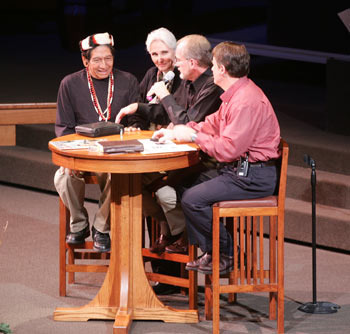
Some years ago Steve Saint and I became friends. He came to our church within a week of the 50th anniversary of the death of those missionaries, and I interviewed him and Mincaye, the former warrior who was one of the murderers of the missionaries, but who later came to faith in Christ. (In the photo, Steve is on my left and Mincaye is on my right.) I invited Steve McCully, son of Ed McCully (one of the other martyrs) to share in one of our services that weekend. (In the photo, Steve McCully is on the far right.)
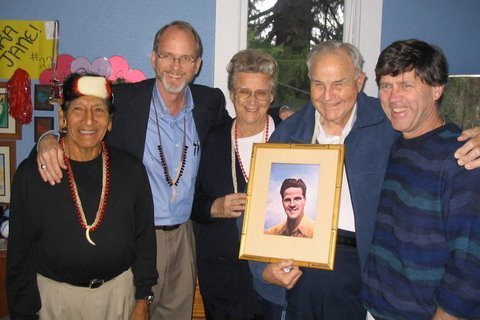 In one of God’s powerful redemptive stories, Mincaye, one of his father’s killers, became a father-figure to Steve. You can see the closeness of their relationship in this excerpt of the fifty-minute interview I did with them at my church. That same day Nanci and I went with Steve Saint, Steve McCully and Mincaye to have dinner in the home in Portland where Jim Elliot grew up. It was there that I met Jim’s brother Bert who I’ve written about, and who recently went home to be with Jesus. The time at the Elliot house, with family members of three of the five martyrs, was incredible, and unforgettable.
Another time I’ll never forget is when Steve’s mother, Marge Saint, was dying in a hospital. Marge wanted me to know how much my Heaven book had meant to her. So Steve called me, then put the phone up to his mother’s ear. On the other end of the line I heard a breathy, tired voice that spoke with an almost supernatural exuberance: “Thank you!” I wept and wept. To think by God’s grace one of my books had a ministry to the widow of Nate Saint, whose story had such a profound impact on me over forty years ago! Steve called me just a day later to tell me his mother was now with Jesus. I wept again to think about Nate and Marge Saint being reunited fifty-some years after his death.
Steve Saint founded ITEC, Indigenous People's Technology and Education Center. They develop tools, technology and training systems for indigenous God-followers to reach their own people with the gospel of Christ through meeting their physical needs (see www.itecusa.org). Steve is an entrepreneur whose flying car has captured the imagination of many. As I noted on my Facebook page, last week he was seriously injured in a test flight.
Here’s Steve Saint himself, speaking from his hospital bed. I love this brother. Even in this crisis, his mind is on God’s kingdom.
June 18, 2012
What does it mean to “love not the things of the world”?
A blog reader asked, What exactly does it mean to “love not the world nor the things of the world” (1 John 2:15)? I hear it preached from time to time, but no one seems to have the courage to tell us what that means.
1 John 2:15-16 reads, “Do not love the world or the things in the world. If anyone loves the world, the love of the Father is not in him. For all that is in the world—the desires of the flesh [the sin nature] and the desires of the eyes [which relates to the warped perspective we sometimes have] and pride in possessions—is not from the Father but is from the world.” (Pride is the root of all other sins. It is rebellion against God and self-sufficiency. It is the attitude, “I can make it on my own. I don’t need God. I’m going to do things my way. Don’t tell me what to do.”)
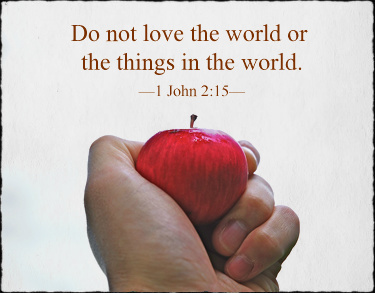 The world as it is now is under the curse of sin. This is the world we are not supposed to love. Now, we should certainly love the world as created by God. (Of course, in the beginning Eden was a perfect world, and the world to come—the New Earth—will be a great and wondrous world.) So it is not the earth we are supposed to reject and avoid (in fact we can’t avoid it), and certainly we are not supposed to hate people or culture. What we should hate is sin.
“Don’t love the world” in John 2:15 doesn’t mean “don’t love the world” that is spoken of in John 3:16, where the same word, cosmos, is used. What does “God so loved the world that He sent His only Son” mean? It doesn’t mean that God loved the sin of the world. It means God loved the people in the world. Obviously when Scripture says to us in 1 John 2, “Don’t love the world,” it’s not telling us, “Don’t love the people of the world.” Rather, it is telling us, “Don’t love the sin of the world.”
In terms of what that practically means, I think it involves not being mesmerized by popular culture. One of the negative things that I see in the American church today is its preoccupation with pop culture. It has become so much a part of us that we tend to be immersed in exactly the same things as the people around us. It’s not an inherently bad thing to watch a decent television program, go to a music concert, or enjoy some arts or sports that are decent and don’t contain anything that specifically violates Scripture. (And hopefully they have some things that not just avoid violating Scripture, but are actually in accord with it and honor it.) There are such things in our culture, and they can be very positive. But let’s face it—there are a lot that aren’t.
I think sometimes we as Christians love the world around us in a way that draws our hearts away from God. Now, of course you can love the people in the world in the right sense and have your heart drawn toward God. But we need to guard against loving the decadent, cultural elements that appeal to our sin nature, pride, and independence. These things are not pleasing to God.
I think that’s really what 1 John 2 is saying. I don’t know that it takes a lot of courage to say that we should avoid being captivated by the world, but it does take courage to actually live out those words. One way we can begin to do that is by asking ourselves, “What are the novels I’m reading?” “What are the movies I’m watching?” “What are the things that preoccupy me?” “What are the things that I talk about?” “Am I proud of my favorite professional, college, or high school team and willing to talk about and defend that team, and yet am ashamed of the gospel of Christ?” Something is fundamentally wrong if we won’t talk to people about Jesus with any kind of passion and enthusiasm like we talk about a sports team or a movie or a TV program. Those things can become idolatrous. The passions we invest in other things should be directed to Jesus.
 I think the warning of 1 John 2:15-16 corresponds beautifully to the last verse of 1 John which says, “Little children, keep yourselves from idols.” An idol is any God-substitute, anything we make bigger than Him. If we take some element of popular culture—whether it’s our leisure, pastime, hobby, or special interest in sports or arts or music—and make that an idol instead of serving the Lord, it becomes our god. We are set in orbit around it, and God becomes secondary. Idolatry is when God is removed from the throne and something else is put in His place. But God must always be primary.
So we should ask ourselves, “Is anything more important to me than God?” If it is, it is an idol and should be taken down. We should also ask ourselves, “Is this activity that I’ve been involved in or place that I’ve been going to contaminating me by tempting me toward sin and helping me be entertained by sin? Do I find myself laughing at a joke that should make me cringe?” If it’s something that makes God in His holiness angry, and calls upon the wrath of God in judgment, why would we desire to be entertained by it and laugh at it? That’s why we should examine our hearts and get on our knees before the Lord. We need to seek His forgiveness and ask Him to convict us of areas of sin in our lives not when we’re loving the beauty of God’s world or the people of the world, but when we’re loving the world’s idols instead of loving God.