
Caitlin Hicks's Blog: Book Reviews, page 22
February 28, 2015
My favorite book this year!
I have spent most of my adult life in another country, thousands of miles from my family of origin. And yet, daily I sift through the myriad of details of the time we shared while I was being formed into a person.
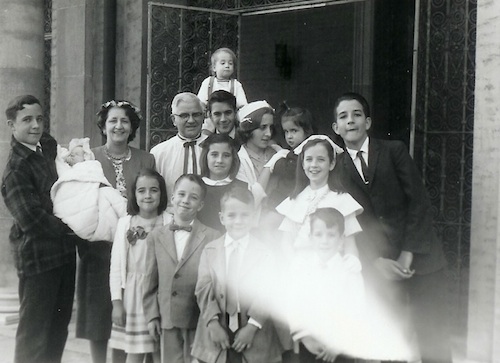 It only takes an instant to blink in the light of another day and understand how much time has passed since then. When I last counted the nieces and nephews born in the generation that follows mine, there were 42. Most of these offspring are grown; I have missed their births, their first communions, their passage into adulthood, their entire lives because I fell in love with a Canadian.
Yet through the years I have nurtured this fantasy. That I just want to be with them. That we miss each other’s company. That we understand how connected we are, and that we know how to love each other.
* * *
“I just finished (A Theory of) Expanded Love, and thought it was just WONDERFUL!!! My favorite book so far this year, and probably will be for the whole year. I know it will do well. Congratulations!”
-Deborah Hining, Writer, A Sinner in Paradise
*IndieFab Book of the Year Bronze Award Winner * Benjamin Franklin Awards Silver Medal Winner
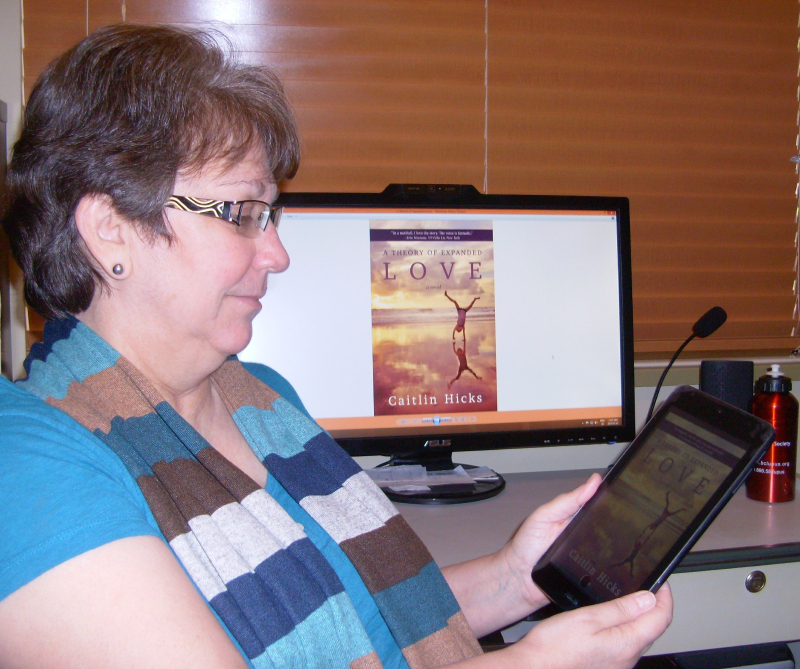 “I love Annie
for who she is.”
“A Theory of Expanded Love is enjoyable from beginning to end and all the while I love Annie for who she is. The ease in which the author is able to include so many characters without confusing the reader is a testament of her writing ability. The story flows seamlessly. It is in every way a true to life experience worth reading. . . It leaves me wanting to know the next chapter in Annie’s life. . . I await the author’s follow up book.
– Yvette Fleming (Complete review on Goodreads)
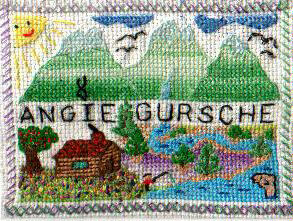
“Brilliant”.
“Through Facebook, I came upon a request to review a book and am proud to say that Caitlin Hicks http://www.caitlinhicks.com/wordpress/the-theory-of-expanded-love/ is a wonderful author.
“The novel, “A Theory of Expanded Love”, is brilliant. Caitlin Hicks’ writing clearly paints pictures to the imagination. The periodic timeline of events and Catholic culture are great assets, as is the challenge Annie faces, of going against her parents, for what she truly believes to be the right thing to do. Loved every minute of the book and was sad to see it end.
“This novel will make a great movie.” Angie Gursche


February 6, 2015
Today’s review “Je suis Annie”
 January 25, 2015
“All the betrayals — the tiny and the monstrous – that define the coming-of-age narrative have come together in Caitlin Hicks’ latest work, “A Theory of Expanded Love.”
“I took on this review as I take on many projects – an impulsive response that the next morning seemed more chore than delight, but five pages into the story I was enraptured.
“Hicks distills God, love, politics and family to their essence through the eyes and ears of Annie, the insouciant centrepiece of an early 60s fleet of Catholic navy brats. Yes, I’m a middle-aged, male atheist, but Hicks made me feel for a time that, “Je suis Annie.”
“To be clear, A Theory of Expanded Love is not a Young Adult novel. Its narrator might be twelve, but the doubts and pain and resolutions Hicks explores through Annie’s voice speak carefully, fluently and deeply to those of us all.
“You will read this book. If not now, you’ll be tempted next year by the awards it garners; if not then, its movie adaptation will finally woo you . . .”
Gord Smedley, journalist
Heidi Ferber
 “Just wanted to send a quick note telling you I am absolutely enjoying your book. You are hilarious and would love to pick your brain . . .
“By the way, have you ever read A Prayer For Owen Meany by John Irving? It is one of my all-time favorite novels and it, too, centers around faith and youth. You should have a read. I think you would enjoy it as your book reminds me of it.
“I can’t believe you called Africans pygmys. Oh my lord. That nearly sent me over the edge.
“What a riot.
“Loving this and very happy to be reading your creation,
“Feb 6, 2015 - Just want you to know, Caitlin Hicks, that I was in tears last night busting a gut. Seriously. Spitting vegetables into your milk?! . . . LOL. #sequel? – Heidi Ferber
Today’s reviews for A THEORY OF EXPANDED LOVE
January 25, 2015
“All the betrayals — the tiny and the monstrous – that define the coming-of-age narrative have come together in Caitlin Hicks’ latest work, “A Theory of Expanded Love.”
“I took on this review as I take on many projects – an impulsive response that the next morning seemed more chore than delight, but five pages into the story I was enraptured.
“Hicks distills God, love, politics and family to their essence through the eyes and ears of Annie, the insouciant centrepiece of an early 60s fleet of Catholic navy brats. Yes, I’m a middle-aged, male atheist, but Hicks made me feel for a time that, “Je suis Annie.”
“To be clear, A Theory of Expanded Love is not a Young Adult novel. Its narrator might be twelve, but the doubts and pain and resolutions Hicks explores through Annie’s voice speak carefully, fluently and deeply to those of us all.
“You will read this book. If not now, you’ll be tempted next year by the awards it garners; if not then, its movie adaptation will finally woo you . . .”
Gord Smedley, journalist
Heidi Ferber
“Just wanted to send a quick note telling you I am absolutely enjoying your book. You are hilarious and would love to pick your brain some more when we visit.
“By the way, have you ever read A Prayer For Owen Meany by John Irvine? It is one of my all-time favorite novels and it, too, centers around faith and youth. You should have a read. I think you would enjoy it as your book reminds me of it.
“I can’t believe you called Africans pygmys. Oh my lord. That nearly sent me over the edge.
“What a riot.
“Loving this and very happy to be reading your creation,
“Feb 6, 2015 - Just want you to know, Caitlin Hicks, that I was in tears last night busting a gut. Seriously. Spitting vegetables into your milk?! Next time we sup, I’m watchin’ you like a hawk. LOL. #sequel? – Heidi Ferber
February 4, 2015
Years later, at dusk
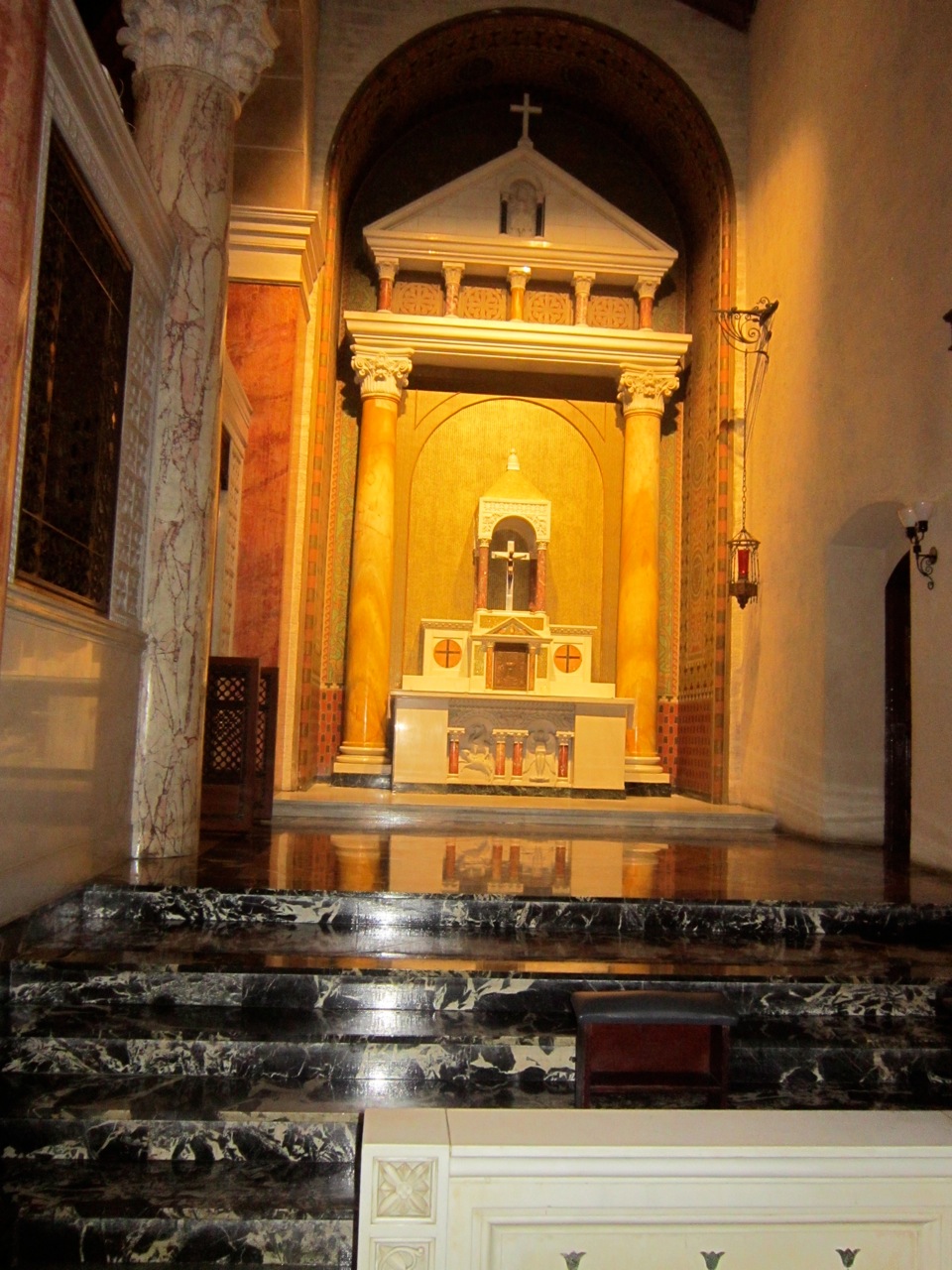
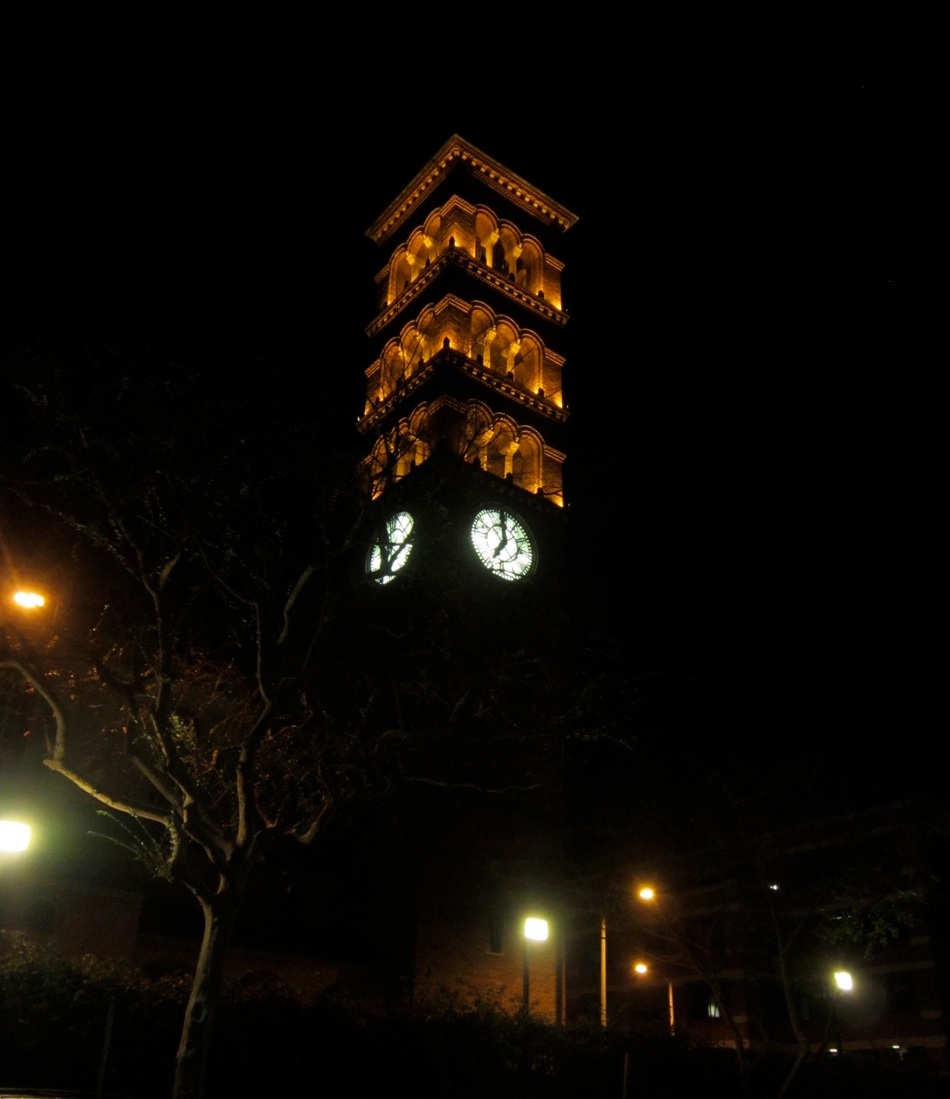 The streets of the town, the halls of the school, the tower, the marbled floors of the church. An instant view and every detail floods back into familiarity. I spent eight years of my early days, my young formative days here, within these walls, surrounded by the marble of this magnificent church, in the balmy, often smoggy Pasadena air. Today, as a tribute to my journey, a parallel reminiscence for A THEORY OF EXPANDED LOVE. It’s an exciting time, as reviews are coming in.

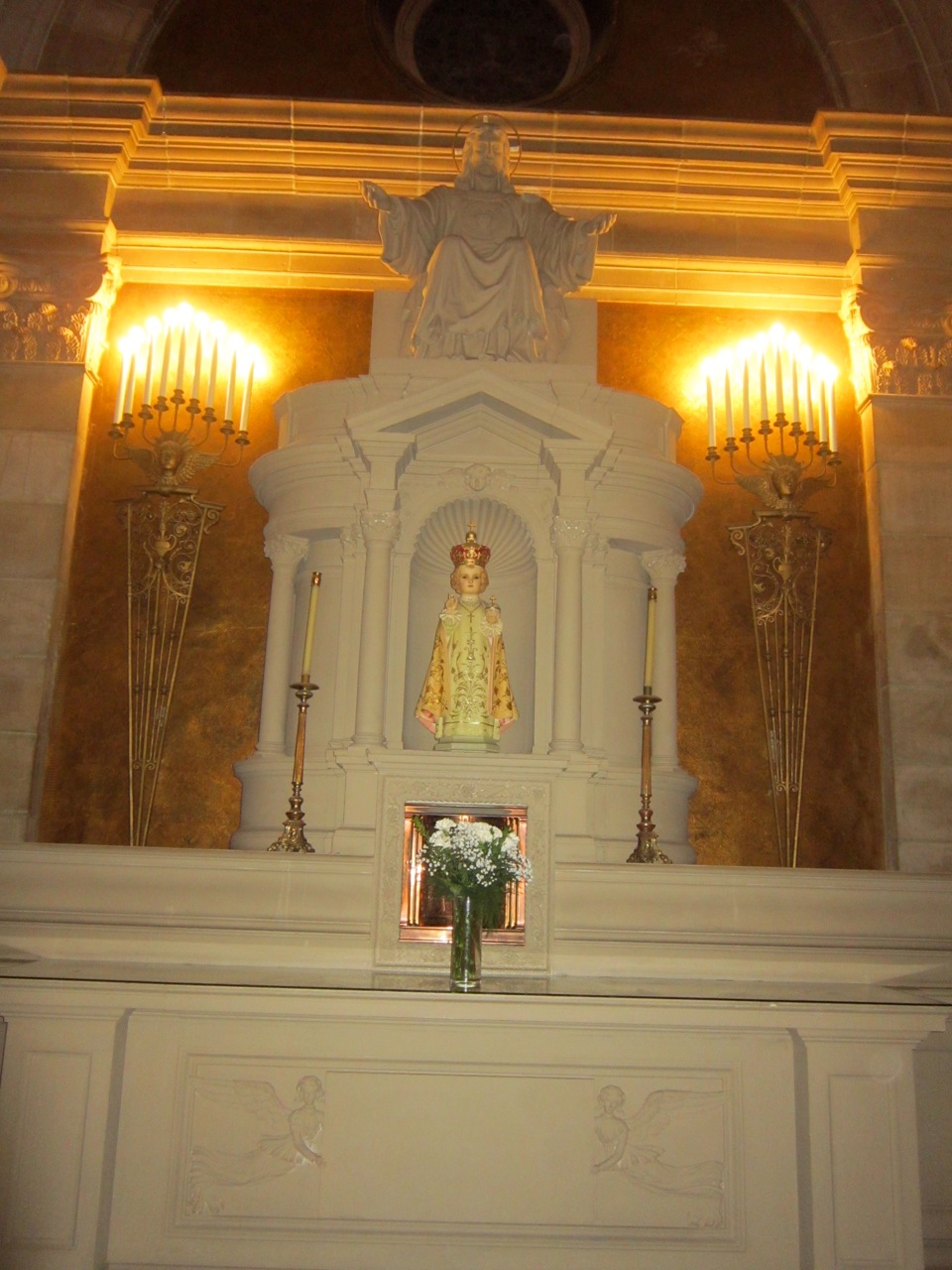
I can’t believe how beautiful, the church. Cool shiny floors, four altars on the sides, three at the front, everything in marble and gold. The most amazing thing was, in all the time I spent wishing and hoping in church for the blessing of God, I had never noticed that the huge columns on the sides surrounding the pews were each made of different colored marble. I could only observe from a distance.
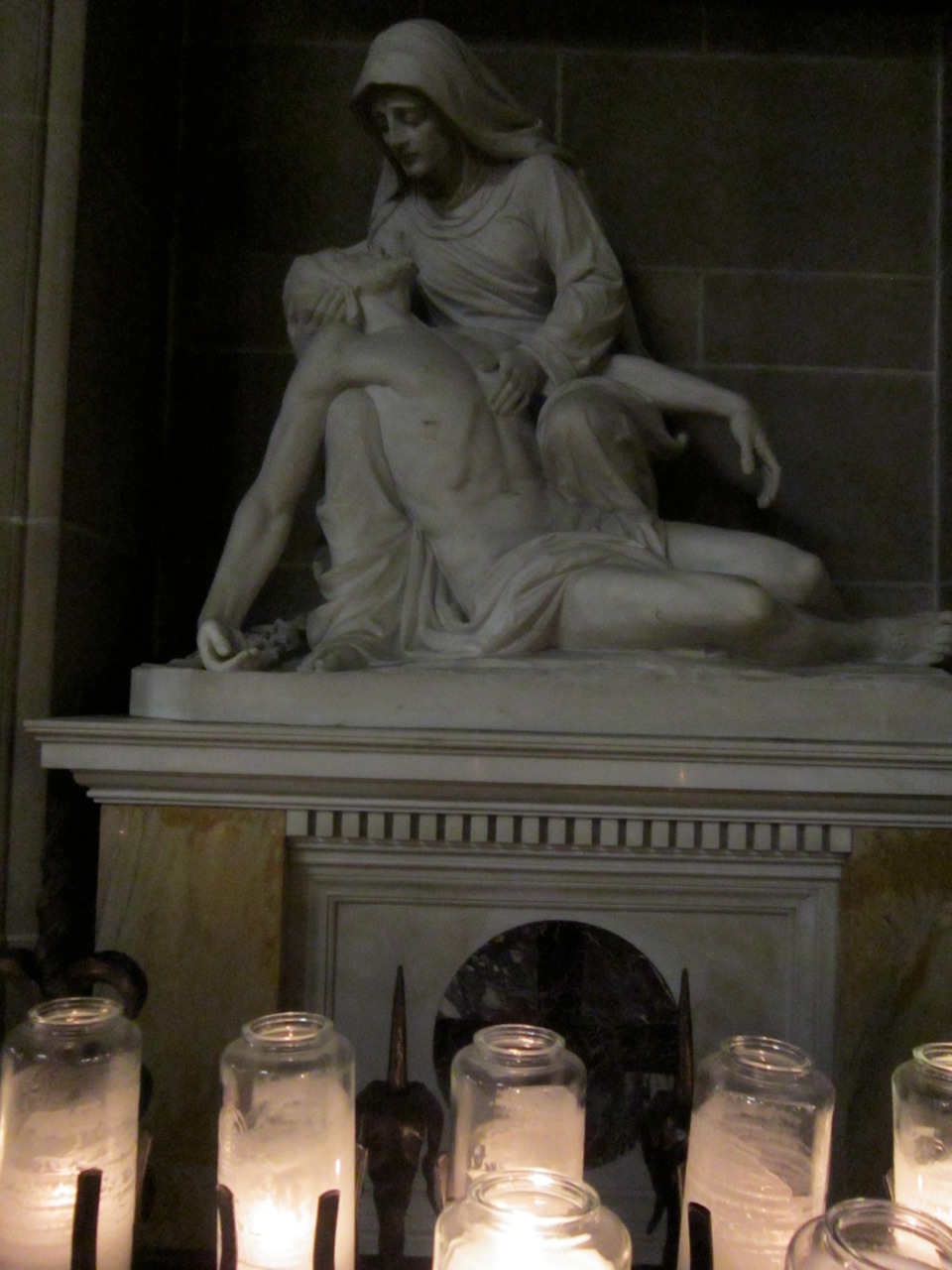 The streets of Pasadena surrounded us. Changed. Storefronts elderly at the time replaced by chain link fences & freeway roadways. And yet. The soles of my shoes walked the same sidewalk outside St. Andrew’s where I stood on my graduation day from 8th grade with Sister Jeanne Dolora. Blushing with youth, adventures not yet imagined. And now, the concept of time so difficult to grasp.
We went to Vroman’s Bookstore. After all. The novel itself takes place in Pasadena. And here’s an early fan:Dayna Bartlett of (Walter Hoving Home for Women) outside Vroman’s Bookstore with a copy of A THEORY OF EXPANDED LOVE.
A recent review:
“Hicks takes the reader into the special world of a devout California Catholic family. But wait! Don’t go! This novel is driven by the first-person narrator known as Annie, a sassy and smart 12 year-old upon whose flat chest (she’s the one complaining about it!) you want to pin a medal for being so damned perceptive and belligerent and especially for deploying so many crack Saxon verbs that make you sit up and say, Whoa!—this chick is going to cut through life’s smog and get noticed, if her father doesn’t smack her senseless, which he tries to do, but to him I say, Good luck. Wow, having just finished the book, I feel like I better understand about a billion more people on earth.
“Hicks has created a story rife with domestic tension, and although not all the promises of disaster pay off, there are myriad that do. Hicks brings us real life, and by that I mean the human condition, and by that I mean characters struggling to be free. Problem is, each character is on a different trajectory to find this freedom, and if that doesn’t make for good drama, I don’t know what does.
“Hicks sets her story in the era of the Pope John’s death and the Kennedy Assassination. We all know what we were doing then and what we felt like and how innocent we were, and how deluded and naïve we were, and helpless and rebellious and fed up with authority, which pretty much puts us in Annie’s skin. So, is this a young adult novel? It deserves to sell well as YA or adult fiction. Any book with a protagonist whose antics are seared into a reader’s memory is going to be enjoyed by many.” Writer PJ Reece
 An early review:
“Does the reader need to be one of thirteen children of a near-destructively religious family in post WWII America to get lost in the trance of the period reality that Caitlin Hicks conjures in her coming-of-age tour-de-force? The answer is irrelevant to the pleasure and horror of consuming this book (that’s what you will do – consume it, inhale it, ingest it). In the same way that you don’t have to be a Huck Finn (or a Jim) to be immersed in Mark Twain’s recounting of Huck’s “Adventures”, you don’t have to be penitent Clare for Hicks to make you cry for the injustice of Clare’s fate. Or to be Jude, to share his infantile discoveries, or Madcap, to be swept away by romantic passion, or Mrs. Shea, to bury her doubts over misguided motherhood in order to keep the marital and familial peace.
“Hicks leads you into and guides you through the story by means of the eyes and mind of Annie Shea, a pre-teen torch in a family of torches. Some of the Sheas may disguise themselves as votive candles in their slow moments, but they are all torches when the fuel is poured on. And there is a great deal of fuel, indeed.
“Yet, in the end, it is not Annie’s eyes, or brain or mouth that brings her story over the finish line with grace and power and love . . . it is her heart. Hicks bares Annie’s heart again and again and again and in doing so, the reader’s as well. . . It’s fucking BRILLIANT!”
– Lance Mason, Independent Health Professional, Santa Barbara, California
January 23, 2015
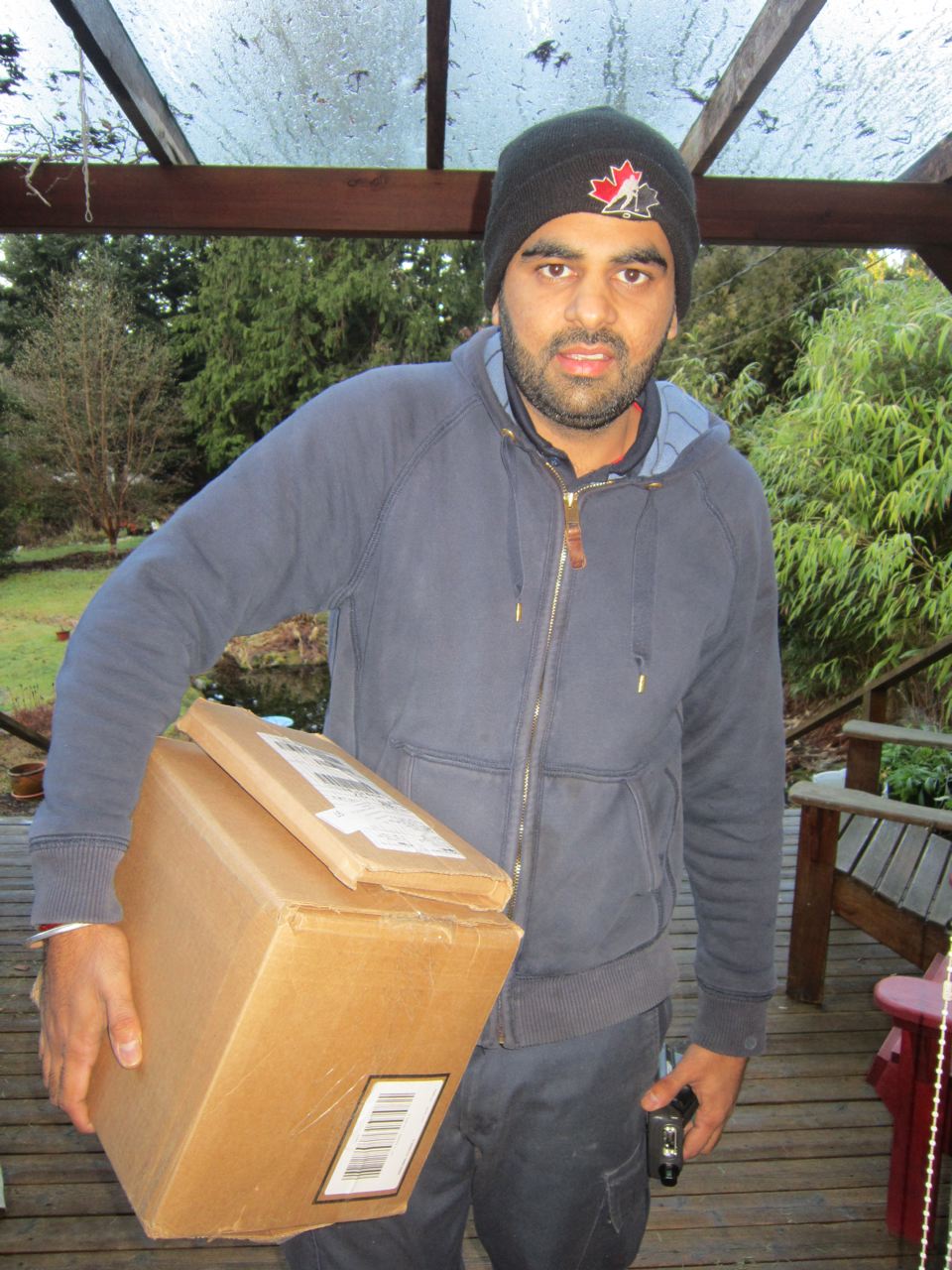
Look what Purolator Guy brought in!
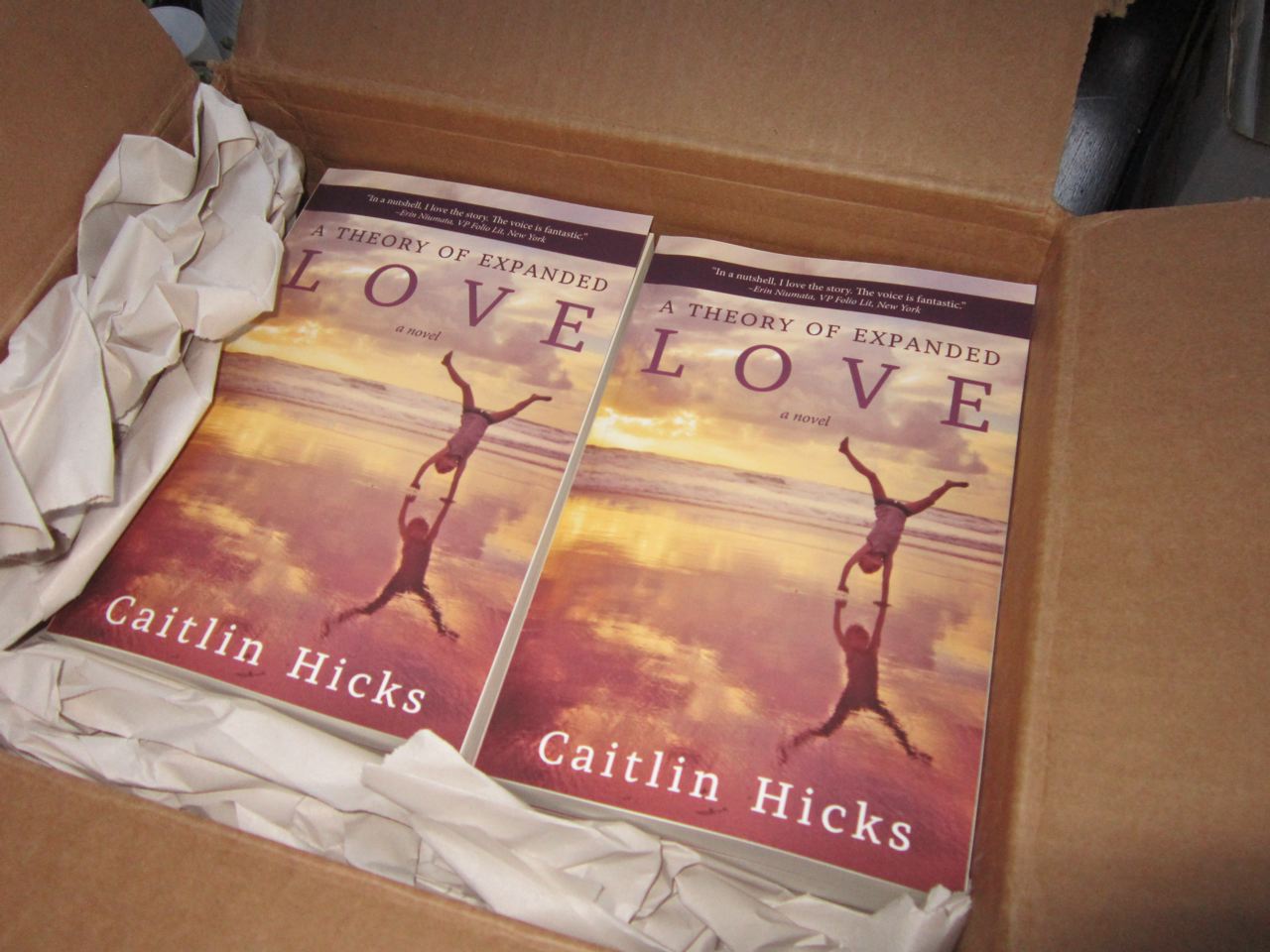 An early morning event in the soft sound of tires over gravel outside the window. We work at home, so a visitor, even in the early morning, is always welcome. I looked through the slats to see a huge, white truck in the driveway.
“They’re here!” I shouted to Gord, facing his computer screen, who could only hear the film inside his editing earphones. I took the steps downstairs two at a time. Purolator Guy trundled up the porch, knocked on the glass and instantly I pushed open the door.
Here he was, bewildered by all my jumping energy. His name is Honey. I signed the screen and carried the box inside. What a moment!
 This was the moment I could feel the inevitability of my own determination. Because the energy had carried: when I finally decided this was what I wanted to do, when I kept making that decision in the face of delay, in the face of rejection, the outcome became inevitable.
But it wasn’t just my it’s-about-time steely resolve. It was the generosity and peanut-gallery egging on from friends and gracious nudging from strangers.
For example, I thought about the suppers with friends who hosted readings when the book was only a string of chapters; of my avid-reader cousin Aggie who nurtured me through our email connection, even as she lay in bed, unable to move; how they all laughed, just daring Annie to be saucier and quirkier and bolder. This was a character they loved.
I thought of my writing group Three Annies; each of us working on a novel, each at a different stage in the writing/editing/publishing process, each with an ‘Annie’ in our name. How one argued against a phrase, the other for it, until I had to decide myself.
 I remembered my elation, the validation I felt at reading the first response from Erin Niumata, an experienced New York editor and agent when she read an early manuscript, “I read it three times. . . I laughed out loud; it was a joy!” and much later the rejection letter from Vicki Williams at Talon Books, words of encouragement — so welcome at the time that I memorized them: While your manuscript is not the sort of thing we publish, it is the sort of thing I read, and I really like it! Therefore I would like to see it published, not only because I would like to read more of Annie’s exploits and influences, but, because I think it could do very well.
 I thought about the revisions and editing, about the open-hearted readers/writers/editors/bloggers, some whom I had never met, who agreed to read and review – so I could attract a publisher. I thought about how I finally, after a year and a half, received interest from three publishers – around the same time – and finally heard the purpose and desire in the voice of the one I ultimately chose, a small, family-run publisher, where I wouldn’t get lost in the crowd. (There’s nothing that perks up the ears of a writer like someone you’ve never had a conversation with, saying “We’d like to publish your book.”)
I thought about the stacks of files filled with profiles of agents and publishers, my letters to them; some kind encouragement but mostly their rejections, and how great it felt to tear apart those files and recycle all that effort.
I thought about Gord’s coaching, when I stalled because of the contract — and almost threw it all away, just as I was about to grasp the ring.
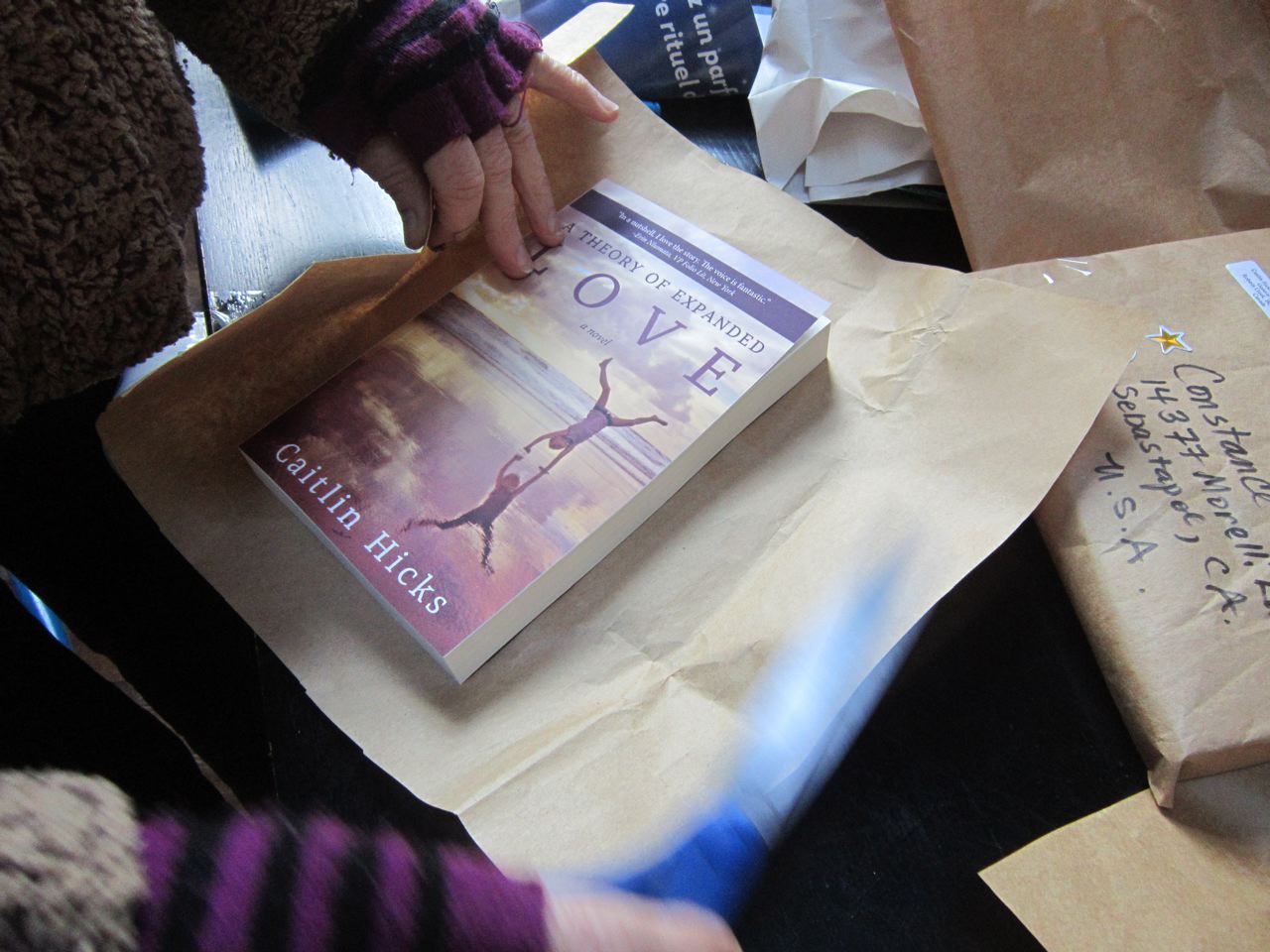
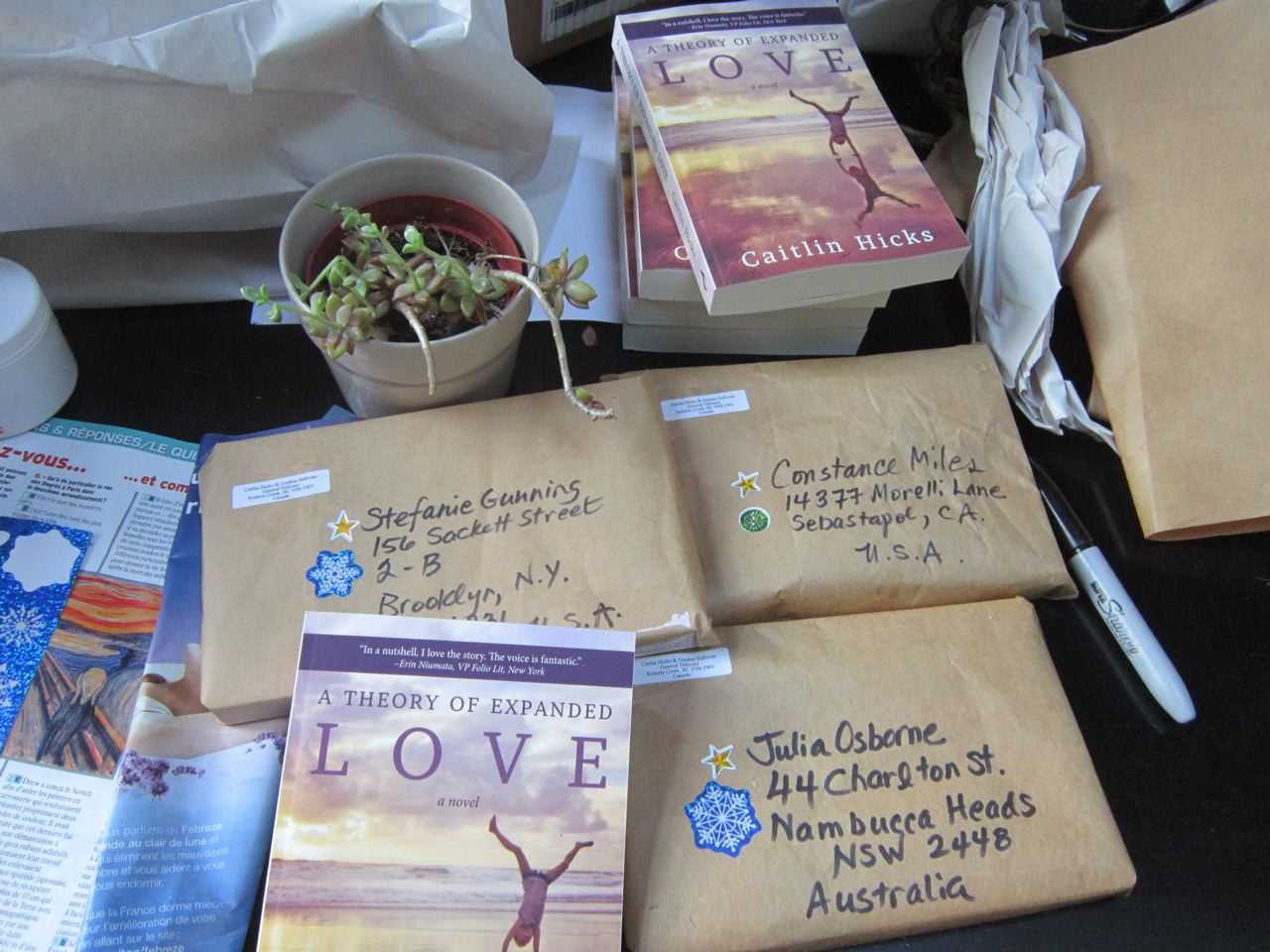
Today my editor talked about the trailer, how she wants Gord and me to ‘tweak’ our creation before it becomes the official trailer. Then she told me about how on Friday, January 23rd, the Advance Review Copies of A THEORY OF EXPANDED LOVE will go out to all the trade reviewers. A momentous occasion in the life of a writer.
But yesterday, it was a day of small moments to cherish. (We don’t make a lot of money in the arts, but we do have these ‘moments’). Here’s another. (I’m going to set up this one for you) Wally & Betty Turnbull are the mom and pop of this family-run publisher, Light Messages.Their daughter is Elizabeth, the editor. Together with other professionals, they have been publishing since 1998 and now put 5 – 6 new titles a year into the world. Betty is the Iron Fist who deals with contracts. Elizabeth is the sweetheart who has the great relationships with authors. ARC = Advance Review Copy.
HERE IS BETTY’S COMMENT:
“Date:
January 21, 2015 9:53:51 AM PST
Subject: in a pickle
Caitlin,
I purposefully do not read our upcoming titles until the ARC has been printed. I do this for numerous reasons, one of which is to leave the Elizabeth’s editing relationship with the author, just that – their relationship. I keep my relationship with the author to details and management.
Well, now I am in a pickle. I began reading A Theory of Expanded Love on Sunday. Had to stop to get some work done. Woke up early this morning and read some more. And now am stuck in the office doing office things when I really want to be reading and finishing the book!
Well done. It’s a great story. Can’t wait for its release and to see good things happening.
Betty
!!!!!”
I know there are more to come. I know this is just the beginning. 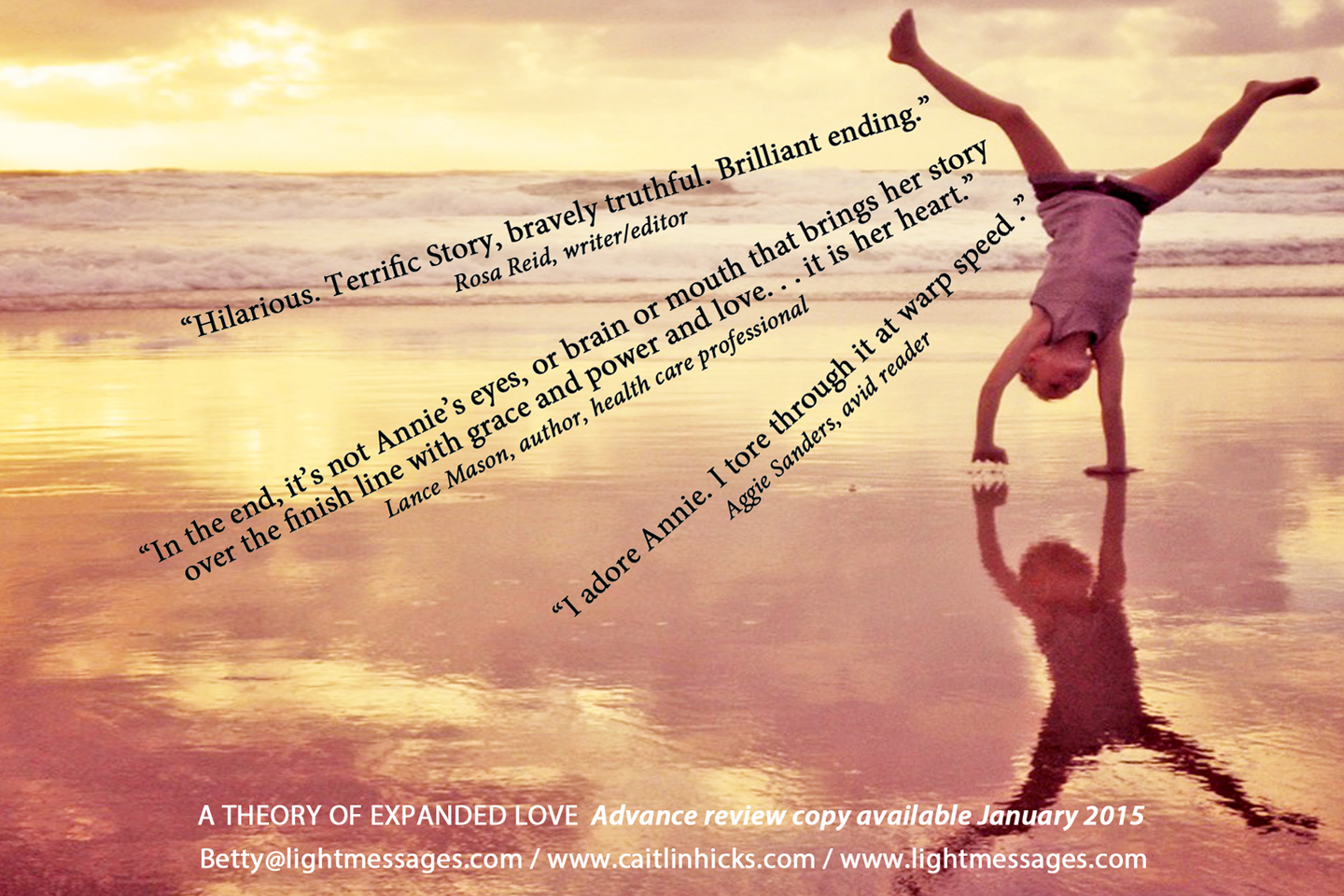
January 2, 2015
Where is your light this year?
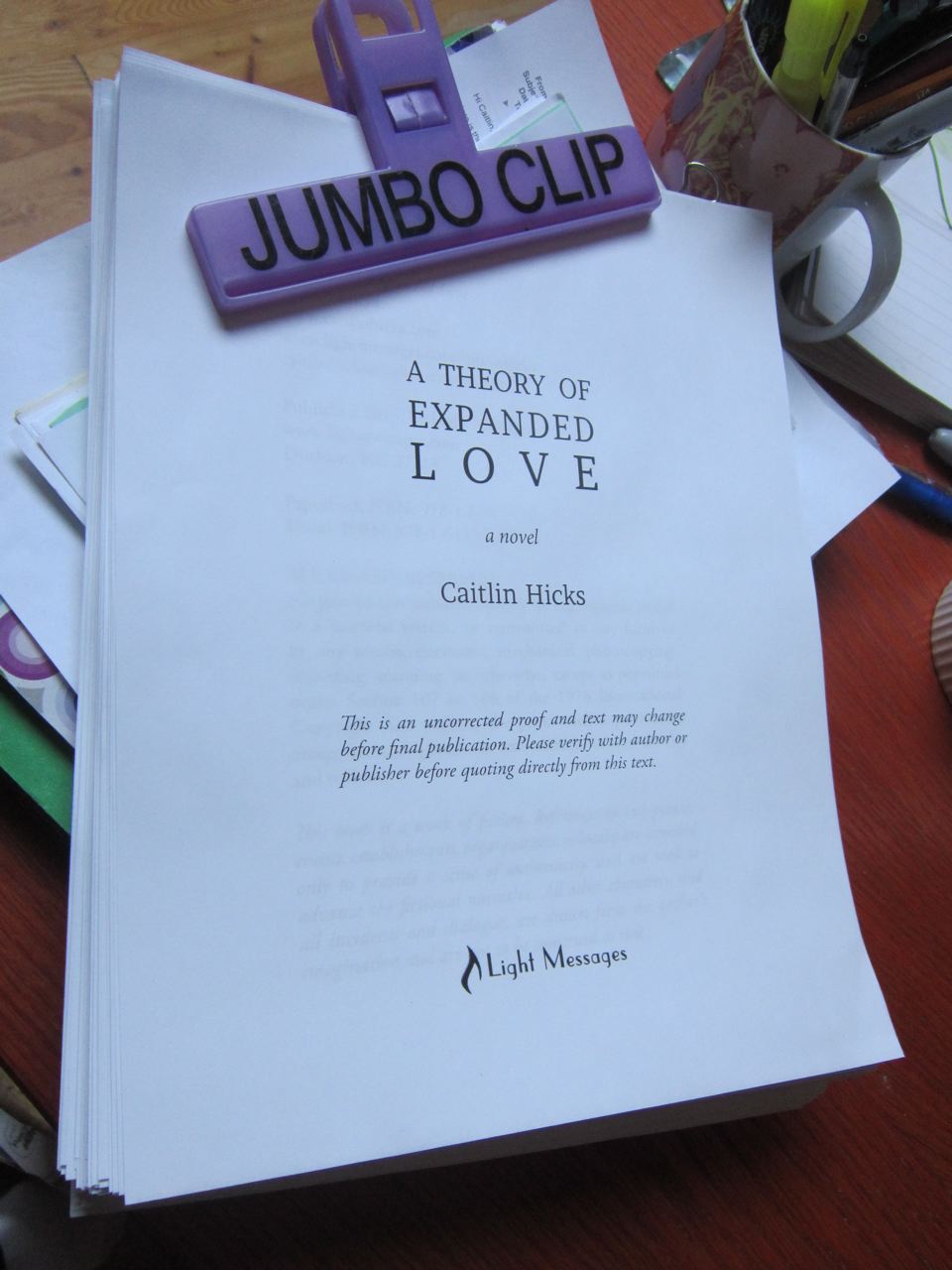
It’s New Year’s Day, the day we mark the quick gallop of time. It feels like everything is about to change. Last year at this time my determination focused on getting a publisher. Today, with a publication date firmly on the calendar for June, I hold the book in my hands, printed on my home printer from the typeset document my publisher sent me. A Jumbo Clip to holds it all together, but it looks beautiful to me.
Now we have to get it into the world.
It’s 3 PM, almost time for our hand-made boats to go out on the harbor with candles and our New Year’s wishes. Today, I have to ask myself: what does all this mean to me?
 My decision to go with a traditional publisher followed my desire to get my work into the world. As a playwright and performer who came lately to these professions, I largely carved out my audiences myself – one envelope, fax and phone call at a time – well before social media. Although we toured areas of the US, Canada, England and Ireland to standing ovations and excellent reviews (www.fatsalmon.ca), although our film SINGING THE BONES screened around the world, I still felt that my light flickered under a bushel. I felt part of a world of my own making, but not part of the world outside.
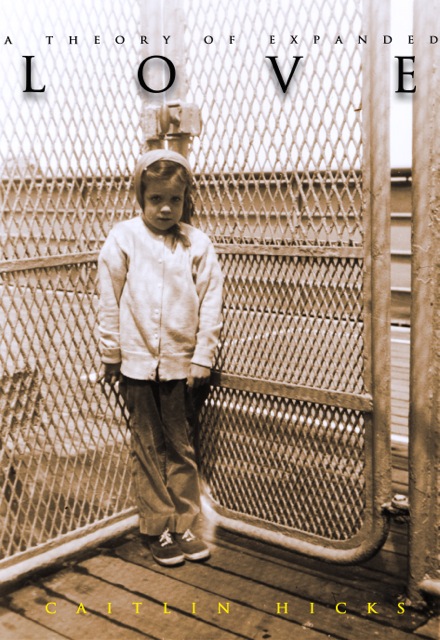
Since signing the contract in August (no easy feat!), I’ve learned to be more patient, to await the decisions of others. To accept that I don’t have complete control over a project I have created. I’ve learned to turn to friends to understand that a cover I did not choose could work for my book. In my choice to get my work into the world, I have to rely on and trust others to help me.
But at this complex, emotional time of year, I know in my heart that the novel itself, A THEORY OF EXPANDED LOVE is in many ways, a love letter to my family, and Annie is the courageous, quirky character I wish I could have been when I was twelve. The story is fictional, colored with authentic details of living in a huge devout, Catholic family in the Sixties. When I was 25 I wanted to be a writer, but I knew I had no perspective. On January 1, 2015 the perspective gained from a lifetime of lessons is woven into my story. My life separated from my family of origin. Of being different from them. But loving them just the same.
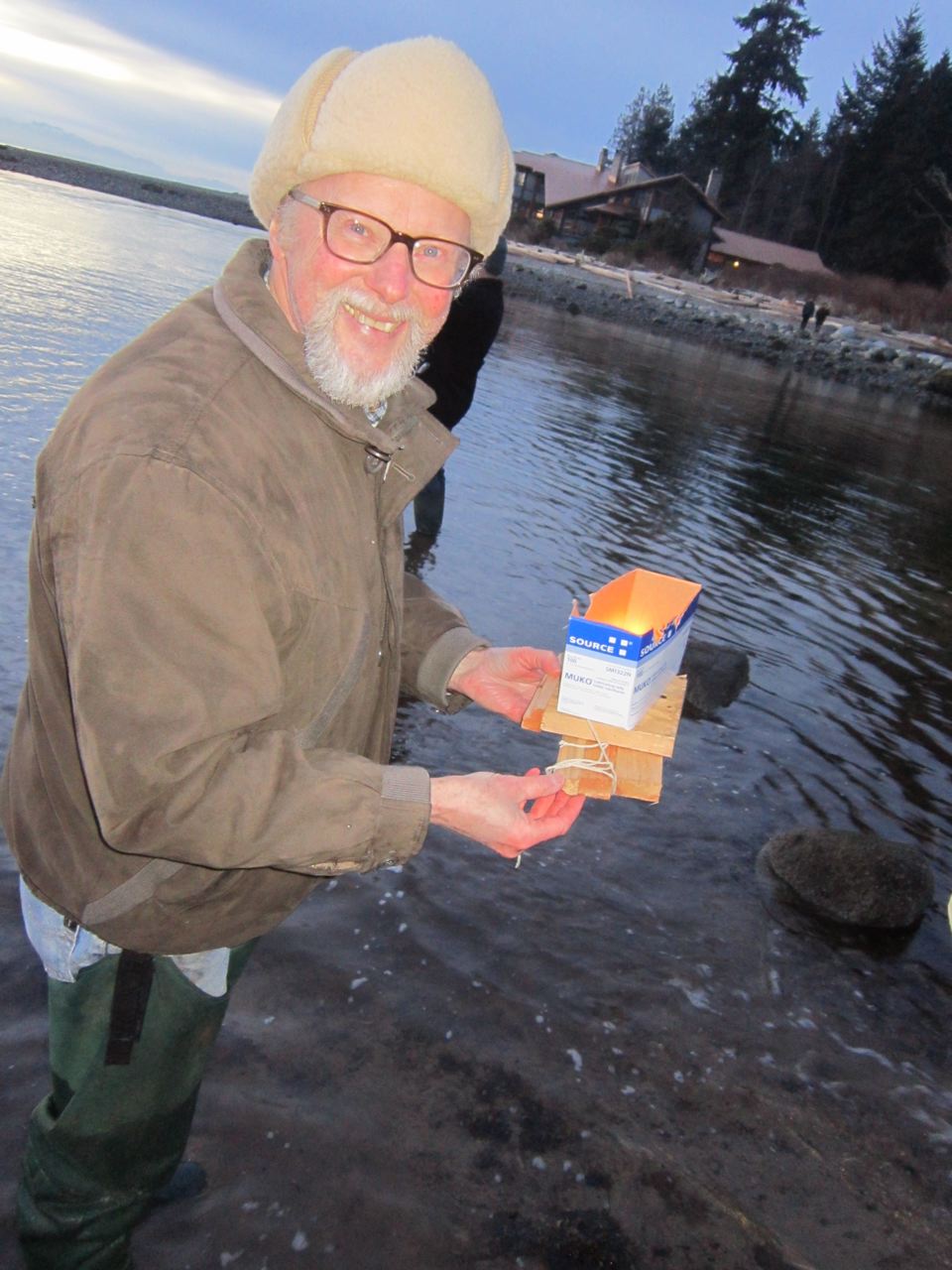 This year, miles and miles from my family of origin, but close to the family of most of my life, at dusk, as the community gathered in our yearly ritual, I chose ‘good health’ as my wish for 2015. As serendipity would have it, Andreas Schroeder, a well-known author and professor of creative writing, offered to put my boat in the water. And then he did. He waded into Roberts Creek and pushed my little wooden cardboard-and-string boat, with my wishes out to sea, into the world.
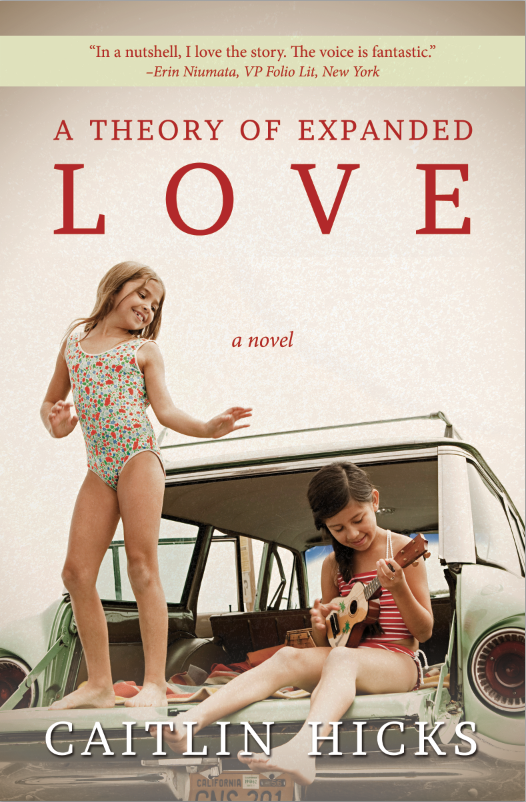
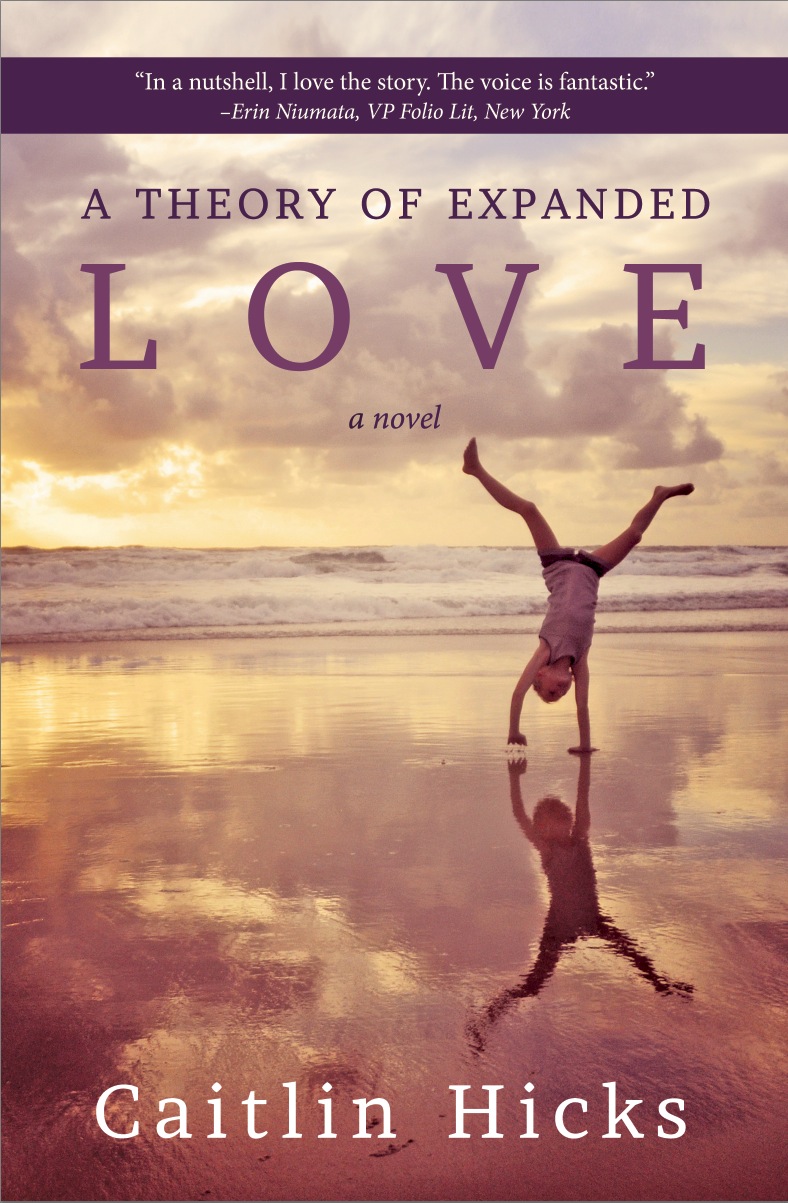 After a ‘poll’ of friends in person, on Facebook and email, I received about 116 votes for ‘the cartwheel’ and 67 votes for ‘the girls on the back of the car’. Everyone who voted, voiced support and interest. The publisher independently chose the cover that won the vote.
THIS MONTH Light Messages is sending out Advance Review Copies for people who would like to read A THEORY OF EXPANDED LOVE, and who promise to review it. If you are one of those people, please contact me at caitlin@caitlinhicks.com with your email, phone and mailing address.
A THEORY OF EXPANDED LOVE is a coming-of-age story featuring a feisty yet gullible adolescent, trapped in her enormous, devout Catholic family in 1963.
Surrounded by twelve brothers and sisters, and desperate for attention, Annie creates a hilarious campaign of lies when the pope dies and their family friend, Cardinal Stefanucci, is unexpectedly on the short list to be elected the first American pope. Driven to elevate her family to the holiest of holy rollers in the parish, Annie is tortured by her own dishonesty. But when ‘The Hands’ visit her in her bed, when her sister becomes pregnant “out of wedlock,” Annie discovers her parents will do almost anything to uphold their Catholic reputation. Questioning all she has believed, and torn between her own gut instinct and years of Catholic guilt, Annie takes courageous risks to wrest salvation from the tragic sequence of events set in motion by her parents’ betrayal.
December 11, 2014
Imagine Success
In less than fifteen days I will begin working with my editor/publisher on final edits for my novel, A THEORY OF EXPANDED LOVE.
This is a project I’ve been juggling (among the other balls I have in the air), with determination and the assistance of several other writers in my weekly 3 Annies Writers Group – for the past two and a half years. Sometimes, I can’t believe it’s actually going to happen. I wrote the novel quickly, in less than a year, and made revisions according to a New York agent for the next six months, until I realized that her direction towards change was not really needed – the novel was pretty solid as originally written.
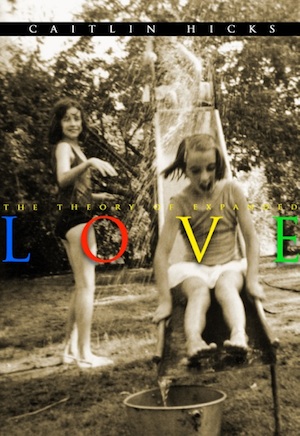
That’s not to say I didn’t change anything, I did. Every time I sent a query, every review or criticism I received – I re-worked the novel, the query, tightening, tweaking, refining.
I started with agents. I researched each one, the kind of books they represented, their successes, even the titles that I felt were similar in some way to my novel. Their responses were all over the map, ( some encouraging words, a few connections!) but after stacks of rejections, or queries simply ignored, I realized that the world of books has expanded greatly and that once again, my book, my effort, was just another grain in a pile of sand.
I’m always getting these parallel reminders that I was born, just one, in a growing family that eventually became very large. All my life, I have been keenly aware that I am just one of many and in order to be heard, I have to amplify my voice. Somehow.
The world now hosts 7 billion people, more than doubling since 1963 when my story takes place ( There were 3 billion then). In 2012, self-publishing increased books by almost 400,000 per year; and trade publishing is flourishing, despite a radical change in the industry.
While I was writing my novel, I was invited to read chapters of it at dinner parties to friends, and so got the confidence in its value. I sent it to my avid-reader cousin who does not mince words; she loved it. When I sent it further afield, to writers, editors and others who had nothing to do with publishing, and little to do with me, I was surprised to discover that most who read it didn’t just like it, they loved it! So I was emboldened to send directly to publishers. Since my novel is truly a California story, I knew I needed a US publisher.
By the time I signed with Light Messages Publishing in July 2014, there were two other publishers in the conversation with me and very interested, but Light Messages immediately saw the cross-over appeal of THEORY into 3 separate markets – and was ready to fast-track my book for a May 2015 publication date.
Many athletes and performers have their talismans; their gestures of good luck, their prayers for success. My way has been to envision the future that I want, to put the picture of my success under my pillow, just before I go to sleep.
By day, I have a bank book, that I change every January and where I record every deposit for the year. As an artist it is an important focus, because in order to keep creating, I have to have reliable streams of income to keep me afloat. This year, I pasted the interim cover (that my award-winning artist husband designed for me) for A THEORY OF EXPANDED LOVE onto this deposit book. 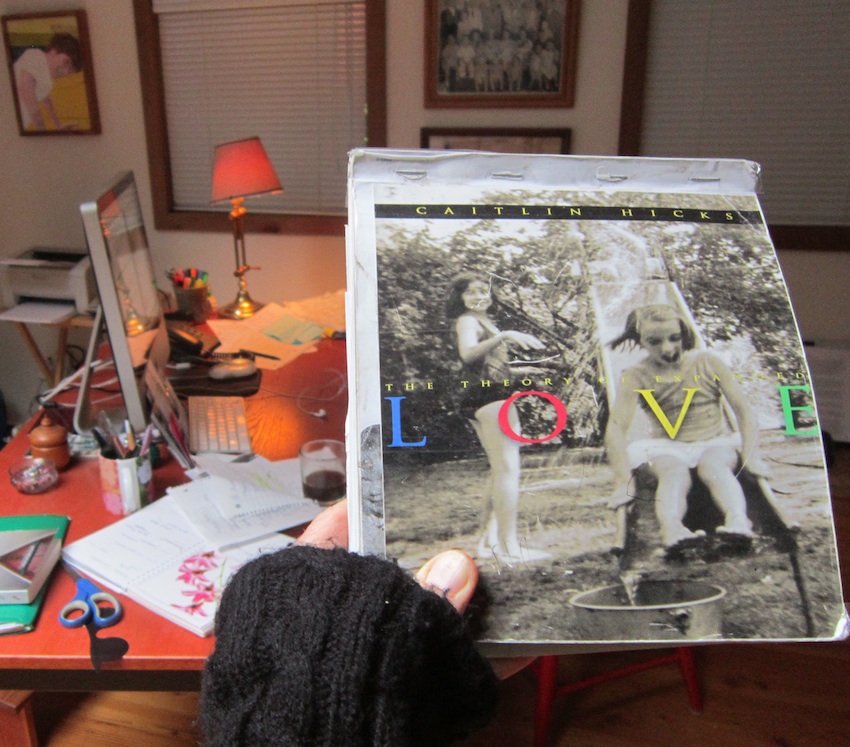
The journey of this past year and a half has been up and down. But every once in a while, something really great came back at me. Here’s my favorite rejection letter ever from a Vancouver publisher who wasn’t right for the book at all:“While your manuscript is not the sort of thing we publish, it is the sort of thing I read, and I really like it! Therefore I would like to see it published, not only because I would like to read more of Annie’s exploits and influences, but, because I think it could do very well.”
So tonight, I go to bed, dreaming of a best-seller.
www.caitlinhicks.com/wordpress
November 9, 2014
A visit for Remembrance
When I was 21 years old, preparing to travel to Europe for the first time, my Mother whispered a request: to get her a photo of the grave of her childhood sweetheart in a cemetery in France. This is the true story of how, years after she died, I finally got the photo, and came to understand its importance.
THIS STORY was published in the Milwaukee Journal Sentinel in 2003 and on Smashwords to 5 star reviews. It inspired an aspect of my novel A THEORY OF EXPANDED LOVE, due to be published in May, 2015.
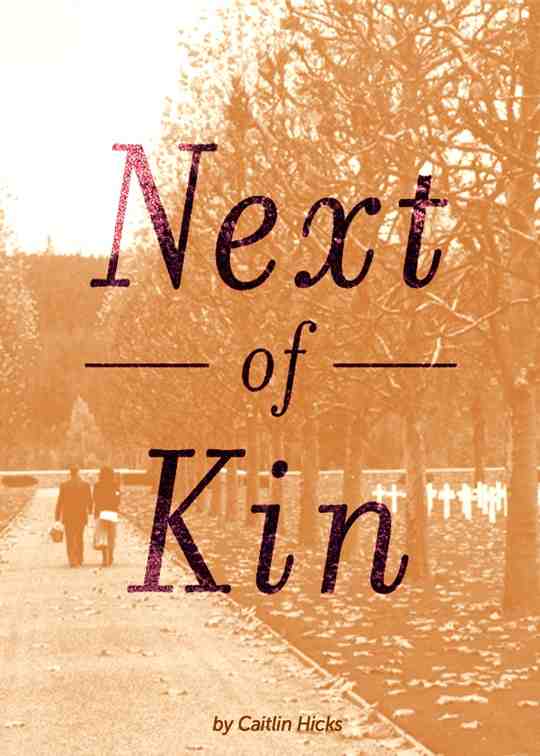
This is a story that began and ended before I existed. All the words were spoken, the songs sung, promises made, kisses, letters, flowers and telegrams — all just a memory before my parents even met. Yet, after they loved and married and I materialised, six births later, the story carried on in my mother’s heart. Even now, long after my mother’s heart has stopped beating, the story carries on in mine.
When I was fifteen, my sister Mary showed me a newspaper clipping she found in Mother’s cedar chest in the tool shed. On a smoggy summer Pasadena day, Mary had lured me into the cobwebbed darkness, with the promise of a really good secret. We scurried past Mother on the back porch, standing in the midst of huge piles of dirty laundry, pouring soap into the washing machine. The clipping announced the death of a man named Carl Robert Swanson, killed in World War II. He was survived by his wife, Marcelle Prudell, our mother.
I sat in the corner of the shed, scratching a sharp rock into the cement. We whispered and giggled to dispel the excitement of the absolutely unexpected. Mother was married ? She loved someone other than Daddy?
In the summer of my twentieth year, my Mother’s secret took on a new dimension.
I am standing in the kitchen next to a sink full of plates immersed in suds, facing my mother. The usual chaos reigns around us, toast crumbs, coffee cups half empty, cupboards open, leftover spaghetti in a metal bowl. Strauss’ Blue Danube coming out of the stereo, a child’s hands banging low notes on the piano. The dog barks and Mother asks me, “Can you do me a favor? While you’re in Europe?” and suddenly I feel important. “I’d really appreciate it,” she says, putting her hands in her apron pockets. My mother moves closer to me, speaks to me in undertones, and in the midst of this, we’re somehow alone. “Will you get me a photograph of Carl Robert ’s grave?” I’ve never spoken his name to her, but Mother doesn’t squander these secret seconds on explanations. She knows we know! She speaks of a French cemetery, near the border of Alsace Lorraine. “Just bring me back a photograph,” she says. I want to hug her, to say I’m up to the task, but I only nod, and she turns and puts her hands back in the sink.
September 28th. San Francisco/Vancouver/ Amsterdam. In Vancouver, I board a DC-8, and now we’re flying across Canada. The oranges and blues of the Aurora Borealis shimmer on the horizon.
It’s 8 AM, midnight Los Angeles time, when the plane touches down. I try not to give into the small, sinking feeling gathering in a ball at the pit of my stomach.
Canals sparkle in the morning light, framed by gingerbread buildings sewn together in whimsical shapes along narrow, cobbled streets. Two tram rides and five hours from touchdown, I arrive at the Van Onna Hotel, next door to a Dutch Reform Church. An empty moment filled with longing, an open door, a choir lifting voices to God: I listen, leaning in the cool doorway, soaking up the smell of incense, the flicker of lit candles. I trudge up steep, winding stairs with my bags to the top floor of the hotel. Rain pours relentlessly on a skylight above my bed; I glance around the small room, count back the hours.
Six months! I breathe in and out, as the months stretch ahead of me like a jail sentence. I realize I have never slept in a room of my own or been without the company of others as long as I have lived. How could I have known I would feel this way? I try to imagine the happy chaos going on so many miles away. They’ll all be eating breakfast soon, Daddy presiding in his captain’s chair, Mother up and down after every request, bright lights, clamouring voices, the room full of familiar sounds and smells and the people I love. I ache to go back, but I’ve already spent some of the grant money on a plane trip. I pull off my boots, walk in damp socks to the sink. The taste of toothpaste comforts me.
December. Icy fingers upstairs at 10, Chemin de la Cheminette, Chambesy, outside Geneva. In the distance, jagged French mountains stretch thick and white with snow. I’m going to stay in this little white house, for three months as an Au Pair to a diplomat from the Ivory Coast and his two five year old charges. I’m going to write my paper on the European Economic Community, and then I’m going straight back, just like the plan. With this little bit of income, I’ll have enough to treat myself to Toblerone chocolate bars. I’ll have a room where I can close the door, my own “shower” and I won’t have to keep an eye on my back pack. Here I’ll make friends in Monsieur’s kitchen with Paul Bouda, from Upper Volta; I’ll try to teach him to read. I’ll tell secrets to plump, cheerful Fiona, my fellow Au Pair across the lane.
Christmas morning, I can see my breath in my icy, bare room as I hold a blue letter, written in my mother’s hand. “I had to look up the records in my box out in the back for the info about Carl’s resting place. U.S. Military Cemetery Epinal, France, plot 2-N, row 6, grave 5682. Put a few flowers on it for me would you? Thanks a lot. It’s hard to believe so much time has gone by. His serial # is 36266015 PFC – Shall write again. I say a prayer for you everyday in Mass – lotsa love, Mother.”
* * *
February is finally here, and I stand in our kitchen, drinking in the sight of my mother for the first time in six months, at the sink beside the dishwasher, hands in her apron pockets. Like she never left, like she’s still washing those dishes. Even as I arrived at dusk in dark and noisy train stations smelling of cigarettes and diesel fuel, as I woke in bunk beds surrounded by strangers in youth hostels, bathed in drafty, group showers, carried everything I owned with me to the toilet, Mother was right here, hands immersed in suds, singing to herself some opera tune which climbed to the top of her range. A simple gratitude floods my body just seeing her familiar face, her thick arms, her orange and yellow flowered apron, muddy with stains, her scuffed Hush Puppy loafers. I’m waiting to hear her “Welcome home!” I’m trying to think of how to say, I put it off to the end. She looks tired, but there is excitement, anticipation in her eyes.
“Did you get the photo?” she says right away. “Did you get the photo of Carl Robert’s grave?” I am stunned by her desperation, and guilty. I have nothing for her. Her face is falling. The room swirls around us both.
“I didn’t have any money left to travel on the trains.” My hair is ragged around my shoulders, I’ve lost 20 pounds, but Mother hasn’t seen me. “My friend wouldn’t take the detour . . . I, I . . It wasn’t safe to hitchhike alone.” Her disappointment suspends sickly in the air between us. “Don’t worry, Mom, I’ll be back to Europe soon.” I can barely spit the words out of my mouth, so desolate do I feel at the thought of ever going on a trip again. With the sights and smells of home surrounding me like old friends, I can only see the impossibility of it all. When will anyone ever have the money, or the time, or the interest to get that photograph? And then as the young do, I pushed aside the regret and got on with my own life.
Years later, after my mother died, as my godmother Aunt Peggy Lou Prudell settled her affairs, she sent me an old faded, yellowed Western Union telegram sent to her husband, my uncle:
1945 MAR 2 PM .
Milwaukee, Wis
Charles A. Prudell
Statler Hotel, WASH DC
CARL KILLED CONSOLE AND CHEER MARCELLE
LOVE, PEGGY LOU
And once again, this man who loved my mother, Carl Robert Swanson, came back to life in my imagination. I remembered his 8 x 10 army head shot tucked away in Mother’s cedar chest: smooth creamy skin, the thin face of a boy, really. As my mother lay dying of cancer, she couldn’t help speaking about him. As her hair fell out, a few details did too: he was her childhood sweetheart, they both loved music. As her bloated belly swished with liquid, I learned that he played the piano to her singing — and that she sang well enough to cut a record at 19. We all knew her voice, full and rich and much too glorious for our dishes. What did his voice sound like?
When she died, a featherless bird at 58, we opened her hope chest again. “Singing Just Fun To Her; Voice Hints of the Opera” headlined an article about Marcelle Prudell (our mother!) at 19. The picture accompanying the article shows my mother sitting at the piano with sheet music open on her lap. She wears a striped blouse, dark fingernail polish and lipstick! She smiles coyly, perfectly composed.
Here, I learn that my Mother had the rare gift of perfect pitch, the ability to hear music, exactly, with her mind. Her voice was a natural coloratura, with a range from low C to the F above high C. “Here’s the first piece in any newspaper about Marcelle Prudell, who may some day be a singer as famous as — well, never mind the Lily Pons business, this young woman seems destined to go places.”
I have one small laminated photo of them. In this picture, my mother is a real bride, wearing a white dress and veil. Standing outdoors in front of the bay window of an old house next to this tall, shy man, my mother is smiling defiantly, triumphantly. She looks like my sisters Bernadette and Frances at the same time. The sun makes shadows of their eyes. Mother-before-she-was-Mother holds a bouquet of ribboned flowers in both her arms. He is lean, his blonde hair cut military short, his uniform crisp with a dark tie and gold buttons. The two of them are close, they’re touching, shoulder to shoulder. Behind their backs, an intimate gesture.
Now it’s fall, 1998, twenty four years after I failed to bring back the photo of Carl Robert’s grave. I live in Canada and my husband and I have flown to London to tour my play SINGING THE BONES in England and Sweden. Our son, Jaz 15, is with us. We vacation in the fall rain in Paris, the south of France and Italy, tourists just barely out of season, misplaced in empty restaurants, gaping museums and hotels about to close for the winter. Around every corner, the isolation of my first travel seems as close as the raindrops.
The night before we leave Italy to drive back to Paris, I stand in a small phone booth in lobby of Hotel Aprille, in Florence, dialling digit after digit to reach my sister Mary, in Santa Barbara. “I’m going to visit Carl Robert’s grave,” I tell her. “Can you find the name of the cemetery in France where he was buried? After all these years, I’ve forgotten it”. She agrees to try. I promise to call her back in a couple of days.
The next morning at breakfast, newspapers announce: “Europeans Remember A War’s End 80 Years Ago”. A young man in a black and white uniform serves me coffee.“Today is Remembrance Day”, he says.
We take the road towards Geneva, arrive in Chamonix at dusk. I dial Mary’s number from the hotel room. Snow-covered mountains surround us; an icy grey river flows just outside our window, empty restaurants advertise Raclette with yellowed photos of badly lit food arranged on plates. Mary is not home, but her husband, Guy, reads to me from her notes: “Carl Robert Swanson was killed on January 8, 1945. He belonged to the 180th infantry, 45th division and is buried at Epinal Cemetery outside the village of Dinoze – Quequement, 30 miles from the German border, near Alsace Lorraine, 231 miles south east of Paris. He is in grave #50, Plot B-Row 30.” My heart is racing, a hot tension forms behind my eyes. In a bookstore we find a yellow map of Epinal, Nancy and Strasbourg. “Dinoze” exists. Quequement apparently, does not. I sleep fitfully.
The next day, we take the road to Geneva, and I find the street and the house where I spent the Christmas of 1974. I walk up the steps at 10 Chemin de la Cheminette. A woman in a bathrobe comes to the window, her hand over her mouth. En francais: she has lived here for 18 years, never heard of the Monsieur. She allows me in the front hallway. In spite of the messy household, I remember everything as it was, immaculate and formal and full of the tension of unspoken secrets. The kitchen to the left, where Paul and I spent hours confiding, laughing, speaking a broken French as he made supper; the dining table, where Monsieur sat for lunch with Liliane his Ivoirien friend, (who loved fried bananas); Monsieur’s bedroom by the French windows, where Paul would snoop into the empty sheets of Monsieur’s unmade bed for the telltale evidence of his love life. Frank & Jacob’s room to the right, where I read bedtime stories. It seems impossible, and yet, here I am. Gord takes my photograph on the front steps. Looking across the lane, I see the house where Fiona lived, the kitchen window we waved through. I glance up to my bedroom above the front door, remember the young woman on Christmas morning with a blue letter in her hand.
In Besancon, the next morning, newspapers count down: 50 days ‘til the introduction of the EURO. And I think: 24 years later, they’re finally getting the currencies together. In the car, I write, my notebook on my knees: “Today, we’re going to get there. A riot of fall colours surround us on either side of the road: browns, amber, cinnamon. Suddenly over the crest of the hill, a city comes into view: Vesoul. Jaz is studying French again – his pronunciation is getting better. Bright orange and yellow leaves hang from black trees as if by a thread. Gord just saw the first sign of Epinal!” We pass a thick dark forest of mature evergreens, try to imagine what it must have been like in January, 1945 in these woods, 43 kilometres south of Epinal. I see freezing white winds, army boots, cracked and dirty, crunching on packed snow.
Fog gathers against a slate grey sky at the base of the hills. “We’ve just taken the road to Dinoze/Epinal, past birch trees striped white and brown. I feel a strong connection with my sister, Mary. The sign says Quequement! Mary was right! We’re here!”
“People live here”, Jaz says as we drive slowly through the manicured grounds into an empty parking lot surrounded by a forest of evergreen and deciduous trees. The ground is dappled in fallen oranges and yellows. In the distance, a sea of white crosses. I pull my sweater close around me. A huge cement wall embossed with the seal of the United States gives us a name for where we are: Epinal American Cemetery and Memorial.
We walk up the steps to a small building. Inside, a spare, formal fifties-style living room. I address the caretaker, a short man with a French accent — in French. He finds the name, Carl Robert Swanson in the computer. In perfect English he tells me there was “quite an impressive ceremony” on November llth. Today is Friday the 13th. We are the only guests on this 54-acre estate, have only to stop talking to hear the rush of silence. The man takes us outside, carrying a white cloth, a green bucket with sand in it, he tells us, from Omaha Beach, and a Polaroid camera. I walk with him down the steps under the arch. Jaz and Gord follow.
The monument at Epinal is majestic but simple, peaceful and clean with space around it. The Vosges mountains on the distant horizon are shrouded in mist. On low pink walls surrounding the central monument we finger the indentation of carved names — over 400 soldiers whose bodies were never found. In the distance, an American flag hangs limp on its pole at the centre of an empty green lawn. A line of trees stand at attention on either side, their leaves falling softly here and there.
“In Flanders Fields, the poppies grow, between the crosses row on row. .” and I see them, white marble crosses, just as the poem promises, thousands of them against bright green grass. We take the path to the right, down Row 30, past grave after grave. My eyes glance eagerly at each cross we pass. The caretaker narrates: as they fell, soldiers were buried here in what was farmland, 12,000 wrapped in cloth bags, in graves marked with wooden crosses. Many were “repatriated”, dug up and sent back to their communities months after the war. More than 5,000 remain.
And I think: How did mother face this decision? It makes sense she would have left him here – by that time, her new life with my father had already begun.
I see it instantly, etched in white relief. The name, so full of meaning since I was 15, Carl R. Swanson, focuses my attention, and I realize I am finally here. The caretaker scoops a handful of sand from his green bucket and fills in the white marble letters. He wipes the cross clean, leaving darkened letters.
CARL R. SWANSON
PFC 180 INF 45 DIV
WISCONSIN JAN 8 1945
I am ambushed by a stifled emotion which escapes and overwhelms me. My breath comes out in short gasps; my hand covers my mouth. A flash pops beside me, the caretaker tucks a developing photo into his shirt. Immediately I want to know: how old was Carl Robert when he died? but his date of birth is not on the cross. I ask the caretaker about the location and the activities of the 45th Division on January 8th, 1945, and he promises to put together an information package for me. He walks back to the fifties living room. We stay.
A plethora of questions: What part of his body sustained what kind of deadly wound? Who was with him when he died? How much did my mother know? Where are the letters they must have written to each other? And I think: how simple it is to be here. I sit down on the wet grass and write to Carl Robert Swanson, somehow thinking he can hear me now. “I honour you because we both loved the same woman.” And I think about her 58-year old bones so faraway in a grave in Ventura, California, under the sod. And right here, under me, under the wet grass, the bones of a young man in his twenties, his memory defined by his death. And in this moment, at the foot of his grave, two days past Remembrance Day, in Epinal, France, I know what Mother and I would have talked about at the sink in our family kitchen 24 years ago.
I would have described the countryside, the French man who spoke perfect English, the quiet in the valley between the mountains, the fog on the horizon, the stately manicured grounds, the sand on the marble cross. I would have told her I stood on this grass and the worms made little balls of mud under my feet. I would have given her the names of the men buried on either side of her husband: on the right, Elmer F.W. Priess, Nebraska, S Sgt 357, 90th Infantry, who died on September 7th, 1944; on the left, James F. Gilman, New York, Private 157, 45th Infantry — who died on October 25th 1944. I would have told my mother that Voral E. Bishop from Kentucky of the 79th Division died on the same day Carl did.
I would have asked my mother, and she would have told me, where she’d been when she learned that Carl Robert was dead. I would have asked, and she would have told what kind of food he liked, their favourite songs, their first memory of each other. I would know now, on what dates through all our lives my mother marked his birthday, their wedding anniversary. Twenty-four years ago, I would have wanted to know if Meta Swanson, his mother, the woman behind the fruitcakes sent every Christmas, was still alive. One thing I am sure of: my mother and I would have shared this weight she carried with her silently, all her life. My visit to this particular grave, number 50, plot B, row 30 would have created a space for her to speak about this man and their life together — and let go of her grief. Finally, I understand her simple, urgent request entrusted to me so many years ago. My tears are not only for this young man’s wasted life; they are for my mother, for his mother, for myself.
The three of us stare, dwarfed in a sea of five thousand white crosses. Jaz says, “Mum, you have to leave something.” I look at Gord.
“Yeah, we gotta leave something,” he says, “what do you have?”
“Nothing . . . Two rings.” So I take the silver ring, the one I wear next to my wedding ring, and tuck it against the base of the cross, so no one will find it when mowing the grass.
Jaz says,“I wonder who else from his family has visited his grave?” And I think: It’s been 53 years since he died. Perhaps they would be comforted to know that every year on November llth, the guns go off in this beautiful place, prayers are said, children lay wreaths and the mayor makes a speech. Two days ago there were 500 people here. We hurry back to the small building.
“Do you have the names of other family members who visited his grave?” I ask the caretaker, a little too eagerly. He hands me a blue folder.
“You are the first one.” He says. In the folder, the Polaroid snapshot of Carl Robert’s grave. “This is for the next of kin,” he says.
Copyright © 2014, Caitlin Hicks, All rights reserved.
Contact: www.caitlinhicks.com/wordpress
www.lightmessages.com
October 19, 2014
A Theory of Expanded Love picked up by US publisher
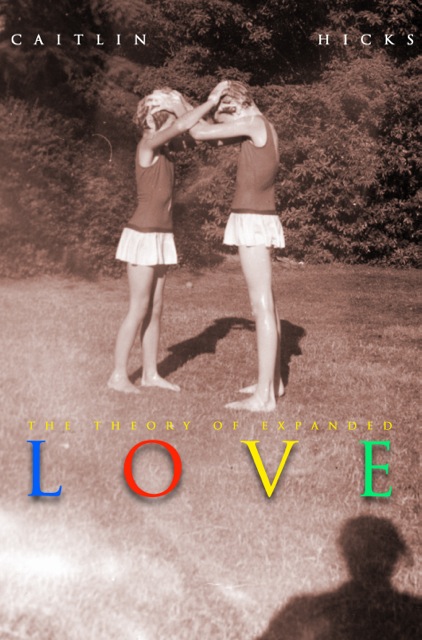
FOR IMMEDIATE RELEASE
Acclaimed Playwright Caitlin Hicks Signs with Light Messages Publishing for Debut Novel
Light Messages Publishing is thrilled to announce that Caitlin Hicks, an acclaimed playwright from Vancouver, Canada, will be publishing her debut novel with the press in May 2015.
Ms. Hicks’ novel A Theory of Expanded Love is a coming-of-age story featuring a feisty yet gullible adolescent, trapped in her enormous, devout Catholic family in 1963.
Surrounded by twelve brothers and sisters, and desperate for attention, Annie creates a hilarious campaign of lies when the pope dies and their family friend, Cardinal Stefanucci, is unexpectedly on the short list to be elected the first American pope. Driven to elevate her family to the holiest of holy rollers in the parish, Annie is tortured by her own dishonesty. But when one of her brothers gets left behind at Disneyland and ‘The Hands’ visit her in her bed, when her sister becomes pregnant “out of wedlock,” Annie discovers her parents will do almost anything to uphold their Catholic reputation. Questioning all she has believed, and torn between her own gut instinct and years of Catholic guilt, Annie takes courageous risks to wrest salvation from the tragic sequence of events set in motion by her parents’ betrayal.
While A Theory of Expanded Love is Ms. Hicks’ first novel, she has published several short stories, including That Rescue Feeling, which was shortlisted for the John Spencer Hill Fiction Award. Monologues from several of her plays were featured in Smith & Kraus’ series ‘Best Women’s Stage Monologues’ (New York). She also wrote the play, later adapted for the screen, Singing the Bones, which debuted at the Montreal World Film Festival to stellar reviews and screened around the world.
“I’m thrilled to share this quirky family with readers,” said Hicks “It’s wonderful to have a partner to help me get this story into the world.”
Light Messages Publishing is a family-run publishing company that specializes in meaningful books by emerging authors.
“Caitlin’s debut novel A Theory of Expanded Love is a gem of a book, and we couldn’t be prouder to represent it,” said Elizabeth Turnbull, Senior Editor of Light Messages Publishing. A Theory of Expanded Love is in final stages of editing, but earlier drafts have already received tremendous praise from readers.
“In a nutshell: I love the story. The voice is fantastic,” said Erin Niumata, VP and Agent at Folio Lit.
“I love it! I love your character! I love this book!” writer JoAnne Bennison told Ms. Hicks after reading an early draft.
“Hilarious. Terrific story, bravely truthful,” enthused writer/editor Rosa Reid.“Brilliant ending.”
With cross-over appeal to both adults and young adult readers, A Theory of Expanded Love reaches across the divide of generations to tell the humorous and unexpected story of self-discovery and coming of age amidst dishes, diapers, dogma and two-piece bathing suits. Advance Reader Copies of A Theory of Expanded Love will be available January 2015. Ms. Hicks is available for interviews. To schedule an interview or event with Ms. Hicks, please contact publicist@lightmessages.com.
5216 Tahoe Drive, Durham, NC, 27713
Phone (919)886-5498 / Email: books@lightmessages.com
April 4, 2014
Early reviews for A THEORY of EXPANDED LOVE
“Does the reader need to be one of thirteen children of a near-destructively religious family in post WWII America to get lost in the trance of the period reality that Caitlin Hicks conjures in her coming-of-age tour-de-force? The answer is irrelevant to the pleasure and horror of consuming this book (that’s what you will do – consume it, inhale it, ingest it). In the same way that you don’t have to be a Huck Finn (or a Jim) to be immersed in Mark Twain’s recounting of Huck’s “Adventures”, you don’t have to be penitent Clare for Hicks to make you cry for the injustice of Clare’s fate. Or to be Jude, to share his infantile discoveries, or Madcap, to be swept away by romantic passion, or Mrs. Shea, to bury her doubts over misguided motherhood in order to keep the marital and familial peace.
“Hicks leads you into and guides you through the story by means of the eyes and mind of Annie Shea, a pre-teen torch in a family of torches. Some of the Sheas may disguise themselves as votive candles in their slow moments, but they are all torches when the fuel is poured on. And there is a great deal of fuel, indeed.
“Yet, in the end, it is not Annie’s eyes, or brain or mouth that brings her story over the finish line with grace and power and love . . . it is her heart. Hicks bares Annie’s heart again and again and again and in doing so, the reader’s as well. . . It’s fucking BRILLIANT!” - Lance Mason, Independent Health Professional
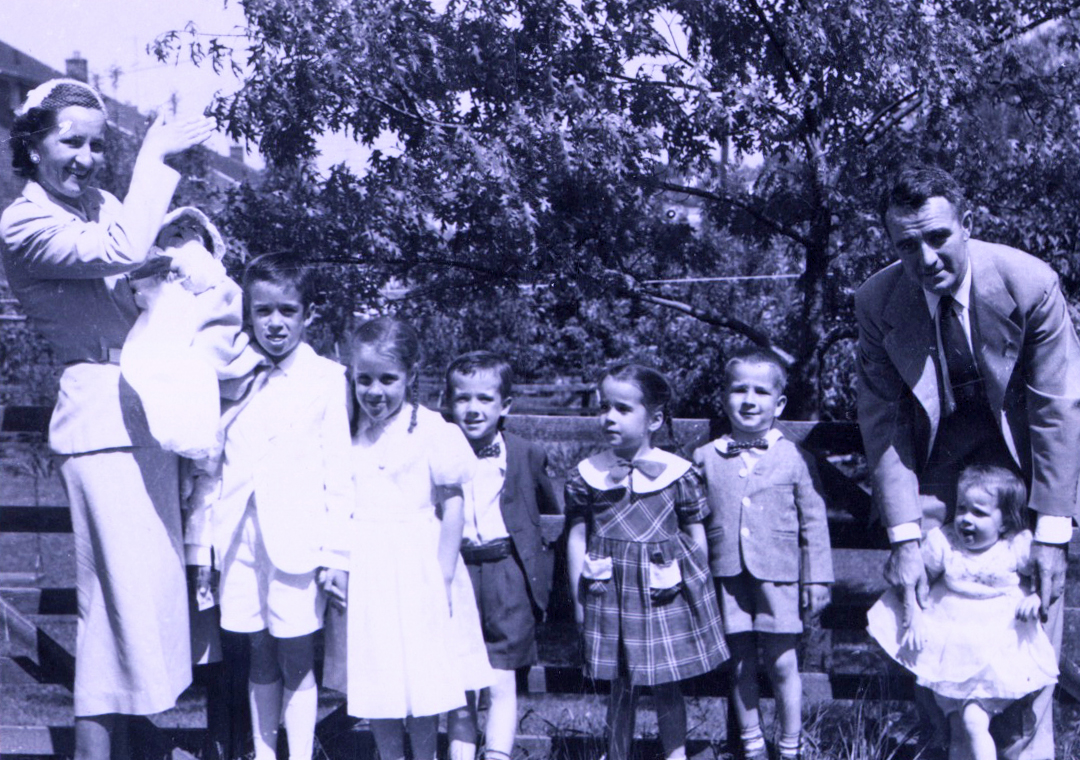
“I love your book The Theory of Expanded Love. I found the juxtaposition of the dysfunction within the family and the church fascinating; more so because despite the dysfunction, the physical and spiritual family were resilient and life affirming. That Annie suffers from the rigidity and chaos of her upbringing and benefits from the love and life training she receives is a conundrum many readers like myself will identify with. Our parents aren’t perfect, sometimes to a criminal fault, but when we come to accept their love, as Annie does, we are equipped to go out in the world and make our own mistakes instead of repeating theirs.
Your language is lively and descriptions engaging enough to make me want to find my way to the Shea’s bathroom to wash my hands regularly! . . . It is difficult to deal with a cast of characters as large as this one, but you do it masterfully. Once I got into the story, I could not put it down. . . The end was brilliant.” -Sydney Avey, Author
“I had to keep reading and hated for it to be over! Your book is wonderful. . . A great story, beautifully written. The Theory of Expanded Love considers all the great themes of life and death, who we are and where we fit or don’t, human greatness and human pettiness, God and religion, abandonment and reclamation, love and hate and in-between, lust and desire and sexual abuse… all from the point of view of 12, nearly thirteen, year old Annie Shea, number 6 in a family of 13! kids.! !
Many of us will remember 1963 as the year Kennedy was assassinated. Few of us will remember or know what it was like living those months before and after that event. What was the society of that time? What was it like to grow up in an enormous, practicing Catholic family with all the rules and rigidity and competition for privilege, social standing, and righteousness? What was it like to risk your eternal soul to stand up for what you believe in … to stand up for love?! ! Annie Shea lets us into that world, lets us live those days in full technicolor, rich and detailed. Annie lets us experience the confusion as real life thoughts and feelings struggle for understanding, as theory is tested against what really happened, as innocence is nearly but never really lost.
What is special and elegant in this story is the humour, honesty, intelligence and wisdom that unfolds and entertains moment by moment.! ! This story is funny. This story is a great read. This story is an eloquent life lesson. The theory of expanded love is proven. -Lynn Chapman, Environmentalist
“In a nutshell: I love the story. The voice is fantastic. I thoroughly enjoyed this and had a lot of fun reading it over, three times! As a Catholic who grew up in the 60′s and 70′s this spoke to me on many levels and I laughed right out loud on more than one occasion. It was a joy.” – Erin Niumanta, Agent & VP @ Folio Lit
“The book is awesome. Totally unpredictable, I literally had NO idea what was going to happen. I adore Annie. I tore through it at warp speed because I just had to know. Then I read it again slower so I wouldn’t miss anything. ” – Aggie Sanders, avid reader
“Hilarious . . too funny. . . “Terrific story with so many twists and turns.”
“Excellent, a huge fall from grace. Very entertaining, lively and bravely truthful. . . A lovely glimpse of childhood faith & the big questions about God.”
“Brilliant ending.” . . .
Rosa Reid, Editor
“Hi Caitlin, I have just finished reading Part 1. Terrific work! The prologue is very intense and compelling, draws us in. I found all fourteen chapters told spellbinding stories. Wonderful how you have remembered all the fine details of the times, the magazines and movies what people watched on TV, all such good memories, that so fully round out your stories. In the reading, your characters come alive and we become attached to them , or suffer with them, you bring us right into all the activities in such a real and vivid way. About the faith and religious part: you have handled it with truth, and very fairly and it just slowly moves along to God knows what lies ahead, but so far without an axe to grind or a cause to beat us with. I like the faith part very much. A great read so far.” – Linda Szabados, writer
“I love it! I love your character! I love this book!” Joanne Bennison, writer
Book Reviews

From the main page, click on 'Reviews' ...more
- Caitlin Hicks's profile
- 39 followers

