Quinn McDonald's Blog, page 75
February 13, 2013
Totally Different Valentine’s Card
After making a mosaic Valentine’s Day card several years ago, and a Valentine Tree card with heart-shaped leaves, I decided to go in a completely different direction this year. With chocolates being out of the picture this year, I thought it would be fun to make an unusual card–no red, no heart shapes, and a card that might hang around after Valentine’s Day.

Heart card tied with a ribbon to hold it closed.
Several months ago, I found a heart-shaped rock on my walk. I took it home, scrubbed it, and kept it for future use.
My biggest accomplishment was remembering where I put it so I could use it for Valentines.
I decided to make a round-ish pocket for the stone, add a sweet saying and hide the stone in the pocket.
Here’s how I made it:
1. I chose a piece of Monsoon Paper I made–using a blue / gold/ silver / purple color scheme to avoid the standard red. I folded the piece into thirds, using an accordion fold. The final measurement is about 5 x 6 inches.

The insert is both colorful and sentimental.
2. I cut a rough circle pattern so that two pieces would create a pocket and the third fold creates the flap. The pocket pieces are joined at the bottom, creating a pocket that I can glue only around the edges.
Using a gel pen, I drew “stitching” around the edge of the pocket and the edge of the flap.
3. Taking the rock, I painted it with gold ink and then put plain water on it to cause the ink to run off unevenly. I wanted a rock with gold highlights, not a uniformly gold rock.
4. Using another piece of Monsoon Paper, I cut an oval out of a section with good color contrast. Using a gold sparkly gel pen (it is Valentine’s Day, after all), I wrote a line from Neil Young’s Heart of Gold on it– “I’ve been a miner for a heart of gold.” On the back I wrote something sentimental and signed it.
 5. I tucked the oval into the pocket, so the edge of the paper just peeks out. I tucked the rock in with it, and tied it all with a ribbon that picked up the purple in the paper. A totally different, but loving Valentine’s card.
And the rock will be a nice lasting reminder of the heart of gold that I found when I found Cooking Man all those years ago.
I’m not big on commercial holidays, but it’s nice to surprise someone you love with a reminder of that love every now and then.
–Quinn McDonald is a romantic at heart, even if Valentine’s Day doesn’t have any chocolate in it anymore.
Filed under: Tutorials Tagged: Different Valentines Day card, monsoon papers, Valentines Day card


February 12, 2013
Celebrate the Important
The author Stephen King celebrates finishing a novel with a ritual. He knows when the last word will be written, and he plans the celebration, which is simple (and not scary).
Ritual is important to us as humans. Celebrating should be. It doesn’t have to be fancy or elaborate, but when something goes right, it’s a good idea to celebrate.
So this week, when I came back from the photo shoot in Cincinnati, I wrote the introduction, the dedication and put in the final patches of items that needed changes. I sent it to my editor, and then the book’s work was done. Yes, there will be edits, yes there is a lot of work to be done, but the writing part is complete.
I kept working till supper time, fed the cats, and then invited Cooking Man to dinner at our favorite Vietnamese restaurant. It was a cold night, it had hailed in parts of town, and we picked out ways through melting ice to get to the restaurant.
It felt good to eat without racing through dinner. It’s good to share a meal when you feel satisfied that a two-year-long project has come to an end. There was hot tea instead of champagne, and pho instead of caviar. But it was a satisfying celebration.
We downplay important occasions. We know what to do on Valentine’s, but when it comes to creating our own celebrations, we stall. Here’s a checklist for celebrating:
1. Talk about your emotions–what was hard to overcome, what makes you happy.
2. Give a name to what you are celebrating. Create your own name for the day if that makes it more special.
3. Plan a special meal. You can share a meal, celebrate on your own, go out, eat in. But it should be a special time where you talk about triumphs and joys, not bills or hardships.
4. Wear something special, buy flowers, or put out fancy placemats. Listen to music that makes you feel happy. Don’t rush through the celebration.
5. Take a photo, write in a journal, do something to remember the day. Feel the happiness in your bones. Let it soak in. You earned it!
–Quinn McDonald is writing another grammar book for a client. She’ll use it for years, but it will never be officially published, just photocopie
Filed under: Coaching, Creativity, In My Life Tagged: celebrate, completion, ritual


February 11, 2013
Tricky Words That Trip You Up
Blogs have spell check, but when you use a word wrong, spell check won’t help you. I was reading the first chapter of a book on someone’s blog today, and I kept stumbling over words that didn’t mean what the writer meant.
“His voice has a pleasant timber.” Unless he’s spitting toothpicks, she meant timbre. Timber is wood. Timbre is the pitch of a sound.
“Her decollage peaked his interest.” From the context, it wasn’t deconstructing a  collage that excited him, it was her decolletage, a low neckline. And it piqued his interest. Totally different word. It’s from the French and it means to give it a little stab of interest. Peek is to look, peak is a top of a mountain, and pique (pronounced peek, that’s why it’s a problem) means to be interested in.
Last week, in the newspaper, I read that woman had performed while she was ill. “She was a real trooper.” Only if she was a policeman. In this case, she was a trouper. Because she was in a troupe of actors, dancers, or other performers. And the show must go on.
 In today’s newspaper, I saw a grocery store that had a “souper sale.” I thought it was a joke, maybe tomato or chicken noodle soup was on sale. Nope, just a typo. A super big one.
Some other words that give us trouble:
It’s is never the possessive. When its tail comes to rest, the dragon will be sleeping. No apostrophe. That’s hard, but the only meaning of it’s (with an apostrophe) is it is or it has.
Disinterested means fair or impartial. It has nothing to do with not being interested.
Peruse means to read carefully, not to skim.
Lie is to recline, lay is to place. I lie down on the bed, I lay the baby back in bed.
Sheer is see-through, shear means to cut off.
It’s a moot point, not a mute point. Moot means debatable, mute is silent.
One of a kind, shortened is “one of.” If you have three apples on the shelf and one is taken away, you have two on the shelf and one off. If you are talking about single pieces, it’s “one of” not “one off.“
Actionable means subject to being sued. It does not mean to take action.
Using words incorrectly makes your writing look unprofessional. And in a world filled with aspiring- and recovering perfectionists, it’s better to check twice, type once.
–Quinn McDonald is a writer and a recovering perfectionist.
Filed under: The Writing Life Tagged: writing tips, wrong words


February 10, 2013
The Box of Stuff
Somewhere, out in the dark, is a box of materials I used in Cincinnati to make art. In theory, it is the most important of my art supplies. My studio, however, isn’t empty. I am lacking pens and watercolor pencils, but if I dig hard enough, I’d find something to draw with.
 Or, I could do it the other way, and say that what is in the box is more important, and I need to get rid of things in the studio. All those “things” are not making me a better artist, but it is making it harder for me to find things I need. I’ve actually purchased things knowing that I had another one someplace, but couldn’t find it.
So maybe it’s time to pare away some of the stuff and keep what’s needed at the moment. Stop buying things unless I know exactly how much and what for. Yes, I may need some of it at some point in the future. But I also have a huge amount of items labeled “for class”–extra pairs of scissors and paints and inks and paper, rubber stamps and things I may or may not need for class. I actually don’t know how to sort those out, because I am still creating classes.
But there are things I must decide on, things that have to go somewhere else.
We’ve all played the game where we pretend the house is on fire and decide what we would save and what could burn to ashes. We consider books and photos, clothing and credit cards. I once had to make that decision. About 10 years ago, the roofers set our house on fire (it was a training issue), and when I called 911, the operator told me to get out of the house immediately, not to take anything.
 I pulled the cat carriers out of the closet and the cats, knowing that I must surely be taking them to the vet, vanished into the burning house. I paused for a long 15 seconds, and watched smoke pouring down the stairs. I weighed the chance of finding the cats in a smoke filled house, and the cats figuring out that fresh air was outside. And then I realized that nothing would be saved if I stood in the house while it collapsed onto me. I picked up my purse and left the house.
And that was the answer–you will not gather up your clothing and your paintings, your child’s drawings and your first editions. You will pick up your purse and walk away. In my case, the roof collapsed through my studio and the cats were found in the basement by the firefighters who know where to look for them. All of them survived with the help of oxygen, and all of them are living with us to this day.
So I’m going to do some sorting and thinking and reducing. I think it will be lead to something that needs space.
–Quinn McDonald is an artist making room for something wonderful to take place.
Filed under: In My Life, Opinion Tagged: clearning out, stuff


The Complicated Landscape of Loss
[Note: This post was previously called "The Geography of Loss." After I hit "publish" I discovered/ remembered that Patti Digh, the author of several well-known self-discovery books, is writing a book and class with that title. On my own (Patti did not contact me) I changed my title because the word "landscape" is less of the study (as geography is) and embraces more of where one finds oneself and includes the struggle of change and creation. (As the image below shows). I also have a chapter on Imagined Landscapes in Raw Art Journaling, and this change suits the whole experience better. ]
The week in Cincinnati was hard work, fun, interesting and well organized. North Light, my publisher, treated me well. Of course, a company is made up of people, and the two people I spent most time with, Amy Jones (editorial) and Christine Polomsky (photographer) were patient, professional, and spoiled me. I would say, as I often do in my studio, “OK, time to change the watercolor brush

Christine getting a completed piece just right.
water,” and Amy or Christine would reach over and do it. (That never happens in the studio!) Amy stood in for Tonia Davenport, my editor, who is based in Phoenix. That means more work for both of them, too, as they communicate back and forth over details that Tonia can’t see and Amy has never read the text for. It’s enough to make their heads hurt and eyes water.
I met the design team, the cover designer, the sales and marketing staff. And for one solid week, I reproduced the art, step by step, for the book so Christine could photograph it. At night, I’d edit the text, finish diagrams, and write the bits and pieces I’d left undone. I have never spent so much continuous time making art. (I have a day job– a thriving creativity coaching business as well as developing and teaching writing, from grammar to technical writing, to business clients. I own the company, but it’s still work.)
Christine directed and photographed every project in the book, but not any of the illustrations –and there are a lot of them– scattered throughout journals, and done on separate pieces of paper. I thought they would be photographed this week, too. Nope, separate step. “When will that happen?” I asked, thinking maybe the next week. Nope, again. And when it is photographed, the artwork is kept until the book is delivered to make sure that nothing is lost and it’s all kept together.

Amy, numbering and describing photo files
That means I won’t see my journals and the free-standing pages, the covers, the folders, the contributors’ art until January of 2014. I wasn’t expecting that. And it doesn’t matter that I understand clearly why that needs to happen. It was a huge feeling of loss. I didn’t use “prepared” journals–these are my daily journals that I write in, figure stuff out in, and deal with life. And they are gone, for a long while.
Yes I can make more; yes its a privilege to have them in the book; yes, I will get them back, but my journals are part of my life in a very intimate way, and for now, they are missing. It triggered a lot of emotion about “missing” happening in my life lately. The food I no longer eat, the changes to my behavior that’s healthier for me, the consequences of some decisions I’ve made, some health issues, the loss of a friend who was threatened about the changes in my life, illness and bad news in my family group—things I don’t talk about on the blog or Facebook, because I believe that not every aspect of life is a sharable moment.
So there I was, facing the things I talk about–fear, sadness, mixed in with joy and relief (my part of the book is largely done!) but washed over by a huge sense of loss. I’d just finished reading Stella Pope Duarte‘s Writing through Revelations, Visions, and Dreams, and a powerful idea from her book came back.
Darkness is a teacher. If we look into the dark parts of our lives, we will encounter the truth, explore our dreams, come to term with our ghosts, and we will see parts of ourselves alive and well in the darkness, and they will live on in the characters we create
Or, in my case, not characters, but art. While re-creating a piece for the book, I brought with me letters from the friend I lost, menus and wrappers of food I no longer eat, photos of places I will never see again in the way I did when seen with those who won’t travel with me again.

The Landscape of Loss. © Quinn McDonald 2013, All rights reserved. For reprint permission, contact Quinn–see contact box above page header image.
I created a landscape from the shapes I use as icons and talismans–the wavy lines that connect us all, and I stitched over them to hold them in place. It was a piece of mourning and a piece of memory, and I will recognize it in a different way when it comes back to me in a year.
We can run from fear and pain, and then we will spend our lives running. We can hold still, let it catch up with us, wash over us. It will not drown or kill us, because the human spirit is resilient and grows, even in fear. It may not be fun to sit with hard emotions, but there is peace in it. And after peace, we change, and we continue the journey changed, but we are no longer hiding and afraid. And that, for me, is success.
—Quinn McDonald has completed the Inner Hero book. It will be in book stores in January of 2014. She is now developing classes to go with the book. One of them will be about the landscape of loss.
Filed under: Inner Critic, Journal Pages, The Writing Life Tagged: art therapy, creativity coaching, loss, maning making, writing


The Geography of Loss
The week in Cincinnati was hard work, fun, interesting and well organized. North Light, my publisher, treated me well. Of course, a company is made up of people, and the two people I spent most time with, Amy Jones (editorial) and Christine Polomsky (photographer) were patient, professional, and spoiled me. I would say, as I often do in my studio, “OK, time to change the watercolor brush
Christine getting a completed piece just right.
water,” and Amy or Christine would reach over and do it. (That never happens in the studio!) Amy stood in for Tonia Davenport, my editor, who is based in Phoenix. That means more work for both of them, too, as they communicate back and forth over details that Tonia can’t see and Amy has never read the text for. It’s enough to make their heads hurt and eyes water.
I met the design team, the cover designer, the sales and marketing staff. And for one solid week, I reproduced the art, step by step, for the book so Christine could photograph it. At night, I’d edit the text, finish diagrams, and write the bits and pieces I’d left undone. I have never spent so much continuous time making art. (I have a day job–I have a thriving creativity coaching business and develop and teach writing, from grammar to technical writing, to business clients. I might own the company, but it’s still work.)
Christine directed and photographed every project in the book, but not any of the illustrations –and there are a lot of them, scattered throughout journals, and done on separate pieces of paper. I thought they would be photographed this week, too. Nope, separate step. “When will that happen?” I asked, thinking maybe the next week. Nope, again. And when it is photographed, the artwork is kept until the book is delivered to make sure that nothing is lost and it’s all kept together.
Amy, numbering and describing photo files
That means I won’t see my journals and the free-standing pages, the covers, the folders, the contributor’s art until January of 2014. I wasn’t expecting that. And it doesn’t matter that I understand clearly why that needs to happen. It was a huge feeling of loss. I didn’t use “prepared” journals–these are my journals that I write in, figure stuff out in, and deal with life. And they are gone, for a long while.
Yes I can make more; yes its a privilege to have them in the book; yes, I will get them back, but my journals are part of my life in a very intimate way, and for now, they are missing. It triggered a lot of emotion about “missing” happening in my life lately. The food I no longer eat, the changes to my behavior that’s healthier for me, the consequences of some decisions I’ve made, some health issues, the loss of a friend who was scared about the changes in my life, illness and bad news in my family group—things I don’t talk about on the blog or Facebook, because I believe that not every aspect of life is a sharable moment.
So there I was, facing the things I talk about–fear, sadness, mixed in with joy and relief (my part of the book is largely done!) but washed over by a huge sense of loss. I’d just finished reading Stella Pope Duarte‘s Writing through Revelations, Visions, and Dreams, and a powerful idea from her book came back.
Darkness is a teacher. If we look into the dark parts of our lives, we will encounter the truth, explore our dreams, come to term with our ghosts, and we will see parts of ourselves alive and well in the darkness, and they will live on in the characters we create
Or, in my case, my art. While re-creating a piece for the book, I brought with me letters from the friend I lost, menus and wrappers of food I no longer eat, photos of places I will never see again in the way I did when seen with those who won’t travel with me again.
The Geography of Loss. © Quinn McDonald 2013, All rights reserved. For reprint permission, contact Quinn–see contact box above page header image.
I created a landscape from the shapes I use as icons and talismans–the wavy lines that connect us all, and I stitched over them to hold them in place. It was a piece of mourning and a piece of memory, and I will recognize it in a different way when it comes back to me in a year.
We can run from fear and pain, and then we will spend our lives running. We can hold still, let it catch up with us, wash over us. It will not drown or kill us, because the human spirit is resilient and grows, even in fear. It may not be fun to site with hard emotions, but there is peace in it. And after peace, we change, and we continue the journey changed, but we are no longer hiding and afraid. And that, for me, is success.
—Quinn McDonald has completed the Inner Hero book. It will be in book stores in January of 2014. She is now developing classes to go with the book. One of them will be about the geography of loss.
Filed under: Inner Critic, Journal Pages, The Writing Life Tagged: art therapy, creativity coaching, loss, maning making, writing

February 7, 2013
Amazing Paper Art: Li Hongbo
The art that fascinates me is the art created by an someone who has an idea and follows it. Even if other people don’t love it, even if others don’t understand it, the creative force that changes the world and how we understand it continues making art.
Li Hongbo works in Beijing. He turns pure white paper into art. Pure White Paper is the name of the exhibition you want to see if it comes your way. He creates amazing sculptures that expand and collapse. They look like porcelain, and move like magic. Here’s the video.
Li is a book editor and designer, and spent thousands of hours gluing sheets of paper together to form shapes inspired by the Chines paper gourd children’s toys. After that, it became art. You can see more photographs by seeing the exhibition at the Dominik Mersch Gallery in Australia.
–Quinn McDonald is amazed at the inspiration that makes art.
Filed under: Creativity, Links, resources, idea boosts Tagged: li hongbo, paper arts, paper sculpture, pure white paper


Monsoon Paper Day at the Photo Shoot
 Today is Monsoon Paper day. I’m not teaching it, I just get to make it so it can be photographed, step by step. I’m so excited, because Monsoon Papers have come a long way since I started making them in the thrashing summer rains in Phoenix. Now I can make them indoors, in any weather, add glitz, glitter and glaze, and even fix the occasional tears in the papers. So it’s going into the book! (And yes, that is a Monsoon Paper towel in the photo)
The photo shoot has been great so far. Lots of laughing and story telling (you already knew I was a yakker, right?)
But today, book contributor Liz Crain has a great blog on creative ideas. It’s a mash up of great tips, links, and ideas about life in your paracosm. What’s a paracosm? Liz will explain. It’s worth stopping over there and getting inspired.
I’ll be back tomorrow.
–Quinn McDonald is a writer and artist who is writing a book on your inner heroes confronting your inner critic.
Filed under: In My Life, The Writing Life Tagged: creative mashups, Creativity, liz crain, monsoon papers, paracosm


February 6, 2013
Collaboration Works (Sometimes)
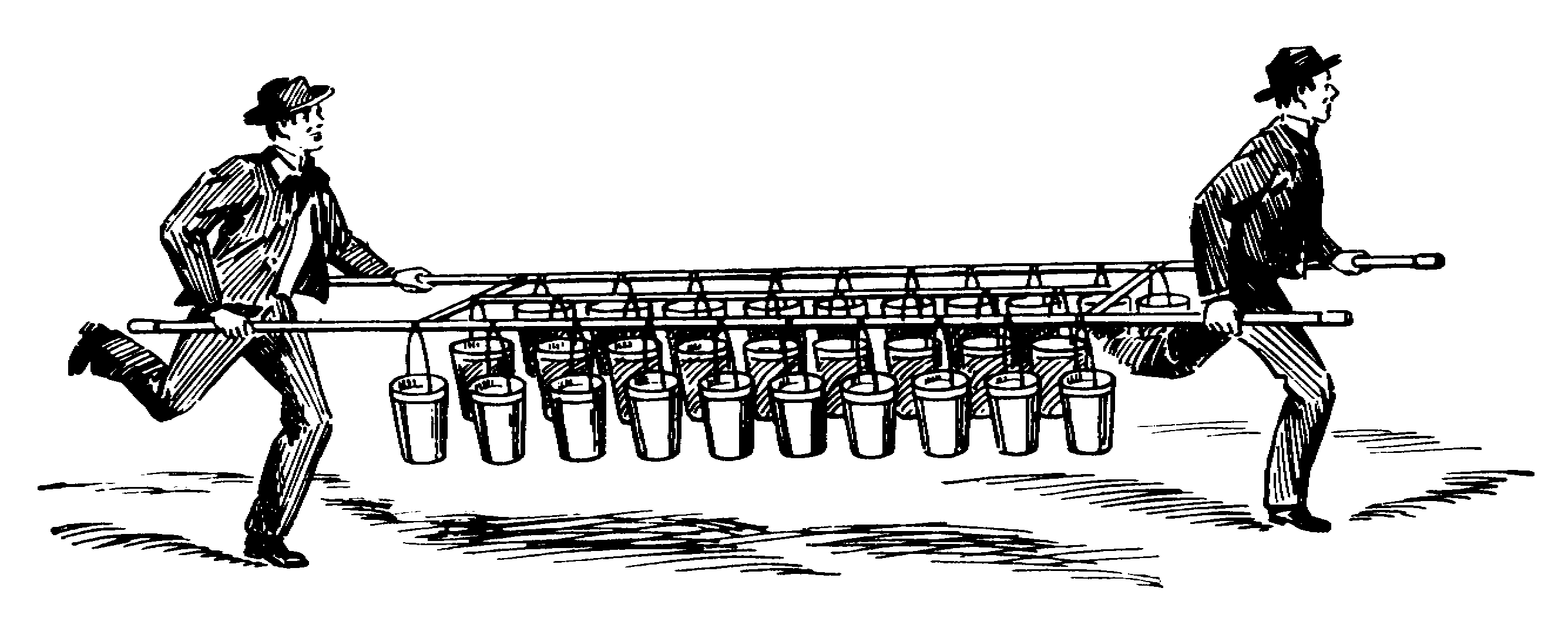
One way of getting lots of buckets to the fire. Two guys, lots of heavy lifting.
Collaboration has never been a word I’ve liked. For me, it’s a word rooted in the history of World War II–the French traitors collaborating with the Germans. In today’s business world, it means working as a team, and the rules vary from company to company. It’s become a jargon word, and the sloppy definition is that two heads are always better than one, that crowd sourcing always results in the best method or answer, and that (groan) every idea is of equal value, so producing more ideas is the best solution in itself.
Today, I experienced real collaboration, and it was fresh, crisp and bright. I’m falling into the rhythm of the photo shoot–I produce the images for the book, Amy takes notes, Christine photographs.
We came to a thorny spot where three steps needed to be done at once. I’d brought a template, and I explained to Amy what I needed to do, so she could see the big picture. Amy had a solution she thought might work better. Christine understood it and agreed. I didn’t get it and looked doubtful. The Inner Critic, who had been playing with spilled ink in the corner, showed up and sat on my shoulder. “They are trying to take over your book,” he mentioned sweetly. “Tell ‘em it’s your book and you are going to do it your way.” Familiar feelings of not-enough-control, not having the best idea washed over me. I let them. I didn’t fight them.

Another way of getting a lot of buckets to a fire. One person, one bucket, repeat.
“What else you got?” I asked the Inner Critic. “You’ll lose con-troooolll” the Inner Critic crooned, sensing an old fear of mine.
It was tempting, but I looked at Amy. “I just get the edge of what you are saying,” I said, “explain it again in a different way, I’m almost there.” By asking for another explanation, for more help (instead of less), I could get more information before I decided it was more control I needed. Christine stepped forward, pushed three pieces around on the photo table, and snapped a picture. She showed it to me in the viewfinder.
And then I got it. Through Amy’s words and Christine’s picture, I could see the solution, not as I wanted it, but as the reader would see–and understood–it. The beauty of their solution was obvious. It could work. It would make it easier for the reader, clearer, simpler. It did the same for me, too.
Here’s what I learned: Collaboration is not always caving in to what someone else wants. It can also be a way of understanding a new idea and a way of connecting one idea to another for a simpler solution. When that happens, collaboration works.
–Quinn McDonald is learning about her book at the photo-shoot this week.
Filed under: Links, resources, idea boosts, The Writing Life Tagged: art team, collaboration, creativity coaching


February 4, 2013
Un-Messing Up a Journal Page
In the North Light photo studio today, I created several projects from the book, while Christine took photos and Amy took notes. I expected to make mistakes and have things go wrong (my Inner Critic followed me from the airplane) but they did not. Christine solved some tedious instruction problems, and Amy made the day race by. I had fun. I made and threw a snowball for the first time in about five years.
And no journal pages were harmed in the production of the journal pages. But we do occasionally mess up a journal page. You can rip it out and burn it, deny it happened, or simply use one of these way to repair it:
You’re working in your journal and one of the pages doesn’t work out. You don’t want it to mess up the rest of the journal, so now what? You’ll know what I’ll say first–that your journal is not a piece of perfection, that some pages will work out better than others. And I’ll know your reply–tell me how to make it work. Here are some ways to fix a journal page that didn’t work out:
1.Cut it out. Trim the page out about an inch from the spine stitching. Put a sturdy piece of cardboard or a cutting mat under the page and cut with an art knife. You’ll get a better cut than with scissors. You now have a stub left in the book. You can attach another page here. Complete the page first, so you know it’s exactly what you want in this part of your journal. Attach with tape or glue.
If you use glue, you’ll want the stub to be on the back of the insert. Put the glue on the stub, after putting a protective page underneath the stub. No sense gluing pages of your journal together.
2. Take notes. If there is room enough on the page, make notes about what you would do differently the next time. This helps you feel better about the mistake. It also helps you learn how to avoid repeating the mistake. If there is not enough room on the page, cut out small rectangles of paper, make your comments on them, and glue them into place on the page you don’t like.
3. Cover it up. There are thin papers that will hide the work, but translucent enough to add interest. Parchment or tracing paper, and some kinds of washi–rice paper–do a good job. You can also add a piece of transparency film or mylar. Transparency can be colored by running it through your printer to put a colored image on it. (Make sure your printer will take transparency film first.) Transparency film can also be dyed or stamped with alcohol inks. Mylar can be tinted with colored pencils or inks.
4. Paint over it. If you don’t mind a thicker page, cover the page with collage or paint. If you are going to paint, use a heavy body acrylic or gesso to start. You’ll get muc better coverage than watercolor or thin acrylics. You can also cover portions with masking tape and paint over the rest of it. Collage works well because you won’t be able to write on paint very easily.
Your inner perfectionist should find one of those methods the right way to keep loving your journal.
–Quinn McDonald is an artist and writer who is having fun at the photo shoot for her second book.
Filed under: Journal Pages, Recovering Perfectionists, The Writing Life Tagged: creativity coaching, fixing journal pages