
Laurie Boris's Blog, page 46
December 30, 2012
So Long, 2012, and Thanks for All the Fish…
 Loss, love, joy, grief, rebirth, pain, triumph: it’s been a rich and melancholic salad of a year for me. That canard of ancient wisdom, “Be careful what you wish for,” is definitely not one to toy with. For a while there, every shiny penny on the sidewalk, it seemed, came with a foot waiting to stomp on my hand as I reached for it.
My professional goals (Thank you, Jim Devitt, for reminding me of the importance of goal-setting) for this year were to publish two novels and continue building up my editing business. I’ve accomplished both. I’m very happy about that. Drawing Breath and Don’t Tell Anyone are both out. I’m helping some wonderful writers get their manuscripts ready for publication. Took me almost fifty years, but I think I’ve finally figured out what I want to do when I grow up. Being up to my elbows in words—my words and those of other’s—is definitely my happy place.
But this year, two additional books came out with my name attached to them as contributing author: Indies Unlimited’s Author’s Snarkopaedia Volume 1 and Indies Unlimited: Tutorials and Tools for Prospering in a Digital World. This would not be possible without the passion and dedication of Stephen Hise and K.S. Brooks, the evil geniuses behind Indies Unlimited. I sit in a little pink room filled with toys in a house in the woods, typing on a keyboard, a recluse by nature, and at times this gets isolating and a bit sad. Being a part of IU and having a virtual extended family of kindred spirits across the Interwebs gives me great joy and at times so much laughter I spit tea across the keyboard. I have actually pulled muscles from laughing. It’s much more entertaining to go to the chiropractor with a good story of how I hurt myself, rather than the usual snow-shoveling or long-car-ride excuse. I do like to be considerate of my healthcare professionals whenever possible. They want funny stories to tell people at parties, too.
So thank you to you all for supporting my writing, for sharing it with your friends, and for trusting me with your work and your words.
However 2012 has treated you, whether you’re gazing fondly in the rearview mirror or bidding it off with glee while saying, “Don’t let the door hit you in the ass on the way out,” I hope 2013 is bursting with health, peace, love, happiness, and prosperity, in whatever form that means to you.
Onward!


December 4, 2012
Tell Everyone!
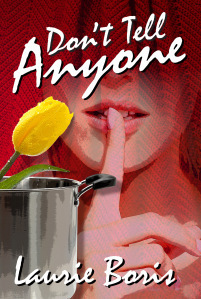 I’m excited to share the news with you…my third novel, Don’t Tell Anyone, has just been released!
When pneumonia lands Estelle Trager unconscious in the emergency room, it ruins everything for the stubborn 65-year-old woman. She’d been keeping a secret—a deadly secret—that she’d planned on taking to the grave. But now her son Adam and his wife, Liza, know about her tumors. Adam is outraged, but Estelle, who watched her mother and grandmother suffer from breast cancer in the days when no one dared speak its name, has no intention of putting her family or herself through the horrors of cancer treatment. Estelle decides there is only one solution: ask Liza, the 33-year-old daughter-in-law she once called a godless hippie raised by wolves, to kill her.
A horrified Liza refuses and keeps the request—among other things—a secret from her furious husband. But she tells his younger brother, Charlie, a close friend from college with whom she shares her own confidences, despite Adam’s serious case of sibling rivalry. Armed with nutrition textbooks and her neighbor, a savvy nurse, can Liza win over her mother-in-law and convince her to consider other options before the cancer, the secrets, and Estelle’s determination to end her life win out?
I didn’t intend on writing another book set into a backdrop of illness. At least not so soon after Drawing Breath, which pretty much wrenched me inside out and had me begging whatever subconscious power supplies me with stories to give me a nice, lighthearted comedy next time. But a death in my own family was still haunting me. And when that happens, I write. So Estelle came into my life. I wanted to know why a woman who knows breast cancer runs in her family would not only conceal that fact from her grown sons, but when she discovers her own lumps, chooses to let nature take its course. And the little apple-cart-upsetter that I am, I let someone find out. Set into a family with its own crazy quirks, closet-skeletons, and almost-healed scars, I sat back to watch how they would handle the situation.
Let’s just say that this isn’t your typical cancer story. I even show you how to make my mother-in-law’s famous chicken soup.
If you’d like to read an excerpt, go here. You can get the e-book from Amazon.com and Smashwords.com right now, and a paperback from Amazon.com shortly.
As always, thank you for your support and your comments. You guys continue to awe and inspire me!


November 13, 2012
Sneak Peek: Don’t Tell Anyone…
I know. I haven’t written, and the little Jewish mother in my head is making me feel so badly for ignoring my blog for so long. Well, maybe this will explain where I’ve been. Here’s a quick look at my next novel, Don’t Tell Anyone, which will be published in December on Amazon. More details to come…
——
As Liza’s professor scrawled diagrams of molecules across his whiteboard in an attempt to explain osmosis and the sodium-potassium pump, something began to ring. That bothered her. There was only so much organic chemistry she could fit into her head, and the ringing took up too much space. She nudged her leg against her husband’s. “Make it stop.”
He grunted.
“Adam…”
He said something that sounded like, “Beer me.”
Right, Liza thought, slowly waking. They’d been down the hill at the Miller’s Halloween party; apparently it was still in full swing in Adam’s head. She wondered if he was still dancing with Cara Miller’s breasts.
Ring. Alert now, Liza could identify it as the telephone. She forced open her eyes, crusted with last night’s congealed makeup, and peered at the clock through a clump of disheveled auburn hair. Four-thirty.
As she fought her way out of the covers for the cordless handset, which should have been on the nightstand, several thoughts seeped through her muzzy brain. One, it had been warm in bed next to her passed-out husband. Two, she almost had the sodium-potassium pump story down pat. And three, dressing up like a flapper and drinking three glasses of zombie punch at the Miller’s Halloween party two days before her organic chemistry midterm had been a very bad idea.
“Where’d he leave that stupid phone?” Startling her orange tabby, Liza followed the sound down the hall to the top of the washing machine. When she picked up, she heard heavy breathing.
You’ve got to be kidding. I was in the middle of a perfectly efficient REM cycle. It had to be one of her neighbors, who’d come to the party dressed as a flasher and had been a little too deep into his character, the punch, and every woman in the room.
“It isn’t funny anymore, Ted.”
The breathing became a tiny, wheezing, nasal voice. It creaked out, “I’m Estelle’s upstairs neighbor? I just called 911.”
Liza froze. Her own voice failed her. She swallowed. “We’ll be right there.” Still holding the receiver, she bolted toward their bedroom, calling her husband’s name.
Nothing.
She shoved his arm. It flopped over like a dead halibut. “Adam.”
“Huh?”
“It’s your mother.”
A groan emanated from the pillows. “What about my mother?”
“A neighbor called. She’s on her way to the hospital.”
“She’s what?”
Oh, for the love of— “Adam. Get dressed.”
———-
There was no time for coffee or hygiene, no time to remove the physical or emotional remnants of the party. Adam and Liza threw on jeans and grabbed car keys and bolted from their yellow ranch house halfway up the hill on Sycamore Street.
Now it seemed surreal to Liza that such a short time ago, they were drinking and dancing in the Miller’s living room. That only three hours ago, they’d argued whether Adam perhaps enjoyed a little too enthusiastically the lewd comments Cara Miller had made about the tight leather pants of his punk-rocker costume. That two hours ago, when they’d arrived home, Adam, possibly thinking about Cara’s hydraulically raised breasts in her Naughty Nurse outfit, had attempted to make love to Liza but passed out instead.
Just as well, Liza thought. She hadn’t wanted that to be the story of how their first child was conceived.
As she drove her baby blue VW bug out of the neighborhood, not trusting Adam behind the wheel, Liza noticed a dribble of cars still parked in front of the Miller’s house. Talking Heads’ “Psycho Killer” pulsed from the windows. What looked like a human form lay on the side of the Miller’s lawn. Another human form swayed rhythmically atop it.
“Unbelievable,” Adam said. “Is that Cara?”
More to the point, Liza thought, is that her husband?
———-
In Liza’s observation, it had hit Adam somewhere around the New Paltz Thruway entrance that a call to 911 at four-thirty in the morning could mean bad news. He’d sobered up enough to be scared and quiet. He seemed to completely disappear when Liza asked the emergency room guard where they could find Estelle Trager.
The guard made a phone call and pulled a glass screen closed.
Adam’s compact body seemed to flinch. “Why’s he doing that?” He knocked on the glass. “Hey—”
The guard ignored them. He talked into the phone and nodded. Then slid the partition open. “They’ll come get you soon.”
“Soon? What the hell is ‘soon?’ It’s my mother.”
“They’re trying to stabilize her.”
Adam’s voice climbed an octave. “Stabilize her? What does that mean?”
“Adam…”
“No, damn it. We should be in there.” He turned to Liza. “Shouldn’t we be in there?”
“Soon,” the guard said. “Have a seat.”
——-
Adam and Liza clung together in the tiny, mostly empty waiting room. The buzzing overhead lights drained the remaining color from his boyishly handsome face and turned his greenish-blue eyes a shade of pale mud. The smeared eyeliner and blue tips in his short, sandy brown hair made the horror of the situation worse. It no longer mattered what Cara had said, Liza realized, or where her neighbor might or might not have put her hands. She just wanted to make it better. She wanted to scrub last night off her husband’s face and hair and tuck him into bed.
Adam said, “Maybe it’s just an allergic reaction.”
“Maybe.”
“I don’t even remember the last time she was sick.”
Finally they heard the slide of the glass. “Mr. and Mrs. Trager, you can go back now.”
Liza cringed, a reflex sharpened over the past five years, at hearing someone call her “Mrs. Trager.” That title belonged to Adam’s mother. She was Liza Stanhope. But at the moment it wasn’t worth an argument.
———-
No one showed them which partition shielded Estelle Trager. Liza felt lost and small as she and Adam wandered amid the bustle of hospital personnel and equipment. People ignored them, as if bedraggled Halloween party refugees drifted through every night. On one gurney was a man in jeans, work boots, and a sleeveless T-shirt. He was out cold and, from the odious cloud surrounding him, dead drunk. Atop another lay a mountain of a black woman surrounded by family and a minister who recited scripture.
“Here.” Adam tugged at Liza’s arm.
All she saw was a rumple of bedclothes, spent equipment, and plastic wrappers on the floor. “But there’s no one…” Then she spotted the dyed red shock of Estelle’s hair sticking up out of a sheet. “…here.”
“Christ,” Adam muttered. “Jesus H.…”
“Are you the son?”
Adam hadn’t moved. Liza normally thought of herself as sanguine, but she had to force her attention from the tube in her mother-in-law’s throat, from the sallow hue of her face, and from the rhythmic wheeze of the machine that thrust Estelle’s chest out and in, out and in.
Standing behind them was a ridiculously young woman in a lab coat.
“Yes,” Liza said. “He is. Well. The only son in the country at the moment.”
The young woman blinked at him and forced a bit of a smile. “Halloween party?”
No, Liza thought, glaring. My stockbroker husband just likes to dress up as Sid Vicious on the weekends. “What happened?”
“First I need to ask you some questions about her history. She’s not in our database.”
Liza waited.
“How long has she been sick?”
Adam shrugged, still staring at his mother. “Didn’t know she was sick.”
“Has she ever had surgery?”
Adam failed to respond. Liza shook her head.
“Taking any prescription medication?”
Again, not a word came from the son who was supposed to supply the answers. “I don’t think so,” Liza said.
“Allergies?”
“None that I’m aware of.” Why have I made myself the keeper of Estelle Trager’s medical history?
The technician scribbled at her chart. “I’ll leave that as ‘unknown.’ And how long has she had the tumors?”
A knot tightened in Liza’s throat. Adam went wooden against her. Finally, he snapped out of his focus and looked at the technician, his brow wrinkled in confusion. “How long has she had what?”


September 23, 2012
Honor a Banned Book
 Sometimes we won’t read a classic work of literature until a teacher plops a copy on our desks or they show up on a college “recommended reading” list. True, I have randomly picked up books like Moby-Dick, The Catcher in the Rye (banned as late as 2001), Cat’s Cradle, and The Sun Also Rises (also banned, and burned in Nazi bonfires), but I’m more likely to go for a contemporary novel. As a novelist and as a person I want to be well rounded, but since I write contemporary novels this is what I usually like to read.
Then I got an interesting freelance assignment: to help write test prep questions for an international academic competition. Each year the organization chooses a theme; that year it was The Great Depression. The students were to address it from a bounty of angles: the literature of the times, popular music, the economy, politics, the legal milieu, and how geological conditions contributed to the Dust Bowl in the Midwestern United States that further depressed the economy and pushed a large chunk the population west.
Before the category assignments were given, I bought a copy of The Grapes of Wrath. I applied to the company to write about literature, film and poetry, so I thought I’d get a head start. But because I was fairly new to the team, a freelancer with more experience scored the literature category and I was assigned to geology.
Although I find the fossil record and many aspects of geology fascinating, science was never my strongest subject. But I still had my copy of The Grapes of Wrath and I felt it calling. All I knew of Steinbeck were the novels my teachers assigned me – The Red Pony and Of Mice and Men (banned and/or challenged so many times the references take up two pages in the list of classic banned books.) I didn’t know much about Steinbeck’s life and why he chose to write about this particular subject, but his prose style hooked me from the first page.
As I read, I could see why some people wanted it banned. Yes, we have the usual complaints about taking the Lord’s name in vain, the cursing and the sexual references (which are laughably tame by today’s standards) but the biggest one was that Steinbeck took the side of the fledgling unions, which, at the time, was tantamount to declaring yourself a communist. Although the record shows that nobody who wanted this book off the shelves or out of the hands of young people referenced its politics.
Many an artist, writer, or filmmaker had been blacklisted for writing about communism, back in the days of the McCarthy witch hunts, and it was extremely brave of Steinbeck to write this novel. Which made it that much more appealing to me.
Not only is he a brilliant writer, but in pinpoint focus he takes a snapshot of what life was like for a subset of Americans during this time. How deep their struggles, how they bore their losses and kept their heads high and moved on. In a community where you lose your land, can barely afford to eat let alone bury your loved ones when they die, it makes complete sense that a preacher would lose his faith in God, a father would want to work to feed his family no matter the consequences, and occasionally people would swear. I can’t imagine a world where a book like this would be banned, where the only fossil record of the Dust Bowl years would be found in dry textbooks and not through the eyes of the Joad family.
What’s the last banned book you read? Did you like it? Do you think it deserved to be banned?


September 22, 2012
Celebrate Writers and Editors!
 Like every month, September contains a basket load of oddball holidays and observances. There’s National Lazy Mom’s Day, Wonderful Weirdos Day (technically, September 9th, but celebrated every day in my house), Stay Away from Seattle Day, and the delightfully amusing Talk Like a Pirate and One Hit Wonder Days. Although we just missed International Enthusiasm week, I hope you might have a little excitement left for one of my favorite September observances: Be Kind to Writers and Editors Month. No, I am not making this one up. In 1984, someone at Lone Star Publishing fielded one too many questions about to when use “lie” or “lay”, went completely off his nut and covered the entire office with red-Sharpied conjugations of several naughty Latin irregular verbs.
Okay, that last part may not be true, but since the people at Lone Star won’t return my calls, I feel free to imagine a variety of incidents that led to the commemoration of the month.
Want to know what you can do to be kind to the writers and editors in your life? (If you are a writer or editor, you may want to forward this to your loved ones or stick a copy on the refrigerator. Just sayin’.)
1. When we start nattering on about plot bunnies, muses, or improper semicolon usage, make us a hot beverage and stroke our hair. It’s very soothing. Just don’t do it to strangers and especially not to that dead-eyed dude drooling into his beard on a bench in the train station. I am not legally liable for compensation for the battery of injections your doctor may require.
2. Keep a steady supply of chocolate in the house. Do I really need to explain?
3. Bring us coffee. It makes us happy, and we’ll get more work done. Even if all that amounts to is a string of Facetwit status updates about the joys of caffeine, hey, it’s still part of our daily word count.
4. For the month, agree to stop asking us the Three Deadly Questions:
How’s the writing going?
When’s the next book coming out?
Why don’t you try to sell your book to a REAL publisher?
If you accidentally utter these words and it sets off a reaction, refer to #1 for a remedy.
5. Read a book. Get the kids to read books. It’s good for the soul, contributes to our meager royalties, lets your imagination fly, and keeps everyone in the house occupied so we can get our work done.
6. Know the consequences of messing with us. You will be written into our books as the security guard or hooker we meet in the first chapter and never see again. So act accordingly. (See #3, Chocolate.)
7. When we moan about rejection, negative reviews, lousy sales numbers, ever-changing Amazon logarithms, or our college roommate who just published her seventeenth critically-acclaimed paranormal historical romantic thriller or penned a three-book deal with a company named after a flightless aquatic waterfowl, resist with all your strength the urge to say, “Hey, you chose this path.” Please. At least for the rest of month. In October, you can resume the tough love. To a point. (see #7)
8. Unless you’re bleeding or the house is on fire, do not disturb us while we’re working. There is no reason to announce that you’re going to get the mail, unless the mailbox is three states over and you won’t be around to keep our coffee IV bags full. We will understand that you have gone to get the mail when we take a break and see that you’re home and there’s an unopened stack of things on the table. We’re smart that way.
How do you plan to celebrate your writer and editor friends—or yourself—during what’s left of this venerated month?
(This post was previously published on IndiesUnlimited.com. Laurie is hard at work celebrating Celebrate Writers and Editors Month by writing and editing. And eating chocolate. And celebrating her readers, because without them, huddling in a small room drinking too much coffee would just sound pathetic.)


September 2, 2012
It’s Showtime, Folks…
 In 1969, I was probably the only eight-year-old in Hopewell Junction, New York who knew the entire soundtrack of Fiorello!
For that, I blame my mother. Her love for Broadway show tunes meant that the soundtrack of my youth was written by Rodgers and Hammerstein. Or Lerner and Loewe, depending on her mood.
They reminded Mom of her own underscored childhood in Brooklyn, escorted by her family (when ticket prices were much cheaper) to original productions of Oklahoma! and South Pacific.
The comforting and sprightly melodies of shows like The King and I, How to Succeed in Business Without Really Trying, and Oliver! were perfect, she said, for cleaning. In her clever way, I’m sure she knew that a jaunty tune would make my two brothers and me more likely to join her. Little did Leonard Bernstein know that his beloved scores were the backdrop for vacuuming or dumping out the kitty litter box. To this day, I can’t listen to West Side Story without wanting to pick up a little here and there.
Fiorello! stuck in my brain for two reasons. One, Hopewell Junction, New York was, at the time, in the middle of nowhere. A trip to piano lessons, Girl Scout meetings, and even the library took a minimum of thirty minutes. That’s thirty minutes strapped—talk about a captive audience—into the front seat of my mother’s wood-paneled station wagon. Not only did she like to listen to show tunes while she cleaned, she also loved singing them in the car. Even though she had, and still has, into her seventies, a lovely singing voice, hours and hours of show tunes at point-blank range were almost enough to put me off Broadway melodies for life. But wait. It gets better. Two, because she wanted something else to do besides taking care of three kids, her husband, a house, a dog, three cats, and earn a belated college degree, she joined the local community theater society. Cast as a singing nun in The Sound of Music, she practicing her part over and over again until my answer for “How do you solve a problem like Maria” was not exactly charitable. Then came her role as New York mayor Fiorello LaGuardia’s secretary in a production of what the Huffington Post dubbed in 2008 as the “greatest musical you’ve never heard of.” So probably, you’ve never heard of it. But it did have a particularly bouncy score that was, like the others, perfect for cleaning. Imagine three little kids running around picking up their toys while singing the iconic number, “Politics and Poker.”
Somehow, though, the generational comforts of a good Broadway score eventually outweighed my initial childhood revulsion. I even grew fond of putting on Cabaret to wash the dishes, and even singing the score of Oklahoma! in the car, now, much to the annoyance of my husband, because I did not inherit my mother’s lovely singing voice.
Several years ago, when my mother sold her house and entrusted the bulk of her belongings to our care, my brothers and I sat before her record collection, negotiating who would adopt what. And even though in the past we made fun of her about her love of show tunes and how they ran through the rhythms of our childhoods, these were the albums we all wanted to keep and share, so the music would play on for another generation.
—
Laurie Boris is a freelance writer, editor, proofreader, and former graphic designer. She is the author of two novels, The Joke’s on Me and Drawing Breath. When not playing with the universe of imaginary people in her head, she enjoys baseball, cooking, reading, and helping aspiring novelists as a contributing writer and editor for IndiesUnlimited.com. She is currently humming the score from The Pajama Game.


August 29, 2012
Week 11: The Next Big Thing
 I need to shake things up a bit. Do something different. Get out of my blog rut. So I’m breaking a few of my own rules. ‘Cause that’s how I roll. So Jacqueline Hopkins-Walton comes along asking for volunteers to pick up where she left off, in a tag-team blogging game where we answer ten questions about our work in progress. Yeah. I’m taking part in a blog-hop game AND talking about my work in progress at the SAME TIME. Now I’m waiting to be struck by lightning.
Off we go…
What is the working title of your book?
The C-Word. I wanted to title it Better Living Through Chemistry, but some silly Hollywood people are making a movie with the same name. Darn you, Jane Fonda.
Where did the idea come from for the book?
Because of a disturbing real-life incident, the idea of secrets had been prickling under my skin. Then two female characters fell into my head: a practical-to-a-fault woman and her controlling mother-in-law. Neither are particularly big fans of the other, and both have life-changing secrets they’d intended to take to their graves. During the course of the story, both have their covers blown. Now what?
What genre does your book fall under?
Contemporary fiction. Seems to be a trend with me lately.
Which actors would you choose to play your characters in a movie rendition?
Hmm. Not Jane Fonda, that’s for sure.
What is the one-sentence synopsis of your book?
Oh, I don’t know yet. Probably something that starts with, “Liza and Adam, a thirty-something couple on the verge of starting a family in their new Hudson Valley home, have their lives and their marriage strained in ways they never imagined when his mother…” Bwah ha ha ha. That’s all I’m telling you.
Will your book be self-published or represented by an agency?
I’ll probably self-publish this one.
How long did it take you to write the first draft of your manuscript?
It was a NaNoWriMo project, so…thirty days. Yes, folks, it can be done. Although after that particular November 30, the project sat for a while. Composting. Growing plot threads. I highly recommend a gestation period for each first draft. Amazing what a little perspective will do.
What other books would you compare this story to within your genre?
Don’t know of any…
Who or What inspired you to write this book?
My mother-in-law. She was one of my biggest fans. She died over five years ago, but I sometimes smell her perfume in my writing room. I can almost hear her saying, “Hurry up and finish that book, already. I need something good to read.”
What else about your book might pique the reader’s interest?
An intriguing but impossible love triangle. Really, are there any other kind?
———–
Follow along as these great folks pick up the thread next week. If anyone else feels like doing it, hop on!
Rules
***Answer the ten questions about your current WIP (Work In Progress) ***
Tag five other writers/bloggers and add their links so we can hop over and meet them. It’s that simple.
Ten Interview Questions for The Next Big Thing
1. What is the working title of your book?
2. Where did the idea come from for the book?
3. What genre does your book fall under?
4. Which actors would you choose to play your characters in a movie rendition?
5. What is the one-sentence synopsis of your book?
6. Will your book be self-published or represented by an agency?
7. How long did it take you to write the first draft of your manuscript?
8. What other books would you compare this story to within your genre?
9. Who or What inspired you to write this book?
10. What else about your book might pique the reader’s interest?


August 11, 2012
Super Italicize Me!
 Authors have been pondering this question since Og figured out he could write dirty limericks on the cave walls with a charred stick: Why didn’t I just become a doctor like my mother wanted? Well…that, and how the heck are we supposed to use italics in our manuscripts?
Before we get into when to use or not use them in our stories, let’s fix ourselves a nice cup of tea and talk about formatting. You may have wandered around the Interwebs and read a certain manuscript-formatting commandment bequeathed unto us by a variety of literary agents, editors, and publishers:
Forsooth! Thou shall not employ the italic font in the hard copies of thine manuscripts, for that which thou require to be italic is to be underlined instead.
Okay, gang, brace yourselves: They’re wrong. This legacy came from the Olden Days of Vlad the Impaler, around 30 BA (Before Amazon.) Back then, pale, bitter, underpaid people input your typed manuscript with THEIR ACTUAL TYPING FINGERS into a keyboard attached to a machine as big as a VW Bug. They translated special markings scribbled on the typed pages by other pale, bitter, underpaid people whose language only survives today thanks to proofreaders who still proofread on paper. (The typesetters’ translations evolved into HTML code, but that’s a story for another day.) But back then, the proofreaders’ language was Ye Olde Law of the Printing Land. If you, the scrivener (Google it, kids), wanted “I love you, you rotten douchewaffle” italicized in your printed book, they made you UNDERLINE it. This is because old-time typewriters did not have fancy fonts and italics, like you kids have today. We had one font AND WE LIKED IT. But if we wanted anything special, we had to do this:
1. Single underline anything that was to be italicized.
2. Squiggly line under anything that was to be bold.
3. Double underline anything that was to be set in small caps.
4. Triple underline stuff that should be capitalized.
Fun, huh? Like learning a secret code. Since your high-falutin’ word-making devices can now do all kinds of fancy stuff, you don’t need to know any of that. Unless you’re a pale, bitter, underpaid proofreader who still does his or her markings on paper, because unfortunately, there is no “sqiggly-line-underneath” font. I blame Bill Gates.
Now. Let’s move on to your actual story. Where to use italics?
1. Inner dialogue. I’ve seen plenty of this in manuscripts: “Maybe I should just defenestrate this Madagascar hissing cockroach lover and be done with it,” she thought to herself. Holy punctuation overkill, Batman! Italics work to set inner dialogue off from actual speech. Some writers prefer to set inner dialogue off in single or double quotes, and some, like Cormac McCarthy, use no punctuation for dialogue of any stripe and sometimes confuse the heck out of us. (And yes, bonus points for you clever readers: thinking to oneself or any self is redundant and can look amateurish, unless your character has the ability to telepathically transmit his or her thoughts.) Here are a couple of tidy ways to use italics to set off your characters’ inner dialogue:
“Sure, I’d be honored to read your article, Doctor Katydid.” Suzie turned away and rolled her eyes. That stupid entomologist can’t tell a dung beetle from a hole in the ground.
Doctor Katydid leaned over Suzie’s shoulder as he examined her work. His breath could dissolve paint, she thought. When I write my novel, he’ll be the first character I’ll put through the woodchipper.
2. Them’s fightin’ words. Italicizing a word here and there in dialogue or exposition can distinguish one character’s voice from another, clarify meaning, and escalate conflict. Such as: “You call yourself a provider, Og? Where were you when I needed help with the fire? Writing stupid dirty limericks?” Warning: A little italic goes a long way. You could risk looking like a Valley Girl. Unless that’s your intention.
3. Foreign words and phrases for $200, Alex. Some foreign phrases have become fairly familiar parts of the English language. Schmuck, for example, needs no introduction. More obscure words and phrases should be italicized to alert the reader that this isn’t something they’re expected to know at first. If the word or phrase is used frequently, many editors and publishers recommend you italicize until you’ve defined it by context.
4. Titles of stuff. Italicize titles of major works, like movies, books, and plays. Italicize names of newspapers and magazines. Anything that’s a subcategory, such as an article in a magazine or a short story in an anthology, gets quotation marks. So, you’d have an article titled “Vlad the Impaler: Evil Monster or Just Misunderstood?” in this month’s issue of Defenestration Today. I didn’t read it; perhaps it got lost underneath that pile of printed manuscripts I’m supposed to cover with secret proofreading code.
(This post was previously published on Indies Unlimited)
Laurie Boris is a freelance writer, editor, proofreader, and former graphic designer. She is the author of two novels, The Joke’s on Me and Drawing Breath. When not playing with the universe of imaginary people in her head, she enjoys baseball, cooking, reading, and helping aspiring novelists as a contributing writer and editor for IndiesUnlimited.com. No Madagascar hissing cockroaches were defenestrated in the making of this post.


July 29, 2012
Olympic Writing Events
 Fully recovered from asphyxiation after laughing your asses off at the opening ceremonies? Great. Now we can get on to the more serious business of the Olympics: the events. Because I’m still pissed that softball and baseball were eliminated after Beijing, I’ve decided to start my own Olympic-style competition. This is for a group of athletes who have been training hard, putting in the time, the effort, the blood, sweat, and tears, and are deserving of some well-earned recognition. They’ve broken land-speed records in coffee brewing and set new endurance milestones for keeping one’s rump in one’s chair. This is for…the writers.
So the next time you tell someone you wrote a book or a new blog post and he says, “Whaddya want, a medal?” you can proudly show him yours. Or kill him off in your next novel, but that choice is up to you. Here is merely a sample of our proposed new Olympic events.
The Hundred-Yard Dash: Writers perform a standard “word sprint,” but afterward are scored on proper use of punctuation. Extra points for correct semicolon placement.
Fencing: Make your characters face off in several elimination heats of thrusts and parries as they duel with dialogue. Extra points if the thrusts and parries lead to an actual duel between competing writers. Then, standard Olympic rules apply, but competitors don’t have to wear those silly white uniforms.
Hurdles: Toss a few in front of your protagonist and see she clears the distance or falls on her face. Second chances are encouraged. If she gives up, the writer must kill her off or start over with a new character.
Mental Gymnastics: You get thirty seconds. Explain to a traffic cop that you missed the stop sign because your protagonist just revealed the secrets in her sordid past, which cracked your novel wide open and probably will require it to be a trilogy, at least. Revealing little costumes not required, unless you think it will help your case.
Convoluted Plot Twists: Strength. Poise. Flexibility. All are needed for this grueling yet beautiful event, which beats jumping about with a giant beach ball or a ribbon on a stick.
Head Hopping: Marvel at the skill in which writers leap from POV to POV without losing the readers’ attention or the plot. Points off for confusing the characters’ names, sexual preferences, or modes of transportation.
Weightlifting: Is your prose muscular? Have you pared off all those excess adverbs and adjectives? Show it off! This is word economy at its finest, and no baby oil required. Unless you like that sort of thing.
Endurance Editing: Draft after draft of the same story…changing three words only to change them back again in the next pass…finding seventeen other ways to say “and,” just,” or “that.” How long can they do it without cracking under the monotony and the strain?
Ha. Who says writing isn’t an athletic event? As long as caffeine is not on the banned substances list, we can take on the world!
—
Laurie Boris is a freelance writer, editor, proofreader, and former graphic designer. She is the author of two novels, The Joke’s on Me and Drawing Breath. When not playing with the universe of imaginary people in her head, she enjoys baseball, cooking, reading, and helping aspiring novelists as a contributing writer and editor for IndiesUnlimited.com. She wishes chess were an Olympic sport.


July 28, 2012
An Experiment of One…Hundred Thousand
 I am a social media experiment. No, Mark Zuckerberg hasn’t plastered electrodes to my head to test my brainwaves while I look at adorable, spelling-deficient baby animals on Facebook, although his calls are getting more insistent and frankly, a little disturbing. I think somewhere in the depths of his underground California lair, he’s training newborn badgers to sing Justin Bieber tunes. But I could be wrong. Since I read it on Wikipedia.
No, every two years, someone from the USC Center for the Digital Future at the Annenberg School for Communication and Journalism inquires about my Internet behavior. This started about fifteen years ago, when a polite young man called asking for my help with a school project. Yeah, I know. It always starts that way. Then you end up in an embarrassing video on YouTube. But eager to lend a hand to educate the youth of America, and as a former advertising major sympathetic to those whose semester grades hinge on cold-calling people about their favorite brand of mayonnaise (I had to do this once), I fielded his questions. Yes, I have access to the Internet. No, we have just the one computer, the one phone line with its dial-up modem, and the many arguments about who is doing what on it when. Do I “know” anyone online that I’ve never met in person? One or two people, and it’s sort of intriguing, like a blind date that never happens. Then they sent me a check for ten bucks.
I still get ten bucks a pop, which now that I’m an indie author, I blow on silly things like food. Although the questions have changed slightly over the years, and I now fill out an online survey instead of answering a call, the intent is the same: to measure the impact the Internet is having on peoples’ lives. In the past fifteen years, Husband and I have accumulated more devices that can access the Internet. Cable modem and two Macs reduced the arguments. Gone are the daily newspapers and most of the print magazines; we listen to radio stations through our computers. Both of us working from home means many Internet hours logged.
But the people? YOU people? Halle-freakin’-luiah. I have friends. Lots and lots of friends. Where previously I could have easily rattled off the names of my Web buds for the USC undergrads, the quantity of my online colleagues, friends, and acquaintances has grown from “countable on both hands and feet” to “a couple dozen,” to “are you kidding me?”
And I LOVE it! Well, most of the time. You guys are pretty cool. I love your support and knowledge and jokes and friendship; I love that any time of the day or night I can go online and “reach out and touch someone” anywhere in the world.
But I just completed this year’s survey, and it gave me pause. In particular, one of the questions:
Has your participation in online communities decreased your involvement with offline communities?
Uh…yeah. To an embarrassing degree. Sure, I tried to rationalize the heck out of this. But I’m a writer! I plant my butt in a chair and draw support and companionship from other writers, with their butts planted in their chairs!
Although I love my online communities, I think I’ve forgotten about balance. I want to fix that. Oh, I don’t plan on going full-Hemingway or anything. I just don’t want to wait for a power failure or a life-changing event to see my neighbors. Maybe I’ll take the ten bucks from this year’s survey and go have an experience. Outside. Then I’ll put it on Facebook, in between photos of Mark’s Bieberwauling badgers.
—–
(This blog originally appeared on Indies Unlimited.)
Laurie Boris is a freelance writer, editor, proofreader, and former graphic designer. She is the author of two novels, The Joke’s on Me and Drawing Breath. When not playing with the universe of imaginary people in her head, she enjoys baseball, cooking, reading, and helping aspiring novelists as a contributing writer and editor for IndiesUnlimited.com. She lives in New York’s lovely Hudson Valley with her very patient husband, a commercial illustrator and website designer.


