
Hannah Farver's Blog, page 11
December 18, 2011
why break up songs are so awesome

A friend posed the rhetorical question while I circled the driveway, stepping on crunchy leaves: "Why are break-up songs so awesome?"
The leaf-stomping stopped. "Uh, I'm not really sure. But they are." (For us, this statement isn't even worth questioning. Besides worship music, many of our favorite songs are rather…melancholy.)
"Do you think," they said, "it could be because break-up songs, in some broken way, reflect the continued love of God for us?"
"Nah," I wanted to say. How could anything like a break-up reflect God's perfect, unending love? But the question is a good one. Why is it that the gut-wrenching songs about love resonate with us the most? I have a hard time thinking of any perfectly happy love songs that have stuck with me. There's always some line about fear, about thorns, about rediscovering love all over again, etc. etc.
Take for example, Taylor Swift. She's made her name through love/crush/whateveryoucallit songs. But you'll notice, none of her songs are about "dramaless" love. T-Swift knows that writing a good song is like writing a good story; and good stories are always complicated.
But it runs deeper than that. I wonder if, simply, the reason break-up songs resonate so much is because we can't relate to faithful love. We don't see it in real life. We don't have it often in ourselves, because we're not perfect and there is nothing in us that is not mixed with some imperfections. The closest we get to knowing faithfulness or real love is when we realize we've lost our chance, and love anyway. (Hence, 99% of break-up songs.)
And what does it say of us, that we identify most with brokenness? Is that not a verdict on the human condition—that we both long for perfect love, but relate best to broken hearts?
We want faithfulness—the kind God has—but we are most comfortable with the opposite. We think highly of love, but when push comes to shove, the closest image we have is a guy with his guitar, "Our love was lost/In the rubble are all the things/That you've, you've been dreaming of…"
In yet another space, we find an ancient fight: The pull between what we are, and the image into which we are being made; the yearning for perfection, but the hearts and affection and atmosphere that are still so far from perfect.
I think of Augustine, who aspired to obey and be like Christ, but who prayed: "Command what You will, but give what You command." Tell us to obey and aspire to greater images, but give us grace to follow through; for we are still spreading roots, learning what it means to depend on grace in You.


December 17, 2011
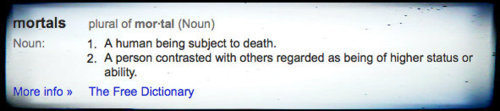
mortals
"You're such a character," my grandma has told me my entire life. She meant it endearingly, but I find myself thinking that of people in a less than endearing way.
I hear some person's name and I groan inside, because they make life unnecessarily complicated; as if that person is "just" a speedbump to progress, "just" a catalyst for conflict, or "just" a strange character thrown in my story for comedy's sake.
There is much wrong with this. For instance—"my story." Whoever said it was mine anyway? In Crazy Love, Francis Chan compares our self-centeredness to the guy who tells his friends to come see a movie "about him," when in reality he was just an extra. He was the back of a head; the face that walks by the screen pushing a stroller. We are the same, in a way, because this isn't our story. We have parts, but we are part of a whole. Who are we to treat others as side characters?
At the same time, we are not just extras. This story has a lot more dimensions than any movie screen could tell. Each person is a dimension. Each soul is a reflection of the image of God—with some images more mended by grace than others.
As Lewis said,
"It is a serious thing…to remember that the dullest and most uninteresting person you talk to may [in Heaven] be a creature which, if you saw it now, you would be strongly tempted to worship… It is in the light of [this]…that we should conduct all our dealings with one another, all friendships, all loves, all play, all politics. There are no 'ordinary' people. You have never talked to a mere mortal.
…it is immortals whom we joke with, work with, marry, snub and exploit — immortal horrors or everlasting splendours. This does not mean that we are to be perpetually solemn. We must play. But our merriment must be of that kind (and it is, in fact, the merriest kind) which exists between people who have, from the outset, taken each other seriously — no flippancy, no superiority, no presumption. And our charity must be a real and costly love, with deep feeling for the sins in spite of which we love the sinner…" (The Weight of Glory)
Per usual, the Apostle Paul recommends a different way of living for followers of Jesus: "…as servants of God we commend ourselves…by great endurance, in afflictions, hardships, calamities…labors, sleepless nights, hunger; by purity, knowledge, patience, kindness, the Holy Spirit, genuine love; by truthful speech, and the power of God…"
We are to be known by this endurance—through hunger and sorrow. And, he says, we are to be known by our truthfulness, patience and real love. With that, he ends his exhortation: "Widen your hearts." (2 Cor. 6:4-13)
There are no mere speedbumps, no mere court-jesters, no mere mortals. We are surrounded by images of God, if our hearts are wide enough to see them.
December 16, 2011
All our times are in Your hands. Efforts do not succeed unless You breathe life into them. Our...
All our times are in Your hands. Efforts do not succeed unless You breathe life into them. Our fighting is but pressing against a brick wall unless You push with us.
All I know of glory is the sunrise at the end of waiting, when who You are spills out from behind the veil of secret mystery; the beauty no fallen eyes can see unless You move them to absorb so much light.
"We do not know what to do, but our eyes are upon You."
December 14, 2011

"Grace is but glory begun, and glory is but grace perfected."
- Jonathan Edwards (via rachel-aldrich)
December 12, 2011
this story

I was broken from the start.
This week at church, pastor said that the doctrine of sin helps us forgive others. How? Because we drank the same poison. If we know all have sinned, we can look at the people who sin against us and say, "You've sinned out of your broken heart." We know the reason.
What they did was not okay. But we are no better, we see.
Paul David Tripp wrote, "[Sin] distorts our identity, alters our perspective, derails our behavior, and kidnaps our hope." We are lost, in uniform. This is us.
I stumbled across this poem on my bookshelf. Written by Dietrich Bonhoeffer from a prison during World War II, the situation couldn't be farther from mine. Or is it?
Am I then really all that which men tell of?
Or am I only what I know of myself,
Restless and longing and sick like a bird in a cage,
Struggling for breath, as though hands were compressing my throat…
Tossing in expectation of great events,
Powerlessly trembling for friends at an infinite distance,
Weary and empty at praying, at thinking, at making
Faint, and ready to say farewell to it all?
Who am I? This or the other?
Bonhoeffer is a hero of the faith. Yet I feel a complicity with him. He was a man; he knew of sin. Torn between courage and fear, in a crisis of identity before God—he was also "broken from the start." My guess is he knew, too, what it was like to hear in one's head, day in and day out, "You're a lost cause. There's no fixing you, kid. You know your nature. You have no future hope." (Sin, you eat us alive.)
But Bonhoeffer was also a consummate theologian and knew the truth:
…Or is something within me still like a beaten army,
Fleeing in disorder from victory already achieved?
Sure, the stain of sin drips off our hands, complicit in the murder of God. From life's first breath, ours has been a story of sin. But as Matt Chandler said from the pulpit at church this past week, "You haven't surprised Him. You haven't plumbed the depths of depravity [and astounded Him.] …He knew. Still He came."
"And the Word became flesh and dwelt among us," we read yearly at Christmas, "…[and] from His fullness we have all received, grace upon grace." (John 1:14;16)
God takes our stories and rewrites them, scrubbing the blood from under our nails by washing us with His. This isn't even about our sin anymore, this story.
"Eyes up!" hope seems to say. "This is the story of God."
For this reason, waiting for death in a prison cell, Bonhoeffer was able to know that regardless of his human weakness, the victory was won. His sin was buried under grace upon costly grace.
Likewise:
If I look at myself, my sin, my angst, as a barrier too great for God to surpass, then I know nothing of Calvary love.
If I count myself among lost causes, then I have not yet basked in the grace of the Crucified.
Grace, upon grace. Does it make sense? No. I don't understand it. I'm still no perfect child. I writhe at God's sovereignty. I still huddle in corners over the problem of pain and trusting God with hurt. I gnash my teeth trying to forgive people. But the Rescue still happened.
We are delighted in and loved unto Calvary.
"You are forgiven."
I hear.
more than a bush demon
I remember staring at the piece of wood, wondering. I could easily imagine people fearing him—his eyes were certainly creepy. But worship? Would someone really pray to such a thing? He was barely the height of a pencil.
I remember that as my first brush with an idol. But all along I'd had my own set of idols I held close, caressed, and whose grip on my heart I kept alive and well. My idols—although invisible—were many and strong. And they made their own temple inside of me…
[Read the rest at the link above.]
December 10, 2011
"While I have bundled myself up in layers of worry
You still scoop up this All Of Me and
Teach me how..."
You still scoop up this All Of Me and
Teach me how to unravel."
December 7, 2011
"Our culture has filled our heads but emptied our hearts, stuffed our wallets but starved our wonder...."
- Peter Kreeft (via firstbreath90)
Hannah Farver's Blog

- Hannah Farver's profile
- 12 followers

