
Joe Velikovsky's Blog, page 11
May 14, 2021
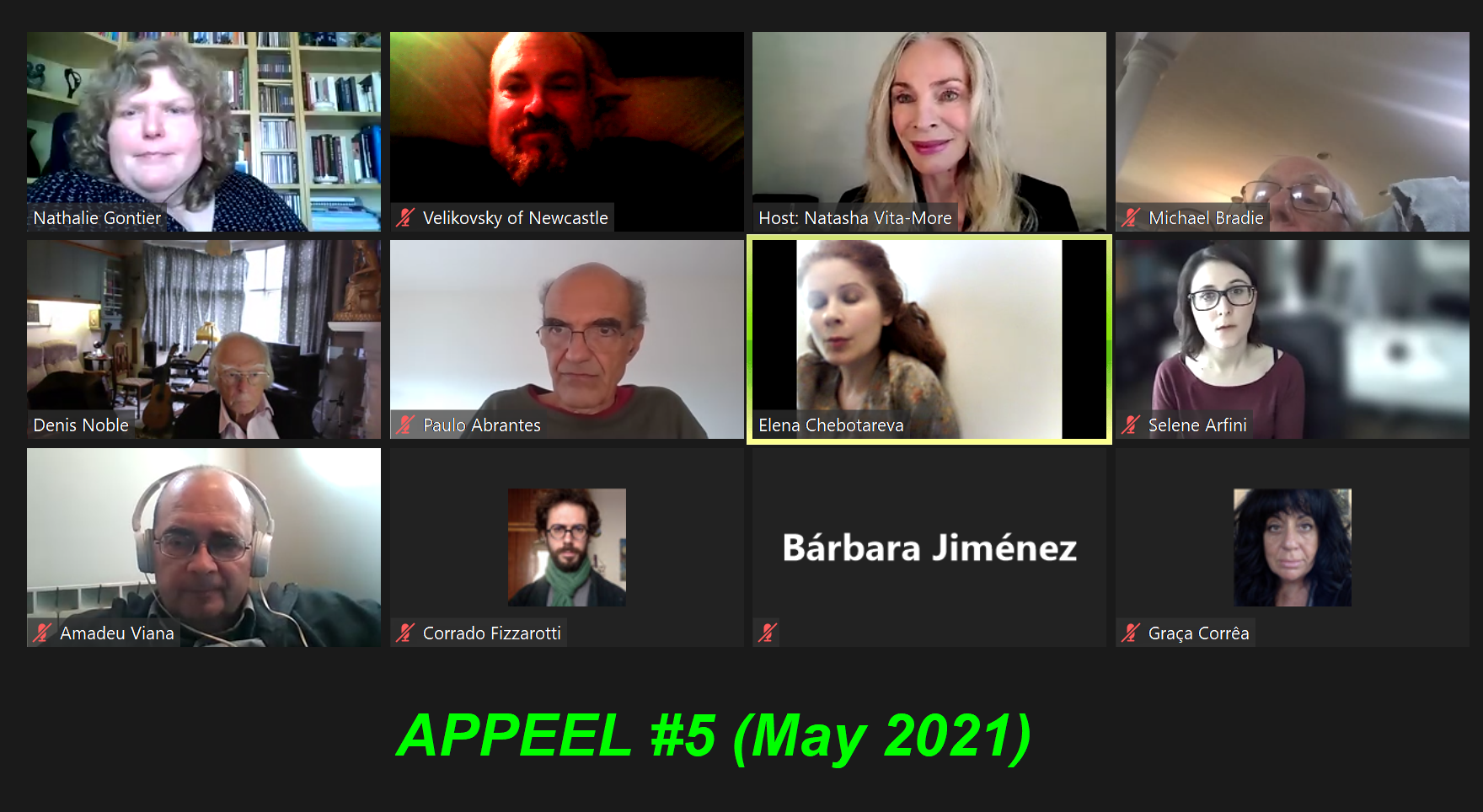
AppEEL webinar #5 (May 2021)
So we had AppEEL webinar #5 of 2021...
It was great!!! (Just like AppEEL webinars #1, #2, #3 and #4)

By the way, this post you're now reading isn't the Official Page for the AppEEL webinars.
This is just: my NOTES... (by Velikovsky of Newcastle)
--------
The video, from AppEEL webinar #5
(featuring AppEEL Director, Nathalie Gontier
AppEEL Webinar #5For more, see https://www.youtube.com/user/appeellisboa/videos
& speakers:
Natasha Vita-More, and Lada Shipovalova & Elena Chebotareva )
AppEEL - in collaboration with the Department of Philosophy of Science and Technology at St.-Petersburg University* Natasha Vita-More on Evolution Mutatis Mutandis: Changing what needs to change
* Lada Shipovalova & Elena Chebotareva on Evolutionizing the Technosphere: Biological Approaches to Engineering
-------------------------
And just in passing, a few items of News:
New book (releasing next week, May 18, 2021) by evolutionary philosopher Andy Norman: `Mental Immunity' - see: https://on-writering.blogspot.com/2021/05/book-review-mental-immunity-andy-norman.html& see: https://cognitiveimmunology.net/& the 2021 CES Conference is next month (Jun 9-11) https://culturalevolutionsociety.org/story/Conferences------//------& for more about AppEEL, see also:
The Applied Evolutionary Epistemology Lab
 ------------//------------
Anyway, another terrific AppEEL webinar - I learned a lot! & met lots of great people/scholars.
What's not to like-?
--------------//---------------
Well, that's about all we have time for, folks.
You have been reading / viewing a blog-post by: Dr J T Velikovsky Ph.D
 (aka: Velikovsky of Newcastle)
Information Scientist
& Systems Scientist
& AI Researcher & Enthusiast
& Evolutionary Culturologist
(aka: Velikovsky of Newcastle)
Information Scientist
& Systems Scientist
& AI Researcher & Enthusiast
& Evolutionary Culturologist
More information:
Transmedia Blog: On Writering
IMDb (Movies, Videogames):
YouTube channel: https://www.youtube.com/joeteevee (over 100 videos, some are even: good)
Academia.edu page: https://newcastle-au.academia.edu/JTVelikovsky
Researchgate page: https://www.researchgate.net/profile/Jt_Velikovsky
JTV's ouvre... etc etc.
ORCiD: https://orcid.org/0000-0001-6741-066X
& Forthcoming book P3 of EC (November 2021): https://www.igi-global.com/book/principles-protocols-practices-evolutionary-culturology/267379
------------------------------------------
& please stay tuned, for more: AppEEL webinars !
& Thanks for reading!


May 13, 2021
TVoL's Examined Lives: Mental Immunity to Infectious Ideas (Session 9)
TVoL's Examined Lives: Mental Immunity to Infectious Ideas (Session 9)
(Webinar of: May 13th 2021)
See: https://thisviewoflife.com/examined-lives/
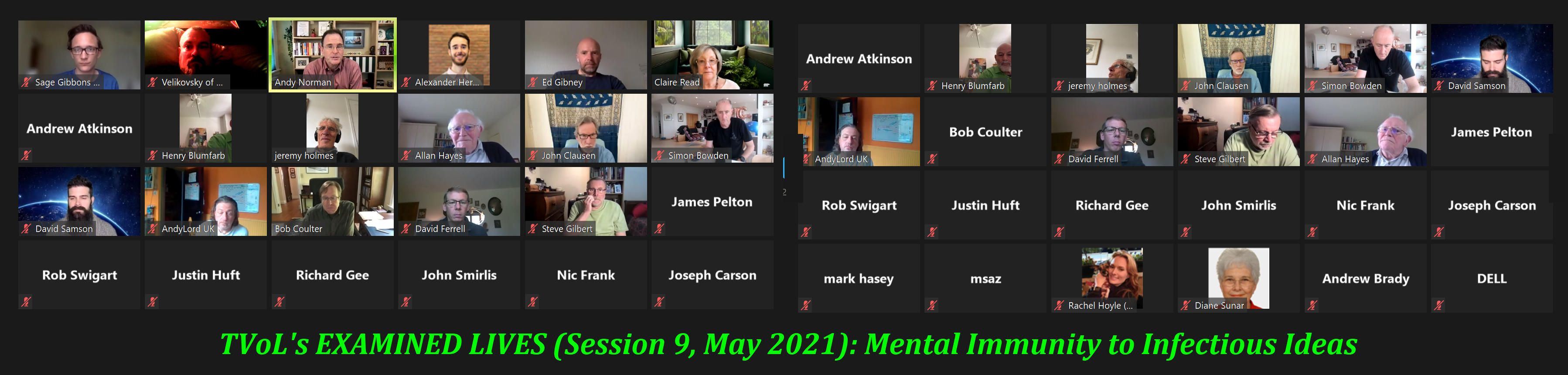
A blog-post by Velikovsky of Newcastle
--------------
So - I just attended this great webinar!
-------//--------
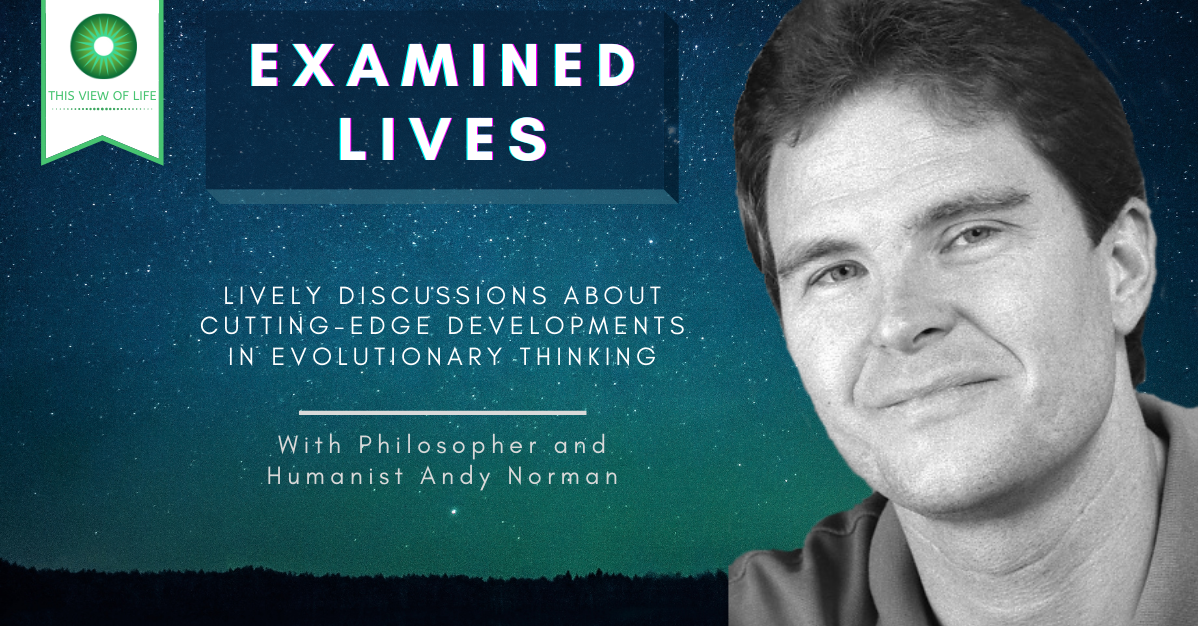
TVoL's Examined Lives: Mental Immunity to Infectious Ideas (Session 9)
Abstract:
`Our species is strangely susceptible to infectious ideas. Take the idea that a cabal of Satan-worshipping pedophiles controls the US government (“QAnon"): in recent years, we’ve watched it spread like a disease online, and dramatically alter political behavior. Epidemiologists at the World Health Organization now speak openly of “infodemics”—they’re even urging us to take off the scare quotes and take such talk literally.
Just as our bodies differ in their susceptibility to Covid, our minds differ in their susceptibility to science denial, conspiracy theories, and extremist ideologies. Those more susceptible can be thought of as less immune, and those less susceptible can be thought as more immune. But what is mental immunity? How does it work? Can our minds be said to have immune systems that function more or less well? Do kooky and harmful ideas spread more readily when mental immunity is compromised? Is there more to mental immunity than being able to think critically? Most important: can we develop our immunity to bad ideas, and become wiser versions of ourselves?
In this special session of Examined Lives, Andy Norman will share the central thesis of his book Mental Immunity, and invite discussion.'
Care to explore a bit beforehand? Start here:
https://cognitiveimmunology.net/
https://andynorman.org/mental-immunity
https://onlinelibrary.wiley.com/doi/abs/10.1002/gch2.201600008
https://en.wikipedia.org/wiki/Inoculation_theory
-------//--------
And, am happy to report we solved all the world's problems, in that great webinar.
THE END.
-------//--------
So, I wouldn't take the below as `True News', or anything :)
Could all be: Fake News. You be the judge.
------------
My Scribbled Mtg Notes :
As a super-brief summary of the book Mental Immunity (2021), Andy's claims, on the topic of Cognitive Immunology are that:
Bad ideas are mind-parasites The `Germ Theory of cognitive contagion' has arrived (among other things, to combat the spread of viral nonsense, online)Minds have immune systems that function more - or less - well, to prevent infectionMinds had to develop resistance, as - the wrong (bad) idea, can get you killed~(!) Our minds' Immune Systems only currently function at a fraction of their potential...The emerging Science of Mental Immunity helps us all to become wiser (given that the term `homo sapiens' = wise ape!)......Discuss-!! :)
---------------
(And, indeed we did!)
Some of the Zoom-chat is below: (mostly, anonymized) - & mainly just presented here, for the links/URLs, which are very informative! (thanks especially to Sage @ TVoL)
------
Questions & Comments made in the Zoom-chat:
Q: How do you define bad ideas?
Q: Marxism is an idea that seems to have resurfaced many times, suggesting not much herd immunity?
Q: In our EAE / (EEA / Environment of Evolutionary Adaptedness), with groups of 150, why would immunity be so important?
Sage (TVOL) to Everyone : To preserve cumulative cultural adaptations would be main guess
Q: In our EAE in groups of 150 why would immunity develop to bad ideas? While the social network is now billions in size
Q: Isn't wishful/willful thinking not usually unconscious? i.e., the motivation is not obvious to the individual
- Religions seem to be pretty good at spreading inconsistent ideas?
- If there is an evolved system, one would think that it would not be entirely dependent on will, deliberate effort, or even learning
- I suggest that "BAD" idea relates to case fatality ratio in the epidemiological models
- From Steve: see Kahn, D. (2017) Misconceptions, Misinformation, and the Logic of Identity-Protective Cognition https://papers.ssrn.com/sol3/papers.cfm?abstract_id=2973067
More Comments, from the Zoom-chat:
- Defining your identity in terms of set of beliefs is the definition of religion!
- An epidemic requires a group, and so does identity; this has to be a question of protecting (immunizing) groups, not just individuals
Velikovsky: I did a short blogpost review of Andy's forthcoming book: https://on-writering.blogspot.com/2021/05/book-review-mental-immunity-andy-norman.html
From Sage (TVOL) to Everyone : I think that WEIRD cultures (see: Joe Henrich's book) probably concentrate “bad ideas” (maladaptive, disconnected from reality, etc.) in a unique way relative to the mental immunity developed in the EAE. In the EAE, cultural knowledge was shared among a tight-knit community of people who relied on each other to survive and had obligations and privileges based on social position. In modern WEIRD cultures, we can find like-minded people according to symbolic abstractions devoid of deeper relations. Therefore, the ideas themselves are more powerful and self-serving, rather than constrained by deeper relations
From Sage (TVOL) to Everyone : The cognitive biases that evolved to preserve cumulative cultural knowledge now are serving more arbitrary in-groups without the same relevance to your day-to-day life or to the relationships you have with those people outside of those ideas.
- Sage's point is very important!
- What function do ideas have from an evolutionary perspective / good ideas, ones that promotes personal and group survival ?
Steve: Can we all agree that a scientific consensus is a “good” idea?
- Scientific consensus can be on bad ideas as well (the ether, for example). Science is all about process, not conclusions
- (to Sage): beneficially applied science maybe
- Evolutionary Ethics! :)
- Just looking at the mess in one section of Congress right now where Truth is a bad idea and those who promote it are doomed…
Sage Gibbons (TVOL) to Everyone : Great point, [X]. Scientists are just the best mouth piece we have for the current state of the process, but good scientific ideas are only known after the fact.
- Religion might be defined as a bad idea in terms of a set of beliefs are not governed by science and yet you could also argue that the lack of religion is causing the greater spread of other bad ideas that substitute for religion like say Marxism or psychotherapy
- Just as a remark for Andy Norman, I think it might be fruitful to try to dodge the question of good or bad and hitchhike on the pragmatic/evolutionary worldview. For instance as done in Functional Contextualism of the contextual behavioral science. The core idea is that statements can only be evaluated in terms of successful working in relation to an analytic goal. Functional Contextualism goes for „prediction and influence“ but doesn’t make any claims about other analytical goals. I think this is clean way to acknowledge but outsource the question of „values“.
- Yes, but we default to our sub-cultural consensus
- And you still do…
- Sage, would you provide the Hendricks citation?
- A “true” idea may not be adaptive if it results in your rejection from the group (unless you can join another group)
Sage Gibbons (TVOL) to Everyone : Best reference is his book, Secret of Our Successhttps://www.amazon.com/dp/B00WY4OXAS/
Sage Gibbons (TVOL) to Everyone : +1 for Don Hoffman. This podcast with him is a bit of a trip: https://thirdeyedrops.com/hoffman170/
- Lies spread faster and wider than then truth. Is that consistent with the immunity idea?https://science.sciencemag.org/CONTENT/359/6380/1146.abstract
- `Nothing spreads like fear' - strapline from the film Contagion
From Sage (TVOL) to Everyone : That’s a great paper. A choice quote: “Whereas the truth rarely diffused to more than 1000 people, the top 1% of false-news cascades routinely diffused to between 1000 and 100,000 people. Falsehood reached more people at every depth of a cascade than the truth, meaning that many more people retweeted false-hood than they did the truth”.
- Looking forward to your book! (i.e. Andy Norman's Mental Immunity)
- Thank you Sage. I think that it's hard to see that we have natural immunity to bad ideas given the evidence in that paper
From Sage (TVOL) to Everyone : On the other hand, that paper also showed that the presence of fact-checking websites (e.g. snopes.com) limited the continued diffusion of false-news cascades. So it’s an uphill battle, but at least people don’t want to be seen as a liar. Adds some backing to Twitter and Facebook’s misinformation warnings
Andy (Norman) also mentioned his new Think-Tank / Nonprofit (& always interested in more researchers joining): pls see
Cognitive Immunology https://cognitiveimmunology.net/
More comments (mostly, anonymized) from the Zoom-chat:
- If anyone is not familiar with the work of John Cook (George Mason University), you should check this out. He was for many years worked on climate change denialism and formalized a process of mental inoculation and other ideas highly relevant to the discussion here. He even has a super-accessible illustrated comic book (John did the drawings as well) called Cranky Uncle vs. Climate Change. And he's offered a MOOC on CC denialism on Coursera or EdX, a course which I highly recommend!
- I really think the main problem with the claims of the book are related to the definition of `good vs. bad'. I think the story becomes better if we are talking about world view or mental model related immunity and resilience. - Or let me rephrase… I haven’t read the book so I don’t want to make any claims about it. Just the ideas we are discussing here.
- Money is an idea. Gresham's law "Bad money drives out good"
- A deal of evidence suggests that bad ideas spread much faster and wider than good ideas and have done throughout human history And rather than having immunity from bad ideas that we are uniquely adapted to absorbing and multiplying bad ideas
- As far as education is concerned, we also have to introduce the skills of critical thinking. Such a seemingly large portion of the population just doesn’t want and doesn’t know how to think…It’s easier to just absorb and regurgitate.
- You should have a look at synthetic media. Deep Fakes, etc. The future is not necessarily gonna make resistance to bad ideas easier.
- At what point can you „blame“ people or „claim“ truth if anything can be faked.
- We [humans?] are norm-followers and group-identifiers rather than truth-seekers, aren't we?
- This is just wonderful! Thank you, Andy
- What’s the role of intuition as a criterion for ascertaining what’s true?
- Just imagine procedurally generated scientific articles that cannot be distinguished from real articles. Already some generated articles have gotten through peer review….
- Wonderful discussion. Thank you very much!!
- Fantastic point, [X]. Ideas wrapped in norms and group identity take all kinds of priority over truth. Certainly in public representations
- Thank you for taking on this topic!
- In addition to DSW’s work, I think Jonathan’s Haidt’s work adds perspective to this discussion!
- Thank you all, especially Andy for being so open
-------//--------
And - I can highly recommend, Andy's new book: Mental Immunity (due out: May 18 2021) !

Mental Immunity (due out: May 18th 2021)
(& I notice, you can pre-order it now on that Amazon link, above... & I did ! )
--------------
So: great webinar. I learned a lot. (JTV)
& Met lots of great people / scholars.
...What's not to like?
THE END
ROLL CREDITS.
--------------//---------------
Well, that's about all we have time for, folks.
You have been reading / viewing a blog-post by:
Dr J T Velikovsky Ph.D
(aka: Velikovsky of Newcastle)
Information Scientist & Systems Scientist & AI Researcher & Enthusiast & Evolutionary Culturologist & Filmmaker & Writer & Artist & Actor & Muso & Rugged Frontiersman & Random Guy
(and, also The StoryAlity Guy)
aka Humanimal
(or, The Artist formally known as Dr J T Velikovsky)
More stuff:
Transmedia Blog: On Writering
IMDb (Movies, Videogames):
Music: Texas Radio & Zen Stupidity
YouTube channel: https://www.youtube.com/joeteevee (over 100 videos, some are even: good)
Academia page: https://newcastle-au.academia.edu/JTVelikovsky
ResearchGate page: https://www.researchgate.net/profile/Jt_Velikovsky
My ouvre... etc etc.
ORCID: https://orcid.org/0000-0001-6741-066X
Forthcoming book (November 2021): https://www.igi-global.com/book/principles-protocols-practices-evolutionary-culturology/267379
May 11, 2021
Book review - `Mental Immunity' (Andy Norman 2021)
Structured-Abstract Book-Review:
Mental Immunity (Norman 2021)
by
Velikovsky of Newcastle
http://storyality.wordpress.com/
12th May 02021
-------//-------
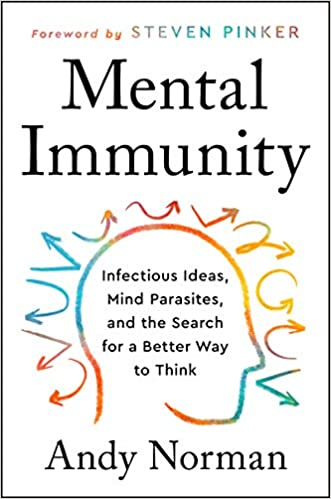 Mental Immunity (Norman 2021)
And - a great interview with Andy Norman, by Michael Shermer (in May 2021):
Mental Immunity: Infectious Ideas, Mind Parasites, and the Search for a Better Way to Think on The Michael Shermer Show / SKEPTIC Magazine-------//-------
STRUCTURED ABSTRACT (BOOK REVIEW) - by Velikovsky
Aim
(of the book Mental Immunity (Norman 2021)
To present a set of methods, practises, and protocols, for improving one's cognitive immunity.
Background
There are good - and bad - ideas.
There are good - and bad - ways of thinking.
…Here’s a remedy, for the bad ways…! ...The emerging Science of Cognitive Immunity.
If you like books by Steven Pinker, Rebecca Goldstein, Dan Dennett, Yuval Noah Harari, Jonathan Haidt, Richard Dawkins, Sam Harris, and Rutger Bregman - you'll love this book too.
Taxon (of the book, Mental Immunity)
Kingdom: Written culture.
Phylum: Literature.
Class: Nonfiction
Order: Epistemology (Rationality)
Genus: Critical Thinking (Morally Responsible Believing)
Species: Cognitive Tools (Technologies) - inspired by Dawkins (1993) `Viruses of the Mind'
Breed: Mental (Cognitive) Immunity Tools
Location
USA & Global (...applies to the meme-o-sphere/the broad domain of all ideas, in general! But especially currently in the US, given The Mango Mussolini (Big Propaganda), the prevalence of QAnon(sense) conspiracy theorists, and the US Capitol Insurrection of Jan 6th 2021). Mental immune systems are under siege en masse, from mind-viruses worldwide.
Methods
A brief history of Philosophy/Epistemology (examining the key turns in: Socrates, Plato, Hume, and Clifford), and, good and bad ways of thinking.
An argument, series of case studies, and supporting illuminating analogies and anecdotes, illustrating many crucial methods of improving human cognitive immunity.
Examinations of good ideas (e.g. objective truth, science, rationality, reasoning, Enlightenment Values, good morals/ethics, etc.), and - conversely - bad ideas [infectious bad ideas, mental parasites, irresponsible subjective values],(conspiracy theories, ideologies, religions, cults, fake news, etc.)
Results
A terrific new set of tools that anyone can use right away to improve their own cognitive health & cognitive immunity, including many helpful and positive ways to engage with `irrational believers', and to resolve problematic differences to enhance global thinking.
Conclusions
A great mind-vaccine...
A path to better reasons !
Also - It will even make you happier!
(Empirical evidence shows: People with an open mind/growth mindset are happier.)
(...In short, you absolutely should read it!)
Brilliantly-written, this work a terrific read throughout, and the Tools it contains and explains will vastly improve your cognitive immunity - i.e., Resistance to bad ideas-! Truly enlightening, and a great contribution to domains of Philosophy, Epistemology, and Cognition. A must-read way to upgrade your (and your friends' and loved ones') cognitive functioning.
-----//-----
REFERENCES
Norman, A. (2021). Mental Immunity: Infectious Ideas, Mind-Parasites, and the Search for a Better Way to Think. Harper Wave.
Dawkins, R. (1991). Viruses of the Mind. (book chapter) In B. Dahlbom (Ed.), Dennett and His Critics: Demystifying Mind (pp. 13-27). Blackwell.
-------//-------
Mental Immunity (Norman 2021)
More information at: Andy Norman's website
And see also: Andy Norman's Examined Lives
FIN
-----//-----
Well, that's about all we have time for, folks!You have been reading / viewing a blog-post by:
Dr. J T Velikovsky Ph.D
(aka: Velikovsky of Newcastle)
Information Scientist & Systems Scientist & AI Researcher & Enthusiast & Evolutionary Culturologist & Filmmaker & Writer & Artist & Actor & Muso & Random Guy
(and, also The StoryAlity Guy)
aka Humanimal
(or, The Artist formally known as Dr J T Velikovsky)
More stuff:
Transmedia Blog: On Writering
IMDb (Movies, Videogames):
Music: Texas Radio & Zen Stupidity
Youtube channel: https://www.youtube.com/joeteevee (over 100 videos, some are even: good)
Academia page: https://newcastle-au.academia.edu/JTVelikovsky
Researchgate page: https://www.researchgate.net/profile/Jt_Velikovsky
My ouvre... etc etc.
ORCID: https://orcid.org/0000-0001-6741-066X
Forthcoming book (November 2021): https://www.igi-global.com/book/principles-protocols-practices-evolutionary-culturology/267379
--------------//---------------
-----//-----
--//--
Post Script.
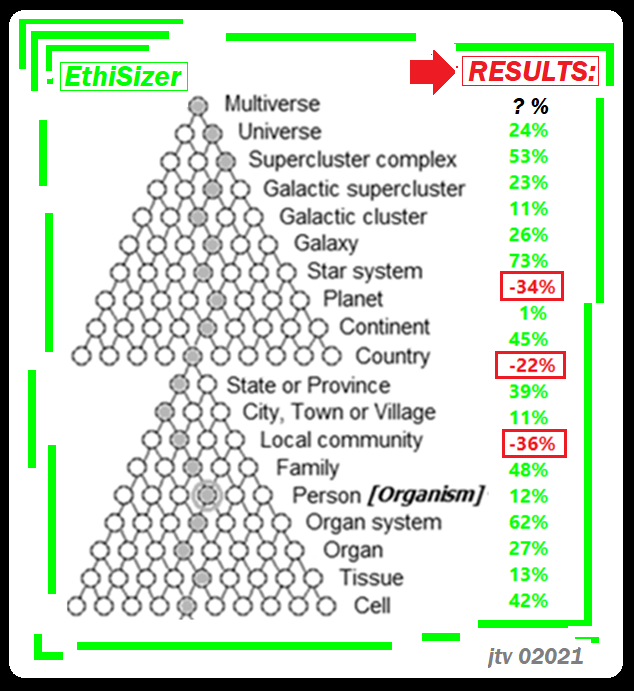
Also, if Values are of interest, perhaps see, this Big List of 268 Values I compiled... (...No doubt, many more exist! :)
And see, The EthiSizer:
The EthiSizer (...monitoring the world's ethics)
--------------------
April 24, 2021
Short Book Review: ScienceBites (Jagers 2019)
Short Book Review: ScienceBites (Jagers 2019)
Review by JT Velikovsky
April 2021
~~~~~~~~~
So I just read this great book:
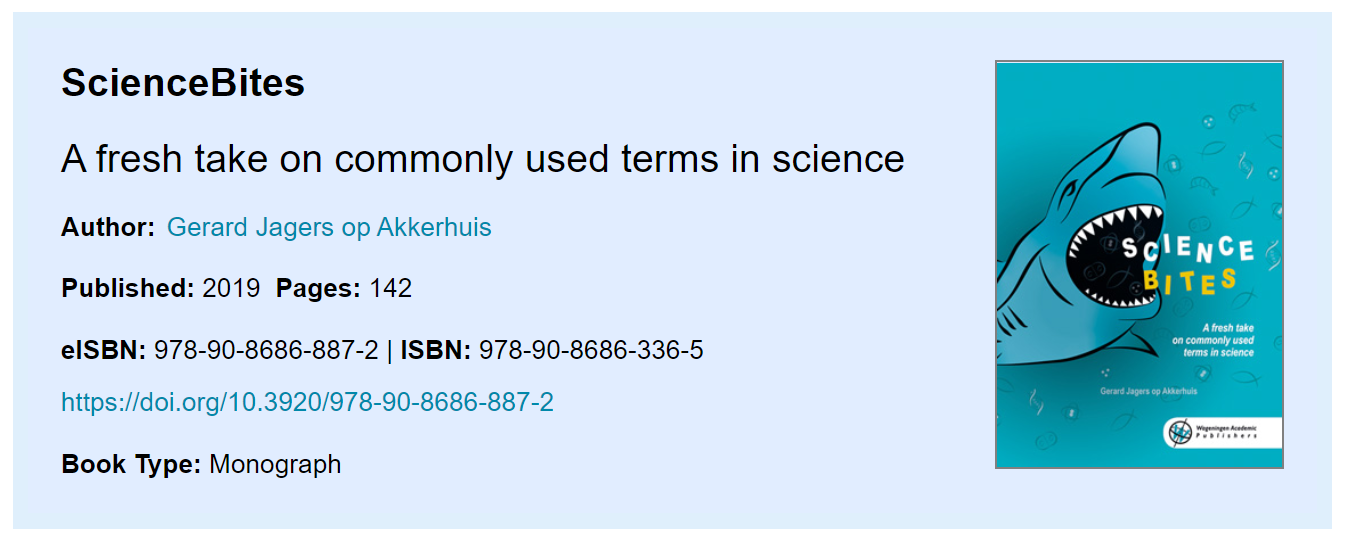 Science Bites (Jagers 2019)
And it's a terrific read. It's a short book, and divided into short, easy-to-read chapters, for a general (and, scientific!) audience. I very highly recommend it!
Here's the Abstract from the book's webpage:
`In science, concepts such as organism, evolution and life, are used almost every day. Every scientist knows the general meaning of such concepts. At the same time, nature is complex, and for this reason, it is difficult to draw stringent lines around classes of things. Scientists therefore accept the use of so called 'working definitions' for many concepts. It is frequently advocated that working on definitions has little use for practical research.
This book explores a different viewpoint, in which definitions are compared with tools. If your toolbox contains too few tools, tools that are worn down, or tools that don't fit, it becomes difficult to carry out even the most easy maintenance or repair job. Experts know: suitable tools make the work easier.
The aim of this book is to examine much-used concepts in science as if these are tools in a scientific toolbox. Do the current definitions represent quality tools? To explore this question, this book uses a recently developed hierarchy theory, the operator theory, as a reference. This theory is explained in the first chapter. Whenever the analyses suggest to do so, the ScienceBites offer directions for improvement of current definitions.
Keywords: life sciences, scientific concepts, operator theory, philosophy, innovation, Darwin'
Source: Science Bites book webpage
Definitions of key concepts do change over time; this book (rightly!) takes the view that definitions are just some of the tools we use in science. (And of course, in everyday life; as all of life is doing science !) And sometimes the tools need sharpening!
Just a few key outstanding points of this great work (in my view):
Jager's Operator Theory! A great controbution to systems science, in my view. [And over 20 years of work/research by Jagers] (...in short, dual closure: a process systems loop, and a containing layer [a structural loop])An improvement in scala naturaeDifferentiation between: gene, replicator, vehicle, interactor, and operator (noting: Dawkins' `meme' theory, 1976)The organism (eg cell) as the unit of organism; DNA is not useful outside the system of a cellAn extremely useful extension/expansion of Waddington's `operator' concept!Operator theory defines unity! A useful tool for examining unitsDual closure, which applies to not just cells and organisms (multicellular and pluricellular, endosymbiont cells, and neural network organisms) but also - atoms and molecules!A super-useful definition: `Every unit that is defined by dual closure is called an operator.’ (Jagers 2019, p 24)So `genes and a body' taken together are: an operator! There is dual closure (of structure, and function/process).. genes are not the only `unit' of inheritance! (see also: cell membrane and cell plasma!... see also protozloan mitochondria, and chloroplasts!) - all these insights by Jagers are crucial tools for understanding systems/units/evolution, in my view. (And are helpful with my own understanding of both hierarchies, and HOLARCHY/partarchies, in both biology and culture. (For more detail on cultural evolution, if of interest, see my forthcoming book, P3 of EC ) Host cells as units of selectionThere are over 100 definitions of `life'! (Jagers 2019, p. 27)A helpful clarifcation on the utility of definitions (What are they, what problems do they solve, and how)A definition of organism: `every operator of a kind that is at least as complex as the cell' (p. 40)A terrific examination of the concept of evolution from Darwin's Origin (1859); Jagers rightly notes, the commonly understood Darwinian concept of evolution is `descent with modification through variation and selection' (Jagers 2019, p. 44)... Jagers rightly notes neither an organism nor a species can `evolve' in those terms (please read the book for the detail, I am summarizing here, and I know it may sound illogical in such a compressed/condensed format!)In fact as a huge fan of Darwin (as is Jagers!) here's a quote from the Origin (6th ed, Darwin 1876), from the brilliant Darwin Online site:
CHAPTER IV.
NATURAL SELECTION; OR THE SURVIVAL OF THE FITTEST.
Natural Selection—its power compared with man's selection—its power on characters of trifling importance—its power at all ages and on both sexes—Sexual Selection—On the generality of intercrosses between individuals of the same species—Circumstances favourable and unfavourable to the results of Natural Selection, namely, intercrossing, isolation, number of individuals—Slow action—Extinction caused by Natural Selection—Divergence of Character, related to the diversity of inhabitants of any small area, and to naturalisation—Action of Natural Selection, through Divergence of Character, and Extinction, on the descendants from a common parent—Explains the grouping of all organic beings—Advance in organisation—Low forms preserved—Convergence of character—Indefinite multiplication of species—Summary.
How will the struggle for existence, briefly discussed in the last chapter, act in regard to variation? Can the principle of selection, which we have seen is so potent in the hands of man, apply under nature? I think we shall see that it can act most efficiently. Let the endless number of slight variations and individual differences occurring in our domestic productions, and, in a lesser degree, in those under nature, be borne in mind; as well as the strength of the hereditary tendency. Under domestication, it may be truly said that the whole organisation becomes in some degree plastic. But the variability, which we almost universally meet with in our domestic productions, is not directly produced, as Hooker and Asa Gray have well remarked, by man; he can neither originate varieties, nor prevent their occurrence; he can only preserve and accumulate such as do occur. Unintentionally he exposes organic beings to new and changing conditions of life, and variability ensues; but similar changes of conditions of life, and variability ensues; but similar changes of conditions might and do occur under nature. Let it also be borne in mind how infinitely complex and close-fitting are the mutual relations of all organic beings to each other and to their physical conditions of life; and consequently what infinitely varied diversities of structure might be of use to each being under changing conditions of life. Can it, then, be thought improbable, seeing that variations useful to man have
undoubtedly occurred, that other variations useful in some way to each being in the great and complex battle of life, should occur in the course of many successive generations? If such do occur, can we doubt (remembering that many more individuals are born than can possibly survive) that individuals having any advantage, however slight, over others, would have the best chance of surviving and of procreating their kind? On the other hand, we may feel sure that any variation in the least degree injurious would be rigidly destroyed. This preservation of favourable individual differences and variations, and the destruction of those which are injurious, I have called Natural Selection, or the Survival of the Fittest.Variations neither useful nor injurious would not be affected by natural selection, and would be left either a fluctuating element, as perhaps we see in certain polymorphic species, or would ultimately become fixed, owing to the nature of the organism and the nature of the conditions.
Origin, 6th Ed, Darwin 1876, pp. 62-63
Jagers (2019) raises some absolutely crucial points regarding the common understanding of evolution, which (in a nutshell) summarizes down to this great point (bold emphasis mine, below)“…only offspring production classifies as a process, while variation and selection classify as assessments… Darwinian evolution can be defined as the combination of one process and two assessments.” (Jagers 2019, p. 48)
and
“Darwinian evolution, classifies as a pattern” (p. 48)
i.e. A process is in fact different to a pattern... These great insights (including Jagers' operator theory) are the sort of thing to be found in Science Bites, and I highly recommend reading it.
Back to a summary of key concepts in the book (Jagers 2019):
A new view of evolutionary transitions (examining Maynard Smith & Szathmary 1995), i.e. replicating molecules to populations of moleculesunlinked replicators to chromosomesRNA as gene & enzyme to DNA & protein (genetic code) Prokaryotes to EukaryotesAsexual clones to sexual populationsSolitary individuals to colonies (non reproductive)Primate societies to human societies (language)(See: Jagers 2019, p. 64)Big History, and eras vs. epochs; Systems vs. regimes (Jagers brings a new clarity and consistency to these terms)Operators and Interaction systems... Species as man-made categories(!)... examining the very concept of species: Does it exist?Levels in hierarchies - first, examining Ernst Mayr's statement:Dual closure: functional and structural closure as defining a unit (Jagers 2019, p. 86)Self, information and unity - dual closure causes a self (p. 88)“The term `meaning’ generally refers to a change in uncertainty in a decision process.” (p. 88)Four dimensions as DICE (Dispersal, Information, Construction, Energy) for checking completeness of a scientific model of interaction systems (p. 93)Popper on black swans (falsifiability)Jagers also presents a very useful list of some internal and external criteria for doing science:Internal: personal attitude, generality, efficiency of reasoning, logical consistency, terminology, data (and for experimental/observational sciences) - mental groupings and classifications, repeatability and verification, falsifiability and improvement, causal explanations, & existence.External: the exchange of ideas, grant applications, citation numbers, ability to present a theory, the profitability of a theory, the fit of the new idea/theory with the zeitgeist, patenting, and societal/technological implications (see Jagers 2019, pp. 104-7) Jagers also discusses extensions of evolution (e.g. the extended evolutionary synthesis)Also fruitfully discussed are:Organisms vs holobionts (and, hologenomes!), andOrganisms vs Superorganisms (ant colonies, beehives, etc) - (and neural network organisms, aka `memons')... and extending the issue (or problem) to cities, companies, etcSelf-organization & the principle of least action, and Adrian Bejan's `constructal law' in self-organizationLimitations of ScienceBeyond postmodernismThe virtues of: Simplicity, scalability and generality
`The complexity of living systems exists at every hierarchical level, from the nucleus, to the cell, to any organ system (kidney, liver, brain), to the individual, to the species, to the ecosystem, the society' (Mayr cited in Jagers 2019, p. 84)
In short, a terrific book. Very helpful with my own thinking on hierarchies - and even the exciting enterprise of Science in general! Highly recommended.
See also Gerard's papers and books on operator theory, at The Operator Theory website:
Well, that's about all we have time for, folks.
You have been reading / viewing a blog-post by: Dr J T Velikovsky Ph.D
(aka: Velikovsky of Newcastle)
Information Scientist
& Systems Scientist
& AI Researcher & Enthusiast
& Evolutionary Culturologist
More information:
Transmedia Blog: On Writering
IMDb (Movies, Videogames):
YouTube channel: https://www.youtube.com/joeteevee (over 100 videos, some are even: good)
Academia.edu page: https://newcastle-au.academia.edu/JTVelikovsky
Researchgate page: https://www.researchgate.net/profile/Jt_Velikovsky
JTV's ouvre... etc etc.
ORCiD: https://orcid.org/0000-0001-6741-066X
& Forthcoming book P3 of EC (November 2021): https://www.igi-global.com/book/principles-protocols-practices-evolutionary-culturology/267379
------------------------------------------
AppEEL webinar #4 (April 2021)
So we had AppEEL webinar #4 of 2021.
It was great!!! (Just like AppEEL webinars #1, #2 and #3)
By the way, this post you're now reading isn't the Official Page for the AppEEL webinars.
This is just: my NOTES... (by Velikovsky of Newcastle)
--------
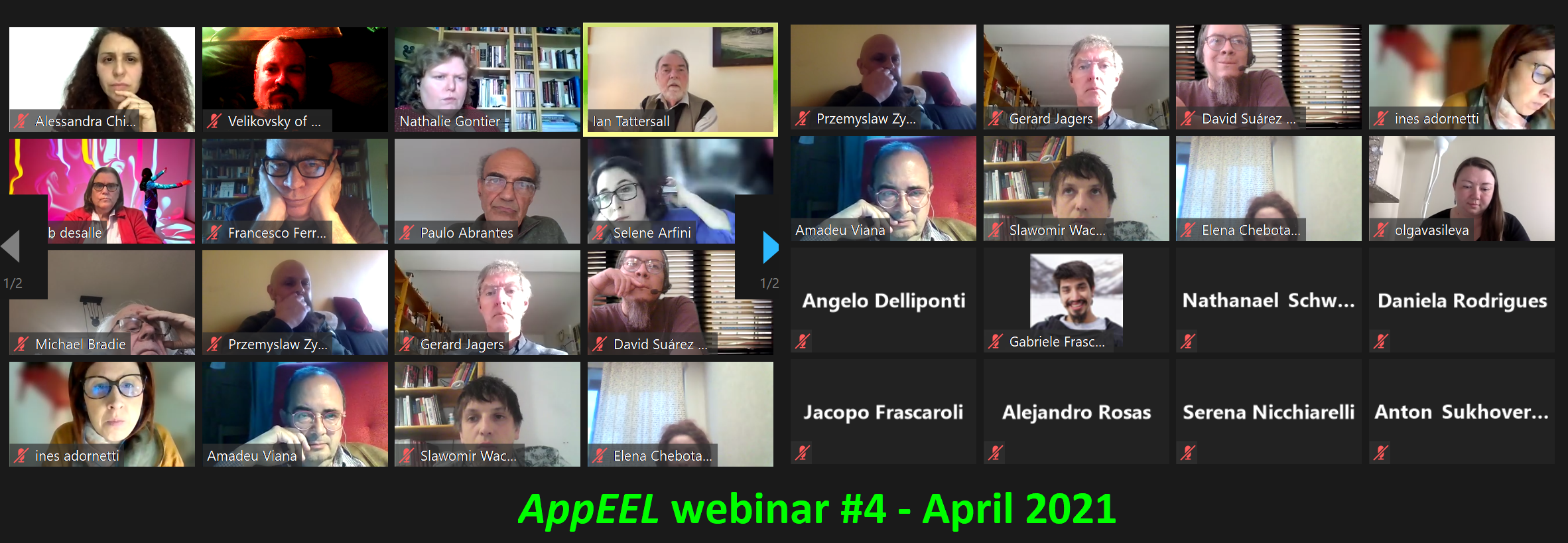
The video, from AppEEL webinar #4
(featuring AppEEL Director, Nathalie Gontier -
& speakers: Ian Tattersall, Alessandra Chiera, Francesco Ferretti, Ines Adornetti, & Robert DeSalle)
--------
& The Program, for Webinar #4:
Webinar # 4 (April 23rd) - In collaboration with the Cosmic Lab* Ian Tattersall on The Pensive Primate: Emergence of Modern Human Consciousness
* Alessandra Chiera, Francesco Ferretti, Ines Adornetti, on Narrative pantomime: a protolanguage for persuasive communication (to be published in Lingua)
* Robert DeSalle on Troublesome Science: The Misuse of Genetics and Genomics in Understanding Race
-------------------------
And just in passing, a few items of News, etc:
A new open access journal launched this month: https://journalofcontroversialideas.org/Earth Day short story competition (if, you like that kind of thing?) https://sapiensplurum.org/A great book on `Flow Theory': https://www.amazon.com.au/Flow-Mihaly-Csikszentmihaly/dp/0061339202--------------
& for more about AppEEL, see also:
The Applied Evolutionary Epistemology Lab
------------//------------Anyway, another terrific AppEEL webinar - I learned a lot! & met lots of great people/scholars.
What's not to like-?
--------------//---------------
Well, that's about all we have time for, folks.
You have been reading / viewing a blog-post by: Dr J T Velikovsky Ph.D
(aka: Velikovsky of Newcastle)
Information Scientist
& Systems Scientist
& AI Researcher & Enthusiast
& Evolutionary Culturologist
More information:
Transmedia Blog: On Writering
IMDb (Movies, Videogames):
YouTube channel: https://www.youtube.com/joeteevee (over 100 videos, some are even: good)
Academia.edu page: https://newcastle-au.academia.edu/JTVelikovsky
Researchgate page: https://www.researchgate.net/profile/Jt_Velikovsky
JTV's ouvre... etc etc.
ORCiD: https://orcid.org/0000-0001-6741-066X
& Forthcoming book P3 of EC (November 2021): https://www.igi-global.com/book/principles-protocols-practices-evolutionary-culturology/267379
------------------------------------------
& please stay tuned, for more: AppEEL webinars !
& Thanks for reading!
April 13, 2021
TVoL Evolutionary Sociology webinar #7 (2021)
TVoL Evolutionary Sociology webinar #7 (2021)
See: https://thisviewoflife.com/evolutionary-science-and-sociology/
-----------
So we had the TVoL Evolutionary Sociology webinar #7 of 2021.
30th March 2021
& it was great!

---------------------
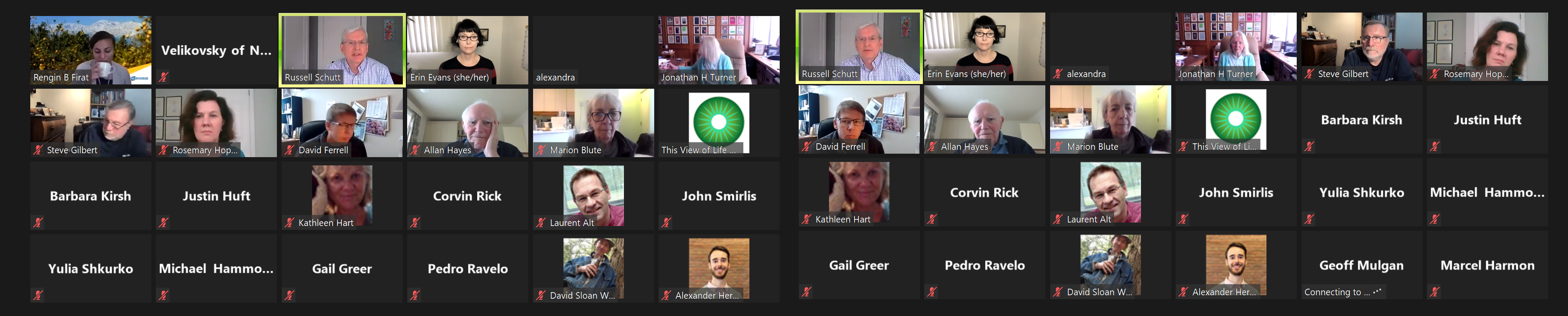
Some random screenshots I took:
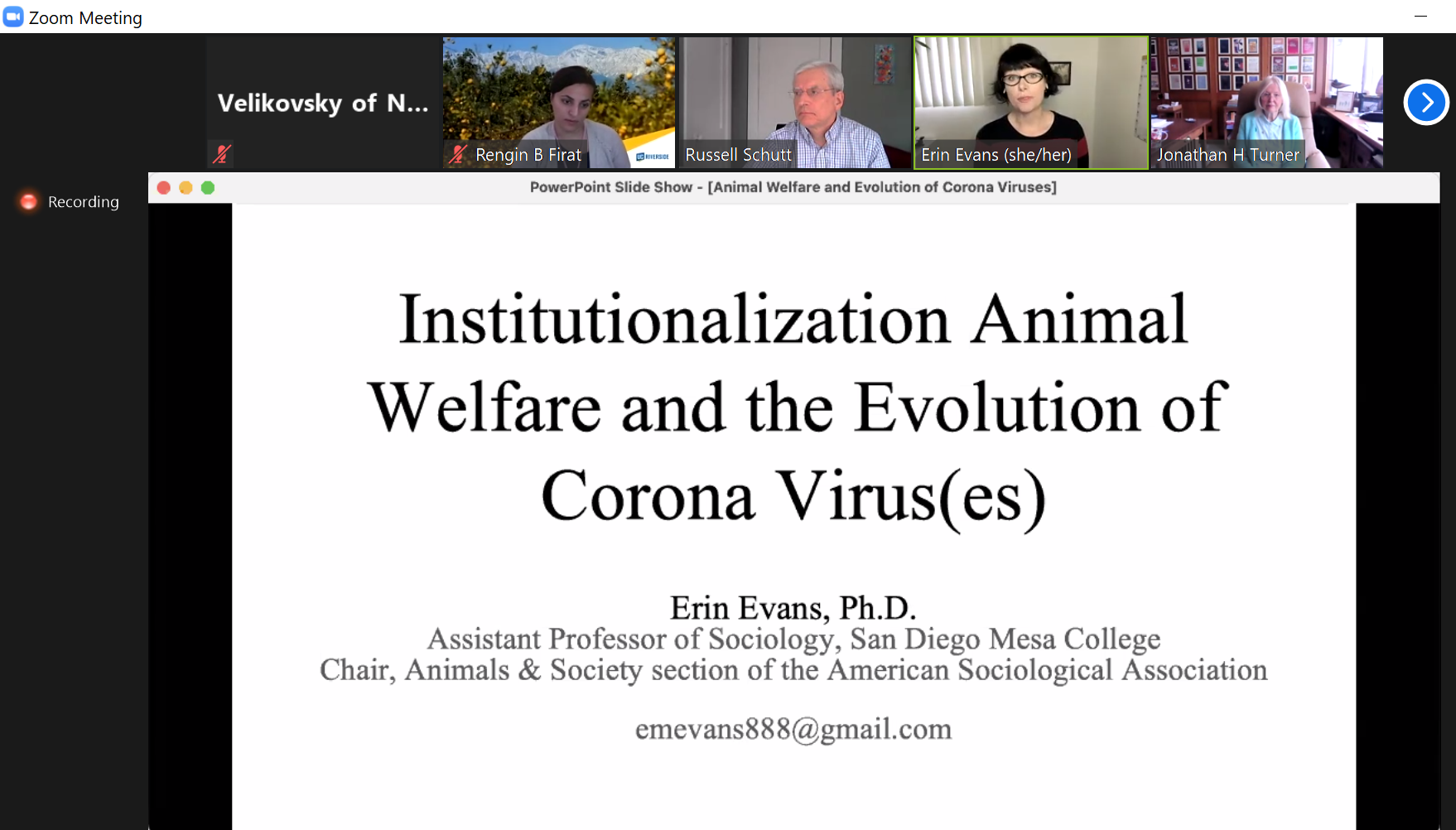
Erin's talk, (& see her great TVoL essay on it here)
---------------
And Alexandra's talk:
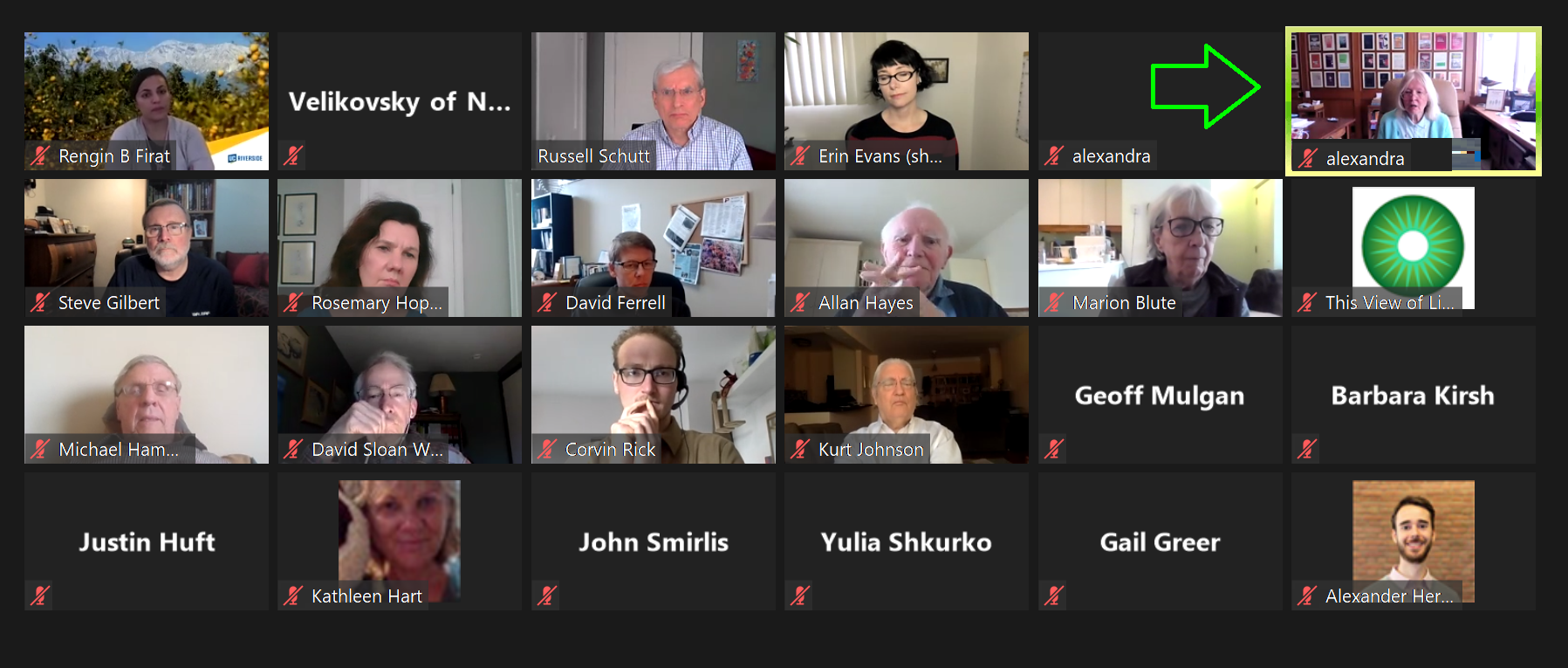
And see Alexandra's great essay (on TVoL), here
-----------------------
And here's some Notes I took, &/or made, &/or scribbled during the mtg/webinar:
(...who knows, what they all mean? Not me, always. Some of them may even be totally: wrong. I can't even read my own writing, sometimes.)
---------------------------Speakers:Dr Erin EvansDr Alexandra Maryanski
Q for Dr Maryanski: in your (great!) TVoL essay, you note: "Early Homo sapiens appeared about 300,000 years ago *but, for reasons unknown*, experienced a population bottleneck so ominous that it reduced the surviving human population to less than a few thousand individuals." So, no advances on the (controversial) `Toba supereruption' theory? (as cause of the genetic bottleneck)? ie https://en.wikipedia.org/wiki/Toba_ca... (Just curious.)
More a comment, re: `Speciesism' (as Dr Evans noted), 2 great articles by Mike Bradie on `The Moral Life/Lives of Animals': https://on-writering.blogspot.com/2021/01/3-papers-by-great-mike-bradie-1986-2011.html
A Question for both speakers (Dr Maryanski & Dr Evans), Yuval Noah Harari (in `Sapiens' 2014) suggests agriculture was a mistake, for human happiness/wellbeing (and, for the suffering of farmed animals)... Do you agree, or, have a strong view on this? (And, any suggestions for solutions?)
--------------
Some of the Zoom-chat:
02:23:24 From David Sloan Wilson to Everyone : The point about weakly tied community structure is important.02:28:48 From David Sloan Wilson to Everyone : The first and most important design principle for efficacious groups identified by Elinor Ostrom is a strong sense of identity and purpose for the group. If the group doesn’t see itself as a community with respect to its objectives, it will not work well as a group. Fortunately, people are very good at establishing a strong sense of community in a highly contextual fashion.02:30:09 From Corvin Rick to Everyone : To Dr Maryanski:The nuclear family is not a primate universal and virtually absent in great apes - except humans. But isn't it still the core unit of human societies in particular? That is: Isn't the evolution of the nuclear family one of the most important thresholds in the evolution of homo sapiens sociality? And if that is so: Why is it wrong to think of the nuclear family as a 'natural' social unit for our species, probably bound by evolved behavioural propensities.02:33:55 From Kathleen Hart to Everyone : Relative scarcity of resources in chimpanzee-land vs. bonobo-land seems to explain the greater collectivism of bonobos.02:34:53 From David Sloan Wilson to Everyone : Richard Wrangham discusses the differences between chimpanzees and bonobos in his book The Goodness Paradox.02:36:38 From Kurt Johnson to Everyone : Quick comment on 2 books on community by same author that have won Nautilus and Gold Axiom awards and one of them being championed (latter published by by Google Inc). Both are books NOT from the scientific community but from the spiritual/transformative community (author is a Yale Divinity School graduate) BUT THE POINT IS the DEFINITION of community in both these books is that degree of “real community” (experienced community?) is directly related to the actual DEGREE OF CARING by the “community” for it’s members, as metric’ed by the members themselves….02:36:45 From Gregory to Everyone : Erin Evans: Re: slide titles -> “Evolving food systems, Evolving food industries” Question: How do you distinguish the terms “evolution”, “development”, and “change”? Do you largely use them synonymously? In common parlance, we “develop” policies according to design & planning methods, rather than typically saying that we “evolve” policies, as if without foresight or aim, or as if "thinking biologically about policies" don’t we? I’m having trouble understanding why you use “(naturally) evolving” for human-made systems, when more effective, forward-looking & purposeful language is available.02:41:01 From David Sloan Wilson to Everyone : Check out Social Baseline Theory, developed by James Coan at the University of Virginia. The thesis is that the one constant of the ancestral environment was for individuals to be embedded in small and for the most part highly cooperative group. This means that social resources were always available to individuals, in addition to their personal resources. Our brains and bodies evolved against this background, which means that if you isolate individuals from a small cooperative group setting, it puts the brain and body into a stress zone.02:43:12 From Velikovsky of Newcastle to Everyone : A Question for both speakers (Dr Maryanski & Dr Evans), Yuval Noah Harari (in `Sapiens' 2014) suggests agriculture was a mistake, for human happiness/wellbeing (and, for the suffering of farmed animals)... Do you agree, or, have a strong view on this? (And, any suggestions for solutions?)02:43:48 From Luiz Lopez to Everyone : It appears that the evolution of highly social species of bees and ants had caused a geological documented loss of diversity of species of solitary species of bee and ants. Eusociality creates endospeies diversity in terms of castes and labor division but reduces external diversity. Now we humans are facing the same evolutionary challenge of how to create more internal social diversity without destroy other species diversity02:44:37 From Velikovsky of Newcastle to Everyone : Q for Dr Maryanski: in your (great!) TVoL essay, you note: "Early Homo sapiens appeared about 300,000 years ago *but, for reasons unknown*, experienced a population bottleneck so ominous that it reduced the surviving human population to less than a few thousand individuals." So, no advances on the (controversial) `Toba supereruption' theory? (as cause of the human genetic bottleneck)? ie https://en.wikipedia.org/wiki/Toba_ca... (Just curious.)02:48:49 From Steve Gilbert to Everyone : Psychologist Michele Gelfand’s book “Rule Makers, Rule Breakers: How Tight and Loose Cultures Wire Our World” for a good explanation of why some countries did better than others in responding to the pandemic.02:48:57 From David Sloan Wilson to Everyone : The Nordic studies are also vibrant market economies but in a way that shapes markets for the common good.02:49:25 From Luiz Lopez to Everyone : Last week it came to my mind: did someone has measured and compared cortisol between bonobo and chimps in natural conditions. I find that someone actuakky did and found not surprisingly (to me) that bonobos population in the wild present low levels of cortisol compared to chimps.02:49:36 From David Sloan Wilson to Everyone : Yes! Michele Gelfand rocks and is on the Board of Prosocial World!02:51:19 From Rosemary Hopcroft to Everyone : Individualism as an intellectual approach goes back to Smith and Locke and the Scottish "moralists"02:52:11 From Kathleen Hart to Everyone : Habermas on separation of public & private/private domestic spheres02:53:33 From Rosemary Hopcroft to Everyone : In Sociology it didn't help that Parsons (a structural functionalist) was a Nazi sympathizer02:53:55 From Steve Gilbert to Everyone : Perhaps we should thank Freud for the rise of a focus on the individual?02:57:17 From Gregory to Everyone : "We need to bring it back … yet few people listen to us". - Maryanski. No, we don't need that. There's already a better way forward. Last session I mentioned that there is an easy way to respond to critics of "evolutionary sociology": face the criticisms directly. I asked: "are only pro-evolutionary sociology voices allowed? It would seem hearing the resistance and reasons against evolutionary sociology should at least eventually be heard in this group." The need to listen to criticisms of "evolutionary sociology", especially given only 1% of sociologists consider themselves as "evolutionary sociologists", was seconded by Andrew Atkinson - "Yes - I think that would be interesting." D.S. Wilson responded: "very happy to air more critiques. We can even arrange an extra session." Wilson asked: "Would you like to lead it?" Is this still on the table? I would be willing to participate in or lead such a session. Does this group wish to face criticisms, or rather prefer to avoid them as much as possible or entirely?02:59:08 From Rosemary Hopcroft to Everyone : Of course we would like to face criticisms02:59:31 From Rosemary Hopcroft to Everyone : We do (or at least I do) all the time03:00:24 From Rengin B Firat to Everyone : Re Gregory: Yes, would absolutely love to hear the critiques. Personally and scholarly, I go through a process of reflection and critique in my own work and actually started my career in critical theory. So, I am very much in favor of that. I know that many of my colleagues are also very reflexive in their research. Perhaps David S. Wilson can organize a future session around that.03:01:06 From Marion Blute to Everyone : Hamilton's article on the selfish herd is relevant here.03:01:52 From Rosemary Hopcroft to Everyone : I would hope Gregory you could lead a session on this03:02:14 From Gregory to Everyone : Fair enough, Rengin. Thanks. Be welcome to suggest the opportunity for that in due time.03:02:21 From David Sloan Wilson to Everyone : To Gregory—we will make good on your offer to lead a session on critiques of evolutionary sociology. In the meantime, check out the lead article on TVOL on the legacy of R.A. Fisher.03:02:55 From This View of Life Magazine to Everyone : https://thisviewoflife.com/ronald-fis... From David Sloan Wilson to Everyone : This has been a great series of discussions and we will be soliciting ideas on how to follow up on it.03:04:51 From David Sloan Wilson to Everyone : What Luiz calls attention to is a major theme of E.O. Wilson in his book The Social Conquest of Earth and his “Half Earth” initiative. Half the earth for humans, half for the rest of nature.03:05:51 From Erin Evans (she/her) to Everyone : Understanding the path dependency of policy regarding environmental protection, and the evolution of that policy, is important for understanding what policy is facilitating that destruction of biodiversity.03:06:19 From Gregory to Everyone : Thanks for the offer. I believe the sociologists here will realize that "palaeo-sociology" isn't going to help us with covid-19 much at all. When an alternative to "evolutionary sociology" is actually available to consider, it changes the conversation considerably. I've seen it happen before. Most sociologists reject "evolutionary" thinking as largely irrelevant to today's "demands of the day". It helps to be cautious against exaggerating the uses of "evolution" where it doesn't fit, as good scholarship should be.03:08:58 From David Sloan Wilson to Everyone : There was a time when evolutionary biologists could be accused of genetic determinism because they had little to say about culture. But now the study of evolution has been expanded to include multiple mechanisms of inheritance. This is a game changer for the field of sociology.03:09:17 From Gregory to Everyone : Policy doesn't evolve. It develops. It's intentional. Path dependency shouldn't be captured to biologistic thinking where randomness & blind foresight rules.03:09:41 From David Sloan Wilson to Everyone : You’re implying that evolution can’t be an intentional process…There is much to discuss!03:09:53 From Gregory to Everyone : " This is a game changer for the field of sociology." Said by a non-sociologist, doesn't carry much value.03:10:05 From Gregory to Everyone : The Hyper-Evolution Institute03:10:28 From Gregory to Everyone : Taking evolutionary biology into sociology … but nicely, not hegemonically ; )03:11:20 From Velikovsky of Newcastle to Everyone : Brilliant series, thanks all for it!03:11:42 From Gregory to Everyone : It's just a problem if it's leading people down the wrong path with "evolutionary sociology", when better alternatives are already available for those not wishing to biologize sociology.03:11:51 From David Sloan Wilson to Everyone : To Gregory—you mean I’m not a member of your tribe? :)
------------------------
[ ...To Be Continued...! ]
When I go to the next great Ev Soc TVoL webinar.
(or whatever it evolves into! :)
--------------
Anyway, great meeting. I learned a lot. (JTV)
& Met lots of great people/scholars.
...What's not to like?
--------------//---------------
END CREDITS
Well, that's about all we have time for, folks.
You have been reading / viewing a blog-post by:
Dr J T Velikovsky Ph.D
(aka: Velikovsky of Newcastle)
Information Scientist & Systems Scientist & AI Researcher & Enthusiast & Evolutionary Culturologist & Filmmaker & Writer & Artist & Actor & Muso & Rugged Frontiersman & Random Guy
(and, also The StoryAlity Guy)
aka Humanimal
(or, The Artist formally known as Dr J T Velikovsky)
More stuff:
Transmedia Blog: On Writering
IMDb (Movies, Videogames):
Music: Texas Radio & Zen Stupidity
Youtube channel: https://www.youtube.com/joeteevee (over 100 videos, some are even: good)
Academia page: https://newcastle-au.academia.edu/JTVelikovsky
Researchgate page: https://www.researchgate.net/profile/Jt_Velikovsky
My ouvre... etc etc.
ORCID: https://orcid.org/0000-0001-6741-066X
Forthcoming book (November 2021): https://www.igi-global.com/book/principles-protocols-practices-evolutionary-culturology/267379
March 30, 2021
TVoL Evolutionary Sociology webinar #6 (2021)
TVoL Evolutionary Sociology webinar #5 (2021)
See: https://thisviewoflife.com/evolutionary-science-and-sociology/
-----------
So we had the TVoL Evolutionary Sociology webinar #6 of 2021.
30th March 2021
& it was great!

Some random screenshots I took:
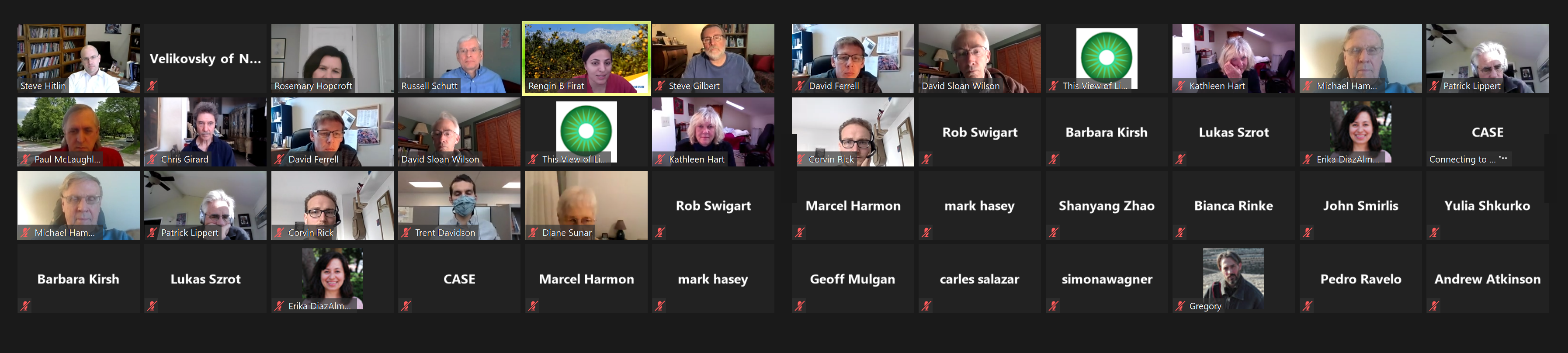
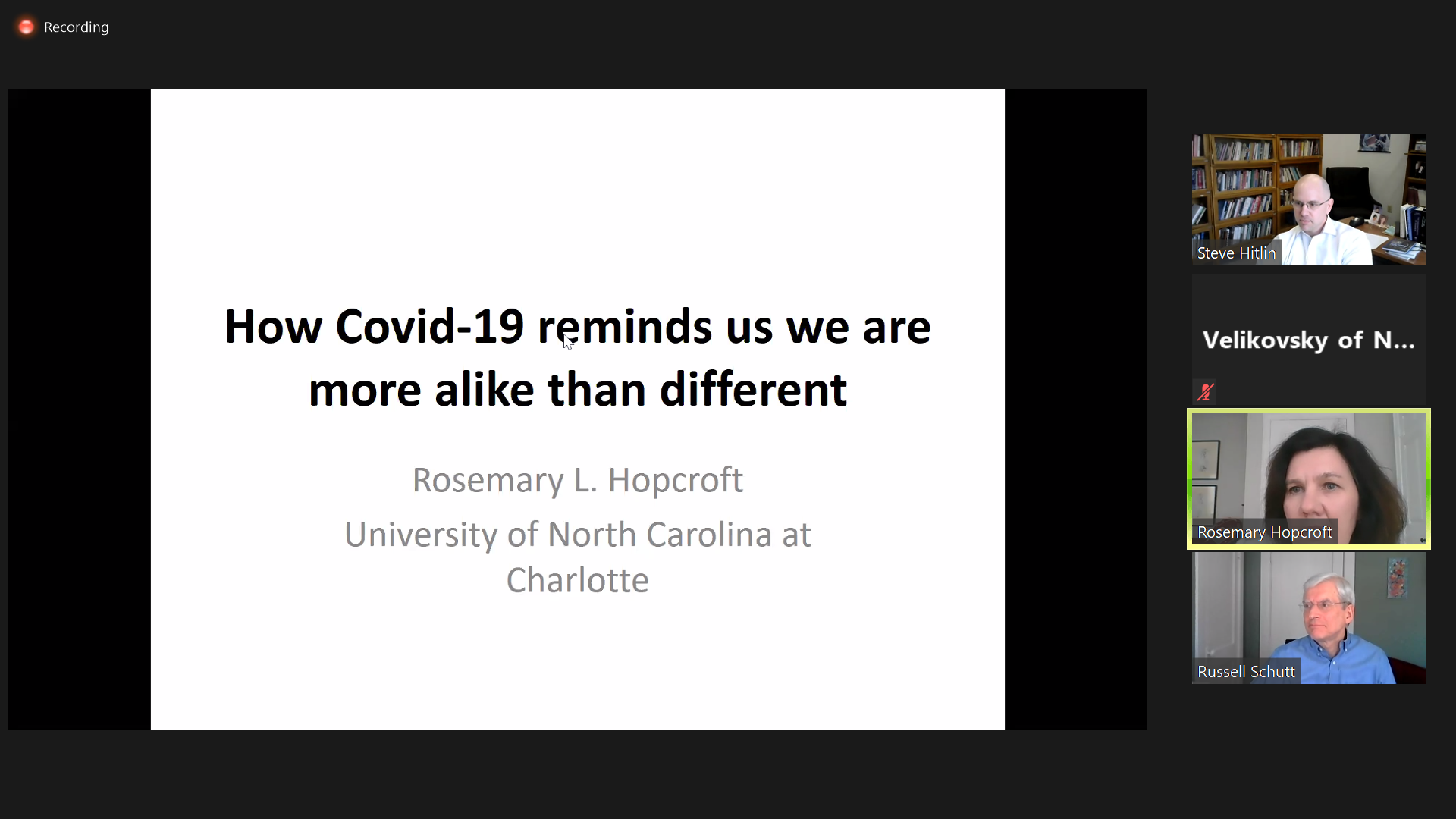 Rosemary's talk
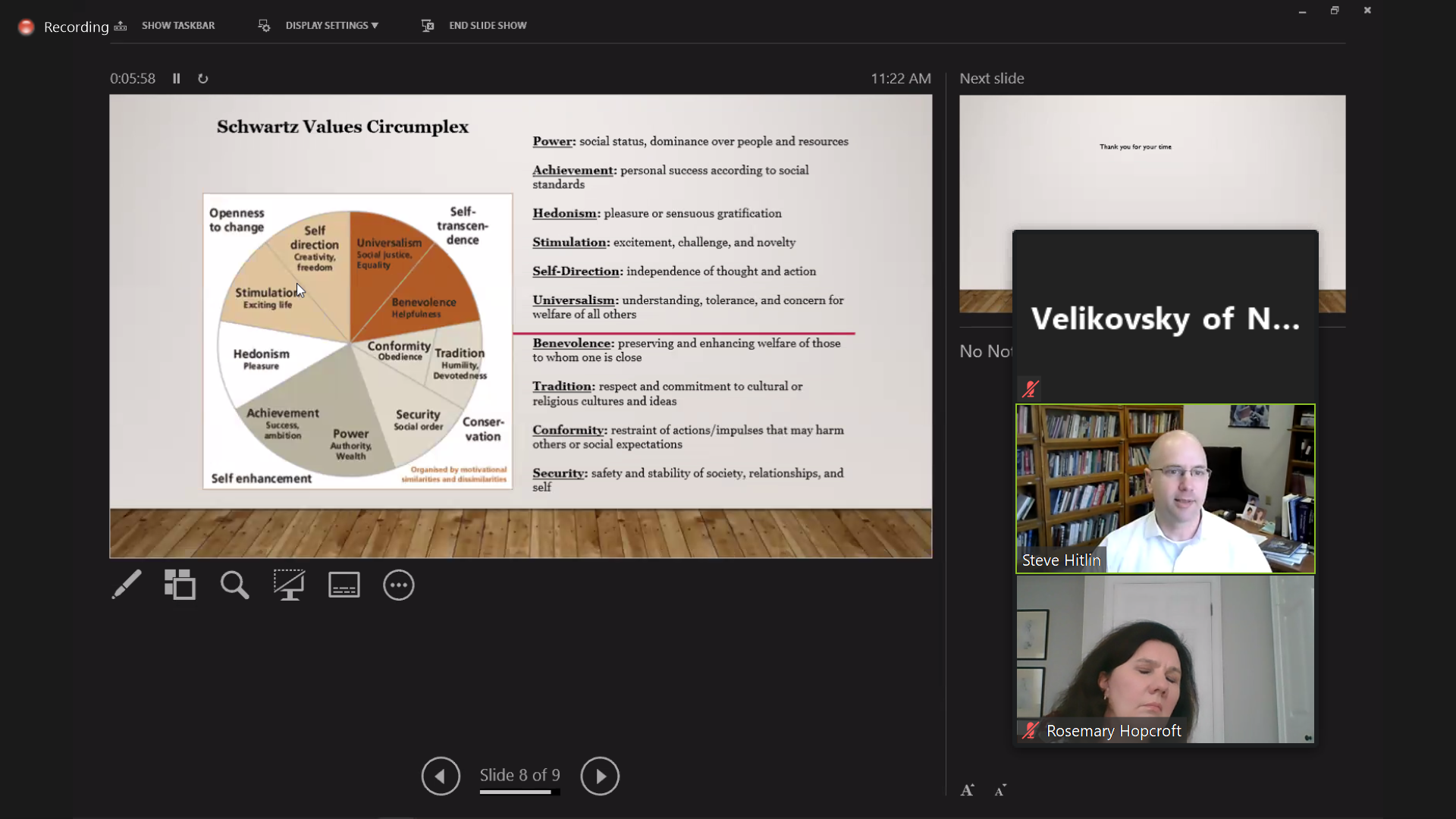 Steve's talk
-----------------------
And here's some Notes I took, &/or made, &/or scribbled during the mtg/webinar:
(...who knows, what they all mean? Not me, always. Some of them may even be totally: wrong. I can't even read my own writing, sometimes.)
---------------------------
Rosemary: Evolved tendencies are just tendencies...& see Joe Whitmeyer's essay in Oxford Handbook of Evolution, Biology, and Society (ed: Rosemary L. Hopcroft 2018)See also George Homans (1910-89) US sociologist 'Bringing Men Back In' (1964) - his Presidential Address to the American Sociological Association
DSW: We study genes in biological evolution... but Evolution is: Any process of Variation, Selection, Heredity eg DIT - a cultural stream of inheritanceBiologists examine differences, not similarities in speciesCultural Variation (Asian vs Western, WEIRD [Joe Henrich] vs Cultural Diversity)Q is...How do we explain (Cultural) Variation?Via, a TOOLKIT from genetic ev, involving niche construction (social construction)Evolution is: genetic, cultural, and personal; We have to keep all the timescales in mind
A Good Q raised by Steve H: What counts as a `niche'? eg: Academic Sociology Faculty?
--------//-----------
Some selected Zoom comments
03:08:57 From David Sloan Wilson to Everyone : This series of TVOL essays titled “The Cultural Evolution of Social Pathologies” by Anthony Biglan is germane to our conversation today, as I will try to highlight during my comment. https://thisviewoflife.com/the-cultural-evolution-of-social-pathologies/
03:19:09 From David Sloan Wilson to Everyone : B.F. Skinner’s 1981 article “Selection by Consequences” made the point that genetic evolution, multigenerational cultural change, and individual open-ended change all share something in common as variation/selection/replication processes. This permits the same evolutionary mode of reasoning.
03:29:03 From Diane Sunar to Everyone : Donald Brown, "Human Universals"
03:32:00 From Diane Sunar to Everyone : Christopher Boehm, Hierarchy in the Forest
03:33:35 From Diane Sunar to Everyone : Curry et al. Morality as Cooperation
03:34:43 From Andrew Atkinson to Everyone : Some provocative comments this week. Conference needed and friendly discussion!
03:35:34 From Velikovsky of Newcastle to Everyone : That Joe Whitmeyer chapter, that Rosemary just mentioned: https://www.oxfordhandbooks.com/view/10.1093/oxfordhb/9780190299323.001.0001/oxfordhb-9780190299323-e-9
03:40:01 From Diane Sunar to Everyone : Carl Degler, In Search of Human Nature, about the relation of sociology/anthropology and evolutionary thinking
04:00:34 From Diane Sunar to Everyone : Gregory - I suggest "Not by Genes Alone" but also DS Wilson's Darwin's Cathedral
04:01:30 From David Sloan Wilson to Everyone : To Gregory: There is indeed a strong intentional component to cultural evolution, but that does not prevent the process from being evolutionary! Much more to discuss. And to you newest comment—very happy to air more critiques. We can even arrange an extra session. Would you like to lead it?
04:01:47 From Gregory to Everyone : E O Wilson is not a sociologist. And Not by Genes Alone is not helpful to sociologists who are resistant to "evolution for everyone" ideology being applied in sociology. Anthony Giddens, Piotr Sztompka & other sociologists are against evolutionary sociology. Shall we not speak about this too?
04:03:16 From David Sloan Wilson to Everyone : We can use this same venue. Short essays and online discussion.
[ ...To Be Continued...! ]
When I go to the next great Ev Soc TVoL webinar.
--------------
Anyway, great meeting. I learned a lot. (JTV)
& Met lots of great people/scholars.
...What's not to like?
--------------//---------------
END CREDITS
Well, that's about all we have time for, folks.
You have been reading / viewing a blog-post by:
Dr J T Velikovsky Ph.D
(aka: Velikovsky of Newcastle)
Information Scientist & Systems Scientist & AI Researcher & Enthusiast & Evolutionary Culturologist & Filmmaker & Writer & Artist & Actor & Muso & Rugged Frontiersman & Random Guy
(and, also The StoryAlity Guy)
aka Humanimal
(or, The Artist formally known as Dr J T Velikovsky)
More stuff:
Transmedia Blog: On Writering
IMDb (Movies, Videogames):
Music: Texas Radio & Zen Stupidity
Youtube channel: https://www.youtube.com/joeteevee (over 100 videos, some are even: good)
Academia page: https://newcastle-au.academia.edu/JTVelikovsky
Researchgate page: https://www.researchgate.net/profile/Jt_Velikovsky
My ouvre... etc etc.
ORCID: https://orcid.org/0000-0001-6741-066X
Forthcoming book (November 2021): https://www.igi-global.com/book/principles-protocols-practices-evolutionary-culturology/267379
March 24, 2021
ICCC 2020
ICCC 2020
11th International Conference on Computational Creativity (2020)

----------//----------
Keynotes (2020):
ICCC'20 Keynote 1 – Emilia Gómez Human & Machine Intelligence: Music Information Retrieval&
ICCC'20 Keynote 2 – Simon Lucas
& see also
-------//-------
& see the forthcoming:
ICCC2021 (September 2021)
[image error]
-------//--------
...Exciting stuff!
Maybe see also:
The Robo-Raconteur Artificial Writer
----------//------------
ROLL CREDITS.
--------------//---------------
Well, that's about all we have time for, folks.
You have been reading / viewing a blog-post by:
Dr J T Velikovsky Ph.D
(aka: Velikovsky of Newcastle)
Information Scientist & Systems Scientist & AI Researcher & Enthusiast & Evolutionary Culturologist & Filmmaker & Writer & Artist & Actor & Muso & Rugged Frontiersman & Random Guy
(and, also The StoryAlity Guy)
aka Humanimal
(or, The Artist formally known as Dr J T Velikovsky)
More stuff:
Transmedia Blog: On Writering
IMDb (Movies, Videogames):
Music: Texas Radio & Zen Stupidity
YouTube channel: https://www.youtube.com/joeteevee (over 100 videos, some are even: good)
Academia page: https://newcastle-au.academia.edu/JTVelikovsky
ResearchGate page: https://www.researchgate.net/profile/Jt_Velikovsky
My ouvre... etc etc.
ORCID: https://orcid.org/0000-0001-6741-066X
Forthcoming book (November 2021): https://www.igi-global.com/book/principles-protocols-practices-evolutionary-culturology/267379
March 19, 2021
AppEEL webinar #3 - March 2021
So we had AppEEL webinar #3 of 2021.
It was great!!! (Just like AppEEL webinar #1 & #2)
By the way, this post you're now reading isn't the Official Page for the AppEEL webinars.
This is just: my NOTES... (by Velikovsky of Newcastle)
--------
The Program, for Webinar #3:
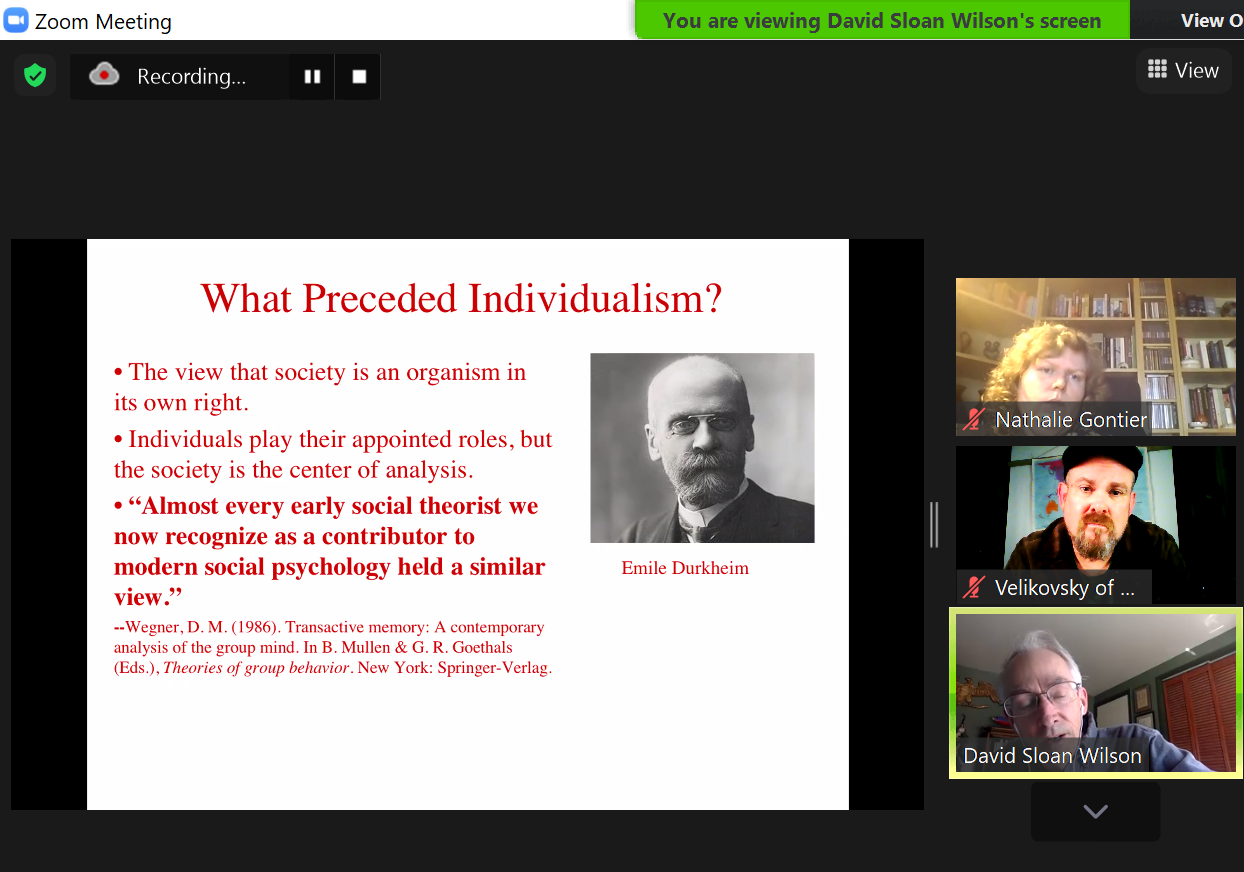
March 19th, 17h (5 pm) Lisbon time (GMT 0)#1 - David Sloan Wilson on Atlas Hugged
------//------
#2 - Dean Keith Simonton on Creativity as Blind Variation and Selective Retention: Campbell’s BVSR as Philosophy and Psychology

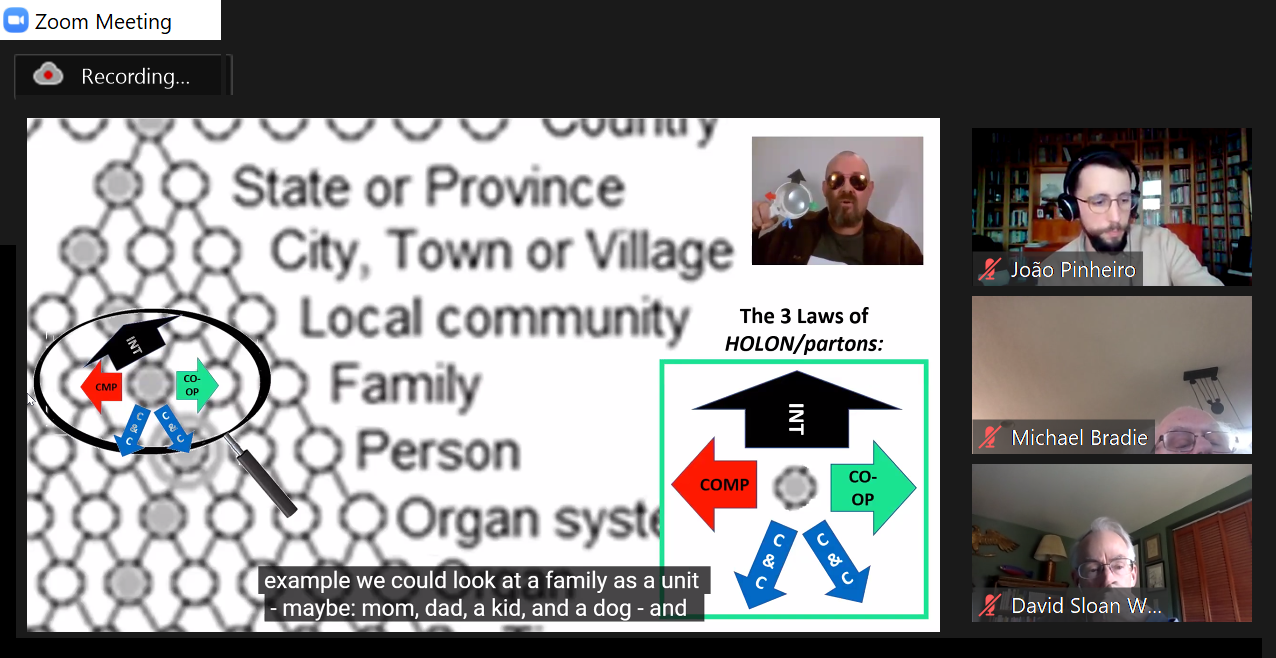
#3 - JT Velikovsky on his (forthcoming) book:
Principles, Protocols, and Practices of Evolutionary Culturology

------//------
& if of interest,
Here's the Youtube video of my presentation on P3 of EC (30 mins)...
`P3 of EC' (forthcoming book)
-------//--------
& see, also:
& for the full year's AppEEL webinar Schedule/Program, see: here!
------------//------------
Anyway - great webinar. I learned a lot. Met lots of great people/scholars. What's not to like?
--------------//---------------
Well, that's about all we have time for, folks.
You have been reading / viewing a blog-post by:
Dr J T Velikovsky Ph.D
(aka: Velikovsky of Newcastle)
Information Scientist & Systems Scientist & AI Researcher & Enthusiast & Evolutionary Culturologist & Filmmaker & Writer & Artist & Actor & Muso & Rugged Frontiersman & Random Guy
(and, also The StoryAlity Guy)
aka Humanimal
(or, The Artist formally known as Dr J T Velikovsky)
More stuff:
Transmedia Blog: On Writering
IMDb (Movies, Videogames):
Music: Texas Radio & Zen Stupidity
Youtube channel: https://www.youtube.com/joeteevee (over 100 videos, some are even: good)
Academia page: https://newcastle-au.academia.edu/JTVelikovsky
Researchgate page: https://www.researchgate.net/profile/Jt_Velikovsky
My ouvre... etc etc.
ORCID: https://orcid.org/0000-0001-6741-066X
Forthcoming book (November 2021): https://www.igi-global.com/book/principles-protocols-practices-evolutionary-culturology/267379
------------------------------------------
Post Script:
There's also actually a 1-hour version (`Director's Cut') of my talk:
1-hour `Director's Cut' of P3 of EC
Also there's this:
Top-Down & Bottom-up causation in HOLON/partons
& this...
Ev Cult - Book Case Study
& for more videos on Ev Cult, see: Evolutionary Culturology presentations.
And maybe see also:
StoryAlity #137 – Culturology – and, the CES (Cultural Evolution Society)StoryAlity #138 – Darwin on the evolution of words and languagesStoryAlity #138B – Cultural Analytics, and yada yada yadaStoryAlity #139 – On the evolution of Darwin’s `Tree of Life’ DiagramStoryAlity#140 – The Evolution of the Systems Model of Creativity (Csikszentmihalyi 1988-onwards)StoryAlity #141 – The StoryAlity-Theory `Robo-Raconteur’ artificial-writerStoryAlity #142 – Our StoryAlity so far – random Technological MarvelsStoryAlity #143 – All of life is doing scienceStoryAlity #144 – The structure of the meme, the unit of culture (in: The Encyclopedia of Information Science & Technology, Velikovsky 2017)StoryAlity #145 – Five views of the monomyth (Velikovsky 2017)StoryAlity #146 – Flow Theory = Evolutionary TheoryStoryAlity #147 – Transmedia @ the ANZCA2017 Communication ConferenceStoryAlity #148 – Why is Movie Screenwriting So Tricky, Anyway?StoryAlity #148A – Evolutionary CulturologyStoryAlity #149 – Karl Popper on creativity and problem-solvingStoryAlity #149B – The Tree of CultureStoryAlity #161 – `Technology – Memes: Units of Culture’ in: Encyclopedia of Creativity (3rd Edn, 02020)StoryAlity #163 – The 5-C Model of CreativityStoryAlity #164 – i=PStoryAlity #165 – The HOLON/parton Structure of the Meme [5 x book-chapters]P3 of EC (forthcoming book)
March 18, 2021
TVoL's Examined Lives: Are We Humans Fundamentally Selfish? (Session 7)
TVoL's Examined Lives: Are We Humans Fundamentally Selfish? (Session 7)
(Webinar of: March 18th 2021)
See: https://thisviewoflife.com/examined-lives/

A blog-post by Velikovsky of Newcastle
--------------
So - I just attended this great webinar!
-------//--------
The idea that we humans are profoundly selfish has deep roots. The view makes an appearance in Plato’s Republic, where it provokes an inquiry into the nature of justice. The idea was incorporated into Christian theology and shaped the dominant institutions of Medieval Europe. Then Enlightenment thinkers like Thomas Hobbes picked it up and built the conceptual frameworks that underlie what we call modernity. And more recently, of course, Richard Dawkins has argued that we are built by selfish genes.
New developments in the biological sciences, though, suggest that we might have underestimated human niceness. It now appears that prosociality—friendliness—is also deeply human. Join us as we examine some profoundly influential pictures of human nature. Suggested reading“Scientific Orthodoxy Upended? A Review of Rutger Bregman’s Humankind“
-------//--------
And am happy to report, we solved all the world's problems, in that great webinar.
THE END.
-------//--------
So, I wouldn't take the below as `True News', or anything :)
Could all be: Fake News. You be the judge.
------------
My Scribbled Mtg Notes :
Are we mostly selfish? No... See: Altruism / Group Selection & MLS!!Andy's review of Bregman's `Humankind' - reminds me of quote from the book Prosocial (2019) "Our view of human nature not only changes what we do personally, it changes the forms of governance we design and implement." (p. 27) [...This means, it changes how you VOTE !!! ] As an aside, David Sloan Wilson & Dean Keith Simonton are talking at an event tomorrow at 1pm - re: Multi-Level Selection, Atlas Hugged etc (I'll put the link in the chat): March 19 AppEEL webinar @1pm Bregman's (`Humankind') urging us all to see Human Nature as basically good / decent, is rather like Dan Dennett on free will; it's actually, a Moral Imperative...(!) ("If you build/believe it, they will come" :)Also, reminds me of the "good" side of tribalism - in hunter-gatherer societies, re: decisions/action, it's all about the good of the tribe, & not: the individual/person...& some of the Zoom-chat:
03:20:04 From David Hurst to Everyone : Absolutely - it’s context dependent. John Dewey: “I should venture to assert that the most pervasive fallacy of philosophic thinking goes back to neglect of context.”
03:24:41 From Diane Sunar to Everyone : What are humans fundamentally?
03:24:59 From Ron Nahser to Everyone : What was the name of the movie?
03:25:34 From Velikovsky of Newcastle to Everyone : Diane: suggest - humans `fundamentally' are: bio-psycho-socio-anthro-cultural systems (?)
03:25:54 From David Hurst to Everyone : John Dewey ref is “Context and Thought” one of his later writings but very difficult to get in digital format
03:28:18 From Diane Sunar to Everyone : Fundamentally we are a group-living species. So we are fundamentally "moral" (other-regarding). We are fundamentally competitive as well. We are also fundamentally formed by culture and our choices are conditioned by context. Both biology and culture can evolve, and possibly co-evolve.
03:31:43 From Velikovsky of Newcastle to Everyone : Just FYI all, a free webinar, 1pm tomorrow, on MLS/`Atlas Hugged'/ & Creativity (David Sloan Wilson, Dean Keith Simonton, & me): https://sites.google.com/view/appeel/events/webinars
03:33:00 From hankblumfarb to Everyone : Comment and Question: David Sloan Wilson has suggested that from an evolutionary biology perspective the basic organism manifests a perfect homeostasis where the fundamental building block is not necessarily selfish but harmonious. Any thoughts= Hank
03:33:13 From Steve Gilbert to Everyone : Selfish or selfless? Human nature means you're both https://theconversation.com/selfish-or-selfless-human-nature-means-youre-both-155528
03:34:08 From David Hurst to Everyone : Joe Henrich “The Secret of Our Success” is to be able to cooperate in groups much larger than the family but "Over time, history suggests that all prosocial institutions age and eventually collapse at the hands of self-interest, unless they are renewed by the dynamics of intergroup competition." p 170
03:34:14 From Steve Gilbert to Everyone : Capitalism and communism answered this question differently. Which system of incentives worked best?
03:40:03 From Steve Gilbert to Everyone : Not surprise — redirect them them into cooperative behavior
03:40:07 From Steve Gilbert to Everyone : supress
03:40:13 From David Hurst to Everyone : @Andre South African concept of “ubuntu” is African humanism. It is often translated as ‘I am because you are’. It means that what makes us human is our connectedness with each other and the empathy that flows from that. The standard Zulu greeting is sawubona – “I see you.” The response is sikhona – “I am here.” Humanity is a quality we owe to each other.
03:40:33 From Velikovsky of Newcastle to Everyone : Great point Steve on capitalism vs communism. (Seems a middle-ground is best? eg Scandinavian countries?)
03:41:20 From Borislav Ignatov to Everyone : It seems that capitalism is more successful and aligned with human nature and because it promotes selfish behaviors, it is evident that people are fundamentally selfish.
03:43:25 From Velikovsky of Newcastle to Everyone : @ David, great point re `ubuntu', also reminds me of xenia as a moral imperative... https://en.wikipedia.org/wiki/Xenia_(Greek) which Brian Boyd talks about in `On the Origin of Stories' (2009)
03:43:55 From Simon Bowden to Everyone : Isn't the issue that in social species Status matters in sexual selection and we show status by selflessness? The "handicap Principle" by the Zarharvi brothers?
03:49:20 From David Hurst to Everyone : Best video on fairness: https://www.youtube.com/watch?v=meiU6TxysCg
03:49:36 From Kathleen Hart to Everyone : Yes and that would be selfish.
03:50:24 From andre to Everyone : We are fundamental adaptable and other cosmovitions give insight to understand the reductionist context of Science. i suggest this native Brazilian thinker. https://www.amazon.com/Ideas-Postpone-World-Ailton-Krenak/dp/1487008511
03:50:53 From David Hurst to Everyone : Doesn’t this call for a dual-process view of cognition? See short blog here: http://www.davidkhurst.com/jonathan-sacks-1948-2020-jewish-wisdom-and-our-binocular-minds/
03:52:25 From hankblumfarb to Everyone : The Mattering Instinct = There may be competition amongst humans around who matters more in the context of the Cosmos. Rebecca Newberger Goldstein. Hank
03:52:44 From David Hurst to Everyone : Isn’t all reasoning is “motivated”
03:53:14 From Simon Bowden to Everyone : We favour "our group" versus "outside our group" - in group empathy is the same thing as out group antipathy - that mitigates against looking at us as one organism
03:53:44 From Steve Gilbert to Everyone : I would define an organism as an entity that ceases to exist when it dies. That is not a social group.
03:54:48 From Diane Sunar to Everyone : Level of outgroup antipathy depends on the relationship between the groups
03:54:55 From Eric Harrington to Everyone : Is it possible that our definition of our group tend to expand as our awareness and understanding of the "other" increases?
03:55:03 From Velikovsky of Newcastle to Everyone : My talk tomorrow @ 1pm (March 19) is about: a mathematical proof (scientific theory) of how it's: `groups all the way down & up'... https://sites.google.com/view/appeel/events/webinars
03:55:41 From Andrew Brady to Everyone : Steve, a human body is made up of more non-human cells than human cells. Not only that, but the cells are dying and being created continuously. So who “you” are today is technically different cells than “you” from a few years ago or a few years from now. Same with social groups…people are coming and going, being born or dying.
03:56:13 From Simon Bowden to Everyone : Selection can only occur at an individual level - albeit moderated by culture - Dual Inheritance
03:56:47 From David Hurst to Everyone : The “savages” were less savage than we can be: http://www.davidkhurst.com/wp-content/uploads/2012/01/Cautionary-Tales-from-the-Kalahari-1991.pdf
03:59:00 From hankblumfarb to Everyone : Lisa Feldman Barret talks to Regulating The Body Budget for the individual; the social brain requiring mutual body regulation. What about the competition between the multiple social brains? Hank
04:00:46 From Diane Sunar to Everyone : All human groups are hierarchical! That is why we have to be competitive.
04:01:51 From David Hurst to Everyone : Distinguish between hierarchies of control and hierarchies of constraint
04:03:06 From Velikovsky of Newcastle to Everyone : David Hurst - yes! Agency & Structure! (`Structuration Theory' - eg Anthony Giddens, Margaret Archer, etc)
& Andy (Norman) rounded out proceedings with a great (& thought-provoking) quote:
"If I am not for myself, who will be for me?
If I am not for others, what am I?
And if not now, when?"
...So, all truly great stuff !!!- Rabbi Hillel
-----------------
And - am really looking forward to Andy's new book: Mental Immunity (due out: May 2021) !
Mental Immunity (due out: May 2021)
(& I notice, you can pre-order it now on that Amazon link, above... & I did ! )
--------------
So: great webinar. I learned a lot. (JTV)
& Met lots of great people / scholars.
...What's not to like?
(Hey - and I also blogged on the previous one, here .)
THE END
ROLL CREDITS.
--------------//---------------
Well, that's about all we have time for, folks.
You have been reading / viewing a blog-post by:
Dr J T Velikovsky Ph.D
(aka: Velikovsky of Newcastle)
Information Scientist & Systems Scientist & AI Researcher & Enthusiast & Evolutionary Culturologist & Filmmaker & Writer & Artist & Actor & Muso & Rugged Frontiersman & Random Guy
(and, also The StoryAlity Guy)
aka Humanimal
(or, The Artist formally known as Dr J T Velikovsky)
More stuff:
Transmedia Blog: On Writering
IMDb (Movies, Videogames):
Music: Texas Radio & Zen Stupidity
YouTube channel: https://www.youtube.com/joeteevee (over 100 videos, some are even: good)
Academia page: https://newcastle-au.academia.edu/JTVelikovsky
ResearchGate page: https://www.researchgate.net/profile/Jt_Velikovsky
My ouvre... etc etc.
ORCID: https://orcid.org/0000-0001-6741-066X
Forthcoming book (November 2021): https://www.igi-global.com/book/principles-protocols-practices-evolutionary-culturology/267379



![[image error]](https://1.bp.blogspot.com/-YJuALP-h68w/YFvDlszk6DI/AAAAAAAAFS4/sOFFXriTfHoMi9Qym8q4gX8E7431T7_qQCLcBGAsYHQ/s1825/ICCC%2B2021%2Bbanner.png)